The Nuclear Regulatory Commission has approved amendments to its requirements for medical uses of radioactive materials. A final rule, approved Aug. 17, modifies 10 CFR Part 35 and makes conforming changes to Parts 30 and 32. The rule will be published in the coming months in the Federal Register after the NRC staff makes certain revisions directed by the Commission.
The changes will amend the definition of medical events associated with permanent implant brachytherapy; update training and experience requirements for authorized users, medical physicists, radiation safety officers, and nuclear pharmacists; address a petition the NRC received seeking to recognize the qualifications of board certified physicists and radiation safety officers not specifically named on a license; change requirements for measuring molybdenum contamination and reporting generator tests that exceed allowed concentration levels; allow associate radiation safety officers to be named on a medical license; and make several minor clarifications.
While implementing the current regulations, NRC staff, stakeholders, and NRC’s Advisory Committee on the Medical Uses of Isotopes identified the need for the revisions. A proposed rule appeared in the July 21, 2014, Federal Register for 120 days of public comment. The final rule takes those comments into consideration and provides responses to them.
August 19, 2017
Posted by Christina Macpherson |
Legal, USA |
Leave a comment
 Inquiry opens into fiscal condition of Millstone nuclear station, The ct mirror, By: MARK PAZNIOKAS | August 17, 2017 “….. Dominion was non-committal Thursday about whether it will provide the financial data sought by two state agencies tasked by Gov. Dannel P. Malloy with assessing by Feb. 1 whether the state needs to change the rules for how electricity is bought and sold to ensure the financial viability of Millstone.
Dominion offered no testimony Thursday as the Department of Energy and Environmental Protection and the Public Utilities Regulatory Authority formally opened the assessment with a public hearing in Hartford, the first of several public sessions. Several of its competitors urged the two agencies to grant no relief unless Dominion proves its case…..
At issue is how much longer Millstone will remain profitable. Dominion disputes portions of the MIT study, as well as an assessment prepared in April for the Electric Power Supply Association that concluded the plant is profitable and will remain so for five years…….
Dominion and its opponents, both competitors and consumer advocates like AARP, spent heavily on lobbying during the legislative session to resolve the issue politically. Tom Swan of the Connecticut Citizen Action Group said Dominion hardly was eschewing politics.
“They’re looking to change the rules for them to get a special deal without the expectaton of being treated as a regulated utility, where their return is based on a cost of service,” Swan said during the hearing. “It is unfathomable to me that we would consider doing this.”https://ctmirror.org/2017/08/17/inquiry-opens-into-fiscal-condition-of-millstone-nuclear-station/
August 19, 2017
Posted by Christina Macpherson |
business and costs, USA |
Leave a comment

 Effort backed by the state’s flagship universities comes as US President Donald Trump shrugs off global warming, Scientific American By Jeff Tollefson, Nature magazine on August 17, 2017
California has a history of going it alone to protect the environment. Now, as US President Donald Trump pulls back on climate science and policy, scientists in the Golden State are sketching plans for a home-grown climate-research institute—to the tune of hundreds of millions of dollars per year.
The initiative, which is backed by California’s flagship universities, is in the early stages of development. If it succeeds, it will represent one of the largest US investments in climate research in years. The nascent ‘California Climate Science and Solutions Institute’ would fund basic- and applied-research projects designed to help the state to grapple with the hard realities of global warming. ……
California might ultimately have some company. At Columbia University in New York City, science dean Peter de Menocal—a palaeoclimatologist—hopes to build an alliance of major universities and philanthropists to support research into pressing questions about the impacts of climate change. Potential topics include local variations in sea-level rise and the changing availability of freshwater resources and food. …..https://www.scientificamerican.com/article/california-scientists-push-to-create-massive-climate-research-program/
August 18, 2017
Posted by Christina Macpherson |
climate change, USA |
Leave a comment
 US Talks to China about North Korea, But Does Not Listen, UCS, GREGORY KULACKI, CHINA PROJECT MANAGER AND SENIOR ANALYST | AUGUST 16, 2017, The United States and China both want North Korea to abandon its nuclear weapons program. The North Korean leadership continues to defy them both. The United States says it is willing to risk a war to stop them. China is not.
China’s top priority is preserving the peace, however uneasy that peace might be. A credible North Korean capability to launch a nuclear-armed ICBM may make US officials psychologically uncomfortable. But the Chinese leadership does not feel that increased US anxiety is a sufficient justification for starting a war that could conceivably kill hundreds of thousands of people and collapse Asia’s economy, even if no nuclear weapons were used.
China has made its priorities clear to both the United States and North Korea. An August 10 editorial published in China’s Global Times warned both sides against striking first. The editorial was not an official statement of Chinese government policy but it almost certainly was reviewed and approved at the highest level. It suggested to the leadership in Pyongyang that, “If North Korea launches missiles that threaten US soil first and the US retaliates, China will stay neutral”. It also suggested to Washington that, “If the US and South Korea carry out strikes and try to overthrow the North Korean regime and change the political pattern of the Korean Peninsula, China will prevent them from doing so.”
China has also made it clear that it will not agree to sanctions that strangle North Korea’s economy. China supports economic penalties that punish North Korea for defying the United Nations and continuing its testing programs. And China is willing to work with the United States and the international community to deny North Korea access to critical technologies. But on August 5th, in an official statement made at the time of the vote on the latest round of UN sanctions, China emphasized, as it has many times in the past, that China “did not intend to negatively impact such non-military goods as food and humanitarian aid.”
US Refusal to Listen
Though China’s position on North Korea is clear and consistent, US policy is based on the assumption that China’s position will change. On August 13th, US Secretary of Defense James Mattis and Secretary of State Rex Tillerson penned an editorial in which they repeated the claim, believed by most US policy makers and analysts, that China has “decisive diplomatic and economic leverage over North Korea.” The implication is that China can force the North Korean leadership to abandon its nuclear weapons program. The joint editorial reiterated a US policy announced earlier this year by Secretary Tillerson, who said the Trump administration was engaged in an unprecedented effort to “lean hard into China” in order to pressure its leaders to change their policy.
Presumably this means trying to compel China to take steps to strangle the North Korean economy. The United States reportedly attempted to include a crude oil embargo in the latest round of UN sanctions. But China refused, as it has in the past, to agree to sanctions that would have the kind of suffocating economic impact the United States believes would force North Korea to surrender its nuclear ambitions. In their editorial Tillerson and Mattis told their Chinese counterparts they expect China to “do more” than enforce the current round of UN sanctions. They want China to cut off North Korea’s “economic lifelines.”…..
History may well record that in this particular moment of high tension, China’s president acted with greater patience, skill and prudence than the president of the United States.
On August 14th, as tensions began to subside, an editorial in the overseas edition of China’s People’s Daily chastised both the United States and North Korea for “playing a game of chicken on the Korean peninsula.” That’s not the language of a country that lacks confidence in its current position or is overly concerned about upsetting the United States. http://allthingsnuclear.org/gkulacki/us-talks-to-china-about-north-korea-but-does-not-listen
August 18, 2017
Posted by Christina Macpherson |
China, politics international, USA |
Leave a comment
Will Utah counties fund thorium reactor? Salt Lake Tribune, 14 Aug 17, “….Now a Utah startup is developing a thorium reactor, perhaps the first in the U.S. in half a century, and a consortium of eastern Utah counties is exploring whether to participate in the project. The Seven County Infrastructure Coalition (SCIC) last month issued a request for qualifications (RFQ) seeking a “project analyst” to evaluate “a thorium energy facility for producing electricity, etc. as proposed by Alpha Tech Research Corp.”……
concerns about the use of limited county resources in such a speculative venture. Nor is it clear how the thorium proposal squares with the coalition’s legal mission, which is to “build essential regional infrastructure elements,” such as pipelines, roads, transmission and rail needed to deliver extracted minerals and power to markets…….
The coalition’s financing and procurement practices have recently
come under intense scrutiny by Utah Treasurer David Damschen, who believes the group could be flouting accountability standards.
As a new member of the state Community Impact Board (CIB), which gives out federal mineral royalties to rural counties,
Damschen has raised numerous concerns about the coalition’s management of CIB grants— its sole source of revenue. At recent meetings, the state treasurer has openly wondered whether the coalition steers contracts to insiders instead of the best qualified people and spends public money in ways that provide minimal public benefit…….
thorium technology has years of costly research and development ahead before it’s ready to produce power and isotopes, according to Mike Simpson, a University of Utah metallurgical engineering professor.
“It‘s not accurate to say it’s proven to work. Aspects of it have been proven, but everything that has to be tied together hasn’t happened,” said Simpson….. many technical hurdles remain and these rural counties are not positioned to help address these challenges other than siting assistance for a reactor, Simpson added.
August 18, 2017
Posted by Christina Macpherson |
technology, thorium, USA |
Leave a comment
North Korea’s nuclear weapons ‘aren’t going away’, says former US intelligence boss, ABC News Breakfast, 17 Aug 17,
The world will need to get used to North Korea having nuclear weapons for now, according to a former top US intelligence advisor currently visiting Australia.
Gregory Treverton was the chairman of the powerful US National Intelligence Council until he stood down in January, and today said the US may need to back down a bit to avoid conflict.
“We have got to find a way to avoid [war] … That means climbing down on our side,” he told News Breakfast.
“It means, over time, I think [it will be] very, very hard for us, but to recognise those North Korean nuclear weapons aren’t going to go away.
“The best thing we can try and do is cap them, contain them.”
After a week of rising tensions and threats, US President Donald Trump this week praised North Korean leader Kim Jong-un for a “wise and well reasoned” decision not to fire missiles towards Guam. However, Mr Treverton said the threat of war had by no means passed…….
The plain fact is there is no good military option.”
According to Mr Treverton a pre-emptive attack by the US against North Korea was not a feasible option.
He said North Korea had been building hidden facilities and moving its missiles around. And even if the US could target its nuclear facilities, it would still have non-nuclear options that could devastate South Korean targets.
Trump’s diplomacy is ‘erratic’
Mr Treverton said Mr Trump had “painted himself into a corner” after ramping up his threats towards North Korea and that his approach to foreign policy was “really quite erratic”.
“I came to realise that almost nothing he says has any content,” Mr Treverton said.
“It’s really attention, self-aggrandisement, upsetting the apple cart.”……http://www.abc.net.au/news/2017-08-17/north-koreas-nuclear-weapons-arent-going-away/8816010
August 18, 2017
Posted by Christina Macpherson |
North Korea, USA, weapons and war |
Leave a comment
crucially the technology, regulation, and business structures necessary to support a thorium reactor may not yet exist.
A coalition of South Carolina utilities developing what would have been the nation’s first new commercial nuclear reactor recently announced a decision to suspend that project partway through construction, following years of delay, billions of dollars in cost overruns.
While a thorium reactor might avoid some of these challenges, others are likely systemic to the state of the nuclear power industry from a technological, regulatory, and business perspective, and would be hard for the counties to avoid. The counties may also have more proximate opportunities to achieve similar goals, including by facilitating or developing renewable energy infrastructure.
 Will Utah counties fund thorium reactor? JDSUPRA, PretiFlaherty 17 Aug 17, Could a coalition of rural counties in Utah and a startup company develop a thorium-fueled nuclear reactor for electric power and other purposes?
According to its website, the Seven County Infrastructure Coalition is currently comprised of seven counties in eastern Utah: Carbon, Daggett, Duchesne, Emery, San Juan, Sevier, and Uintah. The website describes the Coalition’s main roles and mission as “to identify revenue-producing infrastructure assets that will benefit the region” and “to plan infrastructure corridors, procure funding, permit, design, secure rights-of-way and own such facilities,” with operation and maintenance possibly outsourced to third parties.
Apparently under consideration by the Coalition are energy projects, including a “thorium energy” project and a “hydrogen plant” project. For example, the “Procurement” section of the Coalition’s website includes a Request for Qualifications for Project Analyst for Potential Thorium Energy and Hydrogen Plant Projects, as well as a Request for Qualifications Project Financial Analyst on Potential Thorium Energy Project.
Under the Project Analyst RFQ, which closed August 1, 2017,
The Coalition seeks an individual or team to act as a Project Analyst to advise it and its member counties on two proposed projects, how to evaluate emerging technologies, and the respective project teams. One project is a thorium energy facility for producing electricity, etc. as proposed by Alpha Tech Research Corporation. The second project consists of hydrogen plants to be used as fueling stations for hydrogen/electric semi-trucks as proposed by Nikola Motor Company, LLC.
Responsibilities defined in this original RFQ would include evaluation of the thorium energy and hydrogen plant projects, including an evaluation of “the feasibility and viability of projects in general, as well as the proposed projects, and determine how the Coalition and its members may use their assets to best benefit the public.”
According to its website, Alpha Tech Research Corp.’s motto is “Changing the face of nuclear power with clean, safe, molten salt reactor technology.” But little other public information is easy to find on the company.
………crucially the technology, regulation, and business structures necessary to support a thorium reactor may not yet exist.
Fifteen days after the Project Analyst RFQ closed, the Coalition issued another request for qualifications “to seek an individual or team to act as a Project Analyst to advise it and its member counties on a proposed project related to thorium energy. In addition, the Coalition seeks guidance on how to evaluate emerging technologies, and companies or groups proposing projects to the Coalition. The thorium energy facility for producing electricity, etc. is proposed by Alpha Tech Research Corporation.” Proposals under this subsequent RFQ are due by 2:00 PM on October 2, 2017. According to the Salt Lake Tribune, a coalition representative reported, “The coalition’s initial request for qualifications drew no adequate responses by its Aug. 1 deadline.” (Query why not.)
It’s unclear how far the Utah counties’ efforts can go. The coalition’s stated criteria for evaluating potential projects include requiring appropriate project benefits (such as facilitating needs in rural Utah that would otherwise go unaddressed), as well as avoidance of any “fatal flaws” (such as “obvious non-Coalition sponsor that should take the lead”, project success unlikely” and “low perceived benefit compared to cost.”) The coalition is presumably at the stage where it is seeking expert advice to help it evaluate the thorium energy project under these criteria.
In its materials, the coalition emphasizes its expectation to rely on public-private partnerships, in part to allocate project risk to private entities with special expertise in taking those risks. But developing the first commercial thorium reactor inherently involves a variety of risks — including developing a technology that works, securing all necessary regulatory approvals, and having business or financial arrangements in place that make the project a success. These risks could pan out in the counties’ favor — but might not. A coalition of South Carolina utilities developing what would have been the nation’s first new commercial nuclear reactor recently announced a decision to suspend that project partway through construction, following years of delay, billions of dollars in cost overruns. While a thorium reactor might avoid some of these challenges, others are likely systemic to the state of the nuclear power industry from a technological, regulatory, and business perspective, and would be hard for the counties to avoid. The counties may also have more proximate opportunities to achieve similar goals, including by facilitating or developing renewable energy infrastructure……http://www.jdsupra.com/legalnews/will-utah-counties-fund-thorium-reactor-26541/
August 18, 2017
Posted by Christina Macpherson |
business and costs, technology, thorium, USA |
Leave a comment
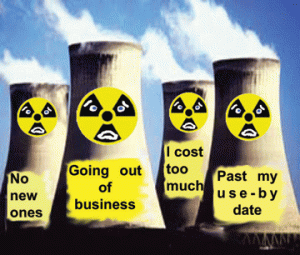 US POWER COMPANIES HAVE A HISTORY OF WALKING AWAY FROM NUCLEAR PROJECTS, Platts Snapshot. William Freebairn, senior managing editor, Platts Nuclear Publications, August 17, 2017
After spending close to $10 billion, two South Carolina power companies recently walked away from a half-finished nuclear power plant they were building, and a decision is expected by the end of August about a Georgia project. William Freebairn explains how the story of the Summer project in South Carolina demonstrates the capital-intensive nature of nuclear energy and the substantial risks of cutting-edge nuclear plant design. Will the Vogtle project in Georgia join the ranks of abandoned projects in the US?……
SANTEE COOPER AND SOUTH CAROLINA ELECTRIC AND GAS ABANDONED SUMMER EXPANSION ON JULY 31….
OWNERS OF VOGTLE PROJECT IN GEORGIA EXPECTED TO ANNOUNCE PROJECT DECISION BY END OF AUGUST
The owners of the Vogtle project in Georgia are expected to announce their decision by the end of August.
It’s certainly not the first time a partly – or even mostly – built nuclear plant was abandoned. In the 1970s, the Tennessee Valley Authority walked away from 11 nuclear reactors for which it had started construction; in fairness, it went back and finished one recently.
Dozens of plants were canceled as costs rose and financial problems mounted, forcing one company, the Washington Public Power Supply System to default on more than $2 billion in bonds and giving the company a new nickname: “whoops”!
The factors that forced all those nuclear plant cancellations in the 1980s may sound familiar to those building today’s plants. The Three Mile Island nuclear accident in 1979 created pressure for increased safety standards in the middle of construction for those plants, and Fukushima in 2011 did the same for today’s projects.
STARTING CONSTRUCTION BEFORE ENGINEERING IS COMPLETE AND UNDERESTIMATING WORK CAN BE BLOWS TO PROJECTS
Additionally, construction got started before engineering was completed. As with many large infrastructure projects, there was a tendency to underestimate the amount of work required to complete the installation of miles of pipes, cables and concrete.
Whoops indeed. https://www.platts.com/videos/2017/august/snapshot-us-nuclear-power-summer-vogtle-081717
August 18, 2017
Posted by Christina Macpherson |
business and costs, USA |
Leave a comment
 FPL nuclear project uncertain, but charges could grow by $90 million, Susan Salisbury, Palm Beach Post Staff Writer, Aug. 16, 2017 Florida Power & Light Co. ratepayers must wait two months before finding out if they will be required to pay many millions of dollars for costs associated with two nuclear reactors that may never be built.
The utility, Florida’s largest, says it has spent roughly $315 million towards two prospective nuclear reactor and in the next five years, those costs could grow by another $90 million, an FPL official told the Florida Public Service Commission Wednesday.
FPL is asking the PSC to allow it to continue spending millions of dollars towards obtaining an operating license from the U.S. Nuclear Regulatory Commission without submitting an updated report on whether the project still makes economic sense for customers.
Through the end of 2016, customers have paid close to $282 million in costs associated with the two reactors that could cost as much as $21.87 billion.
The second day of the hearing concluded Wednesday. The commission is scheduled to make a decision on the issue Oct. 17.
On Wednesday, FPL accounting project manager Jennifer Grant-Keene testified that of the additional $90 million in costs projected to be incurred through 2021, half of that, or $45 million, would consist of carrying costs. About half of those interest charges will go to shareholder profits.
Attorneys for the Florida Public Counsel, which represents all ratepayers, the Florida Industrial Power Users Group, the Florida Retail Federation and the Southern Alliance for Clean Energy urged the commission to reject FPL’s request for an exemption from the required annual financial analysis.
The project’s future is questionable, the groups said, especially since the Westinghouse AP-1000 reactors that would be used are the same type as those in a failed South Carolina nuclear expansion, Westinghouse filed for bankruptcy in March.
If FPL decides to move forward with the project, the proposed reactors, known as Turkey Point 6 and 7, would join two existing nuclear units at the company’s plant overlooking Biscayne Bay south of Miami. FPL project manager Steve Scroggs testified Tuesday that the license will probably be granted by early 2018.
Florida law and PSC rules allow recovery of costs associated with pre-licensing and pre-construction of nuclear plants before they are put into service, but require an annual economic analysis. FPL has not submitted such a report since 2015. FPL has stated it wants to pause the project, perhaps for five years or more after receiving the license. It would make the decision later whether to build the plant and return to the commission then to ask for more money from customers……. http://www.palmbeachpost.com/business/fpl-nuclear-project-uncertain-but-charges-could-grow-million/4tdjsYeT2eTxxid40sYRCK/
August 18, 2017
Posted by Christina Macpherson |
business and costs, USA |
Leave a comment
Gov’t Is Owner In Navajo Land Uranium Cleanup Suit: Judge, By Kat Sieniuc. Law360, New York (August 16, 2017, ) — An Arizona federal judge on Tuesday ruled that the federal government qualifies under environmental cleanup law as an owner of more than a dozen old uranium sites on Navajo Nation land and could be liable for cleaning up the area.
U.S. District Judge David G. Campbell partially granted El Paso Natural Gas Company LLC’s bid for a quick win against the United States and U.S. the Department of the Interior, as well as the Bureau of Indian Affairs and the U.S. Department of Energy, among other…https://www.law360.com/articles/954711/gov-t-is-owner-in-navajo-land-uranium-cleanup-suit-judge
August 18, 2017
Posted by Christina Macpherson |
Legal, Uranium, USA |
Leave a comment
 How War Pollutes the Potomac River, DAVID SWANSON AND PAT ELDER FOR BUZZFLASH AT TRUTHOUT, 17 AUG 17, The Pentagon’s impact on the river on whose bank it sits is not simply the diffuse impact of global warming and rising oceans contributed to by the U.S. military’s massive oil consumption. The U.S. military also directly poisons the Potomac River in more ways than almost anyone would imagine.
Let’s take a cruise down the Potomac from its source in the mountains of West Virginia to its mouth at the Chesapeake Bay. The journey down this mighty waterway details six EPA Superfund sites created by the Pentagon’s reckless disregard for the fragile ecosystem of the Potomac River watershed.
The U.S. Navy’s Allegany Ballistics Laboratory in Rocket Center, West Virginia, 130 miles north of Washington, is a critical source of contamination in the Potomac River. The on-site disposal of explosive metals and solvent wastes contaminates soil and groundwater with hazardous chemicals. The groundwater and soil along the river are laced with explosives, dioxins, volatile organic compounds, acids, laboratory and industrial wastes, bottom sludge from solvent recovery, metal plating pretreatment sludge, paints, and thinners. The site also has a beryllium landfill. An active burning area is still used for waste disposal, sprinkling chemical dust over the river. It’s not good.
Traveling the river 90 miles further south brings us to Fort Detrick in Frederick, Maryland, the Army’s “proving ground” for the nation’s biological warfare program. Anthrax, Phosgene, and radioactive carbon, sulfur, and phosphorous are buried here. The groundwater is laced with deadly trichloroethylene, a human carcinogen, and tetrachloroethene, suspected of causing tumors in laboratory animals. The Army tested ghastly and heinous agents here, like Bacillus globigii, Serratia marcescens, and Escherichia coli. Although the DOD says it ceased biological weapons testing for offensive purposes in 1971, the claim is like the military’s placement of “defensive” missile systems near an enemy’s border.
Fort Detrick also has a history of dumping high levels of phosphorus into its drain system that ultimately washes into the lower Monocacy River, a tributary of the Potomac. In fact, the Maryland Department of Environment has cited the Army for exceeding allowable permit levels. Too much phosphorus in the water causes algae to grow faster than the Potomac ecosystem can handle. It is deadly. The Army is a leading polluter of the Potomac River watershed……..
The Potomac is far from unique. Sixty-nine percent of U.S. Superfund environmental disaster sites are the result of war preparations.
Preparations for war cost over 10 times the money that actual wars do, and cause at least 10 times the deaths. Routine U.S. military war preparations cause deaths by diverting resources from human needs and directly through massive environmental destruction spread all over the world including in the United States, and including in the Potomac.
So-called foreign intervention in civil wars around the world is, according to comprehensive studies, 100 times more likely — not where there is suffering, not where there is cruelty, not where there is a threat to the world, but where the country at war has large reserves of oil or the intervener has a high demand for oil.
The U.S. military is the top consumer of petroleum around, burning more of it than most entire countries, and burning much of it in routine preparations for more wars. There are military planes that can cause more damage with jet fuel in 10 minutes than you can with gasoline driving your car for a year.
All such calculations omit the environmental destruction done by private weapons makers and by their weapons. The U.S. is the leading exporter of war weapons to the rest of the world.
All such calculations also omit much of the damage and all of the details of the human suffering. The U.S. military burns toxic waste in the open, near its own troops in places like Iraq, near the homes of the people who live in the countries it has invaded, and within the United States in many — often poor and minority — communities such as Colfax, Louisiana, and at Dahlgren on the Potomac.
Much of the damage is essentially permanent, such as the poison of depleted uranium, used in places like Syria and Iraq. But this is true in locations all around the United States as well. Near St. Louis, Missouri, an underground fire is moving ever closer to an underground pile of radioactive waste.
And then there is the Potomac River. It flows south between the Lincoln and Jefferson Memorials in Washington, D.C. on the east, and Arlington, Virginia, on the west, where the Pentagon Lagoon brings the water up to the headquarters of world militarism.
Not only does the home of war making sit near rising waters — rising first and foremost because of the effects of war making, but those particular waters — the waters of the Potomac and of the Chesapeake Bay into which it flows, and the tides of which raise and lower the waters of the Pentagon Lagoon each day — are heavily polluted by war preparations.
This is why we are planning and invite you to join in a kayactivist flotilla to the Pentagon on September 16th. We need to bring the demand of No More Oil for Wars to the doorstep of our leading destroyer of the environment.
David Swanson is an author, activist, journalist, and radio host. He is director of WorldBeyondWar.org and campaign coordinator for RootsAction.org. Swanson’s books include War Is A Lie. He blogs at DavidSwanson.org and WarIsACrime.org. He hosts Talk Nation Radio. He is a 2015, 2016, 2017 Nobel Peace Prize Nominee. Follow him on Twitter: @davidcnswanson and FaceBook. http://truth-out.org/buzzflash/commentary/how-war-pollutes-the-potomac-river
August 18, 2017
Posted by Christina Macpherson |
environment, USA, weapons and war |
Leave a comment
Trump’s apocalyptic threats demand a moral case for disarmament,Guardian, Daniel José Camacho, 14 Aug 16, It’s easy to understand why Trump is potentially one of the worst people to be in charge of our nation’s nuclear codes. Yet, the problem runs much deeper.
Martin Luther King Jr once said: “When scientific power outruns moral power, we end up with guided missiles and misguided men.” Now, it appears Donald Trump might be the man who makes us pay for our country’s moral gap.
Trump has rekindled fears of war and nuclear strikes by threatening North Korea, saying: “They will be met with fire and fury like the world has never seen.” True to form, Trump’s words flew out of his mouth without much thought or preparation. In turn, the North Korean government has threatened to fire missiles near the US territory of Guam.
It’s easy to understand why Trump is potentially one of the worst people to be in charge of our nation’s nuclear codes. Yet the problem runs much deeper. Trump’s apocalyptic threat is a reminder that we need to revive the moral argument for disarmament and against militarism.
If the road to hell is paved with good intentions, then the road to this moment has been paved with the consensus of the foreign policy establishment. Both neocons and hawkish Democrats have pushed for an aggressive posture that has US special operations forces operating in 137 countries. US defense spending consistentlydwarfs the rest of the world.
King also said: “A nation that continues year after year to spend more on military defense than on programs of social uplift is approaching spiritual death.” Based on our record, it looks like this nation has been beyond spiritually dead for some time.
King was someone who acutely understood the danger of American militarism and nuclear weapons. In his 1967 Christmas Sermon on Peace, he said: “If somebody doesn’t bring an end to this suicidal thrust that we see in the world today, none of us are going to be around, because somebody’s going to make the mistake through our senseless blundering of dropping a nuclear bomb somewhere.”
Recovering King’s political vision can help us today…….
As long as war remains a business profiting a few, peace will remain a low priority. The problem is not simply Trump or the preceding presidential administrations, but an entire system that profits from violent conflicts and war.
The former president Dwight D Eisenhower understood this when he described the grave implications of the “military-industrial complex” in his 1961 farewell address. According to him: “The total influence – economic, political, even spiritual – [of an immense military establishment and arms industry] is felt in every city, every state house, every office of the federal government.”…..

Far from being idealistic, it is King’s framework which has regained relevance in the Trump era. As he wrote towards the very end of his life: “We still have a choice today: nonviolent coexistence or violent co-annihilation. This may well be mankind’s last chance to choose between chaos and community.” https://www.theguardian.com/commentisfree/2017/aug/11/trump-apocalyptic-threats-moral-case-disarmament
August 16, 2017
Posted by Christina Macpherson |
Religion and ethics, USA |
Leave a comment
The Real Nuclear Option, Americans are disturbingly unbothered by the idea of striking first with nuclear weapons, Slate ,By Fred Kaplan, 15 Aug 17, As President Trump rails against North Korea, threatening to rain down “fire and fury like the world has never seen” if it so much as tests another long-range missile, the world can’t help but wonder: Would he really do this? Would he order a nuclear strike, the ultimate fire and fury, against a country that hadn’t attacked us first?

Many are doubtful. His top security advisers would oppose such a move. So would the American people who, though they have no formal say in the matter, would impose constraints on a president’s actions—or so goes the conventional wisdom. Some scholars have written of a “nuclear taboo” ingrained in our sensibilities since the bombing of Hiroshima. Others detect a growing revulsion against the killing of noncombatants even with conventional weapons.
However, a new study suggests that these comforting notions are mistaken.
In the latest issue of the journal International Security, Scott Sagan and Benjamin Valentino, respectively professors at Stanford University and Dartmouth College, conclude that the American public is “unlikely to serve as a serious constraint on any president who might consider using nuclear weapons in the crucible of war.” In fact, under pressures similar to those facing President Harry Truman at the end of World War II, a clear majority of the public would support the first use of nuclear weapons now, just as it did back then.
Some opinion polls appear at first glance to show otherwise. A majority of Americans now say that Truman was wrong to drop atomic bombs on Hiroshima and Nagasaki. But Sagan and Valentino regard those polls as “a misleading guide” to understanding Americans’ “real views” on the use of nuclear weapons and the killing of civilians.
The problem with the Hiroshima polls is that Americans today lack the mindset of Americans in the time of World War II. Japan is now a leading U.S. ally. Few among the living remember the shock of Pearl Harbor or the horrors of the war in the Pacific and the desperate desire to stop the slaughter of American troops by any means necessary. So, the two professors—Sagan an eminent scholar of nuclear strategy, Valentino an expert on public opinion and the use of force—came up with a clever way of gauging how Americans would react in a similar situation today.
They commissioned the polling firm YouGov to conduct a survey in which those polled were shown a mock news story. In this story, the United States imposes sanctions on Iran for violating the Iran nuclear deal. Iran then attacks an American aircraft carrier in the Persian Gulf, killing 2,403 U.S. military personnel (the same number as those killed at Pearl Harbor, though this parallel isn’t drawn explicitly). The U.S. responds with airstrikes on Iranian military facilities. Iran refuses to surrender. The U.S. invades Iran but gets bogged down after 10,000 American troops are killed.
Those polled were then given a choice. Should we persist with the ground invasion all the way to Tehran, knowing that 20,000 American soldiers would be killed? Or should we drop a nuclear bomb on Mashhad, Iran’s second-largest city, “to pressure the Iranian government to surrender”—an attack that would kill 100,000 Iranian civilians (an arbitrarily chosen number).
The results were unsettling, though not so surprising. More than half of the respondents, 55 percent, favored dropping a nuclear bomb rather than proceeding with the invasion. An even higher number, 59 percent, said they would approve the president’s action after the fact if he chose to drop the bomb.
Then the pollster changed one key premise: What if the nuking of Mashhad killed 2 million Iranian citizens—which would you prefer: dropping the nuclear bomb or proceeding with the ground invasion, which would kill 20,000 U.S. soldiers?
Those favoring the nuclear option did drop, but not by much—from 55 percent (under the scenario with 100,000 killed) to 47 percent (under the scenario with 2 million killed). More sobering, the same number as before—59 percent—said they would approve the president’s action, after the fact, if he decided to drop the bomb.
In other words, to 47 percent—nearly half—of those polled, killing 2 million Iranian civilians is preferable to killing 20,000 American military personnel, a ratio of 100:1….. http://www.slate.com/articles/news_and_politics/war_stories/2017/08/sagan_and_valentino_study_shows_americans_would_likely_support_nuclear_first.html
August 16, 2017
Posted by Christina Macpherson |
politics, USA, weapons and war |
Leave a comment
President Trump holds the ‘nuclear football’ but what is the process to launch an attack? 9 News, Aug 15, 2017 On January 20 Donald Trump was inaugurated as President, giving the former reality star the
sole authority to launch a nuclear attack.
After being sworn in, an aide who had arrived with outgoing president Barack Obama carrying a satchel containing a briefcase, known as “the nuclear football”, moved quietly to Trump’s side.
The symbolism was clear: Trump now had complete control of the launch codes for a strategic nuclear strike.
It was a moment Trump had been waiting for – indeed, even thinking about for a long time……..
And it seems not all US politicians have confidence in the current system.
Ted Lieu – a Democratic member of the US House of Representatives – has filed a proposal to require congressional approval before the president could launch a first nuclear strike, labelling the current process “unconstitutional”.
“Right now one person can launch thousands of nuclear weapons, and that’s the president. No one can stop him. Under the law, the secretary of defense has to follow his order. There’s no judicial oversight, no congressional oversight,” Lieu said.
But what exactly is the current process to launch a nuclear attack? The current approval process dates back to after the atomic bombings of Hiroshima and Nagasaki in Japan to end World War II.
The Atomic Energy Act of 1946, signed by President Harry Truman, gave the president full responsibility over the nation’s nuclear arsenal.
That means, the president can use nuclear weapons with a single verbal order – an order that cannot be overridden.
Unlike other executive branch decisions, there are very limited checks and balances to launching a nuclear strike.
While Lie argues the current process is unconstitutional, the answer to that is not definitive – with possible answers lying in murky territory.
The American Constitution allows the president to use significant military force without congressional approval, if it is in self-defence.
That suggests North Korea would have to attack the US, or a US territory, such as Guam, first before Trump could legally pull the trigger on a nuclear retaliation.
However, a wrinkle in that comforting thought is the Korean War.
The Korean War which ran from 1950 to 1953 did not ever formally end – rather it ended with an armistice, with a peace treaty scheduled in Geneva in 1954 never being signed by the two parties.
Therefore, Trump could still attack North Korea first using the argument the US is already at war with the despot regime.While Trump may be able to launch a nuclear strike against North Korea on his say alone, the 1973 War Powers Resolution requires the president to have or to gain congressional approval to send troops to a foreign territory for combat purposes.
9RAW: Trump threatens ‘big, big trouble’ for North Korea
While the president can send the troops without the approval of Congress, the president then requires to get a yes otherwise they must terminate combat within 60 to 90 days.
While the Western world watch the continued exchange of verbal blows between North Korea and the US – a comment made by Trump in 1984, at the height of the Cold War, when the now President told a Washington Post reporter he wanted to be put in charge of US-Russia nuclear arms negotiations.
“It would take an hour-and-a-half to learn everything there is to learn about missiles,” Trump said. “I think I know most of it anyway.”
In March last year, Trump asserted he would be the last person to use nuclear.
“I’m not going to take cards off the table. We have nuclear capability,” he said.
“The last person to use nuclear would be Donald Trump. That’s the way I feel. I think it is a horrible thing. The thought of it is horrible. But I don’t want to take anything off the table. We have to negotiate. There will be times maybe when we’re going to be in a very deep, very difficult, very horrible negotiation.”
It’s a negotiation the world is watching now as North Korea’s leader Kim Jong Un continues to move ahead with a plan to strike an area around US territory Guam with four missiles.
August 15 could see North Korea begin preparations to launch four intermediate-range Hwasong-12 missiles near Guam, should Kim follow through on his rhetoric.
The rogue state’s head said today he will watch the actions of the United States for a while longer before making a decision, according to North Korea’s official news agency.
Kim said: “The United States, which was the first to bring numerous strategic nuclear equipment near us, should first make the right decision and show through actions if they wish to ease tensions on the Korean peninsula and prevent a dangerous military clash.”The ball seems to be sitting firmly in Trump’s court – and the world watches to see if he becomes the president to open the ‘nuclear football’.http://www.9news.com.au/world/2017/08/15/13/17/trump-north-korea-nuclear-codes
August 16, 2017
Posted by Christina Macpherson |
politics, politics international, USA |
Leave a comment
 The Madhouse Effect: this is how climate denial in Australia and the US compares, The Conversation August 14, 2017 Michael Mann is well known for his classic “hockey stick” work on global warming, for the attacks he has long endured from climate denialists, and for the good fight of communicating the environmental and political realities of climate change.
Mann’s work, including his recent book The Madhouse Effect, has helped me, as a dual US-Australian citizen, think about the similarities and differences between the US and Australia as we respond to what has been called the climate change denial machine.
In both countries, the denialists and distortionists have undermined public knowledge, public policy, new economic development opportunities, and the very value of the environment. Climate policy is being built upon alternative facts, fake news, outright lies, PR spin and industry-written talking points.
From the carbon industry capture of the two major parties, to the Abbott-Turnbull government parroting industry talking points, to coal industry lobbyists as government energy advisers, to the outright idiotic conspiracy pronouncements of senators funded and advised by the US- based denial machine, the Madhouse Effect is in full force in Australia.
How we can expose and counter this denialist machine? To partly lay out the task, I will discuss three points of contrast between the US and Australia.
Political culture
There is a key difference between the two countries’ political cultures. As much as the denialists have determined Australian energy and climate policy, they have not been as successful, yet, at undermining deep-seeded respect in Australian culture for the common good, for science, for expertise and knowledge…….
Last year, when the government fired climate scientists at CSIRO, there was another huge public backlash. The government had to step back a bit, both on the actual science to be done and the radical agenda change away from science for the public good.
And again, when the government wanted to support the dubious work of Bjorn Lomborg, that caused an outcry from both the university sector and the public. Even though the government wound up paying more than A$600,000 on what The Australian called his “vanity book project”, they couldn’t import him and plant him at any Australian university.
As Mann says, the main issue in implementing good, sound climate policy is no longer simply the science. The main issue is the cultural understanding of, and respect for the role of science in informing political decisions.
That’s not to say there are no attacks on science – clearly, these continue (such as the recent challenges to normal Bureau of Meteorology practices). But, overall, climate denialists and their enablers are outnumbered outliers in Australia, rather the norm.
The power of the carbon industry
My second point of comparison is not quite as positive.
The problem in Australia is less a culture turning against the Enlightenment, and more the direct political power and influence of the carbon industry. ……
even here I think there is some hope. We have seen, over the last few years, an incredible coalition grow – one focused on the end of carbon mining, on protecting communities, on creating real jobs, and on supporting renewables.
Once-unthinkable coalitions of farmers and Aboriginal communities are fighting new mines, new attacks on sacred and fertile land and water.
We have intensive household investment in rooftop solar – and as the feed-in tariffs are undermined, those folks will increasingly invest in battery storage. And we’re finally seeing states move in this direction, with increasing development of utility-scale renewable and storage projects. As hard as the federal government and its allies resist, renewables are growing and the public supports this – even conservative voters. https://theconversation.com/the-madhouse-effect-this-is-how-climate-denial-in-australia-and-the-us-compares-81822
August 16, 2017
Posted by Christina Macpherson |
AUSTRALIA, climate change, USA |
Leave a comment