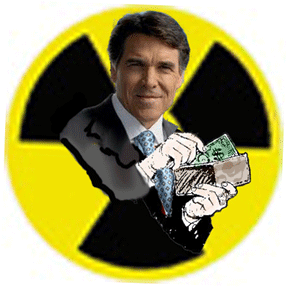
Secretive report on South Carolina nuclear reactor construction never given to state utility regulators, Post and Courier, By Andrew Brown abrown@postandcourier.com, Aug 31, 2017 COLUMBIA — SCANA Corp. may have misled state utility regulators about the existence of a secretive report that detailed construction failures at two troubled nuclear reactors at the V.C. Summer station in Fairfield County, months before the $9 billion energy project was abandoned.
The director of the state Office of Regulatory Staff told The Post and Courier on Thursday that SCANA officials repeatedly told state agency employees they didn’t have a copy of a report that was produced by Bechtel Corp., an engineering and project management company that observed the nuclear construction near Jenkinsville in past years.
“They have continued to ask for it,” said Dukes Scott, the regulatory staff director. “As we asked for it, they never said, ‘Yes, here it is.'” Those state regulators were surprised last week when SCANA and Santee Cooper officials admitted under oath in a Senate hearing the document did exist, and they were again denied access to it by SCANA, who is now claiming it as legally privileged information……http://www.postandcourier.com/business/secretive-report-on-nuclear-reactor-construction-never-given-to-state/article_6d7d5560-8e56-11e7-a0f0-cf722935ab39.html
September 1, 2017
Posted by Christina Macpherson |
business and costs, secrets,lies and civil liberties, USA |
Leave a comment
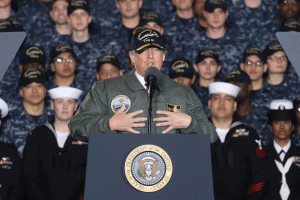 All options on the table after missile: Trump Sky News , 30 August 2017 US president Donald Trump has said ‘all options are on the table’ after North Korea launched a ballistic missile over Japan.
Mr Trump spoke as China said tensions on the Korean peninsula were now at ‘tipping point’.
North Korea fired a midrange ballistic missile that flew over Japan on Tuesday, a test considered one of the most provocative ever from the reclusive state.
It came as US and South Korean forces conduct annual military exercises on the peninsula. Chinese foreign ministry spokeswoman Hua Chunying reiterated Beijing’s call for peace talks, saying ‘pressure and sanctions’ against North Korea ‘cannot fundamentally solve the issue’, and said the country needed to exercise restraint.
‘The UN Security Council has put through several resolutions and sanctions have all along been put in place but everyone can see whether they’ve had actual results,’ she added.
‘On the one hand, sanctions have continued to be put in place via resolutions and on the other hand North Korea’s nuclear and missile launch process is still continuing.’……http://www.skynews.com.au/news/top-stories/2017/08/30/all-options-on-the-table-after-missile–trump.html
August 30, 2017
Posted by Christina Macpherson |
North Korea, politics international, USA |
Leave a comment
 As Historic Flooding Grips Texas, Groups Demand Nuclear Plant Be Shut Down https://www.commondreams.org/news/2017/08/29/historic-flooding-grips-texas-groups-
 demand-nuclear-plant-be-shut-down#
“This storm and flood is absolutely without precedent even before adding the possibility of a nuclear accident that could further imperil millions of people who are already battling for their lives.”
byJon Queally, staff writer, 29 Aug 17, As record-breaking rainfall and unprecedented flooding continue to batter the greater Houston area and along the Gulf coast on Tuesday, energy watchdogs groups are warning of “a credible threat of a severe accident” at two nuclear reactors still operating at full capacity in nearby Bay City, Texas.
Three groups—Beyond Nuclear, South Texas Association for Responsible Energy, and the SEED Coalition—are calling for the immediate shutdown of the South Texas Project (STP) which sits behind an embankment they say could be overwhelmed by the raging flood waters and torrential rains caused by Hurricane Harvey.
“Both the U.S. Nuclear Regulatory Commission and the STP operator have previously recognized a credible threat of a severe accident initiated by a breach of the embankment wall that surrounds the 7,000-acre reactor cooling water reservoir,” said Paul Gunter, director of the Beyond Nuclear’s Reactor Oversight Project, in a statement by the coalition on Tuesday.
The groups warn that as Harvey—which on Tuesday was declared the most intense rain event in U.S. history—continues to dump water on the area, a breach of the embankment wall surrounding the twin reactors would create “an external flood potentially impacting the electrical supply from the switchyard to the reactor safety systems.” In turn, the water has the potential to “cause high-energy electrical fires and other cascading events initiating a severe accident leading to core damage.” Even worse, they added, “any significant loss of cooling water inventory in the Main Cooling Reservoir would reduce cooling capacity to the still operating reactors that could result in a meltdown.”
With the nearby Colorado River already cresting at extremely high levels and flowing at 70 times the normal rate, Karen Hadden, director of SEED Coalition, warned that the continue rainfall might create flooding that could reach the reactors. “There is plenty of reserve capacity on our electric grid,” she said, “so we don’t have to run the reactors in order to keep the lights on. With anticipated flooding of the Colorado River, the nuclear reactors should be shut down now to ensure safety.”
Last week, the STP operators said that safety for their workers and local residents was their top concern, but that they would keep the plant operating despite the approaching storm.
Susan Dancer, president of the South Texas Association for Responsible Energy, said that as residents in Bay City—herself included—were being forced to leave their homes under manadatory evacaution orders, it makes no sense to keep the nuclear plant online.
“Our 911 system is down, no emergency services are available, and yet the nuclear reactors are still running. Where is the concern for employees and their families? Where is the concern for public safety? This is an outrageous and irresponsible decision,” declared Dancer. “This storm and flood is absolutely without precedent even before adding the possibility of a nuclear accident that could further imperil millions of people who are already battling for their lives.”
As Harvey hovers over the coastal region, heavy rains are expected to persist for days even as the storm system creeps toward to Louisiana in the east.
But no matter how remote the possibility, said Gunter, “it’s simply prudent that the operator put this reactor into its safest condition, cold shutdown.”
August 30, 2017
Posted by Christina Macpherson |
climate change, safety, USA |
Leave a comment
World War 3? US tests ‘most dangerous nuclear weapon ever produced’ amid North Korea row, THE United States has carried out a second test of a nuclear bomb, described as the most dangerous nuclear weapon ever produced, as tensions with North Korea escalate. Express UK By JON ROGERS, Aug 29, 2017 US authorities confirmed the test was successful and the B61-12 gravity bomb is expected to go into production within three years.
B61-12 gravity bombs, without a nuclear warhead, were dropped from F-15E fighter jets at Tonopah Test Range in Nevada on August 8, the National Nuclear Security Administration said.
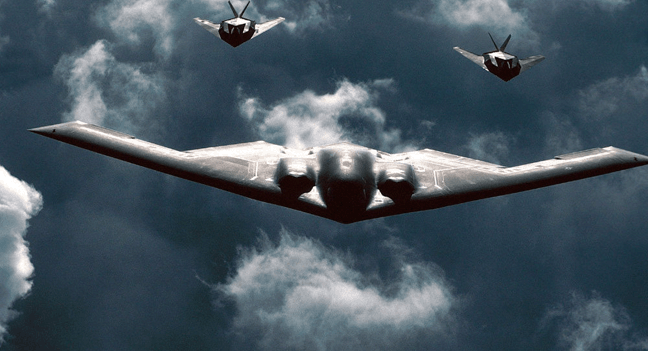
The tests were intended to check the bomb’s “non-nuclear functions and the aircraft’s capability to deliver the weapon.”
A statement from the NNSA said: “B61-12 gravity bombs, without a nuclear warhead, were dropped from F-15E fighter jets at Tonopah Test Range in Nevada on August 8. The tests were intended to check the bomb’s ‘non-nuclear functions and the aircraft’s capability to deliver the weapon.”
These tests are part of a series over the next three years to qualify the B61-12 for service. The first qualification flight test occurred in March.
The new weapon is scheduled for production in March 2020 and will replace the B61.
Military experts believe the weapon’s accuracy and variable power reduces the risk of collateral damage and potential widespread civilian casualties.
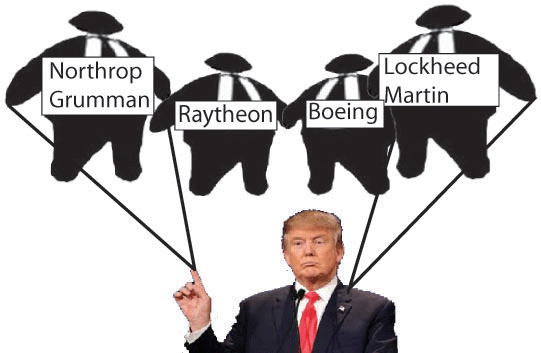
The B61-12 bomb features a tail kit from aircraft manufacturer Boeing which will enable a precision-guided trajectory………
The timing of the latest test comes amid heightened tensions between the US and North Korea whose latest missile launch occurred yesterday as the country sent a rocket over the north of Japan and sparking international condemnation.
Brian Becker, director of the anti-war Answer coalition told RT: “In order to placate his critics, in the media and in politics, Trump has given a blank check to his generals.
“So they are having a grand time right now, and they are testing all the weapons they’ve been wanting to test, but not been able to.” http://www.express.co.uk/news/world/847385/World-War-3-latest-US-nuclear-bomb-test-North-Korea-B61-12
August 30, 2017
Posted by Christina Macpherson |
USA, weapons and war |
Leave a comment
 How climate change could turn US real estate prices upside down
Floridians have long recognised climate’s threat to their homes. Amid the disaster wrought by Harvey, home buyers may look to higher ground, Guardian, Richard Luscombe in Miami, Florida, 30 Aug 17, If Florida gleaned anything from Hurricane Andrew, the intensely powerful storm that tore a deadly trail of destruction across Miami-Dade County almost exactly 25 years to the day that Hurricane Harvey barrelled into the Texas coastline, it was that living in areas exposed to the wrath of Mother Nature can come at a substantial cost.
At the time the most expensive natural disaster ever to hit the US, Andrew caused an estimated $15bn in insured losses in the state and changed the way insurance companies assessed their exposure to risk for weather-related events.
Many of the lessons that Florida has learned since 1992 have parallels in the unfolding disaster in Texas, experts say, and what was already a trend toward factoring in environmental threats and climate change to land and property values looks certain to become the standard nationwide as Houston begins to mop up from the misery of Harvey.
“The question is whether people are going to be basing their real estate decisions on climate change futures,” said Hugh Gladwin, professor of anthropology at Florida International University, who says his research suggests higher-standing areas of Miami are becoming increasingly gentrified as a result of sea level rise.
“In any coastal area there’s extra value in property, [but] climate change, insofar as it increases risks for those properties from any specific set of hazards – like flooding and storm surge – will decrease value.”
Miami Beach in particular has become a poster child for the effects of climate change, with some studies making grim predictions of a 5ft sea level rise by the end of the century and others suggesting that up to $23bn of existing property statewide could be underwater by 2050.
To counter those effects and preserve property values, Miami Beach has embarked on an ambitious and costly defensive programme that includes raising roads and installing powerful new pumps to shift the ever more regular floodwaters.
Even so, there are indications that investors are already looking to higher ground elsewhere in the city, such as the traditionally poor, black neighbourhoods of Little Haiti and Liberty City. “The older urban core was settled on the coastal ridge and anything below that was flooded. The coastal ridge we’re talking about is clearly gentrifying,” Gladwin said.
Or, as the journal Scientific American put it in its own investigation in May: “Real estate investment may no longer be just about the next hot neighbourhood, it may also now be about the next dry neighbourhood.”…….
Albert Slap, president and co-founder of Coastal Risk Consulting: “You have thousands of properties in Norfolk, Annapolis, Atlantic City, Savannah, Charleston and Miami Beach where part of the property goes underwater with seawater for days at a time. When you have fish swimming in your driveway, it’s not an amenity, like a swimming pool. It means you’re driving through saltwater to get your kids to school, get to the supermarket, whatever you’re going to do.
“Will there be a massive decline in the property values of the flooded areas in Houston? Common sense would say yes. And if that’s combined with new legislation that’s going to require full disclosure, then wow.” https://www.theguardian.com/environment/2017/aug/29/hurricane-harvey-climate-change-real-estate-florida
August 30, 2017
Posted by Christina Macpherson |
climate change, USA |
Leave a comment
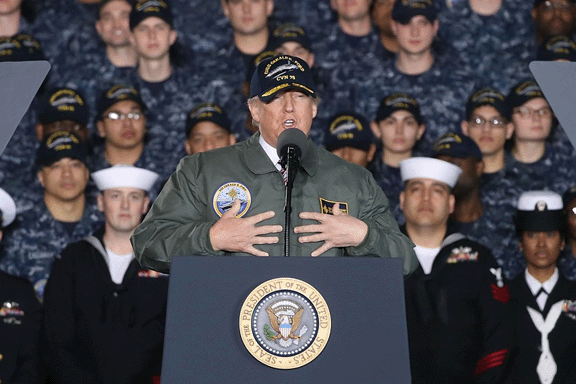
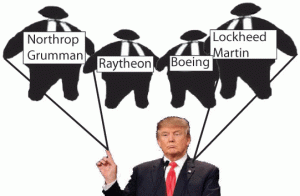 Trump Forges Ahead on Costly Nuclear Overhaul, Sweeping Aside Doubts, By DAVID E. SANGER and WILLIAM J. BROADNYT, AUG. 27, 2017
 During his
speech last week about Afghanistan, President Trump slipped in a line that had little to do with fighting the Taliban: “Vast amounts” are being spent on “our nuclear arsenal and missile defense,” he said, as the administration builds up the military.
August 28, 2017
Posted by Christina Macpherson |
politics, USA, weapons and war |
Leave a comment
 Cyclones and climate change: connecting the dots,https://au.news.yahoo.com/a/36857982/cyclones-and-climate-change-connecting-the-dots/, by Marlowe HOOD, 27 Aug 17, Paris (AFP) – Scientists freely acknowledge they don’t know everything about how global warming affects hurricanes like the one pummelling southeast Texas.
But what they do know is enough to keep them up at night. The amplifying impact of sea level rise, warming oceans, and hotter air — all incontrovertible consequences of climate change — is basic physics, they say. Likewise accelerated shifts in intensity, such as the sudden strengthening that turned Harvey from a Category 2 to a Category 4 hurricane — on a scale of 5 — just as it made landfall Friday.
What’s missing is a detailed track record of hurricanes past, the kind of decades-long log of measurements that climate scientists need to discern the fingerprint of human influence. Starting in the 1970s, satellite data allowed for a better tally, but even that wasn’t enough.
“It is awfully difficult to see climate change in historical data so far because hurricanes are fairly rare,” Kerry Emmanuel, a professor of atmospheric science at MIT in Boston, told AFP. Experts, in other words, do not disagree on the potential of manmade global warming to magnify the destructive power of the tropical storms known variously around the world as cyclones, hurricanes and typhoons. Rather, they are confounded — for now — by a lack of information.
“Just because the data don’t allow for unambiguous detection yet, doesn’t mean that the changes haven’t been occurring,” noted James Kossin, a scientist at the US National Oceanic and Atmospheric Administration’s Center for Weather and Climate in Madison, Wisconsin.
Kossin figured out that cyclones have drifted poleward in their respective hemispheres over the last three decades, a finding hailed by other hurricane gurus as the most unambiguous evidence so far that global warming has already had a direct impact.
– Like a tsunami – When it comes to cyclones and climate change, there are many points of near “universal agreement,” said Emanuel.
One is the consequence of rising seas. “The most lethal aspect of hurricanes — wherever they occur in the world — is storm surge,” he said in an interview. “It is physically the same phenomenon as a tsunami, except that it is excited by wind rather than a sea floor shaken by an earthquake.”
If Hurricane Sandy — which caused $50 billion in damage — had happened a century earlier, it probably would not have flooded lower Manhattan because sea level was about 30 centimetres (a foot) lower, he pointed out.
Global warming is likely to add roughly a metre (three feet) to the global watermark by century’s end, according to recently revised estimates. “The surge from these storms will be more devastating — higher and more penetrating,” said James Elsner, an atmospheric scientists and hurricane expert at Florida State University.
A second point of consensus is that hurricanes will hold more water, raising the threat of lethal and destructive flooding. “We calculate that one degree Celsius (1.8 degrees Fahrenheit) of warming translates into a seven percent increase in humidity in the atmosphere,” said French scientist Valerie Masson-Delmotte, co-chair of the UN?s Intergovernmental Panel on Climate Change (IPCC).
The US National Hurricane Center predicts that Harvey could dump more than 40 inches (100 centimetres) by the time skies clear. Hurricane Mitch — the second deadliest Atlantic hurricane on record — left some 19,000 dead in Central America, “all from fresh-water flooding,” noted Emanuel.
“The irony is that hurricanes are known for wind, yet wind is third on the list of lethal aspects,” after storm surges and flooding caused by rain.
‘Fewer but stronger’ –
Earlier this year, Emanuel published a study pointing to yet another worrying climate “signal” emerging from the noise of raw data.
Scientists have made great progress in anticipating the path a storm will follow, extending their predictive powers from a day or two to about a week.
At the same time they have made scant headway in forecasting hurricane strength.
“The thing that keeps forecasters up at night is the prospect that a storm will rapidly gain strength just before it hits land,” Emanuel said, citing Harvey as an example.
In 2015, Hurricane Patricia in the Pacific Ocean intensified more rapidly — “It just went ‘Boom!’” — than any storm on record.
“Global warming can accentuate that sudden acceleration in intensity,” Emanuel said. A finding oft cited as evidence that the jury is still out on whether climate change will boost cyclones is that scientists don’t know if there will be more or fewer such storms in the future.
But even if there are fewer, which seems likely, that misses the point, the experts interviewed agreed.
Since 1971, tropical cyclones have claimed about 470,000 lives and caused some $700 billion in damages globally, according to the Centre for Research on the Epidemiology of Disasters.
But most of that death and destruction is attributable to a relative handful of storms. Just three, for example, have caused well over half of all storm-related deaths in the US since 1900.
So even if the number of mostly smaller storms diminishes, that’s not what counts.
“The idea of ‘fewer but stronger’ seems to be the fingerprint of climate change on tropical cyclones,” Elsner concluded.
August 28, 2017
Posted by Christina Macpherson |
climate change, USA |
Leave a comment

 If Report Says Iran Is Abiding by Nuclear Deal, Will Trump Heed It?, NYT, By GARDINER HARRIS AUG. 27, 2017 WASHINGTON — Within days, international monitors will send an inspection report on Iran’s nuclear facilities to governments around the world, touching off a chain of events that could lead to another clash between President Trump and congressional Republicans, or even his own top advisers.
August 28, 2017
Posted by Christina Macpherson |
Iran, politics international, USA |
Leave a comment
http://www.abc.net.au/news/2017-08-26/hurricane-harvey-forecast-to-be-on-par-with-katrina/8844584 The menacing Hurricane Harvey is on the verge of reaching Texas, bringing fierce winds and torrential rain to a wide swath of the state’s Gulf Coast and prompting tens of thousands of residents to flee inland in hopes of escaping its wrath.
Key points:
- Hurricane makes landfall as Category four hurricane
- Residents fleeing most powerful storm on US mainland since 2005
- Locals told to take cover from wind, unprecedented flooding
The National Hurricane Centre said the eyewall of the dangerous category four storm has reached the Texas coast, suggesting that the eye of the storm will make landfall in the coming hours.
The system is packing winds of 215 kilometres per hour, and experts fear could be the most destructive since Katrina left 1,800 people dead in 2005.
Texas Governor Greg Abbott has warned it could be “a very major disaster”, while US President Donald Trump made an early disaster declaration, unlocking federal funding.
Harvey is expected to generate storm surges along with prodigious amounts of rain. The resulting flooding, one expert said, could be “the depths of which we’ve never seen”.
Weather experts have warned areas of the state could be uninhabitable for weeks or months if Harvey is as bad as predicted.
Fuelled by warm Gulf of Mexico waters, Harvey grew from an unnamed storm to a life-threatening behemoth in just 56 hours, an incredibly fast intensification.
It is on track to make landfall at Rockport, a fishing-and-tourist town about 50 kilometres north-east of Corpus Christi. The National Hurricane Centre warned life-threatening storm surges could affect low-lying coastal areas.
“We know that we’ve got millions of people who are going to feel the impact of this storm,” spokesman and meteorologist Dennis Feltgen said.
“We really pray that people are listening to their emergency managers and get out of harm’s way.”
Thousands of people have fled, but many others stayed put, stocking up on food and water, and boarding up windows. Rockport Mayor Pro Tem Patrick Rios had a sombre message to anyone defying the orders to evacuate.
“We’re suggesting if people are going to stay here, mark their arm with a Sharpie pen with their name and Social Security number,” he said.
“We hate to talk about things like that.
“It’s not something we like to do but it’s the reality. People don’t listen.” Galveston-based storm surge expert Hal Needham of the private firm Marine Weather and Climate said forecasts indicated it was “becoming more and more likely that something really bad is going to happen”.
At least one researcher predicted heavy damage that would linger for months or longer.
It may also spawn tornadoes. Even after weakening, the system might spin out into the Gulf and regain strength before hitting Houston a second time as a tropical storm, forecasters said.
“In terms of economic impact, Harvey will probably be on par with Hurricane Katrina,” University of Miami senior hurricane researcher Brian McNoldy said.
“The Houston area and Corpus Christi are going to be a mess for a long time.”
While Mr Trump encouraged “everyone in the path of Hurricane Harvey to heed the advice and orders of their local and state officials”. The heavy rain could turn many communities into “essentially islands” and leave them isolated for days, said Melissa Munguia, deputy emergency management coordinator for Nueces County.
“Essentially there’s absolutely nowhere for the water to go,” she said.
Galveston Bay, where normal rain runs off to, will already be elevated.
The heavy rain is expected to extend into Louisiana, driven by counter-clockwise winds that could carry water from the Gulf of Mexico far inland. The Texas Governor activated about 700 members of the state National Guard ahead of Harvey making landfall.
Harvey would be the first significant hurricane to hit Texas since Ike in September 2008 brought winds of 177 kilometres per hour to the Galveston and Houston areas, inflicting $US22 billion in damage.
It would be the first big storm along the middle Texas coast since Hurricane Claudette in 2003 caused $US180 million in damage.
August 26, 2017
Posted by Christina Macpherson |
climate change, USA |
Leave a comment
ALASKA’S PERMAFROST IS THAWING, Alaska’s permafrost, shown here in 2010 [on original] , is no longer permanent. It is starting to thaw. The loss of frozen ground in Arctic regions is a striking result of climate change. And it is also a cause of more warming to come. By 2050, much of this frozen ground, a storehouse of ancient carbon, could be gone. NYT, BY HENRY FOUNTAINAUG. 23, 2017 YUKON DELTA NATIONAL WILDLIFE REFUGE, Alaska — The Arctic is warming about twice as fast as other parts of the planet, and even here in sub-Arctic Alaska the rate of warming is high. Sea ice and wildlife habitat are disappearing; higher sea levels threaten coastal native villages.
August 26, 2017
Posted by Christina Macpherson |
ARCTIC, climate change, USA |
Leave a comment
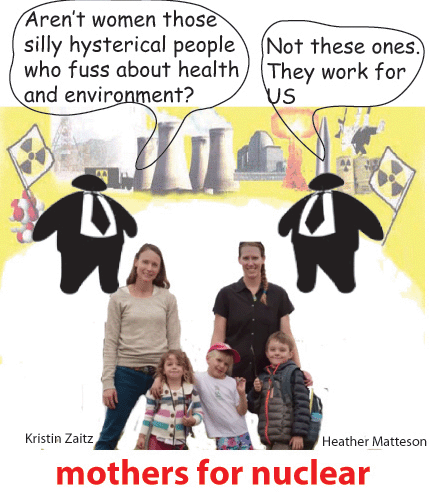
 American Women Step Up as Nuclear Energy Advocates VOA August 25, 2017 Michelle Quinn
Women seen as powerful advocates,
Industry experts say that women who work in nuclear power can be powerful advocates for nuclear. They can help change attitudes of other women who tend to be more skeptical than men about nuclear energy’s benefits.
At the recent U.S. Women in Nuclear conference in San Francisco, women working in the industry talked about how more should be done to make nuclear power’s case to the public, and how they may be the best suited to do it.
“As mothers, I think we also have an important role to play in letting the public know that we support nuclear for the future, for our children,” said Matteson. “And we don’t know other mothers supporting nuclear power in a vocal way. We thought there was a gap to fill.”
Young women say they look at careers in this industry because they are socially minded.
‘Do something good for the world’
“I went into this wanting to do something good for the world,” Lenka Kollar, business strategy director at NuScale, a firm in Oregon that designs and markets small modular reactors. “Wanting to bring power to people. There are still more than a billion people in the world who don’t have electricity.”
Critics of nuclear energy say it doesn’t matter who is promoting it.
“Using mothers’ voices to argue for a technology that is fundamentally dangerous and that has been demonstrated by disasters like Fukushima to be not safe for the communities that surround the power plants or even cities that are hundreds of miles away is disingenuous,” said Kendra Klein, a staff scientist with Friends of the Earth, an environmental group…….https://www.voanews.com/a/american-women-step-up-as-nuclear-energy-advocates/4000185.html
August 26, 2017
Posted by Christina Macpherson |
media, spinbuster, USA |
Leave a comment
Duke Energy Corp. asked to cancel its planned nuclear plant in South Carolina, citing the bankruptcy of reactor manufacturer Westinghouse Electric Co.
North Carolina utility regulators should require customers of the company’s Duke Energy Carolinas unit to pay $353 million of pre-construction costs spent on the Lee Nuclear Station over the next dozen years, the Charlotte-based company said Friday in a state filing.
The decision is the latest blow to the U.S. nuclear industry in the wake of the Westinghouse bankruptcy. South Carolina utilities Scana Corp. and Santee Cooper pulled the plug on a half-finished plant earlier this month after delays and cost overruns, and Southern Co. is weighing whether to halt work on two Georgia reactors. Nuclear units that were operating for decades have shut, unable to compete with low-cost renewable energy and abundant supplies of natural gas from shale basins.
“Risks and uncertainties to initiating construction on the Lee Nuclear project have become too great and cancellation of the project is the best option for customers,” Duke said in a separate statement
A similar request will be made with South Carolina utility regulators in the future, Rick Rhodes, a company spokesman, said by phone Friday. The U.S. Nuclear Regulatory Commission issued a construction and operating license for the plant last year and Duke will maintain that license “to build new nuclear at this site in the future if it is in the best interest of customers.”
NextEra Energy Inc. has said it’s decided to “pause” an expansion of its Turkey Point nuclear plant in Florida, but the company is still seeking approval to obtain and then maintain a federal license for two reactors there.
Duke shares rose 0.8 percent to $87.46 at 12:28 p.m. in New York.
August 26, 2017
Posted by Christina Macpherson |
business and costs, USA |
1 Comment
 Strong indications’ Trump won’t recertify Iranian compliance with nuclear deal
- There are more signs the Trump administration is preparing a case to decertify Iran’s compliance with the international nuclear deal.
- Nikki Haley, the U.S. ambassador to the United Nations, this week visited the atomic watchdog agency in charge of monitoring Iran’s compliance.
- On Thursday, Tehran said it “is abiding by its duties and responsibilities” and accused Washington of using the issue “for ill-wishing political means.” CNBC
Jeff Daniels | The Trump administration is giving “strong indications” that it is preparing a case to decertify
Iran‘s compliance with the international nuclear agreement, an expert says.
If that happens, though, some analysts believe it risks alienating U.S. allies. In addition to the United States and Iran, the 2015 nuclear agreement was signed by Britain, France, Germany, Russia, China and the United Nations.
The White House sent Nikki Haley, U.S. ambassador to the United Nations, to Vienna on Wednesday to meet with officials from the International Atomic Energy Agency, which is responsible for monitoring and verifying Iran’s commitments under the 2015 agreement, known as the Joint Comprehensive Plan of Action.
On Thursday, Iran’s state-run IRNA news agency quoted from a letter sent by Iran’s foreign minister to the U.N. agency saying the country “is abiding by its duties and responsibilities” with regard to nuclear weapons and agreements. He accused Washington of using the issue “for ill-wishing political means.”
During her visit, Haley “discussed the IAEA’s verification and monitoring of Iran’s nuclear-related commitments,” according to a statement by the agency. It provided no additional information, and a statement from Haley’s office discussed her visit but shed no light on imminent action.
Last week, Haley said the Tehran government should be held accountable for “its missile launchers, support for terrorism, disregard for human rights, and violations of U.N. Security Council resolutions. Iran cannot be allowed to use the nuclear deal to hold the world hostage.”
The Trump administration has certified Iran’s compliance twice under a law that requires it to notify Congress of Iran’s compliance every 90 days. The next review ends in October.
Analysts say recent actions by the U.S. demonstrate that President Donald Trump plans to renege on the Iran nuclear agreement. During the election campaign, he threatened to rip up the agreement, calling it “the worst deal ever.”
The actions include new U.S. sanctions imposed on Iran and a comment last week by a U.S. official that Iran is in breach of “the spirit” of the nuclear accord. New sanctions were designed to punish Iran for its human rights record, rocket launches as well as its role in terrorism and arms smuggling.
“He’s given strong indications that he’s just not going to recertify it,” said John Glaser, director of foreign policy studies at the Cato Institute, the libertarian think tank.
“If we were to leave the deal or deliberately abrogate it, we’d be isolated internationally and we wouldn’t be able to do anything like reapply sanctions that would do any kind of damage on Iran,” he added. “That’s because the rest of the international community would not sort of play along.”
Glaser said the other parties to the agreement “agree that Iran is compliance with the deal and agree that the deal should be kept in place because it’s a robust, nonproliferation agreement. It has kind of taken military conflict against Iran because of the nuclear program off the table.”
Last week, Iranian President Hassan Rouhani threatened to quit the nuclear pact if the White House issues new sanctions. Iran charged those sanctions were a violation of the nuclear accord…..https://www.cnbc.com/2017/08/25/strong-indications-trump-wont-recertify-iran-nuclear-deal.html
August 26, 2017
Posted by Christina Macpherson |
Iran, politics international, USA |
Leave a comment
Did climate change make Hurricane Harvey worse? https://qz.com/1062574/hurricane-harvey-and-climate-change-did-rising-temperatures-and-sea-levels-make-harvey-worse/ 25 Aug 17, As climatologist Katharine Hayhoe points out, seasonal hurricanes are a natural part of the weather system in the Gulf coast, and attributing the cause of a single storm entirely to climate change is currently an impossible task. “Once you get down to a small regional level, hurricanes are so rare and random that you would not be able to detect a robust trend even if there was one,” says John Nielsen-Gammon, Texas’ state climatologist.
But did climate change-driven factors make Hurricane Harvey more destructive?
The waters of the Gulf of Mexico have been warmer than average this year, with bathtub-like temperatures breaking heat records all last winter.
Researchers can point to a direct relationship between warmer water temperatures and an increase in tropical cyclone formations, but the link between warm water and hurricanes is less clear, in part because hurricanes require several other ingredients, like specific wind patterns, to form.
Climate change is definitely setting up conditions that are known to make storms more destructive, including heating up the oceans. “The warmer the Gulf water is, the greater the amount of moisture will be available” to fuel rainfall, Nielsen-Gammon says.
Officials at the National Hurricane Center predict Hurricane Harvey will bring torrential rainfall of 15 to 25 inches to Texas—with “isolated maximum amounts of 35 inches over the middle and upper Texas coast,” the Center wrote in its latest warning.
Climate change is also heating South Texas faster than most other regions in the US, and the area has been setting heat records all summer. Warmer air temperatures mean the air has a far greater carrying capacity for moisture—which translates to even more rainfall, and more floods.
“We’ve seen an increase of 30% in very heavy rainfall and intensity across Texas,” Nielsen-Gammon says. The US Environmental Protection Agency’s website notes that rainstorms in Texas are “becoming more intense, and floods are becoming more severe…In the coming decades, storms are likely to become more severe.”
And then there’s sea level rise; global warming is raising sea levels along Texas’ coast by almost two inches per decade, according to the EPA. Sea level rise makes storm surges “that much higher,” Nielsen-Gammon says.
Officials currently warn the storm surge for Harvey is expected to bring “life-threatening” flooding at heights of six to 12 feet above ground level along the coast.
Workers at 39 offshore petroleum production platforms and an oil rig in the Gulf of Mexico were evacuated on Thursday in anticipation of Hurricane Harvey, CNN reports. Over the past century, offshore platform heights have risen with sea level and storm intensity, the Atlantic reports; in the 1940s, they were 20 to 40 ft above sea level. In the 1990s, they rose to 70 ft. Now, after Hurricanes Katrina and Rita, platforms in the Gulf sit 91 ft above the sea surface.
Later, after the storm is over, scientists who work on “event attribution” may try to assess whether Hurricane Harvey would have been less intense in the absence of human-driven climate change, much like researchers did with Hurricane Katrina; for example, one team found that under the climate conditions of 1900, Katrina’s storm surge would have been anywhere between 15% and 60% lower.
But for now, researchers, including experts at NASA, point out that the already-clear effects of a changing climate—warmer air, warmer water, and sea level rise—could make any storm that develops more intense.
August 26, 2017
Posted by Christina Macpherson |
climate change, USA |
Leave a comment
 Rick Perry gets his electricity grid study. The coal and mining industries like it. WP, By Steven Mufson August 24 A much-anticipated Energy Department report on the electricity grid made recommendations for regulatory changes that would bolster coal and nuclear power plants.
The changes, if adopted, would alter the way prices are determined in electricity markets, ease environmental reviews for coal plants and speed the permitting process for a variety of energy sources.
The 187-page report rejects the notion that the coal and nuclear plants that have been forced to shut down over the past 16 years had been closed prematurely, noting that cheap, abundant natural gas had been the main factor — not environmental regulations or renewable energy sources as Republican leaders have contended…..
The Energy Department document carries little weight on its own, and most of its recommendations fall in the turf of other departments and agencies.
But the report has been seen as a test of whether the Trump administration is going to politicize government studies and disregard scientific evidence.
The in-depth look at the state of the grid quickly drew praise from coal and nuclear groups, and sharp rebukes from environmental and solar energy groups.
Among the recommendations is one that suggests that the Environmental Protection Agency ease permitting requirements for new investments at coal-fired plants, a process known as new source review…..
The report also endorsed price changes that would prevent solar and wind energy from providing energy at negative prices, which they can do thanks to federal tax credits.
This hurts other energy suppliers, especially in the nuclear industry, and the recommendation was welcomed.
“We’re very pleased with the top line recommendation for the implementation of long overdue energy market reforms,” said Joe Dominguez, executive vice president of regulatory affairs at Exelon, the nation’s largest nuclear power utility.
The report suggested that the Nuclear Regulatory Commission speed up its permitting process ……
Environmental and renewable industry groups slammed the report for failing to deal with climate change and the drive toward low carbon electricity, and noted that the final report differed from earlier drafts that had been leaked……..https://www.washingtonpost.com/business/economy/2017/08/23/fa4a506a-883e-11e7-a50f-e0d4e6ec070a_story.html?utm_term=.00a738b7bf7a
August 26, 2017
Posted by Christina Macpherson |
ENERGY, politics, USA |
Leave a comment