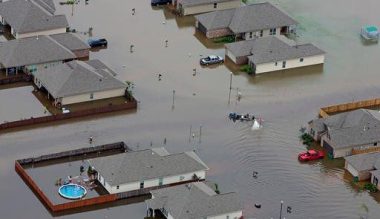
Florida officials begin ordering evacuations as Hurricane Irma intensifies to a Category 5 storm, WP
By Francisco Alvarado, Mark Berman and Sandhya Somashekhar September 5 KEY WEST, Fla. — Another monster storm is hurtling closer to the United States, this time threatening Florida, where officials announced mandatory evacuations Tuesday in advance of what forecasters say could be the most powerful hurricane to strike the Atlantic coast in more than a decade.
Even as millions across Texas picked up the pieces after Hurricane Harvey, which battered that region with record-setting rain last week and was blamed for at least 60 deaths, Hurricane Irma gathered strength in the ocean, registering as a Category 5 with winds in excess of 180 miles per hour.
Concern centered particularly on the Florida Keys, a chain of islands at the southern tip of the state that is a tourist hot spot and home to more than 80,000 residents. It is in the direct path of the storm as currently forecast, leading local officials there to announce that the area would be under mandatory evacuation orders beginning Wednesday.
Haley: Trump ‘has grounds’ to say Iran violating nuclear deal, Politico, By NAHAL TOOSI, 09/05/2017
Donald Trump’s U.N. ambassador says the president “has grounds” to declare that Iran is not complying with the 2015 nuclear deal, stoking doubts about whether Trump intends tokeep an international agreement and core legacy achievement for former President Barack Obama.
Nikki Haley, speaking Tuesday in Washington, said she did not know what Trump plans to do next month when he is due to certify to Congress whether Tehran is complying with the agreement. But she appeared to lay the groundwork for Trump to declare that Iran is in violation of the deal……..http://www.politico.com/story/2017/09/05/trump-iran-violate-nuclear-deal-nikki-haley-242331
WP. By Ben GuarinoSeptember 5 President Trump recently announced his pick for NASA administrator: Rep. Jim Bridenstine (R-Okla.), a former pilot whose goals for our solar system include installing humans on the moon and cleaning up space junk. He also has expressed skepticism about human-caused climate change.
NASA has lacked a permanent administrator since January. The previous one, former astronaut and retired Marine Corps aviator Charles Bolden, resigned the day that Trump took office. NASA’s associate administrator, Robert Lightfoot Jr., stepped in as the temporary head of the agency. Lightfoot holds the record for longest tenure as an acting NASA administrator.
The announcement, on Friday evening before Labor Day weekend, came after months of speculation that the 42-year-old representative from Oklahoma would get the nod. Last year, Bridenstine — a strong supporter of Trump during the presidential race — informally told the Trump campaign he was interested in a leadership role at NASA or the Air Force, The Washington Post reported three days after the November election…….
a bigger question is his stance on earth and climate science. From the House floor in 2013, Bridenstine said that “global temperatures stopped rising 10 years ago,” which is incorrect. In a 2016 interview with Aerospace America, he said that the climate “has always changed,” though remained open to “studying it.”……
Before his election to the House of Representatives, Bridenstine served as a Navy pilot and directed the Tulsa Air and Space Museum. He has not worked as a scientist or engineer, though he was involved with a rocket-powered aircraft league. (The Rocket Racing League — think NASCAR, but with rocket planes — failed to hold any races. “It was before its time,” Bridenstine said to Space News in 2013.)
If confirmed, Bridenstine would be the first politician to serve as NASA administrator. He is a member of the conservative House Freedom Caucus, which has frequently come into conflict with Republican leaders. Those opposed to his nomination, particularly Sens. Marco Rubio (R) and Bill Nelson (D) of Florida, have pointed to his political career as a critical flaw.
SCANA has given money to nearly all South Carolina lawmakers probing the failed nuclear project, Post and Courier, By Thad Moore tmoore@postandcourier.com, Sep 2, 2017 All but one of the 32 lawmakers investigating the demise of the V.C. Summer nuclear project have taken campaign contributions from the utility responsible for building it, highlighting the extent of the power industry’s lobbying efforts in Columbia.
The overwhelming majority have received funds from SCANA Corp., parent company to S.C. Electric & Gas Co., its subsidiaries and political action committees within the last two years, according to a Post and Courier review of campaign finance records. They include 14 who took contributions this year as uncertainties surrounding the construction project mounted.
Those lawmakers, who sit on twin House and Senate committees formed last month, are now tasked with probing what went wrong with the project, which cost $9 billion before construction was halted in July. They’re also responsible for forming ideas on how to limit the financial fallout and create safeguards that prevent another energy failure like it.
The lone lawmaker who didn’t receive contributions was Republican Kevin Hardee of Loris, which is outside of SCE&G’s service territory.
SCANA doesn’t cut big checks — it typically gives individual legislators $500 to $1,000, the maximum for a single election cycle — but critics say the steady dribble of contributions helped build warm relationships under the Statehouse dome.
The Cayce-based utility has also given tens of thousands of dollars to legislative caucus groups, and it spends around $200,000 a year to lobby the General Assembly, with a crew of eight lobbyists to monitor legislation and advance its message.
“They make them because they’re basically trying to gain access,” said Frank Knapp, president and chief executive of the S.C. Small Business Chamber of Commerce, which has called for a ban on utility contributions. “They’re just not after good government. They’re looking for some return on their investment.”
[on original: – details of names of politicians and amounts of money given to each] Continue reading →
Or is an out-of-court settlement announced last week just more of the same?
The attorneys for the plaintiffs who initiated the case describe the agreement as an important step toward finally soothing the nerves of many of the 8.4 million people in Southern California who live within a 50-mile radius of SONGS.
But the settlement has not assuaged a number of other activists, united in their antagonism for the utility that manages the now-shuttered plant, who consider the agreement practically toothless and say it offers false hope.
The federal government was supposed to come up with a long-term storage solution but has never opened a working site.
Michael Aguirre, the former City Attorney of San Diego who is one of the lead attorneys in the plaintiffs’ case, said he understands the scope of the problem.
Under the agreement, Edison will adhere to a quicker schedule to inspect and maintain the canisters containing SONGS waste and will produce a contingency plan should any of them crack or leak. The utility also pledged to give progress reports on a monthly, and then quarterly basis.
In addition, the deal stipulates that Edison make a good faith effort to look at sites to send SONGS waste. That includes spending $4 million to hire a team of experts to develop a strategy. In what Aguirre says is a critical element, the agreement is enforceable by the court, meaning the judge will retain authority to make sure its terms are carried out…….
Potential sites to send SONGS waste
Getting the waste off the beach at San Onofre has long been a priority for many who live in the area. California has a notable history of seismic activity, fueling fears of a Fukushima-like tsunami and SONGS is sandwiched between the Pacific Ocean to the west and Interstate 5, one of the busiest freeways in the U.S., to the east.
The agreement specifically mentions three sites that could potentially accept SONGS spent fuel.
One is the Palo Verde Nuclear Generating Station, located about 50 miles from Phoenix. Even before Monday’s announcement, Aguirre mentioned Palo Verde as a logical place for San Onofre’s waste because Edison is a part-owner at Palo Verde, with a 15.8 percent stake.
The same day the settlement was announced, the utility that operates Palo Verde, Arizona Public Service, said it is not interested in accepting any spent fuel from SONGS……
The agreement also mentions two other sites, one in West Texas and one in southeastern New Mexico.
Each of the sites are categorized as “consolidated interim storage” facilities — based in relatively isolated locations that would require consent from their local communities to accept nuclear waste……..
The West Texas site is more problematic.
Located near the town of Andrews, Texas, the facility is owned by a company called Waste Control Specialists. The site already stores low-level radioactive waste but its plans to expand have been put on hold because of financial problems……..
The group supports moving the waste within the premises of Camp Pendleton.
“It would address the issue of sea level rise,” said Denise Duffield, the group’s associate director. “One of the greatest risks associated with irradiated fuel is terrorism; it is hard to think of a better location to protect it (than) within a Marine base.”………http://www.sandiegouniontribune.com/business/sd-fi-songs-settlement-20170903-story.html
Trump Quietly Promises Billions in New Nuke Contracts, This could trigger a new arms race with Russia and China. The American Conservative By SCOTT RITTER • September 1, 2017 “………Nuclear Armageddon was a pervasive reality during the Cold War, and America had an arsenal and doctrine to make it a reality. Again, flashbacks from my childhood make it all-too real: F-100 fighter-bombers carried nuclear bombs on air-strip alert at an air base in Turkey. F-106 fighter-interceptors armed with nuclear “Genie” air-to-air missiles were on constant air patrol over the skies of Michigan. My father told my mother how he never wanted to be assigned to Strategic Air Command because the “Chrome Dome” mission was insane—packs of nuclear-armed B-52 bombers constantly in the air, flying towards the Soviet Union only to be called back on a routine basis……..
The generals and politicians who controlled this arsenal were schooled in the art of global apocalyptic warfare, having fought and prevailed against fascism in the Second World War. Nuclear war wasn’t an abstraction to them, but reality—America was prepared to fight and win a nuclear exchange with the Soviet enemy, using doctrines with names such as “counterforce,” “first strike,” and “mutually assured destruction,” better known as MAD. Only when the absurdity of the MAD acronym sunk in did these leaders finally undertake to control the arsenal of Armageddon they had created. One of the first agreements reached between the U.S. and the Soviet Union (the anti-ballistic missile, or ABM Treaty) limited their respective defenses against nuclear missile attack, so that neither side would be lulled into a false sense of security and thus be tempted to do the unthinkable.
And yet, even as both American and Soviet leaders sought to limit their respective nuclear forces through negotiations, each side continuously modernized and improved their arsenals to increase the responsiveness, survivability—and ultimately, accuracy and lethality—of the very weapons both parties claimed they never wanted to use. Nuclear war was always a math problem: The first planners calculated that 400 nuclear bombs were all it would take to destroy the communist world. One can assume that the Soviets had similarly calculated that a like-number of their bombs was all they needed to destroy western civilization as well. By the 1970s, each side possessed an arsenal of tens of thousands of nuclear weapons, enough to destroy the planet hundreds of times over………
America’s collective nuclear amnesia has led to the lessons of the past having been largely forgotten. Our military and political leaders have not been schooled by global wars of destruction where hundreds of millions died, but rather minor battlefields where the death toll, while tragic, numbers in the thousands and tens of thousands. We have become accustomed to a war of precision strikes, where threats can be largely dealt with by remote control, either through a drone-delivered missile or a satellite-guided bomb dropped from 30,000 feet. American bodies come home singly or in small groups, enough to remind us of the cost of conflict, but not enough to be painful for anyone but the immediate family and friends of the deceased. The Civil Defense movement has morphed into Emergency Preparedness that is more focused on Mother Nature than nuclear Armageddon.
The Trump administration has just announced that it is moving ahead with an Obama-era plan to modernize America’s nuclear arsenal, sprucing up the nuclear Triad with a new fleet of land-based missiles, missile-carrying submarines, and air-delivered nuclear weapons that will cost the American taxpayer well over $1 trillion in the coming years. The ostensible purpose behind this modernization effort is to maintain America’s nuclear deterrence capability for decades to come. The harsh reality, however, is that through this nuclear upgrade, America is simply repeating the mistakes of the past, building weapons whose precision and speed will trigger a new arms race with Russia and China as they seek to match this new American capability with weapons designed to sustain their version of nuclear deterrence.
Mutually assured destruction (MAD), once relegated to the trash bin of history, has had new life breathed into it. This time there is no foundation of arms control in place to limit the insanity—the ABM treaty is a thing of the past, and America today hides behind the false promise of a missile-defense shield that has questionable utility against a North Korean madman armed with a handful of missiles, let alone a Russian or Chinese military armed with hundreds. Disarmament talks with Russia—once a hallmark of the Trump foreign-policy vision—are stillborn in the face of allegations of election meddling from Moscow.
American tanks patrol the Polish frontier opposite their Russian counterparts, while U.S. and Russian warplanes share the skies over Syria, and play cat and mouse over the Baltics. Into this volatile mix, President Trump now wants to deploy a new generation of nuclear weapons that any enemy possessing a modicum of strategic insight would have no choice but to view as possessing genuine first-strike capability. Given the enhanced performance of these weapons, there will be no “fail safe” mechanism to limit the scope and scale of inadvertent use. There won’t be time for military officers to call home with a furtive warning of impending doom, and “Bert the Turtles” lyrical admonitions to “duck and cover” will be rendered meaningless to a population who has long ago forgotten what it was like to live under the threat of imminent nuclear holocaust. Today Americans are unable or perhaps unwilling to hold their elected leaders responsible as they play nuclear Russian roulette—a game as avoidable as it is insane.
Scott Ritter is a former Marine Corps intelligence officer who served in the former Soviet Union implementing arms control treaties, in the Persian Gulf during Operation Desert Storm, and in Iraq overseeing the disarmament of WMD. He is the author of Deal of the Century: How Iran Blocked the West’s Road to War(Clarity Press, 2017). https://www.theamericanconservative.com/articles/trump-quietly-promises-billions-in-new-nuke-contracts/
The Department of Energy notified its regulators — the Washington State Department of Ecology and the Environmental Protection Agency — on Friday that the deadline could not be met.
But the end remains in sight after two decades of work on cleanup of a plant left highly radioactively contaminated after 40 years of service to the nation.
“Tremendous progress has been made, but for safety and other reasons it will take a few more months,” Doug Shoop, manager of the DOE Hanford Richland Operations Office, said on Friday. Weather and improvements to better protect workers after the spread of radioactive contamination have put the cleanup and demolition project on a slower pace than anticipated over the past nine months.
Shoop expects the plant will be torn down to the ground by the end of this year or possibly early 2018, after two decades of work.
Work has been underway since the ’90s to prepare the plant for demolition, including stabilizing plutonium left in a liquid solution at the plant when it shut down.
Workers have cleaned plutonium and other hazardous material from about 200 pieces of processing equipment and glove boxes. They also have cleaned out 1.5 miles of contaminated ventilation piping and plutonium processing lines, removing most of it from the plant.
Officials at the Department of Ecology are disappointed in the delay, said Ron Skinnerland, manager of Ecology’s Nuclear Waste Program’s waste management section.
But they understand there are good reasons for work to take longer, and they support safe working conditions for employees at the plant, he said.
Haley’s remarks show US envoy’s ignorance of JCPOA text: Iran FM, Press TV, 3 Sept 17Iranian Foreign Minister Mohammad Javad Zarif says the recent remarks by US Ambassador to the United Nations Nikki Haley show her lack of familiarity with the content of the historic nuclear agreement between Iran and the P5+1 group of countries.
“What Ms.Haley has declared mostly show her ignorance of the text of the [nuclear] agreement in all fields, about which she expressed her opinion,” Zarif said in an interview with the official news website of the Iranian administration, dolat.ir, published on Saturday.
He added that the deal, known as the Joint Comprehensive Plan of Action (JCPOA), is a “completely clear and transparent” agreement, adding that the level of monitoring has been determined in it.
He said the JCPOA has been negotiated and written very precisely and has a complete framework with specified approaches in all fields.
Underlining the Islamic Republic’s stance, Zarif tweeted later on Saturday that the International Atomic Energy Agency (IAEA) certifies Iran’s commitment to the nuclear agreement according to the provisions and conditions outlined in the deal, “not the ulterior motives of US officials, nor of lobbyists.”
Iran and the five permanent members of the United Nations Security Council – the United States, France, Britain, Russia and China plus Germany – signed the JCPOA on July 14, 2015 and started implementing it on January 16, 2016.
Under the nuclear agreement, Iran undertook to put limitations on its nuclear program in exchange for the removal of nuclear-related sanctions against Tehran.
Speaking at a news conference in New York on August 25, Haley called on the IAEA to request access to Iranian military sites, in what is regarded as an attempt by Washington to undermine the JCPOA, which is a multilateral nuclear deal.
“We are encouraging the IAEA to use all the authorities they have and to pursue every angle possible with the JCPOA, and we will continue to support the IAEA in that process,” she said.
The IAEA is tasked with monitoring Iranian compliance with the deal, a basically technical matter that falls within the agency’s area of expertise. The IAEA has consistently verified that Iran has been in compliance since the start of the implementation of the deal.
Amid Nuclear Tensions, Trump Mulls Exit From South Korea Trade Deal, NYT, By GLENN THRUSH and GARDINER HARRIS, SEPT. 2, 2017, WASHINGTON — President Trump is considering pulling out of a major trade agreement with South Korea as he tries to fulfill get-tough campaign pledges on international trade. But he has not yet made a final decision, two senior administration officials said Saturday.
SC nuclear debacle, by the numbers, The State 29 Aug 17 , CINDI ROSS SCOPPE “…..What you’ll find here is almost all numbers: the budget, the rate hikes, market share of SC utilities. I’ve also included what state law says about abandoning a nuclear project.
The money
$11 billion: Original projected cost of the two reactors
$20 billion: Minimum projected cost, due to delays and cost overruns, when SCE&G and Santee Cooper decided to abandon the project
$9 billion: What SCE&G and Santee Cooper have spent already on the project
SCE&G
$4.9 billion: Amount of borrowed and stockholder money SCE&G has invested and hopes to recoup
$2 billion: Tax credits SCE&G hopes to receive to offset $4.9 billion investment
$700 million: Payment from Westinghouse parent Toshiba that SCE&G hopes to receive to offset $4.9 billion investment
$2.2 billion: Amount SCE&G will seek to recoup from ratepayers if it receives the tax credits and Toshiba payments
$1.4 billion: Amount SCE&G customers have paid in rate increases to bankroll the two new reactors
9: Rate hikes, so far, that SCE&G has passed on to its customers to pay for the now-abandoned reactors
18 percent: Portion of SCE&G bills that pay for the nuclear project
SANTEE COOPER
$4 billion: Amount borrowed by Santee Cooper, which will have to be paid by ratepayers or taxpayers
$540 million: Amount Santee Cooper customers have paid in rate increases to bankroll the two new reactors
5: Rate hikes, so far, that Santee Cooper has passed on to its customers to pay for the now-abandoned reactors
8 percent: Portion of Santee Cooper bills that pay for the nuclear project
Putin says putting pressure on North Korea is a ‘dead-end road’, By James Griffiths, CNN , 1 Sept 17
Story highlights
US and South Korea conducted a mock bombing drill on the peninsula Thursday
North Korea described the exercise as a “rash act”
Russian President Vladimir Putin has weighed into the North Korea crisis, warning the US and others against going down a “dead-end road” and calling for talks to resolve the issue.
“Russia believes that the policy of putting pressure on Pyongyang to stop its nuclear missile program is misguided and futile,” Putin said in an article released Thursday by the Kremlin, ahead of the BRICS summit in Xiamen, China.
“The region’s problems should only be settled through a direct dialogue of all the parties concerned without any preconditions. Provocations, pressure and militarist and insulting rhetoric are a dead-end road,” Putin said.
Russia was a participant in the six-party talks, which took place in the mid-2000s in an attempt to get North Korea to abandon its then burgeoning nuclear program.
In his published comments, the Russian president said the situation on the Korean Peninsula was “balancing on the brink of a large-scale conflict.”
‘Rash act’
On Thursday, four US F-35B fighter jets joined two US B-1B bombers and four South Korean F-15 fighter jets in a joint US-South Korean drill, which simulated a surgical strike on key enemy facilities, over the Pilsung Range in the eastern province of Gangwon, South Korea.
Pyongyang denounced the drill Thursday, with state news agency KCNA described as “wild military acts.”…….
War games
South Korea and the United States are currently engaged in joint military exercises, which kicked off last week.
At a news conference Thursday, Chinese Ministry of Foreign Affairs spokeswoman Hua Chunying seemed to be referring to the largely simulated drills when she said the situation in the Korean Peninsula “is not like a movie script or computer game.”
The annual exercises always infuriate Pyongyang, and some have called for them to be called off or scaled back as a show of good faith that might bring North Korean leader Kim Jong Un back to the negotiating table…….
Guam has long been a focal point of North Korea’s anger against the US and is often a target of North Korean saber-rattling.
It was threatened specifically by North Korea in 2013 and again in August 2017, following a fiery exchange of threats and insults between Trump and the North Korean regime.
The small island in the Western Pacific is the closest US territory to North Korea and hosts two important US military installations.
One is Andersen Air Force Base, from which the US B-1B bombers flew Thursday. They were joined by F-35 fighters flying from a US Marines base in Iwakuni, Japan.
The F-35 stealth fighters would be a key part of any US pre-emptive strike on North Korea designed to neutralize the country’s defensive and counterstrike capabilities, Jerry Hendrix, a retired Navy captain and senior fellow at the Center for a New American Security, told CNN earlier this month.
Corey Wallace, a security analyst at Freie University in Berlin, told CNN this week the use of the F-35s out of Japan showed the United States had various options for potentially striking North Korea.
“(Washington has) platforms from Guam and Japan linking up and operating together over South Korea with South Korean assets, with all of the governments supporting this,” he said.
This is a long article , but very good, and well worth reading in its entirety
‘It’s Not Going To Be All Right’ In flood-prone coastal Louisiana, towns have started to ask a question Texans may face soon: When should we all just leave? Politico By ANNIE SNIDER, September 01, 2017 HOUMA, La. — If Houston gets serious about preventing massive damage the next time it floods, it may need to learn a lesson from its neighbors in this oil and gas town, just 15 miles up the road from Louisiana’s historic bayou communities.
This town’s residents—roughnecks, shrimpers, shipbuilders and small-business owners—aren’t typically the joining type. And yet dozens have recently begun showing up for an unusual discussion group underwritten by the state and federal government, and dedicated to a question very difficult to grapple with: What happens when the next hurricane hits, sending bayous rising and inundatingthe most flood-prone homes, and people start moving here?
Permanently relocating people is the third rail of disaster planning, the aspect no one—especially politicians—wants to talk about. Local zoning and development decisions have encouraged millions of people to move into floodplains, and federal insurance policies and disaster aid have bailed them out time and again. But as these storms become increasingly costly, and climate change promises to make them more so, it becomes harder to avoid the bigger topic: There are places where people simply shouldn’t live anymore.
Relocation is politically toxic; handled centrally, it is disruptive and interventionist, the kind of move that foments revolutions. But as the state of Louisiana mounts a massive battle against the rising tide, planning and funding ambitious efforts to restore buffering wetlands and build levees and floodgates, it is also beginning to acknowledge to residents that even their best efforts will not be enough—and is asking them to think about what comes next.
With the help of $92.6 million in federal grant money, Louisiana’s Office of Community Development has launched a first-of-its-kind effort to help communities across the state prepare for the tumult to come. Rising waters and escalating flood insurance rates will drive thousands of families farther inland, the state predicts, leaving behind homes they’ve known for generations and places that have fundamentally shaped their identities. But those refugees aren’t the only ones who will experience change. Communities like Houma will experience their own jarring transition as they receive an influx of waterlogged neighbors. Houma sits high enough that it’s less likely to drown in a hurricane, and thanks to its industrial base, could more easily win additional levees and flood protection.
Top: The old Boudreaux Canal School, which has closed since the population of Chauvin has steadily dropped. Bottom: The cemetery at St Joseph Catholic Church, north of Chauvin along Bayou Petit Caillou. | William Widmer for Politico Magazine
“This is the first time that I can remember that a group came in and said it’s not going to be all right,” said Jonathan Foret………
The goal of the new planning effort, dubbed Louisiana’s Strategic Adaptations for Future Environments, or LA Safe,is to head off the worst-case scenario in which people move out of flood-prone areas only once they’ve lost everything, and arrive en masse in communities that aren’t ready to absorb them. It’s a scenario with precedent: After Hurricane Katrina, entire neighborhoods from south and east of New Orleans relocated to the affluent bedroom communities of Covington and Mandeville, north of Lake Pontchartrain, straining schools, clogging roads and leading to resentment among some longtime residents. As far away as Houston, residents complained about “Katrina refugees” sapping local resources…….. http://www.politico.com/magazine/story/2017/09/01/harvey-texas-louisiana-floods-relocation-215565?lo=ap_a1
White House Hires Billionaire War Profiteers To Aid In War Planning, Mint Press News,Blackwater founder Erik Prince and billionaire Stephen Feinberg reportedly “recruited” for war planning, by Jake Johnson July 11th, 2017[good tweets included on original]
Two of President Donald Trump’s closest aides have reportedly solicited advice from two wealthy private military contractors — Erik Prince, founder of Blackwater, and Stephen Feinberg, the billionaire owner of DynCorp International—on how to proceed with the sixteen-year-long war in Afghanistan.
According to the New York Times, White House Chief Strategist Steve Bannon and senior advisor Jared Kushner “recruited” the contractors, who have made a hefty sum from perpetual conflict in the Middle East, “to devise alternatives to the Pentagon’s plan to send thousands of additional troops to Afghanistan.”
Following a meeting with Bannon and Kushner, Prince and Feinberg have “developed proposals to rely on contractors instead of American troops in Afghanistan,” the Times notes.
“The highly unusual meeting dramatizes the divide between Mr. Trump’s generals and his political staff over Afghanistan, the lengths to which his aides will go to give their boss more options for dealing with it and the readiness of this White House to turn to business people for help with diplomatic and military problems,” the Times reports. “But it also raises a host of ethical issues, not least that both men could profit from their recommendations.”
As Common Dreamsreported last month, Prince penned an op-ed in the Wall Street Journal in which he recommended a “viceroy approach” in Afghanistan that would rely heavily on private security forces.
Critics characterized Prince’s proposals as tantamount to “colonialism” and argued they exude “sheer 19th-century bloodlust and thirst for empire.”
ARIZONA REFUSES SPENT FUEL FROM SAN ONOFRE; DOCTOR’S GROUP CRITICIZES NUCLEAR WASTE SETTLEMENT PLAN, East County Magazine August 31, 2017 (San Diego) – Finding a safe place to store spent nuclear fuel from the shuttered San Onofre Nuclear Generating Stations is a daunting task. Yesterday, East County Magazine reported on a settlement reached between Citizens Oversight and Southern California Edison that aspires to move the radioactive waste away from the beach at San Onofre over the next couple of decades.
One of the proposed sites is in Arizona. But now officials at Arizona Public Services Company, which operates the Palo Verde Nuclear Generating Station west of Phoenix, say they won’t take California’s nuclear wastes.
Such a move would require approval from the U.S. Nuclear Regulatory Commission, APS says, but APS won’t be asking for that approval to store fuel from a reactor that’s not their own, AZ Central reports.…..
The settlement’s goal is to reduce the risk of a nuclear catastrophe in densely populated California by eliminating nuclear waste storage just 100 feet or so from corrosive sea water in an area at high risk of earthquake and in a tsunami risk zone as well.
But late yesterday, Physicians for Social Responsibility-Los Angeles warned that the settlement deal “may dramatically increase health and security risks for communities in Southern California and the SouthWestern United States.”
The physicians group concludes that moving the radioactive fuel to a temporary and then permanent storage facility increases risks of a catastrophe through an accident or terrorist attack which could be “devastating,” said Denise Duffield, associate director of the organization.
The group agrees that Southern California Edison’s plan to bury waste on the beach is “inappropriate” given the risk of rising sea levels and the “daunting task of protecting it from terrorist attack in such an accessible location.”
Simply transferring such risk to people in other states is not the best solution, the doctors’ group argues, while noting that U.S. nuclear waste policy has been “broken for decades.”
Yucca Mountain in Nevada, long touted as a possible nuclear waste repository, has been found to be unsuitable due to water penetration that could lead to contamination of water supplies. Two other potential sites mentioned by the physicians’ group have been a “low level” radioactive waste site in Texas and another in new Mexico near the Waste Isolation Pilot Project that recently failed dramatically with an underground explosion and fire that “resulted in plutonium being released into the atmosphere,” the press release from the physicians’ group states.
The only “reasonable alternative” in the view of Physicians for Social Responsibility, would be an option also on the list proposed by Citizens Oversight. That option would be to move the nuclear waste to an inland location on Camp Pendleton where it would be safe from sea level rise, away from public access, and easier to protect against terrorism.
The settlement stemmed from a lawsuit filed by Citizens Oversight against the California Coastal Commission over its approval of a permit to store the dangerous wastes in underground containers near the shoreline at San Onofre.
Under the settlement, a plan must be established by 2035 including use of top experts in spent nuclear fuel transportation, nuclear engineering, spent fuel siting and licensing, radiation detective and monitoring to advise on proposed relocation. The deal also requires regular reporting and oversight.
Song, Mattis reportedly discuss redeployment of tactical nuclear weapons to South Korea, The Hankyoreh, Sep.1,2017
The subject was said broached during the first day of SK Defense Minister’s visit to US
The South Korean and US defense leaders discussed the issue of deploying tactical nuclear weapons on the Korean Peninsula during their meeting on Aug. 30, according to sources.
This marks the first official confirmation of discussions on the tactical nuclear weapon issue between top-level South Korean and US government figures. Critics are calling the discussions a hasty move that could fuel political controversy and confuse the issue of Seoul’s stated opposition to tactical nuclear weapons.
South Korean Minister of National Defense Song Young-moo met with US Secretary of Defense James Mattis at the Pentagon on Aug. 30 and broached the tactical nuclear weapon deployment issue during discussions on amending the South Korea-US missile guidelines, a senior government official reported.
The official remained quiet on the details, saying only that “the tactical nuclear weapon deployment issue was discussed, but it wasn’t anything specific.”
The redeployment of tactical nuclear weapons has become a heated political issue, with conservative parties strongly calling for it as a response to North Korea’s nuclear and missile provocations. It’s also an incendiary issue with bearing on the peninsula’s denuclearization………
Song arrived in the US for a five-day visit on Aug. 29.