Duke Energy’s Levy County nuclear licenses ended by regulators: Duke will switch to solar
Regulators terminate Duke Energy’s Levy County nuclear licenses, Malena Carollo, Tampa Bay Times staff writer, 4 May 18
ST. PETERSBURG — Regulators have finally closed the books on the Levy County nuclear project that never was. The Nuclear Regulatory Commission terminated Duke Energy Florida’s licenses last week for the proposed nuclear reactors at the utility’s request — more than a decade after the project was first proposed.
“Southern Alliance for Clean Energy applauds Duke Energy Florida for formally terminating the licenses for the Levy site,” said Sara Barczak, regional advocacy director for the alliance, in a statement.
The action comes nine months after Duke announced it would no longer make customers pay for the nuclear facility. Duke customers had already paid $800 million on the plant that was never built. The St. Petersburg utility decided to shoulder the remaining $150 million for the project instead of passing it on to customers, saving rate payers about $2.50 on their monthly bills.
Instead of nuclear, the utility will turn its focus to solar and natural gas
We anticipate an increase in solar energy in Florida and have included plans for the addition of over 700 megawatts of solar capacity in the next 10 years,” Ana Gibbs, spokesperson for Duke, said in an email. …..Progress Energy had asked customers to pay up front for the facility, promising the plant would reduce energy costs down the line. But after nearly $1 billion was sunk into the nuclear project, it was never built. In 2013, the venture was canned.
The site where the nuclear plant was supposed to be built is now approved for “unrestricted use.”http://www.tampabay.com/news/business/energy/Regulators-terminate-Duke-Energy-s-Levy-County-nuclear-licenses_167941619
Chairman of nuclear panel adamantly opposed’ to Yucca Mountain as waste dump
 Nuclear panel chair: ‘I remain adamantly opposed’ to Yucca Mountain Las Vegas Sun, By Sun Staff (contact) May 3, 2018
The chairman of the state interim legislative Committee on High-Level Radioactive Waste says he’ll continue to support a 2017 legislative resolution stating opposition to the proposed national nuclear waste repository at Yucca Mountain.
“I remain adamantly opposed to the development of Yucca Mountain as a repository for spent nuclear fuel and high-level radioactive waste, as well as the storage or disposal of spent nuclear fuel and high-level radioactive waste anywhere in the state of Nevada,” the chairman, Assemblyman Edgar Flores, D-Las Vegas, said in a statement. “I will continue to monitor the actions taken on the federal level to ensure that Nevadans’ voices are heard.” …..
Funding for the project was cut off during the Obama administration, but President Donald Trump signaled support for restarting the licensing process by including funding for it in his proposed budget last year. Congress rejected the funding, opting not to include it in the omnibus spending bill, so the project remains in limbo. However, opponents remain concerned that Trump and congressional delegates from other states that support Yucca Mountain will continue trying to revive it. https://lasvegassun.com/news/2018/may/03/nuclear-panel-chair-i-remain-adamantly-opposed-to/
Widening fraud scandal over radioactive contamination clean-up
Former Hunters Point shipyard cleanup workers plead guilty to fraud
First criminal convictions in widening toxic cleanup scandal, Curbed San Francisco , By
Uranium market looking crook – again!
The price of U3O8, a common uranium compound used mainly in nuclear-power generation, has already sunk 12% this year to roughly $21 a pound—near its 12-year low of $18, struck in 2016—according to the Ux Consulting Co….. (subscribers only) https://www.wsj.com/articles/uranium-loses-power-as-u-s-miners-seek-protection-1525424829
NASA ready to radioactively trash another planet – no plan for disposal of wastes from nuclear reactors on Mars

We Now Have A Working Nuclear Reactor for Other Planets — But No Plan For Its Waste,
Futurism, If the power goes out in your home, you can usually settle in with some candles, a flashlight, and a good book. You wait it out, because the lights will probably be back on soon.
But if you’re on Mars, your electricity isn’t just keeping the lights on — it’s literally keeping you alive. In that case, a power outage becomes a much bigger problem.
NASA scientists think they’ve found a way to avoid that possibility altogether: creating a nuclear reactor. This nuclear reactor, known as Kilopower, is about the size of a refrigerator and can be safely launched into space alongside any celestial voyagers; astronauts can start it up either while they’re still in space, or after landing on an extraterrestrial body.
The Kilopower prototype just aced a series of major tests in Nevada that simulated an actual mission, including failures that could have compromised its safety (but didn’t).
………. Nuclear reactors are not an unusual feature in space; the Voyager 1 and 2 spacecraft, now whizzing through deep space after departing our solar system, have been running on nuclear energy since they launched in the 1970s. The same is true for the Mars rover Curiosity since it landed on the Red Planet in 2012.
But we’d need a lot more reactors to colonize planets. And that could pose a problem of what to do with the waste.
If the power goes out in your home, you can usually settle in with some candles, a flashlight, and a good book. You wait it out, because the lights will probably be back on soon.
But if you’re on Mars, your electricity isn’t just keeping the lights on — it’s literally keeping you alive. In that case, a power outage becomes a much bigger problem.
NASA scientists think they’ve found a way to avoid that possibility altogether: creating a nuclear reactor. This nuclear reactor, known as Kilopower, is about the size of a refrigerator and can be safely launched into space alongside any celestial voyagers; astronauts can start it up either while they’re still in space, or after landing on an extraterrestrial body.
But we’d need a lot more reactors to colonize planets. And that could pose a problem of what to do with the waste.
According to Popular Mechanics, Kilopower reactors create electricity through active nuclear fission — in which atoms are cleaved apart to release energy. You need solid uranium-235 to do it, which is housed in a reactor core about the size of a roll of paper towels. Eventually, that uranium-235 is going to be “spent,” just like fuel rods in Earth-based reactors, and put nearby humans at risk.
When that happens, the uranium core will have to be stored somewhere safe; spent reactor fuel is still dangerously radioactive, and releases lots of heat. On Earth, most spent fuel rods stored in pools of water that keep the rods cool, preventing them from catching fire and blocking radiating radioactivity. But on another planet, we’d need any available water to, you know, keep humans alive.
…….Right now, all we can do is speculate — as far as we know, NASA doesn’t have any publicly available plan for what to do with spent nuclear fuel on extraterrestrial missions. That could be because the Kilopower prototype just proved itself actually feasible. But not knowing what to do with the waste from it seems like an unusual oversight, since NASA is planning to go back to the Moon, and then to Mars, by the early 2030s.
And in case you were wondering, no, you can’t just shoot the nuclear waste off into deep space or into the sun; NASA studied that way back in the 1970s and determined it was a pretty terrible idea. Back to the drawing board. https://futurism.com/nuclear-reactor-space-waste/
NASA again hyping its plans for nuclear reactors on Mars
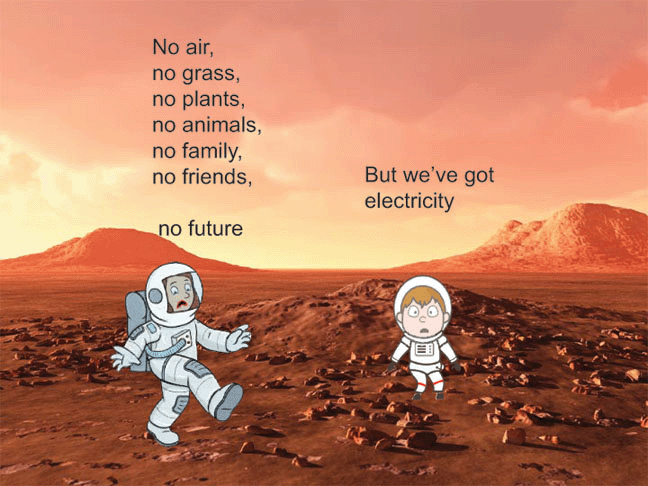
NASA demos little nuclear power plant to help find little green men, Kilopower experiment looks good for 10 kilowatts on the Moon, Mars or beyond By Simon Sharwood, APAC Editor 3 May 2018 NASA has announced successful tests of a small fission reactor capable of producing about 10 kilowatts of power, and hopes the technology will prove suitable for use on the Moon or Mars.
The secret cities behind the atom bomb
 Off the map: the secret cities behind the atom bomb In 1943, three ordinary-looking US cities were constructed at record speed – but left off all maps. They had an extraordinary purpose: to create nuclear weapons as part of the Manhattan project, Guardian, by David Smith in Washington , 3 May 18
Something strange happened in the US state of Tennessee in 1943. Thousands of young workers poured into a 59,000-acre site about 25 miles west of Knoxville. Vast quantities of materials followed, never to re-emerge. Houses and other facilities were built with record speed. Yet officially Oak Ridge did not exist during the war and could not be found on any map.
What was going on there? Very few people knew at the time, even among the residents. The answer was that this was the starting block in a race against Adolf Hitler to build the atom bomb.
Oak Ridge was one of three “secret cities” of the Manhattan Project, along with Los Alamos in New Mexico and Hanford/Richland in Washington state.
More than 125,000 scientists, technicians and support staff occupied the three cities by the end of the war. There is a photo of a Santa Claus being frisked at the gates of Oak Ridge and a local newsletter stamped “restricted”. Anyone aged 12 or over had to wear an ID badge. The use of words such as “atomic” or “uranium” was taboo lest it tip off the enemy.
More than 125,000 scientists, technicians and support staff occupied the three cities by the end of the war. There is a photo of a Santa Claus being frisked at the gates of Oak Ridge and a local newsletter stamped “restricted”. Anyone aged 12 or over had to wear an ID badge. The use of words such as “atomic” or “uranium” was taboo lest it tip off the enemy.
It was late 1942, less than a year after the US had entered the second world war, when the US Army Corps of Engineers quietly began acquiring vast tracts of land in remote areas of three states. The few residents of these areas were summarily evicted and their houses demolished.
…….. Built from scratch in half a year to produce fuel for atomic bombs, Oak Ridge was initially conceived as a town for 13,000 people but grew to 75,000 by the end of the war, the biggest of the secret cities.
……. When the US dropped the atom bomb on Hiroshima, Japan, in 1945, killing tens of thousands of people to force an end to the war, the city’s secret was out. Many residents celebrated. One local newspaper declared: “Atomic super-bomb, made at Oak Ridge, strikes Japan.” Another said: “Oak Ridge Attacks Japanese … Workers thrill as atomic bomb secret breaks; press and radio stories describe ‘fantastically powerful’ weapon; expected to save many lives.”
Not everyone was jubilant, however. Mary Lowe Michel, a typist in Oak Ridge, is quoted in the exhibition as saying: “The night that the news broke that the bombs had been dropped, there was [sic] joyous occasions in the streets, hugging and kissing and dancing and live music and singing that went on for hours and hours. But it bothered me to know that I, in my very small way, had participated in such a thing, and I sat in my dorm room and cried.”……https://www.theguardian.com/cities/2018/may/03/off-the-map-the-secret-cities-behind-the-atom-bomb-manhattan-project
Continued safety concerns about production of “plutonium pits” for nuclear bombs
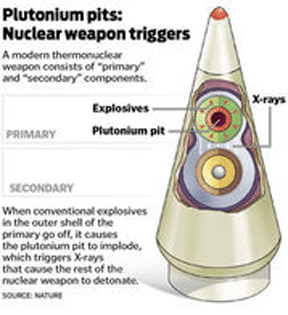 Safety concerns plague key sites proposed for nuclear bomb production, USA Today ,
Decision due soon on where plutonium parts for the next generation of nuclear weapons are to be made
The Department of Energy is scheduled to decide within days where plutonium parts for the next generation of nuclear weapons are to be made, but recent internal government reports indicate serious and persistent safety issues plague both of the two candidate sites.
Some experts are worried about the safety records of either choice: Los Alamos National Laboratory in New Mexico, where plutonium parts have historically been assembled, and the Savannah River Site in South Carolina, where other nuclear materials for America’s bombs have been made since in the 1950s.
An announcement by the Trump administration about the location is expected by May 11 in preparation for the ramped-up production of nuclear warheads called for by the Defense Department’s recent review of America’s nuclear weapons policy.
Recent internal government reports obtained by the Center for Public Integrity have warned that workers at these plants have been handling nuclear materials sloppily or have failed to monitor safety issues aggressively.
A containment failure: How American nuclear regulators undercut power plant safety from the beginning
 Bulletin of Atomic Scientists 4th May 2018 , In 1965, the US Atomic Energy Commission made a fateful decision to license
nuclear power plants that, top safety experts believed, had containment structures that were inadequate to contain dangerous releases of
radioactivity in the case of core-melting accidents.
It was a critical turning point in reactor safety. The AEC’s downgrading of the containment’s role opened the door to smaller, cheaper, “dynamic”
containments, which offered significantly less protection in case of a fuel melt accident. Buyers of nearly four dozen large US power reactors opted
for the most vulnerable of such containments, of which 30 remain in
operation.
Because of their inadequate containments, they should all be retired. All but one have exceeded their original 40-year license
durations. New plants shouldn’t be licensed unless they include containments that actually do what they were originally supposed to do –
contain all radioactive material, even in a worst-case melt-down of a nuclear reactor core.
Climate Change Turns Coastal Property Into a Junk Bond
Climate Change Turns Coastal Property Into a Junk Bond, The returns can be great, unless the investment winds up under water. Bloomberg, By Noah Smith, May 3, 2018 “……… Even in the worst-case scenario, sea level rise will be moderate by 2050 — perhaps 1 or 2 feet along most U.S. east coast locations. And there’s a good chance it will be much less.
A rise of that magnitude doesn’t sound like a lot. But it would inundate a number of low-lying coastal areas. The National Oceanic and Atmospheric Administration’s sea level rise viewer app lets you play around with the data and look at maps. Even a moderately bad climate-change scenario could swamp some pieces of coastal real estate within a few decades.
But sea level rise isn’t a gradual, steady thing. The ocean is not a still bowl of water, but a roiling mass tossed around by winds and tides. Long before coastal areas are permanently underwater, they’ll experience increased risk of catastrophic flooding. Hurricane Harvey, which last year flooded much of the city of Houston and became the second most expensive natural disaster in U.S. history (behind another wind-induced coastal flood, 2005’s Hurricane Katrina), is probably a harbinger of more frequent storm-driven disasters.
So for the next few decades, climate change probably won’t send coastal real estate prices crashing, but it does create a tail risk for buyers. Increased probability of coastal flooding makes waterfront real estate a bit like a junk bond — something that will probably go up in value, but has a small to moderate chance of going to zero. Junk bonds generally don’t have a value of zero, but the risk of devastation definitely does depress their selling price.
Recent research confirms that the climate threat is already showing up in prices. Economists Asaf Bernstein, Matthew Gustafson and Ryan Lewis have a recent paper showing that houses exposed to sea-level rise of between 0 and 6 feet have been selling at a 7 percent discount relative to houses a similar distance from the beach that aren’t exposed. The time period they look at is 2007-2016 — before the damage from Harvey. They also confirm that the discount is higher in locations where people report more worry about climate change.
Another recent study, by environmental researchers Jesse Keenan Thomas Hill and Anurag Gumber, shows something similar. Focusing on Miami-Dade County, they show that higher-elevation locations have risen in price faster than similar locations at low elevations. That’s consistent with the theory that wealthy buyers pay a premium to escape flooding risk. High-elevation areas could also have other benefits, of course, such as increased safety from crime — but with crime down dramatically in Miami, this is a less convincing explanation of the increased elevation premium.
In fact, the price differences these economists find may be understating people’s worries about climate change, because of flood insurance. The U.S. government insures many coastal properties against floods, mostly in Texas and Florida. The National Flood Insurance Program charges below-market premiums to many of the riskiest houses, effectively subsidizing owners of the properties most vulnerable to coastal flooding.
So evidence shows that landlords, homeowners and real estate investors are now taking climate change seriously. Polls still find a big partisan gap in concern about climate change, with 67 percent of Republicans claiming that they worry only a little or not at all. But in financial markets, the reality of the phenomenon is starting to be felt. Noah Smith at nsmith150@bloomberg.net https://www.bloomberg.com/view/articles/2018-05-03/flood-risk-makes-coastal-real-estate-look-like-a-junk-bond
Holtec’s “temporary” nuclear waste dump could be a permanent problem for this American community

Meeting on Holtec proposal fills conference room; Opinions polarized on plan to store nuclear waste in southeast New Mexico, Roswell Daily Record By Vistas
Nuclear industry ‘s struggle to survive – launches huge public relations push
Given that offshore wind is expected to continue falling in price and is being built at the moment, unlike nuclear, the economic case for new reactors in the U.K. appears to diminish by the day.
Similar challenges face nuclear elsewhere in Western Europe.
But the situation in the U.S. is even worse. In America it is now no longer economically viable to keep existing plants running, let alone build new ones.
 How the Nuclear Industry Is Fighting Back, The beleaguered nuclear power sector has launched a charm offensive in a bid to stay relevant. Greentech Media , APRIL 30, 2018 The West’s nuclear industry has embarked on its biggest public relations push ever in a bid to stay relevant to policymakers increasingly focused on renewables.
Recent weeks have seen a coordinated campaign by two of the sector’s top agencies to claw back support for a technology that is struggling to remain economically viable and is in danger of being sidelined in discussions over future energy pathways in Europe and North America.
In the U.S., the Nuclear Energy Institute (NEI) kicked off proceedings in an apparently low-key fashion. With little fanfare, the Institute’s website had a facelift in early March, dispensing with its former staid design and adopting a more modern look with bold type and plenty of video.
In the place of headlines about developments in nuclear technology, the NEI’s site now plays inspirational messages over images of children, cityscapes and electric cars. “Carbon-free. Available 24/7. Powering communities,” it says. “Vital to our clean energy future.”
Soon after, the NEI began talking up its annual briefing for the financial community, which, for the first time, was being streamed live on Facebook.
 Ominously for an industry where new developments always seem plagued with delays, the livestreaming event started late due to technical problems.
Once underway, NEI president and CEO Maria Korsnick lost no time in stating the case for ongoing nuclear energy support. . …..
OECD’s nuclear group weighs in Less than 24 hours after the NEI event, the Nuclear Energy Agency of the Organization for Economic Co-Operation and Development (OECD) took the helm of the industry’s communications machine with the launch of a major report.
The Full Costs of Electricity Provision was unveiled by the NEA’s director-general, William D. Magwood IV, and senior economist, Jan Horst Keppler, along with NEI’s senior director of policy development, Matthew Crozat, and nuclear advocate Kirsty Gogan. …..
A glance through the 214-page document shows it to be a serious attempt by the NEA to reframe the parameters of current energy policy discussions and head off one of two major threats facing the sector.
While nobody disputes nuclear power’s ability to deliver significant quantities of baseload, [?] carbon-free energy, the industry has long wrestled with safety concerns and more recently found itself outflanked by the economics of Western electricity markets.
It is likely that the nuclear sector has learned to take safety accusations in its stride. For years, advocates have been claiming that nuclear power is safer than any other form of electricity generation (although Greenpeace disputes this).
Those arguments didn’t stop nations such as Germany or Italy from turning against nuclear in the wake of the Fukushima Daiichi disaster, however.
And more recently, nuclear plant operators in Europe and, particularly, the U.S. have been worrying over an even bigger concern: cost. In markets such as the U.K., new nuclear is looking increasingly pricey next to renewables.
Last September, for instance, offshore wind — theoretically one of the most expensive forms of mainstream renewable energy generation — undercut the strike price for the U.K.’s Hinkley Point C project by almost 38 percent.
Given that offshore wind is expected to continue falling in price and is being built at the moment, unlike nuclear, the economic case for new reactors in the U.K. appears to diminish by the day, even though the government has restated its commitment to a diverse energy mix.
Similar challenges face nuclear elsewhere in Western Europe. Only two commercial nuclear reactors, Flamanville 3 and Olkiluoto 3, are under construction in the European Union. Both are massively delayed and over budget. But the situation in the U.S. is even worse.
In America it is now no longer economically viable to keep existing plants running, let alone build new ones.
The dire situation facing reactors in U.S. markets flooded with cheap gas and renewables is prompting desperate measures from plant owners in states such as Minnesota and New Jersey. And the NEA report is designed to force a rethink in how these markets are set up. …… Its main finding is that the external costs of the normal operations of electricity generation exceed the costs of other phases of the life cycle of electricity generation, as well as the costs of major accidents, “by at least one order of magnitude.”
…… The problem is that the NEA’s clear interest in promoting nuclear energy somewhat taints the impartiality of the report, opening it up to criticism from observers.
….A one-sided interpretation? Amory Lovins, the notoriously anti-nuclear Rocky Mountain Institute (RMI) chief scientist and co-founder, pulled no punches over the NEA’s attempt to calculate all-in energy costs. A large body of literature, with widely varying quality and independence, has already done this, he said.
“NEA endorses a one-sided interpretation of that literature,” he said. “The workshop that framed and steered this report was co-chaired by two well-known nuclear advocates, making NEA an extension and official endorser of the nuclear industry’s main advocacy group.”
He offered up a long list of potential flaws in the report, including selective citations, assumed rather than observed technology costs, no analysis of financing cost, no mention of risk premiums or construction times, the use of old pricing data, and factually incorrect claims.
Some points of the analysis are largely or wholly correct, but most sections and the broad conclusions are not, he told GTM. “They will be credible only to the credulous or already-committed,” he said. …
Legal discussions over failed nuclear plants – will result in tougher regulations
 Tougher utility regulations advance, as attorneys argue over failed S.C. nuclear project https://www.postandcourier.com/business/tougher-utility-regulations-advance-as-attorneys-argue-over-failed-s/article_872a5b7c-4d5d-11e8-8743-b78c8b42b82a.html, By Andrew Brown abrown@postandcourier.com
Pompeo: Trump Will Drop Iran Nuclear Deal ‘If We Cannot Fix It’
https://www.rferl.org/a/iran-nuclear-deal-us-pompeo-israel/29199116.html Speaking to journalists alongside Israeli Prime Minister Benjamin Netanyahu while visiting Tel Aviv on April 29, U.S. Secretary of State Mike Pompeo said President Donald Trump had “directed the administration to try and fix” the Joint Comprehensive Plan of Action (JCPoA) — a multilateral agreement reached in 2015 to curb Iran’s nuclear program. Should that prove impossible, Pompeo said Trump was “going to withdraw from the deal.” (Reuters)
America’s over-loaded plutonium waste sites pose a serious danger
 Science Recorder 27th April 2018 , The U.S. Energy Department has 54 metric tons of surplus plutonium at sites
across the country and cannot decide what to do with it, according to department officials. Nuclear researchers warn that many of these sites are
storing more of the radioactive substance than is safe and that a mishap at any one of them could lead to full-blown disaster.
https://sciencerecorder.com/article.php?n=united-states-has-too-much-deadly-plutonium-on-its-hands&id=144178
1 This Month





PLEASE OPPOSE HR 8255 AND S.3639 – bills would accelerate satellite deployment, with no environmental review or safeguards – https://ncstd5li.quorum.us/campaign/169331/
To see nuclear-related stories in greater depth and intensity – go to https://nuclearinformation.wordpress.com
-
Archives
- October 2026 (39)
- September 2026 (339)
- August 2026 (330)
- July 2026 (355)
- June 2026 (287)
- May 2026 (306)
- April 2026 (356)
- March 2026 (251)
- February 2026 (267)
- January 2026 (308)
- December 2025 (358)
- November 2025 (359)
-
Categories
- 1
- 1 NUCLEAR ISSUES
- business and costs
- climate change
- culture and arts
- ENERGY
- environment
- health
- history
- indigenous issues
- Legal
- marketing of nuclear
- media
- opposition to nuclear
- PERSONAL STORIES
- politics
- politics international
- Religion and ethics
- safety
- secrets,lies and civil liberties
- spinbuster
- technology
- Uranium
- wastes
- weapons and war
- Women
- 2 WORLD
- ACTION
- AFRICA
- Atrocities
- AUSTRALIA
- Christina's notes
- Christina's themes
- culture and arts
- Events
- Fuk 2022
- Fuk 2023
- Fukushima 2017
- Fukushima 2018
- fukushima 2019
- Fukushima 2020
- Fukushima 2021
- general
- global warming
- Humour (God we need it)
- Nuclear
- RARE EARTHS
- Reference
- resources – print
- Resources -audiovicual
- Weekly Newsletter
- World
- World Nuclear
- YouTube
-
RSS
Entries RSS
Comments RSS

