“A Space Force is not an aspiration unique to the Trump administration, of course,” she continued on the Beyond Nuclear International website of the Takoma Park, Maryland group, “but it feels worse in his reckless hands.”
New book: Climate Scientist Michael E. Mann and political cartoonist Tom Toles join forces
Amazon 23rd June 2018 Climate Scientist Michael E. Mann and political cartoonist Tom Toles have
been on the front lines of the fight against climate denialism for most of
their careers. In The Madhouse Effect, the two climate crusaders team up to
take on denialists and their twisted logic. Toles’s cartoons and Mann’s
expertise in science communication restore sanity to a debate that
continues to rage despite widely acknowledged scientific consensus—and
may even hit home with die-hard doubters. This paperback edition includes a
new chapter on the Trump administration’s attack on climate science.
https://www.amazon.co.uk/Madhouse-Effect-Threatening-Destroying-Politics/dp/0231177860
124,000 tons of low grade radioactive soil being dumped at Michigan landfill
NBC26 , Alan Campbell, Jun 22, 2018 VAN BUREN TOWNSHIP, Mich. — There are questions about radioactive soil and materials coming from out of state to the Wayne County landfill in Michigan.
Trump administration getting ready for nuclear war in space
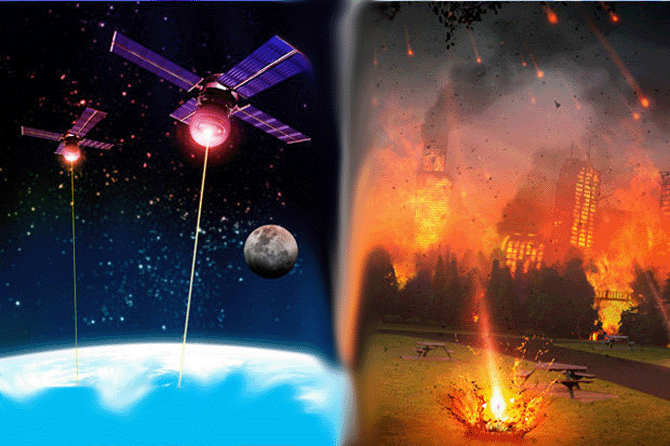
Star Wars Redux: Trump’s Space Force, Counter Punch
 If Donald Trump gets his way on formation of a Space Force, the heavens would become a war zone. Inevitably, there would be military conflict in space.
The Outer Space Treaty of 1967 which designates space as the global commons to be used for peaceful purposes—and of which Russia and China, as well as the United States, are parties—and the years of work facilitating the treaty since would be wasted.
If the U.S. goes up into space with weapons, Russia and China, and then India and Pakistan and other countries, will follow.
Moreover space weaponry, as I have detailed through the years in my writings and TV programs, would be nuclear-powered—as Reagan’s Star Wars scheme was to be with nuclear reactors and plutonium systems on orbiting battle platforms providing the power for hypervelocity guns, particle beams and laser weapons.
This is what would be above our heads.
Amid the many horrible things being done by the Trump administration, this would be the most terribly destructive. “It is not enough to merely have an American presence in space, we must have American dominance in space,” Trump said at a meeting of the National Space Council this week.
“Very importantly, I’m hereby directing the Department of Defense and Pentagon,” he went on Monday, “to immediately begin the process necessary to establish a Space Force as the sixth branch of the armed forces; that is a big statement. We are going to have the Air Force and we are going to have the Space Force, separate but equal, it is going to be something.”
The notion of the U.S. moving into space with weaponry isn’t new…………..
With the Trump administration, there is more than non-support of the PAROS treaty but now a drive by the U.S. to weaponize space.
It could be seen—and read about—coming.
Star wars returns – Free speech tv. 1 of 3
“Under Trump, GOP to Give Space Weapons Close Look,” was the headline of an article in 2016 in Washington-based Roll Call. It said “Trump’s thinking on missile defense and military space programs have gotten next to no attention, as compared to the president-elect’s other defense proposals….But experts expect such programs to account for a significant share of what is likely to be a defense budget boost, potentially amounting to $500 billion or more in the coming decade.”
Intense support for the plan was anticipated from the GOP-dominated Congress. Roll Call mentionedthat Representative Trent Franks, a member of the House Armed Services Committee and an Arizona Republican, “said the GOP’s newly strengthened hand in Washington means a big payday is coming for programs aimed at developing weapons that can be deployed in space.”
In a speech in March at the U.S. Marine Corps Air Station near San Diego, Trump declared: “My new national strategy for space recognizes that space is a war-fighting domain, just like the land, air, and sea. We may even have a Space Force—develop another one, Space Force. We have the Air Force; we’ll have the Space Force.”
Bruce Gagnon, coordinator of the Global Network Against Weapons and Nuclear Power in Space, notes that Trump cannot establish a Space Force on his own—that Congressional authorization and approval is needed. And last year, Gagnon points out, an attempt to establish what was called a Space Corps within the Air Force passed in the House but “stalled in the Senate.”
“Thus at this point it is only a suggestion,” said Gagnon of the Maine-based Global Network.
“I think though,” Gagnon went on, “his proposal indicates that the aerospace industry has taken full control of the White House and we can be sure that Trump will use all his ‘Twitter powers’ to push this hard in the coming months.”
Meanwhile, relates Gagnon, there is the “steadily mounting” U.S. “fiscal crisis…Some years ago one aerospace industry publication editorialized that they needed a ‘dedicated funding source’ to pay for space plans and indicated that it had come up with it—the entitlement programs. That means the industry is now working to destroy Social Security, Medicare, Medicaid and what little is left of the welfare program. You want to help stop Star Wars and Trump’s new Space Force. Fight for Social Security and social progress in America. Trump and the aerospace industry can’t have it both ways—it’s going to be social progress or war in space.”
As Robert Anderson of New Mexico, a board member of the Global Network, puts it: “There is no money for water in Flint, Michigan or a power grid in Puerto Rico, but there is money to wage war in space.”
Or as another Global Network director, J. Narayana Rao of India, comments: “President Donald Trump has formally inaugurated weaponization of space in announcing that the U.S. should establish a Space Force which will lead to an arms race in outer space.”
Russian officials are protesting the Trump Space Force plan, “Militarization of space is a way to disaster,”Viktor Bondarev, the head of the Russian Federation Council’s Defense and Security Committee, told the RIA news agency the day after the announcement. This Space Force would be operating in “forbidden skies.” He said Moscow is ready to “strongly retaliate” if the US violates the Outer Space Treaty by putting weapons of mass destruction in space.
And opposition among legislators in Washington has begun. “Thankfully the president cannot do it without Congress because now is NOT the time to rip the Air Force apart,” tweeted Senator Bill Nelson of Florida.
“Space as a warfighting domain is the latest obscenity in a long list of vile actions by a vile administration,” writes Linda Pentz Gunter, who specializes in international nuclear issues for the organization Beyond Nuclear, this week. “Space is for wonder. It’s where we live. We are a small dot in the midst of enormity, floating in a dark vastness about which we know a surprising amount, and yet with so much more still mysteriously unknown.”
To save the world, we don’t need Trump’s charisma: we need co-operative bureaucratic processes
Charisma in the nuclear age is a bitch. A century ago, the great German sociologist Max Weber showed that modern political authority has two varieties: charismatic and bureaucratic. Charismatic authority is based on personality and is disruptive; bureaucratic authority is based on rules and promises continuity.
 Charisma in the nuclear age https://thebulletin.org/charisma-nuclear-age11926, SHARON SQUASSONI Sharon Squassoni is research professor at the Institute for International Science and Technology Policy, Elliott School of International Affairs, at the George Washington University.
From his speech patterns to his body language, President Donald Trump exudes charisma. Perhaps to the despair of more stalwart democratic leaders, he acts instinctively rather than methodically. His approach to the historic Singapore summit with North Korean leader Kim Jong Un was, he told the press, to size up Kim in the first few minutes and ascertain whether a deal was possible.
And so it was. On the heels of a testy G-7 summit and months of name-calling between Trump and Kim, observers may be grateful that the summit went so well. The two leaders smiled, shook hands, and posed for the cameras. They shared a meal and signed a single page of vague goals that may or may not be realized. And while President Trump personally assured US citizens on Twitter that they could all sleep more safely on Tuesday evening because of the summit, there are many miles to go before anyone sleeps.
Charisma in the nuclear age is a bitch. A century ago, the great German sociologist Max Weber showed that modern political authority has two varieties: charismatic and bureaucratic. Charismatic authority is based on personality and is disruptive; bureaucratic authority is based on rules and promises continuity. Does this sound like two presidential candidates in the 2016 US election? We know who won.
Disruption has its virtues, and while Donald Trump’s campaign statements illustrated his limited understanding of the North Korean nuclear crisis, they also showed he was fearless in his embrace of unorthodox approaches to solving the problem. He called Kim Jong-un a “maniac,” but said—more than a year ago—that he was willing to negotiate with him. Candidate Trump believed China had “total control” over North Korea and could make Kim “disappear.” Ignoring decades of historical context, he flirted with taking troops out of South Korea and Japan and suggested he could support Japan’s development of nuclear weapons in response to North Korea.
As president, Trump’s approach to North Korea’s nuclear weapons has ricocheted from a strategy of isolation and maximum pressure designed to topple Chairman Kim to speculation about beachfront condos replacing missile test launch sites. Expert heads are spinning.
While Trump has focused on his personal relationship with Kim (bad or good), bureaucrats have been left to tidy up the messy details, like guessing which targets might be within range of Kim’s nuclear-tipped missiles, ensuring that missile alerts don’t falsely terrify ordinary people in Hawaii, and musing about whether a deterrence relationship with North Korea is even possible. (They concluded it wasn’t, in part because Kim continued to burnish his brutal dictator brand with firing squads and nerve agent assassination for those deemed a threat or an annoyance to him. Not to mention the long list of human rights violations he has inflicted on his people.).
Trump’s charismatic and chaotic brand of leadership may have helped jump-start talks about North Korea’s nuclear program, but it is inherently dangerous. Eight months ago, the world worried that the personal animosity could cause Trump and Kim to stumble into war; today, the world worries that Trump’s new-found admiration of Kim could lead to the ruin of post-war alliances that have helped to stabilize Northeast Asia. Japan has largely been sidelined, and South Korea was blindsided by Trump’s casual reference during the summit to the end of war-games. Exactly how that US concession will play out is still unclear. Both allies will likely try to make the best out of a bad situation.
The only hope for successful denuclearization will require Trump and Kim to step back and let their worker bees establish a methodical process by which commitments on both sides can be assessed. The only way to make real progress is to establish baselines, identify weapons of mass destruction capabilities, eliminate or somehow repurpose them, and put in place monitoring to ensure those capabilities are not reconstituted.
This is unsexy and uncharismatic work—exactly the kind of thing that we pay disinterested bureaucrats to accomplish. Hopefully, experts with decades of experience—experts therefore unlikely to be fooled by North Korean disinformation—can be put to the task. A few have recently left the State Department; only one seasoned expert on North Korea, Ambassador Sung Kim, was on the US delegation in Singapore.
Unfortunately, Trump has little appreciation for the nuts and bolts of governing, and his administration has devoted considerable attention to stripping away government capabilities. With luck, Secretary of State Mike Pompeo may be able to find experts who are willing to work on this enormous task. He should look beyond the intelligence community. He needs real diplomats, too.
One small but curious element of the Singapore joint statement was a reference to this as a “first historic summit.” President Trump told the press that he and Kim might meet many times, even at the White House or in Pyongyang. For the sake of democracy and global security, we don’t need more summits. It’s time instead to let US government experts do what they do best—careful, cautious negotiation and implementation that produce lasting, verifiable results.
Pro nuclear spruik of Michael Shellenberger is getting weirder and weirder
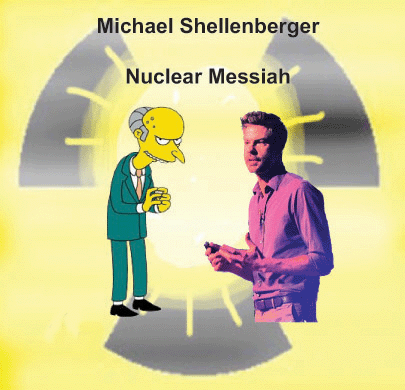
Steve Dale Nuclear Fuel Cycle Watch South Australia, 21 June 18
Shellenberger’s latest article is pretty strange and contradicts a lot of things I’ve heard from his local supporters.
Most unusual is that he calls nuclear waste a “blessing” – “But achieving that future will first require that we abandon our ridiculous fears and start seeing nuclear waste as the environmental blessing that it is.”
He also doesn’t want nuclear waste moved – not even from the reactor, let alone the USA. He says “Don’t Move The Waste” and “transporting cans of used nuclear waste would increase the threat to the continued operation of our life-saving nuclear plants.” This sort of contradicts the whole push of the NFCRC.
Shellenberger proposes that money set aside for storing nuclear waste for millennia should be diverted to nuclear plants, he says “It should be used to subsidize the continued operation of economically distressed nuclear plants, and subsidize the building of new ones.”
When a nuclear accident occurs we are usually told it’s because it is an old or aging plant? Well Shellenberger claims “Nuclear plants are functionally immortal. Existing plants can operate for 60, 80, 100 years or longer because everything inside the plant from the control panels to the steam generators and even the reactor vessel itself can be replaced, if needed.”
And I’ve heard local nuclear lobbyists claim new “waste eating” reactors are just around the corner, less than 10 years away, but Shellenberger says – “Sometime between 2050 and 2100, new nuclear plants — like the kind being developed by Bill Gates — will likely be able to use the so-called “waste” as fuel.”
I wonder what Shellenberger’s local supporters would think of this article? If Shellenberger gets his way, millennia lasting nuclear waste will be stored in half-inch thin, welded casks (see picture below) for centuries – by which time it would be too fragile to move.
The Forbes article is “Stop Letting Your Ridiculous Fears Of Nuclear Waste Kill The Planet” https://www.facebook.com/groups/1021186047913052/
Senator Heller Successfully Keeps Yucca Mountain out of Defense Bill Approved by the U.S. Senate
 June 18, 2018 The U.S. Senate today passed its annual defense authorization bill with three key provisions championed by U.S. Senator Dean Heller (R-NV) to support Nevada’s disabled veterans and veterans struggling with mental illness and to remove the $30 million to store defense nuclear waste at Yucca Mountain that was included in the version approved by the U.S. House of Representatives. The legislation, formally named the John S. McCain National Defense Authorization Act (NDAA) for Fiscal Year 2019, increases funding for training across all service branches and authorizes a 2.6 percent pay raise for troops – the largest increase in nine years for U.S. service members. Moving forward, both chambers will need to convene a joint conference committee in which representatives, who are appointed by leadership in the U.S. House of Representatives and U.S. Senate, reconcile the two versions of the defense bill and must produce a final report.
Heller worked with the U.S. Senate Armed Services Committee and the U.S. Senate Appropriations Committee to keep funding and an authorization of funding to revive Yucca Mountain out of the U.S. Senate’s version of the NDAA. Earlier this year, Heller urged U.S. Senate Armed Services Committee Chairman John McCain (R-AZ) to honor the will of the U.S. Senate appropriators and to exclude any language that authorizes funding for Yucca Mountain in the NDAA. Heller’s letter to Chairman McCain can be found HERE.
“Congress has an obligation to support our men and women in uniform, and that’s why I welcome the U.S. Senate’s passage of legislation that will give Nevada’s service members the largest pay raise in nearly a decade, provide our military with the resources it needs to keep America safe, and support Nevada’s 300,000 veterans. I’m proud that this legislation includes my provisions to support Nevada’s disabled veterans and help our veterans who may be struggling with mental illness and having difficulty finding work,” said Heller. “Furthermore, unlike the U.S. House of Representatives-passed version of the bill that contains $30 million to revive Yucca Mountain, I’m pleased I was able to work with Chairman McCain and U.S. Senate appropriators to successfully ensure that our bill did not include a single dollar authorized for Yucca Mountain. So once again, while the U.S. House of Representatives charges forward with shipping nuclear waste to Nevada, I kill their efforts in the U.S. Senate. While this is progress, we still have more work to do to stop the U.S. House of Representatives from turning Nevada into a nuclear waste dump. I remain committed to doing everything that I can to make sure that Yucca Mountain remains dead.”…….https://www.heller.senate.gov/public/index.cfm/pressreleases?ID=89EE1BBB-BB73-42D9-A192-038B549AADC4
Donald Trump says North Korean leader Kim Jong Un had committed to destroy a western North Korea missile site: USA names it
U.S. identifies North Korea missile test site it says Kim committed to destroy , Matt Spetalnick,
WASHINGTON (Reuters) 21June 18- The missile engine test site that President Donald Trump said North Korean leader Kim Jong Un had committed to destroy is a major facility in the western part of the country that has been used for testing engines for long-range missiles, according to a U.S. official.
Trump told reporters after their June 12 summit that Kim had pledged to dismantle one of his missile installations, which would be North Korea’s most concrete concession at the landmark meeting in Singapore.
However, the president at the time did not name the site.
A U.S. official identified it on Wednesday as the Sohae Satellite Launching Ground, saying North Korea “has used this site to test liquid-propellant engines for its long-range ballistic missiles.”
Pyongyang has said its missiles can reach the United States.
“Chairman Kim promised that North Korea would destroy a missile engine test stand soon,” the official told Reuters, speaking on condition of anonymity.
There was no immediate word on the exact timetable, and North Korea has not publicly confirmed that Kim made such a commitment.
CBS News was the first to identify the site, which is the newest of North Korea’s known major missile testing facilities.
Although Trump has hailed the Singapore summit as a success, skeptics have questioned whether he achieved anything, given that Pyongyang, which has rejected unilateral nuclear disarmament, appeared to make no new tangible commitments in a joint written declaration.
The U.S.-based North Korea monitoring group 38 North said in an analysis at the end of last week there had been no sign of any activity toward dismantling Sohae or any other missile test site.
USA’s nuclear weapons companies need the nuclear weapons race to continue
Eric Sirotkin speaks to RT Int 08012018
North Korea Agreed to Denuclearize, but When Will the US? Marjorie Cohn, Truthout 18 June 18

 A powerful economic incentive continues to drive the nuclear arms race. After the Singapore Summit, the stock values of all major defense contractors — including Raytheon, Lockheed Martin, Northrop Grumman, Boeing and General Dynamics — declined.
Given his allegiance to boosting corporate profits, it’s no surprise that Donald Trump is counterbalancing the effects of the Singapore Summit’s steps toward denuclearization with a Nuclear Posture Review that steers the US toward developing leaner and meaner nukes and lowers the threshold for using them.
The United States has allocated $1.7 trillion to streamline our nuclear arsenal, despite having agreed in the Nuclear Non-Proliferation Treaty in 1968 to work toward nuclear disarmament.
Meanwhile, the US maintains a stockpile of 7,000 nuclear weapons, some 900 of them on “hair trigger alert,” according to the Union of Concerned Scientists.
“If weapons are used they need to be replaced,” Brand McMillan, chief investment officer for Commonwealth Financial Network has argued. “That makes war a growth story for these stocks, and one of the big potential growth stories recently has been North Korea. What the agreement does, at least for a while, is take military conflict off the table.”
Moreover, economic incentives surrounding conventional weapons also cut against the promise of peace on the Korean Peninsula. Eric Sirotkin, founder of Lawyers for Demilitarization and Peace in Korea, has pointed out that South Korea is one of the largest importers of conventional weapons from the United States. If North and South Korea achieve “a lasting and stable peace regime on the Korean Peninsula,” as envisioned by the agreement between Trump and Kim Jong Un, the market for US weapons could dry up, according to Sirotkin.
Even so, US defense spending will continue to increase, according to Bloomberg Intelligence aerospace expert George Ferguson. “If North Korea turns from a pariah state to being welcomed in the world community, there are still enough trouble spots that require strong defense spending, supporting revenue and profit growth at prime defense contractors.”
The US Lags Behind on DenuclearizationLast year, more than 120 countries approved the Treaty on the Prohibition of Nuclear Weapons, which requires ratifying countries “never under any circumstances to develop, test, produce, manufacture, otherwise acquire, possess or stockpile nuclear weapons or other nuclear explosive devices.” It also prohibits the transfer of, use of, or threat to use nuclear weapons or nuclear explosive devices.
Since the treaty opened for signature on September 20, 2017, 58 countries have signed and 10 have ratified it. Fifty countries must ratify the treaty for it to enter into force, hopefully in 2019.
The five original nuclear-armed nations — the United States, Britain, France, Russia and China — boycotted the treaty negotiations and the voting. North Korea, Israel, Pakistan and India, which also have nuclear weapons, refrained from participating in the final vote
During negotiations, in October 2016, North Korea had voted for the treaty.
In advance of the Singapore Summit, dozens of Korean American organizations and allies signed a statement of unity,which says:
Denuclearization of the Korean Peninsula means not only eliminating North Korea’s nuclear weapons but also denuclearizing the land, air, and seas of the entire peninsula. This is not North Korea’s obligation alone. South Korea and the United States, which has in the past introduced and deployed close to one thousand tactical nuclear weapons in the southern half of the peninsula, also need to take concrete steps to create a nuclear-free peninsula. ………https://truthout.org/articles/north-korea-agreed-to-denuclearize-but-when-will-the-us/
A nuclear bomb terrorist attack on New York – the sequence of events
 What a nuclear attack in New York would look like This Is What a Nuclear Bomb Looks Like (picture of a somewhat rusting ordinary van) Ny Mag. 12 June 18
If America is attacked, the strike probably won’t come from North Korea. And it will be even scarier than we imagine. …….
There are currently at least 2,000 tons of weapons-grade nuclear material stored in some 40 countries — enough to make more than 40,000 bombs approximately the size of the one that devastated Hiroshima. Stealing the material would be challenging but far from impossible. Russia stockpiles numerous bombs built before the use of electronic locks that disable the weapons in the event of tampering. Universities that handle uranium often have lax security. And insiders at military compounds sometimes steal radioactive material and sell it on the black market. Since 1993, there have been 762 known instances in which radioactive materials were lost or stolen, and more than 2,000 cases of trafficking and other criminal activities.
Once terrorists obtained the uranium, they would need only a small team of sympathetic engineers and physicists to build what is known as a gun-type nuclear bomb, like the one dropped on Hiroshima. A gun-type nuke uses traditional explosives to fire a slug of uranium through a tube directly into another chunk of uranium, fracturing huge numbers of atoms and unleashing a massive amount of energy. Compared to modern nuclear missiles, which are far more powerful and complex, constructing a crude gun-type nuke is fairly straightforward. …..
The last step in the process — smuggling the weapon into the United States — would be even easier. A ten-kiloton bomb, which would release as much energy as 10,000 tons of TNT, would be only seven feet long and weigh about 1,000 pounds. It would be simple to transport such a device to America aboard a container ship, just another unseen object in a giant metal box among millions of other metal boxes floating on the ocean. Even a moderate amount of shielding would be enough to hide its radioactive signature from most detectors at shipping hubs. Given all the naturally radioactive items that frequently trigger false alarms — bananas, ceramics, Brazil nuts, pet deodorizers — a terrorist group could even bury the bomb in bags of Fresh Step or Tidy Cats to fool inspectors if a security sensor was tripped.
In 1946, a senator asked J. Robert Oppenheimer, the physicist who played a key role in the Manhattan Project, what instrument he would use to detect a nuclear bomb smuggled into the United States. Oppenheimer’s answer: “A screwdriver.” Amazingly, our detection systems have still not caught up to this threat: One would essentially have to open and visually inspect every single crate and container arriving on America’s shores. Once the container ship reached a port like Newark, terrorists would have no trouble loading the concealed bomb into the back of an unassuming white van and driving it through the Lincoln Tunnel directly into Times Square.
The Blast
One of the greatest misconceptions about nuclear bombs is that they annihilate everything in sight, leaving nothing but a barren flatland devoid of shape and life. In truth, the physical destruction inflicted by a nuclear explosion resembles that of a combined hurricane and firestorm of unprecedented proportion. Consider one example: A ten-kiloton nuclear bomb detonated on the ground in Times Square would explode with a white flash brighter than the sun. It would be seen for hundreds of miles, briefly blinding people as far away as Queens and Newark. In the same moment, a wave of searing heat would radiate outward from the explosion, followed by a massive fireball, the core of which would reach tens of millions of degrees, as hot as the center of the sun.
When such a bomb explodes, everyone within 100 feet of ground zero is instantaneously reduced to a spray of atoms. There are photos from Hiroshima and Nagasaki showing eerie silhouettes of people cast against a flat surface, such as a wall or floor. These are not, as is sometimes claimed, the remains of vaporized individuals, but rather a kind of morbid nuclear photograph. The heat of the nuclear explosion bleaches or darkens the background surface, except for the spot blocked by the person, leaving a corresponding outline. In some cases the heat released by the explosion will also burn the patterns of clothing onto people’s skin.
Near the center of the blast, the suffering and devastation most closely conform to the fictional apocalypse of our imaginations. This is what it would look like within a half-mile of Times Square: Few buildings would remain standing. Mountains of rubble would soar as high as 30 feet. As fires raged, smoke and ash would loft into the air. The New York Public Library’s stone guardians would be reduced to pebble and dust. Rockefeller Center would be an unrecognizable snarl of steel and concrete, its titanic statue of Prometheus — eight tons of bronze and plaster clad in gold — completely incinerated.
Within a half-mile radius of the blast, there would be few survivors. Those closest to the atomic bombings on Hiroshima and Nagasaki have described the horrors they witnessed: People with ripped sheets of skin hanging from their bodies; people whose brains were visible through their shattered skulls; people with holes for eyes. Sakue Shimohira watched her mother’s charred body crumble into ash as she tried to wake her. Shigeko Sasamori’s father cut off the blackened husk of skin all over her face, revealing pools of pus beneath.
As the fireball travels outward from the blast, people, buildings, and trees within a one-mile radius would be severely burned or charred. Metal, fabric, plastic, and clay would ignite, melt, or blister. The intense heat would set gas lines, fuel tanks, and power lines on fire, and an electromagnetic pulse created by the explosion would knock out most computers, cell phones, and communication towers within several miles.
Traveling much farther than the fireball, a colossal pressure wave would hurtle forth faster than the speed of sound, generating winds up to 500 miles per hour. The shock wave would demolish the flimsiest buildings and strip the walls and roofs off stronger structures, leaving only their naked and warped scaffolding. It would snap utility poles like toothpicks and rip through trees, fling people through the air, and turn brick, glass, wood, and metal into deadly projectiles. A blast in Times Square, combined with the fireball, would carve a crater 50 feet deep at the center of the explosion. The shock wave would reach a diameter of nearly 3.2 miles, shattering windows as far as Gramercy Park and the American Museum of Natural History.
All this would happen within a few seconds.
From Van to Tsunami
Five different nukes, and what they would do if unleashed on Times Square.……….http://nymag.com/daily/intelligencer/2018/06/what-a-nuclear-attack-in-new-york-would-look-like.html
Donald Trump pledges Israel that he’ll ignore their nuclear weapons
| Report: Trump pledges not to pressure Israel on nuclear issue |
Donald Trump becomes fourth U.S. president to sign letter saying U.S. will not pressure Israel to forfeit its rumored nuclear capabilities, New Yorker reports • Obama aides failed to brief Trump officials on letter during transition, report says.
Israel Hayom StaffIsrael has managed to secure a written pledge from four successive U.S. presidents to safeguard its presumed nuclear deterrent, The New Yorker magazine reported on Monday.
According to uncorroborated reports in the foreign media, Israel has as many as 200 nuclear warheads as part of a presumed military nuclear program dating back to the 1960s. Israel has never publicly acknowledged these reports.
Israel has also pledged not to be the first nation to introduce nuclear weapons in the region.
According to Monday’s report, in the wake of the first Gulf War in the early 1990s, Israel felt that the unwritten understanding struck between President Richard Nixon and Prime Minister Golda Meir in the early 1970s to ensure Israel would never be compelled to denuclearize was insufficient.
Eventually, Israeli policymakers convinced President Bill Clinton to put the Nixon-Meir understandings into writing.
“The first iteration of the secret letter was drafted during the Clinton administration as part of an agreement for Israel’s participation in the 1998 Wye River negotiations with the Palestinians,” said the report, by The New Yorker’s Adam Entous.
“In the letter, according to former officials, President Bill Clinton assured the Jewish state that no future American arms-control initiative would detract from Israel’s deterrent capabilities, an oblique but clear reference to its [alleged] nuclear arsenal.”
The letter was later signed by President George W. Bush. But when President Barack Obama won office in 2008, Israel was concerned he would hold off on renewing the pledge.
“With Obama, we were all crazy,” an Israeli official was quoted in the report. A former U.S. official is quoted as saying that Obama’s advisers believed Israeli Prime Minister Benjamin Netanyahu was “paranoid” that the U.S. would try to take away Israel’s presumed nuclear weapons, but that “wasn’t our intent.”
Ultimately, Obama signed “an updated version of the letter.”
According to the report, efforts to renew the pledge when President Donald Trump assumed office initially stalled, when Israeli Ambassador to the United States Ron Dermer made the request in a surprise move in February 2017. When he came to the White House, the Trump officials said they needed more time, but the Israelis “wanted to limit who could take part in discussions of the letter, citing the need for secrecy.”
According to the report, part of the tensions then arose because the White House was not aware of the letters.
“The very existence of the letters had been a closely held secret. Only a select group of senior American officials, in three previous administrations, knew of the letters,” the report said.
When Trump became president, his aides “didn’t find any copies of the previous letters left behind by their predecessors. The documents had been sent to the archives.”
Agency for Toxic Substances and Disease Registry warn on cancers due to radioactive waste in Coldwater Creek, St Louis County

Radioactive waste in Coldwater Creek increases cancer risk, says federal report, St Louis Public Radio, By SARAH FENTEM • JUN 18, 2018,
A federal government agency has concluded radioactive contamination in a north St. Louis County creek could cause increased risk of certain types of cancer in residents who live near the north St. Louis County waterway.
The Agency for Toxic Substances and Disease Registry’s public health assessment, released Monday, states that residents who were exposed to the area around Coldwater Creek had a higher risk of exposure to radioactive contaminants, and thus a higher risk of bone cancer, lung cancer or leukemia. The federal organization is also calling for the public to comment and add to the report through Aug. 31.
Advocates for residents near Coldwater Creek were pleased to hear representatives of a federal agency acknowledge what they have long suspected.
“What they’re saying [is] they confirm our exposure could be linked to our cancer and our illnesses,” community activist Kim Visintine said.
The Agency for Toxic Substances and Disease Registry assesses the risk of hazardous waste sites, among other tasks. It’s part of the Department of Health and Human Services and is based at the Centers for Disease Control and Prevention headquarters in Atlanta.
Radioactive waste generated by the Mallinckrodt Company from work on the
Manhattan Project was stored in an open site close to the creek. Over years, that waste migrated into the dirt in the Coldwater Creek bed. A report from the Missouri Department of Health and Senior Services found an increased rate of certain types of cancer in the area around the creek.
According to the federal agency’s report, the highest risk for exposure is in children and adults who lived near the creek in 1960s through the 1990s.
“Our evaluation did find an increased risk of some cancer, especially for the past exposures, people who grew up in the area and played very often or frequently in or near the creek,” said Jill Dykin, an environmental health scientist for the agency.
Dykin added the report can’t link individual people’s health problems with exposures, just draw a connection to the risk.
For Visintine, that’s enough. The former north St. Louis County resident and the co-founder of the group Coldwater Creek – Just the Facts said the report confirms years of suspicions.
“It’s one thing for a group of citizens to say there’s an issue, and another thing to actually receive government validation,” Visintine said
She said the federal acknowledgement could pave the way for residents to receive relief from the government through the Radiation Exposure Compensation Act, which provides compensation to people whose cancers can be linked to nuclear weapons tests.
“The big thing you’re now eligible for these grants and funds for your community screening clinics, for insurance,” Visintine said. “To even get to that point, to pursue legislation, you have to have the CDC acknowledge there was exposure.
“It’s a big long process and we’ve come a long way but we sure have a long way to go.”
…. ….Representatives of the Agency for Toxic Substances and Disease Registry will visit St. Mark’s United Methodist Church in Florissant on June 27 and 28 to answer questions and elicit feedback on the report and will hopefully receive more information to add to its findings.“We’ve been working with the community and some community leaders through our entire process,” Dykin said. “We actually based a lot if the assumptions we made for how frequently and how long kids played in and along Coldwater Creek on information we got from the community.”
Follow Sarah on Twitter: @petit_smudge http://news.stlpublicradio.org/post/radioactive-waste-coldwater-creek-increases-cancer-risk-says-federal-report#stream/0
Radioactive Pollution At Los Angeles Jewish Camp
 Scientists Concerned About Radioactive Pollution At Los Angeles Jewish Camp https://forward.com/fast-forward/403091/scientists-concerned-about-radioactive-pollution-at-los-angeles-jewish/
Four nationally known scientists are recommending new testing at a popular Los Angeles-area Jewish camp to determine if contaminants at a nearby former nuclear testing site have posed health risks to past and current campers, NBC Los Angeles reported.
The scientists independently reached that conclusion after reviewing various reports of past testing at Camp Alonim and the land it sits on, the Brandeis-Bardin campus, owned by the American Jewish University. The camp is located just below Santa Susana Field Laboratory, which for decades hosted rocket and experimental nuclear reactor testing. The laboratory has long been closed but is still awaiting a full cleanup, according to NBC. Both AJU and state toxics regulators say the land is safe.
“If you looked at this historically and said, ‘Could being at the camp have led to radiation exposure’ the answer is yes,” said Dr. Jonathan Samet, an internationally known radiation expert and dean of the Colorado School of Public Health, one of the scientists interviewed.
Among the key findings from the two-year investigation are that the test results cited by the camp and state regulators are either too old or too inconclusive to definitely say whether children are safe from contamination from the Field Lab. The article also claimed a 2016 study paid for by the camp’s owner, to investigate concerns about contamination, is flawed. AJU also says the camp has no history of growing food for children to eat in the potentially toxic soil, a claim challenged by past staff.
The article originally was planned to appear in the Los Angeles Jewish Journal, but according to NBC, the Jewish Journal’s new publisher declined to publish the story.
Alyssa Fisher is a news writer at the Forward. Email her at fisher@forward.com, or follow her on Twitter at @alyssalfisher
Trump’s plan for new low-yield nuclear weapon – superfluous and dangerous
Trump Wants a New Low-Yield Nuclear Weapon. But the US Has Plenty Already. UCS
ERYN MACDONALD, ANALYST | JUNE 18, 2018, The Trump administration’s Nuclear Posture Review (NPR), released in February of this year, calls attention to the composition of the US nuclear arsenal and its adequacy as a deterrent. The NPRcalls for a new lower-yield submarine-launched nuclear warhead, arguing that it is needed to “counter any mistaken perception of an exploitable ‘gap’ in U.S. regional deterrence capabilities.” We decided to put together the chart in Fig. 1 to illustrate the range of nuclear weapons alreadyavailable in the US arsenal.
One thing that this visual immediately makes clear is that it would be difficult to perceive any real gap in US capabilities—the existing arsenal certainly does not lack for nuclear options for any occasion……….Labeling such deadly and destructive weapons “low-yield” may give leaders the dangerous impression that using them is not as serious as using a nuclear weapon with a larger yield, and that their use would not lead to full-scale nuclear war. But in reality, no one knows what would happen if a nuclear weapon—of any size—were once again used in war. As Defense Secretary James Mattis has said,
“I don’t think there’s any such thing as a tactical nuclear weapon. Any nuclear weapon used at any time is a strategic game changer.”
The administration’s choice of language in the NPR rationale for the new warhead is also interesting. It does not argue that such a gap actually exists, but that it is concerned that an adversary might mistakenly perceive one. While perceptions are always an important consideration in deterrence, it’s useful to keep in mind the fact that 1) we don’t actually know what our adversaries are thinking, and we’ve been dangerously wrong in past guesses; and 2) trying to ensure that no country could ever possibly perceive that it might have any type of military advantage is how arms races happen. Most relevant in the current situation, it is how the US and Soviet Union ended the Cold War with arsenals of tens of thousands of nuclear weapons each. This type of thinking is not about deterrence, but about “escalation dominance” and “nuclear warfighting,” both of which are even more unstable and dangerous.
Recognition of the particular dangers of low-yield nuclear weapons has, until recently, been widespread and bipartisan among US military and political leaders. Over the past several decades, the United States has eliminated much of its arsenal of low-yield nuclear weapons for this and other reasons. The Trump administration’s new move to develop more of these weapons is a step in the wrong direction that is both unnecessary and dangerous. https://allthingsnuclear.org/emacdonald/trump-wants-a-new-low-yield-nuclear-weapon
A political problem for US Republicans – conservatives hate Trump’s coal and nuclear bailout

 Lots of conservatives hate Trump’s coal and nuclear bailout — that’s a big political problem, The Hill, BY SILVIO MARCACCI, — 06/19/18 Conservative opposition to EPA Administrator Scott Pruitt has dominated headlines — losing stalwarts like Sen. Jim Inhofe (R-Okla.) and Laura Ingraham stings. However, the Trump administration’s bigger political problem among conservatives could be its controversial proposal to spend billions on a coal and nuclear bailout.
After all, President Trump can simply fire Pruitt: problem solved. But enacting his bailout policy would roil U.S. power markets while alienating a growing number of conservatives and costing consumers billions during his re-election campaign — much tougher mistakes to fix.
It’s no surprise environmental groups and clean energy groups are fightingTrump’s bailout — it would keep coal, the dirtiest available electricity source, on life support. What’s shocking here is the withering fire his bailout proposal drew from conservative media outlets, conservative analysts, and even Trump’s conservative appointees.
“This has no intellectual basis by anybody beyond the third grade,” said Peter Van Doren of the Cato Institute. “If you can find anyone who’s market-oriented or says they’re conservative and supports this, they should turn in their badge.”
Conservatives are opposing the bailout’s economic impacts, which could cost U.S. consumers at least $11.8 billion annually according to Energy Innovation’s analysis, or up to $34 billion per year, according to theNuclear Information and Resource Service.
Trump’s bailout would hike consumer bills by guaranteeing payments to coal and nuclear plants that have either been shutting down or are in danger of closing because they cost more to run than renewable energy or natural gas, instead of letting utilities make their own decisions. Americans for Prosperity weighed in on that point via Twitter.
Those bailout billions would be unevenly distributed: In regional U.S. power markets, just five companies own the majority of uneconomic plants, and they’d get the overwhelming majority of federal subsidies.
”Mandating that grid operators buy more expensive coal and nuclear power would raise consumer prices and could reduce natural gas production that has been a boon to many states,” wrote the Wall Street Journal editorial board.
Hiking power costs for businesses and consumers could inflict a grievous political injury. These billions in higher electricity costs would hit consumer pocketbooks in battleground states (Iowa, Pennsylvania, Ohio, Wisconsin, Michigan, Virginia) located within the affected U.S. power markets.
“It is a ridiculously bad idea. Its consequences will be bad for Trump and, in the long run, bad for coal as well,” wrote the Washington Examiner editorial board. “This unprecedented government interference in energy markets will harm the economy under Trump’s watch.”……..
Proposing policies that risk wide-ranging lawsuits is problematic for any president, but this administration has shown it doesn’t care about those typical concerns. But when even conservative groups and conservative media outlets agree with their liberal counterparts, Trump has a bigger problem — and a potential re-election wedge issue — on his hands.
Silvio Marcacci is communications director at Energy Innovation, a nonpartisan clean energy and climate policy firm.http://thehill.com/opinion/energy-environment/393038-lots-of-conservatives-hate-trumps-coal-and-nuclear-bailout-thats-a
Closure of nuclear power stations will not cause increase in electricity prices
Nuclear power shutdowns won’t spike power prices, Science Daily
- Date:
- June 19, 2018
- Source:
- Penn State
- Summary:
- Despite economic woes that could shutter two of Pennsylvania’s nuclear power plants — which generate 6 percent of the state’s power — power prices will remain steady due to low natural gas prices, according to an associate professor of energy policy and economics.
-
Despite economic woes that could shutter two of Pennsylvania’s nuclear power plants — which generate 6 percent of the state’s power — power prices will remain steady due to low natural gas prices, according to Seth Blumsack, associate professor of energy policy and economics, Penn State.
Owners of both Three Mile Island, near Harrisburg, and Beaver Valley Nuclear Power Station, west of Pittsburgh, have cited financial troubles due to historically low electricity prices. Blumsack said rock-bottom power prices are expected to continue for years to come because energy use has plateaued and efficient natural gas power plants — which are nowhere near peak production — have recently come online. That situation is coupled with extremely low natural gas prices.
“There’s just so much extra generation capacity in this region,” Blumsack said. “These nuclear power plants are big, but even if you were to lose these big power plants there’s so much other generation capacity that can produce electricity at costs competitive with the nuclear plants that the market outcomes aren’t going to change and the reliability of the grid won’t be compromised.”
- Blumsack studied the impact of the two nuclear power plants coming offline and found wholesale energy prices would rise between 4-10 percent each year over a three-year period if those plants were not replaced. When that lost nuclear capacity is replaced by natural gas, however, wholesale energy prices decline each year by between 9 percent and 24 percent. The more new generation capacity that enters the market, the larger the reduction in wholesale energy costs as long as market prices for natural gas remain low.
The research will be published in an upcoming issue of The Electricity Journal.
Natural gas prices, which are projected to increase only slightly for the next several years, according to the World Bank Natural Gas Price Forecast, would have to increase by 300 percent at Appalachian trading hubs for nuclear power to again be competitive, Blumsack said………
- “Overall, electricity demand in the U.S. has not grown in the past decade so you have this combination of no growth in demand and excess power generation capacity,” Blumsack said. “That prompts the market to crash, which causes some players to lose and in this case that appears to be the nuclear power plants.” ….. https://www.sciencedaily.com/releases/2018/06/180619122409.htm
1 This Month





PLEASE OPPOSE HR 8255 AND S.3639 – bills would accelerate satellite deployment, with no environmental review or safeguards – https://ncstd5li.quorum.us/campaign/169331/
To see nuclear-related stories in greater depth and intensity – go to https://nuclearinformation.wordpress.com
-
Archives
- October 2026 (29)
- September 2026 (339)
- August 2026 (330)
- July 2026 (355)
- June 2026 (287)
- May 2026 (306)
- April 2026 (356)
- March 2026 (251)
- February 2026 (267)
- January 2026 (308)
- December 2025 (358)
- November 2025 (359)
-
Categories
- 1
- 1 NUCLEAR ISSUES
- business and costs
- climate change
- culture and arts
- ENERGY
- environment
- health
- history
- indigenous issues
- Legal
- marketing of nuclear
- media
- opposition to nuclear
- PERSONAL STORIES
- politics
- politics international
- Religion and ethics
- safety
- secrets,lies and civil liberties
- spinbuster
- technology
- Uranium
- wastes
- weapons and war
- Women
- 2 WORLD
- ACTION
- AFRICA
- Atrocities
- AUSTRALIA
- Christina's notes
- Christina's themes
- culture and arts
- Events
- Fuk 2022
- Fuk 2023
- Fukushima 2017
- Fukushima 2018
- fukushima 2019
- Fukushima 2020
- Fukushima 2021
- general
- global warming
- Humour (God we need it)
- Nuclear
- RARE EARTHS
- Reference
- resources – print
- Resources -audiovicual
- Weekly Newsletter
- World
- World Nuclear
- YouTube
-
RSS
Entries RSS
Comments RSS

