Russian hackers implanting malicious software in the U.S. power grid
 The Hill 28th July 2018 , Intelligence officials and security analysts say Russian hackers are
devoting much more effort toward implanting malicious software in the U.S.
power grid than attempting to breach electoral systems, according to a new
report.
Several intelligence officials told The New York Times that Russian
efforts had been more focused on attacking and infiltrating U.S.
infrastructure systems, while interference in electoral systems remained
lower than the level witnessed in 2016.
The report comes days after the
Department of Homeland Security (DHS) reported that the scope of Russian
intrusions was far greater than previously realized, and that Russian
hackers gained access to the control rooms of power plants across the
country.
http://thehill.com/policy/national-security/399348-concerns-rise-about-russian-attempts-to-disrupt-us-electrical-grid
Las Cruces city – resolution opposing transport and storage of nuclear wastes
City approves resolution opposing nuclear storage facility https://www.timesunion.com/news/article/City-approves-resolution-opposing-nuclear-storage-13114846.php
LAS CRUCES, N.M. (AP) — Las Cruces has become the latest community in New Mexico to voice opposition to building a nuclear waste storage facility in the southeast corner of the state.
The Las Cruces Sun-News reports the Las Cruces City Council on Monday approved a resolution opposing the transport and storage of high-level nuclear waste in the state.
Holtec International, a New Jersey-based company specializing in nuclear storage, has applied to the U.S. Nuclear Regulatory Commission for a license to construct a nuclear waste storage facility about 35 miles east of Carlsbad.
The Nuclear Regulatory Commission is accepting public comment on the proposal through July 30. The council voted in support of the resolution after discussing the issue for nearly two-and-a-half hours.
Legal repercussions continue after two South Carolina nuclear fiascos
1 year after nuclear plants abandoned, fallout continues https://abcnews.go.com/US/wireStory/year-nuclear-plants-abandoned-fallout-continues-56885294 BY JEFFREY COLLINS, ASSOCIATED PRESS
COLUMBIA, S.C. — Jul 28, 2018 In the 12 muddled months since the abandonment of two South Carolina nuclear reactors that never produced a watt of power, only one thing seems certain: it will take a lot of litigation to untangle the mess.
Courtrooms are where much of the saga some call South Carolina’s nuclear boondoggle will unfold.
South Carolina Electric & Gas Co. and state-owned utility Santee Cooper spent more than $9 billion before abandoning construction on the reactors at the V.C. Summer Nuclear Station near Columbia last year. State and federal authorities are probing the failure, and irate customers and shareholders have filed lawsuits.
“We’re just at the end of the beginning,” said Lynn Teague, vice president of the League of Women Voters in South Carolina who has made protecting ratepayers her goal since noticing things weren’t going right for the projects three years ago.
Customers of SCE&G, a SCANA subsidiary, got a temporary 15 percent rate cut. But even the rate cut isn’t on bills yet. Four months of cuts are supposed to show up in August. SCE&G is asking a federal court to stop it, but a judge hasn’t taken up the request.
There is also a likely showdown ahead between Gov. Henry McMaster and the state Senate about whether the governor’s pick to run the board of state-owned Santee Cooper can start immediately without Senate approval. And there are ongoing criminal investigations of potential wrongdoing.
The complexity in unraveling the mess is in part because the two different utilities involved. SCE&G is privately owned with shareholders able to shoulder the loss . Dominion Energy in Virginia appears to be working toward a merger with SCE&G that is awaiting approval.
Santee Cooper is owned by the state and its holdings include land and lakes as well as the power grid. The utility the chief provider for power for the tinier co-ops that serve some of the most remote areas of South Carolina. The utility’s debt — which includes more than just the billions poured into the failed nuclear reactors — is around $8 billion or roughly equal to the annual state budget.
“We got out the paddles and kept the patient from dying. We did CPR,” Climer said of the past year in the Legislature. “Now we need to nurse him back to health.”
But experts predict whether Santee Cooper is sold or not, rates are going up for its customers. The average Santee Cooper customer pays $130 a month, while SCE&G customers pay some of the highest rates in the nation at $163 a month, based on power usage statstics.
“They had three to four billion of state assets and they go up there and they put money in the hole and now, of course, they’re not going to go under because they have a captive audience,” Condon told lawmakers considering his appointment in April. “But is that fair to all concerned? I think not.”
———
Follow Jeffrey Collins on Twitter at https://twitter.com/JSCollinsAP . Read his work at https://apnews.com/search/jeffrey%20collins .
Public opinion being influenced by biased and inaccurate reporting on North Korea
They have thus obscured the reality that the fate of the negotiations depends not only North Korean policy but on the willingness of the United States to make changes in its policy toward the DPRK and the Korean Peninsula that past administrations have all been reluctant to make.
These stories also underscore a broader problem with media coverage of the US-North Korean negotiations: a strong underlying bias toward the view that it is futile to negotiate with North Korea. The latest stories have constructed a dark narrative of North Korean deception that is not based on verified facts. If this narrative is not rebutted or corrected, it could shift public opinion—which has been overwhelmingly favorable to negotiations with North Korea—against such a policy.
How the Media Wove a Narrative of North Korean Nuclear Deception 38 North, BY: GARETH PORTER, JULY 26, 2018
Since the June 12 Singapore Summit between US President Trump and North Korean leader Kim Jong Un, the US media has woven a misleading narrative that both past and post-summit North Korean actions indicate an intent to deceive the US about its willingness to denuclearize. The so-called intelligence that formed the basis of these stories was fed to reporters by individuals within the administration pushing their own agenda.
The Case of the Secret Uranium Enrichment Sites
In late June and early July, a series of press stories portrayed a North Korean policy of deceiving the United States by keeping what were said to be undeclared uranium enrichment sites secret from the United States. The stories were published just as Secretary of State Mike Pompeo was preparing for the first meetings with North Korean officials to begin implementing the Singapore Summit Declaration.
The first such story appeared on NBC News on June 29, which reported: Continue reading
Prosecuting Julian Assange – a dangerous precedent threatening journalists’ rights

 Judges Hear Warning on Prosecution of WikiLeaks https://www.courthousenews.com/judges-hear-warning-on-prosecution-of-wikileaks/ July 24, 2018MARIA DINZEO NAHEIM, Calif. (CN) – Prosecuting WikiLeaks founder Julian Assange for publishing leaked documents related to the 2016 presidential election would set a terrible precedent for journalists, the top lawyer for The New York Times said Tuesday.
Addressing a room full of federal and circuit judges at the Ninth Circuit’s annual judicial conference, David McCraw, the deputy general counsel for The New York Times, explained that regardless of how one feels about Assange and traditional news outlets receiving the same kind of deference over publishing leaked materials, his prosecution would be a gut punch to free speech.
“I think the prosecution of him would be a very, very bad precedent for publishers,” McCraw said. “From that incident, from everything I know, he’s sort of in a classic publisher’s position and I think the law would have a very hard time drawing a distinction between The New York Times and WikiLeaks.”
McCraw went on to clarify that while Assange employs certain methods that he finds discomfiting and irresponsible, such as dumping unredacted documents revealing the personal information of ordinary people, Assange should be afforded the same protections as a traditional journalist.
“Do I wish journalism was practiced in a certain way, like it is with The New York Times, The Washington Post, or The Wall Street Journal? Of course. But I also think new ways of publishing have their value. Our colleagues who are not only challenging us financially but journalistically have raised an awareness that there are different ways to report,” McCraw said.
“But if someone is in the business of publishing information, I think that whatever privilege happens to apply – whatever extension of the law that would apply – should be there. Because the question isn’t whether he’s a journalist. It’s in that instance was he committing an act of journalism.”
Assange has long considered himself a journalist operating no differently than other news outlets. This has complicated matters, because if Assange can be prosecuted for publishing leaked information, why not prosecute news organizations like The New York Times?
Earlier this month, a grand jury returned an indictment against twelve Russian military spies for hacking into the servers and emails of the Democratic National Committee and state election officials, stealing documents and staging the release of those documents to interfere with the 2016 presidential election. While the indictment did not name Assange and WikiLeaks specifically, it has been widely suggested that WikiLeaks received the materials and could very well be the group referred to in the indictment as “Organization Number 1.”
Barry Pollack, who represents Assange in an ongoing criminal investigation in the Eastern District of Virginia, weighed in on the indictment Tuesday.
“If you read the indictment that just came out on Russians and you look at what Organization Number 1, which is clearly WikiLeaks, is alleged to have done in that indictment, it is doing exactly what The New York Times and The Washington Post do every day of the week,” Pollack said. “He [Assange] is communicating with a source, the source provides him with information, he publishes that information.
“There are no questions about the truthfulness or accuracy or authenticity of that information. And then he encourages the source to give him more information. He says ‘don’t give it to my competitors, give it to me. This story will have more impact if I publish it.’”
Pollack and McCraw spoke as part of a panel titled “The Law of Leaks,” a session on how the United States has ramped up efforts to prosecute people who have leaked state secrets. Thirteen people have been prosecuted under the first law against leaking state secrets, the Espionage Act of 1917, most under the Obama administration.
President Donald Trump has waged an unprecedented war against the media, taking to Twitter last year to call the media “the enemy of the American people.” Yet no publisher has ever been indicted over leaks, and both McCraw and Pollack expressed doubts about whether it will happen any time soon.
“Unlike firing off a tweet, bringing a prosecution requires a career professional prosecutor to sign off on the prosecution, so there also is a tremendous check there that doesn’t exist in some of the rhetoric we hear,” Pollack said.
“Prosecutions of journalists would be difficult,” McCraw said. “I think they’d be unpopular, I think they’d be wrong, and I think they’d be unsuccessful. I see this PR campaign against the press as almost an alternative to legal measures.”
Iowa nuclear power station to close in 2020, five years early
 Owner of Iowa’s lone nuclear plant plans to shutter it by 2020
NextEra Energy, owner of the Duane Arnold Energy Center, says it will retire Iowa’s lone nuclear plant in late 2020, five years earlier than anticipated.
The Florida-based utility said Alliant Energy, the plant’s largest power user, has agreed to pay NextEra $110 million to shorten its agreement to purchase power from Duane Arnold.
Alliant said it will partially replace the nuclear energy with wind energy from NextEra and expects new energy deals will save Iowa customers nearly $300 million over 21 years, even after the utility pays NextEra to end its contract early.
Alliant Energy’s plan must go through the Iowa Utilities Board for approval. Duane Arnold, which is located near Cedar Rapids, was licensed to operate until 2034. ……..
Bill Cherrier, CEO of Central Iowa Power Cooperative said low-cost natural gas and the declining cost of renewable energy such as wind and solar have created challenges for nuclear power generators.
NextEra said it plans to invest about $650 million in existing and new renewable energy generation in Iowa by the end of 2020. That includes a $250 million investment to repower four wind facilities, providing about 340 megawatts of electricity for Alliant’s Iowa customers.
Repowering these facilities is expected to create 200 new construction jobs, NextEra said, and will extend payments to landowners and tax revenues for local communities for decades.
NextEra said it’s evaluating redevelopment opportunities at Duane Arnold, including the “construction of new solar energy, battery storage or natural gas facilities.” https://www.desmoinesregister.com/story/money/business/2018/07/27/duane-arnold-nuclear-power-plant-close-alliant-energy-nextera-wind-power-renewables/848824002/
Renewable energy ballots in Arizona may spell the end for Palo Verde nuclear station
Arizona’s nuclear power caught in crossfire, A renewable energy ballot measure could shutter the largest nuclear plant in the country. High Country News, Elena Saavedra Buckley July 27, 2018 “……. in the light of a controversial ballot measure meant to steer Arizona towards renewable energy, Palo Verde’s fate has been caught in the crossfire of a battle between state utilities and environmentalists.
Clean Energy for a Healthy Arizona, a committee backed by former Californian hedge fund manager Tom Steyer, drives the initiative. They submitted over twice the amount of signatures needed to get on the ballot. If successful, the measure would constitutionally require Arizona utilities to use 50 percent renewable resources by 2030, holding them accountable for certain percentages each year.
But Arizona Public Service, the state’s largest utility, funded a lawsuit filed last week against the initiative. The political action group that filed the suit claims most of the signatures are fraudulent, which the initiative denies. The utility has bigger worries than the signatures, though — they’re worried the measure would force Palo Verde to close in six years. An oversupply of solar, they say, would render the plant useless.
………..In Nevada, an identical, Steyer-backed measure is already on the ballot. If the measures pass in November, the two states will join California as the West’s most ambitious examples of renewable commitment.
…….. Beyond Arizona, nuclear energy’s place in the carbon-free future of the West is an open question. In California, whose renewable goal is already 50 percent by 2030, nuclear plants have closed decades before their licensed expiration dates, struggling to compete with cheaper natural gas and solar. Whether nuclear plants should stay open as a stable alternative to fossil fuels divides environmentalists. Amanda Ormond of the Western Grid Group, which promotes incorporating clean energy into the grid, thinks nuclear power is an obstacle to a functional renewable future.
“Transitions have costs, and this is a huge transition,” Ormond said of the ballot measure’s proposals. “Palo Verde might close anyway. It’s an inflexible, expensive resource, and it will face the consequences of any resource.”
…….. Time and legislative obstacles stand in the way of the Clean Energy initiative. But even if it fails, numbers show that Arizona voters are ready for renewables—in two recent polls, Arizonans wanted their state to prioritize solar power over all other resources. “We’re moving to renewable energy,” Ormond. “The question is how fast.”…….https://www.hcn.org/articles/energy-industry-arizona-nuclear-power-caught-in-crossfire
Senator wants answers from DHEC about uranium that leaked from SC nuclear plant
BY SAMMY FRETWELL, sfretwell@thestate.com July 26, 2018
A state senator says he wants answers on why uranium leaked through a hole in the floor of a Richland County nuclear plant with a history of troubles and groundwater contamination.
State Sen. Darrell Jackson, D-Richland, is asking the S.C. Department of Health and Environmental Control to explain what it knows about uranium contamination discovered recently at the Westinghouse nuclear fuel factory on Bluff Road.
At Jackson’s request, DHEC has agreed to hold a public meeting to discuss the leak and other problems. Jackson sent a letter to DHEC on Thursday outlining his concerns………
A state senator says he wants answers on why uranium leaked through a hole in the floor of a Richland County nuclear plant with a history of troubles and groundwater contamination.
State Sen. Darrell Jackson, D-Richland, is asking the S.C. Department of Health and Environmental Control to explain what it knows about uranium contamination discovered recently at the Westinghouse nuclear fuel factory on Bluff Road.
At Jackson’s request, DHEC has agreed to hold a public meeting to discuss the leak and other problems. Jackson sent a letter to DHEC on Thursday outlining his concerns.
………The uranium leak is the latest in a series of problems that have plagued the facility for decades. In the early 1980s, regulators discovered the groundwater was contaminated with fluoride and ammonia. Solvents later were found in groundwater. Solvents are particularly toxic to people exposed to them. The agency also found nitrate in the groundwater that dates to the 1980s. Nitrate is toxic to babies who drink formula with contaminated water.
Efforts to clean up the contamination have produced mixed results, with some pollution continuing to show up in the water……..
In addition to those problems, the Nuclear Regulatory Commission has fined and cited Westinghouse more than a dozen times dating to at least 1993. Those problems range from buildups of uranium in air-pollution control devices and incinerators to worker accidents.https://www.thestate.com/latest-news/article215543880.html
Trump using inappropriate Defense Production Act to prop up failing coal and nuclear power plants.
USA Today 25th July 2018 For all the serious national security threats currently facing our country,
it seems like a waste of time and resources to use a nearly 70-year-old
defense law to rescue failing, outdated industries.
Yet that is precisely what the Trump administration is planning to do. The administration
indicated last month that it intends to use the Defense Production Act of
1950, enacted as a drastic national-security measure to be deployed in time
of war, to prop up failing coal and nuclear power plants.
Invoking this act would be a blatant misuse of the law, which came into effect at the outset
of the Korean War and with the intent of ensuring rapid mobilization of
U.S. industries within the larger context of the Cold War. And it will be
costly for anyone who pays an electric bill.
Today, the president wants to rely on the act to intervene in the energy market and bail out unprofitable
power plants that can no longer compete against natural gas and renewables.
The administration claims these plants are necessary to prevent blackouts
on the grid — a claim nearly all experts say is untrue. The
administration is instead motivated largely by politics — Trump promised
repeatedly on the campaign trail and while in office to bring about a
renaissance in an industry that is in irreversible decline.
https://eu.usatoday.com/story/opinion/2018/07/25/donald-trump-energy-plan-save-coal-cost-consumers-column/792523002/
Hanford Plutonium Finishing Plant clean-up to be restarted
 Daily Mail 27th July 2018 , Work to demolish a former nuclear weapons production factory in Washington
state may resume in September, about six months after it was halted when
workers were exposed to radioactive particles, the U.S. Department oEnergy said Thursday.
workers demolishing the Plutonium Finishing Plant on the Hanford Nuclear
Reservation, which is near Richland. The plant was involved in producing
much of the plutonium for the nation’s nuclear arsenal.
issued a report in late March that said a total of 42 Hanford workers
inhaled or ingested radioactive particles when they were exposed during
contamination events in June and December of last year. Radioactive
contamination was also found outside plant offices and inside two dozen
vehicles, the report said.
http://www.dailymail.co.uk/wires/ap/article-5997239/Work-demolish-nuke-weapons-plant-resume-September.html
South Carolina Nuclear Plant leaking radioactive uranium into ground below
 Uranium Leaked Through Floor of South Carolina Westinghouse Nuclear Plant https://www.ecowatch.com/south-carolina-nuclear-plant-leak-2590122072.html 26 July 18 A nuclear plant in Richmond County, South Carolina with a history of contaminating groundwater has leaked radioactive uranium into the soil below the plant, The State reported Tuesday.
USA Unlikely To See New Nuclear Power Anytime Soon
 Study: US Unlikely To See New Nuclear Power Anytime Soon, WABE • Nuclear power doesn’t have much of a future in the U.S., according to a recent paperthat says the country is unlikely to see many new reactors in coming decades, unless there are major policy changes.
Tactical nuclear weapons for U.S. submarines: why this is a bad idea
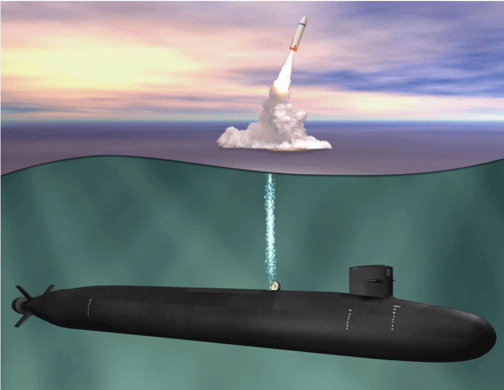
U.S. Submarines Will Soon Carry Tactical Nuclear Weapons https://www.popularmechanics.com/military/weapons/a22550758/us-submarines-will-soon-carry-tactical-nuclear-weapons/ By Kyle Mizokami
St. Lucie nuclear power plant is protected against flooding—unless a flood happens
Leaked video of post-Fukushima flooding risk at American nuclear power plant
Flooding at a Florida Nuclear Plant, UCS, DAVE LOCHBAUM, DIRECTOR, NUCLEAR SAFETY PROJECT | JULY 26, 2018, Role of Regulation in Nuclear Plant Safety #5
St. Lucie Unit 1 began operating in 1976. From the beginning, it was required by federal regulations to be protected against flooding from external hazards. After flooding in 2011 led to the meltdown of three reactors at Fukushima Dai-ichi in Japan, the NRC ordered owners to walk down their plants in 2012 to verify conformance with flood protection requirements and remedy all shortcomings. The owner of St. Lucie Unit 1 told the NRC that only one minor deficiency had been identified and it was fixed.
But heavy rainfall in January 2014 flooded the Unit 1 reactor auxiliary building with 50,000 gallons through flood barriers that had been missing since at least 1982. Unit 1 became as wet as the owner’s damp assurances and the NRC’s soggy oversight efforts.
Parade of Flood Protection Promises
Operators achieved the first criticality, or sustained nuclear chain reaction, of the Unit 1 reactor core at the St. Lucie nuclear plant located about miles southeast of Ft. Pierce, Florida at 8:30 am on April 22, 1976. Federal regulations adopted more than five years earlier required the plant to be protected against natural phenomena. The Atomic Energy Commission (AEC), forerunner to today’s Nuclear Regulatory Commission (NRC), issued guidance in August 1973 that explicitly informed nuclear plant owners and applicants that the natural phenomena to be protected against included heavy local precipitation.
En route to the AEC issuing an operating license for Unit 1 on March 1, 1976, the owner submitted a Preliminary Safety Analysis Report and later a Final Safety Analysis Report, now called the Updated Final Safety Analysis Report (UFSAR), describing the design features and operational procedures that demonstrated conformance with all applicable regulatory requirements such as flood protection. The design bases external flood was a Probable Maximum Hurricane (PMH) while the design bases internal flood was the postulated rupture of a 14-inch diameter low pressure safety injection system pipe. The analyses summarized in the UFSAR reported the flooding rates, flooding depths needed to submerge and disable safety components, alarms alerting workers to the flooding situation, and response actions and associated times for workers to intervene and successfully mitigate a flooding event.
…………The owner reported to the NRC on December 27, 2012, the results of its evaluation of the missing and degraded conduit seals. The NRC was told that the electrical manholes have 4-inch and 1.5-inch diameter drain lines to the storm water system. In the event of site flooding due to a storm, water could flow through these drain lines into the electrical manholes. When the water filled the manholes to a certain depth, water would flow through the missing and degraded conduit seals into the reactor auxiliary building and disable components needed for safe shutdown of the reactor. The owner reported that the conduit seals had been missing since original construction in the 1970s. This potential hazard no longer existed because the missing and degraded conduit seals had been corrected.
The NRC evaluated the missing and degraded conduit seals reported by the owner via its November 27 and December 27 submittals. On April 25, 2013, the NRC issued its report for its evaluation. The NRC noted:
The licensee’s design basis does not allow for any external leakage into safety-related buildings during a PMH. Unit 1 UFSAR section 3.4.4, states in part, that “All external building penetrations are waterproofed and/or flood protected to preclude the failure of safety related system or component due to external flooding.”
Even though the flood protection deficiency existed for over three decades before being found and fixed, the NRC elected to impose no sanction for violating federal safety regulations.
The NRC reported on July 30, 2013, about additional walkdowns its inspectors made of the Unit 1 and 2 reactor auxiliary buildings. The NRC inspectors also reviewed documents in the owner’s corrective action and work order databases for weather-related problems that could result in site flooding. No problems were found.
Raining on the Promise Parade
On January 9, 2014, it rained on St. Lucie. A culvert in the storm water drain system obstructed by debris caused rain water to pool around the reactor auxiliary building instead of being carried away. Rain water leaked into the reactor auxiliary building via two electrical conduits that lacked the proper flood barriers. A video obtained by UCS via the Freedom of Information Act (FOIA) shows water pouring from an electrical junction box mounted on the inside wall of the Unit 1 reactor auxiliary building. (We don’t have a video of this location before the flood, but we know that it wasn’t nearly as wet and noisy.)
An estimated 50,000 gallons of water flooded Unit 1. Workers periodically manipulated valves to allow flood water to drain into the emergency core cooling system (ECCS) pump room sumps where it was transferred to an outdoor collection tank. Their efforts successfully prevented any safety components from being disabled and Unit 1 continuing operating through the rainfall.
When the dust dried, workers found four other electrical conduits that lacked proper flood barriers. The six conduits passed through the reactor auxiliary building wall below the design bases flood elevation. Consequently, they should have been equipped with flood barriers, but the required barriers had not been provided. These six conduits were not part of the plant’s original design, but had been installed via modifications implemented in 1978 and 1982.
The NRC issued a White finding, the second least serious among its Green, White, Yellow and Red classification scheme, on November 19, 2014, for two violations of regulatory requirements:
……..the owner violated federal regulations in 1978 and 1982 by not providing flood barriers with the installed conduit and re-violated federal regulations in 2012 by not finding the flood barriers missing when commanded by NRC to do so after Fukushima.
UCS Perspective
In the letter transmitting the White finding to the plant’s owner, NRC noted that the severity of the two violations of federal regulations would normally have also resulted in a $70,000 fine, but explained:
Because your facility has not been the subject of escalated enforcement actions within the last two years, the NRC considered whether credit was warranted for Corrective Action in accordance with the civil penalty assessment process in Section 2.3.4 of the Enforcement Policy. … Therefore, to encourage prompt identification and comprehensive correction of violations, and in recognition of the absence of previous escalated enforcement action, I have been authorized, after consultation with the Director, Office of Enforcement, not to propose a civil penalty in this case.
What?
“Because your facility has not been the subject of escalated enforcement actions within the last two years” is largely because the owner violated federal regulations by not finding, fixing, and reporting the missing flood barriers on the six electrical conduits that factored in the January 9, 2014, flooding event. So, the reason the owner has a clean slate over the past two years is because the owner violated federal regulations two years ago that would otherwise have uncleaned that slate. Who says crime doesn’t pay?
……… Is the White finding without the usual (and entirely appropriate) $70,000 fine a slap on the wrist of this owner?I don’t know. But I do know that it is a slap in the face of the many plant owners who took the NRC’s order seriously by doing a thorough job of walking down their plants for flooding and earthquake vulnerabilities and remedying all deficiencies (not just a token one or two).
By “encouraging” owners who perform badly, the NRC is discouraging owners who perform well. ……..
For over 30 years, St. Lucie operated without flood barriers it was required by federal regulations to have. ………
St. Lucie is adequately protected against flooding—unless a flood happens. That flood might reveal still more deficiencies for the NRC to “encourage” the owner to promptly find and comprehensively fix (assuming the reactor still hasn’t melted down.)
The only reason this event goes into the “under-regulation” bin is that there are no lower bins for it. https://allthingsnuclear.org/dlochbaum/flooding-at-a-florida-nuclear-plant
Citizens group: Radiation from Grumman plume needs to be addressed
A citizens group called Long Island Pure Water held its first public meeting to share with residents what it’s learned about the area under the former Grumman site in Bethpage.
James Rigano, an attorney representing the 70-member group, says radiation from the toxic plume is in the groundwater and must be addressed.
The group has filed a lawsuit against the Navy and the state Department of Environmental Conservation in an effort to have the radiation investigated.
“The Navy and the DEC have refused to investigate it. They have no plans, they have no intentions to investigate it and they would just let it go and be silent about it,” said Rigano.
The Navy has said that the radium found in the plume occurred naturally and that they are continuing to monitor it. Environmentalists have argued that the levels of radium found are far from natural.
Geologist Nick Valkenberg says that the Navy based it’s conclusion on 1,270 samples – but he says none of them were collected on Long Island.
Among those in attendance was Pat Stuart of Bethpage, who says six of eight of her family members have cancer. She says she doesn’t know whether the former Grumman site is to blame.
“I think the amount of time that they’ve known about this, they could be doing better,” Stuart says. “They’re dragging their heels, and there’s a lot of people’s lives at risk here.”
1 This Month





PLEASE OPPOSE HR 8255 AND S.3639 – bills would accelerate satellite deployment, with no environmental review or safeguards – https://ncstd5li.quorum.us/campaign/169331/
To see nuclear-related stories in greater depth and intensity – go to https://nuclearinformation.wordpress.com
-
Archives
- October 2026 (29)
- September 2026 (339)
- August 2026 (330)
- July 2026 (355)
- June 2026 (287)
- May 2026 (306)
- April 2026 (356)
- March 2026 (251)
- February 2026 (267)
- January 2026 (308)
- December 2025 (358)
- November 2025 (359)
-
Categories
- 1
- 1 NUCLEAR ISSUES
- business and costs
- climate change
- culture and arts
- ENERGY
- environment
- health
- history
- indigenous issues
- Legal
- marketing of nuclear
- media
- opposition to nuclear
- PERSONAL STORIES
- politics
- politics international
- Religion and ethics
- safety
- secrets,lies and civil liberties
- spinbuster
- technology
- Uranium
- wastes
- weapons and war
- Women
- 2 WORLD
- ACTION
- AFRICA
- Atrocities
- AUSTRALIA
- Christina's notes
- Christina's themes
- culture and arts
- Events
- Fuk 2022
- Fuk 2023
- Fukushima 2017
- Fukushima 2018
- fukushima 2019
- Fukushima 2020
- Fukushima 2021
- general
- global warming
- Humour (God we need it)
- Nuclear
- RARE EARTHS
- Reference
- resources – print
- Resources -audiovicual
- Weekly Newsletter
- World
- World Nuclear
- YouTube
-
RSS
Entries RSS
Comments RSS

