Hurricane Michael: US Nuclear Regulatory Commission (NRC) activated regional incident response centre
|
NRC centre activated ahead of hurricane, WNN 11 October 2018 The US Nuclear Regulatory Commission (NRC) yesterday activated its Atlanta regional incident response centre in anticipation of Hurricane Michael’s landfall in the south-eastern USA. Southern Nuclear reduced power at the Farley nuclear power plant in Alabama as a precautionary measureSouthern Company subsidiary Southern Nuclear, which operates the two-unit Joseph M Farley plant on behalf of owner Alabama Power, announced yesterday it was reducing power for both units as a “precautionary safety measure” to prepare for potential “weather-related conditions” caused by the hurricane. “These proactive steps will allow station personnel to continue monitoring the storm’s progress and take any necessary actions,” the company said.
The NRC said staff at the Atlanta centre were monitoring and maintaining close contact with the Farley site, which was not expected to shut down as hurricane-force winds were not expected at the site. The Atlanta centre is one of four regional response centres and covers the regulator’s Region II: Alabama, Florida, Georgia, Kentucky, North Carolina, Puerto Rico, South Carolina, Tennessee, Virginia, U.S. Virgin Islands, and West Virginia. Other regional centres are based in Pennsylvania, Illinois and Texas. The Atlanta centre activated last month in advance of Hurricane Florence, which made landfall in North Carolina on 16 September…….. Two units at Duke Energy’s Brunswick nuclear power plant were taken offline on 13 September ahead of Hurricane Florence. Both units had restarted by 21 September. http://www.world-nuclear-news.org/Articles/NRC-centre-activated-ahead-of-hurricane |
Hurricane Michael threatens nuclear power plants – Georgia – Florida
Hurricane Michael On Path of Several Nuclear Reactors, Latest Maps, Charts, Live Data, Flooding
(Put up with the annoying advertising stuff at the beginning of this video)
Nearly 3,000 Georgia Power personnel ready to respond to Hurricane Michael
Company reminds customers to stay informed and safe during and after storm Ciston PR Newswire ATLANTA, Oct. 10, 2018 /PRNewswire/ — As Hurricane Michael impacts the Gulf Coast, Georgia Power is ready to respond to power outages as quickly and safely as possible with nearly 3,000 personnel from the company and assisting utilities. Crews are continuing to mobilize from unaffected areas across Georgia over the next 24 hours and are strategically positioning throughout the state ready to re-enter central and south Georgia, and other areas, as Hurricane Michael subsides.
Damage assessment teams will be the first to enter affected areas and will relay critical field information so restoration teams can be dispatched as safely and efficiently as possible. Additional resources are available as part of the Southern Company system, which includes multiple electric and gas companies serving more than 9 million customers…….https://www.prnewswire.com/news-releases/nearly-3-000-georgia-power-personnel-ready-to-respond-to-hurricane-michael-300729092.html
Nuclear power plants in the path of Hurricane Michael
BREAKING-NUCLEAR PLANT-CAT5 HURRICANE MICHAEL-HISTORY BOOKS!
Extensive damage and extended power outages in South Georgia expected to continue over next 24 hours due to high winds and falling trees
Georgia Power ATLANTA, Oct. 10, 2018 /PRNewswire/ — Hurricane Michael arrived in Georgia this evening and is impacting service to Georgia Power customers. The company is prepared to respond with approximately 3,900 personnel from the company, other Southern Company operating companies and assisting utilities ready to restore power as quickly and safely as possible following the storm. All of Georgia Power’s resources are being held and dedicated to storm restoration efforts in the state following Hurricane Michael.
Georgia Power expects damage due to high winds, heavy rain and fallen trees. Once the storm passes, the company must wait until conditions are safe for damage assessment teams to enter the impacted zones and begin the restoration process, followed by repair crews, which could take several days, depending on the amount of damage and safe access to the area. As weather conditions improve, restoration efforts will accelerate, but it could take an extended period of time for all customers to be restored…….
As of 8:00 p.m. Wednesday, there are more than 65,000 customers without power in Georgia …https://www.prnewswire.com/news-releases/hurricane-michael-enters-georgia-65-000-customers-without-power-300729151.html
US held subcritical nuclear test last Dec
https://www3.nhk.or.jp/nhkworld/en/news/20181010_27/ A US report says the country held a subcritical nuclear test in the state of Nevada last December.
The test was the first of its kind in 5 years, the 28th by the United States, and the first under the administration of President Donald Trump.
According to the report by the Department of Energy’s National Nuclear Security Administration, the experiment called Vega was held at a nuclear test site in Nevada.
Vega involved new explosives used to create powerful impacts on plutonium, and an examination of a plutonium implosion. The NNSA called the test an important step toward enhancing the performance of nuclear weapons.
The US government in February announced a new nuclear strategy of enhancing deterrence capabilities to counter Russia and China, by such means as increasing low-yield nuclear arsenals.
The move marks a shift from the policy of former president Barack Obama, who advocated a world without nuclear weapons.
Observers say antinuclear groups are expected to criticize the Trump administration for boosting nuclear weapon capabilities while pressing for denuclearization of North Korea.
Japanese people object to US government conducting a subcritical nuclear test last December.
A 39-year-old man expressed regret over the test during a visit with his baby to the Peace Memorial Park in the city of Hiroshima, which was hit by a US atomic bombing in 1945.
He said it’s regrettable that the United States conducted the test, which no one wanted, despite people’s hope for peace.
He said for the sake of children, he does not want nuclear weapons to exist in the future.
A 52-year-old woman in the city said the administration of President Donald Trump is not moving in the right direction, while provoking the world to divide.
She said she hopes the Japanese government will have its own views, without following the US administration.
Shigemitsu Tanaka, the head of the atomic bomb survivors’ organization in Nagasaki, also criticized the subcritical test.
He said it was a move against the UN Treaty on the Prohibition of Nuclear Weapons, which was adopted last year, and the test is unforgivable.
He said he hopes the US will lead efforts to eliminate nuclear arms as the only country to have used nuclear weapons and will call on other nations to abolish them.
Energy firm with alleged Trump ties wants Memphis Light, Gas and Water to switch to unfinished nuclear power plant
Energy firm with alleged Trump ties wants MLGW to ditch TVA for its unfinished nuclear plant, Biz Journals By Samuel Hardiman – Staff Reporter, Memphis Business Journal, 10 Oct 18
Nuclear Development LLC said MLGW could save $400 million annually if it purchases power from the Bellefonte Nuclear Generating Station instead of from the TVA.
The plant in the north Alabama town of Hollywood could be complete by 2024 if the company receives the federal funding it’s seeking……….
Franklin Haney, a Chattanooga developer who is a principal with Nuclear Development, has come under scrutiny after allegedly offering President Donald Trump’s former associate, Michael Cohen, $10 million if he could help Haney land the federal loan.
MLGW is one of TVA’s largest customers. It accounted for 10 percent of the power provider’s operating revenues in 2017, according to filings with the Securities and Exchange Commission. https://www.bizjournals.com/memphis/news/2018/10/09/energy-firm-with-trump-ties-wants-mlgw-to-leave.html
SCANA kept quiet about a ‘potential fraud’ at SC nuclear project.
SCANA execs uncovered ‘potential fraud’ at SC nuclear project. They didn’t tell the cops. By Andrew Brown abrown@postandcourier.com, Oct 8, 2018 COLUMBIA — SCANA’s executives in 2015 learned about a million-dollar bid-rigging scheme during the construction of their South Carolina nuclear project but never reported the discovery to state and federal law enforcement officials.
Rather, they kept the matter quiet to avoid negative publicity about the project, according to a source with direct knowledge, avoiding unwanted attention from regulators and the public.
The alleged fraud highlights the secrecy that SCANA’s leaders cloaked the failed $9 billion project in over the past decade. The previously undisclosed episode has come to light amid continued debate about why the project failed and who is responsible.
Documents show SCANA’s employees confirmed Compuworld, a company based in Lexington County, undermined the purchasing rules for the V.C. Summer nuclear expansion project in order to win contracts to supply office furniture.
An investigation by SCANA’s corporate compliance office showed Alan Saleeby, Compuworld’s owner, submitted bids for his business and allegedly forged the applications for two other companies — allowing him to rake in money while making the purchases look competitive.
SCANA hired attorneys from Atlanta to complete background checks on all of the people involved in the scheme. They studied whether the utility had to report the questionable purchases under federal nuclear oversight regulations. And they considered “possible civil and criminal fraud claims” against Chicago Bridge and Iron, the contractor that approved the purchases.
News of the suspicious activity traveled quickly to SCANA’s top executives as the company’s leaders worked behind the scenes to fix other aspects of the struggling power project. One of the nuclear project’s top executives flagged the case for SCANA’s nuclear chief Jeff Archie. In an email, the executive described the purchases as “potential fraud.”
…….. the allegations leveled against Compuworld mark the most serious issue yet with the purchasing process at V.C. Summer — a project now considered the biggest economic failure in state history.
SCANA inadvertently disclosed its investigation into Compuworld earlier this year in legal bills it filed with the state Public Service Commission. But since then, SCANA’s attorneys have fought to keep other emails and documents about the investigation secret.
Eric Boomhower, SCANA’s spokesman, confirmed that the utility quietly settled the issue with Chicago Bridge and Iron in late 2015. He described the investigation into Compuworld as a “financial dispute.”
SCANA’s investigators referred to it simply as fraud.
……… The investigation became more serious when SCANA discovered evidence that Saleeby also was submitting bids for companies that were purportedly competing against Compuworld. Email addresses and the handwriting on some of the documents showed Saleeby was personally filing the other offers, too, guaranteeing that Compuworld came out on top……… https://www.postandcourier.com/business/scana-execs-uncovered-potential-fraud-at-sc-nuclear-project-they/article_0eb5960a-c63b-11e8-a6a0-cf8c595ea1ed.html
| ReplyForward |
Was it close to a nuclear emergency, when Hurricane Florence hit USA East coast?
|
Was Three a Near-Fukushima Event on the Atlantic During Hurricane Florence? ObRag, Ocean Beach California by on OCTOBER 10, 2018 Nuclear Shutdown News for September 2018 Black Rain PressNuclear Shutdown News chronicles the decline and fall of the nuclear power industry in the US and beyond, and highlights the efforts of those working for a nuclear free future. Here is our September 2018 report.
A Near-Fukushima on the Atlantic? On September 17 the Raleigh News & Observer reported, “Floods limit access to Duke’s Brunswick nuclear plant: crews us partopotties, cots.” Did the Atlantic coast have a near-Fukushima event when during September Hurricane Florence made landfall? Utility Duke Energy’s Brunswick two nuclear reactors are located 30 miles south of Wilmington, NC, where the former Category 4 hurricane made landfall as a tropical storm in mid September. It was reported that “workers are sleeping on cots and using portable toilets because the water is currently shut off and the toilets can’t flush”, and that there was “limited access to the plant, and some workers have been able to leave the site and check up on their homes nearby. After the storm passed some drove to a Walmart in Southport to stock up on provisions.” Brunswick’s twin reactors started up in the 1940s, and are now approaching their designed operating life, 40 years. They are called boiling water reactors, the same model as the three Fukushima reactors that melted down in 2011, and were built by the same company, General Electric. US nuclear plants are required to shut down if hurricane force winds, 73 miles per hour or higher, are moving in. Fortunately the winds weren’t quite that strong when Florence hit the East Coast. The Nuclear Regulatory Commission reported, “Flooding of roads and downed trees prevented fresh crews from relieving the nearly 300 Duke Energy ‘storm riders’ who had been on site for days. And the blocked roads made it impossible to reach the 10 mile emergency evacuation zone if a higher level emergency is declared” Food had to be brought in by helicopters…….https://obrag.org/2018/10/was-three-a-near-fukushima-event-on-the-atlantic-during-hurricane-florence/ |
|
“Transparency”- the Trump administration’s dirty trick to strangle access to reputable science on nuclear radiation
 Yes, radiation is bad for you. The EPA’s ‘transparency rule’ would be even worse. The Trump
  administration wants to strangle access to reputable science. https://www.washingtonpost.com/outlook/2018/10/08/yes-radiation-is-bad-you-epas-transparency-rule-would-be-even-worse/?noredirect=on&utm_term=.b7e530a79729 By Audra J. Wolfe, 8 Oct 18 Audra J. Wolfe is a Philadelphia-based writer, editor, and historian. She is the author of Freedom’s Laboratory: The Cold War Struggle for the Soul of Science.
Last Tuesday, a headline from the Associated Press sparked outrage in the ordinarily quiet world of science policy. The Environmental Protection Agency, the story suggested, was considering relaxing guidelines for low-dose ionizing radiation, on the theory that “a bit of radiation may be good for you.” Within hours, the AP had issued a correction. As it turned out, the EPA was not, after all, endorsing hormesis, the theory that small doses of toxic chemicals might help the body, much like sunlight triggers the production of vitamin D.
Instead, the EPA was doing something much scarier: It was holding hearings on the “Transparency Rule,” which would restrict the agency to using studies that make a complete set of their underlying data and models publicly available. The rule is similar to an “Open Science” order issued by the Interior Department last month, and incorporates language from the HONEST Act, a bill that passed in the House in 2017 but later stalled in the Senate. The HONEST Act originally required that scientific studies provide enough data that an independent party could replicate the experiment — which is simply not realistic for large-scale longitudinal studies.
Although these rules cite the need to base regulatory policy on the “best available science,” make no mistake: They aim to strangle access to reputable studies.
The Transparency Rule continues the Trump administration’s pattern of anti-science policies. The White House’s Office of Science and Technology Policy is a ghost town, with most of the major positions, including the director’s post, vacant since January 2017. Agencies and departments across the board, including the State Department and the Agriculture Department, are dropping their science advisers and bleeding scientific staff. It’s getting harder and harder for federal rulemakers to access expertise.
Understanding what’s wrong with “transparency,” at least as defined by these policies, requires a closer look at how scientists work. Let’s say you’re trying to understand the health effects of a one-time, accidental release of a toxic chemical. This incident might be epidemiologists’ only chance to investigate how this particular chemical interacts with both the air and the humans who breathe it, at varying doses, over a period of time. No matter how careful your approach, your study would fall short of the replicability standard.
You wouldn’t have baseline health information for the specific people who happened to be in the area. You might not have information on which residents had air filtration systems installed in their homes, or which residents were working outside when the incident took place. Your early results would, by definition, reflect only short-term health outcomes, rather than long-term effects. And you couldn’t replicate the study (with better controls) without endangering the health of thousands of people. In such cases, scientists have to extrapolate from existing, sometimes imperfect, data to protect the public.
Epidemiologists have community standards, including peer review, to evaluate these kinds of studies. A careful, peer-reviewed study of this hypothetical incident might well represent the “best available science” on this particular chemical. Regulators might rely on this study to establish the permissible levels of this chemical in the air we breathe. But now, let’s also say that this study took place 30 years ago. The leading scientists involved are dead, and no one kept their files. The raw data are, effectively, lost. Should scientists at the EPA be blocked from using the study?
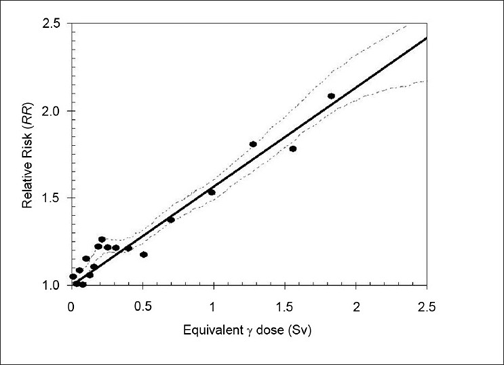
Despite what made last week’s headlines, the EPA’s Oct. 3 hearing went beyond radiation. In fact, its lead witness, University of Massachusetts toxicologist Edward Calabrese, barely mentioned his theory of radiation hormesis. Instead, his testimony argued that the EPA should no longer rely on linear no-threshold (LNT) models for any number of hazards, including toxic chemicals and soil pollutants. In toxicology, LNT models assume that the biological effects of a given substance are directly connected to the amount of the exposure, with no minimum dose required. Radiation protections standards are based on LNT models; so are basic regulations involving ozone, particulate pollution, and chemical exposure.
The original studies asserting a LNT model for low-dose ionizing radiation were conducted in the 1950s. Like our hypothetical epidemiologist investigating a toxic chemical release, the geneticists who tried to understand the biological effects of atomic radiation were working with imperfect data, much of which is no longer available. The concept of a “comprehensive data management policy” simply did not exist in 1955. These particular studies were primarily based on survivors of the atomic bombing of Hiroshima and Japan. The scientists also extrapolated from high-dose exposure data in fruit flies and mice and from unethical high-dose experiments conducted on humans.
These studies are imperfect, but focusing on their limitations misses the broader scandal. These studies took place during the heyday of atmospheric nuclear weapons testing, an era when both the United States and the Soviet Union were pumping the atmosphere full of radioactive nucleotides. Some of the areas near the testing zones received so much radiation that they are still uninhabitable today. The tests coated the entire planet with a scrim of radiation. The Atomic Energy Commission, the agency in charge of the United States’ nuclear weapons program, didn’t even attempt to investigate the potential health effects of this constant, low-dose exposure to ionizing radiation on the world’s population. Studies of low-dose radiation were expensive, inconvenient, and politically risky, potentially jeopardizing the weapons testing program and therefore the United States’ ability to fight the Soviet Union. From the government’s perspective, it was better not to know.
This week, a sensational headline distracted us from a broader crisis. Without government support for research of environmental hazards, the public’s health is left to either the whims of industry researchers, who have a strong incentive to play down their dangers, or to public advocacy groups, which are too easily smeared with charges of anti-industry bias. The “transparency” movement supposedly resolves this crisis of authority by giving the public access to the underlying data on which science is based, but it ignores the power dynamics that determine which research questions get asked, and why and how they’re answered.
In the past, Americans looked to their federal science agencies and science advisers to resolve these sorts of disputes. But a few weeks ago, the EPA announced that it, too, would be eliminating its Office of the Science Adviser. With the science offices empty, who will decide?
There is one bright spot in all of this: On Sept. 28, bipartisan legislation authorized the Energy Department to restart its low-dose radiation research program. But what about the other pollutants that the EPA supposedly regulates? Who will produce the kinds of science deemed acceptable under the “transparency” rule?
“Transparency” has become another way to cultivate institutional ignorance. Americans deserve better from the agencies that are supposed to protect them. In the case of environmental hazards, what you don’t know can hurt you.
Federal indictment alleges that Russian military targeted USA nuclear company Westinghouse
|
Indictment: Russian military targeted Pa. nuclear power company, witf news, by Amy Sisk/StateImpact Pennsylvania | Oct 8, 2018 (Pittsburgh) — A federal indictment filed this week alleges Russian hackers targeted a nuclear power company near Pittsburgh beginning in 2014, in addition to anti-doping agencies throughout the world.The hackers, who are intelligence officers for the Russian military, tried to breach the network of Westinghouse Electric Company by sending emails to employees intending to trick them into entering login credentials on a webpage spoofing the company’s own network, according to the indictment.
Although the indictment says the hackers stole some credentials before redirecting the workers to the company’s actual network, Westinghouse and federal officials said the hacking attempt was unsuccessful. ………The indictment names seven Russian intelligence officials, who face charges ranging from conspiracy to wire fraud to aggravated identity theft. …..Brady said he believes all the defendants named in the indictment are now in Russia. The United States does not have an extradition treaty with Russia, so it’s unclear if the alleged hackers will come to Pittsburgh to face charges…….http://www.witf.org/news/2018/10/indictment-russian-military-targeted-pa-nuclear-power-company.php |
|
Despite its anti-nuclear ordinance, Oakland City Council to increase a contract with nuclear weapons maker AECOM
Nuclear Weapons Maker to Receive Extra $420,600 to Help Repair Oakland Bridge https://www.eastbayexpress.com/SevenDays/archives/2018/10/08/nuclear-weapons-maker-to-receive-extra-420600-to-help-repair-oakland-bridge
In addition to managing US nuclear labs, AECOM does billions in business building overseas military bases and maintaining Air Force drones.
The Oakland City Council is considering increasing an existing contract by $420,600 for a total of $1.25 million to repair the 23rd Avenue Bridge, but the modified contract is with AECOM, an engineering company that has been involved in designing and manufacturing nuclear weapons components, and in the past, helped manage a desert test site where nuclear weapons experiments were conducted.
Oakland has an anti-nuclear ordinance that usually bars companies involved in designing and building nukes from doing business with the city. But city staffers are recommending that the council waive the prohibition for AECOM due to the fact that the company, and its URS subsidiary, have been involved with the 23rd Avenue Bridge project since 2003 and finding another firm to do the technical work would be difficult.
AECOM bought URS in 2014 and as a result became a partner in the nuclear labs’ management company. Three months ago, the federal government selected a new team to manage the Los Alamos lab, dropping AECOM as one of the firms involved there. But AECOM is still part of the Livermore Lab group.
Prior to this, AECOM helped manage the Nevada National Security Site where nuclear weapons are tested in “subcritical” experiments that don’t result in fission or fusion explosions.
AECOM has billions of dollars worth of other contracts with the U.S. military, doing everything from building overseas bases to maintaining drone weapons systems. As a result of its nuclear weapons contracts, AECOM was one of several companies that Norway’s sovereign fund put on an investment blacklist last January.
Russia challenges US compliance with nuclear arms treaty
MOSCOW https://www.kwtx.com/content/news/Russia-challenges-US-compliance-with-nuclear-arms-treaty-495949041.html?ref=041 (AP) 8 Oct 18— Russia on Monday challenged the U.S. claim that it has fulfilled its obligations under a pivotal nuclear arms deal, a new argument that could further fuel tensions between Moscow and Washington.
The Russian Foreign Ministry said it “can’t confirm” the latest U.S. State Department data indicating that the U.S. has complied with the thresholds set by the 2010 New START treaty. It limits each country to no more than 1,550 deployed nuclear warheads and 700 deployed missiles and bombers.
The ministry said the U.S. removed 56 Trident II submarine-launched intercontinental ballistic missiles and 41 B-52H strategic bombers from its count of nuclear arsenals after re-equipping them to carry conventional weapons.
But it argued that the U.S. had failed to let Russia verify the move in line with the treaty, and failed to list four land-based missile silos converted for training purposes — a move Russia said didn’t conform to the treaty.
The ministry said the perceived U.S. breach of the treaty’s limits was “unacceptable,” adding that it expects Washington to “show a constructive approach to settling that acute issue.”
The tough statement marked the first time Russia raised the issue of the alleged U.S. non-compliance with the pact signed by President Barack Obama and then-Russian President Dmitry Medvedev amid a brief thaw in Russia-U.S. ties. The New Start came into effect in 2011 and is to expire in 2021 unless the two countries extend it.
Officials in both Russia and the U.S. have given mixed signals about the pact’s future.
Russia-U.S. ties have sunk to their lowest levels since the Cold war times over the Ukrainian crisis, the war in Syria, the allegations of Russian meddling in the 2016 U.S. presidential election and alleged Russian hacking of world anti-doping bodies, athletes, plane investigations and chemical weapons probes, among other disputes.
In the arms control sphere, Moscow and Washington also have been at loggerheads over another arms control treaty — the 1987 Intermediate-range Nuclear Forces Treaty.
The U.S. has accused Russia of deploying a new type of missile in violation of the pact that bans an entire class of weapons — all nuclear and conventional ground-launched ballistic and cruise missiles of intermediate range. Russia has rejected the accusations.
Science denial in USA government – first about climate change, now about ionising radiation
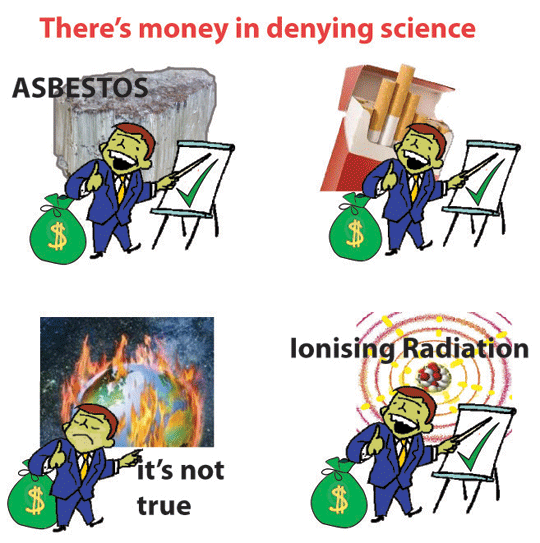
The radiation regulation is supported by Steven Milloy, a Trump transition team member for the EPA who is known for challenging widely accepted ideas about manmade climate change and the health risks of tobacco. He has been promoting Calabrese’s theory of healthy radiation on his blog.
the EPA proposal on radiation and other health threats represents voices “generally dismissed by the great bulk of scientists.”
“The individual risk will likely be low, but not the cumulative social risk,
Turning to scientific outliers, EPA says a little radiation may be healthy, WIVN.com, By: CBS/AP Oct 07, 2018 The Trump administration is quietly moving to weaken U.S. radiation regulations, turning to scientific outliers who argue that a bit of radiation damage is actually good for you — like a little bit of sunlight.
The government’s current, decades-old guidance says that any exposure to harmful radiation is a cancer risk. And critics say the proposed change could lead to higher levels of exposure for workers at nuclear installations and oil and gas drilling sites, medical workers doing X-rays and CT scans, people living next to Superfund sites and any members of the public who one day might find themselves exposed to a radiation release.
The Trump administration already has targeted a range of other regulations on toxins and pollutants, including coal power plant emissions and car exhaust, that it sees as costly and burdensome for businesses. Supporters of the EPA’s new proposal argue the government’s current no-tolerance rule for radiation damage forces unnecessary spending for handling exposure in accidents, at nuclear plants, in medical centers and at other sites.
“This would have a positive effect on human health as well as save billions and billions and billions of dollars,” said Edward Calabrese, a toxicologist at the University of Massachusetts who is to be the lead witness at a congressional hearing Wednesday on EPA’s proposal. “The regulatory agencies are kind of a cult, but they don’t know they’re part of a cult.”
Calabrese, who made those remarks in a 2016 interview with a California nonprofit, was quoted by EPA in its announcement of the proposed rule in April. He declined repeated requests for an interview with The Associated Press. The EPA declined to make an official with its radiation-protection program available……….
As recently as this March, the EPA’s online guidelines for radiation effects advised: “Current science suggests there is some cancer risk from any exposure to radiation.”
“Even exposures below 100 millisieverts” – an amount roughly equivalent to 25 chest X-rays or about 14 CT chest scans – “slightly increase the risk of getting cancer in the future,” the agency’s guidance said.
But that online guidance – separate from the rule-change proposal – was edited in July to add a section emphasizing the low individual odds of cancer: “According to radiation safety experts, radiation exposures of …100 millisieverts usually result in no harmful health effects, because radiation below these levels is a minor contributor to our overall cancer risk,” the revised policy says.
Calabrese and his supporters argue that smaller exposures of cell-damaging radiation and other carcinogens can serve as  stressors that activate the body’s repair mechanisms and can make people healthier. They compare it to physical exercise or sunlight.
Mainstream scientific consensus on radiation is based on deceptive science, says Calabrese, who argued in a 2014 essay for “righting the past deceptions and correcting the ongoing errors in environmental regulation.”……..
The radiation regulation is supported by Steven Milloy, a Trump transition team member for the EPA who is known for challenging widely accepted ideas about manmade climate change and the health risks of tobacco. He has been promoting Calabrese’s theory of healthy radiation on his blog.
But Jan Beyea, a physicist whose work includes research with the National Academies of Science on the 2011 Fukushima nuclear power plant accident, said the EPA proposal on radiation and other health threats represents voices “generally dismissed by the great bulk of scientists.”
The EPA proposal would lead to “increases in chemical and radiation exposures in the workplace, home and outdoor environment, including the vicinity of Superfund sites,” Beyea wrote.
At the level the EPA website talks about, any one person’s risk of cancer from radiation exposure is perhaps 1 percent, Beyea said.
“The individual risk will likely be low, but not the cumulative social risk,” Beyea said.
“If they even look at that – no, no, no,” said Terrie Barrie, a resident of Craig, Colorado, and an advocate for her husband and other workers at the now-closed Rocky Flats nuclear-weapons plant, where the U.S. government is compensating certain cancer victims regardless of their history of exposure.
“There’s no reason not to protect people as much as possible,” said Barrie.
U.S. agencies for decades have followed a policy that there is no threshold of radiation exposure that is risk-free.
The National Council on Radiation Protection and Measurements reaffirmed that principle this year after a review of 29 public health studies on cancer rates among people exposed to low-dose radiation, via the U.S. atomic bombing of Japan in World War II, leak-prone Soviet nuclear installations, medical treatments and other sources.
Twenty of the 29 studies directly support the principle that even low-dose exposures cause a significant increase in cancer rates, said Roy Shore, chief of research at the Radiation Effects Research Foundation, a joint project of the United States and Japan. Scientists found most of the other studies were inconclusive and decided one was flawed.
None supported the theory there is some safe threshold for radiation, said Shore, who chaired the review. If there were a threshold that it’s safe to go below, “those who profess that would have to come up with some data,” Shore said in an interview.
“Certainly the evidence did not point that way,” he said……..
The EPA tucked its proposed relaxation of radiation guidelines into its “transparency in science” proposal in April. The proposal would require regulators to consider “various threshold models across the exposure range” when it comes to dangerous substances. …….https://www.wivb.com/news/turning-to-scientific-outliers-epa-says-a-little-radiation-may-be-healthy/1505019288
USA’s Nuclear Protection Agency, -sorry, Environment Protection Agency , set to weaken radiation guidelines
 CAN SMALL DOSES OF RADIATION HARM YOU? THE EPA ISN’T CONVINCED. A new rule might open the door for regulation rollbacks on radiation and harmful chemicals. Pacific Standard EMMA SARAPPO OCT 3, 2018 CAN SMALL DOSES OF RADIATION HARM YOU? THE EPA ISN’T CONVINCED. A new rule might open the door for regulation rollbacks on radiation and harmful chemicals. Pacific Standard EMMA SARAPPO OCT 3, 2018
On Tuesday, the Associated Press reported that the Trump administration was quietly seeking to roll back the Environmental Protection Agency’s regulations on radiation exposure. The story took a closer look at a rule the EPA proposed back in April called “Strengthening Transparency in Regulatory Science.” When it was released, most coverage focused on the proposal’s potential limitation of what studies the EPA could and could not use in decision-making—it essentially demanded the EPA not use any studies based on data that isn’t publicly available. Ironically, the transparency rule is hiding another agenda. Paragraphs scattered throughout the document make it clear that the proposed rule is meant to re-evaluate the science behind “the dose response data and models that underlie what we are calling ‘pivotal regulatory science.'” That jargon means the EPA wants to challenge the assumptions that underlie its current guidelines on toxic exposure. “The so-called transparency rule is an insidious dodge,” said Rush D. Holt, a former congressman and current president of the American Association for the Advancement of Science, before a Senate subcommittee on October 3rd. “It apparently is about reducing regulation.” And though the actual rule is vague, comments in the press release and a July update to the EPA guidelines on radiation exposure make it seem that nuclear regulation is on the chopping block. Currently, the nuclear industry, the EPA, and other groups operate on the assumption that there is no safe dose of radiation, no matter how small. This is based on the “linear no-threshold” model (LNT). The LNT model is based on studies of people exposed to high and medium doses of radiation, including survivors of Hiroshima, Chernobyl, and Fukushima. That data shows that the higher the dose of radiation you receive, the more severe the consequences—in other words, that the response to doses is linear. The more radiation, the more health effects. Because it’s much harder to accurately measure small doses of radiation in large populations over long periods of time, there isn’t much data available on the lower end. Still, most scientists agree that the relationship stays the same for small amounts of ionizing radiation: Small doses increase the aggregate risk of cancer by a relatedly small amount. LNT’s prevalence pushes regulatory agencies, professional associations, and medical fields to keep radiation doses “as low as reasonably achievable” in all people, especially considering some groups (children, especially) are more vulnerable to radiation than others. ……..in a larger public-health sense, LNT is cautious and prudent. Just because there isn’t documented proof of harm at very low doses doesn’t mean harm isn’t being done, and an inaccurate model means that it’s also possible that LNT sometimes underestimates cancer risks from low doses. In the absence of more definitive data, multiple groups and studies—the National Academy of Sciences, the International Commission on Radiological Protection, and more—have recommended holding fast to regulations that keep radiation exposure as low as possible, at least until a new model is robustly tested and accepted. Others go even further and argue that small doses of radiation are good for you. Edward Calabrese, a professor at the University of Massachusetts, is quoted in the April EPA press release—he was glad the agency was “recognizing the widespread occurrence of non-linear dose responses,” and he appeared in the October 3rd Senate hearing on the rule.
Calabrese is a major critic of the LNT model. He is famous for championing “hormesis”—the idea that small amounts of radiation are beneficial, or “hormetic,” ……… Although Calabrese focused on more mainstream criticisms of LNT before the Senate, his hormesis work is controversial. In 2010, Kristin Shrader-Frechette used Calabrese’s work as a case study of “special-interest science.” Shrader-Frechette compares Calabrese and others to the Queen of Hearts in Lewis Carroll’s Through the Looking Glass. “Just as the Queen claimed she could believe six impossible things before breakfast, SIS proponents often use scientific concepts/methods in ways that are ‘impossible,'” she wrote. She points out that Calabrese’s CV shows significant research funding from Atlantic Richfield Oil (ARCO), Dow Chemical, ExxonMobil, Proctor and Gamble, and R.J. Reynolds Tobacco. And despite Calabrese’s nearly 20 years of advocacy for the theory, even friendly reviews indicate radiation hormesis needs further scientific support. ……the rule promises to give special consideration to studies exploring “various threshold models across the exposure range” and pledges to “evaluate the appropriateness” of using the LNT model. If it’s approved, the EPA’s accepted scientific standard for acceptable radiation doses could change from “as low as reasonably achievable” to a standard that identifies no effect or positive effects from low doses. That could lead to the repeal of strict regulations on radiation containment, which the EPA might deem unnecessary. https://psmag.com/news/can-small-doses-of-radiation-harm-you-the-epa-isnt-convinced |
|
New research raises further concern about radioactive contamination from US arms testing
 Studies renew worry about contamination from US arms testing, Stars and Stripes, By RALPH VARTABEDIAN | Los Angeles Times October 6, 2018 LOS ANGELES (Tribune News Service) — At the dawn of the nuclear age, the Franklin D. Roosevelt administration placed the nation’s major nuclear weapons production and research facilities in large, isolated reservations to shield them from foreign spies – and to protect the American public from the still unknown risks of radioactivity.
By the late 1980s, near the end of the Cold War, federal lands in South Carolina, Tennessee, New Mexico, Colorado, Ohio and Washington state, among other places, were so polluted with radionuclides that the land was deemed permanently unsuitable for human habitation.
That much has long been accepted as a price for the nation’s nuclear deterrent. But a far more complex problem could emerge if recent research is correct.
Studies by a Massachusetts scientist say that invisible radioactive particles of plutonium, thorium and uranium are showing up in household dust, automotive air cleaners and along hiking trails outside the factories and laboratories that for half a century contributed to the nation’s stockpile of nuclear weapons.
The findings provide troubling new evidence that the federal government is losing control of at least some of the radioactive byproducts of the country’s weapons program.
Marco Kaltofen, a nuclear forensics expert and a professor at Worcester Polytechnic Institute, said he collected samples from communities outside three lab sites across the nation and found a wide variation of particle sizes. He said they could deliver lifelong doses that exceed allowable federal standards if inhaled.
“If you inhale two particles, you will exceed your lifetime dose under occupational standards, and there is a low probability of detecting it,” he said.
A peer-reviewed study by Kaltofen was published in its final form in May in Environmental Engineering Science.
Kaltofen, who also is the principal investigator at the nuclear and chemical forensics consulting firm Boston Chemical Data Corp., released a second study in recent weeks.
The Energy Department has long insisted that small particles like those collected by Kaltofen deliver minute doses of radioactivity, well below typical public exposures.
One of the nation’s leading experts on radioactivity doses, Bruce Napier, who works in the Energy Department’s lab system, said the doses cited by Kaltofen would not pose a threat to public health.
Such assurances have been rejected by nuclear plant workers, their unions and activists who monitor environmental issues at nearly every lab and nuclear weapons site in the nation.
Jay Coghlan, executive director of Nuclear Watch New Mexico, cited a long history of denial about the claims of “down winders,” the residents of Western states who were exposed to radioactive fallout from atmospheric weapons testing.
“We cannot trust self-reporting by the Department of Energy,” he said. “I don’t accept that low levels of radioactivity have no risk.”
Tom Carpenter, executive director of another watchdog group, the Hanford Challenge in central Washington, said as recently as last year that the Energy Department released an unknown quantity of radioactive particles during demolition of a shuttered weapons factory, the Plutonium Finishing Plant.
After a series of three releases during 2017, the Energy Department shut down the demolition and has yet to resume it. Forty-two workers were exposed in the incidents.
“If you work in a coal mine, you go home with coal dust on you,” Carpenter said. “Same with a textile mill; you go home with cotton dust. These Hanford workers went home with plutonium dust.”
The second study by Kaltofen, completed in August, reported that fairly high radioactivity levels were found in 30 samples from the communities around the Hanford nuclear site, near Richland, Wash. The samples found contamination on personal vehicles driven inside the Hanford site that would leave mechanics exposed if they worked around the vehicles, the report said.
Kaltofen also reviewed an internal study in March by an Energy Department contractor, Washington River Protection Solutions, that found a calculated potential dose of 95 millirem for workers, roughly 10 times higher than the federal Environmental Protection Agency standard.
Kaltofen said a broader independent study should look at residual contamination around Hanford. An Energy Department spokesman at the Hanford site said the office had no comment on the studies.
For his studies, Kaltofen collected samples outside the Los Alamos National Laboratory in New Mexico, the former Rocky Flats weapons plant near Denver and the Hanford site.
The samples were collected from the crawl spaces of homes, a trailer park office, vacuum cleaner bags, automotive air filters, furnace filters and along a hiking trail.
He subjected those samples to electronic microscopy analysis to determine exactly what type of element was emitting radiation. He identified isotopes of cesium, thorium, uranium and plutonium, all the results of building nuclear weapons parts.
The communities surrounding these facilities have long adapted to the reality that they are near radioactivity, though they are not willing to take risks that compromise their health. Kaltofen’s sampling found some very high levels of contamination in Los Alamos’ Acid Canyon, a recreational area near a community pool and skate park………
A worker’s exposure to radioactivity, such as walking by a radioactive substance or having particles cling to clothing, is checked by monitors and badges worn by workers at plant sites. Such exposure is like a medical X-ray, which delivers a momentary dose. But inhaling a small particle of plutonium or thorium can go unnoticed by such monitors and deliver a lifetime of alpha radiation right next to lung tissue, Kaltofen said.
“You can walk through a portal monitor without setting it off but you can get a substantial amount of energy from particles in the body,” he said. https://www.stripes.com/news/us/studies-renew-worry-about-contamination-from-us-arms-testing-1.550707#.W7pnK–LpJ4.twitter
1 This Month





PLEASE OPPOSE HR 8255 AND S.3639 – bills would accelerate satellite deployment, with no environmental review or safeguards – https://ncstd5li.quorum.us/campaign/169331/
To see nuclear-related stories in greater depth and intensity – go to https://nuclearinformation.wordpress.com
-
Archives
- October 2026 (19)
- September 2026 (339)
- August 2026 (330)
- July 2026 (355)
- June 2026 (287)
- May 2026 (306)
- April 2026 (356)
- March 2026 (251)
- February 2026 (267)
- January 2026 (308)
- December 2025 (358)
- November 2025 (359)
-
Categories
- 1
- 1 NUCLEAR ISSUES
- business and costs
- climate change
- culture and arts
- ENERGY
- environment
- health
- history
- indigenous issues
- Legal
- marketing of nuclear
- media
- opposition to nuclear
- PERSONAL STORIES
- politics
- politics international
- Religion and ethics
- safety
- secrets,lies and civil liberties
- spinbuster
- technology
- Uranium
- wastes
- weapons and war
- Women
- 2 WORLD
- ACTION
- AFRICA
- Atrocities
- AUSTRALIA
- Christina's notes
- Christina's themes
- culture and arts
- Events
- Fuk 2022
- Fuk 2023
- Fukushima 2017
- Fukushima 2018
- fukushima 2019
- Fukushima 2020
- Fukushima 2021
- general
- global warming
- Humour (God we need it)
- Nuclear
- RARE EARTHS
- Reference
- resources – print
- Resources -audiovicual
- Weekly Newsletter
- World
- World Nuclear
- YouTube
-
RSS
Entries RSS
Comments RSS

