Radioactive fallout killed up to 690,000 Americans from 1951 to 1973.
In the 1950s, the U.S. government downplayed the danger of radioactive fallout, asserting that all radioactivity was confined to the Nevada test site. Despite this, a national estimate attributed 49,000 cancer deaths to nuclear testing in the area.
But the results of new research suggest that this number is woefully inaccurate. Using a novel method, and today’s improved understanding of radioactive fallout, Keith Meyers from the University of Arizona discovered that U.S. nuclear testing was responsible for the deaths of at least as many — and likely more — as those killed by the nuclear bombs in Hiroshima and Nagasaki.
Specifically, between 340,000 and 690,000 Americans died from radioactive fallout from 1951 to 1973.
 At least 340,000 Americans died from radioactive fallout between 1951
  and 1973 https://bigthink.com/politics-current-affairs/new-estimate-deaths-from-us-nuclear-tests?rebelltitem=2#rebelltitem2 Domestic nuclear testing wreaked havoc on thousands of families. MATTHEW DAVIS 14 December, 2018
- Hiroshima and Nagasaki resulted in the deaths of hundreds of thousands. But new research shows that domestic U.S. nuclear tests likely killed more.
- The new research tracked an unlikely vector for radioactive transmission: dairy cows.
- The study serves as a reminder of the insidious and deadly nature of nuclear weapons.
When we think of nuclear disasters, a few names probably come to mind. There’s the Chernobyl disaster, which killed around 27,000 people, although estimates are fuzzy. After Fukushima, there were no deaths due to radiation poisoning, but this event occurred relatively recently, and radiation poisoning often kills slowly over decades. When the U.S. dropped atomic bombs on Hiroshima and Nagasaki, estimates put the death toll at around 200,000 people, but again, exact numbers are difficult to calculate.
One name that almost certainly didn’t come to mind is Nevada. When the Soviet Union detonated their first atomic bomb in 1949, the U.S. was shocked into action. America’s prior nuclear testing had been carried out in the Pacific, but it was logistically slow and costly to conduct tests there. In order to maintain dominance over the growing Soviet threat, the U.S. selected a 1,375 square-mile area in Nye County, Nevada.
This was an ideal spot for several reasons. It was closer than Bikini Atoll. The weather was predictable and very dry, reducing the risk that radioactive fallout would be dispersed by rainstorms. It was sparsely populated. There was an understanding that there would be some amount of risk posed to nearby civilians, but it was deemed acceptable at the time. The trouble is, our understanding of radioactive fallout was still in its infancy. It was a catch-22; the only way to learn more was to test nuclear weapons.
In the 1950s, the U.S. government downplayed the danger of radioactive fallout, asserting that all radioactivity was confined to the Nevada test site. Despite this, a national estimate attributed 49,000 cancer deaths to nuclear testing in the area.
But the results of new research suggest that this number is woefully inaccurate. Using a novel method, and today’s improved understanding of radioactive fallout, Keith Meyers from the University of Arizona discovered that U.S. nuclear testing was responsible for the deaths of at least as many — and likely more — as those killed by the nuclear bombs in Hiroshima and Nagasaki. Specifically, between 340,000 and 690,000 Americans died from radioactive fallout from 1951 to 1973.
Prior studies generally looked at the areas surrounded the Nevada test site and estimated the deaths caused by fallout from the area. This number was relatively low, owing to the dry, predictable weather mentioned earlier. However, the bulk of the deaths were actually dispersed throughout the country, primarily in the Midwest and Northeast regions. These deaths were caused by an unfortunate synergy between meteorology, radiation, and — perhaps oddly enough — cows.
Out of all the radioactive elements produced by a nuclear explosion, iodine-131 was the biggest killer. I-131 has an eight-day half-life, tends to accumulate in the thyroid gland, and emits beta and gamma radiation. While alpha radiation is generally weak and doesn’t penetrate material very well, beta and gamma radiation are highly energetic and shoot through clothing and flesh, ripping up DNA as it goes along.
Prior studies had examined the radioactive fallout dispersed by low-altitude winds, which would generally settle around the Nevada test site. However, a significant amount of I-131 was caught up in high-altitude winds. These winds carried the radioactive particles to other regions of the U.S., where it mixed with rain clouds.
 The now-radioactive rain fell onto the grasslands in the Midwest and Northeast. Then, cows ate the now-radioactive grass. The cows then produced radioactive milk. Dairy practices during the study period were different than they are today — most people drank milk that had recently been extracted from local cows.
Thanks to a National Cancer Institute database that contains broad data on radiation exposure, Meyers was able to track the amount of I-131 found in local milk and compare this with the number and nature of deaths on a county level. In this way, Meyers was able to determine that a significant number of these deaths were due to drinking poisoned milk. These civilians would have had no idea that the milk they were drinking had been irradiated by nuclear explosions hundreds of miles away.
Ironically, the area around the Nevada test site didn’t have this problem. Although they too drank fresh milk from local cows, they imported hay from other parts of the country. Since their cows weren’t eating irradiated hay, the local Nevadans took in significantly less radioactive material than their less-fortunate, distant countrymen.
Although our understanding of radiation and nuclear fallout is much improved since the dawn of the nuclear age, the study serves as a warning of the insidious nature of nuclear weapons. Containing nuclear fallout is challenging, even when you know where all of the vectors of radioactive transmission are. The complexity and intertwining nature of our ecological and social systems means that words like “clean,” “precise,” or “surgical” will likely never apply to nuclear weapons.
USA’s absolute dilemma over radioactive trash – used nuclear fuel
 What to do with used nuclear fuel, from Illinois to California https://thebulletin.org/2018/12/what-to-do-with-used-nuclear-fuel-from-illinois-to-california/ By Jeff Terry, December 14, 2018 The largest operator of nuclear power plants in the United States, Exelon, closed two nuclear reactors in the city of Zion, Illinois in 1998 because of low demand, which in turn led to poor operating economics. Ever since, these two pressurized water reactors have sat unused on the Lake Michigan shoreline just north of Chicago. Exelon contracted the company EnergySolutions to decontaminate and decommission the site, and this fall it announced it was nearly done, with demolition of the two structures almost complete.
These two closed reactors have been a thorn in Zion’s side since they shut down 20 years ago. The city lost $18 million in annual property tax revenue when the plants closed, and the shortfall had to be made up by local businesses and residents. Beyond the financial loss, the city can’t use the site for parkland, redevelopment, or anything else. But now that decontamination and decommissioning are nearly complete, Zion should be able to reclaim the land and convert it to beneficial use—right?
Not just yet. There is still spent nuclear fuel at the Zion site—bundles of rods of uranium dioxide pellets contained within Zircaloy metal claddings. These used fuel assemblies have been placed in large cylindrical concrete containers, which will be stored at the site on a 3,000 square-meter pad, an area just larger than half a football field. There they will remain in limbo due to the Nuclear Waste Policy Act of 1982. That year, in its infinite wisdom, the US Congress enacted a law saying that “the generators and owners of high-level radioactive waste and spent nuclear fuel have the primary responsibility to provide for, and the responsibility to pay the costs of, the interim storage of such waste and spent fuel until such waste and spent fuel is accepted by the Secretary of Energy in accordance with the provisions of this Act.” In other words, the power plant owner—in this case Exelon—has to hang on to the waste until the Energy Department agrees to accept it. The problem is that the Energy Department won’t accept it, because it has never arrived at an acceptable political solution for dealing with used nuclear fuel. Back in the late eighties, Congress designated Yucca Mountain in Nevada as the nation’s nuclear waste repository, but it has been the subject of political battles ever since, leaving the United States with no place for long-term disposal of nuclear waste.
Other countries have dealt with this problem. France reprocesses used nuclear fuel rods, extracting usable uranium and plutonium and immobilizing the leftover radioactive waste in hunks of glass. Finland has created the Onkalo repository for disposal in metal canisters deep underground. But since the US Energy Department doesn’t have a plan for nuclear waste, it is destined to sit at the Zion site for years, if not decades. A similar fate will likely befall the used fuel stored at other closed nuclear plants around the country, like the San Onofre Nuclear Generating Station in California. As in Zion, the San Onofre plant is located on prime waterfront real estate that local and state government would like to see available for public use as soon as possible.
n general, the US Nuclear Regulatory Commission and nuclear scientists would prefer to come up with a long-term solution to nuclear waste, meaning one that will last for thousands of years. The Yucca Mountain site was supposed to serve that purpose. But they also recognize that short-term or “interim” storage—good for up to 100 years—may be required. The Energy Department and private companies have floated proposals to use temporary sites around the country for short-term consolidated storage of waste from the current fleet of nuclear reactors. For example, Interim Storage Partners has proposed a consolidated storage site for Andrews County, Texas. Just over a decade ago, the American Physical Society released a comprehensive report, “Consolidated Interim Storage of Commercial Spent Nuclear Fuel,” saying that while it tends to prefer a long-term solution, it does recognize that “Consolidated storage could facilitate the decommissioning of sites with reactors that have been shut down.”
There are many closed nuclear plants in the United States that will undergo decontamination and decommissioning, but the Zion plant is an unusual situation, having nearly reached the point at which the land is entirely recoverable except for the lingering issue of used fuel. It is unreasonable to expect cities and towns to deal with land they can’t use, yet can’t collect tax on. Unfortunately, the problems Zion is about to face are just a harbinger of what is likely to happen around the country.
Proposed interim consolidated waste storage sites will probably face lawsuits from non-governmental organizations that don’t like the idea of nuclear waste being stored at temporary locations. Cities and citizens will also likely object to used nuclear fuel being moved along interstate shipping routes, and sue to stop that from happening. Governors will complain about radioactive materials being shipped into their states. This will all increase the amount of time Zion will have to act as a de facto interim waste storage site, without any of the benefits of being an official storage site, such as the potential to attract jobs in waste disposal and possibly enrichment or reprocessing.
There is, though, another potential option. The used fuel at Zion can be stored on only 3,000 square meters of land, an amount that could easily be found at either of the two Energy Department facilities in Illinois, the Argonne National Laboratory and the Fermi National Accelerator Laboratory, both located west of Chicago. It should be possible to move the waste from Zion to either of these sites. No interstate shipping would be required. Either site could store the waste in the same storage casks, on a similar pad. Neither Argonne nor Fermilab are expected to close, and even if they did unexpectedly, it would be decades before the land could be reclaimed for other purposes, which would give plenty of time for the waste to be moved again.
Both of these Energy Department facilities have experience handling radioactive materials. Both have strong research groups focused on radiation damage. They have the expertise to monitor and perform research on any potential degradation of the dry concrete storage containers. In terms of land use, security, and availability of expert staff, Illinoisans would be far better off with the waste stored at one of these sites than sitting in Zion on the shore of Lake Michigan.
Storing the waste in this way would even offer a research advantage. The Energy Department could fully study and document the process of taking ownership of the used fuel. It would end up with a model of safe transportation, storage, and monitoring that could be used to finally establish a process for the spent fuel sitting at other American commercial nuclear reactors. Even if the federal government fails to come up with a final disposition site, California could follow the Illinois model, transferring waste from closed nuclear plants like San Onofre to Energy Department sites within the state, or potentially even Defense Department facilities.
As EnergySolutions has now demonstrated in Zion, the private sector has the ability to decontaminate and decommission closed reactor sites. These places can be returned to public use, but only if the Energy Department finally takes title to the used nuclear fuel as it was obligated to do 20 years ago. We are about to have a restored site that cannot be fully used by the local community due to used fuel. It could easily take more than 10 years for interim storage to open elsewhere, and cities and towns should not have to serve as nuclear waste storage sites in the meantime. The Energy Department should consider moving used fuel to its own facilities within the same state.
Space travel enthusiasts show their ignorance of ecology and the dangers of Plutonium 238
I do not have time at the moment to really think about this one, – But – a couple of lovely sentences just leaped out at me:
Plutonium-238 is very special for the fact that it’s a material that poses virtually no danger to anyone unless you do something insane
we have to put our illogical fears aside
That’s from this absolute hymn to Plutonium 238 – Forbes 13 Dec 18 – NASA Doesn’t Have Enough Nuclear Fuel For Its Deep Space Missions
Trump and Putin could save The Intermediate-Range Nuclear Force Treaty, and it’s worth saving
Landmark nuclear treaty can still benefit US, NATO and Russia security. They should delay action for six months and negotiate ways to show compliance. The Intermediate-Range Nuclear Force Treaty — a key part of the post cold war nuclear system of controls and restraint — is on life support. President Donald Trump announced his desire to withdraw from the 1987 INF pact in October, citing Russian cheating and a desire to deploy missiles against China as motives. German Chancellor Angela Merkel reportedly convinced Trump this month to hold off on withdrawal for at least two months so the NATO alliance could act in a more united fashion to either bring Russia back into compliance or show it was trying.
As officials who helped negotiate the last two major strategic arms control agreements, we believe there is a deal to save the treaty and ensure its benefits can continue. This will require creative, serious and genuine negotiations by Washington and Moscow. We know firsthand, however, that negotiating with Russia can lead to surprising and positive results. Such engagement is desperately needed now, and could save a critical part of the post-Cold War arms control system that benefits American security
There’s no doubt that Russia violated INF Treaty The INF Treaty signed by President Ronald Reagan and General Secretary Mikhail Gorbachev bans the US and Russia from having land-based missiles with ranges from 500-5500 kilometers. The Treaty helped end the cold war and paved the way for reductions in strategic nuclear weapons. Banning these weapons gave leaders in Russia, Europe and America more time to make decisions in a crisis, and the treaty is worth saving if all sides can show there are fully complying with the deal.
There is no real question that Russia has violated the INF treaty. The United States has been sure of this since 2013 and has been increasingly clear about how Russia has violated the deal. Russia tested its 9M729 cruise missiles from a mobile fixed launcher to a distance of over 500 KM — something allowed by the treaty — and then later tested the same system from a ground-mobile launcher, making the missile a ground-launched system under the terms of INF.
Russia denies the 9M729 missile violates INF and instead accuses the United States of violating the INF by deploying the Mark-41 missile launcher as part of NATO missile defenses in Europe. The Mk-41 on shore is used to launch missile defense interceptors, but is used by the U.S. Navy on ships to launch offensive missiles. Russia claims this violates INF. Washington says the Mk-41 launcher for NATO’s defense is physically capable of holding canisters to launch offensive missiles like the Tomahawk cruise missile, but the land-based variant deployed in NATO is not equipped with firing software. Washington claims this makes the launcher legal, but this explanation gives Moscow little comfort.
For five years, the two countries have tried to get the other to admit their violation. That approach has failed and the treaty is now at risk of disappearing. The only way to save it — something both countries say they want — is for both to go beyond what the treaty requires to assure the other that it is in compliance.
Over the last year, former officials and experts from Russia and the United States have met privately to explore what an extra transparency regime might look like. Russian former military officials have said that the 9M729 should be made available for both inspection and even taken apart for American inspectors to determine if it can travel over 500km. While not an official Russia government offer, it seems unlikely that former officials would suggest such a thing without a sense that it might be possible.
The INF Treaty is beneficial and worth saving
Former American officials, for their part, have said NATO missile defense sites could be made available for visits by Russian officials to show no offensive missiles deployed on site. Other more extreme steps might be to modify the Mk-41 launcher so that it cannot physically hold or launch offensive missiles.
This deal is worth official exploration. Trump and Russian President Vladimir Putin should pledge not to take any unilateral steps on the INF Treaty — including withdrawal — for at least six months. They should send senior officials from their militaries, the State and Defense departments, and the White House and Kremlin to negotiate on a continual basis to see if such a deal is technically feasible. The teams should be directed to produce a draft deal for both presidents and for NATO — whose security is most at risk and whose members will need to agree to steps providing transparency over NATO missile defense sites — in three months for official consideration.
Trying to save the INF treaty can have important benefits for the United States and its NATO allies. Now that the US has publicly released details of Russia violations, European NATO states may be able to bring more pressure on Russia to come back into compliance. If in the end, Russia’s violations cannot be reversed, making these efforts will show it is a lack of political will, and not technical problems, that led to the treaty’s demise. This will in itself help NATO allies as they wrestle with how to manage security and stability in a post-INF world.
Treaties should only remain in force if they benefit American and allied security, and sometimes treaties outlive their usefulness. But the INF still can protect these interests, and Russian security as well, if all sides are prepared to show that they remain in compliance.
Richard Burt is for the former ambassador to Germany and led the 1991 START Agreement talks. Ellen Tauscher is the former undersecretary of state for arms control and international security and oversaw negotiation of the New START Treaty. Both are members of the Nuclear Crisis Group based in Washington.
Transport of nuclear wastes to USA’s Waste Isolation Pilot Plant is stalled while maintenace work is on
 US Nuclear Repository Turns Focus to Maintenance Projects https://www.usnews.com/news/best-states/new-mexico/articles/2018-12-14/us-nuclear-repository-turns-focus-to-maintenance-projects Work to dispose of tons of radioactive waste from defense sites around the United States will be put on hold next month so maintenance can be done at the federal government’s only underground nuclear waste repository. CARLSBAD, N.M. (AP) — Work to dispose of tons of radioactive waste from defense sites around the United States will be put on hold next month so maintenance can be done at the federal government’s only underground nuclear waste repository.
Officials at the Waste Isolation Pilot Plant announced during a meeting Thursday that the three-week work stoppage will begin Jan. 7.
The maintenance will include work on electrical substations and the refurbishing of areas where waste is stored until it’s taken below ground to be disposed of in rooms carved from an ancient salt formation.
The facility receives between five and 10 shipments weekly. That’s not expected to increase much until a new $135 million ventilation system is installed.
Repository managers say they’ve made progress this year but that air quality remains an issue.
PG and E needs $1.6 billion more to decommission Diablo Canyon — and it’ll come from your bill,
PG&E needs $1.6 billion more to decommission Diablo Canyon — and it’ll come from your bill Tribune BY KAYTLYN LESLIE 14 Dec 18 PG&E needs to collect $1.6 billion from ratepayers by 2025 to pay for Diablo Canyon nuclear power plant’s closure, according to new filings with the state.
For a typical residential customer, this would translate to about $1.98 more on your bill, though the exact amount would vary depending on usage.
In its Nuclear Decommissioning Cost Triennial Proceedings, filed on Thursday, the company said it expects the total cost of decommissioning Diablo Canyon to be about $4.8 billion — up from the $3.8 billion it estimated in its last triennial report in 2015. https://www.sanluisobispo.com/news/local/environment/article223058625.html
Environmentalists fear that reclassifying some nuclear wastes means abandoning clean-ups
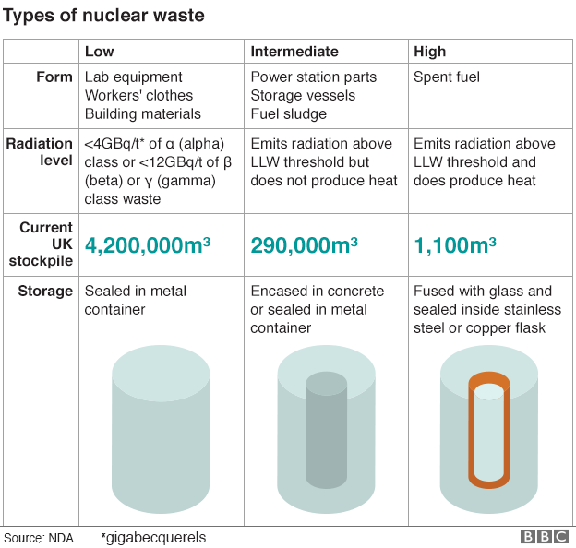
Energy Department Plan to Reclassify Nuclear Waste Worries Environmentalists https://weather.com/science/environment/news/2018-12-10-energy-department-reclassify-nuclear-waster
At a Glance
-
- The U.S. Department of Energy wants to reclassify some of the waste that meets highly technical conditions.
- The agency says the change could save the federal government $40 billion in cleanup costs at nuclear sites across the nation.
- About 56 million gallons of radioactive and hazardous chemical wastes are stored in tanks in Washington state.
- Environmentalists fear a U.S. Department of Energy proposal to reclassify some radioactive waste left from the production of nuclear weapons is simply a way to abandon the cleanup of places like the Hanford Nuclear Reservation in Washington state.The Trump administration proposal to lower the status of some high-level radioactive waste would make disposal cheaper and easier. Reclassifying the material to low-level could save the agency billions of dollars and decades of work by essentially leaving the material in the ground, critics say.
- The proposal joins a long list of Trump administration efforts to loosen environmental protections. Just last week, the Environmental Protection Agency acted to ease rules on the sagging U.S. coal industry.Tom Carpenter of Hanford Challenge, a nuclear watchdog group, said it wants a thorough cleanup of the Washington state nuclear site, which is half the size of Rhode Island. That includes building a national repository somewhere else to bury the waste once it has been stabilized.
- “The cleanup of the site is really at stake,” Carpenter said about the proposed change.
He noted that Hanford is located in an environmentally sensitive site adjacent to the Columbia River and susceptible to earthquakes, volcanoes and flooding.
- Hanford was established by the Manhattan Project in World War II to make plutonium, a key ingredient in the atomic bomb dropped on Nagasaki, Japan. The plant went on to produce most of the plutonium for the nation’s nuclear arsenal.As a result, the site also contains the nation’s largest collection of nuclear waste. The most dangerous is stored in 177 aging underground tanks, some of which have leaked. The tanks hold some 56 million gallons of radioactive and hazardous chemical wastes waiting to be treated for permanent disposal.Cleanup efforts at Hanford have been underway since the late 1980s and cost about $2 billion a year.
Current law defines high-level radioactive waste as resulting from processing irradiated nuclear fuel that is highly radioactive. The Energy Department wants to reclassify some of the waste that meets highly technical conditions.
The agency says the change could save the federal government $40 billion in cleanup costs across the nation’s entire nuclear weapons complex, which includes the Savannah River Plant in South Carolina and Idaho National Laboratory.
- Environmental groups and the state of Washington, which has a legal commitment with the Energy Department to oversee the Hanford cleanup, said the proposal is a concern.”They see it as a way to get cleanup done faster and less expensively,'” said Alex Smith of the Washington state Department of Ecology.Carpenter said there “is not much point in doing much else if they don’t clean up the high-level waste.”
At the request of U.S. Sen. Ron Wyden, an Oregon Democrat, the agency extended the public comment period on the proposal to Jan. 9. The agency can make the change without the approval of Congress.
“No one disputes the difficulty of retrieving and treating high-level waste from Hanford’s aging storage tanks,” Wyden wrote to the DOE. “However, lowering the bar for level of protection of future generations and the environment by changing the definition of what has always been considered high-level waste requiring permanent disposal is a significant change.”
Maine watchdogs keep close eye on Trump’s bid to change nuclear waste storage rules
|
https://bangordailynews.com/2018/12/12/news/midcoast/maine-watchdogs-keep-close-eye-on-trumps-bid-to-change-nuclear-waste-storage-rules/ • December 12 2018, A new proposal by President Donald Trump’s administration to reclassify some high-level nuclear waste to reduce cleanup costs will not affect the 550 metric tons of spent nuclear fuel stored in more than 60 airtight steel canisters near the former Maine Yankee nuclear reactor in Wiscasset. The new proposal focuses on waste generated by nuclear weapons, not power plants. But Mainers tasked with advocating for safe handling of atomic waste voiced concern that it could foretell changes that would affect the Maine Yankee waste.
“Safety costs money; environmental protection costs money,” said Edgecomb resident Ray Shadis, technical adviser to the New England Coalition on Nuclear Pollution in Brattleboro, Vermont, and founder of the group Maine’s Friends of the Coast that eventually got Maine Yankee shut down. “I think that’s the next shoe. This initiative at the weapons’ facilities is very likely the first step.” The U.S. Department of Energy has proposed reclassifying some high-level radioactive waste in various U.S. locations to low-level, allowing the department to leave the waste buried in the ground and save $40 billion in cleanup costs, the Associated Press reported Tuesday. Per the Atomic Energy Act of 1954 and the Nuclear Waste Policy of 1982, high-level radioactive waste is currently defined as waste resulting from processing irradiated nuclear fuel that is highly radioactive. Shadis said the proposal would not affect waste at the former Maine Yankee plant, which closed in 1996. Trump’s current proposal would only affect high-level radioactive waste generated by nuclear weapons production — currently stored in South Carolina, Idaho, Washington and New York — not waste generated by civilian nuclear production. “The terms ‘highly radioactive’ and ‘sufficient concentrations’ are not defined in the [Atomic Energy Act] or the [Nuclear Waste Policy Act],” the proposal states. It goes on to argue that “Congress left it to [Department of Energy] to determine when these standards are met. Given Congress’ intent that not all reprocessing waste is [high-level waste], it is appropriate for DOE to use its expertise to interpret the definition of [high-level waste], consistent with proper statutory construction, to distinguish waste that is non-HLW from waste that is HLW.” According to Shadis, industry officials and regulators have insisted since the beginning of the nuclear age that civilian nuclear production and weapons production for defense have nothing to do with each other. They are not integrated in any way and are handled separately. In fact, waste generated by civilian nuclear reactors is regulated by the U.S. Nuclear Regulatory Commission. Eric Howes, spokesman for Maine Yankee, said Tuesday he is not aware of any proposals to reclassify waste stored at Maine Yankee. Nevertheless, Shadis said, “I will say that we could simply wait for the other shoe to drop, because the Trump administration has rushed to the rescue of commercial power plants, which are shutting down all over the country because they are no longer competitive … it’s one way of fixing the game. One way of adjusting the cost of nuclear is to be more lenient when it comes to environmental regulations, including regulations regarding nuclear waste.” “That’s completely outrageous,” Don Hudson, chairman of the Maine Yankee Community Advisory Panel, said of the proposal. “They couldn’t have done that with a straight face. But it doesn’t affect Maine Yankee’s waste.” A federal judge has already awarded Maine Yankee $24.6 million in a decision based on the federal government’s failure to remove and dispose of the spent nuclear fuel. But Hudson said again on Tuesday there is no viable solution for the waste in Wiscasset, although “there are a couple of potential projects that might get built sometime in the next decade for above-ground storage near Carlsbad, New Mexico, and west Texas.” Previous administrations have said “stranded” nuclear waste — hazardous materials stored where there is no operating nuclear plant such as Maine Yankee, Yankee Rowe in Massachusetts and several others — would be the first to be removed, according to Hudson. But he said he isn’t holding his breath. “The impasse on the nuclear waste issue continues,” Howes said. “Congress to date has not provided any funding in the fiscal year 2019 budget for consolidated interim storage or the Yucca Mountain license application process. Maine Yankee and many others are urging Congress to provide fiscal year 2019 funding for nuclear waste management during this lame duck session of Congress.” “I hate to sound cynical, but I’m not going to believe it’s going to happen until I actually hear there’s a bulldozer on the ground,” Hudson said. “It’s really dangerous stuff, and it needs to be taken care of … depending on who you ask, it’s going to be multi tens of thousands of years before you could assign just casual care of this waste.” |
|
TRUMP WANTS TO RECLASSIFY RADIOACTIVE WASTE FROM NUCLEAR WEAPONS TO ‘LOW LEVEL’ SO DISPOSAL IS CHEAPER
|
The Department of Energy intends to relabel high-level radioactive waste left over from the production of nuclear weapons as low-level, the Associated Press reported. Currently, high-level radioactive waste is defined as that which is a byproduct of fuel reprocessing (where leftover fissionable material is separated from the waste) or from nuclear reactors. Low-level waste, on the other hand, represents around 90 percent of all such waste, according to the American Nuclear Society, and generally comes from facilities where radioisotopes are used, such as nuclear power stations, and local hospitals. Items often include wipes, clothes and plastic. In the U.S., 90,000 metric tons of nuclear waste is being temporarily stored as successive administrations have grappled to find a long-term solution. Storing nuclear waste safely presents a number of challenges: it needs to be protected from natural disasters, and stopped from seeping into the surrounding water and soil, while its radiation blocked. Thieves must be kept from accessing it, and so too future generations who may not understand how toxic such materials are. The Associated Press reported the agency said the reclassification would shave $40 billion off the cost of cleaning up after the production of nuclear weapons. A Department of Energy official told Newsweek it is requesting public comment on its interpretation of the meaning of the statutory term of high-level radioactive waste through the federal register. …….. Facilities which would be affected include the country’s most highly contaminated: the Hanford Nuclear Reservation in Washington state, which takes up an area half the size of Rhode Island. Opened in 1943, the site produced the plutonium for the atomic bomb dropped on Nagasaki, Japan in 1945, according to its website. The production of nuclear materials carried on until 1987, leaving behind waste that threatened the local environment, prompting the state and federal authorities — including the Department of Energy, the Environmental Protection Agency — to pledge in 1987 to clean up the site, without success. Other facilities mentioned in the plans are the Savannah River Plant, South Carolina and the Idaho National Laboratory, according to the Associated Press……. Alex Smith, Program Manager of the State of Washngton Department of Ecology Nuclear Waste Program, which is involved in the Hanford project, told the Associated Press: “They see it as a way to get cleanup done faster and less expensively.” The consultation originally ran from October 10 until December 10. Democratic Senator Ron Wyden for Oregon requested a public consultation on the proposal be extended to January 9……..https://www.newsweek.com/trump-reclassify-radioactive-waste-nuclear-weapons-low-level-disposal-cheaper-1253063?fbclid=IwAR1H-mvAOsdN24NT1pKy3MGAuVDn_q_siZc67iXsl-eLkKNFNMeZ4F8xKgA |
|
|
Pacific island countries accuse USA of obstructing talks at UN climate change summit
Vanuatu’s foreign minister says worst offenders on global warming are blocking progress, Guardian, Ben Doherty in Katowice@bendohertycorro, Wed 12 Dec 2018
The United States and other high carbon dioxide-emitting developed countries are deliberately frustrating the UN climate summit in Katowice, Poland, Vanuatu’s foreign minister has said. His warning came as Pacific and Indian ocean states warned they faced annihilation if a global climate “rule book” could not brokered.In a bruising speech before ministers and heads of state, Vanuatu’s foreign minister, Ralph Regenvanu, singled out the US as he excoriated major CO2-emitting developed countries for deliberately hindering negotiations.
“It pains me deeply to have watched the people of the United States and other developed countries across the globe suffering the devastating impacts of climate-induced tragedies, while their professional negotiators are here at COP24 putting red lines through any mention of loss and damage in the Paris guidelines and square brackets around any possibility for truthfully and accurately reporting progress against humanity’s most existential threat,” he said.
Regenvanu said the countries most responsible for climate change were now frustrating efforts to counter it.
The UN’s climate change talks in Poland have been distracted by a semantic debate over whether the conference should “welcome” or “note” the IPCC’s special report warning of dire consequences if global warming rises more than 1.5C above pre-industrial levels, with a bloc of four oil-producing countries – the US, Saudi Arabia, Russia, and Kuwait – insisting the report be only “noted”.
Documents from the conference presidency, seen by the Guardian, indicate the issue of how to acknowledge the report will be returned to later in the week and is likely to further slow progress on negotiating a final outcome. Negotiators said they are growing increasingly pessimistic that talks can be concluded by their deadline on Friday…….
As 193 countries at the climate talks seek to establish a “rule book” on how to implement the commitments made in the Paris agreement three years ago, Regenvanu condemned a two-tier system that exempted high-emissions countries from reductions obligations, saying the world needed “one common rule book, in which rules apply to all”.
The US state department declined to comment on his remarks……https://www.theguardian.com/environment/2018/dec/11/us-accused-of-obstructing-talks-at-un-climate-change-summit
Washingtonhelping nuclear workers to get compensation State will defend its law
State will fight feds over Hanford worker compensation, Q13 FOX, , DECEMBER 11, 2018, BY ASSOCIATED PRESS SPOKANE, Wash. (AP) — Officials for the state of Washington said Tuesday they will defend a new law that helps employees of a former nuclear weapons production site win worker compensation claims, after the federal government filed a lawsuit seeking to overturn the law.
Democratic Gov. Jay Inslee criticized the lawsuit as outrageous and “depraved.”
“The people who fought communism shouldn’t have to fight their federal government to get the health care they deserve,” said Inslee, who is weighing a run for the White House in 2020.
The U.S. Department of Justice filed the lawsuit on Monday in federal court for the Eastern District of Washington.
The Washington Legislature last spring passed a law that says some cancers and other illnesses among Hanford Nuclear Reservation workers are assumed to have been caused by chemical or radiological exposures at work, unless that presumption can be rebutted by clear and convincing evidence.
…….The legislation signed into law in March by Inslee was propelled through the Legislature by the concerns of sick Hanford workers frustrated by state denials of their compensation claims…..
Ferguson said he presumed the federal government was worried the new Washington law might spread to other states where federal employees were involved in dangerous work. He predicted the issue would likely be resolved at trial.
“Before this, workers had to prove that whatever illness they had was not caused by something else in their lives,” Ferguson said.
Inslee called it another attempt by the Trump administration to take health care away from people in the state.
“They want to tell workers at Hanford to go hang,” said Inslee, who used to represent the Hanford site in Congress.
Lynne Dodson of the Washington State Labor Council said the federal government should be working to improve worker safety, rather than pursuing this lawsuit.
“Donald Trump and (Energy Secretary) Rick Perry would kick these workers while they are down,” Dodson said. https://q13fox.com/2018/12/11/state-will-fight-feds-over-hanford-worker-compensation/
White House fury as Russian nuclear planes visit Venezuela
|
White House fury as Russian nuclear planes visit Venezuela Irish Independent, Harriet Alexander,December 12 2018
Two Russian bombers capable of carrying nuclear weapons have landed in Venezuela in a show of support which has infuriated Washington. General Vladimir Padrino, the Venezuelan defence minister, welcomed about 100 Russian pilots and other personnel after the two TU-160s and two other aircraft landed at the international airport that serves Caracas on Monday. He said the deployment showed “we also are preparing to defend Venezuela to the last inch when necessary”. Nicolas Maduro, the president of Venezuela, has frequently alleged that the US is planning an invasion. Mr Padrino noted that Russian aircraft had visited before in 2013, but said their current deployment was part of a “new experience,” and was designed to “raise the level of interoperability of the aerospace defence systems” of both countries. Mr Maduro has found himself increasingly isolated as Donald Trump takes an increasingly aggressive stance against his regime. With many of his allies under sanctions and financial transactions blocked, Mr Maduro has cultivated friendships with America’s adversaries. He said talks with President Putin in Moscow this month yielded Russian investment in his country’s oil and gold sectors. It was not clear how long the Russian planes would stay in Venezuela, nor what their mission would be. “Russia’s government has sent bombers halfway around the world to Venezuela,” US Secretary of State Mike Pompeo tweeted. “The Russian and Venezuelan people should see this for what it is: two corrupt governments squandering public funds, and squelching liberty and freedom while their people suffer.” The Kremlin rejected Mr Pompeo’s criticism. “As for the idea that we are squandering money, we do not agree. It’s not really appropriate for a country half of whose defence budget could feed the whole of Africa to be making such statements,” said Kremlin spokesman Dmitry Peskov. The developments come as Mr Trump escalated his threat to shut down the US government over his demand for funding of his Mexican border wall……..https://www.independent.ie/world-news/latin-america/white-house-fury-as-russian-nuclear-planes-visit-venezuela-37618272.html |
|
|
USA’s intractable nuclear waste problem: a new approach is needed
U.S. must start from scratch with a new nuclear waste strategy, a Stanford-led panel says
Thousands of tons of highly radioactive spent fuel are in temporary storage in 35 states, with no permanent solution being discussed. International experts led by Stanford show how to end this status quo. Stanford News, BY KATHLEEN GABEL CHUI AND MARK GOLDEN, 10 Dec 18, The U.S. government has worked for decades and spent tens of billions of dollars in search of a permanent resting place for the nation’s nuclear waste. Some 80,000 tons of highly radioactive spent fuel from commercial nuclear power plants and millions of gallons of high-level nuclear waste from defense programs are stored in pools, dry casks and large tanks at more than 75 sites throughout the country.
A Stanford University-led study recommends that the United States reset its nuclear waste program by moving responsibility for commercially generated, used nuclear fuel away from the federal government and into the hands of an independent, nonprofit, utility-owned and -funded nuclear waste management organization.
“No single group, institution or governmental organization is incentivized to find a solution,” said Rod Ewing, co-director of Stanford’s Center for International Security and Cooperation and a professor of geological sciences.
The three-year study, led by Ewing, makes a series of recommendations focused on the back-end of the nuclear fuel cycle. The report, Reset of America’s Nuclear Waste Management Strategy and Policy, was released today.
A tightening knot
Over the past four decades, the U.S. nuclear waste program has suffered from continuing changes to the original Nuclear Waste Policy Act, a slow-to-develop and changing regulatory framework. Erratic funding, significant changes in policy with changing administrations, conflicting policies from Congress and the executive branch and – most important – inadequate public engagement have also blocked any progress.
“The U.S. program is in an ever-tightening Gordian knot – the strands of which are technical, logistical, regulatory, legal, financial, social and political – all caught in a web of agreements with states and communities, regulations, court rulings and the congressional budgetary process,” the report says.
The project’s steering committee sought to untangle these technical, administrative and public barriers so that critical issues could be identified and overcome. They held five open meetings with some 75 internationally recognized experts, government officials, leaders of nongovernmental organizations, affected citizens and Stanford scholars as speakers.
After describing the Sisyphean history of the U.S. nuclear waste management and disposal program, the report makes recommendations all focused around a final goal: long-term disposal of highly radioactive waste in a mined, geologic repository.
“Most importantly, the United States has taken its eyes off the prize, that is, disposal of highly radioactive nuclear waste in a deep-mined geologic repository,” said Allison Macfarlane, a member of the steering committee and a professor of public policy and international affairs at George Washington University. “Spent nuclear fuel stored above ground – either in pools or dry casks – is not a solution. These facilities will eventually degrade. And, if not monitored and cared for, they will contaminate our environment.”
The new, independent, utility-owned organization would control spent fuel from the time it is removed from reactors until its final disposal in a geologic repository. ………https://news.stanford.edu/2018/12/10/square-one-u-s-nuclear-waste-management-program/
The worst performing countries for climate action- USA and Saudi Arabia
 US, Saudi Arabia back-of-the-pack on curbing climate change, Researchers have identified the United States and Saudi Arabia as the climate change laggards. https://www.sbs.com.au/news/us-saudi-arabia-back-of-the-pack-on-curbing-climate-changeThe United States and Saudi Arabia rank last when it comes to curbing climate change among the 56 nations accounting for 90 percent of planet-warming greenhouse gas emissions, researchers said Monday.A large number of laggards means the world is dangerously off-track when it comes to slashing the carbon pollution that has already amplified droughts, flooding and deadly heatwaves worldwide, they reported on the margins of UN climate talks in Katowice, Poland.
Only a few countries have started to implement strategies to limit global warming well below 2 degrees Celsius (3.6 degrees Fahrenheit),” the cornerstone target of the 2015 Paris climate treaty, according to NewClimate Institute and Germanwatch, an NGO.
Most governments “lack the political will to phase out fossil fuels with the necessary speed.” Continue reading
No answer to clean up Washington’s Hanford nuclear site
|
There’s no easy fix for our nuclear past At Washington’s Hanford nuclear site, failing infrastructure and make-do plans as the West prepares for a new round of radioactivity. High Country News, Heather Hansman, Dec. 10, 2018, Fhe Hanford nuclear complex in eastern Washington lies in a green-gold sagebrush steppe, so big you can’t see the edges of it and shimmery in the summer heat. The only landmarks are low-slung buildings on the horizon and ancient sand dunes scrubbed bare when the glaciers melted. There’s almost no trace that this is the biggest nuclear waste dump in the country. The scale of nuclear waste is like that: sprawling out into the metaphysical distance, too big for the human mind to hold. Over the ridge north of us, the Columbia River curves around the site, appearing motionless until you get close and see how much water is pushing past the banks. Over the past year, a series of accidents has put the spotlight on Hanford, its aging infrastructure and the lack of a long-term solution. In May 2017, part of the Plutonium Uranium Extraction Facility, which holds rail cars full of solid waste, collapsed. Later that year, workers tearing down the Plutonium Finishing Plant were contaminated with plutonium and americium particles when an open-air demolition went wrong. In December, others inhaled radioactive dust at the same site, halting work indefinitely. Then, in June of this year, the Department of Energy (DOE), which is responsible for the site, released a proposal to reclassify some of the high-level waste as less toxic, with what’s called a “Waste Incidental to Reprocessing” evaluation, so they could clean it up sooner and more cheaply. “There’s a lot more work to do than there is money to get it accomplished,” Price said. “We’ve really come to a fork in the road.” Across the country, big energy companies are considering a move from coal to nuclear-fueled plants even as sites like Hanford remain mired in many-decades-long cleanups of radioactive landscapes. As the possibility of more waste looms, Hanford has become a flashpoint for people who fear that there’s no safe way to deal with our nuclear legacy. In this era of climate change and large-scale environmental degradation, the site raises the question: Can we ever clean up the mistakes of our past? ………….The Government Accountability Office estimates cleaning up Hanford could total more than $100 billion. Since 1989, when Hanford was first designated as a Superfund site, 889 buildings have been demolished, 18.5 million tons of debris have been put in controlled landfills, and 20 billion gallons of groundwater have been treated. With three decades of work, the scope of the problem has been greatly reduced, but the really toxic stuff is still on site. The groundwater beneath Hanford is never going to be clean enough to drink, thanks to a cocktail of chemicals: strontium-90, which deteriorates marrow in the bones of humans and animals and takes 300 years to break down; hexavalent chromium, which mutates salmon eggs; and technetium-99, which dissolves like salt in water and has a half-life of 211,000 years.
The 586 square miles of sage still hold the 324 Building, home to highly radioactive nuclear containment chambers called hot cells, less than 1,000 feet from the Columbia and right across from the town of Richland, where many of the Hanford workers live. In the central plateau, where the ghostly vitrification plant stands, the Waste Encapsulation Storage Facility holds 1,936 radioactive cesium and strontium capsules currently kept in a glorified swimming pool. If an earthquake were to crack the pool, or the water supply were to run dry, those isotopes, physically hot and linked to bone cancer, would spread quickly.
The knotty heart of the cleanup is the tank farm, on the central plateau, where 56 million gallons of high-level waste — the official term for the long-lived radioactive material leftover from plutonium production — sit in 177 underground tanks. Each tank holds a unique mixture of sludge, solid, supernate liquid and crusty saltcake — a witch’s brew of 1,800 different chemicals that are buzzing, off-gassing and breaking down. Sixty-seven of the 149 carbon-steel single-shell tanks and one of the newer 28 double shells have leaked, but the Energy Department refuses to build new ones, and every year the timeframe for cleanup gets longer.
If you think it’s nearly intractable, that’s because it is,” said Randy Bradbury, the communications director from Washington’s Department of Ecology, one of the three parties that regulates the site. “The biggest mind-boggling thing about it is that we’re all going to be dead before this is cleaned up.” That timespan challenges our decision-making, which is much more suited to responding to accidents than to multigenerational cleanup projects. Philosopher Timothy Morton categorizes nuclear weapons, waste and explosions (not to mention climate change and the longevity of Styrofoam cups) as “hyperobjects” — real-life objects that are too large in time and space for humans to fully grasp. How, then, can we calculate all their costs? The Department of Energy spends billions of dollars on the cleanup each year; next year, it has a $2.4 billion budget. But those billions are barely enough to keep the wheels on, and the Government Accountability Office estimates that the last 15 percent of the cleanup could be as expensive as the first 85 percent, which has already taken 30 years. Maintaining the tanks alone costs $300 million a year, and the minimum amount needed to keep things safe increases as time goes on and infrastructure ages. There currently isn’t enough federal funding to meet cleanup benchmarks, and no money has been allocated for accidents like the tunnel collapse that contaminated workers. At the current rate of funding and cleanup, the DOE’s Richland Office, which manages most of the site, falls another year behind schedule every two years, and the Office of River Protection, which oversees the tank waste, slips back a year every three. This year, President Donald Trump proposed slashing the budget for Hanford cleanup by $230 million. ….….. Cleaning up the tank farm requires moving the waste out of the single-shell tanks, which are each as wide across as a tennis court and can hold up to a million gallons of waste, and into the sturdier double-shell tanks. From there, it will — theoretically — be vitrified, or turned into glass, at the as-yet-unbuilt vitrification plant and then sent to the stalled-out proposed federal nuclear repository at Yucca Mountain in Nevada, or to another long-term storage facility. Every step is excruciatingly complex. The massive tanks were designed to hold radioactive materials, not release them, so any material in these tanks has to come out through a pipe just 12 inches around. Challenges like this have forced Hanford managers to invent every step of the cleanup process, from how to sample the contents to how to keep video cameras from burning up in the radioactive heat inside. It’s a constant guessing game, where the questions of how to store the waste and neuter its effects change endlessly. That’s why in June, the Energy Department proposed reclassifying the remaining high-level waste in the C section of the tank farm as low-activity waste, and then filling the tanks with grout to stabilize the remaining 66,000 gallons of waste, so it could be kept onsite permanently. The department thinks that it would be safe enough to close the door on the tank cleanup once the grout is in, except for long-term monitoring. ……… Some people believe a fast response may be safer than a slower, more thorough response. “Until all the waste is out of those tanks, it’s almost inevitable that more of them will leak,” Bradbury says. The tanks, built starting in the 1940s, were designed to safely contain waste for up to 40 years on the assumption that we’d have figured out a long-term plan by then. But we haven’t, at Hanford or anywhere else. High-level waste was never supposed to stay on site permanently. The waste from the tanks is intended to be vitrified, turned into glass rods, then sent to a federal repository, where it would sit, isolated, forever. But that repository doesn’t exist yet, and it’s possible that it never will. The Nuclear Waste Policy Act of 1987 designated Yucca Mountain, Nevada, as the spot to store the waste. Despite $15 billion spent studying the site, and a growing cost to hold the waste at other sites, plans for Yucca have been in limbo for decades, in large part because of opposition from Nevadans, including former Senate Majority Leader Harry Reid, D-Nev., who don’t want the waste transported through or stored in their state. A bill to reopen Yucca passed the U.S. House of Representatives as recently as May, but failed in the Senate. “We’ve made stuff that will be dangerous for millennia and we deal with it in two-year congressional cycles,” said William Kinsella, a North Carolina State University professor whose research includes nuclear weapons cleanup. “We don’t want to make hasty decisions, but it’s a chokepoint for nuclear constipation.”That has created expensive and dangerous blockages throughout the nuclear waste management system. Without a place to send waste, the cleanup at Hanford has no real endgame. Because of the long-term impossibility, the Hanford Advisory Board — a coalition of tribal members, community volunteers and government workers who advise the agencies that manage the site — is constantly worried that the funds might dry up while the tanks are still full. The fear of slashed funding, and the cleanup’s long delay, is part of what drove the Department of Energy to consider grouting.
But the proposal worries watchdog groups, who are concerned about short-sighted cost-saving measures that could put surrounding communities at lasting risk by keeping 700,00 gallons of waste that’s currently classified as high-level, and that might ultimately leak to the river on site. “What the DOE is proposing is to make the Hanford site a high-level waste repository in all but name,” said Tom Carpenter, executive director of the Hanford Challenge, an environmental advocacy group. “That does not belong in an agriculture zone in a major river system in an earthquake zone.” ……… I ask Price what he thinks the worst-case scenario might be, and he says there are two things that keep him up at night. The first is a dramatic natural disaster, such as an earthquake or a fire, that would damage the fragile infrastructure and cause a massive spill. The site sits at the drought-prone edge of the Cascadia subduction zone, so both are likely. The week before our visit, a fire burned 2,500 acres here, and we can still smell the charred sage. But Price’s second fear is about the equally insidious threat people pose to themselves: A lack of long-term protection and the erosion of care. He says the paradox of Hanford is trying to convince people that the site is safe now, but that in 500 — or 1,000 — years, it might not be, and that we have to make decisions with those unknown risks in mind. “I’m not really worried about today, broad-scale, but I’m worried about the future,”………… Heather Hansman lives in Seattle, where she writes about water and the West. Downriver, her first book, will be out in April. https://www.hcn.org/issues/50.21/nuclear-energy-theres-no-easy-fix-for-our-nuclear-past |
|

1 This Month





PLEASE OPPOSE HR 8255 AND S.3639 – bills would accelerate satellite deployment, with no environmental review or safeguards – https://ncstd5li.quorum.us/campaign/169331/
To see nuclear-related stories in greater depth and intensity – go to https://nuclearinformation.wordpress.com
-
Archives
- October 2026 (10)
- September 2026 (339)
- August 2026 (330)
- July 2026 (355)
- June 2026 (287)
- May 2026 (306)
- April 2026 (356)
- March 2026 (251)
- February 2026 (267)
- January 2026 (308)
- December 2025 (358)
- November 2025 (359)
-
Categories
- 1
- 1 NUCLEAR ISSUES
- business and costs
- climate change
- culture and arts
- ENERGY
- environment
- health
- history
- indigenous issues
- Legal
- marketing of nuclear
- media
- opposition to nuclear
- PERSONAL STORIES
- politics
- politics international
- Religion and ethics
- safety
- secrets,lies and civil liberties
- spinbuster
- technology
- Uranium
- wastes
- weapons and war
- Women
- 2 WORLD
- ACTION
- AFRICA
- Atrocities
- AUSTRALIA
- Christina's notes
- Christina's themes
- culture and arts
- Events
- Fuk 2022
- Fuk 2023
- Fukushima 2017
- Fukushima 2018
- fukushima 2019
- Fukushima 2020
- Fukushima 2021
- general
- global warming
- Humour (God we need it)
- Nuclear
- RARE EARTHS
- Reference
- resources – print
- Resources -audiovicual
- Weekly Newsletter
- World
- World Nuclear
- YouTube
-
RSS
Entries RSS
Comments RSS

