Risk of catastrophic Hanford tunnel collapse prevented as tunnel is stabilised
|
Radioactive waste tunnel at Hanford stabilized after fears of a possible ‘catastrophic’ collapse, Tri City Herald, BY ANNETTE CARY, APRIL 29, 2019 The second Hanford PUREX plant tunnel storing highly radioactive waste has been stabilized to prevent a collapse.
Work to fill the tunnel with concrete-like grout began in early October and was completed at the end of last week. Local government officials are relieved. “We experienced a horrible winter with a massive amount of snow,” said Pam Larsen, executive director of Hanford Communities, a coalition of local governments, at a recent meeting of the Hanford Advisory Board. “The tunnel could have collapsed,” she said. “It would have been catastrophic for our regional economy.” Concerns about the second PUREX tunnel were raised after the first tunnel partially collapsed in spring 2017. An unusually wet winter may have contributed to the collapse. Filling the second tunnel with grout is a temporary measure to prevent a possible collapse and release of radioactive particles into the air, with plans to clean up the waste in the tunnel to be made in the future…… About 40,000 cubic yards of grout, or 4,000 truckloads, were needed to fill the tunnel, which is 1,700 feet long. It holds 28 rail cars loaded with obsolete and failed equipment that is contaminated with highly radioactive waste from the past production of plutonium at Hanford for the nation’s nuclear weapons program. When the first tunnel partially collapsed, thousands of Hanford workers were ordered to take cover and the Tri-Cities-area anxiously waited for information until it was determined that there had been no release of radioactive particles. The soil topping the tunnel fell into the breach, covering the waste……. Hanford watchdogs were concerned that grouting might become a permanent solution, with the radioactive waste left in the ground permanently. “Opponents raised legitimate concerns, but in the end those concerns did not outweigh the potential environmental and safety threats that could have been posed had the tunnel collapsed and exposed its highly radioactive contents,” Ecology officials said in a statement Monday….. In both tunnels, grout was added in layers, with each layer allowed to set before the next layer was added. But the second tunnel was five times longer, requiring changes to procedures and equipment as grout was added every 100 feet along the tunnel…….https://www.tri-cityherald.com/news/local/hanford/article229789389.html |
|
Nuclear bailout could help “old” technology at the expense of “new nuclear”

|
Daily on Energy: Utility group CEO says popular nuclear energy bill could be a bailout in disguise https://www.washingtonexaminer.com/policy/energy/daily-on-energy-utility-group-ceo-says-popular-nuclear-energy-bill-could-be-a-bailout-in-disguise
|
|
USA’s Nuclear Regulators look to New Mexico desert For Temporary Waste Storage Facility
 Nuclear Regulators Search For Temporary Storage Facility In New Mexico, NPR, April 30, 2019 NATHAN ROTT Nuclear Regulators Search For Temporary Storage Facility In New Mexico, NPR, April 30, 2019 NATHAN ROTT
|
|
|
How bailout of Pennsylvania nuclear plants would cost consumers billions,
|
Pennsylvania and New Jersey lawmakers are preparing to push up your monthly electricity bill … in order to shovel subsidies to failing nuclear-power plants. Consumers like you are projected to pay billions in higher electricity bills over the next decade — killing jobs and shrinking your savings in the bargain. What’s driving this? For the past few years, natural-gas pipelines have delivered cheap fuel, shrinking the cost of generating electricity. It is now cheaper to make electricity with natural gas than with any other fossil fuel. That’s a big win for consumers and manufacturers. But it is bad news for nuclear-power plant operators, whose generating costs are often higher than the market price for power. So now nuclear-power operators hope to persuade lawmakers that taxpayers should bail them out. And their plan, backed by a pile of lobbying dollars, is working. The New Jersey Board of Public Utilities awarded “zero-emissions certificates” on April 18 to three state nuclear plants, all owned and operated by investor-owned utility Public Service Enterprise Group. That’s a subsidy of some $300 million per year. Those subsidies will be paid by surcharges on consumer electric bills. The Newark Star-Ledger summed it up best: “For PSEG, a windfall. For us, the shaft.” And Pennsylvania is not far behind the Garden State. Pennsylvania state Rep. Thomas Mehaffie, a Republican, has introduced a bill that would offer subsidies to the Keystone state’s five nuclear plants. He says the plan will cost some $500 million per year — raising utility bills roughly $21.24 per home per year. The real cost will be much higher, critics say, pointing to estimates of more than $60 per year per household. The battle is not over yet in Pennsylvania. Lawmakers in Harrisburg are getting an earful from the AARP and consumer groups. State regulators also believe the Pennsylvania bailout proposal is misguided. Public Utility Commissioner Andrew Place sent a memo to members of the state Senate saying that “this bill, in its current form, is far from the least cost mechanism to achieve these goals.” No kidding. In fact, the subsidy plan is so broadly written that it would also fund nuclear plants, like Beaver Valley Nuclear Station, that are not actually losing money. What’s clear is that utilities are getting what they paid for. In New Jersey, PSEG reportedly spent some $2.4 million lobbying for subsidies in 2017. In Pennsylvania, the company that owns the struggling Three Mile Island plant — Exelon — reportedly tripled its lobbying expenditures since 2016, spending $1.78 million in 2018. While the nuclear-power industry can’t seem to make money off its failing plants, it has certainly figured out how to squeeze a return on investment from its lobbyists and its campaign contributions. The hard truth is that plain-old competition is killing the dinosaur utilities. Thanks to natural gas, U.S. manufacturers enjoy lower industrial kilowatt per-hour prices than all of the other 35 countries in the Organisation for Economic Co-operation and Development, except Norway. That is a huge advantage for factories in Pennsylvania and elsewhere. Subsidies just slow the inevitable. No bailout can change the reality that nuclear plants are whales beached by high insurance and regulatory costs. Their losses should provoke soul-searching among shareholders and far-reaching reforms of current management — not a cry for government bailouts…….. https://www.mcall.com/opinion/mc-opi-pennsylvania-nuclear-industry-bailout-20190501-hjzucrrqm5hovcunhj7dencnly-story.html |
|

UK govt resisting calls to declare ‘climate emergency’
|
Business Green 1st May 2019 , The government is today expected to resist fresh calls for it to declare a’climate emergency’, after Michael Gove indicated that more agreement was
across government before Defra could back a formal ‘climate emergency’. Gove yesterday met with representatives from the Extinction
Rebellion group who later described themselves as “disappointed” at the lack of firm commitments from the Environment Secretary on how he plans to accelerate the UK’s decarbonisation efforts. The group expressed frustration at the government’s continued failure to declare a ‘climate emergency’ and insisted that their campaign of peaceful civil disobedience would continue. Later today the High Court is expected to rule on whether a
legal challenge against the government’s approval for Heathrow expansion can proceed, while tomorrow the CCC will present its long awaited recommendations on whether the UK should adopt a net zero emission target. The Committee is widely expected to call for a new 2050 target, fuelling speculation the government could look to amend the Climate Change Act before the summer in order to get the new goal onto the statute book as quickly as possible. |
|
Curious contradictions on climate change in USA – Denial and Reality

|
The Last Time There Was This Much CO2, Trees Grew at the South Pole, Dahr Jamail, Truthout, 29 April 19, “……….Denial and RealityWhile this certainly comes as no surprise, yet another report came out highlighting how oil and gas giants are spending millions of dollars in their ongoing effort to lobby their paid politicians to block policies aimed at addressing climate disruption. The giant fossil fuel companies are spending an average of $200 million annually to weaken and/or oppose legislation aimed at addressing climate disruption. BP led the way in spending with $53 million, followed by Shell ($49 million), ExxonMobil ($41 million), Chevron and Total ($29 million each). Meanwhile, as per usual, President Donald Trump has signed executive orders to speed up oil and gas pipeline projects, making it harder for states to block construction projects due to environmental concerns. Yet, as the White House is actively denying climate disruption and working as hard as it can to promote fossil fuel use, the U.S. military is planning and preparing for dealing with the vast impacts of ongoing climate disruption. “People are acting on climate not for political reasons, but [because] it really affects their mission,” Jon Powers, an Iraq War veteran who served as the federal chief sustainability officer who is now president and chief executive of the investment firm CleanCapital, told The Washington Post. “With the military, it’s now ingrained in the culture and mission there, which I think is the biggest change over the last 10 years.” Meanwhile, a federal climate disruption study panel and advisory group that was disbanded by the Trump administration due to it not having enough members “from industry,” recently released a report warning that the muddled political response to very clear climate science is putting Americans at risk. “We were concerned that the federal government is missing an opportunity to get better information into the hands of those who prepare for what we have already unleashed,” Richard Moss, a visiting scientist at Columbia University, who previously chaired the federal panel and is a member of the group who released the report, told The Guardian. “We’re only just starting to see the effects of climate change, it’s only going to get much worse. But we haven’t yet rearranged our daily affairs to adapt to science we have.” With each passing month, the impacts of runaway climate disruption continue to intensify. And as they do, so must our awareness of what is happening across the planet, and our resolve to take action to address it – especially since most governments around the world are failing to meet these challenges.https://truthout.org/articles/the-last-time-there-was-this-much-co2-trees-grew-at-the-south-pole/
|
|

The cost of pretending that nuclear power is “clean”

|
Pennsylvania decides whether to subsidize nuclear energy as “clean” https://thebulletin.org/2019/04/pennsylvania-decides-whether-to-subsidize-nuclear-energy-as-clean/?utm_source=Bulletin%20Newsletter&utm_medium=iContact%20email&utm_campaign=PAnuclear_04222019, By Heather Wuest, April 22, 2019
To drive growth in its clean energy market and combat climate change, Pennsylvania adopted the Alternative Energy Portfolio Standards Act in 2004.This requires energy companies to buy specific percentages of their total electricity from clean energy sources. The requirements started small but are designed to increase over time. There are now 16 different clean energy choices for electric utilities to choose from in Pennsylvania. But new legislation would include a 17th clean generation option—nuclear power. Bills introduced in the state’s House and Senate are intended to prevent the retirement of the Three Mile Island nuclear plant outside Harrisburg and the Beaver Valley plant near Pittsburgh. Both plants are set for closure because they cannot compete on price with electricity from natural gas-fired power plants and renewable energy sources. Adding nuclear to the clean energy list would not be a simple or inexpensive process. Pennsylvania energy consumers would have to pay hundreds of millions in subsidies to make the nuclear plants economically viable. It’s a process that other energy generators and the manufacturing sector worry will distort Pennsylvania’s energy market. But the nuclear industry supports roughly 16,000 industry jobs and generates 93 percent of the electricity produced in the state by sources that don’t emit carbon dioxide in the process. Pennsylvania is hardly alone in its quest to buy clean energy; many other states are implementing plans that require energy companies to purchase set amounts so-called “carbon-free” electricity. In some states, nuclear is subsidized as a “green” energy source; in others, it is not. In Pennsylvania, it may be. The battle over that issue will play out in the state Legislature between now and early June, when the owner of the Three Mile Island plant is expected to decide whether to refuel or close it. |
|
Uranium waste in New Mexico puts lie to ‘carbon free’
Uranium waste in NM puts lie to ‘carbon free’, Albuquerque Journal, BY DUANE CHILI YAZZIE / SHIPROCK CHAPTER PRESIDENT, NAVAJO NATION, April 26th, 2019 “……..We must understand that abuse of seemingly inanimate matter has consequence. The extraction of uranium and the exploitation of it causes compounded waste and resultant compounded consequence. We have created mountains of radioactive waste; because we have limited knowledge and capacity to conclusively, effectually and permanently deal with this waste, we bury it. Out of sight, out of mind does not ease our minds because we know it is there. My community of Shiprock has one of the largest uranium waste disposal cells in the country sitting in the middle of our community. People who naively exalt science and technology may simultaneously inebriate themselves from the consequence of the devastating reality.The natural law of cause and effect predicates all. With my Navajo people, we have suffered the deaths of hundreds of our uranium miners, millers, transporters and affected family members due to health complications caused by exposure to uranium. In 1979 a United Nuclear Corp. holding pond burst, releasing 94 million gallons of radioactive waste that cascaded through Gallup and on downstream. Women and children who waded in the contaminated Rio Puerco, burning their feet, were told that the radioactive water was a figment of their imagination. … Our lives continue to be at stake. The radioactive levels remain, and we, the contaminated people, continue to develop uranium-related health issues. We die a slow death. The world of science and technology has damaged us and the natural world.
The Public Service Company of New Mexico, which has made an incredible indelible scar of industrial consequence on New Mexico and the Earth, now wants to add more nuclear to its portfolio. By doing so, PNM will only amplify this consequence. Some say that nuclear-generated electricity should be allowed because it is “carbon-free.” From a life-cycle perspective, it is not carbon-free. The semantics are irrelevant; what matters is the eventual and permanent negative impact and consequence to the land, the people and our planet Earth.
(In honor of) this Earth Day, it is imperative we acknowledge the damage done to the integrity of the life of Earth. The seemingly insurmountable effect from the cause of the extractive industry demands our attention. We have a climate crisis that is ebbing the life of our planet. The delicate balance of the equilibrium of the Earth and its life systems have been dangerously upset. We cannot further aggravate this great dilemma with more uranium exploitation and continue to destroy the sanctity of our Earth Mother and all life upon and within her.https://www.abqjournal.com/1307342/uranium-waste-in-nm-puts-lie-to-carbon-free.html
Subsidies to nuclear industry – legislation “anti-competitive” and “anti-consumer.”
 Free-market advocate chastises nuclear energy subsidies in committee hearing, Ohio Watchdog, By Tyler Arnold | Watchdog.org, Apr 24, 2019,
More evidence that US may seek to prosecute Julian Asssange under the Espionage Act
 https://www.thecanary.co/global/world-analysis/2019/04/28/more-evidence-that-us-may-seek-to-prosecute-julian-asssnge-under-the-espionage-act/ , 28th April 2019 More evidence has emerged that WikiLeaks founder Julian Assange could be prosecuted for offences under the US Espionage Act. Although testimony provided by a digital forensics expert raises questions about the prosecution.
Secretive Fossil Fuel Lobby Group, “Global Climate Coalition”, Manipulated UN Climate Programs
 Global Climate Coalition: Documents Reveal How Secretive Fossil Fuel Lobby Group Manipulated UN Climate Programs, https://www.desmogblog.com/2019/04/25/global-climate-coalition-documents-secretive-fossil-fuel-lobby-un-programs By Mat Hope and Karen Savage • , April 24, 2019 A fossil fuel–backed industry group was able to influence the process behind the United Nations climate assessments for decades, using lobbyists and industry-funded scientists to manipulate international negotiations, a cache of recently discovered documents reveals.
The documents include hundreds of briefings, meeting minutes, notes, and correspondence from the Global Climate Coalition (GCC). They were released Thursday by the Climate Investigations Center in collaboration with DeSmog and Climate Liability News. The documents date from 1989 and continue through 2002, when the lobbying group disbanded as its fossil fuel industry backers succumbed to public pressure to disavow its tactics.
The documents show how the GCC influenced international negotiations, manipulated the Intergovernmental Panel on Climate Change’s (IPCC) process, and undertook a disinformation campaign designed to cast doubt on mainstream climate science.
What was the Global Climate Coalition?
The GCC was initially part of the National Association of Manufacturers (NAM), before becoming its own entity in 1995. NAMhas a long history of defending portions of its membership, including tobacco companies that were facing an onslaught of liability litigation, with aggressive tactics that include discrediting science, attacking scientists, and misleading the public.
Founding members of the GCC were mainly fossil fuel producers and utilities, including oil majors Shell, Texaco (now a part of Chevron), and Amoco (now part of BP); oil refiner and retailers ARCO (now a subsidiary of Marathon Petroleum) and Phillips Petroleum; coal miners BHP-Utah International and Peabody; and utilities American Electric Power and Pacific Gas and Electric.
Other companies, including Exxon, joined later — and the international oil giant would go on to be a key player in the group.
Revealed in the documents is a decades-long campaign that continued until 2002, intended to protect its members’ interests by denying and casting doubt on climate science. Internally, the group acknowledged the dangers of climate change and the scientific consensus that it is overwhelmingly driven by the burning of fossil fuels as early as 1995.
Influencing the UN’s Panel of Climate Scientists
The GCC took a particular interest in the operations of the UN’s official scientific advisory body, the Intergovernmental Panel on Climate Change (IPCC), which produces the international climate assessments that form the basis for global climate policy and negotiations.
GCC representatives regularly met with IPCC scientists to lobby the panel to accept industry language in its reports, the documents show. Tax returns show hundreds of thousands of dollars spent on an “IPCC Tracker Fund” to monitor and lobby the IPCC’s meetings.
In one instance detailed in the documents, the GCC boasted its suggested language was “accepted almost in its entirety”after intensive lobbying by its representatives and after “assistance from several countries.”
The GCC also publicly questioned the validity of the IPCC’s peer-review process and launched public attacks on its scientists, while simultaneously using the IPCC’s status as a respected scientific body to promote the credentials of its own climate science denial research.
The GCC went beyond targeting climate science. In 1995, Exxon gave a presentation to the GCC on how to counter the evidence linking climate change to human health impacts.
In 1997, the GCC wanted to expand its reach with a network of state and local committees that would educate the public about their views on climate change and serve as liaisons to other business and public interest groups with similar views. This plan was implemented, the documents show, with the help of Koch Industries, the U.S.’s largest private energy company, which is an infamous funder of climate science denial across the globe.
The Collapse of the GCC
By the mid-1990s, however, the GCC’s aggressive tactics and continuing effort to cast doubt on accepted climate science had started to become a problem for some of its members. Nine corporations left the GCC from 1996 to 2000: two automakers, one chemical manufacturer, one utility, and five oil companies.
BP was the first major oil company to leave in 1997, stating that “the time to consider the policy dimensions of climate change is not when the link between greenhouse gases and climate change is conclusively proven, but when the possibility cannot be discounted and is taken seriously by the society of which we are part. We in BP have reached that point.”
The GCC also publicly questioned the validity of the IPCC’s peer-review process and launched public attacks on its scientists, while simultaneously using the IPCC’s status as a respected scientific body to promote the credentials of its own climate science denial research.
The GCC went beyond targeting climate science. In 1995, Exxon gave a presentation to the GCC on how to counter the evidence linking climate change to human health impacts.
In 1997, the GCC wanted to expand its reach with a network of state and local committees that would educate the public about their views on climate change and serve as liaisons to other business and public interest groups with similar views. This plan was implemented, the documents show, with the help of Koch Industries, the U.S.’s largest private energy company, which is an infamous funder of climate science denial across the globe.
Additional Takeaways: Infiltrating UN Climate Negotiations, Embracing Climate Deniers Publicly But Not Privately
The documents published Thursday on the Climate Investigation Center’s Climate Files archive, also show:
-
The GCC stacked UN meetings with its members. Some attended meetings transparently, registering as GCC members, while others registered with other NGOs. Often GCC members outnumbered delegates from developing nations at the annual Conference of the Parties (COP) meetings.
-
The GCC coordinated to monitor IPCC meetings. After IPCC meetings, GCC notes reveal attendees met to discuss strategies for exploiting scientific uncertainties in IPCC climate models and amplifying scientific differences of opinion. On at least one occasion, a contractor for the Electric Power Research Institute planned to keep tabs on IPCCproceedings.
-
The GCC internally refuted climate deniers, yet continued to publicly cite their work: Exxon scientist Lenny Bernstein, who co-chaired the GCC’s committee on science and technology assessment, called the work of climate deniers Richard Lindzen and Patrick Michaels “not convincing” in a draft document in 1995. The final copy of that document included no mention of Bernstein’s comments and the GCC continued to cite the two — as well as other known deniers — through at least 1998.
-
The GCC aggressively attempted to control media coverage of climate change: Press releases were sent to reporters praising media coverage featuring climate deniers and correcting those that did not. One document encouraged reporters to contact the GCC for “balance in the global climate change debate.”
Opposition to nuclear subsidies in Pennsylvania
|
Nuclear subsidies an uphill battle in Pennsylvania WHYY, By Marie Cusick
|
|
Russia wants to know details of Trump’s nuclear arms-control initiative
|
https://www.business-standard.com/article/international/russia-wants-to-know-details-of-trump-s-nuclear-arms-control-initiative-119042700734_1.html
US and Moscow are at loggerheads on nuclear weapons after Trump announced in February that he’s pulling out of a landmark Cold War-era treaty banning short- and medium-range missiles Olga Tanas | Bloomberg April 27, 2019 Russia is interested in the details of a potential U.S. plan to push for new arms-control agreements, Dmitry Peskov, spokesman for Russian President Vladimir Putin, told reporters Saturday in Beijing. US President Donald Trump has questioned the cost of maintaining a nuclear arsenal and has asked administration officials to prepare options for potential new arms-control agreements with Russia and China, the Washington Post reported April 25, citing an unidentified senior administration official. Peskov said while it would be ideal to rid the world of nuclear weapons, such a move would also remove the “restraining parity” that guarantees that no nuclear power makes a “monstrous mistake.” There had been no contacts with Russian experts on the issue, he said.
The US and Moscow are at loggerheads on nuclear weapons after Trump announced in February that he’s pulling out of a landmark Cold War-era treaty banning short- and medium-range missiles. The U.S. withdrawal from the 1987 Intermediate-Range Nuclear Forces treaty, after accusing Russia of violating the pact, has raised the threat of a renewed missile build-up in Europe. Russia has warned that time is also running out to begin talks on extending the other key nuclear weapons accord between Russia and the U.S., the New START treaty, before it expires in 2021. |
|
|
Climate change poses huge flooding risk to USA’s nuclear stations, but this is ignored by Trump administration
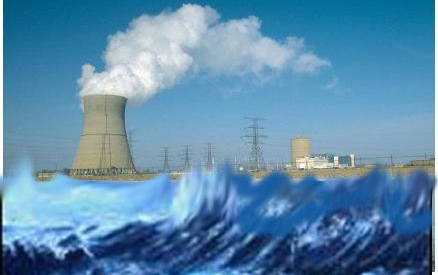 Trump administration is ignoring a massive problem at U.S. nuclear plants Trump administration is ignoring a massive problem at U.S. nuclear plants “54 of the [60] nuclear plants operating in the U.S. weren’t designed to handle the flood risk they face.” https://thinkprogress.org/nuclear-plants-flood-risk-trump-2eb58bc654a7/  At first, the main effort was a direct bailout — Energy Secretary Rick Perry’s failed planto subsidize nuclear (and coal) power plants by raising consumer energy bills. At first, the main effort was a direct bailout — Energy Secretary Rick Perry’s failed planto subsidize nuclear (and coal) power plants by raising consumer energy bills.
Now the administration has started cutting corners in nuclear safety and oversight. Trump appointees, who are a majority at the U.S. Nuclear Regulatory Commission (NRC), are allowing the nuclear industry to avoid costly upgrades to plants that are not designed to withstand current flood risk. What’s especially shocking about this decision, made by the NRC in January, is that a remarkable “54 of the [60] nuclear plants operating in the U.S. weren’t designed to handle the flood risk they face,” as Bloomberg reported last week after reviewing information exchanged between the plant owners and the NRC. Yet, even after examining all of the same information, the three NRC commissioners appointed by President Donald Trump decided to ignore NRC staff recommendations to address the problem. As a result, U.S. nuclear plants weren’t required to upgrade their designs or equipment. The NRC had ordered the original review of the flood risk to U.S. nuclear plants in the wake of the March 2011 Fukushima Daiichi disaster in Japan. In that tragic incident, an earthquake and tsunami led to three nuclear reactors melting down and widespread radiation releases. The cleanup effort will take decades and is currently estimated to cost $470 billion to $660 billion. Nuclear power plants are uniquely vulnerable to flooding because they need to be located next to a river, lake, or ocean since they require a dependable source of vast quantities of water for cooling. But if a major flood event disables the plant’s power and shuts off its cooling systems — as happened at Fukushima — then the reactor will overheat and start melting down, which, in turn can breach the containment vessel, leading to dangerous radioactive releases. Given the terrible cost of such a flood-driven failure, the NRC told all U.S. nuclear plant operators to examine their current flood risk and compare it to what the plants were designed to withstand. After all, since most of the decades-old plants were built, risks have increased thanks to urbanization and climate change. At the same time, flood modeling tools have vastly improved. The results were stunning. Of the 60 U.S. nuclear plants, Bloomberg reports that 53 “weren’t built to withstand their current risk from intense precipitation,” while 25 couldn’t handle current flood projections. Worse, 19 plants — nearly one third of the total — were now at risk of three or more flooding threats that they were not designed to weather, including the maximum storm surge they might face. And this review may actually understate the flood risk because the plant owners were allowed “not only to perform their own estimates of current flood risk but also to decide what assumptions to make.” Even so, some nuclear plants face flood risks of more than 10 feet above their design level. In response to the new flood risks, the NRC staff had proposed that U.S. nuclear plants upgrade their safety equipment. The industry, however, favors simply relying on an existing system called Flex, for Flexible Mitigation Capability, whereby emergency generators and pumps are put in concrete bunkers. On January 24, the three Trump-appointed commissioners overrode objections by the two other commissioners and ruled that U.S. nuclear operators could skip the upgrades required to handle the actual flood risk they face. What’s more, they were not required to routinely update their flood risk analysis as climate science advanced. The Trump appointees also did away with a requirement that U.S. nuclear plants perform Flex drills. That move is especially dangerous considering that as recently as December 2016, one of the emergency generators at the Palo Verde plant near Phoenix “exploded during a routine test,” as AZCentral.com reported in 2017. Nuclear plants clearly need more drills and tests, not fewer. But the Trump appointees appear to support the president’s view that essentially all regulations on industry are bad. The result, as former NRC chair Gregory Jaczko explained to Bloomberg, is that “any work that was done following Fukushima is for naught because the commission rejected any binding requirement to use that work.” Jaczko added, “It’s like studying the safety of seat belts and then not making automakers put them in a car.” So nine out of 10 U.S. nuclear plants are simply unprepared for the flood risk they face today — and they don’t have to plan for the ever-worsening risks posed by climate change. The president is once again failing to protect Americans from a very real threat to their health and safety. |
|
|
USA’s Dept of Energy fails to provide adequate funding for Hanford nuclear clean-up
“The HAB views the combined lack of compliant budget appropriations, the unanticipated problems at Hanford, and the extreme increase in estimated funding levels identified in the lifecycle cost report with great concern,” the board told DOE. Those factors will result in cleanup taking longer and costing more, putting workers, the environment, and the public at increased risk, the letter says.
“They will also result in additional discussion about reducing standards or potentially conducting a lesser quality cleanup,” according to the board.
Unanticipated problems in work at the former plutonium production complex have included the spread of radioactive contamination at the Plutonium Finishing Plant demolition in 2017 and the May 2017 collapse of the older of two PUREX Plant radioactive waste storage tunnels.
The Energy Department has addressed the issues, but the costs and schedule impacts from these and other unanticipated setbacks could compound the challenge of meeting milestones set under the legally binding Tri-Party Agreement on Hanford cleanup, the budget letter said.
The latest Hanford Lifecycle Scope, Schedule and Cost Report, released in January, “is particularly concerning,” the board said. It put the remaining cost of Hanford cleanup and the initiation of long-term stewardship at $323 billion to $677 billion, and said work could continue beyond this century. The amount of funding needed annually would increase to $4 billion starting in fiscal 2020 and later could peak as high as $16 billion in 2088 under the worst-case scenario.
“Receiving appropriation for even the low-range annual funding estimates will be extremely challenging, thereby putting the cleanup mission in further jeopardy,” the letter said.
For fiscal 2020, which begins Oct. 1, DOE is seeking $2.1 billion for the two offices at Hanford. That would be a $400 million reduction from current funding levels.
1 This Month
26 September – International Day for the Total Elimination of Nuclear Weapons





PLEASE OPPOSE HR 8255 AND S.3639 – bills would accelerate satellite deployment, with no environmental review or safeguards – https://ncstd5li.quorum.us/campaign/169331/
To see nuclear-related stories in greater depth and intensity – go to https://nuclearinformation.wordpress.com
-
Archives
- September 2026 (323)
- August 2026 (330)
- July 2026 (355)
- June 2026 (287)
- May 2026 (306)
- April 2026 (356)
- March 2026 (251)
- February 2026 (267)
- January 2026 (308)
- December 2025 (358)
- November 2025 (359)
- October 2025 (375)
-
Categories
- 1
- 1 NUCLEAR ISSUES
- business and costs
- climate change
- culture and arts
- ENERGY
- environment
- health
- history
- indigenous issues
- Legal
- marketing of nuclear
- media
- opposition to nuclear
- PERSONAL STORIES
- politics
- politics international
- Religion and ethics
- safety
- secrets,lies and civil liberties
- spinbuster
- technology
- Uranium
- wastes
- weapons and war
- Women
- 2 WORLD
- ACTION
- AFRICA
- Atrocities
- AUSTRALIA
- Christina's notes
- Christina's themes
- culture and arts
- Events
- Fuk 2022
- Fuk 2023
- Fukushima 2017
- Fukushima 2018
- fukushima 2019
- Fukushima 2020
- Fukushima 2021
- general
- global warming
- Humour (God we need it)
- Nuclear
- RARE EARTHS
- Reference
- resources – print
- Resources -audiovicual
- Weekly Newsletter
- World
- World Nuclear
- YouTube
-
RSS
Entries RSS
Comments RSS

