
Trump administration calls for sharp drop in Hanford nuclear reservation spending , https://www.tri-cityherald.com/news/local/hanford/article228065049.html#storylink=cpy Tri City Herald, BY ANNETTE CARY,  18 Mar 19,
-The Trump administration is proposing cutting Hanford nuclear reservation spending for fiscal 2020 by $416 million.
The nuclear reservation’s annual budget would drop from about $2.5 billion this fiscal year to $2.1 billion next year under the budget request submitted to Congress by the administration.
The biggest hit would be to the Richland Operations Office.
Its budget would drop by almost 25 percent. Current spending of about $954 million would drop by about $236 million to $718 million under the administration’s proposal.
The budget for the Office of River Protection would drop by almost 12 percent, or about $181 million. Spending would be reduced from almost $1.6 billion to about $1.4 billion.
Money proposed for the Office of River Protection included $715 million for the vitrification plant and $677 million for the tank farms.
A further breakdown of how the money is proposed to be spent on individual projects had not been released on Monday.
The Office of River Protection is responsible for 56 million gallons of radioactive waste in underground tanks and the $17 billion vitrification plant being built to treat much of the tank waste for disposal.
The Richland Operations Office is responsible for general operations of the site, including roads and utilities, and all other environmental cleanup, including polluted groundwater, unneeded buildings, old dump sites and contaminated soil.
CONGRESS SETS HANFORD BUDGET
The 580-square-mile site is contaminated from the past production of plutonium for the nation’s nuclear weapons program.
The administration proposes a spending amount for Hanford annually to Congress, which then sets the spending amount for the next fiscal year.
“Unfortunately, presidents on both sides of the aisle have proposed funding cuts that would slow down Hanford cleanup,” said Rep. Dan Newhouse, R-Wash. “And just as I have worked before with my colleagues through the appropriations process to restore funding, I will do so again.”
The federal government created the waste at Hanford and has a moral and legal obligation to finish cleaning up the site, he said.
In 2018 Washington’s congressional delegation was able to increase the administration’s spending proposal for the current fiscal year by about $342 million more than proposed by the Trump administration.
The proposed spending cut comes as a new estimate of remaining cleanup at Hanford at least triples the estimated cost released three years ago.
The Lifecycle Scope, Schedule and Cost Report released at the end of January puts the remaining cleanup costs for Hanford at $323 billion under a best case scenario. At worst it could be $677 billion.
The estimate before the current one put the remaining costs as of 2016 at $108 billion.
March 21, 2019
Posted by Christina Macpherson |
USA, wastes |
Leave a comment

COUNTDOWN TO FULL SPECTRUM DOMINANCE This is what it’s really all about MARCH 20, 2019
Countdown to “Full Spectrum Dominance” by T.J. COLES, CounterPunch
The US is formally committed to dominating the world by the year 2020. With President Trump’s new Space Directive-4, the production of laser-armed fighter jets as possible precursors to space weapons, and the possibility of nuclear warheads being put into orbit, the clock is ticking…
Back in 1997, the now-re-established US Space Command announced its commitment to “full spectrum dominance.” The Vision for 2020 explains that “full spectrum dominance” means military control over land, sea, air, and space (the so-called fourth dimension of warfare) “to protect US interests and investment.” “Protect” means guarantee operational freedom. “US interest and investment” means corporate profits.
The glossy brochure explains that, in the past, the Army evolved to protect US settlers who stole land from Native Americans in the genocidal birth of the nation. Like the Vision for 2020, a report by the National Defense University acknowledges that by the 19th century, the Navy had evolved to protect the US’s newly-formulated “grand strategy.” In addition to supposedly protecting citizens and the constitution, “The overriding principle was, and remains, the protection of American territory … and our economic well-being.” By the 20th century, the Air Force had been established, in the words of the Air Force Study Strategy Guide, to protect “vital interests,” including: “commerce; secure energy supplies; [and] freedom of action.” In the 21stcentury, these pillars of power are bolstered by the Cyber Command and the coming Space Force.
The use of the Army, Navy, and Air Force—the three dimensions of power—means that the US is already close to achieving “full spectrum dominance.” Brown University’s Cost of War project documents current US military involvement in 80 countries—or 40% of the world’s nations. This includes 65 so-called counterterrorism training operations and 40 military bases (though others think the number of bases is much higher). By this measure, “full spectrum dominance” is nearly half way complete. But the map leaves out US and NATO bases, training programs, and operations in Estonia, Latvia, Poland, and Ukraine.
As the US expands its space operations—the fourth dimension of warfare—the race towards “full spectrum dominance” quickens. Space has long been militarized in the sense that the US uses satellites to guide missiles and aircraft. But the new doctrine seeks to weaponize space by, for instance, blurring the boundaries between high-altitude military aircraft and space itself. Today’s space power will be harnessed by the US to ensure dominance over the satellite infrastructure that allows for the modern world of internet, e-commerce, GPS, telecommunications, surveillance, and war-fighting.
Since the 1950s, the United Nations has introduced various treaties to prohibit the militarization and weaponization of space—the most famous being the Outer Space Treaty (1967). These treaties aim to preserve space as a commons for all humanity. The creation of the US Space Force is a blatant violation of the spirit, if not the letter, of those treaties. In more recent decades, successive US governments have unilaterally rejected treaties to reinforce and expand the existing space-for-peace agreements. In 2002, the US withdrew from the Anti-Ballistic Missile Treaty (1972), allowing it to expand its long-range missile systems. In 2008, China and Russia submitted to the UN Conference on Disarmament the proposed Treaty on the Prevention of the Placement of Weapons in Outer Space, the Threat or Use of Force Against Outer Space Objects. This would have preserved the space-as-a-commons principle and answered US claims that “enemies” would use space as a battleground against US satellites.
But peace is not the goal. The goal is “full spectrum dominance,” so the US rejected the offer. China and Russia introduced the proposed the treaty again in 2014—and again the US rejected it. Earlier this year, the US withdrew from the Intermediate-Range Nuclear Forces (INF) treaty. Last month, President Trump sent an unclassified memo on the new Space Directive-4 to the Vice President, Joint Chiefs of Staff, NASA, and the Secretaries of Defense and State.
The document makes for chilling and vital reading. It recommends legislating for the training of US forces “to ensure unfettered access to, and freedom to operate in, space, and to provide vital capabilities to joint and coalition forces.” Crucially, this doctrine includes “peacetime and across the spectrum of conflict.” As well as integrating space forces with the intelligence community, the memo recommends establishing a Chief of Staff of the Space Force, who will to join the Joint Chiefs of Staff. The memo also says that US space operations will abide by “international law.” But given that the US has rejected anti-space weapons treaties, it is barely constrained by international law.
In late-2017, Space.com reported on a $26.3m Department of Defense contract with Lockheed Martin to build lasers for fighter jets under the Laser Advancements for Next-generation Compact Environments program. The report says that the lasers will be ready by 2021. The article links to Doug Graham, the Vice President of Missile Systems and Advanced Programs at Lockheed Martin Space Systems. In the original link Graham reveals that the Air Force laser “is an example of how Lockheed Martin is using a variety of innovative technologies to transform laser devices into integrated weapon systems.”
As if all this wasn’t bad enough, the British Ministry of Defence (MoD) states in a projection out to the year 2050: “Economies are becoming increasingly dependent upon space-based systems … By 2050, space-based weapon systems may also be deployed, which could include nuclear weapons.” But this is extremely reckless. Discussing technologies, including the artificial intelligence on which weapons systems are increasingly based, another MoD projection warns of “the potential for disastrous outcomes, planned and unplanned … Various doomsday scenarios arising in relation to these and other areas of development present the possibility of catastrophic impacts, ultimately including the end of the world, or at least of humanity.”
“Full spectrum dominance” is not only a danger to the world, it is a danger to US citizens who would also suffer the consequences, if and when something goes wrong with their leaders’ complicated space weapons.
https://www.counterpunch.org/2019/03/20/countdown-to-full-spectrum
March 21, 2019
Posted by Christina Macpherson |
USA, weapons and war |
Leave a comment
Back to the Nuclear Precipice, Project Syndicate, Mar 20, 2019 JAVIER SOLANA
Long a global leader in efforts to reduce nuclear-weapons stockpiles and limit nuclear proliferation, the United States is now fostering the conditions for a new global arms race. With hawks calling the shots in US President Donald Trump’s administration, a nuclear conflagration in one of the world’s hot spots is becoming more likely.
………. the author of The Art of the Deal has followed the advice of someone who has yet to meet a deal he didn’t want  to tear up: Trump’s national security adviser, John Bolton. Having already dispensed with the 1972 Anti-Ballistic Missile Treaty in 2002, during his tenure in President George W. Bush’s administration, Bolton has used his position in the Trump administration to launch attacks against the INF Treaty and the Joint Comprehensive Plan of Action(JCPOA) with Iran. Most likely, his next target will be New START. Signed by Obama and then-Russian President Dmitry Medvedev in Prague in 2010, that nuclear arms reduction treaty will expire in 2021, barring an agreement on its extension.
With the steady collapse of the international arms-control architecture has come a fresh race to develop new types of nuclear weapons. The potential use of these weapons is now discussed with such frivolity as to foreshadow a return to the darkest days of the Cold War, but one that is even more dangerous, because other countries not subject to the Non-Proliferation Treaty (NPT), such as North Korea, have since joined the nuclear club.
During Trump’s first year in office, his incendiary public exchanges with North Korean leader Kim Jong-un brought relations between Washington, DC, and Pyongyang to their tensest point in decades. While Trump has since abandoned his threats of “fire and fury” and given diplomacy a chance, his administration’s approach to North Korea has ignored all of the canons of effective diplomacy. This has given rise to another kind of frivolity: the spectacle of vacuous praise.
In the end, the lack of consensus among US foreign policymakers and the misaligned expectations of the two negotiating parties, combined with Trump’s own improvisations, condemned his recent summit with Kim to failure. A reorganization is now urgently needed, particularly to incorporate the other regional powers and keep Bolton and other hawks in the administration from derailing the process further.
Meanwhile, India and Pakistan, two other NPT non-signatories, recently engaged in a cross-border military confrontation, following a terrorist attack last month in the Indian state of Jammu and Kashmir. Once deemed “the most dangerous place in the world” by former US President Bill Clinton, Kashmir is essentially shared between three nuclear powers: India, Pakistan, and China. Not since Pakistan revealed its nuclear capacity to the world in the late 1990s have Indian-Pakistani relations been so tense. Worse, as the latest instability shows, the presence of nuclear weapons is not sufficient to prevent conflict. Instead, it merely raises the risk that quarrels will escalate into existential conflagrations.
Lastly, in the Middle East, the Trump administration has actively sowed the seeds for nuclear proliferation. The decision to abandon the JCPOA was entirely counterproductive, merely reflecting Trump’s blind support for Israel – another NPT non-signatory – and Saudi Arabia. Indeed, the Trump administration is even exploring the possibility of exporting nuclear material to the Saudi regime without putting the necessary safeguards in place.
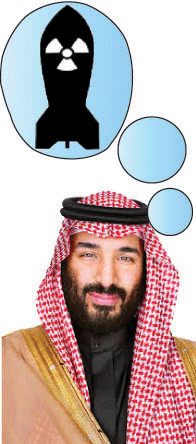
Apparently, Trump is not bothered by the fact that Saudi Crown Prince Mohammed bin Salman has neither ruled out developing nuclear arms nor committed to a strict regime of inspections by the International Atomic Energy Agency. One false step, though, could plunge the Middle East into a nuclear arms race – truly a worst-case scenario for such a fraught region.
Meanwhile, India and Pakistan, two other NPT non-signatories, recently engaged in a cross-border military confrontation, following a terrorist attack last month in the Indian state of Jammu and Kashmir. Once deemed “the most dangerous place in the world” by former US President Bill Clinton, Kashmir is essentially shared between three nuclear powers: India, Pakistan, and China. Not since Pakistan revealed its nuclear capacity to the world in the late 1990s have Indian-Pakistani relations been so tense. Worse, as the latest instability shows, the presence of nuclear weapons is not sufficient to prevent conflict. Instead, it merely raises the risk that quarrels will escalate into existential conflagrations.
Lastly, in the Middle East, the Trump administration has actively sowed the seeds for nuclear proliferation. The decision to abandon the JCPOA was entirely counterproductive, merely reflecting Trump’s blind support for Israel – another NPT non-signatory – and Saudi Arabia. Indeed, the Trump administration is even exploring the possibility of exporting nuclear material to the Saudi regime without putting the necessary safeguards in place.
 Apparently, Trump is not bothered by the fact that Saudi Crown Prince Mohammed bin Salman has neither ruled out developing nuclear arms nor committed to a strict regime of inspections by the International Atomic Energy Agency. One false step, though, could plunge the Middle East into a nuclear arms race – truly a worst-case scenario for such a fraught region.
During the 2016 presidential campaign, Trump raised a red flag for the umpteenth time when he suggested that Japan and South Korea should develop their own nuclear weapons as a means of self-defense. This idea couldn’t have been more wrongheaded. Logic dictates that if more countries acquire nuclear weapons, the likelihood of such weapons being used will increase.
The Cold War gave us a glimpse of the risks we run when our single-minded pursuit of some geopolitical interests causes us to lose sight of the most important of them all: international security. As Obama emphasized ten years ago in Prague, the US is the only country ever to have used nuclear weapons, and therefore has an historic responsibility to ensure that they are never used again. For the US to forsake this responsibility and champion a new era of nuclear proliferation would be a tragic outcome. https://www.project-syndicate.org/commentary/us-trump-nuclear-proliferation-by-javier-solana-2019-03
March 21, 2019
Posted by Christina Macpherson |
politics international, USA, weapons and war |
1 Comment
|
 The youth climate strikes fight back against despair https://grist.org/article/the-youth-climate-strikes-fight-back-against-despair/, By Eric Holthaus on Mar 19, 2019 Last week, as I stood on the front steps of the Minnesota State Capitol, I watched hundreds of high schoolers stream by as they left their classes to join in the U.S. Youth Climate Strike. One sign in particular stood out to me: “Why are we studying for a future we won’t have?” The youth climate strikes fight back against despair https://grist.org/article/the-youth-climate-strikes-fight-back-against-despair/, By Eric Holthaus on Mar 19, 2019 Last week, as I stood on the front steps of the Minnesota State Capitol, I watched hundreds of high schoolers stream by as they left their classes to join in the U.S. Youth Climate Strike. One sign in particular stood out to me: “Why are we studying for a future we won’t have?”
That question gets at the urgency of the youth climate strikes and hints at the despair inherent in not getting this fight right. For anyone who was paying attention to the worldwide action last Friday, it’s absolutely clear that the moral heart of climate action today is in young people demanding a better world.
That’s why I was intrigued to read a Philadelphia Inquirer op-ed that frames the Green New Deal as fundamentally an anti-despair public health agenda. The article’s author, Abraham Gutman, argues that America’s growing income inequality and structural racism are isolating and destructive to our mental health by stealing the hope for a better future. He says we’ve reached a crisis point, not only in the damage this system is doing to our bodies, but also to our planet. Rallying Americans to take bold action on climate change and address inequality could also go a long way to tackling addictions and lowering the suicide rate, Gutman says, saving hundreds of thousands of lives each year.
“The Green New Deal is the shift we need to give people something to look forward to,” he writes.
This potential for optimism, combined with the consistently high polling data that the Green New Deal (and climate in general) is getting lately points to the current moment as a breakthrough unlike any in the history of the climate movement. Climate change has rocketed to the top of the Democratic 2020 primary agenda, in large part due to the insistence of youth voices.
America’s youth have seen two possible visions of the future: One where we continue on with the status quo, or one where we have re-oriented our entire society to live in harmony with the planet we call home.
The rising power of the youth strikes show clearly which one they’d prefer. Once the rest of us have the courage to realize what’s at stake, we can get to work creating it.
|
|
March 21, 2019
Posted by Christina Macpherson |
climate change, election USA 2020 |
Leave a comment

Trump to finalise $3.7 billion in aid for troubled nuclear reactor project https://www.business-standard.com/article/international/trump-to-finalise-3-7-billion-in-aid-for-troubled-nuclear-reactor-project-119032001089_1.html
The plant is seen as critical to the nuclear industry’s future because existing reactors are struggling to compete with cheap natural gas and renewable energy Ari Natter | Bloomberg March 20, 2019
The Trump administration will finalize $3.7 billion in loan guarantees to Southern Co. and its partners who are building a troubled nuclear reactor project in Georgia — the last of its kind under construction in the U.S. — according to two people familiar with the matter.
The guarantees, expected to be announced Friday when U.S. Energy Secretary Rick Perry visits Plant Vogtle alongside Georgia Governor Brian Kemp and Southern Chief Executive Officer Tom Fanning, represents a critical lifeline for the project, which is more than five years behind schedule and has doubled in cost to $28 billion.
The additional help also puts taxpayers on the hook for more money if the project were to collapse. Southern and its partners in Plant Vogtle were already recipients of record $8.3 billion in federally-backed loan guarantees from the Obama administration, but asked the Trump administration to come to their aid amid ballooning costs and setbacks caused in part by the bankruptcy of a contractor, Westinghouse Electric Co.
The plant, near Waynesboro, Georgia, is seen as critical to the nuclear industry’s future because existing reactors are struggling to compete with cheap natural gas and renewable energy. Scana Corp. abandoned its plans to build two reactors in South Carolina after expenses spiraled above $20 billion.
President Donald Trump has made the revival of the coal and nuclear industry a priority. His administration in 2017 announced it would provide a conditional loan guarantee for the Plant Vogtle project.
Representatives of the Energy Department and Southern didn’t immediately respond to requests for comments.
March 21, 2019
Posted by Christina Macpherson |
politics, USA |
1 Comment
A generation gap, when it comes to climate change?, Bulletin of the Atomic Scientists, By Dana Nuccitelli, March 15, 2019 “……….A record number of Americans now
view global warming as a serious threatand blame human activities as the cause. But there is apparently a generation gap out there when it comes to accepting the scientific evidence. And an ethnic gap, a gender gap, and a gap in political leaning—along with whether one can be considered one of society’s “haves” or “have nots.” So, who are these climate deniers? What is their profile?
A June 2014 Washington Post-ABC News poll asked a nationally representative sample of American respondents several questions about their support for climate policies. Specifically, those surveyed were asked whether they would be in favor of government greenhouse gas regulations that increased their monthly energy expenses by $20 per month. Overall, 63 percent of respondents expressed support for the proposed policy, including 51 percent of Republicans and 71 percent of Democrats.
Interestingly, there was a significant age gap among the responses. For Democrats under age 40, support for the policy proposal was 78 percent, as compared to 62 percent over age 65. Among Republicans, 61 percent under age 50 supported the proposed regulations, as compared to 44 percent over age 50. According to a Pew Research Center survey, younger Americans are also more likely to correctly answer that the planet is warming and that this warming is primarily due to human activities.
……. A recent survey conducted by the National Center for Science Education found that teachers who identified as Republicans, teachers who regarded the Bible as the actual word of God to be taken literally, and teachers who favored libertarian and small-government views, were all less likely to emphasize the scientific consensus on climate change and more likely to air opposing views in the classroom.
Consequently, this survey of US middle and high school science teachers found that while approximately 70 percent of these teachers spent one to two hours on climate change per course, only 54 percent taught students about the scientific consensus on human-caused global warming. Thirty percent incorrectly characterized climate change as being natural in origin, and 15 percent ignored the origins of climate change or the topic of climate change entirely. Although the survey identified systemic obstacles to teaching about climate change in American classrooms, those obstacles will eventually be overcome, and climate literacy will improve as a result—at least among the younger generation.
Exposure to the opinions of one’s peer group may also help explain the climate age gap, as older men are the most common faces of climate denial. For example, in 2009 the American Physical Society was petitioned by 206 of its members (approximately 0.45 percent of its membership) to change its climate position and reject the expert consensus on climate change. An analysis of the petition signatories by John Mashey found that approximately 86 percent were born before 1950 (compared to approximately 40 percent of the society’s membership as a whole), and 97 percent were born before 1960 (compared to approximately 60 percent of the overall membership). Climate denial conferences are also disproportionately attended by old white men.
But age is not the only predictor of climate change denial.
The climate acceptance ethnicity gap. African- and Hispanic-Americans were also more likely to correctly answer the Pew Research Center climate questions—and to express concern about climate change—than white Americans. ……..
Climate denial caters to a small and dwindling population of old, white, conservative, American men. As with global temperatures, American acceptance of and concern about human-caused climate change is currently at record levels, and is certain to keep rising in the long-term. https://thebulletin.org/2019/03/a-generation-gap-when-it-comes-to-climate-change/?utm_source=Bulletin%20Newsletter&utm_medium=iContact%20email&utm_campaign=GenerationGap_03152019
March 21, 2019
Posted by Christina Macpherson |
climate change, USA |
Leave a comment

US pursuing mini-nuclear reactors to support military expeditionary capabilities, Defence Connect, 20 Mar 19, The US military is conducting research into the development of rapidly deployable, container mounted nuclear reactors to support deployed American and allied forces, reducing threats to traditional supply and support convoys…….
The US has initiated a series of programs to develop, test and deploy alternatives to traditional petrol-based fuel systems, particularly for power generation and small-scale manufacturing of key materials like munitions at forward operating bases operating in close proximity to peer-competitors, limiting supply line and convoy exposure to enemy interdiction. ….. Enter the development of very small modular nuclear reactors (vSMRs), designed to deliver between one and 10 megawatts (MW) for years without refuelling in a rapidly-deployable (road and/or air) package. Both the US Department of Defense and NASA have collaborated on the development of such reactors for use in military and space exploration contingencies. ………The HOLOS reactor in particular has been designed to support deployed military requirements……..
March 21, 2019
Posted by Christina Macpherson |
Small Modular Nuclear Reactors, USA |
Leave a comment
Campaigning in Vegas, Gabbard calls for end of ‘wasteful wars,’ nuclear tension, http://www.hawaiinewsnow.com/2019/03/19/campaigning-vegas-gabbard-calls-end-wasteful-wars-nuclear-tension/March 19, 2019 at 4:48 AM HST – Updated March 19 at 4:48 AM
LAS VEGAS (AP) – Democratic presidential candidate Tulsi Gabbard says her top priorities if she’s elected to the White House in 2020 would be to end military action in countries like Iraq and Syria and to de-escalate tensions with nuclear-armed countries like Russia and China.
The Hawaii congresswoman told a small but diverse crowd in Las Vegas on Monday afternoon that she wants to end what she called “wasteful regime change wars” that are costing the country trillions of dollars and instead spend that money on health care, education and other needs in the U.S.
Gabbard, a 37-year-old combat veteran, was making her first foray into early-nominating state Nevada as a presidential candidate.
She planned to hold a “meet and greet luau” west of the Las Vegas Strip later in the evening.
March 21, 2019
Posted by Christina Macpherson |
politics, USA |
2 Comments
|
 Daniel Ellsberg Calls Chelsea Manning “an American Hero” Marjorie Cohn, Truthout, March 20, 2019 Two years after being released from prison where she had served seven years for exposing U.S. war crimes in Iraq and Afghanistan, Chelsea Manning was jailed once again for refusing to answer questions before a grand jury investigating WikiLeaks and its founder Julian Assange. Daniel Ellsberg Calls Chelsea Manning “an American Hero” Marjorie Cohn, Truthout, March 20, 2019 Two years after being released from prison where she had served seven years for exposing U.S. war crimes in Iraq and Afghanistan, Chelsea Manning was jailed once again for refusing to answer questions before a grand jury investigating WikiLeaks and its founder Julian Assange.
“I will not comply with this, or any other grand jury,” Manning declaredin a written statement. “Imprisoning me for my refusal to answer questions only subjects me to additional punishment for my repeatedly-stated ethical objections to the grand jury system.”
Noted whistleblower Daniel Ellsberg praised Manning. “Chelsea Manning is in jail again, this time for resisting a grand jury system whose secrecy and lack of witness rights makes it prone to frequent abuse,” Ellsberg told Truthout. “She is also resisting its current abuse, as it is used to attack freedom of the press by pursuing criminal charges for publication of the very war crimes and corruption she courageously revealed to WikiLeaks nine years ago.”
Manning wrote, “The grand jury’s questions pertained to disclosures from nine years ago, and took place six years after an in-depth computer forensics case, in which I testified for almost a full day about these events. I stand by my previous public testimony.”
Prosecutors inadvertently disclosed last summer that they had a sealed indictment against Assange. Since 2010, when WikiLeaks published the documents Manning leaked, the U.S. government has been gunning for Assange. “The Obama administration had decided against trying to charge him because of fears that establishing a precedent that his actions were a crime could chill investigative journalism,” Charlie Savage wrotein The New York Times.
Manning told the judge at her guilty plea hearing that no one at WikiLeaks asked or encouraged her to give them documents. “No one associated with WLO [WikiLeaks Organization] pressured me into sending any more information,” she said.
Before contacting WikiLeaks, Manning tried to interest The Washington Post in publishing the documents, but she received no response. She was also unsuccessful in contacting The New York Times.
At the age of 22, Pfc. Manning, who was an Army intelligence analyst, gave hundreds of thousands of classified Pentagon and State Department documents about the wars in Iraq and Afghanistan to WikiLeaks. In 2013, Manning was sentenced to 35 years in prison. She ultimately served seven years, including time in pretrial custody, after Obama commuted the remainder of her sentence as he was leaving office.
Manning, a transgender woman, suffered in a male military prison and attempted suicide on two occasions in 2016. She was held in solitary confinement and was humiliated by being subjected to forced nudity during inspection for the first 11 months of her incarceration. United Nations Special Rapporteur on Torture Juan Méndez characterized her treatment as cruel, inhuman and degrading. He couldn’t determine whether it amounted to torture because he was not permitted to visit her under acceptable conditions……… https://truthout.org/articles/daniel-ellsberg-calls-chelsea-manning-an-american-hero/
|
|
March 21, 2019
Posted by Christina Macpherson |
civil liberties, USA |
Leave a comment
ime to be serious about it; and honest. Only “Lifetime- total system” accounting – counts
Are these tiny, ‘inherently safe’ nuclear reactors the path to a carbon-free future? by Andrew Maykuth, March 16, 2019

Are these NuScale nuclear power stations REALLY tiny?

“……the industry sees the future not in building gargantuan plants, but in small modular reactors, or SMRs — factory-built units with fewer parts, designed to be installed underground with passive cooling systems that the industry says are “inherently safe.”
……..Among U.S. developers, NuScale Power of Corvallis, Ore., has surpassed its competitors — including Holtec International of Camden — to advance its design closer to the finish line. Supported with $275 million in U.S. Energy Department grants, NuScale has invested about $800 million to design a 75-foot-tall cylindrical reactor that the Nuclear Regulatory Commission is expected to approve next year. NuScale aims to begin producing power at its first plant in 2026.
……. not everyone is sold on their promise.
“SMRs seem to be a fad, as far as I can tell,” said Edwin Lyman, a senior scientist with the Union of Concerned Scientists, who wrote a widely cited paper questioning the economics of small reactors. “There’s very really little substance to its motivation, other than the private sector can’t afford ordinary sized reactors.”
…… Inside a Small Modular Reactor
Small modular reactors are factory-built, contain fewer mechanical parts, and are designed to be installed underground with passive cooling systems that are “inherently safe,” the industry says.
SMR designers say the plants will need fewer operators, and because the design is safer, they have also asked the NRC to reduce the 10-mile emergency planning zones now required for larger commercial reactors to an area confined to the plant site. Critics such as the Union of Concerned Scientists have opposed the request, saying the plants and their accumulated on-site spent fuel still pose a significant risk.
“They argue the reactors are so safe that terrorists won’t be able to effectively cause a massive radiological contamination event, and I beg to differ,” said Lyman.
The initial markets for SMRs are expected to be primarily overseas, where electricity costs are higher and nuclear energy can compete, NuScale says. Some water-starved Middle Eastern countries have expressed interest because some units can be configured to produce steam, rather than electricity, to power a nearby water desalinization plant.
Antidote to climate change
The industry is also positioning carbon-free nuclear plants as an antidote to climate change……
many environmental advocates fiercely oppose any expansion of nuclear energy’s role, including skeptics who cite safety issues exposed by the accident 40 years ago this month at Three Mile Island Unit 2 in Pennsylvania, which put the brakes on the industry’s growth in the 1980s. In the last 20 years, just one new commercial plant has begun operations in the United States, and only two are currently under construction.
Lyman said the industry would need to produce “hundreds or thousands” of units in order to cut costs and reduce the need for government assistance. ……
Nuclear power’s cost is at the heart of a debate that officially launched in Pennsylvania last week with the introduction of a proposal to give the nuclear industry $500 million in annual subsidies, paid by electric customers. Nuclear operators have threatened to shut down several Pennsylvania reactors because they are unable to compete in low-price electricity markets awash in cheap power from natural gas plants.
Exelon Generation says it will shut down Three Mile Island Unit 2, located next to the partly dismantled Unit 1, unless state lawmakers come to the rescue by June. …….
Dozens of companies are working to develop new nuclear reactors, including so-called Generation IV reactors that are cooled with such materials as molten salts, inert gases, or even liquid metals.
Several companies have focused on developing SMR designs. Holtec International, a private company in Camden whose core business is managing spent fuel at nuclear reactors and decommissioning old reactors, has developed a 160-megawatt reactor design it calls the SMR-160. The project’s status is unclear, and Holtec did not respond to written questions.
“I haven’t seen evidence of it really advancing,” said Lyman, of the Union of Concerned Scientists.
Westinghouse and BWX Technologies Inc., which both have long histories of building reactors, abandoned their SMR projects.
NuScale in September chose BWXT to build its SMR. BWXT, which built many of the small reactors used to power U.S. Navy ships and submarines, plans to subcontract component manufacturing to Precision Custom Components of York, Pa.
Mundy said by outsourcing the manufacturing to existing plants, NuScale can keep costs down compared with building a new factory. NuScale’s majority owner is the giant contractor Fluor Corp………
Lyman said that he is worried that multiple modular reactors would fail in NuScale plant, but that the NRC will accept more risk because it is under pressure to not impede the licensing process.
March 18, 2019
Posted by Christina Macpherson |
Small Modular Nuclear Reactors, USA |
1 Comment
FROM JOSEPH FARAH’S G2 BULLETIN
DEMS PROPOSE U.S. GIVE UP FIRST-STRIKE NUCLEAR OPTION https://www.wnd.com/2019/03/dems-propose-u-s-give-up-first-strike-nuclear-option/ Plan would pledge to use nukes only in response to attack
18 Mar 19, Democrats are proposing in Congress that the United States give up the option for a nuclear first strike – for any reason, reports Joseph Farah’s G2 Bulletin.
The policy for decades deliberately has been one of “calculated ambiguity.” It stemmed from a Cold War era in which the U.S. and NATO faced “numerically superior” Soviet and Warsaw Pact conventional forces in Europe, explains a document prepared by the Congressional Research Service.
“At the time, the United States not only developed plans to use nuclear weapons on the battlefield to disrupt or defeat attacking tanks and troops, but it also hoped that the risk of a nuclear response would deter the Soviet Union from initiating a conventional attack. This is not because the United States believed it could defeat the Soviet Union in a nuclear war, but because it hoped the Soviet Union would know that the use of these weapons would likely escalate to all-out nuclear war, with both sides suffering massive destruction.”
That policy of ambiguity has been continued, with even the Obama administration promising that the U.S. “would only consider the use of nuclear weapons in extreme circumstances,” far short of a promise never to use them first.
Democrats now are demanding to change that.
Sen. Elizabeth Warren, D-Mas., and Rep. Adam Smith, D-Wash., have proposed legislation, S. 272 and H.R. 921, that would adopt the statement: “It is the policy of the United States to not use nuclear weapons first.”
Other members of Congress are divided,” the report from the CRS explained, with Sen. Deb Fischer, R-Neb., warning the Democrats’ plan “betrays a naïve and disturbed world view.”
Read more at https://www.wnd.com/2019/03/dems-propose-u-s-give-up-first-strike-nuclear-option/#6cgKvfB7PXt22tiR.99
The Trump administration already had rejected the idea, in its 2018 Nuclear Posture Review, which said the weapons contribute to “deterrence of nuclear and non-nuclear attack; assurance of allies and partners; achievement of U.S. objectives if deterrence fails; and the capacity to hedge against an uncertain future.”
For the rest of this report, and more, please go to Joseph Farah’s G2 Bulletin.
March 18, 2019
Posted by Christina Macpherson |
politics, USA, weapons and war |
Leave a comment

P
utting his money where his mouth is. Your Money, 18 Mar 2019, Jack Derwin Digital Journalist, Oscar-winning actor and Hollywood heartthrob Leonardo DiCaprio has long been an environmental activist, but he’s now turning to the world of finance to help tackle his chosen cause.
DiCaprio has announced he will become a senior adviser to a new $150 million environmental unit at fund manager Princeville Capital that invests directly into tech companies fighting global warming.
Taking to Twitter, it appears he is willing to put his money where his mouth is, becoming an investor himself.
“What I like about Leo’s fund if you are predisposed to wanting to improve the climate or stop climate change, this is a fund that invests in companies that are trying to mitigate the effects of climate change,” The Motley Fool head of investment Scott Phillips told Your Money Live.
The major difference between DiCaprio’s fund and other ethical funds is rather than divesting from big polluters, his is actively investing in potential future solutions…….. https://www.yourmoney.com.au/wealth/investment/leonardo-dicaprio-climate-change/
March 18, 2019
Posted by Christina Macpherson |
climate change, USA |
Leave a comment
 Deadly, Historic Midwest Flooding Threatens Ericson Dam, Nuclear Plant in Nebraska, By Pam Wright and Ron Brackett, weather.com 15 Mar 19,
- New evacuations were ordered overnight in Minnesota and Wisconsin.
- A Nebraska farmer was killed trying to rescue a stranded motorist.
- A Nebraska nuclear plant is threatened.
- A ‘compromised’ dam forced evacuations along the Niobrara River.
- A third of the 24,000 residents in Norfolk, Nebraska, were ordered to evacuate Thursday.
- Flooding in parts of the Midwest has left one man dead threatens a Nebraska dam and nuclear power plant as heavy rains mixed with a melting snowpack swell waterways to historic levels……..
- In Nebraska, a utility company was placing sandbags around a threatened nuclear power plant Thursday as the Missouri River continued to rise, the Omaha World-Journal reports.
Mark Becker, spokesman for the Nebraska Public Power District, told the newspaper that should the river hit the level of 45.5 feet as projected by the National Weather Services this weekend, the Cooper Nuclear Station, which accounts for 35 percent of NPPD’s power, will have to be shut down………… https://weather.com/news/news/2019-03-14-flooding-severe-tornadoes-nebraska-iowa-texas
March 16, 2019
Posted by Christina Macpherson |
climate change, USA |
Leave a comment
 Nuclear industry pushing for fewer inspections at plants
The board of the agency charged with enforcing regulations on commercially operated nuclear plants is dominated by Trump appointees. NBC News, March 16, 2019, By Associated Press
WASHINGTON — The nuclear power industry is pushing the Nuclear Regulatory Commission to cut back on inspections at nuclear power plants and throttle back what it tells the public about plant problems. The agency, whose board is dominated by Trump appointees, is listening.
Commission staffers are weighing some of the industry’s requests as part of a sweeping review of how the agency enforces regulations governing the country’s 98 commercially operating nuclear plants. Recommendations are due to the five-member NRC board in June.
Annie Caputo, a former nuclear-energy lobbyist now serving as one of four board members appointed or reappointed by President Donald Trump, told an industry meeting this week that she was “open to self-assessments” by nuclear plant operators, who are proposing that self-reporting by operators take the place of some NRC inspections. …….
the prospect of the Trump administration’s regulation-cutting mission reaching the NRC alarms some independent industry watchdogs, who say the words “nuclear safety” and “deregulation” don’t go together……..
“For an industry that is increasingly under financial decline … to take regulatory authority away from the NRC puts us on a collision course,” said Paul Gunter, of the anti-nuclear group Beyond Nuclear. With what? “With a nuclear accident,” Gunter said………..
Trump has said he wants to help both the coal and nuclear power industries. So far, it’s the more politically influential coal industry that’s gotten significant action on the regulatory rollbacks that it sought from the Environmental Protection Agency and other agencies.
In January, Trump appointees to the NRC disappointed environmental groups by voting down a staff proposal that nuclear plants be required to substantially — and expensively — harden themselves against major floods and other natural disasters. The proposal was meant to be a main NRC response to the Fukushima nuclear plant disaster after Japan’s 9.0 earthquake and tsunami in 2011……… https://www.nbcnews.com/politics/politics-news/nuclear-industry-pushing-fewer-inspections-plants-n983671
March 16, 2019
Posted by Christina Macpherson |
safety, USA |
Leave a comment









 nuclear-news