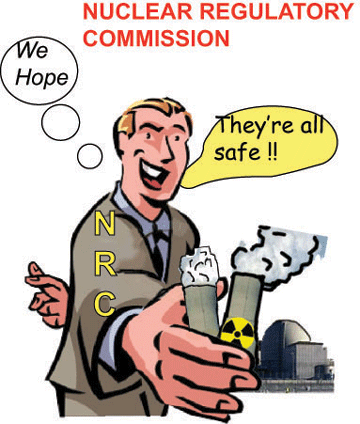
 Nuclear industry has been pushing for less oversight, and it’s working. L A Times ELLEN KNICKMEYER, ASSOCIATED PRESS , JULY 17, 2019
Fewer mock commando raids to test nuclear power plants’ defenses against terrorist attacks. Fewer, smaller government inspections for plant safety issues. Less notice to the public and to state governors when problems arise.
They’re part of the money-saving rollbacks sought by the country’s nuclear industry under President Trump and already approved or pending approval by the Nuclear Regulatory Commission, largely with little input from the general public.
The nuclear power industry says the safety culture in the U.S. nuclear industry — 40 years after a partial meltdown of a nuclear reactor at the Three Mile Island plant in Pennsylvania — is “exceptional” and merits the easing of government inspections.
Maria Korsnick, president of the industry’s Nuclear Energy Institute trade group, said she welcomed changes in NRC plant oversight “to ensure that it reflects a more robust understanding of the current performance of the U.S. nuclear fleet.”
Opponents say the changes are bringing the administration’s business-friendly, rule-cutting mission to an industry — nuclear reactors — in which the stakes are too high to cut corners.
While many of the regulatory rollbacks happening at other agencies under the current administration may be concerning, “there aren’t many that come with the existential risks of a nuclear reactor having a malfunction,” said Geoff Fettus, an attorney for the Natural Resources Defense Council on nuclear issues.
This week, the Nuclear Regulatory Commission released staff recommendations for rollbacks in safety inspections for the 90-plus U.S. nuclear power plants and for less flagging of plant problems for the public. Democratic lawmakers and one commissioner expressed concern about the safety risks and urged the commission to seek broader public comment before proceeding.
The country’s nuclear regulators were looking at “far-reaching changes to the NRC’s regulatory regime without first actively conducting robust public outreach and engagement,” Rep. Frank Pallone Jr. (D-N.J.), chairman of the House Energy and Commerce Committee, said in a letter to Nuclear Regulatory Commission Chairwoman Kristine Svinicki.
Svinicki and two other commissioners did not respond Wednesday to requests for comment made through the agency’s public affairs staff. Public affairs director David Castelveter said the commission would respond directly to lawmakers on Pallone’s letter.
A fourth commissioner, Jeff Baran, spoke out Tuesday, saying he opposed cutting inspections and reducing oversight. Baran called for more public input on proposed rollbacks.
Nuclear regulators post notices of meetings on proposed rollbacks of oversight of nuclear power plants on the Nuclear Regulatory Commission website. Lawmakers complained that there has been scant notice to the public at large about the meetings or proposals.
In general, according to attendance logs, the rollbacks are being hashed out at meetings attended almost solely by commission staffers and nuclear industry representatives. ……
Edwin Lyman, a nuclear safety expert with the Union of Concerned Scientists said the security changes “are jeopardizing public health and safety by restricting the NRC’s ability to ensure that nuclear plants are sufficiently protected against radiological sabotage attacks.”
In January, in one of the comparatively few widely reported changes, commissioners rejected staff recommendations for making nuclear plants harden themselves against natural disasters on the scale of the 2011 earthquake and tsunami that caused meltdowns at three nuclear reactors at the Fukushima nuclear plant in Japan……
Some rollbacks pushed by the industry have been rejected by the commission’s staff. Others are still under consideration, including one that would further cut inspections by regulators and allow more self-inspections overseen by plant operators.
This week’s staff recommendations for rollbacks in government oversight are “just the tip of the iceberg,” Lyman said. https://www.latimes.com/business/story/2019-07-17/nuclear-commission-considers-cutting-back-on-nuclear-power-plant-inspections
July 22, 2019
Posted by Christina Macpherson |
safety, USA |
Leave a comment
 Residents tout small steps in same direction , Peninsula Daily News, By Brian McLean, Sunday, July 21, 2019 , PORT TOWNSEND — Port Townsend City Council members were moved when several residents impressed upon them the value of taking small steps toward a larger issue.
The council unanimously passed a resolution last week in support of a worldwide ban on nuclear weapons following similar actions earlier this spring by the Jefferson County commissioners and the county health department.
“My sense about what this means is not just moving away from the constant waste of money that, if it’s ever put to use, may cost us all of our lives, but also to free up the science and technology and engineering necessary to move towards a more useful strategy as a country,” said Port Townsend’s Doug Milholland, a resident who drove the efforts to pass the resolution.
“Let’s say yes to life.”
Forest Shomer, a speaker in May at the Global Earth Repair conference in at Fort Worden, said that whatever happens in the Key City reverberates.
“We’re right across the water from [Naval Magazine] Indian Island,” Shomer said. “We’ve heard the words so much, ‘Neither confirm nor deny,’ so we don’t know if, right at this moment, we’re sitting three miles away from nuclear weapons.
“It’s pretty personal to Port Townsend to make a statement of how we feel about that.”…. bmclean@peninsuladailynews.com. https://www.peninsuladailynews.com/news/port-townsend-city-council-passes-resolution-to-ban-nuclear-weapons/
July 22, 2019
Posted by Christina Macpherson |
USA, weapons and war |
Leave a comment

Planned small nuclear project reaches milestone with more Utah cities signing on, Deseret News, By Amy Joi O’Donoghue July 20, 2019 SALT LAKE CITY — Enough

communities in Utah and elsewhere have agreed to purchase nuclear power from a small modular reactor planned at the Idaho National Laboratory, triggering a next phase in its development.
Participating members in the Carbon Free Power Project signed contracts that total more than 150 megawatts, which means there will be an increased focus on site characterization and preparing a license for the U.S. Nuclear Regulatory Commission.
Touted as next generation technology in delivery of nuclear power, the small modular reactors developed by Oregon-based NuScale would be the first of its kind in the nation, made up of 12 individual 60 megawatt modules…….
Utah Associated Municipal Power Systems officials say the nuclear component for cities typically hovers in the 5 to 10 megawatt range and is not a big piece of their portfolio, but cities could always opt to buy more.
The project is backed heavily by the U.S. Department of Energy, which gave NuScale a competitive award of $226 million in 2013 to develop the technology. Two years later, the federal agency gave NuScale $16.7 million for licensing preparation.
Two of the modules will be used by the agency’s Idaho National Laboratory in support of research and also to deliver power to the sprawling facility occupying more than 800 acres outside of Idaho Falls. ….
critics say the new untested technology may end up costing municipal ratepayers millions in the long run, and there are cheaper alternatives that won’t generate nuclear waste.
HEAL Utah commissioned a study that it says shows several alternative scenarios that are much less costly and don’t involve investment in a “high-risk” project.
Douglas Hunter, CEO and president of the Utah Associated Municipal Power Systems, said there are several contractual “off-ramps” built into the project that allow both the municipal power association and its member cities to walk away.
Before the next application is submitted to the U.S. Nuclear Regulatory Commission, the association will have to agree to go forward and participating members can agree to proceed, or back out.
“We took it seriously that we didn’t want to be caught in some sort of death spiral for the cities,” Hunter said……https://www.deseretnews.com/article/900080542/planned-small-nuclear-project-reaches-milestone-with-more-utah-cities-signing-on.html
July 22, 2019
Posted by Christina Macpherson |
politics, Small Modular Nuclear Reactors, USA |
Leave a comment

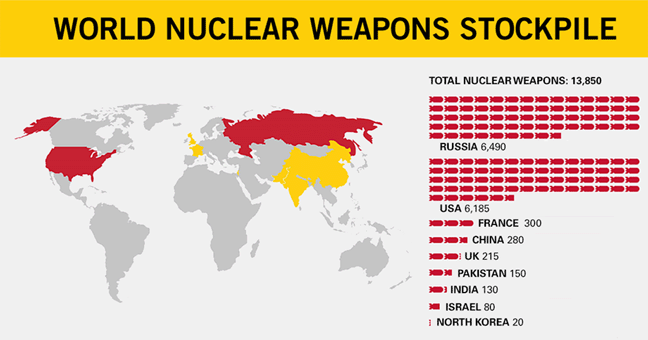
Nobody wins a nuclear war — especially not two nuclear behemoths. https://thehill.com/opinion/international/453576-nobody-wins-a-nuclear-war-especially-not-two-nuclear-behemoths BY DANIEL R. DEPETRIS,— 07/17/19 U.S. and Russian officials met this week in Geneva for what one hopes will be new strategic arms reduction talks. Trump administration officials are cautiously optimistic the discussions could lead to a more substantive negotiation about capping — and perhaps even decreasing — the number of nuclear weapons both countries have in their stockpiles. This matters for U.S. and global security because these two nations possess more than 90 percent of all nuclear weapons.
President Trump, however, wants to go further than a simple extension of the 2010 The New Strategic Arms Reduction Treaty (START) agreement or a new bilateral treaty with the Russians. Instead, he is prodding China to join a trivariate arrangement. But in prefacing or linking an extension of New START to a fresh accord that includes the Chinese, the administration is increasing the possibility of ending up with neither.
For one, pushing Beijing to into a three-way deal is like pushing on a locked door. The Chinese have shown no interest in a three-way deal, in large measure because their nuclear arsenal is a fraction (roughly 2 percent) of the globe’s entire inventory.
At roughly 290 warheads, Beijing’s nuclear weapons program is minuscule when compared to the thousands of combined warheads Washington and Moscow have stockpiled. Indeed, China stockpile is less than 1/20th the size of the United States and about 1/22th the size of Russia’s.
To expect the Chinese to participate in a new arms control negotiation with two nuclear superpowers when the numbers are so steadily stacked against them is a fool’s errand. Beijing’s no-first use nuclear policy, in place since its first ever nuclear explosive test in 1964, was recently reaffirmed just last year.
An offensive nuclear strike is not something U.S. officials in Washington have to worry about. To focus on a U.S.-Russia-China nuclear agreement at the expense of keeping an already existing New START accord alive is the wrong priority.
New START, signed in April 2010, was a win-win, pragmatic arms control agreement for both sides. The pact cut the U.S. and Russian stockpiles byaround one-third; capped the amount of nuclear warheads on deployed intercontinental ballistic missiles at 1,550; limited the number of deployed and non-deployed ICBM launchers to 800; and allowed each country to verify compliance with the treaty, including on-site inspections, information exchanges and advanced notices. Unlike the Intermediate Range Nuclear Forces Treaty, inspectors have verified Moscow’s compliance with the letter of the deal.
For two countries that possess a combined 12,675 nuclear weapons, New START is a critical enforcing mechanism for nuclear parity and a stable balance of power.
It is now the only functional arms control accord preventing the U.S. and Russia from entering another costly, risky arms race. The deal expires in February 2021 but could be extended for another five years if both Presidents Trump and Putin agree to do so. Putin has already expressed his interest. Trump, someone who considers himself a transactional pragmatist, shouldn’t waste any more time before doing the same.
An extension of New START, however, is not only important for strategic stability between the two nuclear superpowers (without New START, there is nothing stopping either the United States or Russia from building and deploying more and better nuclear warheads). but also valuable for stabilizing the entire U.S.-Russia relationship in desperate need of improvement. For this reason, a constructive relationship with Moscow is unquestionably a good thing for U.S. security. Extending New START is a no-brainer and indeed could very well be an opportunity to mend relations.
It’s not hyperbole to describe U.S.-Russia relations as being at their lowest since the land-based missile build-up in Europe in the early 1980s. From Syria and Ukraine to NATO and cybersecurity, Washington and Moscow are often on opposite sides of the issue. Even though both nations share some interests, including arms control and countering terrorism, Washington has become the epicenter of anti-Russia sentiment, where condemning Putin and advocating for sanctions is sport.
Good politics, however, doesn’t necessarily correspond with good statecraft or foreign policy.
Talking with adversaries, rivals, or competitors is a critically important component of effective foreign policy. We must engage with the world as it is, not as we wish it to be. Simply ignoring the Russians, pretending they don’t exist, or believing that using the stick unreservedly against Moscow will force it to cry uncle and change its policies to our liking makes conflict between nuclear superpowers more likely.
Giving New START another five years of life is perhaps the only issue Washington and Moscow can agree on in today’s political climate. It’s perhaps the most important reason the U.S. and Russia must find a way to co-exist.
Ensuring New START survives should be pursued aggressively for the sake of U.S. and global security Nobody wins a nuclear war — especially especially not two nuclear behemoths with thousands of warheads apiece.
Daniel R. DePetris is a fellow at Defense Priorities, a foreign policy think tank focused on promoting security, stability and peace.
|
|
|
July 20, 2019
Posted by Christina Macpherson |
China, politics international, Russia, USA, weapons and war |
Leave a comment
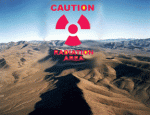 Earthquakes repeatedly striking proposed US nuclear waste site
Officials fear deadly radioactivity could seep into earth if another high-magnitude quake strikes Nevada desert, Independent, Emma Snaith, 19 July 19
Repeated earthquakes could risk releasing deadly radioactivity into the earth if plans for a nuclear waste site in go ahead in Nevada’s desert, the state’s governor has warned.
Tens of thousands of tons of highly radioactive used nuclear reactor fuel are due to be transferred from 35 US states to a new facility in the Mojave Desert.
The Yuka Mountain nuclear waste repository is set to store this material deep within the earth.
But a series of recent earthquakes in the Mojave Desert has raised concerns about the safety of storing radioactive waste at the facility.
On 4 July, a 7.1 magnitude earthquake ruptured the earth in the desert, which stretches across the California-Nevada border.
The force of the quake cracked buildings, sparked fires, damaged roads and caused several injuries in southern California. It was followed by a 6.4-magnitude temblor two days later.
In the wake of the earthquakes, the governor of Nevada Steve Sisolak said he was committed to “fighting any continued federal effort to use Nevada as the nation’s nuclear dumping ground”.
“These significant recent earthquakes so near to Yucca Mountain show one of the many geologic problems with the site as a nuclear waste repository,” he said.
Mr Sisolak sent a letter to the energy secretary, Rick Perry, urging him to reconsider the location of the facility.
………. In governor of Nevada’s letter to Mr Perry, he included the opinions of James Faulds at the Nevada Bureau of Mines and Geology and Graham Kent at the seismological laboratory at the University of Nevada.
They urged for more research to be conducted into the seismic activity at the Yuka Mountain site. “The Ridgecrest earthquake sequence, which began July 4 and has yet to subside, clearly highlights the importance of such studies,” Mr Faulds and Mr Kent said.
A recent ranking compiled by the US Geological Survey found Nevada was the US state with the fourth highest level of seismic activity after Alaska, Wyoming and Oklahoma.
Additional reporting by AP https://www.independent.co.uk/news/world/americas/earthquake-nuclear-waste-radioactive-mojave-desert-nevada-yuka-mountain-a9011051.html
July 20, 2019
Posted by Christina Macpherson |
safety, USA, wastes |
Leave a comment
Ohio Senate passes bill to save state’s two nuclear power plantshttps://www.reuters.com/article/us-ohio-nuclear/ohio-senate-to-vote-on-bill-to-save-states-nuclear-power-plants-idUSKCN1UC1Y2 18 July 19
(Reuters) – The Ohio Senate passed a bill on Wednesday that will create financial subsidies to stop the state’s two nuclear power reactors from retiring early, according to market analysts tracking the legislation.
The two reactors in Ohio, Davis-Besse and Perry, are owned by FirstEnergy Solutions, which has said it would shut the money-losing plants in 2020 and 2021 unless the state provides some financial assistance to keep them operating.
FirstEnergy Solutions is a bankrupt unit of Ohio power company FirstEnergy Corp.
The Senate version of the nuclear bill, House Bill 6 (HB6), is expected to go to the state House of Representatives for a concurrence vote on Wednesday night, one of the analysts said. The House has an “if needed” session scheduled for Thursday if members need more time to debate the Senate changes to the bill. HB6 passed the House in May.
The senate passed the bill after an amendment which postpones nuclear subsidies by one year, according to an analyst.
The earlier version of the bill was designed to reduce consumer power rates by weakening the state’s renewable and energy efficiency goals even though FirstEnergy Solutions would receive an estimated $150 million a year from 2020-2026 to keep its reactors in service.
“We expect the legislature will hit this deadline and send the bill to Governor Mike DeWine’s desk this week,” Josh Price, senior analyst at Height Capital Markets in Washington, said earlier on Wednesday.
Officials at FirstEnergy Solutions had no comment earlier Wednesday. The company has said it needed the bill to pass by July 17 to avoid shutting the Davis-Besse reactor next spring.
FirstEnergy Solutions has warned that shutting the reactors could result in the loss of 4,300 jobs.
On Monday, U.S. electric generator LS Power warned it would be forced to terminate development of an expansion of its Troy natural gas-fired power plant in Ohio if the state passes legislation to subsidize nuclear energy.
LS Power said the expansion of the Troy plant would create hundreds of jobs during construction and about 20 permanent positions. Analysts, however, said that was likely not enough to offset legislators’ concerns about the potential loss of thousands of jobs if the reactors shut.
Gas-fired plants would likely make more money if the reactors shut because they would operate more often.
Reporting by Scott DiSavino and Sumita Layek; Editing by Susan Thomas and Grant McCool
July 20, 2019
Posted by Christina Macpherson |
politics, USA |
Leave a comment
Ohio Delays Bill to Bail Out Nuclear and Coal Plants, Gut Renewable Spending
A setback for House Bill 6, with House and Senate versions at odds. But FirstEnergy’s threat to shutter plants without state support could force final passage next month. GreenTech Media, JEFF ST. JOHN JULY 18, 2019 Ohio lawmakers have delayed a critical vote on a controversial energy bill that would charge the state’s utility customers hundreds of millions of dollars to subsidize two nuclear power plants that their owner, bankrupt utility FirstEnergy Solutions, has threatened to close without financial support.On Wednesday, the Ohio House of Representatives failed to bring to a vote House Bill 6, forcing the legislature to put off consideration of the bill until it reconvenes in August. House Speaker Larry Householder said the late-night decision was due to the absence of four representatives who planned to vote yes on the bill, adding that the House would “tentatively” take it up again on Aug. 1. ……
Other states, including New York, Illinois and New Jersey, have given financially struggling nuclear power plants incentives to keep their carbon-free generation capacity running, as part of a broader policy push toward decarbonizing their energy sectors.
An outlier among state nuclear bailout plans
But Ohio’s bill is different, opponents say, because it also guts the state’s energy efficiency spending and renewable energy mandates — something that Ohio’s Republican legislators have been trying to do for years.
HB 6 would also shift the costs of some of the country’s oldest coal-fired power plants from utilities to ratepayers for a decade to come. The result, opponents say, will be higher electric bills, more pollution and reduced investment and innovation in modern energy infrastructure for the state.
The bill would replace today’s monthly surcharges on utility customers’ bills, which now pay for the state’s energy efficiency and renewable energy mandates, with a new set of lower surcharges. These will pay for FirstEnergy’s two nuclear power plants, as well as two coal-fired power plants operated by Ohio Valley Electric Corp. (OVEC) and jointly owned by the state’s investor-owned utilities. …….
as opponents including the Union of Concerned Scientists, The Sierra Club and the Natural Resources Defense Council have pointed out, monthly payments for energy efficiency and renewable energy represent investments in lower bills and cleaner energy for Ohio ratepayers. HB 6 ends those investments, in exchange for monthly payments that at their best support out-of-market payments for nuclear power plants, and at their worst help keep some of the state’s worst-performing and polluting coal plants running far past their logical retirement date.
Efficiency, renewables, natural gas and consumers groups are opposed
The Senate version of HB 6 differs from the original House bill’s approach to moving utility funding away from efficiency and renewable energy and toward nuclear and coal subsidies, Neil Waggoner, Ohio campaign representative for the Sierra Club, said in a Tuesday interview.
For example, the House version of the bill would have entirely eliminated Ohio’s current 12.5-percent-by-2026 RPS and cut all the monthly surcharges paying for energy efficiency and demand-reduction programs, which have saved Ohio customers $5.1 billion from 2009 to 2017, according to the Midwest Energy Efficiency Alliance.
But the version passed by the Senate opts for changing the targets for both programs in ways that will effectively end further investment, he said. For the efficiency standard, the bill will reduce today’s top energy-efficiency targets for utilities from 22.2 percent to 17.2 percent — a measure that many of the state’s utilities have likely already achieved — while expanding options for large industrial customers to opt out of paying. …..
HB 6 is being opposed by groups representing residential ratepayers and commercial-industrial energy users that worry it will increase energy prices and undermine free-market energy competition. Competing natural-gas-fired power plant owners are also crying foul, with one, LS Power, threatening this week to end a planned 500-megawatt expansion of its Troy, Ohio facility if HB 6 is passed.
HB 6 does provide $20 million a year, amounting to a total of $140 million through 2026, to support utility-scale solar development, including six solar farms already being built that might have lost funding under previous versions of the bill. And the Senate stripped a House amendment that would have allowed county residents to block wind farm projects on unincorporated land via referendum, even if construction had already begun.
As for the argument that HB 6 was necessary to keep FirstEnergy’s carbon-free nuclear plants up and running, “if we want to have a conversation about keeping carbon emissions in Ohio low, we need to talk about how we replace these nuclear plants with clean energy,” Waggoner said. “The legislature isn’t asking that question. They have never had that question in mind. Their only concern from day one has been how…[to] increase these customer bills to bail out these plants.”
Rains noted that another amendment to HB 6 added this week would weaken the Public Utilities Commission of Ohio’s oversight of how FirstEnergy, as the company to receive the “clean air credits” to be created by HB 6, spends its money.
“Language supporting annual audits for recipients from the clean air credits program was dropped in favor of much more flexible disclosures by qualifying firms to the commission on an annual basis,” he wrote. https://www.greentechmedia.com/articles/read/ohio-delays-bill-to-bail-out-nuclear-and-coal-plants-gut-efficiency-and-ren#gs.qa5wl6
July 20, 2019
Posted by Christina Macpherson |
business and costs, politics, USA |
Leave a comment
NRC Staff Recommends Scaling Back Reactor Inspections https://www.powermag.com/nrc-staff-recommends-scaling-back-reactor-inspections/?pagenum=1
07/18/2019 | Sonal Patel For an in-depth analysis – read this article:
“…………concluding statement –
Next Steps and Pushback
The recommendations will need approval by the NRC’s commissioners. Three of the four confirmed commissioners are President Trump appointees—Chair Kristine Svinicki, Annie Caputo, David A. Wright. Only one is an Obama appointee—Jeff Baran. One seat in the five-member commission remains vacant.
However, as the Associated Press reported on July 17, and as notes in the document show, the recommendations were reached after considerable disagreement. The Associated Press quoted Baran as saying, “NRC shouldn’t perform fewer inspections or weaken its safety oversight to save money.” Baran urged the NRC to give the public an opportunity to discuss before it decides on whether to approve the changes.
—Sonal Patel is a senior associate editor at POWER (@sonalcpatel, @POWERmagazine)
July 20, 2019
Posted by Christina Macpherson |
safety, USA |
Leave a comment
Nuclear Industry Looks to Save Money Under Reduced U.S. Safety Oversight, Insurance Journal , By Ellen Knickmeyer | July 19, 2019 Fewer mock commando raids to test nuclear power plants’ defenses against terrorist attacks. Fewer, smaller government inspections for plant safety issues. Less notice to the public and to state governors when problems arise.They’re part of the money-saving rollbacks sought by the country’s nuclear industry under President Donald Trump and already approved or pending approval by the Nuclear Regulatory Commission, largely with little input from the general public.
The nuclear power industry says the safety culture at the U.S. nuclear industry — 40 years after partial meltdown of a nuclear reactor at Three Mile Island — is “exceptional” and merits the easing of government inspections. ,,,,,
Opponents say the changes are bringing the administration’s business-friendly, rule-cutting mission to an industry — nuclear reactors — where the stakes are too high to cut corners.
While many of the regulatory rollbacks happening at other agencies under the current administration may be concerning, “there aren’t many that come with the existential risks of a nuclear reactor having a malfunction,” said Geoff Fettus, an attorney for the Natural Resources Defense Council on nuclear issues.
This week, the NRC released staff recommendations for rollbacks in safety inspections for the 90-plus U.S. nuclear power plants and for less flagging of plant problems for the public. Democratic lawmakers and one NRC commissioner expressed concern about the safety risks and urged the commission to seek broader public comment before proceeding.
The country’s nuclear regulators were looking at “far-reaching changes to the NRC’s regulatory regime without first actively conducting robust public outreach and engagement,” New Jersey Democrat Frank Pallone Jr., chairman of the House Energy and Commerce Committee, said in a letter to NRC Chairwoman Kristine Svinicki..
Svinicki and two other NRC commissioners did not respond Wednesday to requests for comment made through the agency’s public affairs staff. NRC public affairs director David Castelveter said the NRC would respond directly to lawmakers on Pallone’s letter.
A fourth commissioner, Jeff Baran, spoke out Tuesday, saying he opposed cutting inspections and reducing oversight. Baran called for more public input on proposed rollbacks.
Nuclear regulators post notices of meetings on proposed rollbacks on oversight of nuclear power plants on the NRC website. Lawmakers complained there’s been scant notice to the public at large about the meetings or proposals.
In general, according to attendance logs, the rollbacks are being hashed out at meetings attended almost solely by NRC staff and nuclear industry representatives. Occasionally, a single reporter or representative for private groups monitoring or opposing nuclear power is shown as attending.
U.S. nuclear plant operators have seen their operating costs rise as the country’s nuclear fleet ages. Competition from cheaper natural gas and renewables is increasing marketplace pressure on nuclear power providers, making the financial costs of complying with NRC regulation ever more of an issue…….
Commissioners have been moving more assertively to cut regulation requirements for the nuclear industry under the Trump administration, which has now nominated or renominated all four current members of the five-member board.
Edwin Lyman, a nuclear safety expert with the Union of Concerned Scientists non-profit group, pointed to a board move last fall, when the NRC cut the frequency of commission-run mock commando raids at nuclear power plants.
The drills are meant to test whether attackers would be able to reach the heart of a nuclear reactor.
Lyman said the security changes “are jeopardizing public health and safety by restricting the NRC’s ability to ensure that nuclear plants are sufficiently protected against radiological sabotage attacks.”
In January, in one of the comparatively few widely reported changes, commissioners rejected staff recommendations for making nuclear power plants harden themselves against Fukushima-scale natural disasters.
New recommendations by staff made public Tuesday would cut the time and scope of annual plant inspections. They also would change how the NRC flags safety issues at plants for the public and for local state officials.
Some of the changes would require a vote by NRC commissioners…….
July 20, 2019
Posted by Christina Macpherson |
business and costs, safety, USA |
Leave a comment
|
Iran floats offer on nuclear inspections; U.S. skeptical
Arshad Mohammed, Steve Holland, WASHINGTON (Reuters) 18 Jul 19- Iran on Thursday signaled a willingness to engage in diplomacy to defuse tensions with the United States with a modest offer on its nuclear program that met immediate skepticism in Washington.
Iran’s foreign minister told reporters in New York that Iran could immediately ratify a document prescribing more intrusive inspections of its nuclear program if the United States abandoned its economic sanctions, media organizations reported.
The document, known as the Additional Protocol, gives U.N. inspectors from the International Atomic Energy Agency (IAEA) more tools to verify that a nuclear program is peaceful.
While U.S. officials suggested they viewed the idea as a non-starter, analysts said it could provide an opening for U.S. President Donald Trump’s administration to pursue diplomacy.
…….. ‘A CREATIVE OPENING’?
Former U.S. officials saw a diplomatic opening.
“If the foreign minister has suggested that the Majlis (the Iranian parliament) would ratify the additional protocol now, that is a serious step,” said Wendy Sherman, a former Obama administration official who negotiated the 2015 nuclear deal.
“Of course, Iran will want something serious in return. Nonetheless, a creative opening,” she added.
……… Trump on Thursday said a U.S. Navy ship had “destroyed” an Iranian drone in the Strait of Hormuz after the aircraft threatened the ship. But Zarif told reporters at the United Nations he was not aware of any Iranian drone being downed.https://www.reuters.com/article/us-mideast-iran-usa-zarif/iran-floats-offer-on-nuclear-inspections-us-skeptical-idUSKCN1UD310
|
|
July 20, 2019
Posted by Christina Macpherson |
Iran, politics international, USA |
Leave a comment
Nuclear waste moves from wet pools to dry storage at San Onofre
1 down, 43 to go before the plant’s cooling pools are empty and its dry storage system is full By TERI SFORZA | tsforza@scng.com | Orange County Register July 18, 2019 It took the better part of two days, but Canister No. 30 — a 50-ton behemoth full of spent nuclear waste — was successfully moved from a fuel-handling building, rolled across the bluff on a giant transporter, then inserted into its steel-and-concrete vault in the Holtec Hi-Storm UMAX dry storage system at San Onofre Nuclear Generating Station.
The delicate, deliberate dance was originally projected to wrap up by early morning Wednesday, July 17, but finished up about 6 a.m. Thursday. And as far as majority owner and operator Southern California Edison is concerned, that’s just fine and dandy……..
Critics continue to worry about the integrity of those canisters — which have scratches from their descent into the vaults — over what could be decades in the San Onofre’s salty seaside atmosphere. They demand that the waste be moved from what they deride as a “beachfront nuclear waste dump” immediately, but that requires action from a federal government that has dithered on the issue for some 70 years.
The road to here
San Onofre’s reactors powered down in 2012 after tubes in its brand-new steam generators cracked, resulting in a small radiation leak. After local opposition to restarting it appeared insurmountable, San Onofre was shuttered for good in 2013.
The plant will be dismantled – a $4 billion job that’s expected to take at least another decade – and all the spent fuel currently cooling in its spent fuel pools will be transferred to dry storage by next year…….. https://www.ocregister.com/2019/07/18/nuclear-waste-moves-from-wet-pools-to-dry-storage-at-san-onofre/
July 20, 2019
Posted by Christina Macpherson |
USA, wastes |
Leave a comment
|
Impeach Trump Now, He is Careening America To Nuclear Catastrophe by Nuclear Deregulation and Ignoring Climate Change, https://limitlesslife.wordpress.com/2019/07/19/impeach-trump-now-he-is-careening-america-to-nuclear-catastrophe-by-nuclear-deregulation-and-ignoring-climate-change/ [ reference sources supplied on original] By ed tanner Trump and his crew are working hard to keep aged-dangerous reactors opened, in America. They are doing so, in spite of the flooding and hurricanes that destroyed a good part of Houston three years ago, and put half of New Orleans under water last week. There are many beat-up reactors in areas like this in the USA!Climate change is much more dangerous than we are led to think. The flooding in Iowa, Nebraska, Louisiana, Arkansas almost set off 4 of the oldest, most cracked and embrittled nuclear reactors in the world in the past weeks and last couple of months. It is due to unprecedented flooding in the mid-west and south.
A 7.1-magnitude earthquake in southern California could have set off the Diablo Canyon reactors. The two large earthquakes there probably did some damage.
If a reactor blows up all bets are off, yet Trump and his crew are dead set on one or more nuclear cataclysms Occurring in the United States in the next 3 years! This alone is the most immediate need for Trump’s expedited, impeachment leading to his ouster in 2020.
1. Trump and his nuclear industry cronies use and push for more government money and rate increases, to keep the the worst of the 97 old reactors in America going when they should be closed.
Last week Senate Republicans voted at the urging of Trump, to subsidize two of the oldest and most dangerous reactors in the USA, staying opened at taxpayer and ratepayer expense.
2. Trump and nuclear-corporate cronies, have successfully allowed the extension of the operating licenses of reactors, that are long past due to be shut down.
3. The Trumpsters are methodically and busily deregulating supervision of nuclear reactors. Reactors that are cracked, have failing cooling systems, inadequate back-up systems. Highly embrittled reactors are allowed to stay opened, under Trump’s strident policies of nuclear-reactor, deregulation.
4. Trump’s NRC chairman killed regulations made after Fukushima to watchdog reactors in hurricane zones, flood zones and earthquake areas. Old beat-up reactors, like Diablo Canyon in California and Weatherford in Louisiana, are allowed to stay in operation, when hurricanes, earthquakes and floods hit instead of temporary shutdowns, till the danger passes.
These old reactors in hurricane zones and, earthquake zones are well past their due dates, to be shut down.
5. In the face of what has happened at Fukushima and Chernobyl, Trump and the republicans blocked the closing of two of the oldest and most dangerous reactors in the world in Ohio.
6. Trump and his minions have struck down rules and regulations that would have forced the closure of aged reactors, in dangerous earthquake, hurricane, and flood zones. Dangerous reactors like at Diablo Canyon or old Gulf Coast, Mid-western, and Atlantic reactors that continuously flood now. Most of the 97 old embrittled cracked reactors in america are well past their due dates.
America has the most reactors in the world. They are also some of the oldest and most decrepit, dangerous reactors in the world.
The nuclear cartel-Trump team is working hard to extend reactors staying open and having less supervision of them. There have been major reactor problems and nuclear catastrophes occurring, on average, about every seven years in the world, for 65 years.
The United Sates is the country closest to one or more nuclear catastrophes, in the next few years from major increases in floods, hurricanes, and earthquakes in areas with the the most dangerous reactors in the world, in the USA. The USA has 97 of them. Trump is lessening supervision of all of them.
Trump and cronies, are abrogating regulations for hardening reactors in flood zones and closing them in earthquake zones.
The USA has very significant levels of radionuclide contamination, everywhere. From Hanford to Rocky Flats, around all of the 97 old rickety reactors across the United States, in the thousands of nuclear-waste dumps, yada yada yada.
If a reactor and or fuel pool goes off in America it will release the equivalent, high-level radionuclide contamination of 10 thousand or more nuclear bombs.
The USA is already a heavily radionuclide-contaminated country, from sea-to-shining-sea. Kim Kardashian’s baby was recently diagnosed with a rare form of cancer linked to radionuclides, two years after the Santa Susana fires close to where Kim’s family lives.
American’s are stupid in allowing the insanity to continue, considering what happened at Chernobyl and what is going on at Fukushima.
The amount of illness and cancer in the next one or more nuclear-cataclysms in the USA in the next three years will be noticeable and catastrophic because the USA is already heavily contaminated from numerous nuclear-bomb detonations on its own citizens, hundreds of thousands of tons of nuclear waste, and numerous nuclear events that have happened in the past 78 years.
|
|
July 20, 2019
Posted by Christina Macpherson |
politics, USA |
1 Comment
U.S. Slaps Sanctions On Nuclear Supply Network for Iran’s Enrichment Program, Radio Farda, WASHINGTON 18 Jul 19, — The U.S. Treasury Department on July 18 imposed additional sanctions on Iran that target its nuclear-enrichment program.They are the first restrictive measures since Tehran said earlier this month that it would increase enriched uranium levels to above those allowed under the terms of a 2015 nuclear accord.
The blacklist includes five people and an international group of companies in Iran, Belgium, and China that acted as a supply network for Iran’s nuclear program.
The individuals and entities are subject to asset freezes within the United States and will be denied access to the U.S. financial system as well as listed as “weapons of mass destruction proliferators,” U.S. Secretary of State Mike Pompeo said in a statement.,,,,,,, https://en.radiofarda.com/a/u-s-slaps-sanctions-on-nuclear-supply-network-for-iran-s-enrichment-program/30064135.html
|
|
|
July 20, 2019
Posted by Christina Macpherson |
politics international, USA |
Leave a comment
That fee, along with charges to commercial and industrial users, would generate $170 million. Of that money, $150 million would go to the state’s two nuclear plants and the other $20 million would be directed to existing solar farms.
The bill, which has seen many drafts since being introduced, keeps renewable standards around until 2026. The standards require utilities to put a certain amount of renewable energy into their portfolio. The final benchmark would mandate that 8.5% of energy on a utility’s portfolio come from renewable sources, such as wind and solar. Sen. Steve Wilson (R-Maineville) says the efficiency standard will remain at 17.5% by 2020, which means the utilities must achieve 17.5% in saved energy. But Wilson says, “When they reach the 17.5%, then energy efficiency [standard] ceases.”
Supporters of efficiency standards say they’ve helped save ratepayers nearly $5 billion in 10 years.
“Eliminating energy efficiency guarantees that electricity customers in Ohio will pay more on their monthly electric bills,” says Dan Sawmiller, Natural Resources Defense Council’s Ohio Energy Policy Director. “Adding insult to injury, the money that funded the efficiency programs is being diverted to bail out coal plants from the 1950s.”
Sawmiller is referring to a provision in the bill that allows utilities to charge ratepayers up to $1.50 for subsidies towards the Ohio Valley Electric Corporation. OVEC runs two coal plants, Kyger Creek (Gallia County) and Clifty Creek (Madison, IN)
The bill requires the nuclear power plants, which are currently run by FirstEnergy Solutions, to apply for the subsidies through the Ohio Air Quality Development Authority. Through that application process, any trade secrets or proprietary information will be confidential and not subject to public records laws.
FirstEnergy Solutions is filing for bankruptcy after breaking away from FirstEnergy Corporation. Last year, FirstEnergy Solutions announced that it would close its two nuclear power plants; Davis-Besse and Perry, unless the company received some type of legislative relief.
July 18, 2019
Posted by Christina Macpherson |
politics, USA |
1 Comment
Inside Project A119, the secret US plan to detonate a nuclear bomb on the Moon, ABC News, By Antony Funnell for Future Tense 18 July 19, Long before JFK spoke inspiringly of sending humans to the Moon, the American intelligence community was concocting a very different plan.
Landing on the Moon was option B.
Option A was to detonate a nuke on it.
In the late 1950s, Washington set in place a secret operation to examine the feasibility of detonating a thermonuclear device on the surface of our closest celestial neighbour.
It was codenamed Project A119.
Had it gone ahead, the expression “shooting for the Moon” would have gained a whole new meaning.
A spectacular scheme born of desperationWhat might now seem unimaginable only makes sense in the context of the Cold War, historian Vince Houghton says……..
The West was given a shock with the launch of Sputnik and very quickly the US Government flew into action and said we need to do something very spectacular,” Dr Houghton says.
“We need to do something so big that the whole world will know that this was just an anomaly, that Sputnik was just a blip, that the United States was still the big kid on the block.”
And with that, Project A119 was born.
One hell of a mushroom
The idea behind the project was ambitious, but simple — to create an explosion and lunar mushroom cloud so awe-inspiring and unavoidable that no matter where you lived on planet Earth, it would be impossible to ignore the extent of America’s military and technological might.
Appointed to lead the project was a physicist named Leonard Reiffel, who later went on to become the deputy director of the Apollo Program at NASA.
Dr Houghton says when delivering the initial findings in June 1959, cost was among the major reasons why the project was scuttled.
But he says there were also concerns about damaging the lunar landscape.
“There were some scientists who said: ‘You know, we might want to walk up there some day. Maybe we don’t want to blow the hell out of it before we do,'” he says.
“But, again, Sputnik was so terrifying that a lot of people were willing to take that chance.
“A lot of people were willing to say: ‘You know what? The Moon’s big enough that we can nuke it and land on it at the same time, so let’s give this a shot.'”
The big bang that fizzed
Dr Reiffel’s secret report into the feasibility of a lunar detonation was eventually declassified in 2000.
It carried a rather innocuous title: A Study of Lunar Research Flights.
It suggested that detonating a nuclear device on the Moon was technically feasible, but it gave no substantive detail as to how it might be done.
The project never proceeded to operational phase.
Interviewed by The Guardian shortly after the report’s declassification, Dr Reiffel expressed his personal relief.
“I am horrified that such a gesture to sway public opinion was ever considered,” he said.
“Had the project been made public there would have been an outcry.
“I made it clear at the time there would be a huge cost to science of destroying a pristine lunar environment, but the US Air Force were mainly concerned about how the nuclear explosion would play on Earth.”
Dr Houghton says it’s important to view Project A119 in its historical context.
He details the operation in a new book called Nuking the Moon, which examines a whole slate of radical intelligence projects that were set in motion during WWII and the Cold War, but which were never carried out……… https://www.abc.net.au/news/2019-07-17/moon-us-plans-cold-war-russia-sputnik/11220340
July 18, 2019
Posted by Christina Macpherson |
space travel, USA |
Leave a comment