Ohio court to weigh group’s effort to block nuclear plant rescue
By: Associated Press December 27, 2019 The state Supreme Court has agreed to hear arguments from a group attempting to overturn the roughly $1 billion financial rescue of Ohio’s two nuclear power plants…. (subscribers only) https://journalrecord.com/2019/12/27/ohio-court-to-weigh-groups-effort-to-block-nuclear-plant-rescue/
Faith leaders, heed pope’s call on nuclear weapons
https://www.heraldnet.com/opinion/commentary-faith-leaders-heed-popes-call-on-nuclear-weapons/ Washington state’s legacy is tied to nuclear weapons; its religious leaders have a duty to oppose them. Sunday, December 22, 2019 By Carly Brook / For The Herald
Just a few weeks ago, Pope Francis called for the global abolition of nuclear weapons while paying homage to the victims of the bombings of Hiroshima and Nagasaki. Japan. Nagasaki was destroyed by atomic weapons with plutonium produced in Washington state’s Catholic Diocese.
The Holy Father declared: “With deep conviction I wish once more to declare that the use of atomic energy for purposes of war is today, more than ever, a crime not only against the dignity of human beings but against any possible future for our common home. The use of atomic energy for purposes of war is immoral, just as the possessing of nuclear weapons is immoral, as I already said two years ago. We will be judged on this. Future generations will rise to condemn our failure if we spoke of peace but did not act to bring it about among the peoples of the earth. How can we speak of peace even as we build terrifying new weapons of war?”
Washington state has the largest collection of deployed nuclear weapons in the Western Hemisphere at Naval Base Kitsap-Bangor on Hood Canal, just 20 miles from Seattle. This nuclear weapons installation, added to Washington state’s large city centers and many other military installations, makes our state a primary target in the event of a nuclear exchange.
Washington state is also home to the Hanford Nuclear Reservation, the most contaminated nuclear site in the Western Hemisphere, and the Midnite Mine, a former nuclear weapons uranium mine located on the Spokane Tribe of Indians Reservation, and it hosts one of the largest communities of Marshall Islanders in the United States, whose home was the site of67 atmospheric nuclear weapons tests during the Cold War.
The legacy of nuclear weapons and their production in Washington has — and continues to — disproportionately affect communities of color and indigenous people, none of whom has been adequately compensated for the environmental and health consequences of nuclear weapons activities pursued by the United States government during the 50 years of the Cold War.
Congress recently approved funding to deploy a new kind of nuclear weapon: the W76-2 warhead. This gateway nuke, which is being called “useable” will be deployed on Trident nuclear submarines just 20 miles from Seattle in the coming months.
As a person of faith, and coordinator of the Washington Against Nuclear Weapons Coalition, we call on religious leaders in Seattle, especially the Seattle Archbishop, to heed the words of Pope Francis in Nagasaki. We call on faith leaders to join other faith-based members of the Washington Against Nuclear Weapons Coalition and actively preach to your congregants that the continuing possession and so-called modernization of nuclear weapons is immoral.
As the pope said, “Future generations will rise to condemn our failure if we spoke of peace but did not act to bring it about among the peoples of the earth.” I respectfully suggest that Seattle Archbishop Paul Etinne and other faith leaders should act accordingly.
Carly Brook is a member of the Washington Against Nuclear Weapons Coalition
USA House Democrats let Jared Kushner suck them in to a very bad space weapons deal

|
The Very Bad Space Force Deal, https://www.counterpunch.org/2019/12/18/the-very-bad-space-force-deal/ by KARL GROSSMAN Unless grassroots action somehow stops it, it looks likely that the Trump scheme for a Space Force, a sixth branch of United States armed forces, will happen. The U.S. House of Representatives last week passed the $738 billion military policy bill that gives Trump his sought-for Space Force as he moves for what he terms “American dominance in space.”The vote for what is titled the National Defense Authorization Act (NDAA) for 2020 was 377 to 48. Some 189 Republicans and 188 Democrats voted for it. Six Republican House members voted no, along with 41 Democrats and one independent. The large Democratic yes vote came as a result of a trade-off for 12 weeks of paid parental leave for civilian federal employees. The New York The U.S. Senate now will consider the measure and pass it considering the Trump-controlled majority in the Senate, and Trump will sign it. Indeed, last week Trump tweeted: “Wow! All our priorities have made it into the final NDAA: Pay Raises for our Troops, Rebuilding our Military, Paid Parental Leave, Border Security, and Space Force!” Establishment of a U.S. Space Force would come despite the landmark Outer Space Treaty of 1967, put together by the U.S., then Soviet Union and the U.K., designating space as a global commons to be used for peaceful purposes. The U.S. move to negate the intent of the Outer Space Treaty will cause Russia and China to respond in kind—especially considering Trump’s declaration that “it is not enough to merely have an American presence in space. We must have American dominance in space.” This will lead to an arms race in space. The Trump administration and the U.S. military have been claiming that a Space Force is necessary because of Russia and China moving into space militarily but, in fact, Russia and China and U.S. neighbor Canada have been leaders for decades in pushing for an expansion of the Outer Space Treaty. It bans weapons of mass destruction in space. The Prevention of an Arms Race in Outer Space (PAROS) treaty that the three nations have sought to expand would prohibit the placement of any weapons in space. The U.S.—under both Republican and Democratic presidential administrations—has opposed the PAROS treaty and effectively vetoed its enactment at the United Nations. The leading organization internationally in opposing the plan for a U.S. Space Force has been the Global Network Against Weapons & Nuclear Power in Space (www.space4peace.org). Commenting on the House vote, Bruce Gagnon, the network’s coordinator, said: “It is not surprise, but still disheartening, to see that 188 Democrats joined with Republicans to pass the NDAA bill in the House.” He noted that “the Democrats were led by Rep. Adam Smith from the Seattle area which means that the aerospace giant Boeing Corp., which stands to make a gold mine off Space Force, clearly pulls Mr. Smith’s chain.” (Smith, chairman of the House Armed Services Committee, called the bill “the most progressive defense bill we have passed in decades.”) Gagnon continued: “Another Democrat, Rep. Jim Cooper from Tennessee chimed in saying, ‘Trump’s belated support for a Space Force does not make this a Republican idea.’ Cooper chairs the House Armed Services Strategic Forces Subcommittee and clearly is trying to stake out Democratic Party ‘bragging rights’ on passage of this proposal to move warfare into the heavens.” Gagnon said, “About three-dozen progressive and anti-war groups worked hard to stop this NDAA and called the Democrats support for it ‘near complete capitulation.’” “With this newly enshrined Space Force—the NDAA will easily pass in the Senate—Trump will now be poised to tweet that Washington will be able to ‘control and dominate’ space on behalf of corporate interests,” Gagnon stated. “With technology now nearly in place to allow ‘mining the sky’ for precious minerals on planetary bodies, the Space Force fits in nicely with the long-planned Pentagon ability to control which nations, corporations and wealthy individuals will be able to venture into space and which will not. The idea was spelled out in a 1989 Congressional study called ‘Military Space Forces: The Next 50 Years.’” “Thus, Space Force would have two primary missions—give the Pentagon full control of the Earth and control the pathway on and off the Earth—both on behalf of corporate interests,” he said. “These provocative, expensive and destabilizing plans to control space will not be taken lightly by the rest of the world’s space faring nations. Even the Pentagon has lately been predicting the inevitability of war in the heavens.” Gagnon recounted: “In 1989 at a protest I organized at the Kennedy Space Center in Florida, Apollo astronaut Edgar Mitchell, the sixth man to walk on the moon [who took part in the protest] told the assembled that any war in space would be the one and only. By destroying satellites in space massive amounts of space debris would be created that would cause a cascading effect and even the billion-dollar International Space Station would likely be broken into tiny bits. So much space junk would be created, Mitchell told us, that we’d never be able to get a rocket off the planet again because of the mine field of debris orbiting the Earth at 15,000 mph.” “That would mean,” said Gagnon, “activity on Earth below would immediately shut down—cell phones, ATM machines, cable TV, traffic lights, weather prediction and more—all hooked up to satellites, would be lost. Modern society would go dark.” “The aerospace industry has long claimed that Star Wars would be the largest industrial project in the history of our planet,” said Gagnon. “So much money would be needed that the industry has identified the ‘entitlement programs’ for defunding to pay for ‘everything space.’ That means Social Security, Medicare, Medicaid and the remaining tattered social safety net would be cut to pay for Space Force.” “Everything has an Achilles heel,” said Gagnon. He said that “if you want to help defeat plans for Space Force, fight for social and environmental progress. Demand that the compromised Congress not fund this disastrous plan to move the arms race into space. It is going to cost all of us dearly.” A return in many respects to President Reagan’s “Star Wars” scheme of the 1980s, the Space Force notion “started as a joke,” National Public radio reported in August in a report by correspondent Claudia Grisales titled, “With Congressional Blessing, Space Force Is Closer to Launch.” She related: “Early last year President Trump riffed on an idea he called ‘Space Force’ before a crowd of Marines in San Diego. It drew laughs, but the moment was a breakthrough for a plan that had languished for nearly 20 years.” She continued: “’I said maybe we need a new force, we’ll call it the Space Force,’ Trump said at Marine Corps Air Station Miramar in March 2018. ‘And I was not really serious. Then I said, ‘What a great idea, maybe we’ll have to do that.’” The Outer Space Treaty was spurred, as Craig Eisendrath, involved as a U.S. State Department officer in its creation, by the Soviet Union launching the first space satellite, Sputnik, in 1957, as he noted in the 2001 TV documentary that I wrote and narrate, “Star Wars Returns.” Eisendrath said “we sought to de-weaponize space before it got weaponized…to keep war out of space.” The Reagan “Star Wars” program also used a defense rationale—it was formally called the Strategic Defense Initiative. It was based on orbiting battle platforms with nuclear reactors or “super” plutonium systems on board providing the power for hypervelocity guns, particle beams and laser weapons. Despite its claim of being defensive, it was criticized for being offensive and a major element in what the U.S. military documents then and since have described as “full spectrum dominance” over the Earth below which the U.S. has been seeking by taking the “ultimate high ground” of space. Among those voting against the NDAA bill last week were Representatives Jerry Nadler, chair of the House Judiciary Committee which has just approved articles of impeachment against Trump; Alexander Ocasio-Cortez; Tulsi Gabbard; and Ro Khanna, who earlier, with Senator Bernard Sanders, issued a joint statement decrying it as a “bill of astonishing moral cowardice.” Meanwhile, the U.S. military is gearing up for a selling campaign for a Space Force. On a website called “Space War Your World At War” , Barbara Barrett, Air Force secretary, is quoted as saying that the Air Force has come up with a “strategy to find support among not just U.S. lawmakers, but also among the public for Trump’s new branch of the country’s armed forces, the Space Force. She opined that this could clarify to the broader public what the U.S. is doing in this domain and why exactly it needs a separate force for operations in space, as well as funding. More articles by:KARL GROSSMAN
Karl Grossman, professor of journalism at State University of New York/College at Old Westbury, and is the author of the book, The Wrong Stuff: The Space’s Program’s Nuclear Threat to Our Planet. Grossman is an associate of the media watch group Fairness and Accuracy in Reporting (FAIR). He is a contributor to Hopeless: Barack Obama and the Politics of Illusion. |
|

Iran and US both undermining nuclear deal says UN political affairs chief
|
Iran and US both undermining nuclear deal says UN political affairs chief, UN News , 19 December 2019
Both Iran and the United States have been putting strain on the groundbreaking 2015 deal to monitor Iran’s nuclear programme, which remains a “cornerstone of international peace and security”, said the UN’s political affairs chief on Thursday. Rosemary DiCarlo was briefing the Security Council on nuclear non-proliferation, and resolution 2231 that specifically backed the Joint Comprehensive Plan of Action (JCPOA), agreed in July 2015, by China, France, Germany, Russia, The United Kingdom, the United States, the European Union, and Iran (see fact box below for full details). She said the “full and effective implementation” of the Plan was “key to ensuring the peaceful nature of Iran’s nuclear programme and to secure tangible economic benefit to the Iranian people.” Ms. DiCarlo said the US decision to pull out of the deal was a source of “regret” as well as “the recent steps taken by Iran to reduce its nuclear-related commitments”. “Certain actions taken by the United States, since its withdrawal from the Plan, are contrary to the goals of the Plan”, she said and the re-imposition of its national sanctions lifted under the Plan, and decision not to extend waivers for the trade in oil with Iran. But according to the IAEA, she added, Iran since July “has surpassed JCPOA-stipulated limits on its uranium enrichment level, as well as limits on its stockpiles of heavy water and low-enriched uranium.” Steps have also been taken on centrifuge research and development: “Iran has stated that all these steps are reversible and that it intends to remain in the Plan. It is important that Iran returns to full implementation of the Plan, and refrain from further steps to reduce its commitments”, said the UN Political and Peacebuilding Affairs chief. Rising regional tensions…….Summing up the importance of the JCPOA, Ms DiCarlo said that António Guterres considers the full implementation of resolution 2231, by all Member States “as an integral component of our collective conflict prevention efforts.” Given the year of tension in the Gulf, “this has assumed greater importance” she noted, adding that it was the Secretary-General’s wish for all countries “to avoid confrontational actions and explore avenues for dialogue and cooperation in the interest of international peace and security.” https://news.un.org/en/story/2019/12/1054071 |
|
PG and E face bankruptcy- transparency needed on decrepit Diablo Canyons nuclear reactors

|
December 18, 2019, by Common Dreams
The same pattern of lethal neglect and deferred maintenance that made PG&E the proven culprit in murderous wildfires is being repeated at Diablo Canyon. by Mimi Kennedy, Harvey Wasserman But in the interim, it must be brought to light that no squaring of PG&E’s accounts—with the people of California, the utility’s fire victims, the governor, the Public Utilities Commission, the banks, or the planet – will be complete unless there is a transparent public inspection of, and credible mechanical and fiscal accounting for, Diablo Canyon’s two aging reactors (see our petition at www.solartopia.org). The two central coast nukes are scheduled to shut by 2025, a fact that gives some policymakers a false sense of safety and a convenient cover to avoid thinking about the devastating possibility of an earthquake that would render a major population center uninhabitable and its agricultural economy barren. Why kick up a fuss if the problem’s going away in five years? Here’s why: The same pattern of lethal neglect and deferred maintenance that made PG&E the proven culprit in murderous wildfires is being repeated at Diablo Canyon. But the nuclear reactor units are more than thirty years old. Diablo Unit One was long ago found to be seriously embrittled, which means its piping is almost certainly cracked due to age. Its list of deferred maintenance procedures is a by-now notorious PG&E trademark. Its waste management procedures are suspect. The site is surrounded by more than a dozen interlinked earthquake faults. Can we really trust the operation of these immensely complex machines over the coming sixty months to a company we don’t trust to safely deliver electricity in a light breeze? We don’t need to: the power Diablo generates can be made up for by truly renewable energy sources. Now is the time—before PG&E’s bankruptcy is resolved—for the governor, the California Public Utilities Commission, and other public authorities to conduct a transparent inspection of PG&E’s nuclear facility at Diablo. A truthful appraisal of the reactors—what PG&E might claim as its biggest single asset—is impossible without a thorough inventory of the reactors’ structural liabilities Technically, such inspections are the bailiwick of the Nuclear Regulatory Commission. The NRC is currently a captive agency, with three of its five commissioners appointed by Trump. They have advocated a drastic scale-back of on-site safety inspections, allowing the nation’s 96 aging reactors to become progressively more dangerous to our population. But PG&E’s bankruptcy creates a condition outside the NRC’s purview: the court must ensure that the aggrieved parties are given a full understanding of the financial value and risks of the assets at stake. All US reactors, Diablo among them, lack private insurance. A federal fund to which providers contribute to cover their liability for catastrophic accidents contains less than $13 billion, a drop in the bucket compared to what even one such accident would cost. And who will run these two hotly contested nukes after the bankruptcy settlement? Public ownership is being hailed as a possible, progressive solution. Does that mean We the People unwittingly assume liability for the incalculable health, ecological, and property damages if the San Andreas fault (or any other) reduces Diablo to radioactive rubble and sends an apocalyptic Chernobyl cloud through the central valley, down to Los Angeles, up to the Bay Area, and into Northern California, so recently reduced to ash by PG&E? The high-stakes debate over what to do with what was once the world’s largest electric utility has been suspiciously silent on Diablo’s two 800-pound gorillas. So hear this scream: The question of ownership – private or public – cannot be answered without accounting for the structural safety and potential liabilities of the two decrepit megaliths at San Luis Obispo. The governor, the CPUC, the courts, and the company must provide the public with a detailed, independent, and credible look at the innards of these two immense machines before any bankruptcy proceedings can conclude or any future for California’s electric supply can be mapped out. Call them all now!!! |
|
|
Risks in incorporating artificial intelligence into nuclear weapons systems
|
As the US, China, and Russia build new nuclear weapons systems, how will AI be built in? Bulletin of the Atomic Scientists, By Matt Field, December 20, 2019 Researchers in the United States and elsewhere are paying a lot of attention to the prospect that in the coming years new nuclear weapons—and the infrastructure built to operate them—will include greater levels of artificial intelligence and automation. Earlier this month, three prominent US defense experts published a comprehensive analysis of how automation is already involved in nuclear command and control systems and of what could go wrong if countries implement even riskier forms of it.
The working paper “A Stable Nuclear Future? The Impact of Autonomous Systems and Artificial Intelligence” by the team of Michael Horowitz, Paul Scharre, and Alexander Velez-Green comes on the heels of other scholarly takes on the impact artificial intelligence (AI) will have on strategies around using nuclear weapons. All this research reflects the fact that militaries around the world are incorporating more artificial intelligence into non-nuclear weaponry—and that several countries are overhauling their nuclear weapons programs. “We wanted to better understand both the potentially stabilizing and destabilizing effects of automation on nuclear stability,” Scharre, a senior fellow at the Center for a New American Security, told the Bulletin. “In particular, as we see nations modernize their nuclear arsenals, there is both a risk and an opportunity in how they use automation in their nuclear operations.” The report notes that nuclear weapons systems already include some automated functionality: For example, warning systems automatically alert nuclear weapons operators of an attack. After the Cold War, Russian missiles were programmed to automatically retarget themselves to hit US targets if they were launched without a flight plan. For its part, the United States at one point designed its entire missile arsenal so that it could be retargeted in seconds from its peacetime default of flying into the ocean. Even these forms of automation are risky as an accidental launch could “spark a nuclear war,” the report says. But some countries, the report warns, might resort to riskier types of automation. Those risks could come from a variety of different sources. Countries could develop unmanned vehicles carrying nuclear weapons; with no one on board and responsible for deploying a nuclear weapon, the systems could be hacked or otherwise “slip out of control,” the authors say. In fact, the report notes, Russia is already reportedly developing an autonomous nuclear torpedo. Horowitz, a University of Pennsylvania political science professor, told the Bulletin that the weapon, called Poseidon or Status-6, could be the start of a trend, though it’s not yet clear how or if AI will be included. “While so much about it is uncertain, Russia’s willingness to explore the notion of a long-duration, underwater, uninhabited nuclear delivery vehicle in Status-6 shows that fear of conventional or nuclear inferiority could create some incentives to pursue greater autonomy,” Horowitz said. Countries might also build more artificial intelligence into the so-called early warning systems that indicate whether a nuclear attack is underway, or insert more powerful AI into the strategic decision support systems they use to keep tabs on other militaries and nuclear forces. Even simple forms of automation in such systems have, in the past, exacerbated nuclear tensions. The report cites a famous 1983 incident where a Soviet officer, Lt. Col. Stanislav Petrov, had to disregard automated audible and visual warnings that US nuclear missiles were inbound. Fortunately, Petrov chose not to trust what his systems were telling him and defied the powerful cognitive phenomenon known as automation bias. Another problematic form of early automation was the Soviet strategic decision support system known as VYRAN. It was a computer program in place to warn Soviet leaders when the United States had achieved a level of military superiority that required Moscow to launch a nuclear attack. But Soviet intelligence agents were inputting information that often confirmed their pre-existing beliefs about US intentions. “This feedback loop amplified and intensified those perceived threats, rather than providing Soviet leaders with a clearer understanding of US intentions,” the report notes. There is evidence that countries including Russia and China are placing more emphasis on developing these sorts of so-called computational models for analyzing threats. Despite all these drawbacks, however, the report’s authors believe there could be reasons to implement more AI and automation into nuclear weapons systems. They note how artificial intelligence systems could process more data and allow officials in charge of nuclear weapons greater situational awareness. Automation could also be useful in communicating commands in “highly contested electromagnetic environments,” as the report dryly puts it—perhaps, say, during a war. But, the report says, “many of these ways that autonomous systems could increase the resiliency and accuracy of [nuclear command and control systems] are speculative.” ……… Horowitz believes that incorporating artificial intelligence in nuclear weapons systems themselves poses mostly low probability risks. In fact, what concerns him most is how AI in non-nuclear military systems could affect nuclear weapons’ policies. “The risk I worry most about is how conventional military applications of AI, by increasing the speed of war, could place pressure on the early warning and launch doctrines of nuclear weapons states that fear decapitation in conventional war,” Horowitz told the Bulletin. Or, as the report puts it, AI-induced time pressure could lead to a chain of decision-making that, in the worst cases, could result in a country launching a pre-emptive nuclear attack. “Fear of losing quickly could create incentives for more rapid escalation to the nuclear level.”……… https://thebulletin.org/2019/12/as-the-us-china-and-russia-build-new-nuclear-weapons-systems-how-will-ai-be-built-in/ |
|
Elizabeth Warren caves in to the nuclear lobby. Bernie Sanders stands firmly anti nuclear
 ‘We need to keep some’: Warren backtracks on
  nuclear power plants, Washington Examiner, by Josh Siegel, December 19, 2019 Elizabeth Warren would keep existing nuclear plants online to combat climate change, she said at Thursday night’s presidential primary debate, marking a shift in her position on an issue that has divided the Democratic field……..
Warren’s liberal rival Bernie Sanders is perhaps the most skeptical of nuclear, citing concerns about storing nuclear waste, and the high cost of building new plants, in opposing it.
Tom Steyer, the billionaire environmentalist, seemed to echo that position at Thursday night’s debate, saying nuclear costs too much and presents too many risks.
Pentagon goes ahead with ballistic missile test, bringing on deadly arms race
 US shuns treaty, sends chilling nuclear message In the second test since the US pulled out of the INF treaty, the prototype ballistic missile flew more than 500km before crashing into the ocean, Asia Times, By DAVE MAKICHUK 16 Dec 19, In a sobering doomsday signal to Moscow, Beijing, and Pyongyang, the Pentagon again showed it plans to leave the INF treaty behind and boldly risk sparking a new arms race by launching a prototype ballistic missile that blew past the old pact’s range limits, Breaking Defense reported.
In the second test of its kind since the US pulled out of the Intermediate-Range Nuclear Forces treaty in August, the prototype ballistic missile flew more than 500 km before crashing into the ocean, as planned, while “data collected and lessons learned from this test will inform the Department of Defense’s development of future intermediate-range capabilities,” Pentagon spokesman Lt. Col. Robert Carver said in a statement.
In a previous test conducted just two weeks after withdrawing from the treaty, the Navy launched a Tomahawk Land Attack Cruise Missile from an island off the California coast, marking the first time a missile breached the 500-5,000km range barred by the treaty, putting competitors on notice that the US was ready to push ahead quickly, the report said.
That does not bar prototypes or other research and development work. The Pentagon can keep working on them for the next year, but must submit a report to Congress with an Analysis of Alternatives for a future INF-busting missile.
Lawmakers also want more information on potential basing options in Europe and a rundown of what conversations the Pentagon has had with allies about plans for basing and deployment locations in the future…… https://www.asiatimes.com/2019/12/article/us-shuns-treaty-sends-deadly-nuclear-message/
Idaho nuclear waste processing project to close – not commercially viable
Federal officials will shut down an Idaho nuclear waste treatment project after determining it would not be economically feasible to bring in radioactive waste from other states.
The U.S. Department of Energy in documents made public this week said the Advanced Mixed Waste Treatment Project that employs 650 workers will end next year.
A $500 million treatment plant handles transuranic waste that includes work clothing, rags, machine parts and tools that have been contaminated with plutonium and other radioactive elements. The U.S. Nuclear Regulatory Commission says transuranic wastes take much longer to decay and are the most radioactive hazard in high-level waste after 1,000 years.
The Energy Department said that before the cleanup began, Idaho had the largest stockpile of transuranic waste of any of the agency‘s facilities. Court battles between Idaho and the federal government culminated with a 1995 agreement requiring the Energy Department to clean up the Idaho site.
The Idaho treatment plant compacts the transuranic waste, making it easier to ship and put into long-term storage at the Waste Isolation Pilot Plant in New Mexico.
Federal officials earlier this year floated the idea of keeping the $500 million treatment plant running in Idaho with waste from other states. The bulk of that would have been 8,000 cubic meters (6,100 cubic meters) of radioactive waste from a former nuclear weapons production area in Hanford in eastern Washington.
Local officials and politicians generally supported the idea because of the good-paying jobs. The Snake River Alliance, an Idaho-based nuclear watchdog group, said it had concerns the nuclear waste brought to Idaho would never leave.
A 38-page economic analysis the Department of Energy completed in August and released this week found “it does not appear to be cost effective due to packaging and transportation challenges in shipping waste” to Idaho.
“As work at the facility will continue into 2019, no immediate workforce impacts are anticipated,” the agency said in an email to The Associated Press on Friday. The Energy Department “recognizes the contribution of this facility and its employees to DOE‘s cleanup mission and looks forward to applying the knowledge gained and experience of the workforce to other key activities at the Idaho site.”
The agency said it would also consider voluntary separation incentives for workers.
With the Idaho treatment plant scheduled to shut down, it‘s not clear how the transuranic waste at Hanford and other sites will be dealt with.
The Energy Department “will continue to work to ensure a path forward for packaging and certification of TRU (transuranic) waste at Hanford and other sites,” the agency said in the email to the AP.
The Post Register first reported the closure.
Maryland’s Back From the Brink” resolution to support the U.N. Nuclear Ban Treaty
 The Montgomery County Council has joined Baltimore and Washington, D.C. with its own “Back From the Brink” resolution to support the U.N. Nuclear Ban Treaty, alongside the U.S. Conference of Mayors and 40 municipalities and state legislatures from California to Maine calling on the Trump Administration and Congress to exercise global leadership in preventing nuclear war by:
- Renouncing the option of using nuclear weapons first;
- Ending the President’s sole, unchecked authority to launch a nuclear attack;
- Taking U.S. nuclear weapons off hair-trigger alert;
- Canceling the the $1.7 trillion dollar plan to replace the entire U.S. nuclear arsenal with enhanced weapons;
- Supporting the U.S. entry into the Treaty on the Prohibition of Nuclear Weapons; and
- Requiring the U.S. to pursue a verifiable agreement among nuclear-armed states to eliminate their nuclear arsenals.
The U.N. treaty is two-thirds of the way toward the 50 ratifying nations needed to make it operational, whereupon nuclear weapons will be prohibited, stigmatized and eventually eliminated.
Maryland jurisidictions join “back from the brink” nuclear war movement Baltimore Sun, By DAVID GROSSO, BILL HENRY and TOM HUCKER, BALTIMORE SUN |, DEC 16, 2019 “A nuclear war cannot be won and must never be fought.”
— President Ronald Reagan in his 1984 State of the Union address
U.S. presidents have always understood the calamitous power of nuclear weapons. They held the fate of our planet and human civilization in their hands with sole authority to launch a nuclear warhead that could not be recalled.
Under President Donald Trump, the danger of putting planetary fate of the world in the hands of one person has never been clearer. He refuses to listen to, or abide by, the advice of our career military and diplomatic experts. His ill-advised and impetuous withdrawal of U.S. forces from Syria is only the most recent example. Since taking office, President Trump has abandoned the multilateral agreement that constrained Iran’s nuclear program. He also announced plans to withdraw from the Intermediate-Range Nuclear Forces Treaty, which for more than 30 years banned intermediate range missiles and has contributed to stability in Europe.
According to the Bulletin of Atomic Scientists: “The INF treaty’s potential death foreshadows a new competition to deploy weapons long banned. Continue reading
USA rejects North Korea’s ‘hostile’ deadline over nuclear talks
|
Top US diplomat rejects North Korea’s ‘hostile’ deadline over nuclear talks and says Washington will not bow to Pyongyang’s ominous threat of a ‘Christmas Gift’ provocation,
By ROSS IBBETSON FOR MAILONLINE and AFP 17 Dec 19, A senior US diplomat has today slammed North Korea for making ‘hostile demands’ over nuclear talks and warned Kim Jong-un against his planned ‘Christmas Gift’ provocation. US special representative Stephen Biegun told reporters in Seoul that Washington would not bow to Pyongyang’s increasingly strident demands for concessions by 2020. ‘Let me be absolutely clear: The United States does not have a deadline. We are fully aware of the strong potential for North Korea to conduct a major provocation in the days ahead,’ Biegun said. ‘To say the least, such an action will be most unhelpful in achieving lasting peace on the Korean Peninsula.’….. Pyongyang has said that if Washington fails to make it an acceptable offer, it will adopt a so far unspecified ‘new way’. It has carried out a series of static tests at its Sohae rocket facility this month, after a number of weapons launches in recent weeks, some of them described as ballistic missiles by Japan and others – which Pyongyang is banned from testing under UN sanctions……Pyongyang has said that if Washington fails to make it an acceptable offer, it will adopt a so far unspecified ‘new way’. It has carried out a series of static tests at its Sohae rocket facility this month, after a number of weapons launches in recent weeks, some of them described as ballistic missiles by Japan and others – which Pyongyang is banned from testing under UN sanctions…https://www.dailymail.co.uk/news/article-7797205/Top-diplomat-rejects-North-Koreas-deadline-says-Washington-not-bow-threats.html |
|
|
The toxic gender norms in the nuclear weapons establishment
discussion of nuclear weapons is informed by and perpetuates toxic gender norms. In this world, strength, force, rationality, and destruction are masculine. Things like weapon design, targeting, and nuclear strategy fall into this category. Weakness, emotion, the very concept of peace, and the human costs of nuclear weapons are feminine.
|
The human cost of nuclear weapons is not only a “feminine”
 concern https://thebulletin.org/2019/11/the-human-cost-of-nuclear-weapons-is-not-only-a-feminine-concern/ By Lilly Adams, November 22, 2019 The nuclear weapons world is full of subtle and not-so-subtle misogyny, and I’ve had my share of experiences: Fighting my way onto an otherwise all-male panel, only to have my speaking time cut short. Meeting a male colleague at a conference for the first time, where he immediately told me that he liked the red dress I was wearing in my Facebook profile photo and that I should dress like that more. Having a male superior tell me he saw no problem with the all-male, all-white panel he was organizing and scoffing at the idea that we had a “gender problem.” concern https://thebulletin.org/2019/11/the-human-cost-of-nuclear-weapons-is-not-only-a-feminine-concern/ By Lilly Adams, November 22, 2019 The nuclear weapons world is full of subtle and not-so-subtle misogyny, and I’ve had my share of experiences: Fighting my way onto an otherwise all-male panel, only to have my speaking time cut short. Meeting a male colleague at a conference for the first time, where he immediately told me that he liked the red dress I was wearing in my Facebook profile photo and that I should dress like that more. Having a male superior tell me he saw no problem with the all-male, all-white panel he was organizing and scoffing at the idea that we had a “gender problem.”It would be easy to dwell in frustration on experiences like these, or similar ones I have seen my colleagues face. Instead, I’m inspired by the women who excel in this field despite these challenges. What’s more, I’m glad that these experiences led me to start poking holes in the received nuclear weapons wisdom and to seek new approaches. One such approach, which is often overlooked but increasingly gaining prominence, is to examine nuclear issues through a social justice lens. As with many social justice issues, women, indigenous communities, communities of color, and low-income and rural communities have often been those hit hardest by nuclear weapons production and testing. The scope of suffering among these frontline communities—those directly impacted by US nuclear weapons production and testing—is shocking. A recent study very roughly estimates that atmospheric nuclear testing led to 340,000 to 460,000 premature deaths between 1951 and 1973. The US government has estimated that roughly 200,000 armed service personnel were involved in nuclear weapons tests, though others put that number as high as 400,000. The 67 nuclear tests conducted in the Marshall Islands, in total, had the equivalent power of 1.6 Hiroshima bombs exploded every single day for 12 years. Through all of this, women have been and are still being harmed in unique ways. Women exposed to radioactive fallout have much higher risks of miscarriage, stillbirth, and birth defects in their children. In the most exposed areas of the Marshall Islands, it became common for women to give birth to “jellyfish babies”—babies born without bones and with transparent skin. Breast cancer rates in the Marshall Islands are also shockingly high, yet there is a severe lack of cancer care available to the Marshallese. In the United States, breast-feeding mothers exposed to atmospheric nuclear testing passed Iodine-131 to their children through their breast milk. A recent study from the University of New Mexico showed that in the Navajo Nation, 26 percent of women have “concentrations of uranium exceeding levels found in the highest 5 percent of the US population.” In Japan, women who survived the nuclear bombings in Hiroshima and Nagasaki, in addition to bearing the burden of physical health effects, were stigmatized and shunned, unable to marry because of the fear of radiation-caused illnesses and defects passing down to future generations. And overall, though the reasons are not fully understood, women at all ages are more vulnerable to ionizing radiation and seem more likely to get cancer from radiation exposure, and die, than men. Gender matters when it comes to the physical effects of nuclear weapons, but also the way we do and don’t talk about them. In a recent study on women in national security, I was stunned to read that “the consideration of differential group effects is often dismissed by policymakers who do not consider civilian impacts to be important or useful.” Reading that I had to ask: not “important or useful” for whom? Perhaps they’re not important to policymakers, though I find that incredibly cynical. But surely they’re important to the people suffering and dying from these effects. In her classic “Sex and Death in the Rational World of Defense Intellectuals,” Carol Cohn describes the ways that discussion of nuclear weapons is informed by and perpetuates toxic gender norms. In this world, strength, force, rationality, and destruction are masculine. Things like weapon design, targeting, and nuclear strategy fall into this category. Weakness, emotion, the very concept of peace, and the human costs of nuclear weapons are feminine. She found that the reality of human death was not even a part of the language that policymakers use when discussing nuclear weapons—it’s been scrubbed out. If you feel conflicted discussing war plans involving nuclear weapons that could kill tens of millions, you’re a “wimp.” Maybe you don’t have the “stones” for war. The arms control community has largely bought into this mindset. At a recent meeting about how we might reach new audiences, a woman suggested using more emotion and storytelling in our work. Someone else quickly responded that this was not what our work was about, that we didn’t have time to dwell on emotions. I think sticking to strategy, budgets, and warhead and missile design feels safer and more acceptable to this male-dominated field. Because of this, I often feel as if I must work twice as hard to prove my credibility and make my voice heard. Not only am I a woman—already a strike against me—I also want to talk about the human impacts of nuclear weapons, apparently an emotional and irrelevant topic. At a recent nine-day conference for aspiring nuclear professionals, I attended 33 lectures on everything from stockpile stewardship to Russia’s nuclear doctrine to ballistic missile defense. There were no lectures on the human costs of nuclear weapons; it was barely mentioned. It is long past time for the nuclear nonproliferation and arms control community to work with these affected communities and center them in our advocacy. The arms control community is small, but it has resources, access, and in many cases the labels of “expertise” and “credibility.” The communities affected by nuclear weapons creation and testing have in many cases been denied all of these things as part of a larger history of marginalization. When the traditional arms control community also denies them credibility and access, sidelines their stories, and does not support their goals, we are perpetuating the systems of oppression that caused them to be harmed in the first place. People in these communities are dying today, and we are ignoring it. This is the motivation behind my new project, “Sharing the Stage with Nuclear Frontline Communities,” funded by the Ploughshares Fund Women’s Initiative. My project works to put the voices of these communities front and center, share the work of local leaders and experts, and help find opportunities for collaboration with those in the more traditional arms control and nonproliferation sphere. As a first step, I will create a database of leaders and experts that are interested in partnering with those in the arms control and nonproliferation world. Ultimately, I hope to find opportunities for genuine, mutually supportive collaboration. Could those with contacts in congressional offices help atomic veterans organize a lobby day to call for expanding compensation from the government? Could a community watchdog group share their expertise on the ins-and-outs of a nuclear lab and help inform the work of nuclear policy groups? Can the grassroots advocacy and storytelling happening in frontline communities be coordinated with policy work happening on the Hill in Washington, D.C.? The database will also include entries for organizations in the nuclear policy and arms control world. Those interested can support the project by including an entry of their own. An even better way to get involved is to get in touch with frontline community members themselves for suggestions—as the ones directly impacted, they know best what kind of collaboration is most effective and helpful. Over the years, nuclear weapons policy has been made largely without input from the people who actually have a first-hand understanding of the effects of these weapons: the communities harmed by nuclear weapons production and testing. Though there is much work to be done to right the wrongs these communities have endured, a good first step for those in the nuclear policy community is to embrace their perspectives and knowledge: listen to their stories, build relationships, and find ways to meaningfully work together. Lilly Adams Lilly Adams is an independent consultant specializing in nuclear weapons outreach and policy issues. She works with the Union of Concerned Scientists in their Global Security Program and was… |
|
Angst in Utah over dangers of nuclear waste transport to “temporary” storage

“Congress should be pursuing hardened on-site storage for this waste at or near its current location. This is the solution that can most safely contain it and not put others at-risk,”
“Washington is bowing to the political clout of industry while placing unnecessary and potentially costly risks on public health
|
Nuclear Waste Policy Amendments Act hurts Utah http://suindependent.com/nuclear-waste-policy-amendments-act-hurts-utah/
The Nuclear Waste Policy Amendments Act of 2019 inherently puts innocent citizens at risk should an accident occur during transportation. By Steve Erickson, 13 Dec 19, On Dec. 11, organizations announced their opposition to House Resolution 2699, the Nuclear Waste Policy Amendments Act of 2019, and urged the Utah’s federal delegation to vote against this bill. These organizations include the Healthy Environment Alliance of Utah, Citizens Education Project, Utah Physicians for a Healthy Environment, Uranium Watch, the Nevada Nuclear Waste Task Force, and the Utah Sierra Club.
HR 2699 aims to open consolidated interim storage facilities for high-level radioactive waste throughout the southwest. Continue reading
|
United States and Russia are on the verge of a new arms race
By most accounts, the United States and Russia are on the verge of a new arms race, if not already in one.
But last month, something unusual happened: U.S. inspectors traveled to Russia to examine a new missile that Moscow says is super-fast. The demonstration was “aimed at facilitating efforts to ensure the viability and efficiency of New START,” the Russian Defense Ministry said.
Dmitry Stefanovich, a researcher with the Russian International Affairs Council, said the inspection of the weapon — called Avangard by Russian military designers — was a demonstration that Moscow was eager to extend New START.
“It is more like an offer: See, we will [give] you transparency on some new weapons and probably some more in the future, but we have to extend the treaty for it to work,” he told RFE/RL. “And we expect the same from you, when your modernization of strategic weapons reaches fruition.”
Large Arsenals
Signed in 2010 by Presidents Barack Obama and Dmitry Medvedev, New START limited the U.S. and Russian nuclear arsenals by capping the numbers of delivery systems — long-range bombers, silo-based land missiles, and submarine-launched missiles — and deployed warheads.
As of September 1, Russia had 513 deployed strategic launchers with 1,426 warheads, according to State Department figures. The United States deploys 668 strategic launchers with 1,376 warheads, according to the data……
The treaty expires in February 2021, although provisions allow for it to be prolonged by five years if both sides agree. ….. https://www.rferl.org/a/new-hope-for-new-start-can-russia-and-the-u-s-agree-to-keep-a-lid-on-their-nuclear-arsenals-/30326546.html
U.S. Democrats cave in to a weak compromise National Defense Authorization Act
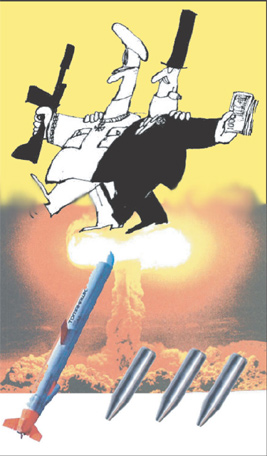 Democrats Retreat on Nuclear Policy Defense One, 13 Dec 19, The 2020 authorization bill fails to check Trump’s worst impulses. Democrats Retreat on Nuclear Policy Defense One, 13 Dec 19, The 2020 authorization bill fails to check Trump’s worst impulses.Question: How do you go from a National Defense Authorization Act that in July was opposed by every House Republican to one that was approved by more GOP votes than Democratic ones and that President Donald Trump called a huge win that he cannot wait to sign? Answer: Add Space Force and parental family leave and take out all of the progressive national security provisions. The House passed the compromise NDAA last night; President Trump has said he will sign it. This final bill is a world apart from the version passed by House Democrats in July. The House version, ably led by Rep. Adam Smith, D-Washington, chair of the House Armed Services Committee, prohibited deployment of Trump’s new “low-yield” nuclear weapon for Trident submarines, which defense experts called “a gateway to nuclear catastrophe.” It prohibited unauthorized U.S. military action against Iran, which Trump came within 10 minutes of ordering in June, and prohibited U.S. military support for the Saudi-led intervention in Yemen. And it supported extension of the New START treaty, which Trump seems to have every intention of sacking even though Russia supports keeping the crucial pact. The list goes on. In other words, the House bill would have constrained the most dangerous tendencies of an out-of-control White House. This is exactly what you would expect Democrats to do when faced with a President that they firmly believe is a danger to U.S. national security—and are now seeking to impeach on that basis. Not surprisingly, Republicans do not share this impression of the President, and they deeply opposed the nuclear policy provisions in the House NDAA……. The outcome was a disaster. The topline budget rose to $738 billion and the major constraints on Trump were ripped out. Others were watered down. The most we can say about the final NDAA is that it includes some useful language on arms control and missile defense, but nothing major. Such weak tea certainly does not justify supporting a bill that funds Trump’s excessive $2 trillion program to rebuild the nuclear arsenal, among other things. Rep. Ro Khanna, D-California, a member of the House Armed Services Committee and a vice-chair of the progressive caucus issued a joint statement with Sen. Bernie Sanders, D-Vermont, a presidential candidate, calling the final agreement “a bill of astonishing moral cowardice.” Over 30 progressive national security organizations (including Ploughshares Fund) sent a letter to Congress opposing the final bill as doing “almost nothing to constrain the Trump administration’s erratic and reckless foreign policy.” Senator and presidential candidate Elizabeth Warren said she would oppose the bill, calling it a “$738 billion Christmas present to giant defense contractors.” ….. Democrats cannot seek to impeach Trump and yet sometimes act as if he is a normal president. They cannot attempt to remove him from office as a danger to national security and yet hand him $738 billion in military spending with no limits on his nuclear weapons development, ability to attack Iran, freedom to abandon arms control treaties, and so much more. Trump is nothing if not a disrupter. The Democrats must give the president a taste of his own medicine. https://www.defenseone.com/ideas/2019/12/democrats-retreat-nuclear-policy/161855/ |
|
|
1 This Month
26 September – International Day for the Total Elimination of Nuclear Weapons





PLEASE OPPOSE HR 8255 AND S.3639 – bills would accelerate satellite deployment, with no environmental review or safeguards – https://ncstd5li.quorum.us/campaign/169331/
To see nuclear-related stories in greater depth and intensity – go to https://nuclearinformation.wordpress.com
-
Archives
- September 2026 (305)
- August 2026 (330)
- July 2026 (355)
- June 2026 (287)
- May 2026 (306)
- April 2026 (356)
- March 2026 (251)
- February 2026 (267)
- January 2026 (308)
- December 2025 (358)
- November 2025 (359)
- October 2025 (375)
-
Categories
- 1
- 1 NUCLEAR ISSUES
- business and costs
- climate change
- culture and arts
- ENERGY
- environment
- health
- history
- indigenous issues
- Legal
- marketing of nuclear
- media
- opposition to nuclear
- PERSONAL STORIES
- politics
- politics international
- Religion and ethics
- safety
- secrets,lies and civil liberties
- spinbuster
- technology
- Uranium
- wastes
- weapons and war
- Women
- 2 WORLD
- ACTION
- AFRICA
- Atrocities
- AUSTRALIA
- Christina's notes
- Christina's themes
- culture and arts
- Events
- Fuk 2022
- Fuk 2023
- Fukushima 2017
- Fukushima 2018
- fukushima 2019
- Fukushima 2020
- Fukushima 2021
- general
- global warming
- Humour (God we need it)
- Nuclear
- RARE EARTHS
- Reference
- resources – print
- Resources -audiovicual
- Weekly Newsletter
- World
- World Nuclear
- YouTube
-
RSS
Entries RSS
Comments RSS

