US. Dept of Energy wants to keep nuclear Waste Isolation Pilot Plant going till 2080

Federal agencies want to extend nuclear waste site to 2080 https://www.santafenewmexican.com/news/local_news/federal-agencies-want-to-extend-nuclear-waste-site-to-2080/article_acff4dbc-8573-11ea-93ac-2bea172dcd37.html By Scott Wyland swyland@sfnewmexican.com
- Apr 25, 2020 The more than 20-year-old nuclear waste disposal site in Southern New Mexico would remain active for at least 60 more years under a proposed permit renewal, reflecting the role of nuclear weapons in the country’s Cold War past and what many federal leaders envision for the future.
The Waste Isolation Pilot Plant’s permit is set to expire in 2024, but federal officials who oversee the nation’s nuclear programs believe the underground repository near Carlsbad can keep taking radioactive waste for decades to come.
Critics contend WIPP, where the waste is buried in salt beds 2,150 feet underground, should not operate beyond the 25-year life that was planned when it opened in 1999.
Yet federal agencies submitted a proposal calling for a permit renewal until 2080, Hancock said. And the latest proposal gives no date for when the permit extension would end, he said.
“So it’s WIPP forever,” he said.
WIPP has the word “pilot” in its name, which means it was supposed to be the first nuclear waste disposal site, not the only one, Hancock said.
Officials at the National Nuclear Security Administration, which oversees WIPP, did not provide answers Friday to questions about the site’s permitting, storage capacity and long-term future.
WIPP receives radioactive material from sources as varied as the decommissioned Hanford Site in Washington state and Los Alamos National Laboratory.
The Los Alamos lab’s legacy waste generated during the Cold War and Manhattan Project is sent to WIPP. If the lab and Savannah River Site in South Carolina ramp up nuclear-core production as planned by 2030, the new waste will go to WIPP.
The Department of Energy also wants to use WIPP as one of the sites to store 34 megatons of diluted plutonium waste. It’s unclear how much of the waste would go to WIPP.
The plan poses challenges, such as how to efficiently dilute the plutonium and how much storage space WIPP would have for the material, the National Academy of Sciences said in a 2018 report.
The 1992 Land Withdrawal Act limits WIPP to 6.2 million cubic feet of waste, or about 175,000 cubic meters.
It also restricts the storage to transuranic waste — from elements that have atomic numbers higher than uranium in the periodic table, primarily produced from recycling spent fuel or using plutonium to fabricate nuclear weapons. Taking in discarded plutonium would require Congress to amend the law, Hancock said.
But the Energy Department persuaded the state Environment Department in 2018 to change the calculation so the empty headspace in the containers isn’t counted.
Then, three weeks before Republican Gov. Susana Martinez left office at the end of 2018, the agency revised the permit to allow the Energy Department greater leeway in estimating WIPP’s remaining capacity. That included letting federal officials deduct a container’s headspace.
The Energy Department, in turn, estimated WIPP had only used about 40 percent of its capacity.
Hancock’s group and two other watchdogs filed a legal challenge, contending the methodology was invalid. They argued the original calculations based on container size should be used.
They also hoped Democratic Gov. Michelle Lujan Grisham’s administration would reverse the permit revision. But the administration has taken no action. When the federal government got plans for WIPP rolling in the 1980s, New Mexicans agreed to create a disposal site for nuclear waste for a limited time as a patriotic duty, said Joni Arends, executive director of Concerned Citizens for Nuclear Safety, one of the groups suing the Energy Department.
The effort to push WIPP’s operation beyond the original 25-year timeline and expand its limited capacity is “an affront to the promises made to New Mexicans,” Arends said. “It’s irresponsible on their part to say WIPP is going to stay open in perpetuity,” she added.
She questioned how WIPP could keep going for 60 more years when it’s already half-full after 17 years of operation.
WIPP lost almost three years of operations after the so-called kitty litter incident in 2014. That was when a Los Alamos lab container packed with a volatile blend of organic cat litter and nitrate salts burst, causing radiation to leak through the underground site.
The contamination, which cost about $2 billion to clean up, led to part of WIPP being sealed off. Crews are having to dig out more space in the salt beds to put waste containers, Arends said, so its footprint is growing.
There are also environmental concerns about disposing of massive nuclear waste at WIPP, she said. For instance, the waste, while embedded in the salt beds, could leach into subterranean clay seams linked to the Pecos River.
The Pecos connects to the Rio Grande, a source of drinking water in the region, she said.
“WIPP — it’s a complicated issue,” Arends said.
Trump administration to boost uranium mining, weaken environmental regulations
|
Trump officials pitch nuclear plan that would bolster struggling uranium industry, The Hill
BY REBECCA BEITSCH – 04/23/20 The Trump administration on Thursday outlined its plan for revitalizing the U.S. nuclear energy industry in a move that would boost uranium mining while benefiting just a handful of companies.The report from the Nuclear Fuel Working Group includes a set of recommendations to the White House and comes as the price of uranium has steadily fallen over the past decade. he effort to shore up nuclear power is sure to be controversial. Uranium mining has been floated in sensitive areas, including land near the Grand Canyon. …. Nuclear energy has also struggled to remain competitive with other energy sources, leaving some states to bail out nuclear reactors to the tune of tens of millions of dollars to keep them afloat…. To revitalize the industry, however, the new report backs President Trump’s proposal to spend $150 million on a uranium reserve, which would buy U.S.-mined uranium from the small number of domestic producers. The Uranium Producers of America identifies just eight members on its website……. Also at risk is nearly 1,562 square miles just outside the boundaries of the Grand Canyon that since 2012 have been off limits for production. Critics have worried Trump might seek to overturn that ban since he declared uranium a critical mineral for national security purposes at the end of 2017. Some uranium mining companies already own some of that land, and there’s been a push from some Republicans lawmakers to open the area for mining. “It’s despicable to risk irreversible harm to spectacular wild places by propping up uranium companies that can’t compete in global markets,” Taylor McKinnon with the Center for Biological Diversity said in a statement Thursday…….. The report published Thursday, however, calls for “expand[ing] access to uranium deposits on federal lands, including support for necessary legislation” and reconsidering categorical exclusions that bar mining in certain areas. It also recommends overhauling regulations to more quickly spur any number of nuclear projects and easing requirements under the National Environmental Policy Act (NEPA). The Trump administration has already proposed a major rollback of NEPA that is set to be finalized in the coming months, including provisions that give companies a greater role in assessing the environmental safety of their own projects. The report also identified potential new financing sources for nuclear projects, like the Export-Import Bank, and changing “legacy policies that disallow support for nuclear projects” to open up financing from the U.S. International Development Finance Corporation…… https://thehill.com/policy/energy-environment/494315-trump-officials-pitch-nuclear-plan-that-would-bolster-struggling |
|
Trump’s new uranium plans threaten Grand Canyon area
|
New Trump Nuclear Plan Favors Uranium Mining Bordering the Grand Canyon, The administration, seeking to restore America’s “competitive nuclear advantage,” also wants to create a $150 million uranium reserve in the coming decade. Inside Climate News, Judy Fahys APR 26, 2020
Evergreen forests blanket the Grand Canyon’s less traveled northern plateau, and the perfume of Ponderosa pine drifts down a creekbed to the bottom of the great redrock canyon. Downstream, the strangely blue waters of the Little Colorado River meet the main Colorado, coming from the southern plateau close to sacred places for indigenous people who have lived here for centuries.
Both plateaus are also where mining companies want to unearth uranium. Mining those claims has been barred since 2012, when Congress imposed a 20-year mining ban across 1,000 acres here because past uranium extraction has polluted drinking water and poisoned the air and the ground. Local tribes and environmental groups that sought the temporary ban have been pressing Congress to make the ban permanent. But in a sweeping plan to revive the domestic uranium mining industry unveiled Thursday, the Trump administration proposed instead to open the scenic and sacred areas once again in the name of economic vitality and national security. Allowing more uranium mining on federal lands is just one of the suggestions that emerged from an eight-month review by the White House Nuclear Fuel Working Group. Proposals outlined in the Restoring America’s Competitive Nuclear Advantage report quickly triggered criticism. Some environmentalists say that the administration shouldn’t propose using taxpayer funds during a pandemic to bail out a dirty, uncompetitive industry that’s largely owned by foreign companies. ….. |
|
Members of Congress from Massachusett want details on how Seabrook Nuclear Power Plant is handling COVID-19.
Mass. Delegation Seeks Details on Seabrook Nuclear Plant’s Pandemic Operations, https://www.nhpr.org/post/mass-delegation-seeks-details-seabrook-nuclear-plants-pandemic-operations#stream/0 By ANNIE ROPEIK • APR 22, 2020 Members of Congress from Massachusetts want details on how Seabrook Nuclear Power Plant is handling COVID-19.
Seabrook Station is currently offline and in the midst of a periodic refueling. That process requires a large extra workforce.
The plant’s owner, NextEra, has said it’s operating under its pandemic plan but it hasn’t offered more details.
Now, Massachusetts U.S. Sens. Elizabeth Warren and Ed Markey and Congressman Seth Moulton of Salem, Mass., are asking for that plan. The delegation wrote to NextEra and the Nuclear Regulatory Commission this week. They also want details on any federal coronavirus exemptions that NextEra is planning to request.
Activists with Seabrook watchdog groups like C-10 have raised similar concerns in recent weeks, about how the pandemic may affect the plant or put workers at risk.
Federal regulators have already said some nuclear plants can ask to have employees work longer shifts during the pandemic.
EDF nuclear power company looks to a profitable future in small-scale, distributed RENEWABLE energy
 Can EDF Make Big Money in Small-Scale Renewables?, Greentech Media
The world’s leading nuclear power generator is betting big on a future of small-scale, distributed energy.
Électricité de France operates 58 nuclear reactors in its home country and owns stakes in several U.S. nuclear plants that it’s now moving to sell. But EDF’s biggest stamp on the American power market has come in large-scale renewables: Its San Diego-based EDF Renewables North America subsidiary has developed and now operates gigawatts of wind and solar farms across the country.
Now, EDF Renewables is trying to replicate that success on a much smaller scale. How it fares in the distributed space will be of great interest to other 20th-century energy giants feeling their way toward a transformed, low-carbon future.
Over the past few years, and largely through acquisitions, EDF Renewables has amassed one of the most comprehensive U.S. distributed energy businesses, covering solar, energy storage, microgrids and electric vehicle chargers.
The coronavirus crisis may open the door to more dealmaking, said Raphael Declercq, who runs the Distributed Solutions unit at EDF Renewables North America. “There will be some casualties in our sector: Assets seemed overpriced up to a month ago; that may change and we may be able to grow through acquisitions,” Declercq told GTM.
Several European energy giants have been on a recent shopping spree for distributed energy companies in the startup-rich U.S. — notably Shell, EDF and Enel. Without their own U.S.-based utilities to worry about taking business from, they can roll up fleets of behind-the-meter energy assets and deliver power to customers in new ways, while learning lessons that can be applied in other markets.
“It’s a grab game right now, getting as much of that value chain as possible,” said Elta Kolo, content lead for grid edge research at Wood Mackenzie. “In a way, you’re almost seeing a new type of utility emerging in the market,” she said.
It’s a hazardous moment for the energy industry, oil companies and utilities alike. State-controlled EDF last week pulled its financial guidance for 2020 and 2021, saying it expects a sharp drop in its French nuclear output this year as the coronavirus outbreak depresses power demand…….
The rising importance of corporate renewables…….
16 hour days, 86 hour weeks for nuclear workers, amid pandemic panic?
 Nuclear agency clears way for long days, weeks for Palo Verde employees, azfamily.comMorgan Loew 22 Apr 20, PHOENIX (3TV/CBS 5) – The Nuclear
 Regulatory Commission has given the operator of the Palo Verde Nuclear Generating Station permission to work its employees 16 hours per day and as many as 86 hours in a week, according to a letter from the NRC obtained by CBS 5 Investigates.
“Palo Verde Generating Station requested and received this exemption from the Nuclear Regulatory Commission early and proactively so that the option to modify work hours is immediately available in response to an extreme circumstance. Work schedules are not changing at this time, nor is a change imminent,” stated Jill Hanks in an email. She is a senior communications consultant at APS…..
environmentalists, like Steve Brittle from Don’t Waste Arizona, say they don’t think exemptions like these are a good idea. “All of the money this industry has, this is the best they can do?” said Brittle.
He said he only found out about the changes because of a standing records request he has on file with the NRC. “Government agencies as well as potential polluters – they all need to have somebody watching over them,” said Brittle.
The NRC has granted similar exemptions to other nuclear reactors across the country and allowed some facilities to postpone scheduled maintenance. Environmental groups warn that reducing maintenance, worker’s protections, and oversight could lead to accidents.
Morgan Loew’s hard-hitting investigations can be seen weekdays on CBS 5 News at 6:30 p.m. and 10 p.m.https://www.azfamily.com/news/investigations/cbs_5_investigates/nuclear-agency-clears-way-for-long-days-weeks-for-palo-verde-employees/article_116ace1e-844a-11ea-890d-b3c0d57fab8c.html
Some Grand Gulf Nuclear Station employees impacted by COVID-19
Some Grand Gulf Nuclear Station employees impacted by COVID-19, PORT GIBSON, Miss. (WJTV)22 Apr 20 Entergy confirmed some of its team members at the Grand Gulf Nuclear Station in Claiborne County tested positive for the coronavirus….. https://www.wjtv.com/health/coronavirus/some-grand-gulf-nuclear-station-employees-impacted-by-covid-19/
Piscataway Community Energy Aggregation (PCEA) program DOES NOT INCLUDE NUCLEAR ENERGY

 Clearing the Air on the PCEA: Nuclear power NOT included By ANN BASTIAN
https://www.tapinto.net/towns/piscataway/sections/green/articles/clearing-the-air-on-the-pcea-nuclear-power-not-included The Piscataway Community Energy Aggregation (PCEA) program, just rolled out for township residents, does NOT include nuclear power as one of its “renewable energy” sources. The referendum voters passed last November required that the PCEA use only Class 1 Renewables: wind, solar, geothermal, hydro and other sustainable sources.
We passed the PCEA in order to move our town and state away from dirty power, from the air pollution of fossil fuels and the radioactive wastes of nuclear power. Bulk purchasing as a community also gives us cost savings, along the way to addressing the climate crisis.
nd that’s what we’re getting: a win-win. Residents can access 30% clean electricity by automatically staying in the basic plan, with a savings on their electric bill. If residents want to “opt UP”, they can choose to go immediately to 50% Class 1 Renewables or to 100% Class 1 Renewables, at reasonable rates. The whole town will move forward in stages, reaching 100% clean renewables in 2035. Individual households can also opt out at any time, and businesses can opt in.
Still, there may be some confusion about how the PCEA will work:
1) SOURCING: The energy provider, EnergyHarbor, is a diversified power company, with some nuclear and fossil fuel holdings. But its PCEA contract with the Township is only for clean energy.
(2) SHADE: The Mayor has always knocked the referendum, which let voters decide town policy, not the insiders. OK, the people have spoken, 64%-36%, let’s move on.
(3) INFORMATION: The town website, which is hard to navigate for basic information, is nearly impossible to navigate for PCEA facts and options, including the choice to opt out. We do need to inform ourselves. Here’s an upcoming forum for residents who have questions:
his Wednesday, April 22 at 6 pm: the town’s PCEA administrator, Good Energy LP, is holding an online Q & A session: https://www.tapinto.net/towns/piscataway/events/facebook-live-piscataway-community-energy-aggreg
And Piscataway Progressive Democrats, who endorsed the PCEA referendum, did a special segment explaining the PCEA and your PSE&G bill last Saturday, April 18:
https://www.facebook.com/pwayprogressivedems/?epa=SEARCH_BOX
Let’s celebrate this Earth Day by making Piscataway cleaner and greener!
Formal petition to close Fermi 2 nuclear reactor in Michigan, from coalition of watchdog groups
Groups that include Beyond Nuclear and Don’t Waste Michigan have asked the Nuclear Regulatory Commission (NRC) to halt reopening within the next week or so of Fermi 2 — currently shut down for routine scheduled maintenance.
The petition was filed Thursday and requires an NRC review board to make an emergency decision on the application over the next week on whether the groups have valid concerns or that Fermi 2 be allowed to resume operations when its current outage for “refuelling” is completed.
“It is a very high-risk situation,” said Michael Keegan of Don’t Waste Michigan. “It is dangerous since the plant, should it reopen, will be operating in a compromised position. They have got a problem that could be a major nuclear accident.”
A spokesman for DTE, which owns and operates the nuclear generating station, said Sunday that proper maintenance and repairs are being conducted and that the facility is safe.
Thousands of residents in Amherstburg and Boblo Island are among those at greatest risk of a nuclear accident at Fermi — which sits across Lake Erie — but there are also potential health risks for thousands more stretching through LaSalle and into Windsor, as well as Michigan, should a Fermi 2 incident occur.
The petition calls on NRC to take enforcement action to inspect Fermi 2 and make full repairs to what’s known as the “torus,” a donut-type structure at the base of the reactor. ……. https://windsorstar.com/news/local-news/watchdog-groups-file-safety-concerns-on-fermi-2-nuclear-reactor/
A warning to Idaho residents on the danger of Hanford’s nuclear wastes

A study released by the National Cancer Institute in 1997 showed that 25 states had citizens exposed to high levels of radiation due to nuclear testing.
“When there is an earthquake in that area, the radiation fallout will be equal to Chernobyl,” Brodesser said in her lecture. “When, not if.”
They know what they’ve done’: America’s nuclear past threatens Idaho’s future https://www.idahopress.com/news/local/they-know-what-theyve-done-americas-nuclear-past-threatens-idahos-future/article_a02826ba-b62f-5964-9b08-09dbe300d596.html, By ASHLEY MILLER amiller@idahopress.com MERIDIAN — In a time before social distancing, the lecture hall of the Idaho College of Osteopathic Medicine was packed. Students, staff, politicians and community members sat intermixed in the seats, elbow to elbow.
But Kaaren Brodesser stood alone.
Before she started her lecture on March 10, she was introduced simply as an advocate. More than that, she is a witness, part of a small group of people fighting for the rights of Idahoans whose lives changed on July 16, 1945, when the U.S. conducted the first-ever nuclear test, setting off a series of events the world is still struggling to fully understand.
These are downwinders, and they are dying.
‘THEY KNOW WHAT THEY’VE DONE’
In the 1950s and ’60s, the bulk of America’s nuclear testing was done in a 680-square-mile piece of desert about 65 miles outside of Las Vegas. The Nevada Test Site was ground zero for America’s Cold War preparations, testing the effects and power of the nuclear bombs designed by the military. From 1951 to 1958, around 100 aboveground nuclear tests were conducted on the site. The site was chosen for its relative isolation from any densely populated cities; however, in the end, distance was not the solution it first seemed.
The term “downwinders” refers to anyone who lived in communities exposed to nuclear radiation during the end of World War II and the peak of the Cold War (roughly the late 1940s to 1980). During the construction and testing of nuclear weapons, wind patterns directed the fallout far beyond the safety perimeters of the sites, spreading radiation hundreds and even thousands of miles away.
In the book “Atomic Farmgirl,” author Teri Hein details her life growing up downwind of Hanford, Washington, where the bulk of America’s plutonium was produced for many decades. She explains the fallout like this: When Mount Saint Helens erupted in 1980, ash drifted far past the state lines of Washington. The wind carried and then settled the debris into neighboring states. Nuclear radiation fallout can be thought of in the same way. The testing locations in Nevada and the production plants in Hanford are the eruption. The radiation then drifted into Idaho, Montana, Wyoming and beyond.
The radiation was in the air and, more importantly, in the crops and livestock of these communities. According to the National Cancer Institute, a significant portion of the Intermountain West was exposed to high doses of radiation from the tests, specifically the radioisotope Iodine-131. Iodine-131 is processed in the thyroid, the gland in your neck that regulates hormones. This is why children seemed to be the hardest hit from the fallout: their thyroid is still developing and isn’t strong enough to process the high dosage of Iodine.
NCI’s list of medical issues tied to downwinders is long, ranging from multiple sclerosis to various forms of cancer that slowly eat away at your life. That’s something that Emmett resident Tona Henderson knows only too much about. Continue reading
COVID-19 Lessons from Three Mile Island #2 — the NRC
I happen to think it is worse for a government in crisis to fake it than to admit they aren’t sure of the correct problem, much less the correct answer. To say that COVID-19 is “no worse than the flu” or that “it will disappear in a few weeks” when you don’t really know what you are talking about is dangerous. It costs lives.
No executive ego is worth loss of life.
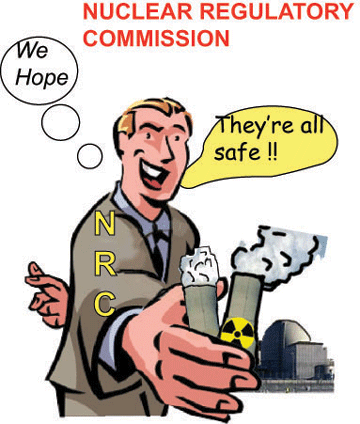 COVID-19 Lessons from Three Mile Island #2 — the NRC https://www.cringely.com/2020/04/17/covid-19-lessons-from-three-mile-island-2-the-nrc/?fbclid=IwAR3GJkbLC9UyA344IclZfHkFACO4fdj9Oxd0nxfUZ3M8xJ9UC5_VmS-T124 By Robert X. Cringely April 17th, 2020 My last column was about crisis management lessons I learned back in 1979 while investigating the Federal Emergency Management Agency for the President’s Commission on the Accident at Three Mile Island (TMI). Let’s just say that FEMA wasn’t ready for a nuclear meltdown. Today we turn to the other federal agency I investigated at that same time — the Nuclear Regulatory Commission (NRC). While FEMA was simply unprepared and incompetent, the NRC was unprepared and lied about it.
Like FEMA, the NRC had recently undergone a rebranding from its previous identity as the Atomic Energy Commission — a schizoid agency that had been charged with both regulating nuclear power and promoting it. It’s difficult to be the major booster of technology while at the same time making safety rules for it. Think of the Trump Administration’s approach to coal as an example of such a paradox.
When the NRC was created to regulate nuclear power, that PR function was sent over to the U.S. Department of Energy. So all the NRC had to do at Three Mile Island was to make sure the utility was following the rules and to help them keep the public safe. Not much of either actually happened during the accident, mainly because nobody really had any idea of the actual state of the reactor. This suggests that maybe a bit more regulation should have been done during the reactor design phase.
Since almost nobody but me remembers any of this let’s get out of the way the two most important lessons of Three Mile Island. The first lesson explains why the accident was so bad while the second explains why nobody died.
The primary technical failing of TMI came down to a poor operator training combined with a major user interface glitch. All of the TMI operators were originally trained by the U.S. Navy, where they operated nuclear reactors on submarines and aircraft carriers. This was a deliberate policy on the part of General Public Utilities (GPU), the electric company that owned the plant. And it wasn’t a bad policy. The Navy vets were proven operators who didn’t panic and had been well trained on their ships. Alas, they weren’t especially well trained on the actual reactor they operated at TMI. In fact, they weren’t really trained to operate the reactor at all: they were trained to pass the reactor operator test.
This distinction between being trained to operate the reactor versus being trained to pass the test is crucial. GPU assumed the Navy veterans already knew plenty about reactors, so they concentrated solely in their training on the actual operation of reactor systems. This may sound okay, but what was missing was any deep understanding of what was actually happening inside the reactor that might have been helpful for troubleshooting.
By streamlining their training, the reactor operators may have known which valve to open or close, but not necessarily why they were opening or closing it.
Look at the picture above [on original] of the control room at Three Mile Island Unit 2. There is a lot going on in this picture from 1979. There are hundreds of switches and valves matched by hundreds of meters and gauges. Video screens on the back wall mainly verified the state (open/closed, on/off) of these valves and switches. In this entire control room there was ONE warning light and ONE horn or buzzer. When something went wrong this one light would start to blink red and the buzzer would sound an alarm.
In theory, when the buzzer sounded an operator could scan all the gauges and figure out what was happening inside the reactor. In real terms, however, this was close to impossible to do. There were just too many variables and — remember — the operators weren’t trained to understand the innards of the reactor, just how to run it.
What actually ran the reactor was a minicomputer. So when the warning light started to blink (by this time they’d turned-off the buzzer) the operators could go to that IBM Selectric printer in the foreground of the picture above where the minicomputer would print out a trouble code and description of what had gone wrong. This printer-based user interface was a key failing at TMI because within two minutes of the first alarm sounding, that printer queue was already six hours behind in printing trouble codes.
While designing this printer-centric system they’d apparently never considered what would happen if there were 100 or 1000 trouble codes hitting at the same time. Worse still, every time the system updated (which as I recall was every minute), it sent to the printer another 100 or 1000 codes.
Certainly, there was an engineer somewhere who understood that printing subsystem and could have found a way into the queue, but nobody in Harrisburg knew who that engineer was. That engineer didn’t work for GPU. So the utility was never able to get past this UI problem which made the reactor operators essentially blind. They had to guess what was happening inside the reactor, and their guesses had to be correct, they thought, or people might die.
No pressure here.
The reactor operators were clueless. The GPU executives called-in to help were clueless. And the NRC “experts” were clueless, too. In fact, nobody at the NRC had been through operator training for this particular class of reactor.
will shortly look in some detail at the NRC’s response, but first let’s cover that other lesson of TMI — why nobody died. That nobody died at Three Mile Island was a total fluke. There was at least one over-pressure event that should have blown the containment dome over the reactor, releasing radiation into Middletown, Pennsylvania. The only reason the containment wasn’t breached was TMI had been built extra-strong because it was right next to the Harrisburg International Airport.
In this picture [on original] notice the airport in the background. The final approach goes right past Three Mile Island. There were a dozen Babcock & Wilcox reactors in the U.S. identical to the two units at Three Mile Island, but only those two TMI reactors were built next to what had been a US Air Force B-52 base. So only those two reactors got an extra foot of concrete added to their containment domes, taking them from three feet thick to four feet thick, just in case a B-52 happened to crash into one.
Had the TMI accident happened at the otherwise-identical Rancho Seco reactor near Sacramento, California, people probably would have died.
So TMI-2 melted-down, but it was overbuilt and nobody was actually in danger. However, back in 1979 nobody knew this.
Let’s take a moment here to contrast TMI and Chernobyl, the difference being that there was no containment at Chernobyl. The accidents were comparable, but with no containment, Chernobyl directly killed 31 people with an estimated 4000 additional deaths over the years since from radiation-caused cancer.
Reactor containments are good.
Not knowing what was actually happening inside the reactor, the men controlling Unit 2 made some bad decisions that made things worse. And after the first few hours, those decisions were all made with the agreement of the NRC, which also didn’t have a clue what was happening. For the most part, whatever was done was based on guesses and more of those guesses were wrong than were right. But since the containment was extra-thick, it probably didn’t matter.
Now to the part about lying. It is common for people in positions of authority to prefer that they are seen as acting correctly. Certainly, that was the case with the NRC, which never in the months I investigated them said anything like the truth — that they had no idea what the fuck was happening inside that reactor. They wanted to be seen as professional and calm, not clueless and panicked. So their official accounts projected this professionalism and tended to point fingers mainly at the utility — GPU. The NRC story was that they saved the day.
With the benefit of 41 years of hindsight, it’s pretty clear that nobody saved the day at TMI. Nor was the day especially at risk, though that, too, wasn’t known at the time.
My job in 1979 was to understand what happened and how it was presented to the outside world and when I did interviews at the NRC it just plain felt wrong. If the agency had done everything right, why did the accident seem so perilous?
That’s when I phoned-into the NRC Emergency Operations Center and learned something the agency had failed to disclose.
In one of the documents I retrieved from the NRC I found a telephone number for the NRC Emergency Operations Center. Purely on a hunch, I called it. This was in July 1979 and the accident began in March of that year. Like all government phones 41 years ago, this one was answered by a person. The EOC was still in operation, still supporting the accident recovery. As I spoke on the phone I heard a beeping sound.
“What’s that beep?” I asked.
“That’s the recorder — this call is being recorded,” the person on the phone explained.
“Are all incoming lines recorded?” I asked.
“Yup, all 40 of them,” was the answer.
We were already a month into investigating the NRC and nobody at the agency had mentioned that all incoming lines to the Emergency Operations Center were recorded (this was very unusual at the time). Rather than listen to the NRC explain what had happened back in March, I could presumably listen to the recordings myself.
The NRC said, “no.”
Remember those FEMA guys tapping their West Point rings on the conference table? Ring tapping was common at the NRC as well, where the agency had a huge investment in looking infallible. Giving me access to those recordings could have blown their cover, so they rejected my request.
The NRC, which was part of the Executive Branch, rejected a request effectively from the President of the United States.
At this point, some writers might mention the Deep State. But that implies a conspiracy. What I think was going on here was more like hubris.
We subpoenaed the tapes. The NRC said they couldn’t give us the tapes (no reason was given, by the way — they just “couldn’t” do it). Nor could they copy the tapes for us. So we went to court and eventually the NRC offered to transcribe the tapes for us — a process they estimated would take six weeks. They wanted to wait until all the transcriptions were finished before providing any, so we went back to court for quicker access.
Does any of this make sense to you? If your state governor calls up the highway department and asks for some files, do you think they ever say “no?”
As the transcripts began to trickle out it was clear that something was wrong. Some of the transcriptions simply didn’t make sense. And key sections were missing entirely, with the transcription saying only that they were unintelligible. So it was back to court to get the original tapes, which the NRC still refused to give up. Instead, they set up a listening room at NRC headquarters where only one investigator at a time could go for a few hours per day to listen to the original tapes. We had to know which tapes to ask for based on the bad transcriptions that still weren’t all complete.
The NRC, so intent on maintaining security, had hired an outside transcription service. That service had no special knowledge of nuclear reactor operations, so when technical terms were used they often got them wrong or just said they were unintelligible. Things were unintelligible, too, when more than two people were on the line or when people were urgently speaking over one another. In other words, the most urgent moments were those moments least likely to be correctly transcribed.
Sitting in that NRC listening room, listening to the tapes after a month of fighting to get them, they were actually quite clear. By this time I was an expert, I knew the terms and I knew what the speakers were discussing and the context. When they said things like “Shit, I think it’s going to blow!” that wasn’t unintelligible to me.
The lesson of the Nuclear Regulatory Commission at Three Mile Island was that they were incompetent and unhelpful. Part of this was a difficult relationship with GPU, part was that crazy printer-based user interface to the reactor computer, but a lot of it came down to the NRC having a huge investment in looking infallible. And that’s the lesson for COVID-19.
I happen to think it is worse for a government in crisis to fake it than to admit they aren’t sure of the correct problem, much less the correct answer. To say that COVID-19 is “no worse than the flu” or that “it will disappear in a few weeks” when you don’t really know what you are talking about is dangerous. It costs lives.
No executive ego is worth loss of life.
Outcry as uranium industry exploits Covid 19 to call for financial bailout
 Uranium Industry’s COVID-19 Bailout Request Sparks a Disgusted Pushback, Phoenix New Times, Uranium Industry’s COVID-19 Bailout Request Sparks a Disgusted Pushback, Phoenix New Times,
ELIZABETH WHITMAN | APRIL 14, 2020 , When Jamescita Peshlakai was a little girl, she herded sheep along the Little Colorado River, which courses through the Navajo Nation in northern Arizona.
One July morning in 1979, a dam containing tailings from United Nuclear Corporation’s uranium mill some 200 miles away broke, letting loose more than 1,000 tons of waste. Ninety-four million gallons of radioactive water gushed into the Puerco River, which feeds the Little Colorado. More than 40 years later, the Church Rock spill is still the biggest release of radioactive material in American history. The lambs born soon after that disaster barely lasted after birth, recalled Peshlakai, now an Arizona state senator. “Once the umbilical cord was cut, they simply died,” she said. “That happened to a lot of livestock at that time, and we did not know it was because of the Church Rock spill.” Uranium mining has left a toxic, indelible imprint on the Navajo Nation. Mining companies would come in over the years to hire Navajo people for the backbreaking work of picking at uranium ore and hauling it in wheelbarrows. When the companies were ready to move on, they abandoned more than 500 mines on the Navajo Nation, the water they had contaminated, and the people who worked them, many of whom died of cancer and whose offspring were born with birth defects, Peshlakai said. “They never did anything to fix the land, and fix the communities or the tribal nations that they used,” Peshlakai said. That legacy has done nothing to stop America’s dwindling uranium mining industry from going to the federal government and asking to be bailed out in the midst of a public health crisis. At the end of March, two uranium companies penned a letter to President Donald Trump asking for a $150 million bailout, citing the economic impacts of COVID-19. One of them was Energy Fuels Resources, which hopes to open a uranium mine south of the Grand Canyon and whose exploratory operations already have led to it trucking radioactive water across the Navajo Nation. The request quickly sparked disgust and fury among those who oppose the industry’s deleterious effects on people and the land. Last Friday, a cohort of 75 conservation and grassroots groups penned a missive of their own and sent it to four congressional leaders, asking them to reject any bailout for an industry that has wreaked so much destruction, and calling into question the companies’ claims that a public health crisis like COVID-19 justifies extending a lifeline to a declining industry. Leaders of the Navajo Nation also oppose the request. Jared Touchin, a spokesperson for Navajo Nation President Jonathan Nez and Vice President Myron Lizer, said that the two leaders “would not support this effort if it proposes to use uranium resources that impact the Navajo people.” Peshlakai also rejected the idea that the industry, which has never been held accountable for its operations in Arizona, receive a bailout. “This industry should not be left off the hook,” she said. In their letter to Senate Majority Leader Mitch McConnell, Senate Minority Leader Chuck Schumer, Speaker of the House of Representatives Nancy Pelosi, and House Minority Leader Kevin McCarthy, the 75 groups declared that the uranium industry was “falsely” suggesting that the COVID-19 pandemic had led to uranium shortages that threatened supply chains. Rather than helping the industry, they said, Congress should “invest stimulus funds towards the assessment, reclamation, and cleanup of the hundreds of thousands of abandoned hardrock mines on public and tribal lands, which are currently polluting roughly 40 percent of western headwaters.” Among the signatories were the Sierra Club, the Wilderness Society, the Grand Canyon Trust, and the Natural Resources Defense Council…….. To the 75 groups who wrote in protest, because the U.S. uranium industry has been in decline for years, the two companies [ Energy Fuels Resources, and Ur-Energy USA], are unjustly invoking the COVID-19 pandemic in an effort to make funding that the administration promised months ago finally materialize. The industry is “seeking to take advantage of the global Coronavirus pandemic for their own benefit by seeking $150 million for the establishment of a uranium reserve,” they wrote. Citing the fact that Arizona Public Service, which operates the country’s largest nuclear power plant, Palo Verde, recently said it was “confident” it could provide reliable service throughout the pandemic, they suggested that the industry’s warning of supply chain disruptions was misleading. “Industry reports are telling us that they have more than enough uranium,” said Ray Rasker, executive director of the Montana-based Headwaters Economics, a nonprofit land management research firm. The U.S. already has a stockpile of uranium, he explained. Because of a global oversupply or uranium, prices have also fallen low, Rasker said; right now, prices are below $30 a pound. And if they were to rise again, the most economically viable deposits of uranium in North America are in Saskatchewan, Canada — an ally of the U.S. “There’s no national security concern,” Rasker said. Past statements suggest that the industry is now invoking COVID-19 to seek what it believes it is due……. In an investigation in 2018, Phoenix New Times found that reviving uranium mining in the U.S. made little sense, because of the low quality of deposits in the country, an oversaturated global market, and the lack of benefits for local economies. https://www.phoenixnewtimes.com/news/uranium-industry-asks-for-bailout-during-covid-19-arizona-11465201 |
|
Climate change will bring regular major floods to USA – no longer “once in a lifetime” floods
 US to have major floods on daily basis unless sea-level rise is curbed – study
- New Orleans, Honolulu and Miami expected to be vulnerable
- Research: advancing tides will ‘radically redefine the coastline’ Guardian, Oliver Milman
@olliemilman, Fri 17 Apr 2020 Flooding events that now occur in America once in a lifetime could become a daily occurrence along the vast majority of the US coastline if sea level rise is not curbed, according to a new study that warns the advancing tides will “radically redefine the coastline of the 21st century”.The research finds major cities such as Honolulu, New Orleans and Miami will become increasingly vulnerable to elevated high tides and stronger storms fueled by the global heating caused by human activity. Beach and cliff erosion will exacerbate this situation.
The accelerating pace of sea level rise means that by the end of the century floods currently considered once in a lifetime, or once every 50 years or so, will become a daily high tide occurrence for more than 90% of the coastal locations assessed by researchers from the US government, the University of Illinois at Chicago and the University of Hawaii.
Within 30 years from now, these now-rare flooding events will become annual occurrences for more than 70% of the locations along the US coast according to the research published in Scientific Reports. This scenario threatens huge, multibillion-dollar damages and, potentially, the viability of some coastal communities.
“If future sea-level rise causes once extreme but rare floods to occur frequently then … this may render some parts of the US coastline uninhabitable,” said Sean Vitousek, a scientist at the US Geological Survey.
The disruption caused by frequent flooding will threaten the habitability of much of the US coastline as it is already widely projected to do to many low-lying islands in the Pacific, Vitousek added……. https://www.theguardian.com/environment/2020/apr/16/us-climate-change-floods-sea-level-rise
Pennsylvania Department of Environmental Protection wants delay to license for moving radioactive Nuclear reactor 2 at Three Mile Island
Pennsylvania raises alarms on transfer of radioactive Three Mile Island reactor, State Impact, Pennsylvania, Susan Phillips , 17 Apr 20,
Citing financial concerns and the COVID-19 emergency, the Pennsylvania Department of Environmental Protection has asked the federal Nuclear Regulatory Commission to delay a decision over a license transfer of the radioactive Unit 2 reactor at the Three Mile Island nuclear power plant in Dauphin County.
The reactor, which sits on an island in the middle of the Susquehanna River, experienced a partial meltdown in 1979, the worst nuclear accident in United States history.
In an April 6 letter to NRC chair Kristine Svinicki, DEP Secretary Patrick McDonnell detailed a number of issues, including a lack of funds to properly clean up the site, unknown levels of radiation that remain on site, how and where the remaining radioactive materials will be disposed of, and how the process could affect the health of the Susquehanna River.
“The TMI Unit 2 nuclear accident resulted in damage to the majority of the reactor core, released millions of curies of radioactive noble gases into the environs, and grossly contaminated the interiors of the containment and auxiliary buildings,” McDonnell wrote in the letter. “… Despite the limited entries into the containment building to remove damaged nuclear fuel in the 1980s, there are vast areas in the plant with unknown radiological conditions related to the TMI Unit 2 accident. I firmly believe TMI Unit 2 is the most radiologically contaminated facility in our nation outside of the Department of Energy’s weapons complex.”
GPU Nuclear (now a subsidiary of FirstEnergy), the company that operated the plant during the meltdown, plans to transfer its license to Salt Lake City-based EnergySolutions, one of a few companies that purchase shuttered nuclear facilities to take over the decommissioning of the sites, with the goal of dismantling and disposing of radioactive materials cheaper and faster.
Each nuclear facility has a mandated trust fund — known as the Nuclear Decommissioning Trust Fund, or NDT, and financed with ratepayer dollars — to cover the costs of the decommissioning. Companies such as EnergySolutions and Holtec International, which bought the license of the shuttered Oyster Creek facility in New Jersey, hope to turn a profit by spending less than the dollars remaining in the trust fund to dispose of the radioactive waste.
Eric Epstein, chair of the anti-nuclear watchdog group TMI Alert, opposes the transfer and has petitioned the NRC for a hearing. Epstein argues that the transfer is an illegal taking of public funds.
“TMI-2 Solutions, an investment vehicle based in Delaware, wants to come in and clean the plant up, something that nobody’s been able to do in 41 years, and do it cheaper and faster than anybody else,” Epstein said. “… there’s over $1 billion in public money sitting in the decommissioning fund. And that’s what this is about, them coming in, taking the money, and then getting whatever is left over.”
Epstein said it’s an easy way for FirstEnergy to get the cleanup of the plant off its books. EnergySolutions has decommissioned a number of shuttered nuclear plants, including the Zion nuclear power plant in Illinois, the La Crosse plant in Wisconsin, the Fort Calhoun plant in Nebraska and the San Onofre plant in California.
Work done in the 1980s removed all the spent fuel at TMI Unit 2 and transferred it to a Department of Energy site in Idaho. The Three Mile Island site was decontaminated to the extent possible and sealed off. But some damaged fuel from the reactor vessel remains, as well as an unknown amount of radioactive material.
AmerGen, now Exelon, bought the neighboring TMI Unit 1 reactor in 1999, operating it until September, when Exelon shut it down. That plant will be put into what is called “SAFSTOR” status, in which the facility’s radiation is left to decay naturally over time, before the plant is dismantled.
GPU Nuclear continues to hold the license of TMI’s Unit 2. In October, EnergySolutions signed an agreement between FirstEnergy and its subsidiary GPU Nuclear. At the time, GPU Nuclear president Greg Halnon said the transfer to EnergySolutions freed FirstEnergy from its “decommissioning obligations.”
EnergySolutions created a joint venture with New Jersey-based construction company Jingoli to do the decommissioning of TMI-2, which they have named ES/Jingoli Decommissioning LLC. EnergySolutions also created a subsidiary known as TMI-2 Solutions.
The Nuclear Regulatory Commission published a notice in the Federal Register of review of the transfer on March 26, setting a 30-day period for public comment.
In his letter to the NRC, McDonnell, the Pennsylvania DEP secretary, said the recent shuttering and planned decommissioning of TMI-1 was never meant to jump-start the decommissioning of the contaminated remains of TMI-2.
“With the announcement of GPU Nuclear Corporation planning to shed its responsibility for TMI Unit 2 to TMI-2 Solutions, we now understand that TMI-2 Solutions plans to immediately begin the decommissioning of TMI Unit 2 with the accrued $800 million in the financial assurance fund that GPU Nuclear Corporation and the NRC currently control,” McDonnell wrote.
DEP pointed out in the letter that cost estimates for the clean-up for TMI-2 are $1.2 billion, but said it could be more given the unknown status of the unit, which has remained inaccessible for 27 years.
In a report issued to the NRC by GPU Nuclear dated March 18, 2020, the trust fund is listed at approximately $899 million, while the estimated clean-up costs are $1,353,638,075.
Epstein, who directs TMI Alert, said costs could run significantly higher.
“This company doesn’t have the experience or wherewithal to clean the place up,” Epstein said. “Their plan is to speed up the decommissioning. It’s on an island in the middle of a river. The building itself is radioactive.”
It’s unclear how the company will close the gap in funding and still make a profit, or who would be responsible for the clean-up should the current trust fund not cover the full costs…..
They’re operating off old data from the ’80s and ’90s in terms of the technical side of the equation,” he said. “And they’re operating off old data from last year in terms of the financial situation. We don’t think the money’s there.”
In a brief filed with the NRC, DEP attorneys asked for more time to review the company’s plan to make sure Pennsylvania taxpayers aren’t left holding the bag if the funds do run out.
DEP Secretary McDonnell also raised questions in his letter about where the radioactive material would end up, including whether any of the low-level waste would be disposed of in Pennsylvania landfills.
“Equally important, we require firm legal assurances that financial resources are available to complete decommissioning once started, including bonding between the Commonwealth and licensee,” he wrote. “I also expect no radioactive waste from TMI Unit 2 will be left on Three Mile Island.”…..
A spokesperson for the Nuclear Regulatory Commission said that “staff reviewing the application will carefully consider any comments submitted.”
Comments are due April 27. https://stateimpact.npr.org/pennsylvania/2020/04/17/pennsylvania-raises-alarms-on-transfer-of-radioactive-three-mile-island-reactor/
Georgia’s Nuclear Plant Vogtle, workforce cut due to coronavirus, costs increase, and costs flow through communityflow
 Georgia Power cuts nearly 2,000 Vogtle workers as coronavirus spreads, AJC, Georgia Power is cutting nearly 2,000 workers from its multibillion-dollar nuclear expansion of Plant Vogtle as the new coronavirus continues to spread, absenteeism grows and more than 400 workers have self isolated. Georgia Power cuts nearly 2,000 Vogtle workers as coronavirus spreads, AJC, Georgia Power is cutting nearly 2,000 workers from its multibillion-dollar nuclear expansion of Plant Vogtle as the new coronavirus continues to spread, absenteeism grows and more than 400 workers have self isolated.
The 20% reduction in the project’s 9,000-person workforce was announced in a Thursday morning regulatory filing by Georgia Power’s parent, Atlanta-based Southern Company. The cuts are expected to last into the summer, according to Southern’s filing with the U.S. Securities and Exchange Commission. …….
The expansion, which the company said is the largest construction project in the state, is already years behind schedule and billions of dollars over budget as a result of numerous problems that began long before the pandemic. Staff and consultants with the Georgia Public Service Commission warned last year of continued challenges for the state’s largest utility to complete the project by its latest approved schedule.
Overruns and delay costs are likely to be passed along not only to Georgia Power customers but also to consumers, businesses, schools and others served by many utilities throughout the state that are contractually tied to the project……. https://www.ajc.com/news/state–regional/georgia-power-cuts-nearly-000-vogtle-workers-coronavirus-spreads/TDwlZkUTBP2e6KzMNbHLZO/
|
|
|
1 This Month
15 October. Joint Appeal for Nuclear Abolition Day -presentation to the UN on October 15 will be live on UNWebTV
Endorse the Nuclear Abolition Day Appeal
23-25 October – on Zoom – World BEYOND War’s annual global conference

To see nuclear-related stories in greater depth and intensity – go to https://nuclearinformation.wordpress.com
-
Archives
- October 2026 (139)
- September 2026 (339)
- August 2026 (330)
- July 2026 (355)
- June 2026 (287)
- May 2026 (306)
- April 2026 (356)
- March 2026 (251)
- February 2026 (267)
- January 2026 (308)
- December 2025 (358)
- November 2025 (359)
-
Categories
- 1
- 1 NUCLEAR ISSUES
- business and costs
- climate change
- culture and arts
- ENERGY
- environment
- health
- history
- indigenous issues
- Legal
- marketing of nuclear
- media
- opposition to nuclear
- PERSONAL STORIES
- politics
- politics international
- Religion and ethics
- safety
- secrets,lies and civil liberties
- spinbuster
- technology
- Uranium
- wastes
- weapons and war
- Women
- 2 WORLD
- ACTION
- AFRICA
- Atrocities
- AUSTRALIA
- Christina's notes
- Christina's themes
- culture and arts
- Events
- Fuk 2022
- Fuk 2023
- Fukushima 2017
- Fukushima 2018
- fukushima 2019
- Fukushima 2020
- Fukushima 2021
- general
- global warming
- Humour (God we need it)
- Nuclear
- RARE EARTHS
- Reference
- resources – print
- Resources -audiovicual
- Weekly Newsletter
- World
- World Nuclear
- YouTube
-
RSS
Entries RSS
Comments RSS

