Compensation for some nuclear workers with mesothelioma .
|
Mesothelioma Compensation Center Urges the Family of a Navy or Civilian Nuclear Power Worker with Mesothelioma to Call Attorney Erik Karst of Karst von Oiste – Compensation Might Be in Excess of a Million Dollars, https://www.prnewswire.com/news-releases/mesothelioma-compensation-center-urges-the-family-of-a-navy-or-civilian-nuclear-power-worker-with-mesothelioma-to-call-attorney-erik-karst-of-karst-von-oiste—compensation-might-be-in-excess-of-a-million-dollars-301136249.html NEWS PROVIDED BY
Mesothelioma Compensation Center , Sep 23, 2020, HOUSTON, Sept. 23, 2020 /PRNewswire/ — The Mesothelioma Compensation Center is urging the immediate family of a Navy Veteran or civilian nuclear power worker who has just been diagnosed with mesothelioma to please call attorney Erik Karst of the law firm of Karst von Oiste at 800-714-0303. Compensation for a Navy Veteran or civilian nuclear power plant worker with mesothelioma could top the list when it comes to a financial compensation claim. Because many civilian nuclear power plant workers learned their craft on a nuclear-powered navy ship or submarine their asbestos exposure might have spanned decades. Financial compensation for a Navy Veteran or civilian nuclear power worker might exceed a million dollars.“We have endorsed, and we strongly recommend attorney Erik Karst because he and his amazing team at Karst von Oiste will work overtime for their clients. What Erik Karst and his team at Karst von Oiste do is ‘work a case’ which means they work overtime to answer the questions related to how, where and when the person with mesothelioma was exposed to asbestos. It is this vital information that becomes the basis for a mesothelioma compensation claim-and it is vitally important.”Do not let the Coronavirus stop a person with mesothelioma from pursing their financial compensation. Attorney Erik Karst and his colleagues now have the capabilities to work around the Coronavirus with conference calls and video conferences to make it easier on their client-and their client’s family. Erik Karst and his colleagues at the law firm of Karst von Oiste want their clients to receive the best possible financial compensation. For direct access to attorney Erik Karst of the law firm of Karst von Oiste please call 800-714-0303 anytime.” www.karstvonoiste.com/Some of the largest nuclear power plants in the US include:
For a list of all operating nuclear power plants in the United States please refer to the following website: https://www.nrc.gov/reactors/operating/list-power-reactor-units.html. The Mesothelioma Compensation Center specializes in assisting specific types of people who have been diagnosed with mesothelioma. The Center’s top priority is assisting US Navy Veterans, shipyard workers, oil refinery workers, public-utility workers, chemical plant workers, manufacturing workers, power plant workers, plumbers, welders, electricians, millwrights, pipefitters, boiler technicians, machinists, nuclear power plant workers, hydro-electric workers or oil and gas field production workers who have been diagnosed with this rare cancer caused by asbestos exposure. In most instances a diagnosed person with mesothelioma was exposed to asbestos in the 1950’s, 1960’s, 1970’s, or 1980’s. https://MesotheliomaCompensationCenter.Com According to the CDC the states indicated with the highest incidence of mesothelioma include Maine, Massachusetts, Connecticut, Maryland, New Jersey, Pennsylvania, Ohio, West Virginia, Virginia, Michigan, Illinois, Minnesota, Louisiana, Washington, and Oregon. However, a Nuclear Navy Veteran or a nuclear power worker with mesothelioma could live in any state including California, New York, Florida, Texas, Illinois, Kentucky, Tennessee, Mississippi, Georgia, Alabama, Wyoming, Colorado, New Mexico, Nevada, Utah, Arizona, Idaho, or Alaska. www.karstvonoiste.com/ For more information about mesothelioma please refer to the National Institutes of Health’s web site related to this rare form of cancer: Contact: |
|
Lawsuit: Ohio Attorney General sues to stop nuclear bailout money, and break up dark money groups

Ohio Attorney General Dave Yost sues to block nuclear bailout money from being paid, The lawsuit also seeks to dissolve the dark money groups involved in the bribery scheme. Author: WKYC Staff, Associated Press, 10TV Web Staff, September 23, 2020
COLUMBUS, Ohio — Ohio Attorney General Dave Yost filed a lawsuit on Wednesday to block the state’s nuclear plants from collecting fees on electricity bills that were authorized in a new law at the center of a $60 million federal bribery probe involving the former speaker of the Ohio House.
The suit was filed in Franklin County Court in Columbus against Energy Harbor, asking the judge to block payments to the company’s two nuclear plants near Cleveland and Toledo that were bailed out through the now-tainted legislation.
Energy Harbor is the former FirstEnergy Solutions, a onetime subsidiary of FirstEnergy Corp. The subsidiary filed for Chapter 11 bankruptcy in 2018 amid a mounting load brought on by the rise of competition from natural gas power in the East and Midwest.
HB 6, a roughly $1 billion financial bailout, was signed into law in July 2019. It added a new fee to every electricity bill in the state and directed over $150 million a year through 2026 to the plants in Lake and Ottawa counties. The fee will be added to every electricity bill in the state starting January 1.
Federal prosecutors allege that from March 2017 to March 2020, former Ohio House Speaker Larry Householder and others received millions of dollars in exchange for help in passing HB 6.
Wednesday’s lawsuit came hours after a House committee looking at repealing the law heard varying proponent testimony from energy lobbying groups and state office representing consumers. Governor Mike DeWine has said he supports a repeal of the law.
Yost had previously promised he would take the legal remedies necessary if the General Assembly could not do so in time.
The lawsuit also seeks to freeze the assets of former House Speaker Larry Householder’s $1 million campaign fund and dissolve the dark money groups involved in the bribery scheme, Yost said.
“Corruption like this doesn’t happen without cash, lots of cash,” he said.
Federal prosecutors in July accused Householder and four others of shepherding energy company money for personal and political use as part of an effort to pass the legislation, then kill any attempt to repeal it at the polls. All five men have pleaded not guilty………. https://www.wkyc.com/article/news/politics/attorney-general-dave-yost-sues-to-stop-nuclear-bailout-money-from-being-paid/95-431fd46c-44c0-440a-9076-46e1c9d23f8a
Will Bears Ears Become the World’s Radioactive Waste Dump?
First, it was a multinational corporation with a factory in the Baltic nation of Estonia that sought to send its unwanted radioactive waste to southeast Utah. Now, another overseas entity, the Japan Atomic Energy Agency (JAEA), has its sights set on the White Mesa uranium mill for new radioactive waste shipments as well.
Is the White Mesa Mill, on the doorstep of the White Mesa Ute community and just outside the original boundaries of Bears Ears National Monument, on a fast track to become a dumping ground for foreign industrial polluters and distant government entities? Not if we have anything to say about it.
Why White Mesa?
Why, you may ask, is the White Mesa Mill so attractive for those in faraway lands who want to dispose of their radioactive waste? It’s simple, really. Sending the material to a uranium mill halfway around the world is expedient when compared to other options. It’s likely the cheapest option for the waste generator.
And this waste-processing business helps keep the struggling uranium mill afloat amid market downturns, too. Usually, the mill would pay miners for the uranium ore they deliver. In this case, it’s likely that the party sending the waste will pay the mill. On a recent investor call, the mill owner’s CEO admitted that accepting, processing, and disposing of these kinds of wastes earns the company $5-15 million a year.
What is this stuff?
In late May, the mill’s owner, Energy Fuels Resources, notified the state of Utah’s Division of Waste Management and Radiation Control that the company plans to receive 136 tons (about 10 dump trucks full) of radioactive waste from two Japan Atomic Energy Agency research facilities: the Ningyo Center and the Tono Center.
The material includes natural uranium ores from mines in Japan and other mines around the world that the Japanese agency tested, as well as uranium-loaded resins, filter-bed sands, and uranium-loaded carbon — materials that concentrate uranium during water cleanup at the two facilities.
The waste contains very little uranium. According to the mill owner, the company would produce less than 0.6 tons of yellowcake from the waste; the rest of the 136 tons would be dumped in massive waste pits at the mill that sit above the White Mesa Ute community’s drinking-water supply. The company likes to claim that it’s “recycling.” But charging millions to accept waste and ultimately dumping more than 99 percent of it into waste pits sounds like a radioactive waste dump, not a recycling operation.
When is the Japanese waste coming?
Energy Fuels Resources’ letter gives no dates as to when it plans to accept this waste, to be shipped from Japan across the Pacific Ocean, likely to ports in Washington state, then transferred to White Mesa by rail and truck across the Western United States. Utah regulators have evaluated the company’s proposal, and on July 28, 2020, they issued a letter concurring with the company’s plans.
This means you, the public, had no formal opportunity to weigh in. That’s why letting regulators know that you object to the Japanese waste is so important now.
No import license, no public involvement
Energy Fuels Resources claims, and the state of Utah agrees, that it doesn’t need an individual import license issued by the U.S. Nuclear Regulatory Commission to accept the Japanese radioactive waste. Nor, the company claims, does it need an amendment to its state-issued license, which would trigger a public comment period.
These claims are based on regulatory alchemy. Though the material is radioactive and is viewed as waste in Japan, the mill owner prefers to call the material “natural ores and equivalent feed materials” because those are the materials the company is licensed to accept for processing and permanent disposal at the mill. But we disagree.
We object to more international radioactive waste being shipped to the White Mesa Mill near the Ute Mountain Ute Tribe’s White Mesa Community. We also believe the public should be heard on this matter. That’s why we’re asking you to take action.
Act now. Let Utah regulators know that the White Mesa Mill is no place for foreign waste ›
History repeats itself
This isn’t the first time the Japanese government has shipped radioactive waste to the White Mesa Mill. In 2004, the Japanese Supreme Court ordered the removal of contaminated soils from the Ningyo-Toge area (one of the two sites that could ship waste now) based on pressure and litigation from those living nearby. Hefty fines were levied against the Japan Atomic Energy Agency for each day the waste remained on site past a court-imposed deadline. In 2005, the agency paid the then-owners of the White Mesa Mill $5.8 million to process uranium from and permanently dispose of 500 tons of contaminated soils.
The Salt Lake Tribune covered the story then, and it sounds much like the situation today. The Tribune noted that “reports from Japan often describe the contaminated soil as waste headed to Utah for disposal.” In 2005, as now, the owners of the mill claim the material is “ore,” not “waste,” and that no special licenses are required.
What’s changed since then? In 2010, the Nuclear Regulatory Commission clarified that an import license is required unless the “materials [are] imported solely for the purposes of recycling and not for waste management or disposal…” A 2003 paper on Ningyo and Tono cleanup plans states repeatedly that: “reclamation of uranium mining and milling facilities is necessary to reduce the burden of the waste management on future generations.”
Then, as now, shipping the waste to White Mesa shifts the burden to the White Mesa Ute community. These materials are clearly treated as waste in Japan, just as the Estonian material is treated as undesirable waste in Estonia. In Japan as in Estonia, the goal is disposal — far away. For that reason, we believe the mill’s owners need an import license from the Nuclear Regulatory Commission for this waste, and for the Estonian waste.
Join us in letting the state of Utah know you agree. White Mesa, the White Mesa Ute community, and Bears Ears cannot become the world’s radioactive dumping ground.
New Mexico is strongly objecting to licensing of Holtec’s multibillion-dollar nuclear waste dump plan
New Mexico objects to license for nuclear fuel storage plan, Madison.com , By SUSAN MONTOYA BRYAN Associated Press, 23 Sept 20
-
- ALBUQUERQUE, N.M. (AP) — The state of New Mexico is strongly objecting to federal nuclear regulators’ preliminary recommendation that a license be granted to build a multibillion-dollar storage facility for spent nuclear fuel from commercial power plants around the U.S.
State officials, in a letter submitted Tuesday to the Nuclear Regulatory Commission, said the site is geologically unsuitable and technical analysis has been inadequate so far. They also say regulators have failed to consider environmental justice concerns and have therefore fallen short of requirements spelled out by federal environmental laws.
The officials pointed to a legacy of contamination in New Mexico that includes uranium mining and milling and decades of nuclear research and bomb-making at national laboratories, saying minority and low-income populations already have suffered disproportionate health and environmental effects as a result.
A group of Democratic state lawmakers also raised concerns, sending separate comments to the commission that pointed to resolutions passed by a number of cities and counties in New Mexico and Texas that are opposed to building the facility.
Elected leaders in southeastern New Mexico support the project, saying it would bring jobs and revenue to the region and provide a temporary option for dealing with the spent fuel.
The deadline to comment on draft environmental review was Tuesday. A study on the project’s impact on human safety is pending and will require another round of public comment.
New Jersey-based Holtec is seeking a 40-year license to build what it has described as a state-of-the-art complex near Carlsbad. The first phase calls for storing up to 8,680 metric tons of uranium, which would be packed into 500 canisters. Future expansion could make room for as many as 10,000 canisters of spent nuclear fuel……. https://madison.com/news/national/govt-and-politics/new-mexico-objects-to-license-for-nuclear-fuel-storage-plan/article_f13be5d3-9381-57dd-aa21-b83915cb57c0.html
Just like Australia, disinformation is thriving during the US fire crisis- Muroch media and Facebook


With its stranglehold on daily newspapers and online news, News Corp in Australia has created the most rightwing media culture in the English speaking world, and they aren’t really accountable to anyone.
Facebook is also the place where we see the two disinformation crises overlap.
Just like Australia, disinformation is thriving during the US fire crisis https://www.theguardian.com/commentisfree/2020/sep/19/just-like-australia-disinformation-is-thriving-during-the-us-fire-crisis
Jason Wilson 20 Sept 20 In both countries, fake news about arson proliferated while the role of climate change was obscured.
isinformation successfully obscured the real causes of Australia’s catastrophic bushfire season. Now the same thing is happening around me, as I report on a disastrous wildfire season in the American west.
In both countries, the response to a pandemic is also being complicated by disinformation, as conspiracy theorists refuse isolation, refuse masks, and ready themselves to refuse vaccines.
A lot of the fundamental problems are the same, but there are differences in detail.
In the western United States in recent days, backroads vigilantism has seen civilians set up armed road blocks, and journalists held at the point of loaded assault rifles.
Australia does not have the complication of American gun culture, which is itself one marker of the clash of ideologies and identities in a deeply divided nation, and also raises the stakes on every other social conflict.
That may be, but it’s easy to forget that one of the major stumbling blocks to stricter gun laws in the United States is a bill of rights.
We can argue whether the right to bear arms is a sensible thing to constitutionally enshrine, but Australia has no such constitutionally defined individual rights, beyond those that the high court has seen fit to torture from the document.
The absence of such rights also contains the real world effects of conspiracy theories – the people recently arrested for incitement in Victoria over the promotion of Covid conspiracy theories and anti-lockdown protests would likely enjoy first amendment protections in the US. Whether or not people ought to have the liberty to promote ideas which are, frankly, insane, and a threat to public order, is beyond the scope of this article.
In other ways, Australia is worse off. It is easy to make the mistake of thinking that Fox News, or other skewed or tabloid media, is representative of US media as a whole. Continue reading
Biden would push for less US reliance on nukes for defense
 Biden would push for less US reliance on nukes for defense, Robert Burns, The Associated Press 20 Sep 20, WASHINGTON — Democrat Joe Biden leaves little doubt that if elected he would try to scale back President Donald Trump’s buildup in nuclear weapons spending. And although the former vice president has not fully detailed his nuclear priorities, he says he would make the U.S. less reliant on the world’s deadliest weapons…….. https://www.militarytimes.com/news/election-2020/2020/09/20/biden-would-push-for-less-us-reliance-on-nukes-for-defense/
US seeks to pressure Russia into nuclear weapons treaty concessions before election
|
US seeks to pressure Russia into nuclear weapons treaty concessions before election, By Kylie Atwood, CNN, September 18, 2020 Washington (CNN)The Trump administration is threatening Russia that they could increase the cost of extending the one remaining nuclear weapons treaty between the two countries if Moscow does not commit to meeting US demands, including agreeing to stronger verification measures, before the American presidential election in November.
The two countries have spent months negotiating over the renewal of the New START nuclear weapons treaty. Moscow has said it is open to renewing it for five years, while the Trump administration is seeking a new framework and will only renew the treaty if Russia makes additional commitments………
Billingslea’s declaration puts new pressure on Russia to come to the table before November, but Moscow is aware that the final outcome will be wholly dependent on who wins the election.
Some experts are skeptical that Russia will buckle under US pressure.
“The Trump administration is playing a risky game of chicken with the New START treaty, which has proven to be effective, which both sides are complying with and which is essential for US and Russian national security,” said Daryl Kimball, the executive director of the Arms Control Association. “I do not see the logic to Russia responding to this offer before November 3. They can see the polls. Why should they say yes to something right now when Trump may be out of office and they think they know the Biden administration will agree to an extension and follow on talks?”
Vice President Joe Biden has already said that he will sign off on renewing New START if he becomes president. The deadline for the extension is February 5, 2021 — which would give a possible Biden administration about two weeks to secure the extension.
The Trump administration suspended the Intermediate-Range Nuclear Forces Treaty last year, promptivng criticism that they are aiming to start a nuclear arms race. Billingslea and other Trump administration officials claim that is not the case…….
Trump has shown a keen interest in America’s nuclear arsenal, and appeared to share classified developments with journalist Bob Woodward, in an interview for his new book “Rage.” Trump states to Woodward: “I have built a nuclear — a weapons system that nobody’s ever had in this country before,” Trump said, according to a recording of their December 5, 2019, conversation, before going on to say: “We have stuff that Putin and Xi have never heard about before. There’s nobody. What we hae is incredible.”………….. https://edition.cnn.com/2020/09/18/politics/us-russia-nuclear-treaty/index.html
|
While other nations seek conciliation, agreement, the U.S. will declare that all international sanctions are back in force
 US to declare nuclear sanctions on Iran are restored, Rome Sentinel, September 17, 2020 US to declare nuclear sanctions on Iran are restored, Rome Sentinel, September 17, 2020WASHINGTON — In defiance of overwhelming opposition, the United States is preparing to declare that all international sanctions against Iran have been restored. Few countries believe the move is legal, and such action could provoke conflict at the United Nations. Despite an agreement brokered during the Obama administration, Iran still pursues nuclear enrichment necessary to produce nuclear weapons. The Associated Press story did not mention that an explosion two months ago at Natanz, Iran, destroyed a key facility likely used to manufacture high quality centrifuges essential for refining uranium for such weapons. President Donald Trump’s administration will announce on Saturday that U.N. sanctions on Iran eased under the 2015 nuclear deal are back in force. Other members of the U.N. Security Council, including U.S. allies, disagree and have vowed to ignore the step. The Trump administration already has slapped extensive sanctions on Iran, but could impose penalties on countries that don’t enforce the U.N. sanctions it claims to have reimposed. Trump plans to address Iran in a speech to the General Assembly on Tuesday. ……. https://romesentinel.com/stories/us-to-declare-nuclear-sanctions-on-iran-are-restored,103958 |
|
USA DID have a plan to drop 80 nuclear weapons on Nortrh Korea
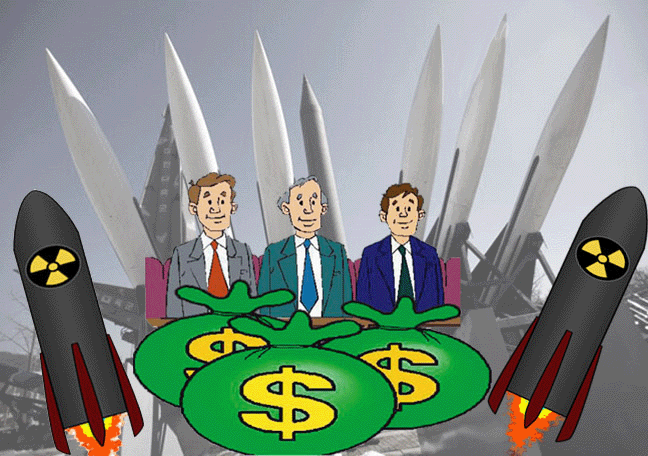 Yes, The United States DidDraw Up A Plan To Drop 80 Nuclear Weapons On North Korea, In 2017, a war between North Korea and the United States was “much closer than anyone would know,” President Trump claims. The Drive BY THOMAS NEWDICK, SEPTEMBER 18, 2020.
Current nuclear war plans are among any nuclear-armed military’s most closely guarded secrets. Details of one such attack plan recently became available, however, revealing that the United States envisaged using 80 nuclear weapons in case of war with North Korea. The way this particular detail emerged is also pretty unusual — the associated passage appeared in U.S. journalist Bob Woodward’s book Rage, detailing President Trump’s administration, which was published this week.
In an interview with NPR, Woodward cleared up any confusion, noting that the 80 nuclear weapons were part of a U.S. attack plan — OPLAN 5027, which would include ‘decapitating’ the North Korean regime of dictator Kim Jong-un.
Woodward said that Mattis confided in him that he was not worried that Trump might launch a preemptive strike against North Korea. Instead, the source of his angst was the North Korean leader in Pyongyang.
In fact, such was Mattis’s level of concern that he would sleep in his gym clothes, Woodward claims. “There was a light in his bathroom… if he was in the shower and they detected a North Korean launch.”
There were alarm bells set up in Mattis’s bedroom and kitchen too, and on more than one occasion during the summer of 2017 they sounded the alert, and he entered the communications room in his Washington DC residency. Woodward explains that Mattis’s car was also constantly followed by an SUV with a team equipped to plot the flight path of any incoming missile, whether it was threatening Japan, South Korea, or the United States. If Mattis considered the missile hostile, he had a mobile communications link to issue launch orders to shoot it down. …………
Clearly, the status of a nuclear-armed North Korea provided much pause for thought within the U.S. administration during Mattis’ tenure as Secretary of Defense. That a strike plan against North Korea involving 80 nuclear weapons was discussed between the president and his defense secretary isn’t all that hard to imagine………..
One of the options under consideration in Washington was OPLAN 5015, a nuclear strike to take out the North Korean leadership, which Woodward also refers to, drawing again from his extensive interviews with Trump. Specifically, Woodward mentions “updating” such a plan — after all, Kim Jong-un and his predecessors will have always been priority targets in the case of an all-out war. ……………… https://www.thedrive.com/the-war-zone/36519/yes-the-united-states-did-draw-up-a-plan-to-drop-80-nuclear-weapons-on-north-korea
USA taxpayers set up by government in the effort to save uneconomic nuclear power

|
The Nuclear Sector Gets A State-Sponsored Lifeline, Oil Price, By Haley Zaremba – Sep 16, 2020, The United States’ nuclear sector is in trouble. And it has been for years now. While the United States remains the largest producer of nuclear energy in the world, producing about one-third of the world’s total nuclear power supply, the industry has been in a state of decline for quite a while. The nuclear sector has never recovered from the influx of cheap natural gas that came along with the domestic shale revolution, and now the country’s aging nuclear fleet faces even bigger problems coming down the pike. Nuclear, like so many other industries (especially in the energy sector), was hit very hard by the pandemic. As Oilprice reported earlier this summer, climate change will hold particularly difficult challenges in store for the nuclear sector, which has to keep its reactors cooled down at all times to avoid meltdowns. And heat is just one risk factor–there are also extreme weather events and catastrophic floods to consider. In 2019, Bloomberg carried out a review of “correspondence between the commission and owners of 60 plants” and made some particularly worrying discoveries. According to nuclear companies’ own risk assessments, “54 of their [60] facilities weren’t designed to handle the flood risk they now face.”
……..Just two weeks after Oilprice wondered “Can The Nuclear Industry Survive COVID-19?,” however, the U.S. Department of Energy (DOE) offered the nuclear sector a lifeline. On June 18, the DOE announced “it would be awarding more than $65m in nuclear energy research, crosscutting technology development, facility access, and infrastructure awards.” According to reporting by PowerTechnology, “the awards fall under the department’s nuclear energy programs – the Nuclear Energy University Programme, the Nuclear Energy Enabling Technologies, and the Nuclear Science User Facilities.” ………The wide scope of these projects points to the multiplicity and complexity of the challenges faced by the U.S. nuclear industry today. While the money awarded by the DOE this June is a good sign for the sector, this is not the first time the DOE has tried to bail out the U.S.’ ailing nuclear industry. “Since 2009, the Office of Nuclear Energy, part of the US Department of Energy, has allocated more than $800m to research, aiming to boost American leadership in clean energy innovation and train the next generation of nuclear engineers and scientists,” Power Technology writes. https://oilprice.com/Alternative-Energy/Nuclear-Power/The-Nuclear-Sector-Gets-A-State-Sponsored-Lifeline.html
|
|
|
Grief in Western America, as inequities, wildfires, and climate change collide
Climate change is making wildfires bigger, fiercer, and deadlier, fueling a new kind of despair on the West Coast—and beyond. Wired 16 Sept 20, GRIEF HAS SETTLED over the western US, along with the thick haze of smoke pouring from dozens of massive wildfires up and down California, Oregon, Colorado, and Washington. It’s grief over the thousands of structures and at least 33 lives lost so far; grief over another villain conspiring with Covid-19 to lock people indoors; grief that the orange-hued dystopia of Blade Runner is now a reality in smoky San Francisco; grief over losing any sense of normalcy, or indeed a clear future.Enveloping all of those emotions—packaging them into an overwhelming feeling of doom—is climate grief, as psychologists call it, the dread that humans have thoroughly corrupted the planet, and that the planet is now exacting its revenge. Wildfires were around before human-made climate change, but by pulling a variety of strings, it’s made them bigger, fiercer, and ultimately deadlier, creating what fire historian Steve Pyne has dubbed the Pyrocene, an Age of Flames.
By burning fossil fuels, we’ve primed the landscape to burn explosively, and by pushing human communities deeper and deeper into what was once wilderness, we’re provided plenty of opportunities for ignition—and plenty of opportunities for grief as these forces catastrophically combine.
“So much is out of our control,” says Adrienne Heinz, a research psychologist at the Stanford University School of Medicine, who studies the effects of disasters like wildfires and the Covid-19 pandemic. “We lose our sense of personal agency over how we will live—the decisions are made for us.”
It shifts from grief over what’s happening with our climate—can we feel safe in our own communities?—to despair, the differentiator being that you don’t feel like tomorrow is going to be any better than today,” Heinz adds. “That’s where it gets really dark.”
For the people of Northern California, an exhausting parade of massive wildfires have marched across the landscape over the past several autumns, with many people having to evacuate several years in a row. Last October, the Kincade Fire burned 120 square miles. The November before, the Camp Fire destroyed the town of Paradise and killed 86 people. And in October 2017, the Tubbs Fire obliterated 5,600 structures and killed 22.
“The catchphrase—kind of with a bitterness around here—is, ‘This is the new normal,’” says Barbara Young, a licensed marriage and family therapist in Healdsburg, north of San Francisco, who had to evacuate last month. “And so with that, I think it’s implied that this isn’t going away—our climate is changing. These aren’t flukes, this is the trend. And I think everyone is very clear that this is not a one-off. This is every year now.” ……………
Thus inequities, wildfires, and climate change collide. Each massive problem on its own is difficult for the human mind to parse, much less all three together. “I am doing a lot of work with people on really increasing psychological self-care, spiritual self-care, physical self-care, and to help that fatigue,” says Young, the therapist in Healdsburg. “And I do think that is connected with climate grief. Finally, maybe we are forced to see how interconnected everything is.” https://www.wired.com/story/climate-grief-is-burning-across-the-american-west/
U.S. Securities and Exchange Commission investigating FirstEnergy over its involvement in the Ohio nuclear corruption scandal
Now the SEC is investigating FirstEnergy and Ohio’s $1 billion nuclear bailout bill: This Week in the CLE, By Laura Johnston, cleveland.comCLEVELAND, Ohio — Who’s investigating FirstEnergy, in relation to the $1 billion nuclear bailout bill?
We’re talking about the U.S. Securities & Exchange Commission investigation on This Week in the CLE…….
|
Is the U.S. Securities and Exchange Commission the latest agency to investigate FirstEnergy over its involvement in a $60 million bribery scheme to bail out nuclear plants and get other goodies from the Ohio Legislature? Yes. The SEC has launched a separate probe of the company tied to the $60 million House Bill 6 bribery scandal. The examination became public in a federal lawsuit the company and a consulting firm filed against a former employee. Just how little do likely voters in Ohio think of Larry Householder, the disgraced and ousted former Ohio House speaker? Householder is now rated one of the most unpopular state politicians in recent history, with a favorable rating at 7% among likely voters.………… With all the corruption talk swirling around FirstEnergy and utilities in Ohio, in the Ohio Power Siting Board really going to stand behind its inexplicable decision that is killing the proposed offshore Lake Erie wind farm? The Ohio Power Siting Board is preparing to rule that it won’t revisit its decision, even though neither side is happy. The board says the the turbines can’t move at night between March 1 and Nov. 1. ……….. https://www.cleveland.com/news/2020/09/now-the-sec-is-investigating-firstenergy-and-ohios-1-billion-nuclear-bailout-bill-this-week-in-the-cle.html |
|
|
Decorum be damned. Top science editor spits the dummy with Trump
|
America’s Top Science Journal Has Had It With Trump
The editor of Science has abandoned staid academic-speak to take on falsehoods in the White House—decorum be damned. Wired Adam Rogers, 16 Sep 20, WITH AN ARCHIVE that goes back to 1880 and a reputation for publishing world-changing research, the journal Science is the apex predator of academic publishing. Getting an article past its gatekeepers and peer reviewers can make a researcher’s career; the journal’s news section is a model for high-level reporting on everything from quarks to viruses to blue whales to galactic clusters. Along with its competitors Cell and Nature, the journal represents not just new knowledge but also the cultural mores of the world it covers—innovation, integrity, accuracy, rectitude, fealty to data.
So it’s surprising (but maybe not as much as you think) that Science’s newish editor-in-chief has focused a laser-like stream of neural energy at calling out the crummy pandemic policies of the Trump administration. H. Holden Thorp, a chemist and longtime university administrator, became editor-in-chief of Science and five other journals published by the American Association for the Advancement of Science last October, just two months before Covid-19 started spreading around the world. The hopes of a planet full of humans looking for treatments and vaccines turned quickly to scientists, and Thorp’s journals would have been among the places that the best, most relevant work would appear. It has, of course. But Thorp also started a crusade from Science’s editorial page, calling out the ways Donald
Trump’s administration has ignored, misunderstood, and misused science for political gain. Now Thorp’s editorial page is at the forefront of a movement—with scientists casting aside the old stereotype of apolitical disinterest. On Wednesday, even the venerable magazine Scientific American endorsed a presidential candidate for the first time in its 175-year history. (It was Joe Biden.)
Thorp’s most recent broadside, “Trump Lied About Science,” appeared last week. It was the most vigorous condemnation yet, a lightning siege of criticism over Trump’s admission, to the journalist Bob Woodward, that the president knew Covid-19 was more serious than he acknowledged to the public. “This page has commented on the scientific foibles of US presidents. Inadequate action on climate change and environmental degradation during both Republican and Democratic administrations have been criticized frequently,” Thorp wrote. But this, he added, “may be the most shameful moment in the history of US science policy.”
That’d be tough stuff on any newspaper op-ed page; from a place like Science, which has in the past had a somewhat arid editorial voice, it was fire. Thorp has been activated. I asked him what did it, and how his new approach might change science—and Science. Thorp’s answers are here, edited lightly for length and clarity………………
think about what science has been putting up with. We have people telling us we’re all deep-state liberals who are trying to destroy the planet, that we’re taking away hope for people, that we’re being too melodramatic about how bad this all is. And all of the stuff that Trump and his surrogates have been saying turns out not only to be wrong, but that they knew it all along. All the snark that scientists have been putting up with, from the news and from their family members who are Fox News people—all these things that we were supposedly doing to sabotage the world were all lies and knowingly delivered, planted, by the president of the United States. ………… https://www.wired.com/story/americas-top-science-journal-has-had-it-with-trump/
|
|
Relicensing Turkey Point nuclear station – a striking example of a dangerous action in climate change times

 With climate change, aging nuclear plants need closer scrutiny. Turkey Point shows why. https://thebulletin.org/2020/09/with-climate-change-aging-nuclear-plants-need-closer-scrutiny-turkey-point-shows-why/ By Caroline Reiser , September 14, 2020
Last December, two nuclear reactors at Florida’s Turkey Point Nuclear Generating Station, located 25 miles south of Miami, became the first reactors in the world to receive regulatory approval to remain operational for up to 80 years, meaning reactors that first came online in the 1970s could keep running beyond 2050.
The ages of the Turkey Point reactors are not unusual; of the 95 reactors currently licensed to operate in the United States, only five are less than 30 years old, while more than half are 40 or more years old. The Turkey Point reactors are a bellwether, just the first of possibly many aging nuclear reactors that will seek permission to stay online well into the middle of the century. Not long after the December decision, in March 2020, the US Nuclear Regulatory Commission granted two more reactors, located in Pennsylvania, the same extensions that it gave Turkey Point.
In pursing these extensions, the US commercial nuclear industry and its supporters collide with the realities of the aging US nuclear fleet and climate science projections. Existing safety and environmental requirements fail to provide the oversight necessary to ensure communities and the environment are protected. As nuclear reactors receive permission to operate for twice as long as originally envisaged, and in a world that, because of climate change, is drastically different from the one they were built for, the insufficiency of the existing regulatory framework is daunting.
A 40-year lifespan? At the beginning of its commercial nuclear power program, the United States designed and licensed reactors with a 40-year projected lifetime. Once the 40-year license is set to expire, regulations require the reactor owner to apply for a renewed license in order to continue operating for an additional 20 years. What the regulations don’t make clear, however, is the number of times a reactor license can be renewed. What Turkey Point received last year was not its first, but its second extension—what regulators call a subsequent renewed license. Continue reading
The coronavirus pandemic and the increased safety risks for nuclear reactors

Nuclear Alert: NRC & Nuke Safety In the Time of COVID-19 https://www.fairewinds.org/demystify/nuclear-alert-nrc-amp-nuke-safety-in-the-time-of-covid-19 September 14, 2020 By The Fairewinds Crew
First off, we would like to preface this by saying that the world simply cannot afford a meltdown or nuclear disaster on top of the already traumatic times wrought by Pandemic 2020.
Did you know that nuclear plants close for scheduled refueling every 18-months, meaning that 1/3 of the operating reactors are off-line each spring and fall? For the record, more than three dozen reactors had planned to do so in Spring 2020. The Nuclear Regulatory Commission (NRC) defines this rather temporary closing as an outage. During these outages, used-up nuclear fuel is replaced, and critical safety inspections are performed.
You may remember, that in early May, Maggie wrote extensively about the numerous safety risks to all of us if the nuclear industry continued operating these reactors during the COVID-19 Pandemic without implementing critical safety protocols and procedures. Along with 86 other organizations from all over the U.S., Fairewinds Energy Education nonprofit cosigned a letter to Vice President Pence and the COVID-19 Task Force detailing significant safety risks that must be addressed. You can read more about that letter and the increased safety hazards here. To date, we have received no response!
When the COVID-19 Pandemic began in late February, atomic reactor operators and owner corporations begged the NRC for special exemptions from regulatory requirements to implement critical safety and security inspections for up to two years! And, in an extreme example of regulatory capture, the NRC has approved all the corporate requested safety inspection delays, handing them out like candy to eager Trick-or-Treaters on Halloween! We know you have heard this before from the Crew at Fairewinds Energy Education, however, let us emphasize again that the federal laws [called statutes] that authorize the NRC, chartered it to protect ‘public health and safety’. Letting the industry continue to ignore critical safety inspections risks public health and safety!
During the past decade, the success in the growth of renewables has caused the nuclear industry to fight tooth and nail to keep operating even though nuclear power plants are much more expensive to operate than sustainable energy sources, and nukes charge much higher rates to consumers. Additionally, the risk of a disaster or other calamity has increased dramatically due to the old age of all current U.S. operating reactors. Instead of moving to solar and wind and shutting down these decrepit reactors, the energy and utility corporations are trying to reduce their higher operating costs by laying off employees and pushing the people remaining to work harder to save money and continue stockholder profit earnings.
Rather than slowing down these Spring refueling outages and allowing more time for inspections and repairs due to the extra burden the COVID-19 Pandemic has put on their employees and contractors, America’s nuclear monopoly has decided to risk ‘public health and safety’ – you remember what the federal law states – by reducing the amount of safety inspections the staff at each reactor was scheduled to perform. We agree that squeezing three or more people into a confined space for an inspection could be a recipe for COVID-19 transmission. However, slowing the inspection down and using fewer people at a time means having the reactor offline [shutdown] for a longer amount of time. In other words, the truth is that any operating schedule delay reduces each corporation’s profits.
Most atomic power reactors earn $1Million dollars in revenue every day. In addition, vice presidents, plant managers, and other corporate functionaries are on special bonus plans equivalent to between 40 and 70% of their salaries in a special year-end bonus. Such huge sums create a unique incentive for nuclear corporate executives to keep the outages as short as possible. When a vice president earns about $500,000, they will receive a $350,000 year-end bonus for meeting corporate goals, especially a short outage. We tend to notice that bonuses of that size cloud one’s judgment. Furthermore, we are reminded of Upton Sinclair when he so aptly said, “it is difficult to get a man to understand something, when his salary depends on his not understanding it.”
Is the risk of a disaster and a major radiation release to the surrounding community worth the extra millions of dollars earned by the corporate owner for starting these reactors up too soon? We don’t believe so.
Despite there being an abundance of available electricity without even using the atomic chain-reaction, the nuclear power operators and their corporate owners as well as the nuclear industry lobby are claiming that delayed testing will not cause a disaster and no nearby communities will be damaged or deal with the radioactive exposure to its residents.
Safety risks obviously increase because critical inspections are being delayed.
-
Archives
- October 2026 (129)
- September 2026 (339)
- August 2026 (330)
- July 2026 (355)
- June 2026 (287)
- May 2026 (306)
- April 2026 (356)
- March 2026 (251)
- February 2026 (267)
- January 2026 (308)
- December 2025 (358)
- November 2025 (359)
-
Categories
- 1
- 1 NUCLEAR ISSUES
- business and costs
- climate change
- culture and arts
- ENERGY
- environment
- health
- history
- indigenous issues
- Legal
- marketing of nuclear
- media
- opposition to nuclear
- PERSONAL STORIES
- politics
- politics international
- Religion and ethics
- safety
- secrets,lies and civil liberties
- spinbuster
- technology
- Uranium
- wastes
- weapons and war
- Women
- 2 WORLD
- ACTION
- AFRICA
- Atrocities
- AUSTRALIA
- Christina's notes
- Christina's themes
- culture and arts
- Events
- Fuk 2022
- Fuk 2023
- Fukushima 2017
- Fukushima 2018
- fukushima 2019
- Fukushima 2020
- Fukushima 2021
- general
- global warming
- Humour (God we need it)
- Nuclear
- RARE EARTHS
- Reference
- resources – print
- Resources -audiovicual
- Weekly Newsletter
- World
- World Nuclear
- YouTube
-
RSS
Entries RSS
Comments RSS

