
|
Spent Nuclear Reactor Passes On Its Way To Disposal, JULY 8, 2020 BY VROBISON By CHARLENE PAUL, The Progress
A huge convoy carrying a low-level nuclear reactor is making its way through Nevada. Last week it passed through the Coyote Springs Valley via U.S. Highway 93. PHOTO BY CHARLENE PAUL/The Progress.
A nuclear reactor vessel from southern California’s decommissioned San Onofre Nuclear Generating Station slowly made it’s way through the Coyote Springs Valley on Monday, June 29………
The vessel’s trip to Utah began on May 24, 2020, when the 770-ton low-level reactor vessel left southern California on the world’s largest rail car, a 40-year-old, 36-axle Schnabel car weighing 2.2 million pounds. (It is believed that this was the rail car’s last load.)
Once the load arrived at Apex, it took a couple of weeks for cranes to lift the reactor from the train car and put it on a 45-axle, 180-tire trailer for the trip to northern Utah.
Experts with the Nevada Department of Transportation (NDOT) worked long and hard to ensure that the state’s roads wouldn’t be damaged as the load passes through.
Two railway tunnels east of Caliente along with rock outcroppings that are too tight to allow the reactor to be shipped by rail to Salt Lake City and then on to Clive, made travel on the highway a necessity.
“It would be, by far, the biggest object ever moved on a road in [Nevada],” said NDOT spokesman Tony Illia. “Our people have been scratching their heads for months to figure out a route that could work. It won’t move until the transportation department issues a permit 24 hours before hitting the highway.”
“The record-sized move over state highways marks the culmination of over a year of planning and coordination across three states,” Illia said. “At 2.4 million total pounds, it’s the heaviest load to ever cross Nevada roadways.”
Making such a massive shipment in summer months is a much bigger issue than it would be in colder months. Asphalt or other road surfaces could easily buckle under the over 1.5-million-pound reactor plus a shipping skid that adds seven tons to the total weight. For the load to be transported safely, drainage structures along the way needed to be reinforced.
“The structures would get crushed like a soda can because the load is so heavy,” said Illia. “Heavy equipment operators with Emmert International [among the world’s biggest movers of heavy equipment] plan to use heavy-duty hydraulic jacks to support culverts when the vehicle hauling the reactor passes over.”
To keep the load off Interstate 15 and Interstate 80, the travel route will follow U.S. Highway 93 and State Route 318 before crossing into Utah.
Interestingly, the route passes by the Yucca Mountain Nuclear Waste Repository. The mountain was to be the nation’s nuclear waste repository, but the plan was terminated in 2008 amid a political battle over its safety. When the San Onofre plant is completely dismantled, all of its low-level waste will be buried in Utah.
The extreme weight of the super-load is dispersed across 460 total tires to prevent damage to state roads and bridges. Pilot cars and Nevada Highway Patrol (NHP) vehicles are escorting the rig. The full convoy is almost two miles long, including extra trucks, mechanics, and project managers. Because of the weight, travel averages four to six miles per hour, and the 400-mile trip is estimated to take eight days.
On the first day of the trip, the convoy stopped at the Coyote Springs turn-off on Highway 93. On July 1, the convoy stopped just south of Alamo, Nevada, and did not travel from July 2 through July 5 to minimize impacts on travel over the Fourth of July holiday weekend.
Mobile messaging signs will be used to inform drivers of delays and detours. http://mvprogress.com/2020/07/08/spent-nuclear-reactor-passes-on-its-way-to-disposal/
|
|
July 11, 2020
Posted by Christina Macpherson |
safety, USA |
Leave a comment
 Nuclear worker with COVID-19 dies, SC plant officials say, The State, BY NOAH FEIT, JULY 07, 2020 An employee at a nuclear plant in South Carolina has died after testing positive for the coronavirus, according to Savannah River Nuclear Solutions.
The employee, who was not publicly identified, got sick last week and died soon after, SRNS President and CEO Stuart MacVean said in a news release.
“I regret to inform you that we have lost a member of the SRNS team to a COVID-related death,” ” MacVean said in the statement. “Our hearts and prayers go out to the individual’s family and friends during this time.”
Grief counseling is being provided to employees in the wake of their colleague’s death at the Savannah River Site atomic weapons and nuclear waste complex near Aiken……..
Through Monday, Savannah River Site officials confirmed 70 staff members tested positive for COVID-19. Of those, 45 have recovered from the virus and been cleared to return to work, it said in the release.
Approximately 11,000 people work at Savannah River Site, the Aiken Standard reported.
On Tuesday, Savannah River Site announced plans to safely resume operations that were reduced as part of the federal government’s response to the coronavirus pandemic…….
As of Tuesday, there are 47,214 confirmed cases of COVID-19 in South Carolina, and 838 coronavirus-related deaths, according to the Department of Health and Environmental Control. https://www.thestate.com/news/local/article244058147.html
July 9, 2020
Posted by Christina Macpherson |
health, USA |
Leave a comment

The end of ecomodernism , John Quiggin, 9 July 20,“….. The most important group of nuclear power advocates who have consistently promoted concerns about climate change as the main reason for their advocacy have been the self-described ‘eco-modernists’. The main organizational focus of ecomodernism is the Breakthrough Institute, established by Michael Shellenberger and Ted Nordhaus in 2003.

Recently, Shellenberger has issued what he describes as ‘an apology on behalf of environmentalists everywhere’ in which he repudiates previous concerns about catastrophic climate change and indicates that he never sincerely shared these concerns. Other ecomodernists have demurred at some of his claims, but have not indicated fundamental disagreement. The result is that, as a movement combining a pro-nuclear position with a commitment to a serious response to climate change, ecomodernism has ceased to exist….. https://johnquiggin.com/2020/07/09/the-end-of-ecomodernism/
 The tragic thing about “Ecomodernism” is that it sucked in a whole heap of very well -intentioned people. It’s prime focus was to promote the nuclear industry – “new’ nuclear in particular. (Fossil fuel promotion has become a secondary aim). But, if you read the 7 page Ecomodernist Manifesto, http://www.ecomodernism.org/manifesto-english , nuclear power gets only ONE short paragraph, low down on page 4. It is all touchy-feeling lovely, seemingly pro environment stuff. It gently and subtly rubbishes any concept of energy conservation, and of renewable energy.
This is the genius of the nuclear propagandists. Like Dr Joseph Goebbels, they know how to pitch their sales talk to which audience. They’ll come up with important sounding technical and economic jargon, to put it over politicians and other “important people. I do think that Australia’s Ben Heard deserves an acknowledgement for his sales pitching skills. He wouldn’t muck up his message, as Shellenberger has recently done, in revealing climate denialism
July 9, 2020
Posted by Christina Macpherson |
spinbuster, USA |
Leave a comment
|
McAdams announces opposition to nuclear testing, hopes to extend compensation for downwinders https://www.stgeorgeutah.com/news/archive/2020/07/07/rmw-mcadams-announces-opposition-to-nuclear-testing-hopes-to-extend-compensation-for-downwinders/#.XwZb3CgzbIU
U.S. Rep. Ben McAdams, D-Utah, announced Monday that he would be sponsoring an extension of the Radiation Exposure Control Act as well as opposing the possibility of more explosive nuclear weapons testing in the United States. McAdams said that next year’s House spending bill covering the Energy Department’s National Nuclear Security Administration would prohibit the use of money to prepare or conduct any nuclear testing.
The RECA act was originally passed in 1990 and compensated people who are known as “downwinders,” those who worked on the sites of the nuclear testing and the Uranium Miners, Millers and Ore Transporters. The act covered nine counties in Utah as well as areas of Arizona and Nevada, where the nuclear testing took place.
In a Facebook live video with Mary Dickson, former KUED on-air host and downwinder, McAdams said that there were over 1,000 nuclear tests, with the last one being conducted in 1992. He added that the fallout of the nuclear testing not only impacted Southern Utah, but all of Utah, Wyoming, Montana, the Dakotas and elsewhere in the United States.
The act is set to expire in 2022, but McAdams is sponsoring an extension that would go through 2045 as well as broaden the areas included in the act.
“In Utah, we’ve seen increases in certain types of cancers — myeloma, thyroid cancer, breast cancer — much of that is due to some of this nuclear weapons testing that happened in Nevada,” McAdams said in a Facebook live video. “RECA, the compensation act, is set to expire in 2022. The impacts are still here, so this would extend it through 2045, so those people who are impacted can receive compensation. Nothing is going to replace the loss of life or a cancer diagnosis, but at the very least, for the harm caused by our government, they should receive some compensation to help pay their medical bills, lost of income and other things.”
A press release from McAdams mentioned the Trump Administration’s recent announcement of plans to resume nuclear testing.
“Any plan to resume nuclear weapons tests would again put us ‘downwind’ of deadly radioactive fallout, even as the government has still not atoned for the devastating consequences from earlier nuclear weapons tests,” McAdams said in the press release. “I thank Chairwoman Kaptur for this important step, and I will continue to fight until this prohibition is signed into law.”
Dickson also spoke out about the issue with the congressman at Monday’s press conference.
“People are still getting sick, their cancers are coming back,” Dickson said. “We are living with health consequences that haven’t gone away. The way I view it is we were all deemed expendable. They killed their own in the name of national security, and it’s so important for us to tell our stories and have these opportunities, or they die with us.”
|
|
July 9, 2020
Posted by Christina Macpherson |
politics, USA |
Leave a comment

Inside the luxury nuclear bunker protecting the mega-rich from the apocalypse
A volcanic-ash scrubber, a decontamination room, a waterslide — when it comes to surviving a nuclear apocalypse, the Survival Condo has everything you could need, at a price. CNet.com, Claire Reilly, July 6, 2020 ……. after visiting my first real nuclear bunker, my apocalypse plan has been upgraded. Now my list of needs includes “underground swimming pool” and “postapocalyptic rock-climbing wall.” I’ve become fussy about how I’ll spend time during the planet’s dying breaths. My bug-out bag has gotten bougie. I’ve seen the world’s most high-tech bunker, and I want in.
Welcome to the Survival Condo. This former Atlas Missile silo turned luxury condominium complex offers the world’s rich and powerful a chance to buy into the ultimate life insurance: an apocalypse bunker that promises the perfect combination of shelter and style.
……. The starting cost for a unit in this complex is $1 million, plus an extra $2,500 per month in dues to cover your living expenses: electricity, water, internet, all the tinned eggs you could dream of.
For the ultra-rich and paranoid, though, you can’t put a price on safety…
The end of the world as we know it
Nuclear winter isn’t like spending Christmas upstate. It’s a global nightmare realm, where Ice Age-like temperatures last for years, populations perish and life as we know it becomes the stuff of sci-fi nightmares.
At least that’s according to Brian Toon, professor of atmospheric and oceanic sciences at the University of Colorado and world-renowned expert on the global effects of nuclear war. ……
Toon says a nuclear explosion is like “bringing a piece of the sun down to the Earth,” and the aftermath of that kind of explosion causes huge fires — think citywide infernos. Those fires push huge amounts of smoke up into the stratosphere. And because it never rains in the stratosphere, sunlight can’t reach Earth. Welcome to nuclear winter.
“The temperatures become colder than the last Ice Age,” says Toon. “So we have sub-Ice Age temperatures over the whole planet for about 10 years.”
That’s exactly why the Survival Condo exists — to protect the mega-rich from the devastation of global nuclear war, and to make sure the world’s most powerful people can survive in comfort, rather than shivering in the wasteland, waiting to have their billionaire brains eaten by hungry hordes. ……..
I’m at the very top of a bunker that descends 15 floors and 200 feet underground. On this upper level, a wide dome set into the hill houses the main entry and communal recreation facilities. That’s where you’ll find the pet park, climbing wall and swimming pool (complete with a water slide).
Beneath the dome, the cylindrical silo houses a further 14 floors — the top three floors are where you’ll find the mechanical rooms, medical facilities and a food store (complete with a full hydroponics and aquaculture setup), followed beneath by seven levels of residential condos. At the bottom, the final four floors house the classroom and library, a cinema and bar, and a workout room (with a sauna). ……..
what if there’s radiation because of a dirty bomb? You would have to go in this room, which is a decontamination scrub room. The chemicals in here can take care of everything. We have iodine pills to treat you for radiation, we have Geiger counters that detect radiation, and we have special chemicals to scrub both biological and radioactive contaminants from you. But you would lose your clothes. You’d be naked and afraid.”
As we wind our way through the Survival Condo, it’s like I’m in an episode of Cribz, set in a dark, alternate reality. This is where we keep the camo gear! This is the gun range! Here’s how we scrub the volcanic ash out of the air in the event of a supervolcano! …….
As a bonus, if the world is really ending, these windows display a real-time view of the carnage outside, thanks to the Survival Condo’s external surveillance cameras. Everyone come to the kitchen! The surface-dwellers are hunting in packs now!….
I guess there’s a grim irony in the idea that even when the nukes drop and the very fabric of society has disintegrated beyond recognition, the rich and powerful will still have it better off than the rest of us.
We’ll still be a society of haves and have-nots. Except in this case, the haves will be watching Armageddon from the comfort of their air-conditioned, underground cinema. And the have-nots will be out in the wilderness, freezing through nuclear winter and picking over the bones of our loved ones, trying to survive the real thing. https://www.cnet.com/features/inside-the-survival-condo-nuclear-bunker-protecting-the-ultrarich-hacking-the-apocalypse/
July 7, 2020
Posted by Christina Macpherson |
safety, USA, weapons and war |
1 Comment
Swarm of insects cause nuclear reactor to lose power in Michigan, Fox 23, July 2, 2020 NEWPORT, Mich. — The Enrico Fermi 2 Nuclear Power Plant in Newport lost offsite power Wednesday in what has been described as a “mayfly accumulation.”
In a report released by the Nuclear Regulatory Commission that the outage was “caused by mayfly accumulation” around the facility’s switchyard. Diesel generators started automatically as a backup power supply.
July 4, 2020
Posted by Christina Macpherson |
incidents, USA |
Leave a comment
 We Don’t Have Enough Cash to Build New Nuclear Weapons, Says Air Force https://www.defenseone.com/politics/2020/07/we-dont-have-enough-cash-build-new-nuclear-weapons-says-air-force-chief/166598/ Chief Nukes or conventional weapons, “the current budget does not allow you to do both,” says Gen. Dave Goldfein, suggesting Congress create a separate account.
The Pentagon’s budget is not large enough to buy new nuclear weapons and conventional forces simultaneously, the U.S. Air Force’s top general said Wednesday.
Chief of Staff Gen. Dave Goldfein gave a blunt assessment of the Pentagon’s growing list of bills amid a growing US deficit, on Wednesday, suggesting nuclear expenses have grown so great they may require a separate account of their own.
I think a debate is that this will be the first time that the nation has tried to simultaneously modernize the nuclear enterprise while it’s trying to modernize an aging conventional enterprise,” Goldfein said during a Brookings Institution appearance. “The current budget does not allow you to do both.”
The Trump administration’s $705 billion fiscal 2021 budget request for the Pentagon — which Congress is reviewing — calls for nearly $29 billion in nuclear weapons spending. The money would go toward new stealth bombers, intercontinental ballistic missiles, ballistic missile submarines, a new nuclear cruise missile and upgrades to the global nuclear command, control and communications network. The stealth bomber is the only weapon that could be used for nuclear or conventional strikes. The Energy Department, which oversees nuclear warheads, has requested $15.6 billion in fiscal 2021.
In January 2019, the Congressional Budget Office estimated that the Pentagon’s nuclear weapons spending plan would cost $494 billion between 2019 and 2028, an average of about $50 billion per year.
Pentagon officials today argue they need 3 to 5 percent annual spending increases to fund weapons projects of all kinds, however defense spending is expected to flatten or slightly decline in the coming years regardless who wins November’s presidential election.
“There are either going to be some significant trades made or we’re going to have to find a fund for strategic nuclear deterrence, that we can use to modernize,” Goldfein said.
In recent years, Pentagon officials, including former Defense Secretary Ash Carter, and lawmakers have considered creating a nuclear weapons fund separate from the military services budgets. Todd Harrison, director of defense budget analysis and the Aerospace Security Project at the Center for Strategic and International Studies, questioned the rationale for moving those funds.
“It doesn’t make new money appear,” he said.
During the Obama administration, the Pentagon began the decades-long process of updating its nuclear arsenal with new ICBMs, bombers, submarines and missiles. Some independent estimates say the price tag could reach nearly $1.7 trillion over the next 30 years. How to pay for it is still debated in the Defense Department, but the need for nuclear weapons is not.
“I would just offer that in my mind, I could never advise anybody to unilaterally disarm or give up second strike capability,” Goldfein said. “I do believe we have to have a debate about the way we’re going to fund this essential part of our military going forward.”
July 2, 2020
Posted by Christina Macpherson |
USA, weapons and war |
Leave a comment
Nowhere else has the United States saddled another country with so much of its nuclear waste, a product of its Cold War atomic testing program.
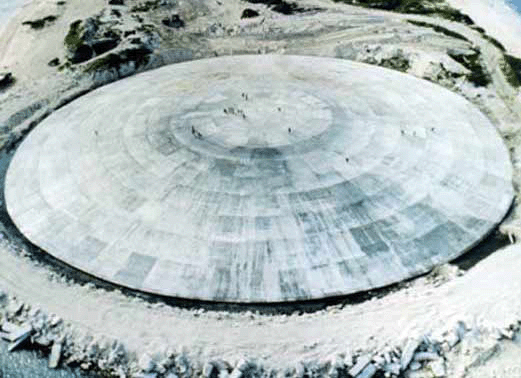
The waste site, known alternatively as the Tomb, holds more than 3.1 million cubic feet — or 35 Olympic-size swimming pools — of U.S.-produced radioactive soil and debris, including lethal amounts of plutonium.
The new report does not include a plan to repair the dome, which was required by Congress.
In 1981, the U.S. government declared in a report that the island should be quarantined indefinitely and that the “possibility would always exist that high levels of plutonium-contaminated subsurface soil could be exposed by wave or storm action.”
U.S. says leaking nuclear waste dome is safe; Marshall Islands leaders don’t believe it, https://www.latimes.com/environment/story/2020-07-01/us-says-nuclear-waste-safe-marshall-islands-runit-dome By SUSANNE RUSTSTAFF WRITER , JULY 1, 2020
In response to a directive from Congress, the Department of Energy
released a report this week assessing the risks of a 50-year-old cracking and crumbling concrete nuclear waste repository in the Marshall Islands, but the findings did little to ease the concerns of Marshallese leaders in the Central Pacific.
The DOE report found that Runit Dome, a repository for atomic waste the United States produced during Cold War weapons testing, is sound and that radioactive leakage into the nearby lagoon is not significant.
After Congress grew concerned last year about the leaking dome, it ordered the DOE to produce a report on the dome’s structural integrity amid climate change and rising sea levels.
The report noted that while sea level rise could increase storm surge, swells, and “lead to wave-induced over-wash of lower sections of the dome,” there is not enough definitive data to determine “how these events might impact on the environment.”
One Marshallese leader was disappointed the DOE again downplayed the risks and declined to take responsibility for Runit Dome and its leaking contents.
“We don’t expect the Enewetak community to feel any safer based on this report as it doesn’t contain any new information from what they’ve seen…and don’t trust,” said Rhea Christian-Moss, the chairperson of the Marshall Islands’ National Nuclear Commission, a government-operated nuclear waste and radiation oversight panel.
“The report offers nothing new and is more or less what we expected to see,” she said, lamenting the Senate’s redaction of a critical line in the House’s mandate, which stipulated that the Department of Energy provide a plan detailing the removal of the radioactive waste into a “safer and more stable location.”
The Department of Energy report is signed by Dan Brouillette, the agency’s secretary. Terry Hamilton, the department’s lead contractor on the project, was not available for comment.
In November last year, The Times published an investigation of the lingering radiation legacy in the Marshall Islands, and the refusal of U.S. authorities to take ownership for the hazards posed by Runit Dome
In December, Congress signed the National Defense Authorization Act for 2020, which required the DOE to provide a plan to repair the dome, evaluate the environmental effects of the dome on the lagoon over the next 20 years, and assess its structure and the potential risk to the people who live near it.
The department was also required to assess how rising sea levels could affect the dome.
Christian-Moss noted data gaps in the report, as well, including the level of radiation in groundwater leaking from the dome into the lagoon.
In 2019, at a presentation delivered in the Marshall Islands to Marshallese and U.S. officials, the DOE’s contractor, Hamilton, mentioned elevated levels of radioactivity in giant clams living near the dome.
The new report does not mention the clams but states that not enough information is available to understand how leakage from the dome is affecting marine life. However, according to the energy department, studies of people living nearby show normal levels of radiation — suggesting they are not being adversely affected.
“The absence of data to show any risk does not mean that there is no risk.” she said. “So my main takeaway from the report is that many risks are still ‘unknown.’”
Nowhere else has the United States saddled another country with so much of its nuclear waste, a product of its Cold War atomic testing program.
The waste site, known alternatively as the Tomb, holds more than 3.1 million cubic feet — or 35 Olympic-size swimming pools — of U.S.-produced radioactive soil and debris, including lethal amounts of plutonium.
The radioactive material was collected, moved and contained by U.S. soldiers during the late 1970s. Many of those veterans say they were unaware of the contents and did not wear protective equipment.
The new report does not include a plan to repair the dome, which was required by Congress. Instead, the report’s authors state that “no further maintenance of the dome is required at this time” beyond conducting occasional maintenance to the dome’s cracking exterior, including the removal of vegetation. The report claims the visible cracking and spalling do not provide a hazard.
“All in all the message seems to be that we should be concerned but not alarmed,” said Michael Gerrard, a legal scholar at Columbia University’s law school. “It is as if Runit is like a radioactive sore in the middle of the Pacific, but one that can get by with band-aids for the foreseeable future unless they find more bleeding.”
The DOE authors also maintain that the lagoon’s sediments are so contaminated with radioactive elements that any additional spillage from the dome would be undetectable.
“It remains to be seen whether the Marshallese will accept this report by the Americans, given how poorly the U.S. has treated the Marshallese in so many ways since 1945,” said Gerrard.
The report also notes that in May 2019, Marshallese officials requested that the Department of Energy build a fence around the island where the dome is located, to keep people off.
In July 2019, DOE officials responded claiming they didn’t have the funding to build a fence and installation of a perimeter would be logistically too complex.
In 1981, the U.S. government declared in a report that the island should be quarantined indefinitely and that the “possibility would always exist that high levels of plutonium-contaminated subsurface soil could be exposed by wave or storm action.”
July 2, 2020
Posted by Christina Macpherson |
OCEANIA, secrets,lies and civil liberties, USA, wastes |
Leave a comment
Temporary Injunction Slows Holtec’s Work at Closed Nuclear Plant, By STEPHANIE A. FAUGHNAN, June 29, 2020 LACEY, NJ – Holtec’s decommissioning work of the former Oyster Creek Nuclear Plant has slowed down since the beginning of this month in compliance with a court-ordered mandate. Ocean County Superior Court Judge Francis R. Hodgson, Jr.’s imposition of temporary restraints on Holtec, puts a temporary hold on work – other than that permitted by the Nuclear Regulatory Commission.
Attorneys for the Township of Lacey filed the court application requesting judicial intervention, citing what it calls Holtec’s refusal to obtain necessary permits or approvals from the municipality.
The Verified Complaint filed by Jerry J. Dasti, of Dasti, Murphy. McGucklin, Ulaky, Koutsouris & Murphy incorporated a letter the firm sent to Holtec’s legal counsel. An excerpt accuses Holtec of already initiating the process of “building structures into the ground, by excavating a substantial area, which presumably will thereafter house the spent fuel rods.”…….
LACEY, NJ – Holtec’s decommissioning work of the former Oyster Creek Nuclear Plant has slowed down since the beginning of this month in compliance with a court-ordered mandate. Ocean County Superior Court Judge Francis R. Hodgson, Jr.’s imposition of temporary restraints on Holtec, puts a temporary hold on work – other than that permitted by the Nuclear Regulatory Commission.
Attorneys for the Township of Lacey filed the court application requesting judicial intervention, citing what it calls Holtec’s refusal to obtain necessary permits or approvals from the municipality.
The Verified Complaint filed by Jerry J. Dasti, of Dasti, Murphy. McGucklin, Ulaky, Koutsouris & Murphy incorporated a letter the firm sent to Holtec’s legal counsel. An excerpt accuses Holtec of already initiating the process of “building structures into the ground, by excavating a substantial area, which presumably will thereafter house the spent fuel rods.”…….. https://www.tapinto.net/towns/barnegat-slash-waretown/sections/government/articles/temporary-injunction-slows-holtec-s-work-at-closed-nuclear-plant
July 2, 2020
Posted by Christina Macpherson |
legal, USA |
Leave a comment
A New Superpower Competition Between Beijing and Washington: China’s Nuclear Buildup, The Trump administration is portraying the small but increasingly potent Chinese arsenal — still only one-fifth the size of the United States’ or Russia’s — as the big new threat. By David E. Sanger and William J. Broad, June 30, 2020
- When negotiators from the United States and Russia met in Vienna last week to discuss renewing the last major nuclear arms control treaty that still exists between the two countries, American officials surprised their counterparts with a classified briefing on new and threatening nuclear capabilities — not Russia’s, but China’s.
….. Many outside experts question whether China’s buildup — assessed as bringing greater capability more than greater numbers — is as fast, or as threatening, as the Trump administration insists.
The intelligence on Beijing’s efforts remains classified, a senior administration official said, noting that sharing such data is not unusual among the world’s major nuclear weapons states. But that means it was given to an adversary with whom the United States is conducting daily, low-level conflict — including cyberattacks, military probes by warplanes and Russian aggression in Ukraine. And that was before
reports surfaced that a Russian military intelligence unit had put bounties on American and allied troops in Afghanistan. ……
The Russians have publicly offered a straight, five-year extension of New START, which would not require congressional approval. But Mr. Trump is clearly betting that he can find common ground with Mr. Putin in confronting the Chinese……..
Nuclear weapons are joining the panoply of issues — including trade deals, banning Chinese students and wiring the world for 5G networks — that Mr. Trump has put at the center of a series of U.S.-China standoffs. …………
the past four presidents have abided by the treaty’s ban on nuclear tests. That may be coming to an end: Mr. Billingslea confirmed that the Trump administration had discussed “unsigning” the treaty and debated whether the United States should return to nuclear testing, which it has not engaged in since 1992. But he said there was no need to do so for now.
The United States conducted more nuclear tests during the Cold War than the rest of the world combined. Over decades of experimentation, and more than 1,000 tests, its bomb designers learned many tricks of extreme miniaturization as well as how to endow their creations with colossal destructive force. Compared with the atomic bomb that leveled Hiroshima, the nation’s first explosive test of a hydrogen bomb, in 1954, produced a blast 1,000 times as powerful.
Because of that history, many nuclear experts now argue that if Mr. Trump begins a new wave of global testing, it would aid American rivals more than the United States.
“We lose more than we gain,” Siegfried S. Hecker, a former director of the Los Alamos weapons laboratory in New Mexico and now a professor at Stanford University, said in an interview. Beijing had conducted only 45 tests, he noted, and would welcome a resumption of testing to “increase the sophistication or perhaps the diversification” of its arsenal, “and that can only come back to be a national security risk for the United States.”
Activity at the desert testing site in Nevada has soared in recent years. There is new drilling, construction, equipment, employees and periodic “subcritical” tests, just below the threshold of producing a nuclear explosion.
For years, some Republicans have urged preparations for a test and poured money into the effort. One instrument now being prepared for the Nevada complex costs $800 million; it would test the behavior of plutonium.
Today, Republicans are still urging more upgrades and speedups, including at the Nevada complex. This month, Senator Tom Cotton, Republican of Arkansas, offered an amendment to a defense bill that would add at least $10 million to “carry out projects related to reducing the time required to execute a nuclear test.”
Top Democrats in the House told the Pentagon and the Energy Department in a recent letter that the idea of a renewal in nuclear testing was “unfathomable,” as well as “shortsighted and dangerous.”
But Mr. Billingslea thinks he succeeded in getting the Russians to think about what is happening in China, not in the Nevada desert. During his meeting last week, the Russians were taking copious notes on China’s buildup, while reviewing classified slides. He insists they want to sit down and talk more later in the summer.
They will do so without the Chinese….https://www.nytimes.com/2020/06/30/us/politics/trump-russia-china-nuclear.html
July 2, 2020
Posted by Christina Macpherson |
China, politics international, USA, weapons and war |
Leave a comment
A group of organizations from around the country filed an appeal in federal court calling for a review of federal regulators’ denial of multiple contentions made against a temporary nuclear waste storage facility proposed to be built near Carlsbad and Hobbs.
The appeal was filed on Monday in the U.S. Court of Appeals for the District of Columbia Circuit against a Nuclear Regulatory Commission (NRC) order in April that denied the standing and relevance of contentions against the facility’s license application submitted to the NRC by Holtec International.
Holtec proposed building and operating a consolidated interim storage facility (CISF) to hold high-level spent nuclear fuel rods at the surface in a remote location near the Eddy-Lea county line on a temporary basis while a permanent repository was developed.
In total, the proposed facility could hold up to 173,00 metric tons of waste.
A permanent repository does not exist nor is one in development as a proposal for such a facility in Yucca Mountain, Nevada was de-funded in 2011 under the administration of former-President Barrack Obama.
Opponents of the Holtec facility warned that the repository could become permanent and posed a risk to public safety not only near the site but along the rail transport routes that would bring the waste to New Mexico from generator sites throughout the nation.
The shipments, up to 10,000 carrying the waste, could travel through up to 45 states before being placed into storage at Holtec, records show.
Supporters, mostly in the local communities closest to the proposed site, touted the economic benefits Holtec could bring to the area in diversifying its economy away from its sole reliance on the oil and gas industry.
Led by non-profit Don’t Waste Michigan, the coalition of groups appealing the NRC’s order spanned seven states including New Mexico which was represented by the Nuclear Issues Studies Group based in Albuquerque.
The group appealed seven contentions previously made in federal court but denied by the NRC including an alleged lack of consideration for historic and cultural properties near the proposed site, an insufficient assurance of financing by Holtec for the project including bonding in case of an emergency and the application’s “underestimation” of the volume of waste that would be stored.
It also called for the NRC to hold at least 24 meetings on the project in states across the country that could be impacted by the project.
Other contentions accused the NRC of an inadequate review of the transportation routes, a lack of a “significant risk assessment” as required by the National Environmental Policy Act (NEPA) and charged that the proposal does not include adequate safety oversight during development and operations of the CISF.
Molly Johnson, board member of San Luis Obispo Mothers for Peace of California said the proposal would send nuclear waste unfairly to a low-income and minority community.
She advocated for storing the waste at or nearby generator sites until a permanent repository was made available.
“The proposal to transport high-level radioactive waste to a poor community of color in southeast New Mexico as a ‘temporary’ storage solution is dangerous and irrational,” Johnson said. “San Luis Obispo Mothers for Peace advocates for storing waste at or as close as possible to the site of generation until a science-based permanent solution can be determined.”
Barbara Warren, executive director of Citizens’ Environmental Coalition of New York said the NRC had not adequately studied the safety issues she alleged would arise during the waste’s transportation.
“Multiple New York activists share serious concerns with our friends in New Mexico about the deficient environmental review for the long-term storage of nuclear waste that will be hazardous for millions of years,” Warren said. “NRC has not required controls adequate to handle both short-term and long-term hazards for this dangerously radioactive irradiated nuclear fuel.”
New Mexico activists also voiced their concerns as Leona Morgan with the Nuclear Issues Study Group said the proposal could lead to her state unduly taking on the burden of the nation’s nuclear waste.
She said the issue was of national concern beyond the opinions of local government in the proposed area of the site.
“The proposal to make New Mexico a national sacrifice zone includes tens of thousands of rail shipments of irradiated nuclear fuel and may be one of the most dramatic long-term transport efforts in the history of the United States,” Morgan said.
“We’re joining six other organizations in a total of five states to challenge the federal government demanding that the 200 million people living within 50 miles of rail corridors have a say in this decision to allow deadly radioactive waste to come through their communities.”
John Heaton, chairman of the Eddy-Lea Energy Alliance, a consortium including the local governments of the cities of Carlsbad and Hobbs and Eddy and Lea counties that worked on developing the project and supporting the licensing project, pointed the NRC’s recent environmental impact statement (EIS) that found the project would have minimal environmental impact.
“They didn’t see any rational reason to not go forward and license the project,” he said. “If there is something significant, we’d like to hear it.”
He said the project was safe and could help protect southeast New Mexico from the economic volatility created by its reliance on extraction.
“We’ve always seen the ups and downs in the oil and gas industry,” Heaton said. “That is one of the main reasons we were looking at a safe nuclear project. This is about as benign a project as you could think of.”
June 30, 2020
Posted by Christina Macpherson |
opposition to nuclear, safety, USA, wastes |
Leave a comment
 WikiLeaks founder Assange faces new indictment in US, By ERIC TUCKER, 29 June 20, WASHINGTON (AP)
 — WikiLeaks founder Julian Assange sought to recruit hackers at conferences in Europe and Asia who could provide his anti-secrecy website with classified information, and conspired with members of hacking organizations, according to a new Justice Department indictment announced Wednesday.
The superseding indictment does not contain additional charges beyond the 18 counts the Justice Department unsealed last year. But prosecutors say it underscores Assange’s efforts to procure and release classified information, allegations that form the basis of criminal charges he already faces.
Beyond recruiting hackers at conferences, the indictment accuses Assange of conspiring with members of hacking groups known as LulzSec and Anonymous. He also worked with a 17-year-old hacker who gave him information stolen from a bank and directed the teenager to steal additional material, including audio recordings of high-ranking government officials, prosecutors say.
Assange’s lawyer, Barry Pollack, said in a statement that “the government’s relentless pursuit of Julian Assange poses a grave threat to journalists everywhere and to the public’s right to know.”
“While today’s superseding indictment is yet another chapter in the U.S. Government’s effort to persuade the public that its pursuit of Julian Assange is based on something other than his publication of newsworthy truthful information,” he added, “the indictment continues to charge him with violating the Espionage Act based on WikiLeaks publications exposing war crimes committed by the U.S. Government.”
Assange was arrested last year after being evicted from the Ecuadorian Embassy in London, where he had sought refuge to avoid being sent to Sweden over allegations of rape and sexual assault, and is at the center of an extradition tussle over whether he should be sent to the United States.
The Justice Department has already charged him with conspiring with former U.S. Army intelligence analyst Chelsea Manning in one of the largest compromises of classified information in U.S. history by working together to crack a password to a government computer.
Prosecutors say the WikiLeaks founder damaged national security by publishing hundreds of thousands of classified documents, including diplomatic cables and military files on the wars in Iraq and Afghanistan, that harmed the U.S. and its allies and aided its adversaries.
Assange maintains he was acting as a journalist entitled to First Amendment protection. His lawyers have argued the U.S. charges of espionage and computer misuse were politically motivated and an abuse of power.
Assange generated substantial attention during the 2016 presidential election, and in investigations that followed, after WikiLeaks published stolen Democratic emails that U.S. authorities say were hacked by Russian military intelligence officials. An investigation by special counsel Robert Mueller revealed how Trump campaign associates eagerly anticipated the email disclosures. One Trump ally, Roger Stone, was found guilty last year of lying about his efforts to gain inside information about the emails. Assange, however, was never charged in Mueller’s Russia investigation.
The allegations in the new indictment center on conferences, in locations including the Netherlands and Malaysia in 2009, at which prosecutors say he and a WikiLeaks associate sought to recruit hackers who could locate classified information, including material on a “Most Wanted Leaks” list posted on WikiLeaks’ website.
According to the new indictment, he told would-be recruits that unless they were a member of the U.S. military, they faced no legal liability for stealing classified information and giving it to WikiLeaks “because ‘TOP SECRET’ meant nothing as a matter of law.”
At one conference in Malaysia, called the “Hack in the Box Security Conference,” Assange told the audience, “I was a famous teenage hacker in Australia, and I’ve been reading generals’ emails since I was 17.”
June 29, 2020
Posted by Christina Macpherson |
legal, secrets,lies and civil liberties, USA |
Leave a comment
 Nuclear tests and the Shoshone people, https://www.reviewjournal.com/opinion/nevada-views-nuclear-tests-and-the-shoshone-people-2063105/ By Ian Zabarte June 27, 2020 -REGARDING Gary Martin’s June 15 Review-Journal article, “Nuke test rumors spur Nevada lawmakers”: As a Shoshone, we always had horses. My grandfather always told me, “Stop kicking up dust.” Now I understand that it was because of the radioactive fallout.
To hide the impacts from nuclear weapons testing, Congress defined Shoshone Indian ponies as “wild horses.” There is no such thing as a wild horse. They are feral horses, but the Wild Horse and Burrow Acts of 1971 gave the Bureau of Land Management the affirmative act to take Shoshone livestock while blaming the Shoshone ranchers for destruction of the range caused by nuclear weapons testing. My livelihood was taken and the Shoshone economy destroyed by the BLM. On the land, radioactive fallout destroyed the delicate high desert flora and fauna, creating huge vulnerabilities where noxious and invasive plant species took hold.
Nuclear weapons testing at the Nevada National Security Site has left a dark legacy of radiation exposure to Americans downwind from the battlefield of the Cold War. Among the victims are the Shoshone people, whom, by no fault of our own, were exposed to radiation in fallout from more than 924 nuclear tests. The Shoshone people never consented to the nuclear weapons testing.
Nuclear testing is a violation of the peace treaty with the Shoshone, the Treaty of Ruby Valley, and the U.S. Constitution, Article 6 Section 2, the treaty supremacy clause. Nothing in the treaty contemplated the secret massacre of Shoshone people with radioactive poison from nuclear weapons testing within our own homelands. My tribe and family are the victims.
The enduring purpose of nuclear technology is the creation of weapons of mass destruction. Their tests within the Shoshone homelands are deliberate acts that destroy the Shoshone people. No Shoshone, not one person, should be sacrificed for the benefit of some Americans and the profit of the military industrial complex.
Nuclear weapons development in Shoshone homelands violates humanitarian law, human rights law and environmental law and is racist. Racism is a crime. It is called genocide, “a crime against humanity.”
To prove intent to commit genocide, we have only to look at the culture of secrecy of the military occupation of Shoshone homelands during and since the Cold War at the test site. The acts committed in nuclear weapons development and testing against the Shoshone people benefit other Americans. The Shoshone people suffer without relief or acknowledgement of our silent sacrifice. Secrecy is not transparent. Secrecy is not democratic and is unconstitutional when the acts are conducted in and upon the Shoshone land and people.
Nothing in the Nuclear Waste Policy Act of 1982, as amended in 1987, considered the fact of Shoshone ownership of the proposed Yucca Mountain high-level nuclear waste repository. Almost $15 billion was spent to characterize the site, giving it the label as, “the most studied piece of real estate in the world.” The Nuclear Regulatory Commission admitted in the licensing proceedings that the Department of Energy has not proven ownership.
Nevada took hundreds of millions of dollars for characterization studies from the federal government in grants equal to taxes from Shoshone property and gave nothing to the Shoshone. A clear case of taxation without representation to defraud the Shoshone people of our property interests.
What is needed now are hearings on and support for the extension and funding of the Radiation Exposure Compensation Act of 2019. The Shoshone people need DNA testing and funding for tribal community health education on radiation basics and information on appropriate protective behavior to mitigate radiation exposure.
The Shoshone people are committed to the enforcement of law in the service of justice and human dignity. That is human growth and development, not nuclear weapons.
Ian Zabarte is Principal Man for the Western Bands of the Shoshone Nation of Indians.
June 29, 2020
Posted by Christina Macpherson |
indigenous issues, USA, weapons and war |
Leave a comment

We have allowed our tax dollars to be spent in continued efforts to dominate the world. Instead of taking care of our citizens, we create weapons of mass destruction at great cost to all living things.
This quote from the late Congressman Stewart Udall is still as applicable now as it was in 1993: “There is nothing comparable in our history to the deceit and the lying that took place as a matter of official government policy in order to protect this [nuclear weapons] industry. Nothing was going to stop them and they were willing to kill our own people. … The atomic weapons race and the secrecy surrounding it crushed American democracy. It induced us to conduct government according to lies. It distorted justice. It undermined American morality.
Step up against expansion of LANL’s nuclear mission https://www.santafenewmexican.com/opinion/my_view/step-up-against-expansion-of-lanls-nuclear-mission/article_d8414dbc-b7ce-11ea-aecc-3b8d2fa29a01.html, By Lydia Clark, 28 June 20
-
The U.S. Senate just approved a 20 percent increase for the fiscal year 2021 defense budget that could go into effect this October. For New Mexico, this is devastating. It gives Los Alamos National Laboratory approximately $837 million for nuclear weapons production.
The U.S. government has far too long ignored the oppression exerted from militaristic efforts to control its citizens and its effects worldwide. This “knee on the neck” of humanity must stop.
We have allowed our tax dollars to be spent in continued efforts to dominate the world. Instead of taking care of our citizens, we create weapons of mass destruction at great cost to all living things. This is not a knee, but an anvil around our necks.
Why is the New Mexico congressional delegation supporting and the leading the charge for nuclear weapons production at LANL? The benefits to Northern New Mexico and the state are minimal. New Mexico ranks in the bottom for education and health care, and near or at the top for poverty levels. We cannot afford to be the nuclear colony for the nation.
The current plan for 80 plutonium pits (the cores of nuclear weapons) per year at LANL will create another Rocky Flats, the last big plutonium pit factory in the U.S. Colorado is still paying the price environmentally for the Rocky Flats pit production factory. The devastation to workers’ lives from plutonium contamination will never be fully compensated. The contamination of the environment, workers and the public is what this pit factory at LANL creates, not security and safety for our nation.
LANL is not the “empire” or “savior” for New Mexico. The lab’s primary focus is nuclear weapons production — the ultimate destruction of the planet. This is not what I believe most New Mexicans want or choose.
We, the people, can say “no” to spending our tax dollars in this manner. There is still time to stop this insanity. As we see now and have seen in the past, together we can create change. Businesses and individuals must stand up and demand positive change. Oppose nuclear weapons production, oppose nuclear weapons use. Demand a Sitewide Environmental Impact Statement. It creates transparency. Only this statement will encompass all Northern New Mexico in the far-reaching impacts of a plutonium pit factory at LANL.
This quote from the late Congressman Stewart Udall is still as applicable now as it was in 1993: “There is nothing comparable in our history to the deceit and the lying that took place as a matter of official government policy in order to protect this [nuclear weapons] industry. Nothing was going to stop them and they were willing to kill our own people. … The atomic weapons race and the secrecy surrounding it crushed American democracy. It induced us to conduct government according to lies. It distorted justice. It undermined American morality. Until the cold war, our country stood for something.” — New York Times, June 8, 1993.
I implore the citizens of Santa Fe, Northern New Mexico and the entire state to take action by opposing production of nuclear weapons at LANL, asking for a Sitewide Environmental Impact Statement and demanding sustainable benefits for our city, region and state.
Let us once more stand for something. Equality, social justice, real democracy and compassion. By definition, compassion means a sympathetic consciousness with a desire to alleviate it. Let us stand together in consciousness and show compassion for our environment, our humanity and our future.
Lydia Clark has lived in Santa Fe since 1967. She is a musician, filmmaker and the outreach director for the Los Alamos Study Group.
June 29, 2020
Posted by Christina Macpherson |
USA, weapons and war |
Leave a comment
Judge Orders Decommissioning Temporarily Halted at Former Nuclear Plant
Lacey Officials, Oyster Creek Generating Station Owners Disagree on Land Use Oversight, The Sandpaper, June 24, 2020, By Gina G. Scala Ocean County Superior Court Judge Francis R. Hodgson issued an order of temporary restraint to the owners of the shuttered Oyster Creek Nuclear Generating Station on June 2, stopping all decommissioning activities unrelated to site security and maintaining the dry cask storage of spent nuclear fuel.
Hodgson’s order came after counsel for Lacey Township filed a complaint against Holtec International and Holtec Decommissioning International in late May.
Holtec is a Camden-based global energy technology company that assumed ownership and licensee status of Oyster Creek in June 2019 after a near 10-month application review by the Nuclear Regulatory Commission. The plant had previously been owned by Exelon Generation, part of the Exelon Corp. nuclear fleet. Lacey Township is the host community of the shuttered nuclear plant, which went online in December 1969 and sits on 779 acres of land in the Forked River section of the township.
In his finding, Hodgson ordered that pending a future court date, Holtec is temporarily prohibited and restrained from continuing any and all work at the facility unless or until permits are provided to plaintiff’s attorney documenting that the work being undertaken is permitted by the appropriate regulatory authority.
At issue is whether the Atomic Energy Act of 1954 and other federal law supersedes the uniform construction code and municipal oversight from mandating a building permit, local planning board approval and site plan approval, among other approvals, prior to construction beginning, according to Jerry J. Dasti, head counsel for Lacey Township, writing in a June 11 supplemental memorandum of law argument filed with Hodgson.
Citing the U.S. Constitution and numerous state and federal Supreme Court cases, Dasti argued determining preemptive status of state laws is well established and Holetc’s argument doesn’t meet the criteria. ……..
Holtec has until June 24 to respond, in writing, to Hodgson’s order, including a request for relief from his determination. The township has until June 29 to file its written response in opposition, according to the June 2 order of temporary restraint.
In the meantime, Holtec officials have come to an agreement with the state of Massachusetts on key issues related to the safe decommissioning of the Pilgrim Nuclear Station, located on Cape Cod Bay in Plymouth. ……
Both Oyster Creek and Pilgrim were boiling water reactors powered by General Electric. The nuclear power plants both used local water sources as their cooling method, as opposed to cooling towers. Oyster Creek permanently ceased operations on Sept. 17, 2018. Pilgrim was shuttered on May 31, 2019. https://www.thesandpaper.net/articles/judge-orders-decommissioning-temporarily-halted-at-former-nuclear-plant/
June 29, 2020
Posted by Christina Macpherson |
Legal, USA |
Leave a comment







 nuclear-news