It’s been a bit of a Watergate week for nuclear power, with individuals in two states arrested for criminally defrauding the public to keep nuclear power alive. In Ohio, it was public officials, backed by nuclear company money, who illegally orchestrated a massive subsidy. In South Carolina, it was the arrest of an energy company official who has pled guilty to a $9 billion nuclear fraud. This week, we feature the Ohio story. Next week, it will be South Carolina’s turn.
If you were going to pull someone out of central casting to play a thuggish villain, you would choose Larry Householder. But he wouldn’t need any acting skills.
On July 21, Householder, along with four others, was arrested for his alleged involvement in what amounts to the biggest criminal racketeering conspiracy in Ohio history. Somehow it’s not a surprise that it revolved around pots of money to keep two aging and unaffordable nuclear power plants open.
While Householder may physically embody everyone’s idea of a gangster, it’s not his official profession. He is — and presumably that will soon be a “was” — the Speaker of the Ohio House of Representatives.
The scheme is laid bare in an 81-page criminal complaint. It was busted open by a year-long, detailed and covert investigation by the US Attorney’s office and the FBI, and involves the flow of $61 million of dark money directed toward activities that would ensure the passage of legislation in Ohio guaranteeing the bailout of the Davis-Besse and Perry nuclear reactors to the tune of $1.5 billion. The subsidy is being funded via a surcharge on electricity customers.
The bill, known as HB6, also slashed mandates for wind and solar energy and eliminated energy efficiency requirements. It was, as David Roberts described it on Vox just after the bill passed in July 2019, “the worst piece of legislation in the 21st century” and “the most counterproductive and corrupt piece of state energy legislation I can recall in all my time covering this stuff.”
FirstEnergy Solutions, the then owner of the plants, had threatened their closure if the subsidy was not forthcoming.
That ultimatum set in motion a breathtaking sequence of criminal activities beginning in 2018, with the $61 million slush fund first used to bankroll political elections, then to ensure sufficient votes for the July 2019 passage of HB 6, and finally the sometimes violent suppression of citizen efforts to overturn it.
Millions of dollars went into the campaign war chests of 21 political candidates, in order to stack the House with friendly votes for the subsequent nuclear bailout bill. (Only one ended up voting against it.) The money also shored up Householder’s successful bid to regain the House Speakership.
The money also went into the personal pockets of the co-conspirators, although the exact amounts and their purposes are still being investigated. As events unfold we may also learn whether votes in favor of HB6 were “bought” by Householder.
As the story is far from over, more arrests will almost certainly follow. And more news on this will continue to break. By necessity, this can only be a glimpse of the story so far.
The crimes with which Householder and four political advisors and lobbyists have been charged constitute “a shameful betrayal of public trust,” said FBI special agent, Chris Hoffman during a July 21 press conference announcing the arrests and indictment.
It was also, “likely the largest bribery money-laundering scheme ever perpetrated against the people of the state of Ohio,” said US Attorney for the Southern District of Ohio, David DeVillers at the same press conference, whose department led the investigation alongside the FBI.
But whose money was it?
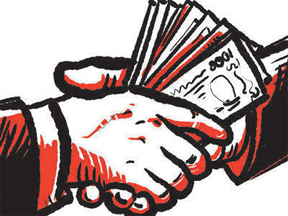
The racketeering scheme that the justice department uncovered found a money trail of $61 million flowing from what they are required to call “Company A” in the indictment, into a 501(c)(4) fund named Generation Now. Generation Now has also been charged with racketeering conspiracy.
“Company A” is FirstEnergy, whose subsidiary, FirstEnergy Solutions (FES) was the then owner of the crumbling and uneconomical Davis-Besse and Perry reactors. (They are now owned by yet another spin-off, Energy Harbor).
Although FirstEnergy has been served with subpoenas, so far no one there has been named in the indictment. And while the company clearly handed out the $61 million, DeVillers said of the web of conspirators that “this enterprise went looking for someone to bribe them”.
Meanwhile, the money trail that led from FirstEnergy to Larry Householder’s pocket and others’ was deftly concealed. As DeVillers described it, the entire scheme was “created completely and utterly to hide where there donor came from and [who it] was.”
Generation Now, as a 501(c)(4), was not obliged to declare the source of its funding. If it had been, said DeVillers at the press conference, the criminal enterprise it operated could never have happened. Despite its name, DeVillers said, “make no mistake, this is Larry Householder’s 501(c)(4).”
And a Republican-led operation. Generation Now’s treasurer is D. Eric Lycan, a Lexington, KY attorney with ties to the Kentucky House Republican Leadership Caucus. In addition to the ad buys Generation Now made for FirstEnergy, it also made them for an entity called Strategic Media Placement, run by GOP operative, Rex Elass. As DeVillers told the media as he pointed to a rather simple flow chart displayed at the press conference, “the real one would have covered this whole wall.”
FBI special agent Hoffman lumped Householder and his cronies in with FBI usual suspects like “gangs, child sex trafficking and Chinese spies,” but said that “public corruption is actually the top criminal priority for the FBI.”
But it should not be the priority for the US Attorney’s office. DeVillers, a Republican and Trump appointee, could not suppress his anger as he told reporters that his district is already struggling with limited resources and “a massive overdose epidemic where you’ve got people dying of overdoses of fentanyl, people stacked up like cord wood at a coroner’s office, we’ve got violent crime sky-rocketing, we’ve got two Franklin County sheriff’s deputies shot this morning.”
And yet, he continued, “we have to take our resources away from those real victim cases and investigate and prosecute some politicians who just won’t do their damn job.”
Chinese spies were in fact part of the Generation Now misinformation campaign, a scare tactic used to derail efforts by a coalition called Ohioans Against Corporate Bailouts (OACB), which launched a petition drive to repeal HB6.
A FirstEnergy/Householder front group ran scaremongering “yellow peril” ads to deter people from signing a petition that would have reversed the nuclear bailout bill, HB6
As petitioners took to the streets, attempting to gather enough signatures to get a repeal of HB6 onto a November ballot, a smear campaign suggested that, among other things, the petition gatherers were in the payroll of Chinese government operatives who were “quietly invading our American electric grid” and that if you signed the HB6 repeal petition, the Chinese government would be capturing “your name, your address, your signature”. National security would be at risk.
Most ludicrously, the Chinese scare ad, put together by Ohioans for Energy Security (in reality a front group funded by Generation Now) suggested China, and by definition the ballot petitioners, were “taking Ohio money,” which is precisely what the Householder racket was doing.
It worked. OACB eventually ran out of time and petition gatherers, with some having been bought off with a portion of the $61 million. In October 2019, OACB withdrew the initiative, which is when HB6 effectively became law. And it still is.
That’s the worst part of the news. Householder and others may pay a fine, or even see jail time, but the people of Ohio remain in danger. Davis-Besse and Perry are two of the most seriously degraded reactors in the country and should have been shut down long ago.
If Davis-Besse suffered a serious meltdown, there could be “1,400 peak early fatalities, 73,000 peak early injuries, 10,000 peak cancer deaths, and $84 billion in property damage,” according to Beyond Nuclear’s Kevin Kamps, citing a 1982 study by the Nuclear Regulatory Commission. With populations having soared since then, today’s figures would be far higher, he pointed out.
Likewise, the Perry plant’s numbers would be well above the 5,500 acute radiation deaths, 180,000 radiation injuries, 14,000 latent cancer fatalities, and $102 billion in property damage, cited in the 1982 study, should that reactor suffer a major accident.
The $1.5 billion subsidy, says Toledo public interest attorney, Terry Lodge, “didn’t go to ensure safe nuclear plant operations for the next five years, but instead was paid to investors as dividends once the FirstEnergy bailout was over.”
However, it looks unlikely that HB6 will be undone, despite the criminal machinations behind its passage. While Howard Learner, executive director of the Chicago-based Environmental Law & Policy Center, told the Toledo Blade that the Ohio bailout “should not remain in effect if obtained through bribery or other means”, it would have to be nullified by the legislature itself, an action for which there seems little political inclination.
One reason for that reluctance could be yet one more sinister discovery. Prior to the vote on HB6, a Trump operative, Bob Paduchik had pressured “at least five members of the Ohio House of Representatives,” to vote ‘yes’ on HR6, according to Politico. “The message is that if we have these plants shut down we can’t get Trump reelected,” one senior legislative source told Politico.
As DeVillers said: “We’re not done with this case.”
How bankrupt US nuclear financing schemes are going to be used to fund nuclear power in the UK to fund nuclear power. https://100percentrenewableuk.org/blogby David Toke 24 July, 20 As different types of corrupt pro-nuclear handouts in the USA unravel the British Government is expected to support bringing in a legalised version of bankrupt US nuclear financing practices to fund Sizewell C nuclear power plant.
The US nuclear power industry is in danger of implosion as corrupt practices used to maintain its old power plant and pay for new plant are the subject of prosecutions. In Ohio the Speaker of the House of Representatives has been arrested on account of charges that he was bribed to ensure that nuclear power and coal plant in Ohio were given bailouts whilst policies supporting renewable energy and energy efficiency were cut back.
Meanwhile in South Carolina the Securities and Exchange Committee has charged executives of the State’s monopoly utility with fraud after the abandonment of two of the only four nuclear reactors whose construction has been started in the USA this century. According to the Wall Street Journal: ‘The defendants claimed the project was on track even though they knew it was significantly delayed and wouldn’t be completed on time by Jan. 1, 2021, to qualify for $1.4 billion of federal tax credits, the securities regulator alleged’. In the process the electricity consumers were charges billions of dollars for the power plant which were not built through a similar cost recovery process that is proposed for the UK.
Over to Florida, and while nobody has been charged with any offences there is great controversy over the way the dominant state utility has charged the electricity consumer for a nuclear power plant that was never built. In this case they never even got as far as breaking ground, but the consumers had to pay out $871 million as well as lots more money for other bungled projects relating to nuclear energy. Florida, like other US states has simultaneously erected huge barriers stopping homeowners (in the so-called ‘Sunshine State’) from putting solar panels on their roofs.
According to the New York Times: ‘Florida is one of eight states that prohibit the sale of solar electricity directly to consumers unless the provider is a utility. There is also a state rule, enforced by the utilities, requiring expensive insurance policies for big solar arrays on houses’.
Meanwhile in Georgia, the third state to use the cost recovery method for financing nuclear plant, the only two nuclear power plant being built in the USA (Vogtle III and IV) are hopelessly delayed with massive cost overruns, again, yes you’ve guessed it, with costs paid by electricity consumers.
Of course all of these real or abandoned nuclear plant were financed under the so-called Regulated Asset Base (RAB) model that is being slated to pay for Sizewell C in the UK. This is hailed as a much cheaper way to pay for nuclear power compared with the way that Hinkley C is financed. Cheaper, for the developer (in this case EDF), certainly, but for the electricity consumer it’s a disaster! The consumer, as the US experience clearly illustrates, starts paying and continues paying for a nuclear power plant long before it is generating any energy, and there is no guarantee even that it will ever generate anything! But the consumer still pays, no matter what the constructions cost overruns turn out to be! And invariably, with nuclear power plant, there are very large cost overruns.
Added to this of course the bias in favour of new nuclear as opposed to new renewable energy schemes is also assured. The contracts nuclear power are being given assure them that they will get paid the premium price for energy generated even if wholesale electricity prices are negative whereas windfarms and solar farms will get nothing in such circumstances. See our report on this. Of course there’s nothing illegal in this because mountains of impenetrable contractual and accountancy paperwork make it so. It is just written by the the people who have the energy establishment’s interests at heart.
Ohio House Republicans introduce legislation to repeal controversial bailout of nuclear power plants, Cleveland 19 News, Jim Nelson | July 23, 2020 COLUMBUS, Ohio (WOIO) – A pair of republican members of the Ohio House of Representatives are introducing a bill to repeal House Bill 6, the controversial bailout of the state’s nuclear power plants now at the center of a bombshell corruption scandal.
“Not only because it was bad policy from the start, but because we need to reassure Ohioans that their representatives, be they democrat or republican, are truly working in their interest,” said Rep. Laura Lanese (R-Grove City).
She, along with Rep. Mark Romanchuk (R-Ontario), will co-sponsor the bill.
Federal investigators say the passage of the controversial legislation was helped by a phony social welfare organization, orchestrated by House Speaker Larry Householder.
They say $61 million was funneled through the organization to Householder and his associates, who in turn helped elect 21 members of the Ohio House of Representatives.
Nearly all of them voted in favor of the bailout.
“House Bill 6 was bad policy from the start,” Lanese said. “From the beginning to the middle through the end, this legislation has been tainted.”
Neither Lanese nor Romanchuk supported the bill.
Romanchuk was not at the Thursday news conference held in Columbus, where Lanese stressed the importance of coming up with a new energy solution.
“Many of my house colleagues are not against nuclear energy. We are part of the ‘all of the above’ policy. This is not about kicking out nuclear energy or destroying jobs,” she said. “I would like to see [that] we include a lot of the clean energy portfolio pieces that were part of the last general assembly’s legislation. Those were taken out in this piece.”
“We did have a lot of support for energy efficiency and renewable energy,” she pointed out……..
While Householder is the only elected official implicated in the criminal complaint, released on Tuesday by the U.S. Attorneys Office, there is speculation that others could be more deeply involved. …….
Former SCANA executive pleads guilty to fraud charges tied to failed SC nuclear project, Post and Courier By Andrew Brown and Avery G. Wilks abrown@postandcourier.com; awilks@postandcourier.com, Jul 23, 2020COLUMBIA — Federal prosecutors locked in a valuable witness Thursday who will give them insights and advantages as they continue to bring charges against the leaders of a failed $9 billion nuclear expansion project in South Carolina.
Steve Byrne, the former vice president of Cayce-based SCANA Corp., pleaded guilty in federal court to defrauding electric customers and lying about construction progress as the company tried to build two nuclear reactors at the V.C. Summer Nuclear Station in Fairfield County.
The guilty plea requires Byrne, 60, to cooperate with federal prosecutors who have spent three years investigating the project’s sudden abandonment in July 2017. The construction failure cost South Carolina electric ratepayers billions of dollars in higher power bills. SCANA’s shareholders also suffered huge losses when the company’s stock value tanked. The company was ultimately sold at a bargain price to Virginia-based Dominion Energy.
On Thursday, Byrne admitted to falsely telling regulators, investors and the public the project was on track in order to win rate hikes on customers and keep the venture going while failing to raise alarms about critical flaws that were dooming the expansion effort.
By pleading guilty, Byrne is hoping to avoid a stiffer sentence. The fraud charges he pleaded to can still carry up to five years in prison, a $250,000 fine and three years of supervised release afterward.
He could also be required to forfeit up to $1 million in pay and bonuses tied to his performance when he oversaw the V.C. Summer venture.
For now, Byrne will remain out of jail. A federal magistrate released him on $25,000 bail and required Byrne, who owns a home on the Isle of Palms, to surrender his passport. He will need permission from federal parole officials to leave the state for consulting work or special occasions.
U.S. Magistrate Judge Shiva Hodges said she was providing leniency because it could take years for a judge to issue Byrne’s sentence, which will come at the end of a federal investigation targeting other SCANA officials…….
Byrne will have more to say as the V.C. Summer investigation progresses. SCANA’s former No. 2 official is expected to be a star witness in future trials or grand jury proceedings involving other officials who oversaw the project.
Former and current Utah Congressmen: Say no to nuclear testing, KSL News Radio, BY CURT GRESSETH JULY 23, 2020 SALT LAKE CITY — The US Senate is ready to restart nuclear weapons testing, but both a current and a former Utah congressman say the testing is still not safe.
The House recently passed the National Defense Authorization Act along with an amendment by Utah Democratic Rep. Ben McAdams that would block funding to restart nuclear weapons testing in the United States.
McAdams’ amendment was adopted along a mostly party-line vote of 227-179.
The Senate version of the NDAA includes $10 million to resume nuclear testing for the first time since 1992.
Nuclear testing
“Explosive nuclear testing causes irreparable harm to human health and to our environment, and jeopardizes the U.S. leadership role on nuclear nonproliferation,” McAdams said Monday in the House.
McAdams joined Lee Lonsberry on Live Mic to discuss his amendment on blocking funding for nuclear testing.
“Utah has been devastated from nuclear weapons testing for decades. The federal government lied to us. They told us it was safe, that there would be no harm that would come from this testing. Then so many people across our state developed cancer and other issues related to that testing, so we were lied to for years by our federal government,” McAdams said. ……..
Former Utah Rep. Jim Matheson
Former Utah Rep. Jim Matheson, also a Democrat, lost his father, former Utah Gov. Scott Matheson, to cancer blamed on living downwind from the Nevada Test Site where atomic tests were conducted in the 1950 and 1960s.
“This is an issue that obviously affected my family in a significant way — my extended family, let alone my own father, who was a Downwinder,” Matheson said.
While serving in Congress, Matheson said his efforts on nuclear weapons testing were focused on whether it was safe to conduct weapons tests. He said he introduced legislation that said the testing couldn’t move forward without the equivalent of an environmental impact statement to assess all the risks and prove that it’s safe to test.
“The folks who were trying to move ahead with testing didn’t like that idea at all,” Matheson said. “It wasn’t safe when it was above ground and it wasn’t safe when it was below ground. It’s still not safe today.”
Cause for alarm
“Technology has not advanced to the point where you can be satisfied with the assertions of these testers, essentially that tests of this nature are safe,” Lee said.
“Absolutely not,” Matheson replied. “They have no justification for even saying that.”
If proponents wish to proceed, the former congressman called for a transparent, public process to assess all the risks of nuclear weapons testing.
“The facts will speak for themselves,” he said.
He said the $10 million appropriation in the Senate NDAA bill to start preparing sites for testing “should be a cause for alarm for all of us.”
“My gosh, we had the government lie to us here in Utah way back when. They told us it was safe. They knew it wasn’t,” he said.
Matheson said the government only did the testing when the wind blew the fallout in the least populated direction, which was southern Utah. He added that declassified documents referred to people living in southern Utah as a low-use segment of the nation’s population.
“Let’s not tuck $10 million into a defense bill in the Senate and say let’s get the site ready without any process to determine if it’s safe or not, without any public effort to reevaluate the risk associated with this. This doesn’t sound right to me. This doesn’t pass the smell test,” Matheson said.
Everybody’s entitled to their opinion – but not their own facts’: The spread of climate denial on Facebook
‘The arguments are that people can’t trust scientists, models, climate data. It’s all about building doubt and undermining public trust in climate science’ Independent, Louise Boyle, New York @LouiseB_NY, 24 July, 20.
“………The pushback
On 1 July, a coalition of environmental and political groups sent a letter to Facebook’s oversight board demanding a crackdown on climate denial and to close the “giant” opinion loophole that allows climate misinformation to be posted as an opinion.
“Facebook is allowing the spread of climate misinformation to flourish, unchecked, across the globe. Instead of heeding the advice of independent scientists and approved fact-checkers from Climate Feedback, Facebook sided with fossil fuel lobbyists by allowing the CO2 Coalition to take advantage of a giant loophole for “opinion” content. The loophole has allowed climate denial to fester by labelling it “opinion,” and thus, avoiding the platform’s fact-checking processes,” they wrote.
More than 500 companies including Coca-Cola, Dunkin’ Donuts, Verizon, and this week Disney, according to WSJ, have slashed or suspended ad spends on Facebook as part of the “Stop Hate for Profit” boycott, a move by civil rights groups to try to force the social media giant to address hate speech and misinformation.
An independent audit of Facebook earlier this month reached harsh conclusions on the social media giant, reporting that it was allowing hate speech and disinformation to proliferate.
Separately, Generation Progress, the youth-centered research and advocacy group, on Thursday launched a “Get The Facts Out Campaign” website aimed at debunking myths on the climate crisis and calling out climate deniers across Congress and the Trump administration, with a focus on the interwoven issues of climate and racial justice.
“Black Americans have been fighting for clean air and water in their communities for years. Our legislators must understand the importance of addressing these inequities, not deny their existence,” the group said.
And earlier this month, two senators introduced legislation to reform Section 230 of the 1996 Communications Decency Act, Reuters reported.
The legislation, titled the Platform Accountability and Consumer Transparency Act, or PACT, from Democratic Senator Brian Schatz and Senate Republican John Thune, aims to provide more accountability and transparency for large tech platforms with respect to content moderation decisions………
Climate experts were sceptical of tech platforms’ ability, or desire, to enact meaningful change, and said that public action was key.
For Dr Mann that means political overhaul. “Americans must vote in a Democratic president and Congress in the next US election. Unlike Trump and Congressional Republicans, who appear beholden to both Russia and fossil fuel interests, will be willing to crack down on Zuckerberg/Facebook’s nefarious activities,” he said.
Dr Cook is working with machine-learning researchers on a system to detect and categorise climate misinformation in real-time. He acknowledged that social media platforms would have to be incentivised to use such a model, as it “would basically be taking money out of their pockets” in terms of ad revenue.
Just as important, he says, is “building public resilience against misinformation” – teaching people how to spot misleading or rhetorical techniques and logical fallacies in climate denial arguments.
“We found that when you explain techniques, that not only neutralises and inoculates people against that myth, but also against other topics like the tobacco industry and anti-vaxxer misinformation,” he said.
Dr Cook and his team have created a smart-phone app for public use and for schools.
He added: ”We need to look at technological solutions but ultimately we need to make ourselves un-hackable.”
SEPTEMBER 3 & 4 – NEW SENTENCING DATES FOR KINGS BAY PLOWSHARES 7
The remaining six Kings Bay Plowshares 7 defendants were granted a continuance for sentencing by Judge Lisa Godbey Wood of the Southern District Federal court of Georgia in Brunswick from the end of July until September 3rd and 4th. Due to spikes in COVID-19 cases in GA and ensuing travel restrictions the anti-nuclear activists had asked the court to further postpone sentencing to accommodate their right to be sentenced in person in open court, not by video, witnessed safely by family, supporters and the press.
The new sentencing dates and times are September 3rd: Carmen Trotta at 9 am, Fr. Steve Kelly at 1 pm, Clare Grady at 4 pm. On September 4 will be Mark Colville at 9 am, Patrick O’Neill at 1 pm, Martha Hennessy (granddaughter of Dorothy Day who co-founded the Catholic Worker movement) at 4 pm. It is possible that there will be further delays depending on the course of the virus over the next month. We will try to keep you updated as we find out more as that time approaches.
The defendants had asked for home confinement during this time of COVID-19, as entering prison, especially for those over 60 years of age with health issues, could be a death sentence. Their request was opposed by the prosecution and the probation department which argued the charges involved a threat to human life (their own) by entering a restricted zone on the base where lethal force is authorized. This would raise the level of the offense and make them ineligible for home confinement. Judge Wood upheld this interpretation in the first sentencing of Elizabeth McAlister on June 8. At 80 years-old, the eldest of the KBP7 defendants and widow of Phil Berrigan, she was sentenced by video conferencing while at her home in Connecticut. Liz had served over 17 months before trial. The judge agreed with the US attorney’s request for a sentence of time served plus 3 years supervised probation and restitution at $25 monthly (of $33,000 owed by all 7 jointly).
Nuclear secrets: the Dutch whistleblower who tried to stop Pakistan’s bomb Frits Veerman first warned the authorities in 1973 about the suspicious activities of his colleague AQ Khan. Why was he ignored?Simon Kuper– 24 July 20,
In the early 1970s, the Dutch technician Frits Veerman shared a large desk in a lab in Amsterdam with a charming Pakistani scientist named Abdul. One day, Veerman mentioned that he’d like to visit Pakistan. He asked if he could stay a few nights with his colleague’s family. Abdul — full name Abdul Qadeer Khan — replied that Pakistan’s government would pay for his entire trip. That’s when Veerman began to suspect that Khan was stealing Dutch nuclear secrets. ………
Veerman first tried to report Khan to the Dutch authorities in 1973. He didn’t make it past a secretary. Had he been heard, then or later, the world might have been spared a nightmare. The Dutch allowed Khan to leave their country in 1975 and to keep visiting European suppliers. The US Central Intelligence Agency didn’t stop him either. Khan ended up building Pakistan’s nuclear bomb and selling the technology to Iran, North Korea and Libya.
………….After Veerman blew the whistle, he lost his job. A report this month by the Huis voor Klokkenluiders, the new Dutch Whistleblowers Authority, finally absolves him. It also helps explain why he and not Khan was punished.
Khan is now 84, and living under unofficial house arrest in Pakistan, where he has long had an up-and-down relationship with the authorities. He is closely escorted by security officials during his restricted movements, while any visitors to his home are screened in advance. …………
The Dutch briefed the CIA on Khan, Lubbers told Japanese TV in 2005. The Americans opposed the nuclear ambitions of their Pakistani allies. Nonetheless, the CIA stopped the BVD from arresting Khan. The Americans wanted to watch him, so as to track Pakistan’s nuclear procurement and Europe’s secretive nuclear suppliers.
The CIA’s failure to stop him in 1975 “was the first monumental error”, Robert Einhorn, who worked on nonproliferation in the Clinton and Obama administrations, told Frantz and Collins. The Americans asked the Dutch “to inform them fully but not take any action”, Lubbers recalled, laughing. He said he “found it a bit strange”, but also thought, “‘OK, it’s American business.’ We didn’t feel . . . safeguarding the world against nuclear proliferation as a Dutch responsibility.” The business of the Netherlands was business. The CIA would watch Khan for decades.
FDO didn’t tell Khan he was under suspicion. It gave him a new job, calling it a promotion, and said he could stop visiting Almelo. He may have realised the game was up. On December 15 1975 he flew to Pakistan on leave, taking his wife, daughters and blueprints of centrifuges. Soon afterwards, from Pakistan, he resigned from FDO. ……..
In September 1976, FDO held a meeting about Khan. Veerman told his colleagues that he thought Khan was a spy. FDO doesn’t seem to have launched an investigation or taken measures, says the Dutch Whistleblowers Authority. Later, Veerman detailed Khan’s actions to BVD agents. But his speaking out was unpopular. There had been rejoicing within FDO when an executive returned from a visit to ex-employee Khan in Pakistan with orders of work. Pakistani technicians began visiting FDO for what Veerman calls “a course in ‘how to build an ultracentrifuge’”.
In September 1976, FDO held a meeting about Khan. Veerman told his colleagues that he thought Khan was a spy. FDO doesn’t seem to have launched an investigation or taken measures, says the Dutch Whistleblowers Authority. Later, Veerman detailed Khan’s actions to BVD agents. But his speaking out was unpopular. There had been rejoicing within FDO when an executive returned from a visit to ex-employee Khan in Pakistan with orders of work. Pakistani technicians began visiting FDO for what Veerman calls “a course in ‘how to build an ultracentrifuge’”. ………..
Why was Veerman sacked? A former Dutch security investigator, who handled the Khan case from 1979, told the whistleblowers authority that Veerman was “sacrificed” because he wouldn’t stop talking. FDO’s security had been lax, the Netherlands and its high-tech sector were embarrassed, those involved didn’t want the story to reach the media or other countries, and the junior employee had to shut up. This is what Veerman had always suspected.
No other Dutch tech company would hire him. Is Veerman bitter? The question seems to surprise him. He doesn’t have a large emotional vocabulary. “I don’t cry about it all day. A great injustice was done to me, but I don’t think about it much. When something like that happens, you have to make an assessment — maybe I am too sober — and go on.” Now, with the whistleblowers’ report, Veerman plans to seek compensation from the Dutch state and the present incarnation of FDO’s former holding company, VMF-Stork (FDO closed in 1992). The current Stork, which now consists of a very different set of operating companies, says it “has fully co-operated with the investigation [by the Dutch Whistleblowers Authority], even though this question is from a very long time ago . . . The current Stork cannot be regarded as Mr Veerman’s employer, as the Authority’s report confirms.” ………
Meanwhile, Khan regularly flew into Brussels, then drove to nearby countries visiting suppliers and scientists. The BVD took no action, even when Dutch businessman Nico Zondag reported in 1977 that Pakistan was seeking products to build a nuclear bomb. A Dutch foreign-ministry official wrote in a memo in 1984 that exports to Pakistan continued, “including essential bomb components that for whatever reason couldn’t be blocked”. Khan said in 1987 that Europeans were keen sellers: “People chased us with figures and details of equipment they had sold to Almelo and Capenhurst [the British site of another Urenco plant]. They literally begged us to buy their equipment.” There were few restrictions on such exports in those days. If an item seemed particularly problematic, the trick was to conceal its destination by routing it through an inoffensive third country.
A small country with an impenetrable language can generally keep national embarrassments secret. The Dutch government commissioned a report on Khan only in 1979, after the German TV channel ZDF — using sources other than Veerman — revealed Khan’s espionage to the world. Nobody then thought Pakistan was close to getting the bomb and the CIA believed it had the matter under control, but the Netherlands — a vocal supporter of the Nuclear Nonproliferation Treaty of 1968 — was humiliated in front of its allies.
In 1983, Veerman was summoned to a meeting at the Bijlmer prison. There, he later told the whistleblowers authority, government officials ordered him to keep quiet about Khan “because the Netherlands’ international relations and reputation were at risk, and the interests of Dutch industry”. When he said he’d keep speaking out, an executive from FDO snapped that speaking out had got him fired — thereby blowing the company’s cover story
Veerman went straight from the meeting to a Dutch newspaper, but afterwards retreated into his social security job and was hardly heard of again in public for decades until now. He was also put on an international watchlist and for many years was questioned by the authorities when he travelled abroad. On one family holiday in Italy, his car was stopped by armed police.
In 1983 the Netherlands sentenced Khan in absentia to four years in jail for seeking secret information. The main evidence was his letters to Veerman. Khan was offended by the verdict and his biographer Zahid Malik would record his complaint that two of the judges were Jews. Later, his sentence was overturned because he hadn’t been served the summons. The Dutch then abandoned prosecution of the most consequential crime committed on their territory since the second world war. The ministry of justice later admitted that Khan’s legal file had gone missing.
Lubbers, who became prime minister in 1982, wanted Khan arrested but was told to “leave it to the [intelligence] services”. Looking back, he told the Argos radio show: “The last word is Washington. There is no doubt they knew everything, heard everything. There is an open line between The Hague and Washington . . . It was very dumb.” Khan was allowed to return to the Netherlands repeatedly, including for a visit to his dying father-in-law in 1992.
The CIA’s former director of central intelligence, George Tenet, once boasted: “We were inside [Khan’s] residence, inside his facilities, inside his rooms.” Yet the Americans missed a lot, partly because they expected Pakistan to pursue a bomb made with plutonium rather than uranium. They were also late to realise that Khan had opened a nuclear supermarket, offering starter kits to many countries including Syria and Saudi Arabia. Decades after leaving the Netherlands, he was still selling Dutch knowledge. He grew rich. In 1998, he also became celebrated as “Mohsin e-Pakistan” (Saviour of Pakistan), after the country detonated six nuclear bombs at a test site.
Proof of his sales emerged in 2003, when the US Navy intercepted a ship carrying nuclear technology from one of his factories to Libya. Later, the Libyans handed the Americans two plastic bags (bearing the names of an Islamabad tailor and a dry cleaner) that contained bomb designs. In 2004, Khan confessed on live television to transferring the technology to Libya, Iran and North Korea. By then, the US couldn’t demand his punishment, as Pakistan was an ally in the “war on terror”.
Meanwhile, the Dutch government admitted in 2004 that Iranian centrifuges had been seen that used “Urenco technology from the 1970s”. Pakistan’s centrifuges were similar. The Dutch foreign ministry told the FT: “The Netherlands attaches great importance to the Non-proliferation Treaty and the prevention of proliferation. The Netherlands did not actively contribute to unwanted proliferation of knowledge.” Khan later withdrew his confession. Some years ago, an American documentary-maker arranged for Veerman to phone his old friend. Khan, who resents being painted as a common spy, told him, “Frits, you are the biggest liar around.” Khan is now out of favour with Pakistan’s government. Security forces personnel installed in the house next door block him from meeting his relatives, friends and lawyers, he complained in an appeal to Pakistan’s Supreme Court last month. ……
New CT scan method lowers radiation exposure, Science Daily
Date: July 23, 2020
Source: University College London
Summary:
A CT scan technique that splits a full X-ray beam into thin beamlets can deliver the same quality of image at a much reduced radiation dose, according to a new study. The technique, demonstrated on a small sample in a micro CT scanner, could potentially be adapted for medical scanners and used to reduce the amount of radiation millions of people are exposed to each year.
A CT scan technique that splits a full X-ray beam into thin beamlets can deliver the same quality of image at a much reduced radiation dose, according to a new UCL study.
The technique, demonstrated on a small sample in a micro CT scanner, could potentially be adapted for medical scanners and used to reduce the amount of radiation millions of people are exposed to each year.
A computerised tomography (CT) scan is a form of X-ray that creates very accurate cross-sectional views of the inside of the body. It is used to guide treatments and diagnose cancers and other diseases.
Past studies have suggested CT scans may cause a small increase in lifelong cancer risk because their high-energy wavelengths can damage DNA. Although cells repair this damage, sometimes these repairs are imperfect, leading to DNA mutations in later years……… https://www.sciencedaily.com/
Many people in this county who are joining community choice energy options in order to use and support advancing clean energy sources will be very upset when they learn our Assembly member, Jordan Cunningham, has introduced AB 2898 to amend California’s Renewables Portfolio Standard Program allowing nuclear power to be named as a carbon free and renewable resource.
However, nuclear is neither carbon free nor renewable. There is a finite supply of uranium 235, which nuclear plants use to power their reactors. The ore is mined, processed, and enriched. The resulting material is manufactured into pellets and rods to contain them. All this industry and transport causes a lot of greenhouse gas emissions. Additionally, during the operation of nuclear plants, CO2 is emitted with water vapor, steam, and heat.
Another “renewable standard” states there is to be no waste. We certainly will have waste—thousands of tons of highly radioactive waste with nowhere to store it. The Central Coast deserves representatives who will be looking out for our health and dollars. One who will look beyond the dinosaur of nuclear power with its dangers, waste, and cost to embrace a future of truly clean sustainable power.
Sharon Coolidge, Dan Horn, Jessie Balmert Cincinnati Enquirer Marc Kovac, Randy Ludlow and Lucas Sullivan contributed to this report 21 Jul 20 CINCINNATI – Federal officials arrested Ohio House Speaker LarryHouseholder and four others Tuesday as part of a $60 million racketeering and bribery investigation that prosecutors describe as one of the largest public corruption cases in Ohio history.
All of the charges are tied to what federal prosecutors describe as a criminal enterprise dedicated to securing a bailout for two nuclear power plants in northern Ohio, which is expected to cost the state’s utility ratepayers $1 billion.
A criminal complaint unsealed Tuesday describes the effort as “Householder’s Enterprise” and states that he and his associates sought to expand their political power, enrich themselves and conceal their criminal conspiracy.
“This is likely the largest bribery, money laundering scheme ever perpetrated against the people of the state of Ohio,” said U.S. Attorney David DeVillers, whose office will lead the prosecution of the case. “This was bribery, plain and simple. This was a quid pro quo. This was pay to play.”
Also charged Tuesday were four lobbyists and Republican operatives:
Neil Clark, founder of Grant Street Consultants and once called by USA Today “one of the best connected lobbyists in Columbus”;
Matthew Borges, former Ohio Republican Party chair and consultant;
Juan Cespedes, co-founder of The Oxley Group in Columbus;
Jeffrey Longstreth, adviser to Householder;
Generation Now, a nonprofit that federal prosecutors link to Longstreth and Householder, also faces racketeering charges.
DeVillers said the arrests Tuesday will not end the investigation and that agents will continue to interview potential witnesses and execute search warrants in the coming days and weeks. “We’re not done with this case,” he said. “There are a lot of federal agents knocking on a lot of doors.”
The criminal complaint accuses Householder of creating an enterprise to collect large sums of money for him and others involved in the conspiracy.
“The millions paid into the entity were akin to bags of cash,” the complaint states. “Unlike campaign or PAC contributions, they were not regulated, not reported, not subject to public scrutiny — and the enterprise freely spent the bribe payments to further the enterprise’s political interests and to enrich themselves.”
The arrests are the result of a nearly two-year FBI investigation that included undercover federal agents who met with Householder and Clark, as well as surveillance that allowed investigators to obtain text messages, emails and other communications between those who have been charged. …… According to the criminal complaint, the arrests are the result of a nearly two-year investigation into bribes and money laundering by the FBI.
Householder oversaw the controversial, Republican-led bailout of the two nuclear plants, owned by FirstEnergy Solutions, of Akron. House Bill 6, signed by Gov. Mike DeWine in June, authorized using ratepayer fees for the $1 billion bailout.
The fight to approve the money was long and costly, extending even after the bill was signed into law. An effort to overturn the bailout ultimately failed after it met fierce resistance from well-funded competition. One group was Generation Now, a 501(c)(4) “dark money” operation that was not required to disclose donors under federal law. The group hired blockers to stall signature collectors working for those opposed to the bailout.
The second group, Ohioans for Energy Security, paid for millions of dollars in advertisements, including ones that warned Ohioans that the Chinese would take over Ohio’s power grid if voters repealed the bailout.
FirstEnergy, which spun off FirstEnergy Solutions in bankruptcy proceedings, gave more than $1.1 million to Ohio politicians, including Householder, between 2017 and 2019. FirstEnergy Solutions was later renamed Energy Harbor Corp.
Cespedes was listed by the state as a lobbyist last year for Energy Harbor and Borges works for the Columbus-based firm 17 Consulting Group, which contributed $90,000 to a pro-nuclear energy group called Ohio Clean Energy Jobs Alliance, which has ties to FirstEnergy Solutions.
Disclosure: 17 Consulting advises The Enquirer on legislative activity affecting the media industry.
The documents unsealed Tuesday afternoon did not name the companies involved, though they noted that “Company A entities paid Householder’s enterprise $60,886,835.86 in secret payments over the approximately three-year period in exchange for the billion-dollar-bailout. The enterprise concealed the payments … to receive the bribe money and then transferring the payments internally to a web of related entities and accounts.”………
Investigators allege the nonprofit used energy company money to back the campaigns of 21 different state candidates in the 2018 primary and general elections, including Householder.
More than $1 million was spent on negative ads against those candidates’ opponents, with additional funds paying for Householder’s campaign staff, according to documents.
Most of the backed candidates won in 2018, and all supported Householder’s election as Speaker, investigators said. Additionally, Householder received $400,000-plus in personal benefits, including funds to settle a personal lawsuit, to pay off credit card debt and for costs associated with his home in Florida, according to documents.
Environmental groups want controversial Ohio nuclear bailout bill reexamined; HB6 now at the center of FBI investigation, Cleveland.com, By Emily Bamforth, cleveland.com 22 Jul 20, CLEVELAND, Ohio — Ohio House Bill 6 bailed out two FirstEnergy power plants and gave subsidies to coal plants, while dismantling mandates designed to move Ohio’s clean energy landscape forward.
The corruption scandal is now prompting groups that already opposed HB6 because of its implications for the economy or environment to call for a re-examination of the bill, or its total repeal. Both the Sierra Club and American Wind Energy Association issued statements on the case Tuesday evening.
“The legislative push to bail out legacy generation and roll back Ohio’s renewable energy commitments was always against the will of Ohioans, who overwhelmingly support renewable energy,” American Wind Energy Association Eastern State Affairs Director Andrew Gohn said in a statement. “It now appears that the passage of this bill was not just against the will of the people, but also may have involved serious and possibly criminal impropriety.”
Supporters of the bill claimed the bailout would save jobs in nuclear energy and reconfigure surcharges to Ohio customers to save money. But those fighting against it, including environmental groups, balked at the changes which effectively “gutted” energy-efficiency and renewable-energy mandates for utilities.
The bill changed Ohio’s renewable-energy goal from a maximum of 12.5 percent by 2027 to 8.5 percent by 2026. Under Ohio requirements introduced in 2008, utilities must reduce customers’ power usage by 22 percent by 2027.
Under House Bill 6, these standards would end after utilities companies reached a 17.5 percent drop in customer power use.
The bill also included subsidies for coal power plants.
Neil Waggoner, the Sierra Club Ohio’s Beyond Coal Campaign representative, said this year the group has seen utilities companies petitioning the state’s public utilities commission to end energy efficiency programs, because companies are already hitting the lowered standard.
Editorial: Trump’s continued disregard for the environment and climate change poses a mortal threat, LA Times THE TIMES EDITORIAL BOARD, JULY 19, 2020
It’s fitting that President Trump invoked an interstate highway expansion in Atlanta last week to announce final rules that, if they survive the inevitable legal challenges, will undermine one of the nation’s bedrock environmental laws, the National Environmental Policy Act. American voters face a fork in their own road this November — stay on the Trump expressway to environmental degradation and catastrophic climate change, or shift to the road, bumpy as it may be, to a cleaner environment and more sustainable future of wind, solar and other energy sources that do not involve burning fossil fuels.
The COVID-19 pandemic understandably has seized the nation’s attention, but that hasn’t lessened the risk we all face from air and water pollution and carbon-fed global warming. Trump has unabashedly sought to dismantle federal regulatory structures to speed up construction projects while forging a national energy plan based on producing and burning fossil fuels.
His embrace of the oil, gas and coal industries defies the global scientific consensus that burning fossil fuels emits greenhouse gases that make the Earth less habitable by warming the atmosphere, feeding stronger and more frequent storms, triggering devastating droughts that propel human migration, and pushing up sea levels so that they encroach on cities and other human settlements. In fact, the National Oceanic and Atmospheric Administration reported last week that unusually high tides led to record flooding among one-quarter of Atlantic and Gulf Coast communities where the agency maintains tide gauges. Climate change is no dystopian vision of the future; it is here.
Trump’s efforts to eviscerate regulatory oversight of the environment is rooted in his belief that regulations are for the most part unnecessary hurdles to economic progress. He bewails the amount of time it takes for projects to clear environmental reviews and related court challenges, adding what, in his mind, are unnecessary costs and delays………..
Biden’s proposal at least recognizes the dire future we all face if the nation — and the world — do not fundamentally alter how we produce and consume energy.
Ohio corruption case throws focus on US nuclear plant troublesFt.com, Gregory Meyer in New York, 23 July 20
Top lawmaker charged over payments relating to bailouts in case that points up economic woes,
Gregory Meyer in New York 3 HOURS AGO 5 Print this page The troubled economics of nuclear energy in the US have come into glaring focus after a top Ohio lawmaker was charged in connection with $60m in alleged payments to orchestrate a $1bn bailout of two struggling power plants on the Lake Erie shore.
Ohio last year became the fifth US state — following Connecticut, Illinois, New Jersey, and New York — to approve aid to nuclear power plants facing low-cost competition from natural gas, solar and wind energy. Its governor, Mike DeWine, signed a bill providing up to $150m a year, funded by a surcharge on electricity customers.
Intense lobbying preceded the bill’s passage. A campaign to overturn it through a referendum failed last autumn. Yet the machinations that led to the bailout ran far deeper than the public knew, federal prosecutors said on Tuesday.
According to the US justice department, for three years ending in March, $60m was poured into an advocacy organisation called Generation Now, controlled by the Republican state house speaker, Larry Householder. Prosecutors said the funds financed a “racketeering conspiracy” led by Mr Householder, who was charged along with his campaign strategist, three lobbyists and Generation Now.
The companies that supplied the money were not named in the indictment, but the details matched Ohio utility FirstEnergy and one of its subsidiaries. The alleged co-conspirators called the company “the bank”, given its seemingly unlimited war chest, according to an affidavit filed with the criminal complaint.
Please use the sharing tools found via the share button at the top or side of articles. Copying articles to share with others is a breach of FT.comT&Cs and Copyright Policy. Email licensing@ft.com to buy additional rights. Subscribers may share up to 10 or 20 articles per month using the gift article service. More information can be found here. https://www.ft.com/content/451324c6-9f9d-48a1-b2d9-76d731e99db6The alleged conspiracy used the money to help more than 20 state candidates who supported the bailout propping up the two power plants, including Mr Householder, in the 2018 election. More than $1m was spent on advertisements attacking opponents of the measure, according to the US attorney for the southern district of Ohio.
Some funds were used to improperly pay for Mr Householder’s campaign staff, while he used more than $400,000 on personal expenses — including a home in Florida — prosecutors alleged. Mr Householder could not be reached for comment.
Please use the sharing tools found via the share button at the top or side of articles. Copying articles to share with others is a breach of FT.comT&Cs and Copyright Policy. Email licensing@ft.com to buy additional rights. Subscribers may share up to 10 or 20 articles per month using the gift article service. More information can be found here. https://www.ft.com/content/451324c6-9f9d-48a1-b2d9-76d731e99db6After legislators passed the bailout last July, the funds were used to derail a public ballot initiative meant to repeal the law by bribing people who were collecting signatures endorsing the effort, the complaint said. Besides the nuclear subsidies, the law also eliminated energy efficiency requirements, pared back mandates for wind and solar power and authorised a fee on customers to support ailing coal-fired power plants.
“When the corruption is alleged to reach some of the highest levels of our state government, the citizens of Ohio should be shocked and appalled,” said Chris Hoffman, special agent in charge at the FBI’s Cincinnati office. ………….
the Electric Power Supply Association, which represents independent power producers, urged its repeal, calling it the outcome of a “corrupt legislative process”.
“Rather than let the market provide the best outcomes for energy customers — and against the warnings and complaints from almost all corners — money and political influence won the day,” said Todd Snitchler, EPSA chief executive and former chairman of the Ohio Public Utilities Commission.
With the referendum having failed, the Ohio law is likely to stand, according to ClearView Energy Partners, a research group: “Only the state legislature can terminate the programme at this point, and we do not think the arrests could be enough to galvanise lawmakers to reverse course . https://www.ft.com/content/451324c6-9f9d-48a1-b2d9-76d731e99db6
Ohio House Speaker Arrested In Case Related To Nuclear Power Plant Bailout Law, Statehouse News Bureau, ByKAREN KASLER•JUL 21, 2020 House Speaker Larry Householder (R-Glenford) has been arrested in connection to a $60 million public corruption racketeering conspiracy case. Federal agents were at his farm in Perry County Tuesday morning.
Sources have confirmed that former Ohio GOP Chairman Matt Borges was also arrested, along with Householder’s adviser Jeff Longstreth. Veteran lobbyist Neil Clark was also arrested, according to sources.
The law sends $150 million a year to the Davis-Besse and Perry power plants, which were owned by FirstEnergy Solutions. That company, which had been a subsidiary of FirstEnergy Corporation when it was first created but was no longer related to FirstEnergy Corporation, emerged from bankruptcy protection earlier this year and is now known as Energy Harbor.
FirstEnergy Solutions had said it would decommission its power plants starting this year if it didn’t get some financial relief from the state…… The law took effect in October after a group that opposed it missed the deadline to collect signatures. In January, that group dropped their courtroom battle to stop the law from taking effect. There was dark money on both sides, and donors were never revealed.
The law sends $150 million a year to the Davis-Besse and Perry power plants, which were owned by FirstEnergy Solutions. That company, which had been a subsidiary of FirstEnergy Corporation when it was first created but was no longer related to FirstEnergy Corporation, emerged from bankruptcy protection earlier this year and is now known as Energy Harbor




 nuclear-news