USA will be bound by nuclear weapons ban treaty, and should join it.
 U.S. should join nuclear weapons ban treaty https://www.syracuse.com/opinion/2021/01/us-should-join-nuclear-weapons-ban-treaty-your-letters.html– Michaela Czerkies Jan 13, 2021
On Jan. 22, the United Nations Treaty on the Prohibition of Nuclear Weapons (TPNW) will enter into force. This treaty is a historic achievement in the global movement to abolish nuclear weapons, making it illegal under international law for participating nations to “develop, test, produce, manufacture, otherwise acquire, possess, or stockpile nuclear weapons or other nuclear explosive devices.” The treaty also acknowledges the suffering that nuclear weapons testing and use have inflicted around the world, and includes provisions for environmental remediation and assistance to people affected.
It is fitting that the TPNW enters into force just after Martin Luther King Jr. Day. King clearly stated that nuclear disarmament was deeply linked to racial justice and essential to our survival. He called for a ban on nuclear weapons, understanding that, “a full-scale nuclear war would be utterly catastrophic.”
Joe Biden under pressure from nuclear lobby, despite the failing state of their industry
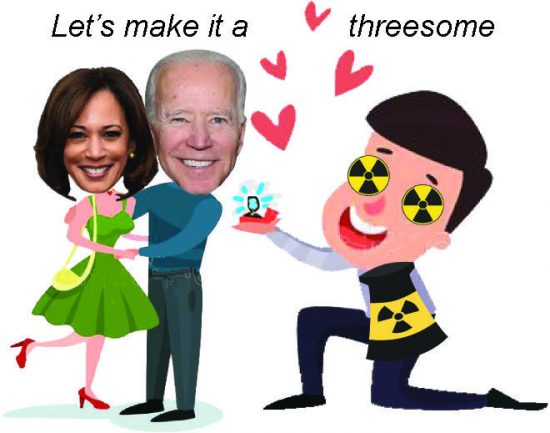
The United States has about 94 traditional reactors, out of the 440 worldwide, but rising costs have forced many plants to shut with five more expected to close this year in Illinois and New York.
Nuclear power faces competition from electricity stations that burn cheap, plentiful natural gas and from renewable power, including wind and solar.
Amid ongoing lawsuits about nuclear corruption, Ohio regulators will stall the nuclear bailout law
 Ohio regulators set to officially pause nuclear bailout fees created through tainted energy bill https://www.cleveland.com/open/2021/01/ohio-regulators-set-to-officially-pause-nuclear-bailout-fees-created-through-tainted-energy-bill.html Jan 11, 2021 By Andrew J. Tobias, cleveland.com Ohio regulators set to officially pause nuclear bailout fees created through tainted energy bill https://www.cleveland.com/open/2021/01/ohio-regulators-set-to-officially-pause-nuclear-bailout-fees-created-through-tainted-energy-bill.html Jan 11, 2021 By Andrew J. Tobias, cleveland.com
COLUMBUS, Ohio — State regulators have ordered a pause on the $170 million in annual new fees created through the controversial House Bill 6, following a judge’s recent ruling in a lawsuit brought by Ohio Attorney General Dave Yost and officials in Cincinnati and Columbus. The Ohio Air Quality Development Authority will formally suspend the charges, $150 million of which would bail out two financially troubled Ohio nuclear plants owned by a former FirstEnergy subsidiary, during a scheduled meeting on Tuesday, the agency’s executive director wrote in a recent letter to officials with the Public Utilities Commission of Ohio. As part of the same official process, the PUCO on Dec. 30 acted to prevent the new fee from going into effect while the legal challenge continues. Both agencies cited a Dec. 21 ruling from a Franklin County judge who, ruling on the lawsuit from Yost and two Ohio cities, ordered the fees be blocked from going into effect. The fees, worth more than $1 billion to the nuclear plants, were to have appeared on Ohioans’ power bills starting on Jan. 1.
But the pause could remain in place at least until a March 5 hearing in the Franklin County case, according to a PUCO spokesman.
Yost and the local officials sued over the law after federal investigators said it was the product of an elaborate corruption scheme financed by FirstEnergy and its affiliates that led to the arrest of former House Speaker Larry Householder and others last July. Prosecutors have said in exchange for $61 million, spent to help Householder become speaker and on a political campaign supporting the law, Householder agreed to push the bill through the legislature. FirstEnergy, based in Akron, hasn’t been charged or officially accused of wrongdoing. Householder has pleaded not guilty to a federal corruption charge, but two associates who helped pass House Bill 6, Jeff Longstreth and Juan Cespedes, have pleaded guilty to participating in the scheme.
The fees will remain blocked even though the Ohio Supreme Court on Monday dismissed a different HB6 legal challenge filed by the Ohio Manufacturers Association, a business group. The Supreme Court previously ordered the fees paused while it considered OMA’s arguments. The OMA had asked permission to drop its challenge, saying the issue was moot since the PUCO had agreed to pause the nuclear subsidies in response to the Franklin County case.
DeWine and state legislative leaders have called for House Bill 6 to be repealed or at least, revisited. But state lawmakers failed to do so during their lame duck session in December, since House members were unable to agree on what specific action to take. The law’s future remains unclear, with legislators expected to reconvene in the coming weeks.
Numerous HB6-related state and federal investigations, including from the FBI and the U.S. Securities and Exchange Commission, are ongoing, as are numerous lawsuits.
|
|
Could Trump start a nuclear war?- a satchel, a biscuit and a football
A satchel, a biscuit and a football, https://wordpress.com/read/feeds/72759838/posts/3119714732 , Could Trump start a nuclear war? By Linda Pentz Gunter, 10 Jan 21,
All that’s involved is a satchel, a biscuit, and a football.
It sounds so benign, doesn’t it? Like schoolboy games. It’s anything but. If the President of the United States opens that satchel with his biscuit to access the football, that simple action could propel us into Armageddon.
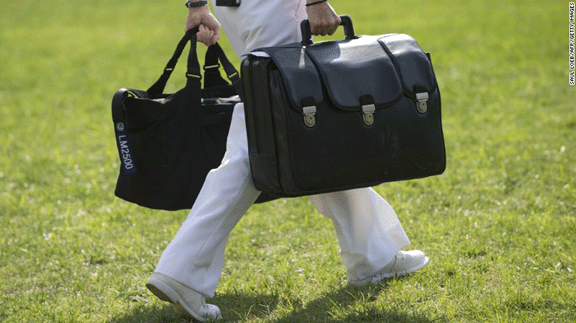
The satchel, which goes everywhere the president does, contains the nuclear “football.” Only the president can open the satchel, using an ID card known as the “biscuit”.
As Time magazine explained it — the first time alarm bells rang around the possibility that an unhinged Donald Trump might “press the nuclear button” — the “biscuit enables him to identify himself to officials at the Pentagon with unique codes letting them know he is authorizing a nuclear strike. He would also need to specify the type of attack he wanted to carry out; the different options are delineated in the nuclear football.
“Once Trump has successfully conveyed his orders, Strategic Command, which has operational control over U.S. nuclear forces, would implement them.”
So while there is no actual nuclear button — Trump’s boasts to North Korea about his big one notwithstanding — it would be all too easy for a petulant madman to start a nuclear war. And we have one in the White House.
No one here needs to be reminded of the eye-stretching scenes of mob violence that unfolded at the Capitol on January 6, egged on by Trump on the day itself, and fueled by the reckless rhetoric and actions of the White House and its Republican lackeys over the past four years.
The events of January 6 in part prompted House Speaker Nancy Pelosi to speak to the “Chairman of the Joint Chiefs of Staff Mark Milley to discuss available precautions for preventing an unstable president from initiating military hostilities or accessing the launch codes and ordering a nuclear strike.
“The situation of this unhinged President could not be more dangerous, and we must do everything that we can to protect the American people from his unbalanced assault on our country and our democracy,” Politico reported Pelosi as saying on Friday.
In a statement issued on January 7, Physicians for Social Responsibility wrote that the scenes of mayhem at the Capitol, brought on by Trump’s “increasingly irresponsible and reckless behavior” should finally “put to rest any doubt about the danger posed by giving any president sole authority for the decision to launch a nuclear weapon. While the incident yesterday did not directly involve that power, President Trump’s alarming conduct demonstrated incontrovertibly why providing a president with the sole authority to launch a nuclear weapon needs to be changed—right now.”
How easy would it be for Trump to launch a nuclear strike? Global Zero explains it, chillingly, in this video, which suggests that starting a nuclear war would be “as easy as ordering a pizza.”
In a January 24, 2018 article in The Straits Times, Mark Fitzpatrick, a nuclear non-proliferation expert at the International Institute for Strategic Studies in Washington, was quoted in an interview he gave to the BBC.
“There are no checks and balances on the president’s authority to launch a nuclear strike,” he said. “But between the time he authorizes one and the time it’s carried out there are other people involved.”
We’ve been saved more than once from nuclear disaster, most notably by Stanislav Petrov, a lieutenant colonel in the Soviet Union’s Air Defense Forces who, on the night of September 26, 1983 just happened to be in charge of monitoring his country’s satellite system that watched for a potential launch of nuclear weapons by the United States. In the early hours, such a launch appeared to have happened.
Petrov had only minutes to decide if the launch was genuine. He was supposed to report the alert up the chain of command. Doing so would almost certainly have led to a counterstrike, triggering a full-on nuclear exchange between the Soviet Union and the U.S. Instead, Petrov decided to check if there was a computer malfunction, later discovered to have been the case. Petrov became known as “the man who saved the world.”
But back at the White House, with only conspiracy-theory believing acolytes left around a man who doesn’t in any case listen to anyone’s advice, we cannot count on there being any Petrovs to save us this time.
Of course, as the PSR statement concluded: “the best way to protect ourselves and the rest of the world from the danger posed by the dysfunctional leadership of a nuclear-armed nation is to eliminate nuclear weapons altogether.
“The incoming Biden administration should embrace the principles of the Treaty on the Prohibition of Nuclear Weapons and lead negotiations that move us toward a nuclear-weapons free world.”
That Treaty will become international law on January 22. Not a moment too soon.
According to experts, the U.S. military cannot legally prevent Trump’s accessto nuclear codes
 The Military Can’t Legally Curb a President’s Access to Nuclear Codes, Experts Say https://www.military.com/daily-news/2021/01/08/military-cant-legally-curb-presidents-access-nuclear-codes-experts-say.html 8 Jan 2021 By Gina Harkins and Oriana Pawlyk The Military Can’t Legally Curb a President’s Access to Nuclear Codes, Experts Say https://www.military.com/daily-news/2021/01/08/military-cant-legally-curb-presidents-access-nuclear-codes-experts-say.html 8 Jan 2021 By Gina Harkins and Oriana Pawlyk
House Speaker Nancy Pelosi called Joint Chiefs Chairman Army Gen. Mark Milley Friday morning to discuss what she described as necessary precautions to prevent an “unhinged” president from accessing nuclear codes. But experts and officials said there’s no place in the system for the military — or Congress — to intervene in a sitting president’s access to the nuclear arsenal. The situation of this unhinged president could not be more dangerous, and we must do everything that we can to protect the American people from his unbalanced assault on our country and our democracy,” Pelosi, a California Democrat, said Friday in a circulated letter. She and dozens of other lawmakers — mostly Democrats — have called for President Donald Trump’s removal from office following Wednesday’s violent takeover of the U.S. Capitol by the commander in chief’s supporters. Milley’s office confirmed that the call took place. “Speaker Pelosi initiated a call with the Chairman,” said Army Col. Dave Butler, Milley’s spokesman. “He answered her questions regarding the process of nuclear command authority.” Pelosi said Friday that Trump should not be allowed to initiate “military hostilities or [access] the launch codes [to order] a nuclear strike.” CNN reported that, after her call with Milley, Pelosi told her caucus she received assurances about safeguards should Trump decide to launch a nuclear weapon. It’s unclear what those assurances would have been since, as the Congressional Research Service wrote last month, “The President does not need the concurrence of either his military advisors or the U.S. Congress to order the launch of nuclear weapons. “In addition, neither the military nor Congress can overrule these orders,” a December report titled “Defense Primer: Command and Control of Nuclear Forces” states. Ankit Panda, a senior fellow with the Carnegie Endowment for International Peace’s nuclear policy program, also noted that, short of removing Trump from office, there’s no legal remedy that Milley or Pelosi can take to prevent the president from issuing a valid and legal order to use nuclear weapons. “It’s how we designed the system,” he wrote Friday. “We could change it, of course. … If there’s a way in which the American presidency is effectively monarchical and absolute, it’s this one.” Officials with U.S. Strategic Command, or STRATCOM, which oversees nuclear weapons, referred questions from Military.com about Pelosi’s call to Milley back to the Pentagon. Adm. Charles “Chas” Richard, the head of STRATCOM, told reporters this week that he would not recommend changes to the system the U.S. has had in place for decades. He would, however, decline to follow illegal orders to deploy a nuclear weapon, Richard added. “I will follow any legal order that I’m given — I will not follow any illegal orders,” he said. “And if you go much further, if I were to say anything else, we’re starting to call in civilian control of the military, which I think is a prized American attribute.” Ultimately, he said, who has the authority to carry out a nuclear strike is “a political question.” “I’m prepared to execute whatever the political leadership of this nation would like to do,” he said. In the event of preparing for a nuclear strike, the president consults with military and civilian advisers. Advisers have the ability to push back on an order they believe does not meet stipulations outlined under the laws of armed conflict, or LOAC, according to the Congressional Research Service. During a Senate hearing in 2017, Robert Kehler, a retired Air Force general who previously served as the commander of STRATCOM, testified before lawmakers that military members can refuse what they deem to be an “illegal” order, but added, “Only the president of the United States can order the employment of U.S. nuclear weapons.” Kehler pointed out that the process is not automatic. “This is a system controlled by human beings,” he said, according to a report from CNN. The process “includes assessment, review and consultation between the president and key civilian and military leaders, followed by transmission and implementation of any presidential decision by the forces themselves.” Aside from nuclear weapon authorities, Milley’s role as chairman of the Joint Chiefs also, by law, falls outside of the chain of command. The role of the chairman is to serve as the president’s top military adviser. Several experts on civilian-military relations also noted Friday that if Pelosi and other politicians are concerned about Trump posing a security risk, they should find a political solution — not a military one. Pelosi and other lawmakers have said they will move ahead with impeachment proceedings if the vice president and Cabinet members do not invoke the 25th Amendment to remove the president from office. Richard Sisk contributed to this report. — Gina Harkins can be reached at gina.harkins@military.com. Follow her on Twitter @ginaaharkins. |
|
Donald Trump the Worst President in the History of the United States

Anna Thurlow, 9 Jan 21, Donald Trump Has Been the Worst President in the History of the United StatesBy Eve ottenburg and Karl Grossman
“For those who concluded from the Covid-19 debacle that Trump simply wasn’t up to the job, it looks unlikely, to say the least, that his China legacy will be anything other than catastrophic. U.S. and Chinese economies are intertwined and, as we’ve already seen, decoupling hurts lots of Americans, starting with farmers. Trump’s executive order on December 28, prohibiting investments in firms reportedly controlled by the Chinese military does little besides ratchet up tensions. Hostilities between the two navies in the South China Sea could explode into regional war at any time. And how that war would be prevented from becoming nuclear is a very well-kept secret. But the geniuses in the Pentagon aren’t concerned. They believe in their new generation of small, “smart” nuclear weapons and “winnable” nuclear wars, as does Trump, the president who arguably has done more to promote nuclear war than perhaps any predecessor since mankind first split the atom.
Donald Trump has been the worst president in the history of the United States.”
Eve ottenburg
The attack by his supporters on the Capitol was a capstone of his presidency — lawless, an attack on democracy, a U.S. counterpart of the rise of Nazism in Germany in the 1930s.
It was a horror representative of his tenure.
Thank heavens and thanks to successful and hard political work, he will in days be out of office. And there must be criminal prosecutions on the state and local levels as well the federal level, which he’ll likely try to wrangle out of with a pardon.
There must be consequences to his horrendous term in office.
“An American Tragedy” was the title of a piece by David Remnick, editor of The New Yorker magazine, right after Election Day 2016. “The election of Donald Trump,” Remnick wrote, “is nothing less than a tragedy for the American republic, a tragedy for the Constitution, and a triumph for the forces, at home and abroad, of nativism, authoritarianism, misogyny, and racism.” There would be “miseries to come”– and there have been.
Remnick warned against an “attempt to normalize” the election of Trump. “Trump is vulgarity unbounded, a knowledge-free national leader”, “a twisted caricature of every rotten reflex of the radical right…a flim-flam man” with “disdain for democratic norms.”
The attack on the Capitol by the Trumpsters was an attempt at a coup to undo a presidential election in which a record number of voters came out to dump Trump and elect Joe Biden.
It was an act of insurrection incited by Trump.
As he tweeted to followers on December 20th — “Big protest in DC on January 6th. Be there, will be wild!”
Yes, and indeed it was wild.
And then, in a speech in front of The White House on Wednesday, addressing his backers who had arrived, said: “We’re going to walk down Pennsylvania Avenue…and we’re going to the Capitol.” He added: “You have to be strong.”
His call was preceded by his lawyer, Rudy Giuliani, proclaiming “let’s have trial by combat.”
Giuliani, who took an oath to be an attorney and adhere to rule of law, represented Trump in many courts in challenges to his election defeat with claims that judges found totally untrue–but Giuliani opted instead, in violation of that oath, for “trial by combat.”
Remnick warned about an “attempt to normalize” Trump, but so much of media have engaged in “both sides-ing” the situation, as Julie Hollar of Fairness and Accuracy in Reporting has written.
When a person tells an out-and-out lie, there is no journalistic obligation to “balance” a story with a falsehood
And Trump, The Washington Post report has recorded, has uttered more than 20,000 falsehoods in his term in office.
And then there have been the Trump disinformation machines led by Fox -about which Nazi propagandist Joseph Goebbels would smile.
But this is far more than a media problem.
Trump tapped into a vein of racism and other poisons in the United States.
He soon will be out of The White House but Trumpism, so horribly, will still be here.
“You have to summon an act of will, a certain energy and imagination, to replace truth with the authority of a con man like Trump,” George Packer wrote in the current issue of The Atlantic.
Trump’s “barrage of falsehoods — as many as 50 daily in the last fevered months of the 2020 campaign — complemented his unconcealed brutality,” writes Packer.
“Two events in Trump’s last year in office broke the spell of his sinister perversion of the truth,” he says: COVID-19 and a free election.
“The beginning of the end of Trump’s presidency arrived on March 11, 2020, when he addressed the nation for the first time on the subject of the pandemic and showed himself to be completely out of his depth. The virus was a fact that Trump couldn’t lie into oblivion or forge into a political weapon — it was too personal and frightening, too real. As hundreds of Americans died and the administration flailed between fantasy, partisan incitement, and criminal negligence, a crucial number of Americans realized that Trump’s lies could get someone they love killed,” says Packer.
He continues: “The second event came on November 3”– the election.
And that is what Trump and his followers who attacked the Capitol sought to undo. And, on the same day, Trump enablers in Congress were trying to undo it by having the votes of the Electoral College denied.
“The election didn’t end his lies — nothing will…But we learned that we still want democracy. This, too, is the legacy of Donald Trump,” Packer concluded.
Yes, most Americans still want democracy, but the history of authoritarian takeovers shows that a relatively small group of fanatics can beat the majority.
And we still are left with those toxic issues that Trump capitalized on.
Another component here is the enabling of Trump by all those Republicans.
Margaret Sullivan wrote a piece earlier this week in The Washington Post, headed “We must stop calling Trump’s enablers ‘conservative.’ They are the radical right.”
She wrote: “These days the true radicals are the enablers of President Trump’s ongoing attempted coup: the media bloviators on Fox News, One America and Newsmax who parrot his lies about election fraud; and the members of Congress who plan to object on Wednesday to what should be a pro forma step of approving the electoral college results, so that President-elect Joe Biden can take office peacefully on Jan. 20.
“But instead of being called what they are, these media and political figures get a mild label: conservative. Instead of calling out the truth, it normalizes; it softens the dangerous edges,” she continued. “It makes it seem, well, not so bad. Conservative, after all, describes politics devoted to free enterprise and traditional ideas. But that’s simply false. Sean Hannity is not conservative. Sen. Josh Hawley of Missouri and Sen. Tommy Tuberville of Alabama are not conservative. Nor are the other 10 (at last count) Senators who plan to object” to the Electoral College vote.
She notes Tim Alberta wrote on Politico that “‘There is nothing conservative about subverting democracy.’ He suggests ‘far right’ as an alternative descriptor. Not bad. But I’d take it a step further, because it’s important to be precise. I’d call them members of the radical right.
“Members of the radical right won’t like this, of course. They soak in the word ‘conservative” like a warm bath.”
“On Jan. 20, we can still presume Trump will be gone from the White House,” she writes. “But his enablers and the movement that fostered him, and that he built up, will remain. That’s troubling. We should take one small but symbolic step toward repairing the damage by using the right words to describe it. It would be a start.”
Journalist Carl Bernstein, of Watergate fame, says Trump “will be in our history books as a dark, dark stain unlike any president of the United States.” And he investigated Nixon.
Nancy Pelosi urged Pentagon on safeguards against Donald Trump launching nuclear war
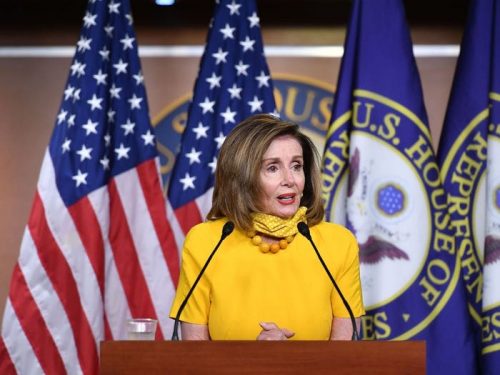 Pelosi Pressed Pentagon on Safeguards to Prevent Trump From Ordering Military Action
But short of the cabinet invoking the 25th Amendment or impeaching and convicting the president, it would be unconstitutional to defy legal orders from the commander in chief, experts note. NYT, By David E. Sanger and Eric Schmitt, Jan. 8, 2021
Speaker Nancy Pelosi of California on Friday took the unprecedented step of asking the chairman of the Joint Chiefs of Staff about “available precautions” to prevent President Trump from initiating military action abroad or using his sole authority to launch nuclear weapons in the last days of his term.
In a phone call to the chairman, Gen. Mark A. Milley, Ms. Pelosi appeared to be seeking to have the Pentagon leadership essentially remove Mr. Trump from his authorities as the commander in chief. That could be accomplished by ignoring the president’s orders or slowing them by questioning whether they were issued legally.
But General Milley appears to have made no commitments. Short of the cabinet invoking the 25th Amendment or removing Mr. Trump through impeachment in the House and conviction in the Senate, it is unconstitutional to defy legal orders from the commander in chief.
Ms. Pelosi’s request, which she announced to the Democratic caucus as an effort to prevent “an unhinged president” from using the nuclear codes, was wrapped in the politics of seeking a second impeachment of Mr. Trump.
Col. Dave Butler, a spokesman for General Milley, confirmed that the phone call with the speaker had taken place but described it as informational. “He answered her questions regarding the process of nuclear command authority,” he said. …….
This was not the first time the issue has come up in American history, or in regard to Mr. Trump.
In the last days of Richard M. Nixon’s presidency, the defense secretary, James R. Schlesinger, quietly issued a set of orders that if Mr. Nixon sought to move or use nuclear weapons, commanders should route the request to him or Secretary of State Henry A. Kissinger. Mr. Schlesinger, describing his actions only after Mr. Nixon left office, said he was concerned that the president was drinking, or that he might lash out.
Michael Beschloss, the presidential historian, said Mr. Schlesinger had told him a number of years ago that “he was worried about Mr. Nixon’s physical and emotional state and wanted to make sure there was no danger the nuclear arsenal would be abused.”……
In the 2016 presidential campaign, Hillary Clinton also raised the issue of Mr. Trump’s suitability to command the nuclear arsenal. “Imagine him in the Oval Office facing a real crisis,” she said in her address at the Democratic National Convention. “A man you can bait with a tweet is not a man we can trust with nuclear weapons.”
……….legally the military cannot deny the president access to the codes unless the 25th Amendment has been activated…….. https://www.nytimes.com/2021/01/08/us/politics/trump-pelosi-nuclear-military.html
Former US defence secretary urges Biden to give up sole power to launch nuclear weapons
|
Biden urged to give up sole power to launch nuclear weapons, https://www.theaustralian.com.au/world/biden-urged-to-give-up-sole-power-to-launch-nuclear-weapons/news-story/fc90ee663c0db888c82917606b7e685e A former US defence secretary has called on president-elect Joe Biden to reform the system that gives sole control of the nation’s nuclear arsenal to the president, calling it “outdated, unnecessary and extremely dangerous”.The call from William Perry came the same day House of Representatives Speaker Nancy Pelosi spoke with the nation’s top military leader about ensuring that an “unhinged” President Donald Trump not be able to launch a nuclear attack in his final days in office.
“Once in office, Biden should announce he would share authority to use nuclear weapons with a select group in congress,” said Dr Perry, who served under Bill Clinton. He was writing in Politico magazine with Tom Collina of the Ploughshares Fund, which advocates for stronger nuclear controls. They said Mr Biden, who takes office on January 20, should also declare that the US would never start a nuclear war and would use the bomb only in retaliation. The piece argues that the current system gives the president — any president — “the godlike power to deliver global destruction in an instant”, an approach the authors call “undemocratic, outdated, unnecessary and extremely dangerous”. Dr Perry, defence secretary from 1994 to 1997, calls Mr Trump “unhinged” and adds: “Do we really think that Trump is responsible enough to trust him with the power to end the world?” American presidents are accompanied at all times by a military aide who carries a briefcase known as “the football” that contains the secret codes and information needed to launch a nuclear strike. Dr Perry and Mr Collina warn that presidents possess the “absolute authority to start a nuclear war. Within minutes, Trump can unleash hundreds of atomic bombs, or just one. He does not need a second opinion. The defence secretary has no say. Congress has no role.” They then ask: “Why are we taking this risk?” Such vast presidential authority, the article notes, dates from the waning days of World War II, when Harry Truman decided, after the nuclear horror unleashed by the bombing of Hiroshima and Nagasaki in Japan, that the power to order the use of atomic weapons should not be left in the hands of the military — that it should be up to the president alone. |
What happens to the nuclear bomb codes, if Trump avoids the inauguration of Biden?
Here’s what happens to the ‘nuclear football’ if Trump skips Biden’s inauguration, Business Insider, RYAN PICKRELL, DEC 16, 2020,
- American presidents are accompanied by a military aide carrying a briefcase with the tools necessary for nuclear war.
- During presidential inaugurations, nuclear command authority and the “nuclear football,” as the briefcase is called, are transferred to the new president.
- But President Donald Trump says he will not participate in President-elect Joe Biden’s inauguration, which could complicate the transfer.
- The Pentagon told Insider there was a plan for the transfer in that scenario but declined to provide details. Nuclear-weapons experts and a former military aide who carried the briefcase were able to offer some insight though.
Trump said Friday that he “will not be going to the Inauguration on January 20th.” He did not say where he will be instead.
So what happens to the “nuclear football” that accompanies the president if Trump doesn’t show? How does it get to Biden?
“That’s a good question,” Hans Kristensen, a nuclear weapons expert at the Federation of American Scientists, told Insider. “It is an unprecedented situation.” In the nuclear age, no president has skipped their successor’s inauguration.
The transfer of the nuclear football is supposed to occur at noon as the new president is sworn in. The military aide who has been carrying the briefcase hands it off to the newly designated military aide, former Vice President Dick Cheney said in a past Discovery documentary. This traditionally happens off to the side and is not a part of the show.
If Trump is not at the inauguration, then the transfer process will be different. Still, the transfer will need to be instantaneous, said retired Air Force Lt. Col. Buzz Patterson, who carried the football for former President Bill Clinton.
USA Congress Speaker Nancy Pelosi asks military to stop Donald Trump accessing nuclear codes
 US politics live updates: Nancy Pelosi asks military to stop Donald Trump accessing nuclear codes https://www.abc.net.au/news/2021-01-09/us-politics-live-updates-donald-trump-nuclear-codes/13043904 Peter Marsh US politics live updates: Nancy Pelosi asks military to stop Donald Trump accessing nuclear codes https://www.abc.net.au/news/2021-01-09/us-politics-live-updates-donald-trump-nuclear-codes/13043904 Peter MarshHouse Speaker Nancy Pelosi says she has spoken to the chairman of the Joint Chiefs of Staff, General Mark Milley (pictured with Donald Trump above), about stopping Donald Trump from launching a nuclear strike during his final days in office. “The situation of this unhinged president could not be more dangerous, and we must do everything that we can to protect the American people from his unbalanced assault on our country and our democracy,” Pelosi said in a letter to colleagues. Reuters is reporting that Milley’s office said that Pelosi had initiated the call and Milley “answered her questions regarding the process of nuclear command authority.” A US official, speaking on condition of anonymity to Reuters, said that any use of nuclear weapons is a highly deliberative process. A person familiar with Friday’s call said Pelosi has told them that Milley has told her there are precautions in place that would prevent Trump from launching a nuclear strike, according to the Associated Press. |
|
183 workers at Waste Isolation Pilot Plant infected with COVID-19
|
183 workers at Waste Isolation Pilot Plant infected with COVID-19, Adrian Hedden
Carlsbad Current-Argus, 8 Jan 21,
Six more cases of COVID-19 were reported at the Waste Isolation Pilot Plant last week, bringing the facility’s total caseload to 183 as coronavirus continued to spread in New Mexico.All six of the cases reported at the nuclear waste facility near Carlsbad were from employees of Nuclear Waste Partnership (NWP), the primary operations contractor at WIPP. The employees were last at the site between Dec. 3 and 18, and the positive results were reported between Dec. 22 and 28……. https://www.currentargus.com/story/news/local/2021/01/05/183-workers-waste-isolation-pilot-plant-infected-covid-19/4125844001/ |
|
|
Australia’s Prime Minister Scott Morrison could stop the persecution of Australian citizen Julian Assange
|
Rex Patrick, Independent senator, January 5, 2021 A British judge has rejected the US Justice Department’s effort to have Wikileaks publisher Julian Assange extradited to the United States to face espionage charges for obtaining and publishing secret documents that revealed war crimes. The decision of Judge Vanessa Baraitser to deny the extradition request has given Assange an important legal victory in his efforts to avoid extradition for actions many would regard as inherent to media freedom – the right of journalists to obtain and publish information and to protect confidential sources. However, in her ruling Judge Baraitser dismissed the arguments of Assange’s lawyers in relation to these matters, saying she was satisfied that the American authorities made their extradition request in good faith, that the case was not politically driven, and that Assange was not merely acting as a journalist. |
|

The risk of USA – Iran military showdown before Trump leaves office
Are the US and Iran headed for a military showdown before Trump leaves office? The Conversation Clive Williams
Campus visitor, ANU Centre for Military and Security Law, Australian National University, January 4, 2021 Tensions are running high in the Middle East in the waning days of the Trump administration.
Over the weekend, Iran’s foreign minister, Mohammad Javad Zarif, claimed Israeli agents were planning to attack US forces in Iraq to provide US President Donald Trump with a pretext for striking Iran.
Just ahead of the one-year anniversary of the US assassination of Iran’s charismatic General Qassem Soleimani, the head of Iran’s Revolutionary Guards also warned his country would respond forcefully to any provocations.
Today, we have no problem, concern or apprehension toward encountering any powers. We will give our final words to our enemies on the battlefield.
Israeli military leaders are likewise preparing for potential Iranian retaliation over the November assassination of senior Iranian nuclear scientist Mohsen Fakhrizadeh — an act Tehran blames on the Jewish state.
Both the US and Israel have reportedly deployed submarines to the Persian Gulf in recent days, while the US has flown nuclear-capable B-52 bombers to the region in a show of force.
And in another worrying sign, the acting US defence secretary, Christopher Miller, announced over the weekend the US would not withdraw the aircraft carrier USS Nimitz and its strike group from the Middle East — a swift reversal from the Pentagon’s earlier decision to send the ship home.
Israel’s priorities under a new US administration
Israeli Prime Minister Benjamin Netanyahu would like nothing more than action by Iran that would draw in US forces before Trump leaves office this month and President-elect Joe Biden takes over. It would not only give him the opportunity to become a tough wartime leader, but also help to distract the media from his corruption charges.
Any American military response against Iran would also make it much more difficult for Biden to establish a working relationship with Iran and potentially resurrect the 2015 Iran nuclear deal.
It’s likely in any case the Biden administration will have less interest in getting much involved in the Middle East — this is not high on the list of priorities for the incoming administration. However, a restoration of the Iranian nuclear agreement in return for the lifting of US sanctions would be welcomed by Washington’s European allies.
This suggests Israel could be left to run its own agenda in the Middle East during the Biden administration.
Israel sees Iran as its major ongoing security threat because of its support for Hezbollah in Lebanon and Palestinian militants in Gaza.
One of Israel’s key strategic policies is also to prevent Iran from ever becoming a nuclear weapon state. Israel is the only nuclear weapon power in the Middle East and is determined to keep it that way.
While Iran claims its nuclear program is only intended for peaceful purposes, Tehran probably believes realistically (like North Korea) that its national security can only be safeguarded by possession of a nuclear weapon.
In recent days, Tehran announced it would begin enriching uranium to 20% as quickly as possible, exceeding the limits agreed to in the 2015 nuclear deal.
This is a significant step and could prompt an Israeli strike on Iran’s underground Fordo nuclear facility. Jerusalem contemplated doing so nearly a decade ago when Iran previously began enriching uranium to 20%.
How the Iran nuclear deal fell apart……….. https://theconversation.com/are-the-us-and-iran-headed-for-a-military-showdown-before-trump-leaves-office-152606
Biden Plans Renewed Nuclear Talks With Russia While Punishing Kremlin
Biden Plans Renewed Nuclear Talks With Russia While Punishing Kremlin, Adviser Says. The president-elect also plans to pursue a “follow-on negotiation” with Iran over its missile capabilities if Tehran re-enters compliance with the nuclear deal.
NYT, By David E. Sanger, Jan. 3, 2021
President-elect Joseph R. Biden Jr.’s incoming national security adviser said on Sunday that the new administration would move quickly to renew the last remaining major nuclear arms treaty with Russia, even while seeking to make President Vladimir V. Putin pay for what appeared to be the largest-ever hacking of United States government networks.
In an interview on “GPS” on CNN, Jake Sullivan, who at 44 will become the youngest national security adviser in more than a half century, also said that as soon as Iran re-entered compliance with the 2015 nuclear deal — which he helped negotiate under President Barack Obama — there would be a “follow-on negotiation” over its missile capabilities.
“In that broader negotiation, we can ultimately secure limits on Iran’s ballistic missile technology,” Mr. Sullivan said, “and that is what we intend to try to pursue through diplomacy.”
He did not mention that missiles were not covered in the previous accord because the Iranians refused to commit to any limitations on their development or testing. To bridge the impasse, the United Nations passed a weakly worded resolution that called on Tehran to show restraint; the Iranians say it is not binding, and they have ignored it.
Taken together, Mr. Sullivan’s two statements indicated how quickly the new administration would be immersed in two complex arms control issues, even as Mr. Biden seeks to deal with the coronavirus pandemic and the economic shocks it has caused. But the first issue to arise, renewing the New Start, will be made more complex because of Mr. Biden’s vow to assure that Moscow pays for the hacking of more than 250 American government and private networks, an intrusion that now appears far more extensive than first thought.
Mr. Biden has said that after the government formally determines who was responsible for the attack, “we will respond, and probably respond in kind.” But that means moving to punish Russia while keeping New Start — a remnant of the era when nuclear rather than cyber was the dominant issue between the two countries — from lapsing and setting off a new arms race. ……… https://www.nytimes.com/2021/01/03/us/politics/biden-russia-iran.html
Astounding failure by Ohio Republican leadership to repeal nuclear bailout law
Claims in a federal complaint released in July indicate that the law was at the heart of an alleged corruption scheme involving roughly $60 million. Former Ohio House Speaker Larry Householder, R-Glenford, and others were arrested last summer.
Failure to repeal the law in 2020 was “an astounding failure by Republican leadership,” said Rep. David Leland, D-Columbus, as the legislature adjourned last month……..
Allegations in the federal criminal case indicate that FirstEnergy and FirstEnergy Solutions — now known as Energy Harbor — provided most of the funding for an alleged scheme to elect favorable lawmakers and then to pass and defend HB 6. …….
Rulings from the Ohio Supreme Court and the Franklin County Court of Common Pleas have temporarily postponed collection of the nuclear plant subsidies anyway. Meanwhile, FirstEnergy benefits from the 2019 law’s revenue guarantee provision. Consumers pay subsidies for the old coal plants. And provisions that gutted Ohio’s renewable energy and energy efficiency standards are in full force…….
FirstEnergy Solutions paid money to Generation Now. The dark money group is a defendant in the criminal case.
And while Seitz maintained that “no alleged corruption infected all of HB 6,” others such as Rep. Mike Skindell, D-Lakewood, have stressed that “all of it — not just part of it” is tainted by the alleged corruption.
“To suggest we can parse out which pieces of the bill were not the product of corruption is wishful thinking,” Leppla said. “There is an ongoing FBI investigation, with more shoes likely to drop, so we won’t know the full extent of the corruption for some time.”
Although a FirstEnergy Solutions officer provided brief testimony on HB 6 in 2019, the company has not provided financial materials in any hearings to back up its alleged need for funding. Asked why he wouldn’t make Energy Harbor provide such sworn testimony now, Seitz said the proposed regulatory audit would be “much better than any testimony at this point.”
“Pushing it off to a closed-door audit that won’t be made fully public is a convenient way for legislators to avoid public scrutiny and outrage at forking over Ohioans’ hard-earned money to bail out a company that doesn’t need it,” Leppla said.
“I can’t think why the legislature would not want this information,” Brown said. Indeed, an option approach would tell Energy Harbor that it could draw on a slush fund if it is too incompetent or too inefficient to compete. In his view, the whole approach is “beyond crony capitalism.”………
“What we do know,” Leppla said, “is that HB 6 was a widely disliked bill that will raise Ohioans’ bills, pollute our air, and send us backward in the fight against climate change — and yet, it passed anyway.” https://www.wvxu.org/post/rep-bill-seitz-forefront-key-points-nuclear-bailout-law-hb-6#stream/0
-
Archives
- October 2026 (119)
- September 2026 (339)
- August 2026 (330)
- July 2026 (355)
- June 2026 (287)
- May 2026 (306)
- April 2026 (356)
- March 2026 (251)
- February 2026 (267)
- January 2026 (308)
- December 2025 (358)
- November 2025 (359)
-
Categories
- 1
- 1 NUCLEAR ISSUES
- business and costs
- climate change
- culture and arts
- ENERGY
- environment
- health
- history
- indigenous issues
- Legal
- marketing of nuclear
- media
- opposition to nuclear
- PERSONAL STORIES
- politics
- politics international
- Religion and ethics
- safety
- secrets,lies and civil liberties
- spinbuster
- technology
- Uranium
- wastes
- weapons and war
- Women
- 2 WORLD
- ACTION
- AFRICA
- Atrocities
- AUSTRALIA
- Christina's notes
- Christina's themes
- culture and arts
- Events
- Fuk 2022
- Fuk 2023
- Fukushima 2017
- Fukushima 2018
- fukushima 2019
- Fukushima 2020
- Fukushima 2021
- general
- global warming
- Humour (God we need it)
- Nuclear
- RARE EARTHS
- Reference
- resources – print
- Resources -audiovicual
- Weekly Newsletter
- World
- World Nuclear
- YouTube
-
RSS
Entries RSS
Comments RSS

