Elon Musk to take part in a project to place advertising in space?

Elon Musk slammed as SpaceX to launch satellite displaying billboard ads in space
ELON MUSK has come under fire from the scientific community after it has emerged a company wants SpaceX to launch a satellite broadcasting billboard ads from space. Express UK By SEBASTIAN KETTLEY, Aug 9, 2021
Background color
The South African billionaire, who does not shy away from controversy, has a lot going on his plate right now. SpaceX is busy assembling and testing the Mars rocket Starship, Starlink is slowly expanding its mega-constellation Internet-beaming satellites and Tesla has recently rolled out the Model S Plaid. A new report has now revealed SpaceX is partnering with a Canadian startup to launch the world’s first space-based ad satellite.
According to Samuel Reid, CEO and co-founder of Geometric Energy Corporation (GEC), the company will pay SpaceX to launch an advertisement satellite into low-Earth orbit (LEO).
This satellite, called CubeSat, will boast a large screen full of purchasable pixels on one side where advertisers will bid to have their logos and products displayed.
Mr Reid told Insider: “There might be companies which want to depict their logo… or might end up being a bit more personal artistic.

“Maybe Coca-Cola and Pepsi will fight over their logo and reclaim over each other.
SpaceX will not play a direct role in the mission but rather act as the launch provider at some point in early 2022, using one of the company’s iconic Falcon 9 rockets.
Once in orbit, the CubeSat will use a selfie stick to broadcast its stream back to Earth via Twitch or YouTube.
Luckily, this means giant billboards are not about to fill up the night skies with advertising.
But the news has sparked an outcry on social media, with scientists and spaceflight enthusiasts alike criticising the move.
Comedy writer James Felton took to Twitter to vent his disapproval
He said: “Going to be difficult to pretend we’re not living in a sci-fi dystopian apocalypse when we take a moment to look up from the raging wildfires engulfing the planet to see the words Drink Pepsi.”
Game programmer and reporter Matthew Chapman said: “No. I draw the line here.
“Congress needs to ban Space Billboards before they become a thing.
“Already SpaceX satellites are creating a minefield of pollution in low-Earth orbit.”
And science writer Amy Shira Teitel said: “Coke vs Pepsi in space? What’s a little more horrendous light pollution between mega-advertising behemoths?
“Hoping this never, ever happens…”
To advertise on the pixel billboard, customers will have to pay using cryptocurrency tokens.
These will include digital tokens like ethereum, though GEC plans to accept dogecoin in the future.
Advertisers will get to select each individual pixel they want and fill them out with a colour of their choice.
Once they fill out enough pixels, a discernable image will emerge on the screen.
Mr Reid said: “I’m trying to achieve something that can democratize access to space and allow for decentralized participation………… https://www.express.co.uk/news/science/1474414/elon-musk-slammed-spacex-launch-satellite-billboard-ads-in-space-scn
Comparing the costs of nuclear and solar power
Solar challenging nuclear as potential climate change solution https://www.pv-magazine.com/2021/08/09/solar-challenging-nuclear-as-potential-climate-change-solution/
Research suggests that we can power 80% of the United States with wind, solar, and 12 hours of energy storage, but the replacement of nuclear power plants hasn’t been financially viable. Is that about to change?AUGUST 9, 2021 JOHN FITZGERALD WEAVER Nuclear power delivers almost 20% of all electricity in the United States, and about 50% [ if you don’t count the uranium-nuclear fuel chain] of all low-emission electricity. Moreover, the United States has almost 100 nuclear power units operating more than 90% of the time, providing a steady base of power generation.
But moving forward, it seems nuclear has lost its swagger. Price increases, project delays, and cancellations have caused what may prove to be generational damage to nuclear power’s reputation. pv magazine USA has previously reported on industry pricing models, showing nuclear’s lagging pricing.
Now, Georgia Power’s Vogtle Unit 3 and Unit 4 – the nation’s only nuclear generating units currently under construction – have announced further delays and price increases. Conservative cost estimates suggest the two 1.117 GW facilities will require at least $30 billion to complete, including $3 billion in finance costs and $27 billion in construction costs.
Solar+storage costs
As solar and energy storage professionals, we must be conscious of the limitations of the sun, and the cost of energy storage. As we all know, the sun also sets. And while research suggests we can power 80% of the U.S. with wind, solar, and 12 hours of energy storage, being able to replace a nuclear power plant that runs 24/7/365 in wind, rain, snow, and sleet simply hasn’t been financially viable.
But is it today?
The chart above [ on original] shows the price of solar panels from 1976 through the end of 2019. Here, we see prices fall by more than 99.8% from over $100 per watt down to nearly $0.20 per watt. Below, we see the price of battery packs starting in 2010 and ending in 2020, based on data from Bloomberg New Energy Finance. Here, we see costs fall from $1,191/kWh to $137/kWh – a price decrease of greater than 88%.
In both cases, we can expect prices to continue trending downward in both the middle and long term. And so, what can we expect to pay when we replace a nuclear power plant with solar power plus batteries?
Cash to spend
The chart above [ on original] shows the price of solar panels from 1976 through the end of 2019. Here, we see prices fall by more than 99.8% from over $100 per watt down to nearly $0.20 per watt. Below, we see the price of battery packs starting in 2010 and ending in 2020, based on data from Bloomberg New Energy Finance. Here, we see costs fall from $1,191/kWh to $137/kWh – a price decrease of greater than 88%.
In both cases, we can expect prices to continue trending downward in both the middle and long term. And so, what can we expect to pay when we replace a nuclear power plant with solar power plus batteries?
Cash to spend
In order to replace the two nuclear plants while the sun is down, the batteries would need to replicate two 1.117 GW power sources for 16 hours. The total energy storage capacity would be 39.3 GWh, after we add an extra 10% for safe measure.
Roughly speaking, the total cost of these solar+storage facilities would be:
- $8.4 billion for 10.55 GWdc of solar power, fully installed at $0.80/watt
- $527 million for hypothetical power grid upgrades at $0.05/watt
- $7.8 billion for 39.3 GWh of energy storage fully installed at $200/kWh
- Around $16.8 billion grand total, no incentives
So, Georgia, pv magazine USA just saved you more than $13 billion (as of today, anyway).
Some caveats
It’s almost certain that a solar facility of this magnitude – roughly 27,000 acres, or around 0.07% of Georgia’s land – would be split among many landowners in the state. If land lease rates in Georgia are comparable to what might be earned in Pennsylvania, the project could provide as much as $27 million per year in income to Georgia landowners for decades to come.
Furthermore, the solar power plants would start generating electricity and revenue within about three years of the first signature, and two years after groundbreaking. The new Vogtle reactors began construction in 2013 (planning began much earlier), and are projected to complete in 2022-23.
With these considerations in mind, the repowering costs to get a solar+storage facility to a 40 to 80-year lifetime would likely be offset by the fact that the solar facility will enter service at least eight years earlier than the equivalent nuclear site. Additionally, during the solar plant’s operating lifetime, it saves massive amounts of regular operations and maintenance costs,
as well as specialist engineer labor costs. The nuclear facility will easily last 40 years, and potentially as long as 80. However, the ongoing operations and maintenance costs are significant, as well as upgrades and equipment replacements that start to become necessary after 40 years. And sometimes, those $1 billion dollar upgrades go wrong, and a nuclear power plant gets trashed.
When we do repower the batteries and solar panels, they almost certainly will be cheaper, and operate at a higher efficiency, likely stretching the life of the solar facility to 50+ years. Again, this solar+storage facility would generate 20% more juice in the summer (when the power is needed most in Georgia) because we oversized it for the winter.
In the end, it would be best if we had a healthy ecosystem of clean energy generation systems that include nuclear [but nuclear is not clean]. However, if we’re going to debate the costs of nukes vs. solar, then it is no longer a discussion.
Stockton Professor: Nuclear Power is “Terrible Neighbor
Stockton Professor: Nuclear Power is “Terrible Neighbor” https://ocnjdaily.com/stockton-professor-nuclear-power-terrible-neighbor/ By MediaWize – August 8, 2021 By DR. JOHN AITKEN Ph.D., Adjunct Professor of Physics, Stockton University
Opponents of the Ocean Wind turbine project spoke in favor of using nuclear power as an alternative to the wind power at the July 27 Michael Shellenberger presentation sponsored by Save Our Shores in Ocean City.
The speaker stated that that while climate change is indeed real, the only solution to reducing carbon emissions is nuclear power, contrary to the position of many environmental organizations.
His proposals to pursue solely nuclear power did not mention its disadvantages and costs. Nuclear power operates carbon free as do solar and wind power, but unlike them, nuclear generates large quantities of dangerous waste that are difficult to dispose of and costly to manage.
Nuclear power can supply an unlimited amount of power but creates an unlimited amount of hazardous nuclear waste requiring storage for at least 300 years. Nuclear power may be a useful servant but it is a terrible neighbor.
Take the example of the Oyster Creek nuclear plant 35 miles north of Atlantic City. After approximately 50 years of service it is being decommissioned due to its inability to compete with cheaper natural gas.
In the 1960s, Lacey Township signed up to host the plant. What they did not realize at the time was that they had signed a deal with devil. The town had traded its own long-term safety for the benefits of good paying jobs and reduced property taxes.
Due to environmental and transportation concerns, nuclear waste storage sites in Nevada or Washington state promised by the federal government never materialized, leaving local plants on their own to store their nuclear waste on site for decades if not centuries.
The costs associated with decommissioning the nuclear site, estimated between $800 million and $1.4 billion, are another legacy left by the plant. The original owner/operator of the plant, Exelon, sold the plant to another company who will execute the decommissioning plan. For the rest of this article I will refer to this decommissioning company as DC.
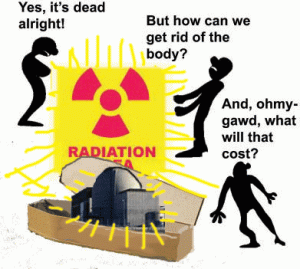
While the project is supported by a decommissioning fund, likely cost overruns will be paid by future generations through their utility bills. The costs cover the removal and deactivation of spent nuclear fuel, control rods, the reactor and associated buildings, which themselves have become radioactive from exposure to radiation.
But now, with decommissioning approaching, the township is paying the piper dearly for the good years. Oyster Creek Nuclear Plant has been shut down. The spent nuclear fuel and radioactive debris from the reactor and the associated buildings will be stored in 68 cylindrical casks, each 22 feet high and 11 feet in diameter, emitting low levels of radiation on the now-defunct site. The casks must remain intact for at least 300 years to allow the radioactivity of the waste inside to decay to handleable levels.
DC is now in charge of the decommissioning project. DC makes no commitment as to how long, decades or even centuries, these casks will have to remain on the Lacey Township site in close proximity to homes and schools.
Nor is there a guarantee that the casks, manufactured by DC, will remain intact during the 300-year storage period. Lacey Township at first sued DC to prevent the storage of these casks on the site. After a long legal battle, Lacey settled the lawsuit with them, acquiescing to the onsite storage on the condition that DC would build and assign another cask for emergency use by the township.
The Lacey Township decision shows it is a virtual prisoner of DC, which now owns the nuclear waste but is also the town’s only hope of restoring the site to radiation-free conditions.
Operating nuclear plants are also a continual hazard to the communities where they are sited. Nuclear plants do not pose a threat of nuclear explosion. Their Achilles heel is the plumbing, which brings water in and out of the reactor vessels.
The water pipes, degraded by the nuclear reactions, develop cracks and eventually leak water with radioactive contaminants. This water can leak into the local water supply and cause cancer or DNA damage to people who drink it.
As shown by the Oyster Creek experience, nuclear power is costly, dangerous and unmanageable. Those in favor of nuclear power should be ready to accept nuclear power stations in their own backyards and relive the Lacey Township experience. Nuclear power makes a terrible neighbor.
Delay in demolition of Three Mile Island Nuclear Station
Three Mile Island Nuclear Plant Demolition Delayed
WKOK Staff | August 8, 2021 MIDDLETOWN – Stateimpact Pennsylvania is reporting…The company responsible for decommissioning the Unit 2 reactor at the Three Mile Island nuclear plant is delaying demolition of the reactor’s two cooling towers, the project director said Wednesday. Frank Helin told the TMI-2 Community Advisory Panel that the towers will come down in 2022 instead of this fall.The decommissioner, TMI-2 Solutions, is a subsidiary of EnergySolutions, a Utah-based company that tries to turn a profit by dismantling inactive nuclear sites under budget. TMI-2 Solutions acquired the reactor’s license from FirstEnergy in December. The company plans to start removing what remains of TMI-2’s damaged core by mid-2022. It expects to complete the entire clean-up process by 2037. EnergySolutions spokesman Mark Walker said the delay in taking down the cooling towers does not affect the rest of the process…………
Eric Epstein, chair of the watchdog group Three Mile Island Alert, said that while he is not concerned about the cooling towers, he believes the reactor building may have more radioactive material than the company is prepared to deal with.
“Our concern is making sure that the plant is finally cleaned up 42 years later,” he said. “We don’t believe the company that owns TMI-2 has the technology, the expertise, or the resources to clean the plant up.” On its website, TMI-2 Solutions says it anticipates the project will cost $1.06 billion. It says the trust fund dedicated to the reactor’s decommissioning contains about $877 million, but that fund growth over time will provide enough money to cover the costs. https://www.wkok.com/three-mile-island-nuclear-plant-demolition-delayed/
David Swanson explodes the myths about why the USA nuclear bombed Hiroshima and Nagasaki

Why do U.S. history teachers in U.S. elementary schools today — in 2021! — tell children that nuclear bombs were dropped on Japan to save lives — or rather “the bomb” (singular) to avoid mentioning Nagasaki? Researchers and professors have pored over the evidence for 75 years. They know that Truman knew that the war was over, that Japan wanted to surrender, that the Soviet Union was about to invade. They’ve documented all the resistance to the bombing within the U.S. military and government and scientific community, as well as the motivation to test bombs that so much work and expense had gone into, as well as the motivation to intimidate the world and in particular the Soviets, as well as the open and shameless placing of zero value on Japanese lives. How were such powerful myths generated that the facts are treated like skunks at a picnic?
Hiroshima Is A Lie Endangerment By David Swanson, World BEYOND War, August 5, 2021
”………………… could an 18-year-old in 2015 be expected to know that most of the victims of WWII were civilians — men and women and children alike? Who would have told her that? Certainly not her text books. Most definitely not the endless saturation of her culture with WWII-themed entertainment. ……… In U.S. culture as well, which heavily influences Italian, a top focus for drama and tragedy and comedy and heroism and historical fiction is WWII.
……… WWII is often called “the good war,” and sometimes this is thought of as principally or originally a contrast between WWII, the good war, and WWI, the bad war. However, it was not popular to call WWII “the good war” during or immediately after it happened, when the comparison with WWI would have been easiest. Various factors may have contributed to the growth in popularity of that phrase over the decades, including increased understanding of the Holocaust (and misunderstanding of the war’s relationship to it),[ii] plus, of course, the fact that the United States, unlike all the other major participants, wasn’t itself bombed or invaded …………
Perhaps the strangest myths, though, are those about nuclear weapons, especially the idea that by murdering huge numbers of people with them a far greater number of lives, or at least the right kind of lives, were spared. The nukes did not save lives. They took lives, possibly 200,000 of them. They were not intended to save lives or to end the war. And they didn’t end the war. The Russian invasion did that. But the war was going to end anyway, without either of those things. The United States Strategic Bombing Survey concluded that, “… certainly prior to 31 December, 1945, and in all probability prior to 1 November, 1945, Japan would have surrendered even if the atomic bombs had not been dropped, even if Russia had not entered the war, and even if no invasion had been planned or contemplated.”[vi]
One dissenter who had expressed this same view to the Secretary of War and, by his own account, to President Truman, prior to the bombings was General Dwight Eisenhower.[vii] Under Secretary of the Navy Ralph Bard, prior to the bombings, urged that Japan be given a warning.[viii] Lewis Strauss, Advisor to the Secretary of the Navy, also prior to the bombings, recommended blowing up a forest rather than a city.[ix] General George Marshall apparently agreed with that idea.[x] Atomic scientist Leo Szilard organized scientists to petition the president against using the bomb.[xi] Atomic scientist James Franck organized scientists who advocated treating atomic weapons as a civilian policy issue, not just a military decision.[xii] Another scientist, Joseph Rotblat, demanded an end to the Manhattan Project, and resigned when it was not ended.[xiii] A poll of the U.S. scientists who had developed the bombs, taken prior to their use, found that 83% wanted a nuclear bomb publicly demonstrated prior to dropping one on Japan. The U.S. military kept that poll secret.[xiv] General Douglas MacArthur held a press conference on August 6, 1945, prior to the bombing of Hiroshima, to announce that Japan was already beaten.[xv]
The Chairman of the Joint Chiefs of Staff Admiral William D. Leahy said angrily in 1949 that Truman had assured him only military targets would be nuked, not civilians. “The use of this barbarous weapon at Hiroshima and Nagasaki was of no material assistance in our war against Japan. The Japanese were already defeated and ready to surrender,” Leahy said.[xvi] Top military officials who said just after the war that the Japanese would have quickly surrendered without the nuclear bombings included General Douglas MacArthur, General Henry “Hap” Arnold, General Curtis LeMay, General Carl “Tooey” Spaatz, Admiral Ernest King, Admiral Chester Nimitz, Admiral William “Bull” Halsey, and Brigadier General Carter Clarke. As Oliver Stone and Peter Kuznick summarize, seven of the United States’ eight five-star officers who received their final star in World War II or just after — Generals MacArthur, Eisenhower, and Arnold, and Admirals Leahy, King, Nimitz, and Halsey — in 1945 rejected the idea that the atomic bombs were needed to end the war. “Sadly, though, there is little evidence that they pressed their case with Truman before the fact.”[xvii]
On August 6, 1945, President Truman lied on the radio that a nuclear bomb had been dropped on an army base, rather than on a city. And he justified it, not as speeding the end of the war, but as revenge against Japanese offenses. “Mr. Truman was jubilant,” wrote Dorothy Day. Weeks before the first bomb was dropped, on July 13, 1945, Japan had sent a telegram to the Soviet Union expressing its desire to surrender and end the war. The United States had broken Japan’s codes and read the telegram. Truman referred in his diary to “the telegram from Jap Emperor asking for peace.” President Truman had been informed through Swiss and Portuguese channels of Japanese peace overtures as early as three months before Hiroshima. Japan objected only to surrendering unconditionally and giving up its emperor, but the United States insisted on those terms until after the bombs fell, at which point it allowed Japan to keep its emperor. So, the desire to drop the bombs may have lengthened the war. The bombs did not shorten the war.[xviii]
Presidential advisor James Byrnes had told Truman that dropping the bombs would allow the United States to “dictate the terms of ending the war.” Secretary of the Navy James Forrestal wrote in his diary that Byrnes was “most anxious to get the Japanese affair over with before the Russians got in.” Truman wrote in his diary that the Soviets were preparing to march against Japan and “Fini Japs when that comes about.” The Soviet invasion was planned prior to the bombs, not decided by them. The United States had no plans to invade for months, and no plans on the scale to risk the numbers of lives that U.S. school teachers will tell you were saved.[xix] The idea that a massive U.S. invasion was imminent and the only alternative to nuking cities, so that nuking cities saved huge numbers of U.S. lives, is a myth. Historians know this, just as they know that George Washington didn’t have wooden teeth or always tell the truth, and Paul Revere didn’t ride alone, and slave-owning Patrick Henry’s speech about liberty was written decades after he died, and Molly Pitcher didn’t exist.[xx] But the myths have their own power. Lives, by the way, are not the unique property of U.S. soldiers. Japanese people also had lives.
Truman ordered the bombs dropped, one on Hiroshima on August 6th and another type of bomb, a plutonium bomb, which the military also wanted to test and demonstrate, on Nagasaki on August 9th. The Nagasaki bombing was moved up from the 11th to the 9th to decrease the likelihood of Japan surrendering first.[xxi] Also on August 9th, the Soviets attacked the Japanese. During the next two weeks, the Soviets killed 84,000 Japanese while losing 12,000 of their own soldiers, and the United States continued bombing Japan with non-nuclear weapons — burning Japanese cities, as it had done to so much of Japan prior to August 6th that, when it came time to pick two cities to nuke, there hadn’t been many left to choose from. Then the Japanese surrendered.
That there was cause to use nuclear weapons is a myth. That there could again be cause to use nuclear weapons is a myth. That we can survive significant further use of nuclear weapons is a myth. That there is cause to produce nuclear weapons even though you’ll never use them is too stupid even to be a myth. And that we can forever survive possessing and proliferating nuclear weapons without someone intentionally or accidentally using them is pure insanity.[xxii]
Why do U.S. history teachers in U.S. elementary schools today — in 2021! — tell children that nuclear bombs were dropped on Japan to save lives — or rather “the bomb” (singular) to avoid mentioning Nagasaki? Researchers and professors have pored over the evidence for 75 years. They know that Truman knew that the war was over, that Japan wanted to surrender, that the Soviet Union was about to invade. They’ve documented all the resistance to the bombing within the U.S. military and government and scientific community, as well as the motivation to test bombs that so much work and expense had gone into, as well as the motivation to intimidate the world and in particular the Soviets, as well as the open and shameless placing of zero value on Japanese lives. How were such powerful myths generated that the facts are treated like skunks at a picnic? ………………………………. https://worldbeyondwar.org/hiroshima-is-a-lie/
How the USA fabricated a movie, full of falsehoods about the nuclear bombing in 1945.

Over and over we’re told that bigger bombs will bring peace and end war.
We’re told and shown completely fabricated nonsense
At the time The Beginning or the End was being scripted and filmed, the U.S. government was seizing and hiding away every scrap it could find of actual photographic or filmed documentation of the bomb sites.
Hiroshima Is A Lie Endangerment By David Swanson, World BEYOND War, August 5, 2021 ”……………………… In Greg Mitchell’s 2020 book, The Beginning or the End: How Hollywood — and America — Learned to Stop Worrying and Love the Bomb, we have an account of the making of the 1947 MGM film, The Beginning or the End, which was carefully shaped by the U.S. government to promote falsehoods.[xxiii] The film bombed. It lost money. The ideal for a member of the U.S. public was clearly not to watch a really bad and boring pseudo-documentary with actors playing the scientists and warmongers who had produced a new form of mass-murder. The ideal action was to avoid any thought of the matter. But those who couldn’t avoid it were handed a glossy big-screen myth. You can watch it online for free, and as Mark Twain would have said, it’s worth every penny.[xxiv]
The film opens with what Mitchell describes as giving credit to the UK and Canada for their roles in producing the death machine — supposedly a cynical if falsified means of appealing to a larger market for the movie. But it really appears to be more blaming than crediting. This is an effort to spread the guilt. The film jumps quickly to blaming Germany for an imminent threat of nuking the world if the United States didn’t nuke it first. (You can actually have difficulty today getting young people to believe that Germany had surrendered prior to Hiroshima, or that the U.S. government knew in 1944 that Germany had abandoned atomic bomb research in 1942.[xxv]) Then an actor doing a bad Einstein impression blames a long list of scientists from all over the world. Then some other personage suggests that the good guys are losing the war and had better hurry up and invent new bombs if they want to win it.
Over and over we’re told that bigger bombs will bring peace and end war. A Franklin Roosevelt impersonator even puts on a Woodrow Wilson act, claiming the atom bomb might end all war (something a surprising number of people actually believe it did, even in the face of the past 75 years of wars, which some U.S. professors describe as the Great Peace). We’re told and shown completely fabricated nonsense, such as that the U.S. dropped leaflets on Hiroshima to warn people (and for 10 days — “That’s 10 days more warning than they gave us at Pearl Harbor,” a character pronounces) and that the Japanese fired at the plane as it approached its target. In reality, the U.S. never dropped a single leaflet on Hiroshima but did — in good SNAFU fashion — drop tons of leaflets on Nagasaki the day after Nagasaki was bombed. Also, the hero of the movie dies from an accident while fiddling with the bomb to get it ready for use — a brave sacrifice for humanity on behalf of the war’s real victims — the members of the U.S. military. The film also claims that the people bombed “will never know what hit them,” despite the film makers knowing of the agonizing suffering of those who died slowly.
One communication from the movie makers to their consultant and editor, General Leslie Groves, included these words: “Any implication tending to make the Army look foolish will be eliminated.”[xxvi]
The main reason the movie is deadly boring, I think, is not that movies have sped up their action sequences every year for 75 years, added color, and devised all kinds of shock devices, but simply that the reason anybody should think the bomb that the characters all talk about for the entire length of the film is a big deal is left out. We don’t see what it does, not from the ground, only from the sky.
Mitchell’s book is a bit like watching sausage made, but also a bit like reading the transcripts from a committee that cobbled together some section of the Bible. This is an origin myth of the Global Policeman in the making. And it’s ugly. It’s even tragic. The very idea for the film came from a scientist who wanted people to understand the danger, not glorify the destruction. This scientist wrote to Donna Reed, that nice lady who gets married to Jimmy Stewart in It’s a Wonderful Life, and she got the ball rolling. Then it rolled around an oozing wound for 15 months and voilà, a cinematic turd emerged.
There was never any question of telling the truth. It’s a movie. You make stuff up. And you make it all up in one direction. The script for this movie contained at times all sorts of nonsense that didn’t last, such as the Nazis giving the Japanese the atomic bomb — and the Japanese setting up a laboratory for Nazi scientists, exactly as back in the real world at this very time the U.S. military was setting up laboratories for Nazi scientists (not to mention making use of Japanese scientists). None of this is more ludicrous than The Man in the High Castle, to take a recent example of 75 years of this stuff, but this was early, this was seminal. Nonsense that didn’t make it into this film, everybody didn’t end up believing and teaching to students for decades, but easily could have. The movie makers gave final editing control to the U.S. military and the White House, and not to the scientists who had qualms. Many good bits as well as crazy bits were temporarily in the script, but excised for the sake of proper propaganda.
If it’s any consolation, it could have been worse. Paramount was in a nuclear arms film race with MGM and employed Ayn Rand to draft the hyper-patriotic-capitalist script. Her closing line was “Man can harness the universe — but nobody can harness man.” Fortunately for all of us, it didn’t work out. Unfortunately, despite John Hersey’s A Bell for Adano being a better movie than The Beginning or the End, his best-selling book on Hiroshima didn’t appeal to any studios as a good story for movie production. Unfortunately, Dr. Strangelove would not appear until 1964, by which point many were ready to question future use of “the bomb” but not past use, making all questioning of future use rather weak. This relationship to nuclear weapons parallels that to wars in general. The U.S. public can question all future wars, and even those wars it’s heard of from the past 75 years, but not WWII, rendering all questioning of future wars weak. In fact, recent polling finds horrific willingness to support future nuclear war by the U.S. public.
At the time The Beginning or the End was being scripted and filmed, the U.S. government was seizing and hiding away every scrap it could find of actual photographic or filmed documentation of the bomb sites. Henry Stimson was having his Colin Powell moment, being pushed forward to publicly make the case in writing for having dropped the bombs. More bombs were rapidly being built and developed, and whole populations evicted from their island homes, lied to, and used as props for newsreels in which they are depicted as happy participants in their destruction.
Mitchell writes that one reason Hollywood deferred to the military was in order to use its airplanes, etc., in the production, as well as in order to use the real names of characters in the story. I find it very hard to believe these factors were terribly important. With the unlimited budget it was dumping into this thing — including paying the people it was giving veto power to — MGM could have created its own quite unimpressive props and its own mushroom cloud. It’s fun to fantasize that someday those who oppose mass murder could take over something like the unique building of the U.S. Institute of “Peace” and require that Hollywood meet peace movement standards in order to film there. But of course the peace movement has no money, Hollywood has no interest, and any building can be simulated elsewhere. Hiroshima could have been simulated elsewhere, and in the movie wasn’t shown at all. The main problem here was ideology and habits of subservience.
There were reasons to fear the government. The FBI was spying on people involved, including wishy-washy scientists like J. Robert Oppenheimer who kept consulting on the film, lamenting its awfulness, but never daring to oppose it. A new Red Scare was just kicking in. The powerful were exercising their power through the usual variety of means.
As the production of The Beginning or the End winds toward completion, it builds the same momentum the bomb did. After so many scripts and bills and revisions, and so much work and ass-kissing, there was no way the studio wouldn’t release it. When it finally came out, the audiences were small and the reviews mixed. The New York daily PM found the film “reassuring,” which I think was the basic point. Mission accomplished.https://worldbeyondwar.org/hiroshima-is-a-lie/
Jesuit Steve Kelly has done jail time for protesting nuclear weapons. He’s willing to do it again.
Jesuit Steve Kelly has done jail time for protesting nuclear weapons. He’s willing to do it again. America Magazine, Kevin Clarke, August 06, 2021 Steve Kelly, S.J., is trying to remain “discreet” about his precise whereabouts just now—it seems there is a warrant out for his arrest. He had already explained to the judge who freed him in April after nearly three years behind bars: He had—and has—no intention of cooperating with any of the stipulations of his supervised release. It took him no time at all to begin pushing against those stipulations.
He was ordered to report at a federal probation office within 72 hours of his release. He has not done so. It is the kind of obstinance that is likely to get a fellow sent back to jail sometime. Father Kelly is on probation after serving time for his most recent acts of civil disobedience in protest of the U.S. nuclear weapons regime
If he is “just incidentally arrested” at a demonstration or picked up during a traffic stop, he expects to be dragged back to a Georgia federal court, where he would face an additional four to 15 months behind bars. Father Kelly seems completely at peace with the prospect.
“I kind of make like a monk when I’m in jail,” he says. “I wouldn’t want to be in there for life, of course, but it’s not a big price to pay, at least for myself.”
A member of Kings Bay Plowshares 7, Father Kelly was convicted for his part in a protest at the Kings Bay Navy base in St. Marys, Ga., home port for six of America’s 14 Ohio-class nuclear submarines. These each carry 24 Trident nuclear ballistic missiles.
If he is “just incidentally arrested” at a demonstration or picked up during a traffic stop, he expects to be dragged back to a Georgia federal court, where he would face an additional four to 15 months behind bars. Father Kelly seems completely at peace with the prospect.
“I kind of make like a monk when I’m in jail,” he says. “I wouldn’t want to be in there for life, of course, but it’s not a big price to pay, at least for myself.”
Wire-cutting in Georgia
He recalls that “the bunker is lit up and double-fenced and guard-towered like a prison…[and] patrolled by Marines with lethal mandates.”Instead of receiving a reward for revealing the incredibly poor security at one of the nation’s premier nuclear weapons storage sites, they were promptly arrested.
Like other Kings Bay Plowshares 7 protesters, Father Kelly declined to apply for bail, waiting behind bars for trial. That meant at his sentencing in Octoberhe was released for time served.
Among the court orders he is ignoring, Father Kelly is declining to pay his share of $33,000 in restitution ordered for the damage at the submarine base: “Why would we want to pay for such idolatry?” he asks. “I’m indigent and I’m itinerant, so I’m just not going to allow donated money to pay for nuclear weapons.”
Paying the restitution and accepting the court supervision seem the path of least resistance. Why risk the additional jail time?
“This is the same authority that has been legitimizing nuclear weapons, so I just cannot in conscience cooperate,” he says.
“My beef is with the U.S. policy of nuclear weapons, so I am a political prisoner. Now, I’m not going to be recognized as a political prisoner by the Bureau of Prisons, nor the executive branch, probably by any branch of the U.S. government, but I still have to assert that; I have to humanize myself,” Father Kelly says.
“I assert my innocence; I assert the political nature of it, and I’m a conscientious objector to all that nuclear weapons represent.” https://www.americamagazine.org/politics-society/2021/08/06/kings-bay-plowshares-nuclear-weapons-jesuit-steve-kelly-240988
While State and Federal governments hurry to subsidise nuclear power plants, Exelon is closing Illinois nuclear stations anyway
State, federal efforts too late to save Exelon’s Illinois nuclear plants, CEO Crane says, Utility Dive Aug. 6, 2021 Iulia Gheorghiu
Dive Brief:
- Exelon Generation has two Illinois nuclear plants slated for shutdown and decommissioning this fall, despite recent federal proposals for both a tax credit and a fund for existing nuclear plants, and rising power prices in the state………….
Dive Insight:
Federal momentum is picking up on creating incentives for existing nuclear generation to stay online: The House and Senate introduced a $15/MWh production tax credit (PTC) for existing nuclear power plants, and the infrastructure bill now in the Senate would set aside $6 billion under the Department of Energy to support nuclear plants facing economic risks of shutdown…………
Exelon executives emphasized that the federal incentives, including the PTC, are only proposals at this point…….
[W]e need to make decisions based on laws that have actually been enacted, and nothing has yet come to fruition in D.C. as of yet,” Kathleen Barron, Exelon’s executive vice president of government, regulatory affairs and public policy, said during the quarterly call……………… https://www.utilitydive.com/news/state-federal-efforts-too-late-to-save-exelons-illinois-nuclear-plants-c/604579/
Activist priest believes that ”the days of nuclear weapons are numbered”
‘
Jesuit Steve Kelly has done jail time for protesting nuclear weapons. He’s willing to do it again. America Magazine, Kevin ClarkeAugust 06, 2021 ”……………..Father Kelly considers the effort to rid the world of nuclear weapons very much of this time and this place. “This is the same kind of thing that took place in the previous century when we did away with slavery,” he says. “Anyone [then] would have told you, ‘Wow, no, slavery is here to stay. It’s an economic reality that has been around for thousands of years. You’re not going to undo this.’”
He believes that nuclear weapons will one day soon be similarly recognized as “God’s nightmare.” There has, in fact, been much recent progress on ridding the world of nuclear weapons.
Through a number of treaties over decades that have eliminated entire classes of nuclear weapons, the United States and Russia (and its predecessor Soviet Union) made huge reductions in the number of nuclear weapons in their arsenals. From a Cold War high of more than 70,000 nuclear warheads, that mutual global arsenal has been reduced to about 14,000 weapons. The United States alone reduced its arsenal by 87 percent, from 32,000 warheads in 1967 to about 4,000 operational and reserve weapons today.
Last year, the United Nations ratified an abolition treaty that outlaws nuclear weapons as a moral and existential affront. The abolition movement has failed, so far, to persuade any of the nine members of the nuclear weapons club to completely abandon their programs, but Father Kelly remains optimistic about Plowshares’ odds in this countercultural fight.
He notes the movement of the church under Pope Francis away from what had been a qualified acceptance of nuclear deterrence to an absolute rejection of the moral acceptability of any possession of nuclear weapons. “We knew that the church was very much opposed to nuclear weapons,” he says, “but to be able to have something that official, that coordinated, to be able to speak with one voice is just a tremendous help.”
Father Kelly says he maintains tremendous hope that “people will pick up this mission” when and if he finally concludes his activism for peace.
“That’s what it’s going to take, I think. The politicians will follow the people,” he says.
“Maybe I might not see it in my lifetime, but I think the days [of nuclear weapons] are numbered.” https://www.americamagazine.org/politics-society/2021/08/06/kings-bay-plowshares-nuclear-weapons-jesuit-steve-kelly-240988
The nuclear industry is dying. Bitcoin to the rescue?

Some lawmakers have called for greater regulation of cryptocurrency, citing the enormous amount of resources required to produce it. “There are computers all over the world right now spitting out random numbers around the clock, in a competition to try to solve a useless puzzle and win the bitcoin reward,” Sen. Elizabeth Warren (D., Mass.) said in June, calling for a crackdown on “environmentally wasteful cryptocurrencies.”
Zero-carbon [?] bitcoin? The owner of a Pennsylvania nuclear plant thinks it could strike gold
Talen Energy plans to build a $400 million bitcoin mine at its Pa. nuclear plant. “I think this is a great opportunity to prolong the life of a lot of nuclear plants.”
Could bitcoin mining be the salvation of the embattled nuclear energy industry in America?
The owners of several nuclear power plants, including two in Pennsylvania, have formed ventures with cryptocurrency companies to provide the electricity needed to run computer centers that “mine” bitcoin. Since nuclear energy does not emit greenhouse gases, [ except that the whole nuclear fuel chain DOES] the project’s investors say, the zero-carbon [ a lie] bitcoin would address climate concerns that have tarnished the energy-intensive cryptocurrency industry.
Talen Energy, the owner of the Susquehanna Steam Electric Station near Berwick, Pa., announced this week that it has signed a deal with TeraWulf Inc., an Easton, Md. cryptocurrency mining firm, to build a giant bitcoin factory next to its twin reactors in northern Pennsylvania. The first phase of the venture, dubbed Nautilus Cryptomine, could cost up to $400 million.
Talen’s project could eventually use up to 300 megawatts — or 12% of Susquehanna’s 2,500 MW capacity. It’s the second bitcoin-mining venture in the last month that involves owners of Pennsylvania nuclear facilities.
Last month Energy Harbor Corp., the former power-generation subsidiary of First Energy Corp., announced it signed a five-year agreement to provide zero-carbon [nuclear is NOT zero-carbon] electricity to a new bitcoin mining center operated by Standard Power in Coshocton, Ohio. Energy Harbor owns two nuclear units in Ohio and the twin-unit Beaver Valley Power Station in Western Pennsylvania.
A nuclear fission start-up, Oklo, also announced last month it signed a 20-year deal with a bitcoin miner to supply it with power, though the company has not yet built a power plant.
In recent years, commercial nuclear operators have struggled to compete in competitive electricity markets against natural gas plants and upstart renewable sources such as wind and solar. Unfavorable market conditions have hastened the retirements of several single-unit reactors, such as Three Mile Island Unit 1 in Pennsylvania. Lawmakers in New Jersey, New York and Illinois have enacted nuclear bailouts, paid by electricity customers, to stave off early retirement for other plants.
The cryptocurrency deals would provide nuclear generators with reliable outlets for their power, and bitcoin miners with predictable sources of power at cheap prices, along with a zero-carbon [nuclear is NOT zero-carbon] cachet…….
The nuclear industry views the crypto craze not as a crutch but as a launching pad for expansion. “U.S. nuclear power plants are ready and able to supply miners with abundant, reliable carbon-free [ but nuclear is NOT carbon-free] power while also providing new business pathways for the nuclear developers and utilities, increasing their operating profits, and potentially accelerating the deployment of the next generation of reactors,” John Kotek, senior vice president of policy development and government affairs at Nuclear Energy Institute, said……
Energy and cryptocurrency experts say several trends are shifting the market in favor of U.S. nuclear power producers.
In May, Chinese regulators announced new measures to limit bitcoin mining in several regions that failed to meet Beijing’s energy-use targets. Bitcoin production levels have fallen since then, forcing bitcoin producers to relocate to places with low operating costs and cool climates to reduce the costs of cooling the bitcoin data centers. The state of Washington, which has lots of inexpensive hydroelectric power, has undergone a huge boom in bitcoin mining.
How mining is done
Bitcoin is a peer-to-peer virtual currency, operating without a central authority, and which can be exchanged for traditional currency such as the U.S. dollar. It is the most successful of hundreds of attempts to create virtual money through the use of cryptography, the science of making and breaking codes — hence, they are called cryptocurrency.
Bitcoin mining is built around blockchain technology, and it involves generating a string of code that decrypts a collection of previously executed bitcoin transactions. Successful decryption is rewarded with a new bitcoin. The supply of bitcoins is limited to 21 million — nearly 90% have already been mined. So the remaining bitcoins become increasingly scarce and more difficult to extract
Data centers operated by bitcoin miners randomly generate code strings, called “hashes,” to solve the puzzle and earn new coins. Worldwide, miners on the bitcoin network generate more than 100 quintillion hashes per second — that’s 100,000,000,000,000,000,000 guesses per second, according to Blockchain.com. The first phase of the Nautilus project in Pennsylvania would generate five quintillion hashes per second.

Such guesswork requires muscular [doncha love that word ”muscular” when they mean ”huge”] computing power, robust internet connections, and lots of electricity. Smaller bitcoin miners have teamed up in consortiums to pool their computing power. Bigger players have built huge data centers devoted exclusively to producing lines of random code.
“Mining cryptocurrency is an international, profitable, and energy-intensive business,” ScottMadden a management consulting firm, said in a paper it published last year. Bitcoin mining consumes an estimated 0.5% of the electricity produced worldwide or about as much as the country of Greece.
Some lawmakers have called for greater regulation of cryptocurrency, citing the enormous amount of resources required to produce it. “There are computers all over the world right now spitting out random numbers around the clock, in a competition to try to solve a useless puzzle and win the bitcoin reward,” Sen. Elizabeth Warren (D., Mass.) said in June, calling for a crackdown on “environmentally wasteful cryptocurrencies.”
………. Unlike other crypto projects in which the power generator is an arms-length electricity supplier, the Nautilus Cryptomine is a 50-50 venture between Talen and TeraWulf. The project would be directly connected to the Susquehanna plant — “behind the meter,” in industry parlance — and would avoid any transmission costs from the grid…….
The cryptomine would be located inside a 200,000-square-foot building — about four football fields. The mining operation would be built on a data center campus that Talen is developing next to the Susquehanna plant……..
“As you look across the United States, and you look at kind of the challenges that are facing nuclear plants, I think this is a great opportunity to prolong the life of a lot of plants,” said Dustin Wertheimer, vice president and divisional chief financial officer of Talen Energy https://www.inquirer.com/business/cryptocurrency-bitcoin-pennsylvania-nuclear-power-talen-susquehanna-20210806.html
Group of USA Republicans and Democrats united in $trillion Bill to subsidise the nuclear and carbon capture industries

Bipartisan $1 trillion Senate infrastructure bill focuses on nuclear, carbon capture, transmission, Utility Dive Aug. 3, 2021
Bipartisan $1 trillion Senate infrastructure bill focuses on nuclear, carbon capture, transmission, Utility Dive Aug. 3, 2021
Catherine Morehouse A bipartisan group of senators on Sunday unveiled its nearly $1 trillion infrastructure bill, formalized into text following a 67-32 consensus to advance the legislation. The vote to advance the bill included the support of 17 Republicans.
The approximately 2,700-page bill would invest billions of dollars in transmission and grid infrastructure, new advanced nuclear plants as well as current nuclear facilities, electric vehicle infrastructure, carbon capture and other clean energy resources.
Ten senators led negotiations on the bill over the weekend, and it remains to be seen whether the legislation has enough support on either side of the aisle to make it to President Joe Biden’s desk. The bill will likely face several rounds of amendments, according to multiple reports…………………
Nuclear, carbon capture a focus
The Senate bill targets two clean [whaa aa t?] energy technologies that currently aren’t an economically viable investment for most utilities: carbon capture and storage and nuclear power. It focuses less on renewables,…..
On nuclear power, the legislative package targets aging power plants as well as yet-to-be-built small modular reactors. It sets aside $6 billion for the Department of Energy to spend on nuclear facilities that are under threat of being shut down due to economic factors. It also sets aside $6 billion in funding for microreactors, small modular reactors and advanced nuclear reactors.
The nuclear industry has struggled economically for decades, and proponents of the fuel believe policy should focus on saving existing plants and financing newer, smaller facilities.
The chair of the Nuclear Regulatory Commission earlier this year predicted that without congressional assistance, the nuclear industry would go under trying to compete with cheaper resources like wind, solar and natural gas. Three nuclear plants owned by Exelon in Illinois failed to clear the PJM capacity auction in June, following the utility’s announcement earlier that year that the plants might face retirement without economic assistance from the state. Only one nuclear unit has been put into service in the last 30 years, and two units are under construction in Georgia, but the Georgia Vogtle project has run over budget and been delayed for years.
The Senate package is “a welcome step forward,” said John Kotek, senior vice president of policy development and public affairs at the Nuclear Energy Institute, but “additional action must be taken” to retain the existing fleet of nuclear power plants, including through a production tax credit…………. https://www.utilitydive.com/news/bipartisan-1t-senate-proposal-focused-on-nuclear-carbon-capture-transmis/604348/
US companies announce plans for nuclear-powered bitcoin mine

US companies announce plans for nuclear-powered bitcoin mine WNN, 04 August 2021 Talen Energy Corporation has announced a joint venture with US-based bitcoin mining company TeraWulf to develop up to 300 MW of zero-carbon bitcoin mining capacity. The Nautilus Cryptomine will be powered by Talen’s Susquehanna nuclear power plant.Phase I of the Nautilus Cryptomine facility will be a 180 MW bitcoin mining facility, which will be built on Talen’s digital infrastructure campus adjacent to the nuclear power plant in Berwick, Pennsylvania. The facility will be powered via a direct interconnection to Susquehanna …………. https://www.world-nuclear-news.org/Articles/US-companies-announce-plans-for-nuclear-powered-bi
US Renewables Generated More Power Than Coal Or Nuclear In 2020 For First Time
US Renewables Generated More Power Than Coal Or Nuclear In 2020 For First Time, IFL SCience, Jack Dunhill, 3 Aug 21, Renewables produced more power than coal or nuclear power in the USA last year for the first time in history, according to a new report by the Energy Information Administration. With surges in wind, solar and hydroelectric power, the renewable industry produced 21 percent of all electricity generation in the US last year, a massive increase over the previous decade.
Over the past year, the US has seen record growth in renewable power generation, adding 26 gigawatts of production capability in 2020 alone, 80 percent more than 2019. Combined with previous infrastructure, it brought the total renewable power production up to 170 gigawatts, which edged out both nuclear and coal by just a few percent (20 percent and 19 percent of total energy production, respectively). ….. https://www.iflscience.com/environment/us-renewables-generated-more-power-than-coal-or-nuclear-in-2020-for-first-time
Exelon keeps up its drive for subsidies to keep uneconomic nuclear reactors going.

Lacking a lifeline, Exelon’s Illinois nuclear plants to retire in fall -CEO Aug 4 (Reuters) – U.S. energy company Exelon Corp (EXC.O) said on Wednesday it still plans to retire uneconomic nuclear reactors at Byron and Dresden in Illinois this autumn unless some state or federal program is passed to save the plants.
Exelon Chief Executive Christopher Crane said in an earnings release that the company remains “hopeful that a state solution will pass in time to save the plants,………
there is also lingering public and political anger at Exelon’s Commonwealth Edison unit after the Chicago-based utility agreed to pay $200 million to resolve a U.S. Justice Department probe over inappropriate lobbying practices in 2020…….
In 2016, Exelon, which operates six nuclear plants in Illinois, won state subsidies that analysts have said provide about $230 million a year to keep its Clinton and Quad Cities plants operating.
Exelon, however, has long sought subsidies for its other Illinois nuclear plants.
Exelon has been successful in winning subsidies in New York and New Jersey to keep reactors operating to help meet those states’ clean(?) energy goals.https://www.reuters.com/business/energy/lacking-lifeline-exelons-illinois-nuclear-plants-retire-fall-ceo-2021-08-04/
Stalemate between environmentalists and unions on keeping Illinois nuclear reactors going
Unions, Environmentalists Declare Impasse on Energy Deal wttw, Amanda Vinicky | August 3, 2021 With possibly just a few weeks left before Exelon shutters a nuclear reactor in Byron, feuding and politically powerful interests have failed to reach a deal that would keep the plant open and otherwise move Illinois toward its renewable energy goals.After years of negotiating on a major energy deal, environmentalists and unions agree that they’re deadlocked, and that it’s time for legislators and Gov. J.B. Pritzker to take over talks.Environmental groups, under the mantle of the Illinois Clean Jobs Coalition, blame organized labor working as the umbrella group Climate Jobs Illinois. “We write to regretfully inform you that negotiations between the Illinois Clean Jobs Coalition and Climate Jobs Illinois around passing a climate and equitable jobs bill in Illinois have reached an impasse,” the environmental advocates wrote Monday in a letter addressed to General Assembly leaders and Gov. J.B. Pritzker. Unions likewise sent a note to the governor and legislative leaders citing “intractable differences.”……..https://news.wttw.com/2021/08/03/unions-environmentalists-declare-impasse-energy-deal |
-
Archives
- October 2026 (104)
- September 2026 (339)
- August 2026 (330)
- July 2026 (355)
- June 2026 (287)
- May 2026 (306)
- April 2026 (356)
- March 2026 (251)
- February 2026 (267)
- January 2026 (308)
- December 2025 (358)
- November 2025 (359)
-
Categories
- 1
- 1 NUCLEAR ISSUES
- business and costs
- climate change
- culture and arts
- ENERGY
- environment
- health
- history
- indigenous issues
- Legal
- marketing of nuclear
- media
- opposition to nuclear
- PERSONAL STORIES
- politics
- politics international
- Religion and ethics
- safety
- secrets,lies and civil liberties
- spinbuster
- technology
- Uranium
- wastes
- weapons and war
- Women
- 2 WORLD
- ACTION
- AFRICA
- Atrocities
- AUSTRALIA
- Christina's notes
- Christina's themes
- culture and arts
- Events
- Fuk 2022
- Fuk 2023
- Fukushima 2017
- Fukushima 2018
- fukushima 2019
- Fukushima 2020
- Fukushima 2021
- general
- global warming
- Humour (God we need it)
- Nuclear
- RARE EARTHS
- Reference
- resources – print
- Resources -audiovicual
- Weekly Newsletter
- World
- World Nuclear
- YouTube
-
RSS
Entries RSS
Comments RSS

