Other owners of Georgia Power’s Vogtle nuclear power project are balking at the billowing costs.

Nuclear plant price doubles to $28.5B as other owners balk. https://www.news4jax.com/business/2021/11/05/nuclear-plant-price-doubles-to-285b-as-other-owners-balk/ Jeff Amy, Associated Press.
ATLANTA – The cost of two nuclear reactors being built in Georgia is now $28.5 billion, more than twice the original price tag, and the other owners of Plant Vogtle argue Georgia Power Co. has triggered an agreement requiring Georgia Power to shoulder a larger share of the financial burden.
Atlanta-based Southern Co. announced in its quarterly earnings statement Thursday that Georgia Power’s share of the third and fourth nuclear reactors at Plant Vogtle has risen to a total of $12.7 billion, an increase of $264 million. Along with what cooperatives and municipal utilities project, the total cost of Vogtle has now more than doubled the original projection of $14 billion.
Opponents have long warned that overruns would be sky-high. Liz Coyle, executive director of consumer advocacy group Georgia Watch, said the price tag is “outrageous” but predictable.
“We said you can’t build it for what you’re saying you can,” she said of Georgia Watch’s opposition to the project when the Georgia Public Service Commission originally authorized the new reactors.
Total costs are actually higher than $28.5 billion, because that doesn’t count the $3.68 billion that contractor Westinghouse paid back to owners after going bankrupt. When approved in 2012, the first electricity was supposed to be generated in 2016…..
Southern Co. also disclosed Thursday that the other owners of Vogtle are saying Georgia Power has tripped an agreement to pay a larger share of the ongoing overruns, a cost the company estimates at up to $350 million. Southern Co. said it disagrees that Georgia Power has crossed the cost threshold but has signed an agreement to extend talks with the other owners on the issue.
Georgia Power owns 45.7% of the new reactors, while cooperative-owned Oglethorpe Power Corp. owns 30%. The Municipal Electric Authority of Georgia owns 22.7% and the city of Dalton’s municipal utility owns 1.6%. Florida’s Jacksonville Electric Authority is obligated to cover some of MEAG’s costs. Some cooperatives and municipal utilities in Alabama and northwest Florida have agreed to buy power as well.
The higher costs stem from more construction delays. Georgia Power announced last month that it doesn’t expect Unit 3 to start generating electricity until the third quarter of 2022. It was the third delay announced since May. Unit 4 is now projected to enter service sometime between April and June of 2023.
The company says it is redoing substandard construction work and contractors aren’t meeting deadlines. Experts hired by the Georgia Public Service Commission to monitor construction have long said Southern Co. has set an unrealistic schedule. In August, the U.S. Nuclear Regulatory Commission found two sets of electrical cables meant to provide redundancy in Unit 3 weren’t properly separated. Earlier, Georgia Power had to repair a leak in Unit 3′s spent fuel pool.
Georgia Power shareholders have been paying the cost of recent overruns, but the company could ask regulators to require customers to pay some or all of those bills.
”Cocooning” Hanford nuclear reactors conveniently leaves the $600 billion clean-up to future generations
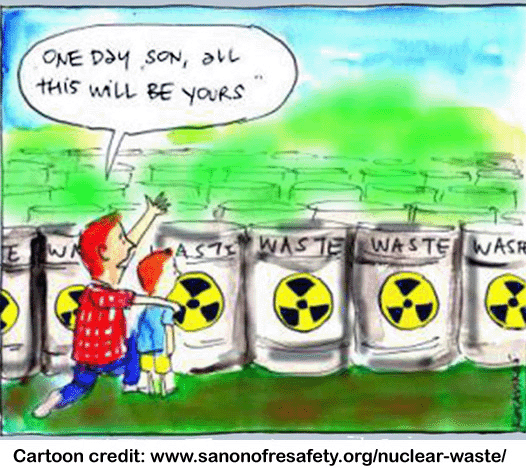
Future generations will decide the final disposition of the eight Hanford reactors.
The bigger question is whether future generations will be willing to pay the massive costs of Hanford cleanup, he said.
Carpenter said the estimated cost to completely clean up just the tank wastes at the Hanford site is around $660 billion.
“It’s rather grim. It’s multigenerational,” he said.
“This will cost more than anyone thought possible,” Carpenter said of the tank wastes and other wastes that were dumped into the ground at Hanford. “It’s a hidden cost of the (nuclear) buildup.
US government works to ‘cocoon’ old nuclear reactors https://abcnews.go.com/Technology/wireStory/us-government-works-cocoon-nuclear-reactors-80964651
Costs to clean up a massive nuclear weapons complex in Washington state are usually expressed in the hundreds of billions of dollars and involve decades of work, By NICHOLAS K. GERANIOS Associated Press5 November 2021 SPOKANE, Wash. — Costs to clean up a massive nuclear weapons complex in Washington state are usually expressed in the hundreds of billions of dollars and involve decades of work.
usually expressed in the hundreds of billions of dollars and involve decades of work.
But one project on the Hanford Nuclear Reservation is progressing at a much lower price.
The federal government is moving forward with the “cocooning” of eight plutonium production reactors at Hanford that will place them in a state of long-term storage to allow radiation inside to dissipate over a period of decades, until they can be dismantled and buried.
“It’s relatively non-expensive,” Mark French, a manager for the U.S. Department of Energy, said of cocooning. “The cost of trying to dismantle the reactor and demolish the reactor core would be extremely expensive and put workers at risk.”
The federal government built nine nuclear reactors at Hanford to make plutonium for atomic bombs during World War II and the Cold War. The site along the Columbia River contains America’s largest quantity of radioactive waste.
The reactors are now shut down and sit like cement fortresses near the southeastern Washington city of Richland. Six have already been cocooned for long-term storage, and two more are headed in that direction. The ninth reactor was turned into a museum as part of the Manhattan Project National Historical Park.
While World War II ended in 1945 and the Cold War ended in 1989, the United States is still paying billions of dollars per year for the disposal of the nuclear waste produced by the atomic weapons that played a big role in ending those conflicts. The biggest expense is dealing with a massive volume of liquid wastes left over from the production of plutonium, a key ingredient in nuclear weapons.
While the liquid wastes stored in 177 underground tanks will take decades of work and hundreds of billions of dollars to clean, efforts to secure the nine plutonium reactors are much closer to completion.
The last two reactors, shut down in 1970 and 1971, are about to enter the cocooning stage, when they are covered with steel and cement to prevent radioactivity from escaping into the environment, French said.
The cocoons are expected to last about 75 years, by which time the radioactivity inside will have dramatically decreased and there presumably will be a plan for final disposition of the remaining parts, French said.
Every five years, workers enter the reactor building to make sure there are no leaks or rodent or bird infestations, he said.
Cleanup of Hanford, which has about 11,000 employees and is half the size of Rhode Island, started in the late 1980s, and now costs about $2.5 billion per year. The work has been slowed by technical issues, lack of funding, lawsuits from state regulators, worker exposure to radiation and turnover of contractors on the complex job.
But the handling of the old reactors is a bright spot.
The nine reactors — called B Reactor, C Reactor, D Reactor, DR Reactor, F Reactor, H Reactor, K-East Reactor, K-West Reactor, and N Reactor — were built from 1943 through 1965.
They were constructed next to the Columbia River because of the abundance of hydropower and cooling water needed by the reactors during operation.
All have been cocooned except K-East and K-West. Work on cocooning the K-East reactor has already started and should be finished by 2023, French said. Work on the K-West reactor is scheduled for completion in 2026.
The cocoon plan for K-East and K-West is to basically construct steel buildings around them. Each building is 158 feet (48.2 meters) long, 151 feet (46 meters) wide and 123 feet (37.5 meters) tall, French said. The two steel buildings will cost less than $10 million each.
The government also operated five plutonium production reactors at the Savannah River Site in South Carolina during the Cold War. All of those are also shut down, although three of the reactor buildings are being used to store radioactive materials Two of the reactors at Savannah River are closed but under a different procedure than the Hanford reactors, said Amy Boyette, a spokeswoman for Savannah River.
Future generations will decide the final disposition of the eight Hanford reactors, French said. They will likely be dismantled and buried in the central area of the Hanford site, away from the river.
Robots may be deployed in the future” for that work, French said.
Hanford watchdogs generally agree with this process, said Tom Carpenter, director of the Seattle-based watchdog group Hanford Challenge.
“Nobody is raising any concerns about cocooning,” Carpenter
said. “We’re all worried about the tank waste that needs immediate and urgent attention.”
The bigger question is whether future generations will be willing to pay the massive costs of Hanford cleanup, he said.
Carpenter said the estimated cost to completely clean up just the tank wastes at the Hanford site is around $660 billion.
“It’s rather grim. It’s multigenerational,” he said.
“This will cost more than anyone thought possible,” Carpenter said of the tank wastes and other wastes that were dumped into the ground at Hanford. “It’s a hidden cost of the (nuclear) buildup.
By then, there might be bigger budget concerns such as dealing with the effects of climate change, Carpenter said.
The most intriguing of the old reactors is the B Reactor, the first one built during World War II. It will not be cocooned, and can be visited by tourists at the national historical park. B Reactor, which shut down in 1968, was cleaned up enough to allow some 10,000 tourists to visit each year and learn the history of Hanford. It has been designated a National Historic Landmark.
Plutonium from Hanford’s B Reactor was used in the testing of the world’s first atomic bomb in July 1945. Called the Trinity Test, the bomb was blown up in the New Mexico desert. Hanford plutonium was also used for the bomb that was dropped over Nagasaki, Japan, on Aug. 9, 1945.
Why the Pentagon Is Equipping the F-35 With a Thermonuclear Bomb
Why the Pentagon Is Equipping the F-35 With a Thermonuclear Bomb, Popular Mechanics, A man with a bomb can do things a missile with a bomb can’t. BY KYLE MIZOKAMINOV 5, 2021
- The F-35 Joint Strike Fighter is nearly certified to carry a new thermonuclear weapon, the B61-12.
- Although the U.S. military has a variety of ways to deliver nuclear weapons, there are only a handful of ways to use them on the battlefield.
- Using a crewed delivery system ensures there is a person in the loop for the entire flight who can execute last minute instructions……………. https://www.popularmechanics.com/military/weapons/a38093134/pentagon-equipping-f-35-thermonuclear-bomb/
Moving to peace and security – by ratifying the Comprehensive Nuclear Test Ban Treaty
Ratifying the Comprehensive Nuclear-Test-Ban Treaty is the way to ensure peace The Hill BY IVANA NIKOLIĆ HUGHES AND HART RAPAPORT, — 11/04/21 The Comprehensive Nuclear-Test-Ban Treaty (CTBT) — the international agreement governing use of nuclear weapons — turned 25 in September. The anniversary, ordinarily a time to celebrate the careful diplomacy that led to such an achievement, was tempered by the continued refusal of the U.S. government to accede to a document that it negotiated. The resulting void created by this lack of leadership threatens to overturn a decades-long period of relative nuclear peace. There is only one option to hem in the dangerous proliferation of nuclear weapons that has led nations such as Iran and North Korea to the precipice of nuclear power: Ratify the CTBT and ensure it enters into force……………
ratification would allow the newly-empowered CTBT and its accompanying oversight organization to benefit from the consent of the world’s most powerful government in creating an international norm against nuclear testing. Currently, nations such as Russia — which is party to the CTBT — face little substantial backlash for their detonations. After all, they can easily point to the United States’s refusal to accede to the treaty as proof of the validity of their own actions. These excuses would lose their power after ratification, with future actions against those nations’ international commitments subject to pushback through the full power of the nearly 200 CTBT signatories marshaled by the United States.
To fully enter force, the CTBT also must be signed by seven nations — China, Egypt, India, Iran, Israel, North Korea and Pakistan — aside from the United States. Achieving this would be a difficult diplomatic effort, but it is possible. These nations’ refusals to sign are largely based on a geopolitical rival’s — India with Pakistan, and vice versa, for example — failure to sign and ratify the document. This presents an opportunity for American foreign policy to work at its best by bringing these pairs of nations to the bargaining table concurrently to hash out any testing-related difficulties. It may be unreasonable to assume that all of the states are willing to do so, but the reduction in geopolitical tensions and chance of nuclear mishaps from even a single additional state pledging not to test nuclear weapons would be substantial. Of course, this can only happen after the United States ratifies the document and commits to support its tenets in the international arena.
During a time of increased partisan polarization in Congress, a domestic and international priority such as the CTBT provides a gateway for politicians from both parties to focus on what matters to the American people: ensuring that nuclear threats do not dominate the 21st century like they did in the latter half of the 20th century. It would send a strong signal to the rest of the world that our political elite can still collaborate to ensure that America remains a defining member of the international community after years of disengagement. If nothing else, it would ensure that time and money can be spent on today’s true priorities — among them, cybersecurity, climate change and infrastructure development — rather than those of the past.
Ivana Nikolić Hughes is a senior lecturer in chemistry at Columbia University and the director of Columbia’s Center for Nuclear Studies.
Hart Rapaport is a research assistant at Columbia’s Center for Nuclear Studies. https://thehill.com/opinion/national-security/579506-ratifying-the-comprehensive-nuclear-test-ban-treaty-is-the-way-to
Utah shouldn’t gamble on unproven small nuclear reactors without public input

The budget for the UAMPS nuclear project has already increased from $3.1 billion to $6.1 billion since it was first conceived, and they are still several years away from plant construction. Last fall, Logan, Kaysville, Bountiful, Murray, Heber and Lehi all withdrew because the financial risks were too significant.
We encourage policymakers who are already involved with or are being approached to participate in the UAMPS nuclear power project to invite presentations by independent experts who can provide a balanced analysis of the pros, cons, actual costs and alternatives.
Scott Williams: Utah shouldn’t gamble on unproven nuclear energy without public input, https://www.sltrib.com/opinion/commentary/2021/11/03/scott-williams-utah/
During the October meeting of the Utah Legislature’s Public Utilities, Energy and Technology Interim Committee, the Utah Associated Municipal Power Systems (UAMPS), a consortium of small cities that operate their own power companies, gave a status update on a nuclear power project to supply electricity for Utahns who live in many of those cities. If this proposal were to succeed, it would be the first time any community in Utah would use nuclear energy to supply its electricity.
During this meeting, common themes of nuclear power being the best and/or only option to secure a reliable source of electricity to fill the gaps of wind and solar power were discussed and pushed forward.
UAMPS project would rely on new and as yet unproven technology. Its participating members would be gambling the dollars of Utah’s taxpayers and ratepayers that this first-of-a-kind project will succeed — a gamble that even risk-taking venture capitalists have shied away from. Our federal tax dollars would be funding much of the research, testing, licensing, construction, liability insurance and, perhaps most importantly, the cost of storing and safeguarding the highly toxic radioactive waste the plant would produce.
Before we accept the claims by the proponents of this project that it is the best and/or only option, the public officials who are approving these expenditures of public funds need to ask the questions about risks, benefits and alternatives that should be asked anytime public funds are being spent. In this case, it’s especially critical to do so because nuclear power projects have a history of significant cost overruns, bankruptcies and municipal bond defaults.
The VC Summer nuclear project budget in South Carolina ballooned from $11 billion to $25 billion. This project was ultimately canceled in 2017 after it was 40% complete and $9 billion had been spent. Ratepayers there will be paying for this mistake for the next 20 years.
The budget for the two new nuclear reactors currently under construction at the Vogtle plant in Georgia has increased from $14 billion to $28 billion.
The budget for the UAMPS nuclear project has already increased from $3.1 billion to $6.1 billion since it was first conceived, and they are still several years away from plant construction. Last fall, Logan, Kaysville, Bountiful, Murray, Heber and Lehi all withdrew because the financial risks were too significant.
The finance director in Logan convinced their city council to pull out, stating, “we’re the last entity that should be participating in risky endeavors. What we should participate in is the 4th or 5th iteration of this project. By that time, I guarantee that the costs will come down to whatever is the market rate for nuclear power.”
After this departure of subscribers, UAMPS decided to cut the size of the plant in half but still insisted that economies of scale would keep the rates competitive. To date, they only have a little over 20% of the purchasing commitments they need to make even this downsized project fully subscribed.
UAMPS issued no requests for proposals to see if this nuclear project was the most cost-effective way to fill the specific need for the power they are trying to address. Their minutes and supporting documents are only available by submitting a formal written public records request. And UAMPS is exempt from Utah’s Open Meetings Act, so the public cannot see the assumptions and calculations they are using to estimate the project’s costs.
We encourage policymakers who are already involved with or are being approached to participate in the UAMPS nuclear power project to invite presentations by independent experts who can provide a balanced analysis of the pros, cons, actual costs and alternatives. Scott Williams is the executive director of HEAL Utah.
New Mexico governor fears expansion of Waste Isolation Pilot Plant, to take even more high level nuclear waste
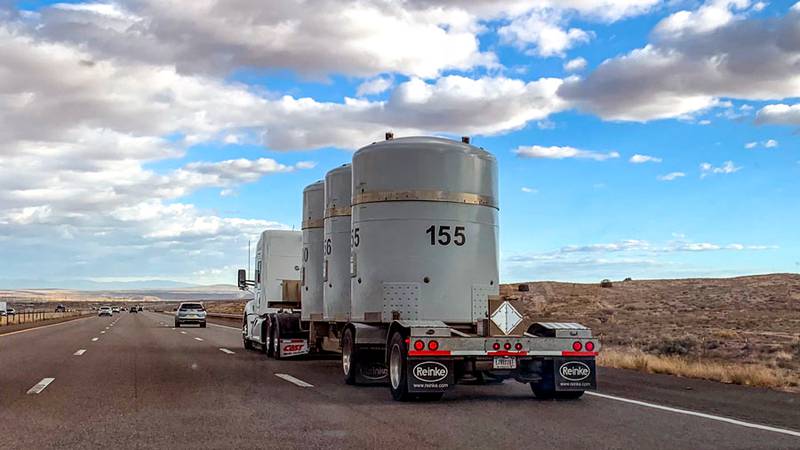
Nuclear Nerves. Governor says she’s concerned about possible increase in radioactive shipments through Santa Fe County, but a bigger worry remains.
Reporter, By Bella DavisNovember 03, 2021
Santa Fe-area activists and residents have been sounding the alarm that more nuclear waste shipments will soon be traveling through the county on their way to the Waste Isolation Pilot Plant—the nation’s only long-term storage facility for transuranic radioactive waste, located near Carlsbad.
Equal parts questions and foreboding answers have dominated two recent town halls hosted by Santa Fe County officials and anti-nuclear activists. While the US Department of Energy is not exactly forthcoming about the future, Gov. Michelle Lujan Grisham says such expansion would be limited to the capacity of state vehicle inspections.
The Energy Department must submit to inspections for all WIPP trucks and trucks that leave Los Alamos National Laboratory under an intergovernmental agreement. New Mexico State Police conducts those inspections—averaging about six or seven a week with the capacity for 20. The agency does not plan to hire additional staff to increase inspection capabilities, Lt. Mark Soriano writes in an email to SFR.
The Department of Energy tells SFR the rate of shipments to WIPP is “expected to increase to 10-12 shipments per week” over the next few months, but it has also put in requests with the state to expand the facility’s underground capabilities and announced earlier this year that it was going to prepare an environmental impact statement to dispose of surplus plutonium at WIPP.
A spokeswoman for Lujan Grisham says the governor is concerned about the possibility of future WIPP expansion and the notion of increased nuclear materials shipments through the state. But Lujan Grisham believes there’s a more pressing, immediate problem embedded in New Mexico’s long relationship with the nuclear industry and all that comes with it.
Her “biggest concern,” Nora Meyers Sackett, the spokeswoman, says, is that the US Department of Energy “continues to prioritize shipments from other states to…WIPP while failing to expedite cleanup of waste at Los Alamos” National Laboratory.
Lujan Grisham says the Energy Department’s position is “unacceptable,” Meyers Sackett tells SFR in a series of answers to emailed questions.
In February, the New Mexico Environment Department sued DOE over what it says is a “continuing pattern of delay and noncompliance” of legacy waste cleanup at Los Alamos, asking for a court-supervised process to resolve the issue. In its initial answer to the lawsuit, DOE “denies that [the state] is entitled to the relief it seeks.” Settlement negotiations in federal court are ongoing…………
Weehler worries about an accident, the odds of which would go up with increased shipments under WIPP’s plans for expansion, and that emergency responders wouldn’t be able to respond fast enough before people were exposed………… https://www.sfreporter.com/news/2021/11/03/nuclear-nerves/
Biden faces Pentagon hawks in his effort to curb nuclear weapons spending
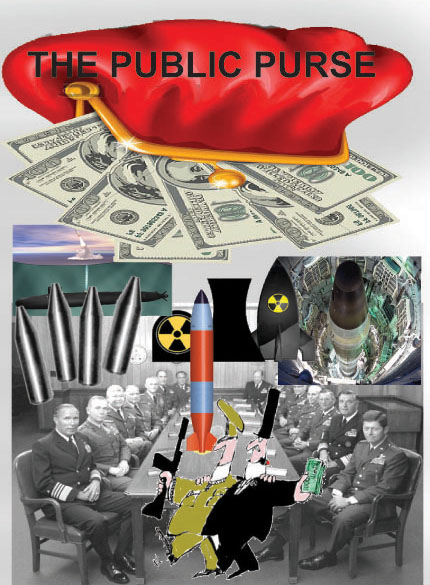
Nuclear arms hawks give bureaucratic mauling to Biden vow to curb arsenal, Guardian, Julian Borger in Washington, Wed 3 Nov 2021 Defence budget and nuclear posture review are battlegrounds as Republicans seek to block limits on US use of weapons,
A battle is being fought in Washington over the Biden administration’s nuclear weapons policy, amid fears by arms control advocates that the president will renege on campaign promises to rein in the US arsenal.
The battlegrounds are a nuclear posture review (NPR) due early next year and a defence budget expected about the same time. At stake is a chance to put the brakes on an arms race between the US, Russia and China – or the risk of that race accelerating.
Despite Biden’s pledge during the campaign – and in his interim national security guidance issued in March – that his administration would reduce “our reliance and excessive expenditure on nuclear weapons”, hawks at the Pentagon have won the early skirmishes.
Biden is also under pressure from some allies, nervous about Biden’s past support for limiting the use of nuclear weapons to the “sole purpose” of deterring, and retaliating against, a nuclear attack on the US or its allies.
The current US posture is broader, leaving open a nuclear response to “significant non-nuclear strategic attacks”. Britain and France also retain a certain amount of ambiguity about when they would use their weapons, and are concerned a US change to “sole purpose” would oblige them ultimately to narrow their options. Paris has taken the lead in conveying those anxieties, and Emmanuel Macron raised nuclear posture issues with Biden when the two met in Rome on Friday.
The big struggle, however, is on the home front, where arms control advocates are on the defensive.
The administration’s first defence budget in February included $43bn for an array of nuclear modernisation schemes, including controversial programmes introduced by Donald Trump, like a new sea-launched cruise missile. The total cost of modernisation could be over $1.5tn.
In September, one of Biden’s political appointees at the Pentagon, Leonor Tomero, who questioned the need for such a vast and growing nuclear weapons budget, was forced out in a bureaucratic power struggle after just nine months in the post. Her job had been to oversee the drafting of the NPR, which sets out what nuclear weapons the US should have and under what conditions they could be used…………..
Senator Edward Markey, a Democrat, has written to Biden demanding to know why Tomero had been removed in the midst of drafting the NPR, demanding to know if “ideology played any role”.
………..Nickolas Roth, the director of the nuclear security programme at the Stimson Center thinktank, said: “I am concerned that the removal of Leonor from her position will have a chilling effect throughout the Biden administration, on those who might be willing to propose anything other than the status quo for US nuclear weapons policy.”
…………. China’s nuclear weapons development, including the recent reported testing of a nuclear-capable hypersonic glider launched from orbit, has increased the political pressure on Biden to abandon his arms control pledges, although the Chinese arsenal is still dwarfed by the US total of 3,750 warheads.
Emma Belcher, the president of the Ploughshares Fund, an arms control advocacy organisation, argued that China’s rise as a nuclear weapons power only underlines the urgency of arms control.
“The best way to control the situation and head off an arms race with China is through diplomacy and restraint,” Belcher said. “We’ve seen this movie before. It’s expensive and dangerous. So what we’re hoping we’ll see from the NPR is for diplomacy to be put first, and an off ramp from a new kind of cold war.” https://www.theguardian.com/world/2021/nov/03/nuclear-arms-joe-biden-pentagon-hawks
White Mesa uranium mill – its owners want to accept radioactive trash from Estonia – 1000s of miles away !

Over the past 40 years, the construction of the mill demolished
archaeological and burial sites important to the Ute Mountain Ute Tribe and
depleted the tribe’s traditional hunting grounds, destroying places where
people once gathered plants for basketry and medicine.
Radioactive waste
has been spilled along the main highway from trucks hauling material from
Wyoming to White Mesa for processing. The children can no longer play
outside because of the stench and the fear of what might be causing it. The
mill sits in the heart of San Juan County, a few miles east of the original
boundaries of Bears Ears National Monument, with Canyonlands National Park
to the north and Monument Valley to the southeast.
It opened in 1980 to
process uranium ore from the Colorado Plateau into yellowcake, a
concentrated powder used in energy production and nuclear weapons. Most
uranium mines closed in the last half-century. But White Mesa not only
remains open, it has become a destination for radioactive material from
around the world. Now, its owners want to accept waste from the Northern
European country of Estonia, nearly 5,000 miles away.
High Country News 1st Nov 2021
The nation’s last uranium mill plans to import Estonia’s radioactive waste
Pandora Papers: is the world’s biggest leak the world’s biggest cover-up?
Pandora Papers: is the world’s biggest leak the world’s biggest cover-up? https://www.michaelwest.com.au/pandora-papers-is-the-worlds-biggest-leak-the-worlds-biggest-cover-up/ , By Michael West|, October 8, 2021
Where are the US billionaires, the Wall Streeters, the Big Four tax firms Deloitte, EY, KPMG, PwC? Michael West explores the mystery of the Pandora Papers in this first of a two-part series.
In the wake of the stunning Pandora Papers data leak this week, the ABC enthused, “Even by the ICIJ’s standards, this is big. If the documents were printed out and stacked up they would be four times taller than Sydney’s Centrepoint Tower”.
Probably not. If we assume Pandora is like its predecessors Panama Papers and Paradise Papers – where less than 1% of the data was made public – that would represent a stack of documents 12.2 metres high, not 1220 metres, which would get you up to Yogurt World on Level 5 of the Centrepoint food court.
Another “biggest data leak in history”, another trove mega-leaks where billionaires, celebrities, Italian mobsters, Russian oligarchs and foreign heads of state have been outed for their links to tax havens.
But where are the US politicians? Where are the Wall Streeters? Where are the Big Four, the masterminds of global tax avoidance PwC, EY, KPMG and Deloitte?
Conspicuously absent, that’s where. Again.
Beating the B Team
Make no mistake this is fabulous, explosive stuff. The Pandora Papers, like Panama Papers and Paradise papers, are a spectacular data leak but, like the leaks before them, they have blown the lid on the world’s Tax Avoidance B Team.
And, like the others, the data has not actually been made public; not much of it anyway, maybe 1%. The rest is sitting with the International Consortium of Investigative Journalists (ICIJ) in Washington. It has been leaked to the ICIJ alone which in turn leaks bits of it, presumably a very small part of it, to its “global media partners”.
n Australia, these are Nine Entertainment’s AFR, Guardian and ABC who are themselves keeping most of it a secret. This from Guardian Australia:
“Australians who appear in the data include senior figures from the finance and property industries. The Guardian has chosen not to identify them.
“About 400 Australian names are contained in the papers, a cache of 11.9m files from companies hired by wealthy clients to create offshore structures and trusts in tax havens such as Panama, Dubai, Monaco, Switzerland, the Cayman Islands and Samoa.”
Meanwhile Julian Assange
Meanwhile Julian Assange continues to rot in London’s Belmarsh Prison, facing extradition to the US, abandoned by successive Australian governments amid reports of a CIA plot to assassinate him. His crime? Wikileaks made public US war crimes; a real leak, documents actually made public.
In contrast, the Washington-based ICIJ has consistently refused to release its data to the public, preferring instead to conduct a choreographed media circus. Its director, Australian journalist Gerard Ryle, declined to respond to questions for this story, doubly ironic given we used to work together on the newsroom floors at Fairfax and the ICIJ is a self-styled beacon of journalistic integrity dedicated to “expose the truth and hold the powerful accountable, while also adhering to the highest standards of fairness and accuracy”.
One question we put to Ryle was whether ICIJ had received a subpoena from US authorities for this incredible trove of corporate information, say the Department of Justice. If not, why not?
The questions are many, not only because of the sheer magnitude of this set of leaks but also because the effect of the Pandora Papers is to, deservedly, trash a suite of non-US tax havens such as the notorious British Virgin Islands and the upshot will be to drive global wealth towards secrecy jurisdictions in the US such as Rupert Murdoch’s preferred haven of Delaware.
So, what is going on here?
The way ICIJ works is they use a panel of 150 “media partners”, mostly large corporate media organisations around the world, to disseminate the information, or at least the bits of it they deem suitable.
In the case of Panama Papers, an anonymous source dubbed John Doe hacked Panamanian law firm Mossack Fonseca and leaked the data to German journalists who got it to ICIJ for dissemination to its band of media partners.
14 Mossack Fonsecas
This time around, there are 14 Mossack Fonsecas; that is, 14 “offshore service providers” have been hacked. This is hacking on an industrial, possibly sovereign, scale. It is possible these “offshore service providers”, from Hong Kong to the Caribbean, divulged the information voluntarily, but unlikely.
Who benefits? The US and the Big Four. Just as the Panama Papers helped to demolish Panama as a tax haven, compelling clients of Mossack Fonseca to flee to other secrecy jurisdictions to hide their money, the upshot of the Pandora Papers is that, right at this moment, the super rich who secrete their money in the British Virgin Islands, the Seychelles or Cyprus will be thinking long and hard about restructuring to hide their riches via Delaware or another onshore tax haven in the US.
They will also think long and hard about getting the Big Four global tax firms – PwC, Deloitte, EY and KPMG – to manage their affairs. The A Team.
This is of course a speculative conclusion but also, as one regulatory finance source confided to Michael West Media this week, just a matter of putting two and two together. The Washington-based ICIJ never seems to be harassed by US authorities, the Big Four are rarely named, US billionaires are rarely named, blue chip tax avoiders are rarely named, the identity of the vast bulk of wealthy Australians in the data are never named.
Foreign PEPs, mobsters and oligarchs
This is not to disparage the work of Gerard Ryle and his team. The latest mega-leak of almost 12 million documents from offshore finance firms has identified the usual high profile types: crooner Julio Iglesias, cricket star Sachin Tendulkar, pop music diva Shakira, supermodel Claudia Schiffer and “an Italian mobster known as “Lell the Fat One”.
Great headlines, and every one a worthy story, although many will have bona fide reasons for being in tax havens. Rich people avoid tax, full stop. We will discuss the mechanics of secrecy jurisdictions, how it all works and who actually benefits in the sequel to this story.
Besides the crooners, mobsters and Russian oligarchs however, the Pandora Papers have outed an array of ”politically exposed persons” (PEP); former politicians and present heads of state. From King Abdullah of Jordan, Azerbaijan’s ruling Aliyev family, the prime minister of the Czech republic, Andrej Babiš and Ukraine’s president, Volodymyr Zelenskiy, to former British prime minister Tony Blair and three current Latin American heads of state, those identified publicly in Pandora Papers have sent shockwaves around the world.
The Aussie connection
A slew of tax authorities have vowed to take action, including the Australian Tax Office which, on Wednesday, froze more than $80 million in assets and companies linked to Gold Coast property developer Jim Raptis.
Westpac director Steve Harker was also identified as a client of one of the offshore service providers Singapore’s Asiaciti. As the identities of most of the Australians remain a secret, Harker is probably feeling unfairly targeted. What of the other 400 Australians?
No doubt the draconian defamation laws in this country, laws which protect the wealthy, played a part in the decision of local media to keep the names secret. Yet this also goes to the fundamental issue with ICIJ’s arbitrary arrangements and its media partners cherry-picking the data.
If ICIJ were truly fair dinkum about transparency and public interest, it would make the data from all its leaks public so that boffins from around the world, anybody for that matter, could hop in and dig around.
Who is calling the shots? One man apparently, Gerard Ryle. In the wake of the Panama Papers, when we asked Ryle on a number of occasions for an ICIJ log-in to analyse the data, we were denied.
“My path, my call,” said Ryle. We already have our media partners, he said.
Meanwhile, the 2016 Panama Papers remain under lock and key, unavailable to the public, secreted by ICIJ. The data is getting stale now. It is six years old. It is wasted, an insult to the people who risked their lives to put it in the public domain.
In Part II: who guards the guards? The second story in our investigation of the ICIJ and its Offshore Leaks examines what is really going on with international tax avoidance.
Michael West
Michael West established michaelwest.com.au to focus on journalism of high public interest, particularly the rising power of corporations over democracy. Formerly a journalist and editor at Fairfax newspapers and a columnist at News Corp, West was appointed Adjunct Associate Professor at the University of Sydney’s School of Social and Political Sciences. You can follow Michael on Twitter @MichaelWestBiz.
Nuclear power plant operators want to run for eight decades, but a federal lab in Washington state found ‘critical gaps’ in knowledge about how reactors age.

One of the most challenging areas involves embrittlement of metal in reactor pressure vessels that are bombarded by neutrons during the fission process. Extreme embrittlement could result in reactors having to reduce power production or shut down all together.
The aging of reactor internals and concrete, and deterioration of cables, also are concerns, according to NRC documents Gunter obtained
Nuclear power plant operators want to run for eight decades, but a federal lab in Washington state found ‘critical gaps’ in knowledge about how reactors age, Nov. 1, 2021 By Hal Bernton , Seattle Times, Seattle Times staff reporter
That report was published online in 2017 by the federal laboratory. It detailed a series of “critical gaps” in knowledge, and proposed an ambitious research plan to help fill them in by studying parts pulled from shuttered nuclear power plants.
This report got a chill reception at the NRC.
Some commission staff thought some of the report’s wording was inaccurate or misleading and could lead readers to believe “we should not be issuing renewed licenses” to run for up to eight decades, according to emails and other documents obtained under the federal Freedom of Information Act.
“I think the entire report needs to be scrubbed for text that points to gaps and, if issued, we need a stronger basis for why we will grant renewed licensing … before harvesting [of parts from shutdown reactors] and testing is completed,” wrote one NRC staffer.
The report was substantially revised by the NRC, which in 2019 released a toned-down version of the report that deleted all seven references to critical gaps in knowledge.
The rocky path of this study through the federal regulatory commission offers an unusual window into the launch of a licensing renewal that is expected to determine the fate of most of the current generation of U.S. nuclear power plants.
This fleet of more than 90 reactors produces about one-fifth of the nation’s electricity — and does so without the direct release of carbon emissions while operating. [ED. Nobody counts the carbon emissions in the full nuclear fuel cycle]]
Most of these reactors, including the Columbia Generating Station, are licensed to operate for up to 60 years past their initial startup date.
Without license extension to operate for an additional 20 years, almost all of them would have to shut down during the first half of the 21st century, ………………..
2017 report posted online, then removed
Paul Gunter obtained the NRC documents detailing the internal criticisms of the PNNL report. He is an activist with Beyond Nuclear, a group working for a world “free of nuclear power and nuclear weapons.”
Gunter for years has watchdogged the relicensing of nuclear power plants, and more recently has been a vocal critic of the NRC’s proposal to consider up to 80 years of operation for U.S. nuclear power plants.
This is pushing to the extreme,” said Gunter.
Gunter during an online search went to the PNNL website, and found a copy of the 2017 report.
He was encouraged by the authors’ recommendations, and cited the study at a Sept. 26, 2018, meeting about relicensing convened by the NRC.
“I started asking questions and their jaws dropped, and they said, ‘We can’t be talking about this,’ ” Gunter recalls.
Soon after Gunter cited the report at the meeting, he said the report was pulled down from the PNNL as well as Department of Energy and International Atomic Energy Agency websites that had also posted the document.
Troubled by the effort to keep the 2017 report from public view, Gunter’s organization then filed a federal Freedom of Information Act request to gain access to NRC documents related to the study.
These documents show how NRC’s own research staff had questions about how important structures would hold up over 80 years of operations. A 2013 project description stated that “understanding and managing” how things degrade is “unquestionably a key need for continued safe and reliable” reactor operations, and “also an area with very significant uncertainties.”
One of the most challenging areas involves embrittlement of metal in reactor pressure vessels that are bombarded by neutrons during the fission process. Extreme embrittlement could result in reactors having to reduce power production or shut down all together.
The aging of reactor internals and concrete, and deterioration of cables, also are concerns, according to NRC documents Gunter obtained…………….
The NRC asked the PNNL researchers to come with a long-term plan to guide harvesting of high-priority parts from shutdown reactors that could then be analyzed and compared with the results from laboratory tests.
The study by PNNL’s Pradeep Ramuhalli and four other scientists concluded such harvesting would be “essential to provide reasonable assurance that the materials/components will continue to perform their safety function throughout the plant licensing period.”
That line was removed from the final report, which portrayed this research more as a useful option — rather than a necessity — and cautioned that it may not always be practical to salvage these parts…….
By the time the revised document was released, the NRC already had begun the relicensing process. https://www.seattletimes.com/seattle-news/nuclear-power-plant-operators-want-to-run-for-eight-decades-but-a-federal-lab-in-washington-state-found-critical-gaps-in-knowledge/
US military blazes trail for 100 per cent renewable energy economy
| US military blazes trail for 100 per cent renewable energy economy with carbon neutral synthetic fuel. Carbon neutral synthetic fuel whose production is powered by renewable energy is a practical way of long-term storage of renewable energy. But it is no surprise that the big energy corporations with their fossil fuel and nuclear power interests don’t advise Governments to support this – but when it can help the US military, well, it’s just chocks away chaps! The irony is that this system was researched in the UK only a few years ago at a pilot stage, and then – you’ve guessed it – completely ignored by the UK Government in favour of kooky ideas like small nuclear reactors and blue hydrogen – not to mention large nuclear power plant that take forever to be built incredible cost! 100% Renewables 31st Oct 2021 https://100percentrenewableuk.org/us-military-blazes-trail-for-100-per-cent-renewable-energy-economy-with-carbon-neutral-synthetic-fuel |
U.S. Discloses Nuclear Weapons Stockpile Numbers
U.S. Discloses Nuclear Stockpile Numbers, November 2021, By Shannon Bugos, Arms Control Association
The Biden administration has publicly released the total number of nuclear weapons in the U.S. stockpile, a sharp reversal of the previous administration’s refusal to do so for the past three years…………
The U.S. stockpile of nuclear warheads was at 3,750 as of September 2020, according to the administration document. This number captures active and inactive warheads, but not the roughly 2,000 retired warheads awaiting dismantlement. The document lists stockpile numbers going back to 1962, including the warhead numbers from the years when the Trump administration refused to declassify the information.
This number represents an approximate 88 percent reduction in the stockpile from its maximum (31,255) at the end of fiscal year 1967, and an approximate 83 percent reduction from its level (22,217) when the Berlin Wall fell in late 1989,” the document said.
Despite a significant overall reduction, the updated figures show the scale of reductions to the stockpile has diminished in recent years and even reflect a 20 warhead increase between September 2018 and September 2019 under the Trump administration.
The Biden administration also disclosed how many nuclear warheads the Energy Department has dismantled each year since 1994, for a total of 11,683. The Obama administration decided in 2010, for the first time, to release the entire history of the size of the U.S. nuclear weapons stockpile. The Trump administration declassified the stockpile data for 2017, but did not do so again for the following years………… https://www.armscontrol.org/act/2021-11/news/us-discloses-nuclear-stockpile-numbers
U.S Suspends Nuclear Trade With Chinese Group
U.S 1. Suspends Nuclear Trade With Chinese Group, November 2021
The U.S. Nuclear Regulatory Commission (NRC) has suspended shipments of radioactive materials to China’s state-owned and -operated nuclear company, the China General Nuclear Power Group (CGN). The action includes restrictions on deuterium, a hydrogen isotope used in nuclear reactors and boosted nuclear weapons.
Concerned about China’s growing nuclear weapons program, the NRC decided Sept. 27 that a suspension was “necessary to further the national security interests of the United States and to enhance the United States common defense and security consistent with the Atomic Energy Act of 1954.” ……………..
The United Kingdom is also planning to remove CGN from the nuclear power plant under construction in Suffolk by selling China’s 20 percent stake in the project. https://www.armscontrol.org/act/2021-11/news-briefs/us-suspends-nuclear-trade-chinese-group
U.S. Navy reports on cause of incident with nuclear-powered submarine in South China Sea
The US Navy has figured out what a nuclear-powered attack submarine ran into in the South China Sea: report, Yahoo News, Ryan Pickrell, Tue, November 2, 2021,
- The US Navy has completed its investigation into a mysterious submarine incident in the South China Sea.
- USS Connecticut grounded on an uncharted seamount, USNI News first reported.
- The investigation has been sent to the fleet commander, who will consider accountability actions.
The US Navy investigators have determined what a nuclear-powered attack submarine hit in the South China Sea last month, USNI News reported Monday, citing defense officials familiar with the investigation and a legislative official.
The Seawolf-class nuclear-powered attack submarine USS Connecticut collided with an unidentified object on October 2, the Navy revealed five days after the incident. Investigators have reportedly determined the submarine ran aground on an undersea mountain, a seamount, the location of which was uncharted………… As of last Wednesday, the US Navy still was not quite sure what the submarine collided with, though defense officials told USNI News that early indications suggested that Connecticut collided with a seamount, an undersea feature that rises from the ocean’s depth…….
As the investigation into the incident has not yet been publicly released, information is still limited on how the submarine ran into an seamount and to what degree members of the crew and command are responsible……. https://news.yahoo.com/us-navy-figured-nuclear-powered-194721944.html
Nuclear power is not a solution for anything except perhaps the nuclear industry’s desire for taxpayer dollars.

New nuclear’ wont’ solve challenges https://www.coloradopolitics.com/opinion/counterpoint-new-nuclear-wont-solve-challenges/article_ffab4b6e-38f1-11ec-a03d-733290cbcf3a.html Nuclear power is not a solution for anything except perhaps the nuclear industry’s desire for taxpayer dollars. The nuclear industry sales pitch, such as presented to a largely invitation-only meeting in Pueblo on July 15, promotes “new nuclear” or advanced nuclear, the only thing new is the packaging of the reactors. Even that is still experimental and on the drawing board, with NuScale working with the Nuclear Regulatory Commission on various elements of their design licensing. No operating commercial models have been built, and even if everything goes according to schedule, a pilot plant in Idaho is not expected to be completed until about 2030 — at a cost of 1.3 to 3.6 billion dollars, which they have received from us taxpayers via the Department of Energy. According to widely available statistics of energy costs, nuclear is still the most expensive generation source.
NuScale corporation’s small modular reactors are, in fact, the same light-water nuclear reactors as used to generate power in other settings, using uranium as fuel, requiring cooling water, and generating the same radioactive waste products. To generate power at the level of the coal-fired Comanche 3 power plant in Pueblo County would require at least 12 of the reactors NuScale is proposing. So instead of one large reactor, there would be twelve or more nuclear reactors, with a correspondingly greater probability of error or accidents.

For NuScale as with other nuclear reactors, even if their more experimental proposal for air-cooled versus water-cooled generating capacity is accepted by the NRC, the waste extracted from the reactors every 12-24 months would have to be stored for five years per batch in a pool of cooling water, with the necessity of use and refreshment of this pool for the life of the plant. A corollary of the waste fuel handling is that each of the 12 reactors must be opened and the radioactive fuel transferred and replaced every 24 months at the least, again with a multiplied probability for accidents or errors.
Because there is no long-term national repository for high level nuclear waste, this waste will be stored on-site in the community where it was generated for many years. Because that waste has a half-life of more than 20,000 years (meaning at that point half of the radioactivity will be broken down), it will remain a burden to future generation for as long as any of us can imagine.
Although proponents present nuclear power as a ready, clean solution to the climate crisis, it is neither. The classic nuclear power plants with their iconic cooling towers are aging out of the system, following a long history of operational difficulties, environmental contamination, closure and clean-up issues, as well as the storage of radioactive waste essentially in perpetuity. The “new nuclear” is not new except for means to package it and is at least 10 years or more from even being ready for commercial construction.
The proponents, including NuScale, want to put these plants into closed coal fired power plants, in communities often well within the zones of risk set by the NRC. Because that could rightfully raise community concerns, as well as increasing potential casualties in case of an accident, NuScale is asking the NRC to reduce the zones of protection around their nuclear reactors and radioactive waste sites because of the claimed lower risk for their still-experimental multi-reactor units.
Is Colorado ready for an unproven energy “solution” that will not even be ready for testing for a decade? The answer is “no.” Velma L. Campbell, MD, MPH is a physician specializing in public health, particularly occupational and environmental health. She is the vice chair of the Sangre de Cristo Group of the Sierra Club.
-
Archives
- October 2026 (104)
- September 2026 (339)
- August 2026 (330)
- July 2026 (355)
- June 2026 (287)
- May 2026 (306)
- April 2026 (356)
- March 2026 (251)
- February 2026 (267)
- January 2026 (308)
- December 2025 (358)
- November 2025 (359)
-
Categories
- 1
- 1 NUCLEAR ISSUES
- business and costs
- climate change
- culture and arts
- ENERGY
- environment
- health
- history
- indigenous issues
- Legal
- marketing of nuclear
- media
- opposition to nuclear
- PERSONAL STORIES
- politics
- politics international
- Religion and ethics
- safety
- secrets,lies and civil liberties
- spinbuster
- technology
- Uranium
- wastes
- weapons and war
- Women
- 2 WORLD
- ACTION
- AFRICA
- Atrocities
- AUSTRALIA
- Christina's notes
- Christina's themes
- culture and arts
- Events
- Fuk 2022
- Fuk 2023
- Fukushima 2017
- Fukushima 2018
- fukushima 2019
- Fukushima 2020
- Fukushima 2021
- general
- global warming
- Humour (God we need it)
- Nuclear
- RARE EARTHS
- Reference
- resources – print
- Resources -audiovicual
- Weekly Newsletter
- World
- World Nuclear
- YouTube
-
RSS
Entries RSS
Comments RSS

