USA rehearsing launching nuclear attack on Russia
US rehearsing nuclear strike: Russia, 7 News,
Andrew Osborn and Phil StewartReuters Wednesday, 24 November 2021 The US has been criticised for rehearsing a nuclear strike on Russia from two different directions earlier this month, with the planes coming within 20km of the Russian border.
The Pentagon responded by saying its drills were announced publicly at the time and adhered to international protocols.
Moscow’s accusation comes at a time of high tension with Washington over Ukraine, with US officials voicing concerns about a possible Russian attack on its southern neighbour – a suggestion the Kremlin has dismissed.
Moscow has in turn accused the United States, NATO and Ukraine of provocative and irresponsible behaviour, pointing to US arms supplies to Ukraine, Kiev’s use of Turkish strike drones against Russian-backed separatists in the east of Ukraine, and NATO military exercises close to its borders.
Russian Defence Minister Sergei Shoigu said Moscow had noted a significant increase in the activity by US strategic bombers, which he said had carried out 30 flights close to Russia this month.
That, he said, was more than twice as many as over the same period last year.
Shoigu complained in particular of what he said was a simulated US nuclear strike against Russia earlier this month.
“The defence minister underlined that during the US military exercises ‘Global Thunder’, 10 American strategic bombers rehearsed launching nuclear weapons against Russia from the western and eastern directions,” Shoigu was quoted as saying in a defence ministry statement.
………………………… https://7news.com.au/politics/security/us-rehearsing-nuclear-strike-russia-c-4681215
NRC finds five safety violations at Davis-Besse Nuclear Power Station
NRC finds five safety violations at Davis-Besse Nuclear Power Station Jon StinchcombPort Clinton News Herald, CARROLL TOWNSHIP — The U.S. Nuclear Regulatory Commission recently found five apparent violations at the Davis-Besse Nuclear Power Station after completing a nearly two-year initial assessment of multiple diesel generator failures from July 2019 to June 2021.
Based on that assessment, as well as a reactor trip with multiple complicating equipment issues at Davis-Besse in early July of this year, the NRC sent an inspection team to the station later that month………
Of the five violations reportedly found during the inspection, two are still pending and undergoing additional NRC reviews to “assess the safety significance of the performance deficiency,” …….. https://www.portclintonnewsherald.com/story/news/2021/11/24/five-safety-violations-davis-besse-nuclear-power-station-nrc/8746112002/
The US Faces Pressure To Do More To Address Its Nuclear Legacy In The Marshall Islands.

The US Faces Pressure To Do More To Address Its Nuclear Legacy In The Marshall Islands, Civil Beat By Anita Hofschneider 22 Nov 21, Marshallese are concerned about continued health effects from Cold War-era nuclear testing as well as a concrete dome in which the atomic waste was stored.
Two Congress members are asking the U.S. Department of Energy to provide more information about the effects of U.S. nuclear waste in the Marshall Islands.
The U.S. conducted 67 nuclear weapons tests in the Marshall Islands from 1946 to 1958, exposing Marshallese people to radiation that continues to have health and environmental implications. The U.S. then stored the atomic waste at Runit Dome, a concrete dome on Enewetak Atoll.
Rep. Katie Porter represents Orange County, California, and is chair of the Subcommittee on Oversight and Investigations in the House Committee on Natural Resources.
She has been seeking more details about the effects of nuclear testing in the Marshall Islands in the wake of a Los Angeles Times investigation that found the U.S. stored nuclear waste from Nevada in Runit Dome without informing the Pacific nation.
In a letter Friday, Porter and Rep. Raul Grijalva of Arizona asked for documents and correspondence among Department of Energy officials related to a letter that officials sent to the Marshall Islands about the state of nuclear waste in May.
The Department of Energy didn’t respond to a request for comment.
In October, Porter led a congressional hearing regarding concerns about Runit Dome, which is leaking radioactive waste. The Energy Department said in a report last year that the leaking is not significant.
“The U.S. has both a moral and national security imperative to address our nuclear legacy in the Marshall Islands,” Porter said at the hearing, adding that addressing the issue would be in line with the Biden administration’s commitment to racial justice and national security issues in the Pacific………
In their letter, Porter and Grijalva criticized the agency’s lack of response to repeated document requests, raised concerns about conflicting Energy Department testimony and the timing of the department’s May letter.
The U.S. is in the midst of renegotiating a treaty with the Marshall Islands that in part gives the U.S. military strategic denial rights over the country’s surrounding air and waters.
The Congress members described how the U.S. failed to evacuate Marshallese people quickly enough to protect them from the fallout during the 1946-1958 testing, and cited descriptions of how mothers later gave birth to babies with translucent skin and no bones.
A 2014 study analyzed how the radiation exposure in the Marshall Islands increased the risk of certain cancers, especially thyroid cancer.
Broader Concerns
Franscine Anmontha, communication director of the Marshall Islands National Nuclear Commission, said Saturday that the community is concerned about the ongoing health effects of radiation on people not only on the atolls enrolled in the U.S. medical program but on surrounding atolls.
“If you were to ask a group of young Marshallese people if they knew someone with cancer almost 90% of them would raise their hands,” she said. She said the commission wants to bring scientists to the Marshall Islands to analyze the dome so that they don’t have to rely solely on U.S. data……….
Friday’s letter is the second letter this month pressing the Biden administration for more information about the nuclear testing.
Several Congress members — including Hawaii Reps. Ed Case and Kai Kahele — wrote to the White House on Nov. 5 pushing for the appointment of a lead negotiator for treaty discussions who would have the ability to address concerns about nuclear waste.
The lead negotiator “should have the mandate to see that legacy issues related to U.S. nuclear testing in the region are appropriately resolved, including proper environmental protections, clean up, health benefits, and monetary compensation for victims and their descendants,” the lawmakers wrote…………. https://www.civilbeat.org/2021/11/the-us-faces-pressure-to-do-more-to-address-its-nuclear-legacy-in-the-marshall-islands/
Exelon Generation Co changing its name to the more appropriate (Nuclear) Spin Co

Exelon moving nuclear plants, including Limerick, to spin-off company, https://www.readingeagle.com/2021/11/22/exelon-moving-nuclear-plants-to-spin-off-company/
The Nuclear Regulatory Commission OK’d the move on Nov. 17, By EVAN BRANDT | ebrandt@pottsmerc.com | Reading Eagle
November 22, 2021 LIMERICK — The federal Nuclear Regulatory Commission has signed off on a plan by Exelon Corp. to divest itself of its fleet of 23 nuclear power reactors, including the two at the Limerick Generating Station.
Exelon Corp. will transfer the NRC licenses to a new company, currently called HoldCo, as part of a corporate restructuring, the NRC announced on Nov. 17.
There is no money changing hands.
Exelon is not “selling” the plants, and spent fuel rod storage facilities, but rather “the transaction is taking place between corporate entities owned by Exelon,” NRC spokesman Neil Sheehan explained in response to a query from MediaNews Group.
‘It intends to separate its utilities, such as PECO, and competitive energy businesses, including its nuclear power plants, into two separate companies,’ Sheehan wrote.
“HoldCo will wholly own Exelon Generation Co. (renamed as SpinCo) and its subsidiaries. SpinCo will continue to own and operate the plants to the same extent as before the transfers. The final names for HoldCo and SpinCo will be determined prior to the completion of the transfer,” according to the Nov. 17 NRC announcement.
The new power-generation company will be named Constellation, according to a Nov. 17 press release from Exelon.
“Each of these companies will emerge as industry leaders with the financial and strategic independence to focus on best serving their respective customers and communities,” Chris Crane, president and CEO of Exelon, said in the company’s press release.
“Blown to Hell: America’s Deadly Betrayal of the Marshall Islanders”

Biggest US nuclear bomb test destroyed an island—and this man’s life, https://nypost.com/2021/11/20/biggest-us-nuclear-bomb-test-destroyed-an-island-and-lives/ By Eric Spitznagel The US bomb tested near John Anjain’s (right) home in the Marshall Islands in 1954 was 1,000 times stronger than at Hiroshima, and left his wife and kids with debilitating and deadly health problems, as detailed in a new book. November 20, 2021
Just before dawn on March 1, 1954, John Anjain was enjoying coffee on the beach in the South Pacific when he heard a thunderous blast, and saw something in the sky that he said “looked like a second sun was rising in the west.”
Later that day, “something began falling upon our island,” said Anjain, who at the time was 32 and chief magistrate of the Rongelap atoll, part of the Marshall Islands. “It looked like ash from a fire. It fell on me, it fell on my wife, it fell on our infant son.”
It wasn’t a paranormal experience. Anjain and his five young sons, along with the 82 other inhabitants of Rongelap, were collateral damage from a “deadly radioactive fallout from a hydrogen bomb test… detonated by American scientists and military personnel,” writes Walter Pincus in his new book, “Blown to Hell: America’s Deadly Betrayal of the Marshall Islanders” (Diversion Books), out now.
In 1946, the US started testing atomic weapons began in Bikini Atoll, 125 miles west of Rongelap. Known as Operation Crossroads, the tests were moved to the islands from the US because officials feared “radioactive fallout could not be safely contained at
any site in the United States,” writes Pincus.
During those early tests, the Rongelapians were relocated to another island a safe distance away.
But the 1954 test was different. Not only were there no evacuations, but “Castle
Bravo,” as it was dubbed, was also the largest of the thermonuclear devices detonated during the military’s 67 tests, “a thousand times as large as the bomb that destroyed Hiroshima,” writes Pincus.
It took just hours for fallout to reach the shores of Rongelap, where it blanketed the island with radioactive material, covering houses and coconut palm trees. On some parts of the isle, the white radioactive ash was “an inch and a half deep on the ground,” writes Pincus.
The natives, who often went barefoot and shirtless, were covered in the toxic debris. It stuck to their hair and bodies and even between their toes.
“Some people put it in their mouths and tasted it,” Anjain recalled at a Washington DC hearing run by the Senate Energy and Natural Resources Committee to investigate the incident in 1977. “One man rubbed it into his eye to see if it would cure an old ailment. People walked in it, and children played with it.”
Rain followed, which dissolved the ash and carried it “down drains and into the barrels that provided water for each household,” writes Pincus.
It took three days before American officials finally evacuated the island, taking the natives to nearby Kwajalein for medical tests. Many Rongelapians were already suffering health effects, like vomiting, hair loss, and all-over body burns and blisters. Tests showed their white blood cell counts plummeting, and high levels of radioactive strontium in their systems. No one died, at least not immediately. That would come later.
After three years, the Rongelapians were allowed to return home, assured by officials that conditions were safe. But by 1957, the rate of miscarriages and stillbirths on the island doubled, and by 1963 the first residents began to develop thyroid tumors.
Though they continued to conduct annual medical tests, the US military admitted no culpability, other than awarding each islander $10,800 in 1964 as compensation for the inconvenience.
In fact, some — including the islanders — have speculated that the US government had used the Rongelapians as “convenient guinea pigs” to study the effects of high-level radiation.
For Anjain and his family, the effects were devastating. His wife and four of his children developed cancer. A sixth child, born after the fallout, developed poliomyelitis and had to use a crutch after one of his legs became paralyzed.
But the biggest tragedy befell his fifth child Lekoj, who was just one year old when Castle Bravo covered their island in nuclear dust. As a child, he was mostly healthy, other than the occasional mysterious bruise. Soon after his 18th birthday, Lekoj was flown to an American hospital, where doctors discovered he had acute myelogenous leukemia.
Anjain stayed at his son’s bedside for weeks as he underwent chemo, holding his dying son’s hand and watching him disappear.
He recounted Lekoj’s final days in a letter to the Friends of Micronesia newsletter in 1973. “Bleeding started in his ears, mouth and nose and he seemed to be losing his mind,” Anjain wrote of his son. “When I would ask him questions he gave me no
answer except ‘Bad Luck.’”
Lekoj passed away on November 15, 1972, at just 19. Newsweek called him “the first, and so far only leukemia victim of an H-bomb,” and said his death was proof that nuclear fallout “could be even more lethal to human life than the great fireball itself.”
After burying his son at a spot overlooking Rongelap Lagoon, Anjain continued to battle for financial restitution for his family and other Rongelapian survivors. In 2004, just months before his death (of undisclosed causes) at 81, he marched with 2,000 people in Japan to commemorate the 50th anniversary of the 1954 hydrogen bomb test that slowly killed his son.
In 2007, a Nuclear Claims Tribunal awarded Rongelap more than $1 billion in damages, but not a penny of it has yet been paid. And according to a 2019 Columbia University study, radiation levels on Rongelap are still higher than Chernobyl or Fukushima.
For Anjain, it was never really about the money. “I know that money cannot bring back my son,” he once said. “It cannot give me back 23 years of my life. It cannot take the poison from the coconut crabs. It cannot make us stop being afraid.”
Humboldt nuclear reactor is dead and gone, but its highly radioactive wastes live on.
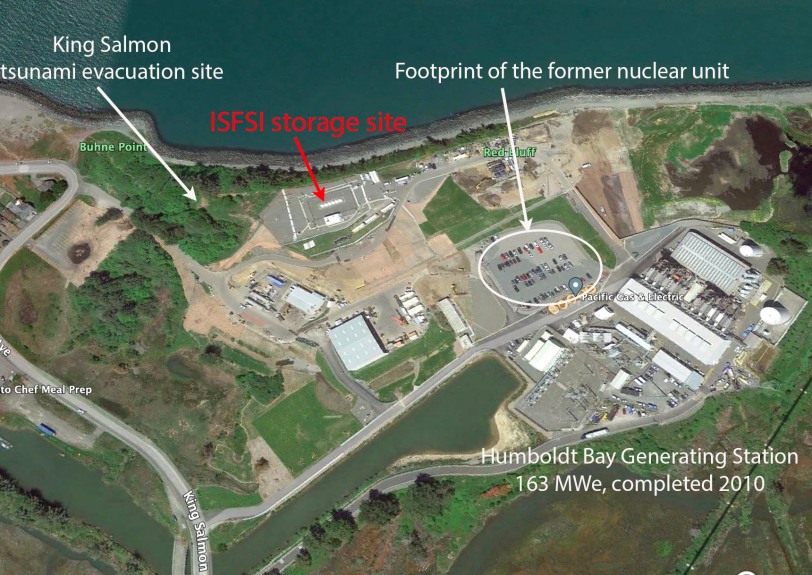
Is this the final chapter? The NRC will soon revoke the operating license for PG&E Unit #3, formally ending its official existence. But the waste is still on-site. The NRC considers cask storage a temporary solution and suggests a 40-year life span. Some hope the casks can last up to 100 years but even this is far shorter than the time needed to safely store high-level waste.
Lori Dengler | Decommissioning a nuclear power plant is a long slow process, https://www.times-standard.com/2021/11/20/lori-dengler-decommissioning-a-nuclear-power-plant-is-a-long-slow-process/By LORI DENGLER |November 20, Nothing happens quickly with a nuclear plant. Power is generated through fission, a process of splitting atoms in a controlled way. Once fission begins, it can be slowed or increased, but there’s no on-off switch and a controlled shutdown takes 6-12 hours. The radioactive byproducts last for millennia.
The fuel at PG&E’s former nuclear facility at King Salmon was small ceramic uranium oxide pellets compressed into fuel rods. A single new rod is only mildly radioactive, but when groups of rods (assemblies) are brought closely together in a reactor core, fission commences. PG&E’s Unit #3 was a boiling water reactor (BWR), where water pumped into the core was brought to a boil and steam produced electricity.
All first-generation nuclear reactors were BWRs. Built in the late 1950s to mid-1960s, seven became operational in the US and none are operating today. In the late 1960s, the second generation BWRs came online with improved efficiency, lifespan, containment, and safety features. The Fukushima-Daichi Nuclear Power Plant that failed during the 2011 Japan tsunami was this type. Of the 93 operating reactors in the US today, 31 are BWRs.
During its 13-year operational history, the Humboldt nuclear facility generated most of the county’s electricity. It was shut down yearly for refueling and maintenance and the spent fuel rods were placed in a cooling pool on the site. The pool was within the containment structure and made of steel-lined reinforced concrete several feet thick.
Spent fuel and reactor waste has been and continues to be the Achilles heel of the nuclear industry. In the early decades of the nuclear era, it was often glossed over as something that science and technology could solve. The Nuclear Regulatory Commission (NRC) classifies nuclear waste as high level or low level depending upon how long-lived the radioactive material is.
Low-level waste is produced by medical facilities, research labs, commercial facilities and in reactor operations. Often short-lived, it has radioactivity levels only slightly above background and can be safely handled with simple precautions. Small amounts can be disposed as ordinary trash and larger amounts moved on highways to approved low-level waste repositories.
It’s the high-level waste that is the big problem. High-level waste is predominately spent nuclear fuel rods. “Spent” is a misnomer as it still contains a substantial amount of energy. Unlike the new, unused fuel rods, they are now highly radioactive and very hot. That’s because once fission starts, can’t be totally stopped. Not all the uranium has been used up; it’s just no longer concentrated enough to be economically worthwhile. Fission is a complex process and creates toxic daughters such as cesium-137 and strontium-90. Fission releases neutrons which may be captured by other uranium atoms to form heavier elements such as plutonium. They aren’t as hot as the daughters but take much longer to decay. Plutonium-239 has a half-life (the time for half to be used up) of 24,100 years.
I admit to much ignorance when it comes to nuclear reactors. In talking about the Humboldt plant, I used to remark how silly it seemed that new fuel rods could be transported on highways and used ones could not. Now I understand why. There is no fission going on in the new ones and emissions are very low.
PG&E announced intentions to decommission Unit #3 in 1983. Three years later, the company requested a SAFTOR license amendment from the NRC. SAFSTOR means “possess-but-not-operate” so that the plant is maintained and monitored and much of the waste can decay before dismantling begins. In 2003, PG&E submitted an application to the NRC to begin transferring the spent fuel rods into dry cask storage.
The Humboldt plant produced 390 spent fuel assemblies in its lifetime. After several years in a storage pool, the NRC considers the waste cool enough to be moved into a dry cask storage facility on site. High-level waste repositories are known as ISFSIs (independent spent fuel storage installation). Finding an ISFSI spot on Buhne Point was problematic in many ways.
The biggest problem was that the ISFSI had to be on the PG&E site. Buhne Point site is exposed to earthquake and tsunami threats, erosion, and sea-level rise. Many people were involved with environmental and hazards studies over the years including a number of HSU geology grads. A site was selected at an elevation of 44 feet just to the west of Unit #3 with the capacity to store 37 tons of high-level waste in six casks.
I attended a community meeting about the ISFSI plan in the early 2000s. It was well attended with scientists, environmental organizations, and other community representatives. What surprised me most was that everyone agreed it was the best solution to a problem all of us wish we never had. Oh, if only time travel were possible – PG&E would be the first in line to reverse the decision to build the Humboldt nuclear facility. But given the legal realities, this was the best option.
NRC issued the Humboldt SAFSTOR license to PG&E in November 2005. By 2008, all of the spent fuel had been moved to the dry casks. The active decommissioning of the site began in 2009 and included removal of the reactor vessel, nuclear systems, containment structure, and other infrastructure. Even the soils at the site were removed. The final step was site restoration and soil remediation. It’s unclear what the footprint of the former nuclear facility may eventually become; at present, it is a parking lot.
Is this the final chapter? The NRC will soon revoke the operating license for PG&E Unit #3, formally ending its official existence. But the waste is still on-site. The NRC considers cask storage a temporary solution and suggests a 40-year life span. Some hope the casks can last up to 100 years but even this is far shorter than the time needed to safely store high-level waste.
Note: The Humboldt ISFSI is covered at http://archive.wmsym.org/2010/pdfs/10217.pdf. If anyone wants to get into the weeds with nuclear reactor technology, see https://www.amacad.org/sites/default/files/academy/pdfs/nuclearReactors.pdf.
Lori Dengler is an emeritus professor of geology at Humboldt State University, an expert in tsunami and earthquake hazards. Questions or comments about this column, or want a free copy of the preparedness magazine “Living on Shaky Ground”? Leave a message at 707-826-6019 or email Kamome@humboldt.edu. https://www.times-standard.com/2021/11/20/lori-dengler-decommissioning-a-nuclear-power-plant-is-a-long-slow-process/
Heritage Foundation – murky think tank funded by the nuclear weapons industry, wants weapons-makers to be exempt from climate and pandemic regulations

“Defense industrial base” is a buzzword that has picked up steam during the pandemic: It sends the message that, whatever happens with the economy and pandemic, we need to make sure we are in “fighting shape” — by keeping military contractors afloat. This concept was invoked to explain why, at the beginning of the pandemic, factories that produce bombs and tankers should be allowed to stay open, even amid the outbreak risk to workers. And it was also used to justify subsidies to contractors during the hardship of the pandemic.
Lockheed Martin is just one of numerous weapons manufacturers that has directly funded the Heritage Foundation. According to a report by the think tank Center for International Policy (CIP), the Heritage Foundation ranks ninth among the top think tanks that received funding from military contractors and the U.S. government from 2014 to 2019. Lockheed Martin and Raytheon were two of those major funders, both of which are among the largest weapons companies in the world and would be impacted by the new regulation.
This case provides a window into the murky world of think tanks, which are often viewed as academic and above-the-fray institutions but operate more as lobbying outfits.
Think Tank Funded by the Weapons Industry Pressures Biden Not to Regulate Military Contractors’ Emissions https://www.rsn.org/001/think-tank-funded-by-the-weapons-industry-pressures-biden-not-to-regulate-military-contractors-emissions.html
Sarah Lazare/In These Times 19 November 21The Heritage Foundation has received considerable donations from the arms industry. And now it’s trying to shield that industry from climate regulations targeting military contractors.
The Heritage Foundation, a prominent conservative think tank, is publicly opposing a new Biden administration regulation that would force the weapons industry to report its greenhouse gas emissions related to federal contracts. It turns out the Heritage Foundation also receives significant funding from the weapons industry, which makes the case worth examining — because it reveals how the arms industry pays supposedly respectable institutions to do its policy bidding at the expense of a planet careening toward large-scale climate disaster.
The regulation in question was first proposed in an executive order in May. It would require federal contractors to disclose their greenhouse gas emissions and their “climate-related financial risk,” and to set “science-based reduction targets.” In other words, companies like Lockheed Martin would have to disclose how much carbon pollution its F‑35 aircraft and cluster bombs actually cause.
In October, the Biden administration started the process to amend federal procurement rules to reflect these changes. “Today’s action sends a strong signal that in order to do business with the federal government, companies must protect consumers by beginning to mitigate the impact of climate change on their operations and supply chains,” Shalanda Young, acting director of the White House Office of Management and Budget, said at the time.The Department of Defense is the world’s biggest institutional consumer of fossil fuels and a bigger carbon polluter than 140 countries. Yet its emissions (and those of other armed forces) are excluded from UN climate negotiations, including the recent COP26 talks. The Biden administration itself supports a massive military budget, initially requesting $753 billion for the 2022 National Defense Authorization Act, a number that has since ballooned, with the Senate set to vote on a $778 billion plan. Organizers and researchers argue that, to curb the climate crisis, it is necessary to roll back U.S. militarism and dismantle the military budget.
But according to the Heritage Foundation, even this modest proposal is a bridge too far.
Continue readingScientists Warn Experimental Nuclear Plant Backed by Bill Gates Is ‘Outright Dangerous’

“fast breeder reactor” types “are proliferation nightmares.“
Continuing to support nuclear energy at the expense of faster and cheaper alternatives for cutting greenhouse gas emissions is a losing strategy.“
Scientists Warn Experimental Nuclear Plant Backed by Bill Gates Is ‘Outright Dangerous’ “Gates has continually downplayed the role of proven, safe renewable energy technology in decarbonizing our economy.” Common Dreams ANDREA GERMANOS, November 17, 2021 Officials announced Tuesday that the small city of Kemmerer, Wyoming would be the site of a new Bill Gates-backed nuclear power project—an initiative whose proponents say would provide climate-friendly and affordable energy but which some scientists warn is a dangerous diversion from true energy solutions.
The experimental Natrium nuclear power plant will be at the site of the coal-fired Naughton Power Plant, slated for retirement in 2025, though siting issues are not yet finalized. The company behind the project is TerraPower. Gates, who helped found TerraPower, is chairman of the board.
Mr. Gates,” nuclear expert Arnie Gundersen wrote in an open letter in August, Natrium “is following in the footsteps of a 70-year-long record of sodium-cooled nuclear technological failures. Your plan to recycle those failures and resurrect liquid sodium again will siphon valuable public funds and research from inexpensive and proven renewable energy alternatives.”………….
A feature of the future plant, TerraPower says, is “a molten salt-based energy storage system”—technology it claims represents “a significant advance over the light water reactor plants in use today.”
At a June press conference, Gates said Natrium was poised to “be a game-changer for the energy industry.” In a Tuesday tweet, Republican Sen. John Barrasso of Wyoming gave a similar message, saying “the Natrium reactor is the future of nuclear energy in America.”
While the company asserts the safety of Natrium’s sodium-cooled fast reactor, a report released in March by the Union of Concerned Scientists, entitled “Advanced” Isn’t Always Better, casts doubt on those claims.
UCS’s Elliott Negin highlighted the analysis in a June blog post, writing:
In fact, according to the UCS report, sodium-cooled fast reactors would likely be less uranium-efficient and would not reduce the amount of waste that requires long-term isolation. They also could experience safety problems that are not an issue for light-water reactors. Sodium coolant, for example, can burn when exposed to air or water, and the Natrium’s design could experience uncontrollable power increases that result in rapid core melting.
“When it comes to safety and security, sodium-cooled fast reactors and molten salt–fueled reactors are significantly worse than conventional light-water reactors,” says [report author Edwin] Lyman. “High-temperature gas-cooled reactors may have the potential to be safer, but that remains unproven, and problems have come up during recent fuel safety tests.”
Fast reactors have another major drawback. “Historically,” the report points out, “fast reactors have required plutonium or [highly enriched uranium]-based fuels, both of which could be readily used in nuclear weapons and therefore entail unacceptable risks of nuclear proliferation and nuclear terrorism.” Some fast reactors, including the Natrium, will initially use a lower-enriched uranium fuel, called high-assay low-enriched uranium, which poses a lower proliferation risk than highly enriched uranium, but it is more attractive to terrorists seeking nuclear weapons than the much lower-enriched fuel that current light-water reactors use.
Continue readingSafety risks of Bill Gates’ Natrium nuclear reactor

The use of liquid sodium has many problems. It’s a very volatile material that can catch fire if it’s exposed to air or water,” Edwin Lyman, director of nuclear power safety with the Union of Concerned Scientists science advocacy nonprofit, told Fortune on Tuesday.
“Honestly I don’t understand the motivation… There are some people who are just strong advocates for it and they’ve sort of won the day here by convincing Bill Gates that this is a good technology to pursue.”
Independent 17th Nov 2021
https://www.independent.co.uk/climate-change/news/bill-gates-nuclear-reactor-wyoming-b1959777.html
USA’s $1.2tn bipartisan infrastructure bill provides $6bn to prop up ailing, aging, unprofitable nuclear power plants.

Ailing nuclear power plants propped up by US infrastructure law. A 2018 report from the Union of Concerned Scientists found that more than a third of American nuclear power plants were unprofitable.
The $1.2tn bipartisan infrastructure bill that Biden signed into law on Monday provides $6bn in
grants for struggling reactors.
The president’s “Build Back Better” spending bill under debate in Congress would also establish a nuclear power production tax credit worth billions of dollars. The federal funding follows bailouts in several US states for nuclear generators on the brink of closure.
FT 17th Nov 2021
https://www.ft.com/content/faba7e8a-1983-4b47-9b70-ec903351a373
NASA seeks ideas for a nuclear reactor on the moon – submissions due by February 19 2022
NASA seeks ideas for a nuclear reactor on the moon abc news, 20 Nov 21
If anyone has a good idea on how to put a nuclear fission power plant on the moon, the U.S. government wants to hear about itBy KEITH RIDLER Associated Press BOISE, Idaho — If anyone has a good idea on how to put a nuclear fission power plant on the moon, the U.S. government wants to hear about it.
NASA and the nation’s top federal nuclear research lab on Friday put out a request for proposals for a fission surface power system.
NASA is collaborating with the U.S. Department of Energy’s Idaho National Laboratory to establish a sun-independent power source for missions to the moon by the end of the decade…….
The reactor would be built on Earth and then sent to the moon…….
The proposal requests are for an initial system design and must be submitted by Feb. 19. https://abcnews.go.com/Technology/wireStory/nasa-seeks-ideas-nuclear-reactor-moon-81282960
The U.S. Nuclear Regulatory Commission found violations of federal regulations at Vogtle nuclear site.
 | |||
U.S. regulator to raise oversight at Georgia Vogtle nuclear power reactor https://finance.yahoo.com/news/u-regulator-raise-oversight-georgia-190308554.html?guccounter=1&guce_referrer=aHR0cHM6Ly93d3cuYmluZy5jb20v&guce_referrer_sig=AQAAAFLUuKMz6yKJdBOQz3f8MPdcejq875Aj93HjGgabK-76iDLroU7mahePG2UUtceKXHdb4cvQJDADLfjHUAdSK7rs4T9iB9Q1qhV5_ncjUA7ziTqk0iBJCIU8oMPpX7xIkkm7oOJH6GBmgz Nov 18 (Reuters) Reporting by Brijesh Patel in Bengaluru Editing by Marguerita Choy – The U.S. Nuclear Regulatory Commission (NRC) on Thursday said it will increase oversight at one of the Southern Co (SO.N) operated Vogtle nuclear power plants under construction in Waynesboro, Georgia.
The decision to increase oversight comes after finalizing two inspection findings involving the safety-related electrical raceway system at Unit 3, the NRC said.
The NRC said it had launched a special inspection in June 2021 and found two violations of federal regulations at the site.
NRC inspectors found that Southern Nuclear did not properly implement its corrective action program, resulting in construction quality issues, extensive rework, and a report to the NRC for a significant quality assurance breakdown.”
“They also found that the company did not follow design specifications while installing safety-related cables for reactor coolant pumps and equipment designed to shut down the reactor safely.”
The NRC said these findings fall under a low-to-moderate safety significance and will schedule a supplemental inspection to verify Southern Nuclear understands the root cause and has taken appropriate corrective actions.
Kamala Harris became the first woman to have control over US nuclear weapons, but only briefly
Kamala Harris became the first woman to have control over US nuclear weapons, but only briefly, Business Insider, Ryan Pickrell, Nov. 19, 2021,
| President Joe Biden briefly transferred presidential authority to Vice President Kamala Harris on Friday.That included the ability to use nuclear weapons, making Harris the first woman in US history to hold that authority.Presidential power was returned to Biden following the completion of a medical procedure. President Joe Biden temporarily transferred his presidential authority to Vice President Kamala Harris on Friday as he underwent a routine colonoscopy, which briefly made her the first woman in US history to have power as commander-in-chief and the first woman to have control of the US nuclear arsenal and nuclear strike authority………………… https://www.businessinsider.com.au/vp-harris-will-become-first-woman-to-control-us-nukes-2021-11?r=US&IR=T |
G and E’s Humboldt Nuclear Power Plant is officially all cleaned up. Environmental groups are not so sure.
PG&E Reactor Officially Decommissioned, Nuclear Waste Not https://www.northcoastjournal.com/NewsBlog/archives/2021/11/18/pgande-reactor-officially-decommissioned-nuclear-waste-not J.A. SAVAGE ON THU, NOV 18, 2021 G&E’s Humboldt Nuclear Power Plant reactor site was deemed fully cleaned up by the Nucle ar Regulatory Commission today. While the federal government no longer has oversight over that part of the site — “none at all,” said commission spokesperson David McIntyre — the spent fuel and other radioactive waste, however, remains under federal jurisdiction.
The former reactor site has no requirement to be monitored for radiation. “There’s no need for it. There’s no accident scenario” in which a radiation release to the environment from that part of PG&E’s plant could occur, according to McIntyre. It could, according to regulators, even be used for farming.
PG&E is required to maintain the area above Buhne Point where spent fuel is stored, “until fuel is removed,” McIntyre said. That means the utility is responsible for “physical security, mostly fences and guards,” he added.
Environmental security is another story, however. When asked about responsibility to keep the site secure from the threat of a radioactive release due to a tsunami, sea level rise or some other environmental event, McIntyre said he would check and then got back to the Journal with an update.
“PG&E, the licensee, is responsible for maintaining its safety and security until the fuel is removed from the site,” he said. “I am advised that the storage casks are below grade, as an additional protection against earthquakes, and they are located on high ground above the town, so sea level rise and tsunamis are not considered a threat to the safety of the facility.”
Environmental groups, however, remain concerned sea level rise will very much be an issue at the site. Read more about the nuclear plant’s history and legacy, which some fear could stretch thousands of years into the future, in previous Journal coverage here.
U.S. govt brings early Christmas to Bill Gates and the nuclear industry – tax-payer funding!

The U.S. Government and Bill Gates Get Behind Nuclear Power, Barrons, By Avi Salzman, Nov. 17, 2021 Nuclear power got a boost from the infrastructure bill signed into law this week by President Biden that could at the very least forestall the industry’s decline. With government support and the endorsement of major investors like Bill Gates, nuclear power looks as if it has a place in a carbon-free future. [ed. only nuclear is not carbon-free]
The legislation sets aside $6 billion to help fund nuclear plants in danger of closing. Several plants have needed help from the states where they are located in recent years because running nuclear plants has not always been profitable as other sources of electricity have become cheaper. A 2018 report from the Union of Concerned Scientists found that “more than one-third of U.S. nuclear plants are unprofitable or scheduled to close.” Having a federal financing program would ease the pressure on states and make it more likely plants could stay open……..
The new law has other goodies for the industry too, including funding for the Energy Department’s Advanced Reactor Demonstration Program.
One project that will receive funding from the bill is a new advanced reactor in Wyoming being built by TerraPower, which was founded by Bill Gates. The TerraPower reactor is expected to be smaller than most traditional nuclear plants, but to have more highly enriched uranium. Theoretically, these kinds of projects could bring power to more remote areas. The TerraPower plant is expected to open by 2028 and replace a coal plant.
Several utility companies could benefit from support for nuclear plants, including Exelon (ticker: EXC) and NextEra Energy (NEE).
Nuclear power could get an even bigger boost from the Build Back Better bill now being debated, including from special tax credits.
Those credits could be worth as much as $15 billion to the industry. Additional credits for low-carbon hydrogen production could also benefit the nuclear industry. https://www.barrons.com/articles/the-u-s-government-and-bill-gates-get-behind-nuclear-power-51637177613
-
Archives
- October 2026 (104)
- September 2026 (339)
- August 2026 (330)
- July 2026 (355)
- June 2026 (287)
- May 2026 (306)
- April 2026 (356)
- March 2026 (251)
- February 2026 (267)
- January 2026 (308)
- December 2025 (358)
- November 2025 (359)
-
Categories
- 1
- 1 NUCLEAR ISSUES
- business and costs
- climate change
- culture and arts
- ENERGY
- environment
- health
- history
- indigenous issues
- Legal
- marketing of nuclear
- media
- opposition to nuclear
- PERSONAL STORIES
- politics
- politics international
- Religion and ethics
- safety
- secrets,lies and civil liberties
- spinbuster
- technology
- Uranium
- wastes
- weapons and war
- Women
- 2 WORLD
- ACTION
- AFRICA
- Atrocities
- AUSTRALIA
- Christina's notes
- Christina's themes
- culture and arts
- Events
- Fuk 2022
- Fuk 2023
- Fukushima 2017
- Fukushima 2018
- fukushima 2019
- Fukushima 2020
- Fukushima 2021
- general
- global warming
- Humour (God we need it)
- Nuclear
- RARE EARTHS
- Reference
- resources – print
- Resources -audiovicual
- Weekly Newsletter
- World
- World Nuclear
- YouTube
-
RSS
Entries RSS
Comments RSS

