Feds: Underground nuclear waste tank at Hanford Nuclear Reservation may be leaking

Feds: Nuclear waste tank at Hanford Nuclear Reservation may be leaking, Statesman Journal NICHOLAS K. GERANIOS, 30 Apr 21, Associated Press SPOKANE, Wash. (AP) — An underground nuclear waste storage tank in Washington state that dates to World War II appears to be leaking contaminated liquid into the ground, the U.S. Department of Energy said Thursday.
It’s the second tank believed to be leaking waste left from the production of plutonium for nuclear weapons at the Hanford Nuclear Reservation. The first was discovered in 2013. Many more of the 149 single-walled storage tanks at the site are suspected of leaking.
Tank B-109, the latest suspected of leaking, holds 123,000 gallons of radioactive waste. The giant tank was constructed during the Manhattan Project and received waste from Hanford operations between 1946 to 1976.
The Hanford site near Richland in the southeastern part of the state produced about two-thirds of the plutonium for the nation’s nuclear arsenal, including the bomb dropped on Nagasaki, Japan, and now is the most contaminated radioactive waste site in the nation.
A multi-billion dollar environmental cleanup has been underway for decades at the sprawling Hanford site.
The Washington state Department of Ecology and the U.S. Environmental Protection Agency were notified Thursday that the tank was likely leaking…….
The leak from Tank B-109 was first suspected in March 2019, when there appeared to be a small drop in the level of its liquid waste. Monthly checks showed the level stable until July 2020, when another drop was detected, and the DOE launched an investigation. https://www.statesmanjournal.com/story/tech/science/environment/2021/04/29/feds-nuclear-waste-tank-hanford-nuclear-reservation-may-leaking/7401579002/
Like Trump, Biden administration to ramp up nuclear bomb-making
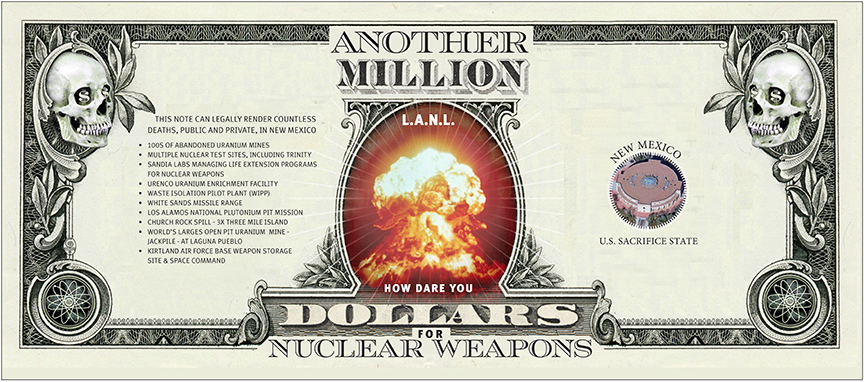
| US pushes ahead with nuclear plans despite watchdog concerns, 9 news, By Associated Press Apr 30, 2021 The Biden administration appears to be picking up where former President US Donald Trump left off as the federal agency that oversees US nuclear research and bomb-making has approved the conceptual design and cost range for infrastructure investments for a multibillion-dollar project to manufacture key components for the nation’s nuclear arsenal. The National Nuclear Security Administration in a decision announced Wednesday stated that planning and construction could cost upwards of $5.15 billion initially.The agency did not articulate what exactly that money would be spent on nor does it include the cost of other preparations that would be needed for Los Alamos National Laboratory to begin producing 30 plutonium cores per year. The push to resume production of the nuclear triggers has spanned multiple presidential administrations, with supporters arguing that the US needs to ensure the stability and reliance of its arsenal given growing global security concerns. The nuclear agency also has said most of the cores in the stockpile date back to the 1970s and 1980s. Lab Director Thom Mason during a virtual community meeting Thursday evening fielded several questions about the project, saying the goal of the work is not to expand the arsenal but rather to extend the life of the existing stockpile……… watchdog groups have been sounding alarms over the potential for more security and safety lapses at the northern New Mexico lab and the potential for environmental contamination. Another concern is the nuclear waste that would be generated by the work. The groups have said the cost estimate outlined by the agency in its decision is roughly double the projections made just last year. Greg Mello with the Los Alamos Study Group said the ballooning budget and uncertainty over whether the lab can meet the federal government’s mandated production schedule “throw further doubt on the wisdom of proceeding with industrial pit production” at Los Alamos.“ LANL’s facilities are simply too old and inherently unsafe, its location too impractical,” he said.“Even with a much smaller stockpile, LANL could not undertake this mission successfully.” Some groups have threatened to sue the US Energy Department and the National Nuclear Security Administration, saying a more comprehensive review should have been done on the plans to produce plutonium cores at Los Alamos and at the Savannah River Site in South Carolina. They argue that nearby communities already have been saddled with legacy contamination from previous defence work.Critics are fearful that the project will result in factories that resemble the Rocky Flats facility in Colorado, which had a long history of leaks, fires and environmental violations and needed a $9 billion clean up that took years to finish………..J Jay Coghlan of Nuclear Watch New Mexico called the federal government’s plans “unnecessary and provocative,” saying more production will result in more waste and help to fuel a new arms race……https://www.9news.com.au/world/us-pushes-ahead-with-nuclear-plans-despite-watchdog-concerns/506472b5-da49-4939-971c-4a36586a3843 |
When USA attacks a foreign state, the media calls it ”Defense”

It’s Aggression When ‘They’ Do It, but Defense When ‘We’ Do Worse https://fair.org/home/its-aggression-when-they-do-it-but-defense-when-we-do-worse/ALAN MACLEOD Aggression, in international politics, is commonly defined as the use of armed force against another sovereign state, not justified by self-defense or international authority. Any state being described as aggressive in foreign or international reporting, therefore, is almost by definition in the wrong.
It’s a word that seems easy to apply to the United States, which launched 81 foreign interventions between 1946 and 2000 alone. In the 21st century, the United States has attacked, invaded or occupied the sovereign states of Afghanistan, Iraq, Libya, Syria, Pakistan, Yemen and Somalia.
Despite the US record, Western corporate media overwhelmingly reserve the word “aggression” for official enemy nations—whether or not it’s warranted. In contrast, US behavior is almost never categorized as aggressive, thereby giving readers a misleading picture of the world.
Perhaps the most notable internationally aggressive act in recent memory was the Trump administration’s assassination of Iranian general and political leader Qassem Soleimani last year. Yet in its long and detailed report on the event, the Washington Post (1/4/20) managed to present Iran as the aggressor. The US was merely “choos[ing] this moment to explore an operation against the leader of Iran’s Quds Force, after tolerating Iranian aggression in the Persian Gulf for months,” in the Post’s words.
t also gave space to senior US officials to falsely claim Soleimani was aiming to carry out an “imminent” attack on hundreds of Americans. In fact, he was in Iraq for peace talks designed to bring an end to war between states in the region. The Iraqi prime minister revealed that he had invited Soleimani personally, and had asked for and received Washington’s blessing to host him. Trump instead used that information to kill him.
For months, media had been awash with stories, based on US officials’ proclamations, that Iranian aggression was just around the corner (e.g., Yahoo! News, 1/2/20; Reuters, 4/12/19; New York Times, 11/23/19; Washington Post, 6/22/19). The Hill (10/3/19) gave a retired general space to demand that we must “defend ourselves” by carrying out a “serious response” against Iran, who is “test[ing] our resolve with aggressive actions.”
Russia is another country constantly portrayed as aggressive. The New York Times (11/12/20) described a US fishing boat’s mix up with the Russian navy off the coast of Kamchatka as typical Russian aggression, complete with the headline, “Are We Getting Invaded?” The Military Times (6/26/20) worried that any reduction in US troops in Germany could “embolden Russian aggression.” And a headline from the Hill (11/14/19) claimed that “Putin’s Aggression Exposes Russia’s Decline.” In the same sentence that publicized a report advocating that NATO expand to take on China directly, the Wall Street Journal (12/1/20) warned of “Russian aggression.” Suffice to say, tooling up for an intercontinental war against another nuclear power was not framed as Western warmongering.
Other enemy states, such as China (New York Times, 10/6/20; CNBC, 8/3/20; Forbes, 3/26/21), North Korea (Atlantic, 11/23/10; CNN, 8/9/17; Associated Press, 3/8/21) and Venezuela (Wall Street Journal, 11/18/05; Fox News, 3/10/14; Daily Express, 9/30/19) are also routinely accused of or denounced for “aggression.”
Corporate media even present the Taliban’s actions in their own country against Western occupation troops as “aggression” (Guardian 7/26/06; CBS News, 11/27/13; Reuters, 3/26/21). The New York Times (11/24/20) recently worried about the Taliban’s “aggression on the battlefield,” while presenting the US—a country that invaded Afghanistan in 2001 and still has not left—as supposedly committed to the “peace process.”
Even as the US has been flying squadrons of nuclear bombers from North Dakota to Iran and back, each time in effect simulating dropping atomic bombs on the country, media have framed this as a “defensive move” (Politico, 12/30/20) meant to stop “Iranian aggression” (Defense One, 1/27/20) by “deter[ring] Iran from attacking American troops in the region” (New York Times, 12/30/20).
In February, President Joe Biden ordered an airstrike on a Syrian village against what the White House claimed were Iran-backed forces. The Department of Defense absurdly insisted that the attack was meant to “deescalate” the situation, a claim that was lamentably uncritically repeated in corporate media, with Politico (2/25/21) writing that “the strike was defensive in nature” and a response to previous attacks on US troops in Iraq. Needless to say, it did not question the legitimacy of American troops being stationed across the Middle East.
That the US, by definition, is always acting defensively and never aggressively is close to an iron law of journalism. The US attack on Southeast Asia is arguably the worst international crime since the end of World War II, causing some 3.8 million Vietnamese deaths alone. Yet in their seminal study of the media, Manufacturing Consent, Edward Herman and Noam Chomsky (Extra!, 12/87) were unable to find a single mention of a US “attack” on Vietnam. Instead, the war was commonly framed as the “defense” of South Vietnam from the Communist North.
Even decades later, US actions in Vietnam are still often described as a “defense” (e.g., Wall Street Journal, 4/29/05; Christian Science Monitor, 1/22/07; Politico, 10/10/15; Foreign Policy, 9/27/17). In a 2018 autopsy of the conflict headlined “What Went Wrong in Vietnam,” New Yorker staff writer Louis Menand (2/26/18) wrote that “our policy was to enable South Vietnam to defend itself” as the US “tried to prevent Vietnam from becoming a Communist state.” “Millions died in that struggle,” he adds, as if the perpetrators of the violence were unknown.
It was a similar story with the US invasion of Grenada in 1983, which was presented as a defense against “Soviet and Cuban aggression in the Western hemisphere” (San Diego Union-Tribune, 10/26/83).
There have only been three uses of the phrases “American aggression” or “US aggression” in the New York Times over the past year. All came in the mouths of Chinese officials, and in stories focusing on supposedly aggressive Chinese actions. For example, at the end of a long article warning about how China is “pressing its territorial claims aggressively” from the Himalayas to the South China Sea, in paragraph 28 the Times (6/26/20) noted that Beijing’s priority is “confronting what it considers American aggression in China’s neighborhood.” Meanwhile, two articles (10/5/20, 10/23/20) mention that Chinese disinformation calls the Korean War the “war to resist American aggression and aid Korea”. But these were written off as “visceral” and “pugnacious” “propaganda” by the Times.
Likewise, when the phrase “American aggression” appears at all in other leading publications, it is largely only in scare quotes or in the mouths of groups long demonized in corporate media, such as the Houthi rebels in Yemen (Washington Post, 2/5/21), the Syrian government of Bashar al-Assad (Associated Press, 2/26/21) or Saddam Hussein’s generals (CNN, 3/3/03).
The concept of US belligerence is simply not being discussed seriously in the corporate press, leading to the conclusion that the word “aggression” in newspeak means little more than “actions we don’t like carried out by enemy states.”
Whistleblower can’t sue U.S.Dept of Labor, because it has ‘sovereign immunity’
Federal Nuclear Engineer Loses Whistleblower Retaliation Appeal, Bloomberg Law, May 1, 2021,
- Safety reports on nuclear plant allegedly cost him promotions
- Energy Reorganization Act doesn’t allow suit against government
A Nuclear Regulatory Commission engineer who blew the whistle on health and safety risks at a nuclear power plant can’t sue the Department of Labor for alleged retaliation because it’s shielded by sovereign immunity, the Fourth Circuit said Friday.
Michael Peck worked as senior resident inspector at the Diablo Canyon Nuclear Power Plant. After he left the plant, Peck took three actions regarding concerns he had with safety conditions there—he filed a formal “differing professional opinion” with the NRC; sent a letter to the Senate Committee on Environment and Public Works, which oversees the NRC; and provided testimony to the…… (subscribers only) https://news.bloomberglaw.com/us-law-week/federal-nuclear-engineer-loses-whistleblower-retaliation-appeal
Extended subsidies for New Jersey’s nuclear stations
New Jersey utility board extends ZEC subsidies for PSEG nuclear plants, S and P Global, Steven Dolley Editor Valarie Jackson 28 Apr 21, The New Jersey Board of Public Utilities voted unanimously April 27 to extend the state’s zero-emission certificate subsidies for PSEG Nuclear’s Hope Creek and Salem plants, payments the company said it must continue to receive if the plants are not to be permanently shut for being unprofitable to operate.
The board’s decision extends, until May 2025, a ZEC subsidy of $10/MWh provided to PSEG for generation from its Hope Creek and Salem-1 and -2 nuclear units in Hancocks Bridge, with a combined capacity of 3.736 GW.
PSEG officials have said, including at a hearing in March on the proposed extension of the ZECs, that the company would permanently shut the units if the subsidies were not extended, because they would be uneconomic to continue to operate.
…….. Opponents of the ZEC program have said that the subsidies are an unnecessary bailout of nuclear power, claiming that economic analyses had not demonstrated that such large subsidies are needed to keep Hope Creek and Salem in operation and renewable generation is a more desirable path for the state.
Jeff Tittel, director of the anti-nuclear New Jersey Sierra Club, said in an April 27 statement, “this is the third year in a row that the BPU rubberstamped these unneeded subsidies,” which “will take money away from offshore wind, solar, and energy efficiency programs in New Jersey. We are concerned that it will prevent this state from moving forward with our 100% renewable goals by 2050.”………… www.spglobal.com/platts/en/market-insights/latest-news/electric-power/042721-new-jersey-utility-board-extends-zec-subsidies-for-pseg-nuclear-plants
The purpose of USA space research is clearly military – they don’t even pretend any more.
US Nuclear Marks Beginning of Age of Space Mining as It Signs Historic Trade Agreement, US Nuclear Corp, April 28, 2021,
Source: US Nuclear Corp. Los Angeles, CA, April 28, 2021 (GLOBE NEWSWIRE) — via NewMediaWire — On April 15, 2021, US Nuclear Corp. (OTCQB: UCLE) signed a historic trade agreement with Solar System Resources Corporation that marked the beginning of the age of space trade and mining. The new agreement sets preliminary prices for the high value materials to be extracted. It also establishes and expands our cislunar and solar system value chain and adds SatRevolution as a new partner. The agreement is a continuation of the Letter of Intent signed on February 5, 2021, and outlines how US Nuclear and Solar Systems Resources Corp. plan to cooperate building a value chain starting with mining and selling valuable helium-3 and lanthanide metals and other materials from space deposits.
Solar Systems Resources Corporation Sp. z o. o. is a space mining company that conducts localization, in-situ verification, and mining of space resources. A third strategic partner, SatRevolution S.A., a leading provider of nanosatellites, is also participating in construction of the value chain mentioned in the agreement. The deal, if completed in full, could be worth many hundreds of billions of dollars and will pave the way to a new frontier mining resources in space.
The agreement is in the form of a Memorandum of Understanding, and highlights include:
……….. The parties will endeavor to support the US (and allies), NATO military, and the development of the operational capabilities of the US Space Force…… https://www.globenewswire.com/news-release/2021/04/28/2218641/0/en/US-Nuclear-Marks-Beginning-of-Age-of-Space-Mining-as-It-Signs-Historic-Trade-Agreement.html
No future for new nuclear

‘the claim that any nuclear reactor system can “burn” or “consume” nuclear waste is a misleading oversimplification. Reactors can actually use only a fraction of spent nuclear fuel as new fuel, and separating that fraction increases the risks of nuclear proliferation and terrorism.’
mini-PWR designs, like NuScale’s Small Modular Reactor. – the UCS is none too keen on SMRs, as witness its earlier report on them –it says ‘small isn’t always beautiful’. A more recent review of SMRs by Prof. M.V. Ravana, from the University of British Columbia, looking more at the economics, came to similar conclusions: ‘Pursuing SMRs will only worsen the problem of poor economics that has plagued nuclear power and make it harder for nuclear power to compete with renewable sources of electricity.’

No future for new nuclear— https://renewextraweekly.blogspot.com/2021/04/no-future-for-new-nuclear.htmlAn arguably definitive study 25 Apr 21, of new advanced non-water cooled nuclear options, including molten salt reactors and liquid sodium cooled fast reactors, from the US Union of Concerned Scientists, concludes that none can be ready for at least a decade, more like two, and there are none that meet safety, security, sustainability criteria, apart possibly from once-through breed and burn reactors. If we want nuclear it says it would more sensible just to upgrade the standard, more familiar, water cooled reactors.
It sets the scene by noting that, in the United States, so-called Light Water Reactors (PWRs and BWRs) have dominated, these using ordinary water to cool their hot, highly radioactive cores, as opposed to reactors like the Canadian CANDU that use ‘heavy water’, with a double neutron hydrogen isotope, as a moderator. Support for LWRs has continued, despite some economic problems, which have bedevilled expansion in the US and elsewhere: ‘new nuclear plants have proven prohibitively expensive and slow to build, discouraging private investment and contributing to public skepticism’.
Continue readingBe aware – Nuclear Thermal Propulsion (NTP) for space rockets has everything to do with the mkilitary, and funding for weapons makers

US Military Seeks Nuclear Space Flight Test by 2025, VOA 26 Apr 21,
The U.S. military has chosen three companies to develop nuclear thermal propulsion, or NTP systems to be tested in space by 2025. The goal is to test the space travel technology in cislunar space – the area between Earth and the moon.
What is NTP? What is NTP?
The U.S. Department of Energy describes on its website how an NTP system works. It needs a radioactive material such as uranium and another element, such as hydrogen, in liquid form. The liquid propellant is pumped through a reactor core. This causes uranium atoms to break apart inside the core and release heat. The heat turns the propellant into gas, which expands through an opening to produce thrust.
The contracts to produce a flight demonstration of NTP technology were awarded by the military’s Defense Advanced Research Projects Agency, or DARPA. The winning contractors were General Atomics, Blue Origin and Lockheed Martin. DARPA did not announce how much the contracts were worth.
In a recent announcement about the project, DARPA said the area of space, or “space domain,” will be very important to business, scientific discovery and national defense. Establishing “space domain awareness in cislunar space…will require a leap-ahead in propulsion technology,” the agency said……..
NTP and NASA
The U.S. space agency NASA has long been interested in nuclear propulsion systems to power its spacecraft of the future. But the technology has not yet been demonstrated…….. https://learningenglish.voanews.com/a/us-military-seeks-nuclear-space-flight-test-by-2025/5864011.html
Do the New Jersey nuclear power plants really need a handout?
N.J. nuclear plants may get $300M bailout renewed. If they do, you’ll keep footing the bill.
nj.com Apr 26, 2021By Amanda Hoover | NJ Advance Media For NJ.com,
The Board of Public Utilities will decide Tuesday if it will continue to award hundreds of millions in subsidies to PSE&G, the operator of New Jersey’s three nuclear power plants.
And if it does, you’ll see the money come out of your pocket — even if you’re not a PSE&G customer.
The question before the board is whether or not the power company needs the money as nuclear plants become increasingly less profitable. Critics and consumer advocates say the company should take the financial hit itself, but PSE&G insists the plants present a situation so dire it will be forced to shutter them without assistance.
This won’t be new money on your bill, but a continued rate hike. PSE&G first won about $300 million in annual subsidies in a controversial 2019 BPU decision. The subsidies are zero emissions credits, known as ZECs for short. They became available under a law signed by Gov. Phil Murphy in 2018 to promote clean energy.
But things have changed, critics say. The coronavirus shutdowns have put many out of work and hampered local businesses. The extra charge tacked on to each bill means more to consumers.
And electric usage is likely up now as many people work and spend more time at home. With more people struggling financially, the estimated $41 a year per customer takes new significance. There’s already a moratorium on energy shutoffs through the end of June to help those who are struggling.
“These are profitable plants, we didn’t think they deserved this handout from the beginning,” said Stefanie Brand, director of the Rate Counsel, the body that advocates for utility customers. “We now have about a million households in this state that are struggling to pay their bills. Their plants may not be as profitable as PSE&G would like, they’re still — as far as we’re concerned — profitable.”
Because the companies are unregulated, much of the financial information is private. That leaves outsiders guessing how much the energy company really needs a handout. The plants include Salem 1 and 2 reactors owned by PSE&G and Exelon, as well as the Hope Creek Nuclear Generating Station owned solely by PSE&G. All are in Lower Alloways Creek in Salem County……..
Keeping the plants in place until 2050 also assumes they will function past their expected lifespan. That means costly repairs that will continue to threaten their profitability…….
PSE&G has spent millions in lobbying and threatened to shutter the plants or neglect repairs without the subsidies…….. https://www.nj.com/business/2021/04/nj-nuclear-plants-may-get-300m-bailout-renewed-if-they-do-youll-keep-footing-the-bill.html
Subsidies for New Jersey’s nuclear power stations

What ratepayers will pay in subsidies for NJ’s nuclear power plants, nj spotlight, TOM JOHNSON, APRIL 26, 2021 PSEG pushing state regulators to move forward on a yearly subsidy of about $300 million. The state is poised once again to decide whether to subsidize New Jersey’s three remaining nuclear power plants, but unlike two years ago, the question is not so much about whether ratepayers should fund the program, but how much they should pay.
PSEG pushing state regulators to move forward on a yearly subsidy of about $300 million. The state is poised once again to decide whether to subsidize New Jersey’s three remaining nuclear power plants, but unlike two years ago, the question is not so much about whether ratepayers should fund the program, but how much they should pay.
Public Service Enterprise Group, the operator of the three plants in South Jersey, is urging state regulators to approve another yearly subsidy at the same level of roughly $300 million, awarded in April 2019. This time, however, the New Jersey Board of Public Utilities can reduce the level of subsidy, an option not available previously to the annoyance of a couple of BPU commissioners, who nevertheless went along with approving the subsidy anyway………
How other states have dealt with nuclear subsidies
In Illinois, Exelon Generation has threatened to shutter two of its power plants. The governor of Illinois released an analysis earlier this month that recommends $350 million in ratepayer subsidies over five years be approved to keep them open.
Meanwhile in Ohio, nuclear plants were originally awarded ratepayer subsidies of $150 million annually, but they were repealed this spring. That happened after a scandal concerning the speaker of the Ohio House of Representatives and others over bribery allegations involving subsidies intended for FirstEnergy Solutions, a former subsidiary of FirstEnergy, to be approved.
For some critics, all of that raises the question of how long states will have to subsidize these plants.
“This is a habit that won’t go away and only increase over time,’’ said Steven Goldenberg, an attorney for the New Jersey Large Energy Users Coalition, and a participant in the last two zero-emissions credits (ZEC) cases. As the nuclear plants age, the companies will keep asking ratepayers to fund huge capital investments, he said…….
Opponents of the subsidy dispute the company’s claims. The Division of Rate Counsel’s review of PSEG’s applications claims the company overstates its projected costs and underestimates projected revenues……..https://www.njspotlight.com/2021/04/what-ratepayers-will-pay-in-subsidies-for-njs-nuclear-power-plants/
Is the US nuclear community prepared for the extreme weather climate change is bringing?

Is the US nuclear community prepared for the extreme weather climate change is bringing? https://thebulletin.org/2021/04/is-the-us-nuclear-community-prepared-for-the-extreme-weather-climate-change-is-bringing/?utm_source=Newsletter&utm_medium=Email&utm_campaign=ThursdayNewsletter04222021&utm_content=NuclearRisk_NuclearExtremeWeather_04202021 By Susan D’Agostino | April 20, 2021
In May 2000, a planned burn to remove dead, dried underbrush on New Mexico’s drought-stricken Cerro Grande peak in the Bandelier National Monument grew out of control. As the sky darkened with smoke, a wall of flames fueled by high winds burned through tens of thousands of acres of land where people, elk, and bald eagles made their homes. The monstrous blaze escaped the monument’s containment line and headed to the forested birthplace of the atomic bomb—Los Alamos National Laboratory. There, it raced over soil, rocks, and trees contaminated from decades-old nuclear weapons testing, releasing radioactive particles into the air and setting 47 buildings ablaze. As the devastation unfolded, the wildfire inched close to, but stopped short of, a facility containing tritium, a radioactive form of hydrogen.
In May 2000, a planned burn to remove dead, dried underbrush on New Mexico’s drought-stricken Cerro Grande peak in the Bandelier National Monument grew out of control. As the sky darkened with smoke, a wall of flames fueled by high winds burned through tens of thousands of acres of land where people, elk, and bald eagles made their homes. The monstrous blaze escaped the monument’s containment line and headed to the forested birthplace of the atomic bomb—Los Alamos National Laboratory. There, it raced over soil, rocks, and trees contaminated from decades-old nuclear weapons testing, releasing radioactive particles into the air and setting 47 buildings ablaze. As the devastation unfolded, the wildfire inched close to, but stopped short of, a facility containing tritium, a radioactive form of hydrogen.
The US response to potential climate impacts on the country’s various nuclear activities has, in the eyes of many experts, fallen far short of what it needs to be.
“All of these [nuclear] structures were built on the presumption of a stable planet. And our climate is changing very rapidly and presenting new extremes,” Hill said. “There’s harm that stems from that.”
Drought and spent nuclear waste. When forests are drier for long periods of time, they act as kindling for wildfires. Extreme drought exacerbated by climate change is a key driver of wildfires in the Western United States, which are increasing both in frequency and in size. For nuclear infrastructure in the heart of wildfire territory, this trend spells trouble.
Continue readingRising threat of nuclear war is barely noticed. Corporate media likes it that way.
Rising Threat of Nuclear War Is Barely Noticed, Consortium news, By Caitlin Johnstone
CaitlinJohnstone.com 23 Apr 21, U.S. Strategic Command, the branch of the U.S. military responsible for America’s nuclear arsenal, tweeted the following on Tuesday:
“The spectrum of conflict today is neither linear nor predictable. We must account for the possibility of conflict leading to conditions which could very rapidly drive an adversary to consider nuclear use as their least bad option.”
STRATCOM called it a preview of the “posture statement” it submits to U.S. Congress every year. It was a bit intense for Twitter and sparked a lot of alarmed responses. This alarm was due not to any inaccuracy in STRATCOM’s frank statement, but due to the bizarre fact that our world’s increasing risk of nuclear war barely features in mainstream discourse.
STRATCOM has been preparing not just to use its nuclear arsenal for deterrence but also to “win” a nuclear war should one arise from the (entirely U.S. -created) “conditions” which are “neither linear nor predictable.”
And it’s looking increasingly likely that one will as the prevailing orthodoxy among Western imperialists that U.S. unipolar hegemony must be preserved at all cost rushes headlong toward America’s plunge into post-primacy.
The U.S. has been ramping up aggressions with Russia in a way that has terrified experts, and it looks likely to continue doing so. These aggressions are further complicated on increasingly tense fronts like Ukraine, which is threatening to obtain nuclear weapons if it isn’t granted membership to NATO, either of which would increase the risk of conflict.
Aggressions against nuclear-armed China are escalating on what seems like a daily basis at this point, with potential flashpoints in the China Seas, Taiwan, Xinjiang, Hong Kong, India and any number of other possible fronts………
The fact that those in charge of U.S. nuclear weapons now see both Russia and China as a major nuclear threat, and the fact that U.S. cold warriors are escalating against both of them, is horrifying.
The fact that they’re again playing with “low-yield” nukes designed to actually be used on the battlefield makes it even more so. This is to say nothing of tensions between nuclear-armed Pakistan and nuclear-armed India, between nuclear-armed Israel and its neighbors, and between nuclear-armed North Korea and the Western empire.
The Bulletin of the Atomic Scientists has the 2021 Doomsday Clock at 100 seconds to midnight, citing the rising threat of nuclear war:……………
As I all too frequently find myself having to remind people, the primary risk here is not that anyone will choose to have a nuclear war, it’s that a nuke will be deployed amid heightening tensions as a result of miscommunication, miscalculation, misfire, or malfunction, as nearly happened many times during the last Cold War, thereby setting off everyone’s nukes as per Mutually Assured Destruction.
The more tense things get, the likelier such an event becomes. This New Cold War is happening along two fronts, with a bunch of proxy conflicts complicating things even further. There are so very many small moving parts, and it’s impossible to remain in control of all of them.
Thousands of Starter Buttons
People like to think every nuclear-armed country has one “The Button” with which they can consciously choose to start a nuclear war after careful deliberation, but it doesn’t work that way.
There are thousands of people in the world controlling different parts of different nuclear arsenals who could independently initiate a nuclear war. Thousands of “The Buttons.” It only takes one. The arrogance of believing anyone can control such a conflict safely, for years, is astounding.
A 2014 report published in the journal Earth’s Future found that it would only take the detonation of 100 nuclear warheads to throw 5 teragrams of black soot into the Earth’s stratosphere for decades, blocking out the sun and making the photosynthesis of plants impossible. This could easily starve every terrestrial organism to death that didn’t die of radiation or climate chaos first. China has hundreds of nuclear weapons; Russia and the United States have thousands.
This should be the main thing everyone talks about. There is literally no more urgent matter on earth than the looming possibility that everyone might die in a nuclear war.
But people don’t see it.
On a recent “Tucker Carlson Tonight” appearance, former Congresswoman Tulsi Gabbard did a solid job describing the horrors of nuclear war and the very real possibility that it could be inflicted upon the U.S. due to America’s insane brinkmanship with Russia. She spoke earnestly about how “such a war would come at a cost beyond anything we can really imagine,” painting an entirely accurate picture of “hundreds of millions of people dying and suffering, seeing their flesh being burned from their bones.”
Gabbard is correct, and was right to give such a confrontational account of what we are looking at right now. But if you read the replies to Gabbard’s tweet in which she shared a clip from the interview, you’ll see a deluge of commenters accusing her of “hyperbole,” saying she’s being soft on Russian President Vladimir Putin and admonishing her for appearing on Tucker Carlson. It’s like they can’t even hear what she’s saying, how real it is, how significant it is.
Normalcy Bias & Media Malpractice
People’s failure to wrap their minds around this issue is a testament to the power of normalcy bias, a cognitive glitch which causes the U.S. to assume that because something bad hasn’t happened in the past, it won’t happen in the future. We survived the last Cold War by the skin of our teeth, entirely by sheer, dumb luck; the only reason people are around to bleat “hyperbole” is because we got lucky. There’s no reason to believe we’ll get lucky in this New Cold War environment; only normalcy bias says we will. Believing we’ll survive this Cold War just because we survived the last one is as sane as believing Russian roulette is safe because the guy passing you the gun didn’t die.
It’s also a testament to the power of plain old psychological compartmentalization. People can’t handle the idea of everything ending, of everyone they know and love dying, of watching their loved ones die in flames or from radiation poisoning right in front of them, all because someone made a mistake at the wrong time after a bunch of imperialists decided that U.S. planetary domination was worth putting every terrestrial organism at risk.
But mostly it’s testament to the ubiquitous malpractice of the Western media. It’s inconvenient to the agendas of the imperial war machine to have people protesting these insane Cold War games of nuclear brinkmanship, so their media stenographers barely touch on this issue. If mainstream journalism actually existed, this flirtation with nuclear war would be front and center in everyone’s awareness and people would be flooding the streets in protest against their lives being toyed with as casino chips in an insane all-or-nothing gamble.
This is so much bigger than any of the petty little things we spend our mental energy on from day to day……….The rising threat of nuclear war is the most urgent matter in the world and it’s absolute madness that we’re not talking about it all the time. https://consortiumnews.com/2021/04/23/rising-threat-of-nuclear-war-is-barely-noticed/
Attachments areaPreview YouTube video Tulsi Gabbard issues warning about potential war with RussiaTulsi Gabbard issues warning about potential war with RussiaPreview YouTube video Vasili Arkhipov: HeroVasili Arkhipov: Hero
”Advanced” nuclear reactors not necessarily better. NuScale’s ”small” nuclear reactors not really small

Johnson Loves Pie in the Sky nuClear News N0. 131 April 2021 ………….. NuScale In Jan 2021, a UK company, Shearwater, announced a partnership with US NuScale to develop 3GW hybrid off-shore wind/SMR plant to produce electricity & hydrogen. (9) The NuScale option, whether as a standalone plant or a hybrid with offshore wind, suffers from the fact that while the individual reactors are small, they are designed to be in as cluster of 12 – about 1GW capacity – making it effectively a large reactor. Until a project being built in the USA is completed and operating efficiently and economically, it will remain an unproven and risky investment.
The NuScale SMR design is further ahead than Rolls Royce’s, since they have been working on it since 2003. It is a 77MW reactor designed to be deployed in clusters of 12 – so 924MW altogether. NuScale has only one potential project – Utah Associated Municipal Power Systems (UAMPS) – with USDOE funding for part of the project but not sufficient investors yet for rest of project.
M.V. Ramana (Liu Institute for Global Issues, School of Public Policy and Global Affairs, The University of British Columbia) argues that higher construction and operational costs per unit of electricity generation capacity will make electricity from SMRs more expensive than electricity from large nuclear power plants. An assessment of the markets for these technologies, suggests they are inadequate to justify constructing the necessary manufacturing facilities. (10)
Economics of scale would suggest that SMRs would be more expensive per unit of electricity than large-scale reactors. Proponents argue that they can make up for the lost economies of scale by savings through mass and modularized manufacture in factories and resultant learning. Learning in this context refers primarily to the reduction of cost with increased construction. It is often quantified through a learning rate, which is defined as the percentage cost reduction associated with a doubling of units produced. Sustained learning would require just one or two standard reactor designs to be built in large quantities. However, there are roughly six dozen SMR designs are in various stages of development in multiple countries.
Although there is no data on jobs from SMRs—because SMRs have not been deployed at any meaningful level to measure employment figures—the literature is clear that nuclear power generates fewer jobs than renewables like solar and wind energy per unit of energy generated. (11) (12)
Several advocates have argued that SMRs are capable of load following to balance intermittent renewables. From a technical point of view, shutting down, restarting, or varying the output power are all more challenging for nuclear power plants, especially water-cooled reactors, compared to other electricity sources. Further, although load following may be technically possible, operating reactors in this mode would decrease their economic competitiveness. The challenge arises from the fact that nuclear power plants have high fixed (capital) costs. Therefore, it makes more economic sense to operate them continuously near their maximum capacity in order to improve the return on investment. Given the already poor economic prospects for SMRs, this penalty will essentially rule out deployment of these technologies in a load-following mode.
Ramana concludes that pursuing SMRs will only worsen the problem of poor economics that has plagued nuclear power and make it harder for nuclear power to compete with renewable sources of electricity. The scenario is even more bleak as we look to the future because other sources of electricity supply, in particular combinations of renewables and storage technologies such as batteries, are fast becoming cheaper. Finally, because there is no evidence of adequate demand, it is financially not viable to set up the manufacturing facilities needed to mass produce SMRs and advanced reactors. All of these problems might just end up reinforcing The Economist magazine’s observation from the turn of the century: ‘‘nuclear power, which early advocates thought would be ‘too cheap to meter’, is more likely to be remembered as too costly to matter’’.
Professor Dave Elliott is also sceptical about claims that SMRs can reduce costs. Delivery of power at £40-60/MWh is promised, but there is still some way to go before any project actually goes ahead and we can see if the promises hold up in practice. He says most designs are basically variants of ideas proposed, and in some cases tested, many decades ago, but mostly then abandoned. The most developed is the NuScale reactor, which is basically PWR technology. Rolls Royce is also promoting a mini-PWR design, which, it is claimed, will be ready for grid use by 2030. Some of the other SMR proposals are less developed and may take more time to get to that stage. But it is claimed that one of the more novel design, the Natrium fast reactor system, proposed by Terrapower and backed by Bill Gates, will be on line this decade. Given that this makes use of liquid sodium and molten salt heat storage, that is quite a claim.
If they are going to be economically viable, some say that SMRs will have to be run in Combined Heat and Power ‘Cogen’ mode, supplying heat for local used, as well as power for the grid. That implies that they will have to sited in or near large heat loads i.e. in or near urban areas. Will local residents be keen to have mini-nuclear plants nearby? That issue is already being discussed in the USA, with some urban resistance emerging. A key issue in that context is that it has been argued that since they allegedly will be safer, SMRs will not need to have such large evacuation zones as is the norm for standard reactors, most of which are sited in relatively remote area. (13)
“Advanced” is not always better The Union of Concerned Scientists (UCS), examines all the proposed new types of reactor under development in the US and fails to find any that could be developed in time to help deal with the urgent need to cut carbon emissions.
The US government is spending $600 million on supporting these prototypes. While the report goes into details only about the many designs of small and medium-sized reactors being developed by US companies, it is a serious blow to the worldwide nuclear industry because the technologies are all similar to those also being underwritten by taxpayers in Canada, the UK, Russia and China. This is a market the World Economic Forum claimed in January could be worth $300 billion by 2040. Edwin Lyman, who wrote the report, and is the director of nuclear power safety in the UCS Climate and Energy Program, thinks the WEF estimate is extremely unlikely. He comments on nuclear power in general: “The technology has fundamental safety and security disadvantages compared with other low-carbon sources.” He says none of the new reactors appears to solve any of these problems. The industry’s claims that their designs could cost less, be built quickly, reduce the production of nuclear waste, use uranium more efficiently and reduce the risk of nuclear proliferation have yet to be proved. The developers have also yet to demonstrate that the new generation of reactors has improved safety features enabling them to shut down quickly in the event of attack or accident. (14)
One of the industry’s ideas for using the power from these reactors to produce “green hydrogen” for use in transport or back-up energy production is technically feasible, but it seems likely that renewable energies like wind and solar could produce the hydrogen far more cheaply, the report says.
“Advanced” reactors often present greater proliferation risks, says Lyman. “In many cases, they are worse with regard to … safety, and the potential for severe accidents and potential nuclear proliferation. ‘Advanced’ Isn’t Always Better”. (15)
Lyman says, if nuclear power is to play an expanded role in helping address climate change, newly built reactors must be demonstrably safer and more secure than current generation reactors. Unfortunately, most “advanced” nuclear reactors are anything but. A comprehensive analysis of the most prominent and well-funded non-light-water reactor (NLWR) designs concluded that they are not likely to be significantly safer than today’s nuclear plants and pose even more safety, proliferation, and environmental risks than the current fleet. (16) https://www.no2nuclearpower.org.uk/wp/wp-content/uploads/2021/04/nuClearNewsNo131.pdf
Not necessary to increase USA’s nuclear arsenal – China’s goal is defence – a stronger-second strike arsenal.
We Don’t Need a Better Nuclear Arsenal to Take on China
The military’s arguments for a nuclear overhaul are unconvincing. Slate, BY FRED KAPLAN, APRIL 23, 2021
This week, top military officers launched their big push on Capitol Hill for a total overhaul of the U.S. nuclear arsenal, at an estimated cost of $1.3 trillion over the next 30 years, and their top rationale—the go-to rationale for just about every large federal program these days—was the threat from China.
Their case was less than compelling
Yes, China is displaying some bellicose behavior these days, economically, politically, and militarily. But a new generation of U.S. intercontinental ballistic missiles, bombers, cruise missiles, and submarines would do nothing to deal with the problem.
Adm. Charles Richard, the head of U.S. Strategic Command, which runs plans and operations for the nuclear arsenal, laid out his case in hearings before House and subcommittees on strategic forces. He noted that China is expanding its nuclear arsenal at an “unprecedented” pace, on course to double in size by the end of the decade. It’s building more solid-fuel missiles, which can be launched right away (older liquid-fuel missiles require hours to load). It’s also building better early-warning radar, putting some of its ICBMs on trucks and moving them around. It might have adopted a launch-on-warning policy.
But all of this adds up to something less alarming than Richard’s rhetoric suggested—namely that the People’s Liberation Army is improving its ability to detect, and respond to, a nuclear attack on the Chinese homeland. Even if the Chinese doubled the size of their arsenal, which would give them about 600 nuclear weapons instead of the current 300, it would be well under half the size of the U.S. arsenal, so they would have no ability to launch a first strike against us.
In other words, China seems to be building a more potent second-strike arsenal—what we in the West would call a deterrent—perhaps in the face of Russia’s build-up of medium-range missiles and America’s development of a missile-defense force. This is troubling only to the extent it means that the United States would have a hard time launching a nuclear first-strike against China.
This is a bit troubling, but for reasons that seem less so, the more deeply the problem is analyzed. China’s military strategy is to establish hegemony in the region—especially in the Taiwan Straits and the South China Sea—and to prevent U.S. air and naval forces from intervening in this area. Beijing has made progress toward this goal by declaring some small islands, which are clearly in international waters, to be Chinese territory and converting them into military bases. It has also built and deployed hundreds of missiles that can attack ships, even large ones, with steadily improving accuracy and steadily longer range. China has also improved its ability to hit satellites and sensors in outer space (through cyber and more conventional means). Again, the goal is to keep the U.S. from intervening in Chinese military ventures. The American trump card in any such conflict has long been its nuclear arsenal (whether any president actually would use nukes to protect, say, Taiwan is another matter), but if China has its own potent nuclear deterrent, this card’s value is reduced: if we attack them, they can attack us……..
But all of this adds up to something less alarming than Richard’s rhetoric suggested—namely that the People’s Liberation Army is improving its ability to detect, and respond to, a nuclear attack on the Chinese homeland. Even if the Chinese doubled the size of their arsenal, which would give them about 600 nuclear weapons instead of the current 300, it would be well under half the size of the U.S. arsenal, so they would have no ability to launch a first strike against us.
n other words, China seems to be building a more potent second-strike arsenal—what we in the West would call a deterrent—perhaps in the face of Russia’s build-up of medium-range missiles and America’s development of a missile-defense force. This is troubling only to the extent it means that the United States would have a hard time launching a nuclear first-strike against China.
This is a bit troubling, but for reasons that seem less so, the more deeply the problem is analyzed. China’s military strategy is to establish hegemony in the region—especially in the Taiwan Straits and the South China Sea—and to prevent U.S. air and naval forces from intervening in this area. Beijing has made progress toward this goal by declaring some small islands, which are clearly in international waters, to be Chinese territory and converting them into military bases. It has also built and deployed hundreds of missiles that can attack ships, even large ones, with steadily improving accuracy and steadily longer range. China has also improved its ability to hit satellites and sensors in outer space (through cyber and more conventional means). Again, the goal is to keep the U.S. from intervening in Chinese military ventures. The American trump card in any such conflict has long been its nuclear arsenal (whether any president actually would use nukes to protect, say, Taiwan is another matter), but if China has its own potent nuclear deterrent, this card’s value is reduced: if we attack them, they can attack us.
……. the main point is this: We would gain no leverage in this scenario by building new ICBMs, bombers, cruise missiles, or submarines. To the extent these sorts of weapons loom as the ultimate deterrent, as a sort of overlord to any military competition, we already have plenty.
………. There will be fierce resistance to any slowdown of the strategic juggernaut. Most members of the congressional armed services committees regard the Nuclear Triad with the same veneration that Catholics bestow to the Holy Trinity. When they ask a witness if he believes in the Triad, they do so with a quivering tone, as if they were priests asking a supplicant if he believes in God.
At the same time, budget pressures are rousing some lawmakers to mull, a bit more deeply than before, whether so many nukes are necessary, whether they all have to be 100 percent reliable to deter adversaries from aggression, whether the recondite scenarios and theories of the nuclear game are quite real. It’s long past time to demystify the nuclear enterprise, to strip away the fear and trembling, and ask how many weapons are needed to do what. https://slate.com/news-and-politics/2021/04/nuclear-triad-overhaul-china.html
Brookfield interested in selling its stake in nuclear company Westinghouse
Brookfield explores sale of stake in nuclear firm Westinghouse -sources, Reuters, 24 Apr 21, Joshua FranklinDavid French, Brookfield Business Partners (BBU_u.TO) is exploring options including the sale of a minority stake in Westinghouse Electric Co that could value the U.S. nuclear power developer and servicer at as much as $10 billion including debt, people familiar with the matter said on Friday.
The sale plans come as the nuclear power sector may benefit from President Joe Biden’s push to tackle climate change. Biden unveiled a target to slash America’s carbon emissions by the end of the decade to 50% of what they were in 2005, and included nuclear power in the potential energy mix to achieve this goal. read more
While critics argue it is more expensive than renewable power sources and poses heightened safety risks, Westinghouse is among the companies seeking to develop smaller nuclear reactors, which are billed as cheaper and easier to deploy.
Brookfield Business Partners has hired investment banks to engage with potential buyers for a minority stake in Westinghouse, the sources said, requesting anonymity as the discussions are private.
The sources cautioned that there is no certainty Brookfield will find a buyer and that an outright sale of the company is also an option. Brookfield Business Partners and Westinghouse declined to comment.
Brookfield Business Partners Chief Executive Cyrus Madon said on a Feb. 5 earnings call that it could “test the market” in relation to Westinghouse.
“We could hang onto it and continue milking these incredible cash flows, but it will all come down to what’s the value we can get versus what we can create by keeping it,” Madon said.
One of the most storied names in the American power industry, Westinghouse was acquired by Brookfield Business Partners, an affiliate of Canadian asset manager Brookfield (BAMa.TO), in 2018 for $4.6 billion, including debt, from Toshiba Corp (6502.T)…… Brookfield Business Partners Chief Executive Cyrus Madon said on a Feb. 5 earnings call that it could “test the market” in relation to Westinghouse.
“We could hang onto it and continue milking these incredible cash flows, but it will all come down to what’s the value we can get versus what we can create by keeping it,” Madon said.
One of the most storied names in the American power industry, Westinghouse was acquired by Brookfield Business Partners, an affiliate of Canadian asset manager Brookfield (BAMa.TO), in 2018 for $4.6 billion, including debt, from Toshiba Corp (6502.T)…….. Brookfield Business Partners Chief Executive Cyrus Madon said on a Feb. 5 earnings call that it could “test the market” in relation to Westinghouse.
“We could hang onto it and continue milking these incredible cash flows, but it will all come down to what’s the value we can get versus what we can create by keeping it,” Madon said.
One of the most storied names in the American power industry, Westinghouse was acquired by Brookfield Business Partners, an affiliate of Canadian asset manager Brookfield (BAMa.TO), in 2018 for $4.6 billion, including debt, from Toshiba Corp (6502.T)……. https://www.reuters.com/business/energy/exclusive-brookfield-explores-sale-stake-nuclear-firm-westinghouse-sources-2021-04-23/
1 This Month
26 April – Chernobyl: Inside the Meltdown airs on National Geographic on Sunday 26th April from 4pm
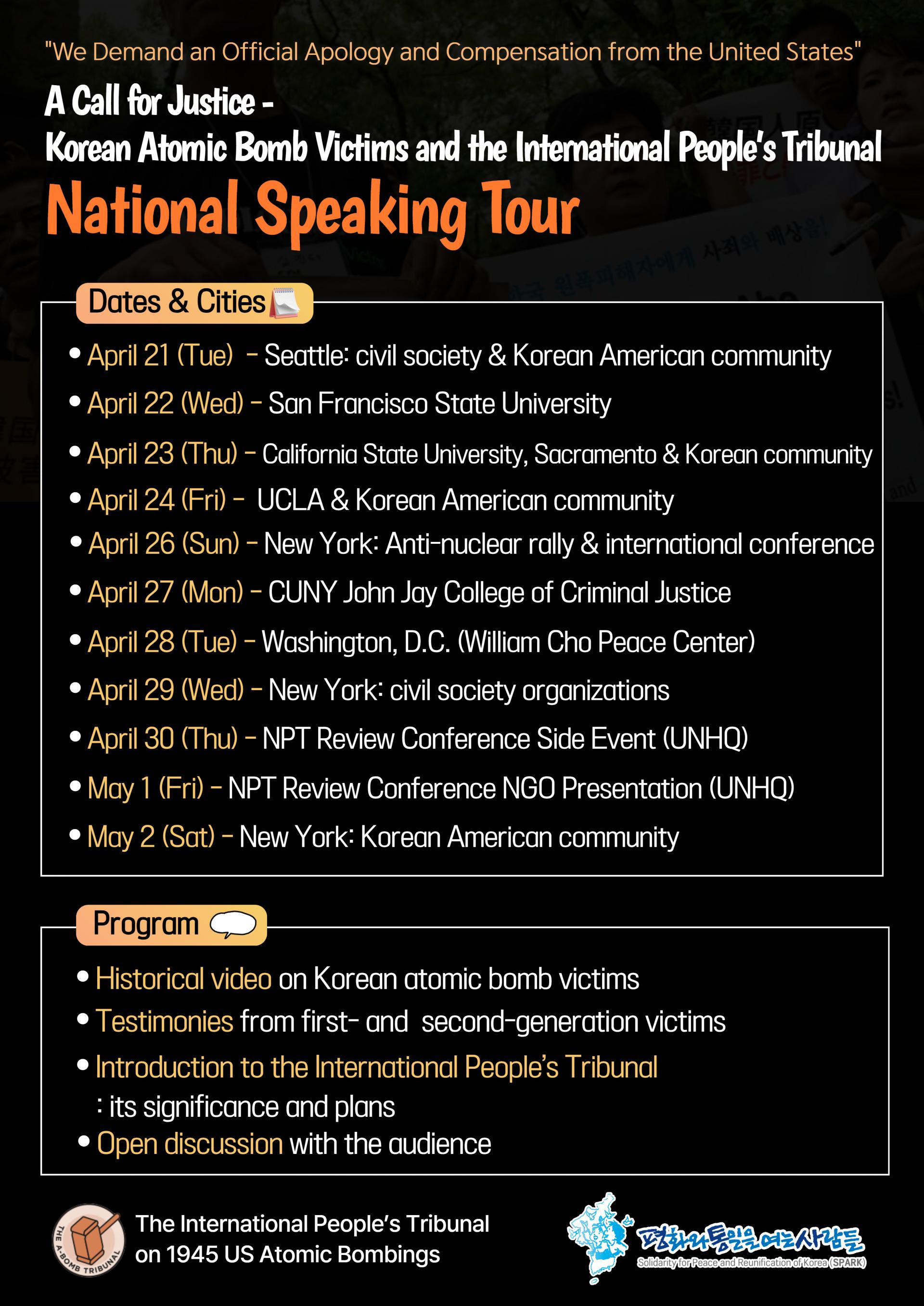
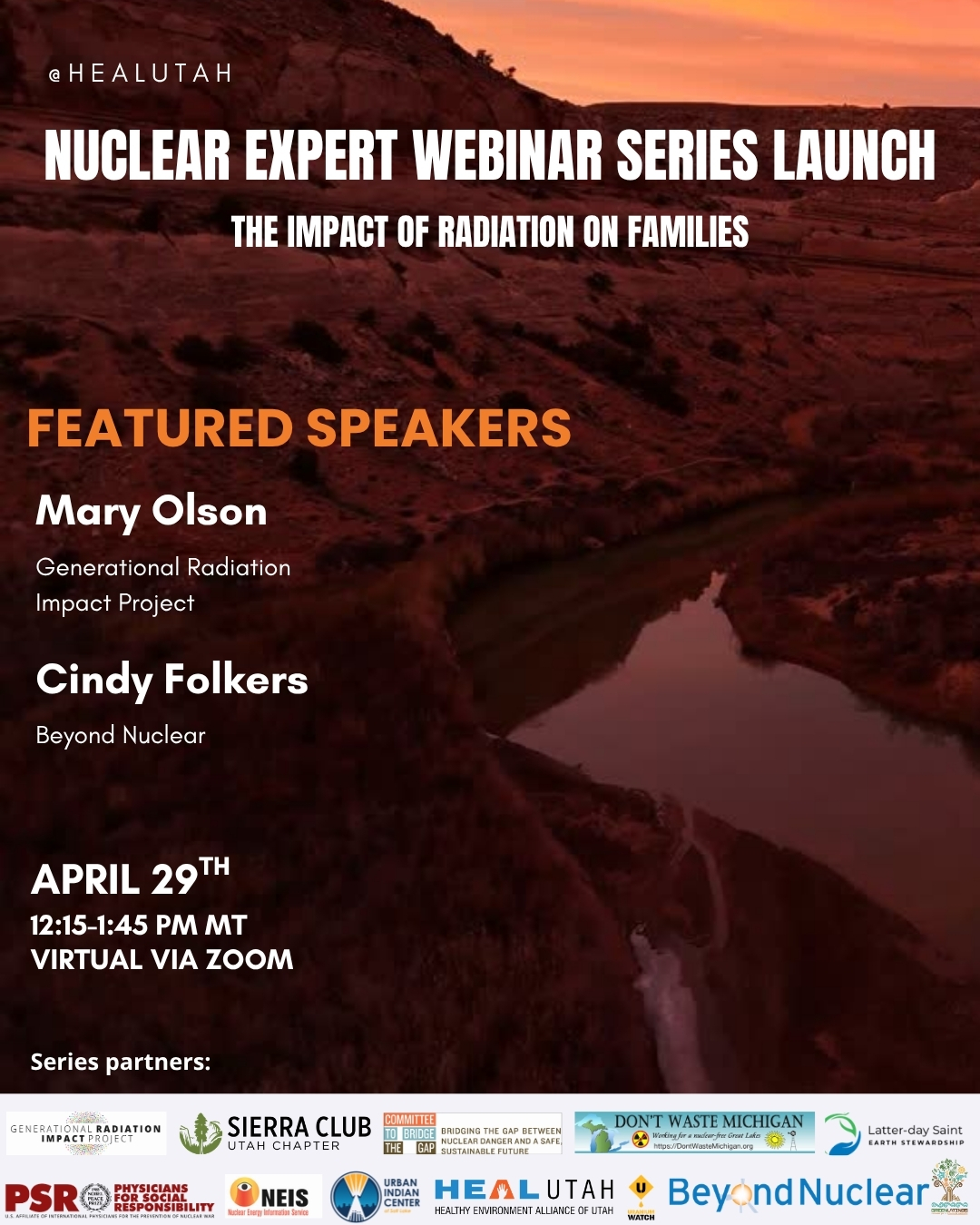
29 April – Nuclear Expert Webinar #1 – Radiation Impacts on Families with Mary Olson and Cindy Folkers
- 12:15 PM MT – 1:45 PM MT
- Location: Virtual – REGISTER TODAY

4 May -West Suburban Peace Coalition to discuss Iran war at May Educational Forum
Monday, May 4, 7:00 – 8:00 PM Central Standard Time
Title: : How Trump’s Narrative Tries to Shape the Reality of the War on Iran.
Contact Walt Zlotow, zlotow@hotmail.com 630 442 3045 for further information
14 May – online event From Bombs to Data Centres: the Face of Nuclear Colonialism

Pine Ridge Uranium is the real threat, not Tehran- Tell Burgum: Stop the Extraction.
Chernobyl: The Lost Tapes – A good documentary on Chernobyl on SBS available On Demand for the next 3 weeks– https://www.sbs.com.au/ondemand/tv-program/chernobyl-the-lost-tapes/2352741955560
To see nuclear-related stories in greater depth and intensity – go to https://nuclearinformation.wordpress.com
-
Archives
- April 2026 (356)
- March 2026 (251)
- February 2026 (268)
- January 2026 (308)
- December 2025 (358)
- November 2025 (359)
- October 2025 (376)
- September 2025 (257)
- August 2025 (319)
- July 2025 (230)
- June 2025 (348)
- May 2025 (261)
-
Categories
- 1
- 1 NUCLEAR ISSUES
- business and costs
- climate change
- culture and arts
- ENERGY
- environment
- health
- history
- indigenous issues
- Legal
- marketing of nuclear
- media
- opposition to nuclear
- PERSONAL STORIES
- politics
- politics international
- Religion and ethics
- safety
- secrets,lies and civil liberties
- spinbuster
- technology
- Uranium
- wastes
- weapons and war
- Women
- 2 WORLD
- ACTION
- AFRICA
- Atrocities
- AUSTRALIA
- Christina's notes
- Christina's themes
- culture and arts
- Events
- Fuk 2022
- Fuk 2023
- Fukushima 2017
- Fukushima 2018
- fukushima 2019
- Fukushima 2020
- Fukushima 2021
- general
- global warming
- Humour (God we need it)
- Nuclear
- RARE EARTHS
- Reference
- resources – print
- Resources -audiovicual
- Weekly Newsletter
- World
- World Nuclear
- YouTube
-
RSS
Entries RSS
Comments RSS
 nuclear-news