Biden’s genocide comment raised concern
SOTT, Carol E. Lee, Josh Lederman, NBC News, Fri, 15 Apr 2022
President Joe Biden’s declaration this week that Russia is committing “genocide” in Ukraine raised concerns among some officials in his own government and has so far not been corroborated by information collected by U.S. intelligence agencies, according to senior administration officials.
At the State Department, which is tasked with making formal determinations of genocide and war crimes through an independent legal process, two officials said that Biden’s seemingly offhand declaration during a domestic policy speech in Iowa on Tuesday made it harder for the agency to credibly do its job.
U.S. intelligence agencies collect information when allegations are made of actions that could amount to genocide, but policymakers are the ones who actually decide whether to declare it. Intelligence reports on Ukraine currently do not support a genocide designation, officials said.
“Genocide includes a goal of destroying an ethnic group or nation and, so far, that is not what we are seeing.”…………..
The question of when to label Russia’s actions in Ukraine “genocide,” particularly the legal threshold for doing so had been discussed inside the White House ever since images of mass graves and civilian torture and assassinations emerged in Bucha, people familiar with the discussions said. Biden had recently begun to make his views clear in private, so White House officials weren’t surprised that he called what’s happening in Ukraine “genocide,” but they were taken aback that he did so offhandedly in a speech in Iowa about inflation, the people said.
The president’s declaration of genocide in Ukraine was the third time in recent weeks that the president has tried to separate what he says are his personal views from official U.S. policy to take a position that he believes is right even though it’s not aligned with the position of his own government.
Biden said Russia was committing war crimes in Ukraine — another symbolically and legally significant moment in which he got ahead of his own administration — a week before the U.S. government completed its legal process and formally made that declaration.
Biden also said Russian President Vladimir Putin should no longer be in power, prompting a scramble by his aides to say that’s not what he meant and stress that U.S. policy is not regime change in Moscow. Biden later said he did mean what he said — that it was his “personal” view — but not U.S. policy.
…………… “These aren’t gaffes,” said one person close to the White House. “He’s doing this very purposefully.”
Responding to questions about Biden’s genocide declaration, White House press secretary Jen Psaki told reporters this week, “The president was calling it like he sees it, and that’s what he does.”
The apparent disconnect between the president and the bureaucracy he oversees is striking given Biden’s extensive experience in foreign policy and government. Biden also has stressed since the 2020 campaign that “the words of a president matter.” And he’s gone out of his way to say he would not try to influence independent Justice Department decisions, but some administration officials see a willingness for him to do just that with other independent legal processes.
Once the president says he believes genocide and war crimes have been committed, administration officials said that puts immense pressure on career government officials to reach the same conclusion. The concern is that if and when the State Department’s Office of Global Criminal Justice reaches those conclusions on its own, the office risks appearing late to the game or like it’s trying to justify Biden’s public comments, the officials said. One of the administration officials said Biden’s comments had put particular pressure on Beth Van Schaack, the U.S. ambassador for global criminal justice, who was confirmed by the Senate last month. On Friday, Schaack met with Ukraine’s prosecutor general, Iryna Venediktova, to compare notes as Venediktvoa’s office investigates alleged Russian war crimes by Russia. Venediktova, like Ukrainian President Volodymyr Zelenskyy, has already accused Russia of genocide in Ukraine.
U.S. intelligence shows that the Russians have been told that Ukrainians in the eastern Donbas region, where fighting is expected to intensify, are Nazis and that the Ukrainian civilians are Nazi sympathizers, raising concerns about genocide, officials said. The Russians also have been told the same about Ukrainians in Mariupol, officials said, with one noting how brutal Moscow’s military campaign has been there.
Genocide is a specific crime defined under international law, and proving it requires showing an intent at high levels to commit genocide.
Biden’s early accusation against Russia, which was welcomed by Zelenskyy, came even ahead of human rights organizations that have often pushed U.S. administrations to declare that a regime has committed genocide.
Human Rights Watch, for instance, so far has not found evidence of a genocidal campaign waged by Russia, according to Tara Sepehri Far, acting deputy director of Human Rights Watch’s Washington office.
“Our research is not matching the definition yet,” said Sepehri Far. “It doesn’t mean it’s not happening.”
Biden has throughout his decades long career at times been quicker than others in the U.S. government to speak out about genocide………………………….. https://www.sott.net/article/466834-Biden-genocide-comment-raised-concern-among-some-U-S-officials
Dissent is dying in America – the backlash is vitriolic
 | |||
AMERICAN DISSENT ON UKRAINE IS DYING IN DARKNESS https://popularresistance.org/american-dissent-on-ukraine-is-dying-in-darkness/ AUDIO
- By Robert Scheer, Scheer Post., April 16, 2022
When It Came To The Ukraine Conflict, Professor Michael J. Brenner Did What He’s Done His Whole Life: Question American Foreign Policy.
This time the backlash was vitriolic.
As the death toll in Russia’s illegal invasion of Ukraine continues to rise, there have only been a handful of Westerners publicly questioning NATO and the West’s role in the conflict. These voices are becoming fewer and further between as a wave of feverish backlash engulfs any dissent on the subject. One of these voices belongs to Professor Michael J. Brenner, a lifelong academic, Professor Emeritus of International Affairs at the University of Pittsburgh and a Fellow of the Center for Transatlantic Relations at SAIS/Johns Hopkins, as well as former Director of the International Relations & Global Studies Program at the University of Texas.
Brenner’s credentials also include having worked at the Foreign Service Institute, the U.S. Department of Defense and Westinghouse, and written several books on American foreign policy. From the vantage point of decades of experience and studies, the intellectual regularly shared his thoughts on topics of interest through a mailing list sent to thousands of readers—that is until the response to his Ukraine analysis made him question why he bothered in the first place.
In an email with the subject line “Quittin’ Time,” Brenner recently declared that, aside from having already said his piece on Ukraine, one of the main reasons he sees for giving up on expressing his opinions on the subject is that “it is manifestly obvious that our society is not capable of conducting an honest, logical, reasonably informed discourse on matters of consequence. Instead, we experience fantasy, fabrication, fatuousness and fulmination.” He goes on to decry President Joe Biden’s alarming comments in Poland when he all but revealed that the U.S. is—and perhaps has always been—interested in a Russian regime change.
On this week’s “Scheer Intelligence,” Brenner tells host Robert Scheer how the recent attacks he received—many of a personal, ad hominem nature—were some of the most vitriolic he’s ever experienced. The two discuss how many media narratives completely leave out that the eastward expansion of NATO, among other Western aggressions against Russia, played an important part in fueling the current humanitarian crisis. Corporate media’s “cartoonish” depiction of Russian president Vladimir Putin, adds Brenner, is not only misleading, but dangerous given the nuclear brinkmanship that has ensued. Listen to the full discussion between Brenner and Scheer as they continue to dissent despite living in an America that is seemingly increasingly hostile to any opinion that strays from the official line.
U.S. Jews Favor Return to Iran Deal
Jews support a return to the Iran deal by 68-32, according to a new survey. And when Jews are asked to name their top two political issues, Israel shows up near the bottom of the list, well behind climate change.
Portside, April 16, 2022, Philip Weiss MONDOWEISS
merican Jews overwhelmingly support the renewal of the Iran deal, and very few American Jews consider Israel a political priority, according to a new survey of American Jewish voters.
Jews support a return to the Iran deal by 68-32, the Jewish Electoral Institute found in a poll of 800 Jews this spring. The proportion is nearly 4-to-1 among Reform Jews (79-21) and women (77-23). And Jews over 65 are for the deal by a larger percentage (72-28) than Jews under 40. Only the orthodox are against the Iran deal, by 85-15! But orthodox make up just 9 percent of the Jewish population.
Now here’s the indifference to Israel question.
Voters were asked to say which two issues they wanted the president to focus on. Israel got clobbered. Only 4 percent listed it as one of their two issues.
When you break it out by denomination, it’s even starker. 1 percent of non-denominational Jews and 2 percent of Reform Jews think Israel should be a priority. And those two groups make up more than two-thirds of American Jews — 31 percent non-denominational, 37 percent Reform. Though 5 percent of Conservative and 18 percent of Orthodox Jews see Israel as a priority.
Other issues are just way more important. 42 percent of nondenominational Jews say climate change should be a top priority; 32 percent say voting rights; 12 percent say crime…………………
The new poll also shows that 93 percent of American Jews are concerned about antisemitism. The Reform number there is 95 percent concerned, the orthodox 96 percent, the non-denominational 89 percent concerned……. https://portside.org/2022-04-16/us-jews-favor-return-iran-deal
Extremely rare brain cancer appearing in people who attended a New Jersey school, close to former nuclear weapons fuel plant

94 former staff and students from Colonia High School in the Woodbridge Township School District have been stricken by the devastating diagnoses in recent years.
While the exact number of former faculty and staff diagnosed with glioblastoma is not precisely known, the cancer is exceedingly rare. According to the American Association of Neurological Surgeons, glioblastoma has an incidence of 3.21 per 100,000
Nearly 100 people at this NJ school got brain tumors — a survivor demands answers, https://nypost.com/2022/04/14/why-nearly-100-people-at-nj-school-got-brain-tumors/?fbclid=IwAR1IItuf3UXbHuJAJr-gByHSGIgbgX1lZYsljrokhDTk6z1Dx77P5UMwrg4
By Andrew Court
A cancer survivor is vowing to untangle the twisted mystery of why almost 100 people associated with a New Jersey high school have developed “extremely” rare malignant brain tumors.
Al Lupiano is among the 94 former staff and students from Colonia High School in the Woodbridge Township School District who have been stricken by the devastating diagnoses in recent years.
“I will not rest until I have answers,” Lupiano, 50, declared in an interview with NJ.com and the Star-Ledger on Thursday. “I will uncover the truth.”
Among the others diagnosed with brain cancer was Lupiano’s younger sister, who passed away from the disease in February at the age of 44.
The devoted brother promised his sister on her deathbed that he would get to the bottom of what was causing the apparent cancer cluster at Colonia High. On Tuesday — after a public push by Lupiano — local officials approved an emergency probe of the school.
“There could be a real problem here, and our residents deserve to know if there are any dangers,” Woodbridge Mayor John McCormac said in a statement. “We’re all concerned, and we all want to get to the bottom of this. This is definitely not normal.”
Starting this weekend, various radiological assessments will be conducted across the school’s 28-acre campus, including the testing of indoor air samples for radon.
Lupiano was diagnosed with a brain tumor back in the late 1990s, at the age of 27. He went on to recover from the disease.
Last year, his wife — who also attended Colonia — was diagnosed with a rare brain tumor. On the exact same day, Lupiano’s younger sister, Angela DeCillis, another alumna of Colonia, learned that she too had brain cancer.
After his sister’s death in February, Lupiano became convinced of a link between the Colonia campus and the brain cancers that he, his wife and his sister had developed. Last month, he started a Facebook group asking locals whether they knew of any other people associated with the school who had been stricken by similar diagnoses.
In less than six weeks, Lupiano says, he has gathered the names of 94 people connected with the school who have developed brain tumors.
The disturbing development became headline news this week after CBS News took it national. A subsequent TikTok video discussing the medical mystery has also racked up more than 2.2 million viral views in just 24 hours.
The vast majority of those who have developed brain tumors “graduated between 1975 and 2000, although outliers have come as recently as a 2014 graduate,” according to the Star-Ledger.
The diagnoses include “several types of primary brain tumors, including cancerous forms like glioblastoma and noncancerous yet debilitating masses such as acoustic neuromas, haemangioblastomas and meningiomas.”
“To find something like this … is a significant discovery,” Dr. Sumul Raval, one of New Jersey’s top neuro-oncologists, told the outlet. “Normally speaking, you don’t get radiation in a high school … unless something is going on in that area that we don’t know,” Raval added, calling for an immediate investigation.
The viral TikTok video discussing the purported cancer cluster was posted Wednesday by popular personality Dr. Joe Whittington.
Whittington — a board-certified MD in California — claimed several of the brain tumors developed by ex-Colonia High staff and students are glioblastoma multiforme — an aggressive cancer which spreads to brain tissue.
While the exact number of former faculty and staff diagnosed with glioblastoma is not precisely known, the cancer is exceedingly rare. According to the American Association of Neurological Surgeons, glioblastoma has an incidence of 3.21 per 100,000.
Meanwhile, the TikTok video sparked panic and a range of conspiracy-theory style comments, with people claiming mold, toxic waste, asbestos and nearby cellphone towers could all be causing the cluster.
Lupiano also spoke with CBS News on Thursday, saying he now believes ionizing radiation must be responsible for the health issues.
“What I find alarming is there’s truly only one environmental link to primary brain tumors, and that’s ionizing radiation,” he declared. “It’s not contaminated water. It’s not air. It’s not something in soil. It’s not something done to us due to bad habits.”
The school was built back in 1967 on acres of empty land, with McCormac telling the news network he is stumped as to what could be causing the cancers.
Lupiano alleges that some contaminated soil was removed from the site when it closed down in 1967 — the same year Colonia High School was built. He now wonders whether some of that soil ended up on the school grounds.CBS2
He has reached out to the state Department of Health, Department of Environmental Protection and the federal Agency for Toxic Substances and Disease Registry for help — which is reportedly still in the “early stages,” according to the CBS News report.
Lupiano told NJ Spotlight News that the school is located less than 12 miles from the Middlesex Sampling Plant — a site that was used, under the direction of the Manhattan Project, to crush, dry, store, package and ship uranium ore for the development of the atomic bomb.
He alleges that some contaminated soil was removed from the site when it closed down in 1967 — the same year Colonia High School was built. Lupiano is wondering whether some of that soil ended up on the school grounds.
Today, Colonia enrolls approximately 1,300 students, with many said to be “anxious” about the possible cancer cluster.
“We are looking at possible things that we can do between the town and school, and they said they will look at anything we come up with,” McCormac said. at top https://nypost.com/2022/04/14/why-nearly-100-people-at-nj-school-got-brain-tumors/?fbclid=IwAR1IItuf3UXbHuJAJr-gByHSGIgbgX1lZYsljrokhDTk6z1Dx77P5UMwrg4
Scientist fired after raising questions about safety at nuclear waste plant
|
4 Investigates: Scientist fired after raising questions about safety at nuclear waste plant https://www.kob.com/albuquerque-news/4-investigates-scientist-fired-after-raising-questions-about-safety-at-nuclear-waste-plant/6445723/
Brittany Costello, April 14, 2022 CARLSBAD, N.M— There are some things we just leave up to the experts – that includes the science and research that goes into the Waste Isolation Pilot Plant in Carlsbad, New Mexico, the only-of-its-kind facility that stores transuranic radioactive waste from around the country.
What if we told you there are questions about the science of its long-term safety? KOB 4 spoke with a former scientist who said he lost his job after raising the red flag.
There’s an expectation, a reputation that follows the name Sandia National Labs. Its advanced scientific work is something many of us take for granted. Not Dr. Charles Oakes, who is a geochemist who used to work for Sandia National Labs in Carlsbad at the Waste Isolation Pilot Plant, also known as WIPP.
Part of his job was to make sure WIPP, and all of the transuranic radioactive waste stored inside, is safe for years to come.
This is a case where they weren’t, not only were they not doing their job, they were claiming they were doing their job but falsifying all the evidence that went into the claims that they were doing the job,” Dr. Charles Oakes said.
From the outside, there’s not much to see at WIPP. That’s because all the waste is stored more than 2,000 feet below ground.
“WIPP is the only facility of its kind in the world, deep geologic repository for nuclear waste,” said Don Hancock, Director of the Nuclear Waste Program a Southwest Research and Information Center.
Hancock has served as a WIPP watchdog even before the first disposal at the Department of Energy site in 1999.
“Essentially what’s in WIPP are elements that are contaminated from the manufacturing of components in nuclear weapons, particularly the plutonium core, the heart of it,” said Hancock. “That includes machinery that includes gloves, and booties, that includes sludges.”
It might sound complex, but the key to safe storage of radioactive material is simple: accurate, reliable science and research. Regulators at the Environmental Protection Agency demand it.
Sandia National Labs is contracted to do it, at a cost of $18-million a year.
It’s so important that, in order for WIIPP to continue accepting waste, every five years, it has to recertify that its projections show the facility will be safe after it’s filled up and closed down.
Safe from that point and 10,000 years beyond it.
“The most common feared way that the radiation will get to the surface is through the flow of water,” said Dr. Oakes. “There are some aquifers in the rock of the repository. One of the fears is that a well will be drilled through the repository or near to this repository and water may flow through the repository and intersect with a well bore.”
Dr. Oakes said his job was to look at how much of that radioactive material would make it to the surface.
“If you do have radioactive material dissolved in the water, will it react with rocks, minerals along the way, and be removed from the water, in which you removed the threat, or will it carry on its merry way dissolved and get to the surface where it can potentially hurt people and the environment,” he said.
During his time at Sandia National Labs, Dr. Oakes said he discovered inaccuracies that called into question WIPP’s long-term safety, what he believed to data errors.
Oakes said he brought it up to his bosses, the Department of Energy and even the EPA.
After he spoke up, Oakes said Sandia labeled him a problem employee and showed him the door.
Oakes is being represented by attorney Timothy White – and Nick Davis of Davis Law. Their goal is to address much more than what they believe to be retaliatory discharge.
“We’re trying to achieve a certain safety standard here and the information that is being used to allegedly show that we’ve achieved that standard, that we should be recertified to manage the WIPP project, is built on bad science leading to fraud,” said White.
KOB 4 wanted to hear from Sandia National Labs. A spokesperson told us they cannot comment on these accusations because of the pending lawsuit.
There are a number of defendants named in the suit: Honeywell International, National Technology and engineering Solutions of Sandia, LLC, Carol Adkins, and Paul Shoemaker.
Attorneys representing the defendants have responded in court. Documents allege Oakes was fired after multiple “inappropriate interactions with colleagues” but they did not go into detail.
Attorneys are also asking a federal judge to dismiss the case.
As far as all of that expansive data is concerned, officials at the Department of Energy, with the WIPP project, said there are quality assurance procedures in place including several independent reviews.
They said a recertification decision is expected later in April or early May.
Rep. Ilhan Omar: Accountability for Russia Means Abandoning US ‘Hypocrisy’
Akbar Shahid Ahmed/HuffPost,
The congresswoman revealed a proposal to make America a member of the International Criminal Court and revoke a Bush-era measure that undermines it.
Mounting evidence of widespread Russian atrocities in Ukraine is spurring the Biden administration and lawmakers from both parties to demand justice at a global level — specifically, at the International Criminal Court in The Hague. Now Rep. Ilhan Omar (D-Minn.) is challenging them to boost that prospect by making the U.S. a member of the court and repealing a George W. Bush-era law that requires the U.S. to block the court from investigating Americans.
“We’ve engaged in a process for a long time of delegitimizing these international institutions that essentially call for accountability, and I think it is really disturbing that we now think they are powerful enough … to hold Russia accountable. It’s easy for people to see the hypocrisy in those two statements when we’ve said previously that we don’t believe in the ability of the court to [be] unbiased,” Omar said on Wednesday………….
“It’s really important for us not to have a law on the books that says in many ways it is OK for everyone to be prosecuted” but not Americans, Omar told HuffPost. “Think about just how much more powerful of a statement it would be if we didn’t just call for accountability for war crimes in Ukraine in holding Russians accountable for the possible war crimes they have committed but if we actually had skin in the game.”
| Progressives like Omar see developing a loud, nuanced position on Ukraine as critical to expanding their influence over national security policy and reforming the U.S.’s approach to global affairs.Conservatives and the Pentagon have argued for years that if the U.S. joined the court, American officials would face unfair and politically motivated investigations. But every Republican in the Senate recently voted for legislation recommending the court as a venue for probing Russia’s abuses, and House Republicans are supporting a bill urging the court to prosecute Putin if any harm befalls Ukrainian President Volodymyr Zelenskyy………………. https://www.rsn.org/001/rep-ilhan-omar-accountability-for-russia-means-abandoning-us-hypocrisy.html |
Nonstop Corporate News on Ukraine Is Fueling Support for Unchecked US Militarism
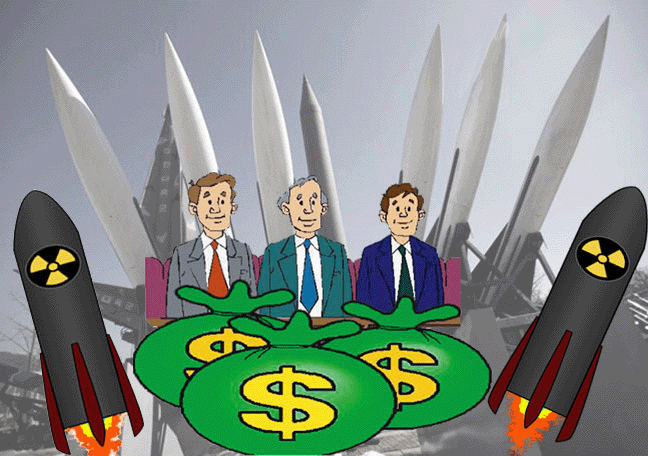
The U.S. public is being fed continuous nonstop images of technologically sophisticated weapons being used in Ukraine — in effect this appears to function as a sort of advertisement for the weapons industry, coupled with the sensational presentation of gratuitous violence
Talking heads in the dominant media landscape churn out cheap binarisms about good and evil, democracy versus authoritarianism. In doing so, they reinforce the mythic narrative that the U.S., a model of liberal innocence, is furthering the global fight for democracy, untainted in its false assertion that fascism is always elsewhere — in this case exclusively in Russia.

There is almost no talk about the role of the military-industrial complex, both in its push for war, and how it usually emerges as the only winner. Nor is there any talk about who profits from an embrace of war talk, the spectacularization of war and war itself.
Henry A. Giroux, Truthout, 13 Apr 22, The drums of fascism are beating louder. The catastrophe of war and outpouring of support for the millions of Ukrainians suffering under the brutal attacks by Russia has morphed into increased warmongering from the West. The shock of war has been transformed into a cinematic spectacle used to fan the flames of militarism. The sheer boldness, violence and ruthlessness of Russia’s attack on Ukraine has created a global political crisis accentuated by both a crisis of ideas and a crisis of historical reckoning, at least in the Western mainstream media.
The wider public’s inability to reflect on the underlying causes of the war is due at least in the United States to its long-standing dominant belief in its own exceptionalism, reinforced by a moral righteousness endlessly reproduced in the mainstream media.
Tragic pictures of the agonizing hardships faced by the Ukrainian people too often appear with little or no critical commentary in the corporate-controlled cultural apparatuses. Endless images of unfathomable agony by the Ukrainian people dominate the conventional news outlets and other monopolies of information governed by the spectacle of 24/7 coverage, matched almost entirely by a lack of historical analysis. While widespread moral repulsion to the tragedies of the war are understandable, what is not acceptable is the refusal of the mainstream media to reflect on the historical, political and economic conditions leading up to the war.
The U.S. public is being fed continuous nonstop images of technologically sophisticated weapons being used in Ukraine — in effect this appears to function as a sort of advertisement for the weapons industry, coupled with the sensational presentation of gratuitous violence.
Within this militarized aesthetic, operating in the service of permanent war, as cultural critic Rustom Bharucha writes, “there is an echo of the pornographic in maximizing the pleasure of violence.” The corporate media are thus rendering war as riveting, emotional and free from demanding intellectual complexities since it emerges out of an either/or view of good and evil.
Images of violence are replayed in the mainstream media over and over again, making violence not only more visible but also rootless. The sheer monopoly of such images gives them a fascist edge, all the while dissolving politics into a cinematic pathology. Writer and philosopher Susan Sontag’s observation about war coverage, made in a different historical context, is even more relevant today. According to Sontag, the endless images of war and suffering, removed from the context of rigorous historical analysis, represent a contempt for “all that is reflective, critical and pluralistic [and are] linked to forms of rabid masculinity [that] glamorizes death.”
Talking heads in the dominant media landscape churn out cheap binarisms about good and evil, democracy versus authoritarianism. In doing so, they reinforce the mythic narrative that the U.S., a model of liberal innocence, is furthering the global fight for democracy, untainted in its false assertion that fascism is always elsewhere — in this case exclusively in Russia. There is almost no talk about the role of the military-industrial complex, both in its push for war, and how it usually emerges as the only winner. Nor is there any talk about who profits from an embrace of war talk, the spectacularization of war and war itself.
When more critical explanations of the war appear, especially from those criticizing the eastward expansion of the North Atlantic Treaty Organization (NATO), which created one set of conditions for the conflict, they are often mocked, ignored, or at worst, accused of being treasonous. In this instance, a rampant militarism collapses the difference between a critical analysis and a justification for Russia’s actions………….
We have seen a similar shutting down of dissent before in the face of catastrophic events, especially in the aftermath of the 9/11 attacks and the ensuing “war on terror.” Yet, the frenetic opposition to dissent today seems more dangerous, especially given the multiple cultural platforms calling for “virtual war, for participating in it, and being manipulated by it, [including] crowd funding urban militias on Twitter, posting videos of captured tanks or ‘army cats’ to Instagram and TikTok.”
The need for community is too often now organized around a bristling war fever feeding on militaristic language in mainstream outlets such as The Atlantic, The New Republic, New Yorker, The Financial Times and The Wall Street Journal. In all cases, rightful moral outrage over the brutality of Russia’s unlawful invasion morphed quickly into a fog-of-war hysteria demanding more military aid, more punitive sanctions and bolstered by the discourse of unchecked jingoism. The call for peace or a diplomatic solution is barely mentioned.
With the war in Ukraine raging, more nuanced analyses along with dissent disappear in the suffocating discourses of hyper-nationalism and the growing bonfire of militarism fueled by what Indian essayist and novelist Pankaj Mishra, writing in the London Review of Books, calls “an infotainment media [that] works up citizens into a state of paranoid patriotism.” The military-industrial-intellectual-academic complex has reasserted itself in the face of Russia’s violation of international law, accelerating the prospect, if not welcoming, the potential of another looming Cold War, aided greatly by media apparatuses that bask in the comfort of moral certainty and patriotic inanity. In this atmosphere of hyper-war culture, military victories become synonymous with moral victories as language becomes weaponized and matters of ethics no longer inform the urgent call for peace.
In the face of the brutal Russian invasion, the concept of militarization is being amplified and put into service as a call for more upgraded weapons. Talk of war, not peace, dominates the mainstream media landscapes both at home and abroad. Such talk also fuels a global arms industry, oil and gas monopolies, and the weaponization of language itself. Militarism as a tool of unchecked nationalism and patriotism drives the mainstream and right-wing disimagination machines. Both fuel a global war fever through different degrees of misrepresentation and create what intellectual historian Jackson Lears writing in the London Review of Books calls “an atmosphere “poisoned by militarist rants.” He goes further in regarding his critique of the U.S. response to the war in Ukraine, writing in the New York Review of Books:
Yet the US has failed to put a cease-fire and a neutral Ukraine at the forefront of its policy agenda there. Quite the contrary: it has dramatically increased the flow of weapons to Ukraine, which had already been deployed for eight years to suppress the separatist uprising in the Donbas. US policy prolongs the war and creates the likelihood of a protracted insurgency after a Russian victory, which seems probable at this writing. Meanwhile, the Biden administration has refused to address Russia’s fear of NATO encirclement. Sometimes we must conduct diplomacy with nations whose actions we deplore. How does one negotiate with any potential diplomatic partner while ignoring its security concerns? The answer, of course, is that one does not. Without serious American diplomacy, the Ukraine war, too, may well become endless.
The horrific events in Ukraine have mobilized a global response against the brutal acts of violence inflicted on the Ukrainian people, but such massive acts of violence have also taken place in Syria, Afghanistan, Iraq and Yemen without eliciting comparable condemnations or humanitarian aid from the U.S. and Europe. Moreover, while public outrage in the U.S. is warranted in light of the “horrendous crimes by Russian troops against Ukrainian civilians—massacre, murder, and rape, among them,” memory fades, and the line between fantasy and historical consciousness disappears, “erasing the brutalizing crimes committed during America’s Global War on Terror.”……………………………………..
Historical amnesia and a prolonged military conflict combine making it easier to sell war rather than peace, which would demand not only condemnation of Russia but also an exercise in self-scrutiny with a particular focus on the military optic that has been driving U.S. foreign policy since President Dwight D. Eisenhower warned in the 1950s of the danger of the military-industrial complex.
The Ukrainian war is truly insidious and rouses the deepest sympathies and robust moral outrage, but the calls to punish Russia overlook the equally crucial need to call for peace. In doing so, such actions ignore a crucial history and mode of analysis that make clear that behind this war are long-standing anti-democratic ideologies that have given us massive inequality, disastrous climate change, poverty, racial apartheid and the increasing threat of nuclear war.
The horrific events in Ukraine have mobilized a global response against the brutal acts of violence inflicted on the Ukrainian people, but such massive acts of violence have also taken place in Syria, Afghanistan, Iraq and Yemen without eliciting comparable condemnations or humanitarian aid from the U.S. and Europe. Moreover, while public outrage in the U.S. is warranted in light of the “horrendous crimes by Russian troops against Ukrainian civilians—massacre, murder, and rape, among them,” memory fades, and the line between fantasy and historical consciousness disappears, “erasing the brutalizing crimes committed during America’s Global War on Terror.”……………………………………..
Historical amnesia and a prolonged military conflict combine making it easier to sell war rather than peace, which would demand not only condemnation of Russia but also an exercise in self-scrutiny with a particular focus on the military optic that has been driving U.S. foreign policy since President Dwight D. Eisenhower warned in the 1950s of the danger of the military-industrial complex.
The Ukrainian war is truly insidious and rouses the deepest sympathies and robust moral outrage, but the calls to punish Russia overlook the equally crucial need to call for peace. In doing so, such actions ignore a crucial history and mode of analysis that make clear that behind this war are long-standing anti-democratic ideologies that have given us massive inequality, disastrous climate change, poverty, racial apartheid and the increasing threat of nuclear war.
War never escapes the tragedies it produces and is almost always an outgrowth of the dreams of the powerful — which always guarantees a world draped in suffering and death. Peace is difficult in an age when culture is organized around the interrelated discourse of militarism and state violence. War has become the only mirror in which alleged democratic capitalist and authoritarian societies recognize themselves. Rather than defined as a crisis, war for authoritarian rulers and the soulless arms industries becomes an opportunity for power and profits, however ill-conceived.
Peace demands a different assertion of collective identity, a different ethical posture and value system that takes seriously Dr. Martin Luther King Jr.’s admonition that human beings must do everything not to “spiral down a militaristic stairway into the hell of thermonuclear annihilation.” This is not merely a matter of conscience or resistance but of survival itself.
U.S. foreign policy, corporate news on Ukraine and elsewhere is steeped in racism
Nonstop Corporate News on Ukraine Is Fueling Support for Unchecked US Militarism,
Henry A. Giroux, Truthout, 13 Apr 22 ”…………………………………….
U.S. foreign policy is soaked in blood; torture; the violations of civil rights; abductions; kidnappings; targeted assassinations; illegal black holes; the scorched bodies of members of a wedding party in Yemen killed by a drone attack; and hundreds of women, children and old men brutally murdered by U.S. soldiers in the Vietnam village of My Lai.
In a war culture, memory fades, violence is elevated to its most visible and mediating force, and logic is refigured to feed a totalitarian sensibility. Under such circumstances, as London School of Economics Professor Mary Kaldor has argued, we live at a time in which the relationship between politics and violence is changing. She states: “Rather than politics being pursued through violent means, violence becomes politics. It is not conflict that leads to war but war itself that creates conflict.”
Behind this disproportionate response by the international community and its media platforms lies the ghosts of colonialism and the merging of culture and the undercurrents of white supremacy. For example, the general indifference to comparable acts of war and unspeakable violence can be in part explained by the fact that the Ukrainian victims appearing on the mass media are white Europeans. What is not shown are “Black people being refused at border crossings in favor of white Ukrainians, leaving them stuck at borders for days in brutal conditions [or] Black people being pushed off trains.” The mainstream media celebrate Poland’s welcoming of Ukrainian refugees but are silent about the Polish government boasting about building walls and “creating a ‘fortress’ to keep out refugees from Syria and Afghanistan.”
The war in Ukraine makes clear that racism is not deterred by global boundaries. Empathy in this war only runs skin deep. It is easy for white people in the media to sympathize with people who look just like them. This was made clear when CBS News Senior Correspondent Charlie D’Agata, reporting on the war, stated that it was hard to watch the violence waged against Ukrainians because Ukraine “isn’t a place, with all due respect, like Iraq or Afghanistan, that has seen conflict raging for decades. This is a relatively civilized, relatively European [country] … one where you wouldn’t expect that, or hope that it’s going to happen.” In this case, “civilized,” is code for white. D’Agata simply echoed the obvious normalization of racism as is clear in a number of comments that appeared in the mainstream press. The Guardian offered a summary of just a few, which include the following:
The BBC interviewed a former deputy prosecutor general of Ukraine, who told the network: ‘It’s very emotional for me because I see European people with blue eyes and blond hair … being killed every day.’ Rather than question or challenge the comment, the BBC host flatly replied, ‘I understand and respect the emotion.’ On France’s BFM TV, journalist Phillipe Corbé stated this about Ukraine: ‘We’re not talking here about Syrians fleeing the bombing of the Syrian regime backed by Putin. We’re talking about Europeans leaving in cars that look like ours to save their lives…. And writing in the Telegraph, Daniel Hannan explained: ‘They seem so like us. That is what makes it so shocking. Ukraine is a European country. Its people watch Netflix and have Instagram accounts, vote in free elections and read uncensored newspapers. War is no longer something visited upon impoverished and remote populations.’
There is more here than a slip of the tongue; there is also the repressed history of white supremacy. As City University of New York Professor Moustafa Bayoumi writing in The Guardian observes, all of these comments point to a deeply ingrained and “pernicious racism that permeates today’s war coverage and seeps into its fabric like a stain that won’t go away. The implication is clear: war is a natural state for people of color, while white people naturally gravitate toward peace.”
Clearly, in the age of Western colonialism, a larger public is taught to take for granted that justice should weigh largely in favor of people whose skin color is the same as those who have the power to define whose lives count and whose do not. These comments are also emblematic of the propaganda machines that have resurfaced with the scourge of racism on their hands, indifferent to the legacy of racism with which they are complicit……………… https://truthout.org/articles/nonstop-corporate-news-on-ukraine-is-fueling-support-for-unchecked-us-militarism/?eType=EmailBlastContent&eId=77fff940-46b2-4233-a46f-c6b8512452b6
Oregon regulators have doubts about Natrium nuclear schedule for Kemmerer

Oregon regulators question nuclear schedule for Kemmerer
Public utility officials in Oregon say they support PacifiCorp’s plan to add the Natrium plant to its power fleet, but declined to formally recognize it as a viable project this early.
by Dustin BleizefferApril 13, 2022 TerraPower’s Natrium nuclear power plant in Kemmerer might help Oregon accomplish its climate action plan by helping to replace coal power, but state regulators, concerned by the project’s unprecedented timeline, aren’t yet willing to bet on it. TerraPower’s Natrium nuclear power plant in Kemmerer might help Oregon accomplish its climate action plan by helping to replace coal power, but state regulators, concerned by the project’s unprecedented timeline, aren’t yet willing to bet on it.
The Oregon Public Utility Commission in March declined to formally acknowledge PacifiCorp’s plans for Natrium to be a part of its future electrical generation portfolio.
“This project is just so early that we don’t really feel like we can give it that kind of weight,” Oregon PUC Commissioner Mark Thompson said. “That’s not because PacifiCorp has done something wrong. I just think it’s just not knowable. It’s so early on.”
The commission approved the balance of PacifiCorp’s “integrated resource plan” for how it will meet future power needs for its Oregon customers. Commissioners said they remain open to including Natrium in future filings from PacifiCorp.
Why it matters
Natrium skeptics have noted that crucial federal funding for the project is tied to meeting aggressive deadlines. The commission’s decision appears to be the first instance of a regulatory body acting on similar concerns.
PacifiCorp, which operates as Rocky Mountain Power in Wyoming, is a regulated utility providing electrical power to customers in six western states, including Oregon. State public utility authorities must approve plans for new electrical generation facilities before a utility is allowed to tap ratepayers to cover the cost………….
“PacifiCorp and TerraPower understand that PacifiCorp will only move forward if the Natrium demonstration project brings value to our customers,” PacifiCorp spokeswoman Tiffany Erickson said. https://wyofile.com/oregon-regulators-question-nuclear-schedule-for-kemmerer/
What should America do with its nuclear waste?
What Should America Do With Its Nuclear Waste?
Currently there are about 80 locations in 35 states where spent fuel is being stored, with no long-term plans for disposal., WP, By Rebecca Tuhus-Dubrow 1 Apr 22, ”……………………………………….. (closure of SanOnofre nuclear power station) Magda and other activists realized that all of the high-level radioactive waste that had accumulated at the plant over the course of its lifetime — 1,600 tons of spent fuel rods — would remain at the site for the foreseeable future. Although the federal government is legally responsible for disposing of commercial spent nuclear fuel in a permanent underground repository, there has been no plan for fulfilling that obligation since the Obama administration halted the project at Nevada’s Yucca Mountain in 2010. There are currently about 80 locations in 35 states — mostly at operational and decommissioned nuclear plants — where spent fuel is being stored indefinitely.
Since the San Onofre plant shut down, Magda has been trying to get the spent fuel moved to a more suitable site and to ensure that, until then, it is stored as safely as possible. As of 2017, she has represented her local chapter of the Sierra Club on the Community Engagement Panel, an entity established by SCE that holds quarterly meetings with the public. In her garage, she showed me a gray filing cabinet with four vertically stacked drawers, her granddaughter’s teal bike propped up against the side. The drawers contain hundreds of manila files with hand-scrawled labels: ………. In addition to earthquakes and tsunamis, Magda and other activists are worried about coastal erosion and sea level rise caused by climate change. “We can’t leave it here,” Magda says.
The question of what to do with the nation’s spent nuclear fuel has recently garnered renewed attention. This is thanks in part to U.S. Rep. Mike Levin (D-Calif.), who represents the district encompassing San Onofre and has taken up the cause as one of his signature issues. An environmental lawyer by training, he told me he ran for Congress partially to make progress on reviving the nation’s stalled efforts. In January 2019, he established a task force of local stakeholders to study the situation at San Onofre. He has also co-founded the bipartisan Spent Nuclear Fuel Solutions Caucus, with Rep. Rodney Davis (R-Ill.), and introduced the Spent Fuel Prioritization Act, which would ensure that the material is moved first from the most sensitive locations, including San Onofre.
Among scientific experts and government officials, there is broad consensus that the optimal solution is to eventually bury nuclear waste in a deep geological repository. But that is a long-term goal, and in the near future, Levin and many others are pushing for “consolidated interim storage.” This would mean that the spent fuel scattered at sites across the country would be moved to one or more facilities, in appropriate settings, that would be devoted entirely to safely storing the fuel until a geological disposal facility is ready.
There is also agreement, of a limited sort, between many nuclear opponents and supporters on the importance of addressing the waste issue. But for many opponents, such as Magda, the waste is a reason to abandon this form of energy altogether. ……………..
Despite recent momentum to break the spent fuel impasse, the obstacles are considerable. “Frankly we have a real problem in the U.S., not just at San Onofre,” Levin told me. “San Onofre is just the symptom, with 9 million people within 50 miles and two earthquake faults and rising sea level. The actual problem is that we’ve got nowhere to move it to.”
…………. The 1982 Nuclear Waste Policy Act was the first major law to address spent nuclear fuel, and assigned the federal government the task of constructing and operating such facilities. By that time, there were dozens of commercial nuclear plants that had been accumulating spent fuel and storing it on-site with no plans for disposal. According to the law, the Department of Energy was required to move promptly to site two geological repositories for permanent disposal.
In 1987, however, amendments to this law identified only a single location: Yucca Mountain, about 90 miles northwest of Las Vegas. The selection was based on the Energy Department’s assessment of the site’s geological features and was also thought to reflect political dynamics at the time. In the state, the legislation became known as the “Screw Nevada Bill.” Nevada’s powerful long-serving senator, Harry M. Reid, made it his mission to see that this repository would never come to pass. In 2010, the Obama administration announced that it would withdraw the license application to the Nuclear Regulatory Commission for the project. “We’re done with Yucca,” Carol Browner, President Barack Obama’s energy adviser, said. (The United States does have a deep geological repository for defense waste, in New Mexico, but not for commercial spent fuel.)
Meanwhile, Obama’s secretary of energy convened the bipartisan Blue Ribbon Commission on America’s Nuclear Future to devise a new strategy. The commission issued a report in January 2012. “The overall record of the U.S. nuclear waste program has been one of broken promises and unmet commitments,” the report stated.
The report’s first recommendation, highlighting its importance, was a “consent-based approach to siting future nuclear waste management facilities” for both permanent underground disposal and temporary aboveground storage. That is, instead of selecting sites based strictly on physical characteristics, the new approach would solicit volunteers, and engage communities, states, tribes and other stakeholders to obtain their approval before proceeding with plans…………
The spent fuel at San Onofre is stored in 123 canisters, in what’s called an independent spent fuel storage installation (ISFSI, pronounced “ISSfuhsee”). Contrary to the popular impression of nuclear waste as green goo, the fuel rods consist of solid pellets, each slightly larger than a pencil eraser. The fuel rods, bundled into fuel assemblies, were retrieved from the reactors over the course of decades. After cooling for at least five years in pools of water, they were transferred into stainless-steel canisters, with walls five-eighths of an inch thick. Workers then transferred the loaded canisters, each of which weighs 50 tons, to a concrete pad overlooking the ocean and lowered them into stainless-steel cavities beneath the pad’s surface………….
the ongoing demolition of the plant — major decommissioning work is expected to continue through 2028 — as well as the construction of a rail yard. It was a reminder that radioactive spent fuel is not the only kind of waste produced by nuclear plants: Millions of pounds of metal and steel, and tens of thousands of titanium tubes, will eventually be loaded onto rail cars and shipped away, some to be recycled, some to a landfill. One day, according to the plan, the spent fuel will be shipped away on this rail line as well, though no one knows to where……………………………….
The 1957 National Academy of Sciences report stated, “Unlike the disposal of any other type of waste, the hazard related to radioactive waste is so great that no element of doubt should be allowed to exist regarding safety.” Being in the same room with unshielded nuclear waste, fresh out of the reactor, could very quickly give you a fatal dose of radiation……………………………………
Magda points out that for real progress to occur, the law needs to change so that Yucca Mountain is not the only permissible site for a permanent repository. Levin has not yet introduced legislation to change that, but he told me he plans to. One arguable reason for optimism is that an improved waste management strategy, unlike so many other causes, has bipartisan support. “Nuclear waste doesn’t care if you’re a Democrat or a Republican,” Levin says……………………….. https://www.washingtonpost.com/magazine/2022/04/11/america-nuclear-waste-san-onofre/
San Onofre’s not the only nuclear worry – there are “nuclear materials events” — lost or stolen radioactive material, radiation overexposures, leaks, and more.
Worried about nuclear waste at San Onofre? Other danger lurks
GAO sounds alarms about dirty bombs fashioned from small amounts of medical, industrial material Experts in protective gear prepare to sweep the University of Washington Research and Training Building after the accidental release of radioactive cesium-137 in 2019. (U.S. Government Accountability Office)
By TERI SFORZA | tsforza@scng.com | Orange County Register: April 11, 2022
In one doomsday scenario, rocket attacks on the nuclear waste stored at San Onofre Nuclear Generating Station send plumes of dangerous radiation skyward.
Critics in Southern California spend a lot of time worrying about the safety of the 3.6 million pounds of spent fuel entombed on the bluff above the blue Pacific — but the U.S. Government Accountability Office fixes its gaze on more mundane, and perhaps more terrifying, scenarios involving much smaller amounts of nuclear material routinely used by businesses, hospitals, universities and the like.
“The risks of an attack using a dirty bomb — a weapon that combines a conventional explosive, like dynamite, with radioactive material — are increasing and the costs could be devastating,” said the GAO in a snapshot released Tuesday, April 5.
“For example, weaknesses in Nuclear Regulatory Commission licensing for radioactive materials make it too easy for bad actors to obtain them, and NRC’s security requirements don’t account for the potentially devastating effects of a dirty bomb, such as billions of dollars in cleanup costs and deaths from chaotic evacuations.”
More than 2,000 “nuclear materials events” — including lost or stolen radioactive material, radiation overexposures, leaks of radioactive material and more — were reported by the NRC between 2010 and 2019, the GAO found.
In April 2019, an Arizona technician was arrested after stealing three radioactive devices from his workplace. According to a court filing, the technician intended to release the radioactive materials at a shopping mall, but was stopped before he could do any harm.
An accident at the University of Washington in 2019, involving a small amount of material, required clean-up and other costs of $150 million for one building alone, the GAO said.
In 2016, the GAO created a fake company to get a license for radioactive materials. GAO altered the license “and used it to obtain commitments to acquire a dangerous quantity of material.”
“The number of incidents of thefts, lost shipments, and careless mishandling are outrageously large,” said Edwin Lyman, director of nuclear power safety for the Union of Concerned Scientists, a nonprofit NRC watchdog
Even though very few of these lead to significant radiological consequences to the public, the NRC’s lax requirements fall short of best practices.”
Common stuff
Radioactive material is used in many medical and industrial settings in Southern California and throughout the nation. Small amounts help create images of organs, so doctors can find, identify and track tumors. Radioactive materials are used to kill cancer cells, shrink tumors and alleviate pain.
But security is an increasingly acute issue, the GAO said.
In 2018, the GAO reported that officials at U.S. airports had not verified the legitimacy of all licenses for imported radioactive materials.
“GAO has repeatedly found potential security weaknesses at medical and industrial locations storing such materials in the U.S.,” it said in one of many reports on the issue over the past several years.
“For example, in 2014, GAO reported that an individual had been given unescorted access to high-risk radioactive materials, even though he had two convictions for terroristic threat. Furthermore, small quantities of radioactive materials located within the same facility are not subject to enhanced security requirements that the total amount would be required to meet.”……………………………
Lyman, of the Union of Concerned Scientists, acknowledged that the NRC has taken some action to address the most egregious problems the GAO has identified over the years, but has not gone as far as many want.
“I do support the effort for better tracking and security of radioactive sources,” Lyman said………………….https://www.ocregister.com/2022/04/11/worried-about-nuclear-waste-at-san-onofre-other-danger-lurks/
Hanford report reveals problem with nuclear waste solution
Hanford report reveals problem with nuclear waste solution
An internal federal document says the preparation for turning nuclear waste into glass logs will produce toxic vapors. Crosscut, by John Stang, April 11, 2022 Fourteen years behind its original deadline, the Hanford Nuclear Reservation is scheduled to begin turning radioactive wastes into benign glass in 2023.
However, an internal federal document said the preparatory process for this work will produce toxic vapors from a substance called acetonitrile, which would be unsafe for workers and people and animals that live nearby.
In fact, that complication has not been studied, said the U.S. Department of Energy report dated Aug. 27, 2021.
On March 2, 2022, the Washington State Department of Ecology sent a message to the U.S. Department of Energy, asking for answers on this issue. That came after the state agency received a March 1 letter on the matter from the Seattle-based watchdog organization Hanford Challenge, which obtained the internal document.
As of Friday, the state has not received a reply from the DOE. And DOE’s Hanford headquarters declined to provide anyone to discuss the matter with Crosscut. A spokesperson wrote in an email that the issue has been resolved, but did not provide any details.
In emails, the DOE and major contractor Washington River Protection Services, which designed the glassification equipment, both said the public can ask questions about this matter at a May 10 public hearing related to permits for acetonitrile-related equipment at the glassification plant. But neither the federal government nor its contractor would elaborate on the internal memo that raised concerns about acetonitrile, which will be used to re-treat the nuclear waste before it is turned into glass logs.
Written public comment is being accepted through June 4.
Acetonitrile, which exists in liquid and vapor forms, is easily ignited by heat, sparks or flames. When ignited, it gives off hydrogen cyanide fumes and potentially flammable vapors. Short-term effects from exposure can range from eye, nose and lung irritation to heart irregularities and death. Long-term, exposure could enlarge the thyroid gland and damage the liver, lungs, kidneys and the central nervous system.
The Hanford Nuclear Reservation was created in late 1942 to create plutonium for America’s atomic bombs in World War II and the Cold War. Producing plutonium required nuclear reactors and massive radioactive chemical extraction plants. The worst of the radioactive wastes from those facilities ended up as liquids, sludge and gunk in 177 leak-prone underground tanks on the 586-square-mile complex along the Columbia River in Benton County in south-central Washington. These tanks hold 56 million gallons of waste on what is arguably the most radioactively and chemically contaminated spot in the Western Hemisphere. The site’s overall cleanup began in 1989.
Hanford’s longtime master plan has been to convert those wastes into benign glass. Originally, glassification was supposed to begin in 2009 and completed by 2021 at a cost of $4 billion. Numerous budget, technical and engineering problems have bumped the price to $17 billion, with glassification to begin in late 2023 and end by 2069.
The first glassification facility is scheduled to start its work glassifying the least radioactive wastes in late 2023. Dubbed the “direct-feed low-activity-waste” plant, or DFLAW. It will glassify the least radioactive and least complex of the tank wastes following some preprocessing of the material. That pretreatment and acetonitrile are the subject of the 2021 memo.
While Washington River Protection Solutions did computer-model testing on the possibility of a liquid acetonitrile leak during the pre-treatment process, it did not calculate for the possibility of acetonitrile vapors, according to the internal DOE memo…………………………. https://crosscut.com/environment/2022/04/hanford-report-reveals-problem-nuclear-waste-solution
A $50 billion (bottomless?) pit? Four public interest groups demand review of production of nuclear weapons ”pits”

DOE’s and NNSA’s pit production plan would involve extensive processing, handling, and transportation of extremely hazardous and radioactive materials, and presents a real and imminent harm to the plaintiffs and to the frontline communities around the production sites.
The government estimates that the cleanup will take until about 2060, Kelley said. “And at Site 300, some contamination will remain there in perpetuity—parts of Site 300 are essentially a sacrifice.” Such contamination is present at all U.S. nuclear weapons sites, “and at some of the big production sites, the contamination is even worse.”
Nuclear weapons monitors demand environmental review of new bomb production plans https://wordpress.com/read/feeds/72759838/posts/3943195911 By Marilyn Bechtel. 10 Apr 22,
Four public interest groups monitoring the nation’s nuclear weapons development sites are demanding the Department of Energy and the National Nuclear Security Agency conduct a thorough environmental review of their plans to produce large quantities of a new type of nuclear bomb core, or plutonium pit, at sites in New Mexico and South Carolina.
The organizations, Tri-Valley Communities Against a Radioactive Environment, Savannah River Site Watch, Nuclear Watch New Mexico, and Gullah/Geechee Sea Island Coalition, filed suit in late June 2021 to compel the agencies to conduct the review as required under the National Environmental Policy Act. They are now fighting an effort by DOE and NNSA to dismiss the suit over the plaintiffs’ alleged lack of standing. The groups are represented by the nonprofit South Carolina Environmental Law Project.
In 2018, during the Trump administration, the federal government called for producing at least 80 of the newly designed pits per year by 2030.
The public interest groups launched their suit after repeated efforts starting in 2019 to assure that DOE and NNSA would carry out their obligations to issue a thorough nationwide programmatic environmental impact statement, or PEIS, to produce the new plutonium pits at the Los Alamos National Laboratory in New Mexico and the Savannah River Site in South Carolina.
The organizations said that in correspondence with NNSA in March, the agency stated that it did not plan to review pit production, relying instead on a decade-old PEIS and a separate review limited to the Savannah River Site.
Although more will be known when the Biden administration completes the Nuclear Posture Review now underway, the administration’s request for $43.2 billion in fiscal 2022 to maintain and modernize the U.S. nuclear arsenal, and individual items to expand U.S. capabilities including pit production, very much follows the Trump administration’s spending patterns. The proposed nuclear weapons spending comes to nearly 6 percent of the $753 billion the current administration is asking for national defense, itself a total marginally higher than under Trump.
Continue readingIs the USA , while not directly involved in the war, giving direct instructions to Ukrainian forces?
US giving intel to Ukraine for operations in Donbas, Defense Secretary says
By Oren Liebermann, Barbara Starr, Jeremy Herb and Katie Bo Lillis, CNN, April 7, 2022
(CNN) Defense Secretary Lloyd Austin said publicly for the first time Thursday that the US is providing intelligence to Ukrainian forces to conduct operations in the Donbas region.
Testifying before the Senate Armed Services Committee, Austin was asked whether the US was providing intelligence to help Ukraine carry out attacks against Russian forces in the separatist-controlled Donbas region or Crimea.
“We are providing them intelligence to conduct operations in the Donbas, that’s correct,” Austin said in response to the question from Republican Sen. Tom Cotton of Arkansas.
Austin did not mention Crimea in his response. He also stated the US is not discouraging Ukraine from launching attacks against Russian forces in these areas.
Austin’s comments were the first time a US official has publicly acknowledged the US role in Ukraine’s operations in the contested region as the fighting shifts away from the capital of Kyiv and toward southeast Ukraine.
A senior defense official told CNN that some of the intelligence provided to Ukraine is “near real time.”……………. more https://edition.cnn.com/2022/04/07/politics/us-intel-ukraine-donbas-operations/index.html
What to do with closed Massachusetts nuclear plant’s wastewater?

Columbian, By Jennifer McDermott, Associated Press April 9, 2022,
1 million gallons of radioactive water could be discharged into bay, evaporated or trucked elsewhere
One million gallons of radioactive water is inside a former nuclear power plant along Cape Cod Bay, and it has got to go.
But where? And will the state intervene as the company dismantling the plant decides? These are the vexing questions.
Holtec International is considering treating the water and discharging it into the bay, drawing fierce resistance from local residents, shell fishermen and politicians. Holtec is also considering evaporating the contaminated water or trucking it to a facility in another state.
The fight in Massachusetts mirrors a current, heated debate in Japan over a plan to release more than 1 million tons of treated radioactive wastewater into the ocean from the wrecked Fukushima nuclear plant in spring 2023. A massive tsunami in 2011 crashed into the plant. Three reactors melted down.
Pilgrim Nuclear Power Station in Plymouth, Mass., closed in 2019 after nearly half a century providing electricity to the region. U.S. Rep. William Keating, a Democrat whose district includes the Cape, wrote to Holtec with other top Massachusetts lawmakers in January to oppose releasing water into Cape Cod Bay. He asked the U.S. Nuclear Regulatory Commission to examine its regulations.
Keating said in late March that Holtec’s handling of the radioactive water could set a precedent because the U.S. decommissioning industry is in its infancy. Most U.S. nuclear plants were built between 1970 and 1990.
Holtec has acquired closed nuclear plants across the country as part of its dismantling business, including the former Oyster Creek Generating Station in New Jersey and Indian Point Energy Center in New York. It’s taking ownership of the Palisades Nuclear Plant on Lake Michigan, which is closing this year.
Pilgrim was a boiling-water reactor. Water constantly circulated through the reactor vessel and nuclear fuel, converting it to steam to spin the turbine. The water was cooled and recirculated, picking up radioactive contamination.
Cape Cod is a tourist hotspot. Having radioactive water in the bay, even low levels, isn’t great for marketing, said Democratic state Rep. Josh Cutler, who represents a district there. Cutler is working to pass legislation to prohibit discharging radioactive material into coastal or inland waters……………….
Vermont Yankee Nuclear Power Station, another boiling-water reactor, was shut down in Vernon, Vt., in 2014. It’s sending wastewater to disposal specialists in Texas and other states. Entergy operated and sold both Vermont Yankee and Pilgrim. NorthStar, a separate and competing corporation in the decommissioning business, is dismantling Vermont Yankee……………………
Why are people worried?
In Duxbury, Kingston and Plymouth Bays, there are 50 oyster farms — the largest concentration in the state, worth $5.1 million last year, according to the Massachusetts Seafood Collaborative. The collaborative said dumping the water would devastate the industry, and the local economy along with it……………..
Towns on the Cape are trying to prohibit the dispersal of radioactive materials in their waters. Tribal leaders, fishermen, lobstermen and real estate agents have publicly stated their opposition as well…………….
Who gets the final say?
Holtec wouldn’t need a separate approval from the NRC to discharge the water into the bay. However, Holtec would need permission from the U.S. Environmental Protection Agency if the water contained pollutants regulated by the Clean Water Act, such as dissolved metals.
If the water contained only radioactive materials regulated by the NRC, Holtec wouldn’t need to ask the EPA for a permit modification, according to the EPA’s water division for New England. Holtec has never given the EPA a pollutant characterization of the water associated with decommissioning, the division’s director said.
Mary Lampert, of Duxbury, is on a panel created by the state to look at issues related to Pilgrim’s decommissioning. She believes the state could use its existing laws and regulations to stop the dumping and plans to press the Massachusetts attorney general to file a preliminary injunction to do so.
The attorney general’s office said it’s monitoring the issue and would take any Clean Water Act violations seriously.
Mary Lampert, of Duxbury, is on a panel created by the state to look at issues related to Pilgrim’s decommissioning. She believes the state could use its existing laws and regulations to stop the dumping and plans to press the Massachusetts attorney general to file a preliminary injunction to do so.
The attorney general’s office said it’s monitoring the issue and would take any Clean Water Act violations seriously. https://www.columbian.com/news/2022/apr/09/what-to-do-with-closed-massachusetts-nuclear-plants-wastewater/
1 This Month





PLEASE OPPOSE HR 8255 AND S.3639 – bills would accelerate satellite deployment, with no environmental review or safeguards – https://ncstd5li.quorum.us/campaign/169331/
To see nuclear-related stories in greater depth and intensity – go to https://nuclearinformation.wordpress.com
-
Archives
- October 2026 (91)
- September 2026 (339)
- August 2026 (330)
- July 2026 (355)
- June 2026 (287)
- May 2026 (306)
- April 2026 (356)
- March 2026 (251)
- February 2026 (267)
- January 2026 (308)
- December 2025 (358)
- November 2025 (359)
-
Categories
- 1
- 1 NUCLEAR ISSUES
- business and costs
- climate change
- culture and arts
- ENERGY
- environment
- health
- history
- indigenous issues
- Legal
- marketing of nuclear
- media
- opposition to nuclear
- PERSONAL STORIES
- politics
- politics international
- Religion and ethics
- safety
- secrets,lies and civil liberties
- spinbuster
- technology
- Uranium
- wastes
- weapons and war
- Women
- 2 WORLD
- ACTION
- AFRICA
- Atrocities
- AUSTRALIA
- Christina's notes
- Christina's themes
- culture and arts
- Events
- Fuk 2022
- Fuk 2023
- Fukushima 2017
- Fukushima 2018
- fukushima 2019
- Fukushima 2020
- Fukushima 2021
- general
- global warming
- Humour (God we need it)
- Nuclear
- RARE EARTHS
- Reference
- resources – print
- Resources -audiovicual
- Weekly Newsletter
- World
- World Nuclear
- YouTube
-
RSS
Entries RSS
Comments RSS

