Former Sect. of State Kissinger says U.S. should get along with China
Gary Clifford Gibson, Blog and Books, 23 May 22, Former Sect. of State Henry Kissinger; 99 years old, spoke at an economic forum on the need to get along with China. If the Biden administration had its oars in the water on international affairs it would understand that mentioning the U.S. would go to war if China invades Taiwan is a diplomatic faux pas.
There are other ways to let China know what the administration thinks about Taiwanese independence and U.S. support for that without using a bludgeon, in a manner of speaking.
The Democratic President and his party leadership are used to forcing whatever they want into being, since the U.S. is regarded as the most powerful nation on Earth militarily and financially and party leadership realizes that force can get what they want done sometimes. Yet nuclear war with either Russia or China shouldn’t be an option; and it is for Democrats as an escalation from conventional war implicitly. Having peaceful and mutually prosperous relations with China is advantageous for the world and the world environment. Intelligent leadership needs to find a way to return international affairs to order as soon as possible including ending sanctions on Russia directly if they sign on on halting the Ukraine venture in place and sign off on a permanent peace……….. https://wordpress.com/read/blogs/53114755/posts/13350
War in Ukraine is getting complicated, and America isn’t ready — The New York Times

https://en.thepage.ua/politics/war-in-ukraine-is-getting-complicated-and-america-isnt-ready Author Valery Moiseev, 22 May 22,
The Senate passed a $40 billion emergency aid package for Ukraine, but with a small group of isolationist Republicans loudly criticizing the spending and the war entering a new and complicated phase, continued bipartisan support is not guaranteed. This is stated in an editorial published in The New York Times (NYT).
Avril Haines, the director of national intelligence, warned the Senate Armed Services Committee recently that the war in Ukraine could take “a more unpredictable and potentially escalatory trajectory”, with the increased likelihood that Russia could threaten to use nuclear weapons.
The newspaper also notes that there are many questions that President Biden has yet to answer for the American public.
Is the United States, for example, trying to help bring an end to “this conflict” (as the newspaper calls the war in Ukraine) through a settlement that would allow for a sovereign Ukraine and some kind of relationship between the United States and Russia? Or is the United States now trying to weaken Russia permanently? Has the administration’s goal shifted to destabilizing Putin or having him removed? Does the United States intend to hold Putin accountable as a war criminal? Or is the goal to try to avoid a wider war — and if so, how to achieve this?
Without clarity on these questions, the White House not only risks losing Americans’ interest in supporting Ukrainians — who continue to suffer the loss of lives and livelihoods — but also jeopardizes long-term peace and security on the European continent, the NYT says.
The authors of the article believe that Americans “have been galvanized by Ukraine’s suffering”, but popular support for a war far from U.S. shores will not continue indefinitely. Inflation is a much bigger issue for American voters, and problems in global food and energy markets are likely to intensify.
“It is tempting to see Ukraine’s stunning successes against Russia’s aggression as a sign that with sufficient American and European help, Ukraine is close to pushing Russia back to its positions before the invasion. But that is a dangerous assumption.”
The article says that Russia remains too strong, and Putin has invested too much personal prestige in the invasion to back down.
“Unrealistic expectations could draw the United States and NATO ever deeper into a costly, drawn-out war. Russia, however battered and inept, is still capable of inflicting untold destruction on Ukraine and is still a nuclear superpower with an aggrieved, volatile despot who has shown little inclination toward a negotiated settlement.”
The NYT says that it is the Ukrainians who must make the hard decisions: they are the ones fighting, dying and losing their homes to Russian aggression, and it is they who must decide what an end to the war might look like. “If the conflict does lead to real negotiations, it will be Ukrainian leaders who will have to make the painful territorial decisions that any compromise will demand.”
But as the war continues, “Biden should also make clear to President Volodymyr Zelenskyy and his people that there is a limit to how far the United States and NATO will confront Russia, and limits to the arms, money and political support they can muster. It is imperative that the Ukrainian government’s decisions be based on a realistic assessment of its means and how much more destruction Ukraine can sustain.”
Confronting this reality may be painful, but it is not appeasement, the NYT stresses. This is what governments are duty bound to do, not chase after an illusory “win.” Russia will be feeling the pain of isolation and debilitating economic sanctions for years to come, and Putin will go down in history as a butcher. The challenge now is to shake off the euphoria, stop the taunting and focus on defining and completing the mission.
US Government Secret Files: Human Experiments With Plutonium Side Effects
by SOFREP, 22 May 22, ” …………………………………… The Manhattan Project………….. The most famous development of the Manhattan Project was when they produced atomic bombs, two of which were the Little Boy Bomb and the Fat Man Bomb, that were dropped on the two cities of Japan, Hiroshima, and Nagasaki. There was also this not-so-famous bomb that was supposed to be the third bomb to be dropped in Japan had they not surrendered, known as the Demon Core (know why it was called as such here.)
Although a huge chunk of the Manhattan Project was dedicated to the development and production of the weapons, a small portion of it was dedicated to studying the health effects of the radioactive materials involved in the project, which was Plutonium.
Human Experiments
…………………. the huge amounts of radioactive materials used in the experiments also led to widespread contamination even outside of the research facilities. They wanted to know exactly the risks and dangers that these researchers were facing, so they began studying the effects of radiation on human bodies.
The plutonium toxicity studies began with rats as the main subject. These were quickly deemed inconclusive, so they decided to move the experiments onto human trials beginning in 1945. They didn’t realize at the time that rats are pretty resistant to radiation. At that time, details about plutonium were not yet disclosed to the public, so they decided that for the secrecy of it, they would not inform anyone outside of scientific circles about the trials, not even the human test subjects.
A total of eighteen human subjects were selected and injected with plutonium without their knowledge from 1945 until 1947, their ages ranging from 4 to 69. One common thing about them was their diagnosis of a terminal illness.
Patient CAL-1
One of the involuntary subjects of the human radiation experiment was a house painter from Ohio in his late 50s named Albert Stevens, or patient CAL-1. At that time, he had checked into the University of California Hospital in San Francisco and was diagnosed with terminal cancer. It was suggested that a gastroscopy be performed to make sure that the diagnosis was accurate, but it never really happened. And so Stevens was chosen for the study because, according to acting chief of radiology Earl Miller, “he was doomed” to die.
Before he underwent the operation that would try to rid him of cancer, Stevens was injected with what would be known as the highest accumulated radiation dose in any human, 131 kBq (3.55 µCi) of plutonium. After that, stool and urine samples were taken from Stevens for analysis. He then underwent an operation to remove his cancer, which included taking out parts of his liver, entire spleen, lymph nodes, part of his pancreas, part of his omentum, and most of his ninth rib.
When some of the materials removed from Stevens were analyzed, they discovered that Stevens was misdiagnosed and did not have cancer in the first place. He was, in fact, suffering from a large gastric ulcer. He and his family were not informed about it and were instead told that his recovery was speedy. ………….. https://sofrep.com/news/us-government-secret-files-human-experiments-with-plutonium-side-effects/
Entergy shuts down Palisades nuclear station ahead of time
Entergy Corp said on Friday it has permanently shut a nuclear power
station in Michigan despite a Biden administration plan to rescue plants
like it because they generate electricity virtually free of carbon
emissions. Entergy closed the 800-Megawatt Palisades plant in Michigan that
had operated for more than 50 years. “After careful monitoring, operators
made the conservative decision to shut down the plant early due to the
performance of a control rod drive seal,” Entergy said in a statement about
the plant.
Reuters 21st May 2022
Global heating brings megadrought and water shortages to over half of the USA
The “megadrought” gripping the southwestern US has driven water levels
at the two largest reservoirs to record lows, forcing unprecedented
government intervention to protect water and power supplies across seven
states.
Millions of Americans already contending with critical water
shortages now face the prospect of black outs as energy demand grows during
heatwaves just as hydroelectric power supply is strained. A US power
regulator this week warned that a big swath of the US was at risk of
blackouts, partly as a result of drought conditions curtailing
hydroelectric supplies.
US government climate scientists have said more
than half the country is enduring drought conditions, while a separate
study estimated that the drought affecting southwestern states was the
worst to hit the region for 1,200 years after being exacerbated by human
activity.
FT 21st May 2022
https://www.ft.com/content/9f00dfff-3a44-483f-9d5a-f58db7806046
Seismic Concerns at Los Angeles Nuclear Laboratory and Expanded Plutonium Pit Production
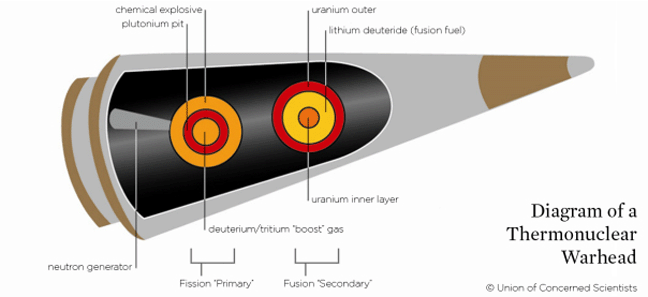
Seismic Concerns at LANL and Expanded Plutonium Pit Production http://nuclearactive.org/, May 19th, 2022, Ongoing Plutonium operations at Los Alamos National Laboratory’s Technical Area 55 are centered in the middle of the 36-square mile national nuclear weapons facility. LANL is the only U.S. facility with the capabilities to fabricate plutonium triggers, or the fissile pits, for nuclear weapons. However, Technical Area 55, or TA-55, is located within the complex Pajarito Fault Zone between two young, north – south running faults called the Guaje Mountain and Rendija Canyon faults. Visual evidence of faulting can be found in the canyons to the north of TA-55. http://nuclearactive.org/gilkeson/ see Seismic Documents.
The U.S. Department of Energy owns LANL. It has plans for expansion of all things plutonium-pit production at the Plutonium Facility and at least five new support buildings at TA-55. CCNS anticipates that DOE will continue its efforts to conceal and ignore the reality of the growing seismic threats of the young faults.
We witnessed similar efforts in the mid-2000s when DOE began to design a new super Walmart-sized Nuclear Facility within TA-55 next door to the Plutonium Facility. DOE was so bold as to dig into the volcanic tuff with heavy equipment to prepare a pad for future construction. http://www.nuclearactive.org/news/030510.html In the end, public opposition and escalating costs forced the cancellation of its plans. http://nuclearactive.org/livestreamed-nuclear-safety-board-hearing-on-february-21st-in-albuquerque/
Fabricating plutonium pits for nuclear weapons involves many steps – some using aqueous processes that result in water contaminated with radiation and hazardous materials. That water is treated across the street from the Plutonium Facility at the Radioactive Liquid Waste Treatment Facility and for decades was discharged through an industrial outfall into Effluent Canyon. Since November 2011, though, the treated water has been evaporated into the air at a mechanical evaporator.
In April, the Environmental Protection Agency renewed the five-year industrial permit for LANL to discharge through Outfall 051 into Effluent Canyon. https://www.epa.gov/nm/los-alamos-national-laboratory-lanl-industrial-wastewater-permit-final-npdes-permit-no-nm0028355
We note that on May 11th, CCNS, Honor Our Pueblo Existence, and the Albuquerque Veterans for Peace, Chapter No. 63, appealed the EPA decision to permit the outfall and five others to the Environmental Appeals Board. https://yosemite.epa.gov/oa/EAB_Web_Docket.nsf/f22b4b245fab46c6852570e6004df1bd/ba987f24df0c356085258837004f3dcd
Then on May 5th, the New Mexico Environment Department approved for the first time a ground water discharge permit for not only for the Radioactive Liquid Waste Treatment Facility, the outfall and Mechanical Evaporator, but for two large solar evaporative tanks, and a new low-level radioactive liquid waste treatment facility. In addition, DOE plans to build a liquid waste treatment facility for the transuranic plutonium liquid waste. https://www.env.nm.gov/public-notices/, go to Los Alamos County, and scroll down to DP-1132 where the draft permit is posted, but not the final permit.
These facilities are all in support of DOE’s plans for expanded plutonium pit production at LANL.
Americans Divided on Nuclear Energy
News Gallup poll. BY LYDIA SAAD, 20 May 22
STORY HIGHLIGHTS
- 51% of Americans favor, 47% oppose nuclear energy, similar to 2019
- Recent views contrast with 2004 to 2015, when majorities backed it
- Republicans and independents in favor, but not Democrats
WASHINGTON, D.C. — Americans are evenly split on whether nuclear energy should be a source of electricity in the U.S., with 51% in favor and 47% opposed. Three years ago, the two camps were tied at 49%, while in 2016, the majority (54%) opposed nuclear power.
Americans’ relatively limited support for nuclear energy in recent years contrasts with more solid backing from 2004 to 2015, when majorities of between 53% and 62% favored it.
……………………….. As Gallup has found previously, support for nuclear energy also differs sharply by gender, while it varies modestly by education. Older adults are slightly more positive than those younger than 55, but differences by age have been less consistent over time.
- Sixty-three percent of men versus 39% of women are in favor of using nuclear energy for electricity.
- Support by education ranges from 57% of college graduates to 50% of those with some college experience and 45% of those with no college.
- A 57% majority of adults 55 and older favor nuclear energy, compared with half of 18- to 34-year-olds and 45% of those aged 35 to 54.
………………………………. https://news.gallup.com/poll/392831/americans-divided-nuclear-energy.aspx
Five new plutonium buildings for Los Alamos National Laboratory, with the costly funding details rather obscure
Nuclear agency plans five new plutonium buildings at Los Alamos lab, Santa Fe New Mexican , By Scott Wyland swyland@sfnewmexican.com, May 18, 2022
As a further sign Los Alamos National Laboratory is inching toward its 2026 target for making 30 warhead triggers a year, nuclear security managers plan to construct five buildings in the lab’s plutonium complex over the next five years, in part to support that effort.
A new building would be funded annually, beginning in fiscal year 2023, with the aim of supporting production of the bomb cores, known as pits, and other plutonium operations, according to the National Nuclear Security Administration’s budget request for the coming year.
The total cost of the five buildings will be more than $240 million………………….
One critic of the lab’s pit production plans said each of the buildings was priced just under the $50 million threshold that would trigger a more rigorous congressional review.
That might allow the lab to change the office buildings into something else later for a different purpose, such as producing more pits, said Greg Mello, executive director of the Los Alamos Study Group.
“No one ever talked about these costs before,” Mello said. “We don’t think this is the end of the surprises. There are more surprises to come.”
The federal budget for plutonium operations has climbed steeply in recent years, both at the lab and at Savannah River Site in South Carolina, where officials hope to make an additional 50 pits yearly by the mid-2030s.
Under the U.S. Department of Energy’s draft budget, the lab’s plutonium modernization funding would climb to $1.56 billion in 2023 from the current year’s $1 billion, more than a 50 percent increase.
At the same time, the nuclear security agency, an Energy Department branch, has proposed funneling $700 million this coming year toward converting Savannah River Site into a pit factory. That’s a sizable jump from the $475 million spent for that purpose in the last budget cycle………………….
Jay Coghlan, executive director of Nuclear Watch New Mexico, said federal officials want the lab’s pit plant to be able to produce up to 80 pits for short periods.
He contends the lab is likely to use this “surge capacity” given the longer time it will take for Savannah River to begin production…………….. https://www.santafenewmexican.com/news/local_news/nuclear-agency-plans-five-new-plutonium-buildings-at-los-alamos-lab/article_48acffdc-d5fb-11ec-985e-5b26a02df8f5.html
The U.S. energy secretary says it is critical to find a solution for storing the nation’s spent nuclear fuel.
Energy Secretary: We Must Find a Solution for Nuclear Waste The U.S. energy secretary says it is critical to find a solution for storing the nation’s spent nuclear fuel. By Associated Press, May 20, 2022, JENNIFER McDERMOTT, Associated Press
WATERFORD, Conn. (AP) — It is critical to find a solution for storing the nation’s spent nuclear fuel, U.S. Energy Secretary Jennifer Granholm said Friday during a visit to a nuclear power plant in Connecticut……………………
There’s renewed momentum to figure out a storage site, or sites, to free up the land where the waste is currently being stored and move it away from population centers, fault lines and flood plains………….
There is roughly 89,000 metric tons of used commercial fuel at nearly 80 sites in 35 U.S. states, according to the Nuclear Energy Institute, the industry’s trade association. At 20 of the sites, there’s no longer an operating reactor, the institute said………………..
Democratic U.S. Rep. Joe Courtney is part of a bipartisan congressional caucus working to change how spent nuclear fuel is stored. Its members believe the current system is not sustainable, particularly for sites that could be redeveloped. Many are along the coastline, in flood plains — the worst geology for spent fuel to be stranded, Courtney said.
WATERFORD, Conn. (AP) — It is critical to find a solution for storing the nation’s spent nuclear fuel, U.S. Energy Secretary Jennifer Granholm said Friday during a visit to a nuclear power plant in Connecticut……………………
There’s renewed momentum to figure out a storage site, or sites, to free up the land where the waste is currently being stored and move it away from population centers, fault lines and flood plains………….
There is roughly 89,000 metric tons of used commercial fuel at nearly 80 sites in 35 U.S. states, according to the Nuclear Energy Institute, the industry’s trade association. At 20 of the sites, there’s no longer an operating reactor, the institute said………………..
Democratic U.S. Rep. Joe Courtney is part of a bipartisan congressional caucus working to change how spent nuclear fuel is stored. Its members believe the current system is not sustainable, particularly for sites that could be redeveloped. Many are along the coastline, in flood plains — the worst geology for spent fuel to be stranded, Courtney said.
Congress has provided about $40 million to fund the consent-based siting process that would be used to identify sites to store the nation’s spent nuclear fuel, and the administration asked for $53 million more for fiscal 2023, Courtney said.
Edwin Lyman, director of nuclear power safety at the Union of Concerned Scientists, said his main concern is that planning for consolidated interim storage could undermine efforts to figure out a permanent storage repository underground.
If there’s a place to ship fuel, there won’t be the political momentum to site an underground repository, which is the only plausible, safe, long-term solution for this waste, he said Friday…………… https://www.usnews.com/news/business/articles/2022-05-20/energy-secretary-to-visit-nuclear-plant-discuss-waste-issue
Say No to Nuclear Power.

Our energy future should consist of modern solar, wind, battery and LED/efficiency technologies, not nuclear reactors. https://progressive.org/op-eds/say-no-to-nuclear-power-wasserman-220518/ BY HARVEY WASSERMAN , MAY 18, 2022

Desperate atomic cultists including Bill Gates are now touting small modular reactors. But they’re unproven, can’t deploy for years to come, can’t be guarded against terrorists and can’t beat renewables in safety, speed to build, climate impacts, price or job creation.
The nuclear power industry has been pushing the fantasy of yet another “renaissance” of nuclear power, based on the absurd idea that atomic reactors — which operate at 571 degrees Fahrenheit, resulting in substantial greenhouse gas emissions and, periodically, explosions — can somehow cool the planet.
But the fact is that no more big, old-style light water reactors are likely to be built in the United States. And the current 93 licensed reactors in this country (there are 400-plus worldwide) grow increasingly dangerous every day.
As a green power advocate since 1973, I’ve visited dozens of reactor sites throughout the U.S. and Japan. The industry’s backers portray them as high-tech black boxes that are uniformly safe, efficient and reliable, ready to hum for decades without melt-downs, blow-ups or the constant emissions of heat, radiation, chemical pollution and eco-devastation that plague us all.
In reality, the global reactor fleet is riddled with widely varied and increasingly dangerous defects. These range from inherent design flaws to original construction errors, faulty components, fake replacement parts, stress-damaged (“embrittled”) pressure vessels, cracked piping, inoperable safety systems, crumbling concrete, lethal vulnerabilities to floods, storms and earthquakes, corporate greed and unmanageable radioactive emissions and wastes — to name a few.

Heat, radiation and steam have pounded every reactor’s internal components. They are cracked, warped, morphed and transmuted into rickety fossils virtually certain to shatter in the next meltdown.

Twice-bankrupt Pacific Gas & Electric of California has been found guilty in the 2010 burning deaths of eight San Bruno residents caused by under-maintained gas pipes. The company was also convicted in the deaths of more than eighty people when its faulty wires ignited whole northern California forests and towns in a series of fires.

In 2003, the Perry and Davis-Besse power plants’ operators blacked out 50 million homes in southern Canada and the northeastern United States. The FBI has linked them to a $61-million-bribe handed to the majority leader of the Ohio House of Representatives, and possibly tens of thousands more to the former chair of the state Public Utilities Commission.
The industry’s “regulators” have turned blind eyes to crumbling concrete at the Seabrook and Davis-Besse facilities, whose “hole-in-the-head” defects almost brought Chernobyl to the shores of Lake Erie. When Diablo Canyon’s resident site inspector warned the plant could not withstand a likely seismic shock, the Nuclear Regulatory Commission shut him up and moved him out.
The industry’s four most recent reactor construction projects include two at South Carolina’s Virgil C. Summer Nuclear Generating Station— totally abandoned after over $10 billion was spent — and two at Georgia’s Alvin W. Vogtle Electric Generating Plant, years late and costing more than $30 billion. Plagued by corruption and incompetence, design flaws and labor problems, Plant Vogtle might never open, especially in light of the astonishing advances in renewable and efficiency technologies, which have completely buried any economic or ecological justification for atomic power, new or old.
Desperate atomic cultists including Bill Gates are now touting small modular reactors. But they’re unproven, can’t deploy for years to come, can’t be guarded against terrorists and can’t beat renewables in safety, speed to build, climate impacts, price or job creation.
Our energy future should consist of modern solar, wind, battery and LED/efficiency technologies, not nuclear reactors. Let’s work to guarantee that none of them explode before we get there.
Environmentalists oppose possibility of extending the life of Diablo Canyon Nuclear Power Plant
ABC Los Angeles Eyewitness News, Dozens of environmental and anti-nuclear organizations expressed opposition Tuesday to any attempt to extend the life of California’s last operating nuclear power plant, challenging suggestions that its electricity is needed to meet potential future shortages in the nation’s most populous state.
Last month, Democratic Gov. Gavin Newsom raised the possibility that the Diablo Canyon Nuclear Power Plant – which sits on a coastal bluff halfway between San Francisco and Los Angeles – could keep running beyond a scheduled closing by 2025………….
PG&E, which in 2016 decided to shutter the plant by 2025, did not directly address Newsom’s suggestion at the time or say whether the company would consider seeking federal dollars to remain open beyond the scheduled closing.
PG&E announced the closing plan in 2016 as part of a deal with environmentalists and union workers, citing a “recognition that California’s new energy policies will significantly reduce the need for Diablo Canyon’s
……… The environmental groups argued that continuing to operate the plant beyond its scheduled closing would generate hundreds of tons of highly radioactive waste, with no permanent storage site for it. And they said state, by its own account, is lining up enough wind, solar and other renewables to replace Diablo’s electricity.
They also questioned whether any federal funds would be enough to unravel the complex deal to close Diablo Canyon, which is regulated by state and federal agencies.
Issues in play at Diablo Canyon range from a long-running debate over the ability of structures to withstand earthquakes – one fault runs 650 yards (594 meters) from the reactors – to the possibility PG&E might be ordered by state regulators to spend potentially billions of dollars to modify or replace the plant’s cooling system, which sucks up ocean water and has been blamed for killing fish and other marine life.
Newsom continues to support closure of the plant “in the long term” as the state moves to renewable energy……. https://abc7.com/diablo-canyon-nuclear-power-plant-environmentalists-extension/11864747/#:~:text=Facing%20possible%20electricity%20shortages%2C%20California,its%20planned%20closing%20in%202025.
U.S. extends application deadline for nuclear power rescue program
WASHINGTON, May 18 (Reuters) – The U.S. Department of Energy said on Wednesday it has extended a deadline by 47 days, to July 5 for nuclear power plants to apply for federal funding to keep them running.
The first stage of the program is aimed at saving two plants, one in California and one in Michigan.
……. The DOE statement came two days after two industry trade groups, Edison Electric Institute and Nuclear Energy Institute, sent a letter to Energy Secretary Jennifer Granholm requesting the extension on behalf of their members.
Under the plan, called theCivilian Nuclear Credit (CNC) program, owners of nuclear reactors that are scheduled to retire would get priority for the first portion of $6 billion in available funding. CNC funding comes from last year’s bipartisan infrastructure law.
Entergy Corp’s (ETR.N) Palisades plant in Michigan, which may be eligible for the funding, is due to shut down on May 31.
Entergy said in an email it was committed to shutting the plant after its Chief Executive Leo Denault said in an earnings call in April that there are “significant technical and commercial hurdles to changing course at this point.”
………. The Diablo Canyon facility in California, owned by PG&E Corp (PCG.N), is scheduled to fully shut in 2025. A company spokesperson said on Tuesday the utility had not yet decided whether to apply for the funds. https://www.reuters.com/business/energy/us-extends-application-deadline-nuclear-power-rescue-program-2022-05-18/
Don’t hold your breath waiting for NuScam’s small nuclear reactors to be profitable

As for valuation, the company is being valued on significant growth occurring in the potentially far distant future, so prospective investors would essentially be betting on the company’s ability to sell operating units at scale and profitably…and to do so in the coming near-to-medium term rather than the 2030s or beyond.
Spring Valley Completes NuScale Merger, But Growth Timing Is Unknown, Donovan JonesMarketplace, Author of IPO Edge. May 18, 2022 A Quick Take On NuScale.
Spring Valley Acquisition Corp. (NYSE:SMR) has announced the closing of its initial business combination with NuScale Power for an estimated enterprise value of approximately $1.9 billion.
NuScale has developed proprietary nuclear small modular reactors for utilities and industrial customers.
It is likely that NuScale will require significant time to generate material revenue growth and even longer for profits
……………. Business Combination Terms
The Spring Valley Acquisition SPAC originally raised $230 million in gross proceeds in its IPO in late 2020, selling a total of 23 million units including underwriter allotments.
The previously announced transaction included a PIPE (Private Investment in Public Equity) which rose to $235 million from Samsung C&T, DS Private Equity, Segra Capital Management and Spring Valley’s sponsor Pearl Energy.
The deal will provide NuScale with gross proceeds of up to $413 million to pursue its commercialization initiatives and growth plans.
Major NuScale investor Fluor Corporation will retain approximately 60% ownership of NuScale, with other legacy shareholders retaining approximately 20.4%, the Spring Valley SPAC public shareholders having 6.5%, the Spring Valley Acquisition Sponsor retaining 2.4% and PIPE investors purchasing 10.7% of the outstanding NuScale stock.
………………. As for valuation, the company is being valued on significant growth occurring in the potentially far distant future, so prospective investors would essentially be betting on the company’s ability to sell operating units at scale and profitably…and to do so in the coming near-to-medium term rather than the 2030s or beyond.
…………….. In any event, it is likely that NuScale will require significant time to generate material revenue growth and even longer for profits, so I’m on Hold over the near term for SMR. https://seekingalpha.com/article/4512948-spring-valley-completes-nuscale-merger-but-growth-timing-is-unknown
Back to square one for $28B nuclear management contract.

By Nick Wakeman, WashingtonTechnology, Editor-in-chief MAY 17, 2022
The National Nuclear Security Administration is taking current global events into account as it develops new solicitations. It’s back to the drawing board for the National Nuclear Security Administration and its $28 billion contract to manage two facilities that process nuclear weapons and other weapons of mass destruction.
That huge contract attracted mega-teams including such notable market players as Booz Allen Hamilton, Leidos, Amentum and Fluor.
Fluor and Amentum are the main partners in joint venture Nuclear Production One LLC. That team also known as NPOne unseated the incumbent Consolidated Nuclear Security LLC, another joint venture.
Consolidated Nuclear Security’s key members include Bechtel National, Leidos, Northrop Grumman and SOC LLC. Booz Allen is involved also as a subcontractor.
After losing the contract in late November, CNS went to the Government Accountability Office with a protest that claimed the winner had an organizational conflict-of-interest and NNSA improperly evaluated the bids.
In December, the National Nuclear Security Administration said it would review the award decision. NNSA is part of the Energy Department.
With that review done, NNSA decided this week to scrap the whole thing and split the contract into two separate acquisitions. One will be for the Pantex Plant near Amarillo, Texas; and the second for the Y-12 National Security Complex in Oak Ridge, Tennessee.
Each facility will now have its own presumably multibillion-dollar contract for management and operations services.
NNSA said it was splitting the contract because each facility has increased workloads. A “challenging geopolitical environment” was another reason cited………..
NNSA has now begun the process of developing two new solicitations. The NPOne and CNS teams will presumably continue to pursue the contracts.
But they are likely now armed with much more information on each other’s bids and approaches to the work, given what they’ve learned through debriefings and the protests.
NNSA’s restart also opens the opportunity to bring on new teammates as they push to differentiate themselves.
In the meantime, the current contract with Consolidated Nuclear Security will be extended.
GovTribe data shows that contract has netted $32 billion in spending since it was awarded in 2013. https://washingtontechnology.com/contracts/2022/05/back-square-one-28b-nuclear-management-contract/367044/
U.S., allies may be planning Ukraine proxy war model for Myanmar — Anti-bellum
ReutersMay 17, 2022 Myanmar resistance urges West to provide arms for fight against junta The defence chief of Myanmar’s shadow government has called for international help to arm its resistance forces fighting the ruling military, requesting support similar to that being given to Ukrainians battling invading Russian troops. The people of Ukraine and Myanmar’s anti-government] […]
U.S., allies may be planning Ukraine proxy war model for Myanmar — Anti-bellum
1 This Month





PLEASE OPPOSE HR 8255 AND S.3639 – bills would accelerate satellite deployment, with no environmental review or safeguards – https://ncstd5li.quorum.us/campaign/169331/
To see nuclear-related stories in greater depth and intensity – go to https://nuclearinformation.wordpress.com
-
Archives
- October 2026 (91)
- September 2026 (339)
- August 2026 (330)
- July 2026 (355)
- June 2026 (287)
- May 2026 (306)
- April 2026 (356)
- March 2026 (251)
- February 2026 (267)
- January 2026 (308)
- December 2025 (358)
- November 2025 (359)
-
Categories
- 1
- 1 NUCLEAR ISSUES
- business and costs
- climate change
- culture and arts
- ENERGY
- environment
- health
- history
- indigenous issues
- Legal
- marketing of nuclear
- media
- opposition to nuclear
- PERSONAL STORIES
- politics
- politics international
- Religion and ethics
- safety
- secrets,lies and civil liberties
- spinbuster
- technology
- Uranium
- wastes
- weapons and war
- Women
- 2 WORLD
- ACTION
- AFRICA
- Atrocities
- AUSTRALIA
- Christina's notes
- Christina's themes
- culture and arts
- Events
- Fuk 2022
- Fuk 2023
- Fukushima 2017
- Fukushima 2018
- fukushima 2019
- Fukushima 2020
- Fukushima 2021
- general
- global warming
- Humour (God we need it)
- Nuclear
- RARE EARTHS
- Reference
- resources – print
- Resources -audiovicual
- Weekly Newsletter
- World
- World Nuclear
- YouTube
-
RSS
Entries RSS
Comments RSS

