Not all American politicians want to adore Zelensky

House Republican Introduces Resolution to Place Bust of Zelensky in the Capitol
Rep. Marjorie Taylor Greene (R-GA) and other conservative GOP members blasted the ideaby Dave DeCamp Posted onCategoriesNewsTagsUkraine
Rep. Joe Wilson (R-SC) introduced a bill this week that would place a bust of Ukrainian President Volodymyr Zelensky in the House wing of the US Capitol building, an idea that was strongly criticized by more conservative GOP members.
The resolution reads: “Resolved, That the House of Representatives directs the Fine Arts Board to obtain a bust of the President of Ukraine, Volodymyr Zelenskyy, for display in a suitable, permanent location in the House of Representatives wing of the United States Capitol.”
On Twitter, Rep. Marjorie Taylor Greene (R-GA) posted a picture of the resolution and wrote: “Absolutely NOT! We serve AMERICA NOT UKRAINE!”
Rep. Thomas Massie (R-KY) wrote on Twitter that he wanted to believe the resolution was “satire” and linked to an article from the conservative advocacy group FreedomWorks giving five reasons to oppose the bust.
The five reasons FreedomWorks listed are:
- Ukraine is NOT the 51st US State
- The US doesn’t own the conflict or is obligated to continue funding it
- Further payments would encourage US taxpayer-funded reconstruction of Ukraine
- Ukraine is corrupt and this conflict is not about “defending democracy”
- Zero oversight of taxpayer aid to Ukraine
Rep. Andy Biggs (R-AZ) also ripped the resolution on Twitter. “There is now a House resolution that seeks to put a display of Zelenskyy’s head in the US Capitol. Was the $100+ billion to Ukraine not enough?” he wrote.
While Zelensky mostly received a hero’s welcome when he visited Washington DC and was given many rounds of applause when addressing Congress, only 86 out of 213 House Republicans attended his speech, although some of the absences could be explained by the lawmakers getting a head start on Christmas travel.
For now, GOP leadership is incredibly supportive of arming Ukraine and is critical of President Biden for not sending longer-range and more advanced weapons. But there is opposition to the policy among a small but notable number of Republicans, and that opposition will likely grow as the war drags on.
Some Republicans are against arming Ukraine because they think the US should be flooding Taiwan with weapons instead, a policy that could provoke a similar crisis in the Asia Pacific. Sen. Josh Hawley (R-MO) in December wrote a letter to Secretary of State Antony Blinken urging the Biden administration to prioritize arming Taiwan over Ukraine.
Trump suggested dropping a nuclear bomb on North Korea and blaming it on someone else in 2017, book claims.

Yahoo News , Alia Shoaib, Sun, January 15, 2023
- As president, Donald Trump suggested nuking North Korea and blaming someone else, a new book extract says.
- Trump was also reportedly “baffled and annoyed” that he would need congressional approval for a pre-emptive strike.
- It is alleged that Trump made the comments in 2017 around the time he was issuing public threats to North Korea.
In his first year in office, Donald Trump suggested striking North Korea with a nuclear weapon and blaming it on someone else, according to a new section of a book obtained by NBC News.
In this article:
- As president, Donald Trump suggested nuking North Korea and blaming someone else, a new book extract says.
- Trump was also reportedly “baffled and annoyed” that he would need congressional approval for a pre-emptive strike.
- It is alleged that Trump made the comments in 2017 around the time he was issuing public threats to North Korea.
In his first year in office, Donald Trump suggested striking North Korea with a nuclear weapon and blaming it on someone else, according to a new section of a book obtained by NBC News.
The revelation was made in a new afterword to the book “Donald Trump v. The United States” by New York Times Washington correspondent Michael Schmidt, due to be released on Tuesday.
Trump made the alleged comments behind closed doors in 2017 when he publicly warned North Korea that it would “be met with fire and fury like the world has never seen” if it continued to make threats.
The then-president also routinely took to Twitter to taunt North Korean leader Kim Jong-Un, who he had nicknamed “Rocket Man.”
The book suggests that John Kelly, who had started as Trump’s White House Chief of Staff in July 2017, was alarmed by the president’s attitude towards the East Asian nation…………………………………….
Read the original article on Business Insider https://news.yahoo.com/trump-suggested-dropping-nuclear-bomb-103150916.html
Savannah River Site, Los Alamos plutonium pit production plan could cost over $30 billion

Matthew Christian, Aiken Standard, S.C. Sat, January 14, 2023 https://news.yahoo.com/savannah-river-los-alamos-plutonium-005900374.html?guccounter=1&guce_referrer=aHR0cHM6Ly9uZXdzLmdvb2dsZS5jb20v&guce_referrer_sig=AQAAADJqdcGm_qX6CdNLQ8_g7p81OistELVP4KvAUR1PfQl-0Q2SBtdSRa8GwdKyTIcwvX8aofXxou_a1DmL9axGTUu9S4o5f35bRYrwMTXGG5ZaoooE2PgjQaFWi5uLyJbf3gg8EShjtVi5A26UqvyJcSYMPWp9GQCX2T9NlsjflzJW
Jan. 13—It could cost over $30 billion for the National Nuclear Security Administration to reestablish plutonium pit production, according to recently released report.
Allison Bawden, director of natural resources and environment at the Government Accountability Office, wrote Thursday the Government Accounting Office has identified between $18-$24 billion in potential costs to begin production of 80 plutonium pits per year by 2036 at the Savannah River Site and Los Alamos National Laboratory.
Plutonium pits are the core of a nuclear weapon into which a neutron is injected to begin an uncontrolled reaction.
The United States has been without a permanent capability for plutonium pit production since 1989 after a combination of environmental mismanagement — the EPA and the FBI raided the facility in 1989 after receiving reports of numerous environmental violations from employees — and the end of the Cold War stopped pit production at the Rocky Flats facility in Colorado.
From 2007-2012, around 10 pits per year were made at the Los Alamos National Laboratory.
Trying to restart plutonium pit production and modernizing the Los Alamos National Laboratory for production has cost $8.6 billion since 2005 according to the report.
NNSA plans to produce 50 pits per year at the Savannah River Site beginning in 2036 and 30 pit per year at the Los Alamos National Laboratory beginning in 2027.
At the Savannah River Site, the plans call for the failed Mixed-Oxide Fuel Fabrication Facility to be converted into the Savannah River Plutonium Production Facility.
Bawden says the NNSA estimates through 2035 a cost of between $6.9-$11.1 billion to make the conversion, which is in three steps: getting the main building ready, providing utilities and other infrastructure to the area and constructing an administration building, security facilities and a training area.
Other costs include $6.94 billion for plutonium modernization program at the Savannah River Site and the Los Alamos National Laboratory .
At the Savannah River Site, Bawden says costs include preparing employees to produce pits and learning from the Los Alamos National Laboratory how to produce pits more efficiently. She says at Los Alamos the costs include designing a pit production line, getting equipment, hiring and training staff and making sure the production line is working and checking the quality of the produced pits.
She adds other costs at the Los Alamos National Laboratory include between $4.17-$5.61 billion for capital projects, $240-244 million for support buildings and $45-46 million for maintenance and recapitalization.
Bawden spends a few pages in the 84-page report discussing activities at other Department of Energy-owned sites that are not included in the NNSA cost estimates.
Those activities include design of a warhead at Lawrence Livermore National Laboratory and the lab making sure the produced pits meet the specifications of the warhead, experimental facilities at the Nevada National Security Site, production of non-nuclear pit components at the Kansas City National Security Campus, disassembling pits at the Pantex Plant in Texas and storing produced waste at the Waste Isolation Pilot Plant in New Mexico.
Including these costs and developing more thorough estimates of the costs at the Savannah River Site and Los Alamos is one of two recommendations the GAO makes in the report.
The other is for the NNSA to develop a more complete schedule of activities and when they’re supposed to happen.
Bawden notes NNSA decision-makers said both recommendations will be implemented later in the process when firm construction plans for the Savannah River Plutonium Production Facility are set in 2024 or 2025. She adds the NNSA decision-makers said they are hesitant to make more thorough cost estimates because of a concern of making an estimate, then paying a higher cost and having the public concerned about rising costs for the project.
California PUC launches rulemaking to consider extension of Diablo Canyon nuclear plant

Kavya Balaraman, Jan. 13, 2023
Dive Brief:
- California regulators on Thursday voted to open a rulemaking to consider extending the operations of the 2.2-GW Diablo Canyon nuclear power plant, the last operational nuclear facility in the state.
- The rulemaking stems from legislation approved last September, which among other things required the California Public Utilities Commission to issue a decision by the end of this year establishing new retirement dates for the two units of the nuclear plant.
- The Diablo Canyon nuclear plant, which is owned and operated by Pacific Gas & Electric, is currently licensed to operate until 2024 and 2025 for each of its two units respectively. In 2018, state regulators approved a plan to retire the facility once these licenses expire.
Dive Insight:………………………..
Under SB 846, Diablo Canyon Unit 1 could be kept running through Oct. 31, 2029, and Unit 2 until Oct. 31, 2030.
In November, PG&E applied to the U.S. Nuclear Regulatory Commission to keep the plant running until 2030.
Under the umbrella of its new rulemaking, the CPUC could either authorize extending operations at the plant through 2029 and 2030, or establish earlier retirement dates.
…………………………. California stakeholders remain split on the state’s reversal on the future of the Diablo Canyon nuclear plant.
“The rush to keep Diablo Canyon running beyond 2025 is not only dangerous, but will set back California’s drive to make solar and wind the prevailing sources of electricity in the state,” Ken Cook, president of the Environmental Working Group, said in an emailed statement. …………………. https://www.utilitydive.com/news/california-puc-diablo-canyon-nuclear-extension/640351/
Republican Rep Joe Wilson of South Carolina wants the US capitol to have a bust of Ukrainian president Vladimir Zelensky on permanent display.

Chris Menahan
InformationLiberation
Jan. 12, 2023
Rep. Joe Wilson of South Carolina filed a resolution earlier this week directing the Fine Arts Board of the U.S. House of Representatives to obtain a bust of Mr. Zelenskyy for display.
The board has authority over all works of art and historical objects displayed on the House wing of the U.S. Capitol and the associated office buildings.
A staunch conservative, who came under fire for shouting “you lie” at former President Obama during a 2009 address to Congress, Mr. Wilson has emerged as a strong supporter of Ukraine.
In December, he told the Charleston Post and Courier that Ukraine’s fight against Russian aggression reminded him of the American Revolution.
Here’s the full text of his resolution:………..
Truly embarrassing.
If Congress insists that a bust of Zelensky go in the Capitol, it should be placed in a bathroom. https://www.informationliberation.com/?id=63546
Significant environmental victory for Savannah River Site Watch in stopping import of high level nuclear waste from Germany
A decade-long effort to export a large volume of highly radioactive nuclear
waste from Germany to the U.S. Department of Energy’s Savannah River Site
(SRS) in South Carolina has been terminated, resulting in a significant
environmental victory.
The German company managing the waste at the Juelich
research site informed the public-interest group Savannah River Site Watch
(SRS Watch) that “the option to ship the aforementioned spent fuel has
indeed been terminated…” These definitive words bring an end to a
decade-long effort by DOE to import an unusual form of highly radioactive
spent fuel to SRS.
Savanah River Site Watch 10th Jan 2023
Does anyone know why I get this message? When I try to find out about Savanah River Site Watch, and especially when I try to find out about “a significant
environmental victory” . – Savanah River Site Watch 10th Jan 2023
https://srswatch.org/3832-2/
The U.S. Can’t Make Enough Plutonium Triggers for Its Nuclear Warheads
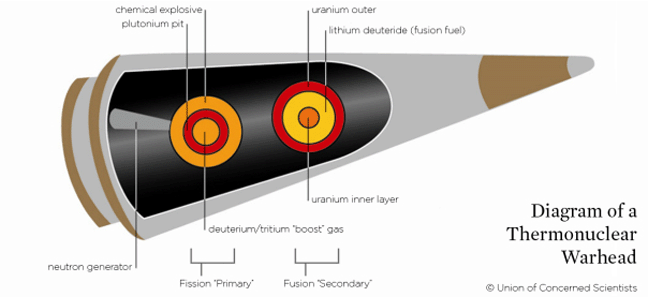
The Pentagon wants 80 new plutonium pits per year by 2030. It doesn’t look like that’s possible.
VICE, By Matthew Gault 13 Jan 23,
American power relies on the constant threat of nuclear annihilation. One of the reasons the U.S. military is so powerful is that the country is sitting on more than 5,000 potential world-ending nuclear weapons. But those nukes are aging and America hasn’t been building more. The Pentagon’s goal is to spin up production and make 80 plutonium pits—the trigger mechanism for nukes—a year by 2030. A new report from federal investigators said that’s a pipe dream.
A nuclear pit is a hollow ball of plutonium. On a basic level, nuclear weapons work by surrounding one of these balls with high explosives. When the high explosives go off, they apply uniform pressure to the plutonium pit and cause a nuclear explosion. They are a key ingredient in nuclear weapons, but America hasn’t made a new one since 1989.
America’s nuclear infrastructure is crumbling and in desperate need of modernization, according to the Pentagon. To keep America’s nukes running, the Pentagon wants to start production again. According to a new report from the Government Accountability Office (GAO), it’s not going well.
This isn’t shocking. The National Nuclear Safety Administration (NNSA) warned Congress in 2022 that the official plan to meet a deadline of 80 pits produced per year by 2030 wasn’t going to happen. According to the GAO, the NNSA doesn’t even know how much it will cost to create the infrastructure to build these pits, what resources it will need, or how long the project will take. “According to officials, such a life cycle cost estimate has not been completed because of concerns about releasing preliminary or uncertain information,” the report said.
For a brief period after the end of the Cold War it seemed like broad nuclear disarmament might be possible. That didn’t happen and now the U.S. is falling behind on modernization goals it set for itself. …………………….
America has pushed to modernize its nuclear forces. The U.S. Air Force is building a new intercontinental-ballistic missile and revealed a new stealth bomber last year with the fanfare of a Super Bowl halftime show. But these fancy new weapons require plutonium cores, and it doesn’t look like the U.S. can build them fast enough. https://www.vice.com/en/article/88qp5k/the-us-cant-make-enough-plutonium-triggers-for-its-nuclear-warheads
Slew of companies keeping watch on DOE nuclear cleanup work for small biz
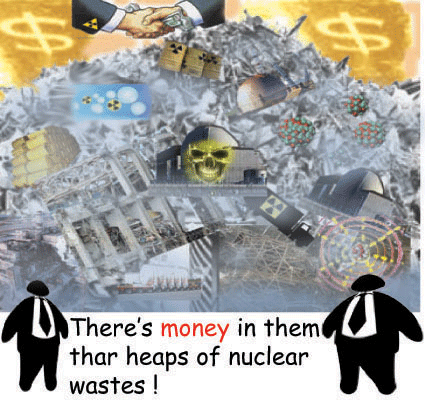
More than 20 companies expressed interest to the Department of Energy’s Office of Environmental Management in landing a slice of various nuclear remediation projects set aside for small business. Twenty-one signed up by Dec. 20 to be on an “interested vendors”… (subscribers only) more https://www.exchangemonitor.com/slew-of-companies-keeping-watch-on-doe-nuclear-cleanup-work-for-small-biz-2/
US military deepens ties with Japan and Philippines to instigate proxy war with China like it did with Russia
Kathrin Hille, Financial Times, Sun, 08 Jan 23
The US and Japanese armed forces are rapidly integrating their command structure and scaling up combined operations as Washington and its Asian allies prepare for a possible conflict with China such as a war over Taiwan, according to the top Marine Corps general in Japan.
The two militaries have “seen exponential increases . . . just over the last year” in their operations on the territory they would have to defend in case of a war, Lieutenant General James Bierman, commanding general of the Third Marine Expeditionary Force (III MEF) and of Marine Forces Japan, told the Financial Times in an interview.
Bierman said that the US and its allies in Asia were emulating the groundwork that had enabled western countries to support Ukraine’s resistance to Russia in preparing for scenarios such as a Chinese invasion of Taiwan.
“Why have we achieved the level of success we’ve achieved in Ukraine? A big part of that has been because after Russian aggression in 2014 and 2015, we earnestly got after preparing for future conflict: training for the Ukrainians, pre-positioning of supplies, identification of sites from which we could operate support, sustain operations.
“We call that setting the theatre. And we are setting the theatre in Japan, in the Philippines, in other locations.”
Bierman’s unusually frank comparison between the Ukraine war and a potential conflict with China comes as Beijing has dramatically increased the scale and sophistication of its military manoeuvres near Taiwan in recent years. Japan and the Philippines are also intensifying defence co-operation with the US in the face of mounting Chinese assertiveness.
Japan and the US are set to discuss strengthening their alliance at security talks between the foreign and defence ministers on Wednesday and a summit between US president Joe Biden and Japanese prime minister Fumio Kishida on Friday in Washington. The summit comes as Tokyo embarks on a radical security policy shift that will include increasing defence spending and deploying missiles capable of hitting Chinese territory.
III MEF is the Marine Corps’ only crisis response force permanently stationed outside the US. It operates within the range of Chinese medium- and long-range missiles, with which Beijing seeks to constrain US operational freedom in the region.
The unit is at the heart of a sweeping reform of the Marine Corps that aims to replace its focus on fighting counter-insurgency in the Middle East with creating small units that specialise in operating quickly and clandestinely in the islands and straits of east Asia and the western Pacific to counter Beijing’s “anti-access area denial” strategy.
To realise that strategy, closer integration with allies was vital, Bierman said. In a series of recent exercises, the Marines for the first time set up bilateral ground tactical co-ordination centres rather than exchanging liaisons with allies’ command points.
In another sign of deepening co-operation, specific Japanese military units have been designated as part of the “stand-in force” alongside III MEF and US Navy and Air Force units.
Instead of a “round robin” of Japanese military units working with US counterparts, as in the past, a “standing community of interest” is emerging of allied units with responsibility for operational plans, Bierman added.
He said while the US military was paying attention to Chinese aggressive behaviour around Taiwan, the People’s Liberation Army should not be perceived as being “10 feet tall”.
“When you talk about the complexity, the size of some of the operations they would have to conduct, let’s say [in] an invasion of Taiwan, there will be indications and warnings, and there are specific aspects to that in terms of geography and time, which allow us to posture and be most prepared.”
As part of those preparations, the Philippines plan to allow US forces to preposition weapons and other supplies on five more bases in addition to five where the US has already access.
“You gain a leverage point, a base of operations, which allows you to have a tremendous head start in different operational plans. As we square off with the Chinese adversary, who is going to own the starting pistol and is going to have the ability potentially to initiate hostilities . . . we can identify decisive key terrain that must be held, secured, defended, leveraged.
Georgia’s Vogtle nuclear plant startup delayed due to vibrating pipe
Vogtle is the only nuclear plant under construction in the United States. Its costs and delays could deter other utilities from building such plants
Midland Daily News, JEFF AMY, Associated Press, Jan. 11, 2023
ATLANTA (AP) — Startup of a nuclear power plant in Georgia will be delayed since its operator found a vibrating pipe in the cooling system during testing.
Georgia Power Co., the lead owner of Plant Vogtle near Waynesboro, announced the delay Wednesday. The company said that the third reactor at the plant is scheduled to begin generating electricity for the grid in April. The unit of Atlanta-based Southern Co. had previously given a startup deadline of March.
The problem was found during startup testing in a pipe that is part of the reactor’s automatic depressurization system, said Georgia Power spokesperson Jacob Hawkins. He said the pipe needs to be braced with additional support. “
Southern Nuclear Operating Co., which will operate the reactor on behalf of Georgia Power and other owners, must get approval for a license modification from the U.S. Nuclear Regulatory Commission, the company said in an investor filing. “It’s not a safety issue,” he said.
The plant includes two operating nuclear reactors and the first two nuclear reactors being built from scratch in the United States in decades. The fourth reactor is still under construction and is supposed to start generating electricity sometime in 2024.
The delay will cost Georgia Power and other co-owners at least $30 million.
A third and a fourth reactor were approved for construction at Vogtle by the Georgia Public Service Commission in 2012, and the third reactor was supposed to start generating power in 2016. The cost of the third and fourth reactors has climbed from an original cost of $14 billion to more than $30 billion…………
Georgia Power customers are already paying part of the financing cost and state regulators have approved a monthly rate increase as soon as the third reactor begins generating power. But the Georgia Public Service Commission will decide later who pays for the remainder of the costs.
Vogtle is the only nuclear plant under construction in the United States. Its costs and delays could deter other utilities from building such plants….https://www.ourmidland.com/news/article/Georgia-nuclear-plant-startup-delayed-due-to-17711807.php
Going nuclear? MPSC to hire outside firm to study Michigan’s energy future (but will the firm have vested interests?)

by: Matt Jaworowski, Jan 9, 2023
GRAND RAPIDS, Mich. (WOOD) — The Michigan Public Service Commission is looking for a consulting firm to conduct a study on whether the state should consider allowing a new nuclear power plant.
The study is a requirement of Michigan’s appropriations bill passed last July, giving the MPSC $250,000 to find an outside team to run the study. The goal is to spell out the advantages and disadvantages of operating a nuclear energy plant in Michigan and its economic and environmental impact.
The bidding window will for consulting firms opens on March 3. The study must be submitted to the Legislature by April 2024………………………… more https://www.upmatters.com/news/michigan-news/going-nuclear-mpsc-to-hire-outside-firm-to-study-michigans-energy-future/
Holtec seeks $7.4 billion government loan for expansion tied to new reactor
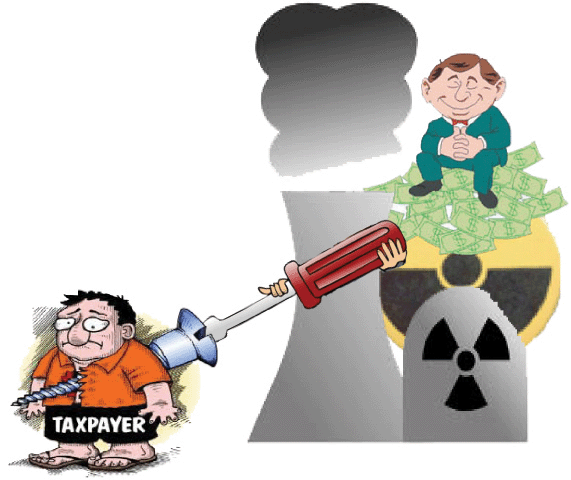
“an outrageous pickpocketing of hardworking American taxpayers to benefit a filthy rich private company.”
Jim Walsh, Cherry Hill Courier-Post, 9 Jan 23
CAMDEN – Holtec International Inc. has applied for a $7.4 billion federal loan to fund expansion expected from future sales of a company-designed nuclear reactor.
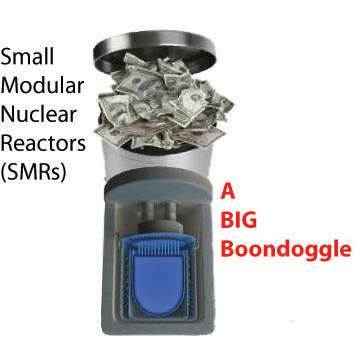
Holtec would tap the loan to boost capacity to make parts at its existing U.S. facilities, and to build and commission “at least four” SMR-160 advanced light water reactors.
It also expects to build “one or more additional manufacturing plants,” the company said.
Holtec added it’s “actively evaluating” potential sites “for the new ultra-modern manufacturing plant(s).”
The firm has three nuclear manufacturing facilities in the United States, including one at its Camden corporate campus that was designed for the eventual production of SMR-160s. It also has a fabrication plant in India.
Holtec claims its small modular reactor produces carbon-free energy more safely than a conventional nuclear power plant.
The firm has invested more than $400 million in the reactor’s development since 2010. It was approved in 2020 for $116 million in federal aid “to support the SMR-160’s commercialization readiness.”
Holtec is seeking the loan from the U.S. Department of Energy’s Loan Programs Office, which received an infusion of about $111 billion from last year’s Inflation Reduction Act.
“We anticipate that (the application process) will be ongoing for a while as DOE usually (has requests) for information or clarifying questions for an applicant,” said Holtec spokesman Patrick O’Brien………………….
Holtec also said it expects the U.S. Nuclear Regulatory Commission “early this year” will license its planned nuclear-waste storage facility in New Mexico.
The complex, in the works for seven years, could hold “the vast quantity of spent nuclear fuel presently stored at more than 70 nuclear sites in 35 states,” the company said.
But an environmental coalition plans to challenge any NRC approval in federal court, said Kevin Kamps of Beyond Nuclear, a nonprofit that’s sharply critical of Holtec’s plan.
Kamps said Holtec’s waste-storage project also faces court challenges from the states of New Mexico and Texas, as well as from businesses with mining and ranching interests near the proposed storage site.
He also described potential federal aid to Holtec as “an outrageous pickpocketing of hardworking American taxpayers to benefit a filthy rich private company.”
According to Holtec, the operation of a consolidated waste-storage site would spur nuclear power in the United States, “leading to the rise of small modular reactors.”
It also expressed the belief that modular reactors made in America would find “a large global export market.”
Holtec previously has predicted it could place 32 SMR-160s in the United Kingdom by 2050………….. https://www.courierpostonline.com/story/news/local/south-jersey/2023/01/09/holtec-federal-loan-production-advanced-nuclear-reactor-oyster-creek/69779027007/
It’s all about the bomb: why civilian nuclear power is merely a cover for producing more nuclear weapons

Nuclear weapons are a special kind of horror opposed by most rational people around the world.
the IAEA’s bluntly stated mission is to promote nuclear technology.
Like Atoms for Peace, this repackaging of a military activity as a civilian one succeeded in making the endeavor socially acceptable and somewhat self-funding
The nuclear power-nuclear weapons link can only be broken by a ban on both
It’s all about the bomb — Beyond Nuclear International
Why civilian nuclear power is merely a cover for producing more nuclear weapons
By Alfred Meyer, 8 Jan 23,
The Zaporizhzhia Nuclear Power Station in southeastern Ukraine, Europe’s largest nuclear power plant, has the world’s attention right now, and rightly so. For the first time in history, six nuclear reactors and thirty-seven years’ worth of high-level nuclear waste are in the middle of a battlefield in an active war zone—one artillery shell, on site or off, could interrupt the control and cooling of the operational reactor, or the cooling of the waste in storage, leading to a catastrophic release of radiation that could spread throughout the Northern Hemisphere. How in the world can nuclear power reactors be considered clean and safe sources of electricity?
Russia, a nuclear-armed nation that invaded Ukraine on February 24, 2022, has said that it would use nuclear weapons if needed. And strong allies of Ukraine—the United States, the United Kingdom, and France, all NATO members—are also armed with nuclear weapons.
You likely are aware of what has happened in the weeks since this magazine went to press, and whether or not the world is in the midst of another major radioactive disaster, as happened at Fukushima in Japan in 2011, Chernobyl in northern Ukraine in 1986, and Three Mile Island in the United States in 1979. I assume that if you are reading this, nuclear weapons have not been used in the war in Ukraine. So how has the world ended up in such an existentially threatening situation? Why does the nuclear enterprise have the world’s future so tightly in its grip?
The short answer: nuclear weapons. It is all about the bomb.
In 1939, Albert Einstein wrote to President Franklin D. Roosevelt urging him to pursue nuclear research in the United States. It was crucial, Einstein wrote, to counter Germany’s efforts to harness the magic of radioactivity and develop a super weapon. A few years later, the Manhattan Project was born in secrecy in 1942. A sprawling and tightly controlled academic, military, industrial, and governmental infrastructure was built to accommodate an entirely new industry equal in size to the American automobile industry at the time. Secrecy was so thorough that when Vice President Harry Truman ascended to the presidency on April 12, 1945, upon Roosevelt’s sudden death, he was unaware that the atomic bomb program even existed, much less that it was on the verge of testing a plutonium weapon in July.
During World War II, the United States succeeded in developing atomic weapons, while Germany was defeated before it could do so. Even though Japan was essentially defeated by then, Truman, some three months after he learned that the United States did possess the super weapons, chose to use them. Although the firebombing of Tokyo in March 1945 had burned to death more than 100,000 people and left more than a million people homeless, it did not occasion the global outcry that followed the use of the uranium bomb on Hiroshima, on August 6, 1945, and the plutonium bomb on Nagasaki, three days later. Nuclear weapons are a special kind of horror opposed by most rational people around the world.
However, following the use of nuclear weapons in Japan in 1945, there has been significant ongoing public opposition to them. In the earliest days of the United Nations, there were various efforts to abolish or control nuclear weapons. It was clear that they constitute an entirely different type of military threat that includes the likelihood of ending life on earth as we know it. Abolishing nuclear weapons is the way to end this existential threat.
When World War II hero General Dwight D. Eisenhower became President in 1953, the dilemma for the military, and for Eisenhower, was how to grow the atomic bomb programs, in light of negative public opinion toward the nuclear enterprise. At the same time, the United States wanted to be recognized as the leader of the “free world” in the postwar years. In the early 1950s, the military needed to recast nuclear enterprise activities to appear to be peaceful, beneficial parts of our modern life, very distant from the wartime horrors.
In August 1953, Eisenhower was worried about the Soviet Union’s successful test of a sophisticated hydrogen bomb—which signaled to the United States that the nuclear arms race was officially on. Eisenhower considered delivering a type of “fireside chat” to the American public—or perhaps a “mushroom cloud chat”—to level with citizens about the truly horrific existential threat that nuclear weapons posed to the world.
But by December of that year, a different strategy appeared to take effect. In a now famous speech on December 8, 1953, titled “Atoms for Peace,” Eisenhower proposed to the U.N. General Assembly an international program of sharing “peaceful” nuclear materials and know-how for untold bounty, to encourage development of nuclear programs around the world.
The United States also proposed an international agency under the United Nations to promote and oversee nuclear activities, which today is the International Atomic Energy Agency, or IAEA. While acknowledging the IAEA’s important oversight role, such as inspecting the Zaporizhzhia reactors and fuel pools at this perilous time in history, one should also recognize that the IAEA’s bluntly stated mission is to promote nuclear technology. The first leaders of the IAEA were from the United States, to ensure that U.S. interests were protected.
Nuclear enterprise infrastructure is an outgrowth of World War II. These new endeavors drew international interest in creating the huge nuclear marketplace now in existence. Atoms for Peace—a plan to share nonmilitary nuclear technology with other countries to “win hearts and minds”—placed nuclear materials and reactors in more than forty countries, including Iran. This generated ongoing business for many American nuclear enterprise companies while supporting and expanding the U.S. military’s nuclear infrastructure and capacity in the United States.
Having nuclear activities under the auspices of the United Nations conferred upon them the legitimacy and respect of that international body. While Eisenhower was making his “Atoms for Peace” speech at the United Nations, he was in the middle of planning the largest hydrogen bomb test ever in the United States, the fifteen-megaton “Bravo” test, on March 1, 1954, which was more than 1,000 times bigger than the bomb dropped on Hiroshima.
The generally favorable response to Atoms for Peace was a trifecta for the nuclear enterprise. U.S. nuclear activities were repackaged as the “peaceful” atom and given the patina of social acceptance through United Nations oversight. Eisenhower was lauded as a good leader for sharing the atom with the world, and the U.S. nuclear infrastructure got new business and growth, which supported more U.S. nuclear weapons and nuclear Navy programs.
Atoms for Peace also served geopolitical ends. For instance, one reason the United States provided Iran with a research reactor in 1967 was to saddle that country with significant financial obligations, including paying for ongoing parts, services, and technical support from American companies. These financial obligations would then, theoretically, force Iran to sell more oil on the world market, regardless of OPEC actions, a kind of atoms-for-oil program—but only peaceful atoms, mind you!
As Atoms for Peace was taking shape, a major policy change was made via the Atomic Energy Act of 1954. The top-secret, tightly controlled Manhattan Project to build the atomic bomb was a governmental endeavor. Nuclear reactors produce the plutonium needed for atomic bombs. With the passage of this new bill by Congress, the operation of nuclear power reactors by privately owned corporations was allowed.
The Atomic Energy Commission was created in 1946 to promote and regulate the development of this new industry. With the commission led by Wall Street banker Lewis Strauss for five critical years, it is not surprising that the scales heavily favored promotion over regulation. Encouraging private investment in these risky reactor projects was assisted by minimizing regulatory safety and operational demands upon the private operators.
Being the biggest nuclear enterprise on earth encourages the circular, self-sustaining dynamic of the nuclear arms race.
But why was it so important for the U.S. government to develop and subsidize civilian nuclear power? Because it allowed the military, in essence, to spin off its nuclear reactor activities to private financing and corporate operations. Like Atoms for Peace, this repackaging of a military activity as a civilian one succeeded in making the endeavor socially acceptable and somewhat self-funding—although government subsidies are still perennially needed to carry on, and taxpayers are still covering the liability insurance costs of the private corporations. Most importantly, as detailed in a 2017 report by former U.S. Energy Secretary Ernest Moniz, civilian nuclear power is an “essential enabler” of our national security. The Atlantic Council calculates the value of this contribution to national security to be $42.4 billion a year. Businesses contributing to the nuclear Navy’s supply chain are in forty-four U.S. states.
The essential nature of civilian nuclear power for national security would suggest that if the United States has the largest national inventory of civilian nuclear reactors in the world, then it also has the largest nuclear enterprise infrastructure to support nuclear weapons production and a nuclear Navy.
Being the biggest nuclear enterprise on earth encourages the circular, self-sustaining dynamic of the nuclear arms race. The United States is busy modernizing its nuclear weapons infrastructure to be “strong enough” to negotiate the elimination of nuclear weapons. This is presented as official doctrine in the nonproliferation world. In reality, the United States is actually driving the growing international nuclear arms race.
Atoms for Peace and the nuclear enterprise employ particularly successful advertising campaigns, greatly influencing public opinion and shaping our cultural consciousness of the nuclear world.
Presenting civilian nuclear power as the answer to climate change, as clean and safe electrical generation, or as energy “too cheap to meter” is simply a sales pitch. What is actually delivered by a robust nuclear energy fleet is the capacity for nuclear weapons and a nuclear Navy.
Over the decades, there have been numerous expert critiques of nuclear power, authoritatively debunking these misleading and false promises, yet these critiques seem to have no effect on the trajectory of the nuclear enterprise. I suggest that these sales pitches are diversionary techniques aimed at sapping our energy. It does not matter if nuclear power can really solve climate change, it just has to be seen as an essential part of the solution to attract bright, young talent into what is made to appear as the cutting edge of technology and climate solutions, even though the civilian nuclear power industry worldwide has been in decline since 2002.
To protect ourselves from the dangers of the nuclear enterprise, we need to stop the nuclear weapons and nuclear power reactor programs—a tall order, for sure. But if we seek success in our efforts, we are well advised to understand the forces we are engaging with. It is all about nuclear weapons.
Alfred Meyer is a member of Physicians for Social Responsibility and has worked with communities affected by the Chernobyl and Fukushima nuclear catastrophes.
Pentagon pressures NATO allies to boost arms flow to Ukraine

January 8, 2023, Rick Rozoff Interfax-Ukraine January 7, 2023 https://antibellum679354512.wordpress.com/2023/01/08/pentagon-pressures-nato-allies-to-boost-arms-flow-to-ukraine/
USA to seek from its allies to expand military aid to Ukraine – Pentagon
U.S. Secretary of Defense Lloyd Austin, (pictured above) in a phone conversation with his Ukrainian counterpart Oleksiy Reznikov, said the United States will convince its allies of the need to increase military assistance to Kyiv, according to the Pentagon.
Austin reaffirmed its commitment to encouraging allies and partners to provide additional air defense systems, combat vehicles and other critical capabilities to support Ukraine.
Arms flow to Ukraine
Date: January 8, 2023Author: Rick Rozoff0 Comments
Interfax-Ukraine
January 7, 2023
USA to seek from its allies to expand military aid to Ukraine – Pentagon
U.S. Secretary of Defense Lloyd Austin, in a phone conversation with his Ukrainian counterpart Oleksiy Reznikov, said the United States will convince its allies of the need to increase military assistance to Kyiv, according to the Pentagon.
Austin reaffirmed its commitment to encouraging allies and partners to provide additional air defense systems, combat vehicles and other critical capabilities to support Ukraine.
At the same time, the U.S. minister said assistance would be provided “as much as needed.”
The Pentagon also said Austin had already discussed with German Defense Minister Christine Lambrecht ways to increase assistance in the run-up to the meeting of the Ukrainian Defense Contact Group in Ramstein, Germany.
Austin appreciated Germany’s decision to provide Ukraine with a Patriot air defense battery and Marder infantry fighting vehicles.
According to Ukrainian Ambassador to the United States Oksana Markarova on her Facebook page, in addition to a new $3.075 billion U.S. military aid package for Ukraine, Washington provides “$682 million in additional foreign military funding to stimulate and compensate for the transfer of military equipment to Ukraine from allies and partners”.
Ukrainian News
January 7, 2023
Defense Minister Reznikov discusses new military aid to Ukraine with Pentagon head Austin
Defense Minister Oleksii Reznikov announced that he discussed the details of the new U.S. aid package to Ukraine with his American colleague Lloyd Austin.
We discussed the details of the new U.S. security assistance package for Ukraine and the next Ramstein-style meeting with Lloyd Austin,” Reznikov emphasized.
According to the head of the Ministry of Defense of Ukraine, this largest the United States’ aid package gives Ukraine “new opportunities to liberate our territory in the east and south.”
Return to studying baby teeth for radioactivity from nuclear weapons and nuclear facilities

St. Louis baby teeth study sparked nuclear test ban 60 years ago
Now, the baby tooth study from decades ago carries new life in the form of a Harvard study.
by: Joey Schneider, Jan 7, 2023 https://fox2now.com/news/missouri/st-louis-baby-teeth-study-sparked-nuclear-test-ban-60-years-ago/
ST. LOUIS – A famous study involving the baby teeth of St. Louis area children helped lay the foundation for a treaty to ban atmospheric nuclear testing 60 years ago.
A group of scientists, led by physician Louise Reed and St. Louis-area professor Barry Commoner, launched the study in December 1958 through the Greater St. Louis Citizen’s Committee for Nuclear Information. The mission: To determine whether radioactive fallout and nuclear energy had a negative impact on children’s health.
From 1958 to 1970, researchers collected more than 320,000 baby teeth of children from various ages, primarily from those in the St. Louis area.
The study followed a 1956 report from the U.S. Public Health Service, which hinted that St. Louis and other Midwestern cities could have alarming levels of radioactivity in water, air and milk following above-ground nuclear tests around the United States. In the decade leading up to that, officials had moved forward with nearly 100 nuclear tests, some that happened above-ground and spurred concerns of exposure, according to the Arms Control Association.
Preliminary case studies determined that children born in 1963 had levels of strontium 90, a radioactive isotope found in bomb fallout, nearly 50 times higher than children born in 1950. A limited study published by Science Magazine in 1961 presented similar findings.
“The immediate radiation danger moved public opinion, which influenced Congress to pass and President John F. Kennedy to implement the Limited Test Ban Treaty in 1963,” said the Missouri History Museum on the research. “They knew that a by-product of nuclear weapons testing is death-dealing, cancer-causing radiation. Some elemental isotopes last for thousands of years while others decay quickly, but airborne debris drifts for miles from explosions, falling onto food and water.”
Kennedy campaigned for president in strong opposition to nuclear testing, according to the John F. Kennedy Presidential Library. However, he entered his term at the height of the Cold War and faced mounting pressure after the Soviet Union conducted dozens of above-ground nuclear tests. In 1962, he reluctantly announced that the United States would resume atmospheric testing.
As Kennedy attempted to negotiate a ban on such testing, the findings of the St. Louis baby tooth study came to his attention. Negotiations to end atmospheric radioactive testing, the issue at the center of the baby tooth study, intensified midway through 1963.
By July, Kennedy had reached an agreement with the Soviet Union to exclusively conduct nuclear tests underground. By August, government officials from the Soviet Union, the United Kingdom, and the United States gathered in Moscow to sign what is officially known as the “Treaty Banning Nuclear Weapon Tests in the Atmosphere, in Outer Space and Under Water” or “Partial Test Ban Treaty.”
“Let us if we can step back from the shadows of war and seek out the way of peace. And if that journey is 1,000 miles or even more, let history record that we, in this land, at this time, took the first step,” said Kennedy on the agreement in a televised speech on July 26, 1963.
The initial baby tooth study continued through 1970. A research team acquired 85,000 of the tested teeth for a 2001 analysis that concluded 12 children who died of cancer had strontium 90 levels twice as high as others alive during the time of research. Some scientists denounce those findings to this day.
Now, the baby tooth study from decades ago carries new life in the form of a Harvard study. Researchers hope to collect tens of thousands and determine a possible connection between metals and cognitive decline at an older age. Harvard neuroscientist Marc Weisskopf launched the study in 2021, and one survey for the project remains ongoing.
According to a report from DrBicuspid.com, Japanese filmmaker Hideaki Ito is also working on a documentary about the original study and visited St. Louis last year for some groundwork.
1 This Month





PLEASE OPPOSE HR 8255 AND S.3639 – bills would accelerate satellite deployment, with no environmental review or safeguards – https://ncstd5li.quorum.us/campaign/169331/
To see nuclear-related stories in greater depth and intensity – go to https://nuclearinformation.wordpress.com
-
Archives
- October 2026 (81)
- September 2026 (339)
- August 2026 (330)
- July 2026 (355)
- June 2026 (287)
- May 2026 (306)
- April 2026 (356)
- March 2026 (251)
- February 2026 (267)
- January 2026 (308)
- December 2025 (358)
- November 2025 (359)
-
Categories
- 1
- 1 NUCLEAR ISSUES
- business and costs
- climate change
- culture and arts
- ENERGY
- environment
- health
- history
- indigenous issues
- Legal
- marketing of nuclear
- media
- opposition to nuclear
- PERSONAL STORIES
- politics
- politics international
- Religion and ethics
- safety
- secrets,lies and civil liberties
- spinbuster
- technology
- Uranium
- wastes
- weapons and war
- Women
- 2 WORLD
- ACTION
- AFRICA
- Atrocities
- AUSTRALIA
- Christina's notes
- Christina's themes
- culture and arts
- Events
- Fuk 2022
- Fuk 2023
- Fukushima 2017
- Fukushima 2018
- fukushima 2019
- Fukushima 2020
- Fukushima 2021
- general
- global warming
- Humour (God we need it)
- Nuclear
- RARE EARTHS
- Reference
- resources – print
- Resources -audiovicual
- Weekly Newsletter
- World
- World Nuclear
- YouTube
-
RSS
Entries RSS
Comments RSS

