China has strongly condemned the submarine deal, accusing AUKUS of displaying a ‘Cold War mentality.
The AUKUS trilateral alliance, which includes Australia, the UK and the US, has signed a landmark deal under which it will create a fleet of nuclear-powered submarines to counter China in the Indo-Pacific region. The deal provides a significant shot in the arm to Australia’s military capability. Canberra will buy three nuclear submarines, with the option to purchase two more. The submarines will use the US’s elite nuclear propulsion technology and be built in Britain and Australia. In addition, American and British nuclear-powered submarines will rotate into Australian waters as early as 2027. The deal marks a significant milestone; Australia has now become the second country after the UK to be provided with this elite American technology. While the supply of nuclear submarines to Australia will beef up Western capacity to contain China in the Indo-Pacific, this is a brazen violation of the Nuclear Non Proliferation Treaty, under which nuclear weapons states are forbidden from sharing nuclear technology with non-nuclear weapon states. However, this is not the first time that such nuclear sharing is taking place. China has shared its nuclear and missile technology with Pakistan and North Korea, while the US stationed its tactical nuclear weapons in several Western European countries during the Cold War. China has strongly condemned the submarine deal, accusing AUKUS of displaying a “Cold War mentality,” embarking on a “path of error and danger,” damaging the NPT regime, and triggering a nuclear arms race. Its allegations are valid……………………
It is hard to ignore the fact that the hostility between China and the West is increasingly looking like that between the latter and the Soviets during the Cold War years. The Cold War resulted in both sides pouring billions of dollars into their conventional and nuclear arsenals. It is still possible for the two sides to back off. Importantly, they must continue to engage diplomatically and ensure that their competition does not escalate into armed conflict. Weapons and alliances may give countries a sense of security but this is at best hollow. Misperceptions can trigger a war. AUKUS must follow up its nuclear deal by calling for talks with China. https://www.deccanherald.com/opinion/first-edit/changing-dynamics-of-us-nuclear-alliances-1200527.html—
ST.. PAUL, Minn. (AP) — Minnesota regulators said Thursday they’re monitoring the cleanup of a leak of 400,000 gallons of radioactive water from Xcel Energy’s Monticello nuclear power plant, and the company said there’s no danger to the public.
………………… While Xcel reported the leak of water containing tritium to state and federal authorities in late November, the spill had not been made public before Thursday. State officials said they waited to get more information before going public with it.
…………………….. The Monticello plant is about 35 miles (55 kilometers) northwest of Minneapolis, upstream from the city on the Mississippi River.
………………. Xcel said it has recovered about 25% of the spilled tritium so far, that recovery efforts will continue and that it will install a permanent solution this spring.
Billions over budget and years behind schedule, the expansion of the Vogtle nuclear power plant signals that conventional nuclear projects are a dying breed.
The first new nuclear reactor built in the U.S. in the last 30 years reached a milestone last week that brings it tantalizingly close to syncing up with the electrical grid and generating power for customers. But this is not the dawn of the long-threatened nuclear renaissance — it’s more like the swan song of the conventional nuclear industry in the U.S.
………….. Construction started for the two reactors in 2009, with plans to get them online by 2017, but the project is six years overdue and has cost utility customers well over $30 billion, more than double the original price tag. The Department of Energy’s Loan Programs Office provided about $12 billion in loan guarantees to help complete the project against a backdrop of spending freezes and lawsuits.
……………….
If and when Georgia’s two new Vogtle reactors become fully operational, they will be the first nuclear reactors to have completed the full licensing process under the U.S. Nuclear Regulatory Commission. All other reactors in operation began licensing before the NRC opened its doors in 1975.
It’s the end of the reactor as we know it
……….“Vogtle 3 and then Vogtle 4. And then most likely nothing,” said Gregory Jaczko, a former chair of the Nuclear Regulatory Commission.
…….The NRC has issued permits for eight more nuclear reactors to be built at or near existing plant sites in the U.S., but none of these are expected to be completed. Instead, the industry is betting on advanced nuclear reactors to save the day.
It’s a bad bet.
The Idaho National Laboratory has an optimistic timeline for the demonstration and test-bed reactors it expects will power up this decade, but the commercialization path for these experiments is uncertain. The advanced and small modular reactors (SMRs) under development face a raft of economic, regulatory, technological and temporal risks. This will translate to cost overruns, project delays and uneconomic power, with utility customers ultimately left holding the bag at some distant day in the 2030s or 2040s.
The advanced reactor closest to market in the U.S. is being developed by NuScale, which has a nonbinding agreement to build a first-of-its-kind SMR project in Idaho. The company has already raised its projected power cost from $58 per megawatt-hour to $89, even though it’s still years away from even beginning construction. The first module at the plant is set to begin commercial operation in December 2029, NuScale says, but nuclear project timelines are inevitably Pollyannaish and wildly off-base.
NuScale’s regulatory journey with the NRC has been long and arduous, and it’s far from over. Advanced reactors such as TerraPower’sNatrium, which are significantly different in design from existing light-water reactors, face an even steeper regulatory climb. And they’ll have to contend with broken or nonexistent supply chains because the more highly concentrated uranium fuels used by most advanced reactors are currently unavailable in large quantities outside of Russia.
NYT, By Serge Schmemann, Mr. Schmemann is a member of the editorial board., March 13, 2023
“……………………………………………………….. More than 30 years after the end of the Cold War, the threat of nuclear obliteration simply doesn’t rank among Americans’ greatest fears. For a while after Sept. 11, global terrorism reigned in the public’s mind as the most pressing threat. According to a 2022 survey by the Pew Research Center, cyberattacks are now considered the major global menace, followed by false information, China, Russia, the global economy, infectious diseases and climate change. My grandson, a college student, told me his peers don’t see a global nuclear war as a real danger today.
Yet even the sharply reduced Russian and American nuclear arsenals are still enough to wipe out much of the world, China is pushing hard to become the third nuclear superpower, and at least six other countries, including the uber-dictatorship North Korea, have nuclear weapons (the others: Britain, France, Israel, India and Pakistan).
Perversely, the complexity of today’s world has even generated something akin to nostalgia for a time when there were only two superpowers to deal with and stability depended on mutually assured destruction. But it is hard to be nostalgic about a time when President John Kennedy urged all Americans to prepare nuclear shelters (“The time to start is now”) and nuclear nightmares were the stuff of popular movies like “On the Beach,” “Fail Safe” and “Dr. Strangelove or: How I Learned to Stop Worrying and Love the Bomb.”
…………………………… nuclear arms controls are as needed today as they ever were, and not only with Moscow. Mr. Putin obliquely acknowledged that when, after saying on Feb. 21 that Russia would suspend participation in New START, Russia quickly added that the country would continue to respect the treaty’s limits on nuclear warheads and delivery systems.
…………………….. Even if the Doomsday Clock doesn’t move any closer to midnight, time is still running out. New START expires in three years. It’s hard to imagine negotiations on a new treaty so long as the war in Ukraine rages on. At the same time, China is racing ahead in an apparent bid to match the U.S. and Russian arsenals by 2035. So far, Beijing has rebuffed any efforts to negotiate limits with the United States, though it joined the United States, Russia, France and Britain in January 2022 in declaring that “nuclear war cannot be won and must never be fought.” Even if Russia and China can be brought to the table, the parties will need a new way to define how many bombs each nation needs to deter the other two………………………………….more https://www.nytimes.com/2023/03/13/opinion/international-world/putin-ukraine-nuclear-weapons.html
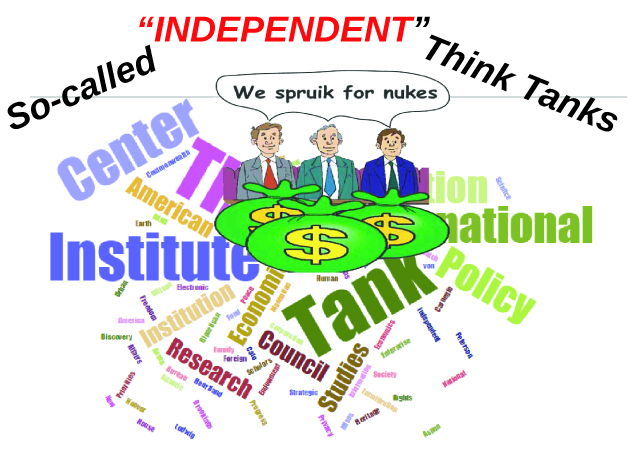
From producing reports and analysis for U.S. policy-makers, to enlisting representatives to write op-eds in corporate media, to providing talking heads for corporate media to interview and give quotes, think tanks play a fundamental role in shaping both U.S. foreign policy and public perception around that foreign policy. Leaders at top think tanks like the Atlantic Council and Hudson Institute have even been called upon to set focus priorities for the House Intelligence Committee. However, one look at the funding sources of the most influential think tanks reveals whose interests they really serve: that of the U.S. military and its defense contractors.
This ecosystem of overlapping networks of government institutions, think tanks, and defense contractors is where U.S. foreign policy is derived, and a revolving door exists among these three sectors. For example, before Biden-appointed head of the Pentagon Lloyd Austin took his current position, he sat on the Board of Directors at Raytheon. Before Austin’s appointment, current defense policy advisor Michèle Flournoy was also in the running for the position. Flournoy sat on the board of Booz Allen Hamilton, another major Pentagon defense contractor. These same defense contractors also work together with think tanks like the Center for Strategic and International Studies to organize conferences attended by national security officials.
On top of all this, since the end of the Cold War, intelligence analysis by the CIA and NSA has increasingly been contracted out to these same defense companies like BAE Systems and Lockheed Martin, among others — a major conflict of interest. In other words, these corporations are in the position to produce intelligence reports which raise the alarm on U.S. “enemy” nations so they can sell more military equipment!
And of course these are the same defense companies that donate hundreds of thousands of dollars each year to think tanks. Given all this, is it any wonder the U.S. government is simultaneously flooding billions of dollars of weaponry into an unwinnable proxy war in Ukraine while escalating a Cold War into a potential military confrontation with China?
The funding to these policy institutes steers the U.S. foreign policy agenda. To give you a scope of how these contributions determine national security priorities, listed below are six of some of the most influential foreign policy think tanks, along with how much in contributions they’ve received from “defense” companies in the last year.
All funding information for these policy institutes was gathered from the most recent annual report that was available online. Also note that this list is compiled from those that make this information publicly available — many think tanks, such as the hawkish American Enterprise Institute, do not release donation sources publicly.
1 – Center for Strategic and International Studies According to their 2020 annual report
$500,000+: Northrop Grumman Corporation
$200,000-$499,999: General Atomics (energy and defense corporation that manufactures Predator drones for the CIA), Lockheed Martin, SAIC (provides information technology services to U.S. military)
$100,000-$199,999: Bechtel, Boeing, Cummins (provides engines and generators for military equipment), General Dynamics, Hitachi (provides defense technology), Hanwha Group (South Korean aerospace and defense company), Huntington Ingalls Industries, Inc. (largest military shipbuilding company in the United States), Mitsubishi Corporation, Nippon Telegraph and Telephone Corporation (provides intelligence and information technology services to U.S. military), Qualcomm, Inc. (semiconductor company that produces microchips for the U.S. military), Raytheon, Samsung (provides security technology to the U.S. military), SK Group (defense technology company)
$65,000-$99,999: Hyundai Motor (produces weapons systems), Oracle
$100,000-$249,000: Huntington Ingalls Industries, Neal Blue (Chairman and CEO of General Atomics), Qualcomm, Inc., Raytheon, Boeing.
$50,000-$99,000: BAE Systems, Booz Allen Hamilton, Intel Corporation (provides aerospace and defense technology), Elbit Systems of America (aerospace and defense company), General Dynamics, Palantir Technologies
Federal agencies won’t look at cancer impacts of commercial nuclear facilities
By Cindy Folkers, 12 Mar 23
If you thought the government of the United States, the country with the most nuclear power reactors in the world, might be interested in finding out the cancer impact of nuclear power on our children, you’d be wrong. But, our government is willing to give failed, uneconomic, decaying nuclear power reactors oodles of taxpayer money without first figuring out if and how they harm our children. Assessing potential health damage should be a prerequisite for reactor license renewal.
Citizens and lawmakers from California have been working to revivify a cancelled National Academy of Sciences (NAS) health study originally requested and funded by the U.S. Nuclear Regulatory Commission (NRC) in 2010. The study was to have been carried out in two phases. The first phase “identified scientifically sound approaches for carrying out an assessment of cancer risks” that would inform the study design(s) to be carried out in Phase 2.
Phase 1 recommended examining seven pilot sites, six of which are operating or closed nuclear power plants: Big Rock Point (MI, closed), Dresden (IL), Haddam (CT, closed), Millstone (CT), Oyster Creek (NJ), and San Onofre (CA, closed). The seventh site, Nuclear Fuel Services (TN), is a fuel processing and stockpile conversion facility.
There were also two study designs recommended in the subsequent 2012 Phase 1 report: an ecologic study that would look at a variety of cancers among adults and children over the operational history of the facilities; and a record-linkage-based case-control study examining cancer risks for childhood exposures to radiation during more recent operating histories of the facilities. Because the case-control study would have focused on children, Beyond Nuclear supported this study type over the ecologic study recommendation.
The NAS was preparing to perform the pilot study at the seven sites in order to see which study type had the stronger methodology to be performed nationwide when it was scuttled by the NRC in 2015.
The NRC justified the cancelation by publicly contending that it would cost too much, take too long, and not be able to see any health impact — claims that are still disputed. The NAS health study would have cost an estimated $8 million at the time it was first proposed.
Yet, at the same time that the NRC claimed the cancer study was too expensive, it signed a 20-year lease for a third building at its Rockville, MD headquarters (against the advice of Congress) that will eventually mount to a cost of $350 million. The decision was made in anticipation of the so-called Nuclear Renaissance, which instead fizzled, leaving the NRC scrambling to lease out the new space instead.
The NAS was considering using new ways of examining the health impacts of radioactivity from NRC licensed sites by implementing a more detailed, more thorough, publicly shared research protocol. Such a protocol could have opened up the NRC’s regulatory regime to exhaustive scrutiny, revealing just how inadequate it is for examining health impacts.
Instead of asking the NRC to restart the original study, three members of the U.S. House of Representatives from California have asked the U.S. Department of Health and Human Services (HHS) to pick up the NAS study where the NRC left off, only to be rebuffed with the jaw-dropping claim by HHS Secretary Xavier Becerra, that such a study would be “premature”(letter from X. Becerra to Hon. Mike Levin (D-CA), September 12, 2022), despite 60+ years of exposures to radiation from nuclear power. Becerra wants more delays to allow “collaboration” with other agencies, like the U.S. Department of Energy that has historically been sanctioned from involvement in certain health studies.
In fact, such studies done in Europe have shown increases of childhood leukemia around nuclear facilities worldwide. These studies were not “premature”, they were revelatory. Despite these findings, there has never been independent nationwide analysis in the U.S. examining connections between childhood cancer and nuclear power facilities. The NAS case-control study under consideration had a design similar to the European studies that found linkage between living near a nuclear reactor and increases in childhood cancers.
While Bacerra claims it is “premature” to study health impacts from nuclear power, it seems to be just the right time to throw more bailout money down the nuclear bottomless pit in order to keep the current reactor fleet running without knowing what their health impacts have been or will be.
In an ironic twist, the first $1.1 billion nuclear bailout was given to Diablo Canyon in California, a slap in the face for those asking for the health study. This taxpayer largess given to the California nuclear power plant was just a small piece of the $30 billion subsidy (by some estimates, nuclear subsidies could be even higher) earmarked for nuclear power in the Inflation Reduction Act.
The two Diablo Canyon nuclear generating units released 72 curies of tritium gas alone in 2019, part of a suite of radionuclides routinely released by operating reactors. This particular isotope is a radioactive form of hydrogen that can collect in fetal tissue to twice the concentration as it does in maternal tissue. It is well-known that pregnancy development is particularly sensitive to damage from radiation exposure — more so than adults or even children — clearly making this an issue that should interest HHS, as well as one that should help determine whether nuclear power can continue to operate or if its impact on our future generations might be too great. After all, we have readily available, cheaper and safer alternatives.
Despite its published motto — “Protecting people and the environment” — the NRC’s main focus has always been nuclear reactor operations, while downplaying and denying rather than investigating health impacts. The agency’s cancellation of the child cancer study was industry-friendly and tone-deaf; in other words, expected. It had undertaken the study to soothe public anxiety about health impacts. When the NRC learned the study might not accomplish this, or worse, might reveal the agency’s shortcomings as a watchdog agency, it pulled the plug.
From HHS, on the other hand, I expected better. “Health” after all, is in their name.
Cindy Folkers is the Radiation and Health Hazard Specialist at Beyond Nuclear.
In a win for public participation and environmental protection, the United States District Court of South Carolina denied the Department of Energy’s motion to dismiss a 2021 legal action filed by multiple citizen groups.
The suit was prompted by the agency’s failure to take the “hard look” required by the National Environmental Policy Act at its plans to more than quadruple the production of plutonium pits for new nuclear weapons and split their production between the Los Alamos National Laboratory and the Savannah River Site.
In her ruling, Judge Mary Geiger Lewis thoroughly rejected the defendants’ arguments that the plaintiffs lacked standing, saying it was “not a close call”.
“We were able to defeat yet another attempt to use standing as a weapon to keep members of the public out of the government’s decision-making process,” said Leslie Lenhardt, Senior Managing Attorney at the South Carolina Environmental Law Project (SCELP).
To date, the Department of Energy (DOE) has refused to fully examine the environmental and safety impacts of their cross-country plan, which would create massive quantities of dangerous radioactive materials, put hundreds of billions of taxpayer dollars on the line, risk a new nuclear arms race, and violate the nation’s foundational environmental law.
The Savannah River Site has never produced plutonium pits, the explosive cores of all U.S.nuclear weapons, and currently stores 11.5 metric tons of plutonium, which poses a daunting management and disposal challenge. Pit production will only increase its plutonium burden, along with more waste that needs to be treated, stored and disposed of.
“The ruling is a significant loss for the DOE in its efforts to dodge its legal obligations under NEPA,” said Tom Clements, Director of SRS Watch. “We will push forward in court to make sure that the DOE conducts the mandated environmental analysis of impacts of plutonium pit production at all involved DOE sites, including sites at which plutonium waste would be disposed.”
Despite outdated analyses failing to account for significant changes in circumstances, the U.S. government has ignored the repeated calls from the public, including the plaintiffs specifically, to conduct the legally required “hard look” at this major shift in policy that will only exacerbate the already documented waste of taxpayers’ money.
“It’s critical that the public understands that no future pit production is to maintain the safety and reliability of the existing nuclear weapons stockpile,” said Jay Coghlan, Executive Director of Nuclear Watch New Mexico. “Instead, it is for speculative new designs that can’t be tested because of the international testing moratorium. Or worse yet, it could prompt the U.S. to resume testing, which would have severe proliferation consequences. This is the kind of needed public discussion that the Department of Energy seeks to shut down while spending enormous sums of taxpayers’ money on expanding nuclear weapons production.”
SCELP filed the lawsuit on behalf of Savannah River Site Watch, Nuclear Watch New Mexico, Tri-Valley CAREs and the Gullah/Geechee Sea Island Coalition in June of 2021 after the DOE’s semi-autonomous National Nuclear Security Administration (NNSA) concluded it was unnecessary to conduct a broad, nationwide review of this two-site strategy. Instead, the agency is relying on a supplemental analysis of an outdated Programmatic Environmental Impact Statement (PEIS) completed more than a decade ago, along with a separate review done for SRS alone.
“We are thrilled that the Court ruled in our favor and that this landmark environmental case can now proceed toward a final decision,” said Marylia Kelley, Executive Director of the Livermore-based Tri-Valley CAREs. “What’s at stake in our litigation is nothing less than the question of whether the federal government will be allowed to run roughshod over affected communities like mine all across the country.
“We believe the Court will ultimately agree with Plaintiff groups that the National Nuclear Security Administration must produce a nationwide Programmatic Environmental Impact Statement and hold public hearings at all of the locations that will be actively involved in these dangerous plutonium bomb core activities, including Livermore, CA. The analysis of risks must precede implementation of the project in order to forestall serious environmental degradation and potential loss of life, “Kelley concluded.
Energy Department Announces Funds for Nuclear Power Plants
MARCH 12, 2023
Both existing operational and closed facilities are receiving assistance.
The Department of Energy has announced a $1.2 billion fund dedicated to extending the life of America’s aging nuclear power plants or potentially reopening plants that have closed, expanding the reactors eligible for aid.
Secretary Jennifer Granholm said, “Preserving the domestic fleet is critical to reaching America’s clean energy future.” She said that expanding the scope of funding “will allow even more nuclear facilities the opportunity to continue operating as economic drivers in local communities that benefit from cheap [??], clean[??] and reliable power.” …………………… https://www.presidentialprayerteam.org/2023/03/12/energy-department-announces-funds-for-nuclear-power-plants/—
COLUMBIA, S.C. (AP) — A former executive utility who gave rosy projections on the progress of two nuclear power plants in South Carolina while they were hopelessly behind will spend 15 months in prison for the doomed project that cost ratepayers billions of dollars.
Ex-SCANA Corp. Executive Vice President Stephen Byrne apologized in court Wednesday, saying he thinks about how he let down customers, shareholders, employees, taxpayers and his family almost every day.
The two nuclear plants, which never generated a watt of power despite $9 billion of investment, were supposed to be “the crowning achievement of my life,” Byrne said. “But I failed.”
Byrne is the second SCANA executive to head to prison for the nuclear debacle. Former CEO Kevin Marsh was sentenced to two years in prison in October 2021 and released earlier in March after serving about 17 months.
Two executives at Westinghouse, which was contracted to build the reactors, are also charged. Carl Churchman, who was the company’s top official at the Fairfield County construction site at V.C. Summer, pleaded guilty to perjury and is awaiting sentencing. Former Westinghouse senior vice president Jeff Benjamin faces 16 charges. His trial is scheduled for October.
The White House unveiled its budget request for the 2024 fiscal year Thursday, with the largest ever proposed spending on the military. It is a $1 trillion budget for world war. The Biden administration wants the resources to fight Russia in Ukraine, intensify its buildup towards war with China in the Far East and sustain US military aggression in the Middle East.
Besides $842 billion for the Pentagon, which will undoubtedly be pushed even higher in Congress, there is $24 billion for the Department of Energy, which maintains the US nuclear arsenal, and $20 billion for military-related programs in the State Department, CIA and other agencies, bringing the total official military spending to $886 billion.
To this must be added the real cost of the war in Ukraine, which is listed as only $6 billion for the 2024 fiscal year, which begins October 1. In the previous fiscal year, the Biden administration requested $6.9 billion but ended up spending $114 billion. Given that there is no sign of the war ending—on the contrary, it is escalating rapidly—the cost of US support for the otherwise bankrupt regime in Kiev is likely to surpass the current level. This would swell total military outlays well above the $1 trillion mark.
Since Biden took office, the budget for the Pentagon alone has jumped from $718 billion in fiscal 2022, the first full year of his administration, to $816 billion last year. The $842 billion requested for this year could rise past the $900 billion mark once Congress and lobbyists for the weapons manufacturers have their say. Congressional Republicans have already denounced the budget for providing too little funding for the military.
The name “Department of Defense” is itself a gross distortion since there is not an inch of American soil that needs to be defended against an external enemy. It is rather the world which is under threat from the Pentagon. The US government maintains a global military presence without precedent in history, with more than 700 US bases worldwide, while its main targets, Russia and China, have only one base each outside their own borders.
The department should be renamed the Department of Maintaining America’s Global Empire, or perhaps more simply, the Department of World Destruction. Some $38 billion of the Pentagon budget will go to nuclear weapons modernization, bringing the total spending this year on the US nuclear arsenal, to carry out the worldwide annihilation of civilization and perhaps all life on the planet, to more than $60 billion.
Much of the “non-military” budget also contributes to the US capacity to wage war around the world. ………………………………………………………..
The proxy war against Russia in Ukraine is only the antechamber to an even greater conflict with China, which now takes the form of a rapid military buildup towards what one top general suggested would be open warfare by 2025. The corporate media is doing its part to suppress popular opposition to these wars, seeking to shift public opinion with a propaganda blitz over Russia’s reactionary invasion of Ukraine, and whipping up hysteria over alleged Chinese “spy balloons” and the social media app TikTok, depicted as a nefarious scheme by Beijing to collect intelligence on ordinary Americans………………………………………… https://www.wsws.org/en/articles/2023/03/10/pers-m10.html
Christian Davenport, The Washington Post, Wed, March 8, 2023
Ukraine’s use of commercial satellites to help repel the Russian invasion has bolstered the U.S. Space Force’s interest in exploiting the capabilities of the private sector to develop new technologies for fighting a war in space.
But the possible reliance on private companies, and the revolution in technology that has made satellites smaller and more powerful, is forcing the Defense Department to wrestle with difficult questions about what to do if those privately owned satellites are targeted by an adversary.
White House and Pentagon officials have been trying to determine what the policy should be since a top Russian official said in October that Russia could target the growing fleet of commercial satellites if they are used to help Ukraine.
Konstantin Vorontsov, deputy director of the Russian Foreign Ministry’s department for nonproliferation and arms, called the growth of privately operated satellites “an extremely dangerous trend that goes beyond the harmless use of outer-space technologies and has become apparent during the latest developments in Ukraine.”
He warned that “quasi-civilian infrastructure may become a legitimate target for retaliation.”
In response, White House press secretary Karine Jean-Pierre reiterated earlier comments from her counterpart at the Pentagon that “any attack on U.S. infrastructure will be met with a response, as you’ve heard from my colleague, in a time and manner of our choosing.”
But what that response will be is unknown, as officials from a number of agencies try to lay out a policy framework on how to react if a commercial company is targeted…………………………………
The discussions come as the Pentagon is investing in more systems that were originally developed for civilian use but also have military applications. In the National Defense Strategy released late last year, the Pentagon vowed to “increase collaboration with the private sector in priority areas, especially with the commercial space industry,
leveraging its technological advancements and entrepreneurial spirit to enable new capabilities.”
Several companies are developing small rockets that would launch inexpensively, and with little notice. SpaceX, meanwhile, has launched its Falcon 9 rocket at a record cadence, firing it off 61 times last year
The company is on track for even more launches this year.
“We think in a few years we’ll be in the 200, 300, 400 range,” Space Force Maj. Gen. Stephen Purdy Jr. said during a conference this month, referring to total space launches. “There’s a massive increase in commercial launch.”
He said the Space Force would like to get to the point where “we’re constantly launching, and there’s a schedule. There’s a launch in two hours, and there’s launch in 20 hours. Your satellite is not ready? Okay, get on the next one.”
For its next round of national security launch contracts, the Space Force has proposed an approach specifically designed to help small launch companies compete.
One track of contracts will be reserved for the most capable rockets – those able to hoist heavy payloads to every orbit the Pentagon wants to plant a satellite. Stalwarts such as SpaceX and the United Launch Alliance, the joint venture of Lockheed Martin and Boeing, would probably compete for those. Blue Origin, the venture owned by Jeff Bezos, could also potentially bid its New Glenn rocket, though it has yet to fly. (Bezos owns The Washington Post.)
But the Space Force has proposed offering a second track for smaller rockets, allowing start-ups to enter one of the most reputable and lucrative space marketplaces that could be worth billions of dollars over several years. Those companies include Rocket Lab, which has recently christened its launch site on the Eastern Shore of Virginia, adding to its facility in New Zealand, and Relativity, which is scheduled to launch the world’s first 3D printed rocket on Wednesday…………..
As for Julian Assange, the urgency behind bringing attention to the case is justified. According to Shenkman, “We tried to dig through the history to see if a publisher has ever been charged for anything like Julian Assange has been accused of. And the answer is no. This is the first case in U.S. history of its kind. And it would set a precedent that would open the floodgates for prosecuting the press.”
The use of the century old Espionage Act in the Julian Assange case continues to set the chilling precedent of a bleak future in American journalism, a precedent that endangers even those outside US borders.
arey Shenkman, attorney, author, and litigator specializing in civil and human rights, joins Robert Scheer for this week’s Scheer Intelligence, where Shenkman offers a sobering analysis on one of the most chilling attacks on press freedom exhibited in the Julian Assange case. Using his recently published book, A Century of Repression: The Espionage Act and Freedom of the Press, Shenkman details the history of the Espionage Act and how civil liberties have continued to be eroded as a result of the existence of this law and the lack of revision.
Shenkman talks about the bipartisan disdain towards the Espionage Act in legal circles yet its continued use by bipartisan presidents brings the conversation to its flaws and disreputability: “Over the decades, you have folks that are coming out with law review articles saying that it’s vague, verbose, that it makes no sense, and that ambiguity in the law is being exploited now to go after Julian Assange, to go after government whistleblowers. So there have actually been serious calls for its reform and repeal in recent years.” Assange faces 175 years in a U.S. maximum security prison after being indicted with 17 charges relating to the Espionage Act.
Going back to its inception during World War I, Shenkman explains what its true purpose was and how within the law, “you get a sense that this language of promoting disloyalty, of promoting opposition to the war, was actually used to go after conscientious objectors and folks that opposed entry into World War I.”
As for Julian Assange, the urgency behind bringing attention to the case is justified. According to Shenkman, “We tried to dig through the history to see if a publisher has ever been charged for anything like Julian Assange has been accused of. And the answer is no. This is the first case in U.S. history of its kind. And it would set a precedent that would open the floodgates for prosecuting the press.”
Shenkman says if Assange is extradited, it will make his case a law school case for all the wrong reasons. Despite all the concern surrounding the overreaching power of the United States, this case could also open the door to countries around the world to extradite citizens from foreign countries for exposing their wrongdoings. As Shenkman mentions, “Assange is not a U.S. government employee. He’s not even a U.S. citizen. And somehow the U.S. government says it has jurisdiction.”
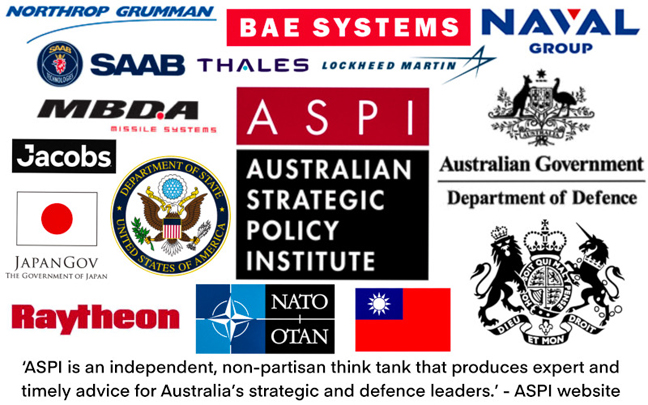
Steele-John, the Australian senator, called Richardson and other American consultants “inherently biased” and said they were primarily representing U.S., not Australian, interests
In its quest to build nuclear-powered submarines, the government of Australia recently hired a little-known, one-person consulting firm from Virginia: Briny Deep.
Briny Deep, based in Alexandria, Va., received a $210,000 part-time contract in late November to advise Australian defense officials during their negotiations to acquire top-secret nuclear submarine technology from the United States and Britain, according to Australian contracting documents. U.S. public records show the company is owned by John M. Richardson, a retired four-star U.S. admiral and career submariner who headed the U.S. Navy from 2015 to 2019.
Richardson, who declined to comment, is the latest former U.S. Navy leader to cash in on the nuclear talks by working as a high-dollar consultant for the Australian government, a pattern that was revealed in a Washington Post investigation last year. His case brings to a dozen the number of retired officers and former civilian leaders from the U.S. Navy whom Australia has employed as advisers since the nuclear talks began in September 2021, documents show.
The former U.S. Navy officials are profiting from a web of sources with sometimes divergent interests. One retired U.S. admiral charges $4,000 per day to consult for the Australian government while simultaneously advising other foreign defense clients and collecting his U.S. military pension, according to records obtained by The Post under the Freedom of Information Act (FOIA).
The overlapping arrangements cast doubt on whether the U.S. consultants can provide impartial advice and raise questions about whose interests they are representing, said Jordon Steele-John, a member of the Australian Senate whose Green Party opposes the nuclear talks and has been critical of the government’s dependence on American advisers. “If you’re on the payroll of a foreign government, your advice is by definition not independent,” he said.
Under federal law, retired U.S. military personnel must obtain approval from the Pentagon and the State Department before they can accept money or jobs from foreign powers that could compromise their sworn allegiance to the United States. The law applies to retirees — generally those who served at least 20 years in uniform — because they receive a U.S. pension and can be recalled to active duty……………………………………………………………..
Vice Adm. Jonathan Mead, (above) the chief of Australia’s nuclear-powered submarine task force, told an Australian parliamentary committee last month that Richardson had been hired to provide guidance “on stewardship — that is, how to safely and securely manage nuclear technology” and on the training of naval personnel. “When we have specific tasks, questions or complex problems which come our way that we don’t have the subject matter expertise for, we reach in for his assistance,” Mead said during a Feb. 15 hearing.
……………………………….. Since his retirement from active duty, Richardson also has served on the board of directors for major companies in the defense and nuclear sectors, including Boeing, Constellation Energy and BWX Technologies. In 2021, he received more than $900,000 in compensation for his services on corporate boards, records show, plus a six-figure U.S. military pension.
……… “We’ve been very careful to make sure his advice is very specific to the questions that remain within the guidelines,” Mead said.
Steele-John, the Australian senator, called Richardson and other American consultants “inherently biased” and said they were primarily representing U.S., not Australian, interests. “Our government has been paying them handsomely for their advice,” he said. But he added that the arrangement “calls into question” any collaboration between Australia and the United States on military matters.
……………………………. One of the most prominent former officers is retired Vice Adm. William Hilarides, a career submariner who commanded the U.S. Naval Sea Systems Command until 2016. Since then, he has received consulting contracts from the Australian government worth $1.3 million, according to Australian defense officials.
He charges $4,000 per day for his consulting services, according to documents that the U.S. Navy recently released in response to The Post’s FOIA lawsuits. He has also worked for Fincantieri Marine Group, a Wisconsin shipyard company that is majority owned by the government of Italy. He did not respond to an email seeking comment.
Koeberg Thin Walled Holtec Nuclear Waste Canister In S. Africa Leaked After 17 Years, More Holtec Canister Problems That Threaten Massive Radiological Releases, Explosion & Criticality Risks From Holtec Canisters, Potential Canister Problem At Diabalo Canyon After 2 Years.
List of other thin walled nuclear canisters vendors who threaten life on Earth listed at https://sanonofresafety.org in addition to Holtec. Where is the media? The vaunted “free press”?
In his farewell address, Dwight D. Eisenhower warned of the “military-industrial-congressional complex” where one hand fed the other in a vicious cycle of self-aggrandizement at public expense. Of the expenses paid since 1960, none has been dearer than the habitable climate of Earth.
………………………………………………………………………. Direct Air Capture, Small Modular Reactors, and Fusion Energy — all are pwnings of solar by the National Laboratories, set in motion by Edward Teller.
National Labs make some sense if you are trying to solve some gargantuan problem that humanity faces — it would be good to have one for climate change, for instance — but today they mainly exist to keep engineers and physicists fully employed.
It is easy for the labs to lobby their funders, ultimately taxpayers, for ungodly sums for national security reasons, to prevent a brain drain, to advance basic science — even if the work being proposed is not only useless but mindlessly destructive, as long as it costs a lot and employs millions of little Edward Tellers. It will be good for the economy and will advance the cause of democracy, right?
History Rhymes
Edward Teller is commonly thought of as the “father of the hydrogen bomb” although he did not like the sobriquet. Born in Hungary in 1908, Teller came to the United States in the 1930s as one of the many so-called “Martians”, physicists being rescued from Europe to join what would become the Manhattan Project that developed the first atomic bomb. After the war, having successfully pwned his rival, Robert Oppenheimer, as a pinko, Teller co-founded the Lawrence Livermore National Laboratory, and was its director for many years. He was author of the Red Scare, the Cold War expansion of nuclear arsenals, the Reagan “Star Wars” Strategic Defense Initiative, posthumously the Trump Space Force, and some hare-brained plans that thankfully never came to fruition, such as nuclear-powered airplanes and a plan to excavate an artificial harbor in Alaska using H-bombs.
In a recent Pugwash podcast, Professor Frank von Hippel, Co-Director of the Science and Global Security program at Princeton, explained how Teller was so masterful at pwning presidents and secretaries of Energy and Defense. In the 1990’s, von Hippel was an advisor to President Clinton, and later Obama. In the ’80s, he advised Gorbachev on how to wind down the Soviet nuclear threat. He reveals that Reagan and Gorbachev had agreed, mano a mano at the Reykjavik summit, to eliminate nuclear weapons from the face of the Earth only to have Reagan backpedal when the weapons labs balked. Reagan was pwned. Von Hippel tells how it later went during the Clinton years:
… the emphasis has been on energy but the research really was done for nuclear weapons design purposes … and the issue was a Nuclear Weapons Test Ban and where the weapons lab directors were insisting that they needed to do 15 more tests… there were reasons of safety or reliability that required them.
And the labs presented the tests that they wanted to do in this meeting that was called by the Secretary of Energy [Hazel Henderson] and I was not convinced so I brought along a retired weapons designer who was also not convinced. And it turns out the Secretary of Energy wasn’t convinced either.
And one of them [the directors] said, well if you would give us as much money for not testing as you’ve been giving us for testing we might be able to see it your way. And so that was the beginning of the science-based stockpile stewardship program and it was basically the budgets — some billions of dollars a year — that were offered to the weapons labs basically to do what they wanted.
This month’s issue of Wired magazine gushes over one outcome:
In December 2022 — a solid century since physicists first identified fusion as the source of star power — American scientists at the National Ignition Facility in Livermore, California, where ignition is a way of life, had a breakthrough – [much touted laser fusion experiment]…………………………………
……………………………………. they’ve been trying to ignite these little pellets for decades now and they finally got to the point where [for 80 nanoseconds] they got as much energy out of of the pellet from fusion energy as they put into it from laser energy and that was a breakthrough.
To get to a power plant is an enormous, enormous extrapolation. You’d have to do this many times a second — hundreds of times a second. You’d have to have affordable lasers that would do this repeatedly many hundreds of times a second and in the end, whether that would compete with other sources of energy is a stretch. Even a very simple nuclear power plant can’t compete with solar and wind power anymore, so whether this extravagant contraption could is extremely unlikely.
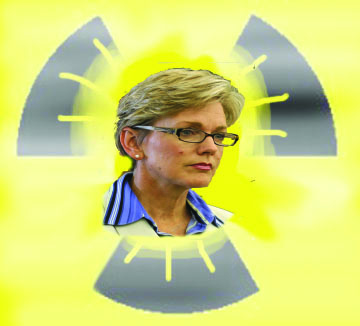
I watched the press conference where US Energy Secretary Jennifer Granholm [above] took to the stage and announced this world-changing breakthrough with visions of unlimited energy that would have no climate consequences. I could barely fathom how people could be so gullible as to believe it. Even when one of the lab directors got up and said that the breakthrough would really help their weapons research, apparently no-one saw through the ruse. Astonishing.
Wired’s head exploded in technocornucopian orgasm:
Fusion will, of course, rescue the environment and decarbonize planet Earth in a cool afternoon.………………………..
That 80-nanosecond burst was estimated to have cost $3.5 billion, which is likely an underestimate. It resulted in nuclear waste — principally tritium, which will linger for some 240 years as a lethal isotope. Gordon Edwards, President of Canadian Coalition for Nuclear Responsibility, replied to von Hippel that:
I think we have been we have been manipulated and a lot of people fell for it because you don’t think that the Secretary of Energy is going to go on public airwaves and simply give a false account of what actually happened. And that’s what we’re seeing. I think that the the scramble for money for fusion research, and even for fission research in terms of small modular reactors, is impelling people to misrepresent their product as a way of of getting governments to invest in it and the public to support it.
………………………………………………………. Rather than disguising a fundamentally military project like the Lawrence Lawrence Livermore Lab experiment as a peaceful energy thing when in fact it’s a military maintenance project, we have to restart the debate over nuclear weapons policy.
And thus we all drift, pwned like Granholm, stocked to the gills with horrific weaponry and new threats to unleash it out of MRGA (Make Russia Great Again) rage. Every new reactor built is both a bomb component factory and a wartime target. It makes plutonium. We gave up a critical 50 years chasing the peaceful atom myth — unlimited energy that’s safe, clean, too cheap to meter — when we could have had cheap, safe, clean renewable energy with no explosive potential and a tamer climate all that time. Maybe it is time we stop listening to Edward Teller’s ghost and listened to Justin Trudeau’s dad, Maybe it’s time we did something different for a change. https://medium.com/the-shadow/jennifer-granholm-was-pwned-301c2a3c657a








 nuclear-news