Putin Still Selling U.S. Nearly $1 Billion in Nuclear Fuel
NewsWeek, BY ANNA SKINNER ON 5/11/23
The United States has done a thorough job of sanctioning Russia, but it still relies on the nation for one key resource.
The U.S. and other Western nations were quick to sanction Russia after Russian President Vladimir Putin ordered an invasion of Ukraine in February 2022. Western allies joined forces in sanctioning resources like Russian oil and gas to deprive the Kremlin of financial gain amid funneling money into its war against Ukraine. International companies located in Russia also were quick to leave, further damaging the Russian economy, but Russia still maintains a firm grasp on a horde of something that many other countries want: nuclear fuel.
Nuclear energy, which generates power through a process of splitting uranium atoms, has evaded sanctions more than a year into the war. Enriching uranium is a highly specialized process that can only be done in certain countries, such as Russia. Russia has some of the world’s largest uranium supplies, and it also excels in the necessary process of converting it to enriched uranium, which then can be used as nuclear fuel. Commercial plants converting uranium operate in Russia, Canada, China and France, with Russia having the most infrastructure needed for the conversion……………..
Because of this, Rosatom State Nuclear Energy Corporation—Russia’s collection of nuclear suppliers—provides a quarter of the U.S.’s nuclear fuel, and the United States continues to pay for the resource, spending a collective $1 billion last year, according to a report by the Wall Street Journal.
………………. In March, the U.S.’s first nuclear reactor in seven years started nuclear reactions in Georgia. CNBC reported that including the new reactor, there are 93 reactors throughout the United States providing a fifth of the nation’s energy. A quarter of the nuclear resources needed to power that energy is sourced from Rosatom.
U.S. companies are paying steeply for the resources needed to power its reactors, which means it is funding both Russia and Ukraine during the war….. https://www.newsweek.com/putin-selling-us-nearly-billion-dollars-nuclear-fuel-1799788
Pentagon wants authority to start work on new technologies without Congressional approval
Jared Serbu @jserbuWFED, May 8, 2023
Over the last several years, Congress has passed several pieces of legislation meant to speed up the Defense Department’s acquisition system. Now, DoD officials have an idea of their own: they’re asking for new authorities that would let the military services begin early work on critical new programs without lawmakers’ explicit permission, arguing the current approval process takes too long and risks putting the U.S. military at a technological disadvantage.
………………………………….. If Congress agrees to the proposal as part of next year’s Defense authorization bill, DoD would be able to spend up to $300 million on new programs without getting Congressional approval: lawmakers would only be notified about a new start after a decision has been made………………………. https://federalnewsnetwork.com/defense-news/2023/05/pentagon-wants-authority-to-start-work-on-new-technologies-without-congressional-approval/
Regulator issues permit for New Mexico nuclear waste facility against wishes of local, state, and federal leaders
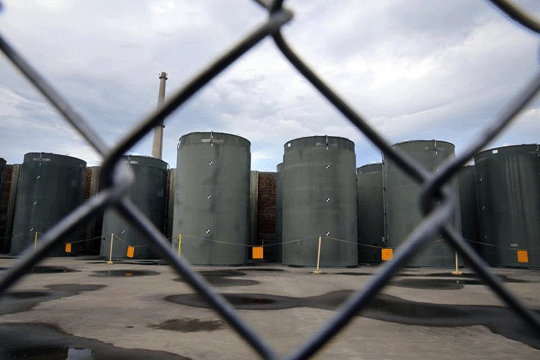
By Simon Druker, https://www.upi.com/Top_News/US/2023/05/09/3631683671382/
May 9 (UPI) — The agency that governs nuclear power in the United States issued a permit Tuesday to build a facility to store nuclear waste in New Mexico.
The Nuclear Regulatory Commission permit goes against the wishes of both state and federal elected officials.
“I have been strongly opposed to the interim storage of spent nuclear fuel and high-level waste in New Mexico, which would pose serious risks to our communities. But today’s announcement paves the way for New Mexico to be home for indefinite storage of spent nuclear fuel,” Sen. Ben Ray Lujan D-N.M., told The Hill in a statement.
“This approach — over the objections of many local, state, and federal leaders — is unacceptable,” he said.
Gov. Michelle Lujan Grisham, D-N.M., in March signed legislation prohibiting the facility from being built by Florida-based Holtec International.
It’s not clear what effect her law would have on the NRC’s federal permit.
Lujan Grisham called on President Joe Biden to intervene.
The NRC permit grants Holtec the right to build the consolidated interim storage facility for spent nuclear fuel in the state’s Lea County. The company can store 500 canisters, or approximately 8,680 metric tons, of spent nuclear fuel for 40 years.
Holtec said it plans to eventually apply for amended licenses in order to eventually store up to 10,000 canisters or approximately 173,600 metric tons over an additional 19 phases.
The company was founded in 1986 in New Jersey and specializes in manufacturing parts for nuclear reactors. It also offers existing nuclear waste storage services.
Despite having the permit, Holtec is not fully committed to moving ahead with the project.
“We’re still working with our partners and the key stakeholders to understand what our paths are … what our potential options are. Then we’re going to head forward from that,” the company’s director of government affairs and communications Patrick O’Brien told the Albuquerque Journal in an interview Tuesday.
Robert Kennedy Jr: America needs a revolution
The 2024 outsider on Biden, Ukraine and Covid misinformation, more https://unherd.com/thepost/robert-kennedy-jr-america-needs-a-revolution/ 4 May 23
For decades, as a scion of the Kennedy family and environmental litigator, Robert F. Kennedy Jr was considered an establishment hero. In recent years, however, his rhetoric against Covid lockdowns and vaccines sealed his reputation among most commentators as irresponsible and potentially dangerous. So, since he announced that he was running for president two weeks ago, challenging Joe Biden for the Democratic nomination, he has presented the establishment media with something of a conundrum. He is already polling at 20% — should he be ignored or interrogated?
UnHerd‘s Freddie Sayers invited RFK Jr. to the studio to discuss his campaign promises and get behind the controversies.
US nuclear companies urge Congress for $billions, as Russia’s nuclear industry profits from both sides of the Ukraine war

U.S. companies collectively sent almost $1 billion last year to Rosatom.
“That’s money that’s going right into the defense complex in Russia,”
“We’re funding both sides of the war.”
The West Needs Russia to Power Its Nuclear Comeback. WSJ 10 May 23
U.S., Europe add reactors but still heavily dependent on Moscow for crucial ingredients to produce fuel
Nuclear power in the West is having a long-awaited revival, with new reactors opening in the U.S. and Europe and fresh momentum toward building more soon.
A gaping hole in the plan: The West doesn’t have enough nuclear fuel—and lacks the capacity to swiftly ramp up production. Even more vexing, the biggest source of critical ingredients is Russia and its state monopoly, Rosatom, which is implicated in supporting the war in Ukraine………….
Nuclear power supplies nearly 20% of U.S. electricity, and roughly 25% of European electricity, but in recent decades has struggled to gain traction in most of the West as a green alternative to fossil fuels, for reasons ranging from cost to waste disposal and an erosion of expertise in building reactors.
Pockets of stiff resistance remain: Germany closed its last reactors in April, in a phaseout that began more than a decade ago………………………….
A recent Gallup poll found that Americans are more supportive of the technology than at any point in the past decade…………………………………..
Westinghouse, a storied pioneer of electric power, has struggled in the nuclear sector and repeatedly changed hands amid market swings and tighter industry regulation after the reactor accidents at Three Mile Island, Chernobyl and Fukushima.
A group including private-equity firm Brookfield Asset Management bought Westinghouse for almost $8 billion in October, in a move billed as a bet on nuclear power’s resurgence.
Westinghouse said this month that it next plans to launch a line of smaller reactors that could cost as little as $1 billion each.
Despite the industry’s progress, the dependence on Russian enriched uranium for nuclear fuel has proven intractable.
Nuclear fuel is one of the few Russian energy sources not banned by the West as a result of the war in Ukraine. The reason is rooted in a program from the early 1990s, soon after the Cold War ended, aimed at shrinking the threat of Soviet nuclear warheads falling into the wrong hands.
Under the 1993 deal, the brainchild of a Massachusetts Institute of Technology researcher named Thomas Neff and dubbed Megatons to Megawatts, the U.S. bought 500 metric tons of highly enriched uranium, enough for 20,000 warheads, and had it converted into reactor fuel.
Arms-control advocates hailed it as a win-win: Moscow got urgently needed cash, Washington reduced its proliferation headache and U.S. utilities got inexpensive fuel. It remains one of the world’s most successful nuclear-disarmament programs.
The deal “did what was promised,” Dr. Neff said in an interview. “We have many fewer nuclear weapons and stuff to make them out of than we did.”
The problem, critics said, was that the deal delivered Russian nuclear fuel so cheaply that rival suppliers struggled to compete. Before long, U.S. and European companies were scaling back and Russia was the world’s biggest supplier of enriched uranium, with nearly half of global capacity.
Before the deal ended in 2013, Russian suppliers, now organized as Rosatom, signed a new contract with the U.S. private sector to provide commercial fuel beyond the government-to-government program. Rosatom still supplies as much as one-fourth of U.S. nuclear fuel.
U.S. companies collectively sent almost $1 billion last year to Rosatom, according to a recent analysis from Darya Dolzikova at the Royal United Services Institute in London.
“That’s money that’s going right into the defense complex in Russia,” said Scott Melbye, executive vice president of uranium miner Uranium Energy and president of the Uranium Producers of America, an industry group. “We’re funding both sides of the war.”
Rosatom was formed by Russian President Vladimir Putin in 2007 from various parts of the country’s nuclear-power industry and is closely controlled by the Kremlin. Its top managers have been deeply involved in running Ukraine’s Zaporizhzhia nuclear-power plant, Europe’s largest………………….
A proposed new generation of reactors, which proponents and investors including Microsoft founder Bill Gates are touting as less risky and more environmentally friendly than current reactor designs, requires a special type of fuel that is the nuclear equivalent of high-octane gasoline.
The only source of that fuel today is Rosatom.
……………………….. The multinational Urenco owns one of only two uranium-processing facilities in the U.S., in Eunice, N.M., just across the Texas border. The company says it is spending roughly $200 million on new capacity and can invest much more if Russian uranium is sanctioned.
The catch: It wants government guarantees on quantities allowed in the market.
Urenco’s fear, said Kirk Schnoebelen, head of U.S. sales, is that in several years low-price Russian enriched uranium might swamp world markets, tanking prices……….
But because of the Megatons deal, “the business case for that project was utterly destroyed,” Today that history “absolutely” informs the U.S. nuclear industry’s thinking and makes corporate boards reluctant to invest the necessary billions…..
Westinghouse’s Mr. Fragman said the legislation is long overdue……… https://www.wsj.com/articles/nuclear-power-makes-a-comeback-underpinned-by-russian-uranium-24ed8e12
Microsoft just made a huge, far-from-certain bet on nuclear fusion

Microsoft just made a huge, far-from-certain bet on nuclear fusion, The Verge 10 May 23,
Microsoft just signed a jaw-dropping agreement to purchase electricity from a nuclear fusion generator. Nuclear fusion, often called the Holy Grail of energy, is a potentially limitless source of clean energy that scientists have been chasing for the better part of a century.
A company called Helion Energy thinks it can deliver that Holy Grail to Microsoft by 2028. It announced a power purchase agreement with Microsoft this morning that would see it plug in the world’s first commercial fusion generator to a power grid in Washington. The goal is to generate at least 50 megawatts of power — a small but significant amount and more than the 42MW that the US’s first two offshore wind farms have the capacity to generate today.
To say that’s a tall order would be the understatement of the year. “I would say it’s the most audacious thing I’ve ever heard,” says University of Chicago theoretical physicist Robert Rosner. “In these kinds of issues, I will never say never. But it would be astonishing if they succeed.”
Experts’ optimistic estimates for when the world might see its first nuclear fusion power plant have ranged from the end of the decade to several decades from now.
Helion’s success depends on achieving remarkable breakthroughs in an incredibly short span of time and then commercializing its technology to make it cost-competitive with other energy sources. Nevertheless, Helion is unfazed.
“This is a binding agreement that has financial penalties if we can’t build a fusion system,” Helion founder and CEO David Kirtley tells The Verge. “We’ve committed to be able to build a system and sell it commercially to [Microsoft].”……………………………………
The most advanced attempts at generating electricity through nuclear fusion involve shooting powerful laser beams at a tiny target or relying on magnetic fields to confine superheated matter called plasma with a machine called a tokamak.
Helion uses neither of those methods. The company is developing a 40-foot device called a plasma accelerator that heats fuel to 100 million degrees Celsius. It heats deuterium (an isotope of hydrogen) and helium-3 into a plasma and then uses pulsed magnetic fields to compress the plasma until fusion happens. (The company has a Youtube video that illustrates the process in much more detail.
Helion claims that the machine should eventually be able to recapture the electricity used to trigger the reaction, which can be used to recharge the device’s magnets.
Figuring out how to be energy efficient is crucial to make fusion power a reality. After all, you need extreme heat and pressure to force atoms to fuse together. ………………
Assuming Helion can pull this all off, it still has to ensure that it can do so in an affordable way. The cost of the electricity it generates for consumers would need to be comparable to or cheaper than today’s power plants, solar, and wind farms. The company isn’t sharing what price it agreed to in its power purchase agreement with Microsoft, but Kirtley says the company’s goal is to one day get costs down to a cent a kilowatt hour.
……………………as has been the case with dreams of nuclear fusion for decades — we’ll have to wait and see. https://www.theverge.com/2023/5/10/23717332/microsoft-nuclear-fusion-power-plant-helion-purchase-agreement
New Mexico State law and multiple federal court challenges may yet block the Holtec nuclear waste project.

State Laws Could Block CISF Projects
Multiple lawsuits in federal appeals courts and state laws opposing storage and disposal of irradiated nuclear fuel in both New Mexico and Texas could upend both nuclear waste CISF schemes.
Beyond Nuclear , LEA COUNTY, NEW MEXICO and WASHINGTON, D.C., May 9, 2023 —
Today, the Nuclear Regulatory Commission (NRC) announced it approved licensing for Holtec International’s controversial consolidated interim storage facility (CISF) in southeastern New Mexico’s Lea County, not far from the Texas border. The facility is designed to store high-level radioactive waste from nuclear power plants across the U.S. But NRC approval notwithstanding, a recently enacted New Mexico State law and multiple federal court challenges may yet block the project
…………….. Holtec now seeks to branch out into consolidated storage and its associated high-level radioactive waste transportation. On the New Mexico CISF scheme it partnered with the Eddy-Lea Energy Alliance (ELEA), a quasi-governmental entity comprised of Eddy and Lea Counties (which border one another), as well as their county seats of Carlsbad and Hobbs, New Mexico. ELEA owns the targeted nuclear waste CISF site’s land surface, and would take a large cut of the proceeds.
Giant Capacity May Signal Storing Foreign and Military Nuclear Waste
The Holtec-ELEA nuclear waste CISF would store up to 173,600 metric tons of highly radioactive irradiated fuel (often euphemistically called “spent” nuclear fuel or SNF, despite the fact it is highly radioactive and lethal), as well as Greater-Than-Class-C (GTCC) radioactive waste from commercial nuclear reactors. The facility would hold up to 10,000 canisters of nuclear waste, inserted into pits in a platform which sits on the surface. Part of the canisters would stay above the natural land surface.
“If opened, the site could become home to the biggest concentration of radioactive waste in the world,” reported Diane D’Arrigo, Radioactive Waste Project Director at Nuclear Information and Resource Service.
The Holtec-ELEA CISF’s nuclear waste storage capacity would be in addition to another planned CISF some 40 miles to the east in Andrews County, Texas. If built, it would be able to store 40,000 metric tons of irradiated fuel and GTCC in above-ground dry casks. The Texas facility, proposed by Interim Storage Partners, LLC (ISP), was granted construction and operation license approval by the Nuclear Regulatory Commission on September 13, 2021.
Since the entire SNF inventory at U.S. commercial reactors is just over 90,000 metric tons, experts have questioned why the Texas and New Mexico facilities would need a combined capacity of 213,600 metric tons, and whether the projects may be aiming to store nuclear waste from abroad and/or from the military.
There is precedent for shipping irradiated fuel from other countries to the U.S. for storage at Idaho National Labs. And in 2018, a test shipment of a mock SNF cask was transported from Europe to Colorado. Lead ISP partner Orano (formerly Areva) of France services the largest nuclear power reactor fleet of any single company in the western world. It lacks facilities in France to permanently dispose of the country’s own waste.
The consortium backing the ISP facility includes Waste Control Specialists, LLC (WCS), a national dump for so-called “low-level” radioactive waste, located immediately adjacent to (and upstream of) the New Mexico border. WCS loudly proclaims its ties to the U.S. military, which needs to dispose of its own highly radioactive wastes.
Nuclear Waste Transport Dangers
Opening a CISF in the U.S. would trigger many thousands of shipments of domestic irradiated fuel across many of the Lower 48 states, through a large percentage of U.S. congressional districts. SNF canisters and transport casks are subject to so-called “routine” radiation emissions, as well as leakage and other failures, which would pose threats to thousands of communities along the transportation routes.
“Transporting highly radioactive waste is inherently high-risk,” said Kevin Kamps, Radioactive Waste Specialist with Beyond Nuclear. “Fully loaded irradiated nuclear fuel containers would be among the very heaviest loads on the roads, rails, and waterways. They would test the structural integrity of badly degraded rails, for example, risking derailments. Even if our nation’s infrastructure gets renovated someday, the shipping containers themselves will remain vulnerable to severe accidents and terrorist attacks.
They could release catastrophic amounts of hazardous radioactivity, possibly in densely populated urban areas.”
“Even so-called ‘incident-free’ shipments are like mobile X-ray machines that can’t be turned off, in terms of the hazardous emissions of gamma and neutron radiation, dosing innocent passersby, as well as transport workers,” Kamps added.
Kamps’ February 24 letter to U.S. Transportation Secretary Pete Buttigieg, cc’d to governors and state Attorneys General across the U.S., warned of the dangers of transporting high-level radioactive waste. “The recent train wreck at East Palestine, Ohio demonstrates the urgency of the problem and the potential for a serious radiological accident from nuclear waste transport,” he wrote. “Environmental toxicologists have expressed deep concern that detection and response to release of hazardous chemicals in East Palestine were ineffective and untransparent and failed to protect public health and safety. But if the train that derailed had been carrying SNF or other highly radioactive wastes, the consequences would have been much worse.”
The Nuclear Waste Technical Review Board has recommended spending a minimum of a decade to develop better irradiated nuclear fuel cask and canister designs before attempting to transport highly radioactive wastes. Yet Holtec and ISP expect their nuclear waste CISFs to open and start accepting shipments in just the next few years.
State Laws Could Block CISF Projects
Multiple lawsuits in federal appeals courts and state laws opposing storage and disposal of irradiated nuclear fuel in both New Mexico and Texas could upend both nuclear waste CISF schemes.
Siting nuclear facilities is supposed to be consent-based, but both Texas and New Mexico have made it abundantly clear they do not consent. In advance of the NRC licensing the ISP facility in September 2021, the Texas legislature overwhelmingly approved a bill banning storage or disposal of high-level radioactive waste including SNF in the state, and directing the Texas Commission on Environmental Quality to deny state permits the ISP project needs. The measure passed the Texas Senate unanimously, and passed the Texas House 119-3. Texas Governor Greg Abbott then signed the bill into law.
“This kind of bipartisan vote is very rare”, said Karen Hadden, Executive Director of the Sustainable Energy and Economic Development (SEED) Coalition based in Austin, TX. “The message should be loud and clear: Texas doesn’t want the nation’s deadliest nuclear waste and does not consent to being a dumping ground.”
In the runup to the Legislature passing the law, opposition to the ISP project in Texas was widespread and vocal. Abbott and a bipartisan group of U.S. Congressional Representatives from Texas wrote strong letters to the NRC opposing the project. Andrews County, five other counties and three cities, representing a total of 5.4 million
Texans, passed resolutions opposing importing nuclear waste from other states to Texas. School districts, the Midland Chamber of Commerce and oil and gas companies joined environmental and faith-based groups in opposing the ISP project. The City of Fort Worth, Texas submitted a Friend of the Court brief supporting appeals against ISP in the U.S. Court of Appeals for the District of Columbia Circuit.
Strenuous opposition to nuclear waste CISFs is also widespread in New Mexico. The state recently enacted Senate Bill 53 (SB53) barring storage and disposal of highly radioactive wastes in New Mexico without its explicit consent. New Mexico Governor Michelle Lujan Grisham signed SB53 into law on March 17, 2023, immediately after it had passed both houses of the State Legislature. Grisham has strongly objected to both nuclear waste CISFs on either side of New Mexico’s southeastern border since before she became governor in 2019.
“I am thankful that the New Mexico Legislature voted to stop this dangerous nuclear waste from coming to our state, and for Governor Grisham for signing it into law,” said Rose Gardner of Eunice, New Mexico, co-founder of the environmental justice watchdog group Alliance for Environmental Strategies. Gardner’s hometown is very close to the ISP project site in Texas, as well as to the Waste Control Specialists, LLC (WCS) national dump for hazardous and so-called “low-level” radioactive waste. Every single one of thousands of rail shipments of highly radioactive waste bound for the ISP CISF would pass through Eunice.
These lawsuits argue that nuclear waste CISFs violate federal law. Consolidated interim storage facilities are predicated on the assumption that the U.S. Department of Energy (DOE) will enable SNF transportation by taking title to commercial reactor waste as it leaves the reactor sites, thus relieving the licensees of their liability for it. But transferring responsibility for highly radioactive nuclear waste from private businesses to the federal government is specifically prohibited by the Nuclear Waste Policy Act of 1982, as Amended (NWPA) — unless and until a geologic repository is open and operating. By DOE’s own admission, an operating geologic repository remains at least 25 years away.
The prohibition against DOE taking title to commercial reactor waste was included in the NWPA precisely to guard against “interim” storage sites becoming de facto permanent surface dumps for nuclear waste. But the Nuclear Regulatory Commission’s CISF licensing process was pushed ahead anyway in defiance of the law, on the theory the law will be changed by Congress and the President.
Participants in the legal challenge to the Holtec CISF include the Non-Governmental Organizations (NGOs) Beyond Nuclear, Sierra Club, and Don’t Waste Michigan, et al., a national grassroots coalition of watchdog groups, including the New Mexico-based anti-nuclear collective formerly called Nuclear Issues Study Group (recently renamed DNA, short for Demand Nuclear Abolition). Additional coalition members include: Citizens for Alternatives to Chemical Contamination (MI); Citizens’ Environmental Coalition (NY); Nuclear Energy Information Service (IL); and San Luis Obispo Mothers for Peace (CA). Federal appeals before the D.C. circuit court have also been filed by
Fasken Land and Minerals, Ltd., and Permian Basin Land and Royalty Owners, which advocate for ranching and mineral rights.
“The grand illusion that the nuclear power industry will figure out what to do with the lethal nuclear waste later, is now revealed,” said Michael J. Keegan of Don’t Waste Michigan, one of the lead intervenors in the lawsuits. “There is nowhere to put the waste. No community consents to accept nuclear waste — not Texas, not New Mexico, not Michigan, or anywhere on this planet. We have to stop making it. No more weapons of mass deception!”
US to Provide Ukraine $1.2 Billion in Long-Term Security Aid

Military.com 8 May 2023, Associated Press | By Lolita C. Baldor and Matthew Lee
WASHINGTON — The U.S. will provide $1.2 billion more in long-term military aid to Ukraine to further bolster its air defenses as Russia continues to pound Ukraine with drones, rockets and surface-to-air missiles, U.S. officials said Monday.
The aid package is expected to be announced on Tuesday and the money will be provided under the Ukraine Security Assistance Initiative. Unlike the U.S. equipment, weapons and ammunition that are more frequently sent to Ukraine from Pentagon stocks — so they can be delivered quickly — this money is to be spent over the coming months or even years to ensure Ukraine’s future security needs.
The assistance initiative will fund HAWK air-defense systems, air-defense munitions and drones for air defense. It will also buy artillery, rockets, satellite imagery assistance, and funding for ongoing maintenance and spare parts for a variety of systems, according to the officials. They spoke on condition of anonymity because the aid package has not yet been formally announced.
The assistance initiative will fund HAWK air-defense systems, air-defense munitions and drones for air defense. It will also buy artillery, rockets, satellite imagery assistance, and funding for ongoing maintenance and spare parts for a variety of systems, according to the officials. They spoke on condition of anonymity because the aid package has not yet been formally announced……………………………………………. https://www.military.com/daily-news/2023/05/08/us-provide-ukraine-12-billion-long-term-security-aid.html
US Politicians Suggest Bombing Taiwan Semiconductor Manufacturing Company (TSMC) in Event of Cross-Strait Conflict
US politicians have once again sparked debate by suggesting bombing Taiwan Semiconductor Manufacturing Company (TSMC) in the event of cross-strait conflict. During a recent Milken Institute forum discussion on China-US strategic competition, Democratic Congressman Seth Moulton stated, “China needs to know that if you invade Taiwan, we’ll blow up TSMC”. While participating in the same panel discussion, US House Foreign Affairs Committee Chairman Michael McCaul revealed that President Tsai Ing-wen had asked him about the status of her country’s weaponry during his visit to Taiwan in April.
This is not the first time that US politicians have suggested bombing TSMC. In 2019, former Vice President Joe Biden had mentioned that the US would have to come up with new ways to counter China’s cyber attacks and intellectual property theft, including striking at Chinese companies like TSMC. Republican Senator Tom Cotton also touched on the topic earlier in May this year when he stated that America’s military response should include targeting Chinese critical infrastructure such as TSMC and Huawei.
Moulton later clarified his stance, saying that it is not the best strategy but only an example. Nevertheless, his comment could bring Taiwan’s technology industry, particularly TSMC, into focus in the escalating tensions between the US and China over the issue of Taiwan. TSMC, a crucial supplier to US firms such as Apple and Qualcomm, has seen its stock fall repeatedly this week following his comment.
Experts have pointed out that bombing TSMC would not only anger China but also cause significant harm to Taiwan’s economy. TSMC accounts for nearly half of the world’s chip production and is a critical part of Taiwan’s technology industry. The threats against it have highlighted how Taiwan, which relies heavily on the US for support, can be caught in the middle of tensions between the superpowers.
The crazy plan to explode a nuclear bomb on the Moon

BBC the next giant leap, 3 May 23
In the 1950s, with the USSR seemingly sprinting ahead in the space race, US scientists hatched a bizarre plan – nuking the surface of the Moon to frighten the Soviets.
…………………………….. At first reading, the title of the research paper – A Study of Lunar Research Flights, Vol 1 – sounds blandly bureaucratic and peaceful. The kind of paper easy to ignore. And that was probably the point.
Glance at the cover, however, and things look a little different.
Emblazoned in the centre is a shield depicting an atom, a nuclear bomb, and a mushroom cloud – the emblem of the Air Force Special Weapons Center at Kirtland Air Force Base, New Mexico, which played a key role in the development and testing of nuclear weapons.
Down at the bottom is the author’s name: L Reiffel, or Leonard Reiffel, one of America’s leading nuclear physicists. He worked with Enrico Fermi, the creator of the world’s first nuclear reactor who is known as the “architect of the nuclear bomb“.
Project A119, as it was known, was a top-secret proposal to detonate a hydrogen bomb on the Moon. Hydrogen bombs were vastly more destructive than the atomic bomb dropped on Hiroshima in 1945, and the latest in nuclear weapon design at the time. Asked to “fast track” the project by senior officers in the Air Force, Reiffel produced many reports between May 1958 and January 1959 on the feasibility of the plan……………………
While it might have helped to answer some rudimentary scientific questions about the Moon, Project A119’s primary purpose was as a show of force. The bomb would explode on the appropriately named Terminator Line – the border between the light and dark side of the Moon – to create a bright flash of light that anyone, but particularly anyone in the Kremlin, could see with the naked eye. The absence of an atmosphere meant there wouldn’t be a mushroom cloud.
There is only one convincing explanation for proposing such a horrendous plan – and the motivation for it lies somewhere between insecurity and desperation.
In the 1950s, it didn’t look like America was winning the Cold War. Political and popular opinion in the United States held that the Soviet Union was ahead in the growth of its nuclear arsenal, particularly in the development, and number, of nuclear bombers (“the bomber gap”) and nuclear missiles (“the missile gap”).
In 1952, the US had exploded the first hydrogen bomb. Three years later the Soviets shocked Washington by exploding their own. In 1957 they went one better, stealing a lead in the space race with the launch of Sputnik 1, the first artificial satellite in orbit around the world.
t didn’t help American nerves that Sputnik was launched on top of a Soviet intercontinental ballistic missile – albeit a modified one – nor that the US’s own attempt to launch an “artificial moon” ended in a huge, fiery explosion. The inferno that consumed their Vanguard rocket was captured on film and shown around the world. A British newsreel at the time was brutal: “THE VANGUARD FAILS…a big setback indeed…in the realm of prestige and propaganda…”
All the while, US schoolchildren were being shown the famous “Duck and Cover” information film, in which Bert the animated turtle helps teach children what to do in the event of a nuclear attack.
Later that same year, US newspapers citing a senior intelligence source reported that “Soviets to H-Bomb Moon On Revolution Anniversary Nov 7” (The Daily Times, New Philadelphia, Ohio) and then followed it up with reports that the Soviets might already be planning to launch a nuclear-armed rocket at our nearest neighbour.
Like with other Cold War rumours, its origins are hard to fathom…………………………………………………..
“Project A119 reminds me of the segment in The Simpsons when Lisa sees Nelson’s ‘Nuke the Whales’ poster on his wall,” says Bleddyn Bowen, an expert in international relations in outer space. “And he says, ‘Well you’ve got to nuke something.’
…………………………………. Most of the details of Project A119 are still shrouded in mystery. Many of the were apparently destroyed…. https://www.bbc.com/future/article/20230505-the-crazy-plan-to-explode-a-nuclear-bomb-on-the-moon
Vogtle-3 nuclear reactor flunked cybersecurity inspections, still at 0% power
The Vogtle-3 nuclear reactor in Georgia hasn’t even reached full power yet
(still at 0% as of yesterday morning) and it has already flunked a
cybersecurity inspection, with three violations, including issues with
procedure adherence and training.
Ed Lyman 6th May 2023
NRC 3rd May 2023
Power alert: Be wary of lifting moratorium on new Illinois nuclear plants

Advocates of ending the moratorium have said they want to make it possible to build small power nuclear power plants in the state.
Chicago Sun-TimesBy CST Editorial Board May 9, 2023
Illinois should move carefully before repealing its three-decade-old moratorium on new nuclear power plants.
On Tuesday, the House Senate Energy and Public Utilities Committee will discuss an amended version of a bill passed by the state Senate to lift the moratorium and allow “advanced nuclear reactors.” Advocates of ending the moratorium have said they want to make it possible to build small power nuclear power plants in the state, which would take advantage of new federal spending, although the technology to make that possible is years in the future. And it’s not clear how the “advanced nuclear reactors” in the bill would differ from small modular ones.
Meanwhile, Illinois still faces the problem that led to the moratorium in the first place: There is no long-term storage facility to store nuclear waste, which can go on emitting hazardous radiation for tens of thousands of years.
As envisioned, small modular nuclear power plants would have about a third of the generating capacity of traditional nuclear reactors. Their modular design would allow them to be factory assembled, saving money and allowing them to be constructed on sites too small for traditional reactors. U.S. Special Presidential Envoy for Climate John Kerry has said small modular reactors can be a tool to fight against climate change.
But some environmentalists and stakeholders are wary. “What’s really at play here is the attempt to resurrect the moribund and uneconomic nuclear industry,” said David Kraft, director of the Nuclear Energy Information Service, a nuclear watchdog. “But most fundamentally and important, we need an overhaul of the transmission grid, because you could have a million reactors or you could have a million wind turbines, but if you can’t connect power to the customer, they are worthless.”
…………………. small nuclear plants are a dubious answer. Will the nuclear waste they generate lead to vulnerable storage sites or risky transportation of spent fuel? Global energy prices are higher now, but if they go back down, will smaller reactors be in line for the subsidies larger ones got? Why focus on them when they won’t be built in time to meet the Intergovernmental Panel on Climate Change’s 2030 deadline to halve carbon emissions?
Illinois needs to focus on achieving its goal of transitioning to renewable energy. The state must ensure the idea of new nuclear plants does not divert it from that mission. https://chicago.suntimes.com/2023/5/8/23715796/small-modular-power-nucear-energy-reactors-moratorium-illinois-legislature-editorial
Cumulative risk and nuclear war

The precedent for nuclear confrontation is the Cuban Missile Crisis. Both sides settled for less than a win.
We will need a strong president to adjust to the current world reality, which will require us to back away from the forward containment strategy. Neither Joe Biden nor Donald Trump seem to be that type of president.
Lenconnect.com, James W. Pfister 7 May 23
A substantial nuclear strike against the United States would destroy cities and would result in untold deaths and misery. Yet, the United States’ foreign policy interferes with nuclear powers such as Russia in Ukraine and China in Taiwan. We don’t talk much about nuclear war, as if rational beings would never do such a thing. But who expects pure rationality into the unknown future? Humans will experience irrationality, mistakes and even pure evil, as we saw in 9/11.
My thesis is that even though there is a low probability of nuclear war at any given moment, a series of interactions in enmity with nuclear states leads to a cumulative risk over time, just as a dangerous driver will probably eventually experience a crash. We are on China’s and Russia’s borders, based on the old Cold War dynamics of containment. This is dangerous. We will need a strong president to adjust to the current world reality, which will require us to back away from the forward containment strategy. Neither Joe Biden nor Donald Trump seem to be that type of president.
………………………………… Arms control, which was a hope in the past to control nuclear weapons, seems to be weakened. Russia said it will not permit the inspections of the START Treaty. Any meaningful arms-control regime would require an agreement among China, Russia and the United States. Such agreement does not seem likely today.
What about a mistake, or cyber used by terrorists? There could be “faulty judgment, false warnings of attack, or other miscalculation … cyber attacks to disrupt the command and control of nuclear weapons and early warning systems … leaving governments only minutes to decide………………………..
There is no defense to a major nuclear attack. Recently, South Korean President Yoon Suk Yoel met with President Biden to assure that the United States will, in fact, use nuclear weapons against North Korea, even though the latter will have nuclear weapons that can reach the United States. Biden, in effect, said yes, we will risk an attack on Los Angeles, for instance. South Korea and Japan, which have begun to talk, should have their own nuclear deterrents.
The precedent for nuclear confrontation is the Cuban Missile Crisis. Both sides settled for less than a win. Instead of invading Cuba, as some advisers urged, President John F. Kennedy chose the more restrained blockade (“quarantine”). Chairman Nikita Khrushchev, realizing his gamble had failed, withdrew his missiles. Kennedy promised not to invade Cuba and to remove our offensive and provocative weapons from Turkey. Both leaders withdrew from the brink.
“Their prudence holds lessons for today, when so many commentators in Russia and in the West are calling for resolute victory of one side or the other in Ukraine.” (Sergey Radchenko and Vladislav Zubok, “Blundering on the Brink,” Foreign Affairs, April 3, 2023). Many around Putin say, “…Moscow should prefer nuclear Armageddon to defeat.” (Ibid.). Kennedy concluded: “…while defending our own vital interests, nuclear powers must avert those confrontations which bring an adversary to a choice of either a humiliating retreat or nuclear war.”
With the United States assertively involved in enmity with Russia and China, with NATO expansion, doing “saber-rattling” shows of force in Asia in military exercises, the chance of nuclear war increases with cumulative risk. …………
We need spheres of Influence among the three great nuclear powers, and prudence. The United States cannot aggressively be on their doorsteps without risking nuclear war. The United States must climb down from its unipolar role.
James W. Pfister, J.D. University of Toledo, Ph.D. University of Michigan (political science), retired after 46 years in the Political Science Department at Eastern Michigan University. He lives at Devils Lake and can be reached at jpfister@emich.edu. https://www.lenconnect.com/story/opinion/columns/2023/05/07/james-w-pfister-cumulative-risk-and-nuclear-war/70191242007/
West Hartford Preps For Hypothetical Nuclear Nightmare
The town is a host community for hypothetical evacuees living near a nuclear power plant in the state, with the largest drill ever planned.
Michael Lemanski, Patch Staff, May 7, 2023 https://patch.com/connecticut/westhartford/west-hartford-preps-nuclear-nightmare
—
Armageddon is not scheduled to break out in West Hartford on Saturday, May 13.
But it will only seem that way at Conard High School, where a faux nuclear disaster will play out that “fateful” day.
The West Hartford Fire Department and West Hartford Office of Emergency Management will conduct the largest, full-scale disaster drill in the town’s history.
As a result, residents are advised the parking lots at Conard High School, 110 Beechwood Road, will not be accessible during the drill hours of 7 a.m. to 3 p.m.
Town officials also warn that there will be a heavy presence of fire and police department personnel in the area.
“This is all part of the exercise,” wrote the town in an announcement last week.
The scenario for the drill is to activate West Hartford’s Emergency Shelter at Conard High School and be ready to receive and process residents of Montville and Waterford.
These “residents” were asked to evacuate due to an incident at the Millstone Nuclear Power Plant in Waterford.
West Hartford’s role is to scan evacuees and their vehicles and pets for hazardous particles and then provide assistance, counseling and placement services, if needed, according to the town.
The Federal Emergency Management Agency (FEMA) will be evaluating West Hartford’s readiness to serve as a “Host Community Reception Center” during this drill.
This exercise follows a practice drill held April 14 which allowed West Hartford to receive feedback in areas needing improvement.
The May 13 exercise involves about 150 staff, volunteers and role players from seven town departments and eight outside agencies.
Those agencies include the State Department of Emergency Management & Homeland Security, American Red Cross, Connecticut Department of Mental Health & Addiction Services, FEMA and Dominion Energy.
For more information on these exercises, email the West Hartford Office of Emergency Management at OEM@westhartfordct.gov.
For more information on the West Hartford Office of Emergency Management, click on this link.
1 This Month





PLEASE OPPOSE HR 8255 AND S.3639 – bills would accelerate satellite deployment, with no environmental review or safeguards – https://ncstd5li.quorum.us/campaign/169331/
To see nuclear-related stories in greater depth and intensity – go to https://nuclearinformation.wordpress.com
-
Archives
- October 2026 (74)
- September 2026 (339)
- August 2026 (330)
- July 2026 (355)
- June 2026 (287)
- May 2026 (306)
- April 2026 (356)
- March 2026 (251)
- February 2026 (267)
- January 2026 (308)
- December 2025 (358)
- November 2025 (359)
-
Categories
- 1
- 1 NUCLEAR ISSUES
- business and costs
- climate change
- culture and arts
- ENERGY
- environment
- health
- history
- indigenous issues
- Legal
- marketing of nuclear
- media
- opposition to nuclear
- PERSONAL STORIES
- politics
- politics international
- Religion and ethics
- safety
- secrets,lies and civil liberties
- spinbuster
- technology
- Uranium
- wastes
- weapons and war
- Women
- 2 WORLD
- ACTION
- AFRICA
- Atrocities
- AUSTRALIA
- Christina's notes
- Christina's themes
- culture and arts
- Events
- Fuk 2022
- Fuk 2023
- Fukushima 2017
- Fukushima 2018
- fukushima 2019
- Fukushima 2020
- Fukushima 2021
- general
- global warming
- Humour (God we need it)
- Nuclear
- RARE EARTHS
- Reference
- resources – print
- Resources -audiovicual
- Weekly Newsletter
- World
- World Nuclear
- YouTube
-
RSS
Entries RSS
Comments RSS

