The Hill, BY EDWIN LYMAN, OPINION CONTRIBUTOR – 07/25/23
Imagine a future where experimental nuclear reactors are scattered across the U.S. landscape like so many Starbucks, in densely populated and rural areas alike. Also, imagine they are allowed to operate without thoroughly reviewed and validated safety analyses, highly trained personnel at the controls, the protection of armed security officers, any provisions for off-site emergency planning and robust containment structures that would help prevent the release of highly hazardous radioactive materials if the worst happens.
This is the future that many in the nuclear industry, along with their vocal supporters, are working overtime to achieve.
The only bulwark against the most dangerous proposals is the Nuclear Regulatory Commission, the independent federal agency in charge of protecting the public from the radiological hazards of civil nuclear facilities. However, the NRC is facing a coordinated, massive push by the industry to drastically weaken its safety and security regulations and speed up the implementation of its back-to-the-1950s dystopian vision.
NRC critics blame the agency for the slow pace of new nuclear reactor licensing and construction in the U.S. But the NRC should not be scapegoated for the nuclear industry’s own failures. These include repeatedly missing cost and schedule targets for the Vogtle-3 reactor in Georgia, or supplying technically deficient, inadequate applications, such as Oklo’s attempt to apply for a license for a “micro” nuclear reactor, which the NRC justifiably rejected, and NuScale’s application for a standard design approval for its small modular reactor, which the NRC found contained numerous gaps.
The industry’s ire has focused on the NRC’s development of the “Part 53” rule for so-called risk-informed licensing of new reactors, which proponents argue are so much safer than the currently operating fleet that they need far less regulatory oversight across the board. But the fundamental problem is that many of these reactor designs,which introduce new safety and security risks,only exist on paper or have had extremely limited (and not necessarily relevant) real-world experience………………………………………………………………………………………………………………….
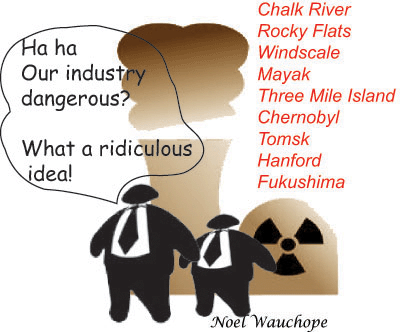
Some may ask why nuclear power still requires stringent regulation given that proponents claim it is already the safest form of energy. But although some nuclear supporters attempt to gaslight the public by playing down the massive health, environmental and economic impacts of the 1986 Chernobyl and 2011 Fukushima disasters, the fact remains that, unlike renewable energy technologies, nuclear power generates vast amounts of uniquely hazardous and long-lived radioactive materials as they operate. Not only are these substances highly carcinogenic, but evidence of their role in cardiovascular disease is growing.
Extending operations of the Diablo Canyon nuclear power plant through 2045 could cost California ratepayers as much as $45 billion, a new report has found.
The state’s biggest utility, Pacific Gas and Electric (PG&E), is currently in the process of seeking a license renewal that could enable the aging facility to run for another 20 years — with the widespread support of state legislators, but in opposition to environmental activists.
If the plant ends up staying online for two more decades, total costs to run the site could range from more than $20 billion to nearly $45 billion from 2023 through 2045, according to a new analysis from the Environmental Working Group (EWG).
“Keeping Diablo Canyon open past its closure date is a terrible idea for many reasons, including the staggering price tag that unwitting ratepayers will face for keeping the dilapidated and dangerous nuclear plant operating,” EWG President Ken Cook, who is also a Bay Area resident, said in a statement.
While PG&E in 2016 had announced plans to retire the site and decommission its two reactors when their licenses expire — in November 2024 and August 2025, respectively — California enacted legislation last fall seeking to extend operations until 2030.
About six months later, the federal Nuclear Regulatory Commission granted PG&E an exemption that enabled the plant to stay open under its current licenses while the agency considers renewal application — whose terms would apply for 20 years……………………………………
The EWG analysis — based in part on testimony filed by the Utility Reform Network, a consumer advocacy group — estimated that keeping the plant open would likely require hundreds of millions of dollars every year.
Because that cost would need to be passed on to the consumer, households could then expect an increase of between $55–124 per year on typical utility bills, according to the analysis.
“It’s clearly a high-cost, no-reward and puzzling scenario for California, given its decades-long leadership on the environment,” a statement from EWG said……………………………………..
The estimated $20 billion–$45 billion cost to ratepayers could be even higher, the EWG analysts argued, stressing that these projections don’t account for expenditures associated with disasters, such as radiation leaks or earthquake damage.
Grant Smith, EWG energy advisor and co-author of the report, argued that the 6-8 percent of California’s electricity that is provided by Diablo Canyon could easily come from cleaner and safer sources.
“California added enough renewables in the past year to match the power output of Diablo Canyon,” Smith said.
“Without civilian nuclear energy there is no military use of this technology — and without military use there is no civilian nuclear energy,” admitted French President Emmanuel Macron in 2019. No surprise then, that France is investing billions in SMR technology.
If you didn’t know better, you’d think Lloyd Marbet was a dairy farmer or maybe a retired shop teacher. His beard is thick, soft, and gray, his hair pulled back in a small ponytail. In his mid-seventies, he still towers over nearly everyone. His handshake is firm, but there’s nothing menacing about him. He lumbers around like a wise, old hobbling tortoise.
We’re standing in the deco lobby of the historic Kiggins Theater in downtown Vancouver, Washington, about to view a screening of Atomic Bamboozle, a remarkable new documentary by filmmaker Jan Haaken that examines the latest push for atomic power and a nuclear “renaissance” in the Pacific Northwest. Lloyd, a Vietnam veteran, is something of an environmental folk hero in these parts, having led the early 1990s effort to shut down Oregon’s infamous Trojan Nuclear Plant. He’s also one of the unassuming stars of a film that highlights his critical role in that successful Trojan takedown and his continued opposition to nuclear technology.
I’ve always considered Lloyd an optimist, but this evening I sense a bit of trepidation.
“It concerns me greatly that this fight isn’t over yet,” he tells me in his deep baritone. He’s been at this for years and now helps direct the Oregon Conservancy Foundation, which promotes renewable energy, even as he continues to oppose nuclear power. “We learned a lot from Trojan, but that was a long time ago and this is a new era, and many people aren’t aware of the history of nuclear power and the anti-nuclear movement.”
The new push for atomic energy in the Pacific Northwest isn’t just coming from the well-funded nuclear industry, their boosters at the Department of Energy, or billionaires like Bill Gates. It’s also echoing in the mainstream environmental movement among those who increasingly view the technology as a potential climate savior.
In a recent interview with ABC News, Bill Gates couldn’t have been more candid about why he’s embraced the technology of so-called small modular nuclear reactors, or SMRs. “Nuclear energy, if we do it right, will help us solve our climate goals,” he claimed. As it happens, he’s also invested heavily in an “advanced” nuclear power start-up company, TerraPower, based up in Bellevue, Washington, which is hoping to build a small 345-megawatt atomic power reactor in rural Kemmerer, Wyoming.
The nuclear industry is banking on a revival and placing its bets on SMRs like those proposed by the Portland, Oregon-based NuScale Power Corporation, whose novel 60-megawatt SMR design was approved by the Nuclear Regulatory Commission (NRC) in 2022. While the underlying physics is the same as all nuclear power plants, SMRs are easier to build and safer to run than the previous generation of nuclear facilities — or so go the claims of those looking to profit from them.
NuScale’s design acceptance was a first in this country where 21 SMRs are now in the development stage. Such facilities are being billed as innovative alternatives to the hulking commercial reactors that average one gigawatt of power output per year and take decades and billions of dollarsto construct. If SMRs can be brought online quickly, their sponsors claim, they will help mitigate carbon emissions because nuclear power is a zero-emissions energy source.
Never mind that it’s not, since nuclear power plants produce significant greenhouse gas emissions from uranium mining to plant construction to waste disposal. Life cycle analyses of carbon emissions from different energy sources find that, when every stage is taken into account, nuclear energy actually has a carbon footprint similar to, if not larger than, natural gas plants, almost double that of wind energy, and significantly more than solar power.
“SMRs are no longer an abstract concept,” Assistant Secretary for Nuclear Energy Kathryn Huff, a leading nuclear advocate who has the ear of the Biden administration, insisted. “They are real and they are ready for deployment thanks to the hard work of NuScale, the university community, our national labs, industry partners, and the NRC. This is innovation at its finest and we are just getting started here in the U.S.!”
A Risky (and Expensive) Business
Even though Huff claims that SMRs are “ready for deployment,” that’s hardly the case. NuScale’s initial SMR design, under development in Idaho, won’t actually be operable until at least 2029 after clearing more NRC regulatory hurdles. The scientists of the Intergovernmental Panel on Climate Change are already calling for fossil-fuel use to be cut by two-thirds over the next 10 years to transition away from carbon-intensive energy, a schedule that, if kept, such small reactors won’t be able to speed up.
And keep in mind that the seemingly prohibitive costs of the SMRs are a distinct problem. NuScale’s original estimate of $55-$58 per megawatt-hour for a proposed project in Utah — already higher than wind and solar which come in at around $50 per megawatt-hour — has recently skyrocketed to $89 per megawatt-hour. And that’s after a $4 billion investment in such energy by U.S. taxpayers, which will cover 43% of the cost of the construction of such plants. This is based on strikingly rosy, if not unrealistic, projections. After all, nuclear power in the U.S. currently averages around $373 per megawatt-hour.
And as the Institute for Energy Economics and Financial Analysis put it:
“[N]o one should fool themselves into believing this will be the last cost increase for the NuScale/UAMPS SMR. The project still needs to go through additional design, licensing by the U.S. Nuclear Regulatory Commission, construction, and pre-operational testing. The experience of other reactors has repeatedly shown that further significant cost increases and substantial schedule delays should be anticipated at any stages of project development.”
Here in the Pacific Northwest, NuScale faces an additional obstacle that couldn’t be more important: What will it do with all the noxious waste such SMRs are certain to produce? In 1980, Oregon voters overwhelmingly passed Measure 7, a landmark ballot initiative that halted the construction of new nuclear power plants until the federal government established a permanent site to store spent nuclear fuel and other high-level radioactive waste. Also included in Measure 7 was a provision that made all new Oregon nuclear plants subject to voter approval. Forty-three years later, no such repository for nuclear waste exists anywhere in the United States, which has prompted corporate lobbyists for the nuclear industry to push several bills that would essentially repeal that Oregon law.
NuScale, no fan of Measure 7, has decided to circumvent it by building its SMRs across the Columbia River in Washington, a state with fewer restrictions. There, Clark County is, in its own fashion, beckoning the industry by putting $200,000 into a feasibility study to see if SMRs could “benefit the region.” There’s another reason NuScale is eyeing the Columbia River corridor: its plants will need water. Like all commercial nuclear facilities, SMRs must be kept cool so they don’t overheat and melt down, creating little Chernobyls. In fact, being “light-water” reactors, the company’s SMRs will require a continuous water supply to operate correctly.
Like other nuclear reactors, SMRs will utilize fission to make heat, which in turn will be used to generate electricity. In the process, they will also produce a striking amount of waste, which may be even more challenging to deal with than the waste from traditional reactors. At the moment, NuScale hopes to store the nasty stuff alongside the gunk that the Trojan Nuclear Plant produces in big dry casks by the Columbia River in Oregon, near the Pacific Ocean.
As with all the waste housed at various nuclear sites nationwide, Trojan’s casks are anything but a permanent solution to the problem of such waste. After all, plutonium garbage will be radioactive for hundreds of thousands of years. Typically enough, even though it’s no longer operating, Trojan still remains a significant risk as it sits near the Cascadia Subduction Zone, where a “megathrust” earthquake is expected someday to violently shake the region and drown it in a gigantic flood of seawater. If that were to happen, much of Oregon’s coastline would be devastated, including the casks holding Trojan’s deadly rubbish. The last big quake of this sort hit the area more than 300 years ago, but it’s just a matter of time before another Big One strikes — undoubtedly, while the radioactive waste in those dry casks is still life-threatening.
Nuclear expert M. V. Ramana, a soft-spoken but authoritative voice in Jan Haaken’s Atomic Bamboozle documentary, put it this way to me:
“The industry’s plans for SMR waste are no different from their plans for radioactive waste from older reactors, which is to say that they want to find some suitable location and a community that is willing to accept the risk of future contamination and bury the waste underground.
“But there is a catch [with SMR’s waste]. Some of these proposed SMR designs use fuel with materials that are chemically difficult to deal with. The sodium-cooled reactor design proposed by Bill Gates would have to figure out how to manage the sodium. Because sodium does not behave well in the presence of water and all repositories face the possibility of water seeping into them, the radioactive waste generated by such designs would have to be processed to remove the sodium. This is unlike the fleet of reactors [currently in operation].”
Other troubles exist, too, explains Ramana. One, in particular, is deeply concerning: the waste from SMRs, like the waste produced in all nuclear plants, could lead to the proliferation of yet more atomic weaponry.
Nuclear Hot Links
As the pro-military Atlantic Council explained in a 2019 report on the deep ties between nuclear power and nuclear weapons in this country:
“The civilian nuclear power sector plays a crucial role in supporting U.S. national security goals. The connectivity of the civilian and military nuclear value chain — including shared equipment, services, and human capital — has created a mutually reinforcing feedback loop, wherein a robust civilian nuclear industry supports the nuclear elements of the national security establishment.”
In fact, governments globally, from France to Pakistan, the United States to China, have a strategic incentive to keep tabs on their nuclear energy sectors, not just for potential accidents but because nuclear waste can be utilized in making nuclear weapons.
Spent fuel, or the waste that’s left over from the fission process, comes out scalding hot and highly radioactive. It must be quickly cooled in pools of water to avoid the possibility of a radioactive meltdown. Since the U.S. has no repository for spent fuel, all this waste has to stay put — first in pools for at least a year or more and then in dry casks where air must be constantly circulated to keep the spent fuel from causing mayhem.
The United States already has a troubling and complicated nuclear-waste problem, which worsens by the day. Annually, the U.S. produces 88,000 metric tons of spent fuel from its commercial nuclear reactors. With the present push to build more plants, including SMRs, spent fuel will only be on the rise. Worse yet, as Ramana points out, SMRs are going to produce more of this incendiary waste per unit of electricity because they will prove less efficient than larger reactors. And therein lies the problem, not just because the amount of radioactive waste the country doesn’t truly know how to deal with will increase, but because more waste means more fuel for nukes.
As Ramana explains:
“When uranium fuel is irradiated in a reactor, the uranium-238 isotope absorbs neutrons and [transmutes] into plutonium-239. This plutonium is in the spent fuel that is discharged by the reactor but can be separated from the rest of the uranium and other chemicals in the irradiated fuel through a chemical process called reprocessing. Once it is separated, plutonium can be used in nuclear weapons. Even though there are technical differences between different kinds of nuclear reactors, all reactors, including SMRs, can be used to make nuclear weapons materials… Any country that acquires a nuclear reactor automatically enhances its ability to make nuclear weapons. Whether it does so or not is a matter of choice.”
Ramana is concerned for good reason. France, as he points out, has Europe’s largest arsenal of nuclear warheads, and its atomic weapons industry is deeply tied to its “peaceful” nuclear energy production. “Without civilian nuclear energy there is no military use of this technology — and without military use there is no civilian nuclear energy,” admitted French President Emmanuel Macron in 2019. No surprise then, that France is investing billions in SMR technology. After all, many SMR designs require enriched uranium and plutonium to operate, and the facilities that produce materials for SMRs can also be reconfigured to produce fuel for nuclear weapons. Put another way, the more countries that possess this technology, the more that will have the ability to manufacture atomic bombs.
As the credits rolled on Atomic Bamboozle, I glanced around the packed theater. I instantly sensed the shock felt by movie-goers who had no idea nuclear power was priming for a comeback in the Northwest. Lloyd Marbet, arms crossed, was seated at the back of the theater, looking calmer than most. Still, I knew he was eager to lead the fight to stop SMRs from reaching the shores of the nearby Columbia River and would infuse a younger generation with a passion to resist the nuclear-industrial complex he’s been challenging for decades.
“Can you believe we’re fighting this shit all over again?” he asked me later with his usual sense of urgency and outrage. “We’ve beat them before and you can damn well bet we’ll do it again.”
In a new article titled “Ukraine’s Lack of Weaponry and Training Risks Stalemate in Fight With Russia,” The Wall Street Journal’s Daniel Michaels reports that western officials knew Ukrainian forces didn’t have the weapons and training necessary to succeed in their highly touted counteroffensive which was launched last month.
Michaels writes:…………………………………………………
The claim that western officials had sincerely believed Ukrainian forces might be able to overcome their glaring deficits through sheer pluck and ticker is undermined later in the same article by a war pundit who says the US would never attempt such a counteroffensive without first controlling the skies, which Ukraine doesn’t have the ability to do:
“America would never attempt to defeat a prepared defense without air superiority, but they [Ukrainians] don’t have air superiority,” the U.S. Army War College’s John Nagl told WSJ. “It’s impossible to overstate how important air superiority is for fighting a ground fight at a reasonable cost in casualties.”
“Leading up to the Ukrainian counteroffensive, which was launched in June, the Discord leaks and media reports revealed that the US did not believe Ukraine could regain much territory from Russia. But the Biden administration pushed for the assault anyway, as it rejected the idea of a pause in fighting.”
So the empire is still knowingly throwing Ukrainian lives into the meat grinder of an unwinnable proxy war, even as western officials tell the public that this war is about saving Ukrainian lives and handing Putin a crushing defeat whenever they’re on camera.
This attitude from the empire is not a new development. Last October The Washington Post reported that “Privately, U.S. officials say neither Russia nor Ukraine is capable of winning the war outright, but they have ruled out the idea of pushing or even nudging Ukraine to the negotiating table.”
Now why might that be? Why would the western empire be so comfortable encouraging Ukrainians to keep fighting when it knows they can’t win?
We find our answer in another Washington Post article titled “The West feels gloomy about Ukraine. Here’s why it shouldn’t.”, authored last week by virulent empire propagandist David Ignatius. In his eagerness to frame the floundering counteroffensive in a positive light for his American audience, Ignatius let slip an inconvenient truth:
“Meanwhile, for the United States and its NATO allies, these 18 months of war have been a strategic windfall, at relatively low cost (other than for the Ukrainians). The West’s most reckless antagonist has been rocked. NATO has grown much stronger with the additions of Sweden and Finland. Germany has weaned itself from dependence on Russian energy and, in many ways, rediscovered its sense of values. NATO squabbles make headlines, but overall, this has been a triumphal summer for the alliance.”
Anyone who believes this proxy war is about helping Ukrainians should be made to read that paragraph over and over again until it sinks in. The admission that the US-centralized power structure benefits immensely from this proxy conflict is revealing enough, but that parenthetical “other than for the Ukrainians” aside really drives it home. It reads as though it was added as an afterthought, like “Oh yeah it’s actually kind of rough on the Ukrainians though — if you consider them to be people.”
The claim that this war is about helping Ukrainians has been further undermined by another new Washington Post report that Ukraine is now more riddled with land mines than any other nation on earth, and that US-supplied cluster munitions are only making the land more deadly.
That’s right kids! We’re turning Ukraine into an uninhabitable wasteland of death and dismemberment to save the Ukrainians.
We should probably talk more about the fact that the US empire is loudly promoting the goal of achieving peace in Ukraine by defeating Russia while quietly acknowledging that this goal is impossible. This is like accelerating toward a brick wall and pretending it’s an open road.
The narrative that Russia can be beaten by ramping up proxy warfare against it makes sense if you believe Russia can be militarily defeated in Ukraine, but the US empire does not believe that Russia can be militarily defeated in Ukraine. It knows that continuing this war is only going to perpetuate the death and devastation.
“Beat Putin’s ass and make him withdraw” sounds cool and is egoically gratifying, and it’s become the mainstream answer to the problem of the war in Ukraine, but nobody promoting that answer can address the fact that the ones driving this proxy war believe it’s impossible. In fact, all evidence we’re seeing suggests that the US is not trying to deliver Putin a crushing defeat in Ukraine and force him to withdraw, but is rather trying to create another long and costly military quagmire for Moscow, as western cold warriors have done repeatedly in instances like Afghanistan and Syria.
Wanting to weaken Russia and wanting to save lives and establish peace in Ukraine are two completely different goals, so different that in practice they wind up being largely contradictory. Drawing Moscow into a bloody quagmire means many more people dying in a war that drags on for years, with all the immense human suffering that that entails.
The US does not want peace in Ukraine, it wants to overextend Russia, shore up military and energy dominance over Europe, expand its war machine and enrich the military-industrial complex. That’s why it knowingly provoked this war. It’s posing as Ukraine’s savior while being clearly invested in Ukraine’s destruction.
From body bags of ice to pavement burn: US grapples with new extreme heat reality. As unrelenting, record-breaking temperatures continue across many states, pressure is mounting on US healthcare systems due to an increasing number of people in heat distress coming through their doors.
In the Southwest, doctors are relying on tried-and-tested measures such as body bags packed with ice to quickly bring down dangerously high body temperatures. Doctors at Memorial Hermann Medical Center in Houston, Texas, told The Independent that there has been an increase in the number of patients presenting with heat-related illnesses including heat stroke, which can be potentially fatal if not treated rapidly.
SGS has released research showing in unprecedented detail the spread of radioactive fallout from 94 continental U.S. atmospheric nuclear weapon tests, including the first nuclear weapon test – the 16 July 1945 Trinity explosion that was a key part of the Manhattan Project. This work has been reported in The New York Times.
The new model shows the nuclear explosions carried out in New Mexico and Nevada between 1945 and 1962 led to widespread radioactive contamination, with Trinity making a significant contribution to exposure in New Mexico, in neighboring states, and reaching 46 of the 48 contiguous United States as well as Canada and Mexico. The study also documents significant deposition in Nevada, Utah, Wyoming, Colorado, Arizona and Idaho, as well as dozens of federally recognized tribal lands.
The research provides estimates of the deposition of radioactivity over 10 days following the detonation of the Trinity nuclear explosion, and for five days subsequent to the atmospheric tests in Nevada. It highlights that significant radioactive deposition took place in locations in New Mexico and on federally recognized tribal lands not covered by the U.S. Radiation Exposure Compensation Act. It also reveals that plutonium carried by the wind from the Trinity test explosion reached Crawford Lake in Canada on July 20, 1945. The presence of plutonium in Crawford Lake sediments has been proposed as one maker for the beginning of the Anthropocene epoch……………………………………….. more https://sgs.princeton.edu/news-announcements/n
The real symbol of the United States is not the stars and stripes, nor the bald eagle, nor the Statue of Liberty, nor even the mighty McDonald’s logo. The real symbol of the United States is the Pentagon.
The Pentagon should feature centrally on the US flag. It should be on the coins and on all the bills, and it should appear next to the name of every American in the Olympics. When anyone sees a five-sided polygon, they should immediately think “United States of America”.
There is nothing more representative of the most significant things about the United States than the Pentagon. Sure the US has lovely national parks, an abundance of fast food chains and 500 million-dollar superhero movies, but nothing has anywhere near the effect on the world as the US government’s ability to project force around the planet with military violence and the threat thereof.
That is the main thing that makes the US unique among nations, after all. Americans are taught from childhood to take special pride in their nation’s “freedom” and “democracy” (of which they have neither), when what actually makes their country stand out against the crowd is its role as the hub of a globe-spanning empire that is held together by nonstop military aggression. The five-sided building which houses the US Department of Defense — formerly called the Department of War until someone noticed that was a bit too truthful — is the perfect symbol for that empire. It conveys what the United States is really putting out into the world more accurately than any other…………………………………….. more https://www.caitlinjohnst.one/p/the-true-symbol-of-the-united-states
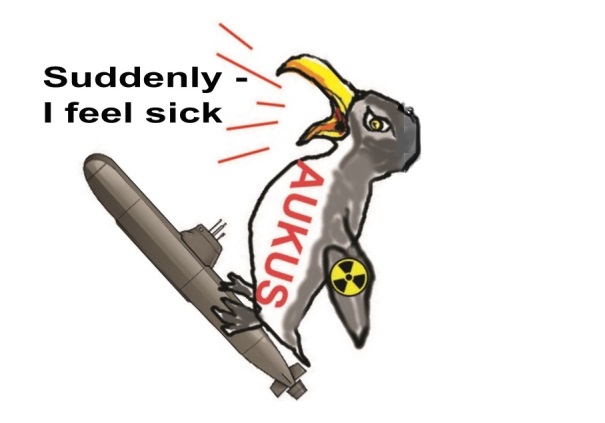
Australia’s AUKUS submarine deal with the United States has hit a hurdle with Senate Republicans threatening to block the sale unless President Joe Biden boosts funding for the domestic production line.
Republican members of the Senate Armed Services Committee on Friday moved to block legislation which would enable the sale of US Virginia-class submarines to Australia.
But the ranking Republican on the Senate Armed Services Committee, senator Roger Wicker, said Biden needed to commit more money to guarantee “we have enough submarines for our own security before we endorse that pillar of the agreement”.
Wicker said Australia’s commitment of US$3 billion ($4.4 billion) for the US production line would not be enough to meet the needs of both countries.
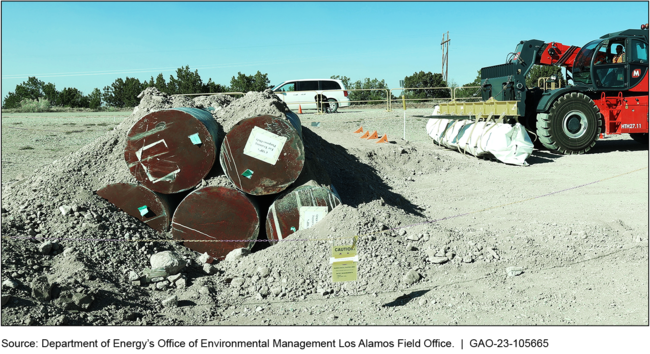
Workers at Los Alamos National Laboratory dug up buried nuclear waste they planned to dispose of at the federal repository near Carlsbad, amid pressure from State officials that the facility prioritize New Mexico waste.
The U.S. Department of Energy’s Los Alamos Field Office and the lab’s cleanup contractor Newport News Nuclear BWXT (N3B) Los Alamos announced Tuesday they began exhuming corrugated metal pipes containing transuranic (TRU) nuclear waste and preparing them for shipment.
At the Waste Isolation Pilot Plant near Carlsbad, TRU waste is disposed of via burial in a salt deposit about 2,000 feet underground, trucked into the site from DOE facilities throughout the country.
TRU waste is made up of irradiated clothing, equipment and other debris from nuclear research and development activities around the U.S.
Before it can be shipped to WIPP, the pipes must be cut using hydraulic sheers, allowing them to be loaded into waste boxes for shipment and disposal.
The pipes weight about 10,000 to 14,000 pounds, and measure about 20 feet long. They are cut into five pieces, with each piece loaded into a box.
It’s occurring at portion of the lab known as Dome 375, and the waste came from Los Alamos’ former radioactive liquid waste treatment facility operating during the Cold War at Technical Area 21 (TA-21).
There were 158 pipes in total transferred from TA-21, records show, containing cemented waste.
They were buried in 1986, where the waste sat until recently when worked began preparing it for final disposal.
The DOE hoped to finish digging up and preparing the pipes for disposal by spring 2024.
Chicago Tribune, Jul 21, 2023 , Larry R. Eaton, Chicago
Fifty years ago, as chief of the Illinois attorney general’s Environmental Control Law Division, a relatively new field of law at that time, I had the occasion to tour an Illinois nuclear power plant. I was taken aback to see extensive pools of water containing bundles of spent nuclear fuel rods standing on end just beneath the surface of the water. I was advised that a pilot plant study had indicated that it would have an essentially closed-loop system that would not generate large amounts of spent fuel; however, once the full-scale plant became operational, the system failed to perform as anticipated. Plant workers were left with no good alternative but to store spent fuel rods in pools of water, at least temporarily, pending (hopefully) a better idea.
It appears that the nuclear power industry is still waiting for that better idea. A supporter of nuclear power production now maintains, in essence, that we have nothing to be concerned about regarding spent nuclear fuel because all we need to do is encase it in concrete and then open it up and repackage it in concrete every several decades. (In perpetuity, presumably; the radioactivity will remain unabated for a very long time indeed.) To understand how absurd this proposal is requires little more than to say it out loud.
Chernobyl and Three Mile Island were wake-up calls, but we do not appear to have fully awakened. It does not help that a nuclear power plant now sits near the front lines of a shooting war between Russia and Ukraine. Hopefully, we will somehow be lucky enough never to have a massive nuclear power plant disaster. But regardless of that, we will have radioactive spent fuel problems with us forever. We can no longer escape that fact. However, we can choose to stop making it worse.
Germany has decided to end its use of nuclear power. The U.S. should do the same. If there is anything worse than having an enormous carbon footprint, it has to be for that footprint to be radioactive too!
“…………………………………………………………………………………………. Ukraine’s leaders are so over the top that it’s becoming impossible to ignore. Add in the fact that they have been enriched by U.S. taxpayers more or less directly despite crumbling infrastructure, catastrophic homelessness, apartheid healthcare, and a host of other problems that the U.S. could address with adequate funding.
From RT (whose editor-in-chief, Margarita Simonyan, just survived a second assassination attempt):
On July 7, US Under Secretary of Defense for Policy Colin Kahl spoke about a new package of aid from the US which includes cluster munitions – which are banned in 120 countries. The cost was $800 million.This is the 42nd delivery of aid that Ukraine has received from the US in the past year and a half.[emphasis mine] Since the beginning of Russia’s offensive, the US Congress has approved military and economic assistance to Ukraine amounting to over $70 billion – and that’s only counting direct expenses..
“Ukraine needs only one thing… To have someone come to power who won’t steal. Someone who won’t do it himself and won’t allow others to do so. Unfortunately, so far we haven’t been lucky,” [Aleksey Arestovich, former advisor to President Zelensky] said.
Ok, so Arestovich has a motive for trashing the government that used to include him. How about Pulitzer Prize-winning U.S. investigative journalist Seymour Hersh? Hersh does not approve of Russia’s entry into the war but he nonetheless published a piece on rampant corruption in Ukraine, “Trading with the Enemy,” back in April.
Zelensky has been buying fuel from Russia, the country with which it, and Washington, are at war, and the Ukrainian president and many in his entourage have been skimming untold millions from the American dollars earmarked for diesel fuel payments. One estimate by analysts from the Central Intelligence Agency put the embezzled funds at $400 million last year, at least; another expert compared the level of corruption in Kiev as approaching that of the Afghan war………………………………
Then there is President Zelensky, elected on pledges to end corruption and, incidentally, the war on the Donbas.
Pre-2022, i.e. when corporate media headlines about Ukraine did a 180, even The Guardian found he was part of the problem and not likely to be part of the solution.
The diminutive reactors are likely to be just as prone to delays and cost overruns as their behemoth predecessors.
I just read Pal Hockenos’ fine story about small nuclear reactors. But Hockenos is naive to think that Bill Gates and co. give a hoot about our future. What they do care about is their own increasing $squillions. And the coming source of new $squillions is in weaponry – that’s where all sorts of applications for SMRs lie. And Gates etc are well aware that the fixing-climate story is just a cover for the real practical purpose.
IN RECENT YEARS, the nuclear power lobby and its advocates have begun to sing a new song. They have bailed on the monstrous reactors of the 20th century — not because of safety or toxic waste concerns, but because of the reactors’ exorbitant expense and ponderous rollout schedules. And they have switched their allegiance to a next generation nuclear fission technology: small modular reactors, which they claim will help rescue our warming planet, as well as the nuclear power industry— once they exist.
Respected thinkers such as former U.S. president Barack Obama, French president Emmanuel Macron, and Microsoft co-founder and philanthropist Bill Gates have toasted the idea of small modular reactors, or SMRs, as a potentially reliable, almost-emissions-free backup to intermittent renewable energy sources like wind and solar. Advocates claim that because SMRs will be smaller than the giants that currently dominate horizons, they will be safer, cheaper, and quicker to build. Although SMRs will have only a fraction of the power-generating capacity of traditional nuclear power reactors, proponents envision that they will, one day, be assembled in factories and transported as a unit to sites — like Sears’ mail-order Modern Homes of the early 1900s.
Currently, half of the states in the EU, both major political parties in the U.S, and the five BRICS nations — Brazil, Russia, India, China, and South Africa — have indicated that they want to split atoms for the purpose of generating energy. U.S. President Joe Biden included billions of dollars in tax credits for nuclear energy in the Inflation Reduction Act and the Infrastructure Investment and Jobs Act. Gates has gone so far as to invest a chunk of his fortune in a firm he founded, TerraPower, a leading nuclear innovation company. But despite the prodigious chatter, the endeavor to blanket the Earth with SMRs is a Hail Mary pass that’s very unlikely to succeed.
Granted, it is certainly a step in the right direction that most observers now see the postwar, giga-watt-scale water-cooled reactors as obsolete. When constructed new, these behemoths generate electricity at up to nine times the cost of large-scale solar and onshore wind facilities, and can take well over a decade to get up and running. Perhaps for this reason, there has been one, and only one, new nuclear power project initiated in the U.S. since construction began on the last one 50 years ago: a two-reactor expansion of the Vogtle Electric Generating Plant in Georgia. The first of the reactors came online this year — seven years behind schedule. The staggering $35 billion cost for the pair is more than twice the original projection.
But SMRs are just as likely to face similar delays and cost overruns. Currently, there are just two existing advanced SMR facilities in the world that could be reasonably described as SMRs: a pilot reactor in China and Russia’s diminutive Akademik Lomonosov. More small reactors are under construction in China, Russia, and Argentina, but all of them are proving even more expensiveper kilowatt than traditional reactors.
It’s worth noting that in the U.S., and everywhere else in the world, nuclear policy relies heavily on subsidies to be economically competitive. Starting next year, utilities operating nuclear facilities in the U.S. can qualify for a tax credit of $15 per megawatt-hour — a break that could be worth up to $30 billion for the industry as a whole. However, even these giveaways won’t reduce the projected costs of SMR-generated electricity to anywhere near the going prices of wind and solar power.
In the U.S., the only SMR developer with a design approved by the Nuclear Regulatory Commission is NuScale, which plans to deploy six modules at one site in Idaho that will together generate less electricity than a smallish standard nuclear reactor. So far, however, NuScale has yet to lay a single brick. Its biggest win to date is securing $4 billion in federal tax subsidies. In January of this year, NuScale announced plans to sell electricity not at $58 per megawatt-hour, as originally pledged, but at $89 per megawatt-hour, citing higher than anticipated construction costs. The new projection is nearly twice the average global cost of utility-scale solar and onshore wind, according to calculations by BloombergNEF. And without the government subsidies, NuScale’s price tag would be that much higher.
In fact, there’s a fair chance that not a single NuScale SMR will ever be built: The company has said it will not begin construction until 80 percent of its expected generation capacity is subscribed, and currently buyers have signed up for less than a quarter of the plant’s capacity.
Gates’s TerraPower has an even longer way to go, although it too is cashing in on subsidies. The U.S. Department of Energy has pledged up to $2 billion in matching funds to construct a demonstration plant in Wyoming. Yet TerraPower recently announced it’s facing delays of at least two years because of difficulties securing uranium fuel from its lone supplier: Russia.
Even if the unlikely rollout of SMRs eventually happens, it will unfold too late to curb the climate crisis. And the reactors will face many of the same safety and radioactive waste concerns that plagued their larger counterparts, if only at smaller scales. Meanwhile, the siren song of nuclear energy is diverting critical resources from the urgent task of building out clean technologies. And the idea that nuclear reactors would serve as “backups” for wind and solar is misguided because the reactors can’t be ramped up and down quickly.
……………………………The technology of the future is already here. Clean wind and solar energy — coupled with updated smart grids, expanded storage capacity, hydrogen technology, virtual power plants, and demand response strategies — can work. Our energy systems of the future will look like a patchwork quilt, with diverse energy sources kicking in at different times during the day, and with the mix differing from one day to the next.
Bill Gates and like-minded innovators should put their minds and fortunes to work on this futuristic project of the present — and leave the 20th century relic that is nuclear power in the past, where it belongs
“Many investors, given a choice, would not want to profit from companies that manufacture weapons of mass destruction,” said As You Sow’s Andrew Behar.
Amidst what the Bulletin of Atomic Scientists calls “an exceedingly dangerous nuclear situation” facing humanity today, the largest U.S. mutual funds—which manage the retirement and other savings of tens of millions of Americans—are profiting from investments in nuclear weapons, cluster munitions, and other banned or controversial arms, an analysis by a leading shareholder advocacy group revealed Tuesday.
Measured by dollars invested, the top 25 U.S. asset managers “all earn a D grade or worse, with significant investments in arms manufacturers and major military contractors, including companies involved with nuclear weapons and controversial weapons like cluster munitions, anti-personnel landmines, incendiary weapons, and depleted uranium,” Berkeley, California-based As You Sow said in its new report.
Some of the largest corporate 401(k)s like American Funds, John Hancock Funds, and Franklin Templeton Investments were among the most heavily invested in these armaments, while “fund managers that focus on sustainable investing have less exposure to military weapons, on average.”
Seven funds profiled in the analysis—Eventide Funds, Ecofin, New Alternatives, Vert Asset Management, Aspiration Funds ,Thrivent, and Kayne Anderson—held no investments in the controversial weapons.
“Many investors, given a choice, would not want to profit from companies that manufacture weapons of mass destruction,” As You Sow CEO Andrew Behar said in a statement. “Yet nearly every retirement plan has nuclear and other controversial weapons embedded in their plan. Our new ratings empower investors with the tools to know what they own so they can invest their money in alignment with their values.”
As You Sow’s mutual fund ratings are part of the group’s Weapons Free Funds investment tool, “built to help responsible investors prioritize peace and people over war and violence.”
Common Dreams reported last month that nuclear-armed nations spent $82.9 billion on their arsenals last year, with the United States accounting for more than half of the global total, according to the Nobel Prize-winning International Campaign to Abolish Nuclear Weapons.
In a windowless corridor of PF-4, the Los Alamos National Laboratory’s plutonium processing facility, the deputy director of weapons stood among a cluster of journalists and National Nuclear Security Administration officials, all clad in anti-contamination lab coats and booties, safety goggles and dosimeters.
“It’s not that scary,” said Robert Webster, during a rare media tour of several rooms brimming with glove boxes, some almost as old as the Cold War-era building itself, others newly installed. “You just have to be careful.”
In these highly classified rooms, each task is the sum of its many protocols, a meticulous choreography that was palpable on a recent morning — June 22 — even in the absence of workers. The respirators, protective clothing, ventilation systems and dosimeters — fail-safes aimed, according to officials, at reducing or detecting the risk of exposure — are routine and required controls at “the plant,” as PF-4 is popularly known. Here, no task can be taken for granted and no movement unintended.
Five years ago, LANL began embarking on a controversial mission — to produce an annual quota of plutonium pits, the triggers for nuclear weapons. Matt Johnson, head of the lab’s Pit Technologies division, characterized it as “probably one of the safest places in New Mexico.”
A recent NNSA investigation portrays another version of the plant, a place cited for its “significant lack of attention or carelessness” in protecting workers and the public, as a Preliminary Notice of Violation read. Released on May 18, the findings detailed four “nuclear safety events” that took place over a five-month period in 2021, including one glove box breach, two floods, and an instance in which too much fissionable material was placed in one area.
The NNSA, as a result, withheld nearly $1.5 million from its 2021 contract award to Triad National Security, the organization that manages and operates the lab. (The NNSA, nonetheless, refrained from exacting additional civil penalties, which could have totalled an extra half a million dollars.)
Its 11-page report revealed an environment in which workers were either too underqualified to perform certain tasks or overburdened by too many tasks to perform them well. Another problem stemmed from faulty equipment, which had presented problems since 1990 and had not been replaced under Triad’s tenure, despite multiple requests.
The report emphasized that Triad routinely focused on “human errors rather than on the conditions that make those errors more likely.”
That particular oversight, in part, led to water entering a ventilation system for multiple rooms and glove boxes — the windowed, stainless-steel containers where radioactive materials are handled. According to the NNSA, it amounted to a violation of “criticality safety requirements.” Water has long been known to enhance fission and, in certain circumstances, cause plutonium to go critical, sending out a blast of blue light and radiation.
The four nuclear safety events cited by the NNSA represented only a small fraction of the many “process deviations” and compliance concerns around handling nuclear materials that have beset the plant since May 2018. That’s the same year the lab was recommended as one of two sites in the country to produce plutonium pits for nuclear warheads.
In an attempt to understand a fuller picture of risks at the plant, Searchlight New Mexico culled through the last five years of weekly reports by the Defense Nuclear Facility Safety Board (DNFSB), a federal watchdog that oversees the U.S. nuclear weapons complex and makes recommendations to the Department of Energy. An analysis like this has never been conducted before, according to the DNFSB.
Searchlight counted at least 100 process deviations at the plant during that period: a mix of safety incidents, emergency events and protocol violations. The examples were wide ranging — from construction accidents and small fires, to floods and worker contamination. Not all had the potential to be catastrophic, but at a facility like PF-4, the consequences can be much higher than in other workplaces.
In 2019, one worker was nearly felled by a 320-pound toxic nuclear waste container and, in 2020, another inhaled plutonium oxide powder — the most dangerous form of plutonium. There was a broken finger, a mysterious head injury and several instances in which containers of toxic waste were backlogged, up to 80 at one point, in a single storage room. The all-important protective gloves inside the glove boxes have on occasion become separated from their ports in the box wall; they’ve also torn on sharp objects or been worn down by tools or overuse. The DNFSB called glove box glove failures and floods “repeat events” — serious incidents they attribute to “poor conduct of operations.” Records show at least 20 such incidents in the last five years that resulted in several instances of skin contamination, though only 2 reports indicated an “uptake” — an absorption of plutonium into the body.
“NNSA is investing billions of dollars in production-related infrastructure at Los Alamos,” a DNFSB spokesperson wrote in an email to Searchlight, “and the Board is continuing to urge commensurate investment in the safety infrastructure needed to ensure workers and the public are adequately protected from potential accidents at PF-4.”
In the June 2020 glove box breach, the worker underwent chelation therapy for significant radiation — on hair, skin and by inhalation — when he “pulled out of the glovebox gloves after weighing and packaging plutonium-238 oxide powder.” As a soluble form of plutonium, oxide powder can begin to circulate in the bloodstream almost immediately and eventually end up in the liver and bones, according to reports. Fourteen other workers were also exposed in that same incident.
Searchlight found other incidents that could be considered outliers. In July 2021, for example, a 4.2 magnitude earthquake hit some 30 miles northwest of the lab, located within the Pajarito Fault System.
The plant’s new glove boxes have been built to withstand an earthquake, according to the DNFSB. But, there are “a large number of existing gloveboxes that do not meet current seismic standards,” the agency’s email to Searchlight made clear.
The worst possible scenario would be a cataclysmic earthquake that triggers a fire at the plant. For almost two decades, the DNFSB has argued that the building’s “passive confinement system” — essentially its capacity to prevent a release of radioactive material from leaking out and reaching the public — is insufficient. After years of back and forth on the matter, and piecemeal enhancements to the plant, the NNSA, in 2022, deemed significant upgrades, including to the ventilation system, were unnecessary — despite DNFSB’s strong recommendations to the contrary.
Another one-off event occurred in February 2019, when two electricians were “inadvertently locked inside a caged storage location” for 40 minutes. “During this time,” the DNFSB reported, “the workers would have been unable to properly respond to alarms associated with a nuclear criticality, an airborne radioactive material release, fire, or other emergency situations requiring egress.”
When asked about a recent spate of glove box and other safety matters at the plant, the lab responded with the following statement:
“PF-4 is one of the safest places in the country as a result of the many redundant safety and security measures in place to protect our workforce, the environment, and the community. We have ongoing programs to ensure the safe handling of materials at TA-55. In the case of glove box breaches, training and controls identified the breaches and allowed us to address them immediately. Employees’ personal protective equipment and the facility and room ventilation systems help keep workers safe at all times.”
Searchlight produced the interactive graphics in this story to help visualize the DNFSB reports. Searchlight’s counts are based on the findings of site inspectors and confirmed by the DNFSB. While there could be many reasons behind an incident, site inspectors categorized the events according to a complex set of procedures. The number of reported incidents in 2022 rose by 33 percent compared to the previous year. In 2022, Triad commenced round-the-clock operations.
Noah Raess contributed to the reporting of this story.