Even with billions of dollars in tax credits, costs skyrocket at U.S. Small Modular Reactor Project
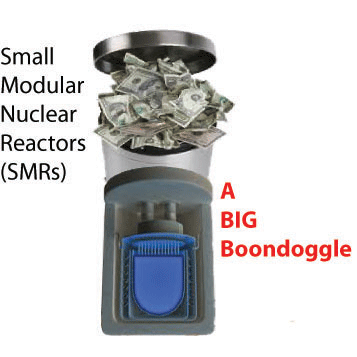
Costs Skyrocket at U.S. Small Modular Reactor Project https://www.theenergymix.com/2022/11/18/costs-skyrocket-at-u-s-small-modular-reactor-project/?fbclid=IwAR2o88KrFfN4Z5XD2pX8Kwpqk1eNAzrBmYFFcAySiVwckPjbA2aZ-311Je8 November 18, 2022
Higher steel costs and rising interest rates are taking the blame after a small modular nuclear reactor project in Utah reported a cost increase from US$58 to $90 or $100 per megawatt-hour for the electricity it’s meant to produce.
Utah Associated Municipal Power Systems is planning to bring the six NuScale reactors online in 2029 with combined output of 462 megawatts. But “the rise in prices likely means the UAMPS project will not hit certain engineering, procurement, and construction benchmarks, allowing participants to renegotiate the price they pay or abandon the project,” Utility Dive reports.
“It was like a punch in the gut when they told us,” said Scott Hughes, power manager for Hurricane City Power, one of the 27 municipal utilities that had signed on to buy power from UAMPS’ advanced nuclear Carbon Free Power Project (CFPP).
“The increased costs in the new Class 3 cost estimate currently being finalized for the CFPP have been shocking, even to NuScale and Fluor, the company responsible for overall management of the project,” the Institute for Energy Economics and Financial Analysis (IEEFA) writes, citing minutes of an October, 2022, Idaho Falls Power Board meeting.
Another municipal utility official called the increase a “big red flag in our face”.
The new cost projections factor in billions of dollars in tax credits the project would receive under the Biden administration’s Inflation Reduction Act, amounting to a 30% saving. IEEFA estimates the total subsidy at $1.4 billion.
Without the IRA, the cost per megawatt-hour would be closer to $120. Utility Dive and IEEFA both say any price above $58/MWh could allow the utilities to renegotiate their contracts or leave the project with no financial penalty.
“The next question is what are we going to do instead?” Hughes told Utility Dive. “Or what if the project fails, what are we gonna do? There’s not a lot of options.”
Then again, if other cities abandon the CFPP, it “might just fail anyway,” he added.
With seven years remaining before the project goes online, Hughes said material costs and interest rates could come back down. But the history doesn’t back that hope. “Nuclear industry experience over the past four decades points to the likelihood of future cost increases and schedule delays during all phases of the project—design, construction, licencing, and testing,” IEEFA says.
The institute cites the Vogtle nuclear project in Georgia, the only new reactors currently under construction in the U.S., where costs have increased 140% and work has fallen more than six years behind schedule since construction began in 2011.
UAMPS doesn’t plan to complete design work until 2024, and has eight years of design, licencing, construction, and pre-operational and start-up testing ahead. (IEEFA puts the project start date at 2030, not 2029.) But even at today’s revised pricing, “a target power price between $90 and $100 per MWh will make the CFPP even more uneconomic compared to renewable and battery storage resources costs that are expected to continue to decline over the next decade.”
In October, analysis by investment banking giant Crédit Suisse found that IRA funding combined with other available tax credits would bring solar project costs in as low as $4 per megawatt-hour, or less than half a penny per kilowatt-hour, falling to zero (literally) in the second half of the decade.
Fallout from a nuclear past: New book explores human toll of ‘nuclear colonization’ in New Mexico.

From Los Alamos to the Trinity Test site, the human toll of “nuclear colonization” looms large
Las Cruces Sun News, Alicia Inez Guzmán, Searchlight New Mexico, 20 Nov 22,
Of the three waves of colonization New Mexico has undergone — Spanish, American and nuclear — the latter is the least explored. And for author Myrriah Gómez, there were personal reasons to reveal the truth about how “nuclear colonization” has altered the state’s past and continues to shape its future.
Gómez, an assistant professor at the University of New Mexico, is the author of “Nuclear Nuevo México,” a book that explores the history of the Los Alamos National Laboratory and the fundamental tension of living in its shadow. Its publication this month by the University of Arizona Press couldn’t be timelier: Los Alamos is currently preparing to build plutonium “pits” that act as triggers in nuclear weapons, putting the lab front and center in an ongoing national debate about nuclear impacts.
“If Spanish colonialism brought Spanish colonizers and U.S. colonialism brought American colonizers,” as Gómez writes in her book, “then nuclear colonialism brought nuclear colonizers, scientists, military personnel, atomic bomb testing, and nuclear waste among them.”
For Gómez, the story is deeply felt. She grew up in El Rancho, just 20 miles from Los Alamos. And like so many in the Pojoaque Valley and its nearby villages, she was surrounded by relatives and others who worked at “the labs.” The profound, but not uncommon, loss of family members to radiation exposure shaped her writing.
The book describes in great detail how the Manhattan Project’s site was chosen; how the deaths of Nuevo Mexicanos in the 1950s were designated as “classified” and kept secret; and how atomic testing affected the health of people living in the Tularosa Basin, downwind of the world’s first nuclear detonation. She also touches on the plutonium pit production that is gearing up today.
I recently sat down with her to talk about her book, which started as a PhD dissertation and grew from there. We also shared some of our common experiences. As a Truchas native, I myself lost a relative to illness that was linked to his work at Los Alamos.
……………………………………………………………………………….So it’s not just the health, the illness, the disease and the deaths. It’s also the rifts created in the community. The big reduction in the labor forces that happened in the 1990s, the majority of whom were from the valley — that period of time was the biggest reflection of how dependent we are on the labs and why it’s problematic.
It’s not just the illness. It’s not just kicking people off their land. It’s not just the Radiation Exposure Compensation Act, or the ‘Let us give you this lump sum of money for how you’ve been sick.’ This is all treating the symptoms instead of getting to the root of the illness.
Which is to say that it’s systemic, which is why it’s colonialism.
The fading promise of low-cost power from UAMPS’ Small Modular Reactors – Institute for Energy Economics and Financial Analysis
Small Modular Reactor Update: The Fading Promise of Low-Cost Power from
UAMPS’ SMR. The original target power price for a planned 12-module SMR by
UAMPS (Utah Associated Municipal Power Systems) and NuScale Power
Corporation was $55 per megawatt-hour (MWh).
When UAMPS reduced the size of the carbon-free power plant (CFPP) to six modules in the summer of 2021, it raised the target power price to $58 per MWh. Recent presentations to the
power boards of Washington City and Hurricane, two of the Utah communities
that have signed agreements to buy power from the CFPP, suggest that
project power prices are now likely to end up in the range of $90-$100 per
MWh.
The prices include an anticipated $1.4 billion subsidy from the U.S.
Department of Energy and a new subsidy from the Inflation Reduction Act
(IRA) on the order of $30 per MWh. The unsubsidized price of the power from
the CFPP would be substantially higher than $100 per MWh, perhaps even
double the current $58 target price.
IEEFA 17th Nov 2022
https://ieefa.org/resources/small-modular-reactor-update-fading-promise-low-cost-power-uamps-smr
US Empire Views Ukrainians And Russians As Lab Rats For Weapons Testing

One of the many reasons the US and its complex network of allies, partners and assets are always fighting so many wars is because new weapons technology needs to be tested in battle before it can be deemed effective. What this means in practice is using human bodies as test subjects, the way a scientist uses laboratory rats or guinea pigs.
The US-centralized empire pretends to care about Ukrainian lives, but in reality it only cares about them to the extent that a researcher cares about his lab rats. And for exactly the same reason.
What could be more sinister than that? Well, the agendas that they are running those tests in preparation for, I suppose.
Caitlin Johnstone, Nov 18 2022,
A surprisingly frank article by The New York Times titled “Western Allies Look to Ukraine as a Testing Ground for Weapons” describes how the imperial war machine is capitalising on the US proxy war to test its weapons for future use.
“Ukraine has become a testing ground for state-of-the-art weapons and information systems, and new ways to use them, that Western political officials and military commanders predict could shape warfare for generations to come,” write’s NYT’s Lara Jakes.
Jakes writes that “new advances in technology and training in Ukraine are being closely monitored for the ways they are changing the face of the fight.” These new technological advancements include an information system known as Delta, as well as “remote-controlled boats, anti-drone weapons known as SkyWipers and an updated version of an air-defense system built in Germany that the German military itself has yet to use.”
A former Lithuanian president is quoted as saying, “We’re learning in Ukraine how to fight, and we’re learning how to use our NATO equipment,” adding, “It is shameful for me because Ukrainians are paying with their lives for these exercises for us.”
Yeah, no shit.
At some point The New York Times article was re-titled from “Western Allies Look to Ukraine as a Testing Ground for Weapons” to the slightly less obvious “For Western Weapons, the Ukraine War Is a Beta Test.”
News that the west is using Ukraine to test weapons systems for future wars aligns with recent comments by the commander of the US nuclear arsenal that the proxy war is a test run for a much bigger conflict that’s on its way.
“This Ukraine crisis that we’re in right now, this is just the warmup,” said US STRATCOM head Charles Richard at a naval conference earlier this month. “The big one is coming. And it isn’t going to be very long before we’re going to get tested in ways that we haven’t been tested [in] a long time.”
So in addition to being used to advance longstanding US geostrategic objectives, apparently this war is also being used to sharpen the imperial war machine’s claws for a looming hot war with China and/or Russia. The US would certainly have an advantage in military test runs over the years in such a conflict.
As an aside, it’s probably worth noting that all the testing of new western weapons technology would likely explain reports from Ukrainian astronomers that the skies over Kyiv have been “swarming with unidentified flying objects (UFOs).” The aforementioned New York Times article quotes Ukrainian vice prime minister Mykhailo Fedorov as saying that the weapons testing he’s seen has convinced him that “the wars of the future will be about maximum drones and minimal humans.”
One of the many reasons the US and its complex network of allies, partners and assets are always fighting so many wars is because new weapons technology needs to be tested in battle before it can be deemed effective. What this means in practice is using human bodies as test subjects, the way a scientist uses laboratory rats or guinea pigs.
The US-centralized empire pretends to care about Ukrainian lives, but in reality it only cares about them to the extent that a researcher cares about his lab rats. And for exactly the same reason.
What could be more sinister than that? Well, the agendas that they are running those tests in preparation for, I suppose.
U.S. rejects funding to re-open Michigan nuclear plant -Holtec
By Timothy Gardner, WASHINGTON, Nov 18 (Reuters) – The U.S. Department of Energy rejected Holtec International’s application for funding to reopen the Palisades nuclear power plant in Michigan, a Holtec spokesperson said on Friday.
Holtec bought the 805 megawatt Palisades plant in May to decommission the facility, which had struggled to compete with natural gas-fired plants and renewable energy. It was looking to reopen it with funding from the initial phase of the Energy Department’s $6 billion Civil Nuclear Credit program.
…………….
The DOE did not immediately respond to a request for comment.
Nuclear power produces toxic waste, currently held at 28 plants across the country.
ClearView Energy Partners, a nonpartisan research group, said in September that Palisades’ closure was “likely to be permanent.” Palisades was out of nuclear fuel, faced a control rod drive seal issue that needed to be fixed and likely needed a new company to operate it, as well as a buyer for the power it generates, ClearView said at the time.
The CNC program, launched by the DOE this year, is intended for plants in states with competitive electricity markets and funded by the infrastructure bill that passed last year……………..
In the first phase of the CNC program, the DOE prioritized plants that had already shut or announced intentions to close. Power utility PG&E Corp (PCG.N) was the only other company to apply in the first phase, for its Diablo Canyon plant in California, slated to fully close by 2025. PG&E did not immediately respond to a request for comment about the status of its application. https://www.reuters.com/business/energy/us-rejects-funding-re-open-michigan-nuclear-plant-holtec-2022-11-18
Biden and CIA Director Burns in Double Act to Split Putin and Xi
This American president has said publicly on four occasions that the U.S. would defend Taiwan militarily if the Chinese mainland were to exercise its legal right to use force for bringing the island under full administrative control from Beijing. Those declarations by Biden violate the legally binding One China principle recognized by international law as well as under domestic U.S. laws. At the G20 summit this week, Biden said there was no change in American policy on Taiwan, despite his previous flagrant statements to the contrary.
The heavily reported narrative of “warning Russia against nukes” reinforces the contrived notion that Russia is a pariah state that is threatening to use nuclear weapons, whereas it is Moscow that has repeatedly warned that the war being fueled in Ukraine by the United States and its NATO partners could spiral uncontrollably into a catastrophic confrontation.
Russia has not threatened to use nuclear weapons, has not even mentioned the word.
Strategic Culture, Finian Cunningham, November 15, 2022,
Biden and Burns’ clunky double act is likely to not impress anyone in Beijing and Moscow.
U.S. President Joe Biden apparently sought to lower tensions with China this week when he promised Chinese counterpart Xi Jinping that Washington was “not seeking a new Cold War” with Beijing.
The two leaders met on the sidelines of the G20 summit in Indonesia. It was their first face-to-face meeting since Biden took office in January 2021. While Biden was all smiles for a handshake photo-op, Xi looked noticeably reserved, like a guy who was bracing himself as one about to hear loads of bullshit.
After more than three hours of private discussions, the Americans and Western media subsequently tried to spin that both sides had agreed on condemning Russia’s alleged threat to use nuclear weapons in Ukraine. This was the Americans taking license. Xi did not specify Russia, according to the White House readout of the meeting. Both leaders condemned nuclear war and said it should never be fought, a rebuke which applies as much to the United States as anyone else. The Western media, however, tried to spin it as joint condemnation of Russia.
The Chinese side had quite a different take on what was conveyed in the meeting. No wonder that Xi had looked reserved when he greeted Biden earlier.
President Xi was quoted as telling Biden: “A statesman should think about and know where to lead his country. He should also think about and know how to get along with other countries and the wider world… Instead of talking in one way and acting in another, the United States needs to honor its commitments with concrete action.”
This was pretty close to the Chinese president calling out his American counterpart as a bare-faced liar who can’t be trusted in what he says.
After all, Biden has continued the policy of massively arming China’s island province of Taiwan. That is a direct assault on Beijing’s sovereignty and China’s territorial integrity as well as posing a threat to its national security across the 150-km Taiwan Strait.
This American president has said publicly on four occasions that the U.S. would defend Taiwan militarily if the Chinese mainland were to exercise its legal right to use force for bringing the island under full administrative control from Beijing. Those declarations by Biden violate the legally binding One China principle recognized by international law as well as under domestic U.S. laws. At the G20 summit this week, Biden said there was no change in American policy on Taiwan, despite his previous flagrant statements to the contrary.
The Biden administration is planning to station nuclear-capable B-52 bombers in Australia aimed at provoking China as well as supplying Canberra with nuclear submarines as part of a new military coalition in the Asia-Pacific involving the United Kingdom, known as AUKUS.
Washington has also stepped up economic warfare against China with bans on the export of hi-tech semiconductors vital for Chinese industry.
The resumption of U.S. war drills off the Korean Peninsula in recent weeks after a three-year hiatus has sharply escalated tensions with between North and South Korea which poses a destabilizing national security risk for neighboring China.
So, Biden’s talk of “not seeking a new Cold War” with China is contemptible in the face of empirical events and U.S. conduct.
Which brings us to the question: what was Biden trying to achieve in soft-talking to Xi?
It seems the U.S. president was really seeking to split China from Russia.
Biden talked about no Cold War with China. But what about Russia? Seems the United States is full-on about aggravating Moscow. Can a presumed superpower be credibly in a Cold War with one adversary but not with another? That dichotomy doesn’t sound believable. So, what’s going on?
………………………… William Burns, the CIA director, met with the head of Russia’s foreign intelligence Sergei Naryshkin in Ankara……………..
Western headlines dutifully reported that Burns purportedly “warned Russia against using nuclear weapons in Ukraine”.
The White House’s national security council emphasized that Burns was not engaged in talks to end the conflict in Ukraine.
The heavily reported narrative of “warning Russia against nukes” reinforces the contrived notion that Russia is a pariah state that is threatening to use nuclear weapons, whereas it is Moscow that has repeatedly warned that the war being fueled in Ukraine by the United States and its NATO partners could spiral uncontrollably into a catastrophic confrontation.
Russia has not threatened to use nuclear weapons, has not even mentioned the word, and it has warned of the reckless dangers that the U.S. and NATO are stoking. If anything, it is the United States and its partners who are implicitly threatening the risk of nuclear war. President Vladimir Putin’s warned in September that if Russia’s existential security is threatened by NATO then Moscow reserves “the right to use all means of defense”. That reasonable warning has been cynically distorted to appear like a menacing threat to use nukes by Russia.
It seems that the Burns trip was aimed at further demonizing Russia as a nuclear threat to world security. Meanwhile, Biden was trying to ingratiate himself with Xi as a way to undermine the strong friendship that has developed between Beijing and Moscow, especially under Xi and Putin’s leadership.
Biden’s bid to appease Xi by saying that there is no Cold War intended is a blatant lie that China no doubt can see through as plain as a glass of urine. Biden and Burns’ clunky double act is likely to not impress anyone in Beijing and Moscow. https://strategic-culture.org/news/2022/11/15/biden-and-burns-in-double-act-to-split-putin-and-xi/
US nuclear strategy gravely threatens global security
https://www.globaltimes.cn/page/202211/1279678.shtml By Kong Jun Nov 16, 2022 The US Department of Defense recently released its 2022 Nuclear Posture Review (NPR), which continues the US’ consistent Cold War mentality and hegemonic logic, plays up great power competition and bloc confrontation, and exploits nuclear deterrence as a geopolitical tool. The international community is widely concerned that the US nuclear strategy will severely deteriorate the global strategic security environment.
The NPR shows that the incumbent US administration has not adopted a policy of “no first use” of nuclear weapons or the policy that “the sole purpose of our nuclear arsenal weapons is to deter -and, if necessary, retaliate for – a nuclear attack against the United States or its allies” as it promised during the 2020 presidential campaign, but has continued its longstanding policy of reserving the option of launching a preemptive nuclear strike.
While shouting the slogan of “reducing the role of nuclear weapons,” the US claims to deter nuclear and non-nuclear strategic attacks with nuclear weapons. Its hypocrisy is evident for all to see. Daryl G. Kimball, executive director of the Arms Control Association, recently published an article that suggested the NPR “sends muddled messages about the role of nuclear weapons in US defense strategy and foreign policy at a time when the United States should be more clearly de-emphasizing the salience of nuclear weapons and the threat of nuclear weapons use.”
The US nuclear strategy undermines strategic mutual trust among major powers. The US has long pretended to be a victim, hyping up nuclear threats from China and Russia and exaggerating that “by the 2030s the United States will, for the first time in its history face two major nuclear powers as strategic competitors and potential adversaries,” and openly tailored its nuclear deterrence strategy against China, Russia and other countries. The size of China’s nuclear arsenal is not on the same level with that of the US, and China has pledged to “no first use” of nuclear weapons at any time and under any circumstances. The US’ hyping up of the “China nuclear threat theory” will not change the fact that the US’ nuclear weapons pose a threat to the world, nor will it justify its nuclear expansion. Instead, it will only severely impair the strategic security relations of major powers.
The US nuclear strategy raises the risk of nuclear conflict. US President Joe Biden expressed his opposition to his predecessor’s plan to deploy a low-yield nuclear warhead called the W76-2. However, the NPR has retained this type of nuclear warhead and earmarked it for tailored deterrence against China and Russia, and also stated its intention to deploy a new B61-12 nuclear bomb. In January, the Joint Statement of the Leaders of the Five Nuclear-Weapon States on Preventing Nuclear War and Avoiding Arms Races reiterated that “a nuclear war cannot be won and must never be fought.” Going back on its own words, the US is developing nuclear weapons for combat use, in a complete disregard of the consequences of increasing the risks of nuclear conflict.
The US nuclear strategy stimulates a nuclear arms race. As a country with the largest nuclear arsenal, the US bears special and primary responsibilities for nuclear disarmament and should reduce its nuclear weapons in accordance with the international consensus. Regrettably, the US does not have any substantive nuclear disarmament measures, but instead seeks to upgrade its nuclear triad. The US expansion of nuclear arsenal has undermined global strategic balance and stability. It cannot be ruled out that other nuclear-weapon States will follow suit. It will also stimulate non-nuclear-weapon States to develop nuclear weapons of their own or seek “nuclear umbrella,” thereby impeding the international arms control and disarmament process.
The US nuclear strategy undermines the international nuclear non-proliferation and disarmament regime. Washington talks about strengthening regional nuclear deterrence and detailed plans to deploy strategic bombers, dual-capable fighter jets and even nuclear weapons in the Asia-Pacific region. This is exactly the same as its nuclear submarine cooperation with the UK and Australia under AUKUS and its connivance of the talks about nuclear sharing in Japan and the ROK, which fully exposes the reality that it puts geopolitical self-interest above nuclear non-proliferation obligations and is a complete destroyer of the international nuclear non-proliferation system.
Washington mentions China dozens of times in the report and speculates on and smears the modernization of China’s nuclear capabilities. In fact, since possessing nuclear weapons, China has explicitly undertaken not to be the first to use nuclear weapons at any time and under any circumstances, and unconditionally committed itself not to use or threaten to use nuclear weapons against non-nuclear-weapon states or nuclear-weapon-free-zones, and always keeps its nuclear capabilities at the minimum level required for national security. The US, which has long been in a hegemonic position, should change its hegemonic mentality of maliciously speculating about other countries.
At the moment, the global security structure, as well as international arms control, disarmament and non-proliferation mechanisms, are facing the most severe challenge since the end of the Cold War. The risk of nuclear arms race and nuclear conflict keeps rising. How the US uses its huge nuclear arsenal has a major bearing on world peace and development. We urge the US to abandon the Cold War mentality and the logic of hegemonism, pursue a rational and responsible nuclear policy, and play its due role in maintaining global strategic stability and world peace and security.
DOE awards millions to restart nuclear operations in southern Ohio as contamination concerns continue
The United States Department of Energy has awarded $30 million to produce
nuclear fuel at the Portsmouth Gaseous Diffusion Plant in Piketon. The
award comes with accolades from some and grave concerns from others.
According to the DOE, the “$30 million cost share during the first year
to start up and operate 16 advanced centrifuges in a cascade” at the
Piketon facility. The announcement raises concerns over radiation
contamination in Pike, Ross, and Scioto counties.
Scioto Valley Guardian 15th Nov 2022
U.S. nuclear plants expect government decision on credits by year-end
Reuters 16 Nov 22,
WASHINGTON, Nov 15 (Reuters) – Two companies that have applied for funding to keep struggling nuclear power plants open said they expect to hear from the U.S. Department of Energy by the end of the year.
Both power utility PG&E Corp (PCG.N) and Holtec International applied to the first phase of the $6 billion DOE Civil Nuclear Credit program to keep their reactors running. The Biden administration believes nuclear power is essential to fight climate change, but plants are struggling with costs and competition from natural gas plants and renewables.
PG&E’s Diablo Canyon reactors in California are slated to close in 2024 and 2025 but could stay open if they get the funding………….
The DOE declined to comment on timelines and future recipients of awards. U.S. infrastructure legislation passed in 2021 included funding for the civil nuclear credit program in the United States………………. https://www.reuters.com/business/energy/us-nuclear-plants-expect-government-decision-credits-by-year-end-2022-11-15/
Urging peace with Russia, top US general challenges DC’s proxy war
A series of leaks, including a call for diplomacy from Gen. Mark Milley, show that some US officials are ready for a settlement in Ukraine.
Substack, Aaron Maté Nov 13,
When the Congressional Progressive Caucus was bullied into withdrawing a letter urging diplomacy with Russia to end the war in Ukraine, everyone from neoconservative pundits to Sen. Bernie Sanders came forward to scold them. But now the same call is coming from a source that cannot be so easily ignored, and intimidated.
“A disagreement has emerged at the highest levels of the United States government over whether to press Ukraine to seek a diplomatic end to its war with Russia,” the New York Times reports. Leading the call for talks with Moscow is Gen. Mark Milley, the chairman of the Joint Chiefs of Staff. According to US officials, Milley “has made the case in internal meetings that the Ukrainians have achieved about as much as they could reasonably expect on the battlefield before winter sets in and so they should try to cement their gains at the bargaining table.”
The top US general has made no secret of his stance. “When there’s an opportunity to negotiate, when peace can be achieved, seize it,” Milley declared in a public speech this week.
Milley’s view “is not shared” by President Biden or his National Security Adviser, Jake Sullivan, the Times claims. Nor by the top US diplomat, Secretary of State Antony Blinken. As one US official explained to CNN, “the State Department is on the opposite side of the pole,” leading to “a unique situation where military brass are more fervently pushing for diplomacy than US diplomats.”
While US “diplomats” oppose diplomacy, White House officials would not be disclosing that Milley, the nation’s highest military officer, is challenging their stance if he were alone. Indeed, the Milley revelation is only the latest in a series of leaks suggesting that, despite the uproar over the progressives’ pro-diplomacy letter, at least some close to the president agree with its message……… more https://mate.substack.com/p/urging-peace-with-russia-top-us-general?utm_source=post-email-title&publication_id=100118&post_id=84024812&isFreemail=true&utm_medium=email
Biden’s Nuclear Policy Fails the Ukraine Test
His administration’s Cold War-style thinking is missing a golden opportunity.
Defense One, BY TOM Z. COLLINA, POLICY DIRECTOR, PLOUGHSHARES FUND, NOVEMBER 14, 2022
Senior Russian military leaders reportedly recently discussed how they might use nuclear weapons in Ukraine, while other Russian officials were suggesting that Kyiv might detonate a “dirty bomb”—suggestions widely dismissed as a setup for a false-flag excuse to escalate the war. And even before all that, President Joe Biden reckoned that the world was closer to “Armageddon” than any time since the 1962 Cuban missile crisis…………………………………….
Cause for concern? You bet. But if you’re looking for new ideas to address Russian President Vladimir Putin’s attempts at nuclear blackmail in Ukraine, you won’t find them in the Biden administration’s new statement on nuclear policy. Known as the Nuclear Posture Review, or NPR, the report is a disappointing defense of the status quo. It breaks little new ground, and it fails to respond to the Ukraine moment. Reading it, you might almost forget that the world is facing the most serious nuclear threat in 60 years.
Lacking fresh thinking on the Ukraine crisis, the Biden team has fallen back on the old Cold War playbook: when in doubt, build more nuclear bombs. Biden lends his support to essentially all the new nuclear weapons proposed by his predecessor, including a new $260 billion intercontinental ballistic missile and new lower-yield warheads for missiles on Trident submarines. As a candidate, Biden said the Trump administration’s new Trident warheads were a “bad idea,” and that having them would make the U.S. “more inclined to use them.” Now that he’s president, Biden opposes just one Trump-proposed nuke—a new and unneeded sea-launched cruise missile—that will likely win support in Congress anyway due to the administration’s tepid effort to stop it.
Building new nukes we don’t need will not solve the Ukraine crisis, but it could get us into another expensive and dangerous arms race. One of the more troubling assertions in the NPR is that “By the 2030s the United States will, for the first time in its history, face two major nuclear powers as strategic competitors and potential adversaries.” This sets the stage for a future administration to argue, erroneously, that the Pentagon needs a larger nuclear arsenal—say, as big as Russia’s and China’s combined. This could lead to a new arms race with both Moscow and Beijing.
What should we do instead? In the short term, the Biden team needs to talk with Russia’s leaders, as it has started to do. These talks should not yet be about ending the war in Ukraine, but we need to set clear expectations with Russia about preventing the war from going nuclear or spreading beyond Ukraine’s borders. As Biden has rightly said, we must do all we can to prevent direct U.S. conflict with Russia, which would lead to World War III. Biden has so far successfully balanced support for Ukraine while withholding U.S. forces, a no-fly zone, and more sophisticated weapons.
…………………… One of the underappreciated lessons of the Ukraine crisis is that the West would be better off if nuclear weapons were not part of the conflict. Russia might have not invaded if it did not have nukes to hide behind, and the United States could play a bigger role in helping Ukraine if it did not have to worry about Russian nuclear escalation. As Putin is showing, the bomb is a weapon of the weak and only serves to neutralize the U.S. conventional military advantage.
The Biden NPR missed a golden opportunity to update our nuclear policies for a new era. We cannot meet the Ukraine moment with Cold War thinking. President Biden must, and can, do better. https://www.defenseone.com/ideas/2022/11/bidens-nuclear-policy-fails-ukraine-test/379717/
—
The USA’s “climate” envoy at COP27 John Kerry is just another nuclear shill

John Kerry, ostensibly the US Special Climate Envoy, but actually yet another nuclear industry shill, used the occasion of the COP first to hold a special press conference to trumpet a $3 billion US nuclear deal with Romania and then announced a small modular reactor partnership with, incredibly, Ukraine.
“We have a viable alternative in nuclear,” Kerry told reporters. Viable? This was duly lapped up by the press without challenge.
John Kerry uses last-chance climate summit to tout nuclear power, https://beyondnuclearinternational.org/2022/11/13/the-kerry-copout/
By Linda Pentz Gunter, 14 Nov 22
“Russia’s seizure earlier this year of Ukraine’s Zaporizhzhia nuclear energy facility is shining a new light on the safety and security risks of the atomic export policies of the United States and other technologically advanced countries,” began a promising November 8 article in Roll Call.
However, that light seems to have blinded those in power to any common sense.
What has the alarm over the vulnerabilities of Ukraine’s reactors caught in a war zone actually taught any of them? Let’s start with the International Atomic Energy Agency.
“The problem is not nuclear energy,” IAEA Director General Rafael Grossi told the BBC recently. Nuclear power, Grossi said,“can provide a safe, clean source of energy and this is why many countries in Africa and in other places are turning to nuclear.” It’s just war that’s the trouble, Grossi said.
That’s like the gun lobby claiming it’s bad guys, not guns, that do the killing. Sorry, but no. Bad guys without guns can’t shoot people. Broken solar panels and fallen wind turbines can’t release massive amounts of radioactivity. The problem here very definitely IS nuclear energy. Period.
The IAEA position isn’t disingenuous of course. It’s a necessity borne of the agency’s massive conflict of interest, bound, as it is, to further and expand the use of nuclear power across the world. And then enforce safety at plants that are inherently dangerous.
“You will see that nuclear energy has a really solid, very consistent safety record,” said Grossi as the COP27 climate summit got underway in Egypt.
Except of course when there is a war, a prolonged loss of power, a natural disaster, a major human error or a catastrophic technical failure. Then, all of a sudden, having nuclear power plants is, according to Grossi, “playing with fire.”
Will US elected (or appointed) officials take heed of the obvious obstacles presented by nuclear power plants to achieving lasting peace and safety? Of course not. As we wrote here last week, US vice president, Kamala Harris, crowed about selling three Westinghouse reactors to Poland, tweeting that “We can address the climate crisis, strengthen European energy security, and deepen the US-Poland strategic relationship.”
Only the third part is true and is, of course, the basis for the contract in the first place, given Poland’s shared Eastern borders with Russia, Lithuania, Belarus, and Ukraine.
John Kerry, ostensibly the US Special Climate Envoy, but actually yet another nuclear industry shill, used the occasion of the COP first to hold a special press conference to trumpet a $3 billion US nuclear deal with Romania and then announced a small modular reactor partnership with, incredibly, Ukraine.
“We have a viable alternative in nuclear,” Kerry told reporters. Viable? This was duly lapped up by the press without challenge.
The Romanian debacle-to-be will be funded by the US Export-Import Bank. The Ukraine announcement read:
“Special Presidential Envoy for Climate John Kerry and Ukraine Minister of Energy German Galushchenko announced a Ukraine Clean Fuels from SMRs Pilot project that will demonstrate production of clean hydrogen and ammonia using secure and safe small modular nuclear reactor (SMR) and cutting-edge electrolysis technologies in Ukraine.”
Then they used the word “clean” again four times in the next paragraph. Which speaks volumes and definitely falls into the “doth protest too much” category.
Meanwhile, some experts in the field are warning against exporting nuclear technology to countries that might become embroiled in a war. Surely that would rule out Ukraine? And most if not all of Grossi’s beloved Africa? And what about Poland and Romania? How can we ever be sure which countries might suddenly find themselves at war? Another world war in Europe seemed unthinkable until February 24, 2022.
“An air raid siren sounded for the first time this morning in the nuclear city of Sosnovy Bor on the southern coast of the Gulf of Finland in the Baltic,” wrote Russian activist, Oleg Bodrov, a member of the Public Council of the Southern Coast of the Gulf of Finland (PCSCGF) in a November 8 email.
“A similar siren would have been heard by 2 million residents of the Leningrad Region,” said Bodrov. “It was a drill in case of war, which was carried out by decision of the authorities of the region.”
The term “nuclear football” is traditionally applied to the black bags containing the “nuclear button” that accompany the US president and vice president at all times. (The third is kept at the White House.) But nuclear power plants are also now proverbial nuclear footballs, being used to deliver a false sense of security but actually putting the countries on whose soil they sit in far greater danger.
Selling US reactors to Eastern European countries clearly has nothing whatever to do with climate or energy needs. “We don’t get to net zero by 2050 without nuclear power in the mix,” Kerry said at his COP press conference. Actually, yes, doing without slow, expensive and dangerous nuclear power is essential if we have any chance whatsoever of achieving net zero (2050 is already too late).
It is ever more apparent that most of our “mediocre politicians,” as Bodrov rightly characterizes them, are not interested in net zero. They are interested in using nuclear power as a nuclear weapons surrogate; in bolstering alliances with Russia’s neighbors in a dangerous move to drive Russia into ever greater political isolation; in propping up failing nuclear corporations like Westinghouse; and in answering their nuclear paymasters in Washington by wasting time and our money on foolish new nuclear plants that are irrelevant to addressing the climate peril we are already in.
Linda Pentz Gunter is the international specialist at Beyond Nuclear and writes for and curates Beyond Nuclear International.
USA, France, continue to buy nuclear supplies from Russia – no sanctions on that industry!
Stop funding Russia’s nuclear weapons, The Hill, BY HENRY SOKOLSKI, – 11/13/22
As Washington and the commentariat wring their hands about Russian President Vladimir Putin’s nuclear sword rattling, the United States and the European Union (EU) continue to shovel hundreds of millions of dollars to Rosatom — a Russian nuclear firm that maintains Moscow’s nuclear weapons complex and just filched a $60-billion Ukrainian nuclear plant.
Why would Washington and Brussels back such a nuclear villain? Do we really want to support Russian organizations that are critical to Putin building the nuclear bombs he is now threatening us with? No one will say yes, but the nuclear industry in Europe and the United States insist we can’t afford not to.
Besides being in charge of all of Russia’s nuclear weapons production and development, Rosatom supplies nuclear fuel to nuclear plants in the Czech Republic, Slovakia, Bulgaria and Hungary. Any European Union (EU) decision to cut off fuel to these plants would immediately harm these states economically. So, when Poland, Ireland, Estonia, Latvia, Lithuania and Germany recently recommended that the EU ban Russian nuclear imports to avoid funding Russia’s military efforts, the Hungarians and French howled and Brussels blinked.
What’s Paris’s brief? Russia buys two-thirds of France’s electrical steam generators. Also, French nuclear fuel fabricator Framatome just struck a major nuclear fuel development cooperation agreement with Rosatom……………………………
The EU, of course, must act by consensus. But what of the United States? There are no Russian-designed reactors in America. Nor is the United States without alternative uranium suppliers in Canada, Australia and Kazakhstan or practical, near-term uranium enrichment options. Yet, Washington pretty much followed the EU’s play book.
Russia provides roughly 15 percent of America’s raw uranium and 28 percent of its enriched uranium. Combined with Russian nuclear sales to the EU, these uranium imports from Russia fatten Rosatom’s coffers by as much as $1 billion a year — easily more than Rosatom spends to maintain Russia’s nuclear weapons complex.
You’d think that this last point would be politically fatal to further imports. Think again. Only days after Russia seized the Zaporizhzhia nuclear plant, the Nuclear Energy Institute and Duke power lobbied President Biden to keep Russian uranium imports coming. Failing to do so, they claimed, would risk increasing the cost of “zero-carbon” nuclear-supplied electricity. Worse, they insisted, it would jeopardize the future of advanced small modular reactors, most of which favor using special enriched uranium.
Soon after they made this plea, the White House concurred: Biden announced a U.S. embargo on all forms of Russian energy – oil, natural gas, and coal – but not on uranium……………………………. https://thehill.com/opinion/national-security/3732521-stop-funding-russias-nuclear-weapons/
How Bill Gates’ TerraPower rips off the American taxpayers
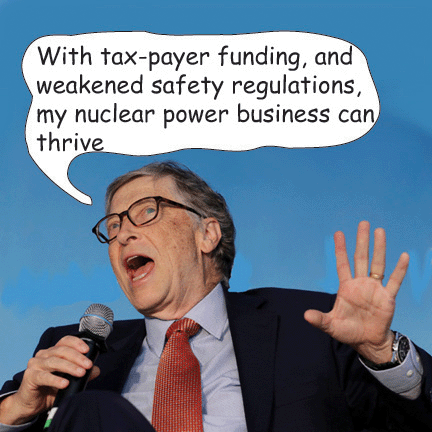
government support adds up to nearly as much as private investments and almost certainly more than Gates has personally invested. In other words, taxpayers have already paid tens of millions of dollars, and could pay far more in the future, for this technology
Beyond Nuclear By M.V. Ramana and Cassandra Jeffery 14 Nov 22…………………………………………………………………………. Bill Gates and TerraPower
TerraPower was founded in 2006 and Gates continues to serve as Chairman of the Board. The company has funded the development of three different nuclear reactor designs through a mix of venture capitalist investments from fellow billionaires, engineering and manufacturing corporations in the energy and defense sector, and government.
The company has research and development partnerships with several major institutions, including the Los Alamos National Laboratory and Y-12 National Security Complex, both of which design and test nuclear weapons.
TerraPower is well-funded. In 2010, the company received $35 million in seed money from venture capital firms to develop the first of its nuclear power plant designs, the “traveling wave” reactor. It has also received an undisclosed amount of funding from Breakthrough Energy Ventures, an investment firm co-founded and co-chaired by Gates.
According to a 2015 TerraPower promotional video, Gates pledged to invest $2 billion into emerging energy technologies, including nuclear technologies produced by TerraPower. And a few years back, Gates promised to invest $1 billion from his personal coffers and raise another $1 billion in private capital to fund TerraPower directly.
Despite these announcements, the exact financial figure Gates has personally invested into TerraPower is not known. In 2019, he declined interview requests by the Washington Post about his investment in the company. TerraPower’s financial records are not publicly available.
But investments by Gates and his friends are not the only source of funding for TerraPower. In 2016, TerraPower received a $40 million grant from the Department of Energy (DOE), followed by another $80 million in 2020, and $8.5 million in 2022.
In 2021, under the Bipartisan Infrastructure Act, the U.S. Department of Energy’s Office of Clean Energy Demonstrations has set aside $2.5 billion for nuclear projects and some of this funding will subsidize the TerraPower nuclear project slated for development in Wyoming.
As far as we can tell from publicly available data, government support adds up to nearly as much as private investments and almost certainly more than Gates has personally invested. In other words, taxpayers have already paid tens of millions of dollars, and could pay far more in the future, for this technology.

The U.S. taxpayer isn’t the only source of public funding that Bill Gates has tried to leverage. The 1.4 billion people of China came close to ponying up their tax dollars (or renminbis). After a series of visits by Gates to the Middle Kingdom, TerraPower reached an agreement with state-owned China National Nuclear Corporation in 2017 to build an experimental nuclear reactor south of Beijing.
That project would have likely gone forward but was stopped by America’s waning diplomatic and trade relationship with China…………………………….more https://beyondnuclearinternational.org/2022/11/13/bill-gates-and-techno-fix-delusions/
‘Subpoenas’ Served on US Weapons Manufacturers

These four corporations are representative of the modern-day piracy that is the U.S. war industry, a corporate capture of U.S. foreign policy, the Congress, the Departments of Defense and State, and the U.S. economic system.
https://www.commondreams.org/views/2022/11/11/subpoenas-served-us-weapons-manufacturers BRAD WOLF, November 11, 2022
What is it like to be so ashamed of the company for whom you work that you cannot bring yourself to admit you work there? Ashamed of the products they manufacture, the innocent people those products kill, the hundreds of billions of dollars of public taxpayer money squandered in a gluttonous pursuit of profits?
This is life as seen on November 10th, 2022, at Raytheon Technologies in Arlington, VA. Members and supporters of the Merchants of Death War Crimes Tribunal, a public tribunal, served “subpoenas” on four United States weapons manufacturers charging them with War Crimes, Crimes Against Humanity, Theft, and Bribery.
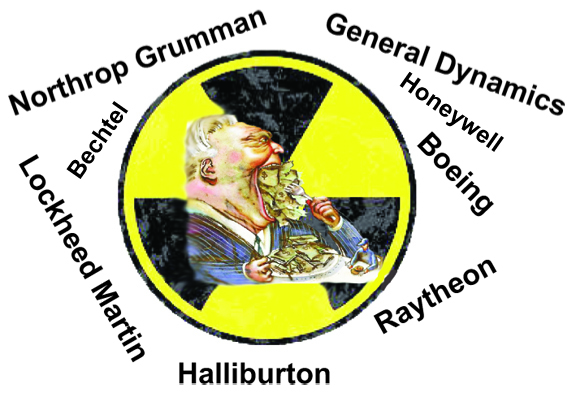
The other three corporations served that same day were Lockheed Martin, Boeing, and General Atomics. These four corporations are representative of the modern-day piracy that is the U.S. war industry, a corporate capture of U.S. foreign policy, the Congress, the Departments of Defense and State, and the U.S. economic system.
Raytheon Technologies occupies a towering office building in Arlington, a stone’s throw from the Pentagon and Arlington National Cemetery, two sites commemorating death and the utter failure of war. Though the Raytheon building has its corporate logo plastered in blood-red letters at the top, once inside no sign exists evidencing this corporate war profiteer. No name, no logo, no receptionist. A sad attempt to hide their dealings in the black art of war.
When asked, security guards refused to acknowledge Raytheon was in the building. Of the dozens of employees who passed, none would admit they worked at Raytheon, averting their eyes as they hurried away. When police arrived to escort the Tribunal members and supporters off premises, the police would not acknowledge Raytheon was headquartered there. Just like the employees, they had their orders. Keep quiet, admit nothing.
It was silent as a tomb except for the voices of the Tribunal members speaking the truth about the trail of suffering and death Raytheon and its corporate brethren have left across Iraq, Afghanistan, Pakistan, Syria, Somalia, and the Palestinian Occupied Territory. Meanwhile, these Merchants of Death have left the United States financially, morally, and spiritually bankrupt.
Raytheon Technologies has a market capitalization of $96 billion. According to Macrotrends, Raytheon Technologies revenue for the quarter ending September 30, 2022 was $16.951B, a 4.55% increase year-over-year. For 2021 it was $64.388B, a 13.79% increase from 2020, for 2020 was $56.587B, a 24.78% increase from 2019, and for 2019 was $45.349B, a 30.68% increase from 2018. In four years, they have garnered almost a 70% increase in revenue. Marketing death is good for profits if you can live with yourself. Apparently, given their silence, many Raytheon employees struggle with this very issue.
Raytheon builds some of the most destabilizing, destructive, and expensive weapons on earth. The Hypersonic Missile which travels in excess of five times the speed of sound — Mach 5 — covering vast distances in minutes. It is “hard to stop and flies nimbly to avoid detection and dodge defensive countermeasures.” All these are attributes which make the missile so destabilizing to a foreign leader who has only minutes to determine whether they are being attacked with a nuclear weapon.
Raytheon makes the Peregrine Air-to-Air Missile which they claim “increases firepower, penetrates bad weather, and goes the distance.” Add to that their plans to use “high power microwaves” in war and we see the epitome of a Merchant of Death.
Boeing, General Atomics, and Lockheed Martin are the same. They too revel in blood money as they build for war and drain the U.S. economy. In fact, some $8 trillion in U.S. taxpayer money has been given to U.S. defense contractors over the last twenty years.
The U.S. War Industry plays a key role in fomenting war with their congressional lobbying, not just pushing for weapons contracts but influencing military strategy, thereby exacerbating and prolonging the anguish of civilians bearing the brunt of these wars of choice. On the issue of war in particular, Congress must be answerable to its citizens, not a handful of corporations.

With their silence on November 10, these weapons manufacturers revealed their shame. Their corporate mission statement is “War Begets Profit.” For the Merchants of Death War Crimes Tribunal, the mission statement is “Come War Profiteers, Give Account.” Stand before a Tribunal and be judged.
And so, what is it like to give your talents to a corporation which hides its very existence, to give all your efforts and education and experience in the creation of weapons which kill indiscriminately? Their loss of words, their averting eyes, the damning silence offered in their corporate crypt, is the devastating answer.
1 This Month
Chernobyl: The Lost Tapes – A good documentary on Chernobyl on SBS available On Demand for the next 3 weeks– https://www.sbs.com.au/ondemand/tv-program/chernobyl-the-lost-tapes/2352741955560

of the week–London Campaign for Nuclear Disarmament

Tell the Ukrainian Government to Drop Prosecution of Peace Activist Yurii Sheliazhenko
To see nuclear-related stories in greater depth and intensity – go to https://nuclearinformation.wordpress.com
-
Archives
- April 2026 (152)
- March 2026 (251)
- February 2026 (268)
- January 2026 (308)
- December 2025 (358)
- November 2025 (359)
- October 2025 (376)
- September 2025 (257)
- August 2025 (319)
- July 2025 (230)
- June 2025 (348)
- May 2025 (261)
-
Categories
- 1
- 1 NUCLEAR ISSUES
- business and costs
- climate change
- culture and arts
- ENERGY
- environment
- health
- history
- indigenous issues
- Legal
- marketing of nuclear
- media
- opposition to nuclear
- PERSONAL STORIES
- politics
- politics international
- Religion and ethics
- safety
- secrets,lies and civil liberties
- spinbuster
- technology
- Uranium
- wastes
- weapons and war
- Women
- 2 WORLD
- ACTION
- AFRICA
- Atrocities
- AUSTRALIA
- Christina's notes
- Christina's themes
- culture and arts
- Events
- Fuk 2022
- Fuk 2023
- Fukushima 2017
- Fukushima 2018
- fukushima 2019
- Fukushima 2020
- Fukushima 2021
- general
- global warming
- Humour (God we need it)
- Nuclear
- RARE EARTHS
- Reference
- resources – print
- Resources -audiovicual
- Weekly Newsletter
- World
- World Nuclear
- YouTube
-
RSS
Entries RSS
Comments RSS
 nuclear-news