Secrecy on USA’s new nuclear stealth bomber, and of course, secrecy on its cost to taxpayers.


The fact that the price is not public troubles government watchdogs.
Pentagon unveils new nuclear stealth bomber after years of secrecy The HillBY THE ASSOCIATED PRESS VIA NEXSTAR MEDIA WIRE – 12/02/22
WASHINGTON (AP) — America’s newest nuclear stealth bomber is making its public debut after years of secret development and as part of the Pentagon’s answer to rising concerns over a future conflict with China.
The B-21 Raider is the first new American bomber aircraft in more than 30 years. Almost every aspect of the program is classified. Ahead of its unveiling Friday at an Air Force facility in Palmdale, California, only artists’ renderings of the warplane have been released. Those few images reveal that the Raider resembles the black nuclear stealth bomber it will eventually replace, the B-2 Spirit.
The bomber is part of the Pentagon’s efforts to modernize all three legs of its nuclear triad, which includes silo-launched nuclear ballistic missiles and submarine-launched warheads, as it shifts from the counterterrorism campaigns of recent decades to meet China’s rapid military modernization………………………………….
Six B-21 Raiders are in production; The Air Force plans to build 100 that can deploy either nuclear weapons or onventional bombs and can be used with or without a human crew. Both the Air Force and Northrop also point to the Raider’s relatively quick development: The bomber went from contract award to debut in seven years. Other new fighter and ship programs have taken decades.
The cost of the bombers is unknown. The Air Force previously put the price for a buy of 100 aircraft at an average cost of $550 million each in 2010 dollars — roughly $753 million today — but it’s unclear how much the Air Force is actually spending.
The fact that the price is not public troubles government watchdogs.
“It might be a big challenge for us to do our normal analysis of a major program like this,” said Dan Grazier, a senior defense policy fellow at the Project on Government Oversight. “It’s easy to say that the B-21 is still on schedule before it actually flies. Because it’s only when one of these programs goes into the actual testing phase when real problems are discovered. And so that’s the point when schedules really start to slip and costs really start to rise.”
The Raider will not make its first flight until 2023. However, using advanced computing, Warden said, Northrop Grumman has been testing the Raider’s performance using a digital twin, a virtual replica of the one being unveiled.
…………………… Given advances in surveillance satellites and cameras, the Raider will debut very much under wraps and will be viewed inside a hangar. Invited guests including Defense Secretary Lloyd Austin will witness the hangar doors open to reveal the bomber for its public introduction, then the doors will close again. https://thehill.com/homenews/3759575-pentagon-unveils-new-nuclear-stealth-bomber-after-years-of-secrecy/
The coming Sinophobic calamity
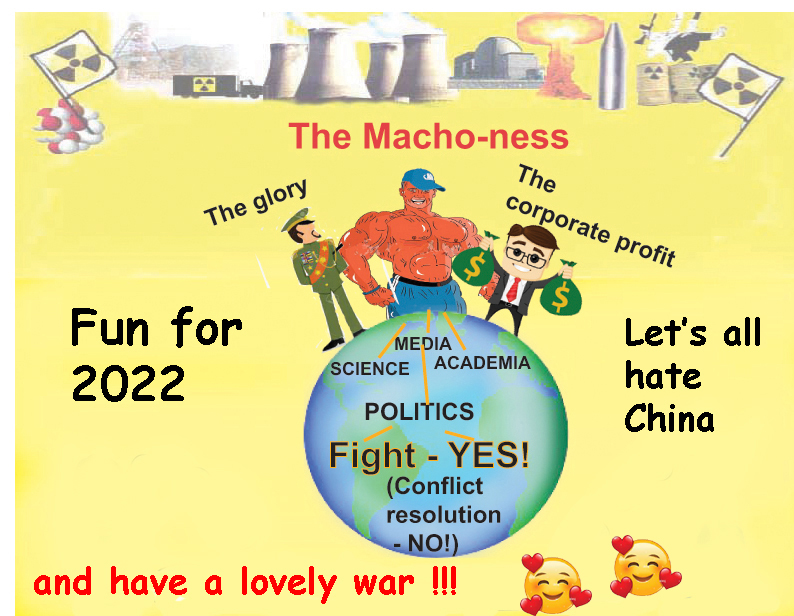
Expect to see such China-hating maniacs back in government in the unlikely event that Trump regains the white house.
powerful Dems like Biden and Nancy Pelosi went out of their way prior to the election to prove that they, too, are tough on China; Pelosi with her idiotic and inflammatory jaunt to Taiwan last summer and Biden, with his many pronouncements that Washington backs Taipei to the hilt and will go to war to prove it.
there are people in his administration who walk back his bellicose yowls….. they ARE oblivious. They aim to drag the Ukraine war out as long as possible
https://johnmenadue.com/the-coming-sinophobic-calamity/ By Eve Ottenberg, Nov 24, 2022,
Neither the red wave nor the blue one materialised in the latest USA election, which removes some of the impetus for the coming congressional Sinophobic rampage.
Some, not all. The relatively good results for Biden mean that for the moment he no longer needs the Beijing boogeyman and could afford to be gracious toward China’s leader, Xi Jinping at the G20 summit. But the GOP won by enough last week to say that so did Sinophobia. The Dems may be, quite despicably, all about World War III with Moscow, but it is a partisan endeavour, because a recent poll revealed that 48 percent of Republicans think we spend too much on the Ukraine war. And the congressional GOP responds to its base.
But war with Beijing, the GOP project, is not a partisan effort; it is bipartisan, and the Republicans are quite proud of and open about that. So their House win last week means one thing: the military and the security state will push ferociously for the assault on China that they have long lusted for, though they are happy, for now, for that assault to remain economic. But don’t be fooled. There is real danger afoot. Those Dems who really want to avert World War III with Beijing will have to be very nimble. And they will have to go about it in a relentless, low-profile manner, because anyone perceived as standing up to the bash-China juggernaut will be crushed, regardless of the lull in Biden’s incendiary rhetoric.
At the top of the GOP foreign affairs agenda is economic war with China – no matter what price we pay (and it will be high) in inflation. Because you can’t slap economic sanctions on your biggest trading partner with impunity. You can’t even slap economic sanctions on any major economy, like Russia’s, without them backfiring badly, as Biden and birdbrain Eurocrats found out when their precious sanctions on Moscow started destroying western economies. Regardless, an economic fight to the death with Beijing is the first item on the GOP to-do list. The second item is actual, all-out, military hot war with China, if it makes any hostile move on Taiwan. Or, for some congressional Neanderthals, even if it doesn’t.
GOP congressmen are all keyed up about confronting Beijing militarily and have been since the Trump administration, with its Sinophobic fanatics like his trade advisor Peter Navarro and Trump national security council member, a foaming-at-the-mouth China-basher, Matt Pottinger, both egging Trump on to heights of folly that could have culminated in a planet-killing nuclear war. Navarro and Pottinger hyped the insane hysteria that China deliberately created covid in a lab and unleashed it (on its own population, an oddity that these two geniuses never bothered to explain), with Navarro proclaiming the arrant nonsense that the “virus was a product of the Chinese Communist Party.” Expect to see such China-hating maniacs back in government in the unlikely event that Trump regains the white house.
According to Trump’s NSC advisor H.R. McMaster, quoted by the Washington Post in April 2020, Pottinger is “central to the biggest shift in U.S. foreign policy since the cold war, which is the competitive approach to China.” So, not to put too fine a point on it, Pottinger bequeathed us disaster. And don’t forget Trump secretary of state Mike Pompeo, no slouch in the anti-China psychosis department, jetting into Taiwan last year to inflame the separatist movement by lauding the Chinese territory as a great “nation,” and hectoring Europeans, as he did in 2020, to sever economic ties with Beijing. This crabby approach to Europe’s Chinese links is now de rigueur in Washington.
And when the Exceptional Empire gets crabby, watch out! The empire carped and groused about Nordstream 1 and 2 for years. Then came the imperial news – from Biden of course – that if Russia invaded Ukraine, Washington would stop Nordstream 2. When asked how this would happen, he said, “I promise you, we will be able to do it.” No one speculated back then that this pronouncement might mean Washington was ready to go full-on Don Corleone. Because Biden didn’t specify how. But barely a year later – voila! Some mysterious somebody blew up both pipelines. Whoever could it be?
So it’s time for imbecile Eurocrats to wake up. The gangsters who exploded their gas pipelines now eye their trade with China, though admittedly blowing up tankers shipping manufactured goods is a more complicated affair. But the Empire is nothing if not creative when it comes to destroying what it perceives as a threat. Assassinations, riots, coups, curating Nazi movements, bombing pipelines – and I’m sure the list includes things we haven’t even thought of or don’t know about. So who knows what could be afoot. Who knows? I’ll tell you: Bipartisan anti-China thugs, led by the GOP, the same GOP whose senator Ted Cruz made a cause celebre out of blocking Nordstream.
Knowing all this, powerful Dems like Biden and Nancy Pelosi went out of their way prior to the election to prove that they, too, are tough on China; Pelosi with her idiotic and inflammatory jaunt to Taiwan last summer and Biden, with his many pronouncements that Washington backs Taipei to the hilt and will go to war to prove it. But at least the election soothed and lowered the temperature of Biden’s bullying, and at least there are people in his administration who walk back his bellicose yowls. They know what a global nuclear catastrophe such a war would be, even if they appear oblivious to the same thing in Ukraine. And they ARE oblivious. They aim to drag the Ukraine war out as long as possible, something Moscow, with its repeated warnings that more NATO weapons only prolong the war, seems not to have taken note of.
Thus the two hydra heads of the bipartisan war party, demonstrating that if indeed the next stage of development after imperial, late-capitalist oligarchy is outright fascism (and if it is, we better figure out a way to stop it, fast), the death wish remains the same. Because no, fascists are not pacifists, no matter how much they demur over the cost of Washington’s abominable proxy war with Moscow in Ukraine. Biden risks global conflagration in Europe, while whoever the GOP vomits up to replace him will simply refocus the nukes onto East Asia.
Expect the worst. “House Republicans plan to put sharp scrutiny on China next year if they win the majority, including establishing a select committee to take on Beijing on a range of economic and military issues,” led an article in the Hill October 28. The GOP believes this work would largely be bipartisan. Gee, I wonder how they got that idea? Could Biden’s war whoops directed at Beijing have anything to do with it? If those whoops and hollers were cynical politics as usual (I suspect they were), this is a very dangerous game. They may box the white house into a policy it didn’t really mean to adopt and one that could leave tens of millions of Americans and an equal number of Chinese, uh, radioactive. But Biden’s played that game before. During the Reagan years and after, while in congress, he tacked right, leaving a ghastly legislative legacy that the great cowards in the progressive caucus would do well to ponder.
House minority leader Kevin McCarthy has long wanted a China select committee, the Hill reports, and “tried to work with Democrats to create one in 2020.” But Pelosi pulled Dems out of this potential quagmire – quite surprisingly, considering her characterisation of the very violent and brutal Hong Kong riots as “beautiful” and her later incitement of Taiwan’s independence, that is, incitement of war – with a foresight she has since lost and one can only hope she quickly recovers.
But intermittent Dem common sense isn’t the only hope. Hard at work to avert the coming debacle between the U.S. and China has been Code Pink. This organisation currently runs campaigns to urge the senate to oppose the Taiwan Policy Act, which would arm Taiwan to the teeth and end the One China policy – a huge blow to peace prospects; to tell congress to stand for peace with China; and condemning “the escalating U.S. militarisation of Guam and the wider Asia-Pacific region.” Code Pink does great work to contain the U.S. anti-China lunacy. But that’s only one organisation.
The GOP wants war with China. The Dems want – and have got – war with Russia, one they intend to drag out for years. Either way, ordinary people all over the globe lose badly. If there’s anyone in government with the sense and the power to stall or, better yet, undo Washington’s coming confrontation with Beijing, now would be a good time to get cracking.
First published in COUNTERPUNCH Nov 19
Why small modular reactors are a climate liability, not a solution, (but good for nuclear weapons development)
Touted as a solution to global heating – small nuclear reactors have zero usefulness
Beyond Nuclear International, By Linda Pentz Gunter, 27 Nov 22

“……………………………………………………. SMRs will be needed in their hundreds if not thousands, requiring up front investment in factories and a known source of readily available fuel. None of this is in place. The typical timeframe for even a known reactor design is more than a decade — sometimes several decades. We don’t have that kind of time.
.

Small modular reactors would deliver electricity that is more expensive than that provided by traditional large reactors today

SMRs will actually produce more radioactive waste per unit of electricity generated than today’s reactors, waste for which there is still no safe and permanent solution.
Every dollar sunk into new small modular reactor plans could have reduced more carbon faster if invested instead in renewable energy and energy efficiency. It’s a no-brainer simple equation that an elementary school kid could work out. But not, apparently, our leaders. Why not?
See above (follow the money) and then there’s the weapons link.
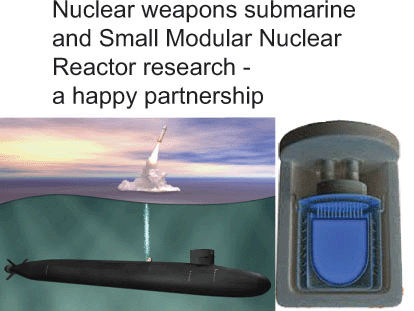
“A strong domestic supply chain is needed to provide for nuclear Navy requirements,” said the Energy Futures Initiative in its report — The U.S. Nuclear Energy Enterprise: A Key National Security Enabler. “This supply chain has an inherent and very strong overlap with the commercial nuclear energy sector and has a strong presence in states with commercial nuclear power plants.”
SMRs would keep that supply chain — and the civil nuclear sector — alive. A 2019 Atlantic Council report — The Value of the US Nuclear Power Complex to US National Security — agrees. “Civil nuclear underpins military nuclear,” it said. “The lack of a civilian nuclear sector would present an immediate and significant economic shock (and impact on the labor force) — which, in turn, would have immediate and longer-term budgetary implications for the US government.”
At least two of the companies striving to develop SMRs in the US have direct links to the nuclear weapons sector. Bill Gates’s TerraPower — whose reactor can be modified to “dual purpose” for weapons and power — has research and development partnerships with Los Alamos National Laboratory and the Y-12 National Security Complex, both of which design and test nuclear weapons. NuScale is majority owned by Fluor Corporation, which operates the U.S. Pantex and Y-12 nuclear weapons complexes.
Furthermore, SMRs are largely destined for export, and hardly for any domestic use at all. That hands proliferation-friendly materials, technology and know-how to countries not presently in possession of this relatively straightforward pathway to nuclear weapons.
If we are to understand the blind obsession with SMRs, the weapons connection offers one of the only plausible explanations. The stranglehold in the halls of power is the other — sound science, economics and our future be damned.
Only we can change this. Please use this latest edition of our Talking Points [Our newest edition — Unfounded Promises: Small Modular Reactors (SMRs) solve none of the challenges of nuclear power and make climate change and proliferation worse ] to contribute to a tsunami of our own — decrying the reckless waste of precious time and taxpayer money that would favor an elusive SMR program. These funds must urgently be directed to renewable energy, an industry that is here now, growing fast and one that can both reduce carbon emissions and provide good, long-term jobs into the future.
Note: In the interest of brevity, the Talking Points do not include footnotes. However, the sources and references used for the SMR Talking Points can be found in a separate document here. https://beyondnuclearinternational.org/2022/11/27/no-use-in-the-climate-crisis/
USA government forks out a $billion to keep uneconomic Diablo Canyon Nuclear Power Plant going.

U.S. Ponies Up $1B to Keep California’s Last Nuclear Plant Humming
The Diablo Canyon Power Plant was scheduled to close in 2025, but federal backing will now prolong its (half) life indefinitely
Los Angeles Magazine, By Julius Miller, November 27, 2022,
The Biden Administration announced this week that it had reached preliminary approval to allocate at least $1.1 billion in an effort to keep California’s sole remaining nuclear power plant running.
The Energy Department says that it is negotiating final terms for the Diablo Canyon Power Plant on the central coast of California to remain open and avoid its 2025 end date, according to the Associated Press. The plant was selected in the first round of funding for the administration’s new civil nuclear credit program, which is intended to help owners or operators of the nation’s last nuclear plants help cover the costs of preserving the existing U.S. reactor fleet.
Applicants must not only demonstrate that closure of their plant could directly lead to economic suffering, but also that carbon emission and air pollutant levels will rise without their continued operation………………………
“This investment creates a path forward for a limited-term extension of the Diablo Canyon Power Plant to support reliability statewide and provide an onramp for more clean energy projects to come online,” Newsom said……………
The Diablo Canyon Power Plant produces nine percent of California’s electricity. For comparison, the wind power provides roughly seven percent of the state’s electricity, while solar makes up nearly 14 percent of the total. https://www.lamag.com/citythinkblog/u-s-ponies-up-1b-to-keep-californias-last-nuclear-plant-humming/
USA’s Inflation Reduction Act of 2022 (IRA) cleverly worded so it could be a bonanza for small nuclear plant developers
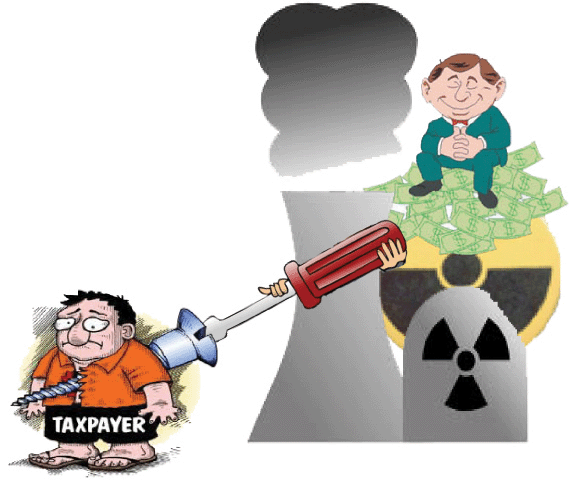
Advanced Nuclear Plants Poised to Benefit from Inflation Reduction Act, Retiring Coal Plants
American Power Association, November 27, 2022 Peter Maloney “………………………………… The Inflation Reduction Act of 2022 (IRA) provides production tax credits (PTC) for existing nuclear power plants but, more importantly, for new nuclear power plants and specifically for advanced reactors and small modular reactors – the type NuScale Power is working on. The IRA amends the definition of a qualified facility eligible for a “clean PTC” to mean any plant placed into service after Dec. 31, 2024, that produces zero greenhouse gas emissions.
The IRA also amends the Internal Revenue Service (IRS) rules on qualifying for a clean energy investment tax credit (ITC) by changing the language in the code to allow investments for advanced reactors to qualify for the credit. The change provides a tax credit of 30 percent of the cost of building a zero-emission advanced nuclear power plant that is placed in service after 2025.
“If you design and plan to put in a small modular reactor at the site of a retired coal plant, there is a further 10 percent ITC available, and if you use domestic content there is another 10 percent ITC added on,” Colbert said. “That can add up to a 50 percent reduction in costs.”
In September, the Department of Energy (DOE) released a study that found that hundreds of coal power plant sites across the country could be converted to nuclear power plant sites……………………..
Each NuScale small modular reactor (SMR) is designed to generate 77 megawatts (MW) of electricity. Up to 12 SMRs can be combined to make a 924-MW VOYGR™-12 power plant. In addition to their compact design, which makes them scalable and cost competitive, …………………………..
NuScale is now looking forward to reaching another milestone in the regulatory process.
In July, the NRC directed its staff to issue a final rule certifying NuScale’s SMR design.
The rulemaking would amend NRC regulations to incorporate NuScale’s SMR standard plant design, which would allow applicants intending to build and operate an SMR plant to reference the design certification rule.
“If approved, the certification would be published in the Federal Register and have the effect of law,” Colbert said.
The rulemaking is on the docket for the NRC to make a decision in November.
Kamala Harris, nuclear saleswoman extraordinaire, touting small nuclear reactors to Thailand

US to help Thailand harness nuclear energy, Manila Times. By Agence France-Presse, November 28, 2022
IN SEARCH OF CLEAN FUEL A staff member works at the production line of Dunan Metals Co. Ltd in the Thai-Chinese Rayong industrial zone in Rayong province, Thailand, Nov. 8, 2022. The United States will help Thailand develop nuclear power through a new class of small reactors, part of a program aimed at fighting climate change, Vice President Kamala Harris announced on a visit Saturday, November 26. XINHUA PHOTO
BANGKOK: The United States will help Thailand develop nuclear power through a new class of small reactors, part of a program aimed at fighting climate change, Vice President Kamala Harris announced on a visit Saturday.
The White House said the assistance was part of its Net Zero World Initiative, a project launched at last year’s Glasgow climate summit in which the United States partners with the private sector and philanthropists to promote clean energy.
Thailand does not have nuclear power, with the public mood on the issue souring after the 2011 Fukushima disaster in Japan.
The White House said it would offer technical assistance to the Southeast Asian country to deploy the developing technology of small modular reactors, which are factory-built and portable………………
The White House did not give a timeline but said it would support Thailand, which is highly vulnerable to climate change, in its goal of going carbon neutral by 2065.
Harris is visiting the US ally for an Asia-Pacific Economic Cooperation summit and discussed climate efforts in a meeting with Thai Prime Minister Prayut Chan-O-Cha………… https://www.manilatimes.net/2022/11/28/news/world/us-to-help-thailand-harness-nuclear-energy/1868041
Small Modular Nuclear Reactor cost overruns: the same old problems haunt new nuclear in Utah
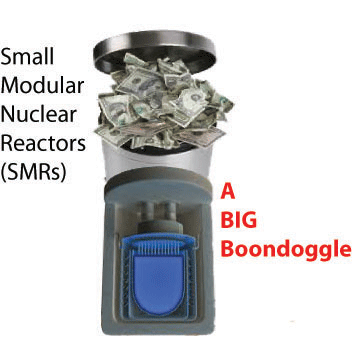
Much hope is being placed on Small Modular Reactors (SMR) making new
nuclear plants competitive. But David Schlissel at IEEFA summarises their
research into the publications, updates and statements coming from the
stakeholders involved with the SMR by UAMPS (Utah Associated Municipal
Power Systems) and NuScale Power Corporation that shows that costs are
going out of control, a persistent problem in the nuclear industry.
The original target power price of $55/MWh has risen to $100 (with subsidies)
and is likely to rise further by the time it’s switched on in 2030, says
Schlissel. Construction costs and delays are the main causes (as usual). So
concerned are potential customers that, since February 2022, only 101MW of
the plant’s total 462MW have been subscribed to.
It will be difficult to
secure financing for the plant without a fully subscribed project.
Meanwhile, IEEFA figures say renewable resources and battery storage will
provide reliable electricity at lower cost than the UAMPS plant, even if
the price for the power from the project is just $58 per MWh. And
renewables and battery costs are still declining.
Energy Post 25th Nov 2022 more https://energypost.eu/small-modular-reactor-cost-overruns-the-same-old-problems-haunt-new-nuclear-in-utah/
US Arms Dealing Is Out of Control
What will it take to rein in Washington’s arms-sales addiction?

The Nation, By William D. Hartung. NOVEMBER 23, 2022,
There’s a seldom commented upon reality of this century and this moment: The United States remains the number-one arms-exporting nation on the planet. Between 2017 and 2021, it grabbed 39 percent of the total global weapons market, and there’s nothing new about that. It has, in fact, been the top arms dealer in every year but one for the past three decades. And it’s a remarkably lucrative business, earning American weapons makers tens of billions of dollars annually.
It would be one thing if it were simply a matter of money raked in by the industrial half of the military-industrial complex. Unfortunately, in these years, US-supplied weaponry has also fueled conflicts, enabled human-rights violations, helped destabilize not just individual countries but whole regions, and made it significantly easier for repressive regimes to commit war crimes.
At first glance, it appeared that Joe Biden, on entering the White House, might take a different approach to arms sales. On the campaign trail in 2020, he had, for instance, labeled Saudi Arabia a “pariah” state and implied that the unbridled flow of US weaponry to that kingdom would be reduced, if not terminated. He also bluntly assured voters that this country wouldn’t “check its values at the door to sell arms.”
Initially, Biden paused arms deals to that country and even suspended one bomb sale. Unfortunately, within eight months of his taking office, sales to the Saudi regime had resumed. In addition, the Biden team has offered arms to a number of other repressive regimes from Egypt and Nigeria to the Philippines. Such sales contrast strikingly with the president’s mantra of supporting “democracies over autocracies,” as well as his reasonable impulse to supply weapons to Ukraine to defend itself against Russia’s brutal invasion.
The last president who attempted to bring runaway US weapons trafficking under some sort of control was Jimmy Carter. In 1976, he campaigned for the presidency on a platform based, in part, on promoting human rights globally and curbing the arms trade. And for a period as president, he did indeed suspend sales to repressive regimes, while, in that Cold War era, engaging in direct talks with the Soviet Union on reducing global arms sales. He also spoke out eloquently about the need to rein in the trade in death and destruction.
However, Zbigniew Brzezinski, his hard-line national security advisor, waged a campaign inside his administration against the president’s efforts, arguing that arms sales were too valuable as a tool of Cold War influence to be sacrificed at the altar of human rights. And once that longtime ally, the shah of Iran, was overthrown in 1978 and the Soviet Union invaded Afghanistan in 1979, all talk of controlling the arms trade went out the window.
THE BIDEN RECORD: WHY NOT RESTRAINT?
What accounts for Joe Biden’s transformation from a president intent on controlling arms sales to a business-as-usual promoter of such weaponry globally? The root cause can be found in his administration’s adherence to a series of misguided notions about the value of arms sales. In a recent report I wrote for the Quincy Institute for Responsible Statecraft on the US approach to such exports, I lay out those notions fully, including lending a hand in stabilizing key regions, deterring Washington’s adversaries from engaging in aggression, building meaningful military-to-military relationships with current or potential partner nations, increasing this country’s political and diplomatic influence globally, and creating jobs here in the United States. In the Saudi case, Biden’s shift was tied to the dangerous notion that we needed to bolster the Kingdom’s supposedly crucial role in “containing Iran”—a policy that only increases the risk of war in the region—and the false promise that, in return, the Saudis would expand their oil output to help curb soaring gas prices here at home.
Such explanations are part of an all-encompassing belief in Washington that giving away or selling weaponry of every sort to foreign clients is a risk-free way of garnering yet more economic, political, and strategic influence globally. The positive spin advocates of the arms trade give to the government’s role as the world’s largest arms broker ignores the fact that, in too many cases, the risks—from fueling conflict and increasing domestic repression elsewhere to drawing the United States into unnecessary wars—far outweigh any possible benefits.
AN ARMS CLIENTS HALL OF SHAME
There are numerous examples, both historically and in the present moment, of how this country’s arms sales have done more harm than good, but for now let’s just highlight four of them—Saudi Arabia, Egypt, Nigeria, and the Philippines.
SAUDI ARABIA……………
EGYPT…………………….
NIGERIA………………….
THE PHILIPPINES……….
COMPANIES CASH IN
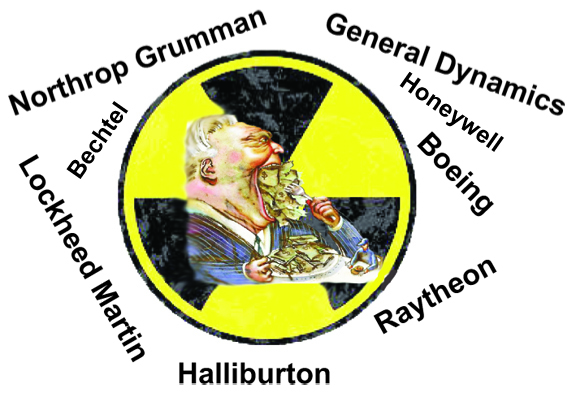
While the humanitarian consequences of US arms sales may be devastating, if you happen to be a major weapons maker like Lockheed Martin, Boeing, Raytheon, or General Dynamics, the economic benefits are enormous. Weapons systems built by those four companies alone have figured in more than half of the $100 billion-plus in major arms offers made since President Biden took office.
While those firms prefer to pose as passive beneficiaries of carefully considered government policies, they continue to work overtime to loosen restrictions on weapons exports and expand the number of countries eligible for such equipment and training. To that end, those four giant firms alone routinely donate millions of dollars to key members of Congress, while employing 300 lobbyists, many of them drawn from the ranks of the Pentagon, Congress, and the National Security Council. Once on board, those retired generals, admirals, and other officials use their government contacts and inside knowledge of the arm-sales process to influence government policies and practices.
A particularly egregious and visible example of this was Raytheon’s effort to pressure Congress and the Trump administration to approve a sale of precision-guided munitions to the Saudis. A former Raytheon lobbyist, Charles Faulkner, worked inside the State Department to keep the Saudi arms pipeline open despite that country’s bombing of civilian targets in Yemen, and then Raytheon’s former CEO, Thomas Kennedy, even went so far as to directly lobby Senate Foreign Relations chairman Senator Robert Menendez over Saudi arms sales. (He was rebuffed.) But the most spectacular lobbyist for the Saudis was, of course, President Trump, who justified continuing arms sales to Riyadh after the regime’s 2018 murder of US resident, Saudi journalist, and Washington Post columnist Jamal Khashoggi this way:
$110 billion will be spent on the purchase of military equipment from Boeing, Lockheed Martin, Raytheon, and many other great U.S. defense contractors. If we foolishly cancel these contracts, Russia and China would be the enormous beneficiaries—and very happy to acquire all this newfound business. It would be a wonderful gift to them directly from the United States!
In fact, neither Russia nor China would be able to replace the US as Saudi Arabia’s primary arms supplier any time soon. The kingdom is so reliant on American equipment that it might take a decade or more for it to rebuild its military around weapons supplied by another nation.
In reality, expansive as American arms sales to the Saudis are, that $110 billion figure was a typical case of Trumpian exaggeration. Actual sales during his term were less than one-third of that, and jobs tied to those sales in the US were similarly far less than President Trump claimed. The figure he liked to throw around— 500,000—was at least 12 times the actual one. Still, the damage done by the weaponry his administration rammed through Congress for the Saudis has been incalculable and can’t be measured by the dollar value of any particular sale.
The Raytheon lobbying campaign was extraordinary primarily because its details became public knowledge. But count on one thing: Similar efforts by other military-industrial corporations surely take place behind closed doors on a regular basis. One precondition for reducing dangerous arms deals would have to be reducing the political power of the major weapons-producing companies.
PUSHING BACK AGAINST AMERICA’S ARMS SALES ADDICTION
In 2019, spurred by Saudi actions ranging from the war in Yemen to the Khashoggi murder, both houses of Congress voted down a specific deal for the first time—$1.5 billion in precision-guided bombs for Saudi Arabia and other Middle Eastern clients—only to have their actions vetoed by President Trump. Successful votes to end military support or Saudi Arabia under the War Powers Resolution met a similar fate……………………………
Success in reining in Washington’s arms-sales addiction will, at the very least, require a major campaign of public education. Too few Americans even know about their nation’s role as the world’s largest weapons trader, much less the devastating impact of the arms it transfers. But when asked, a majority of Americans are against arming repressive regimes like Saudi Arabia and consider arms sales to be “a hazard to US security.”
Still, until there is greater public understanding of the humanitarian and security consequences of what the government is doing in our name, coupled with concerted pressure on the Biden administration, the national security state, and the weapons makers, the arms trade is likely to continue full speed ahead. If so, those companies will remain in weapons heaven, while so many people on this planet will find themselves in a hell on Earth https://www.thenation.com/article/world/arms-dealing-us-weapons-market/?utm_source=Sailthru&utm_medium=email&utm_campaign=Daily%2011.23.2022&utm_term=daily
Confusion over nuclear wastes from small modular reactors
Managing NuScale, other SMR waste will be ‘roughly comparable’ with conventional reactors, DOE labs find Utility Dive Stephen Singer, 23 Nov 22
Dive Brief:
- Two studies differ over how much nuclear waste would be a factor with small modular reactors, or SMRs, such as those planned by NuScale and TerraPower.
- The Argonne and Idaho national laboratories say managing waste from SMRs would have few challenges compared with traditional light water reactors. Spent fuel is thermally hot and highly radioactive, requiring remote handling and shielding.
- A study led by Stanford University and the University of British Columbia says SMRs will generate more radioactive waste than conventional nuclear power plants…………………………… more https://www.utilitydive.com/news/smr-modular-reactor-nuclear-waste-doe-stanford-0
USA Vice-President For the Nuclear Industry Kamala Harris on a marketing jaunt for NuScam’s Small Nuclear Reactors to Southeast Asia

Thailand, Philippines, Indonesia – nuclear reactors such a jolly idea in this earthquake ring of fire ?
US to supply Thailand, Philippines with modular nuclear reactors
BenarNews staff, 2022.11.23, Bangkok.
The United States says it will help Thailand and the Philippines with a new civilian nuclear technology to reduce climate-damaging emissions, but experts warn the final products are years away from being operational and other hurdles exist.
Plans by the U.S. to supply its longtime Southeast Asian allies with so-called small modular reactors (SMRs) were unveiled during Vice President Kamala Harris’ trip to both countries in recent days.
While attending the Asia-Pacific Economic Cooperation meetings in Bangkok last weekend, Harris launched a new clean energy partnership with Thailand.
From there, the vice president went to the Philippines where she announced that Washington and Manila were starting negotiations on the 123 Agreement, which would allow for civilian nuclear cooperation.
The U.S. nuclear technology plans for Thailand and the Philippines are firsts involving Southeast Asian nations.
The SMRs, which can be as small as a bucket and transportable, are to be constructed under “the highest standards of safety, security and nonproliferation,” officials said.
Another country in Southeast Asia that has shown interest in developing such reactors – Indonesia – appears to be looking at designs from several countries. [Never mind about the earthquakes?]
In a press release, the White House said the new partnership with Thailand would “build capacity for the secure and safe deployment of advanced nuclear reactor technologies.”
“This partnership will help Thailand take advantage of the unique benefits of SMRs that provide 24/7 reliable power, complement other clean energy sources, use a small land footprint and incorporate advanced safety features.”
The Thai government has set a goal of Net Zero Emissions by 2065, but no timeline for the SMR partnership. Washington praised the “unique benefits” of reactors which, besides providing reliable power, also fight climate change.
Small modular reactors generally are defined as advanced nuclear reactors with a capacity of less than 300 MW, according to the International Energy Agency.
A reactor could be as small as a five-gallon (18.9-liter) bucket. The traditional design has fuel and control rods, and energy is transported through boiling water, according to NuScale, a U.S. SMR manufacturer, which estimated initial costs at about U.S. $500 million.
The agreement with Manila calls for the U.S. and the Philippines to cooperate on advanced nuclear technologies to ensure energy security as that Southeast Asian country transitions to clean energy.
Once in force, the 123 agreement “will provide the legal basis for U.S. exports of nuclear equipment and material to the Philippines. The United States is committed to working with the Philippines to increase energy security and deploying advanced nuclear reactor technology as quickly as safety and security conditions permit to meet the Philippines’ dire baseload power needs,” the White House said in a statement.
Under President Ferdinand Marcos Jr.’s father, the late dictator Ferdinand E. Marcos, the Philippines began construction of the Bataan Nuclear Power Plant in 1976, in an area about 100 km (62 miles) west of Manila. The plant, constructed above a major fault line, was mothballed amid safety concerns after the 1986 Chernobyl disaster.
Today, the Philippines runs a couple of research reactors for training and education purposes while Thailand has no nuclear power.
……….. Tanagorn said Thais were concerned about safety in light of the 2011 Fukushima nuclear disaster caused by a tsunami in Japan. Other obstacles are the limited number of investors and the lack of domestic laws and regulation of nuclear activities.
John Timmer, science editor of Ars Technica, a web portal focusing on science and technology, said that with nuclear reactors, the principle is always “safety first.”
“The approval process for that reason tends to be long and includes a lot of documentation,” he said.
“The SMRs are designed to be much safer, but they haven’t been built (in the U.S.) in a final form yet, so it’s difficult to say whether the real-world experience will show that to be the case and also how useful they’ll be for addressing climate change,” Timmer told BenarNews.
“I’ve been hearing about SMRs for about a decade,” he said, adding that “until we build and get a sense what operating them is like and what costs are like, I’m going to be a bit skeptical.”
Cost is another obstacle.
“We’ve never built one of these, so this is going to be a learning experience and for the first few years. It’s going to be more expensive and more complicated to complete,” Timmer said.
‘Widespread misconceptions’
Economist John Quiggin, a professor at the University of Queensland in Australia, listed economic viability of nuclear power plants compared to coal, gas or solar and wind facilities as one of the “widespread misconceptions.”
“When pressed, nuclear fans will mostly shift the argument to the ill-defined notion of ‘small modular reactors,’ which don’t actually exist, and may never [exist],” Quiggin said, noting there are operating examples of small reactors, but “those are made on a one-off basis and are expensive because they forgo size economies.”
Once the reactors can be factory-produced “the ‘modular’ idea is to counter this loss with the economic gains of high-volume,” he said.
“There has been a lot of talk lately about a revival of nuclear power, partly in response to the need to replace the energy previously supplied by Russia, and partly as a longer-term response to climate change,” Quiggin said.
While in office U.S. President George W. Bush launched a nuclear power program, which led to talks of a “nuclear renaissance” but yielded only two projects despite no effective opposition “except from consumers objecting to the massive costs.”
Quiggin expects that the number of SMRs constructed will be also “tiny.”
“The work of decarbonizing energy supply will be done almost entirely by the sun and the wind,” he said.
Jason Gutierrez in Manila contributed to this report. https://www.benarnews.org/english/news/philippine/nuclear-reactors-11232022142149.html
U.S. Nuclear Reactors Among the Oldest in the World
NUCLEAR PROGRAMS
Statista, by Katharina Buchholz, Nov 23, 2022,
The United States’ 92 nuclear reactors currently in operation have a mean age of 41.6 years, the third oldest in the world. The only nuclear fleets that are older are those of Switzerland (46.3 years) and Belgium (42.3 years). Also older are the singular reactors in use in Armenia and the Netherlands.
The U.S. was among the first commercial adopters of nuclear energy in the 1950s, explaining the number of aging reactors today. A building boom between the 1960s and 1970s created today’s nuclear power plants in the United States. The five reactors completed in the 1990s and the one finished in 2016 were all holdovers of delayed construction projects from the 1970s experiencing roadblocks due to regulatory problems and mounting opposition to nuclear energy. The most recent construction start date of a completed U.S. reactor today is 1978 – one year before the nuclear accident at Three Mile Island, which further cemented the public’s rejection of nuclear energy and the challenges of updating nuclear reactor infrastructure today. However, two reactors started at Vogtle power plant in Georgia in 2013 will join the grid soon as the newest additions to the U.S. fleet. They too experienced many regulatory and other delays, culminating in the bankruptcy of the reactor construction company. The U.S. government stepped in with a loan so that the project can now be finished almost 17 years after its initial proposal.
The U.S. today is one of only 15 countries which the World Nuclear Industry Status Report lists as actively pursuing nuclear energy. This includes new nuclear programs in the United Arab Emirates, Belarus and Iran that were started in the past decade only, as well as a younger program in China that started producing power in 1991 and today has a mean reactor fleet age of just nine years. India, running a nuclear energy program since 1969, nevertheless saw much more recent construction than the U.S., achieving a current mean reactor age of 24.2 years. Many European countries which were early adopters of the technology are meanwhile phasing out their programs, at times before the end of reactors’ expected lifespans……….. https://www.statista.com/chart/28805/mean-age-of-nuclear-reactor-fleets-in-selected-countries/
NuScam’s Utah small nuclear reactor project in doubt – needs $billions of tax-payer support

Want to buy into a nuclear power project? This Utah group would like to talk.
UAMPS is still looking at small reactors in Idaho, but cost estimates are climbing and they need more partners.
After seven years, the Utah Associated Municipal Power Systems is still pursuing a series of small nuclear reactors at the Idaho National Laboratory as their clean-power solution.
And, after seven years, they still need more company.
UAMPS, which has 50 members that coordinate on buying and delivering electricity, will soon be updating the 27 entities that have opted into the “Carbon-Free Power Project,” and the price is going up.
The CFPP, a partnership between UAMPS and NuScale Power, an Oregon company developing small nuclear reactors, had given the members an earlier estimate of about $58 per megawatt-hour for power from the project, which was well above what they’re currently paying for power. And now it’s looking closer to be in the $80 to $100 per megawatt-hour by the time it would come online in 2029.
Meanwhile, the UAMPS members who have committed to the project would only take about a quarter of the CFPP’s planned 462-megawatt capacity. UAMPS’ incoming CEO Mason Baker acknowledges that isn’t enough…………..
Baker said they are looking for partners both inside and outside UAMPS. There were originally 36 interested members, but concerns over costs and risks were enough for Logan, Bountiful and others to withdraw in 2020…………………………………………
Is it a too-risky business?
Both Laurie Mangum, energy services director for St. George City. and Dennis Bott, mayor of Brigham City said they would like to see more financial participation from the federal government to lower the risk. The Department of Energy has committed $1.4 billion to the project. “I’d like to see them double or triple that,” Bott said.
UAMPS spokesman LaVarr Webb said completion of the latest cost estimates will trigger an “off-ramp” opportunity for the 27 participants. And if the price estimate exceeds a certain level, UAMPS will have the option to walk away with most of its costs recouped. If they do proceed, UAMPS will issue bonds to pay for the project, and power ratepayers in those cities will pay back the bonds through their monthly bills……………………….
The environmental watchdog group HEAL Utah has opposed the project since its inception, and Executive Director Lexi Tuddenham said CFPP can’t gain enough participants because of the open-ended financial risk of nuclear energy. She pointed to nuclear projects in South Carolina and Georgia that have seen large cost overruns.
“Baseload is important, but nuclear is certainly not the only way to meet that need — in addition to demand-side management, efficiency upgrades, and smart grids,” she said. “Battery storage technology of many types is at a stage where it can provide the reliable and dispatchable energy needed to pair with intermittent sources like wind and solar. In fact it is better and far more efficient at load-following than nuclear, which becomes even less cost effective when it is switched on and off.”………………………………
Still, what about nuclear waste?
From NuScale’s standpoint, the project is still full-speed ahead.
“We have issued the long-lead material specifications for the upper reactor pressure vessel, and the UAMPS project remains on track to start delivering safe and reliable carbon-free energy by the end of this decade,” said Diane Hughes, Vice President of NuScale’s Marketing and Communications. She said UAMPS’ license application is on schedule to be submitted to the Nuclear Regulatory Commission in 2024. The NRC review is expected to completed in 2026, and construction is planned for later that year. NuScale declined to comment on whether the project needed more participation to proceed.
For all of its safety refinements, the CFPP still relies on the fission of uranium, and with that process comes high level nuclear waste that takes up to 250,000 years to decay to a safe level. The U.S. government has never come up with a permanent solution for the waste, which is still stored near the plants that produced it. Like all nuclear power plants, the CFPP will be paying into a federal fund aimed at developing a solution………… https://www.sltrib.com/renewable-energy/2022/11/24/want-buy-into-nuclear-power/
Costs of NuScam’s Small Modular Nuclear Reactors revised upwards – yet again!
According to industry reports the builders of the NuScale small modular reactor (SMR) project recently submitted revised cost estimates to their muni and co-op partners. Initial cost estimates were for power to be produced at about $58/MWh. This figure was recently revised upwards to roughly $90-$100/Mwh, a projected price increase of 60-70%.
The causes cited by management for these price increases were twofold: inflation (in material costs, i.e. steel) and higher interest rates. This initial NuScale project located at the federal government’s Idaho National Laboratories in Idaho Falls would consist of six 77 MW reactors with the units slated to enter commercial service in 2029-2030. These estimates of per KWH cost are significantly above those we have seen recently for renewables plus storage.
Oil Price 21st Nov 2022
Nuclear Guinea Pigs: NRC’s Licensing of Experimental Nuclear Plants


“Dr. Lyman warns us all once again how largely beholden to the nuclear industry the NRC is. NRC is willing to twist and contort even reasonable safety regulations in ways that cater to nuclear industry desires to a degree that would rival a toy balloon-dog at a children’s party. It is this kind of almost institutionalized acquiescence to industry wants that has led many to believe that NRC stands for Not Really Concerned.”
https://www.counterpunch.org/2022/11/22/nuclear-guinea-pigs-nrcs-licensing-of-experimental-nuclear-plants/ BY KARL GROSSMAN 22 Nov 22,
“Guinea Pig Nation: How the NRC’s new licensing rules could turn communities into test beds for risky, experimental nuclear plants,” is what physicist Dr. Edwin Lyman, Director of Nuclear Power Safety with the Union of Concerned Scientists (UCS), titled his presentation last week.
The talk was about how the U.S. Nuclear Regulatory Commission is involved in a major change of its “rules” and “guidance” to reduce government regulations for what the nuclear industry calls “advanced” nuclear power plants.
Already, Lyman said, at a “Night with the Experts” online session organized by the Nuclear Energy Information Service, the NRC has moved to allow nuclear power plants to be built in thickly populated areas. This “change in policy” was approved in a vote by NRC commissioners in July.
For a more than a half-century, the NRC and its predecessor agency, the U.S. Atomic Energy Commission, sought to have nuclear power plants sited in areas of “low population density”—because of the threat of a major nuclear plant accident.
But, said Lyman, who specializes in nuclear power safety, nuclear proliferation and nuclear terrorism, the NRC in a decision titled “Population-Related Siting Considerations for Advanced Reactors,” substantially altered this policy.
The lone NRC vote against the change came from Commissioner Jeffery Baran who in casting his ‘no’ vote wrote “Multiple, independent layers of protection against potential radiological exposure are necessary because we do not have perfect knowledge of new reactor technologies and their unique potential accident scenarios….Unlike light-water reactors, new advanced reactor designs do not have decades of operating experience; in many cases, the new designs have never been built or operated before.”
He noted a NRC “criteria” document which declared that the agency “has a longstanding policy of siting nuclear reactors away from densely populated centers and preferring areas of low population density.”
But, said Baran, under the new policy, a “reactor could be sited within a town of 25,000 people and right next to a large city. For reactor designs that have not been deployed before and do not have operating experience, that approach may be insufficiently protective of public health and safety…And it would not maintain the key defense-in-depth principle of having prudent siting limitations regardless of the features of a particular reactor design—a principle that has been a bedrock of nuclear safety.”
That is just one of the many reductions proposed in safety standards.
“The central issue,” commented Lyman in an interview following his November 17th presentation, “is that the NRC is accepting on faith that these new reactors are going to be safer and wants to adjust its regulations accordingly, to make them less stringent—on faith.”
The key motivation, he said, behind the nuclear industry’s push to significantly weaken safety standards is that the line of smaller nuclear power plants the nuclear industry is now pushing—including what it calls the “small modular nuclear reactor”—is that they are going to be “much more expensive” than the existing light-water nuclear power plants, the most common type of nuclear power plant which are large and are cooled by plain water. Thus, he said, these “advanced” nuclear plants would be more costly to operate than using energy alternatives, “certainly wind and solar.”
And the NRC is complying with the nuclear industry.
It’s a demonstration of one of the alternatives for the acronym for the NRC—Nuclear Rubberstamp Commission.
The list of proposed safety reductions in the PowerPoint portion of Lyman’s presentation under “Cutting corners on safety and security to cut costs,” and what the nuclear industry “wants” in what the NRC calls its “Part 53” assemblage of changes, included, in addition to the already completed alteration of siting criteria:
+ Allowing nuclear power plants to have a “small containment—or no physical containment at all.” Containments are the domes over nuclear plants to try to contain radioactive releases in an accident.
+ “No offsite emergency planning requirements.” The NRC has been requiring emergency planning including the designation of a 10-mile evacuation zone around a nuclear power plant.
+ “Fewer or even zero operators.” The nuclear industry would like advanced nuclear plants to operate “autonomously.”
+ Letting the plants have “fewer” NRC “inspections and weaker enforcement.”
+ “Reduced equipment reliability reporting.”
+ “Applications” for an advanced reactor “should contain minimal information.”
+ “The NRC’s review standards should be lenient.’
+ Letting the plants have “fewer inspections and weaker enforcement.”
+ “Fewer back-up safety systems.”
+ “Regulatory requirements should be few in number and vague.”
+ “Zero” armed security personnel to try to protect an advanced nuclear power plant from terrorists.
Lyman commented: “I could go on and on.”
The Nuclear Energy Information Service’s summary of his presentation stated: “Under
the direction of Congress, the NRC is developing new regulations to facilitate licensing of experimental reactors by relaxing safety security standards and by relying on safety demonstrations that utilize computer simulations rather than experimental data. The major focus of this effort, known as ‘Part 53,’ is being written with an unprecedented level of industry involvement. If ‘Part 53’ is enacted, first-of-a kind reactors would be located in densely populated urban areas without any promise for emergency evacuation, planning, without security forces to protect against terrorist attack, and without highly trained operators—and all without meaningful opportunities for public input”.
In his talk, Lyman referenced a 140-page report of the Union of Concerned Scientists which he authored, issued last year, titled “Advanced” Isn’t Always Better, Assessing the Safety, Security, and Environmental Impacts of Non-Light-Water Nuclear Reactors.
The report states: “Almost all nuclear power reactors operating and under construction today are LWRs, so called because they use ordinary water to cool their hot, highly radioactive cores. Some observers believe that the LWR, the industry workhorse, has inherent flaws that are inhibiting nuclear power’s growth….In response, the US Department of Energy’s national laboratories, universities, and numerous private vendors—from large established companies to small startups—are pursuing the development of reactors that differ fundamentally from LWRs. These non-light-water reactors are cooled not by water, but by other substances, such as liquid sodium, helium gas, or even molten salts.”
These “are sometimes referred to as ‘advanced reactors.’ However, that is a misnomer for most designs being pursued today…largely descend from those proposed many decades ago,” the report continued.
“In part,” it went on, “the nuclear industry’s push to commercialize NLWRs is driven by its desire to show the public and policymakers that there is a high-tech alternative to the static, LWR-dominated status quo: a new generation of ‘advanced’ reactors. But a fundamental question remains: Is different actually better? The short answer is no. Nearly all of the NLWRs currently on the drawing board fail to provide significant enough improvements over LWRs to justify their considerable risks.”
In the report, Lyman extensively examines issues involving each of the NLWR (Non Light Water Reactors) or “advanced” reactors.
David Kraft, director of the Chicago-based Nuclear Energy Information Service, after Lyman’s talk said in an interview: “Dr. Lyman warns us all once again how largely beholden to the nuclear industry the NRC is. NRC is willing to twist and contort even reasonable safety regulations in ways that cater to nuclear industry desires to a degree that would rival a toy balloon-dog at a children’s party. It is this kind of almost institutionalized acquiescence to industry wants that has led many to believe that NRC stands for Not Really Concerned.”
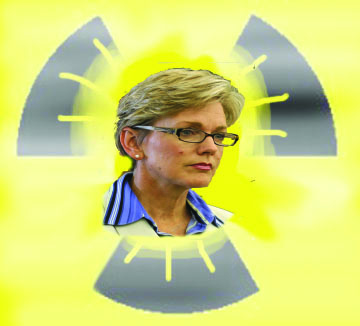
Kraft continued: “Make no mistake about it—while NRC is doing its part to serve nuclear industry needs, we should not lose sight of the fact that it is the aggressive pro-nuclear agenda of the Biden Administration that has unleashed a juggernaut of financial and PR support for new nuclear reactors. Everything from the tens of billions of dollars allocated for new nuclear in the Infrastructure Act and the IRA [Inflation Reduction Act, which establishes a nuclear power production tax credit], to the national dog-and-pony show [the recent U.S. tour promoting nuclear power] of Energy Secretary Jennifer Granholm, demonstrates the administration’s intentions to run roughshod over the objections of the public. We have a hard fight ahead of us.”
The Nuclear Energy Information Service is among the safe-energy, anti-nuclear organizations that are challenging the NRC’s effort to change its “rules” and “guidance” to boost “advanced” nuclear plants. Founded in 1981, its website is neis.org. It plans to soon post through its website a recording of Lyman’s Zoom presentation.
Lyman’s PowerPoint included a slide saying the “NRC is not currently” accepting comments on its plan for changes in its regulations for “advanced” reactors. But, it said, “the public is always free to weigh in” on NRC actions and recommended people attend any public meetings held on the issue.
Lyman joined the Union of Concerned Scientists in 2003 and is based in its Washington, D.C. office. Previously, he was president of the Nuclear Control Institute in Washington. Before that he was a postdoctoral research associate at Princeton University’s Center for Energy and Environmental Studies, now the Science and Global Security Program. He earned a doctorate in physics from Cornell University in 1992. He is a co-author of the book Fukushima: The Story of a Nuclear Disaster.
Karl Grossman, professor of journalism at State University of New York/College at Old Westbury, and is the author of the book, The Wrong Stuff: The Space’s Program’s Nuclear Threat to Our Planet, and the Beyond Nuclear handbook, The U.S. Space Force and the dangers of nuclear power and nuclear war in space. Grossman is an associate of the media watch group Fairness and Accuracy in Reporting (FAIR). He is a contributor to Hopeless: Barack Obama and the Politics of Illusion.
A new nuclear weapons delivery system is the last thing the US needs
The Hill, BY YINT HMU, – 11/21/22,
As conditions for Russian soldiers deteriorate on the battlefields of Ukraine, we have seen a rhetorical escalation of threats of a nuclear strike from Moscow in response. The risk of a possible nuclear conflict has not been this high since the height of the Cold War decades ago.
At this moment, we should be doubling down on our efforts toward nuclear arms control. Instead, the United States Congress is trying to develop a new nuclear weapons delivery system we don’t need, and one the Biden administration has emphatically declared it doesn’t want.
Congress’s pet nuclear boondoggle is known as the nuclear-armed sea-launched cruise missile (SLCM-N). It’s a Cold War-era idea that was given new life by former president Donald Trump only to haunt us in the year 2022. Nuke-happy, hawkish Democrats teamed up with the GOP and managed to slip $45 million for SLCM-N research and development into this year’s defense budget — the FY23 National Defense Authorization Act, a bill that is now being debated.
If completed, SLCM-N would essentially do what its name suggests: deliver nuclear warheads from ships, submarines or naval aircraft on a trajectory that makes it hard to track by radar.
Weapons like the SLCM-N are inherently more dangerous because of their ambiguous nature. These weapons look pretty much like conventional missiles, which are carried by U.S. naval assets around the world. Neither our allies nor our adversaries will be able to tell whether any random ship or submarine is armed with a nuclear weapon. And whenever a ship or a submarine fires a missile, everyone will be left wondering if it’s a nuke or not. The risk of accidental nuclear conflict is exponentially higher with these weapons in play. And they’re not treaty-limited either, which further destabilizes the environment.
Members of Congress, nuclear non-proliferation groups and anti-war organizations have called for the elimination of the SLCM-N. The Biden administration has also strongly opposed its funding in the NDAA. And in the recently released Nuclear Posture Review, the administration laid out multiple reasons to scrap the SLCM-N program entirely, ranging from the cost of the program to its redundancy with already existing weapon systems.
Still, the SLCM-N is on track to receive its funding. The provision to fund the research and development of the program passed the House, and right now it’s in the Senate as part of the NDAA. But it’s not a done deal yet, and there’s still time for the Biden administration and Senate Democrats to eliminate the program. ………………..
At a time when the world is rightly terrified of tactical nuclear weapon use by Russia, it’s unacceptable for Congress to go rogue and pursue the development of SLCM-N. The Biden administration needs all the credibility it can get to reduce nuclear risk in Ukraine. Congress pursuing a new tactical nuclear delivery system — a destabilizing move at any time — is especially counterproductive now. It’s time for Democrats to step up and end SLCM-N once and for all.
Yint Hmu is a senior associate for digital campaigns at Win Without War. You can follow him on Twitter @yinth_. https://thehill.com/opinion/national-security/3745138-a-new-nuclear-weapons-delivery-system-is-the-last-thing-the-us-needs/
1 This Month
Chernobyl: The Lost Tapes – A good documentary on Chernobyl on SBS available On Demand for the next 3 weeks– https://www.sbs.com.au/ondemand/tv-program/chernobyl-the-lost-tapes/2352741955560

of the week–London Campaign for Nuclear Disarmament

Tell the Ukrainian Government to Drop Prosecution of Peace Activist Yurii Sheliazhenko
To see nuclear-related stories in greater depth and intensity – go to https://nuclearinformation.wordpress.com
-
Archives
- April 2026 (152)
- March 2026 (251)
- February 2026 (268)
- January 2026 (308)
- December 2025 (358)
- November 2025 (359)
- October 2025 (376)
- September 2025 (257)
- August 2025 (319)
- July 2025 (230)
- June 2025 (348)
- May 2025 (261)
-
Categories
- 1
- 1 NUCLEAR ISSUES
- business and costs
- climate change
- culture and arts
- ENERGY
- environment
- health
- history
- indigenous issues
- Legal
- marketing of nuclear
- media
- opposition to nuclear
- PERSONAL STORIES
- politics
- politics international
- Religion and ethics
- safety
- secrets,lies and civil liberties
- spinbuster
- technology
- Uranium
- wastes
- weapons and war
- Women
- 2 WORLD
- ACTION
- AFRICA
- Atrocities
- AUSTRALIA
- Christina's notes
- Christina's themes
- culture and arts
- Events
- Fuk 2022
- Fuk 2023
- Fukushima 2017
- Fukushima 2018
- fukushima 2019
- Fukushima 2020
- Fukushima 2021
- general
- global warming
- Humour (God we need it)
- Nuclear
- RARE EARTHS
- Reference
- resources – print
- Resources -audiovicual
- Weekly Newsletter
- World
- World Nuclear
- YouTube
-
RSS
Entries RSS
Comments RSS
 nuclear-news