The ‘Demon Core,’ The 14-Pound Plutonium Sphere That Killed Two Scientists
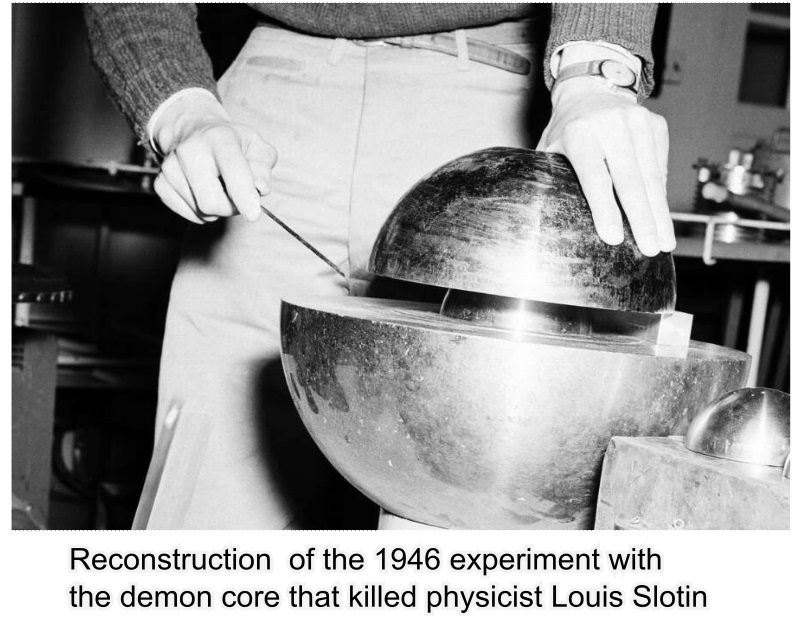
By Kaleena Fraga | Checked By Erik Hawkins https://allthatsinteresting.com/demon-core December 10, 2022
Physicists Harry Daghlian and Louis Slotin both suffered agonizing deaths after making minor slips of the hand while working on the plutonium orb known as the “demon core” at Los Alamos Laboratory in New Mexico.
To survivors of the nuclear attacks in Hiroshima and Nagasaki during World War II, the nuclear explosions seemed like hell on earth. And though a third plutonium core — meant for use if Japan didn’t surrender — was never dropped, it still managed to kill two scientists. The odd circumstances of their deaths led the core to be nicknamed “demon core.”
Retired to the Los Alamos National Laboratory in New Mexico following the bombings of Hiroshima and Nagaski, demon core killed two scientists exactly nine months apart. Both were conducting similar experiments on the core, and both made eerily similar mistakes that proved fatal.
Before the experiments, scientists had called the core “Rufus.” After the deaths of their colleagues, the core was nicknamed “demon core.” So what exactly happened to the two scientists who died while handling it?
The Heart Of A Nuclear Bomb
In the waning days of World War II, the United States dropped two nuclear bombs on Japan. One fell on Hiroshima on Aug. 6, 1945, and one fell on Nagasaki on August 9. In case Japan didn’t surrender, the U.S. was prepared to drop a third bomb, powered by the plutonium core later called “demon core.”
The core was codenamed “Rufus.” It weighed almost 14 pounds and stretched about 3.5 inches in diameter. And when Japan announced its intention to surrender on August 15, scientists at the Los Alamos National Laboratory were allowed to keep the core for experiments.
As Atlas Obscura explains, the scientists wanted to test the limits of nuclear material. They knew that a nuclear bomb’s core went critical during a nuclear explosion, and wanted to better understand the limit between subcritical material and the much more dangerous radioactive critical state.
But such criticality experiments were dangerous — so dangerous that a physicist named Richard Feynman compared them to provoking a dangerous beast. He quipped in 1944 that the experiments were “like tickling the tail of a sleeping dragon.”
And like an angry dragon roused from slumber, demon core would soon kill two scientists at the Los Alamos National Laboratory when they got too close.
How Demon Core Killed Two Scientists
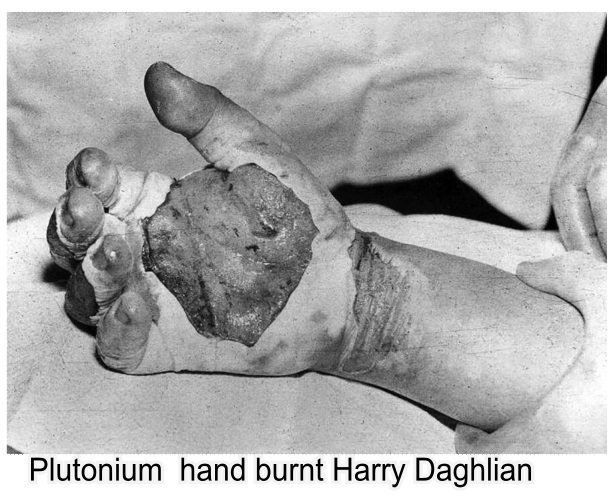
On Aug. 21, 1945, about a week after Japan expressed its intention to surrender, Los Alamos physicist Harry Daghlian conducted a criticality experiment on demon core that would cost him his life. According to Science Alert, he ignored safety protocols and entered the lab alone — accompanied only by a security guard — and got to work.
Daghlian’s experiment involved surrounding the demon core with bricks made of tungsten carbide, which created a sort of boomerang effect for the neutrons shed by the core itself. Daghlian brought the demon core right to the edge of supercriticality but as he tried to remove one of the bricks, he accidentally dropped it on the plutonium sphere. It went supercritical and blasted him with neutron radiation.
Daghlian died 25 days later. Before his death, the physicist suffered from a burnt and blistered hand, nausea, and pain. He eventually fell into a coma and passed away at the age of 24.
Exactly nine months later, on May 21, 1946, demon core struck again. This time, Canadian physicist Louis Slotin was conducting a similar experiment in which he lowered a beryllium dome over the core to push it toward supercriticality. To ensure that the dome never entirely covered the core, Slotin used a screwdriver to maintain a small opening though, Slotin had been warned about his method before.
But just like the tungsten carbide brick that had slipped out of Daghlian’s hand, Slotin’s screwdriver slipped out of his grip. The dome dropped and as the neutrons bounced back and forth, demon core went supercritical. Blue light and heat consumed Slotin and the seven other people in the lab.
“The blue flash was clearly visible in the room although it (the room) was well illuminated from the windows and possibly the overhead lights,” one of Slotin colleagues, Raemer Schreiber, recalled to the New Yorker. “The total duration of the flash could not have been more than a few tenths of a second. Slotin reacted very quickly in flipping the tamper piece off.”
Slotin may have reacted quickly, but he’d seen what happened to Daghlian. “Well,” he said, according to Schreiber, “that does it.”
Though the other people in the lab survived, Slotin had been doused with a fatal dose of radiation. The physicist’s hand turned blue and blistered, his white blood count plummeted, he suffered from nausea and abdominal pain, and internal radiation burns, and gradually become mentally confused. Nine days later, Slotin died at the age of 35.
Eerily, the core had killed both Daghlian and Slotin in similar ways. Both fatal incidences took place on a Tuesday, on the 21st of a month. Daghlian and Slotin even died in the same hospital room. Thus the core, previously codenamed “Rufus,” was nicknamed “demon core.”
What Happened To Demon Core?
Harry Daghlian and Louis Slotin’s deaths would forever change how scientists interacted with radioactive material. “Hands-on” experiments like the physicists had conducted were promptly banned. From that point on, researchers would handle radioactive material from a distance with remote controls.
So what happened to demon core, the unused heart of the third atomic bomb?
Researchers at Los Alamos National Laboratory had planned to send it to Bikini Atoll, in the Marshall Islands, where it would have been publicly detonated. But the core needed time to cool off after Slotin’s experiment, and when the third test at Bikini Atoll was canceled, plans for demon core changed.
After that, in the summer of 1946, the plutonium core was melted down to be used in the U.S. nuclear stockpile. Since the United States hasn’t, to date, dropped any more nuclear weapons, demon core remains unused.
But it retains a harrowing legacy. Not only was demon core meant to power a third nuclear weapon — a weapon destined to rain destruction and death on Japan — but it also killed two scientists who handled it in similar ways.
Nuclear waste permit ‘more stringent’ New Mexico says as feds look to renew for 10 years
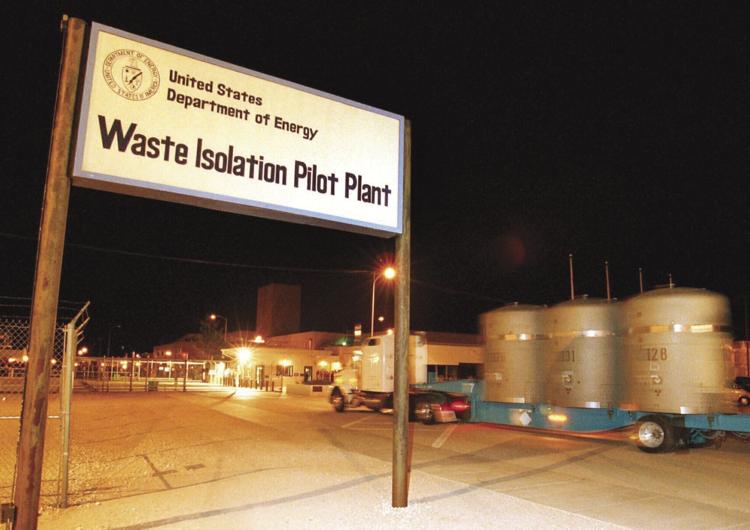
Adrian Hedden, Carlsbad Current-Argus, 12 Dec 22
Tougher rules for a nuclear waste repository near Carlsbad could be on the way as New Mexico officials sought “more stringent” regulations as the federal government sought to renew its permit with the state for the facility.
The State sought new requirements to prioritize nuclear waste from within New Mexico for disposal, called for an accounting of all of the waste planned for disposal in the next decade and regular updates on federal efforts to find the location for a new repository as conditions of the permit.
The Waste Isolation Pilot Plant is owned by the U.S. Department of Energy which holds a permit with the New Mexico Environment Department (NMED) that must be updated every 10 years.
The facility sees transuranic (TRU) nuclear waste from DOE facilities around the country disposed of via burial in an underground salt formation about 2,000 feet beneath the surface.
The upcoming renewal, expected by the end of next year, involved negotiations between NMED and the DOE, months of public comments and hearings and multiple expected revisions.
A draft permit was scheduled for public release Dec. 20, and the NMED released on Dec. 8 several conditions it proposed to add to the permit.
The release of the draft will be followed by a 60-day period when NMED will accept comments from the public, and the agency intended to hold a public hearing next summer.
NMED Cabinet Secretary James Kenney said the State wanted a permit with stronger regulations moving forward, to better protect people and the environment from the impacts of nuclear waste disposal.
“It will be more stringent, full stop,” Kenney said. “The conditions were adding to it are designed to add more accountability to the whole complex that are sending waste to WIPP.”………………………………..
State of New Mexico says priority should go to New Mexico nuclear waste
Key among the revisions was prioritizing nuclear waste held at Los Alamos National Laboratory in northern New Mexico, where the DOE develops nuclear weapons.
More:Nuclear waste from Tennessee filling new disposal area at repository near Carlsbad
The facility was recently planned by the DOE to increase production of plutonium pits, used as the triggers for nuclear bombs, as part of efforts to modernize the U.S.’ weapons arsenal.
Kenney said space should be saved at WIPP for New Mexico waste, as the state hosts the repository and he said should receive the most benefit. He said agreements between the DOE and the State of Idaho to prioritize waste from Idaho National Laboratory and another prioritizing waste from Savannah River Site in South Carolina – a facility also set to ramp up pit production – unfairly “leap-frogged” New Mexico for waste disposal.
More:Gov. Lujan Grisham demands President Biden block nuclear waste site in southeast New Mexico
The waste Kenney hoped to target in this provision, he said, was “legacy waste” held at Los Alamos for decades, posing environmental risks in the area and in need of permanent disposal at WIPP.
“We want to make sure we preserve enough space at WIPP for the entirety of New Mexico’s legacy waste,” Kenney said. “I’m significantly concerned that the notion of cap and cover and leaving things around Los Alamos while continuing to emplace waste at WIPP around the country will squeeze out and leave behind waste that should have been there from legacy issues.”
New Mexico aims to hold feds ‘accountable’ for nuclear waste disposal
Another significant change proposed by NMED in the permit would require a full accounting of waste planned to be disposed of at WIPP for the decade following the permit to justify keeping the facility open after the permit expires.
This would better hold the federal government accountable, Kenney said, for future planning at WIPP.
In past proposal for the upcoming permit renewal, the DOE removed a 2024 closure date, opting to leave WIPP’s lifetime open-ended as worked to its statutorily maximum capacity of 6.2 million cubic feet of nuclear waste specified by the federal Land Withdrawal Act (LWA).
The DOE estimated the site could be open until 2085 based on the potential future availability of nuclear waste.
That ambiguity was unacceptable, Kenney said in proposing the added condition.
“We’re not satisfied. That is a completely unacceptable answer. There’s a presumption that if they’re going to continue to operate the underground in New Mexico, they’re going to have to inventory all of the waste that could come to WIPP,” he said.
“They are going to be accountable to every state where they do business including ours. Full accounting, no switching numbers.”
He said he believed WIPP will stay open past the next 10-year permit term, but that the DOE must do a better job at planning future waste streams.
“We know there’s going to be a need for this kind of facility. I don’t think WIPP will reach the LWA limits in 10 years,” Kenney said. “We can’t blindly go down the path of not knowing what they’re doing in every state regarding clean up.”
Nuclear waste facility will ‘run out of volume one day’ state says
As for finding a location for a new nuclear repository to continue disposal of the nation’s nuclear waste, Kenney said he has not seen “anything substantive” from the DOE, but that he did not believe WIPP could be the only repository in the nation for an unlimited amount of time.
But to do that, or to increase WIPP’s capacity, would take an act of Congress, and Kenney said the State of New Mexico should be kept updated on such activities as it held the only deep geological repository for nuclear waste in the U.S.
“There’s an irony with it being called a pilot plant and extending it out to 2080,” Kenney said. “We believe there is a need for this kind of facility. We have legacy waste and we have pit production that has waste that needs a place to go.
“(WIPP) will run out of volume one day. Someone, somewhere in (Washington), D.C. needs to be thinking about where that repository will be.”
Should Congress choose to increase the capacity at WIPP beyond the LWA limit, NMED’s proposal would automatically revoke WIPP’s permit.
This would protect New Mexico, Kenney said, from the being the sole resting place for U.S. nuclear waste.
“That’s a deal breaker for us,” he said. “We’re reclaiming our authority to not let the federal government pull the rug out from under New Mexicans.”
Ricardo Maestas, WIPP program manager at NMED’s Hazardous Waste Bureau also pointed out that the WIPP facility’s proximity to nearby oil and gas operations in the growing Permian Basin region, was so far unaddressed in the permit, and the state should be kept update on fossil fuel operations as they grow around the site. https://www.currentargus.com/story/news/2022/12/10/new-mexico-proposes-tougher-rules-for-nuclear-waste-site-near-carlsbad/69711594007/
Revealing He Too Had Manning Leaks, Ellsberg Dares Justice Dept to Prosecute Him Like Assange
“Let’s take this to the Supreme Court,” says the Pentagon Papers whistleblower, taking aim at what he argues is an unconstitutional use of the Espionage Act.
https://www.commondreams.org/news/2022/12/07/revealing-he-too-had-manning-leaks-ellsberg-dares-doj-prosecute-him-assange JESSICA CORBETT, December 7, 2022
Pentagon Papers whistleblower Daniel Ellsberg on Tuesday dared U.S. prosecutors to come after him like they have Julian Assange by revealing in a BBC News interview that the WikiLeaks publisher sent him a backup of leaked materials from former military analyst Chelsea Manning.
“Let me tell you a secret. I had possession of all the Chelsea Manning information before it came out in the press,” Ellsberg said to BBC‘s Stephen Sackur in the on-camera interview. “I’ve never said that publicly.”
Assange had sent him the materials—which include evidence of U.S. war crimes—in case “they caught him and they got everything,” the 91-year-old explained. “He could rely on me to find some way to get it out.”
Australian-born Assange is currently detained in London and fighting in British and European courts against his extradition to the United States, where he could spend the rest of his life in prison if convicted under Espionage Act charges.
Inviting action by the U.S. Department of Justice (DOJ), Ellsberg said that “I am now as indictable as Julian Assange and as everyone who put that information out—the papers, everybody who handled it.”
“Yes, I had copies of it and I did not give them to an authorized person. So, if they want to indict me for that, I will be interested to argue that one in the courts—whether that law is constitutional,” he continued, referring to the Espionage Act.
Highlighting that the highest U.S. court has never held that it is constitutional to use the Espionage Act as if it were a British Official Secrets Act, Ellsberg said that “I’d be happy to take that one to the Supreme Court.”
The Espionage Act, “used against whistleblowers, is unconstitutional,” he asserted. “It’s a clear violation of the First Amendment.”
Ellsberg’s public confession comes after editors and publishers at five major media outlets that collaborated with WikiLeaks in 2010 for articles based on diplomatic cables from Manning released a letter late last month arguing that “it is time for the U.S. government to end its prosecution of Julian Assange for publishing secrets.”
“This indictment sets a dangerous precedent, and threatens to undermine America’s First Amendment and the freedom of the press,” the letter states. “Obtaining and disclosing sensitive information when necessary in the public interest is a core part of the daily work of journalists. If that work is criminalized, our public discourse and our democracies are made significantly weaker.”
The new Ellsberg interview also follows the European Court of Human Rights (ECHR) confirming earlier this month that 51-year-old Assange has asked the tribunal to block his extradition to the United States.
Assange’s brother Gabriel Shipton told Reuters last week that “I would imagine the U.S. wants to avoid” a case going before the ECHR for “trying to extradite a publisher from Europe for publishing U.S. war revelations when the U.S. is asking Europe to make all sort of sacrifices for the war in Ukraine.”
Five ways the Biden DOE is spending tax-payers money big on nuclear energy

THe Hill, BY SAUL ELBEIN – 12/08/22
The Department of Energy is spending big to keep America’s old nuclear reactors online while laying the foundations of the nuclear energy industry of the future.
The investment into America’s long-declining nuclear industry — which includes tens of millions of funding announced this week — builds on a far-broader package of federal subsidies invested in the nuclear sector, which remains America’s leading single source of zero-carbon electricity [ not zero in full nuclear fuel cycle].
One program — a $6 billion fund established under the 2021 bipartisan infrastructure plan — will help to keep otherwise uneconomic nuclear plants from shutting down.
But other programs announced by the Energy Department look beyond the current generation of nuclear plants to build out foundations for the next generation of nuclear energy.
Here are five nuclear goals that the Energy Department is pouring money into.

Advanced and theoretical research
One grant announced on Wednesday will pay $12 million to fund scientists across America’s national laboratories as they work on advanced research into problems at the edges of our understanding of nuclear physics.
The five projects funded “span topics like the 3-dimensional internal structure of nucleons, the exotic states of quarks and gluons, the microscopic properties of quark-gluon plasma and neutrino and nuclear interactions,” according to a statement from the Energy Department…………………………….
Training nuclear-electric engineers

The Energy Department is also funding universities to educate “the next generation nuclear security work force.”
The department announced on Wednesday that $5 million will go to three state universities to help them create curriculum to train electrical engineers to work on nuclear reactors. ……………
Keep old plants online

The infrastructure legislation passed into law earlier this year contained $6 billion in Civil Nuclear Credits to help keep online nuclear plants that would otherwise be replaced with fossil-fuel infrastructure.
The Energy Department paid out its first disbursement last month, sending $1.1 billion to keep southern California’s Diablo Canyon Power Plant running. …………….
Build nuclear fuel supply chains

The Energy Department is putting $150 million into producing nuclear fuel essential to advanced reactors, officials announced in November.
So-called high-assay, low-enriched uranium (HALEU) is uranium that is far more enriched than the nuclear fuel used in current reactors. It’s only low-enriched in contrast to the kinds of enriched uranium used in nuclear weapons.
Since it’s essential to smaller, more efficient nuclear reactors, the Energy Department estimates that the U.S. will need about 40 metric tons of HALEU per year by the end of the decade……………………………
Catching up on fusion

The Energy Department in October announced $47 million for research into fusion — the process by which stars like our sun create energy.
Unlike fission, fusion energy is created by forcing atoms together, rather than splitting them — a process that releases no radioactive pollution.
But the extreme temperatures and pressures needed to convince atoms to fuse have so far kept fusion as a theoretical energy source, rather than a practical one.
At the superheated temperatures and pressures required for fusion, gas turns into plasma — which is extremely difficult to control.
“We can’t just put it in a vessel because it will melt anything it touches,” said Eugenio Schuster of Lehigh University, who had received $1.75 million to work with researchers on this problem.
The money helps pay for collaborative experiments between U.S. and international scientists at research “tokamaks” at sites in China, the European Union and South Korea
How to scale rooftop community solar in cities

New York has over 1 gigawatt of community solar, more than any other
state, with another 700 projects in the pipeline that will add another 2
gigawatts of solar capacity.
Yet few of these projects are in the state’s
most iconic city, home to more than 8 million people. “It’s not because
they don’t pencil out” economically, Russell Wilcox, co-founder and CEO
of Urban Energy, said of siting urban community-solar projects in New York
City and its surroundings. “It’s the complexity of the market.”
But despite this market complexity, rooftop community solar is garnering more
attention, and not just in New York state, which has a goal of 10 gigawatts
of distributed solar. A number of affordable housing agencies, including
the New York City Housing Authority, are investing in rooftop community
solar projects. In Washington, D.C., the Solar for All program installed
more than 160 community solar rooftop projects from 2019 to 2021 that
provided utility bill credits to 6,000 income-qualified families.
Canary Media 8th Dec 2022
https://www.canarymedia.com/articles/sponsored/how-to-scale-rooftop-community-solar-in-cities
Missouri Community and Its Children Grappling With Exposure to Nuclear Waste
In the 2022 report, BCDC took 32 soil, dust, and plant samples throughout the school buildings and campus. Using x-ray to analyze the samples BCDC found more than 22 times more lead-210 than the estimated exposure levels for the average US elementary school in the Jana Elementary playground alone. There were also more than 12 times the lead-210 expected exposure in the topsoil of the basketball courts alone.
Radioactive isotopes of polonium-210, radium-266, thorium-230, and other toxicants were also found in the library, kitchen, ventilation system, classroom surfaces, surface soil and even soil as far as six feet below the surface.
https://blog.ucsusa.org/chanese-forte/missouri-community-and-its-children-grappling-with-exposure-to-nuclear-waste/ Chanese Forte, December 8, 2022
The families, students, and school officials in Florissant, Missouri have been living a modern nightmare for the past several weeks, learning that Jana Elementary school and the surrounding region has high levels of radiation, a problem caused decades ago by the production of nuclear weapons
Radiation exposure can damage the DNA in cells leading to a host of health problems including cancer and auto-immune disorders. What’s more troubling is that the Centers for Disease Control reports that children and young adults, especially girls and women, are more sensitive to the effects of radiation.
Jana Elementary school has 400 students and a predominantly (82.9%) Black student body. Unfortunately, the United States has a long history of environmental racism which results in harming Black, Indigenous and Brown communities much more in the process of creating and maintaining nuclear weapons.
When science cannot agree, the community suffers
The suburban school north of St. Louis, Missouri, was thought to be safe for students based on research completed in 2000 by the Army Corps of Engineers (USACE).
Specifically, USACE has been in the Coldwater Creek region for the last 20 years attempting to remediate radioactive waste associated with the creek (which does not include Jana Elementary).
Toward the start of the 2022 semester, as part of an ongoing lawsuit in the region the Boston Chemical Data Corp (BCDC), an environmental consulting group, reported the elementary school as having radioactive waste levels far above the estimated national levels.
These radioactive waste exposures—like lead-210—are associated with decreased cognition, brain defects, thyroid disease, and cancer, and can accumulate in the body over time.
Following the BCDC report, all Jana Elementary students were sent home for the rest of the semester in hopes their homes were less toxic.
By the Thanksgiving holiday break, the USACE returned to test inside and on the playground of the school and found no radiation on the campus, news which many community members and organizers unsurprisingly expressed as suspicious.
The School Board then hired SCI Engineering, a private engineering firm, to sample Jana Elementary who came to a similar conclusion as USACE.
Now returning to classes from Thanksgiving break, many wary students joined classes at new schools in the area per the school board’s decision related to BCDC’s radiation exposure assessment. Many parents also expressed to National Public Radio they felt left out of discussions for decisions being made.
How did radioactive waste end up in Florissant, MO?
The region near Jana Elementary was first contaminated by the US Department of Energy’s decision to make St. Louis one of the processing sites for uranium during the Manhattan Engineering District project. These nuclear weapons were built through World War II and originally stored at the St. Louis Lambert International Airport.
Unfortunately, the waste was later illegally dumped in 1973 at the West Lake Landfill in Bridgeton, MO, which lies about 10 miles Southwest of Jana Elementary. The West Lake Landfill is located near the Mallinckrodt Chemical Works Company which regularly floods, causing these harmful chemicals to be carried away by nearby water ways like Coldwater Creek.
Coldwater Creek runs for 19 miles throughout the area and flows directly into the Missouri River. Jana Elementary, just North of St. Louis, is bordered by the creek on two sides but has to date not been included in any clean-up efforts by the US Army Corps of Engineers (USACE).
US Army Corps of Engineers initially didn’t sample inside or outside of Jana Elementary
Prior to the Boston Chem Data Corp 2022 report, the USACE did not take any samples within 300 feet of the school building in their 2017 assessment. According to BCDC’s report, this doesn’t follow US Agency for Toxic Substances Disease Registry (ATSDR) standards for radioactive sampling.
In fact, it ignores the conclusion ATSDR made that most exposures in the region will be indoors and just outdoors of buildings.
Indoor samples from creek-facing homes in the same neighborhood as Jana Elementary had similar radioactive waste both indoors and outdoors. ATSDR also noted in a 2019 report that radioactive wastes are routinely moved from Coldwater Creek into homes due to flooding. The region floods frequently which is only increasing due to climate change in the region.
New radioactive sampling methods used to understand student exposure
In the 2022 report, BCDC took 32 soil, dust, and plant samples throughout the school buildings and campus. Using x-ray to analyze the samples BCDC found more than 22 times more lead-210 than the estimated exposure levels for the average US elementary school in the Jana Elementary playground alone. There were also more than 12 times the lead-210 expected exposure in the topsoil of the basketball courts alone.
Radioactive isotopes of polonium-210, radium-266, thorium-230, and other toxicants were also found in the library, kitchen, ventilation system, classroom surfaces, surface soil and even soil as far as six feet below the surface.
Marco Kaltofen, an environmental engineer who is leading the BCDC team, collected roughly 1,000 samples from across the region as a part of law suit efforts. There are several businesses and homes also indicated as exposed in the lawsuit as well.
Overall, Kaltofen suggests that BCDC’s unprecedented x-ray method better picks up the microscopic radioactive materials. However, he also asserts both studies are essentially saying the same thing, which is of course confusing for many community members.
Community organizers fight for testing and clean-up
Just Moms STL activist Dawn Chapman has worked tirelessly since 2014 to get the federal government to test for radioactive material in more regions where the creek floods.
The co-founder of Just Moms STL, Karen Nickel, also attended Jana Elementary School and has reported currently living with several autoimmune disorders. She uses her experience and love of the area to battle these exposure injustices.
In a 2017 Nation Public Radio report, Ms. Chapman says,
“They [The US Government] fought us for years. Finally, they [tested] parks that had flooded, and found [radioactive waste]. They started testing some backyards and found it. We pushed for Jana Elementary, because it is the closest school to the creek.” Just Moms STL activist, Dawn Chapman
We reached out to Just Moms STL to understand what the next steps are. Just Moms STL Recommends:
- The sites in St. Louis should be expeditiously cleaned up.
Unfortunately, Jana Elementary School is not the only place to be concerned about near St. Louis.- Since remediation of nuclear weapons waste in the area has already taken decades, many of these students will likely age out of Jana Elementary School before there is full remediation of radioactive waste in the St. Louis area.
While there is guidance on defining “safe” or acceptable radioactive exposure levels as it relates to human health, scientists also calculate “expected” levels from the Earth naturally (like radon in sediment).
Unacceptable levels are frequently defined as radiation exposure above natural levels by communities.
- However, legally the Army Corps is allowed to leave some radioactive residue above naturally occurring levels, and Just Moms STL would like this to no longer be the case.
- Residents near nuclear weapon processing sites like the St. Louis area should be included in federal radiation compensation programs, such as the Radiation Exposure Compensation Act (RECA). UCS also suggests consideration of St. Louis in the Energy Employees Occupational Illness Program Act (EEOICPA), and other forms of compensation as well.
Expanding radiation compensation programs is complicated because the list of communities that want to be included who currently qualify is long. Moreover, Just Moms STL says the RECA program needs to be expanded to include processing sites like St. Louis, which has previously only applied to nuclear testing exposure sites and uranium workers, or EEOICPA, which has only covered nuclear site workers, but not surrounding communities.
There are currently two bills being proposed to the House and Senate to extend and strengthen RECA. Just Moms STL is working to get Missouri elected officials to help sponsor and carry RECA as well. And your representatives may also be interested in supporting adjustments to RECA or the EEOICPA.
USA and UK welded together firmly in the grip of the nuclear lobby, with their Small Nuclear Reactor folly.

UK and US ‘like-minded’ on nuclear power as key to energy security,
SMR, Rob Harris, December 7, 2022 British Prime Minister Rishi Sunak and his counterpart, US President Joe Biden, have announced a new venture to secure supply and reduce price volatility, with the US promising to more than double the amount of gas it exported to the UK last year.
British Prime Minister Rishi Sunak and his counterpart, US President Joe Biden, have announced a new venture to secure supply and reduce price volatility, with the US promising to more than double the amount of gas it exported to the UK last year.
The new “UK-US Energy Security and Affordability Partnership” will aim to reduce global dependence on Russian energy exports, stabilise energy markets and step up collaboration on energy efficiency, nuclear and renewables.
But the focus on nuclear sharpens the divide between Australia’s attitudes towards a civil nuclear power industry and those of its two closest allies – governments of all persuasions in Canberra have outlawed a domestic industry and resisted calls to overturn the ban for decades……………..
In a joint statement, Sunak and Biden said their new agreement would promote nuclear energy as “a safe and reliable part of the clean energy transition”.
“This includes deepening global collaboration on nuclear fuels and advanced nuclear technologies.”
They said both nations would work to deepen global collaboration between “like-minded countries” on small modular reactors (SMRs) and support a resilient and diversified nuclear fuel supply chain………………………………….
Nuclear power is now firmly back on the agenda, particularly in Britain and France, amid new fears for energy security following Russia’s invasion of Ukraine and the ever-greater need to reduce global carbon emissions.
The US, with 92 commercial reactors, is the world’s largest producer, accounting for more than 30 per cent of the nuclear-generated electricity worldwide.
Large reactor projects are still facing financial and construction problems, with the UK’s 3.2 gigawatt Hinkley Point C plant hit by delays and cost overruns. But analysts believe [for “analysts” read “nuclear salesmen”]the time may be right for SMRs – which could also prove affordable to nations unable to fund large nuclear plants…………
Australian Prime Minister Anthony Albanese this week rebuffed a push by South Australian Premier, Peter Malinauskas, to restart the nuclear debate in Australia, citing waste and safety concerns as key reasons nuclear should not be considered as an energy option………
“I haven’t changed my view that it’s a huge distraction from what we need to do. It just doesn’t add up,” he said on Adelaide radio 5AA. “That’s essentially the problem. Every five years or so we have this economic analysis of whether nuclear power stacks up and every time it’s rejected.”……….. https://www.smh.com.au/world/europe/uk-and-us-like-minded-on-nuclear-power-as-key-to-energy-security-20221207-p5c49q.html
Lawmakers reject bid to audit US aid for Ukraine

House Republicans vowed to try again later after their resolution was narrowly defeated.

The US has been supplying Ukraine with assorted heavy weaponry, including armored vehicles, artillery, rockets and drones, since – and even before – Russia launched its military operation against the neighboring state in late February. The total amount of funds appropriated for Kiev in military and economic aid by the US has already exceeded $100 billion in less than a year.
https://www.rt.com/news/567836-us-lawmakers-ukraine-audit/ 7 Dec 22,
A resolution calling for an audit of US military and economic aid to Ukraine has been narrowly defeated in the House of Representatives. The measure, spearheaded by Representative Marjorie Taylor Greene (R-Ga.) and backed by multiple fellow legislators, was rejected by 26 votes to 22 before the House Foreign Affairs Committee on Tuesday.
The proposed audit had been strongly opposed by House Democrats, who argued that such oversight activities would have sent a wrong signal to Ukraine, which has been strongly supported by Washington in its ongoing conflict with Russia.
“This is not the time for us to be divided. We’ve held together with NATO, and the EU, and our allies. Let’s not fall into this trap,” the top Democrat on the committee, Representative Gregory W. Meeks (NY), said during the debate.
Republicans rejected such arguments, however, insisting that the measure was about transparency and accountability for Americans, rather than about sending any messages to Kiev. Greene also claimed that House Democrats were “blinded by hate” for her and were making Ukrainian oversight a purely political issue.
Despite the failure of the resolution to get through the committee, the outcome of the vote was hailed as a major win by its sponsors, as it has demonstrated unity among Republicans. Greene vowed to continue her efforts to push through the audit motion, promising to try again when the Republicans gain a slim majority in the House.
“It’s official the Democrats have voted NO to transparency for the American people for an Audit for Ukraine. But we take over in January! This audit will happen!” Greene wrote on Twitter.
While the Republicans have managed to demonstrate unity on the issue of stricter oversight in relation to continued support for Kiev, few have actually spoken against it altogether. Greene is one of few conservative Republicans who have been vocally opposed to sending billions to Ukraine.
The US has been supplying Ukraine with assorted heavy weaponry, including armored vehicles, artillery, rockets and drones, since – and even before – Russia launched its military operation against the neighboring state in late February. The total amount of funds appropriated for Kiev in military and economic aid by the US has already exceeded $100 billion in less than a year.
Another dodgy Special Purpose Acquisition Company (SPAC) set up to promote small nuclear reactors.
https://www.youtube.com/watch?v=AAJTkL99anI&t=22s
Nuclear SMR developer X-energy to merge with Ares Management-backed SPAC, creating $2B company, Utility Dive, Stephen Singer, Dec. 7, 2022
Dive Brief
- X Energy Reactor Co., a developer of small modular nuclear reactors and fuel technology, is merging with a special purpose acquisition company backed by private equity firm Ares Management Corp., X-energy announced Tuesday. The deal would establish a combined publicly traded company valued at $2 billion.
- The company will receive about $1 billion in cash in the trust account of Ares Acquisition Corp., the SPAC, assuming no redemptions by shareholders. Investments and financing commitments include $75 million from Ares Management and $45 million from Ontario Power Generation and Segra Capital Management.
……………………… X-energy, based in Rockville, Maryland, is advancing nuclear generation through a high-temperature gas-cooled small modular reactor, or SMR, the Xe-100, and its fuel, TRISO-X. The reactor is engineered to operate as a single 80-MW unit and optimized as a four-unit plant delivering 320 MW.
……………………. Edwin Lyman, director of Nuclear Power Safety at the Union of Concerned Scientists, questioned the “fundamental economic justification” for SMRs.
“A small reactor is going to produce more expensive electricity than large ones,” he said.
Backers defend SMRs as benefiting from economies of scale, but that’s not been demonstrated, Lyman said. “It would require a large order book and experience,” he said.
…………………………. At the closing of the deal, which is expected in the second quarter of 2023, the combined company will be named X-Energy Inc. and will be listed on the New York Stock Exchange. https://www.utilitydive.com/news/X-energy-ares-managment-spac-merger-small-modular-nuclear-smr/638097/
Nuclear lobby continues to capture universities.

From Rust Belt to Green Belt: Penn State leads nuclear research alliance. Pennsylvania State University, 8 Dec 22,
Led by Penn State, academia, national laboratories and industry have formed the Post-Industrial Midwest and Appalachia (PIMA) Nuclear Alliance to harness carbon-free energy while educating and training the future energy workforce……………………………..
Alliance members include foundational partners University of Michigan Nuclear Engineering and Radiological Sciences, University of Tennessee at Knoxville, and the Westinghouse Electric Company. Additional partners include Pennsylvania College of Technology, Idaho National Laboratory, Los Alamos National Laboratory, Argonne National Laboratory, Sandia National Laboratories, Oak Ridge National Laboratory, Morgan Advanced Materials, Pittsburgh Technical, Energy Driven Technologies and Reuter Stokes. Faculty from University of Central Florida, California Polytechnic State University and Cornell University are also participating………………………………
“We aspire to innovate and accelerate the adoption of microreactors – nuclear batteries – and advanced nuclear reactor technology across the regions of PIMA
The complicated politics of nuclear power
Cardinal News, by Dwayne Yancey, December 5, 2022
Feelings about nuclear energy generally split along left-right lines. But while Gov. Glenn Youngkin is pushing nuclear energy in Virginia, it’s left-of-center governments that are now pushing small nuclear reactors internationally and a conservative state legislator in Southwest Virginia who opposes them.
The push to build such small portable reactors – the technical term is “small modular reactor,” or SMR – is pretty widespread, though………………………
It will not surprise you to learn that Americans are politically polarized over nuclear energy the way they are most other things. A Gallup Poll earlier this year found Americans almost evenly split – 51% in favor, 47% against. What’s more interesting, though (or maybe more predictable), is how they split: 60% of Republicans are in favor of nuclear energy, only 39% of Democrats are.
That left-right split is generally true around the world, which a) helps explain why this nuclear proposal is coming from a Republican governor, and b) makes the exceptions so interesting.
Globally, France is an obvious exception. …………….. there has been a general left-right consensus that nuclear energy is an important national priority. Not until the Green Party came along in 1984 was there any significant voice against nuclear power, according to a paper published by Oxford Academic.
Another interesting exception comes just to our north – in Canada, specifically with the government of Prime Minister Justin Trudeau……… Trudeau has also come down on the side of nuclear power. …………[Four provinces] called for making Canada “a global SMR technology hub” ………………………
Another left-of-center government promoting nuclear energy is our own – the Biden administration.
The Democrats’ so-called climate bill – officially the Inflation Reduction Act – that passed this summer contains numerous provisions promoting nuclear energy. More recently, Biden’s special presidential envoy for climate, John Kerry, has been one of the chief proponents. In November, Kerry made two announcements that haven’t gotten much attention. First, he announced that the United States will partner with Ukraine on a pilot program to build a “secure and safe small modular nuclear reactor” in Ukraine. Second, he announced plans to help Europeans – particularly in central and eastern Europe – convert coal-fired plants to small modular reactors
……… All these exceptions to ideological orthodoxy have come on the left, but there are some on the right, too. I mentioned that the Gallup Poll found 60% of Republicans in favor – but it also found 37% opposed. One of those Republicans who opposes nuclear power – at least in Southwest Virginia – is Del. Marie March, R-Floyd County. She recently posted on Facebook: “Youngkin wants nuclear micro reactors to be placed in SWVA coal mines. I am very concerned about this new technology and prefer that SWVA isn’t used as the lab rat.
For too long NOVA harvests our taxes and our land. Now they want to use us to harvest power. Right now a Nuclear power plant is being targeted in Ukraine to be bombed. Look at the impact of a nuclear meltdown on generations of people and the ecosystem. We don’t need Geiger counters in SWVA!”
March’s concern about coal country effectively being used as a sort of “sacrifice zone” to generate energy for urban areas isn’t that different from what some liberal groups might say. ……………………
Now, none of this is meant to make a case one way or another on the wisdom of splitting atoms and whether some of that should be done in Southwest Virginia. It is meant to put the proposed SMR in Southwest Virginia in a global context and to show that the politics of nuclear are not always clear-cut. We in Virginia will get to see this play out in the General Assembly (and perhaps beyond). Youngkin has proposed $10 million to go toward research and development of innovative energy technologies, with half of that devoted to nuclear research. That may be exactly what we should expect of a conservative governor. Meanwhile, the liberal government in Canada has invested more than $18 million toward its own nuclear research. Who would have thought that Glenn Youngkin and Justin Trudeau had so much in common, or that Marie March would wind up aligned with Greenpeace? https://cardinalnews.org/2022/12/05/the-complicated-politics-of-nuclear-power/—
Pursuing Assange in a US court could cause even more embarrassment than the WikiLeaks’ publications.
It’s possible that pursuing Assange in a US court could cause even more embarrassment than the WikiLeaks’ publications. As the years have passed, we have learned that a Spanish security firm recorded his every move and those of his visitors and legal counsel in the Embassy of Ecuador. This was passed to the CIA, and was used in the US case for his extradition. The trial of Daniel Ellsberg for leaking the Pentagon Papers failed because his psychiatrist’s records were stolen by investigators, and this should set a precedent for Assange.
Enough is enough for Albanese on Assange: our allies may respect us if we say this more. https://johnmenadue.com/enough-is-enough-for-albanese-on-assange-our-allies-may-respect-us-if-we-say-this-more/ By Alison Broinowski, Dec 2, 2022
The Prime Minister’s surprise revelation that he has raised the case against Julian Assange with US officials and urged that charges of espionage and conspiracy be dropped opens up many questions.
Mr Albanese thanked Dr Monique Ryan for her question on Wednesday 31 November, giving what appeared to be a carefully prepared and timed answer. The Independent MP for Kooyong sought to know what political intervention the government would make in the case, observing that public interest journalism is essential in a democracy.
The news flashed around between Assange supporters in and outside Parliament, and reached the Guardian, the Australian, SBS, and Monthly online. Neither the ABC nor the Sydney Morning Herald carried the story, even the next day. SBS reported that Brazil’s president-elect Luiz Inacio Lula da Silva expressed support for the campaign to free Assange.
But two days earlier, on Monday 29 November, the New York Times and four major European papers had printed an open letter to the US Attorney-General Merrick Garland, deploring the assault on media freedom which the pursuit of Assange represented.
The NYT, the Guardian, Le Monde, Der Spiegel and El Pais were the papers which in 2010 received and published some of the 251,000 classified US documents provided by Assange, many revealing American atrocities in Afghanistan and Iraq.
US Army intelligence analyst Chelsea Manning gave them to Assange, who redacted names of people he considered could be harmed by publication. A senior Pentagon serving officer later confirmed that no-one had died as a result. Manning was imprisoned, and then pardoned by Obama. Assange spent seven years in diplomatic asylum in the Embassy of Ecuador in London before British police removed him and he was imprisoned for breach of bail condition.
Assange has been in Belmarsh high security prison for three years, in poor physical and mental health. Court proceedings against him over extradition to face trial in the US have been farcical, biased, oppressive, and excessively prolonged.
In Opposition, Albanese said ‘Enough is enough’ for Assange, and he has at last done something about it in Government. What exactly, with whom, and why now, we don’t yet know. The PM’s hand may have been forced by the major dailies’ letter to Attorney-General Garland, which made Australian politicians and media appear to be doing nothing. Or he may have raised the Assange case in his recent meetings with Biden, at the G20 for example.
Another possibility is that he was talked into it by Assange’s barrister, Jennifer Robinson, who met with him in mid-November and spoke about the case at the National Press Club. When I asked if she could say if she and Albanese discussed Assange, she smiled and said ‘No’ – meaning she couldn’t, not that they didn’t.
Monique Ryan made the point that this is a political situation, requiring political action. By raising it with US officials, Albanese has moved away from the previous government’s position that Australia couldn’t interfere in British or American legal processes, and that ‘justice must take its course’. That wasn’t the approach Australia took to secure the freedom of Dr Kylie Moore-Gilbert, imprisoned for espionage in Iran, or of Dr Sean Turnell from jail in Myanmar. It isn’t Australia’s approach in China either, where a journalist and an academic remain in detention.
By taking up Assange’s case, Albanese is doing nothing more than the US always does when one of its citizens is detained anywhere, or than the UK and Canada quickly did when their nationals were imprisoned in Guantanamo Bay. Australia allowed Mamdouh Habib and David Hicks to spend much longer in US custody before negotiating their release. We might gain more respect from our allies if we adopted their speedy approach to these cases, than we do by subservience to British and American justice.
It’s possible that pursuing Assange in a US court could cause even more embarrassment than the WikiLeaks’ publications. As the years have passed, we have learned that a Spanish security firm recorded his every move and those of his visitors and legal counsel in the Embassy of Ecuador. This was passed to the CIA, and was used in the US case for his extradition. The trial of Daniel Ellsberg for leaking the Pentagon Papers failed because his psychiatrist’s records were stolen by investigators, and this should set a precedent for Assange.
Even though Biden once called Assange a ‘hi-tech terrorist’, as President he is now an advocate of human rights and democratic freedoms. This might be a good time for him to put them into practice. Doing so would make both Biden and Albanese look better than their predecessors.
‘Guinea Pig Nation’- Lax rules for new reactors deliberately endanger communities

“Make no mistake about it—while NRC is doing its part to serve nuclear industry needs, we should not lose sight of the fact that it is the aggressive pro-nuclear agenda of the Biden Administration that has unleashed a juggernaut of financial and PR support for new nuclear reactors. Everything from the tens of billions of dollars allocated for new nuclear in the Infrastructure Act and the IRA [Inflation Reduction Act, which establishes a nuclear power production tax credit], to the national dog-and-pony show [the recent U.S. tour promoting nuclear power] of Energy Secretary Jennifer Granholm, demonstrates the administration’s intentions to run roughshod over the objections of the public. We have a hard fight ahead of us.”
‘Guinea Pig Nation’ — Beyond Nuclear International NRC will weaken regulations for new “advanced” reactors says scientist
By Karl Grossman
“Guinea Pig Nation: How the NRC’s new licensing rules could turn communities into test beds for risky, experimental nuclear plants,” is what physicist Dr. Edwin Lyman, Director of Nuclear Power Safety with the Union of Concerned Scientists, titled his presentation last week.
The talk was about how the U.S. Nuclear Regulatory Commission is involved in a major change of its “rules” and “guidance” to reduce government regulations for what the nuclear industry calls “advanced” nuclear power plants.
Already, Lyman said, at a “Night with the Experts” online session organized by the Nuclear Energy Information Service, the NRC has moved to allow nuclear power plants to be built in thickly populated areas. This “change in policy” was approved in a vote by NRC commissioners in July.
For a more than a half-century, the NRC and its predecessor agency, the U.S. Atomic Energy Commission, sought to have nuclear power plants sited in areas of “low population density”—because of the threat of a major nuclear plant accident.
But, said Lyman, who specializes in nuclear power safety, nuclear proliferation and nuclear terrorism, the NRC in a decision titled “Population-Related Siting Considerations for Advanced Reactors,” substantially altered this policy.

The lone NRC vote against the change came from Commissioner Jeffery Baran who in casting his ‘no’ vote wrote “Multiple, independent layers of protection against potential radiological exposure are necessary because we do not have perfect knowledge of new reactor technologies and their unique potential accident scenarios….Unlike light-water reactors, new advanced reactor designs do not have decades of operating experience; in many cases, the new designs have never been built or operated before.”
He noted a NRC “criteria” document which declared that the agency “has a longstanding policy of siting nuclear reactors away from densely populated centers and preferring areas of low population density.”
But, said Baran, under the new policy, a “reactor could be sited within a town of 25,000 people and right next to a large city. For reactor designs that have not been deployed before and do not have operating experience, that approach may be insufficiently protective of public health and safety…And it would not maintain the key defense-in-depth principle of having prudent siting limitations regardless of the features of a particular reactor design—a principle that has been a bedrock of nuclear safety.”
That is just one of the many reductions proposed in safety standards.
“The central issue,” commented Lyman in an interview following his November 17th presentation, “is that the NRC is accepting on faith that these new reactors are going to be safer and wants to adjust its regulations accordingly, to make them less stringent—on faith.”
The key motivation, he said, behind the nuclear industry’s push to significantly weaken safety standards is that the line of smaller nuclear power plants the nuclear industry is now pushing—including what it calls the “small modular nuclear reactor”— are going to be “much more expensive” than the existing light-water nuclear power plants, the most common type of nuclear power plant, which are large and are cooled by plain water. Thus, he said, these “advanced” nuclear plants would be more costly to operate than using energy alternatives, “certainly wind and solar.”
And the NRC is complying with the nuclear industry.
It’s a demonstration of one of the alternatives for the acronym for the NRC—Nuclear Rubberstamp Commission.

The list of proposed safety reductions in the PowerPoint portion of Lyman’s presentation under “Cutting corners on safety and security to cut costs,” and what the nuclear industry “wants” in what the NRC calls its “Part 53” assemblage of changes, included, in addition to the already completed alteration of
siting criteria:
- Allowing nuclear power plants to have a “small containment—or no physical containment at all.” Containments are the domes over nuclear plants to try to contain radioactive releases in an accident.
- “No offsite emergency planning requirements.” The NRC has been requiring emergency planning including the designation of a 10-mile evacuation zone around a nuclear power plant.
- “Fewer or even zero operators.” The nuclear industry would like advanced nuclear plants to operate “autonomously.”
- Letting the plants have “fewer” NRC “inspections and weaker enforcement.”
- “Reduced equipment reliability reporting.”
- “Applications” for an advanced reactor “should contain minimal information.”
- “The NRC’s review standards should be lenient.”
- Letting the plants have “fewer inspections and weaker enforcement.”
- “Fewer back-up safety systems.”
- “Regulatory requirements should be few in number and vague.”
- “Zero” armed security personnel to try to protect an advanced nuclear power plant from terrorists.
What the industry wants
from Part 53
- Regulatory requirements should be few in number and vague. – details should go in non-binding guidance.
- Applications should contain minimal detail.
- The NRC’s review standards should be lenient.
- Fewer inspections and weaker enforcement.
The Nuclear Energy Information Service’s summary of his presentation stated: “Under the direction of Congress, the NRC is developing new regulations to facilitate licensing of experimental reactors by relaxing safety security standards and by relying on safety demonstrations that utilize computer simulations rather than experimental data. The major focus of this effort, known as ‘Part 53,’ is being written with an unprecedented level of industry involvement. If ‘Part 53’ is enacted, first-of-a kind reactors would be located in densely populated urban areas without any promise for emergency evacuation, planning, without security forces to protect against terrorist attack, and without highly trained operators—and all without meaningful opportunities for public input.”
These “are sometimes referred to as ‘advanced reactors.’ However, that is a misnomer for most designs being pursued today…largely descend from those proposed many decades ago,” the report continued.
“In part,” it went on, “the nuclear industry’s push to commercialize NLWRs is driven by its desire to show the public and policymakers that there is a high-tech alternative to the static, LWR-dominated status quo: a new generation of ‘advanced’ reactors. But a fundamental question remains: Is different actually better? The short answer is no. Nearly all of the NLWRs currently on the drawing board fail to provide significant enough improvements over LWRs to justify their considerable risks.”
In the report, Lyman extensively examines issues involving each of the NLWR (Non Light Water Reactors) or “advanced” reactors.
David Kraft, director of the Chicago-based Nuclear Energy Information Service, after Lyman’s talk said in an interview: “Dr. Lyman warns us all once again how largely beholden to the nuclear industry the NRC is. NRC is willing to twist and contort even reasonable safety regulations in ways that cater to nuclear industry desires to a degree that would rival a toy balloon-dog at a children’s party. It is this kind of almost institutionalized acquiescence to industry wants that has led many to believe that NRC stands for Not Really Concerned.”
Kraft continued: “Make no mistake about it—while NRC is doing its part to serve nuclear industry needs, we should not lose sight of the fact that it is the aggressive pro-nuclear agenda of the Biden Administration that has unleashed a juggernaut of financial and PR support for new nuclear reactors. Everything from the tens of billions of dollars allocated for new nuclear in the Infrastructure Act and the IRA [Inflation Reduction Act, which establishes a nuclear power production tax credit], to the national dog-and-pony show [the recent U.S. tour promoting nuclear power] of Energy Secretary Jennifer Granholm, demonstrates the administration’s intentions to run roughshod over the objections of the public. We have a hard fight ahead of us.”
Founded in 1981, Nuclear Energy Information Service is among the safe-energy, anti-nuclear organizations that are challenging the NRC’s effort to change its “rules” and “guidance” to boost “advanced” nuclear plants. It plans to soon post through its website a recording of Lyman’s Zoom presentation.
Weapons company Raytheon continues to be the winner in the Ukraine war, with new $1.2 billion surface-to-air missile contract .

Raytheon wins $1.2 billion surface-to-air missile order for Ukraine, By Jen Judson, Defense News, 1 Dec 22
WASHINGTON — The U.S. Army awarded Raytheon Missiles and Defense a contract worth as much as $1.2 billion to deliver six National Advanced Surface to Air Missile System batteries for Ukraine.
The contract is part of the fifth Ukraine Security Assistance Initiative package and includes training and logistical support to Ukraine’s military and security forces, the Army said in a a Nov. 30 statement.
Raytheon, the world’s second-largest defense contractor, won a contract in August to deliver to NASAMS batteries to Ukraine as part of the third USAI package. The new contract is a follow-on…………………
The work to award Raytheon a contract was led by the Army’s Program Executive Office for Missiles and Space, along with others across the Defense Department.
Ukraine has requested an integrated air and missile defense system that the U.S. and other allies are striving to fulfill. The system would be made up of short-range, low-altitude systems; medium-range, medium-altitude systems; and long-range, high-altitude systems that together would neutralize the threat of Russian aircraft and missiles.
Ukrainian forces had been using Russian-made SA-6 and SA-8 air defenses. In addition to NASAMS, the country also asked for Cold War-era Hawk systems – a medium-range, medium-altitude system, that’s considered to still be effective. https://www.defensenews.com/land/2022/12/01/raytheon-wins-12-billion-surface-to-air-missile-order-for-ukraine
No place for nuclear in New York’s clean energy future
syracuse.com, by Joseph J. Heath & Betty Lyons 2 Dec 22
As New York energy demand and prices spike heading into winter, the state’s Climate Action Council (CAC) works on its final Scoping Plan for implementing New York’s landmark climate legislation, the Climate Leadership and Community Protection Act (CLCPA). The Scoping Plan will lay out the details of how the state will accomplish the transition to clean energy, and how the transition will serve environmental justice.
Justice is a cornerstone of New York’s climate law, which stipulates that actions must not disproportionately burden disadvantaged communities. In a recent meeting, CAC members proposed strengthening Scoping Plan language to explain exactly why such burdens are unacceptable, and why climate and environmental justice must include every community in the state, including serious consultation with Indigenous Nations.
Continued reliance on nuclear plants — both existing and untested “advanced” nuclear or “small modular reactors” — violates these priorities. The Onondaga Nation, Haudenosaunee Environmental Task Force and the American Indian Law Alliance concluded that nuclear power is not viable in combating climate change. The CAC should reach the same conclusion.
The CAC’s Climate Justice Working Group has called on the CAC to draft a serious plan to phase out Oswego County’s three aging nuclear plants (on the traditional territory of the Onondaga Nation): Nine Mile Point (NMP) Unit 1, NMP 2 and FitzPatrick. So far, CAC has not responded to that call.
All three plants are old and obsolete. NMP Unit 1 is the oldest operating U.S. reactor, commissioned in 1969; FitzPatrick in 1975. These two are already past the 40-year lifespan they were designed for. However, their operating licenses are dangerously extended — through 2029 for NMP Unit 1, 2034 for FitzPatrick and 2046 for NMP Unit 2 (commissioned in 1988). These plants require increasing repair and replacement as components age, and, since they cannot compete in an unrigged market, rely on massive state and federal subsidies taken from ratepayers.
The three Oswego plants have GE Boiling Water Reactors, the same flawed design as Fukushima: weak containment vessels and highly radioactive spent fuel stored on an upper floor. The vulnerable pools are packed with more fuel rods than they were designed to hold. If the pools leak or water circulation fails, risk of fire and major radiation rises significantly. Water levels at Lake Ontario in recent years came within one foot of flooding these cement pools, a major problem at Fukushima. With rain events increasing due to climate change, flooding-related catastrophes increase in likelihood…………
The longer the Oswego plants run, the worse their impacts will be. The plants’ day-to-day operation kills millions of fish, causes thermal pollution, withdraws 13 million gallons of water from Lake Ontario a year, and releases tritium (a non-filterable radioactive hydrogen isotope) into air and water, to be absorbed by plants and our skin, lungs and GI tracts.
A leading point in CAC’s consideration of how to serve justice through the Scoping Plan should be that the whole nuclear lifecycle disproportionately harms Indigenous Nations and Peoples.
Seneca Nation citizens living on the Cattaraugus “Reservation” have already been impacted by the West Valley nuclear fuel reprocessing facility south of Buffalo. Tritium and lethal isotopes Cesium 137 and Strontium 90 contaminate the soil, groundwater and surface waters including Cattaraugus Creek, which flows into Lake Erie…………………..
Impacts from existing and proposed nuclear plants are not trivial or dismissible. New York should not waste resources in so-called advanced nuclear plants or even riskier small modular reactors. This is no better than existing technology: They have the same life-cycle impacts, accident risks, high costs and toxic waste. The growing dangers of continuing spent fuel rod accumulation, with no safe storage mechanism and no plan, is enough of a reason for reasonable CAC members to refuse money for new nuclear plants.
Not only is new nuclear not a just option, the state should cease subsidizing Nine Mile Point Units 1 and 2 and FitzPatrick. Nuclear energy harms the environment and public health and violates Indigenous rights and sovereignty. Investing in any nuclear energy goes against New York’s commitment to environmental justice and climate justice.
Joe Heath has served as General Legal Counsel for the Onondaga Nation since 1982. He was a leader in the effort to ban fracking in New York state. Prior to law school, Heath served as an officer on nuclear submarines.
Betty Lyons is the president and executive director of The American Indian Law Alliance (AILA) and an Onondaga Nation citizen. AILA was founded in 1989; it is an Indigenous, nonprofit, nonpartisan organization that works with Indigenous nations, communities and organizations for sovereignty, human rights and social justice for Indigenous Peoples.
1 This Month
Chernobyl: The Lost Tapes – A good documentary on Chernobyl on SBS available On Demand for the next 3 weeks– https://www.sbs.com.au/ondemand/tv-program/chernobyl-the-lost-tapes/2352741955560

of the week–London Campaign for Nuclear Disarmament

Tell the Ukrainian Government to Drop Prosecution of Peace Activist Yurii Sheliazhenko
To see nuclear-related stories in greater depth and intensity – go to https://nuclearinformation.wordpress.com
-
Archives
- April 2026 (152)
- March 2026 (251)
- February 2026 (268)
- January 2026 (308)
- December 2025 (358)
- November 2025 (359)
- October 2025 (376)
- September 2025 (257)
- August 2025 (319)
- July 2025 (230)
- June 2025 (348)
- May 2025 (261)
-
Categories
- 1
- 1 NUCLEAR ISSUES
- business and costs
- climate change
- culture and arts
- ENERGY
- environment
- health
- history
- indigenous issues
- Legal
- marketing of nuclear
- media
- opposition to nuclear
- PERSONAL STORIES
- politics
- politics international
- Religion and ethics
- safety
- secrets,lies and civil liberties
- spinbuster
- technology
- Uranium
- wastes
- weapons and war
- Women
- 2 WORLD
- ACTION
- AFRICA
- Atrocities
- AUSTRALIA
- Christina's notes
- Christina's themes
- culture and arts
- Events
- Fuk 2022
- Fuk 2023
- Fukushima 2017
- Fukushima 2018
- fukushima 2019
- Fukushima 2020
- Fukushima 2021
- general
- global warming
- Humour (God we need it)
- Nuclear
- RARE EARTHS
- Reference
- resources – print
- Resources -audiovicual
- Weekly Newsletter
- World
- World Nuclear
- YouTube
-
RSS
Entries RSS
Comments RSS
 nuclear-news