Plan for Dumping Nuclear Wastewater Into Hudson River Is Paused

New York Times, By Patrick McGeehan, April 14, 2023
Wastewater from the shuttered Indian Point nuclear power plant in New York will not be dumped into the Hudson River next month as planned, the company that owns the plant said.
The owner, Holtec International, said on Thursday that it would take more time to explain its plan to elected officials and community leaders who have become alarmed about potential harmful effects on the environment.
A Holtec spokesman, Patrick O’Brien, said the company would take a “voluntary pause” in its scheduled release of water from the pools that contained spent fuel rods from Indian Point’s reactors, which stopped generating electricity in 2021.
Why It Matters: Area Residents Feared Contamination of Drinking Water
Releasing water from the spent-fuel pools into the Hudson had always been part of Holtec’s plan for dismantling Indian Point, in Buchanan, N.Y. But a recent notice from the company that it might speed up the process alarmed some environmental activists, who oppose discharging the wastewater because it contains tritium, a radioactive element.
Riverkeeper, an organization that advocates for clean water in New York, opposed the plan, saying: “Ingestion of tritium is linked to cancer, and children and pregnant women are most vulnerable.” Riverkeeper called for the wastewater to be stored in tanks on the site until a safer method of disposal could be devised.
In an April 6 letter to the federal Nuclear Regulatory Commission, New York’s Democratic senators, Chuck Schumer and Kirsten Gillibrand, said that Holtec’s “sudden” announcement had “shocked the community” and would increase public opposition and distrust of Holtec as it continues the decommissioning of Indian Point.
On Thursday, Mr. Schumer said in a statement that he was “relieved that Holtec has heeded our call and will put a stop to its hastily hatched plan to dump radioactive wastewater into the Hudson this May.”
………………………………………… Holtec tried to assure community leaders that the safest way to dispose of the wastewater was to put it in the river. But elected officials proposed legislation in Albany that would ban the “discharge of any radiological agent into the waters of the state.”
What’s Next
Holtec has not abandoned its plan to discharge the wastewater. Mr. O’Brien said the company hoped to “further engage” with elected officials and state agencies and that regulators would gain “time to continue explaining the science and regulations” at public meetings. The Indian Point Decommissioning Oversight Board has scheduled a special online meeting for public comment on April 25. https://www.nytimes.com/2023/04/14/nyregion/hudson-river-nuclear-waste.html
U.S. Senate Weighs Big Plans for Small Reactors

NRC reporting on alternative sources of nuclear fuel, in particular, would be especially noteworthy for SMR developers. Fueling most SMR designs is so-called high-assay low-enriched uranium (HALEU), which has a higher uranium-235 content than larger reactors’ fuel. Currently, the world’s only commercial HALEU provider is TENEX, a Russian state-owned company: a source that has become particularly problematic in the wake of Russia’s aggression in Ukraine. Licensing a more geopolitically tenable HALEU supply chain, then, is a priority for any U.S.-based SMR project.

The Price-Anderson Act’s present iteration expires in 2025, and time is ticking. Lawmakers can certainly renew it elsewhere.
But a failure to renew it would throw the entire nuclear industry into uncertainty—SMRs included—potentially delaying deployment,
The ADVANCE Act could give nuclear SMR developers more than a few advancements
RAHUL RAO, 15 Apr 23 IEEE Spectrum,
Small modular reactors (SMRs) power many of today’s nuclear enthusiasts’ clean-energy dreams. ………….
In the U.S., SMR designers, operators, and fuel suppliers must all pass the Nuclear Regulatory Commission (NRC), the U.S. government’s nuclear arbiter. Unfortunately, SMRs don’t fit neatly into the NRC’s aged regulatory scheme, one built for old and established large reactors. That’s at least part of the reason why, on 3 April, a bipartisan group of U.S. senators unveiled the ADVANCE Act, a bill containing a package of nuclear reforms.
Anyone hoping for total renovation of the NRC will be disappointed; the act retains the philosophy that NRC approval is necessary. But the act would order a platter of small, subtle changes to the NRC’s innards. At least some SMR proponents are optimistic that—if the act passes—those changes could smooth the ways for a growing number of SMR developers.
…………. For one, applicants today must pay around $300 for each hour of the NRC’s time. When a single review can take tens of thousands of hours, these fees pile up. Larger firms like Rolls-Royce might be able to afford them, but smaller SMR developers—more than a few of them nascent startups—may struggle. The act would offset some of those costs: around half, according to an NIA estimate.
The act would also establish prizes. “Those prizes involve the first [developers] going through the different regulatory frameworks that the NRC has,” says Erik Cothron, an analyst at the NIA. For instance, the bill would reward the first reactor designer to receive the stamp of Part 53, a new SMR-specific licensing process that Congress ordered the NRC to create in 2018.
Nuclear-themed prizes may make for a fun day at the fair, but their dividends are more than short-term. The prizes, the NIA analysts say, would also pay back developers who might have to bear with a sluggish NRC whose regulators are themselves still learning how to navigate new regulatory routes.
Additionally, the act would require reports on several NRC-related topics, such as: how to license nuclear reactors for applications beyond electricity (such as heating); how to speed up approvals for reactors at previously developed “brownfield” sites (such as depreciated fossil fuel power plants); and how effectively the NRC might license alternative sources of nuclear fuel.
Reports like these might seem like busywork for bureaucrats, but analysts say they serve an important risk-reducing role, giving SMR developers (and investors) a clearer picture of and more confidence in the path ahead.
NRC reporting on alternative sources of nuclear fuel, in particular, would be especially noteworthy for SMR developers. Fueling most SMR designs is so-called high-assay low-enriched uranium (HALEU), which has a higher uranium-235 content than larger reactors’ fuel. Currently, the world’s only commercial HALEU provider is TENEX, a Russian state-owned company: a source that has become particularly problematic in the wake of Russia’s aggression in Ukraine. Licensing a more geopolitically tenable HALEU supply chain, then, is a priority for any U.S.-based SMR project.
Of course, all speculation is moot unless the ADVANCE Act clears Congress.
The Act isn’t Congress’s first recent recent attempt at nuclear reforms. The ADVANCE Act shares multiple provisions and supporters with an earlier bill called the American Nuclear Infrastructure Act (ANIA), first introduced in 2020. However, ANIA never saw the light of legislative day.
The Act isn’t Congress’s first recent recent attempt at nuclear reforms. The ADVANCE Act shares multiple provisions and supporters with an earlier bill called the American Nuclear Infrastructure Act (ANIA), first introduced in 2020. However, ANIA never saw the light of legislative day.
If the ADVANCE Act followed ANIA’s fate, it wouldn’t deal a mortal wound to SMR developers. But one of the ADVANCE Act’s other provisions is crucial to U.S. nuclear energy as a whole: It would renew the Price-Anderson Act, which mandates civilian nuclear plants carry insurance that would compensate members of the public for severe accidents.
The Price-Anderson Act’s present iteration expires in 2025, and time is ticking. Lawmakers can certainly renew it elsewhere. But a failure to renew it would throw the entire nuclear industry into uncertainty—SMRs included—potentially delaying deployment, according to Adam Stein, an analyst at the Breakthrough Institute think tank, which helped give input on earlier drafts of the bill’s text. https://spectrum.ieee.org/small-modular-reactors-advance-act
‘No Business In The Public Domain’: National Security Council spokesman Kirby Warns Journalists Not To Report On Leaked Pentagon Documents

Biden administration and National Security Council spokesman John Kirby addressed the media on Monday, asking in so many words that pretty please would journalists not report on the trove of highly classified documents which were leaked online.
“This is information that has no business in the public domain… It has no business… on the front pages of newspapers or on television.” But Kirby is a bit late, given already days ago major outlets from the NY Times to Washington Post to foreign outlets like The Guardian and RT have widely reported on them. They classified reports have circulated widely on English-language and foreign social media as well.
Independent media outlets have also widely shared images of the documents, which Pentagon officials claim could have been altered by the Kremlin to make the US look bad……….
Some observers have speculated that given the high number of documents marked SECRET/NOFORN, which literally means Not Releasable to Foreign Nationals (and thus it can’t be shared with even close allied services of the US), this points to the leak originating within the US chain of command. Others have said the leak may have come from the Ukrainians, given the high numbers of Ukraine-related battlefield assessments that were part of the trove that appeared online.
The Pentagon and DOJ meanwhile says they are still “working around the clock” to assess the source and scale of the massive breach of highly classified data. New bombshell documents have continued to trickle out in media stories into Monday and Tuesday, likely with more revelations to come throughout the week.
FT and others have called the breach the “most significant since Edward Snowden released a trove of classified documents about US intelligence activities a decade ago — included apparently highly classified documents.” Officials have also noted they “appear mostly authentic”.
“These photos appear to show documents similar in format to those used to provide daily updates to our senior leaders on Ukraine and Russia-related operations as well as other intelligence updates,” Meagher explained, though agreeing with other officials that some of them appear doctored. https://www.zerohedge.com/political/kirby-asks-journalists-pretty-please-dont-report-leaked-pentagon-documents
Leaked documents expose US-NATO Ukraine war plans

Perhaps the most notable piece of information contained in the leaked documents relates to military death tolls, with Ukrainian and Russian losses estimated at about a 4:1 ratio. According to one document, 71,500 Ukrainian troops have been killed in action.
That figure is close to the 100,000 KIA’s cited by EU Commission President Ursula von der Leyen in a November 2022 speech, before her comments were retracted.
ALEXANDER RUBINSTEIN·APRIL 7, 2023, https://thegrayzone.com/2023/04/07/leaked-documents-us-nato-ukraine-war-plan/
Classified Pentagon documents containing information about US and NATO plans for a Ukrainian offensive and key details of the ongoing war have leaked. And the Biden administration is reportedly demanding they be scrubbed from the internet. Is there a hidden agenda behind the leak?
Update: We have added a leaked Defense Intelligence Agency document at the end of this article outlining potential scenarios in which Israel would provide Ukraine with lethal weapons. [on original]
The New York Times has reported “a significant breach of American intelligence in the effort to aid Ukraine” through the leak of classified documents which have been shared on social media. It correspondents cited “senior Biden administration officials” who apparently tipped the outlet off to the story. Documents circulating on Telegram which closely resemble those referred to by the Times are reproduced at the end of this article.
The Times writes, “Military analysts said the documents appear to have been modified in certain parts from their original format, overstating American estimates of Ukrainian war dead and understating estimates of Russian troops killed. The modifications could point to an effort of disinformation by Moscow, the analysts said… The analysts warned that documents released by Russian sources could be selectively altered to present the Kremlin’s disinformation.”
Neither the New York Times nor the “military analysts” it cited explain how the documents were altered, or why they have the appearance of tampering. However, because the leaked documents have arrived in the form of photographs of printed documents, rather than original files, the possibility of forgery or alteration must be considered.
The leaked documents claim that Russia has sustained troop losses ranging from 16,000 to 17,500 while Ukrainian losses amount to as many as 71,500 – a staggering differential that stands at odds with the triumphalist narrative projected by Kiev. They are dated March 1 2023 and appear to be part of an ongoing briefing effort to analyze the war’s progress and plan a Ukrainian counteroffensive.
The Grayzone obtained the documents from a public Telegram channel. Though they resemble those described by the Times, we can not confirm their authenticity.
According to the New York Times, the Pentagon is investigating the leak while the White House is “working to get them deleted.” Twitter owner Elon Musk appears to have confirmed the pressure campaign, sarcastically commenting, “Yeah, you can totally delete things from the Internet – that works perfectly and doesn’t draw attention to whatever you were trying to hide at all.”
Perhaps the most notable piece of information contained in the leaked documents relates to military death tolls, with Ukrainian and Russian losses estimated at about a 4:1 ratio. According to one document, 71,500 Ukrainian troops have been killed in action.
That figure is close to the 100,000 KIA’s cited by EU Commission President Ursula von der Leyen in a November 2022 speech, before her comments were retracted. It also tracks closely with statements by one of Ukrainian President Vlodymyr Zelensky’s top advisers, Mykhailo Podolyak, who told the BBC in June of last year that Ukraine was losing between 100 and 200 soldiers per day (200 deaths per day over the course of 370 days between the launch of Russia’s military operation and the date of the documents would total 74,000.)
Other American and EU state officials have offered dramatically different figures placing Russian KIA’s over the six figure mark. For instance, Norway’s defense chief has charted 100,000 Ukrainian soldiers dead to Russia’s 180,000, while Chairman of the Joint Chiefs of Staff Gen. Mark Miley asserted that Russian losses are “significantly well over 100,000.”
Another key detail in the documents pertains to the size of the front lines in Donetsk: Russia maintains 91 battalions in the “Donetsk axis” with around 23,000 total personnel, while Ukraine maintains eight brigades and 40 battalions, with 10,000 to 20,000 total personnel.
The documents also outline expectations of weapons deliveries to Ukraine from the US and other NATO countries along with training schedules for Ukrainian forces as a Spring counteroffensive approaches. The timeline spans from January through April, detailing twelve Ukrainian brigades under construction and the weapons they have been or will be supplied. Nine brigades are said to be armed and trained by the US and NATO allies, and six are said to be ready by the end of March, while the rest will be in action by the end of April. The brigades are said to require 253 tanks, 381 mechanized vehicles, 480 motor vehicles and more.
While the documents distributed on Telegram contain important details about NATO and Ukrainian military capacity, and highlight the astounding depth of American involvement in the war, their publication raises a number of questions.
If the documents were partially faked, were they disseminated to help Russia advance its public relations goals, perhaps by minimizing their casualty numbers or inflating those of their foe? They certainly would not be fooling anyone at the Department of Defense, since they obviously have the original files on hand. Or could it be that the United States leaked the documents with faulty intelligence strewn throughout their contents to confuse Russia ahead of a Ukrainian offensive?
There is also the possibility that they are one hundred percent authentic. If so, Ukraine and its Western patrons may have more serious problems than a few leaked documents.
Holtec seeking $300M from Michigan to restart Palisades nuclear plant

Beth LeBlanc and Carol Thompson, The Detroit News 13 Apr 23
Lansing — The Florida-based owner of a shuttered nuclear power plant on the shores of Lake Michigan is asking the State of Michigan for roughly $300 million in taxpayer assistance to help it restart operations at the Palisades Nuclear Generating Station.
Holtec International approached a few regional lawmakers recently about the plan, but a formal request has not yet been made to the state, said Rep. Joey Andrews, a St. Joseph Democrat who represents Covert Township in Van Buren County, where the nuclear plant is located.
“It’s bridge money to help them get from ending the decommissioning process to beginning operating against,” Andrews said of the funding request, which was first reported by The Herald-Palladium.
The more than 50-year-old plan was decommissioned by then-owner Entergy Nuclear last year before the company sold the facility to Holtec. The nuclear power plant shut down last May.
Holtec said it was approached by the state last month to restart the plant to address “the need for zero-emission clean energy.” Representatives for the energy company presented plans last month to resume operations at the plant to the U.S. Nuclear Regulatory Commission………………………….
State Rep. Angela Witwer, the Delta Township Democrat who chairs the House Appropriations Committee, said she had not yet received a formal request for the funding. The Michigan Economic Development Corp. did not immediately respond to a request for comment……………………….
……..the $300 million inventive request from Holtec would rank among the largest in straight incentive payments the state has given to businesses.
The restart of the Palisades plant would mark the first time an American nuclear plant resumed operations after being decommissioned………..
Holtec currently is using a decommissioning trust funded by Consumers Energy customers to pay the salaries of the roughly 220 workers decommissioning the site. But the money is restricted to decommissioning efforts and can’t be used to restart a plant, Andrews said…………………………
The reopening has met opposition from anti-nuclear groups worried about the challenges of reversing decommissioning.
Two American brigades close to the Ukrainian border, but no plan, no leadership towards ending the war!

“The problem is Biden and his principal lieutenants—Blinken and Sullivan and their court of worshippers—who see those who criticize Zelensky as being pro-Putin.
the juniors are running the show here,” the official added. “There’s no NSC coordination and the US army is getting ready to go to war. There’s no idea whether the White House knows what’s going on.
| If worse comes to worst for the undermanned and outgunned Ukraine army in the next few months, will the two American brigades join forces with NATO troops and face off with the Russian army inside Ukraine? Is this the plan, or hope, of the American president? TRADING WITH THE ENEMY Amid rampant corruption in Kiev and as US troops gather at the Ukrainian border, does the Biden administration have an endgame to the conflict? Seymour Hersh, Substack, Apr 12 ∙ |
“CIA Director William Burns is not the problem,” the official said. “The problem is Biden and his principal lieutenants—Blinken and Sullivan and their court of worshippers—who see those who criticize Zelensky as being pro-Putin. ‘We are against evil. Ukraine will fight ’til the last military shell is gone, and still fight.’ And here’s Biden who is telling America that we’re going to fight as long as it takes.”
The official cited the little-known and rarely discussed deployment, authorized by Biden, of two brigades with thousands of America’s best army combat units to the region. A brigade of the 82nd Airborne Division has been intensively training and exercising from its base inside Poland within a few miles of the Ukrainian border. It was reinforced late last year by a brigade from the 101st Airborne Division that was deployed in Romania. The actual manpower of the two brigades, when administrative and support units—with the trucks and drivers who haul the constant stream of arms and military equipment flowing by sea to keep the units combat ready—could total more than 20,000.
The intelligence officials told me that “there is no evidence that any senior official in the White House really knows what’s going on in the 82nd and 101st. Are they there as part of a NATO exercise or to serve with NATO combat units if the West decides to engage Russians units inside Ukraine? Are they there to train or to be a trigger? The rules of engagement say they can’t attack Russians unless our boys are getting attacked.”
But the juniors are running the show here,” the official added. “There’s no NSC coordination and the US army is getting ready to go to war. There’s no idea whether the White House knows what’s going on. Has the president gone to the American people with an informative broadcast about what is going on? The only briefings the press and the public get today are from White House spokespeople.
“This is not just bad leadership. There is none. Zero.” The official added that a team of Ukrainian combat pilots are now getting trained here in America to fly US-built F-16 fighter jets, with the goal, if needed, of flying in combat against Russian troops and other targets inside Ukraine.” No decision about such deployment has been made.
The clearest statements of American policy have come not from the White House, but from the Pentagon. Army General Mark A. Milley, who is chairman of the Joint Chiefs of Staff, said of the war last March 15: “Russia remains isolated. Their military stocks are rapidly depleting. Their soldiers are demoralized, untrained, unmotivated conscripts and convicts, and their leadership is failing them. Having already failed in their strategic objectives, Russia is increasingly relying on other countries, such as Iran and North Korea. . . . This relationship is built on the cruel bonds of repressing freedom, subverting liberty and maintaining their tyranny. . . . Ukraine remains strong. They are capable and trained. Ukrainian soldiers are . . . strong in their combat units. Their tanks, infantry fighting vehicles and armored vehicles are only going to bolster the front line..”
There is evidence that Milley is as optimistic as he sounds. I was told that two months ago the Joint Chiefs had ordered members of the staff—the military phrase is “tasked”—to draft an end-of-war treaty to present to the Russians after their defeat on the Ukraine battlefield.
If worse comes to worst for the undermanned and outgunned Ukraine army in the next few months, will the two American brigades join forces with NATO troops and face off with the Russian army inside Ukraine? Is this the plan, or hope, of the American president? Is this the fireside chat he wants to give? If Biden decides to share his thoughts with the American people, he might want to explain what two army brigades, fully staffed and supplied, are doing so close to the war zone.
From the Manhattan Project to the Bronx Project: the toxic legacy of the nuclear age

by Alice Slater Spring 2023 Edition
Recent alarming reports state that the UK is prepared to supply Ukraine with depleted uranium ammunition in the ongoing slaughter in Ukraine. These lethally toxic carcinogens are known to cause illness and death, not only for the victims of war but for the perpetrators as well. Victims who have suffered genetic damage pass it on to their children who are often born with terrible malformations and illnesses.
In Metal of Dishonor–Depleted Uranium: How the Pentagon Radiates Soldiers and Civilians with DU Weapons, published in 1997 by Ramsay Clark and the International Action Center, essays reveal the horrors caused by depleted uranium in the first Gulf War. Although the figures on the nuclear budgets have risen astronomically, with the United States now budgeting over $1 trillion for new bombs, bomb factories and delivery systems, sadly, nothing else has changed much since that time, although civil society did succeed in establishing the International Renewable Energy Agency to promote benign life affirming energy from the sun, wind, and tides. Below is a chapter written for that book in 1996, when the author was president of GRACE, the Global Resource Action Center for the Environment.
he world is awash in radioactive waste. We simply haven’t a clue where to put it. The best we have come up with in the United States is a harebrained scheme to ship the lethal carcinogenic garbage from nuclear weapons and civilian nuclear power plants, by rail and by truck, from the four corners of the continent, and bury it in a hole in the ground in Nevada at Yucca Mountain. Citizens groups, like the proverbial boy with his finger in the dike, have been holding off the onslaught of this devastating disposal solution, preventing the legislation from passing in the Congress. Deadly plutonium remains toxic for 250,000 years and there is no way of guaranteeing that the Yucca site could prevent radioactive seepage into the ground water over this unimaginable period of time. Remember that all of recorded history is only 5000 years old!
The National Academy of Sciences reported last August that most of the contaminated nuclear weapons sites across our land can not be adequately cleaned up because of “insufficient money, technical skill or political will to do the job.” reflecting the skewed priorities of our national leadership. Congress approved Clinton’s last request for $5.1 billion to the Department of Energy’s weapons labs which will fund the design of new nuclear weapons ……………………………………….
We’ve Wasted Precious Resources………….
We’ve Polluted Our Own Environment
We’ve created more than 4,500 contaminated sites, covering tens of thousands of acres that may take 75 years and cost as high as one trillion dollars to ‘clean up.’ ‘Clean up’ of toxic plutonium, which remains lethal for over 250,000 years, is the wrong word. At best, we can only attempt to manage and contain the poisons from seeping into the air and groundwater and visiting further destruction on our people.
We’ve Experimented on Our Own People
Nuclear weapons drove us to the unspeakable act of secretly testing radiation on our own population. 23,000 American civilians were subjected to radiation research in about 1,400 projects over 30 years. The government tested on children with mental disabilities, mental patients, poor women, and US soldiers. More than 200,000 troops were ordered to observe nuclear test detonations and were exposed to radiation.
We’ve Abused Indigenous Peoples
Every nuclear test site in the world is on indigenous land. ……………………
Worst of All—We’re Still Doing It…………………………….
Enchanted by the “hardness” of depleted uranium which can penetrate tank armor, some evil genius in the pay of the Pentagon thought to make bullets from it in a bizarre recycling program which enabled the government to make a dent in the 500,000 tons of depleted uranium waste amassed since the Manhattan Project. Don’t be misled by the term “depleted uranium.” Like “spent fuel” from civilian reactors, depleted uranium is highly toxic and carcinogenic and has a half-life of some 4.4 billion years.
“Half life” is another euphemism that distances us through our language from grasping the deadly seriousness of what we are doing to our planet. For example, while the half-life of plutonium is 26,000 years, this lethal poison has a fully toxic life of about 250,000 years until all the radioactivity decays. So you can imagine — or can you — the life span of toxic depleted uranium with its “half life” of over 4 billion years!
While our brilliant military was dreaming up its scheme of penetrating Saddam’s tanks with “hard” depleted uranium (DU), they neglected to calculate the impact this material would have on our own soldiers. “Friendly fire” killed 35 U.S. soldiers and wounded 72 others during the Gulf War while disabling more US tanks than the Iraqis did. Spewing 300 tons of DU ammunition over Iraq, the U.S. left a growing legacy of respiratory problems, liver and kidney dysfunction, and birth defects among the newborn children of U.S. vets (A Veterans Administration study of 251 Gulf War veterans families in Mississippi found that 67 percent of the children born to the vets since the war have severe illnesses, with effects ranging from missing eyes and ears to fused fingers.) And similar medical reports are coming from Iraq with an increase of leukemia and congenital birth defects from 8% before the war to 28% today. Undeterred, similar environmental havoc and dangers to health were created by the use of depleted uranium ammunition in the bombing of Bosnia.
This callous disregard for human well being is sadly typical of government policy during the nuclear age………………………………………………………..
Trying to get our government to admit that radioactive bomb factories and power plants are harmful to living things is like the long battle waged against the tobacco companies who continued to claim that there is no connection between smoking, cancer, and other life threatening diseases. There are current assaults on the permissible level of radiation exposure. Don’t protect the people. Just change the standards…………………………………………………………………..
We need to tell the boys to put away the toys of war and clean up the mess they made. ………………………
Our ability to govern ourselves has been eroding as a result of the unprecedented secrecy and cover-up engendered by the nuclear age…………………………….
A sane informed citizenry would call for an immediate cessation of the production of any new nuclear material, leaving all existing nuclear waste as close to the point where it is generated, as safely as possible, under international guard…………………………….more https://peaceandplanetnews.org/toxic-legacy-of-the-nuclear-age/
A Cold War Legacy — uranium pollution

Uranium mills dumped their toxic wastes and filled cancer wards
A Cold War Legacy — Beyond Nuclear International
What’s lurking in U.S. groundwater?
By Mark Olalde, Mollie Simon and Alex Mierjeski, video by Gerardo del Valle, Liz Moughon and Mauricio Rodríguez Pons
This story was originally published by ProPublica.
ProPublica is a Pulitzer Prize-winning investigative newsroom. Sign up for The Big Story newsletter to receive stories like this one in your inbox.
In America’s rush to build the nuclear arsenal that won the Cold War, safety was sacrificed for speed.
Uranium mills that helped fuel the weapons also dumped radioactive and toxic waste into rivers like the Cheyenne in South Dakota and the Animas in Colorado. Thousands of sheep turned blue and died after foraging on land tainted by processing sites in North Dakota. And cancer wards across the West swelled with sick uranium workers.
The U.S. government bankrolled the industry, and mining companies rushed to profit, building more than 50 mills and processing sites to refine uranium ore.
But the government didn’t have a plan for the toxic byproducts of this nuclear assembly line. Some of the more than 250 million tons of toxic and radioactive detritus, known as tailings, scattered into nearby communities, some spilled into streams and some leaked into aquifers.
Congress finally created the agency that now oversees uranium mill waste cleanup in 1974 and enacted the law governing that process in 1978, but the industry would soon collapse due to falling uranium prices and rising safety concerns. Most mills closed by the mid-1980s.
When cleanup began, federal regulators first focused on the most immediate public health threat, radiation exposure. Agencies or companies completely covered waste at most mills to halt leaks of the carcinogenic gas radon and moved some waste by truck and train to impoundments specially designed to encapsulate it.
But the government has fallen down in addressing another lingering threat from the industry’s byproducts: widespread water pollution.
Regulators haven’t made a full accounting of whether they properly addressed groundwater contamination. So, for the first time, ProPublica cataloged cleanup efforts at the country’s 48 uranium mills, seven related processing sites and numerous tailings piles.
At least 84% of the sites have polluted groundwater. And nearly 75% still have either no liner or only a partial liner between mill waste and the ground, leaving them susceptible to leaking pollution into groundwater. In the arid West, where most of the sites are located, climate change is drying up surface water, making underground reserves increasingly important.
ProPublica’s review of thousands of pages of government and corporate documents, accompanied by interviews with 100 people, also found that cleanup has been hampered by infighting among regulatory agencies and the frequency with which regulators grant exemptions to their own water quality standards.
The result: a long history of water pollution and sickness.
Reports by government agencies found high concentrations of cancer near a mill in Utah and elevated cancer risks from mill waste in New Mexico that can persist until cleanup is complete. Residents near those sites and others have seen so many cases of cancer and thyroid disease that they believe the mills and waste piles are to blame, although epidemiological studies to prove such a link have rarely been done……………………………………………………………………………………………
For all the government’s success in demolishing mills and isolating waste aboveground, regulators failed to protect groundwater.
Between 1958 and 1962, a mill near Gunnison, Colorado, churned through 540,000 tons of ore. The process, one step in concentrating the ore into weapons-grade uranium, leaked uranium and manganese into groundwater, and in 1990, regulators found that residents had been drawing that contaminated water from 22 wells………………………………………………………………………………
When neither water treatment nor nature solves the problem, federal and state regulators can simply relax their water quality standards, allowing harmful levels of pollutants to be left in aquifers.
…………………………………………………………………………………………… Layers of Regulation
It typically takes 35 years from the day a mill shuts down until the NRC approves or estimates it will approve cleanup as being complete, ProPublica found. Two former mills aren’t expected to finish this process until 2047.
……………………………………………………………………… “A Problem for the Better Part of 50 Years”
While the process for cleaning up former mills is lengthy and laid out in regulations, regulators and corporations have made questionable and contradictory decisions in their handling of toxic waste and tainted water.
More than 40 million people rely on drinking water from the Colorado River, but the NRC and DOE allowed companies to leak contamination from mill waste directly into the river, arguing that the waterway quickly dilutes it.
Federal regulators relocated tailings at two former mills that processed uranium and vanadium, another heavy metal, on the banks of the Colorado River in Rifle, Colorado, because radiation levels there were deemed too high. Yet they left some waste at one former processing site in a shallow aquifer connected to the river and granted an exemption that allowed cleanup to end and uranium to continue leaking into the waterway……………………………………………………………………………… more https://beyondnuclearinternational.org/2023/04/10/a-cold-war-legacy/
The Pros And Cons of Modular Nuclear Reactors
By Leonard Hyman & William Tilles – Apr 10, 2023 https://oilprice.com/Alternative-Energy/Nuclear-Power/The-Pros-And-Cons-of-Modular-Nuclear-Reactors.html
- Customization in nuclear power led to isolated and non-transferable experiences and limited the industry’s growth.
- Small modular reactors are a new approach that allows for standardization and assembly line efficiency, but also offer logistical and funding challenges.
- The future of nuclear energy could rely, in part, on the development and implementation of small modular reactors.
Did you ever get the feeling that you’ve seen this movie before, except with another name? The remake, maybe in color this time or with a younger cast? Well, nothing wrong with recycling but not when you get the uncomfortable notion that the actors don’t know that somebody did it before them.
Take nuclear power What went wrong last time around? We suggest that a principal culprit was customization. Almost every utility wanted a nuke tailored to its needs, site by site. Thus, each site had its own problems, and solving them produced little experience that helped anywhere else.
France, of course, was the main exception. The French state, which owned the utility, settled on one design and repeated it again and again. Of course, the French utility had the scale that U.S. and British’s utilities lacked. And the French never shied from dirigisme, state control of the economy. If the government planned to finance, subsidize and insure the industry, it might as well specify what it wanted. Not so in the USA, where we didn’t want the government to tell utilities what to buy, although we had no problem subsidizing and insuring whatever they built.
Today, we applaud the efforts to design nuclear power stations of smaller size, which will achieve economies of scale by constructing identical equipment in a manufacturing setting and shipping the modules to the construction site where they will be assembled. We have yet to establish whether the modular units will be substantially cheaper, and we have a good idea that most of the designs will not solve the nuclear waste problem. We are still determining whether the public will accept the new nukes more warmly than the old ones, too. But we are confident that builders will have less money at risk in any one piece of machinery, which is good.
Here’s our worry. There are at least 21 announced small modular reactor technologies ( as we wrote in a previous report), some with big-name tech backers. It is almost as if some tech entrepreneurs that can no longer find app start-ups to fund have plunged into nuclear energy.
Now, let’s do some rough numbers. There are 439 nuclear power plants in the world (92 in the USA, 56 in France, 54 in China and 37 in Russia, 33 in Japan, and 24 in South Korea). Over the coming 20 years, we believe most of these reactors will have to be retired, some in extreme old age. Figure that the new units might average one-tenth to one-quarter the size of the old ones.
So maybe a requirement for 4000 units over 20 years. Or 200 units per year. Divide that by 20 different designs. If each producer got an equal share, that would mean ten units per year. We don’t know but have to ask whether that number would yield financing for a factory that could achieve economies of scale.
Now add on the nationalism and security issues. Should we expect the USA, France, Russia and China to buy from foreign sources? If they require in-country sourcing, it is more difficult for any manufacturer to achieve real scale. The contestable market for manufacturers might be closer to 100 units per year, maybe less. That might not give room for manufacturing economies of scale.
We do not expect to see reliable analyses of the manufacturing costs of SMRs for some time, if ever, because the information would be a competitive secret. We are not even sure that current cost estimates are reliable, as opposed to come-ons to bring in generator companies to sign memoranda of interest, which are not contracts but might convince backers to put up money to build a factory.
However, let’s assume that manufacturing a reactor in a factory is not much different than manufacturing an airplane or automobile. Each facility ( or firm) has a U-shaped or saucer shaped cost curve. That is, cost per unit is high when volume is low, hits a low point at a a given volume, and then, eventually rises as the firm hits diseconomies of scale. [graph on original]
Average cost per unit at given production volumes
Let’s say that the total market per year for the product is 200 units. With the optimal, low-cost-per-unit production point at 50-60 units, the market couldn’t support more than four manufacturers. Whether the nuclear market can support 21 or four manufacturers depends on presently unknown manufacturing cost curves. As good capitalists, you might ask why consumers should care if a bunch of manufacturers put up plants and don’t get enough business to support them and then go under.
Well, there are several reasons. For one, we don’t want manufacturers hard up for orders and profits to skimp on the production process. The nuclear plant had better operate safely. Second, owners of nukes will need decades of service. Would they buy plants from manufacturers that look like they might not be around when needed?
Third, considering the financial consequences of outages, would they want to take a chance on a cheaper unit or rather pay up for perceived quality? Fourth, and most importantly, would government watchdogs encourage a proliferation of designs, making their jobs harder?
We don’t expect many of these SMR providers to get off the ground, especially if the government, the real backer of the industry, decides to opt for uniformity in order to get economies of scale in manufacturing and in regulation. In short, we’d put our money on the big names with long years of servicing their products.
Finally, SMRs, while welcome, neither substantially reduce nuclear costs nor cure the waste disposal problem, although they should reduce the financial burden inherent in big nuclear projects. In other words, they seem like a better way to pursue nuclear energy, which remains the most expensive, environmentally controversial, non-carbon producer. Is there a better way?
Law to ban high-level nuclear waste storage facility effective June
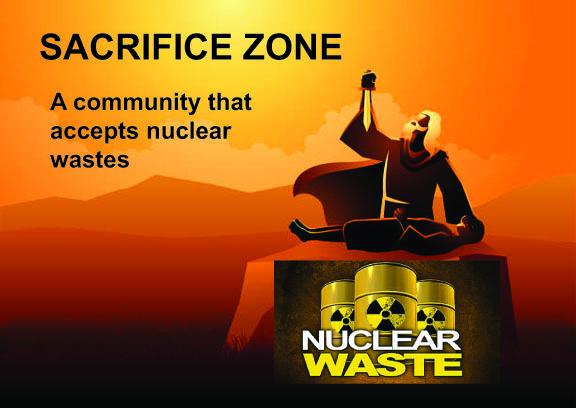
“New Mexico can’t just be the convenient sacrifice zone for the country’s contamination,”
Proponents call the ban an ‘important first step’ to limit impacts from radioactive waste
Source New Mexico, BY: DANIELLE PROKOP – APRIL 10, 2023
A state ban on high-level nuclear waste will go into effect in June, blocking a private company’s ability to build a contentious storage facility in southern New Mexico.
Gov. Michelle Lujan Grisham signed Senate Bill 53 into law March 17. The bill did not have the votes for an emergency enaction, so it goes into effect June 15.
The new law has two provisions.
The first expands the scope and duties for a task force to consult state agencies on nuclear disposal and investigate its impacts on New Mexico.
The second bans storage of high-level nuclear waste. The ban is in effect until two conditions are met – the state agrees to open a facility to handle waste, and the federal government has adopted a permanent underground storage site for nuclear waste.
“We do need a permanent solution. But New Mexico can’t just be the convenient sacrifice zone for the country’s contamination,” said Sen. Jeff Steinborn (D-Las Cruces) in an interview.
High level radioactive waste is extremely toxic. Some types will remain highly radioactive for thousands, if not tens of thousands of years. Short doses of exposure can be fatal. If radioactive waste leaches into the groundwater or soils, it can move through the food chain.
The state ban would include regulations on Holtec International’s plans for an underground facility for spent nuclear fuel from nuclear power reactors and other high-level radioactive waste from across the country.
At its peak, Holtec projected the facility could hold 176,600 metric tons of waste aboveground on more than 1,000 acres between Hobbs and Carlsbad.
“This bill is another major obstacle that will prevent this site from ever receiving any nuclear waste,” said Don Hancock, Nuclear Waste Safety program director and administrator at the nonprofit Southwest Research and Information Center.
The region already hosts the Waste Isolation Pilot Project, an underground site that stores clothes, tools, rags and other items contaminated with radioactive waste. The new law does not impact WIPP……………………………………
Kayleigh Warren, a member of Santa Clara Pueblo and a health and justice coordinator at the nonprofit Tewa Women United, called the four-page bill “an important first step.”
“It’s a way our state can start to communicate to the rest of our county that we’ve done our part,” Warren said. “We’re not interested in being a sacrifice zone for the country’s waste anymore.
Tewa Women United protests the impacts of toxins from Los Alamos National Laboratory on water and land in the Española valley and surrounding Pueblos. Looking forward, a key issue is how tribal governments will participate on the task force.
Native Americans are disproportionately vulnerable from uranium mining on the Navajo Nation or exposed at higher rates to radiation in water supplies.
“I want to see how our voices become part of these conversations moving forward,” Warren said. https://sourcenm.com/2023/04/10/law-to-ban-high-level-nuclear-waste-storage-facility-effective-june/
US deploys nuclear submarine to West Asia as influence plummets
As China and Russia expand their influence in West Asia, and Arab nations move to reconcile with Iran and Syria, Washington has seen its grip on the region weaken significantly
The Cradle – April 08 2023
The Pentagon announced on 8 April that it deployed the USS Florida — a nuclear-powered, guided-missile submarine — to the Red Sea in support of the Bahrain-based US Fifth Fleet…………………………….
“It is capable of carrying up to 154 Tomahawk land-attack cruise missiles and is deployed to US 5th Fleet to help ensure regional maritime security and stability,” US Commander Timothy Hawkins said in a statement.
In a rare move, the Pentagon released a picture of the Ohio-class submarine as it transited the Suez Canal to the Persian Gulf. Washington usually keeps the locations of its submarines private while they are at sea.
Experts see the public show of force by the Pentagon as an attempt to beef up its forces in the region and deter resistance groups from targeting the US occupation army and its allies………………………………. more https://thecradle.co/article-view/23448/us-deploys-nuclear-submarine-to-west-asia-as-influence-plummets
Northampton nuclear weapons activist Ira Helfand wins peace award

Helfand said the two biggest threats to the planet are climate change and nuclear weapons, which has a much simpler solution.
“I think we can absolutely do it in 10 years,” he said. “It will take two to three years of talks and six to seven years to dismantle the weapons.”
Apr. 09, 2023,
By Jeanette DeForge | jdeforge@repub.com
NORTHAMPTON — After 45 years of fighting for the worldwide elimination of nuclear weapons, a local physician believes the solution could be no more than 10 years away.
Dr. Ira Helfand, a retired doctor who most recently worked at the Family Care Medical Center in Springfield, is the recipient of Morehouse College’s Gandhi-King-Ikeda Community Builder’s Award for his creation and activist work with the Back from the Brink.
While honored by the award, which is designed to recognize someone who promotes peace and social transformation in a positive and non-violent way, Helfand said he is hoping the prize will help call attention to the effort to end nuclear weapons. He will be the keynote speaker at the April 13 awards ceremony at the college in Atlanta.
“Nuclear weapons don’t make us safe. They are the greatest threat to security and we have to get rid of them,” he said. “Our message is the problem never went away after the Cold War.”
The issue has returned to the forefront this year with the Russian invasion of Ukraine. A week ago, President Vladimir Putin announced he would move nuclear weapons close to the border of Belarus and in February he delivered a warning to the West over Ukraine by suspending a landmark nuclear arms control treaty.
“The Russian invasion of Ukraine has made it clear that we can no longer afford to deny the danger of nuclear war,” Helfand said. “We have a very short window of opportunity to eliminate these weapons—before they eliminate us. But we can do that. We made these weapons with our own hands. We know how to take them apart. We just need to create the political will to do that.”
A precedent has already been set. Negotiations over nuclear weapon disarmament, even among hostile countries, have had successes in the past, he said.
The threat of nuclear war in the 1980s initiated Russian President Mikhail Gorbachev to propose talks with U.S. President Ronald Regan. More than two years of negotiations and ups and downs led to the historic 1987 Intermediate-Range Nuclear Forces Treaty that had both countries reduce nuclear arms.
The 2017 International Treaty on the Prohibition of Nuclear Weapons was signed, bringing the world another step toward eliminating nuclear weapons.
The world has about 13,000 warheads across nine countries. Leaders have already destroyed 50,000 over different treaties, he said.
But that simply isn’t enough. There have been at least six different real threats to nuclear war in the past that are known and the consequences of one will be horrific and felt worldwide, he said.
Helfand said the two biggest threats to the planet are climate change and nuclear weapons, which has a much simpler solution.
“I think we can absolutely do it in 10 years,” he said. “It will take two to three years of talks and six to seven years to dismantle the weapons.”……………………………………………… https://www.masslive.com/news/2023/04/northampton-nuclear-weapons-activist-ira-helfand-wins-peace-award.html
Absolutely disingenuous – DARC – the Deep-Space Advanced Radar Capability – Australia to join USA’s plan for Space as a War-fighting Domain.
“So, what worries me most is China’s use of space to complete the kill chain necessary to generate long-range precision strikes against the maritime and air components scheme of maneuver. That’s what concerns me the most,” Brig. Gen. Anthony Mastalir, commander of Space Forces Indo-Pacific, said.
By COLIN CLARKon April 07, 2023
SYDNEY — The vast landmass of Australia, possessed of clear skies free of city lights or pollution, is the perfect spot to place the most acute space situational awareness systems. Which is why Brig. Gen. Anthony Mastalir, the head of Space Forces Indo-Pacific says it’s “absolutely critical” to get a new radar system there as quickly as can be.
“When you look at a place like Australia as a landmass, you have a lot of opportunity to contribute to that space picture,” Mastalir told Breaking Defense during an interview during the Sydney Dialogue, put on by the Australian Strategic Policy Institute. “The Australians, the defense Space Command folks and the acquisition arms, they absolutely understand that, so they’re moving aggressively to embrace some of these opportunities and bring systems like DARC — deep space radar capability — here on the continent.”
DARC, officially the Deep-Space Advanced Radar Capability, was designed by Johns Hopkins Applied Physics Laboratory to provide global monitoring of geosynchronous orbits in all kinds of weather and during daylight. According to the APL, it relies heavily on commercial technology. The Space Force received DARC technology from APL last year, with demonstrations taking place at White Sands Missile Range in New Mexico.
Ultimately, the operational DARC program calls for three transmit/receive sites, spaced at mid-latitudes around the world, to detect and track satellites. Northrop Grumman won a $341 million contract from US Space Force’s Space Systems Command last February to begin building the global system, with the first location in Australia targeted for calendar year 2025. That will be followed by one in Europe and a third in the US, with those locations yet to be announced.
FY24 budget justification documents show $174M requested for DARC in the next fiscal year. It further states that “The total cost of the DARC Rapid Prototype Middle Tier of Acquisition (MTA) effort is 844.6M. DARC Site 1 is not fully funded across the Future Years Defense Program.” $40 million is set aside for early work on sites 2 and 3.
“The DARC program will field a resilient ground-based radar providing our nation with significantly enhanced space domain awareness for geostationary orbit,” Pablo Pezzimenti, vice president for integrated national systems at Northrop Grumman said in a statement announcing the first contract award. “While current ground-based systems operate at night and can be impacted by weather conditions, DARC will provide an all-weather, 24/7 capability to monitor the highly dynamic and rapidly evolving geosynchronous orbital environment critical to national and global security.”
Discussions are underway about where to locate the system in Australia once it’s ready. Before anything can be released officially, negotiations must conclude on a treaty level document known as the Technology Safeguards Agreement. Negotiations began in mid-2021. Mastalir declined to discuss the talks, noting they are led by the Department of Commerce.
Russia And China Remain Top Concerns
During the panel Mastalir appeared on at the Sydney Dialogue, the general said that Russia had clearly possessed space superiority at the beginning of the invasion of Ukraine but had lost it. After the panel, Breaking Defense asked him to explain his remarks.
“Russia clearly is a dominant space power, relative to Ukraine. So they entered that conflict in that position,” he said. “Now you see no less than seven or eight different commercial entities, everything from GPS jammer detection, communications to tactical ISR that are bringing products to bear to support the Ukrainians. And has Russia been able to deny the adversary, in this case, Ukraine, from benefiting from space? And the answer, I think, is no — not really.”
His assessment is that the two countries have reached perhaps the most dangerous state for two militaries slugging it out on the battlefield: parity.
“Now parity, parity is dangerous, right? Because when you have parity — and I think this is what we’re kind of seeing play out — you have these prolonged conflicts, and a lot of destruction and death. And that’s not a situation that we ever want to be in as the United States.”
Asked if there are lessons for the United States military and intelligence community in light of what he called “a potential paradigm shift.” the general said it raises many difficult policy and operational questions.
That includes the question of how commercial operators are protected, or not, by the government if they are being used for military operations.
“Number one, who’s going to defend those assets? Is there a responsibility for the United States to protect and defend commercial on-orbit capability that’s assisting the US military?” The related issue is, “to what extent should we integrate commercial across all of our space capabilities?”
Given these complexities, what keeps the general up at night in this region?
So, what worries me most is China’s use of space to complete the kill chain necessary to generate long-range precision strikes against the maritime and air components scheme of maneuver. That’s what concerns me the most,” Mastalir said. “I have to have the ability to deny China in this situation, as a potential adversary, the ability to do that. And so those are the kinds of things that that you know, worry me the most now.”
He stressed that the simple possession of such capabilities “doesn’t mean it’s wrong. But if you look at our efforts to maintain a free and open Indo-Pacific, you quickly run into a situation where our ends, and what we see in terms of behavior coming from China, their ends don’t necessarily align.”
Theresa Hitchens in Washington contributed to this report.
More warheads, more nuclear waste to New Mexico. Santa Fe fearful, as Carlsbad leaders support efforts

“legacy waste” from past programs still waiting for disposal at Los Alamos was being disregarded in favor of the new streams the NNSA intended to generate.
“It’s heart-wrenching when you hear the young people concerned with manufacturing bombs.”
Adrian Hedden, Carlsbad Current-Argus 6 Apr 23,
Two meetings on nuclear waste were held in New Mexico this week, on different sides of the state with very different reactions from attendees.
On Tuesday, a townhall-style meeting was held in Santa Fe which more than 300 persons attended and about 200 participated online.
Most expressed fears and concerns that a federal plan to transport surplus plutonium to the Waste Isolation Pilot Plant near Carlsbad would endanger local communities along the transportation routes.
The next night at a meeting at the city golf course in Carlsbad, about 30 business leaders, elected officials and invited guests took a much warmer tone with the federal government and its plans for New Mexico and the nearby WIPP site.
Under the federally proposed plan, surplus plutonium would move via truck from the Pantex Plant near Amarillo, Texas to Los Alamos National Laboratory (LANL) in northern New Mexico for processing, then to the Savannah River Site in South Carolina for additional preparation before finally heading to WIPP for disposal.
By then, the 34 metric tons of plutonium set for disposal would meet characterization standards for transuranic (TRU) nuclear waste, meaning the program would not result in any waste of a higher radioactivity than that which the repository was intended to store.
But the program would see waste traveling through New Mexico, and especially the northern portion of the state, multiple times.
That’s a problem for Santa Fe County Commissioner Anna Hansen, who moderated the Tuesday meeting at the Santa Fe Convention Center with the Department of Energy’s National Nuclear Security Administration (NNSA) – the agency devising the plan – and argued it could burden her community with the risk of exposure.
At the same time, the NNSA also was planning to ramp up the production of plutonium pits, the triggers for nuclear warheads, at Los Alamos and Savannah River site, hoping to produce up to 80 pits a year by 2030.
Some of the waste from that program would also be destined for WIPP as it’s the only deep geological repository in the U.S. for nuclear waste.
“People feel betrayed,” Hansen said in an interview with the Carlsbad Current-Argus, arguing the two NNSA programs marked an “expansion” of WIPP’s operations beyond what New Mexico originally agreed to when the facility was developed.
She said “legacy waste” from past programs still waiting for disposal at Los Alamos was being disregarded in favor of the new streams the NNSA intended to generate.
“They still feel frustrated that the legacy waste at LANL has not been cleaned up and new waste is being generated and also going to WIPP,” Hansen said of attendees at the Santa Fe meeting. “It’s heart-wrenching when you hear the young people concerned with manufacturing bombs.”
Jack Volpato, chair of the Carlsbad Mayor’s Nuclear Task Force, commended the NNSA and the WIPP project at the Wednesday meeting in Carlsbad for supporting the local community, its workforce and economy in the decades since the site was opened……………………………………………………………………………
Hansen, the Santa Fe County commissioner, said the NNSA’s plans were extraneous to WIPP’s original mission and what should be its primary purpose: to get nuclear waste “off the hill” in Los Alamos.
That’s the only true benefit to the people of New Mexico who host the WIPP site, she said.
“It’s a complete expansion of WIPP’s mission to be putting new and generated waste,” Hansen said. “It’s insanity to move surplus plutonium around the country. We don’t want to continue being left behind. Waste from all over the country has been coming here.”………………………………………………… https://www.currentargus.com/story/news/2023/04/06/nuclear-waste-new-mexico-santa-fe-carlsbad-nuke-plutonium-department-energy-bombs-nuke-warhead/70080266007/
8 peaceful protestors arrested at the Nevada National “Security” Site

Nonviolent Activism, North America
By Nevada Desert Experience, April 8, 2023 https://worldbeyondwar.org/8-arrested-at-the-nevada-national-security-site/
On Good Friday, April 7, 2023 , 8 concerned citizens were arrested and cited for trespass at the Nevada National “Security” Site insisting on nuclear weapons abolition. On April 10, 2023 Brian Terrell and John Amidon will appear in Beatty Justice Court for trespass citations from October 2022.
The NDE Sacred Peace Walk engaged the Department of Energy and the Nye County Sheriff’s department in dialogue and civil resistance. Jacques Linder, Philadelphia, PA, Richard Bishop, Missoula, MT, Sylver Pondolfino, Staten Island, NY, Tessa Epstein, Salt Lake City, Utah, Mark Babson, Salem, Oregon, George Killingsworth, Berkeley, CA, Theo Kayser, St. Louis, MO, Catherine Hourcade, Stockton, CA were arrested, cited for trespass and released at the NNSS.
Mark Babson said “I felt the arresting officers were listening to us. It is so vital we continue this work because we have the ability to make a significant choice that will effect the survival of our species and that of other living beings.”
Brian Terrell and John Amidon will appear in Beatty Justice Court, Monday morning for previous trespass citations at the NNSS from last October, 2022. Both have pleaded not guilty as both had permission and land use permits from the Western Shoshone National Council, the legal owners of this land.
1 This Month

of the week – Shut Down Drone Warfare!


Tell the Ukrainian Government to Drop Prosecution of Peace Activist Yurii Sheliazhenko

Petition to revoke the licensing of the Near Surface Nuclear Disposal Facility (NSDF) at Chalk River. https://www.ourcommons.ca/petitions/en/Petition/Details?Petition=e-7247
To see nuclear-related stories in greater depth and intensity – go to https://nuclearinformation.wordpress.com
-
Archives
- April 2026 (103)
- March 2026 (251)
- February 2026 (268)
- January 2026 (308)
- December 2025 (358)
- November 2025 (359)
- October 2025 (376)
- September 2025 (257)
- August 2025 (319)
- July 2025 (230)
- June 2025 (348)
- May 2025 (261)
-
Categories
- 1
- 1 NUCLEAR ISSUES
- business and costs
- climate change
- culture and arts
- ENERGY
- environment
- health
- history
- indigenous issues
- Legal
- marketing of nuclear
- media
- opposition to nuclear
- PERSONAL STORIES
- politics
- politics international
- Religion and ethics
- safety
- secrets,lies and civil liberties
- spinbuster
- technology
- Uranium
- wastes
- weapons and war
- Women
- 2 WORLD
- ACTION
- AFRICA
- Atrocities
- AUSTRALIA
- Christina's notes
- Christina's themes
- culture and arts
- Events
- Fuk 2022
- Fuk 2023
- Fukushima 2017
- Fukushima 2018
- fukushima 2019
- Fukushima 2020
- Fukushima 2021
- general
- global warming
- Humour (God we need it)
- Nuclear
- RARE EARTHS
- Reference
- resources – print
- Resources -audiovicual
- Weekly Newsletter
- World
- World Nuclear
- YouTube
-
RSS
Entries RSS
Comments RSS
 nuclear-news