‘It Is Skynet’: Pentagon Envisions Robot Armies in a Decade

Blitzkrieg 2040
Nazi Germany, overran Europe in a very, very short period of time … because they were able to take those technologies and put them together in a doctrine which we now know as Blitzkrieg,” he said.

Milley, and the Pentagon with him, hopes to do the same now by bringing together emergent capabilities like robotics, AI, cyber and space platforms, and precision munitions into a cohesive doctrine of war.
By being the first to integrate these technologies into a new concept, Milley says, the United States can rule the future battlefield.
The Pentagon’s quest for an AI-dominated battlefield is becoming a reality
Epoch Times, By Andrew Thornebrooke, April 20, 2023
WASHINGTON—Robotic killing machines prowl the land, the skies, and the seas. They are fully automated, seeking out and engaging with adversarial robots across every domain of war. Their human handlers are relegated to the rearguard, overseeing the action at a distance while conflicts are fought and won by machines.
Far from science fiction, this is the vision of Joint Chiefs of Staff Chairman Gen. Mark Milley.
The United States, according to Milley, is in the throes of one of the myriad revolutions in military affairs that have spanned history.
Such revolutions have spanned from the invention of the stirrup to the adoption of the firearm to the deployment of mechanized maneuver warfare and, now, to the mass fielding of robotics and artificial intelligence (AI).
It is a shift in the character of war, Milley believes, greater than any to have come before.
“Today we are in … probably the biggest change in military history,” Milley said during a March 31 discussion with Defense One.
“We’re at a pivotal moment in history from a military standpoint. We’re at what amounts to a fundamental change in the very character of war.”
Robotic Armies in 10 Years
Many would no doubt be more comfortable with the idea of robots battling for the control of Earth if it were in a science-fiction novel or on a movie screen rather than on the list of priorities of the military’s highest-ranking officer.
Milley believes, however, that the world’s most powerful armies will be predominantly robotic within the next decade, and he means for the United States to be the first across that cybernetic Rubicon.
“Over the next ten to fifteen years, you’ll see large portions of advanced countries’ militaries become robotic,” Milley said. “If you add robotics with artificial intelligence and precision munitions and the ability to see at range, you’ve got the mix of a real fundamental change.”
“That’s coming. Those changes, that technology … we are looking at inside of 10 years.”
That means that the United States has “five to seven years to make some fundamental modifications to our military,” Milley says, because the nation’s adversaries are seeking to deploy robotics and AI in the same manner, but with Americans in their sights.
The nation that gets there first, that deploys robotics and AI together in a cohesive way, he says, will dominate the next war.
“I would submit that the country, the nation-state, that takes those technologies and adapts them most effectively and optimizes them for military operations, that country is probably going to have a decisive advantage at the beginning of the next conflict,” Milley said.
The global consequences of such a shift in the character of war are difficult to overstate.
Milley compared the ongoing struggle to form a new way of war to the competition that occurred between the world wars
In that era, Milley says, all the nations of Europe had access to new technologies ranging from mechanized vehicles to radio to chemical weapons. All of them could have developed the unified concept of maneuver warfare that replaced the attrition warfare which had defined World War I.
But only one, he said, first integrated their use into a bona fide new way of war.
“That country, Nazi Germany, overran Europe in a very, very short period of time … because they were able to take those technologies and put them together in a doctrine which we now know as Blitzkrieg,” he said.
Blitzkrieg 2040
Milley, and the Pentagon with him, hopes to do the same now by bringing together emergent capabilities like robotics, AI, cyber and space platforms, and precision munitions into a cohesive doctrine of war.
By being the first to integrate these technologies into a new concept, Milley says, the United States can rule the future battlefield.
To that end, the Pentagon is experimenting with new unmanned aerial, ground, and undersea vehicles, as well as seeking to exploit the pervasiveness of non-military smart technologies from watches to fitness trackers.
Though the effort is just gaining traction, Milley has in fact claimed since 2016 that the U.S. military would field substantial robotic ground forces and AI capabilities by 2030.
Just weeks from now, that idea will begin to truly culminate, when invitations from the Defense Department (DoD) go out to leaders across the defense, tech, and academic spheres for the Pentagon’s first-ever conference on building “trusted AI and autonomy” for future wars.
The Pentagon is on a correlating hiring spree, seeking to pay six figures annually for experts willing and able to develop and integrate technologies including “augmented reality, artificial intelligence, human state monitoring, and autonomous unmanned systems.”
Likewise, the U.S. Army Futures Command, created in 2018, maintains as a critical goal the designing of what it calls “Army 2040.” In other words, the AI-dependent, robotic military of the future.
Though slightly further out than Milley’s assumption of 10 to 15 years, Futures Command deputy commanding general Lt. Gen. Ross Coffman believes that 2040 will mark the United States’ true entry into an age characterized by artificially intelligent killing machines.
…………………….. Everything Spins Out of Control’
Remaking the American military and forming a new, cohesive way of war is a tall order. It is nevertheless one that the Pentagon appears prepared to pay for.
The DoD is requesting a record $1.8 billion in funding for AI projects for the next year alone. That amount will exceed the estimated $1.6 billion in AI investments being made by China’s military.
……………….. John Mills, former director of cybersecurity policy, strategy, and international affairs at the Office of the U.S. Secretary of Defense, believes that this path is rife with the potential for unintended consequences.
“It is Skynet,” Mills told the Epoch Times, referencing the fictional AI that conquers the world in “The Terminator” movie franchise. “It is the realization of a Skynet-like environment.”
“The question is, what could possibly go wrong with this situation? Well, a lot.”
…………… “The integration of AI with autonomous vehicles, and letting them action independently without human decision-making, that’s where everything spins out of control.”
To that end, Mills expressed concern about what a future conflict might look like between the United States and its allies, and China in the Indo-Pacific.
Imagine, he said, an undersea battlespace in which autonomous submarines and other weapons systems littered the seas.
Fielded by Chinese, American, Korean, Australian, Indian, and Japanese forces, the resulting chaos would likely end with autonomous systems engaging in war throughout the region, while manned vessels held back and sought to best launch the next group of robotic war machines. Anything else would risk putting real lives in the way of the automated killers.
“How do you plan for engagement scenarios with autonomous undersea vehicles?” Mills said
“This is going to be absolute chaos in subsurface warfare.”
……………………… There is just one caveat to that ethical, trustworthy, governable, deployment of lethal AI systems: The Pentagon does not have any hard and fast rules to prohibit autonomous systems from killing…………………………………………………………….
more https://www.theepochtimes.com/in-depth-it-is-skynet-pentagon-envisions-robot-armies-in-a-decade_5207504.html?utm_source=China&src_src=China&utm_campaign=uschina-2023-04-20&src_cmp=uschina-2023-04-20&utm_medium=email&est=vibelq5SAFOai0xZ2IdvvJe4uwKWVBE7hfxTKp%2FcR9S0a9BSSEoQCAfiSObFUg%3D%3D
Daniel Ellsberg is still fighting — Beyond Nuclear International

For Ellsberg there was “no greater cause” than confronting the evils of nuclear weapons
Daniel Ellsberg is still fighting — Beyond Nuclear International
Legendary whistleblower keeps giving in his final months
By Linda Pentz Gunter
Most of us who have been around long enough in this movement probably have their own Daniel Ellsberg story. With the 91-year old famous whistleblower’s recent announcement that he has terminal pancreatic cancer, with just months to live, many were re-telling theirs. It was an apt outpouring of admiration, respect and love. So much so, that April 24-30 is now Daniel Ellsberg Week.
……………………………………….Thus I came to learn that one of the great heroes of our time, who was prepared to sacrifice a lifetime of freedom for a just cause, was indeed a man of quiet humility and one who has filled that lifetime that he views as some sort of unexpected bonus, with endlessly generous gifts of writing, insight, analysis and conviction.
His recent book — The Doomsday Machine, confessions of a nuclear war planner — is essential and definitive and nightmare-inducing. In other words, desperately important.
“In public, he has been a beacon of integrity and truth, willing to say and do what the warmakers and nuclear-holocaust planners find completely unacceptable,” RootsAction co-founder and director Norman Solomon told Common Dreams columnist, Brett Wilkins. ”In private, his thoughtful kindness and daily commitment to humanity are central to his being. And I want to emphasize right now that nothing in the world is more important to read and heed than Dan’s monumental book The Doomsday Machine.”
……………………………………………………………………….When I copied the Pentagon Papers in 1969, I had every reason to think I would be spending the rest of my life behind bars…………………………
………………………………………………….I was able to devote those years to doing everything I could think of to alert the world to the perils of nuclear war and wrongful interventions: lobbying, lecturing, writing and joining with others in acts of protest and non-violent resistance.
…………………………………………………..China and India are alone in declaring no-first-use policies. Leadership in the US, Russia, other nuclear weapons states, NATO and other US allies have yet to recognize that such threats of initiating nuclear war–let alone the plans, deployments and exercises meant to make them credible and more ready to be carried out–are and always have been immoral and insane: under any circumstances, for any reasons, by anyone or anywhere…………………………………………………….. more https://beyondnuclearinternational.org/2023/04/23/daniel-ellsberg-is-still-fighting/
Nuclear life extension plans tested by obsolete components
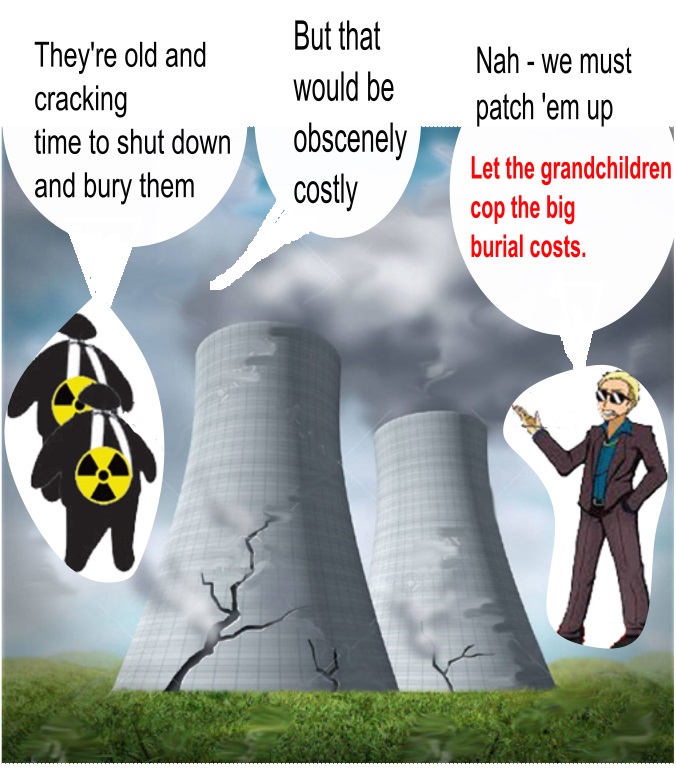
Reuters, By Paul Day, April 5 – Nuclear operators must be able to swap out old parts for new to keep a reactor running, but when like-for-like is unavailable, original equipment manufacturers (OEMs) are faced with the challenge of finding an alternative while avoiding making any major changes.
There’s a rule of thumb that if a plant has to do a design change, it’ll cost anywhere from $300,000-$500,000 just in engineering, licensing changes, drawing changes, and that doesn’t include the cost of the required equipment … so we try, wherever possible, to keep our clients from doing a design change,” says Vice President of Westinghouse Parts Business in its Operating Plant Services unit Craig Irish………………………….
Life extensions
Many of the world’s nuclear power plants were built several decades ago and applications for long-term operations (LTOs) beyond initial lifespans are becoming increasingly common.
…………………………………………………………..In the United States………….the average age of the fleet is 41 years including three reactors that started operation 52 years ago, according to the Department of Energy (DOE)
Nine U.S. reactors have active applications with the Nuclear Regulatory Commission (NRC) to extend their lives and 10 reactors have publicly announced plans to extend their licenses to 80 years.
“Under current license basis 92% of operating reactors would shut down by 2050 and 74 percent would shut down by 2050 with anticipated license renewals. However, if 54 reactors extended operation to 80 years, only 20% of operating reactors would shut down by 2050,” the DOE said in its 2022 report on nuclear energy supply chains.
Obsolescence challenge
The challenge, say OEMs, is keeping a supply chain running and up to date for complex, always-on machines that were built with Reagan-era (or earlier) technology.
………………with construction times for some plants approaching ten years, many of the parts can be obsolete before the plant has even started generating power, according to Westinghouse’s Irish.
……………………………………………Internationally, part of the challenge is many of the parts produced for the nuclear industry face varying specifications depending on the regulator they are working under, restricting an already tight market to national boundaries.
Such differences will become even more pronounced with the introduction of a new generation of reactors expected to begin commercial operations within the next decade, with more than 70 SMR designs under development in 18 countries.
…………………………………………………………………………… “The biggest problem is a lot of these discrete components, resistors, diodes, transistors, capacitors, etc are either substantially changed from the 70s and 80s when we built these instruments or they’re not available or they got bought and sold by another company,” he says. https://www.reuters.com/business/energy/nuclear-life-extension-plans-tested-by-obsolete-components-2023-04-05/
Complex safety problems in overhauling USA’s nuclear weapons stockpile, especially plutonium pits

TRUST BUT VERIFY. U.S. labs are overhauling the nuclear stockpile. Can they validate the weapons without bomb tests?
20 APR 2023, BY SARAH SCOLES Science.org
LOS ALAMOS, NEW MEXICO—Behind a guard shack and warning signs on the sprawling campus of Los Alamos National Laboratory is a forested spot where scientists mimic the first moments of a nuclear detonation. Here, in the Dual-Axis Radiographic Hydrodynamic Test (DARHT) facility, they blow up models of the bowling ball–size spheres of plutonium, or “pits,” at the heart of bombs—and take x-ray pictures of the results.
In a real weapon, conventional explosives ringing an actual pit would implode the plutonium to a critical density, triggering an explosive fissile chain reaction. Its energy would drive the fusion of hydrogen isotopes in the weapon’s second stage, generating yet more neutrons that would split additional fission fuel………………………………………………………..
Facilities like DARHT have been important since 1992, when the Department of Energy’s (DOE’s) three weapons labs—Los Alamos, Lawrence Livermore National Laboratory, and Sandia National Laboratory—stopped full-fledged tests of nuclear weapons. By 1996, the United States had signed the Comprehensive Nuclear-Test-Ban Treaty—credited not only with stopping the environmental damage of nuclear testing, but also with disincentivizing new weapons designs.
Without tests, however, the only things ensuring that warheads work are facilities like DARHT, computer simulations from “weapons codes,” and a cache of data from the old days of nuclear testing. For relatively minor changes to old weapons—new fuses, fresh top-ups of the hydrogen isotope tritium—that has been enough. Every year, DOE’s National Nuclear Security Administration (NNSA) and the Department of Defense have certified the stockpile, an assessment that means they are convinced the weapons will work when they’re supposed to, as they’re supposed to—and not do anything when they’re not supposed to. “Because we’ve blown up so many of them, these things are incredibly reliable,” says Geoff Wilson, director of the Center for Defense Information at the Project on Government Oversight, which argues nuclear weapons spending should be reduced.
But now the stockpile is getting an overhaul, the biggest in decades. This fiscal year, NNSA has a record $22.2 billion budget. Much of the money will go to producing new plutonium pits to replace those in the arsenal and to modernizing four warheads. A fifth weapon, dubbed the W93—a submarine-launched warhead—is a new design program. “It’s really the first warhead program we’ve had since the end of the Cold War” that isn’t a life extension or modernization of an existing weapon, says Marvin Adams, NNSA’s deputy administrator for defense programs………………………………
Wilson worries that the international dynamics and the U.S. overhaul could ultimately lead to a revival of bomb tests, bringing back their hazards and stoking a new arms race. “It is not unfathomable to me, which is scary to say.” It’s one thing to tweak weapons with a deep heritage. It’s another to infer functionality for modified weapons that have never been fully tested, he says………………………………….
SIMPLY REPLACING the bombs’ plutonium pits poses a science challenge: understanding how subtle changes affect their behavior. They aren’t easy to make, in part because plutonium, a metal only in existence since 1940, is mysterious and hard to handle. The last time anyone made pits at scale—in the 1980s at Colorado’s Rocky Flats plant—DOE’s contractor was shut down for environmental violations and forced to pay an $18.5 million fine.
This time, NNSA is splitting production between Los Alamos and the Savannah River Site in South Carolina. It has tasked them with making 80 new pits per year by 2030, a deadline NNSA admits it will not meet.
Los Alamos’s pits will be made at a facility called PF-4, a set of high-security buildings surrounded by cyclone fences with razor wire. Inside PF-4 are glovebox enclosures—radiation-shielded workstations where workers use thick gloves and peer through glass windows to manipulate the exotic metal. The lab is hiring thousands of workers, and its first pit is likely to be ready for the stockpile next year.
The gargantuan effort is motivated by a simple fact: many current pits are more than 40 years old, and plutonium behaves in confounding ways as it ages and radioactively decays. A green, fuzzy coating grows on it as its surface oxidizes. Atoms in its metallic lattice are knocked out of place as it spits out uranium isotopes. Its dimensions shift when it slips between six different solid phases. And the pits do not necessarily degrade smoothly. “We know at some point there will be a nonlinear piece,” says David Clark, director of Los Alamos’s National Security Education Center and editor of the Plutonium Handbook. “We just haven’t seen it.”…………….
One might think the new pits would make it easier to certify the stockpile, by avoiding the uncertainties of aging plutonium. But they come with uncertainties of their own. The new pits won’t be twins of their predecessors, so weapons scientists will have to understand how the alterations change pit behavior. They are being manufactured using recycled and purified plutonium from old pits, not fresh material, unlike the originals. Moreover, they will be made with different processes, and in some cases designed to slightly different specifications. “If you look at a new requirement,” Adams says, “you often will find that the old pits we have available to us are really, really suboptimal.”………………………………………. https://www.science.org/content/article/trust-verify-can-u-s-certify-new-nuclear-weapons-without-detonating-them
Chinese Diplomacy Seen as Threat to US ‘Peace,’ ‘Stability’
FAIR, GREGORY SHUPAK 21 Apr 23
China has undertaken a diplomatic blitz that has seen it broker a rapprochement between Iran and Saudi Arabia, warm relations with France, and put forth a proposal to end the war in Ukraine. US media coverage of these developments has involved illusion-peddling about America’s potentially waning empire, and calls for the US to escalate what amounts to a new cold war with China.
In Foreign Policy (3/14/23), Michael McFaul and Abbas Milani say that China “now shares the burden of keeping the peace in the Middle East. This is not an easy assignment, as the United States has learned bitterly over the decades.”
The US has done the opposite of “keeping the peace in the Middle East.” Nor has it sought to, as the Iraqi case makes tragically clear. Since the US-led 2003 invasion, Brown University’s Costs of War Project notes,………………………………………………………
Power = ‘peace’
Walter Russell Mead of the Wall Street Journal (3/27/23) claimed that while “American power” results in “peace and prosperity,” “challengers like China, Russia and Iran undermine the stability of the American order.” “Peace” and “stability” must seem like odd ways of characterizing that order to, say, Libyans, who had their country flattened by a US-led intervention (Jacobin, 9/12/13), and endured years of a brutal war, and even slavery.
David Ignatius of the Washington Post (3/16/23) asserted that
if Chinese President Xi Jinping wants to take on the role of restraining Iran and reassuring Saudi Arabia, good luck to him. The United States has been trying since 1979 to bend the arc of the Iranian revolution toward stability.
Washington supported Iraq’s invasion of Iran, to the point of helping Iraq use chemical weapons against the country. The US has also levied sanctions that have immiserated the country, undercutting Iranians’ access to food and medicine. Describing such aggression as attempts to engender “stability” inverts reality—to say nothing of Ignatius’ strange desire to “reassur[e]” Washington’s execution-happy longtime client in Riyadh.
In the case of the war that turned Yemen into the world’s worst humanitarian crisis, McFaul and Milani exculpate the US, writing that “the Biden administration, supported by other countries with a commitment to stopping this war, helped negotiate a truce.”
Like McFaul and Milani, Ignatius accuses China of “harvest[ing] the goodwill” after the US allegedly “laid the groundwork for a settlement of the horrific war in Yemen.” This omits the rather salient point that the United States is a major reason the war has gone on for as long as it has, with as high a price as it has had for Yemenis.
The Obama, Trump and Biden administrations prolonged and escalated the war……………………………………………………………………..
Looking just at wars in this century, the United States carried out a 20-year occupation of Afghanistan, and its troops remain in Iraq 20 years after it invaded and overthrew that country’s government. US troops still occupy parts of Syria against the will of that country’s government. Washington has carried out bombing campaigns against Libya, as noted, as well as Somalia and Pakistan.
Given that it is also the “major patron” of Israel, which invaded Lebanon in the relevant period (on top of occupying and annexing Syrian and Palestinian land), and of Saudi Arabia, the main aggressor against Yemen, there’s a strong case to be made that Uncle Sam is the world’s “most destabilizing state.”
If China overtakes the US’s position atop the global order, it’s uncertain exactly what the world system will look like. What is clear, however, is that US hegemony has been “anything but peaceful.”
Environmentalists say Starship failure boosts their concerns
Washington Post, 21 Apr 23
Thursday’s Starship explosion underscored the concerns of the American Bird Conservancy, which has opposed SpaceX’s operations at Boca Chica in South Texas because of the facility’s impacts on wildlife habitat and the species that rely on it, including species listed under the Endangered Species Act.
The fiery mishap highlighted in dramatic fashion the risks and the stakes of potential environmental destruction, the group said. Photos showed that the launch itself had sent debris flying across across the launch site and appeared to have damaged the company’s facilities. SpaceX and local officials had enforced a broad keep-out area to ensure no one was threatened by the launch.
“From our point of view, it’s good news it didn’t blow up at the pad site, but future launches could,” said American Bird Conservancy President Michael Parr. The sounds, debris and fires fueled by a crash could all pose risks to wildlife, he said. Had an explosion taken place over the sensitive wetlands, a cleanup would further disturb the environment………………………………………… https://www.msn.com/en-us/news/technology/unmanned-starship-explodes-over-gulf-after-liftoff/ar-AA1a6BtR?ocid=msedgdhp&pc=U531&cvid=225bf63143754ebc94b3de444cf9de7d&ei=14
Six war mongering think tanks and the military contractors that fund them.

Center for Strategic and International Studies
Center for a New American Security
Hudson Institute
Atlantic Council
International Institute for Strategic Studies
Australian Strategic Policy Institute
Amanda Yee, March 7, 2023 https://www.liberationnews.org/six-war-mongering-think-tanks-and-the-military-contractors-that-fund-them/
From producing reports and analysis for U.S. policy-makers, to enlisting representatives to write op-eds in corporate media, to providing talking heads for corporate media to interview and give quotes, think tanks play a fundamental role in shaping both U.S. foreign policy and public perception around that foreign policy. Leaders at top think tanks like the Atlantic Council and Hudson Institute have even been called upon to set focus priorities for the House Intelligence Committee. However, one look at the funding sources of the most influential think tanks reveals whose interests they really serve: that of the U.S. military and its defense contractors.
This ecosystem of overlapping networks of government institutions, think tanks, and defense contractors is where U.S. foreign policy is derived, and a revolving door exists among these three sectors. For example, before Biden-appointed head of the Pentagon Lloyd Austin took his current position, he sat on the Board of Directors at Raytheon. Before Austin’s appointment, current defense policy advisor Michèle Flournoy was also in the running for the position. Flournoy sat on the board of Booz Allen Hamilton, another major Pentagon defense contractor. These same defense contractors also work together with think tanks like the Center for Strategic and International Studies to organize conferences attended by national security officials. On top of all this, since the end of the Cold War, intelligence analysis by the CIA and NSA has increasingly been contracted out to these same defense companies like BAE Systems and Lockheed Martin, among others — a major conflict of interest. In other words, these corporations are in the position to produce intelligence reports which raise the alarm on U.S. “enemy” nations so they can sell more military equipment!
And of course these are the same defense companies that donate hundreds of thousands of dollars each year to think tanks. Given all this, is it any wonder the U.S. government is simultaneously flooding billions of dollars of weaponry into an unwinnable proxy war in Ukraine while escalating a Cold War into a potential military confrontation with China?
The funding to these policy institutes steers the U.S. foreign policy agenda. To give you a scope of how these contributions determine national security priorities, listed below are six of some of the most influential foreign policy think tanks, along with how much in contributions they’ve received from “defense” companies in the last year.
All funding information for these policy institutes was gathered from the most recent annual report that was available online. Also note that this list is compiled from those that make this information publicly available — many think tanks, such as the hawkish American Enterprise Institute, do not release donation sources publicly.
1 – Center for Strategic and International Studies
According to their 2020 annual report
$500,000+: Northrop Grumman Corporation
$200,000-$499,999: General Atomics (energy and defense corporation that manufactures Predator drones for the CIA), Lockheed Martin, SAIC (provides information technology services to U.S. military)
$100,000-$199,999: Bechtel, Boeing, Cummins (provides engines and generators for military equipment), General Dynamics, Hitachi (provides defense technology), Hanwha Group (South Korean aerospace and defense company), Huntington Ingalls Industries, Inc. (largest military shipbuilding company in the United States), Mitsubishi Corporation, Nippon Telegraph and Telephone Corporation (provides intelligence and information technology services to U.S. military), Qualcomm, Inc. (semiconductor company that produces microchips for the U.S. military), Raytheon, Samsung (provides security technology to the U.S. military), SK Group (defense technology company)
$65,000-$99,999: Hyundai Motor (produces weapons systems), Oracle
$35,000-$64,999: BAE Systems
2 – Center for a New American Security
$500,000+: Northrop Grumman Corporation
$250,000-$499,999: Lockheed Martin
$100,000-$249,000: Huntington Ingalls Industries, Neal Blue (Chairman and CEO of General Atomics), Qualcomm, Inc., Raytheon, Boeing
$50,000-$99,000: BAE Systems, Booz Allen Hamilton, Intel Corporation (provides aerospace and defense technology), Elbit Systems of America (aerospace and defense company), General Dynamics, Palantir Technologies
3 – Hudson Institute
According to their 2021 annual report
$100,000+: General Atomics, Linden Blue (co-owner and Vice Chairman of General Atomics), Neal Blue, Lockheed Martin, Northrop Grumman
$50,000-$99,000: BAE Systems, Boeing, Mitsubishi Heavy Industries
4 – Atlantic Council
According to their 2021 annual report
$250,000-$499,000: Airbus, Neal Blue, SAAB (provides defense equipment)
$100,000-$249,000: Lockheed Martin, Raytheon
$50,000-$99,000: SAIC
5 – International Institute for Strategic Studies
Based in London. From fiscal year 2021-2022
£100,000+: Airbus, BAE Systems, Boeing, General Atomics, Lockheed Martin, Raytheon, Rolls Royce (provides military airplane engines)
£25,000-£99,999: Northrop Grumman Aerospace Systems, Northrop Grumman Corporation
6 – Australian Strategic Policy Institute
Note: ASPI has been one of the primary purveyors of the “Uyghur genocide” narrative
From their 2021-2022 annual report
$186,800: Thales Australia (aerospace and defense corporation)
$100,181: Boeing Australia
$75,927: Lockheed Martin
$20,000: Omni Executive (aerospace and defense corporation)
$27,272: SAAB Australia
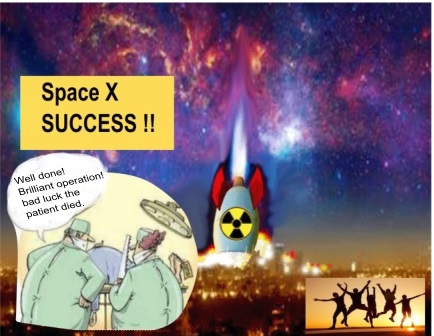
SpaceX launches most powerful rocket in history in explosive debut – like many first liftoffs, Starship’s test was a successful failure
The Conversation, Wendy Whitman Cobb 21 Apr 23
Professor of Strategy and Security Studies, Air University
Starship is almost 400 feet (120 meters) tall and weighs 11 million pounds (4.9 million kilograms). An out-of-control rocket full of highly flammable fuel is a very dangerous object, so to prevent any harm, SpaceX engineers triggered the self-destruct mechanism and blew up the entire rocket over the Gulf of Mexico.
On April 20, 2023, a new SpaceX rocket called Starship exploded over the Gulf of Mexico three minutes into its first flight ever. SpaceX is calling the test launch a success, despite the fiery end result. As a space policy expert, I agree that the “rapid unscheduled disassembly” – the term SpaceX uses when its rockets explode – was a very successful failure.
The most powerful rocket ever built
This launch was the first fully integrated test of SpaceX’s new Starship. Starship is the most powerful rocket ever developed and is designed to be fully reusable. It is made of two different stages, or sections. The first stage, called Super Heavy, is a collection of 33 individual engines and provides more than twice the thrust of a Saturn V, the rocket that sent astronauts to the Moon in the 1960s and 1970s.
The first stage is designed to get the rocket to about 40 miles (65 kilometers) above Earth. Once Super Heavy’s job is done, it is supposed to separate from the rest of the craft and land safely back on the surface to be used again. At that point the second stage, called the Starship spacecraft, is supposed to ignite its own engines to carry the payload – whether people, satellites or anything else – into orbit.
An explosive first flight
While parts of Starship have been tested previously, the launch on April 20, 2023, was the first fully integrated test with the Starship spacecraft stacked on top of the Super Heavy rocket. If it had been successful, once the first stage was spent, it would have separated from the upper stage and crashed into the Gulf of Mexico. Starship would then have continued on, eventually crashing 155 miles (250 kilometers) off of Hawaii.
During the SpaceX livestream, the team stated that the primary goal of this mission was to get the rocket off the launch pad. It accomplished that goal and more. Starship flew for more than three minutes, passing through what engineers call “max Q” – the moment at which a rocket experiences the most physical stress from acceleration and air resistance.
According to SpaceX, a few things went wrong with the launch. First, multiple engines went out sometime before the point at which the Starship spacecraft and the Super Heavy rocket were supposed to separate from each other. The two stages were also unable to separate at the predetermined moment, and with the two stages stuck together, the rocket began to tumble end over end. It is still unclear what specifically caused this failure.
Starship is almost 400 feet (120 meters) tall and weighs 11 million pounds (4.9 million kilograms). An out-of-control rocket full of highly flammable fuel is a very dangerous object, so to prevent any harm, SpaceX engineers triggered the self-destruct mechanism and blew up the entire rocket over the Gulf of Mexico…………………………………… https://theconversation.com/spacex-launches-most-powerful-rocket-in-history-in-explosive-debut-like-many-first-liftoffs-starships-test-was-a-successful-failure-204248
It’s High Time the US Signed a Peace Treaty with North Korea

Halt the Endless and Futile Condemnation of the DPRK
by Alice Slater* 21 Apr 23, https://www.indepthnews.net/index.php/armaments/nuclear-weapons/6110-it-s-high-time-the-us-signed-a-peace-treaty-with-north-korea
NEW YORK, 21 April 2023 (IDN) — It is far beyond hypocrisy for the US and its allies to condemn North Korea for testing a long-range missile when the US boasts about its Air Force Global Strike Command of more than 33,700 Airmen and civilians responsible for the nation’s three intercontinental ballistic missile wings capable of delivering nuclear weapons.
Indeed, a US Minute Man Intercontinental Ballistic Missile (IBM) was tested this past February, with another scheduled for this August.
The 1950-1953 Korean War is the longest-standing US conflict. It has never actually ended. It was only suspended by a truce and armistice between North Korea, representing the Korean People’s Army and the Chinese People’s Volunteers and the United States, representing the multinational UN Command.
During this endless armistice, we have had US troops stationed in South Korea, amassed on North Korea’s border, organizing “war games” and manoeuvres with South Korean troops in a continuous series of threats over the years against a heavily armed North Korea.
Various peace initiatives were contemplated, but the US withdrew from them or didn’t follow through. During those years, North Korea persisted in requesting a peace treaty, offering to stop enriching “peaceful” reactor material to bomb-grade in return for a lifting of punishing sanctions that were causing great stress and poverty to the people of North Korea.
It froze its nuclear program after an agreement with the Clinton administration but started it up again when President Bush in 2002 stopped honouring the Clinton agreements and characterized North Korea as part of the “axis of evil”.
In 2017, South Korea elected a new President, Moon Jae-in, who campaigned for a “Sunshine Policy” and for peaceful Korean reunification.
Ironically, at a United Nations First Committee Meeting for Disarmament in 2017, when the amazing International Campaign for the Abolition of Nuclear Weapons (ICAN) succeeded in its ten-year campaign to bring a vote to the UN floor for negotiations on a treaty to ban the bomb, five western nuclear powers, the US, UK, France, Russia, and Israel voted NO.
China, Pakistan, and India abstained, and North Korea was the only nuclear weapon state to vote YES for negotiations on the new Treaty for the Prohibition of Nuclear Weapons (TPNW), which was adopted later that year at a special UN negotiating session!
It was clear that North Korea was sending a signal to the world as the only nuclear weapon state to approve the talks to negotiate a ban treaty. But just as the Western reporting about North Korea today fails to acknowledge the extraordinary provocations North Korea suffers at the hand of the Western colonial powers and their allies, not a word about North Korea’s startling vote was reported in the mainstream media.
During the Trump Presidency, some progress was made in negotiations between the US and North Korea, with a supportive new peace president in South Korea, but Congress refused to honour Trump’s promise to Kim Jong Un that the US would remove some of our troops from South Korea as part of a peace deal for North Korea to forego the development of nuclear weapons.
In the United States, there is a growing movement of people inspired by the Women Cross DMZ, which in 2015 organized an unprecedented crossing of the De-Militarized Zone that separates North and South Korea, where 30 women, including Nobel Peace laureates and feminist leaders, joined with 10,000 Korean women on both sides of the DMZ.
Through their efforts, and on behalf of an estimated 100,000 people who cannot visit their families in the Koreas—two nations which continue to live in a perpetual state of war—there is legislation pending in the US House of Representatives, H.R. 1369, Peace on the Korean Peninsula Act, calling for a peace treaty to formally end the Korean War. It also calls for a review of the travel restrictions to North Korea and the establishment of liaison offices in both countries.
It is time to reevaluate our perception of North Korea, and treat it, not as a country planning to attack us with nuclear bombs but as a country that wants relief from the harsh sanctions and isolation it has endured these long 76 years.
The sooner we understand how the Empire has contributed to the “evil doings” of North Korea, the more true security we will gain. In the memorable words of Pogo Possum, the Walt Kelly comic character who entertained us during the red scare of the 1950s, “We have met the enemy and he is us!”
* Alice Slater serves on the boards of World Beyond War and the Global Network Against Weapons and Nuclear Power in Space and is an NGO representative to the UN for the Nuclear Age Peace Foundation. [IDN-InDepthNews]
The nuclear lobby continues to buy universities- University of Wyoming well and truly bought.

University of Wyoming Receives Faculty Advancement Grant From Nuclear Regulatory Commission
UW, April 21, 2023
The U.S. Nuclear Regulatory Commission’s (NRC) Office of Nuclear Regulatory Research recently announced the University of Wyoming has been selected for a Faculty Development Advancement Award as part of the NRC’s University Nuclear Leadership Program.
The award was announced in person by Commissioner Annie Caputo and Raymond Furstenau, director of the Office of Nuclear Regulatory Research from the NRC, at UW’s Research Explorations for Nuclear Energy in Wyoming (RENEW) event April 14.
“We are pleased to welcome the University of Wyoming as a NRC University Nuclear Leadership Program grant recipient,” Furstenau says. “The university’s proposal is exactly the type of activity we were aiming for with this grant program.”
The $600,000 award is intended to support new faculty in the nuclear-related fields of nuclear engineering, health physics and radiochemistry, and it advances the NRC’s goal of focusing on university-led projects that complement current and future research needs.
UW’s School of Energy Resources (SER) will augment the funding with an additional $100,000……………………… https://www.uwyo.edu/uw/news/2023/04/uw-receives-faculty-advancement-grant-from-nuclear-regulatory-commission.html
Biden willing to damage US economy to counter China – US Treasury
21 Apr 23, https://www.rt.com/news/575100-china-sanctions-impact-us-economy-yellen/
Janet Yellen has conceded that protecting national security may come at an economic cost
President Joe Biden will stop at nothing to protect America against security threats posed by China, even if it means damaging the US economy, Treasury Secretary Janet Yellen has claimed.
“National security is of paramount importance in our relationship with China,” Yellen said during a speech in Washington in Wednesday. She gave the example of blocking China from obtaining certain technologies, adding, “We will not compromise on these concerns, even when they force trade-offs with our economic interests.”
Yellen accused China of “unfair” economic practices and of “taking a more confrontational posture” toward the US and its allies in recent years. Washington has a “broad set of tools” to deal with security threats from China, she added, such as export controls and sanctions against entities that provide support to the People’s Liberation Army (PLA).
The Treasury Department has sanctions authorities to address threats related to cybersecurity and China’s military-civil fusion,” Yellen said. “We also carefully review foreign investments in the United States for national security risks and take necessary actions to address any such risks. And we are considering a program to restrict certain US outbound investments in specific sensitive technologies with significant national security implications.”
The Biden administration has already taken steps to block Chinese companies from securing advanced semiconductor technologies, such as restricting exports of chip-making equipment. Yellen insisted that Washington doesn’t take such actions to gain an economic advantage or to stifle China’s growth and modernization.
Yellen also scolded China for alleged human rights abuses and alleged “no limits” support for Russia amid the Ukraine crisis. She warned that consequences would be severe if China provided material support or helped Russia evade sanctions, and she added that the US would use its “tools” to deter human rights abuses.
“Like national security, we will not compromise on the protection of human rights,” Yellen said. “This principle is foundational to how we engage with the world.”
Beijing has balked at US accusations, suggesting that Washington should “make more effort in solving its own human rights problems.” Chinese leaders also have faulted Washington for a “Cold War mentality” in which Beijing is demonized as a security threat as Biden’s administration tries to contain its economic progress.
“Containment and suppression will not make America great again, nor will it stop China from moving towards national rejuvenation,” Chinese Foreign Minister Qin Gang told reporters last month.
Yellen admitted earlier this week that Washington’s use of its leverage over the global financial system to sanction other countries could diminish the role of the US dollar as the world’s reserve currency. Asked about “weaponization” of the US currency, she told CNN that such tactics “could undermine the hegemony of the dollar.”
Whaa -at ? Bill in North Carolina legislature would define nuclear as source of CLEAN energy

North Carolina Public Radio | By Rusty Jacobs, April 19, 2023
“…………………………… The bill, which advanced through the Senate Agriculture, Energy and Environment Committee on Wednesday, would change statutory language from “renewable” to “clean” energy, and would add nuclear facilities to that category along with wind and solar.
“I am for the least cost (sic) energy consumers have to buy,” Newton said…………..
Sen. Mike Woodard (D-Durham), a member of the Agriculture, Energy and Environment Committee, expressed reservations about a bill that would change statutory language from “renewable” to “clean” energy and add nuclear facilities to that category along will wind and solar.
…………….The bill now goes to the Senate Rules Committee. https://www.wunc.org/environment/2023-04-19/bill-north-carolina-legislature-nuclear-source-clean-energy
Lawsuit seeks to uphold closing California’s last nuke plant

By MICHAEL R. BLOOD, April 11, 2023
LOS ANGELES (AP) — An environmental group on Tuesday sued to block Pacific Gas & Electric from seeking to extend the federal operating licenses for California’s last nuclear power plant.
A complaint filed in San Francisco Superior Court by Friends of the Earth asks the court to prohibit the utility from sidestepping its 2016 agreement with environmentalists and plant workers to close the twin-domed Diablo Canyon Nuclear Power Plant by 2025.
The possibility of a longer operating run emerged last year after Democratic Gov. Gavin Newsom and the Legislature opened the way for PG&E to seek an extended lifespan for the twin reactors. The company intends to apply to the Nuclear Regulatory Commission by the end of the year to extend operations by as much as two decades.
The operating license for the Unit 1 reactor expires next year and the Unit 2 license expires in 2025.
Hallie Templeton, legal director for Friends of the Earth, said in a statement that “PG&E has been acting as if our contract has disappeared.”……………..
Newsom’s decision last year to support a longer operating run for Diablo Canyon shocked environmentalists and anti-nuclear advocates because he had once been a leading voice for closing the plant…………….
At issue in the lawsuit is how a complex 2016 agreement figures in the Legislature’s decision reverse itself and to try and keep the reactors running. At the time the agreement to wind down Diablo Canyon was made, California utility regulators, the Legislature and then-Democratic Gov. Jerry Brown agreed to the closure………..
“PG&E acts as if it has no remaining contractual obligations,” the complaint said, while asserting that the utility still has a responsibility to retire the nuclear power plant on schedule.
It’s not clear if the reactors will continue operating beyond the expiration of their 2024 and 2025 licenses — and if so, for how long — since many regulatory milestones and unanswered questions remain. Last year, PG&E CEO Patricia “Patti” Poppe warned that the “permitting and relicensing of the facility is complex and so there’s a lot of hurdles to be overcome.”……
Newsom’s decision last year to support a longer operating run for Diablo Canyon shocked environmentalists and anti-nuclear advocates because he had once been a leading voice for closing the plant…………..
At issue in the lawsuit is how a complex 2016 agreement figures in the Legislature’s decision reverse itself and to try and keep the reactors running. At the time the agreement to wind down Diablo Canyon was made, California utility regulators, the Legislature and then-Democratic Gov. Jerry Brown agreed to the closure.
The complaint describes the 2016 agreement as a “contract,” and asks the court to find it binding. It also asks for an order prohibiting PG&E from violating the contract.
“PG&E acts as if it has no remaining contractual obligations,” the complaint said, while asserting that the utility still has a responsibility to retire the nuclear power plant on schedule.
It’s not clear if the reactors will continue operating beyond the expiration of their 2024 and 2025 licenses — and if so, for how long — since many regulatory milestones and unanswered questions remain. Last year, PG&E CEO Patricia “Patti” Poppe warned that the “permitting and relicensing of the facility is complex and so there’s a lot of hurdles to be overcome.”
For example, it’s not yet publicly known what it will cost to update the plant for a longer run given that the company was preparing to close it for years. The state could consider backing out if capital costs climb over $1.4 billion and a string of state agencies also has to review extending the plant’s lifespan…………………
The lawsuit also named labor groups from the plant that were involved in the 2016 agreement as defendants, including the Coalition Of California Utility Employees. https://apnews.com/article/diablo-canyon-nuclear-extension-california-reactors-pge-cd398f8251311053b08aa8fbfcfa8ef4
SEN. MARKEY AND REP. LIEU ANNOUNCE LEGISLATION TO LIMIT U.S. PRESIDENT’S POWER TO UNILATERALLY START NUCLEAR WAR
17 Apr 23
Bill would prevent any American president from launching a nuclear first strike without Congressional approval
Washington (April 14, 2023) – Senator Edward J. Markey (D-Mass.), co-chair of the Nuclear Weapons and Arms Control Working Group, and Representative Ted Lieu (CA-33) today announced the reintroduction of the Restricting First Use of Nuclear Weapons Act to prohibit any United States President from launching a nuclear strike without prior authorization from Congress. The legislation would also institute safeguards to prevent the president from introducing nuclear weapons in a conflict and reaffirm Congress’ singular constitutional authority to declare war. The reintroduction of Restricting First Use of Nuclear Weapons Act comes after a year of reckless nuclear threats from Russian President Vladimir Putin in his war of aggression against Ukraine. Fifty-four years ago this week, on April 15, 1969, North Korea shot down a U.S. military plane. According to top aides present at the time, an intoxicated President Richard Nixon allegedly ordered a nuclear strike in response. Thankfully, that order was disregarded and never carried out – however, it exposed the dangerous possibility of a rogue U.S. president ordering a nuclear strike without Congressional authorization.
“No president has the right or the constitutional authority to unilaterally declare war, let alone launch a nuclear first strike,” said Senator Markey. “In the face of Vladimir Putin’s nuclear threats, Congress must pass the Restricting First Use of Nuclear Weapons Act to reaffirm its authority and make clear to world leaders that the United States will uphold its commitment to peace, stability, and democracy.”
“Our founders established a system of checks and balances for a reason—no one person should have the ability to launch a war that would end life as we know it,” said Representative Lieu. “Congress alone has the constitutional duty to declare war, and decide whether a nuclear launch is necessary. In the wake of Russia’s unprovoked and illegal invasion of Ukraine, and given the volatility of autocrats like war criminal Vladimir Putin, the threat presented by unpredictable use of nuclear weapons has never been clearer. I’m proud to join Senator Markey in reintroducing this important legislation, which will establish necessary guardrails to the President’s ability to launch nuclear weapons.”
A copy of the legislation can be found HERE.
The Restricting First Use of Nuclear Weapons Act is endorsed by Physicians for Social Responsibility, Council for a Livable World, Foreign Policy for America, Friends Committee on National Legislation, Global Zero, Win Without War, and Ploughshares Fund.
In 2022, Senators Markey and Jeff Merkley (D-Ore.) and Representatives John Garamendi (CA-03) and Don Beyer (VA-08) led 51 of their colleagues in a letter to President Joe Biden urging the U.S. to reduce its reliance on nuclear weapons. On the one-year anniversary of the start of Russia’s full-scale invasion of Ukraine, the lawmakers condemned President Putin’s nuclear threats and Russia’s violation of the New START Treaty.
Shining a light on St Louis’ radioactive waste landfill scandal

ST. LOUIS PREPS FOR “CATASTROPHIC” NUCLEAR EVENT http://armydotmil.com/st-louis-preps-for-catastrophic-nuclear-event/
To offer your help, email: westllakemoms@gmail.com http://armydotmil.com/epa-does-nothing-as-nuclear-waste-calamity-inches-closer/
1 This Month

of the week – Shut Down Drone Warfare!


Tell the Ukrainian Government to Drop Prosecution of Peace Activist Yurii Sheliazhenko

Petition to revoke the licensing of the Near Surface Nuclear Disposal Facility (NSDF) at Chalk River. https://www.ourcommons.ca/petitions/en/Petition/Details?Petition=e-7247
To see nuclear-related stories in greater depth and intensity – go to https://nuclearinformation.wordpress.com
-
Archives
- April 2026 (103)
- March 2026 (251)
- February 2026 (268)
- January 2026 (308)
- December 2025 (358)
- November 2025 (359)
- October 2025 (376)
- September 2025 (257)
- August 2025 (319)
- July 2025 (230)
- June 2025 (348)
- May 2025 (261)
-
Categories
- 1
- 1 NUCLEAR ISSUES
- business and costs
- climate change
- culture and arts
- ENERGY
- environment
- health
- history
- indigenous issues
- Legal
- marketing of nuclear
- media
- opposition to nuclear
- PERSONAL STORIES
- politics
- politics international
- Religion and ethics
- safety
- secrets,lies and civil liberties
- spinbuster
- technology
- Uranium
- wastes
- weapons and war
- Women
- 2 WORLD
- ACTION
- AFRICA
- Atrocities
- AUSTRALIA
- Christina's notes
- Christina's themes
- culture and arts
- Events
- Fuk 2022
- Fuk 2023
- Fukushima 2017
- Fukushima 2018
- fukushima 2019
- Fukushima 2020
- Fukushima 2021
- general
- global warming
- Humour (God we need it)
- Nuclear
- RARE EARTHS
- Reference
- resources – print
- Resources -audiovicual
- Weekly Newsletter
- World
- World Nuclear
- YouTube
-
RSS
Entries RSS
Comments RSS
 nuclear-news