Vogtle-3 nuclear reactor flunked cybersecurity inspections, still at 0% power
The Vogtle-3 nuclear reactor in Georgia hasn’t even reached full power yet
(still at 0% as of yesterday morning) and it has already flunked a
cybersecurity inspection, with three violations, including issues with
procedure adherence and training.
Ed Lyman 6th May 2023
NRC 3rd May 2023
Power alert: Be wary of lifting moratorium on new Illinois nuclear plants

Advocates of ending the moratorium have said they want to make it possible to build small power nuclear power plants in the state.
Chicago Sun-TimesBy CST Editorial Board May 9, 2023
Illinois should move carefully before repealing its three-decade-old moratorium on new nuclear power plants.
On Tuesday, the House Senate Energy and Public Utilities Committee will discuss an amended version of a bill passed by the state Senate to lift the moratorium and allow “advanced nuclear reactors.” Advocates of ending the moratorium have said they want to make it possible to build small power nuclear power plants in the state, which would take advantage of new federal spending, although the technology to make that possible is years in the future. And it’s not clear how the “advanced nuclear reactors” in the bill would differ from small modular ones.
Meanwhile, Illinois still faces the problem that led to the moratorium in the first place: There is no long-term storage facility to store nuclear waste, which can go on emitting hazardous radiation for tens of thousands of years.
As envisioned, small modular nuclear power plants would have about a third of the generating capacity of traditional nuclear reactors. Their modular design would allow them to be factory assembled, saving money and allowing them to be constructed on sites too small for traditional reactors. U.S. Special Presidential Envoy for Climate John Kerry has said small modular reactors can be a tool to fight against climate change.
But some environmentalists and stakeholders are wary. “What’s really at play here is the attempt to resurrect the moribund and uneconomic nuclear industry,” said David Kraft, director of the Nuclear Energy Information Service, a nuclear watchdog. “But most fundamentally and important, we need an overhaul of the transmission grid, because you could have a million reactors or you could have a million wind turbines, but if you can’t connect power to the customer, they are worthless.”
…………………. small nuclear plants are a dubious answer. Will the nuclear waste they generate lead to vulnerable storage sites or risky transportation of spent fuel? Global energy prices are higher now, but if they go back down, will smaller reactors be in line for the subsidies larger ones got? Why focus on them when they won’t be built in time to meet the Intergovernmental Panel on Climate Change’s 2030 deadline to halve carbon emissions?
Illinois needs to focus on achieving its goal of transitioning to renewable energy. The state must ensure the idea of new nuclear plants does not divert it from that mission. https://chicago.suntimes.com/2023/5/8/23715796/small-modular-power-nucear-energy-reactors-moratorium-illinois-legislature-editorial
Cumulative risk and nuclear war

The precedent for nuclear confrontation is the Cuban Missile Crisis. Both sides settled for less than a win.
We will need a strong president to adjust to the current world reality, which will require us to back away from the forward containment strategy. Neither Joe Biden nor Donald Trump seem to be that type of president.
Lenconnect.com, James W. Pfister 7 May 23
A substantial nuclear strike against the United States would destroy cities and would result in untold deaths and misery. Yet, the United States’ foreign policy interferes with nuclear powers such as Russia in Ukraine and China in Taiwan. We don’t talk much about nuclear war, as if rational beings would never do such a thing. But who expects pure rationality into the unknown future? Humans will experience irrationality, mistakes and even pure evil, as we saw in 9/11.
My thesis is that even though there is a low probability of nuclear war at any given moment, a series of interactions in enmity with nuclear states leads to a cumulative risk over time, just as a dangerous driver will probably eventually experience a crash. We are on China’s and Russia’s borders, based on the old Cold War dynamics of containment. This is dangerous. We will need a strong president to adjust to the current world reality, which will require us to back away from the forward containment strategy. Neither Joe Biden nor Donald Trump seem to be that type of president.
………………………………… Arms control, which was a hope in the past to control nuclear weapons, seems to be weakened. Russia said it will not permit the inspections of the START Treaty. Any meaningful arms-control regime would require an agreement among China, Russia and the United States. Such agreement does not seem likely today.
What about a mistake, or cyber used by terrorists? There could be “faulty judgment, false warnings of attack, or other miscalculation … cyber attacks to disrupt the command and control of nuclear weapons and early warning systems … leaving governments only minutes to decide………………………..
There is no defense to a major nuclear attack. Recently, South Korean President Yoon Suk Yoel met with President Biden to assure that the United States will, in fact, use nuclear weapons against North Korea, even though the latter will have nuclear weapons that can reach the United States. Biden, in effect, said yes, we will risk an attack on Los Angeles, for instance. South Korea and Japan, which have begun to talk, should have their own nuclear deterrents.
The precedent for nuclear confrontation is the Cuban Missile Crisis. Both sides settled for less than a win. Instead of invading Cuba, as some advisers urged, President John F. Kennedy chose the more restrained blockade (“quarantine”). Chairman Nikita Khrushchev, realizing his gamble had failed, withdrew his missiles. Kennedy promised not to invade Cuba and to remove our offensive and provocative weapons from Turkey. Both leaders withdrew from the brink.
“Their prudence holds lessons for today, when so many commentators in Russia and in the West are calling for resolute victory of one side or the other in Ukraine.” (Sergey Radchenko and Vladislav Zubok, “Blundering on the Brink,” Foreign Affairs, April 3, 2023). Many around Putin say, “…Moscow should prefer nuclear Armageddon to defeat.” (Ibid.). Kennedy concluded: “…while defending our own vital interests, nuclear powers must avert those confrontations which bring an adversary to a choice of either a humiliating retreat or nuclear war.”
With the United States assertively involved in enmity with Russia and China, with NATO expansion, doing “saber-rattling” shows of force in Asia in military exercises, the chance of nuclear war increases with cumulative risk. …………
We need spheres of Influence among the three great nuclear powers, and prudence. The United States cannot aggressively be on their doorsteps without risking nuclear war. The United States must climb down from its unipolar role.
James W. Pfister, J.D. University of Toledo, Ph.D. University of Michigan (political science), retired after 46 years in the Political Science Department at Eastern Michigan University. He lives at Devils Lake and can be reached at jpfister@emich.edu. https://www.lenconnect.com/story/opinion/columns/2023/05/07/james-w-pfister-cumulative-risk-and-nuclear-war/70191242007/
West Hartford Preps For Hypothetical Nuclear Nightmare
The town is a host community for hypothetical evacuees living near a nuclear power plant in the state, with the largest drill ever planned.
Michael Lemanski, Patch Staff, May 7, 2023 https://patch.com/connecticut/westhartford/west-hartford-preps-nuclear-nightmare
—
Armageddon is not scheduled to break out in West Hartford on Saturday, May 13.
But it will only seem that way at Conard High School, where a faux nuclear disaster will play out that “fateful” day.
The West Hartford Fire Department and West Hartford Office of Emergency Management will conduct the largest, full-scale disaster drill in the town’s history.
As a result, residents are advised the parking lots at Conard High School, 110 Beechwood Road, will not be accessible during the drill hours of 7 a.m. to 3 p.m.
Town officials also warn that there will be a heavy presence of fire and police department personnel in the area.
“This is all part of the exercise,” wrote the town in an announcement last week.
The scenario for the drill is to activate West Hartford’s Emergency Shelter at Conard High School and be ready to receive and process residents of Montville and Waterford.
These “residents” were asked to evacuate due to an incident at the Millstone Nuclear Power Plant in Waterford.
West Hartford’s role is to scan evacuees and their vehicles and pets for hazardous particles and then provide assistance, counseling and placement services, if needed, according to the town.
The Federal Emergency Management Agency (FEMA) will be evaluating West Hartford’s readiness to serve as a “Host Community Reception Center” during this drill.
This exercise follows a practice drill held April 14 which allowed West Hartford to receive feedback in areas needing improvement.
The May 13 exercise involves about 150 staff, volunteers and role players from seven town departments and eight outside agencies.
Those agencies include the State Department of Emergency Management & Homeland Security, American Red Cross, Connecticut Department of Mental Health & Addiction Services, FEMA and Dominion Energy.
For more information on these exercises, email the West Hartford Office of Emergency Management at OEM@westhartfordct.gov.
For more information on the West Hartford Office of Emergency Management, click on this link.
The Twenty-First Century of (Profitable) War- Not Your Grandfather’s Military-Industrial Complex

TOMGRAM, Hartung and Freeman, The Twenty-First Century of (Profitable) War, MAY 4, 2023
Unwarranted Influence, Twenty-First-Century-Style Not Your Grandfather’s Military-Industrial Complex
BY BEN FREEMAN AND WILLIAM D. HARTUNG
The military-industrial complex (MIC) that President Dwight D. Eisenhower warned Americans about more than 60 years ago is still alive and well. In fact, it’s consuming many more tax dollars and feeding far larger weapons producers than when Ike raised the alarm about the “unwarranted influence” it wielded in his 1961 farewell address to the nation.
The statistics are stunning. This year’s proposed budget for the Pentagon and nuclear weapons work at the Department of Energy is $886 billion — more than twice as much, adjusted for inflation, as at the time of Eisenhower’s speech. The Pentagon now consumes more than half the federal discretionary budget, leaving priorities like public health, environmental protection, job training, and education to compete for what remains. In 2020, Lockheed Martin received $75 billion in Pentagon contracts, more than the entire budget of the State Department and the Agency for International Development combined.
This year’s spending just for that company’s overpriced, underperforming F-35 combat aircraft equals the full budget of the Centers for Disease Control and Prevention. And as a new report from the National Priorities Project at the Institute for Policy Studies revealed recently, the average taxpayer spends $1,087 per year on weapons contractors compared to $270 for K-12 education and just $6 for renewable energy.
The list goes on — and on and on. President Eisenhower characterized such tradeoffs in a lesser known speech, “The Chance for Peace,” delivered in April 1953, early in his first term, this way: “Every gun that is made, every warship launched, every rocket fired signifies, in the final sense, a theft from those who hunger and are not fed, those who are cold and are not clothed. This world in arms is not spending money alone. It is spending the sweat of its laborers, the genius of its scientists, the hopes of its children…”
How sadly of this moment that is.
New Rationales, New Weaponry
Now, don’t be fooled. The current war machine isn’t your grandfather’s MIC, not by a country mile. It receives far more money and offers far different rationales. It has far more sophisticated tools of influence and significantly different technological aspirations.

Perhaps the first and foremost difference between Eisenhower’s era and ours is the sheer size of the major weapons firms. Before the post-Cold War merger boom of the 1990s, there were dozens of significant defense contractors. Now, there are just five big (no, enormous!) players — Boeing, General Dynamics, Lockheed Martin, Northrop Grumman, and Raytheon. With so few companies to produce aircraft, armored vehicles, missile systems, and nuclear weapons, the Pentagon has ever more limited leverage in keeping them from overcharging for products that don’t perform as advertised. The Big Five alone routinely split more than $150 billion in Pentagon contracts annually, or nearly 20% of the total Pentagon budget. Altogether, more than half of the department’s annual spending goes to contractors large and small.
In Eisenhower’s day, the Soviet Union, then this country’s major adversary, was used to justify an ever larger, ever more permanent arms establishment. Today’s “pacing threat,” as the Pentagon calls it, is China, a country with a far larger population, a far more robust economy, and a far more developed technical sector than the Soviet Union ever had. But unlike the USSR, China’s primary challenge to the United States is economic, not military.
Yet, as Dan Grazier noted in a December 2022 report for the Project on Government Oversight, Washington’s ever more intense focus on China has been accompanied by significant military threat inflation. While China hawks in Washington wring their hands about that country having more naval vessels than America, Grazier points out that our Navy has far more firepower. Similarly, the active American nuclear weapons stockpile is roughly nine times as large as China’s and the Pentagon budget three times what Beijing spends on its military, according to the latest figures from the Stockholm International Peace Research Institute.
But for Pentagon contractors, Washington’s ever more intense focus on the prospect of war with China has one overriding benefit: it’s fabulous for business. The threat of China’s military, real or imagined, continues to be used to justify significant increases in military spending, especially on the next generation of high-tech systems ranging from hypersonic missiles to robotic weapons and artificial intelligence…………………………………………………….

The arms industry as a whole has donated more than $83 million to political candidates in the past two election cycles, with Lockheed Martin leading the pack with $9.1 million in contributions, followed by Raytheon at $8 million, and Northrop Grumman at $7.7 million. Those funds, you won’t be surprised to learn, are heavily concentrated among members of the House and Senate armed services committees and defense appropriations subcommittees. For example, as Taylor Giorno of OpenSecrets, a group that tracks campaign and lobbying expenditures, has found, “The 58 members of the House Armed Services Committee reported receiving an average of $79,588 from the defense sector during the 2022 election cycle, three times the average $26,213 other representatives reported through the same period.”
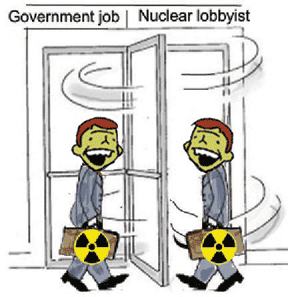
Lobbying expenditures by all the denizens of the MIC are even higher — more than $247 million in the last two election cycles. Such funds are used to employ 820 lobbyists, or more than one for every member of Congress. And mind you, more than two-thirds of those lobbyists had swirled through Washington’s infamous revolving door from jobs at the Pentagon or in Congress to lobby for the arms industry. Their contacts in government and knowledge of arcane acquisition procedures help ensure that the money keeps flowing for more guns, tanks, ships and missiles. Just last month, the office of Senator Elizabeth Warren (D-MA) reported that nearly 700 former high-ranking government officials, including former generals and admirals, now work for defense contractors. While a few of them are corporate board members or highly paid executives, 91% of them became Pentagon lobbyists, according to the report.
And that feverishly spinning revolving door provides current members of Congress, their staff, and Pentagon personnel with a powerful incentive to play nice with those giant contractors while still in their government roles. After all, a lucrative lobbying career awaits once they leave government service………………………………………………..
Shaping the Elite Narrative: The Military-Industrial Complex and Think Tanks

One of the MIC’s most powerful tools is its ability to shape elite discussions on national security issues by funding foreign policy think tanks, along with affiliated analysts who are all too often the experts of choice when it comes to media coverage on issues of war and peace. A forthcoming Quincy Institute brief reveals that more than 75% of the top foreign-policy think tanks in the United States are at least partially funded by defense contractors. Some, like the Center for a New American Security and the Center for Strategic and International Studies, receive millions of dollars every year from such contractors and then publish articles and reports that are largely supportive of defense-industry funding.

Some such think tanks even offer support for weapons made by their funders without disclosing those glaring conflicts of interest. For example, an American Enterprise Institute (AEI) scholar’s critique of this year’s near-historically high Pentagon budget request, which, she claimed, was “well below inflation,” also included support for increased funding for a number of weapons systems like the Long Range Anti-Ship Missile, the Joint Air-to-Surface Standoff Missile, the B-21 bomber, and the Sentinel intercontinental ballistic missile.
What’s not mentioned in the piece? The companies that build those weapons, Lockheed Martin and Northrop Grumman, have been AEI funders. Although that institute is a “dark money” think tank that doesn’t publicly disclose its funders, at an event last year, a staffer let slip that the organization receives money from both of those contractors.
Unfortunately, mainstream media outlets disproportionately rely on commentary from experts at just such think tanks…………………………………………
Shaping the Public Narrative: The Military-Entertainment Complex
Top Gun: Maverick was a certified blockbuster, wowing audiences that ultimately gave that action film an astounding 99% score on Rotten Tomatoes — and such popular acclaim helped earn the movie a Best Picture Oscar nomination. It was also a resounding success for the Pentagon, which worked closely with the filmmakers and provided, “equipment — including jets and aircraft carriers — personnel and technical expertise,” and even had the opportunity to make script revisions, according to the Washington Post. Defense contractors were similarly a pivotal part of that movie’s success. In fact, the CEO of Lockheed Martin boasted that his firm “partnered with Top Gun’s producers to bring cutting-edge, future forward technology to the big screen.”
While Top Gun: Maverick might have been the most successful recent product of the military-entertainment complex, it’s just the latest installment in a long history of Hollywood spreading military propaganda. “The Pentagon and the Central Intelligence Agency have exercised direct editorial control over more than 2,500 films and television shows,” according to Professor Roger Stahl, who researches propaganda and state violence at the University of Georgia.
“The result is an entertainment culture rigged to produce relatively few antiwar movies and dozens of blockbusters that glorify the military,” explained journalist David Sirota, who has repeatedly called attention to the perils of the military-entertainment complex. “And save for filmmakers’ obligatory thank you to the Pentagon in the credits,” argued Sirota, “audiences are rarely aware that they may be watching government-subsidized propaganda.”
What Next for the MIC?
More than 60 years after Eisenhower identified the problem and gave it a name, the military-industrial complex continues to use its unprecedented influence to corrupt budget and policy processes, starve funding for non-military solutions to security problems, and ensure that war is the ever more likely “solution” to this country’s problems. The question is: What can be done to reduce its power over our lives, our livelihoods, and ultimately, the future of the planet?
Countering the modern-day military-industrial complex would mean dislodging each of the major pillars undergirding its power and influence. That would involve campaign-finance reform; curbing the revolving door between the weapons industry and government; shedding more light on its funding of political campaigns, think tanks, and Hollywood; and prioritizing investments in the jobs of the future in green technology and public health instead of piling up ever more weapons systems. Most important of all, perhaps, a broad-based public education campaign is needed to promote more realistic views of the challenge posed by China and to counter the current climate of fear that serves the interests of the Pentagon and the giant weapons contractors at the expense of the safety and security of the rest of us…………………… https://tomdispatch.com/unwarranted-influence-twenty-first-century-style/
Former CIA Officer Says Decision to Drone Attack Kremlin Was Made by the United States
Deadly escalation an effort to provoke major Russian response.
Summit News, 5 May, 2023, Paul Joseph Watson
Former CIA intelligence officer Larry Johnson says the decision to launch a drone attack on the Kremlin was made by the United States.
The Wednesday attack, which was likely to have been targeting Russian President Vladimir Putin, was stopped by electronic warfare systems which disabled the drones before they could reach their target.
According to Johnson, the attack must have been spearheaded by the Biden administration and the US military-industrial complex because “decisions on such attacks are made not in Kiev, but in Washington.”
“Washington should understand clearly that we know this,” Johnson told reporters.
Although the attack, which Ukraine denied it was involved in, failed to accomplish its tactical goal, it was still highly “symbolic,” according to Johnson……………………………………….
Democratic presidential candidate Robert F. Kennedy Jr. denounced the attempted drone attack as a dangerous escalation. https://summit.news/2023/05/05/former-cia-officer-says-decision-to-drone-attack-kremlin-was-made-by-the-united-states/
Antony Blinken, Jake Sullivan, and the ‘made men’ of the Biden administration

Antony Blinken and the ‘made men’ of the Biden administration
BY JONATHAN TURLEY, – 04/22/23 https://thehill.com/opinion/white-house/3963743-antony-blinken-and-the-made-men-of-the-biden-administration/
Secretary of State Antony Blinken would really, really prefer to talk about grain in Ukraine this week. But many people are less interested in what Blinken is doing as secretary of state than in what he did to become secretary of state.
This week, Blinken was implicated in a political coverup that could well have made the difference in the 2020 election. According to the sworn testimony of former acting CIA Director Michael Morrell, Blinken – then a high-ranking Biden campaign official – was “the impetus” of the false claim that the Hunter Biden laptop story was really Russian disinformation. Morrell then organized dozens of ex-national security officials to sign the letter claiming that the Hunter laptop story had “all the classic earmarks of a Russian information operation.”
Morrell further admitted that the Biden campaign “helped to strategize about the public release of the statement.”
Finally, he admitted that one of his goals was not just to warn about Russian influence but “to help then-Vice President Biden in the debate and to assist him in winning the election.”
Help it did. Biden claimed in a presidential debate that the laptop story was “garbage” and part of a “Russian plan.” Biden used the letter to say “nobody believes” that the laptop is real.
In reality, the letter was part of a political plan with the direct involvement of his campaign, but Biden never revealed their involvement. Indeed, over years of controversy surrounding this debunked letter, no one in the Biden campaign or White House (including Blinken) revealed their involvement.
Of course, the letter was all the media needed. Discussion of the laptop was blocked on social media, and virtually every major media outlet dismissed the story before the election.
That was also all Biden needed to win a close election. The allegations that the Biden family had cashed in millions through influence peddling could have made the difference. It never happened, in part because of Blinken’s work.
Once in power, Blinken was given one of the top Cabinet positions. He was now one of the “made” men of the administration.
He was not alone. The 2016 election was marred by false allegations of Russian collusion with the Trump campaign. Unlike the influence peddling allegations made against Biden, the media ran with those stories for years. It later turned out that the funding and distribution of the infamous Steele dossier originated with the Clinton campaign. The campaign, however, reportedly lied in denying any such funding until after the election. It was later sanctioned for hiding the funding as legal expenses.
Those involved in spreading this false story were rewarded handsomely. For example, the second collusion story planted in the media by the campaign concerned the Russian Alfa Bank.
The campaign used key Clinton aide Jake Sullivan, who went public with the entirely false claim of a secret back channel between Moscow and the Trump campaign.
Sullivan was also a “made” man who was later made Biden’s national security adviser. Others who were implicated in either the Steele dossier or Alfa Bank hoaxes also later found jobs in the administration. The Brookings Institution proved a virtual turnstile for these political operatives.
Many signatories on the Russian disinformation letter continue to flourish. MSNBC analyst Jeremy Bash signed the letter and was put on the president’s Intelligence Advisory Board. As with Sullivan, it did not seem to matter that Bash had gotten one of the most important intelligence stories of the election wrong.

Former CIA head James Clapper was referenced by Biden on the letter and was also a spreader of the Russian collusion claims. Despite those scandals and a claim of perjury, CNN gave him a media contract.
They are all “made” men in the Beltway, but they could not have succeeded without a “made” media.
These false stories planted by the Clinton and Biden campaigns succeeded only because the media played an active and eager role. In any other country, this pattern would fit the model of a state media and propaganda effort. However, there was no need for a central ministry when the media quickly reinforced these narratives. This is a state media by consent rather than coercion. The Biden campaign knew that reporters would have little interest or curiosity in how the letter came about or the involvement of campaign operatives.
If Republicans did not control the House of Representatives, the Morrell admission would never have occurred. The Democrats repeatedly blocked efforts to investigate this story and the influence peddling allegations. Even this week, some Democrats called it a “tabloid story.”
Given the career paths of figures such as Blinken and Sullivan, there is a concern that other officials may see the value in “earning their bones” as “made” men and women. There is now a senior IRS career official who is seeking to disclose what he claims was special treatment given to Hunter Biden in the criminal investigation.
While the 51 former intelligence figures were eager to raise Russian disinformation claims before the election, most have become silent. After all, the letter served its purpose, as Morrell indicated, “to assist [Biden] in winning the election.” After the false stories planted before the 2016 and 2020 elections, the question is what is in store for 2024?
Jonathan Turley is the Shapiro Professor of Public Interest Law at George Washington University. Follow him on Twitter @JonathanTurley.
Newbuild: How Much of Vogtle Nuclear Plant’s Capital Costs Can Southern Recover?

Energy Intelligence Group , Apr 28, 2023, Stephanie Cooke, Washington
As the first of two AP1000 newbuilds ramps up to commercial operation at Georgia Power’s Vogtle plant in the US state of Georgia, an “epic battle” is brewing over how much the operator can recover in capital cost overruns from ratepayers. Preparation for a possible standoff between the Southern Co. subsidiary and staff of the state Public Service Commission (PSC) is already under way against a toxic political backdrop.
Voter rights litigation challenging ossified Republican dominance on the commission is delaying a PSC election previously slated for November. Now the question is to what extent a delayed PSC election, and pressure from the two Democratic contenders, might influence the outcome of “prudency” hearings that will determine how much ratepayers will be on the hook for capital expenditures at the Vogtle-3 and -4 newbuilds.
Much is at stake for Georgia Power and its ratepayers. The latter have been charged for the financing portion — but not the actual capital costs — of Georgia Power’s construction bills since 2011, well before the first concrete was poured for Vogtle-3 on Mar. 2, 2013. By the end of the year, ratepayers will have on average paid approximately $913 per person for the project, according to PSC testimony earlier this year.
Once Unit 3 is in commercial operation, the utility is authorized to include $2.1 billion of capital costs in the rate base. And when fuel loading begins at Unit 4 the PSC will begin hearings to determine the “prudency” of billions more in capital expenditures as a basis for passing on the cost to ratepayers.
Earlier this year PSC staff said Georgia Power may ultimately seek to recover as much as $9.7 billion of its capital costs, translating into a potential rate hike of 15%, or $17.20 extra per month for each customer based on an average monthly bill of $131. This figure is 120% higher than the $4.4 billion in capital costs expected at certification, and both figures are only a fraction of total capital costs, as Georgia Power is only a 45.7% owner of the Vogtle newbuilds. Georgia Power provided no response to Energy Intelligence questions as to what Vogtle capital cost recovery it will seek.
For Southern, the key is getting both reactors into commercial operation, after which all capital expenditures become fair game for inclusion in the rate base…………………
…………. any additional technical glitches — Unit 3 was forced to shut down for a week earlier this month because of an electrical malfunction — could delay recovery of capital costs. And at some point Georgia Power might face a very different PSC. If one or both Democratic candidates succeed in ousting current PSC commissioners, they would likely not shift the majority vote in disputed rate cases, but they would be better positioned to draw media attention to any Georgia Power capital cost recovery requests.
“There’s never been any single financial decision this large in the state of Georgia,” said Patty Durand, a candidate running to unseat Commissioner Tim Echols, whose term technically expired in December. In Georgia, it’s “going to be the epic financial battle of the century.”
Even getting on the ballot has been a challenge for Durand and for Shelia Edwards, who is challenging Commissioner Fitz Johnson, and now both candidates must wait until a federal court case over the PSC electoral process is decided……………………………………………….
…………………………………… Sources close to the PSC suggest that the total Vogtle project cost, including financing costs and on a 100% basis, may ultimately surpass $35 billion. https://www.energyintel.com/00000187-b4f4-d9b3-afdf-f6f7d5780000—
US ‘Dangerously Close’ To Another Nuclear Missile Crisis; After Russia, China Could Respond To Deployment Of Nuke Subs To S.Korea
The Eurasian Times, 4 May 23
South Korean President Yoon Suk-yeol was on a state visit to the US from April 25 for six days. The top agenda of the visit was ‘how to contain, control, and neutralize the North Korean nuclear threat.’
Since the beginning of 2023, North Korea has carried out about a dozen missile tests. Kim Jong Un, the North Korean dictator, has been categorical in condemning military exercises being carried out jointly by South Korean and US military and has threatened to retaliate.
South Korea and the US have regularly carried out military exercises. …………………………….
Proposed US Nuclear Submarine Deployment
To protect South Korea from the North Korean nuclear threat, the US has announced that it will deploy SSBN in South Korean waters. The event is yet to take place.
Proposed US Nuclear Submarine Deployment
To protect South Korea from the North Korean nuclear threat, the US has announced that it will deploy SSBN in South Korean waters. The event is yet to take place.
A look at the globe will indicate that US nuclear submarines, equipped with nuclear-warhead Submarine Launched Ballistic Missiles, will also be able to strike mainland China.
However, if the SSBN deployment indeed does take place, it might, and will, be different from the Cuban Missile Crisis due to the following reasons:
a. In 1962, only two nuclear powers, the US and the USSR, challenged each other with a nuclear strike.
b. China, then, was not a nuclear power. China exploded its first nuclear device on October 8, 1964.
c. In 2023, there are nearly a dozen nations in possession of nukes.
d. China is a formidable economic and nuclear power now.
e. In 1962, the USSR’s decision to deploy nuclear missiles in Cuba forced the US to retaliate. Then, the USSR was the initiator. The US was the affected party.
f. In 2023, China will be the affected party, and the USA will be the initiator if the US does not back off from its decision to deploy SSBNs near South Korea.
g. In the event of an escalation, the US will have to face nukes from China and North Korea but also (maybe) from Russia.
Key Issues
The key issue, which might rather lead to a similar situation as the Cuban Missile Crisis, is the US announcement to deploy nuclear weapons capable submarines near South Korea.
Such a deployment aims to protect South Korea from any North Korean military or nuclear misadventure. However, a closer look at the probable region of deployment of nuclear submarines will indicate that the US will be able to threaten the underbelly of China exactly in the same manner as the Soviet missiles threatened the US underbelly. China will almost certainly react or retaliate in the way deemed fit.
Should that happen, will diplomacy succeed yet again and prevent a nuclear holocaust? Global grouping in 2023 is vastly different from what prevailed in 1962………..
SSBNs are extremely difficult to track. China, Russia, or North Korea cannot track and confirm the presence of US Navy SSBNs. If deployed in the abovementioned areas, the SSBN will threaten North Korea, China, and Russia.
China’s Concerns
Beijing has already reacted by describing the planned deployment of SSBNs by the US as a bid to promote the latter’s selfish geopolitical interests.
The US expansion of the nuclear umbrella has been termed an irresponsible action and a threat to world peace. The Chinese spokesperson said, “The United States has put regional security at risk and intentionally used the (Korean) peninsula issue as an excuse to create tensions.
What the US does is full of Cold War thinking, provoking bloc confrontation, undermining the nuclear non-proliferation system, damaging the strategic interests of other countries, exacerbating tensions on the Korean peninsula, undermining regional peace and stability, and running counter to the goal of the de-nuclearisation of the peninsula.
………….. The recently concluded AUKUS treaty has already raised hostility between China and the US. The decision to deploy SSBNs capable of carrying up to 20 MIRVed ballistic missiles in close proximity has invited extremely adverse reactions from China………………………………………………………………………………………
Conclusion
The US decision to deploy SSBNs in South Korea would almost certainly invite adverse reaction and possible retaliation from China, which Russia and North Korea will support. ……………………………………………..https://eurasiantimes.com/us-dangerously-close-to-nuclear-crisis-after-russia/
US Secretary of State Antony Blinken embroiled in alleged attempt to influence US officials on Burisma

Hunter Biden joined the board of the allegedly corrupt Ukrainian company Burisma in April 2014, while the US authorities were working with British law enforcement on a financial investigation into its owner, Mykola Zlochevsky.
Secretary of State Blinken and his cabinet secretary wife were embroiled in an alleged attempt to influence US officials on behalf of Burisma – and may have known Hunter was on the board despite telling investigators otherwise.
- Emails show Tony Blinken and his wife Evan Ryan corresponding with a consultancy firm hired by Hunter’s Ukrainian gas company Burisma
- Blinken told Senate investigators under oath that he had ‘no knowledge’ of Hunter Biden’s service on the board of Burisma
- Hunter emailed Ryan to make sure her husband took a meeting with the consultancy firm to discuss ‘some troubling events we are seeing in Ukraine’
By JOSH BOSWELL FOR DAILYMAIL.COM, 2 May 2023
Secretary of State Tony Blinken and his wife, Joe Biden‘s cabinet secretary Evan Ryan, were both embroiled in an alleged attempt to influence US government officials on behalf of Ukrainian gas firm Burisma, emails show.
Blinken told Senate investigators under oath in 2020 that he had ‘no knowledge of Hunter Biden‘s service on the board’ of Burisma, and didn’t know about Blue Star Strategies, a Democrat consultancy hired by the firm in 2015 to improve its image in Washington DC.
But State Department emails show he spoke with Blue Star’s CEO Karen Tramontano at a political event around July 2016 while he was Deputy Secretary of State, and agreed to have a coffee with her to discuss ‘some troubling events we are seeing in Ukraine’.
And July 14, 2016 emails from Hunter’s laptop show the First Son checked in with Blinken’s wife to try to make sure he took a call from Tramontano and her chief operating officer Sally Painter – as well as meeting with Blinken himself at his State Department office in July 2015.
There is no evidence that Blinken or Ryan tried to change US policy on Burisma’s behalf.
But Senator Ron Johnson is now accusing the Secretary of State of having ‘lied bald-faced to Congress’ about his links to the murky influence campaign in 2020 sworn testimony.
Blinken has come under new scrutiny this month over his relationship with the Bidens, after the House Judiciary Committee received testimony that he helped orchestrate a letter by intelligence chiefs claiming Hunter’s laptop was a Russian disinformation campaign just weeks before the 2020 election.
The government and laptop emails obtained by DailyMail.com suggest Blinken, who was Joe’s senior campaign advisor, his Vice Presidential National Security Advisor in the Obama administration and now Secretary of State, may have been more aware of Hunter’s dealings than he has let on.
Blinken was grilled by Senate homeland security committee investigators in December 2020, as part of a probe into Hunter’s business dealings run by Senators Chuck Grassley and Ron Johnson.
Hunter joined the board of the allegedly corrupt Ukrainian company Burisma in April 2014, while the US authorities were working with British law enforcement on a financial investigation into its owner, Mykola Zlochevsky.
When Hunter’s appointment became public soon after, it caused a firestorm of controversy – including among State Department officials, who complained in emails that ‘the presence of Hunter Biden on the Burisma board was very awkward for all U.S. officials pushing an anti-corruption agenda in Ukraine.’
However, the furor apparently passed by Blinken, who told investigators in sworn testimony that he was not ‘aware of any association that Hunter Biden had with Burisma’ while Deputy Secretary of State from 2015 to 2017, had no emails or texts with the First Son, and never discussed Hunter’s financial or business arrangements with him.
Data on Hunter’s laptop shows 26 emails involving Blinken’s personal address and three with his Vice Presidential office address, between 2010 and 2018.
A further 47 emails include his wife Evan’s VP office email and 22 have her personal email address.
A contact book entry for Blinken on Hunter’s laptop includes three numbers labeled ‘mobile’, ‘car’ and ‘other’, as well as his office and personal email addresses.
Speaking to Fox New on Sunday, Senator Ron Johnson, who has been investigating the Biden’s business dealings for four years, accused Blinken of having ‘lied boldface to Congress about never emailing Hunter Biden.’
‘Antony Blinken finally did come in and sit down for a voluntary transcribed interview in December of 2020 because he wanted to be Secretary of State,’ Johnson told Maria Bartiromo.
‘And now, because of more information that’s come out, we know that he lied boldface to Congress about never emailing Hunter Biden. My guess is he told a bunch of other lies that hopefully we’ll be able to bring him and his wife back in. Tell them to preserve their records.’
On May 22, 2015, Hunter wrote to Blinken asking if he had ‘a few minutes next week to grab a cup of coffee? I know you are impossibly busy, but would like to get your advice on a couple of things.’
Blinken replied ‘absolutely’, and copied his secretary to ‘find a good time’. Hunter forwarded the exchange to his business partner and fellow Burisma board member, Devon Archer.
The meeting was postponed due to the death of Hunter’s brother Beau eight days later from brain cancer.
Hunter and Blinken eventually met for lunch at his State Department office on July 22, 2015, but Blinken told Senate investigators they only discussed ‘the loss the family had suffered and how they were coping’.
In November that year Burisma hired Blue Star Strategies to improve the firm’s image in DC.
Blue Star CEO Karen Tramontano played down her relationship with Hunter in her own 2020 testimony to the Senate committee, and claimed at first that she didn’t know Hunter was on its board.
In June 2021 DailyMail.com revealed emails from Hunter’s laptop showing in fact he was the point man for Burisma’s hiring of Blue Star, and that as far back as March 2014 Tramontano had discussed registering her investment banking license with Hunter’s firm Rosemont Seneca.
Tramontano and her COO Sally Painter set about arranging meetings and calls with top government officials, trying to convince them to take a softer approach towards Burisma owner Zlochevsky and refrain from calling his gas firm ‘corrupt’.
Blinken told investigators that although he knew Tramontano and Painter, he was unaware of their firm, Blue Star.
State Department emails obtained by the Homeland Security Committee show that on June 27, 2016 Painter wrote to Blinken’s assistant from her Blue Star email address about a meeting he agreed to when he bumped into them at an event three days earlier.
‘Per my conversation with Tony at the Truman event, Karen Tramontano and I would like to have a brief coffee with Tony at his earliest convenience regarding some troubling events we are seeing in Ukraine. (He said yes),’ Painter said in the email.
‘Karen was President Clinton’s Deputy Chief of Staff and we are just back from Kiev.’
A call appears to have been scheduled for the following month, but when it fell through Hunter got involved – contacting Blinken’s wife and then-assistant secretary of state for educational and cultural affairs Evan Ryan to chase up the contact.
‘Time for a very quick call?’ Hunter wrote to her AOL email address on July 14, 2016. ‘He said neither Karen or Sally called this afternoon,’ she responded.
‘I don’t know what happened. Talked to S and K and they said they called at 5:30 and left message w/ his Asst. Sorry,’ Hunter wrote. She replied: ‘He didn’t get the msg. He said if we can get him their numbers he can call them late afternoon DC time tmrw – let me know if that works.’
The next day Blinken wrote to his aide, ‘Please send me her [Tramontano’s] number. I may call.’
It is unclear if the call took place. Blinken told investigators ‘I don’t recall having a coffee with them.’
influence campaign with the DoJ.
Tramontano’s lawyer said the probe ended when the firm submitted a filing to the government admitting its lobbying activities for the Ukrainian gas firm – more than six years after the fact.
Blue Star’s filing, submitted in May 2022, finally declared its $60,000 of work for Zlochevsky in 2015 and 2016 including ‘to help schedule meetings with U.S. Government officials so counsel for Mr. Zlochevsky could present an explanation of certain adverse proceedings in the U.K. and Ukraine involving Mr. Zlochevsky.’
The filing listed a 2016 ’email and meeting’ with Obama’s energy envoy Amos Hochstein, and also with Under Secretary of State for Economic Growth, Energy, and the Environment Catherine Novelli.
It did not declare any meetings, emails or calls with Blinken.
The Golden Rule, the first boat to protest nuclear weapons is back to inspire a new generation

Now, in the midst of its Great Loop Tour circling the entirety of the eastern United States, the 21st century Golden Rule aims to be more than a history lesson. Veterans for Peace and the project’s many supporters are working for nothing less than igniting a new movement to abolish nuclear weapons altogether.
Waging Non Violence, Arnie Alpert May 1, 2023
65 years ago, the Golden Rule ignited protests that led to a partial ban on nuclear weapons testing. Now it’s back to fight for nothing short of abolition.
Arnie Alpert May 1, 2023
Fredy Champagne has been a peace activist ever since he returned from combat in Vietnam. He’s been kicked out of college, where he was accused of starting a riot. He’s opened health clinics in Vietnam. He’s delivered school buses to Cuba. But in 2010, he received a call that opened his eyes to a story of resistance he had never heard before.
The call was from one of Champagne’s fellow members of Veterans for Peace, or VFP, asking him to go check out a boat that had been hauled out of the water in Humboldt Bay, California — only an hour’s drive north from his home in Garberville, where he was serving as the president of the local VFP chapter.
The boat — named the Golden Rule — wasn’t much to look at. It was far from seaworthy, and those who had already looked it over thought it was better suited for firewood than seafaring. “A lot of the side planking was gone,” Champagne said. “There was absolutely no interior. It was all rotten. And there was no steering mechanism, no mast, no motor, no nothing.”
But there was more to this broken-down old ship than what the eye could see. This vessel was a piece of history — having once played a consequential role in making the world safe from above-ground nuclear weapons testing. In 1958, the Golden Rule’s former owners, a group of peace activists, tried to sail it into the American nuclear weapons testing zone in the Pacific as a form of protest. While the authorities cut their voyage short, the Golden Rule still managed to spark an upsurge of opposition to nuclear testing, leading five years later to the adoption of the Partial Test Ban Treaty.
When Champagne learned this history, he was shook. “I was standing there. It was real quiet at the shipyard… And I felt the boat was talking to me. I felt the boat’s spirit. And you know what it said? I sensed that the boat was telling me, ‘Get off your ass and do something.’”
So, do something he did. Champagne set about restoring the boat along with a small team of several other VFP members. Five years later, the Golden Rule was sailing down the West Coast to the 2015 VFP National Convention in San Diego.
Now, in the midst of its Great Loop Tour circling the entirety of the eastern United States, the 21st century Golden Rule aims to be more than a history lesson. Veterans for Peace and the project’s many supporters are working for nothing less than igniting a new movement to abolish nuclear weapons altogether.
Nuclear dread inspires nonviolent action
The story of the Golden Rule begins, in a sense, with the explosion of the atomic bomb over Hiroshima in 1945………………………………………………………………………………….. more https://wagingnonviolence.org/2023/05/golden-rule-first-boat-protest-nuclear-weapons-testing-veterans-for-peace/
Is nuclear power attractive or risky? In Minnesota, it’s both.
Christian Science Monitor, By Colette Davidson Special correspondent @kolet_ink May 1, 2023|MONTICELLO, MINN.
At a clearing in the brush, a clunky wooden dock is still pulled onshore for the season amid piles of dirty snow. Usually, this boat landing at the Montissippi Regional Park is a popular spot for amateurs to fish bass and walleye from the Mississippi River.
But after the Xcel Energy nuclear plant – just half a mile away – announced in March that radioactive material had leaked twice from a faulty pipe since November, some locals say they’re worried about what’s in the water. ……………………….
The Minnesota Pollution Control Agency and Minnesota Department of Health say the risks to the public from the leaks of water contaminated with tritium – totaling a little more than 400,000 gallons – are minimal and have not affected public drinking water. Xcel Energy powered down its Monticello plant in mid-March for maintenance, once the second leak had been discovered.
That has done little to assuage the fears of local residents, however, who say the utility company should have notified the public earlier about the leak.
…………………………….. a renewed push for nuclear energy, even among former skeptics. Yet building public trust remains a key challenge, in Minnesota and across the nation – particularly in the wake of incidents like the one in Monticello.
………………………………………………..
Reliance, but also restrictions
The U.S. gets approximately 19% of its electricity from nuclear power, according to the Energy Information Administration. While states need to go through the federal Nuclear Regulatory Commission (NRC) for licensing approval, much of the challenge of building nuclear energy plants or considering new nuclear technologies is getting past state legislation.
Minnesota – which gets 24% of its electricity from two nuclear power plants – is one of 12 states that currently have a moratorium on the construction of new nuclear power facilities. That has led proponents here to focus their efforts instead on the latest technologies, like small modular reactors………..
…………… in the past five years, more Minnesota Democrats have come around to the idea of nuclear energy – an issue that once split along party lines.
This mirrors a wider national trend. In 2023 alone, there have been close to 100 bills across 20 states to repeal moratoriums or study nuclear energy, according to the Nuclear Innovation Alliance, based in Washington, D.C. The U.S. Department of Energy recently invested nearly $2 billion in TerraPower’s construction of a nuclear reactor in Kemmerer, Wyoming, to replace a retiring coal plant. And John Kerry, the special presidential envoy for climate, has openly supported nuclear energy….
Evolving concerns on safety
That’s not to say there aren’t concerns about nuclear from within the climate advocacy community. With the exception of the Vogtle plant in Burke County, Georgia – which boasts next-generation technology – the U.S. reactor fleet is of the same or similar generation as the one involved in Japan’s Fukushima disaster in 2011.
“Whether they’re identical in design or not, they all have the same level of vulnerability,” says Edwin Lyman, a physicist and the director of nuclear power safety at the Union of Concerned Scientists, a national watchdog. …………………………..
Dr. Lyman says the Biden administration, in its enthusiasm to tackle carbon emissions and roll out new nuclear plants, must be careful not to forgo needed safety rules. That becomes even more essential as climate change brings higher winds and flooding, the biggest risks for a reactor short-circuit. Nuclear operators have also struggled with how to store waste long term. New waste is stored in pools before being transferred to dry casks, which can take up land space indefinitely.
Mixed feelings by the Mississippi
The public seems to be on board with putting more time and research into nuclear energy. According to an April Gallup poll, 55% of Americans support nuclear energy, the highest level in a decade.
But for those living near nuclear plants, there are still concerns about safety and security – from the quality of groundwater to the threat of domestic terrorism. Out on the trail at Montissippi Regional Park in Monticello, locals joke that their tomatoes are extra large thanks to their proximity to the Xcel plant. Others say they’ve been drinking bottled water since the leak.
“When those Chinese surveillance balloons flew overhead [in February], I did wonder, would the nuclear plant be a target?” says Betty, out for a walk with her husband Jack. Betty used to work for the city of Monticello and did not want to identify herself by her full name.
While the immediate risks may be small, she says she and her husband “live in the shadow of the nuclear plant,” which is a half mile from their house. Every year, Xcel Energy distributes a free calendar, which includes evacuation information in the event of disaster. …………………………… https://www.csmonitor.com/Environment/2023/0501/Is-nuclear-power-attractive-or-risky-In-Minnesota-it-s-both
ACTION ALERT: False NYT Spy Claim on Iran Nukes Needs Correction
JIM NAURECKAS, https://fair.org/home/action-alert-false-nyt-spy-claim-on-iran-nukes-needs-correction/ 1 May 23
The New York Times (5/1/23), reporting on Iran’s execution of British spy Alireza Akbari, reported:
The spy had provided valuable information — and would continue to do so for years — intelligence that would prove critical in eliminating any doubt in Western capitals that Iran was pursuing nuclear weapons.
This is not correct; as FAIR has often pointed out (FAIR.org, 10/17/17, 9/9/15, 9/24/13; 1/31/13; Extra!, 3–4/08), the position of US intelligence is that it has no proof Iran has decided to build a nuclear weapon. As the US State Department reiterated in April 2022:
The United States continues to assess that Iran is not currently undertaking the key nuclear weapons–development activities it judge necessary to produce a nuclear device.
This is a serious error that deserves prompt correction.
ACTION:
Please tell the New York Times to correct its false claim that there is no doubt that Iran is pursuing nuclear weapons.
CONTACT:
Letters: letters@nytimes.com
Dealing with a debacle: A better plan for US plutonium pit production

Bulletin, By Curtis T. Asplund, Frank von Hippel | April 27, 2023
For two decades, the Pentagon and Congress have been increasingly concerned that the United States does not have a reliable capability to produce plutonium “pits,” the cores of US thermonuclear warheads. In 2018, the agency responsible for the production and maintenance of US nuclear warheads, the National Nuclear Security Administration (NNSA), responded with a plan to build, on a crash basis, pit production lines in New Mexico and South Carolina at the same time, with a combined production capacity of 80 pits per year.
One of the production lines is in an advanced state of installation at the Los Alamos National Laboratory in New Mexico, the home of US pit-production expertise. The other is to be installed at the Department of Energy’s Savannah River Site (SRS) in South Carolina, where there is no pit-production expertise, in a massive building that the Department of Energy built for another purpose and was then forced to abandon because of huge cost overruns. South Carolina’s congressional delegation, led by Sen. Lindsey Graham, successfully prevailed on the Trump administration to repurpose this $6 billion building—once known as Mixed Oxide Fuel Fabrication Facility and intended to downblend surplus military plutonium for use as commercial reactor fuel—to plutonium pit production. History is repeating itself, however. The NNSA’s cost estimate for using the Savannah River facility to manufacture warhead pits has already risen from $3.6 billion in 2017 for an 80 pit-per-year production capacity to $11.1 billion for a 50 pit-per-year capacity in 2023.
The NNSA’s rationale for its ambitious pit production program is, to say the least, questionable. The agency proposes to first build 800 pits for new US intercontinental ballistic missile (ICBM) warheads, which would be needed only if the US decides to increase the number of warheads on each missile from one to three. Previous US administrations have considered such uploading destabilizing; silo-based ICBMs are targetable and increasing the number of warheads they each carry would make them more attractive targets. Loading the ICBMs with more warheads would also make compliance with the New START arms control agreement with Russia extremely difficult, should that agreement be extended in 2026.
After producing the ICBM warheads, the NNSA plans to replace all 1,900 US submarine-launched ballistic missile warheads with new warheads, equipped with what is known as insensitive high explosive, which is shock resistant and therefore less susceptible to accidental explosions that could disperse a warhead’s plutonium. No such accident has ever happened with ballistic missile warheads, and it is unclear how much this program would actually improve safety. The warheads in the Trident II missile used by US submarines are located near the missile’s third stage, which carries propellant that is as detonable as conventional explosive.
There is also another concern about the NNSA’s plans: The designs of new warheads in which new plutonium pits would be used may depart from designs that have been previously tested. This could result in demands to resume explosive testing, which would undermine the moratorium on nuclear testing that has been observed by all nuclear-weapon states (other than North Korea) since 1998.
Given these questionable production plans and the already out-of-control cost and schedule of the Savannah River pit production facility, and because the remaining life expectancy of the pits in current US warheads is at least 60 years and perhaps much longer, we propose that the Savannah River facility be put on hold and that the Los Alamos program be focused on demonstrating reliable production of 10 to 20 pits per year. Such a demonstration production line would establish that the United States has the capacity to produce pits and would reduce the time required to build additional production lines, if they are needed.
The NNSA should also renew research programs at the Livermore and Los Alamos Laboratories to study the aging of the already existing plutonium pits in the US arsenal and also the older pits from retired warheads. ……………………………………………………………………………….. more https://thebulletin.org/2023/04/dealing-with-a-debacle-a-better-plan-for-us-plutonium-pit-production/
1 This Month

of the week – Shut Down Drone Warfare!


Tell the Ukrainian Government to Drop Prosecution of Peace Activist Yurii Sheliazhenko

Petition to revoke the licensing of the Near Surface Nuclear Disposal Facility (NSDF) at Chalk River. https://www.ourcommons.ca/petitions/en/Petition/Details?Petition=e-7247
To see nuclear-related stories in greater depth and intensity – go to https://nuclearinformation.wordpress.com
-
Archives
- April 2026 (103)
- March 2026 (251)
- February 2026 (268)
- January 2026 (308)
- December 2025 (358)
- November 2025 (359)
- October 2025 (376)
- September 2025 (257)
- August 2025 (319)
- July 2025 (230)
- June 2025 (348)
- May 2025 (261)
-
Categories
- 1
- 1 NUCLEAR ISSUES
- business and costs
- climate change
- culture and arts
- ENERGY
- environment
- health
- history
- indigenous issues
- Legal
- marketing of nuclear
- media
- opposition to nuclear
- PERSONAL STORIES
- politics
- politics international
- Religion and ethics
- safety
- secrets,lies and civil liberties
- spinbuster
- technology
- Uranium
- wastes
- weapons and war
- Women
- 2 WORLD
- ACTION
- AFRICA
- Atrocities
- AUSTRALIA
- Christina's notes
- Christina's themes
- culture and arts
- Events
- Fuk 2022
- Fuk 2023
- Fukushima 2017
- Fukushima 2018
- fukushima 2019
- Fukushima 2020
- Fukushima 2021
- general
- global warming
- Humour (God we need it)
- Nuclear
- RARE EARTHS
- Reference
- resources – print
- Resources -audiovicual
- Weekly Newsletter
- World
- World Nuclear
- YouTube
-
RSS
Entries RSS
Comments RSS
 nuclear-news