US cuts data sharing with Russia under New START nuclear deal
US says withholding information is retaliatory measure for Moscow’s suspension of New START (Strategic Arms Reduction Treaty).
The United States will stop providing Russia with some notifications required under the New START nuclear arms control treaty, including updates on missile and launcher locations, in what Washington describes as a retaliatory “countermeasure” due to Moscow’s “violations” of the accord.
The US state department said on Thursday that it had ceased providing the status and locations of its nuclear missiles and launchers but would continue to provide notification of the launch of intercontinental ballistic missiles and submarine-launched ballistic missiles.
Russian inspection activities on US territory have ceased and visas issued and pending for Russian New START (Strategic Arms Reduction Treaty) inspectors and their aircrews – as well as diplomatic clearance for Russian inspection aircraft – have been revoked, according to a state department fact sheet released on Thursday.
The US will also not provide telemetric information to Russia on the launch of US intercontinental and submarine-launched ballistic missiles. Such data involves information that originates during a missile’s test flights and under the treaty, both Moscow and Washington were to exchange such information annually…………………………..
Russian President Vladimir Putin has not formally withdrawn from the New START treaty, but he announced in February that Moscow would suspend its participation in what is a key pillar of US-Russian nuclear arms control.
Putin said Moscow could not accept US inspections of its nuclear sites under the agreement when Washington and its NATO allies had openly declared Moscow’s defeat in Ukraine as a primary goal.
In March, Moscow emphasised that it had not withdrawn from the START pact altogether and would continue to respect the caps on nuclear weapons the treaty sets. Russia’s foreign ministry had also said that Moscow would continue to notify the US of planned test launches of its ballistic missiles – a key element of the agreement.
Notices on ballistic launches are an essential element of nuclear strategic stability for decades, allowing Russia and the US to correctly interpret each other’s moves and make sure neither country mistakes a test launch for a preemptive nuclear missile attack.
Moscow and Washington collectively control nearly 90 percent of the world’s nuclear warheads – enough to destroy the planet several times over.
The New START limits the number of strategic nuclear warheads countries deploy. Signed in 2010 and due to expire in 2026, the New START treaty caps the number of strategic nuclear warheads that the US and Russia can deploy to no more than 1,550 strategic nuclear warheads and 700 land- and submarine-based missiles and bombers to deliver them……………………………………………………. https://www.aljazeera.com/news/2023/6/2/us-to-withhold-some-data-from-russia-under-new-start-nuclear-deal—
Biden wants to engage Russia on nuclear arms control
By Jonathan Landay and Arshad Mohammed, Canberra Times, June 2 2023
The United States will offer to abide by the nuclear weapons limits set in the New START treaty until its 2026 expiration to bolster global security if Russia does the same, two senior administration officials say.
US national security advisor Jake Sullivan will make the offer in a speech to the Arms Control Association, the oldest US arms control advocacy group, the officials said on Thursday on condition of anonymity.
Sullivan will say President Joe Biden’s administration is open to resuming unconditional talks with Moscow on managing nuclear dangers, including replacing New START with a new pact, the sources said…………………………………
Signed in 2010 and due to expire in February 2026, New START capped the number of strategic nuclear warheads the sides can deploy at 1550.
It also limits the number of land and submarine-based missiles and bombers that can deliver the warheads to 700.
Sullivan, the officials said, will offer US adherence to those limits through the treaty’s expiration if Russia does as well………… https://www.canberratimes.com.au/story/8220319/biden-wants-to-engage-russia-on-nuclear-arms-control/
Panellists discuss nuclear documentary ‘Atomic Bamboozle’ and warn against return of nuclear power .
Activists show, discuss nuclear documentary ‘Atomic Bamboozle’ at Kiggins in Vancouver, Film, panelists warn against return of nuclear power,
By Scott Hewitt, Columbian staff writer, June 2, 2023, https://www.columbian.com/news/2023/jun/02/activists-show-discuss-nuclear-documentary-atomic-bamboozle-at-kiggins-in-vancouver/
Get used to the phrase “small modular nuclear reactor” and its abbreviation, SMR. A global debate about this old-made-new energy idea is already heating up, with big implications for the people and environs of the Pacific Northwest.
SMRs are either the cleaner, safer, cheaper future of nuclear power or the return of the same old bundle of hazards, dressed up in newly attractive camouflage.
“They’re going to make nuclear energy cool again,” said former Trump administration energy secretary Rick Perry (consistently mispronouncing the word “nuclear”) in a news clip featured in the new documentary film “Atomic Bamboozle.”
“Atomic Bamboozle” is the latest in a series of timely, social-issue documentaries directed by Jan Haaken, a retired Portland State University psychology professor. Last year, Haaken produced a film about the courtroom victories of local oil-train protesters called “Necessity: Climate Justice and the Thin Green Line,” which screened, along with a panel discussion, at Vancouver’s Kiggins Theatre.
The same will happen at a Wednesday screening of “Atomic Bamboozle” at Kiggins. Environmental activists featured in the film will discuss the potential resurgence of nuclear power in the Pacific Northwest through supposedly safe, small, factory-built nuclear plants.
Panelists are Cathryn Chudy and Lloyd Marbet of the Oregon Conservancy Foundation; Desiree Hellegers, English professor and director of the Collective for Social and Environmental Justice at Washington State University Vancouver; public interest attorney Dan Meek; Dr. Patricia Kullberg, former medical director of the Multnomah County Health Department; “Atomic Days” author Joshua Frank; and film director Haaken.
(Frank’s book about the decommissioned Hanford nuclear site in Eastern Washington, “Atomic Days: The Most Toxic Place in America,” is the Fort Vancouver Regional Library system’s “Revolutionary Reads” book for this year. Free copies of the book are available to all at library branches.)
Climate wedge
Although small modular nuclear reactors are still more blueprint than reality, they’ve become a wedge issue among some environmentalists who are desperate to beat climate change, said Chudy, who lives in Vancouver.
“SMRs sound pretty cool but there are very big problems that they don’t want to talk about,” Chudy said during a phone interview with The Columbian.
“Atomic Bamboozle” reviews the troubled history of Oregon’s only commercial nuclear power plant, Trojan, which operated from 1976 through 1992 near Rainier, just across the Columbia River from Kalama. Trojan’s cooling tower dominated the skyline until it was demolished in 2006, but problems plagued the plant throughout its short life, including construction flaws, unexpected cracks, steam leaks and discovery of previously unknown earthquake fault lines nearby.
“We had assurances the plant was safe. The public relations around Trojan were amazing,” said Chudy, a pediatric mental health therapist at Legacy Emanuel Medical Center in Portland.
Chudy said today’s youth are struggling as never before with existential worry about a world that grown-ups have failed to steward. Proposed SMRs represent an opportunity to choose wisely and safely now rather than punting complicated problems into an unknown future, she said.
“Kids don’t trust adults to make good decisions,” Chudy said. “We are all putting our lives in the hands of people we elect … but I don’t think we can rely on them to steer the ship in the right direction without all of us being involved.”
Unsolved problems
Both Oregon and Washington have adopted clean energy policies for the future, Chudy said, but both include a loophole for nuclear power because nuclear plants do not emit carbon pollution.
She argues that nuclear power is actually a big cause of carbon pollution and a driver of global warming from many sources other than operating the plants themselves, including uranium mining as well as construction, decommissioning and materials transportation.
Necessary economies of scale are another serious question about nuclear power, Chudy added.
SMR boosters like them because they’re small. But what they contain is standard, old-school nuclear technology that’s simply operating on a tiny scale, M.V. Ramana, professor of physics, public policy and global affairs at the University of British Columbia, said in the film.
Early experiments with nuclear power started small too, Ramana said, but grew huge in pursuit of financial efficiency. Nothing has changed about that, he argues in the film, and new forecasts show the productions costs of nuclear power climbing.
“All nuclear reactors used to be small. The only way the nuclear industry could figure out to reduce cost was to go to larger reactors,” Ramana said. “There’s no way small modular reactors are going to be economically competitive.”
Soaring projected costs have led some members to drop out of a consortium of Western cities now pursuing an SMR on the Snake River in Idaho, according to Reuters.
The risk of nuclear accidents always remains, Ramana said in the movie. But siting decisions are made by politicians and investors in state and national capitals, far removed from the action.
US announces $46 million in funds to eight nuclear fusion companies
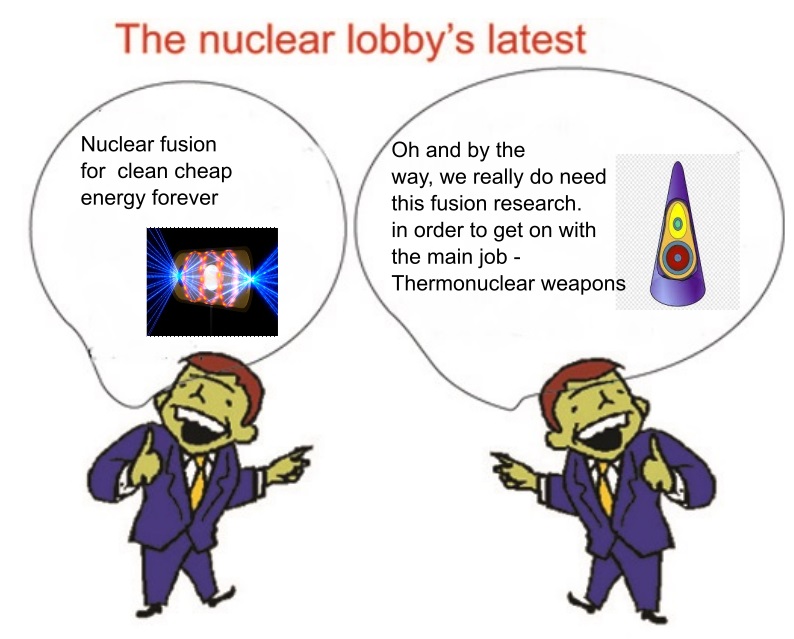
By Timothy Gardner, WASHINGTON, May 31 (Reuters) – Eight U.S. companies developing nuclear fusion energy will receive $46 million in taxpayer funding to pursue pilot plants attempting to generate power from the process that fuels the sun and stars, the Department of Energy said on Wednesday.
Generating more energy from a fusion reaction than goes into the fusion plant to heat fuel to temperatures of more than 100 million Celsius has eluded scientists for decades.
…………..”The Biden-Harris Administration is committed to partnering with innovative researchers and companies across the country to take fusion energy past the lab and toward the grid,” Energy Secretary Jennifer Granholm said in a release.
The awardees are:
-Commonwealth Fusion Systems (CFS)
-Focused Energy Inc
-Princeton Stellarators Inc
-Realta Fusion Inc
-Tokamak Energy Inc
-Type One Energy Group
-Xcimer Energy Inc
-Zap Energy Inc
The funding, which comes from the Energy Act of 2020, is for the first 18 months. Projects may last up to five years, with future funding totaling $415 million contingent on congressional approval and engineering and scientific milestones.
“Participating companies only get paid if they deliver results and the public program verifies the science is sound,” said Bob Mumgaard, the CEO and founder of CFS.
Looking to develop fusion plants that use lasers or magnets, private companies and government labs spent $500 million on their supply chains last year, according to a Fusion Industry Association (FIA) survey.
They plan to spend about $7 billion by the time their first plants come online, and potentially trillions of dollars mainly on high-grade steel, concrete and superconducting wire in a mature industry, estimated to be sometime between 2035 and 2050.
Reporting by Timothy Gardner in Washington Editing by Matthew Lewis and Diane Craft https://www.reuters.com/business/energy/us-announces-46-million-funds-eight-nuclear-fusion-companies-2023-05-31/
Call on ratepayers to fund a study for small nuclear reactors in Clark County

Nuclear power may again be on horizon for Clark County , By Lauren Ellenbecker, Columbian staff writer, June 2, 2023
Clark Public Utilities delays decision on helping fund study
“…………………..Energy Northwest invited Clark Public Utilities to participate in a feasibility study on its proposed small nuclear reactor development in Richland. The agency is considering creating four to 12 modular reactors, projected to generate 320 to 960 megawatts of power — less than its existing Columbia Generating Station, which has a capacity of 1,200 megawatts.
During a Clark Public Utilities Board of Commissioners meeting in May, Energy Northwest representatives sought $200,000 of ratepayer funds for the study, which is projected to cost $4 million. The body did not approve the request, as its three-member vote was split.
Commissioners Nancy Barnes and Jane Van Dyke both requested more time to consider Energy Northwest’s request and speak with other utilities, saying further clarity was needed.
Commissioner Jim Malinowski, who sits on Energy Northwest’s board of directors, advocated for Clark Public Utilities’ involvement. By providing funding, the utility would be “keeping the effort live” and showing there’s regional support for nuclear energy, he said.
Following the May meeting, skeptics said that discussions surrounding Energy Northwest’s project haven’t been substantive or transparent to the public, given the agency’s initial request for ratepayer funds.
“It seems this proposed financial investment is on a fast track with no obvious reason for the rush and shortchanges the public’s opportunity to ask questions and weigh meaningfully,” Cathryn Chudy of Vancouver wrote to the Clark Public Utilities commission.
Commissioners are expected to revisit Energy Northwest’s small modular reactor developments at their June 6 meeting.
Energy Northwest is meeting with Washington’s 28 public utility districts and municipalities for investments to its feasibility study, as well as reaching out to utilities in Oregon and Idaho. Eight utilities in Washington have contributed to date. https://www.columbian.com/news/2023/jun/02/nuclear-power-may-again-be-on-horizon-for-clark-county/
$528 Billion nuclear clean-up at Hanford Site in jeopardy

The government now appears to be seriously considering whether it will be necessary to leave thousands of gallons of leftover waste buried forever in Hanford’s shallow underground tanks, according to some of those familiar with the negotiations, and protect some of the waste not in impenetrable glass, but in a concrete grout casing that would almost certainly decay thousands of years before the toxic materials that it is designed to hold at bay.
At site after site, the solution has come down to a choice between an expensive, decades-long cleanup or quicker action that leaves a large amount of waste in place.
A Poisonous Cold War Legacy That Defies a Solution
NYT, By Ralph Vartabedian, Reporting from Richland, Wash., May 31, 2023
From 1950 to 1990, the U.S. Energy Department produced an average of four nuclear bombs every day, turning them out of hastily built factories with few environmental safeguards that left behind a vast legacy of toxic radioactive waste.
Nowhere were the problems greater than at the Hanford Site in Washington State, where engineers sent to clean up the mess after the Cold War discovered 54 million gallons of highly radioactive sludge left from producing the plutonium in America’s atomic bombs, including the one dropped on the Japanese city of Nagasaki in 1945.
Cleaning out the underground tanks that were leaching poisonous waste toward the Columbia River just six miles away and somehow stabilizing it for permanent disposal presented one of the most complex chemical problems ever encountered. Engineers thought they had solved it years ago with an elaborate plan to pump out the sludge, embed it in glass and deposit it deep in the mountains of the Nevada desert.
But construction of a five-story, 137,000 square-foot chemical treatment plant for the task was halted in 2012 — after an expenditure of $4 billion — when it was found to be riddled with safety defects. The naked superstructure of the plant has stood in mothballs for 11 years, a potent symbol of the nation’s failure, nearly 80 years after the Second World War, to deal decisively with the atomic era’s deadliest legacy.
The cleanup at Hanford is now at an inflection point. The Energy Department has been in closed-door negotiations with state officials and the U.S. Environmental Protection Agency, trying to revamp the plan. But many fear the most likely compromises, which could be announced in the coming months, will put the speed and quality of the cleanup at risk.
The government now appears to be seriously considering whether it will be necessary to leave thousands of gallons of leftover waste buried forever in Hanford’s shallow underground tanks, according to some of those familiar with the negotiations, and protect some of the waste not in impenetrable glass, but in a concrete grout casing that would almost certainly decay thousands of years before the toxic materials that it is designed to hold at bay.
“The Energy Department is coming to a big crossroads,” said Thomas Grumbly, a former assistant secretary at the department who oversaw the early days of the project during the Clinton administration.
Successive energy secretaries over the last 30 years, he said, “have slammed their heads against the wall” to come up with a technology and budget that would make the problem go away not only at Hanford, but also at other nuclear weapons sites around the country.
Plants in South Carolina, Washington, Ohio and Idaho that helped produce more than 60,000 atomic bombs have tons of radioactive debris that will be radioactive for thousands of years. And unlike nuclear power plants, whose waste consists of dry uranium pellets locked away in metal tubes, the weapons facilities are dealing with millions of gallons of a peanut butter-like sludge stored in aging underground tanks.
Two million pounds of mercury remain in the soils and waters of eastern Tennessee. Radioactive plumes are contaminating the Great Miami aquifer near Cincinnati.
At site after site, the solution has come down to a choice between an expensive, decades-long cleanup or quicker action that leaves a large amount of waste in place.
Hanford, some 580 square miles of shrub-steppe desert in south-central Washington State, is the largest and most contaminated of all the weapons production sites — too polluted to ever be returned to public use. But the problem is urgent, given the risk of radionuclides contaminating the Columbia River, a vital lifeline for cities, farms, tribes and wildlife in two states……………………………………………………………………………………………………
“The closer you get to the bottom of those tanks, the more radioactive, toxic and dangerous waste is,” said Geoffrey Fettus, a lawyer with the Natural Resources Defense Council, which has sued the government over the Hanford cleanup………………………………………………………………. more https://www.nytimes.com/2023/05/31/us/nuclear-waste-cleanup.html
Julian Assange: the plot thickens

The FBI has reopened its case against Wikileaks founder and Australian journalist Julian Assange, the SMH reports, after agents tried to interview his ghostwriter, Andrew O’Hagan, in London.
O’Hagan refused to talk to them because he would never give a statement against “a fellow journalist being pursued for telling the truth”. Badass, particularly as O’Hagan isn’t exactly fond of Assange as a person, as he famously wrote in the London Review of Books.
Anyway, Assange’s lawyer, Stephen Kenny, was taken by surprise by the news — he says it’s been years since the indictment was issued, and he didn’t realise there was an investigation under way. What if they’re gathering evidence to clear Assange’s name, considering there are growing rumours the Albanese government is working on it, as The New Daily’s reporting indicates? It’s not impossible, Kenny says, but it would be “very unusual” if the FBI was trying to help him.
USA urged not to use bomb-grade uranium in nuclear power experiment

By Timothy Gardner May 31, 2023 https://www.reuters.com/world/us/us-urged-not-use-bomb-grade-uranium-nuclear-power-experiment-2023-05-30/
(Reuters) – Former U.S. State Department and nuclear regulatory officials on Tuesday urged the U.S. Energy Department to reconsider a plan to use bomb-grade uranium in a nuclear power experiment, saying that its use could encourage such tests in other countries.
The Energy Department and two companies aim to share costs on the Molten Chloride Reactor Experiment (MCRE) at the Idaho National Laboratory and use more than 1,322 pounds (600 kg) of fuel containing 93% enriched uranium.
Bill Gates-backed company TerraPower LLC, the utility Southern Co (SO.N) and the department hope the six-month experiment will lead to breakthroughs in reactors……….
But a group of former Nuclear Regulatory Commission members, including former Chairman Allison Macfarlane, and U.S. assistant secretaries of state responsible for nonproliferation, said MCRE could give other countries an excuse to enrich uranium to bomb-grade level in pursuit of new reactors.
“The damage to national security could exceed any potential benefit from this highly speculative energy technology,” the experts said in a letter to Energy Department officials. They fear an increase in such experiments boosts risks that militants looking to create a nuclear weapon could get hold of the uranium.
Disconnecting War from Its Consequences, (cut welfare spending, increase weapons)
Common Wonders, By Robert C. Koehler, 31 May 23
Twenty-two years ago, Congress put sanity up for a vote. Sanity lost in the House, 420-1. It lost in the Senate, 98-0.
Barbara Lee’s lone vote for sanity — that is to say, her vote against the Authorization for the Use of Military Force resolution, allowing the president to make war against . . . uh, evil . . . without congressional approval — remains a tiny light of courageous hope flickering in a chaotic world, which is on the brink of self-annihilation.
Militarism keeps expanding, at least here in the USA. If there’s a problem out there, option one is to kill it quickly. Problem solved! This simplistic (and utterly false) mindset, which is always present — the companion of fear — may have a grip on American politics like never before, as demonstrated in the recent debt-ceiling standoff, in which President Biden came to an agreement with the Republicans that social spending will be slashed but “defense” spending must continue to expand.
You know. It’s the only thing that’s truly crucial. Poverty? Collapsing infrastructure? Underfunded schools? Climate disaster? We can worry about that stuff later, but as House Speaker Kevin McCarthy explained to reporters recently:
“Look, we’re always looking where we could find savings . . . but we live in a very dangerous world. I think the Pentagon has to actually have more resources.”
In other words, the USA is not a country with the maturity to discuss and analyze complex issues, such as the future of the world. Hey, it’s dangerous out there! It’s full of terrorists and dictators. That’s all you need to know. “Weak on defense” is the equivalent of “wants to defund the police” — a politician’s death sentence by advertising. No matter how much hell war creates — no matter how many families it displaces, no matter how many children it kills — we’ve got to be ready wage it, you know, whenever we feel like it. And the mainstream media, in its basic coverage, doesn’t question this or delve into a complex analysis of the world.
But we are still a country that is slowly and complexly evolving — no matter that the powers that be, for the most part, don’t know it. Let’s return to that AUMF vote, passed in the wake of the 9/11 devastation. Barbara Lee, whose father was in the Army, serving in both World War II and the Korean War, knew about the human costs of war. After 9/11 she was deeply uncertain what the nation’s immediate response should be. She attended the memorial service at the capital, held the day of the vote (and attended by four former presidents plus the sitting president, GWB).
There, as she told Politico, the Rev, Nathan Baxter, as he led the attendees in prayer, called on the nation’s leaders, as they considered how to respond, to “not become the evil we deplore.”…………………………………………………………… more http://commonwonders.com/disconnecting-war-from-its-consequences/
A Mothers Day protest: Activists blockaded the entrance to the US 2 Navy’s west-coast nuclear submarine base
No survivors. Protestors bring their annual message for peace to the gates of hell
By Leonard Eiger by beyondnuclearinternational
Activists blockaded the entrance to the US Navy’s west-coast nuclear submarine base, which is home to the largest operational concentration of deployed nuclear weapons, in a nonviolent direct action the day before Mother’s Day.
Eight peace activists from the Ground Zero Center for Nonviolent Action, holding banners reading “The Earth is Our Mother Treat Her With Respect” and “Nuclear Weapons are Immoral to Use, Immoral to Have, Immoral to Make,” briefly blocked all incoming traffic at the Main Gate at Naval Base Kitsap-Bangor in Silverdale, Washington as part of a May 13th Mothers Day observance.
Traffic was diverted as the 15 member Seattle Peace Chorus Action Ensemble, facing the Navy’s security detail, sang “The Lucky Ones”, an original composition by their director, Doug Balcom of Seattle, to the assembled guards and Navy personnel.
The song describes the different stages of personal, regional and global destruction that a nuclear war would inflict on humanity and the earth’s biosphere, and posits whether survivors to later stages of the devastation would wish they’d perished earlier; it ends with a call to save us from this fate by eliminating all nuclear weapons. …………………………………
Tom Rogers, a retired Navy captain and former nuclear submarine commanding officer, stated: “The destructive power of the nuclear weapons deployed here on board Trident submarines is beyond human imagination. The simple fact is, that a nuclear exchange between the great powers would end civilization on our planet. I understand this. If I fail to protest the existence of these evil weapons, then I am complicit.”
The civil disobedience was part of Ground Zero’s annual observance of Mothers Day, first suggested in the United States in 1872 by Julia Ward Howe as a day dedicated to peace. Howe saw the effects on both sides of the Civil War and realized destruction from warfare goes beyond the killing of soldiers in battle. …………………………………….
The Navy is currently in the process of building a new generation of ballistic missile submarines — called the Columbia-class — to replace the current OHIO-class “Trident” fleet. The Columbia-class submarines are part of a massive “modernization” of all three legs of the nuclear triad that also include the Ground Based Strategic Deterrent, which will replace the Minuteman III intercontinental ballistic missiles, and the new B-21 stealth bomber.
The Ground Zero Center for Nonviolent Action was founded in 1977. The center is on 3.8 acres adjoining the Trident submarine base at Bangor, Washington. We resist all nuclear weapons, especially the Trident ballistic missile system.
Leonard Eiger is with Ground Zero Center for Nonviolent Action.
U.S. planning test reactor to run on weapons-grade uranium.

Use of highly enriched fuel in civilian reactor would contravene decades-old nonproliferation policy
23 MAY 2023, BYADRIAN CHO, https://www.science.org/content/article/u-s-planning-test-reactor-run-weapons-grade-uranium
The U.S. Department of Energy (DOE) is planning a small test reactor that would burn a large amount of weapons-grade uranium, according to the project’s draft environmental assessment. The experiment, to be built in a cost-sharing arrangement, would provide data for a new type of power reactor being developed by TerraPower and Southern Company Services. But the use of highly enriched uranium, first reported by Physics Today, would contravene the U.S. policy of removing HEU from civilian reactors around the world to keep it from being made into bombs.
The decision is “discouraging,” says Edwin Lyman, a physicist and director for nuclear safety at the Union of Concerned Scientists. “When the U.S. preaches the nonproliferation gospel, it should practice what it preaches.” Alan Kuperman, a political scientist at the University of Texas at Austin, says, “There was not by any means adequate public disclosure by the department that they were planning to contradict
5 decades of U.S. nonproliferation policy.”
Neither DOE nor Idaho National Laboratory (INL), where the test reactor will be built, would comment on the issue
The Molten Chloride Reactor Experiment (MCRE) would differ dramatically from conventional power reactors. They consume uranium fuel enriched to roughly 4% uranium-235, the fissile isotope, and encased in metal rods. Some uranium atoms split or fission to release energy and neutrons, which then split other uranium atoms in a chain reaction. Pressurized water flows around the rods both to slow the neutrons so that they split atoms more effectively and to carry heat to steam generators that ultimately drive turbines to generate electricity.
The MCRE would instead be cooled by molten salt, into which the uranium would be dissolved. In theory, a molten salt reactor could burn used fuel from conventional reactors and generate less long-lived radioactive waste, Kuperman says. Because the salt would not slow the neutrons, the reactor would need fuel with higher enrichment, which would generate more neutrons.
TerraPower’s commercial reactor would use fuel enriched to as much as 19% uranium-235, so-called high-assay, low-enriched fuel. But the MCRE will run on HEU enriched to greater than 90%—630 kilograms of it. That’s hundreds of times more than some research reactors use and enough to make dozens of bombs, Kuperman estimates. The uranium is leftover from another research reactor that ran at INL from 1969 to 1990, he says.
Running on HEU should enable the MCRE to produce the data needed to design and license the molten-salt power reactor while remaining relatively small and inexpensive, Lyman says. DOE would cover $90 million of the MCRE’s $113 million cost, and the reactor would start up in a few years. But its thrifty design would cost the United States credibility, says John Tierney, executive director of the Center for Arms Control and Non-Proliferation. “This is going to be seen as hypocritical by many, many people.”
In the 1950s and ’60s, the U.S. helped build research reactors around the world, providing HEU for many of them. In the 1970s, it changed course and led efforts to remove HEU from those reactors and repatriate it. Of the 171 research reactors that ran on HEU, 71 have switched to low-enriched fuel and
28 have shut down, according to the International Atomic Energy Agency—although five U.S. research reactors still use HEU.
The issue highlights a tension between DOE’s Office of Nuclear Energy, which is eager to develop new reactors, and its National Nuclear Security Administration, which controls nuclear weapons and works for nonproliferation, Kuperman says. He and others have drafted a letter to DOE and President Joe Biden’s administration to encourage them to reconsider the plan. “If they make the wrong decision, I think they’re going to undermine much more of the nonproliferation regime than they realize.”
Sea level rise will “disappear” California’s famed beaches
California is known for golden sands and endless waves, but much of the
state’s famous shoreline could vanish in the future. That’s according
to a new study, which found that between 25% and 70% of California beaches
might be washed away by the end of the century, leaving only cliffs or
coastal infrastructure in their wake.
Guardian 27th May 2023
https://www.theguardian.com/us-news/2023/may/27/california-beaches-erosion-2100-study
Insurance giant halts sale of new home policies in California due to wildfires
The insurance giant State Farm, America’s biggest car and home insurer
by premium volume, will halt the sale of new home insurance policies in
California, citing wildfire risk and inflation of construction costs.
Starting on Saturday, the company will not accept insurance applications
for business and personal lines property and casualty insurance. The
company will still accept auto insurance applicants.
Guardian 27th May 2023
https://www.theguardian.com/us-news/2023/may/27/state-farm-home-insurance-california-wildfires
The next escalation in the war against Russia: US sends largest warship ever constructed to Norway
WSWS, Andre Damon @Andre__Damon , 25 May 2023
“…………….As the Ukrainian military continues to suffer military setbacks on the ground—most clearly demonstrated by the fall of Bakhmut—the US and the NATO powers are preparing for the potential direct entry of air, land and sea forces into the conflict.
On Wednesday, the USS Gerald R. Ford arrived in Oslo, Norway. The USS Ford is the largest warship ever constructed and the first of a new generation of such carriers commissioned by the United States.
The carrier strike group led by the Ford includes two nuclear-powered attack submarines, two Ticonderoga-class cruisers and a squadron of destroyers. Manning the strike group are many thousands of naval military personnel, who will be operating within striking distance of Russian territory.
Vice Admiral Thomas E. Ishee, the commander of the US Sixth Fleet, explained that upon leaving Oslo the carrier strike group would travel north to the Arctic to carry out “freedom of navigation” operations—a term used by the United States to describe provocatively sailing ships into contested waters.
In other words, this massive armada with its thousands of troops will sail near the Russian coastline under conditions of a rapidly escalating proxy war that Biden said last year would threaten a nuclear “Armageddon.”
What weapons this massive armada carries are not known to the public. While the United States has a policy of neither confirming or denying the presence of nuclear weapons on its warships, leading US military think tanks have for years advocated the deployment of tactical nuclear weapons on US carriers. ……………………………………………………………………….. https://www.wsws.org/en/articles/2023/05/26/hjwf-m26.html
Everything’s Getting Way More Dangerous And Way More Stupid

CAITLIN JOHNSTONE, MAY 27, 2023
Moon of Alabama has an article out on how an uncomfortable number of relatively restraint-oriented foreign policy officials have been exiting the Biden administration, while a China hawk has just been appointed the next chairman of the Joint Chiefs of Staff.
Antiwar has an article out about how New York congressman Jerry Nadler told an Epoch Times reporter that he “wouldn’t care” if Ukraine used US-made F-16s to strike Russian territory, and doesn’t find the possibility that they might do so concerning.
This comes days after we learned that the Biden administration has signed off on Ukraine getting F-16s while also greenlighting an offensive on Crimea using US-made weapons, a nightmare scenario which greatly escalates the risks of nuclear war.
There are no adults behind the wheel of the vehicle that’s driving us toward World War Three. We’re on a bus that’s being driven straight toward a cliff, and it’s being driven by infants. If we survive this it will not be because of the experienced leadership of western governments, but completely in spite of it.
It’s getting more and more dangerous, and it’s getting more and more stupid. The other day the Ukrainian government tweeted a video in which the faces of characters from the Harry Potter film series are superimposed over Ukrainian soldiers, a perfect compliment to an earlier tweet by NATO about the Ukrainian military saying “We are Harry Potter and William Wallace, the Na’vi and Han Solo. We’re escaping from Shawshank and blowing up the Death Star. We are fighting with the Harkonnens and challenging Thanos.” This truly is the phoniest, most PR-intensive proxy war of all time.
And that’s nothing compared to how stupid the 2024 US presidential race is getting, already in May of 2023. In a recent interview on Fox News, Republican presidential hopeful Ron DeSantis was asked by Trey Gowdy how he would respond to the war in Ukraine on day one of his presidency and he started babbling about wokeness and gender ideology………………………….. more https://caitlinjohnstone.substack.com/p/everythings-getting-way-more-dangerous?utm_source=post-email-title&publication_id=82124&post_id=124081677&isFreemail=true&utm_medium=email
1 This Month

of the week – Shut Down Drone Warfare!


Tell the Ukrainian Government to Drop Prosecution of Peace Activist Yurii Sheliazhenko

Petition to revoke the licensing of the Near Surface Nuclear Disposal Facility (NSDF) at Chalk River. https://www.ourcommons.ca/petitions/en/Petition/Details?Petition=e-7247
To see nuclear-related stories in greater depth and intensity – go to https://nuclearinformation.wordpress.com
-
Archives
- April 2026 (103)
- March 2026 (251)
- February 2026 (268)
- January 2026 (308)
- December 2025 (358)
- November 2025 (359)
- October 2025 (376)
- September 2025 (257)
- August 2025 (319)
- July 2025 (230)
- June 2025 (348)
- May 2025 (261)
-
Categories
- 1
- 1 NUCLEAR ISSUES
- business and costs
- climate change
- culture and arts
- ENERGY
- environment
- health
- history
- indigenous issues
- Legal
- marketing of nuclear
- media
- opposition to nuclear
- PERSONAL STORIES
- politics
- politics international
- Religion and ethics
- safety
- secrets,lies and civil liberties
- spinbuster
- technology
- Uranium
- wastes
- weapons and war
- Women
- 2 WORLD
- ACTION
- AFRICA
- Atrocities
- AUSTRALIA
- Christina's notes
- Christina's themes
- culture and arts
- Events
- Fuk 2022
- Fuk 2023
- Fukushima 2017
- Fukushima 2018
- fukushima 2019
- Fukushima 2020
- Fukushima 2021
- general
- global warming
- Humour (God we need it)
- Nuclear
- RARE EARTHS
- Reference
- resources – print
- Resources -audiovicual
- Weekly Newsletter
- World
- World Nuclear
- YouTube
-
RSS
Entries RSS
Comments RSS
 nuclear-news