Do right by the whales
Beyond Nuclear International 6 Aug 23
No environmental study has ever been conducted of the impact of the North Atlantic right whales’ protected birthing waters being occupied by the massive Kings Bay naval station
Nuclear sub base expansion ignores precious species; missiles could destroy us all
Background: The U.S. Navy has released a Draft Environmental Assessment for the homeporting of the Columbia Class submarines at Naval Submarine Base (NSB) Kings Bay.
The Navy proposes to establish facilities and functions at NSB Kings Bay to support the homeporting of Columbia Class submarines as replacements for the retiring Ohio Class submarines currently homeported at NSB Kings Bay. Under the Proposed Action, the Navy would construct eight facilities, modify five facilities, and demolish three facilities across three locations on NSB Kings Bay.
Facility changes and development activities would be phased over a period of five years and completed coincident to the first Columbia Class submarines in 2028.
Nuclear Watch South has prepared comments opposing this development. The following article is drawn from their statement and comments recently submitted to the U.S. Navy.
Georgia’s 100 miles of Atlantic Ocean coastline is a globally unique, fertile, and fragile marshland environment of barrier islands, freshwater tidal forests, maritime forests, and endangered longleaf pine forest. Georgia’s vast salt marshes support a staggering diversity of plant and animal life nurturing the eggs and hatchlings of countless sea creatures and providing significant nesting and migration habitat for 200 bird species.
Kings Bay, near the Georgia-Florida state line, is home base for six Trident submarines and deploys 25% of the U.S. nuclear arsenal. A Trident submarine is the most expensive and deadly nuclear weapons system on Earth. The only other nation to possess a similarly powerful system is the United Kingdom, a longtime United States ally. The Trident has been controversial since its inception as it upsets the so-called MAD (Mutually Assured Destruction) power balance, fueling a dangerous and costly international arms race.
The Navy conducted an Environmental Impact Statement (EIS) in 1977 when Kings Bay Naval Submarine Base was first proposed. The EIS was performed to fulfill environmental and public accountability requirements of the newly instituted National Environmental Protection Act (NEPA) of 1969.
In 1979, construction began on Kings Bay. In 1984, it was first discovered that the base had unwittingly intruded upon the (previously unknown and apparently only) birthing waters for the critically endangered North Atlantic right whales in the Cumberland Sound.
Kings Bay base began operations in 1989. The Soviet Union dissolved in 1991. At the same time, the U.S. nuclear weapons manufacturing complex, occupying vast reservations in more than a dozen states from Washington to South Carolina, was shuttering its reactors and facilities amidst revelations of widespread nuclear contamination and vast inventories of poorly managed radioactive wastes.
The nuclear weapons complex suddenly and belatedly became subject to environmental law and NEPA has since proved to be a difficult filter through which to permit new nuclear weapons manufacture.
For example, the U.S. Department of Energy and National Nuclear Security Agency have failed in five attempts over the past 30 years to establish a plutonium pit production facility at the Savannah River Site (SRS) on the South Carolina/Georgia state line.
Nuclear weapons manufacturing has languished since 1990 in all nuclear-armed nations and limited nuclear treaties have greatly reduced nuclear stockpiles. All nuclear testing ceased in 1992. Trident submarines now carry fewer nuclear weapons, but each Trident submarine currently can deploy the explosive power of 1,825 Hiroshimas.
In 2021, the UN Treaty on the Prohibition of Nuclear Weapons entered into force, presently counting 68 nations as parties. The treaty begins by expressing the parties’ concern for “the catastrophic humanitarian consequences that would result from any use of nuclear weapons, and recognizing the consequent need to completely eliminate such weapons, which remains the only way to guarantee that nuclear weapons are never used again under any circumstances.”
This landmark, game-changing treaty sets forth as international law that it is illegal to “develop, test, produce, manufacture, otherwise acquire, possess or stockpile nuclear weapons or other nuclear explosive devices.”
The North Atlantic right whale population rebounded from near extinction when hunting the whales was outlawed in 1935. The whales encountered new hazards, however, with the industrialization of shipping and fishing. Ship strikes and entanglement in fishing gear are held responsible for mortality events which are now decimating the whale population.
The current population of the critically endangered North Atlantic right whale has crashed to fewer than 350 animals. The National Oceanic and Atmospheric Administration (NOAA) estimates 50 births per year are required to avoid extinction of these ancient, magnificent marine mammals. In 2022, only 15 North Atlantic right whales were born.
No environmental study has ever been conducted of the impact of the North Atlantic right whales’ protected birthing waters being occupied by the massive Kings Bay naval station.
Despite the moribund state of nuclear weapons manufacture, in 2022, the U.S. spent $83,000 per minute on nuclear weapons. This budget includes items such as the redundant Columbia class submarine, which this environmental study narrowly contemplates.
Earth’s inhabitants now face extreme dislocation from climate change in addition to living under the Damocles sword of nuclear annihilation for the previous three generations. Clearly, resources now squandered on nuclear weapons can be converted to the task of making the lifestyle changes required to retain our planet’s life-supporting atmosphere.
It is the pleasure and duty of the public to participate in important decisions as framed and codified by the National Environmental Policy Act of 1969. Nuclear Watch South lists here the pertinent portions of the Act upon which these comments rely.
Comments
An Environmental Assessment is inadequate. An Environmental Impact Statement should be performed…………………………………………………………………………….
Before 1984, it was unknown where the critically endangered North Atlantic right whales gave birth to their calves. Nuclear Watch South believes that the construction activities of the naval base forced the whales into open waters during a most vulnerable part of their life cycle, which led to the death of the baby calf discovered in 1982 and puts ongoing pressure upon the dwindling population of this critically endangered, protected species. Kings Bay’s presence must be counted among the human-created hazards driving the North Atlantic right whale to extinction.
The reasonably foreseeable impact of nuclear weapons is wholesale environmental destruction
NEPA requires analysis of all foreseeable impacts from the proposed activity. The environmental impact from use of the nuclear weapons and nuclear weapons system housed at Kings Bay must be contemplated in an EIS. It is the nature of the SSBN (Sub-Surface Ballistic Nuclear) program that it is capable of destroying the whole Earth. The whole Earth is stakeholder…………………………………………………
Kings Bay impacts on unique Georgia coastal environment are absent from EA and must be considered in an EIS
Kings Bay is a complex and unique site with environmental impacts from 30 years of Kings Bay operation in the sensitive Georgia coastal eco-system. Kings Bay’s previous environmental impacts, some of which are highlighted below, must be included in an EIS……………………………………………………………….
The sound where whales have given birth for previous millennia is regularly dredged to accommodate the five-story Trident submarines. In addition, U.S. Navy sonar testing has been shown to harm sea turtles and marine life, including the large marine mammals, whales, and dolphins. The impacts of Kings Bay on the dwindling North Atlantic right whale population’s southern range must be considered in addition to its impacts on other sea-life……………………………………………………………..
We are at a cultural crossroads that requires contemplation of whether to continue planet-killing nuclear arms roulette or to denuclearize and end the Atomic Age to avert annihilation. The NEPA process provides for a public and transparent exploration of the “big picture” with respect to large projects. Indeed, NEPA was borne out of the previously unforeseen environmental misadventures of the military industrial complex and instituted as a method to avert disaster with experience and deep foresight.
An alternative to continued “business as usual” at Kings Bay would be to remove the submarine killing machines and nuclear weapons from this sensitive, fragile, and vital eco-system and instead maintain a presence of national defense in the coastal marsh with a Coast Guard base and marine wildlife sanctuary.
This serves as a more benign project for our national defense that will also defend our wildlife and restore a healthy atmosphere to our planet.
Nuclear Watch South is a grassroots, statewide direct action environmental organization founded in 1977. Nuclear Watch South’s three-fold mission is 1) phase out nuclear power and promote conservation and sustainable energy sources such as wind and solar, 2) halt the proliferation of nuclear materials and abolish the global threat of nuclear weapons, and 3) promote the formation of ethical environmental policies for nuclear waste handling and containment. https://beyondnuclearinternational.org/2023/08/06/do-right-by-the-whales/
Demonstrators protest development of nuclear weapons in Oak Ridge
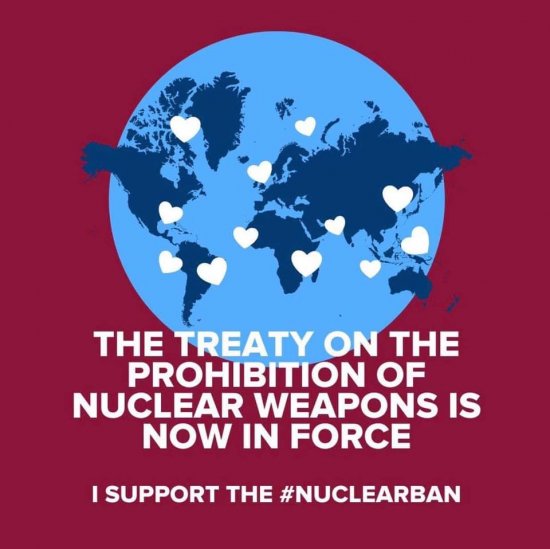
by: Ella Wales, Aug 6, 2023
OAK RIDGE, Tenn. (WATE) — Demonstrators held a march in Oak Ridge Saturday against the development and use of nuclear weapons.
The Oak Ridge Environmental Peace Alliance (OREPA) held the demonstration ahead of the 78th Anniversary of the U.S. bombings of Hiroshima and Nagasaki, Japan. The group marched from Alvin K. Bissell Park to the Y-12 National Security Complex.
Tanvi Kardile, coordinator of OREPA, said they are an anti-violence grassroots organization.
“We work against development of nuclear weapons, we fight against Y-12 which is still producing weapons to this day and we want to spread public awareness about what they’re doing out there,” she said.
The group’s demonstration aimed to support nuclear abolition in the United States.
“We came here to talk about the Treaty on the Prohibition of Nuclear Weapons, which is the only viable treaty that’s currently on the path to end nuclear weapons. The U.S. has not signed onto this treaty yet, so we’re here to spread public awareness about that,” Kardile said.
The nuclear arms race’s legacy: Toxic contamination, staggering cleanup costs and a culture of government secrecy
Advocates for a full Hanford cleanup warn that without such a commitment, the site will become a “national sacrifice zone,” a place abandoned in the name of national security.
By William J. Kinsella, 6 Aug 23, https://japantoday.com/category/features/opinions/the-nuclear-arms-race’s-legacy-at-home-toxic-contamination-staggering-cleanup-costs-and-a-culture-of-government-secrecy
RALEIGH, North Carolina
Christopher Nolan’s film “Oppenheimer” has focused new attention on the legacies of the Manhattan Project – the World War II program to develop nuclear weapons. As the anniversaries of the bombings of Hiroshima and Nagasaki on Aug. 6 and Aug. 9, 1945, approach, it’s a timely moment to look further at dilemmas wrought by the creation of the atomic bomb.
The Manhattan Project spawned a trinity of interconnected legacies. It initiated a global arms race that threatens the survival of humanity and the planet as we know it. It also led to widespread public health and environmental damage from nuclear weapons production and testing. And it generated a culture of governmental secrecy with troubling political consequences.
As a researcher examining communication in science, technology, energy and environmental contexts, I’ve studied these legacies of nuclear weapons production. From 2000 to 2005, I also served on a citizen advisory board that provides input to federal and state officials on a massive environmental cleanup program at the Hanford nuclear site in Washington state that continues today.
Hanford is less well known than Los Alamos, New Mexico, where scientists designed the first atomic weapons, but it was also crucial to the Manhattan Project. There, an enormous, secret industrial facility produced the plutonium fuel for the Trinity test on July 16, 1945, and the bomb that incinerated Nagasaki a few weeks later. (The Hiroshima bomb was fueled by uranium produced in Oak Ridge, Tennessee, at another of the principal Manhattan Project sites.)
Later, workers at Hanford made most of the plutonium used in the U.S. nuclear arsenal throughout the Cold War. In the process, Hanford became one of the most contaminated places on Earth. Total cleanup costs are projected to reach up to US$640 billion, and the job won’t be completed for decades, if ever.
Victims of nuclear tests
Nuclear weapons production and testing have harmed public health and the environment in multiple ways. For example, a new study released in preprint form in July 2023 while awaiting scientific peer review finds that fallout from the Trinity nuclear test reached 46 U.S. states and parts of Canada and Mexico.
Dozens of families who lived near the site – many of them Hispanic or Indigenous – were unknowingly exposed to radioactive contamination. So far, they have not been included in the federal program to compensate uranium miners and “downwinders” who developed radiation-linked illnesses after exposure to later atmospheric nuclear tests.
On July 27, 2023, however, the U.S. Senate voted to extend the Radiation Exposure Compensation Act and expand it to communities near the Trinity test site in New Mexico. A companion bill is under consideration in the House of Representatives.
The largest above-ground U.S. tests, along with tests conducted underwater, took place in the Pacific islands. Meanwhile, the Soviet Union and other nations conducted their own testing programs. Globally through 2017, nuclear-armed nations exploded 528 weapons above ground or underwater, and an additional 1,528 underground.
Estimating how many people have suffered health effects from these tests is notoriously difficult. So is accounting for disruptions to communities that were displaced by these experiments.
Polluted soil and water
Nuclear weapons production has also exposed many people, communities and ecosystems to radiological and toxic chemical pollution. Here, Hanford offers troubling lessons.
Starting in 1944, workers at the remote site in eastern Washington state irradiated uranium fuel in reactors and then dissolved it in acid to extract its plutonium content. Hanford’s nine reactors, located along the Columbia River to provide a source of cooling water, discharged water contaminated with radioactive and hazardous chemicals into the river through 1987, when the last operating reactor was shut down.
Extracting plutonium from the irradiated fuel, an activity called reprocessing, generated 56 million gallons of liquid waste laced with radioactive and chemical poisons. The wastes were stored in underground tanks designed to last 25 years, based on an assumption that a disposal solution would be developed later.
Seventy-eight years after the first tank was built, that solution remains elusive. A project to vitrify, or embed tank wastes in glass for permanent disposal, has been mired in technical, managerial and political difficulties, and repeatedly threatened with cancellation.
Now, officials are considering mixing some radioactive sludges with concrete grout and shipping them elsewhere for disposal – or perhaps leaving them in the tanks. Critics regard those proposals as risky compromises. Meanwhile, an estimated 1 million gallons of liquid waste have leaked from some tanks into the ground, threatening the Columbia River, a backbone of the Pacific Northwest’s economy and ecology.
Radioactive trash still litters parts of Hanford. Irradiated bodies of laboratory animals were buried there. The site houses radioactive debris ranging from medical waste to propulsion reactors from decommissioned submarines and parts of the reactor that partially melted down at Three Mile Island in Pennsylvania in 1979. Advocates for a full Hanford cleanup warn that without such a commitment, the site will become a “national sacrifice zone,” a place abandoned in the name of national security.
A culture of secrecy
As the movie “Oppenheimer” shows, government secrecy has shrouded nuclear weapons activities from their inception. Clearly, the science and technology of those weapons have dangerous potential and require careful safeguarding. But as I’ve argued previously, the principle of secrecy quickly expanded more broadly. Here again, Hanford provides an example.
Hanford’s reactor fuel was sometimes reprocessed before its most-highly radioactive isotopes had time to decay. In the 1940s and 1950s, managers knowingly released toxic gases into the air, contaminating farmlands and pastures downwind. Some releases supported an effort to monitor Soviet nuclear progress. By tracking deliberate emissions from Hanford, scientists learned better how to spot and evaluate Soviet nuclear tests.
In the mid-1980s, local residents grew suspicious about an apparent excess of illnesses and deaths in their community. Initially, strict secrecy – reinforced by the region’s economic dependence on the Hanford site – made it hard for concerned citizens to get information.
Once the curtain of secrecy was partially lifted under pressure from area residents and journalists, public outrage prompted two major health effects studies that engendered fierce controversy. By the close of the decade, more than 3,500 “downwinders” had filed lawsuits related to illnesses they attributed to Hanford. A judge finally dismissed the case in 2016 after awarding limited compensation to a handful of plaintiffs, leaving a bitter legacy of legal disputes and personal anguish.
Cautionary legacies
Currently active atomic weapons facilities also have seen their share of nuclear and toxic chemical contamination. Among them, Los Alamos National Laboratory – home to Oppenheimer’s original compound, and now a site for both military and civilian research – has contended with groundwater pollution, workplace hazards related to the toxic metal beryllium, and gaps in emergency planning and worker safety procedures.
As Nolan’s film recounts, J. Robert Oppenheimer and many other Manhattan Project scientists had deep concerns about how their work might create unprecedented dangers. Looking at the legacies of the Trinity test, I wonder whether any of them imagined the scale and scope of those outcomes.
Greg Mitchell on “Oppenheimer” & Why Hollywood Is Still Afraid of the Truth About the Atomic Bomb
The movie Oppenheimer about the “father of the atomic bomb” focuses on J. Robert Oppenheimer’s conflicted feelings about the weapons of mass destruction he helped unleash on the world, and how officials ignored those concerns after World War II as the Cold War started an arms race. Journalist Greg Mitchell says that while the film is well made and worth seeing, “the omissions are quite serious.” He says there is little mention of the dangers of radiation and no focus on the impact of the bomb on its victims in Hiroshima and Nagasaki. The film also does not question the necessity of using the bomb in the first place, upholding the “official narrative … that has held sway since 1945,” says Mitchell.
Greg Mitchell is a documentary filmmaker and the author of numerous books, including The Beginning or the End: How Hollywood—and America—Learned to Stop Worrying and Love the Bomb. He was editor of Nuclear Times magazine from 1982 to 1986 and has written about this new film for Mother Jones, on his Substack, and in an opinion piece for the Los Angeles Times headlined “‘Oppenheimer’ is here. Is Hollywood still afraid of the truth about the atomic bomb?” Transcript: https://www.democracynow.org/2023/7/2…
‘Barbenheimer’ highlights U.S. ignorance of nuclear reality
Lack of images depicting the real-life horrors of the atomic bombs left a generation in the dark
BY DON CARLETON 4 Aug 23 https://www.japantimes.co.jp/commentary/2023/08/04/japan/barbie-oppenheimer-nuclear-weapons/
As we approach the 79th anniversary of the bombings of Hiroshima and Nagasaki, America is gripped in a confusing and (as some have argued) insensitive cultural moment.
The release of very different movies, “Barbie” and “Oppenheimer,” on the same day has spawned the “Barbenheimer” craze where the two come together in a strange yet symbiotic fashion. Box office records have been broken across America and it has become a trend among moviegoers to express an ironic sense of humor by seeing both films on the same day.
In addition, countless internet jokes and memes — some showing “Barbie” and “Oppenheimer” juxtaposed against the backdrop of atomic explosions — have gone viral. However, the resulting satire has led to deep offense and anger among many Japanese. Things culminated earlier this week when Warner Bros. (the makers of “Barbie”) issued an apology after their official U.S. social media account reacted positively to a Barbenheimer meme.
These memes aren’t harmless fun, because atomic bombs are never harmless. The two bombs dropped by the American armed forces on Hiroshima and Nagasaki created immense and intense human suffering. The Barbenheimer trend thus glosses over the tragedy at the core of “Oppenheimer” and points to the fact that few Americans have ever fully grappled with the enormous devastation of the atomic bombings. In large part, that’s because few Americans have ever seen that reality.
In 2018, I was approached by Hankaku Shashin Undo, the Anti-Nuclear Photographer’s Association (ANPM), who have worked since 1982 to preserve the legacy of Japanese photographers who documented the bombings and their immediate aftermath firsthand in Hiroshima and Nagasaki.
As the executive director of the Briscoe Center for American History at the University of Texas at Austin, a research center dedicated to fostering scholarly and public understanding of U.S. history, I was interested in ANPM’s invitation to collaborate. At the heart of ANPM’s activism is a desire to remove the danger of nuclear war from the world
— a motive we can all support, regardless of how we feel about the American decision to drop the bombs. In working together, we hoped to raise visual awareness of “what actually happened” in Hiroshima and Nagasaki so that a new generation of Americans might better understand the realities of nuclear war.
ANPM agreed to place a large digital archive of photographs at the Briscoe Center and I agreed to publish a book and create an exhibition of selected images. Along with two members of my staff, I visited Hiroshima and Nagasaki in 2018, meeting with museum staff, journalists and hibakusha.
The result was “Flash of Light, Wall of Fire,” a 2020 book and subsequent exhibit. Throughout the project, our goal was simple. We wanted to show Americans something that they had never seen before: comprehensive visual evidence of the devastation and suffering atomic bombs cause.
Why have Americans not seen this evidence until now?
After World War II, photographs of Hiroshima and Nagasaki were immediately suppressed by the Japanese military and later by the American occupation forces in Japan, meaning very few were published on either side of the Pacific Ocean. After the end of the occupation in the 1950s (when Japanese books documenting the bombings began to be published and the memorial museums in Hiroshima and Nagasaki were founded), few photographs made their way from Japan to the United States.
If Americans thought of the bomb at all, their only visual memory was of the mushroom cloud, not the horrors inflicted on the Japanese civilians. This void led to a strange cultural dichotomy during the 1950s.
On the one hand, Americans took the bomb very seriously, with the Cold War fueling moments of political and cultural hysteria from McCarthyism to suburban fallout shelters. On the other hand, cultural fads such as “Miss Atomic Bomb” to atomic-themed candy made light of the bombings. Today, with Barbenheimer, we see that the pattern still resonates — seriousness on one hand, silliness on another, all smushed together in our popular culture.
“Oppenheimer” is a moving and serious film that raises important questions about the consequences of nuclear weapons through the personal experiences of physicist Robert Oppenheimer. It includes harrowing depictions of the July 1945 Trinity test site explosion in New Mexico, as well as a compelling scene where Oppenheimer briefly envisions the terrifying human effects of the bombs during a victory speech.
However, there is no attempt to depict the resulting terrors from the perspective of the people of Hiroshima and Nagasaki. Director Christopher Nolan explains this decision, in part: “(Oppenheimer) learned about the bombings of Hiroshima and Nagasaki on the radio, the same as the rest of the world.” It would be unreasonable to criticize Nolan for not including longer and more graphic scenes of this nature, given his vision for the film’s focus on Oppenheimer’s perspective. But without those scenes, and without any visual record in our collective memory, it is easier to avoid the ramifications of Hiroshima and Nagasaki when our view is taken from the bomb bay doors of the Enola Gay or Bockscar.
Conversely, it is impossible to deny the terror and tragedy of the bombings when one looks through the eyes of Yoshito Matsushige, Yosuke Yamahata, Eiichi Matsumoto, Shigeo Hayashi and other photographers on the ground in 1945. Thus, when the Briscoe Center agreed to receive, display and publish photographs donated by the ANPM, the desire was to get the American mind to look from under the mushroom cloud, so to speak.
Unfortunately, the COVID-19 pandemic disrupted our project (as well as the 75th anniversary commemorations in Japan) and diminished the impact of the center’s book and exhibit. Nevertheless, next year’s 80th anniversary gives historians, archivists and curators around the world a new opportunity.
The Barbenheimer moment shows us that much work remains to be done. If Americans are going to take the very real nuclear dangers of our age more seriously than previous generations (not to mention having a clearer view of what was done to the people of Hiroshima and Nagasaki), they must be confronted with the stark visual evidence of what actually happened. On the whole, Americans are still looking at the history of Hiroshima and Nagasaki from a distance — visually, emotionally and intellectually.
As we approach the 80th anniversary of the bombings, it is time to make a renewed push to change that perspective.
Is the US preparing to dump the proxy war in Ukraine so it can start another in Taiwan?
4 Aug 23 https://sputnikglobe.com/20230803/is-biden-preparing-to-dump-ukraine-for-taiwan-1112361859.html
US President Joe Biden is reportedly seeking congressional approval for financing military aid for Taiwan as part of the supplemental budget for Ukraine. What’s behind the move?
The White House is going to ask the US Congress to fund the arming of the island of Taiwan via the Ukraine budget in order to speed up weapons transfers to Taipei, as per Western media. The request followed the Biden administration’s announcement that the US would deliver $345 million worth of weapons to the island through a mechanism known as the “presidential drawdown authority.” The mechanism has long been used by the US to send arms to Ukraine.
Taiwan, an island located at the junction of the East and South China Seas in the northwestern Pacific Ocean, is regarded by Beijing as an inalienable part of the People’s Republic of China.
“Well, what it shows is that the Biden administration has no regard or concern for angering China,” Larry Johnson, a veteran of the CIA and the State Department’s Office of Counterterrorism, told Sputnik.
“China has made it very clear that it views any effort by the United States to provide weapons or military training to Taiwan as a direct threat to China. And for some reason, the Biden administration refuses to accept or acknowledge the position of the Chinese. In submitting this aid package, I don’t think the Biden administration will have any problem getting it passed. We’ve still not reached a point in the United States where there is opposition to funding the war in Ukraine, or the potential for war in China. So, I think it’s likely to go through, which means it’s going to make relations between China and the United States worse, not better.”
At the same time, the CIA veteran does not consider the development as lessening support for Ukraine. It’s likely that the Biden administration has come under pressure to show support for Taiwan, per Johnson. The expert sees the funding maneuver “as a convenient legislative vehicle to get approval for the funding in a way that expedites it, doesn’t delay it.”
“I’m still not clear that it represents a cut in funds for Ukraine and a shifting of those funds to Taiwan. I think it’s more a function of the US legislative process, that Congress must appropriate money before the administration, in theory, can spend it. Because this legislation had already been presented, they were able, I think, decided to carve out some of the funds in that for Taiwan, because they had made prior commitments to Taiwan to provide some kind of support,” Johnson explained.
China has repeatedly urged the US to stop escalating tensions in the Taiwan Strait. Nonetheless, US government officials and congressional leaders continue to send mixed signals to the island and meet with Taiwan’s leadership. Furthermore, the US is encouraging its allies to beef up their military presence in the Asia Pacific, citing the “China threat” to the island. To cap it off, President Joe Biden has repeatedly pledged to protect Taiwan “militarily,” with the White House then downplaying his vows as gaffes. Why is Washington continuing to develop the conflict around Taiwan?
“Well, because, number one, the United States continues to believe that it is the most powerful country in the world and can dictate to other countries reality. It’s a consequence of arrogance and hubris. The United States refuses to accept the fact that China and Russia have an equal say in matters. And I think, unfortunately, the United States, if it persists in taking actions like this, will provoke a conflict that will be very damaging to the United States and will weaken it, not make it stronger. The United States can’t even fund the one proxy war in Ukraine right now. It’s been losing. It can’t provide sufficient artillery shells, for example. The United States fails to recognize that it’s reached the limits of its power,” Johnson concluded.
Judge tosses charges against executive in South Carolina nuclear debacle, but case may not be over
A judge has ordered criminal charges dropped against the final executive
accused of lying about problems building two nuclear reactors in South
Carolina that were abandoned without generating a watt of power. The judge
tossed the charges Wednesday because ratepayers of the utility that lost
billions of dollars on the project were improperly allowed on the grand
jury that indicted Westinghouse Electric Co. executive Jeffrey Benjamin.
But federal judge Mary Geiger Lewis also ruled that nothing is stopping
prosecutors from properly seeking another indictment.
Daily Mail 3rd Aug 2023
US rejects Australian plea to drop Assange case

29 July 23, https://www.rt.com/news/580512-blinken-rejects-assange-australia/
Secretary of State Antony Blinken insisted that the WikiLeaks founder caused “serious harm” to US national security
US Secretary of State Antony Blinken has confirmed that Australia has raised the case of Julian Assange’s continued prosecution, but declared that Washington will not cease seeking the extradition of the former WikiLeaks boss and intends to try him for espionage.
Speaking alongside Australian Foreign Minister Penny Wong in Brisbane on Saturday, Blinken said that while he understands “the concerns and views of Australians,” Assange’s alleged actions “risked very serious harm to our national security, to the benefit of our adversaries, and put named human sources at grave risk – grave risk – of physical harm, and grave risk of detention.”
Assange, he said, was “charged with very serious criminal conduct” and had allegedly taken part in “one of the largest compromises of classified information in the history of our country.”
An Australian citizen, Julian Assange is currently being held in London’s Belmarsh Prison. He is fighting extradition to the US, where he faces 17 charges under the Espionage Act and potentially a 175-year prison sentence. Human-rights and press-freedom activists have demanded his release, citing his deteriorating mental and physical health, while Australian Prime Minister Anthony Albanese said in May that he was “working through diplomatic channels” to press the US into dropping the case.
The charges against Assange stem from his publication of classified material obtained by whistleblowers, including Pentagon documents detailing alleged US war crimes in Iraq and Afghanistan, and more than 250,000 diplomatic cables exposing US efforts to – among other things – spy on its allies and influence foreign elections.
While Assange did not personally steal these documents, he is nevertheless being prosecuted for espionage. He and his supporters argue that WikiLeaks’ publication of this material is protected by the First Amendment of the US Constitution.
“We have made clear our view that Mr Assange’s case has dragged on for too long,” Foreign Minister Wong said on Saturday. “We’ve said that publicly and you would anticipate that that reflects also the position we articulate in private.”
The extradition of Assange from Britain to the US was approved in 2020 by then-UK Home Secretary Priti Patel. The publisher lodged his final appeal against the decision in June, after all eight grounds of a previous appeal were rejected by a British High Court judge.
Responding to Blinken’s comments on Saturday, Assange’s brother, Gabriel Shipton, said that it is now up to Prime Minister Albanese to make a public appeal for Assange’s freedom, during his upcoming visit to the US.
The unpalatable facts of the costs to consumers of electricity from new nuclear power
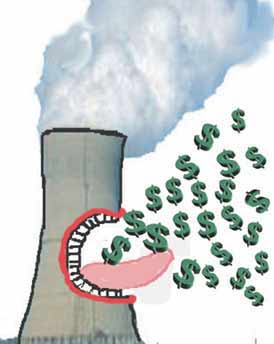
ATLANTA (AP) — The first American nuclear reactor to be built from scratch in decades is sending electricity reliably to the grid, but the cost of the Georgia power plant could discourage utilities from pursuing nuclear power as a path to a carbon-free future.
Georgia Power Co. announced Monday that Unit 3 at Plant Vogtle, southeast of Augusta, has completed testing and is now in commercial operation, seven years late and $17 billion over budget.
……………………………………………………. In Georgia, almost every electric customer will pay for Vogtle. Georgia Power currently owns 45.7% of the reactors. Smaller shares are owned by Oglethorpe Power Corp., which provides electricity to member-owned cooperatives, the Municipal Electric Authority of Georgia and the city of Dalton. Oglethorpe and MEAG plan to sell power to cooperatives and municipal utilities across Georgia, as well in Jacksonville, Florida, and parts of Alabama and the Florida Panhandle.
Georgia Power’s residential customers are projected to pay more than $926 apiece as part of an ongoing finance charge and elected public service commissioners have approved a rate increase. Residential customers will pay $4 more per month as soon as the third unit begins generating power. That could hit bills in August, two months after residential customers saw a $16-a-month increase to pay for higher fuel costs.
The high construction costs have wiped out any future benefit from low nuclear fuel costs in the future, experts have repeatedly testified before commissioners.
“The cost increases and schedule delays have completely eliminated any benefit on a life-cycle cost basis,” Tom Newsome, director of utility finance for the commission, testified Thursday in a Georgia Public Service Commission hearing examining spending.
The utility will face a fight from longtime opponents of the plant, many of whom note that power generated from solar and wind would be cheaper. They say letting Georgia Power make ratepayers pay for mistakes will unfairly bolster the utility’s profits.
“While capital-intensive and expensive projects may benefit Georgia Power’s shareholders who have enjoyed record profits throughout Vogtle’s beleaguered construction, they are not the least-cost option for Georgians who are feeling the sting of repeated bill increases,” Southern Environmental Law Center staff attorney Bob Sherrier said in a statement.
Commissioners will decide later who pays for the remainder of the costs of Vogtle, including the fourth reactor. Customers will pay for the share of spending that commissioners determine was prudent, while the company and its shareholders will have to pay for spending commissioners decide was wasteful.
Georgia Power CEO Kim Greene said the company hasn’t decided how much it will ask customers to pay. https://apnews.com/article/georgia-power-nuclear-reactor-vogtle-9555e3f9169f2d58161056feaa81a425
First new US nuclear reactor in 3 decades may well also be its last

“The only reason there’s a nuclear renaissance is because the federal government is throwing tens of billions of dollars at nuclear,” …….. “Investors aren’t interested.”
Opening of Georgia Power’s Vogtle unit 3 comes 7 years late and billions
of dollars over budget.
FT.com Myles McCormick in Houston, 31 July 2023
The US nuclear energy industry has reached a watershed moment. Plant Vogtle unit 3 began delivering commercial electricity to the Georgia power grid, becoming the first nuclear reactor the country has built from scratch in more than three decades.
Unit 3 and a twin reactor to open in the coming months may also be the last. Years of delays and billions of dollars of cost overruns have made the megaproject as much a cautionary tale as a new chapter for atomic investment.
The 1,100-megawatt Vogtle unit 3 was initially supposed to enter service in 2016, however. Its start of operations was delayed once more in June after the company discovered a degraded seal in its main generator.
“It turns out nuclear construction is hard,” said Bob Sherrier, a staff attorney at the Southern Environmental Law Center, which challenged the project in court.
“Along the way the company kept ratcheting up the cost estimates, pushing back the deadlines a bit at a time. Every time it was raised just enough where it was still within the bounds of justification that it made sense to proceed. But they were wildly off in their estimates every single time.”
“The resurgence of America’s nuclear industry starts here in Georgia, where you’ve just got approval, for the first time in three decades, to build new nuclear reactors,” then-US energy secretary Steven Chu said as Vogtle was authorised in 2012.
The Georgia project was supposed to be the first among dozens of new reactors built across the country. But the renaissance floundered amid safety concerns after the 2011 Fukushima disaster in Japan coupled with plunging prices for natural gas, a competing generation fuel. In the end only four reactors moved ahead and two, Vogtle units 3 and 4, have been built. Unit 4 is scheduled to come online by early 2024.
Soaring costs at Vogtle, along with new reactors at the VC Summer nuclear project in South Carolina, forced engineering contractor Westinghouse into bankruptcy in 2017. While South Carolina utilities pulled the plug on their project, Georgia ploughed ahead.
The $14bn original cost of Vogtle units 3 and 4 has now ballooned to more than $30bn. The cost for Georgia Power, with a 45 per cent share of the project, will be about $15bn.
How the company’s costs are shared with its customers will be decided by the commission once unit 4 is operating: the law allows only costs deemed “prudent” to be passed on to ratepayers.
McDonald said the company should not expect an easy ride. “They are guilty until they prove themselves innocent,” he said.
Georgia Power, a division of New York-listed Southern Company, did not respond to multiple requests for an interview.
……………………………………… there are no other traditional large-scale light water reactors under way in the US. Critics say that investors have been turned off.
“The only reason there’s a nuclear renaissance is because the federal government is throwing tens of billions of dollars at nuclear,” said David Schlissel at the Institute for Energy Economics and Financial Analysis. “Investors aren’t interested.”
For Georgians, the more immediate concern is what the project means for utility bills. Georgia Watch, a consumer group, estimates ratepayers have already paid $900 extra since construction began to cover financing costs. Bills are set to rise by another $3.78, or 3 per cent, on average when unit 3 comes online.
But the ultimate impact will not be felt until unit 4 comes online and the PSC decides how much of the burden will be left for ratepayers to shoulder. Georgia Watch estimates the final increase will add anywhere between 10-13 per cent to bills……………… https://www.ft.com/content/5d8e0c6c-59c9-4b40-806f-604889dd5fb6
Military interest in nuclear-powered space travel, but solar-powered is just as good, -and safer.
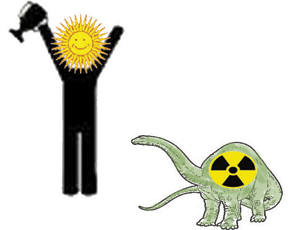
2 Government, Industry Explore Nuclear, Solar Space Engines
COLORADO SPRINGS, Colorado — More commercial and military activity is taking place in space, and the Defense Department and industry are investing in emerging propulsion technologies to move systems in orbit faster, farther and more efficiently.
……………………………………..In 2021, the Defense Advanced Research Projects Agency selected Lockheed Martin as one of three prime contractors — along with General Atomics and Blue Origin — for Phase 1 of its Demonstration Rocket for Agile Cislunar Operations, or DRACO, program to showcase the potential of a nuclear thermal propulsion system in space, a DARPA release said.
This January, NASA announced it had partnered with DARPA on the DRACO program, describing a nuclear thermal rocket engine as “an enabling capability for NASA crewed missions to Mars.” The goal is to demonstrate the system in orbit in fiscal year 2027, with the Space Force providing the launch vehicle for the DRACO mission, a DARPA statement said.
The program is about to enter Phase 2, which “will primarily involve building and testing on the non-nuclear components of the engine” such as valves, pumps, the nozzle and “a representative core without the nuclear materials in it,” DARPA’s program manager for DRACO Tabitha Dodson said during a panel discussion at the Space Foundation’s Space Symposium in April. Dodson said then a Phase 2 decision is “quite close.” However, at press time in mid-July, no contracts have been awarded.
…………………………………“There are no facilities on Earth that we could use for our DRACO reactor’s power test … so we’ve always baselined doing our power test for the reactor in space,” Dodson said. Once in space, DARPA will “very gradually” ramp up the system to “full power thrust,” she said…………………………………………………………………………………………………………………………………………
Despite DARPA’s commitment to safety, nuclear propulsion systems face an uphill battle getting deployed on spacecraft at scale, said Joel Sercel, founder and CEO of TransAstra, a space technology company.
………………………………………………………………………………..In May, the Space Force awarded TransAstra a Phase One Small Business Innovation Research contract to explore new applications for the company’s propellant-agnostic Omnivore thruster.
The Omnivore thruster uses solar reflectors to focus sunlight onto a solar absorber, which then superheats the system’s propellant to generate thrust “typically six times faster and eight times cheaper than electric systems,” a company release said.
Additionally, TransAstra calculated an Omnivore thruster “using liquid hydrogen propellant … will perform similarly to nuclear rockets, but without nuclear materials, costs or risk.”
Sercel said Omnivore has “80 percent of the performance of nuclear at 1 percent of the cost.” The system is essentially nuclear powered, “but the nuclear reactor in question is the fusion reactor at the center of the solar system called the Sun,” he added.
“The nice thing about nuclear reactors is that you have a small, compact reactor versus large deployable solar reflectors, but the basic performance of solar thermal rockets and nuclear rockets is about the same,” he said. And with Omnivore “you don’t have all these safety concerns and radioactive material and reactor control issues and so on. So, we think it’s a much more practical approach.”
Omnivore could have multiple mission applications for the Defense Department, Sercel said. Using liquid hydrogen propellant, the thruster “can deliver hundreds of kilograms” of spacecraft to geosynchronous orbit “on small launch vehicles, and the Space Force seems to be very excited about this,” he said. The system could also deliver spacecraft weighing more than 100 kilograms to cislunar space, he said.
Additionally, TransAstra has an Omnivore variant that uses water as the propellant, the solar absorber superheating the water vapor and releasing the gas through a nozzle to generate thrust.
The water-based variant can be placed on the company’s Worker Bee small orbital transfer vehicles, about 25 of which can fit on a single Falcon 9 rocket, Sercel said.
“Each [Worker Bee] could deliver up to six small [satellites] to their orbital destinations. So, we can deliver a full constellation of 100 small or micro [satellites] to all different inclinations, and you would get global coverage in one launch.”…………………………………………………………more https://www.nationaldefensemagazine.org/articles/2023/7/31/government-industry-explore-nuclear-solar-space-engines
Past and Future Collide over Diablo Canyon Nuclear Power Plant

A History of Accidents and Centuries of Radioactive Waste to Come Dog Diablo Operator PPG&E
By Lauren Hanson and Mary Jones, Sun Jul 30, 2023 https://www.independent.com/2023/07/30/past-and-future-collide-over-diablo-canyon-nuclear-power-plant/
The past and the future collided at a virtual Public Participation Hearing held by the California Public Utilities Commission (CPUC) on July 25. The subject: the potential extension of operations at Diablo Canyon nuclear power plant.
Over 100 commenters spoke. The majority of them (by a 61 percent to 39 percent margin) vigorously opposed continued operations at the plant. As Justin LeBlanc of Sustainable Transit El Dorado put it, “The way of the future is not legacy monoliths.”
Diablo Canyon’s two reactors were scheduled to shut in 2024 and 2025 when their operating licenses expire. A surprise, and very energetic, push by Governor Newsom has led to a last-minute governmental scramble to consider continued operations to 2030 or beyond. The State Legislature has already given a conditional go-ahead.
The CPUC is expected to take a position on the matter before the end of this year. That decision could facilitate or block the extension. Of the five appointed members, a single CPUC commissioner, Karen Douglas, attended the hearing.
Proponents and opponents of the extension definitely did not see the future in the same way. They didn’t agree on the past, either.
Supporters of the extension most frequently cited what they said were ongoing low costs and safe, carbon-free nuclear operations. The mayor of Arroyo Grande, Caren Ray Russom, noted jobs and said that her city is “a direct beneficiary” of the plant’s operations. Jeff Luse, of Generation Atomic, a group that describes itself as “the heart of the pro-nuclear movement,” stated that the radioactive waste stored on site is “safely handled.” Several proponents even advocated adding more nuclear reactors to the site and operating them indefinitely.
Administrative Judge Patrick Doherty, who presided at the hearing, twice had to remind participants to refrain from personal attacks on other speakers. This came after two proponents of the extension referred to those with different views as “eco-terrorists,” “superstitious,” and “propaganda peddlers.”
Those opposed to the extension didn’t need to name-call to make their points. The long list of operational problems of PG&E, Diablo’s operator, did not instill confidence. Elizabeth Brooking of San Francisco, who voiced concerns about how the radioactive waste will be handled for the centuries it will exist, commented that PG&E “doesn’t have an exemplary track record for maintenance.” That’s putting it mildly, as others noted. Adding some dark historical context were Scott Rainsford and Bob Rowen, who described their firsthand experiences with PG&E’s Humboldt Bay nuclear reactor #3, which, they said, experienced a nuclear accident in 1970 that contaminated employees and was covered up by PG&E and the regulatory agencies.
As for continuing Diablo operations beyond the ’24 and ’25 shutdown date, the reasons against that were many and varied. Here are a few that were brought up:
• Under-reported earthquake dangers that downplay the seismic risk to the plant.
• The alarming embrittlement of the metalurgical material inside the reactor vessel of Diablo’s Unit 1: Bruce Severance of San Luis Obispo gave a summary of his findings from reviewing 4,000 pages of U.S. Nuclear Regulatory Commission documents.
• The actual unreliability of the plant’s scheduled operations: Donna Gilmore of SanOnofreSafety.org stated that the two reactors at Diablo had been down 40 percent of the time in the past two years.
• The increasing availability of battery storage as an alternative baseline supply of energy that already exceeds what Diablo offers and will likely exceed it by 3x in the coming two years.
• The uranium mining and transporting that endangers communities near it and contributes significantly to the carbon footprint of nuclear power.
• The financial costs of getting Diablo sufficiently ready to operate any longer than the already agreed upon shutdown: A study by the Environmental Working Group was cited, which states the costs could be as high as $45 billion.
• The absurdity of spending so much to prop up Diablo instead of deploying those funds as rapidly as possible for solar, wind and other renewables: Rooftop solar, in particular, was urged by a number of commenters.
• The danger to the ocean and marine creatures from the once-through cooling system that would apparently be allowed to continue, even though it is no longer an approved process.
• And finally, the unthinkable loss that a catastrophic failure at Diablo would cause.
This last item seems to be something that the proponents of extension want to whistle past, while the opponents of extension do what they can to sincerely sound the loudest possible alarm.
Adrianne Davis of Santa Barbara summed up the Diablo problem succinctly, calling the aging plant a “truly lethal dinosaur.”
And Myla Reson of Santa Monica concluded her remarks with this: “Take a moment to think how you’ll feel if there is a meltdown and you didn’t do anything to shut it.”
There is still time to submit written comments online to the CPUC at apps.cpuc.ca.gov/c/R2301007.
Lauren Hanson and Mary Jones live in Santa Barbara.
Humans Might Be About to Break the Ocean? Don’t Stop the Presses

JULIE HOLLAR, FAIR, 31 July 23
When a new peer-reviewed study (Nature Communications, 7/25/23) announces that a crucial Atlantic Ocean circulation system, a cornerstone of the global climate, may collapse as quickly as two years from now, you’d think news outlets might want to put that on the front page.
The AMOC (Atlantic Meridional Overturning Circulation) moves warmer water from the tropics to the North Atlantic, where it cools, sinks and returns down the US East Coast. Its collapse would be a “climate tipping point” with, as the British Guardian (7/25/23) explained,
disastrous consequences around the world, severely disrupting the rains that billions of people depend on for food in India, South America and West Africa. It would increase storms and drop temperatures in Europe, and lead to a rising sea level on the eastern coast of North America. It would also further endanger the Amazon rainforest and Antarctic ice sheets.
The study, published by an open-access affiliate of the prestigious scientific journal Nature, used new statistical methods, rather than new observations, to make its prediction, which contradicts the IPCC’s latest assessment. The IPCC (6/14/19) deemed a full collapse this century “very unlikely,” but it relied on data that only went back to 2004. The new study, the Guardian reported, “used sea surface temperature data stretching back to 1870 as a proxy for the change in strength of AMOC currents over time.” The study projected the collapse of the ocean system between 2025 and 2095, with 2050 the most likely date, without sharp reductions in global carbon emissions.
Some climate scientists are cautious about the new study, suggesting that more observational data is needed to say the collapse could happen so imminently (Grist, 7/26/23). But as climate scientist Jonathan Foley argued (Twitter, 7/27/23), though the study doesn’t offer certainty, the consequences are so dire that “the only prudent reaction to this is to work to address climate change, as quickly as possible, to avoid these kinds of impacts.”
“I really wish that journalists and editors took this as seriously as scientists do, and reported it loudly and accurately, taking the time to get the facts right,” Foley wrote. “The planet is in trouble, and we need to have the best possible information.”
Unfortunately for the planet and those who inhabit it, corporate media would rather look the other way, at worst, and offer scary clickbait headlines with few connections to actionable policy at best.
‘Try all that we can’
At the Washington Post, editors put the news on page 12 (7/26/23). …………………………….
The Wall Street Journal, the favored newspaper of the business crowd, didn’t even bother to cover the report, ………………………………..
NPR (7/27/23) focused more on the importance of the timing of the collapse than on the collapse itself,…………………………………..
‘Plausible we’ve fallen off a cliff’
The New York Times (7/26/23) was one of the only major outlets to put the news on its front page, with a well-reported piece by Raymond Zhong. It also did better than many, mentioning “human-driven warming” in the second paragraph, and paraphrasing a scientist that “uncertainty about the timing of an AMOC collapse shouldn’t be taken as an excuse for not reducing greenhouse-gas emissions to try to avoid it.” That scientist, Hali Kilbourne, was given the last word:
“It is very plausible that we’ve fallen off a cliff already and don’t know it,” Dr. Kilbourne said. “I fear, honestly, that by the time any of this is settled science, it’s way too late to act.”
Yet even here, no connections were made to concrete policy options, and no policy experts or activists were quoted to offer them.
The only other front-page US newspaper mention FAIR could find in the Nexis database was in the Charleston Post & Courier (7/25/23), which similarly made no connections to policy.
In the context of a summer of extreme climate events, including unprecedented heatwaves, ocean temperatures and wildfires, we desperately need a media system that treats the climate crisis like the five-alarm fire that it is, and demands accountability from the politicians and industries—not least the fossil fuel industry—driving us off the cliff.
Scared to Death!

BY JOHN MIKSAD, https://www.counterpunch.org/2023/07/31/scared-to-death/– 31 July 23
I met U.S. Rep. Joe Courtney (D-CT) for the first time recently. I had a short, but revealing conversation with him.
I don’t know what he thought coming away from the exchange, but I know what I felt. I felt afraid. I saw someone who was enthusiastic about the current proxy war with Russia and the potential war with China, two nuclear armed nations. I saw someone who believes that the US only fights for freedom and democracy although I wonder if he could tell me that last war that was fought for freedom or that resulted in democracy.
I will admit that the weapons manufacturers–who Joe staunchly assists at every turn–have experienced more financial freedom (read “profits”) as a result of Joe’s efforts.
I saw someone who had no use for diplomacy because he believes that you can’t negotiate with adversaries, a belief that has led to countless wars through the millennia and continuous war in this century.
This is deeply concerning to me. Violent conflict over land, resources, ideology, power, and ego may have been the only model we’ve been exposed to, but we can no longer afford to continue working within this old paradigm of might makes right, zero-sum games, and endless arms races. All this has led us to where we find ourselves today, on the brink of self-annihilation.
The fear I felt coming away from this conversation stems from the realization that many of our elected officials adamantly maintain that violence is the only way.
We must find a way to talk, negotiate, build trust, and ultimately cooperate with all nations. I come to this conclusion based on the premise that all people of all nations now face the same existential threats from pandemics, climate collapse, and war escalating to nuclear annihilation.
For the first time in history, the entire human species has obvious common interests. The only rational way forward is to put aside our petty grievances and come together to deal with these existential threats. No one nation can solve these threats alone. There is no other way but together as an international community.
People like Joe are unwilling to give peace a chance and in doing so they are condemning all of us to hardship, suffering, and potentially death. They know only “us versus them” thinking.
They cannot get past the obsolete and barbaric paradigm of resolving conflict by violence or the threat of violence. They don’t realize that we will only have safety and security when all nations have safety and security. Their belief system is incompatible with the realities that we face.
They think that fighting over there protects us here. They don’t realize that there is always blowback and tragic predictable consequences from war that come back to bite us in many ways. We now have epidemic levels of violence within a society that has been shown by its government that violence is the best way to settle disputes.
The blood and treasure that war has stolen from us has left us with crumbling infrastructure, poor results in education and health, and a failing democracy. The planet’s climate is fast approaching tipping points (points of no return) as people around the world experience escalating climate catastrophes including deadly heat waves, floods, wildfires, droughts, and storms.
We continue to spend $1 trillion/year on war and militarism when we know from experience that the military cannot protect us from the real threats that we are now facing. In fact, war exacerbates these threats. War is the worst investment ever.
We must start with a reassessment of U.S. foreign policy and draw down our overreaching military with its expensive and ineffective 750 bases on the sovereign soil of some 80 foreign countries.

If we are to survive and help head the world in the right direction, we must join treaties for nuclear weapons. We must create strong democratized international institutions.
The clock is ticking.
Someone needs to take the lead and break the cycle of mistrust we helped create. It takes courage to do this. We must realize that only peace serves our interest and the interests of all our fellow inhabitants of earth.
I believe people can change. People do change. But not everyone will change. There were people who believed that owning slaves was morally acceptable even after slavery was outlawed.
That’s the way it will be with war and militarism as well. Even when it becomes quite obvious to most of us that the only way to deal with the global threats we face is through international cooperation, I suspect that Joe will believe that wars are still the preferable way to resolve our differences. I suspect he will always believe that all US wars are good and noble even though they kill civilians, create refugees, result in war crimes, and creates poverty, trauma, and desperation just like all war does.
Fortunately, we don’t have to convince everyone that war is barbaric and destructive. We only have to convince enough of our fellow citizens. When we reach a tipping point, the old paradigm will come tumbling down like the Berlin Wall.
Joe prefers to cling to his childhood games where he played the “good” cowboy that killed the “evil savages.” I’ve got some bad news for him about that story as well.
Joe is scared to death of Russia, China, Iran and North Korea.
I am scared to death of Joe.
Joe thinks that we should continue fighting over slivers of land on the other side of the planet.
I think we should be fighting to save the planet and all living things.
Joe thinks that nuclear war is on the table.
I think we must do everything in our power to reduce and ultimately eliminate the threat of nuclear annihilation.
Joe’s fear of other nations brings us ever closer to nuclear annihilation while distracting us from dealing with impending climate collapse and future pandemics.
I believe we need international cooperation for the safety, security, and well-being of all people.
Joe’s actions jeopardize the health and well-being of all people.
I believe we need to send an unequivocal message to Joe and the many other warmongers in Congress that they need to give peace a chance, not someday, but now.
John Miksad is Chapter Coördinator with World Beyond War.
BRING IT HOME-Robert F. Kennedy, Jr.

https://www.kennedy24.com/peace 31 July 23, In the long term, a nation’s strength does not come from its armies. America spends as much on weaponry as the next nine nations combined, yet the country has grown weaker, not stronger, over the last 30 years. Even as its military technology has reigned supreme, America has been hollowing out from the inside. We cannot be a strong or secure nation when our infrastructure, industry, society, and economy are infirm.
A high priority of a Kennedy administration will be to make America strong again. When a body is sick, it withdraws its energy from the extremities in order to nourish the vital organs. It is time to end the imperial project and attend to all that has been neglected: the crumbling cities, the antiquated railways, the failing water systems, the decaying infrastructure, the ailing economy. Annual defense-related spending is close to one trillion dollars. We maintain 800 military bases around the world. The peace dividend that was supposed to come after the Berlin Wall fell was never redeemed. Now we have another chance.
As President, Robert F. Kennedy, Jr. will start the process of unwinding empire. We will bring the troops home. We will stop racking up unpayable debt to fight one war after another. The military will return to its proper role of defending our country. We will end the proxy wars, bombing campaigns, covert operations, coups, paramilitaries, and everything else that has become so normal most people don’t know it’s happening. But it is happening, a constant drain on our strength. It’s time to come home and restore this country.
In Ukraine, the most important priority is to end the suffering of the Ukrainian people, victims of a brutal Russian invasion, and also victims of American geopolitical machinations going back at least to 2014. We must first get clear: Is our mission to help the brave Ukrainians defend their sovereignty? Or is it to use Ukraine as a pawn to weaken Russia? Robert F. Kennedy will choose the first. He will find a diplomatic solution that brings peace to Ukraine and brings our resources back where they belong. We will offer to withdraw our troops and nuclear-capable missiles from Russia’s borders. Russia will withdraw its troops from Ukraine and guarantee its freedom and independence. UN peacekeepers will guarantee peace to the Russian-speaking eastern regions. We will put an end to this war. We will put an end to the suffering of the Ukranian people. That will be the start of a broader program of demilitarization of all countries.
We have to stop seeing the world in terms of enemies and adversaries. As John Quincy Adams wrote, “Americans go not abroad in search of monsters to destroy.” Robert F. Kennedy will revive a lost thread of American foreign policy thinking, the one championed by his uncle, John F. Kennedy who, over his 1000 days in office, had become a firm anti-imperialist. He wanted to exit Vietnam. He defied the Joint Chiefs of Staff and refused to bomb Cuba, thus saving us from nuclear Armageddon. He wanted to reverse the imperialistic policies of Truman and Eisenhower, rein in the CIA, and support freedom movements around the world. He wanted to revive Roosevelt’s impulse to dissolve the British empire rather than take it over.
John F. Kennedy’s vision was tragically cut short by an assassin’s bullet. But now we have another chance. The country is ailing, yes, but underneath there is vitality still. America is a land rich in resources, creativity, and intelligence. We just need to get serious about healing our society, to become strong again from the inside.
America was once an inspiration to the world, a beacon of freedom and democracy. Our priority will be nothing less than to restore our moral leadership. We will lead by example. When a warlike imperial nation disarms of its own accord, it sets a template for peace everywhere. It is not too late for us to voluntarily let go of empire and serve peace instead, as a strong and healthy nation.
1 This Month

of the week – Shut Down Drone Warfare!


Tell the Ukrainian Government to Drop Prosecution of Peace Activist Yurii Sheliazhenko

Petition to revoke the licensing of the Near Surface Nuclear Disposal Facility (NSDF) at Chalk River. https://www.ourcommons.ca/petitions/en/Petition/Details?Petition=e-7247
To see nuclear-related stories in greater depth and intensity – go to https://nuclearinformation.wordpress.com
-
Archives
- April 2026 (91)
- March 2026 (251)
- February 2026 (268)
- January 2026 (308)
- December 2025 (358)
- November 2025 (359)
- October 2025 (376)
- September 2025 (257)
- August 2025 (319)
- July 2025 (230)
- June 2025 (348)
- May 2025 (261)
-
Categories
- 1
- 1 NUCLEAR ISSUES
- business and costs
- climate change
- culture and arts
- ENERGY
- environment
- health
- history
- indigenous issues
- Legal
- marketing of nuclear
- media
- opposition to nuclear
- PERSONAL STORIES
- politics
- politics international
- Religion and ethics
- safety
- secrets,lies and civil liberties
- spinbuster
- technology
- Uranium
- wastes
- weapons and war
- Women
- 2 WORLD
- ACTION
- AFRICA
- Atrocities
- AUSTRALIA
- Christina's notes
- Christina's themes
- culture and arts
- Events
- Fuk 2022
- Fuk 2023
- Fukushima 2017
- Fukushima 2018
- fukushima 2019
- Fukushima 2020
- Fukushima 2021
- general
- global warming
- Humour (God we need it)
- Nuclear
- RARE EARTHS
- Reference
- resources – print
- Resources -audiovicual
- Weekly Newsletter
- World
- World Nuclear
- YouTube
-
RSS
Entries RSS
Comments RSS
 nuclear-news