Sen. Blumenthal: US Getting Its ‘Money’s Worth’ in Ukraine Because Americans Aren’t Dying.

“We’re losing no lives in Ukraine, and the Ukrainians are fighting heroically against Russia,” Romney said. “We’re diminishing and devastating the Russian military for a very small amount of money … a weakened Russia is a good thing.”
By Dave DeCamp / Antiwar.com https://scheerpost.com/2023/08/31/sen-blumenthal-us-getting-its-moneys-worth-in-ukraine-because-americans-arent-dying/
Sen. Romney recently called the proxy war the ‘the best national defense spending’ the US has ever done.
Fresh from a trip to Kyiv, Sen. Richard Blumenthal (D-CT) is arguing that the US is getting its “money’s worth” in Ukraine because Russia is taking losses and no Americans are dying, showing a lack of concern for Ukrainian lives.
“Even Americans who have no particular interest in freedom and independence in democracies worldwide, should be satisfied that we’re getting our money’s worth on our Ukraine investment,” Blumenthal wrote in the Connecticut Post.
“For less than 3 percent of our nation’s military budget, we’ve enabled Ukraine to degrade Russia’s military strength by half … All without a single American service woman or man injured or lost,” he added.
The argument has become a common talking point among hawks in Washington who want the US to keep fueling the proxy war against Russia. Sen. Mitt Romney (R-UT) recently called the conflict “the best national defense spending I think we’ve ever done.”
“We’re losing no lives in Ukraine, and the Ukrainians are fighting heroically against Russia,” Romney said. “We’re diminishing and devastating the Russian military for a very small amount of money … a weakened Russia is a good thing.”
The hawkish senators’ comments came amid Ukraine’s faltering counteroffensive. Despite the lack of success on the battlefield, the Biden administration and most members of Congress want to keep funding the war, which they acknowledge would not continue without US support.
“As Zelensky is frank and forthcoming to say, Ukraine could not have survived without America and our allies,” Blumenthal said. “But his counteroffensive is far from an assured success. In the end, the only way he loses is if America pulls the plug.”
The Washington Post recently reported that US intelligence has determined Ukraine’s counteroffensive will fail to meet its main objective of severing Russia’s land bridge to Crimea. Despite the conclusion, the US is pushing Ukrainian commanders to go harder on the battlefield and complaining that Ukraine has become too “casualty averse.”
Leading up to the counteroffensive, the Discord leaks and other media reports showed that the US did not believe Ukraine could regain significant territory. But the Biden administration still pushed for the assault and rejected the idea of a ceasefire.
Ratepayers on the hook for costs of Georgia nuclear reactor project
Investor-owned Georgia Power will recover capital costs associated with the over-budgeted construction of two new nuclear reactors from ratepayers, according to a preliminary agreement announced Thursday.
Georgia Power and the Georgia Public Services Commission’s public interest advocacy staff agreed to a $7.56 billion cap on the amount of capital construction costs placed in the rate base to fund completion of a pair of nuclear reactors at Plant Vogtle in Waynesboro, Georgia.
The PSC said it was “a significant reduction” from the $10.19 billion the utility said it needs to …………………………………..(Subscribers only)
Why is The New York Times Burning Peace Activist Jodie Evans at the Stake?

The New York Times have targeted Code Pink’s Jodie Evans in a smear piece claiming she and her husband are agents of China.
SCHEERPOST 31 Aug 23
The New York Times has revealed what the future could potentially look like in an impending war with China. Through conjecture and innuendo-filled reporting, America’s “paper of record” went out of its way to attack one of the country’s most fierce peace movement fighters — Code Pink co-founder Jodie Evans.
Evans joins host Robert Scheer on this episode of Scheer Intelligence to discuss what Scheer called “one of the most vicious articles I’ve ever read in a mainstream publication.” While The Times attempted to tie Evans and her husband to the Chinese government, Evans points out the bigger picture in what the piece represents: the vilification of anything or anyone having to do with China.
She points out how her familiarity with the country allowed her to bring it up in conversation but in the last few years, any sort of discussion, debate or otherwise normal discourse has turned sour. This is all part of an effort, Evans said, to manufacture consent for a war with China. This has not only affected her but thousands of Chinese American people as well.
“Americans are being dumbed down by this propaganda. And it has an intention. It is a part of this war. [A]nybody that gets in our way, we’re going to destroy them and we are going to continue this drive to go to war on China, to demonize China,” Evans said.
Transcript……………………………………………………………………………….https://scheerpost.com/2023/08/31/why-is-the-new-york-times-burning-peace-activist-jodie-evans-at-the-stake/
Federal appeals court blocks plan to ship nuclear waste to West Texas.

Marfa Public Radio | By Travis Bubenik, August 30, 2023 https://www.kut.org/energy-environment/2023-08-30/federal-appeals-court-blocks-plan-to-ship-nuclear-waste-to-west-texas
A federal appeals court last Friday blocked a company’s long simmering plan to ship highly radioactive nuclear waste to West Texas, a ruling that further complicates the country’s search for a long-term home for its growing stockpile of waste from nuclear power plants.
The company, Interim Storage Partners, has for years pursued the idea of using an existing site in Andrews County, on the Texas border with New Mexico, as a long-term home for much of the nation’s “high-level” nuclear waste.
In 2021, the Nuclear Regulatory Commission granted the company a license for the plan, despite a move by state lawmakers that same year to ban the proposal. The State of Texas responded with a lawsuit arguing that the NRC didn’t have authority to issue the license.
On Friday, a three-judge panel of the U.S. Fifth Circuit Court of Appeals agreed with the state, ruling that federal law does not give the commission the power to issue such licenses.
“The Atomic Energy Act doesn’t authorize the Commission to license a private, away-from-reactor storage facility for spent nuclear fuel,” U.S. Circuit Judge James Ho wrote for the majority. “And issuing such a license contradicts Congressional policy expressed in the Nuclear Waste Policy Act.”
“This is an important ruling for Texas against a federal agency attempting to overstep its authority,” said Paige Willey, a spokesperson for Texas Attorney General Ken Paxton.
Living on a War Planet

All this has put fresh wind in the sails of the weapons manufacturers of the American military-industrial-congressional complex. In May 2022, the CEO of Lockheed Martin thanked President Biden personally for his kindness. F-16s, after all, are big money-makers. As for the additional fuel that ordinary Ukrainians require, it is now being sequestered underground by Ukrainian commodities traders at enormous environmental risk.
And Managing Not to Notice.
SCHEERPOST, By David Bromwich / TomDispatch August 30, 2023
A new war, a new alibi. When we think about our latest war — the one that began with the Russian invasion of Ukraine, just six months after our Afghan War ended so catastrophically — there is a hidden benefit. As long as American minds are on Ukraine, we are not thinking about planetary climate disruption. This technique of distraction obeys the familiar mechanism that psychologists have called displacement. An apparently new thought and feeling becomes the substitute for harder thoughts and feelings you very much want to avoid.
Every news story about Ukrainian President Volodymyr Zelensky’s latest demand for American or European weaponry also serves another function: the displacement of a story about, say, the Canadian fires which this summer destroyed a forest wilderness the size of the state of Alabama and 1,000 of which are still burning as this article goes to press. Of course, there is always the horrific possibility that Ukraine could pass from a “contained” to a nuclear war, as out of control as those Canadian fires. Yet we are regularly assured that the conflict, close to the heart of Europe, is under careful supervision. The war has a neatly framed villain (Vladimir Putin) and — thanks to both the U.S. and NATO — a great many good people containing him. What could possibly go wrong?
A fantasy has taken root among well-meaning liberals. Ukraine, they believe, is the “good war” people like them have been searching for since 1945. “This is our Spain,” young enthusiasts have been heard to say, referring to the Spanish Republican war against fascism. In Ukraine in the early 2020s, unlike Spain in the late 1930s, the Atlantic democracies will not falter but will go on “as long as it takes.” Also, the climate cause will be assisted along the way, since Russia is a large supplier of natural gas and oil, and the world needs to unhook itself from both.
That theory got tested a year ago, with the underwater sabotage of Russia’s Nordstream natural gas pipelines in the Baltic Sea. President Biden, National Security Adviser Jake Sullivan, and Deputy Secretary of State Victoria Nuland all welcomed that environmental disaster. In an eventually deleted message the former Polish foreign minister and war advocate Radislaw Sikorski tweeted thanks to the U.S. for what he took to be a transparently American operation.
The American media, however, treated the attack as an imponderable mystery, some reports even suggesting that Russia might have destroyed its own invaluable pipeline for reasons yet to be fathomed. Then, in a February 2023 article, the independent investigative reporter Seymour Hersh traced the attack to the U.S., and later Western reports would come halfway to his conclusion by assigning credit to Ukraine, or a pro-Ukrainian group.
As of late summer, all reporting on the Nordstream disaster seems to have stopped. What has not stopped is the killing. The numbers of dead and wounded in the Ukraine war are now estimated at nearly half a million, with no end in sight.
The Nordstream wreck was only one attention-getting catastrophe within the greater horror that a war always is. An act of industrial sabotage on a vast scale, it was also an act of environmental terrorism, causing the largest methane leak in the history of the planet. According to a report in Forbes, “The subsequent increase in greenhouse gases… was equivalent to as much as 32% of Denmark’s annual emissions.”
The Russian invasion of Ukraine was an illegal and immoral act, but the adjective that usually follows illegal and immoral is “unprovoked.” In truth, this war was provoked. A contributing cause, impossible to ignore, was the eastward extension of NATO, always moving closer to the western borders of Russia, in the years from 1991 to 2022………………………………………………..
Counterfeit Solidarity
The United States has supported Ukraine with copious donations of weapons, troop-trainers, and logistical and technical advisers left to work the interoperable targeting equipment we “share” with that country. Between 2014 and 2022, NATO drilled at least 10,000 Ukrainian troops per year in advanced methods of warfare. In the war itself, weapons supplies have climbed steadily from Stinger and Javelin missiles to Abrams tanks (whose greenhouse-gas environmental footprint is 0.6 miles per gallon of gas, or 300 gallons every eight hours of use), to cluster bombs, and most recently the promise of F-16s.
All this has put fresh wind in the sails of the weapons manufacturers of the American military-industrial-congressional complex. In May 2022, the CEO of Lockheed Martin thanked President Biden personally for his kindness. F-16s, after all, are big money-makers. As for the additional fuel that ordinary Ukrainians require, it is now being sequestered underground by Ukrainian commodities traders at enormous environmental risk.
Wars and their escalation — the mass destruction of human life that is almost invariably accompanied by destruction of the natural world — happen because preparations for war bring leaders ever closer to the brink. So close, in fact, that it feels natural to go on. That was certainly the case with Russia, Ukraine, and NATO, and the escalation that followed. Examples of such escalation are indeed the rule, not the exception in time of war………………………………………………………………………………………………………………………………………………………..
All of us now inhabit a war planet threatened in other devastating ways as well. Our escape will not be achieved through a new “norms-based” international order in which NATO, with the U.S. at the helm, replaces the United Nations as the global authority presiding over war and peace. The “next war on the horizon,” whether in the Baltic Sea, the Persian Gulf, or Taiwan, is a matter of grave interest to the citizens on all those horizons who may want anything but to serve as its field of exercise. Meanwhile, the lesson for the United States should be simple enough: the survival of the planet cannot wait for the world’s last superpower to complete our endless business of war. https://scheerpost.com/2023/08/30/living-on-a-war-planet/
Elon Musk’s Shadow Rule

In the past twenty years, against a backdrop of crumbling infrastructure and declining trust in institutions, Musk has sought out business opportunities in crucial areas where, after decades of privatization, the state has receded. The government is now reliant on him, but struggles to respond to his risk-taking, brinkmanship, and caprice.
Musk was asked whether he has more influence than the American government. He replied immediately, “In some ways.”
“We are living off his good graces,” a Pentagon official said of Musk’s role in the war in Ukraine. “That sucks.”
How the U.S. government came to rely on the tech billionaire—and is now struggling to rein him in.
New Yorker, By Ronan Farrow, August 21, 2023
Last October, Colin Kahl, then the Under-Secretary of Defense for Policy at the Pentagon, sat in a hotel in Paris and prepared to make a call to avert disaster in Ukraine. A staffer handed him an iPhone—in part to avoid inviting an onslaught of late-night texts and colorful emojis on Kahl’s own phone. Kahl had returned to his room, with its heavy drapery and distant view of the Eiffel Tower, after a day of meetings with officials from the United Kingdom, France, and Germany. A senior defense official told me that Kahl was surprised by whom he was about to contact: “He was, like, ‘Why am I calling Elon Musk?’ ”
The reason soon became apparent. “Even though Musk is not technically a diplomat or statesman, I felt it was important to treat him as such, given the influence he had on this issue,” Kahl told me. SpaceX, Musk’s space-exploration company, had for months been providing Internet access across Ukraine, allowing the country’s forces to plan attacks and to defend themselves. But, in recent days, the forces had found their connectivity severed as they entered territory contested by Russia.
More alarmingly, SpaceX had recently given the Pentagon an ultimatum: if it didn’t assume the cost of providing service in Ukraine, which the company calculated at some four hundred million dollars annually, it would cut off access. “We started to get a little panicked,” the senior defense official, one of four who described the standoff to me, recalled. Musk “could turn it off at any given moment. And that would have real operational impact for the Ukrainians.”
Musk had become involved in the war in Ukraine soon after Russia invaded, in February, 2022. Along with conventional assaults, the Kremlin was conducting cyberattacks against Ukraine’s digital infrastructure. Ukrainian officials and a loose coalition of expatriates in the tech sector, brainstorming in group chats on WhatsApp and Signal, found a potential solution: SpaceX, which manufactures a line of mobile Internet terminals called Starlink. The tripod-mounted dishes, each about the size of a computer display and clad in white plastic reminiscent of the sleek design sensibility of Musk’s Tesla electric cars, connect with a network of satellites.
The units have limited range, but in this situation that was an advantage: although a nationwide network of dishes was required, it would be difficult for Russia to completely dismantle Ukrainian connectivity. Of course, Musk could do so. Three people involved in bringing Starlink to Ukraine, all of whom spoke on the condition of anonymity because they worried that Musk, if upset, could withdraw his services, told me that they originally overlooked the significance of his personal control. “Nobody thought about it back then,” one of them, a Ukrainian tech executive, told me. “It was all about ‘Let’s fucking go, people are dying.’ ”
In the ensuing months, fund-raising in Silicon Valley’s Ukrainian community, contracts with the U.S. Agency for International Development and with European governments, and pro-bono contributions from SpaceX facilitated the transfer of thousands of Starlink units to Ukraine. A soldier in Ukraine’s signal corps who was responsible for maintaining Starlink access on the front lines, and who asked to be identified only by his first name, Mykola, told me, “It’s the essential backbone of communication on the battlefield.”
Initially, Musk showed unreserved support for the Ukrainian cause, responding encouragingly as Mykhailo Fedorov, the Ukrainian minister for digital transformation, tweeted pictures of equipment in the field. But, as the war ground on, SpaceX began to balk at the cost. “We are not in a position to further donate terminals to Ukraine, or fund the existing terminals for an indefinite period of time,” SpaceX’s director of government sales told the Pentagon in a letter, last September. (CNBC recently valued SpaceX at nearly a hundred and fifty billion dollars. Forbes estimated Musk’s personal net worth at two hundred and twenty billion dollars, making him the world’s richest man.)
Musk was also growing increasingly uneasy with the fact that his technology was being used for warfare. That month, at a conference in Aspen attended by business and political figures, Musk even appeared to express support for Vladimir Putin. “He was onstage, and he said, ‘We should be negotiating. Putin wants peace—we should be negotiating peace with Putin,’ ” Reid Hoffman, who helped start PayPal with Musk, recalled. Musk seemed, he said, to have “bought what Putin was selling, hook, line, and sinker.” A week later, Musk tweeted a proposal for his own peace plan, which called for new referendums to redraw the borders of Ukraine, and granted Russia control of Crimea, the semi-autonomous peninsula recognized by most nations, including the United States, as Ukrainian territory. In later tweets, Musk portrayed as inevitable an outcome favoring Russia and attached maps highlighting eastern Ukrainian territories, some of which, he argued, “prefer Russia.” Musk also polled his Twitter followers about the plan. Millions responded, with about sixty per cent rejecting the proposal. (Volodymyr Zelensky, Ukraine’s President, tweeted his own poll, asking users whether they preferred the Elon Musk who supported Ukraine or the one who now seemed to back Russia. The former won, though Zelensky’s poll had a smaller turnout: Musk has more than twenty times as many followers.)
……… . One day, Ukrainian forces advancing into contested areas in the south found themselves suddenly unable to communicate…………………………………….. . The Financial Times reported that outages affected units in Kherson, Zaporizhzhia, Kharkiv, Donetsk, and Luhansk. American and Ukrainian officials told me they believed that SpaceX had cut the connectivity via geofencing, cordoning off areas of access.
The senior defense official said, “We had a whole series of meetings internal to the department to try to figure out what we could do about this.” Musk’s singular role presented unfamiliar challenges, as did the government’s role as intermediary……………… The Pentagon would need to reach a contractual arrangement with SpaceX so that, at the very least, Musk “couldn’t wake up one morning and just decide, like, he didn’t want to do this anymore.”
……………… To the dismay of Pentagon officials, Musk volunteered that he had spoken with Putin personally. Another individual told me that Musk had made the same assertion in the weeks before he tweeted his pro-Russia peace plan, and had said that his consultations with the Kremlin were regular……………. On the phone, Musk said that he was looking at his laptop and could see “the entire war unfolding” through a map of Starlink activity. ………….Musk told Kahl that the vivid illustration of how technology he had designed for peaceful ends was being used to wage war gave him pause.
After a fifteen-minute call, Musk agreed to give the Pentagon more time. He also, after public blowback and with evident annoyance, walked back his threats to cut off service. “The hell with it,” he tweeted. “Even though Starlink is still losing money & other companies are getting billions of taxpayer $, we’ll just keep funding Ukraine govt for free.” This June, the Department of Defense announced that it had reached a deal with SpaceX.
The meddling of oligarchs and other monied interests in the fate of nations is not new.……………………………….
But Musk’s influence is more brazen and expansive. There is little precedent for a civilian’s becoming the arbiter of a war between nations in such a granular way, or for the degree of dependency that the U.S. now has on Musk in a variety of fields, from the future of energy and transportation to the exploration of space. SpaceX is currently the sole means by which nasa transports crew from U.S. soil into space, a situation that will persist for at least another year. The government’s plan to move the auto industry toward electric cars requires increasing access to charging stations along America’s highways. But this rests on the actions of another Musk enterprise, Tesla. The automaker has seeded so much of the country with its proprietary charging stations that the Biden Administration relaxed an early push for a universal charging standard disliked by Musk. His stations are eligible for billions of dollars in subsidies, so long as Tesla makes them compatible with the other charging standard.
In the past twenty years, against a backdrop of crumbling infrastructure and declining trust in institutions, Musk has sought out business opportunities in crucial areas where, after decades of privatization, the state has receded. The government is now reliant on him, but struggles to respond to his risk-taking, brinkmanship, and caprice.
Current and former officials from nasa, the Department of Defense, the Department of Transportation, the Federal Aviation Administration, and the Occupational Safety and Health Administration told me that Musk’s influence had become inescapable in their work, and several of them said that they now treat him like a sort of unelected official. One Pentagon spokesman said that he was keeping Musk apprised of my inquiries about his role in Ukraine and would grant an interview with an official about the matter only with Musk’s permission. “We’ll talk to you if Elon wants us to,” he told me. In a podcast interview last year, Musk was asked whether he has more influence than the American government. He replied immediately, “In some ways.” Reid Hoffman told me that Musk’s attitude is “like Louis XIV: ‘L’état, c’est moi.’ ”
Musk’s power continues to grow. His takeover of Twitter, which he has rebranded “X,” gives him a critical forum for political discourse ahead of the next Presidential election. He recently launched an artificial-intelligence company, a move that follows years of involvement in the technology. Musk has become a hyper-exposed pop-culture figure, and his sharp turns from altruistic to vainglorious, strategic to impulsive, have been the subject of innumerable articles and at least seven major books, including a forthcoming biography by Walter Isaacson. But the nature and the scope of his power are less widely understood.
More than thirty of Musk’s current and former colleagues in various industries and a dozen individuals in his personal life spoke to me about their experiences with him. Sam Altman, the C.E.O. of OpenAI, with whom Musk has both worked and sparred, told me, “Elon desperately wants the world to be saved. But only if he can be the one to save it.”
…………………………………………………..officials expressed profound misgivings. “Living in the world we live in, in which Elon runs this company and it is a private business under his control, we are living off his good graces,” a Pentagon official told me. “That sucks.”
……………………………………………………………………………………………………………………………………………………………………………………………………Of all Musk’s enterprises, SpaceX may be the one that most fundamentally reflects his appetite for risk…………………………………………………………………………………………………………………………………………………………….. “He has a long history of launching and blowing up rockets. And then he puts out videos of all the rockets that he’s blown up. And like half of America thinks it’s really cool,” the former nasa administrator Jim Bridenstine told me. “He has a different set of rules.”
……………………………………………………………………………………………………………………………….. There are competitors in the field, including Jeff Bezos’s Blue Origin and Richard Branson’s Virgin Galactic, but none yet rival SpaceX. The new space race has the potential to shape the global balance of power. Satellites enable the navigation of drones and missiles and generate imagery used for intelligence, and they are mostly under the control of private companies…………………………………
Several officials told me that they were alarmed by nasa’s reliance on SpaceX for essential services. “There is only one thing worse than a government monopoly. And that is a private monopoly that the government is dependent on,” Bridenstine said. “I do worry that we have put all of our eggs into one basket, and it’s the SpaceX basket.”
………………………………………………………………………………………………………. Officials who have worked at osha and at an equivalent California agency told me that Musk’s influence, and his attitude about regulation, had made their jobs difficult…………………………………………………………………………………. You add on the fact that he considers himself to be a master of the universe and these rules just don’t apply to people like him,” Jordan Barab, a former Deputy Assistant Secretary of Labor at osha, told me. “There’s a lot of underreporting in industry in general. And Elon Musk kind of seems to raise that to an art form.” Garrett Brown, a former field-compliance inspector at California’s Division of Occupational Safety and Health, added, “We have a bad health-and-safety situation throughout the country. And it’s worse in companies run by people like Elon Musk, who was ideologically opposed to the idea of government enforcement of public-health regulations.”
………………………………………………………………………………………………………………………………………………………………………………………………………………………………. On July 12th, Musk announced xAI, his entry into a field that promises to alter much about life as we know it. He tweeted an image of the new company’s Web site, featuring a characteristically theatrical mission statement: the firm’s goal, he said, was “to understand the true nature of the universe.”
……………………………………………………… Musk has been involved in artificial intelligence for years. In 2015, he was one of a handful of tech leaders, including Hoffman and Thiel, who funded OpenAI, then a nonprofit initiative. (It now has a for-profit subsidiary.)………………………………………………… Musk left the company in 2018, reneging on a commitment to further fund OpenAI……………………………. a lot of my life and time to make sure we had enough funding.” OpenAI went on to become a leader in the field, introducing ChatGPT last year. Musk has made a habit of trashing the company,
……………………..It is difficult to say whether Musk’s interest in A.I. is driven by scientific wonder and altruism or by a desire to dominate a new and potentially powerful industry.
……………………….. In March, Musk, along with dozens of tech leaders, signed an open letter calling for a six-month pause in the development of advanced A.I. technology……………………. Yet in the period during which Musk endorsed a pause, he was working to build xAI, recruiting from major competitors, including OpenAI, and even, according to someone with knowledge of the conversation, contacting leadership at Nvidia, the dominant maker of chips used in A.I. The month the letter was distributed, Musk completed the registrations for xAI.
…………… “His whole approach to A.I. is: A.I. can only be saved if I deliver, if I build it.” …………………………………. more https://www.newyorker.com/magazine/2023/08/28/elon-musks-shadow-rule#:~:text=How%20the%20U.S.%20government%20came,struggling%20to%20rein%20him%20in.&text=Last%20October%2C%20Colin%20Kahl%2C%20then,to%20avert%20disaster%20in%20Ukraine.–
Space agency NASA and bro billionaires conspire to trash the moon

Two days before the Lockheed Martin news broke, NASA had announced a literally lunatic plan to trash the Moon with nuclear waste. It’s as if our species has learned nothing at all after ruining our own planet to the point of extinction as a livable organism.
We are arming the heavens
NASA joins the lunatic fringe, By Linda Pentz Gunter, https://beyondnuclearinternational.org/2023/08/27/nasa-joins-the-lunatic-fringe/
Russia just crash-landed on the moon. India’s lunar rover is trundling across its surface. Are their intentions purely benign? Just about science? Or something more?
There are no such doubts lingering over US lunar plans, however. The mistakes made on Planet Earth will now be repeated on the moon.

In his fascinating and frightening 2012 book — A Short History of Nuclear Folly — that I somehow maddeningly missed on publication, Rudolph Herzog writes:
“There are places where radioactive substances have no business being. One of them is space.”
Herzog, son of the famous film director Werner, and whose book, written in German, was translated into English in 2013, details a whole panoply of terrifying nuclear accidents and near-misses, including disasters that could have befallen us in and from space.
But no lessons have been learned and no such warnings heeded.
Consequently, we now learn that NASA and the US Defense Department have awarded nuclear weapons company, Lockheed Martin, a contract to build a nuclear powered rocket to speed humans on their way to Mars.
“Higher thrust propulsion” is what Lockheed Martin is seeking to develop, but is travel speed to Mars really the only motivation? Of course not. The Pentagon admits it is also keen to develop nuclear reactor technology that will power satellites with more “fuel-efficient fuel sources” so that they can maneuver in space in such a way as to “make them more difficult for adversaries to target” reported the Washington Post.
As Herzog recounts in his book, we have been here before, and the outcome could have been catastrophic. In his chapter, Flying Reactors, he recounts how in the 1960s, the then Soviet Union developed miniature nuclear reactors to power their RORSAT military surveillance satellites. At the end of their life they were simply blasted into deeper space where their radioactive load would decay far from human exposure risk. Or, at least, that is what was supposed to happen.
Needless to say, eventually one of the Soviet reactor-powered satellites failed to follow orders and instead began plummeting toward Earth. The Soviets warned the US it could crash in North America on January 24, 1978.
Panicked headlines ensued as the media began to speculate on worst case scenario crash landing locations. As Herzog relates, “Time magazine calculated that if the satellite had orbited the Earth one more time it could have crashed in New York City in rush hour.”
Instead, luck prevailed, although not for northwestern Canada where it eventually reached Earth in the middle of the Arctic winter, prompting a challenging and month-long search party to find it and clean up the “mess”.
Despite this, the Soviets continued right on and lost several more of these Cosmos satellites, although none, apparently, crashed on land.
Two days before the Lockheed Martin news broke, NASA had announced a literally lunatic plan to trash the Moon with nuclear waste. It’s as if our species has learned nothing at all after ruining our own planet to the point of extinction as a livable organism.
A total of $150 million in contracts are to be awarded by NASA to “build landing pads, roads and habitats on the lunar surface, use nuclear power for energy, and even lay a high-voltage power line,” reported the Washington Post.
Yes, the USA is going to pave the moon and put up a parking lot.
The endgame is to allow human beings to live on the moon for extended periods of time. And to contaminate it with nuclear waste while they’re about it. And to dig it up and pave it over and, most absurdly, to “Iive off the land” as one NASA administrator put it.
That means implementing an extractive industry to mine the moon for construction materials such as metals, as well as to find water. And, presumably, to dispose of all the waste on other parts of the moon not targeted for human living spaces.

A major recipient of NASA’s lunatic largesse was, needless to say, one of the bro billionaires who are already heavily invested in the futile and expensive space odyssey that will eventually allow human habitation on the moon and Mars (presumably for a handful of other bro billionaires and their cronies.) So Amazon and Washington Post owner, Jeff Bezos, is first in line for a $43.7 million handout to support these goals.
Solar arrays for the moon are also in the offing, but this does little to nullify the awful prospect of the moon turning into Thneed-Ville (see Dr. Seuss’s seminal book on industrial destruction, The Lorax).
As these latest NASA announcements reveal, without actually spelling it out, the agenda here goes well beyond the thrill of human space exploration. We are arming the heavens and that, as Herzog points out, can only go badly.

The madness of nuclear power and nuclear weapons in space has been well documented in War in Heaven: The Arms Race in Outer Space by Helen Caldicott and Craig Eisendrath and The Wrong Stuff: The Space Program’s Nuclear Threat to Our Planet, by Karl Grossman.We also examine the more sinister agenda behind all this in the Beyond Nuclear Handbook — The U.S. Space Force and the dangers of nuclear power and nuclear war in space.
But there is also another question: What gives the United States the right to decide, unilaterally, that it will colonize the moon and Mars? When did the US annex these celestial territories? Human beings have for centuries waxed lyrical and poetic about the moon as it shines down on us with its magical and ethereal glow. But do any of us own it? Surely it belongs in the commons and we, as a collective species, should decide whether or not it can be plundered and desecrated by one country alone, or, preferably, not at all?
Ironically, after all the sci-fi fantasies about evil Martians invading Planet Earth, it turns out that it is we humans who are about to invade Mars and the moon, bringing our heedless and destructive ways with us. And all this, while we leave a spectacularly beautiful planet behind us to decay and degenerate as a result of our selfish greed.
Texas nuclear waste storage permit invalidated by US appeals court
By Clark Mindock, August 26, 2023, https://www.reuters.com/legal/texas-nuclear-waste-storage-permit-invalidated-by-us-appeals-court-2023-08-26/
Aug 25 (Reuters) – A U.S. appeals court on Friday canceled a license granted by a federal agency to a company to build a temporary nuclear waste storage facility in western Texas, which the Republican-led state has argued would be dangerous to build in one of the nation’s largest oil basins.
A three-judge panel of the New Orleans-based 5th U.S. Circuit Court of Appeals found that the U.S. Nuclear Regulatory Commission lacked the authority under federal law to issue permits for private, temporary nuclear waste storage sites.
The license, which was issued in 2021 to project developer Interim Storage Partners LLC, was challenged by Texas as well as west Texas oil and gas interests that opposed the facility.
U.S. Circuit Judge James Ho, writing for the court, agreed with Texas that the Atomic Energy Act does not give the agency the broad authority “to license a private, away-from-reactor storage facility for spent nuclear fuel.”
Ho, an appointee of Republican President Donald Trump, said a license for that kind of a facility also conflicts with a U.S. law called the Nuclear Waste Policy Act, which prioritizes permanent storage solutions and otherwise allows temporary storage of nuclear waste only at reactors themselves or at federal sites.
Representatives for the NRC, Texas Governor Greg Abbott’s office and the developer did not immediately respond to requests for comment.
Abbott and other state officials had petitioned the court in 2021 to review the order by the agency authorizing Interim Storage Partners to receive and store up to 5,000 metric tons of spent fuel and about 230 metric tons of low-level radioactive waste for 40 years at a planned repository in Andrews County, Texas.
Abbott opposed the plan, saying he would not let Texas become “America’s nuclear waste dumping ground.”
The plan for a temporary facility was devised in order to address a growing nuclear waste problem in the United States. The Andrews County site was chosen after efforts to build a permanent storage facility in Nevada fell apart amid fierce local opposition.
Chicago Tribune should support Vivec Ramasramy’s call for end to perpetual war in Ukraine .
Walt Zlotow, President, West Suburban Peace Coalition, Glen Ellyn IL 27 Aug 23
As a peace advocate for the local West Suburban Peace Coalition, I take issue with the Trib’s Editorial: ‘Vladimir Putin is no Bond villain. Supporting him is morally repulsive.’
It mischaracterized Ramaswamy’s implied plea for peace in Ukraine thru ending unlimited weaponizing of the failed Ukraine counteroffensive. It said not one word about “going soft” on Russian President Putin.
Ramaswamy is not “morally repugnant”. He was simply reflecting current US public opinion. A majority now support ending weapons which squander US treasure while extending the killing and destruction in Ukraine indefinitely. –The Trib should know that virtually every war ends with a negotiated settlement. The only way that will not occur in Ukraine is if it goes nuclear. Ramaswamy was the only candidate on the podium promoting peace in Ukraine. That deserves our support, not condemnation.
The Last Time A Foreign Military Threat Was Placed Near The US Border, The World Almost Ended
To demand that Russia and China tolerate foreign activities on their borders that the US would never even think about tolerating on its own borders is just demanding that the entire world lie down and submit to being ruled by Washington. It’s American supremacism at its worst.
CAITLIN JOHNSTONE, AUG 27, 2023 https://www.caitlinjohnst.one/p/the-last-time-a-foreign-military?utm_source=post-email-title&publication_id=82124&post_id=136456696&isFreemail=true&utm_medium=email
It’s ridiculously hypocritical for westerners to condemn Russia and China for responding aggressively to the US empire building up military threats on their borders, because the last time a credible military threat was placed near the border of the United States, the US responded so aggressively that it almost ended the world.
I point out this hypocrisy not because hypocrisy in and of itself is an especially terrible sin — there are much worse things you can be in life than a hypocrite — but to flag the fact that people who think Russia and China should tolerate US actions on their borders that the US would never tolerate on its own borders actually believe the United States should rule the world.
It’s worth spending some time learning about the Cuban Missile Crisis for a number of reasons in the 2020s. First, in a time of soaring hostilities between nuclear-armed governments it’s probably good to have a lucid understanding of how close humanity came to wiping itself out in 1962, and the fact that total nuclear war was averted by a single dissenting decision by a single Soviet officer on a nuclear-armed submarine that was being bombarded by the US navy. Second, in an environment where talk of peace negotiations and compromise are regarded as treasonous Kremlin loyalism it’s good to have an understanding of the fact that the only reason we survived that perilous standoff was because Washington made compromises and pulled its Jupiter missiles out of Turkey and Italy. Third, the Cuban Missile Crisis shows how aggressively the US will respond to a foreign rival placing a military threat near its border.
As we’ve discussed previously, the single dumbest thing the US empire asks us to believe is that its amassing of war machinery near the borders of its top two geopolitical rivals should be seen as a defensive measure, rather than the act of extreme aggression that it obviously is. The US empire was the aggressor when it expanded NATO and began turning Ukraine into a de facto NATO member, and it is the aggressor as it accelerates its encirclement of China and opens the floodgates of US-financed weapons into Taiwan.
We know the US would never in a million years tolerate such things being done anywhere near its own borders. We know this from the Cuban Missile Crisis, and we know this from the way empire managers talk about potential threats near the US border. There are US presidential candidates openly talking about invading Mexico just to take out drug cartels. Last month John Bolton penned a furious screed demanding aggressive military force against Cuba in response to reports that Havana and Beijing could possibly be in talks for a joint military training facility on the island at some point in the future. Earlier this year Senator Josh Hawley gave a speech at the Heritage Foundation ominously asking his audience to imagine a dark, horrifying future in which the Chinese military surrounds the United States, and his description of this frightening imaginary scenario matched the way the US military has actually been surrounding China in real life.
“Imagine a world where Chinese warships patrol Hawaiian waters, and Chinese submarines stalk the California coastline,” Hawley said. “A world where the People’s Liberation Army has military bases in Central and South America. A world where Chinese forces operate freely in the Gulf of Mexico and the Atlantic Ocean.”
This kind of rhetoric illustrates quite clearly that the managers of the US empire would regard military buildups by Russia and China near their borders as an incendiary and entirely unacceptable provocation — an act of war in and of itself.
And apologists for the empire would have you believe that wild discrepancy is perfectly fine and normal.
To demand that Russia and China tolerate foreign activities on their borders that the US would never even think about tolerating on its own borders is just demanding that the entire world lie down and submit to being ruled by Washington. It’s American supremacism at its worst.
Saying the US empire gets to do extremely aggressive things to other nations but those other nations aren’t allowed to do those same things to them is just saying you think the US rules the world. You’re saying it plays by different rules, because it’s in charge of the planet. You’re saying the US empire has a monopoly on military aggression in the same way the police in your society have a monopoly on violence. They’re allowed to act with extreme aggression on the borders of Russia and China for the same reasons that a police officer can legally tase you, but you can’t legally tase a police officer.
If you say Russia and China should let the US do things on their borders that it would never permit them to do on its own borders, what you are really saying is that you think the US should be functioning as the police, judge, jury and executioner of the entire world.
That is in fact the mainstream consensus on these conflicts. It normally gets obfuscated and manipulated to keep people from looking at it too closely, but that is in fact the argument being presented here. The US empire believes it is the rightful ruler of this planet, and those who are currently shaking their fists at Russia and China for refusing to accept this are fully behind it in that perspective.
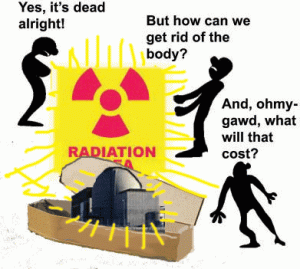
Dismantling of deactivated Fort Greely nuclear power plant to resume.
Alaska Public Media By Tim Ellis, KUAC – Fairbanks, August 25, 2023
The decommissioning of an old nuclear power plant at Fort Greely can move forward now that the federal agency overseeing the project has resolved a contract dispute that delayed work for more than a year.
Work on the final phase of decommissioning and dismantling the long-mothballed SM-1A heat and power plant has been on hold since late last year, when a company that was competing for the contract began filing protests over how the Army Corps of Engineers handled the bid proposals…………………………………………………………………………………………
Barber said the year-long, back-and-forth process of reviewing and re-evaluating the proposals means the completion date of the project also will be pushed back by a year.
“So we’re looking at 2029, at this point,” she said, adding that it’ll take a while for A3D to begin work on the facility……………..
The SM-1A’s highly enriched uranium dioxide fuel and most highly radioactive components of the facility were removed after it was shut down in 1972. Remaining materials have been entombed in concrete or safely stored onsite. Much of that will be removed as part of the contract with A3D……
Barber says when the the remaining work is completed, the SM-1A, like two other prototype military nuclear power plants developed during the Cold War, will finally all be decommissioned and dismantled. https://alaskapublic.org/2023/08/25/dismantling-of-deactivated-fort-greely-nuclear-power-plant-to-resume/
.
Concerned Citizens for Nuclear Safety Urges State Legislature to Protect the Española Aquifer from LANL Pollutants.
August 24th, 2023 http://nuclearactive.org/
Did you know that in 2008 the Environmental Protection Agency (EPA) designated the 3,000 square mile Española Basin System as a Sole Source Drinking Water Aquifer? https://www.epa.gov/dwssa One ongoing concern is that Los Alamos National Laboratory (LANL) sits on its western edge, near the Valles Caldera. And a recent dispute between the New Mexico Environment Department and the Department of Energy about the LANL hexavalent chromium plume, which is being pushed deeper into the regional drinking water aquifer, highlights the need for state agencies to have the resources to protect it. See Powerpoint presentations titled “DOE-Los Alamos Field Office (1)” and “NMED Hex Chrome Plume” under Item 1.
On Monday, August 21st CCNS requested that a New Mexico Legislative Committee provide funding to key state agencies to protect this aquifer from LANL pollutants, which are migrating through the aquifer to the Rio Grande and beyond. The request to the New Mexico Radioactive and Hazardous Materials Committee was for line items for the budgets of the Office of the State Engineer and New Mexico Environment Department. See CCNS presentation “Concerned Citizens for Nuclear Safety” under Item 1. https://www.nmlegis.gov/committee/Handouts_List?CommitteeCode=RHMC&Date=8/21/2023
An important history: In 2006, La Cienega Valley Citizens for Environmental Safeguards and geo-hydrologist Zane Spiegel submitted a petition to the Environmental Protection Agency (EPA) to designate the area as a sole source aquifer. They argued that the aquifer supplies at least 50 percent of the drinking water for its service area and there are no reasonably available alternative drinking water sources should the aquifer become contaminated. The aquifer encompasses the area between the Jemez and Sangre de Cristo Mountains, from Tres Piedras to the north almost to Galisteo to the south.
Then, in 2008, after EPA determined that 85% of the drinking water in the area covered by the petition comes from wells in the aquifer, EPA approved the application and designated the aquifer as a sole source drinking water aquifer. http://www.nuclearactive.org/news/011808.html
Nevertheless, LANL has been investigating the hexavalent chromium contamination for nearly 20 years. http://www.nuclearactive.org/audio/092706.mp3 and http://www.nuclearactive.org/news/122206.html
More recently, NMED became concerned that the hexavalent chromium was being pushed further and further into the regional drinking water and ordered that the injection process be stopped. See NMED Hex Chrome Plume Powerpoint under “Item 1” at https://www.nmlegis.gov/committee/Handouts_List?CommitteeCode=RHMC&Date=8/21/2023
The threat posed to the Española Basin Sole Source Aquifer by the hexavalent chromium contamination encouraged CCNS to ask for legislative oversight by providing funding to the Office of State Engineer and New Mexico Environment Department.
It is important to note that three of the Los Alamos County drinking water wells are located close to the known perimeter of the hexavalent chromium plume.
A full recording of the August 21, 2023 meeting of the Radioactive and Hazardous Materials Committee meeting is available here: https://sg001-harmony.sliq.net/00293/Harmony/en/PowerBrowser/PowerBrowserV2/20230824/-1/73647 The presentation by Joni Arends, Executive Director of CCNS begins at 10:06 AM.
Senate extends nuclear liability-limiting law without public scrutiny. Here’s why we should care.
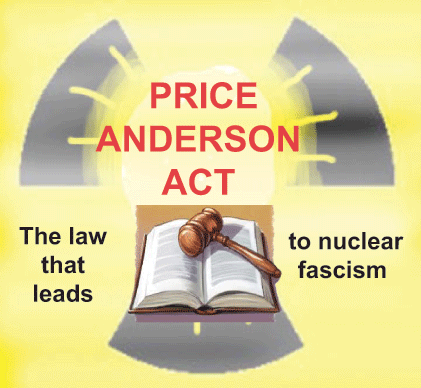
The chief problem with the Price-Anderson Act is the difference in how the law affects the public and the nuclear firms. In view of federal preemption of nuclear licensing, the public has essentially no say in the siting of a nuclear power plant and so must accept the associated accident risk. Nuclear vendors, however, are freed from all liability for offsite consequences of a nuclear accident, and so have nothing to worry about, either financially or legally.
Bulletin, By Victor Gilinsky | August 22, 2023
By Victor Gilinsky | August 22, 202
On the night of July 27, the US Senate passed the National Defense Authorization Act for fiscal year 2024. The Senate-approved bill included a 20-year extension of the Price-Anderson Nuclear Industries Indemnity Act, which provides that if there are any offsite lives and property lost in a severe reactor accident, nuclear industry manufacturers and builders cannot be held liable. The extension of the act also includes another controversial provision—the adequacy of funds provided by the act for compensating victims of a nuclear accident.
The approval last month of this extension came without any public hearings and was introduced in Congress in a rather troubling manner. The extension’s backers, knowing it would face rough sledding in an open hearing, first attached it to the Accelerating Deployment of Versatile, Advanced Nuclear for Clean Energy (ADVANCE) Act of 2023, which was then placed on the Senate legislative calendar on July 10 and added to the “must-pass” National Defense Authorization Act. While it has yet to pass the House, the act bears powerfully on the country’s commitment to nuclear energy, and especially on safety standards for nuclear power plants and therefore should not escape public scrutiny.
The Price-Anderson Act was first approved in 1957, soon after the Atomic Energy Act of 1954 permitted private nuclear energy activity. Firms like General Electric and Westinghouse, among others, told Congress they would not build commercial nuclear power plants—a technology with which there was essentially no experience—if they faced vast liability for possible accidents. To promote rapid investment in nuclear power plants, the government gave the builders and vendors freedom from liability for offsite accidents. It added provisions for public compensation after a catastrophic accident. But both provisions need updating in view of what we have learned in the last 60-odd years.
The act currently provides about $13 billion for post-accident public compensation, with the funds coming over time from a self-insurance scheme funded by the owners of nuclear power plants. But the estimated cost of the 2011 Fukushima accident—several hundred billion dollars—dwarfs the Price-Anderson amount. Yet, there is more. If an accident was to lead to widespread and long-term nuclear plant shutdowns, as occurred in Japan, it isn’t clear the owners would be able to meet their financial obligations. What’s clear is that after a severe nuclear accident, the issue of compensation would land in the lap of Congress.
At a 2014 Nuclear Regulatory Commission hearing on a safety upgrade for the 19 US plants essentially identical to the ones at Fukushima, the staff of the US Nuclear Regulatory Commission (NRC) told the commissioners that a fire in only one of the pools in which nuclear plants store highly radioactive used fuel could release much more radioactivity, conceivably 20 times more, than in the 2011 Fukushima accident. The commissioners at the time dismissed the concern on grounds that such an event was so improbable it failed the NRC’s cost-benefit analysis. But, however remote, the possibility remains.
The chief problem with the Price-Anderson Act is the difference in how the law affects the public and the nuclear firms. In view of federal preemption of nuclear licensing, the public has essentially no say in the siting of a nuclear power plant and so must accept the associated accident risk. Nuclear vendors, however, are freed from all liability for offsite consequences of a nuclear accident, and so have nothing to worry about, either financially or legally.
According to the NRC, calculations using “probabilistic risk assessment” serve as proof that the probability of severe nuclear accidents at US nuclear plants is extremely remote. But large nuclear vendors like General Electric and Westinghouse evidently don’t believe these numbers; otherwise, they would accept liability and would not fear risking their stockholders’ investment. If reactor builders won’t accept paying for the consequences of a possible nuclear accident, why then should members of the public, whose health and communities would be affected?……………………………………………………….
The current exuberance over “advanced” reactors” has some of the same boosterish markings as the earlier AEC episode, with the advocates so sure they are right that they think cutting corners is okay—like dispensing with public hearings on Price-Anderson Act extension.
The Price-Anderson Act extension is part of a larger program that would pull out the stops on granting generous subsidies to private nuclear firms, speeding approvals of nuclear license applications and promoting nuclear reactor exports—all supposedly in the interest of “reestablishing America’s preeminence as the global leader in nuclear energy in the 21st century.”
We need to stop and think as a society before it’s too late. Rather than a hastily and quietly passed 20-year extension, we need first a thorough public examination of the Price-Anderson Act’s fundamental provisions and their effect on nuclear reactor safety and licensing standards. https://thebulletin.org/2023/08/senate-extends-nuclear-liability-limiting-law-without-public-scrutiny-heres-why-we-should-care/?utm_source=Newsletter&utm_medium=Email&utm_campaign=ThursdayNewsletter08242023&utm_content=NuclearRisk_NuclearLiabilityLimiting_08222023
Neocon Dark Money Front Launches Desperate Ad Blitz, as Support for Ukraine Forever War Craters
By Alexander Rubinstein / The Grayzone 23 Aug 23
Defending Democracy Together, a neoconservative outfit led by career chickenhawk scribe Bill Kristol, has launched a new initiative called “Republicans for Ukraine” to transform the 2024 presidential election into a referendum on US funding for the NATO proxy war.
Urging Republicans in Congress to support more funding for Ukraine in the upcoming appropriations bill is also a key item on the agenda…………………………………………………….
Now, as the Ukrainian counteroffensive fails and a majority of Americans declare opposition for the first time to sending more military aid to Ukraine, Kristol is launching a multimillion dollar ad blitz to keep the tanks slogging through the Donbas mud and the dark money flowing into his bank accounts. https://scheerpost.com/2023/08/23/neocon-dark-money-front-launches-desperate-ad-blitz-as-support-for-ukraine-forever-war-craters/
Most ‘experts’ pushing for endless conflict in Ukraine share a common benefactor.

the top 50 think tanks received over a billion dollars from the US government and its defense contractors and manufacturers, including some of the biggest beneficiaries of weapons production today ‘for Ukraine’. The top recipients of this funding include the Atlantic Council, German Marshall Fund of the United States, Brookings Institution, Heritage Foundation, Center for Strategic and International Studies, New America Foundation, RAND Corporation, Center for a New American Security, Council on Foreign Relations, and the Stimson Center.
A whopping 85% of media quotes on US military involvement come from someone paid by the defense industry
rachelmarsden.com 20 Aug 23
Experts with important-sounding titles linked to academic-sounding entities have been shaping hearts and minds in the press, both at home and abroad, in favor of endless conflict in Ukraine. Guess what deep-pocketed benefactor lurks beneath the surface?
During the Iraq War, the Pentagon backed retired generals to make the rounds of TV and radio shows as ‘military analysts’ to promote the Bush administration’s agenda in the Persian Gulf. It was like inviting Ronald McDonald on a program to debate and discuss the merit of Big Macs. You could almost see the strings attached to the puppets, linked to the military-industrial complex that benefited from war without an off-ramp.
Fast forward 20 years, and the sales tactics have drastically changed. The generals have been replaced by various experts with academic credentials, typically linked to one or more ‘think tanks’. Far from the neutral academic centers of intellectual integrity that the names suggest, these entities are little more than laundromats for discreet special interests. I should know – I used to be a director of one.
Every Wednesday, some of the highest-ranking figures of the Bush administration would come to our Washington, DC office to deliver their main agenda points for the week, requesting assistance in placing and promoting them to both grassroots activists sympathetic to the cause and to the general public. The experts within the think tank were hired based on political litmus tests, no doubt to ensure that their views aligned with the organization’s. When they no longer do, you’re either fired or you leave.
The donors, many of whom were well-known millionaires and billionaires driven by a passion for certain issues, would come straight out and ask for bang for their buck in exchange for the opening of their wallets. In some cases, an entire project or department would be mounted at the think tank with the understanding that it would be fully funded by a single donor. These rich, influential folks typically had business or investment interests that benefited from shaping the establishment narrative in their favor, and they wanted to do so without leaving any footprints. What better way than to have it all fronted by a shiny veneer of expert credibility?
So while the generals of the Iraq War era had all the subtlety of a sledgehammer in representing the interests of the military-industrial complex, the new salesmen of endless armed conflict in Ukraine have overwhelmingly adopted the more subtle model. A study published in 2020 found that the top 50 think tanks received over a billion dollars from the US government and its defense contractors and manufacturers, including some of the biggest beneficiaries of weapons production today ‘for Ukraine’. The top recipients of this funding include the Atlantic Council, German Marshall Fund of the United States, Brookings Institution, Heritage Foundation, Center for Strategic and International Studies, New America Foundation, RAND Corporation, Center for a New American Security, Council on Foreign Relations, and the Stimson Center.
Some of these black boxes are more ideologically-driven than others. The Heritage Foundation, for example, leans overwhelmingly neoconservative and interventionist. Others, like the Atlantic Council and German Marshall Fund, are effectively force multipliers for NATO talking points. But the RAND Corporation also houses systems analysts and scientists specializing in space and computing. The fact that not all of these entities – or even the people who work within some of them – can be tossed into the same basket and labeled mere parrots for the special interests of their organization’s benefactors helps to muddy the waters.
In an analysis published in June of media coverage related to US military involvement in Ukraine, the Quincy Institute for Responsible Statecraft found that, when a think tank is cited regarding the issue, 85% of the time it’s a think tank with “financial backing from the defense industry.” Taken at face value, this risks being interpreted by the general public as expert ‘consensus’ on the need for US taxpayers to continue flooding Ukraine with weapons, unaware that it’s really just a bunch of Pentagon-backed actors agreeing with each other about the need to pursue the most profitable course of action on behalf of their War Inc. sugar daddies. Just like when climate scientists, who have parlayed climate change into endless funding and a perpetual justification for their existence, aren’t going to kill their cash cow by arguing that the climate can’t be controlled by man and that throwing cash at the issue – or at them – is futile.
Many of the Ukraine think tank experts are quick to attack analysis and information published on platforms they don’t like – such as RT – as ‘Russian-backed’. You’d have to be living under a rock these days to not know that RT is linked to Russia. No transparency issues there.
But there is far less transparency around their own organizations’ financing. Where is their insistence on being above board about the use of defense industry cash to influence not just the general public but the course of the conflict itself? Around a third of top foreign policy think tanks don’t disclose this Pentagon funding, according to the Quincy Institute. Nor is it unheard of for these experts to springboard from these establishment-friendly platforms and the public notoriety they provide, right into public office – where they can translate the same agenda that they promoted into actionable policy. Isn’t it important for voters to consider the powerful hidden hand who helped to get them there?
1 This Month

of the week – Shut Down Drone Warfare!


Tell the Ukrainian Government to Drop Prosecution of Peace Activist Yurii Sheliazhenko

Petition to revoke the licensing of the Near Surface Nuclear Disposal Facility (NSDF) at Chalk River. https://www.ourcommons.ca/petitions/en/Petition/Details?Petition=e-7247
To see nuclear-related stories in greater depth and intensity – go to https://nuclearinformation.wordpress.com
-
Archives
- April 2026 (91)
- March 2026 (251)
- February 2026 (268)
- January 2026 (308)
- December 2025 (358)
- November 2025 (359)
- October 2025 (376)
- September 2025 (257)
- August 2025 (319)
- July 2025 (230)
- June 2025 (348)
- May 2025 (261)
-
Categories
- 1
- 1 NUCLEAR ISSUES
- business and costs
- climate change
- culture and arts
- ENERGY
- environment
- health
- history
- indigenous issues
- Legal
- marketing of nuclear
- media
- opposition to nuclear
- PERSONAL STORIES
- politics
- politics international
- Religion and ethics
- safety
- secrets,lies and civil liberties
- spinbuster
- technology
- Uranium
- wastes
- weapons and war
- Women
- 2 WORLD
- ACTION
- AFRICA
- Atrocities
- AUSTRALIA
- Christina's notes
- Christina's themes
- culture and arts
- Events
- Fuk 2022
- Fuk 2023
- Fukushima 2017
- Fukushima 2018
- fukushima 2019
- Fukushima 2020
- Fukushima 2021
- general
- global warming
- Humour (God we need it)
- Nuclear
- RARE EARTHS
- Reference
- resources – print
- Resources -audiovicual
- Weekly Newsletter
- World
- World Nuclear
- YouTube
-
RSS
Entries RSS
Comments RSS
 nuclear-news