USA can’t get investors for Small Nuclear Reactors: no problem – flog them off to Ghana!
U.S. Announces New Support for Ghana’s Civil Nuclear Energy Program under the FIRST Capacity Building Program
US Embassy in Ghana 16 Sept 23

Accra, Ghana – U.S. Principal Deputy Assistant Secretary of State for International Security and Nonproliferation Ann Ganzer joined Ghanaian counterparts today to announce further U.S. support for establishing Ghana as a Small Modular Nuclear Reactor (SMR) Regional Training Hub and center of excellence for the sub-Saharan African region……………………………………………………………………………………….
Pentagon’s new plan to counter China includes swarms of smart satellites

Deputy Secretary Kathleen Hicks: DoD wants to “leverage platforms that are small, smart, cheap, and many”
Space News, Sandra Erwin, September 6, 2023
ARLINGTON, Va. — Under a new strategy to counter China’s military buildup, the Pentagon is advocating the use of low-cost autonomous platforms that can be mass produced and deployed at sea, on land, in the air and in space.
“This is about driving culture change just as much as technology change — so we can gain military advantage faster,” Deputy Defense Secretary Kathleen Hicks, said Sept. 6 at the DefenseNews annual conference.
Hicks discussed DoD’s plan to field thousands of autonomous systems across all domains within the next 18 to 24 months. China’s advantage is “mass,” said Hicks. DoD will continue to invest in its traditional platforms but will counter with “mass of our own,” or large numbers of autonomous systems.
DoD would field fleets of tiny drones and swarms of satellites that would be inexpensive to replace.
“Imagine constellations of autonomous, attritable systems on orbit, flung into space scores at a time, numbering so many that it becomes impossible to eliminate or degrade them all,” she said.
The strategy is to “leverage platforms that are small, smart, cheap, and many,” Hicks said. …………………………………………………….
The U.S. military’s Space Development Agency is building a government-owned proliferated constellation. DoD is also a major customer of Starlink, SpaceX’s massive internet in space. ……………….. https://spacenews.com/pentagons-new-plan-to-counter-china-includes-swarms-of-smart-satellites/?utm_medium=email
US incapable of negotiating – Russian diplomat
Rt.com 12 Sept 23
Strategic dialogue with Washington has done nothing for Moscow’s national security, Aleksandr Kramarenko claims
No amount of negotiating with the US has been able to bring about meaningful results, as Washington has repeatedly broken the trust of its partners and refused to respect agreements, acting solely in its own interests, Russian diplomat Aleksandr Kramarenko has said.
In an article for International Affairs published last week, Kramarenko, the director of the Russian Foreign Ministry Institute of Current International Problems, said that despite decades of trying to maintain strategic dialogue with the US, Russia has ultimately been unable to achieve any results in ensuring its national security, and neither has China.
He added that trust between Moscow and Washington was undermined long ago. In 2011, Russia allowed the passing of what seemed to be a humanitarian UN resolution on Libya, which was then used by the West to lay ruin the country.
In 2015, Russia was deceived by the Minsk agreements, which were meant to resolve the internal conflict in Ukraine, but instead were used to buy time to build up Kiev’s army with the goal of inflicting a military or strategic defeat on Russia.
“What kind of trust can we talk about here? Where is the principle of pacta sunt servanda [contracts must be respected]? And what then is the meaning of contracts when everything happens regardless and in spite of any contracts? Apparently, it turns out that Washington is simply unable to negotiate,” Kramarenko wrote, noting that Russia is not the only country to come to this conclusion.

Commenting on the conflict in Ukraine, he recalled the words of US National Security Advisor Jake Sullivan (above)at the recent Aspen Security Forum, who said that the US and its allies are willing to “take risks” with their arms supplies to Kiev. What Sullivan meant, according to Kramarenko, was that Washington is willing to risk nuclear escalation, and that it is willing to do so because the principle of nuclear deterrence does not work for Russia.
“This means we need to think about how to restore trust in it.”
Kramarenko went on to suggest that all the arms control systems that have been destroyed by the US in attempts to maintain strict control over other nations while remaining ambiguous with regards to its own nuclear potential, could soon be replaced by a new process based on a multipolar world. ………. https://www.rt.com/russia/582797-us-incapable-of-negotiating/
With long-range missiles for Ukraine, US crosses own red line
The US will reportedly send ATACMS to Ukraine — yet another advanced weapons system that the White House had previously ruled out.
Substack AARON MATÉ, SEP 12, 2023
The Biden administration is reportedly close to authorizing yet another weapons system for Ukraine that it had previously ruled out. According to ABC News and the Financial Times, the US will send Army Tactical Missile Systems, or ATACMS, a high priority for Kiev and its most hawkish backers. The long-range missiles, which travel up to 190 miles, would bolster Ukraine’s capacity to hit Crimea and possibly mainland Russia.
The White House previously invoked that very capability to rule out the ATACMS as too dangerous an escalation. As National Security Advisor Jake Sullivan explained in June 2022, President Biden was “not prepared to provide” long-range missiles, given the “key goal” of avoiding “the road towards a third world war.”
Just over one year later, the road towards a third world war is no longer closed…………………….. (subscribers only) more https://mate.substack.com/p/with-long-range-missiles-for-ukraine?utm_source=post-email-title&publication_id=100118&post_id=136923393&utm_campaign=email-post-title&isFreemail=true&r=ln98x&utm_medium=email
If The US Really Were What It Pretends To Be

CAITLIN JOHNSTONE, SEP 12, 2023 https://www.caitlinjohnst.one/p/if-the-us-really-was-what-it-pretends?utm_source=post-email-title&publication_id=82124&post_id=136958632&utm_campaign=email-post-title&isFreemail=true&r=1ise1&utm_medium=email
It’s wild to consider how many of the world’s problems would not exist if the US really was the thing it advertises itself as.
Ukraine would not be at war right now, because the US empire would not have provoked that war, since the US really would be an upholder of peace and international order.
The world would not be staring down the barrel of nuclear armageddon, because the US really would be a normal country that respects the sovereignty of other nations instead of the hub of a globe-spanning undeclared empire which keeps ramping up aggression against nuclear-armed states who refuse to consent to its planetary rule.
China would not be preparing for war, because the US military really would be used for the defense of the United States instead of rapidly encircling the US empire’s top geopolitical rival with massive amounts of war machinery.
The middle east would not have spent the 21st century being ripped to pieces by western aggression, because the US really would care about the lives of the people who live there and not just pretend to in order to promote regime change interventionism.
Mountains of human corpses would not have been amassed in Yemen by violence, starvation and disease, because the US really would oppose tyrannical dictatorships like Saudi Arabia instead of enthusiastically facilitating their war crimes.
The information ecosystem of the western world would not be strangled by empire propaganda, internet censorship and Silicon Valley algorithm manipulation, because the US really would value free speech and free thought instead of churning out a continual barrage of mass-scale psychological operations designed to dominate the way people think, speak, work, act and vote.
Julian Assange would not be languishing in prison, because the US really would support press freedoms instead of working to set a legal precedent normalizing the persecution of journalists for reporting inconvenient facts.
The people of the United States would not be floundering in poverty and broken infrastructure, because they really would live in a democracy that allows them to influence government policy instead of an oligarchy rigged to benefit the rich and powerful at the expense of normal human beings.
The US would not be a tyrannical police state with the largest incarceration rate on the planet, because the US government really would care about civil rights and liberty instead of only caring about the profits that can be harvested via prison slavery and private prisons from those citizens who don’t make good cogs in the capitalist machine.
Developing nations would be thriving a lot more, because the US really would support their national sovereignty and independence instead of doing whatever’s necessary to facilitate the imperialist extraction of their wealth.
Human civilization would be far more just and equitable than it currently is, because the US really would value every nation’s right to forge its own path, and therefore would not have spent generations aggressively stomping out every attempt to move toward socialism everywhere in the world.
The planet would not be circled by hundreds of foreign US military bases and continually terrorized by US wars of aggression, proxy conflicts, CIA coups and starvation sanctions, because all the US government secrecy which makes this malfeasance possible wouldn’t exist, since the US really would value truth and transparency instead of power and domination.
The world would be a much more healthy and harmonious place if the US really was the peace-loving, tyranny-opposing democracy that it and all its propaganda systems frame it as. But because the US government is actually the most tyrannical regime on earth and values nothing apart from its own ability to dominate as many members of the human species as possible, we live in a world of far greater peril and abuse than we otherwise would.
I write so much about the US empire because that’s just what you find yourself doing when you set out to describe the problems of our world with an open mind; trace those problems back to their origins, and many of them revolve around this strange and profoundly abusive power structure which manages to evade much criticism and scrutiny because it has the most sophisticated soft power narrative control systems ever devised.
The US empire depends on keeping the world asleep to its abusiveness. And the world depends on everyone waking up to it.
“A Good Investment”: The Ukraine War and the US Arms Racket
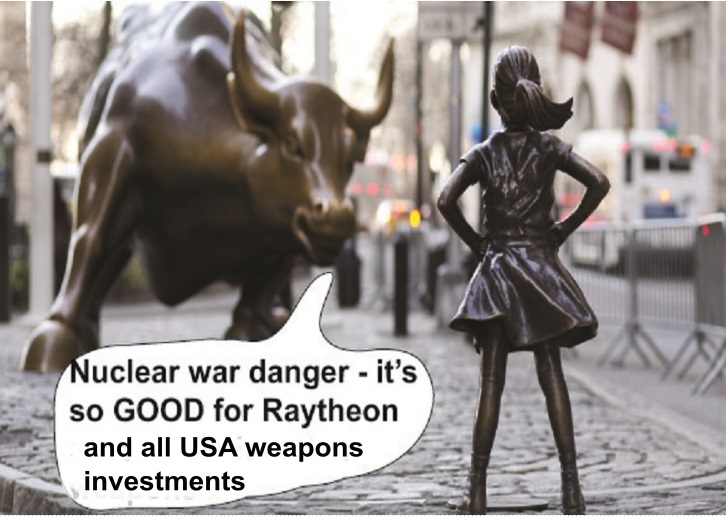
“from numerous perspectives, when viewed from a bang-per-buck perspective, US and Western support for Ukraine is an incredibly cost-effective investment.”
the US arms industry is the “one clear winner” in this bloody tangle.
September 9, 2023 by: Dr Binoy Kampmark https://theaimn.com/a-good-investment-the-ukraine-war-and-the-us-arms-racket/
It all tallies. War, investments and returns. The dividends, solid, though the effort expended – at least by others – awful and bloody. While a certain narrative in US politics continues in the vein of traditional cant and hustling ceremony regarding the Ukraine War – “noble freedom fighters, we salute you!” twinned with “Russian aggressors will be defeated” – there are the inadvertently honest ones let things slip. A subsidised war pays, especially when it is fought by others.
The latter narrative has been something of a retort, an attempt to deter a growing wobbling sentiment in the US about continuing support for Ukraine. In a Brookings study published in April, evidence of wearying was detected. “A plurality of Americans, 46%, said the United States should stay the course in supporting Ukraine for only one to two years, compared with 38% who said the United States should stay the course for as long as it takes.”
In early August, a CNN survey found that 51% of respondents believed that Washington had done enough to halt Russian military aggression in Ukraine, with 45% approving of additional funding to the war effort. A breakdown of the figures on ideological grounds revealed that additional funding is supported by 69% of liberals, 44% of moderates and 31% of conservatives. In Congress, opposition to greater, ongoing spending is growing among the Republicans, reflecting increasing concern among GOP voters that too much is being done to prop up Kyiv.
Such a mood has been anticipated by number crunching types keen to reduce human life to an adjustable unit on a spreadsheet. The Centre for European Policy Analysis, for example, suggested that a “cost-benefit analysis” would be useful regarding US support for Ukraine. “Its producing wins at almost every level,” came the confident assessment. In spectacularly vulgar language, the centre notes that, “from numerous perspectives, when viewed from a bang-per-buck perspective, US and Western support for Ukraine is an incredibly cost-effective investment.”
War-intoxicated Democrats would do well to remind their Republican colleagues about such wins, notably to those great patriots known as the US Arms Industry. Aid packages to Ukraine, while dressed up as noble, democratic efforts to ameliorate a suffering country’s position vis-à-vis Russia, are much more than that.
In May 2022, for instance, President Joe Biden signed a bill providing Kyiv $40.1 billion in emergency funding, split between $24.6 for military programs, and $15.5 billion for non-military objects. Even then, it was clear that one group would prove the greatest beneficiary. Stephen Semler of the Security Policy Reform Institute was unequivocal: US military contractors.
Of the package, rich rewards amounting to $17.3 billion would flow to such contractors, comprising goods, be they in terms of weapons and equipment, or services in the form of training, logistics and intelligence. “It allows the Biden administration,” writes Semler, “to continue escalating the United States’ military involvement in the war as the administration appears increasingly disinterested in bringing it to an end through diplomacy.”
Broadly speaking, the US military-industrial complex continues to gorge and merely getting larger. Whatever the outcome of this war – talk of absolute victory or defeat being the stuff of dangerous fantasy – it remains the true beneficiary, the sole victor fed by new markets and opportunities. Former Israeli foreign minister Shlomo Ben-Ami, now vice president of the Toledo Center for Peace, had to concede that the US arms industry was the “one clear winner” in this bloody tangle.
The addition of new member states to NATO, in this case Finland and Sweden, will, Ben Ami suggests, “open up a big new market for US defence contractors, because the alliance’s interoperability rule would bind them to American-made defence systems.” The evidence is already there, with Finland’s order of 64 new F-35 strike fighters developed by Lockheed Martin, Northrop Grumman and BAE Systems. The Ukraine War has been nothing short of lucrative in that regard.
Such expansion also comes with another benefit. The interoperability requirement in the NATO scheme acts as a bar to any alternatives. “The market for their goods is expanding,” writes Jon Markman for Forbes, “and they will face no competition for the foreseeable future.”
It should come as little surprise that the US defence contractors have been banging the drum for NATO enlargement from the late 1990s on. While a good number of those in the US diplomatic stable feared the consequences of an aggressive membership drive, those in the business of making and selling arms would have none of it. The end of the Cold War necessitated a search for new horizons in selling instruments of death. And with each new NATO member – Hungary, Poland, the Czech Republic – the contracts came. Washington and the defence contractors, twinned with purpose, pursued the agenda with gusto.
In 1997, Democratic Senator Tom Harkin was awake to that fact in hearings of the Senate Appropriations Committee on the cost of NATO enlargement. He was particularly concerned by a fatuous remark by Secretary of State Madeleine Albright comparing NATO’s expansion with the economic Marshall plan implemented in the aftermath of the Second World War. “My fear is that NATO expansion will not be a Marshall plan to bring stability and democracy to the newly freed European nations but, rather, a Marshall plan for defense contractors who are chomping [sic] at the bit to sell weapons and make profits.”
The moral here from the US military-industrial complex is: stay the course. The returns are worth it. And in such a calculus, concepts such as freedom and democracy can be commodified and budgeted. As for Ukrainian suffering? Well, let it continue.
Are They Already Cutting Corners on Worker Protection at DOE’s New Plutonium Processing Plant?

plutonium is toxic at the scale of micrograms, deadly at the scale of milligrams, and useable in nuclear weapons of mass destruction at the scale of kilograms. This is why plutonium work requires rigid, intensive safety systems, referred to as “defense in depth,” to protect workers and the surrounding people and landscape; as well as extreme levels of security and material accounting.
CounterPunch, BY DON MONIAK 11 Sept 23
As of this past Labor Day, there are strong indications that future workers at the planned, new Savannah River Plutonium Processing Plant (SRPPF) may face unnecessary, increased risks of exposure to radiological hazards inherent in plutonium toxicity and chemical complexity.
According to an August 3, 2023 letter from the Defense National Facilities Safety Board (DNFSB) to the Department of Energy’s (DOE) National Nuclear Security Agency (NNSA), the SRPPF project leadership team does not consider vital plutonium processing safety equipment as “safety significant controls.”
According to the letter, NNSA’s project leadership team believes a reliance on worker sense of sight, hearing, taste, smell, and touch is sufficient to detect and/or prevent accidents such as plutonium fires and dispersal of plutonium oxide powder.
In the hierarchy of nuclear safety, the Department of Energy standards place “Safety Significant Controls” above administrative controls that are reliant upon the absence of human error.
The motive for SRPPF project team’s preference for administrative controls is unknown.
The New Plutonium Processing Plant.
The plutonium/MOX (Pu/MOX) fuel facility was a massive, multi-billion dollar endeavor designed to help dispose of dozens of tons of surplus nuclear weapons plutonium (Pu). This Savannah River Site(SRS) project was abandoned in the late 2010’s, following a chronic array of technical issues, mismanagement, major cost overruns, cutting of corners, and the lack of commercial Pu/MOX fuel customers.
After the project was abandoned, the Department of Energy’s (DOE) National Nuclear Security Agency (NNSA) decided to repurpose the unfinished facility into a new “plutonium pit”production plant. The Mixed Oxide Fuel Fabrication Facility (MFFF) was then renamed the Savannah River Plutonium Processing Plant (SRPPF). This $11 billion plus repurposed facility is already burdened by cost overruns—-the original estimate was $3.7 billion.
Plutonium pits are referred to as the primary nuclear explosives, or triggers,” (1) that dominate the known U.S. nuclear weapons arsenal. Pits acquired their quaint nickname by virtue of the resemblance of the configuration of high explosives surrounding the primary nuclear explosive to stone fruit like peaches and plums—an example of early nuclear weaponeers’ inside humor.
The Pu pits are pressure vessels with nested shells of material, comprised of other non-nuclear parts, including the metal cladding, welds, a pit tube, neutron tamper(s) and initiator, as well as the usually hollow-cored plutonium hemispheres. In most pit designs, a sealed pit tube carries deuterium-tritium gas into the hollow-core to boost the nuclear explosive power of weapons.
But unlike the sweet, fruity, and and delectable flesh surrounding plum and peach pits, a Pu pit is surrounded by a high explosives package powerful enough to implode the plutonium metal sphere contained in the pit. This is not like compressing a tin can, as plutonium is the most durable of the transuranic heavy metals.
The current plan is to annually produce at least eighty new plutonium pits in the SRPPF. Pit fabrication was once the exclusive task at the long-closed Rocky Flats plant in Colorado, and the work processes constitute the most dirty—in terms of waste production—and dangerous workplace in the national nuclear weapons complex. In this century, Los Alamos National Laboratory (LANL) has failed miserably to reconstitute a tiny fraction of the Rocky Flats pit production rate.
Pit production is unlikely to be the only task at the SRPPF. An estimated ten to twelve-thousand surplus plutonium pits, containing a sum of 30 to 34-metric tonnes of plutonium, could also be processed at a plutonium pit disassembly and conversion line at the SRPPF. The resulting plutonium oxide powder would then be sent to the SRS K-Area’s Pu waste production facility, where the powder is diluted to a three to five percent level within a larger mixture of inert materials………………………….
Some Plutonium Processing Hazards
There is a negligible level of debate that plutonium is toxic at the scale of micrograms, deadly at the scale of milligrams, and useable in nuclear weapons of mass destruction at the scale of kilograms. This is why plutonium work requires rigid, intensive safety systems, referred to as “defense in depth,” to protect workers and the surrounding people and landscape; as well as extreme levels of security and material accounting.
The most hazardous plutonium operations involve plutonium pit fabrication. After pit disassembly, the plutonium within pits is converted to a finely dispersed powder form (2), made up of sticky grains containing energetic alpha particles that easily damage soft lung tissues. Sticky plutonium oxide particles clinging to ductwork can also hinder ventilation systems over time.
Recycling plutonium for pit production then requires difficult and dangerous processes to remove impurities and undesirable decay products such as intensely radioactive Americium-241. (3) The resulting plutonium form is transferred to the next step, the plutonium foundry.
The foundry work involves a complex ten-step process, summarized as melting, casting, and heat treating of plutonium metal. Gallium is added at a one-percent ratio to produce an alloy that is considered almost as easy to machine as aluminum or silver. The risk from explosion, criticality, and spill hazards must be rigidly controlled; while contaminated parts such as crucibles pose unique waste management measures.
The final plutonium processing step is machining the foundry product into a precise sub-critical configuration. Like any machining, Plutonium metal work casts tiny shavings and creates fine dust.
These shavings can ignite upon exposure to air and lead to larger fires that can destroy glove boxes and ventilation systems, and cause large releases of plutonium into the atmosphere. The Rocky Flats experience suggests that fires of any size are not a remote possibility, they are a probability.
The task is to keep Pu metal fires small and nondestructive, while preventing injury and harmful exposures to workers. A small fire can render costly equipment useless. A large fire can lead to a countryside contaminated with particles that become more intensely radioactive for decades.
Extreme care must also be taken to keep plutonium metal in a non-critical configuration at all times. The wrong geometry or placement of metal pieces in the wrong configuration can produce the deadly blue light that signifies criticality accidents. In 2009, a number of Los Alamos criticality engineers walked off the job at the lab’s pit production line, citing a casual approach to criticality safety.
The final step is assembly, where the parts that make pits tick are introduced. The making of these parts pose their own toxic hazards, such as the fine dust from machining beryllium metal.
Those are just several aspects of the safety issues involved with the plutonium pit fabrication.
The True, and False, Necessity for New Pit Fabrication and Production. ……………………………………………………………………………………………………………………………………………………………………………….
The Pit Plant’s Initial Design: One Less Layer of Safety Depth?
Because of all these factors, new pit production is considered essential, and a new, smaller scale—by Cold War Standards—plutonium pit fabrication capacity is presently in the preliminary design phase at the SRPPF complex.
The highest standards of safety are expected to prevent accidents or mitigate the impacts of spills, fires, leaks, and dispersion of fine radioactive dust. A less rigid approach to safety is quite unexpected for a high hazard, hardened nuclear facility that would only be the second its kind in the weapons complex—-the last being the Rocky Flats plant built in the 1950’s.
But according to the August 3, 2023 letter from the Defense Nuclear Facilities Safety Board (DNFSB), the DOE/NNSA’s project leadership team does not consider vital plutonium processing safety equipment as “safety significant controls.”…………………………………………………………………………………………………………………………………………………………………………………………….more https://www.counterpunch.org/2023/09/11/are-they-already-cutting-corners-on-worker-protection-at-does-new-plutonium-processing-plant/
Oregon hasn’t said never to nuclear power, but it should

BY LLOYD K. MARBET, Sep 10, 2023 https://www.bendbulletin.com/opinion/guest-column-oregon-hasnt-said-never-to-nuclear-power-but-it-should/article_5f0b13ec-4e93-11ee-873b-6fbd0628540c.html
Recently, editorials have appeared across Oregon in a number of newspapers. They are remarkably similar, and subtly deceptive in their content, as if the Nuclear Pied Piper is once again in town, playing new music for a great revival if only you will follow the Pied Piper down its unforseen road once again.
Have we resolved the problems of the nuclear fuel cycle? NO! A complicated cycle consisting of: — availability of uranium, mining, milling, enrichment, and fuel fabrication — construction of nuclear power plants with its delays and tremendous cost overruns — uncertain safety of nuclear plant operations with government limited liability leaving taxpayers holding the bag — targets of war, terrorism and natural disasters — radiation releases difficult to detect, and health effects difficult to prove, with ongoing disputes over the number of deaths — radioactive wastes throughout the fuel cycle demanding permanent disposal, up to thousands of years for high level radioactive waste — and decommissioning of an elaborate contaminated nuclear infrastructure. The problems of the nuclear fuel cycle are not resolved, nor fully accounted for!
Nuclear energy is not “zero emissions.” Oregon law measures carbon emissions at only one point in its fuel cycle: at the generation of electricity. The nuclear fuel cycle is an ongoing tragedy visiting its impacts on generations to come. Commercial “Small Modular Nuclear Reactors” are unproven designs on paper. If we are going to save ourselves from Climate Annihilation the time for honest accountability has come. Read Mark Jacobson’s book “No Miracles Needed: How Today’s Technology Can Save Our Climate and Clean Our Air.”
Oregon’s ballot measure and legislative referral process is a valuable educational tool for enlightening the electorate on important issues. It is also the reason why I strongly support preserving the ballot measure law passed by Oregon voters in 1980 and not repealing this hard-fought effort, that has protected Oregonians for 43 years by requiring the commercial nuclear power industry to have a “terminal” repository for its high level radioactive waste before producing any more. This law doesn’t say never to nuclear power.
Secondly, and most important, it provides, by referral to all Oregon voters, the right to make the final decision on whether proposed commercial nuclear power plants are needed, cost effective, and can safely operate in our state! The Bulletin’s editorial provides an incorrect history of the 1980 and 1986 ballot measures. The 1986 ballot measure on nuclear power was not passed into law!
Why are nuclear proponents seeking another vote on the 1980 law? Especially when repealing what gives Oregonians an ongoing vote on whether the nuclear industry has successfully met its obligation to provide a viable cost effective energy resource, capable of terminally disposing its high level nuclear wastes.
In the last Oregon legislative session, a hearing was held on one of the two identical bills that sought to re-refer the 1980, not the failed 1986, ballot measure to another vote. Both 2023 bills “fizzled out” after a House Committee heard testimony in favor of them and overwhelming testimony in opposition! Especially of note is testimony provided by Dirk Dunning, formerly of the Oregon Department of Energy, and Tami Thatcher, formerly of the Idaho National Laboratory. All testimony is available to read online at: tinyurl.com/Testimonyonnukes.
If Everyone Understood That The US Deliberately Provoked This War
CAITLIN JOHNSTONE, SEP 7, 2023 https://www.caitlinjohnst.one/p/if-everyone-understood-that-the-us?utm_source=post-email-title&publication_id=82124&post_id=136816741&isFreemail=true&r=1ise1&utm_medium=email
War is the single worst thing humans do. The most insane. The most cruel. The most destructive. The most traumatic. The least sustainable. Those who knowingly choose to steer humanity into more war when it could be avoided are the worst people in the world, without exception.
And there are mountains of extensively documented evidence that that’s exactly what the drivers of the US-centralized empire did in Ukraine. That’s why so many western analysts and experts spent years warning that the actions of western powers were going to lead Ukraine into disaster, and it’s why US empire managers keep openly boasting about how much their proxy warfare in Ukraine advances US interests. They knowingly steered Ukraine into war to advance their own geostrategic interests while being fully aware that no powerful nation would ever permit the kinds of foreign threats the west was amassing on its borders, and then they intervened in the early days of the war to prevent the outbreak of peace.
If there was widespread awareness of these facts, the US war machine would lose support around the world — not just for its actions in this one war, but for all future wars as well. Which is why so much energy goes into making sure this does not become a widespread understanding.
The official mainstream narrative throughout the western world is that Putin invaded Ukraine solely because he is evil and hates freedom. That’s the actual, literal belief about this war that the western political/media class works to instill in the western public. Anyone who counters this self-evidently ridiculous assessment with facts and evidence gets branded a Russian agent and swarmed with pro-US trolls on social media, and loses all hope of securing a major platform in any mass media.
And it’s important to notice that shutting down all mature adult analysis of the events which led to the war in this way does not actually save a single Ukrainian life. It doesn’t make Russia any more likely to stop fighting and withdraw its troops. All it does is prevent people from seeing the US empire for what it really is. It isn’t being done to protect Ukrainians, it’s done to protect the empire.
The worst thing that could possibly happen to the information interests of the US empire would be for a critical mass of people to become aware that all this death and destruction in Ukraine could have been avoided by the US-centralized empire behaving less aggressively on Russia’s doorstep, and that those aggressions were instead increased with the goal of advancing US strategic interests on the world stage. If everyone really, deeply understood that all this suffering, all these mountains of human corpses could simply not have happened if the US hadn’t been feverishly focused on securing planetary domination at all cost, the US would no longer be able to manufacture consent for its agendas. It would no longer be able to whip up international support for its actions against its enemies. It would no longer be able to persuade the world to help prop up the hegemony of the dollar.
But because the US empire has the most advanced soft power apparatus that has ever existed, hardly anyone understands this. Not even the people who understand that the west provoked this war have deeply grappled with exactly what that means on a visceral emotional level, for the most part. It’s more of a superficial intellectual understanding for most, without really grokking into the horror of it all, really letting the enraging nature of what the US empire did wash over them.
The west was deceived into supporting yet another evil American war, this time with the added dimension of nuclear brinkmanship threatening the life of every terrestrial organism. All to suck Moscow into another draining military quagmire so war plans can be safely drawn up against China while advancing US energy interests in Europe and building support for US military alliances. It’s almost too evil to take in. There aren’t really words for it.
And that’s one of the reasons it’s hard to get people to take in exactly what happened with Ukraine: people have a hard time wrapping their minds around the idea that anyone could be that evil, much less the government we’ve been trained by Hollywood to think of as sane and humanitarian.
It’s about as monstrous a thing as you could possibly come up with. Yet here it is, still unfolding in all its blood-spattered glory.
Our task then is to help people see this and understand it, not just intellectually but emotionally. Help people really grasp deep down the horrors the US empire unleashed upon our world with the war in Ukraine; the suffering; the death; the existential danger. We can’t fight the empire on our own, but we can each do what we can to help weaken the consent manufacturing machine it uses to rule and terrorize the world.
The West’s blueprint for goading China was laid out in Ukraine
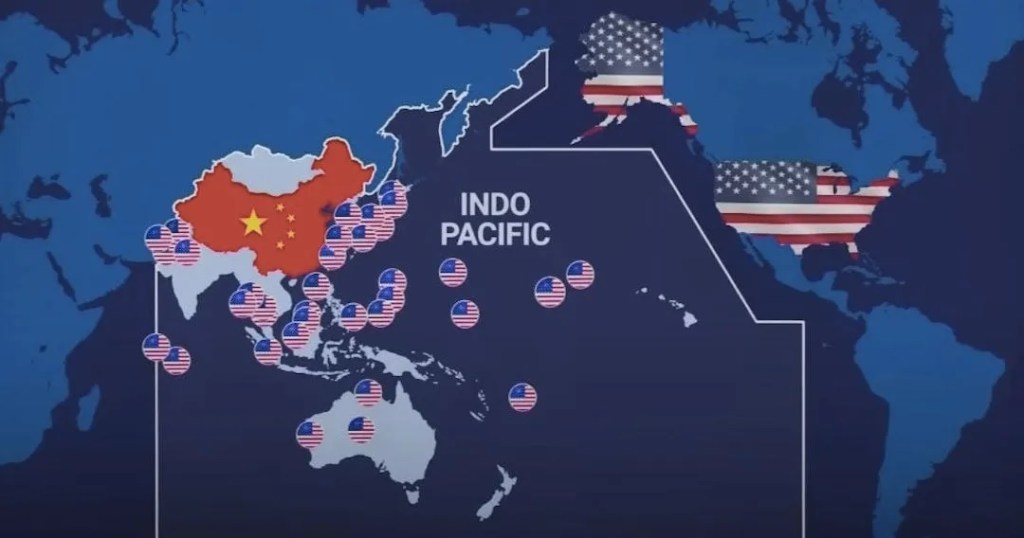
After Ukraine, Taiwan, we are told, must be the locus of the West’s all-consuming security interest.
Europe fears losing access to Chinese markets, plunging it deeper into a cost-of-living crisis. But it fears Washington’s wrath more
JONATHAN COOKSEP 8, 2023, Middle East Eye
The West is writing a script about its relations with China as stuffed full of misdirection as an Agatha Christie novel.
In recent months, US and European officials have scurried to Beijing for so-called talks, as if the year were 1972 and Richard Nixon were in the White House.
But there will be no dramatic, era-defining US-China pact this time. If relations are to change, it will be decisively for the worse.
The West’s two-faced policy towards China was starkly illustrated last week by the visit to Beijing of Britain’s foreign secretary, James Cleverly – the first by a senior UK official for five years.
While Cleverly talked vaguely afterwards about the importance of not “disengaging” from China and avoiding “mistrust and errors”, the British parliament did its best to undermine his message.
The foreign affairs committee issued a report on UK policy in the Indo-Pacific that provocatively described the Chinese leadership as “a threat to the UK and its interests”.
In terminology that broke with past diplomacy, the committee referred to Taiwan – a breakaway island that Beijing insists must one day be “reunified” with China – as an “independent country”. Only 13 states recognise Taiwan’s independence.
The committee urged the British government to pressure its Nato allies into imposing sanctions on China.
Upping the stakes
The UK parliament is meddling recklessly in a far-off zone of confrontation with the potential for incendiary escalation against a nuclear power, a situation unrivalled outside of Ukraine.
But Britain is far from alone. Last year, for the first time, Nato moved well out of its supposed sphere of influence – the North Atlantic – to declare Beijing a challenge to its “interests, security and values”.
There can be little doubt that Washington is the moving force behind this escalation against China, a state posing no obvious military threat to the West.
t has upped the stakes significantly by making its military presence felt ever more firmly in and around the Straits of Taiwan – the 100-mile wide waterway separating China from Taiwan that Beijing views as its doorstep.
Senior US officials have been making noisy visits to Taiwan – not least, Nancy Pelosi last summer, when she was house speaker.
Meanwhile, the Biden administration is showering Taiwan with weapon systems.
If this weren’t enough to inflame China, Washington is drawing Beijing’s neighbours deeper into military alliances – such as Aukus and the Quad – to isolate China and leave it feeling threatened. The Chinese president, Xi Jinping, describes this as a policy of “comprehensive containment, encirclement and suppression against us”.
Last month, President Biden hosted Japan and South Korea at Camp David, forging a trilateral security arrangement directed at what they called China’s “dangerous and aggressive behavior”.
Meanwhile, the Pentagon’s “Pacific Defence Initiative” budget – chiefly intended to contain and encircle China – just keeps rising.
In the latest move, revealed last week, the US is in talks with Manila to build a naval port in the northernmost Philippine islands, 125 miles from Taiwan, boosting “American access to strategically located islands facing Taiwan”.
That will become the ninth Philippine base used by the US military, part of a network of some 450 operating in the South Pacific.
Dirty double game
So what’s going on? Is Britain – along with its Nato allies – interested in building greater trust with Beijing, as Cleverly argues, or backing Washington’s escalatory manoeuvres against a nuclear-armed China over a small territory on the other side of the globe, as the British parliament indicates?
Inadvertently, the foreign affairs committee’s chair, Alicia Kearns, got to the heart of the matter. She accused the British government of having a “confidential, elusive China strategy”, one “buried deep in Whitehall, kept hidden even from senior ministers”.
And not by accident.
European leaders are torn. They fear losing access to Chinese goods and markets, plunging their economies deeper into recession after a cost-of-living crisis precipitated by the Ukraine war. But most are even more afraid of angering Washington, which is determined to isolate and contain China.
That divide was highlighted by French President Emmanuel Macron following a visit to China in April,……………………………………………………………………………………….
After Ukraine, Taiwan, we are told, must be the locus of the West’s all-consuming security interest…………………………………………………………………………………………………………………………………………………..
Economic chokehold
As with Ukraine, the cover story concealing the West’s provocations towards China has been carefully directed from Washington.
Europeans like Cleverly are parading around Beijing to make it look like the West desires peaceful engagement. But the only real engagement is the crafting of a military noose around China’s neck, just as a noose was crafted earlier for Russia. …………………………………………………………………………………………………………………..
The US isn’t likely to go down without a fight. Which is why Ukrainians and Russians are currently dying on the battlefield. And why China and the rest of us have good reason to fear who may be next. https://www.middleeasteye.net/opinion/china-west-blueprint-goading-ukraine-laid-out
Russia says US supplying depleted-uranium shells to Ukraine could lead to war between nuclear powers

The US will have to answer for the ‘very sad consequences’ of its decision to provide depleted uranium munitions to Ukraine, the Kremlin said
i news, By Jessie Williams, Foreign news reporter, September 7, 2023
Russia has condemned a US decision to send controversial depleted uranium tank shells to Ukraine as “a criminal act”, that would increase the chance of “direct armed conflict between nuclear powers”.
The Kremlin said on Thursday that the US would have to answer for the “very sad consequences” of its decision to provide depleted uranium munitions to Ukraine.
The controversial weapons – included in a $175m (£140m) package of military equipment for Ukraine announced by the US on Wednesday – have armour-piercing capabilities, which mean they could help to destroy Russian tanks.
The shells are intended for 31 American M1 Abrams tanks due to be delivered to Ukraine later this year.
Sergei Ryabkov, Russia’s deputy foreign minister, accused the US of a “criminal act” beyond reasonable escalation. “Now this pressure is dangerously balancing on the brink of direct armed conflict between nuclear powers,” he said.
“It is a reflection of Washington’s outrageous disregard for the environmental consequences of using this kind of ammunition in a combat zone. This is, in fact, a criminal act, I cannot give any other assessment.”
In March, Putin warned that Moscow would “respond accordingly, given that the collective West is starting to use weapons with a ‘nuclear component.’” Foreign Minister Sergei Lavrov called the move “a step toward accelerating escalation”.
Depleted uranium is a byproduct of the uranium enrichment process needed to create nuclear weapons. The rounds retain some radioactive properties, but they cannot generate a nuclear reaction as a nuclear weapon would, Edward Geist, a nuclear expert and policy researcher at the US-based Rand non-profit research institution, told The Associated Press.
The shells sharpen on impact, which further increases their ability to tear through tank armour. “It’s so dense and it’s got so much momentum that it just keeps going through the armour – and it heats it up so much that it catches fire,” he added.
“The administration’s decision to supply weapons with depleted uranium is an indicator of inhumanity,” Russia’s embassy in Washington said on Telegram. “Clearly, with its idea of inflicting a ‘strategic defeat’, Washington is prepared to fight not only to the last Ukrainian but also to do away with entire generations.”
on Friday the Kremlin spokesman Dmitry Peskov said Nato’s heavy use of such ammunition in the bombing of Yugoslavia in 1999 had caused a jump in cases of cancer and other diseases.
“These consequences are also felt by subsequent generations of those who somehow came into contact or were in areas where these weapons were used,” he told reporters, saying the same would now happen in Ukraine……………………………………….
The International Coalition to Ban Uranium Weapons said there were dangerous health risks from ingesting depleted uranium dust, including cancer.
A Defence Department official told Politico the weapons are considered the most effective way of arming their Abrams tanks. The UK has already sent the same type of ammunition to Ukraine to arm its Challenger 2 tanks, but this is the first time the US is sending the rounds.
Earlier this year the Pentagon said it would not be sending the depleted uranium munitions to Ukraine, but made a U-turn in their announcement on Wednesday during the US Secretary of State Antony Blinken’s visit to Kyiv……………………………..
The decision comes after the White House announced it will be sending another controversial weapon to Ukraine -cluster munitions – which are banned by more than 100 countries. https://inews.co.uk/news/world/russia-us-supplying-depleted-uranium-shells-ukraine-war-2599291
22 Years of Drone Warfare and No End in Sight

Twenty-two years later, drones continue to be instruments of civilian slaughter and the language deployed by successive administrations to describe such slaughter has served to sanitize that fact. Whether it’s the use of “target” or “collateral damage,” both minimize the reality that human beings are being murdered. Taken together with a larger war-on-terror narrative in which Muslims have been strikingly demonized and criminalized, the result has been the production of killable bodies whose deaths elicit neither guilt, remorse, nor accountability.
SCHEERPOST, September 7, 2023 By Maha Hilal / TomDispatch
“………………………………………………………..In 2023, this country’s drone warfare program has entered its third decade with no end in sight. Despite the fact that the 22nd anniversary of 9/11 is approaching, policymakers have demonstrated no evidence of reflecting on the failures of drone warfare and how to stop it. Instead, the focus continues to be on simply shifting drone policy in minor ways within an ongoing violent system.
The Inherent Dehumanization of Drone Warfare
In February 2013, White House Press Secretary Jay Carney justified drone strikes as a key tool of American foreign policy this way:
“We have acknowledged, the United States, that sometimes we use remotely piloted aircraft to conduct targeted strikes against specific al-Qaeda terrorists in order to prevent attacks on the United States and to save American lives. We conduct those strikes because they are necessary to mitigate ongoing actual threats, to stop plots, prevent future attacks, and, again, save American lives… The U.S. government takes great care in deciding to pursue an al-Qaeda terrorist, to ensure precision and to avoid loss of innocent life.”
More aggressively endorsing the use of such drones, Georgetown Professor Daniel Byman, who has held government positions, emphasized the necessity of such warfare to protect American lives. “Drones,” he wrote, “have done their job remarkably well… And they have done so at little financial cost, at no risk to U.S. forces, and with fewer civilian casualties than many alternative methods would have caused.”
In reality, however, Washington’s war on terror has inflicted disproportionate violence on communities across the globe, while using this form of asymmetrical warfare to further expand the space between the value placed on American lives and those of Muslims. As the rhetoric on drone warfare suggests, the value of life and the need to protect it are, as far as Washington is concerned, reserved for Americans and their allies.
Since the war on terror was launched, the London-based watchdog group Airwars has estimated that American air strikes have killed at least 22,679 civilians and possibly up to 48,308 of them. Such killings have been carried out for the most part by desensitized killers, who have been primed towards the dehumanization of the targets of those murderous machines. In the words of critic Saleh Sharief, “The detached nature of drone warfare has anonymized and dehumanized the enemy, greatly diminishing the necessary psychological barriers of killing.”
In his book On Killing: The Psychological Cost of Learning to Kill in War and Society, retired Army Lieutenant Colonel Dave Grossman focuses on the “mechanical distancing” of modern warfare, thanks to “the sterile Nintendo-game unreality of killing through a TV screen, a thermal sight, a sniper sight, or some other kind of mechanical bugger that permits the killer to deny the humanity of his victim.” Scholar Grégoire Chamayou describes this phenomenon in even starker terms. Thanks to the distance between the drone operator and the victim, “One is never spattered by the adversary’s blood. No doubt the absence of any physical soiling corresponds to less of a sense of moral soiling… Above all, it ensures that the operator will never see his victim seeing him doing what he does to him.”
Needless to say, drone technology has rendered those in distant lands so much more disposable in the name of American national security. This is because such long-range techno-targeting has created a profound level of dehumanization that, ironically enough, has only made the repeated act of long-distance killing, of (not to mince words) slaughter, remarkably banal. ………………………………………………………………………………………………………………………………..
Twenty-two years later, drones continue to be instruments of civilian slaughter and the language deployed by successive administrations to describe such slaughter has served to sanitize that fact. Whether it’s the use of “target” or “collateral damage,” both minimize the reality that human beings are being murdered. Taken together with a larger war-on-terror narrative in which Muslims have been strikingly demonized and criminalized, the result has been the production of killable bodies whose deaths elicit neither guilt, remorse, nor accountability.
US Intelligence Official: Media Misleading Americans About Ukraine’s Battlefield Success

The massive push by Ukraine resulted in nearly no territorial gains.
Still, Washington has pushed Kyiv to continue the counteroffensive. The White House acknowledges that for Ukraine to have a possibility of success, Kyiv will have to be willing to sustain high casualties.
By Kyle Anzalone / Antiwar.com 8 Sept 23
In an interview with renowned reporter Seymour Hersh, a US intelligence official scolded the media for misleading the American public about Ukraine’s battlefield failures during the Spring counteroffensive. ………..
Responding to reports in recent weeks that Ukrainian forces were gaining momentum and recapturing territory, the official remarked, “Where are the reporters getting this stuff?” he asked. “There are stories talking about drunk Russian commanders while the Ukrainians are penetrating the three lines of Russian defense and will be able to work back to Mariupol.”
He continued, “The goal of Russia’s first line of defense was not to stop the Ukrainian offense, but to slow it down so if there was a Ukrainian advance, Russian commanders could bring in reserves to fortify the line.” The official added, “There is no evidence that Ukrainian forces have gotten past the first line. The American press is doing anything but honest reporting on the failure thus far of the offense.”
Secretary of State Antony Blinken delivered a similarly optimistic message during his trip to Kyiv on Wednesday. “In the ongoing counteroffensive, progress has accelerated in the past few weeks. This new assistance will help sustain it and build further momentum,” he said at a press conference.
The official says that message is being delivered from military intelligence to the White House, while the CIA has drawn other conclusions. “This kind of reporting from the military intelligence community is going to the White House. There are other views,” he said, referring to the CIA. The official explained those views do not reach President Joe Biden.
For over three months, Kyiv has ordered its forces to advance on entrench Russian defensive lines in southern Ukraine. Russian minefields caused Ukraine to lose a significant portion of its Western-trained soldiers and equipment in the opening weeks of the offensive. The massive push by Ukraine resulted in nearly no territorial gains.
Still, Washington has pushed Kyiv to continue the counteroffensive. The White House acknowledges that for Ukraine to have a possibility of success, Kyiv will have to be willing to sustain high casualties.
The official told Hersh no matter how committed Kyiv is to the war effort, President Zelensky’s goals are unattainable. “Zelensky will never get his land back,” he said……………. https://scheerpost.com/2023/09/08/us-intelligence-official-media-misleading-americans-about-ukraines-battlefield-success/
Biden’s horse-trading on nuclear technology and fuels is an unprecedented proliferation risk

he is funding not just prudent nuclear research, but also their boondoggles to expand use of plutonium and HEU fuel. To ensure US military support for the trilateral Australia-United Kingdom-United States (AUKUS) deal, he is acquiescing to Navy insistence on using weapons-grade uranium reactor fuel, even in exported submarines. However, recent spikes in demand for nuclear weapons, among friends and foes alike, suggests this is a dangerously short-sighted approach.
Bulletin, By Alan J. Kuperman | September 6, 2023
News media in the United States rarely report on nuclear proliferation until it reaches the crisis stage—as in North Korea and Iran. By then, however, it is typically too late to stop the spread of nuclear weapons. Effective nonproliferation must begin much earlier, not only by suppressing demand for nuclear weapons but also by restricting supplies of the fissionable materials necessary to build them in the first place. Sadly, the Biden administration is bungling this latter responsibility.
To acquire the bomb, nuclear aspirants must first obtain its key ingredient: plutonium or highly enriched uranium (HEU). So, as demand for nuclear weapons grows in Asia, the Middle East, and Europe, one would expect the US government to do everything it can to clamp down on supply. Instead, President Joe Biden is actually doing just the opposite, by promoting commerce in weapon-usable nuclear materials as a bargaining chip for other issues. Unless the president reverses course, one of his greatest foreign policy legacies could wind up being global nuclear proliferation.
The spike in demand for nuclear weapons has been driven by several key events over the past two decades………………………………………………………………………………………………………….
Considering this growing demand for nuclear weapons, an essential policy to avert proliferation is to block the supply of the necessary fissionable materials. Regrettably, the Biden administration instead has taken four steps that would foster proliferation of both plutonium and weapons-grade uranium.
First, President Biden is funding US companies like Oklo that want to reprocess used reactor fuel—how plutonium is obtained in the first place, by separating it from nuclear waste—and then deploy its fuel recycling technology “on a global scale.” This would reverse nearly half a century of bipartisan US policy opposing such activity at home and abroad, which has succeeded at restricting commercial reprocessing to only two countries, France and Russia, both of which already have nuclear weapons.
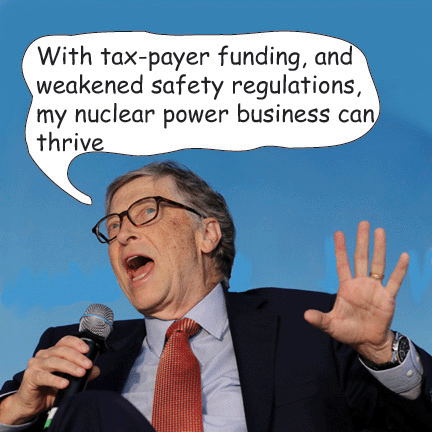
Second, the Biden administration is providing a $2 billion subsidy to Bill Gates (currently the fifth richest person in the world) to develop exotic “fast” nuclear reactors, which originally were designed explicitly to increase supplies of plutonium. Gates’s nuclear energy startup Terrapower promises not to use them this way, but the reactors are so expensive that countries importing them could cite economics to justify turning them into plutonium factories.

Third, the president is pursuing construction of a civilian US research reactor using weapons-grade HEU fuel for the first time since the 1960s, thereby threatening to undermine decades of progress in delegitimizing this dangerous fuel globally.

Fourth, the White House has agreed to export tons of weapons-grade uranium—an amount sufficient for hundreds of nuclear bombs—to fuel Australia’s forthcoming SSN-AUKUS nuclear-powered submarines. This announcement already has prompted at least one other country, Iran, to suggest that it too may produce HEU for naval fuel—a well-known back door to nuclear weapons. The good news is that Australia’s submarines likely could be redesigned to use low-enriched uranium that is unsuitable for nuclear weapons. Unfortunately, the Biden administration recently canceled funding for the eight-year-old program to develop such proliferation-resistant naval fuel.
Why is President Biden doing all this? The US president seems to think he can prevent proliferation solely by quashing demand—using carrots and sticks to persuade countries not to seek the bomb—despite evidence to the contrary. So, he feels free to relax supply restrictions in political horse-trades. For example, to persuade legislators to support solar and wind power, he is funding not just prudent nuclear research, but also their boondoggles to expand use of plutonium and HEU fuel. To ensure US military support for the trilateral Australia-United Kingdom-United States (AUKUS) deal, he is acquiescing to Navy insistence on using weapons-grade uranium reactor fuel, even in exported submarines. However, recent spikes in demand for nuclear weapons, among friends and foes alike, suggests this is a dangerously short-sighted approach.
Of course, the United States should continue trying to reduce demand for proliferation, including by avoiding attacking any more countries that have halted their nuclear weapons programs like Iraq and Libya. But if President Biden imagines that demand-suppression is a silver bullet that gives him license to expand civilian commerce in nuclear weapons-usable materials, he is deeply mistaken. Unless Biden changes course, his promotion of such dangerous nuclear technologies will enable supply to meet demand—in the market of mass destruction. https://thebulletin.org/2023/09/bidens-horse-trading-on-nuclear-technology-and-fuels-is-an-unprecedented-proliferation-risk/
US Air Force tests nuclear-capable long-range missile

By Michael Callahan, CNN, September 6, 2023
The US Air Force on Wednesday tested an unarmed nuclear-capable long-range missile, according to the Air Force Global Strike Command.
The unarmed Minuteman III intercontinental ballistic missile, equipped with three test reentry vehicles, was launched from Vandenberg Air Force Base in California and traveled 4,200 miles to the Kwajalein Atoll in the Marshall Islands…………………………………………………………………………….
The Minuteman III is traditionally known as the only land-based leg to the US nuclear triad. The other two parts of the triad are the Trident submarine-launched ballistic missile and nuclear weapons carried by long-range strategic bombers. https://edition.cnn.com/2023/09/06/politics/usaf-nuclear-missile-tests/index.html
1 This Month

of the week – Shut Down Drone Warfare!


Tell the Ukrainian Government to Drop Prosecution of Peace Activist Yurii Sheliazhenko

Petition to revoke the licensing of the Near Surface Nuclear Disposal Facility (NSDF) at Chalk River. https://www.ourcommons.ca/petitions/en/Petition/Details?Petition=e-7247
To see nuclear-related stories in greater depth and intensity – go to https://nuclearinformation.wordpress.com
-
Archives
- April 2026 (91)
- March 2026 (251)
- February 2026 (268)
- January 2026 (308)
- December 2025 (358)
- November 2025 (359)
- October 2025 (376)
- September 2025 (257)
- August 2025 (319)
- July 2025 (230)
- June 2025 (348)
- May 2025 (261)
-
Categories
- 1
- 1 NUCLEAR ISSUES
- business and costs
- climate change
- culture and arts
- ENERGY
- environment
- health
- history
- indigenous issues
- Legal
- marketing of nuclear
- media
- opposition to nuclear
- PERSONAL STORIES
- politics
- politics international
- Religion and ethics
- safety
- secrets,lies and civil liberties
- spinbuster
- technology
- Uranium
- wastes
- weapons and war
- Women
- 2 WORLD
- ACTION
- AFRICA
- Atrocities
- AUSTRALIA
- Christina's notes
- Christina's themes
- culture and arts
- Events
- Fuk 2022
- Fuk 2023
- Fukushima 2017
- Fukushima 2018
- fukushima 2019
- Fukushima 2020
- Fukushima 2021
- general
- global warming
- Humour (God we need it)
- Nuclear
- RARE EARTHS
- Reference
- resources – print
- Resources -audiovicual
- Weekly Newsletter
- World
- World Nuclear
- YouTube
-
RSS
Entries RSS
Comments RSS
 nuclear-news