Motor fault, legal problems, future delays …. giant costly Vogtle nuclear project struggles on

Vogtle 4 start-up moved to 2024
World Nuclear News, 09 October 2023 #nuclear #anti-nuclear #nucler-free #NoNukes
The in-service date for the second AP1000 plant at the site near Waynesboro, Georgia, has been revised after a motor fault was discovered in a reactor coolant pump. Meanwhile, Georgia Power has agreed to pay the plant’s co-owner Oglethorpe Power Corporation USD308 million in settlement of an ongoing dispute.
The motor fault in one of the unit’s four reactor coolant pumps – or RCPs – was discovered during start-up and pre-operational testing, Georgia Power said in a filing to the US Securities and Exchange Commission (SEC)……………………………
Southern Nuclear believes that the motor fault on the RCP at Vogtle 4 is an isolated event, the companies said. The projected schedule for Vogtle 4 “primarily depends on the continued progression of pre-operational testing and start-up”, it added: “As testing continues, new challenges also may continue to be identified, which may result in required engineering changes or remediation related to plant systems, structures, or components (some of which are based on new technology that only within the last few years began initial operation in the global nuclear industry at this scale). These challenges may result in further schedule delays and/or cost increases.”
Dispute settled
In the same SEC filing, Georgia Power and its parent, Southern Company, announced the agreement with Oglethorpe Power to resolve a dispute regarding cost-sharing and tender provisions of the joint ownership agreements relating to Vogtle units 3 and 4. Georgia Power has agreed to make a payment of USD308 million to Oglethorpe for a portion of Oglethorpe’s previously incurred construction costs, as well as paying a portion of Oglethorpe’s further construction costs for the units – around USD105 million – based on the current capital cost forecast. It will also pay 66% of Oglethorpe’s costs of construction with respect to any amounts above the current project capital cost forecast. The parties have agreed to dismiss pending litigation on this issue, including counterclaims by Georgia Power.
Georgia Power resolved a similar dispute with another of the plant’s co-owners, the Municipal Electric Authority of Georgia (MEAG Power) in September 2022. Similar litigation with the other co-owner, Dalton Utilities, is still pending.
Construction of the two Westinghouse AP1000s began in 2013. Unit 3 ………………… Plant Vogtle is jointly owned by Georgia Power (45.7%), Oglethorpe (30%), MEAG Power (22.7%) and Dalton Utilities (1.6%).
Endless electricity and water use: the Artificial-Intelligence-Blockchain-Data Centre -Nuclear-NuScale nightmare to come

Blockchain biz goes nuclear: Standard Power wants to use NuScale reactors for DCs
Please, no crypto boom, thank you
The Register, Tobias Mann, Sun 8 Oct 2023 #nuclear #anti-nuclear #nucler-free #NoNukes
Colocation outfit Standard Power hopes to power two new datacenters in Ohio and Pennsylvania entirely by miniaturized nuclear reactors from NuScale.
Standard Power makes no secret it focuses on providing datacenter services to not just those into AI workloads and other kinds of high-performance computing but also those performing proof-of-work blockchain mining, the kind needed to craft digital tokens like Bitcoin. The significant energy requirements of this type of blockchain work spurred an investigation by the White House Office of Science and Technology Policy last year, and calls by lawmakers to implement reporting and/or sustainability requirements for such operations.
Generally speaking, a datacenter packed with proof-of-work miners is going to demand a chunky amount of power. Concerned it may not get adequate electricity supplies for its new facilities, which by the sounds of it will support blockchain mining as well as other workloads, Standard Power said it hopes to take the nuclear option.
“We see a lot of legacy baseload grid capacity going offline with a lack of new sustainable baseload generation options on the market especially as power demand for artificial intelligence-computing and datacenters is growing,” Standard Power CEO Maxim Serezhin said in a statement.
And the colo outfit’s Ohio and Pennsylvania datacenters may need or get a lot of power. The company expects to deploy 24 of NuScale’s small modular reactors between the two sites. These reactors are reportedly capable of generating 77 megawatts apiece — putting the total deployed capacity at 1,848 megawatts.
Despite the announcement, it may be a few years before Standard Power can realize its nuclear dreams. As we learned in January, Idaho National Labs will be among the first to demonstrate NuScale’s reactors, and the first of these modules isn’t expected to come online until 2029. We asked Standard Power when it expects its facilities will be operational; we’ll let you know if we hear anything back…………………………………..
Standard Power is hardly the first datacenter operator to get excited about nuclear power, either. Cumulus Data opened a datacenter next to a nuclear plant — the full-size kind — in January and last month we learned that Microsoft is now hiring someone to potentially deploy SMR systems to power its growing cloud enterprise. https://www.theregister.com/2023/10/08/standard_power_nuclear_datacenter/
US public support declines for arming Ukraine, Reuters/Ipsos poll shows
By Jason Lange and Patricia Zengerle. October 6, 2023 #nuclear #antinuclear #nuclear-free #NoNukes
WASHINGTON, Oct 5 (Reuters) – Support is falling among Americans of both major political parties for supplying Ukraine with weapons, a warning sign for Kyiv, which relies heavily on U.S. arms to fight against a Russian invasion, according to a new Reuters/Ipsos poll.
The two-day poll, which closed on Wednesday, showed only 41% of respondents agreed with a statement that Washington “should provide weapons to Ukraine,” compared to 35% who disagreed and the rest unsure.
Support for U.S. weapon shipments is down from May, when a Reuters/Ipsos poll showed 46% of Americans backed sending arms, while 29% were opposed and the rest unsure.
The poll was taken as U.S. congressional leaders debate Democratic President Joe Biden’s request for $24 billion in additional funding for Ukraine, of which about $17 billion would be defense aid………………………………………………………. https://www.reuters.com/world/us/us-public-support-declines-arming-ukraine-reutersipsos-2023-10-05/
Senators worry about Saudi nuclear arms plans
Beyond Nuclear #nuclear #antinuclear #nuclear-free #NoNukes
US should reconsider helping Saudi Arabia develop domestic nuclear power, they wrote
Editor’s introduction: Brett Wilkins with Common Dreams has reported on an important step taken by a handful of US Senators who pushed back last week on selling commercial nuclear technology to Saudi Arabia. We republish the article below. (As always, any views expressed in the article are the writer’s own and do not necessarily reflect those of Beyond Nuclear.) But while the Senators’ letter to President Joe Biden voices concern that the Saudis could use a domestic reactor program to transition to nuclear weapons, it fails to recognize that this is an inevitable outcome of nuclear power technology no matter whose hands it is in.
By Brett Wilkins, Common Dreams
Amid reports that Saudi Arabia is seeking United States support for its nuclear energy program—whose capacities critics fear could be utilized to develop nuclear weapons—a group of 20 U.S. senators on Wednesday urged President Joe Biden to “seriously consider” whether such a move is in the national interest as the administration brokers a possible normalization deal between the kingdom and Israel.
In addition to concerns over the fundamentalist monarchy’s desire for a U.S. security guarantee as a condition for normalizing relations with apartheid Israel, as well as the future of a two-state solution in illegally occupied Palestine, the senators note in a letter to Biden that “the Saudi government is also reportedly seeking U.S. support to develop a civilian nuclear program, and to purchase more advanced U.S. weaponry.”
“While we should seriously consider whether it is in U.S. interests to help Saudi Arabia develop a domestic nuclear program, we should always maintain the high bar of the ‘gold standard’ 123 Agreement and insist on adherence to the Additional Protocol,” the senators wrote, referring to a provision of the Atomic Energy Act of 1954 requiring a country seeking a nuclear cooperation deal with the United States to commit to a set of nine nonproliferation criteria and expanded International Atomic Energy Agency (IAEA) inspections. The U.S. has entered into such agreements with more than two dozen countries, Taiwan, and the IAEA…………………………
The lawmakers’ letter was led by Democratic Sens. Chris Murphy (Conn.), Chris Van Hollen (Md.), Dick Durbin (Ill.), and Peter Welch (Vt.). Signatories include Sens. Bernie Sanders (I-Vt.), Elizabeth Warren (D-Mass.), John Fetterman (D-Pa.), Jeff Merkley (D-Ore.), Patty Murray (D-Wash.), and Ed Markey (D-Mass.)……………………………………………………………………………. more https://beyondnuclearinternational.org/2023/10/08/senators-worry-about-saudi-nuclear-arms-plans/
Why The US Canceled Project Pluto: The Super Weapon That Never Was
Slash Gear, BY QUINA BATERNA/OCT. 8, 2023 #nuclear #antinuclear #nuclear-free #NoNukes
With the role of nuclear powers in maintaining global order and its ongoing arms race, it’s unsurprising that the United States has its eyes on Russia’s ongoing development of nuclear-powered missiles. However, it’s also a little more personal, especially because the United States had canceled a similar project more than half a century earlier: Project Pluto.
……………………………………………………………………………………… What is Project Pluto?
……………………. In 1961, the United States successfully unveiled the revolutionary Tory IIA-I in the midst of the Cold War. Mounted on top of a railroad car, it marked the world’s first nuclear ramjet engine when it came to life for just a few seconds. Three years later, the U.S. tested the Tory II-C, which was able to run for five minutes at full power — generating 513 megawatts or 35,000 pounds of thrust.
In theory, this marked a game-changing innovation for nuclear-powered missiles. However, coming off the heels of the success from the Tory II-C testing, the U.S. Air Force and the Atomic Energy Commission canceled Project Pluto for good. So, what made the U.S. Air Force change its mind?
The beginning of the end for Project Pluto
Despite spending $260 million for its budget, Project Pluto’s sponsors cited fears that the project would be dangerous to even its allies, doing things such as “deafen, flatten, and irradiate people” en route to its target (even before the bomb drops).
SCIENCE
Why The US Canceled Project Pluto: The Super Weapon That Never Was
Romolotavani/Getty Images
BY QUINA BATERNA/OCT. 8, 2023 7:45 AM EST
With the role of nuclear powers in maintaining global order and its ongoing arms race, it’s unsurprising that the United States has its eyes on Russia’s ongoing development of nuclear-powered missiles. However, it’s also a little more personal, especially because the United States had canceled a similar project more than half a century earlier: Project Pluto.
In 2018, Russian President Vladimir Putin announced the development of several innovative nuclear weapons, including a nuclear-powered cruise missile. In his presidential address, Putin claimed that Russia’s innovations would make NATO missile defense systems “useless.” Citing the United States’ withdrawal from the 1972 Anti-Ballistic Missile (ABM) Treaty in 2002, Putin reiterates that its ongoing response is reactionary to the increasing range and proximity of the U.S. global missile defense systems to Russian borders.
A year later, The New York Times published an article stating U.S. officials suspected a nuclear blast from Russia’s Nenoksa Missile Test Site was one of the worst nuclear accidents in the region since Chernobyl. Reports claim that at least seven people were killed in the explosion, including five scientists (via The Bulletin). Here’s how it could have been inspired by the United States’ Project Pluto, and why it may cause problems.
What is Project Pluto?
Nevada National Security Site
For decades, the Nevada National Security Site (NNSS) has had an extensive history of supporting U.S. national security through nuclear testing. The base has served as a testing site for several types of new weapons, such as the Supersonic Low-Altitude Missile (SLAM) using nuclear ramjet power: codenamed Project Pluto.
In a 2013 brochure, the NNSS claimed that the principles behind the ramjet power used nuclear heat in combination with the force from the air in front of a vehicle to make it expand. Afterward, its exhaust provides the thrust necessary to fly and create impact.
In 1961, the United States successfully unveiled the revolutionary Tory IIA-I in the midst of the Cold War. Mounted on top of a railroad car, it marked the world’s first nuclear ramjet engine when it came to life for just a few seconds. Three years later, the U.S. tested the Tory II-C, which was able to run for five minutes at full power — generating 513 megawatts or 35,000 pounds of thrust.
In theory, this marked a game-changing innovation for nuclear-powered missiles. However, coming off the heels of the success from the Tory II-C testing, the U.S. Air Force and the Atomic Energy Commission canceled Project Pluto for good. So, what made the U.S. Air Force change its mind?
The beginning of the end for Project Pluto
Federal Government of the United States (via Wikimedia)
Despite spending $260 million for its budget, Project Pluto’s sponsors cited fears that the project would be dangerous to even its allies, doing things such as “deafen, flatten, and irradiate people” en route to its target (even before the bomb drops).
Aside from this, it’s possible that additional testing requirements and manufacturing risks may have also come into consideration. In an interview with Scientific American, Edwin Lyman, a senior scientist in the Union of Concerned Scientists’ Global Security Program shared, “They had a proof-of-principle reactor on the ground, but my impression is that at the time the project was canceled there was probably still a substantial amount of engineering work that needed to be done, not to mention flight testing.”
According to the NNSS brochure, one of the key challenges that scientists cited was the materials used for the reactor. While typically used at the time, concrete made it difficult for missiles to fly long trips towards targets. In addition, materials needed to be able to withstand incredible heat to avoid damaging the structural integrity of the missile.
SCIENCE
Why The US Canceled Project Pluto: The Super Weapon That Never Was
Romolotavani/Getty Images
BY QUINA BATERNA/OCT. 8, 2023 7:45 AM EST
With the role of nuclear powers in maintaining global order and its ongoing arms race, it’s unsurprising that the United States has its eyes on Russia’s ongoing development of nuclear-powered missiles. However, it’s also a little more personal, especially because the United States had canceled a similar project more than half a century earlier: Project Pluto.
In 2018, Russian President Vladimir Putin announced the development of several innovative nuclear weapons, including a nuclear-powered cruise missile. In his presidential address, Putin claimed that Russia’s innovations would make NATO missile defense systems “useless.” Citing the United States’ withdrawal from the 1972 Anti-Ballistic Missile (ABM) Treaty in 2002, Putin reiterates that its ongoing response is reactionary to the increasing range and proximity of the U.S. global missile defense systems to Russian borders.
A year later, The New York Times published an article stating U.S. officials suspected a nuclear blast from Russia’s Nenoksa Missile Test Site was one of the worst nuclear accidents in the region since Chernobyl. Reports claim that at least seven people were killed in the explosion, including five scientists (via The Bulletin). Here’s how it could have been inspired by the United States’ Project Pluto, and why it may cause problems.
What is Project Pluto?
Nevada National Security Site
For decades, the Nevada National Security Site (NNSS) has had an extensive history of supporting U.S. national security through nuclear testing. The base has served as a testing site for several types of new weapons, such as the Supersonic Low-Altitude Missile (SLAM) using nuclear ramjet power: codenamed Project Pluto.
In a 2013 brochure, the NNSS claimed that the principles behind the ramjet power used nuclear heat in combination with the force from the air in front of a vehicle to make it expand. Afterward, its exhaust provides the thrust necessary to fly and create impact.
In 1961, the United States successfully unveiled the revolutionary Tory IIA-I in the midst of the Cold War. Mounted on top of a railroad car, it marked the world’s first nuclear ramjet engine when it came to life for just a few seconds. Three years later, the U.S. tested the Tory II-C, which was able to run for five minutes at full power — generating 513 megawatts or 35,000 pounds of thrust.
In theory, this marked a game-changing innovation for nuclear-powered missiles. However, coming off the heels of the success from the Tory II-C testing, the U.S. Air Force and the Atomic Energy Commission canceled Project Pluto for good. So, what made the U.S. Air Force change its mind?
The beginning of the end for Project Pluto
Federal Government of the United States (via Wikimedia)
Despite spending $260 million for its budget, Project Pluto’s sponsors cited fears that the project would be dangerous to even its allies, doing things such as “deafen, flatten, and irradiate people” en route to its target (even before the bomb drops).
Aside from this, it’s possible that additional testing requirements and manufacturing risks may have also come into consideration. In an interview with Scientific American, Edwin Lyman, a senior scientist in the Union of Concerned Scientists’ Global Security Program shared, “They had a proof-of-principle reactor on the ground, but my impression is that at the time the project was canceled there was probably still a substantial amount of engineering work that needed to be done, not to mention flight testing.”
According to the NNSS brochure, one of the key challenges that scientists cited was the materials used for the reactor. While typically used at the time, concrete made it difficult for missiles to fly long trips towards targets. In addition, materials needed to be able to withstand incredible heat to avoid damaging the structural integrity of the missile.
To manage this, Coors Porcelain Company (now CoorsTek) — an offshoot of the famous American brewery and beer company — designed solutions with ceramics. According to a 1996 case filed with the U.S. Department of Labor, 18,681.5 kilograms of beryllium were used in Project Pluto to fabricate 500,000 beryllium and beryllium-uranium fuel elements. However, this didn’t come without risks, with its workers acquiring chronic beryllium disease (CBD) years later.
Is the nuclear dream still alive?
While there was a time in history when nuclear energy powering everything was the goal, there’s a reason why America doesn’t build more nuclear power plants. With issues in regulation, increasing manufacturing prices, and growing renewable energy alternatives, there are increasingly more effective options for powering our machines — as well as our weapons…………………….. https://www.slashgear.com/1410540/us-canceled-project-pluto-why/–
Depleted Ukrainium: What Comes After Failure?

public support for the war—and here and here official support—ever more visibly wobbles and wanes……… And those running the war in Ukraine are slowly but surely losing on this side of the conflict.
October 5, 2023, By Patrick Lawrence / Original to ScheerPost #Ukraine
ou cannot name the last time you read anything about a parliamentary election in Slovakia, so I won’t bother asking. But you are reading about one this week, assuming you still follow mainstream media—if only to understand what you are supposed to think about one or another event, as against what has actually occurred.
In results announced in Bratislava Sunday, a leftist party whose primary platform plank is opposition to the war in Ukraine won 23 percent of the vote. On Monday the Slovakian president, Zuzana Čaputová, formally asked Robert Fico, who leads the SMER party, to form a government. It looks like he will do so in a coalition with either Voice, a social-democratic party that took 15 percent of the vote, or with Progressive Slovakia, a liberal-centrist party that finished with 18 percent of the vote.
Fico is an interesting figure. He has served as prime minister twice over the course of a decade, during which time he proved sufficiently European to bring Slovakia into the euro. To one or another extent, his likely coalition partners favor keeping Slovakia as a card-carrying member of the Western coalition supporting Ukraine. But they did not win the election: Fico did.
And Fico is all business in his opposition to Slovakia’s support for the U.S. proxy war tearing Ukraine and its people to pieces.
SMER’s platform assigns the West and Ukraine equal responsibility for the war—a purposeful rip into the “unprovoked” charade—and promises an immediate end to all Slovakian arms shipments to the war effort. Speaking after the election results were announced, Fico pointedly pledged to press Kiev and its backers to begin peace talks with Moscow. “More killing is not going to help anyone,” he declared.
There are two things to say about Robert Fico’s return to the top of Slovakian politics. One, we find once again that the U.S. is a victim of its old, Manichean habit of dividing the whole of humanity into good guys and bad guys. The headline on CNN’s report on the elections reads, “Pro–Russian politician wins Slovakia’s parliamentary election.” The New York Times head is, “Unease in the West as Slovakia Appears Set to Join the Putin Sympathizers.”
Tell me, which of these is more pathetic? “Pro–Russian?” “Putin sympathizers?” This is infantile—apart from being false, I mean. Fico simply articulates an independent, perfectly sound position on the war. CNN and The Times are infantilizing their viewers and readers as they reduce this position to the simplistic binary of a Saturday-morning cartoon. The insidious thing here, and let us be ever vigilant on this point, is that these media are inserting into our brains the thought that any deviation from the Russophobic orthodoxy amounts to support for the Kremlin’s demonized occupant.
Two, “unease” is too mild a word for the reigning sentiment among the war-mongering elites in Washington and the European capitals. An incipient panic is closer to the reality as public support for the war—and here and here official support—ever more visibly wobbles and wanes. The first front in any war is the home front, where it is imperative the battle is won. And those running the war in Ukraine are slowly but surely losing on this side of the conflict.
They are losing it on the ground in Ukraine, too, it is now more or less obvious. Our question becomes: Where will the powers that instigated this war and invested heavily in it turn next? As I argued soon after the Russian intervention began in February 2022, this conflict was probably conceived as the Washington neoconservatives’ shoot-the-moon moment, its all-out play to take down the Russian Federation. What happens now, as the neocons lose this round of Hearts and the game as they have played it is over?
To my great relief, the blue-and-yellow flags that disfigured the American landscape in the early months of the war are now mostly gone. More than half of Americans polled agree with Robert Fico: No more military aid and weapons to Ukraine. This percentage is headed in only one direction from here on out.
Volodymyr Zelensky’s swing through North America beginning with his attendance at this year’s General Assembly last month, went pretty badly. At the GA, he did not make any headway persuading the global majority opposed to the war to come over to his side. His reception in Washington was… what is the best word?… muted? House Republicans, many of whom oppose more military aid, refused to meet him. When, over the weekend, Speaker Kevin McCarthy finally pushed through a bill to keep the government funded, he had to strip out a provision authorizing another tranche of weapons funding.
The mood elsewhere appears to be no brighter. That astonishing debacle in the Canadian Parliament—presenting an old SS man as a hero because he fought the Soviets?—cannot have done Zelensky’s constituency in Canada any good. Across the pond there are signs of impatience as roughly eight million Ukrainian refugees settle in Europe, displaying little interest—and who can blame them?—in going home when the war is over. War or no, solidarity or no, the Poles have blocked imports of cheap Ukrainian wheat. There are signs of buyer’s remorse among the Finns a matter of months after their impulsive decision to join NATO. And now the Slovakians and their new leader’s alarming display of political and intellectual independence.
However these matters may stand as you read this commentary, the trends here outlined are destined to accelerate in coming months. The Ukrainians’ long-touted counteroffensive, a major prop in the campaign to maintain public support for the war, is touted no more. It is well on the way to taking its place next to the 2007 “surge” in Iraq. Remember that? Of course you don’t. And you won’t remember the counteroffensive any more distinctly in, I would say, a year’s time.
Not even The New York Times pretends any longer that the front line in eastern Ukraine has budged more than a matter of meters the whole of this year. And this is before the harsh winter weather begins. At that point, stasis will be the best the Ukrainians can hope for. All this autumn and all winter, the Russians are likely to continue their rolling volleys of rockets, missiles, and artillery shells to the point most of Ukraine east of Kiev resembles Ypres or the Somme in 1918.
Let us look ahead to next spring, then. The Ukrainian front will have sustained another winter’s deterioration, and popular discontent among Europeans is likely to have sharpened. It will be considerably harder to pretend that the Kiev regime can win the war or, indeed, that it makes any sense to continue it. And Joe Biden will be looking at an election in seven or so months.
At that point, what? ………………………………………………………………………………………………………………………………. more https://scheerpost.com/2023/10/05/patrick-lawrence-depleted-ukrainium/
Groups Demand DOE Environmental Impact Statement Before Agency Bails Out Palisades Zombie Reactor Restart

Beyond Nuclear, September 20, 2023 #nuclear #antinuclear #nuclear-free #NoNukes
| NEPA Requires “Major Federal Project” Hard Look, Groups Assert |
| Covert Township, MI and Washington, DC, September 20, 2023– Legal counsel for Beyond Nuclear, Don’t Waste Michigan, and Michigan Safe Energy Future, have written the Energy Secretary and the Loan Programs Office director at the U.S. Department of Energy (DOE), demanding National Environmental Policy Act (NEPA) compliance before DOE awards Holtec International a requested $1 billion risk- and interest-free nuclear loan guarantee, backed by U.S. taxpayer dollars. The billion dollar federal loan, which Holtec does not have to pay back, is the linchpin in Holtec’s reactor restart scheme, also backed by Michigan’s governor, Gretchen Whitmer, as well as the state legislature. The State of Michigan has already gifted Holtec with $150 million towards the restart, although Holtec requested twice that. The state handout is contingent on the much larger federal bailout. A Power Purchase Agreement was just announced between Holtec and rural electric co-ops in Michigan (Wolverine) and Indiana (Hoosier), although how far above market rates the co-ops’ members will be forced to pay, and for how long, has not been publicly disclosed. Citing the largesse provided by the public (which most taxpayers and ratepayers are not even aware of, let alone consent to), Holtec is pressuring the U.S. Nuclear Regulatory Commission to simply reverse legally-binding, permanent shutdown filings from June 2022. |
A coalition of hundreds of environmental groups, including more than fifty groups in Michigan, have written Energy Secretary Jennifer Granholm — herself a former governor and attorney general of the State of Michigan — several times in the past year, urging Holtec’s requests for federal bailouts to restart Palisades be rejected.
Toledo, Ohio-based attorney Terry Lodge, and Cedar Rapids, Iowa-based attorney Wally Taylor, serve as legal co-counsel for the environmental groups. They provided DOE with a litany of pathways to catastrophic reactor core meltdown at Palisades, which Energy Secretary Granholm and Loan Programs Office Director Shah have been asked by Holtec to bankroll. The severe safety risks include: the most neutron radiation-embrittled reactor pressure vessel in the country, at risk of pressurized thermal shock through-wall fracture; a reactor vessel closure head in need of replacement for more than two decades; steam generators in need of replacement for more than two decades, as well; and the worst control rod drive mechanism seal leaks in industry.
There is no indication that, even with $1.15 billion, or more, in federal and state subsidies, Holtec will fix any of those severe safety problems before restarting the long problem-plagued reactor.
Lodge and Taylor also pointed out that restarting Palisades’ more than half-century old reactor would lead to the generation of another 20 metric tons per year of highly radioactive irradiated nuclear fuel. The high-level radioactive waste stored on-site since 1971 already poses its own severe risks, including violating NRC earthquake safety regulations. Palisades’ dry cask storage is perched on the very edge of Lake Michigan, a major headwaters of the entire Great Lakes, 84% of North America’s surface fresh water, and drinking water supply to 40 million people in eight U.S. states, two Canadian provinces, and a very large number of Indigenous Nations……………………………………………. more https://beyondnuclear.org/groups-demand-doe-eis-before-bailing-out-palisades-zombie-reactor-restart/?fbclid=IwAR1qlrC0heccGG150YGtyT3F1-38m4p2TVIz0ITiuFOK0Pi-qpjc6VNUrDM
NRC Commissioners Fail to Take Action on Critical Safety Issue at Diablo Canyon
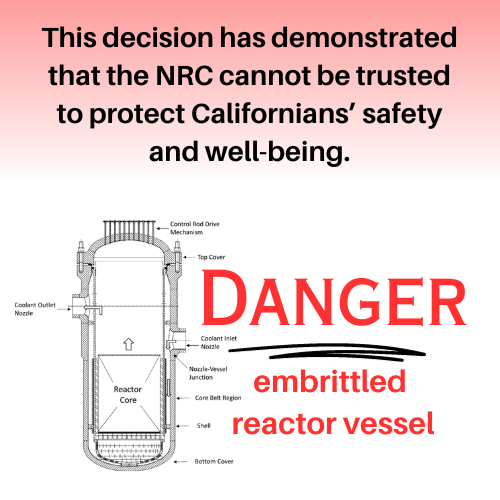
San Luis Obispo, CA, October 4, 2023 https://mothersforpeace.org/nrc-commissioners-fail-to-take-action-on-critical-safety-issue-at-diablo-canyon/?fbclid=IwAR1A_L1NhvPiZW4tMjfCTfu-4Ov7duSTtEOyamayx97DjaRb4fGQ7UGVjZI #nuclear #antinuclear #nuclear-free #NoNukes
— San Luis Obispo Mothers for Peace (MFP) and Friends of the Earth (FoE) today deplored a decision of the Commissioners of the Nuclear Regulatory Commission (NRC) for demonstrating a complete lack of concern for the safety and security of the people living near the Diablo Canyon Nuclear Power Plant.
Disregarding expert evidence presented by MFP and FoE that the Diablo Canyon Unit 1 pressure vessel is at risk of dangerous embrittlement due to decades of neglect by Pacific Gas and Electric Co. (PG&E) and lax oversight by the NRC technical staff, the Commissioners refused to grant the groups’ hearing request or to order the immediate shutdown of the reactor for comprehensive testing of the reactor vessel’s condition.
Instead, the Commissioners bucked the groups’ shutdown request back to the agency’s technical staff to consider whether to take enforcement action against PG&E.
“We are appalled that the Commissioners are entrusting this important safety review to the same agency staff who for fifteen years has given PG&E repeated extensions of deadlines for essential tests and inspections,” said Diane Curran, attorney for MFP. Curran noted that the groups had intentionally petitioned the Commissioners, as the highest officers of the NRC, to exercise their legal responsibility for oversight of the technical staff.
Nevertheless, the groups vowed to persevere. Hallie Templeton, Legal Director for FoE, said, “We plan to continue our rigorous watchdogging of PG&E and the NRC.” She added, “The Commissioners’ decision has raised a red flag to all of us. Anyone, including California politicians, who thinks the safety of Diablo Canyon can be entrusted to the federal government unquestioningly has just received a big wakeup call.”
Linda Seeley, spokesperson for MFP, renewed the group’s call to the State of California to “go back to the original plan to close Diablo Canyon when it reaches its 40-year operating license limit in 2024 (Unit 1) and 2025 (Unit 2). Enough is enough.”
The CIA’s “Information War” is Now Globalized?
Global Research, 6 Oct 23
In 1967, the CIA’s covert use of the National Student Association to spread countermessages to communism was revealed by a college dropout named Michael Wood.2 The revelation sent shockwaves through the U.S., and as journalists started to pull at the strings, the the CIA’s covert propaganda operations unraveled.
Journalists discovered that the CIA had set up nonprofit foundations to funnel taxpayer money into philanthropic foundations that then sent the CIA’s “donations” to organizations that had joined the CIA’s payroll to promote government-sponsored propaganda
These included youth organizations and student groups, church groups, public radio and news organizations. Sen. Wayne Morse, D-Ore., slammed the CIA’s covert propaganda activities, arguing the agency had created a “credibility chasm” within public opinion — a gap that could not and would not be bridged unless the government made clear that it would “fill the chasm with the truth”
The CIA was never reined in and is more involved in propaganda activities today than ever before
While many still have not realized it, we are at war, and the aggressors are government intelligence and security agencies that have turned their weapon of choice — information — against their own citizens
The video above [on original https://www.youtube.com/watch?v=op0HMkcQhew&t=297s%5D features a 1967 CBS special report titled “In the Pay of the CIA: An American Dilemma,”1 hosted by Mike Wallace. It examines how the Central Intelligence Agency (CIA) was secretly paying students, labour organizations, broadcasting networks and other organizations to do their bidding…….
A Condensed History
The National Security Act of 1947, signed by President Truman, created the CIA, the National Security Council, the Office of Secretary of Defense and the U.S. Air Force.3 As explained by the Office of the Historian,4 the Act “was a major reorganization of the foreign policy and military establishments of the U.S. government.”
The CIA was an outgrowth of the World War II era Office of Strategic Services and several small post-war intelligence organizations, and as noted by Wallace:
“Since the beginning, the CIA has suffered a personality split, because in addition to intelligence, the Security Act of 1947 orders the CIA to ‘perform other functions and duties as directed by the President and his National Security Council.’ That phrase has become a sort of blank check, authorizing CIA excursions into everything from simple propaganda to the overthrow of unfriendly governments.”
Wallace goes on to explain how the CIA ended up with fingers in so many pies. First, it set up several nondescript nonprofit foundations, the function of which were to funnel taxpayer money from the CIA to other, real foundations involved in real-world philanthropy.
However, in return for CIA funds, these foundations “agreed to become conduits for central intelligence,” and funneled the exact dollar amounts received on to other organizations that, in the 1940s, ’50s and ’60s, joined the CIA’s payroll to promote government-sponsored propaganda………………………………………………………..
Operation Mockingbird Is Alive and Well
Unfortunately, the CIA was never reined in, and its propaganda activities have only expanded and become more sophisticated over time. The 1976 Church Committee investigation (chaired by Senator Frank Church) exposed how the CIA had corrupted the media by paying journalists to promote the agency’s narratives.
The program, called Operation Mockingbird, was officially dismantled, but while the operational name may have been retired, there’s plenty of evidence to suggest the CIA never discontinued its media influence.5
In fact, we have evidence the CIA is controlling mainstream media to this day, and it is doing so with unprecedented efficiency, as it can now push its narratives out through the three global news agencies, which are responsible for crafting and curating most of the news disseminated worldwide…………………………………………………
The FBI is also in on the action, as are most of the world’s intelligence agencies. They are all pushing the same Great Reset and Fourth Industrial Revolution narratives, the aim of which is the technocratic control of the global population. That is why we are seeing the same narratives playing all over the world including the Orwellian argument that we must censor to protect democracy.
A New Type of War
While many still have not realized it, we are at war. The aggressors are government intelligence and security agencies that have turned their weapon of choice — information — against their own citizens.
And, while the organizations doing the CIA’s dirty work may have changed, the basic organizational structure is the same as it was in 1967. Taxpayer money gets funneled through various federal departments and agencies into the hands of non-governmental agencies that carry out censorship activities as directed.
Military space groups in New Mexico expand recruitment and STEM education for children

STEM Education
AFRL’s STEM Academy provides curriculum and hands-on activities for students in kindergarten through high school including rocket launch competitions and simulated Mars missions.
Space News, Debra Werner, October 3, 2023 #nuclear #antinuclear #nuclear-free #NoNukes
“……….. Air Force Research Laboratory’s Space Vehicles Directorate along with other military space organizations at Kirtland, including the Space Systems Command Innovation and Prototyping Directorate and the Space Rapid Capabilities Office, are funding science, technology, engineering and math (STEM) education, expanding internship programs and bolstering local and long-distance recruitment efforts.
Since 2019 when Congress established the U.S. Space Force, demand for military, civilian and contractor space professionals across the country has grown. Demand is particularly acute in New Mexico, a state with about 2.1 million employees……………
Internships and Fellowships
AFRL brings high school, college and postgraduate researchers to Kirtland for summer internships. The goal is to “expose people to some of the things we do, because some of the things we do here are pretty cool,” Erwin said. “They can be offsets for things like not being able to pay people as much money” as private industry.
Science and engineering staff members at AFRL publish research topics online. Students can apply to work on specific topics.
“Those topics run all the way from things that are appropriate for a freshman in high school to advanced research, where we’re writing papers for journals and conferences for a PhD candidate,” Erwin said.
STEM Education
AFRL’s STEM Academy provides curriculum and hands-on activities for students in kindergarten through high school including rocket launch competitions and simulated Mars missions.
To meet growing demand, military space organizations seek to attract workers living in New Mexico and encourage other people to move there.
…….The Space Force, meanwhile, is working with state and local governments and nonprofits like the Space Valley Coalition and NewSpace Nexus on STEM programs that encourage New Mexico students to consider space careers and stay in-state.
The Innovation and Prototyping Acquisition Delta also is strengthening ties with universities.
“We are developing partnerships with universities within New Mexico and regional universities, like the University of Texas, El Paso, to leverage those recruitment pipelines for technical as well as programmatic talent,” Straight said………. https://spacenews.com/military-space-groups-in-new-mexico-expand-recruitment-and-stem/
Trump blabbed nuclear sub secrets to Australian billionaire member of Mar-a-Lago club, report claims
Andrew Feinberg, Fri, October 6, 2023 https://www.yahoo.com/news/trump-blabbed-nuclear-sub-secrets-211203147.html?guccounter=1
Former president Donald Trump allegedly revealed highly classified information about American nuclear-powered submarines to a wealthy Australian who regularly paid large sums to one of his companies, according to a report from ABC News.
Mr Trump reportedly disclosed the extremely sensitive information to a billionaire member of his Mar-a-Lago social club, which is housed at the location where he allegedly hoarded hundreds of classified documents for more than a year after his term as president — and his authorisation to possess such documents — had come to an end.
Citing sources familiar with the matter, ABC reported that the Aussie high-roller in question allegedly shared the information about US nuclear-powered submarines with “scores” of other people not authorised to have it, including “more than a dozen foreign officials” and journalists of unknown nationality.
Department of Justice investigators working under the supervision of Special Counsel Jack Smith learned of the potential breach as they were investigating Mr Trump’s alleged unlawful retention of national defence information.
Both prosecutors and special agents with the Federal Bureau of Investigation have reportedly spoken to the Mar-a-Lago member, packaging magnate Anthony Pratt, on at least two occasions this year.
Mr Pratt reportedly told investigators that the ex-president told him two pieces of information about the submarines: How many nuclear warheads are carried by American Ohio class ballistic missile submarines, and how close to such vessels a Russian submarine must get to detect them.
Both of those figures are among the US Navy’s most closely guarded secrets. But sources reportedly told ABC that Mr Pratt described what Mr Trump had said to at least 45 other people, including 10 Australian officials and a trio of former prime ministers.
Georgia Power will pay $413 million to settle lawsuit over nuclear reactor cost overruns

GPB, October 6, 2023 Associated Press #nuclear #antinuclear #nuclear-free #NoNukes
Georgia Power Co. will pay $413 million to settle a lawsuit accusing the utility of reneging on financial promises to one of its nuclear reactor partners.
The payments to Oglethorpe Power Corp., announced Friday, could hold down future bills for millions of electric cooperative customers in Georgia.
Oglethorpe sued Georgia Power in June 2022 in a contract dispute over who should pay for cost overruns for a third and fourth reactor at Plant Vogtle, southeast of Augusta.
Atlanta-based Southern Co., which owns Georgia Power, said it would write off a $152 million loss on the settlement.
Georgia Power also announced Friday that it must replace one of the four massive pumps that cools the Unit 4 reactor after operators found a problem with the pump’s motor during testing. Georgia Power said it believes the problem is an “isolated event” and has a spare pump on site, but said the replacement ends the company’s hope of placing Unit 4 in commercial operation this year. The utility said the reactor is still on schedule to begin operating by March.
That was already the company’s fallback date……………………………………………………………………………………………..
Currently, all the owners are projected to pay more than $31 billion in capital and financing costs, Associated Press calculations show. Add in $3.7 billion that original contractor Westinghouse paid to the Vogtle owners to quit building the reactors, and the total nears $35 billion.
Besides Oglethorpe and Georgia Power, Vogtle’s owners include the Municipal Electric Authority of Georgia and the city of Dalton. MEAG and Dalton also sued. Georgia Power agreed last year to pay up to $76 million to settle the lawsuit by MEAG, which provides power to 49 municipal utilities. The Dalton lawsuit is still pending, and Georgia Power said Friday that it could owe the city up to $17 million…………………………………………………………………………………………………. https://www.gpb.org/news/2023/10/06/georgia-power-will-pay-413-million-settle-lawsuit-over-nuclear-reactor-cost
AI Goes to War

But you can count on one thing: the new approach is likely to be a gold mine for weapons contractors, even if the resulting weaponry doesn’t faintly perform as advertised.
When such advanced weapons systems can be made to work, at enormous cost in time and money, they almost invariably prove of limited value, even against relatively poorly armed adversaries
Will the Pentagon’s Techno-Fantasies Pave the Way for War with China?
By William D. Hartung / TomDispatch, 4 Oct 23 #ArtificialIntelligence
On August 28th, Deputy Secretary of Defense Kathleen Hicks chose the occasion of a three-day conference organized by the National Defense Industrial Association (NDIA), the arms industry’s biggest trade group, to announce the “Replicator Initiative.” Among other things, it would involve producing “swarms of drones” that could hit thousands of targets in China on short notice. Call it the full-scale launching of techno-war.
Her speech to the assembled arms makers was yet another sign that the military-industrial complex (MIC) President Dwight D. Eisenhower warned us about more than 60 years ago is still alive, all too well, and taking a new turn. Call it the MIC for the digital age.
Hicks described the goal of the Replicator Initiative this way:
“To stay ahead [of China], we’re going to create a new state of the art… leveraging attritable, autonomous systems in all domains which are less expensive, put fewer people at risk, and can be changed, upgraded, or improved with substantially shorter lead times… We’ll counter the PLA’s [People’s Liberation Army’s] with mass of our own, but ours will be harder to plan for, harder to hit, and harder to beat.”
Think of it as artificial intelligence (AI) goes to war — and oh, that word “attritable,” a term that doesn’t exactly roll off the tongue or mean much of anything to the average taxpayer, is pure Pentagonese for the ready and rapid replaceability of systems lost in combat. Let’s explore later whether the Pentagon and the arms industry are even capable of producing the kinds of cheap, effective, easily replicable techno-war systems Hicks touted in her speech. First, though, let me focus on the goal of such an effort: confronting China.
Target: China
However one gauges China’s appetite for military conflict — as opposed to relying more heavily on its increasingly powerful political and economic tools of influence — the Pentagon is clearly proposing a military-industrial fix for the challenge posed by Beijing. As Hicks’s speech to those arms makers suggests, that new strategy is going to be grounded in a crucial premise: that any future technological arms race will rely heavily on the dream of building ever cheaper, ever more capable weapons systems based on the rapid development of near-instant communications, artificial intelligence, and the ability to deploy such systems on short notice.
The vision Hicks put forward to the NDIA is, you might already have noticed, untethered from the slightest urge to respond diplomatically or politically to the challenge of Beijing as a rising great power. It matters little that those would undoubtedly be the most effective ways to head off a future conflict with China.
Such a non-military approach would be grounded in a clearly articulated return to this country’s longstanding “One China” policy. Under it, the U.S. would forgo any hint of the formal political recognition of the island of Taiwan as a separate state, while Beijing would commit itself to limiting to peaceful means its efforts to absorb that island.
There are numerous other issues where collaboration between the two nations could move the U.S. and China from a policy of confrontation to one of cooperation, as noted in a new paper by my colleague Jake Werner of the Quincy Institute: “1) development in the Global South; 2) addressing climate change; 3) renegotiating global trade and economic rules; and 4) reforming international institutions to create a more open and inclusive world order.” Achieving such goals on this planet now might seem like a tall order, but the alternative — bellicose rhetoric and aggressive forms of competition that increase the risk of war — should be considered both dangerous and unacceptable.
On the other side of the equation, proponents of increasing Pentagon spending to address the purported dangers of the rise of China are masters of threat inflation. They find it easy and satisfying to exaggerate both Beijing’s military capabilities and its global intentions in order to justify keeping the military-industrial complex amply funded into the distant future……………………………………………………………………………………………………………………………………
The notion that advanced military technology could be the magic solution to complex security challenges runs directly against the actual record of the Pentagon and the arms industry over the past five decades. In those years, supposedly “revolutionary” new systems like the F-35 combat aircraft, the Army’s Future Combat System (FCS), and the Navy’s Littoral Combat Ship have been notoriously plagued by cost overruns, schedule delays, performance problems, and maintenance challenges that have, at best, severely limited their combat capabilities. In fact, the Navy is already planning to retire a number of those Littoral Combat Ships early, while the whole FCS program was canceled outright.
In short, the Pentagon is now betting on a complete transformation of how it and the industry do business in the age of AI — a long shot, to put it mildly.
But you can count on one thing: the new approach is likely to be a gold mine for weapons contractors, even if the resulting weaponry doesn’t faintly perform as advertised. This quest will not be without political challenges, most notably finding the many billions of dollars needed to pursue the goals of the Replicator Initiative, while staving off lobbying by producers of existing big-ticket items like aircraft carriers, bombers, and fighter jets…………………………………………………………………….
The Pentagon has long built its strategy around supposed technological marvels like the “electronic battlefield” in the Vietnam era; the “revolution in military affairs,” first touted in the early 1990s; and the precision-guided munitions praised since at least the 1991 Persian Gulf war. It matters little that such wonder weapons have never performed as advertised. For example, a detailed Government Accountability Office report on the bombing campaign in the Gulf War found that “the claim by DOD [Department of Defense] and contractors of a one-target, one-bomb capability for laser-guided munitions was not demonstrated in the air campaign where, on average, 11 tons of guided and 44 tons of unguided munitions were delivered on each successfully destroyed target.”
When such advanced weapons systems can be made to work, at enormous cost in time and money, they almost invariably prove of limited value, even against relatively poorly armed adversaries . (as in Iraq and Afghanistan in this century). China, a great power rival with a modern industrial base and a growing arsenal of sophisticated weaponry, is another matter. The quest for decisive military superiority over Beijing and the ability to win a war against a nuclear-armed power should be (but isn’t) considered a fool’s errand, more likely to spur a war than deter it, with potentially disastrous consequences for all concerned.
Perhaps most dangerous of all, a drive for the full-scale production of AI-based weaponry will only increase the likelihood that future wars could be fought all too disastrously without human intervention. As Michael Klare pointed out in a report for the Arms Control Association, relying on such systems will also magnify the chances of technical failures, as well as misguided AI-driven targeting decisions that could spur unintended slaughter and decision-making without human intervention. The potentially disastrous malfunctioning of such autonomous systems might, in turn, only increase the possibility of nuclear conflict.
It would still be possible to rein in the Pentagon’s techno-enthusiasm by slowing the development of the kinds of systems highlighted in Hicks’s speech, while creating international rules of the road regarding their future development and deployment. But the time to start pushing back against yet another misguided “techno-revolution” is now, before automated warfare increases the risk of a global catastrophe. Emphasizing new weaponry over creative diplomacy and smart political decisions is a recipe for disaster in the decades to come. There has to be a better way. https://scheerpost.com/2023/10/04/ai-goes-to-war/
Senators Express Concerns Over Reports That Saudis Want US Support for Nuclear Program
“We should seriously consider whether it is in U.S. interests to help Saudi Arabia develop a domestic nuclear program,” 19 Democratic senators and independent Bernie Sanders wrote.
Common Dreams, BRETT WILKINS, Oct 04, 2023 #nuclear #anti-nuclear #nuclear-free #NoNukes
Amid reports that Saudi Arabia is seeking United States support for its nuclear energy program—whose capacities critics fear could be utilized to develop nuclear weapons—a group of 20 U.S. senators on Wednesday urged President Joe Biden to “seriously consider” whether such a move is in the national interest as the administration brokers a possible normalization deal between the kingdom and Israel.
In addition to concerns over the fundamentalist monarchy’s desire for a U.S. security guarantee as a condition for normalizing relations with apartheid Israel, as well as the future of a two-state solution in illegally occupied Palestine, the senators note in a letter to Biden that “the Saudi government is also reportedly seeking U.S. support to develop a civilian nuclear program, and to purchase more advanced U.S. weaponry.”
“While we should seriously consider whether it is in U.S. interests to help Saudi Arabia develop a domestic nuclear program, we should always maintain the high bar of the ‘gold standard’ 123 Agreement and insist on adherence to the Additional Protocol,” the senators wrote, referring to a provision of the Atomic Energy Act of 1954 requiring a country seeking a nuclear cooperation deal with the United States to commit to a set of nine nonproliferation criteria and expanded International Atomic Energy Agency (IAEA) inspections. The U.S. has entered into such agreements with more than two dozen countries, Taiwan, and the IAEA…………………………………………………………………………………………………………………………………………more https://www.commondreams.org/news/saudi-arabia-nuclear
Hardening Ourselves into Weapons

By Robert C. Koehler Wednesday, October 4th, 2023 #Ukraine #nuclear #nuclear-free #anti-nuclear #NoNukes
“………………………………What would shut down if Congress choked off funding? The Department of Defense informed the nation: “During a government shutdown, DOD still must continue to defend and protect the United States and conduct on-going military operations.”
The superficial certainty of these words jolted me. This was cliché writ large: “continue to defend and protect the United States.” The words took American vulnerability for granted, summoning a basic national lie. Nations are always in conflict. The need for armed defense — “ongoing military operations” — is a basic truth and must not be questioned.
A Pentagon spokesman assured us that “the U.S. military is going to continue to do its job and protect our national security interests.”
What “interests” are being referenced? The untouched cliché is the fact of an ever-hostile world. National interests are things like, you know: life, liberty and the pursuit of happiness. The larger world hates this! The Defense Department’s assurances have the depth of a third-grade coloring book.
And an NPR story noted that a shutdown would strategically “play into the hands of U.S. competitors” — China, Russia, etc. — and, uh oh, we can’t let that happen, right?
In my unprotected emotional state, the shallowness of such “warnings” was almost too much to bear. Global warming, the threat of nuclear war — that’s stuff for another story. This story is about national defense, which requires a seriously limited understanding of our enemies and competitors. This is about winning and losing — abstractly, of course. Don’t think about the corpses that are piling up.
Why, oh why, I found myself quietly screaming, does militarism and national “defense” always get a free pass or a quick shrug? Why is killing for peace so easily taken for granted? As we approach the sixtieth anniversary of the JFK assassination, I found myself reaching out to the words he spoke in his inaugural address: “So let us begin anew — remembering on both sides that civility is not a sign of weakness, and sincerity is always subject to proof. Let us never negotiate out of fear. But let us never fear to negotiate.”
Kennedy, in the wake of the Cuban Missile Crisis, also said, in defiance of the defense establishment: “So, let us not be blind to our differences — but let us also direct attention to our common interests and to the means by which those differences can be resolved. And if we cannot end now our differences, at least we can help make the world safe for diversity. For, in the final analysis, our most basic common link is that we all inhabit this small planet. We all breathe the same air. We all cherish our children’s future. And we are all mortal.”
I quoted these words recently in a column but they are too valuable to let go, especially in this criminally simplified world of “global competition.” We know the world is far more complex than that — unless we’re talking about U.S. militarism. Then our awareness returns to the third grade, or earlier. ………………………..
1 This Month

of the week – Shut Down Drone Warfare!


Tell the Ukrainian Government to Drop Prosecution of Peace Activist Yurii Sheliazhenko

Petition to revoke the licensing of the Near Surface Nuclear Disposal Facility (NSDF) at Chalk River. https://www.ourcommons.ca/petitions/en/Petition/Details?Petition=e-7247
To see nuclear-related stories in greater depth and intensity – go to https://nuclearinformation.wordpress.com
-
Archives
- April 2026 (91)
- March 2026 (251)
- February 2026 (268)
- January 2026 (308)
- December 2025 (358)
- November 2025 (359)
- October 2025 (376)
- September 2025 (257)
- August 2025 (319)
- July 2025 (230)
- June 2025 (348)
- May 2025 (261)
-
Categories
- 1
- 1 NUCLEAR ISSUES
- business and costs
- climate change
- culture and arts
- ENERGY
- environment
- health
- history
- indigenous issues
- Legal
- marketing of nuclear
- media
- opposition to nuclear
- PERSONAL STORIES
- politics
- politics international
- Religion and ethics
- safety
- secrets,lies and civil liberties
- spinbuster
- technology
- Uranium
- wastes
- weapons and war
- Women
- 2 WORLD
- ACTION
- AFRICA
- Atrocities
- AUSTRALIA
- Christina's notes
- Christina's themes
- culture and arts
- Events
- Fuk 2022
- Fuk 2023
- Fukushima 2017
- Fukushima 2018
- fukushima 2019
- Fukushima 2020
- Fukushima 2021
- general
- global warming
- Humour (God we need it)
- Nuclear
- RARE EARTHS
- Reference
- resources – print
- Resources -audiovicual
- Weekly Newsletter
- World
- World Nuclear
- YouTube
-
RSS
Entries RSS
Comments RSS
 nuclear-news