US reportedly planning to station nuclear weapons in Britain for first time in 15 years
THE UNITED STATES is reportedly planning to station nuclear warheads in Britain that are three times as powerful as 1945’s Hiroshima bomb.
Pentagon documents seen by the Telegraph indicate that the weapons could be stationed at RAF Lakenheath in Suffolk, where the US previously stored nuclear missiles until 2008.
The papers show procurement contracts for a new facility at the air base.
A Ministry of Defence spokesperson said: “It remains a longstanding UK and Nato policy to neither confirm nor deny the presence of nuclear weapons at a given location.”
The documents have surfaced amid concerns of an escalation between Nato countries and Russia as Vladimir Putin continues his war on Ukraine.
Last week, Nato announced its biggest drills since the cold war, involving deployment of 90,000 military personnel to central and eastern Europe.
US Court Hears Case Alleging Biden Complicit in Israel’s Genocide in Gaza
“We are watching a genocide unfold in Gaza in real time and, despite the government’s view that a U.S. court can do nothing about it, CCR and our clients argue that it certainly can and it absolutely must!” said one advocate.
JULIA CONLEY. Jan 26, 2024, https://www.commondreams.org/news/us-complicity-genocide
Calling for an emergency injunction to stop the Biden administration from aiding Israel in its bombardment of Gaza, which has so far killed more than 26,000 people and pushed roughly 2 million more to the point of starvation, human rights organizations and Palestinians in the U.S. on Friday took federal leaders to court to stop U.S. “complicity in the Israeli government’s unfolding genocide.”
The U.S. District Court for the Northern District of California in Oakland held a hearing on the case, in which the Center for Constitutional Rights (CCR) is representing groups including Defense for Children International – Palestine (DCIP) and Al-Haq in suing President Joe Biden, Secretary of State Antony Blinken, and Secretary of Defense Lloyd Austin.
The groups, joined by individual plaintiffs whose families in Gaza have been subjected to Israel’s assault and decades of occupation, argue that the U.S. is violating domestic and international law and breaching the Genocide Convention, of which it is a a signatory.
The hearing was held hours after the International Court of Justice (ICJ) released its initial ruling in South Africa’s case accusing Israel of genocide in Gaza. The ICJ found that Israel must “take all measures within its power” to prevent genocide.
Laila El-Haddad, one of the plaintiffs in the U.S. case, said the group entered the courtroom “proud and hopeful” on the heels of the ICJ ruling.
The CCR reported that the court’s livestream was at capacity during the hearing, while outside the courtroom, supporters painted, “Biden complicit in genocide,” and, “No bombs to Israel” on the street.
“A recording of the hearing will be made available by the court in due course,” said CCR.
Dena Takruri of AJ+reported that in the “unprecedented” hearing, a doctor testifying remotely from Rafah, Gaza told the court that “cases of childbirth in the streets are widespread at this time.”
Along with relentless air and ground attacks by Israeli forces, Gazans have for nearly four months faced a near-total blockade on Gaza, with aid deliveries severely curtailed by Israel. Roughly 90% of Gaza residents are now frequently going without any meals for at least a full day.
South Africa’s case at the ICJ outlined numerous statements of genocidal intent by top Israeli officials.
Despite the mounting evidence of ethnic cleansing, the Biden administration has called South Africa’s accusations “meritless” and has continued to arm Israel without congressional approval.
“Our community mobilized to put Biden in power after [former President Donald Trump,” Basim Elkarra, executive director of the Council on American-Islamic Relations (CAIR) in the Sacramento Valley and another Palestinian American plaintiff, testified at the hearing. “It hurts. It hurts deeply.”
The plaintiffs planned to hold a post-hearing press conference.
“The takeaway from today’s court hearing,” said CCR executive director Vince Warren, “is that we are watching a genocide unfold in Gaza in real time and, despite the government’s view that a U.S. court can do nothing about it, CCR and our clients argue that it certainly can and it absolutely must!”
Nancy Pelosi’s attack on Gaza ceasefire advocates is a disgrace
Walt Zlotow, West Suburban Peace Coalition, Glen Ellyn IL 29 Jan 24
Every day of America’s descent into moral depravity supporting, enabling Israel’s genocide in Gaza brings new madness.
Yesterday, former House Speaker went on CNN to compare the tens of millions of us Americans demanding ceasefire in Gaza to apologists spreading “Putin’s message. Make no mistake, this is directly connected to what he would like to see.”
So far Pelosi was correct but not for the venal reason she intended. Putin would like to see ceasefire in Gaza for the same reason the entire world, save for Israeli and US leaders, including Biden and Pelosi do…end the ongoing genocide. Biden and Pelosi viciously oppose ceasefire to continue their lockstep support of the Israeli leadership determined to make Gaza uninhabitable for its 2,300,000 Palestinians.
Being a good soldier in Biden’s crazed foreign policy, which is also destroying Ukraine, Pelosi then pivoted to charge, “Same thing with Ukraine. It’s about Putin’s message” That’s what known in propaganda circles as a ‘twofer.’ Peace advocates seek to undermine benevolent US policy toward both Ukraine and Gaza, regardless those policies are destroying both.
Worst of all, Pelosi didn’t just stop at demonizing ceasefire advocates. She wants the FBI to investigate us. “Some of these protesters are sincere, but some, I think, are connected to Russia. I think some financing should be investigated. And I want to ask the FBI to investigate that.”
Good grief. As a spokesman in the peace community for ceasefire and end to US supported genocide, Pelosi’s got me pondering the next knock at my door. If it’s my local FBI dude, I’ll answer by asking…”Did Nancy send you?”
Biden cuts off life-saving aid to Palestinians based on Israeli allegations against UNRWA

The State Department has paused funding for UNRWA after the Israeli government accused 12 employees of being involved in the October 7 attack.
BY MICHAEL ARRIA , https://mondoweiss.net/2024/01/biden-cuts-off-life-saving-aid-to-palestinians-based-on-israeli-allegations-against-unrwa/
The State Department paused additional funding for the United Nations Relief and Works Agency for Palestine Refugees in the Near East (UNRWA) after the Israeli government accused 12 UNRWA workers of being involved in the October 7 Hamas attack.
A press statement from State Department spokesperson Matthew Miller said the Biden administration was “extremely troubled by the allegations.” Secretary of State Antony Blinken has spoken with United Nations Secretary-General Antonio Guterres “to emphasize the necessity of a thorough and swift investigation of this matter.”
UNRWA has already terminated the staffers and opened an investigation into the allegations. “The Israeli authorities have provided UNRWA with information about the alleged involvement of several UNRWA employees in the horrific attacks on Israel on October 7,” said UNRWA Commissioner General Philippe Lazzarini. “To protect the agency’s ability to deliver humanitarian assistance, I have taken the decision to immediately terminate the contracts of these staff members and launch an investigation in order to establish the truth without delay.”
Many have noted that UNRWA provides life-saving aid to more than 2 million Palestinians in Gaza.
“Based on unproven allegations alone, the U.S. has cut off funding to UNRWA, one of few groups which provides crucial on the ground aid to Palestinians,” said the antiwar group CODEPINK. “Yet, as Israel commits war crime after war crime, the U.S. continues sending weapons.”
“The US is collectively punishing Palestinians, who rely on UNRWA to survive, based on Israeli allegations against 0.0004% of UNRWA’s staff. Outrageous,” said the Institute for Middle East Understanding (IMEU).
The Biden administration’s announcement comes on the same day that the UN’s top court ordered Israel to prevent genocidal acts Gaza and a U.S. court began hearing a lawsuit accusing Israel of genocide.
Commentators questioned the State Department’s timing across social media.
“So, the US State Dept drops a rather significant statement on (unsubstantiated) allegations against UNRWA workers and pulling funding on the day of the ICJ ruling which finds sufficient evidence for plausible genocidal acts—- and decides there’s no need for a press briefing,” wrote AJ+’s Sana Saeed. “Honestly, this would be masterful manufacturing of the news if it wasn’t so transparent.”
“The US chose to stop funds to UNRWA only an hour after the ICJ decision,” tweeted USCPR Organizing & Advocacy Director Iman Abid. “Israel kills over 33,000 Palestinians and the US still continues to negotiate an increase in funding to Israel. I don’t know what more you need to know about this administration.”
Israeli Defense Minister Yoav Gallant praised the move on Twitter. “Major changes need to take place so that international efforts, funds and humanitarian initiatives don’t fuel Hamas terrorism and the murder of Israelis,” he wrote. “Terrorism under the guise of humanitarian work is a disgrace to the UN and the principles it claims to represent.”
In December, UNRWA announced that Israel’s onslaught against Gaza had killed 142 employees of the organization.

US will station nukes in Britain for the first time in 15 years, as West escalates conflicts on multiple fronts
- Pentagon documents reveal the US is intending to place warheads three times the strength of the Hiroshima bomb on UK soil
https://www.sott.net/article/488290-US-will-station-nukes-in-Britain-for-the-first-time-in-15-years-as-West-escalates-conflicts-on-multiple-frontsBy PIRIYANGA THIRUNIMALAN and MARK NICOL 27 January 2024 |
The United States is planning to station nuclear weapons in Britain for the first time in 15 years to counter threats from Russia, it emerged last night.
Pentagon documents reveal the US is intending to place warheads three times the strength of the Hiroshima bomb on UK soil. Moscow said it would view the move as an ‘escalation’ that would be met with ‘counter-measures’.
Procurement contracts for a new facility at RAF Lakenheath in Suffolk show the US plans to house B61-12 gravity bombs ‘imminently’ at the site.
US warheads were last stationed in Britain in 2008, when it was judged that the Cold War threat from Russia had decreased.
The plans come as part of a Nato-wide programme aimed at developing and upgrading nuclear sites in response to rising tensions with the Kremlin.
The unredacted documents from the US Department of Defence’s procurement database show the Pentagon has ordered equipment, including ballistic shields, for Lakenheath, and state that construction of a housing facility for US soldiers at the base will start in June.
Nuclear weapons were stationed at RAF Lakenheath during the Cold War. Activists held protests outside the site in 2022 when it was reported that US warheads could be stationed there.
Russian foreign ministry spokesman Maria Zakharova said: ‘In the context of the transition of the United States and Nato to an openly confrontational course of inflicting a ‘strategic defeat’ on Russia, this practice and its development force us to take compensating countermeasures to reliably protect the security interests of our country and its allies.’
Comment: ‘An openly confrontational course’; because, whilst the West’s aggression against Russia has been brazen, the intention behind this move is undeniable.
Notably, back in August 2023: Poland’s President says Russia’s moving tactical nuclear weapons to Belarus ‘shifting regional security’
The Pentagon insisted the documents ‘are not predictive of, nor are they intended to disclose any specific posture or basing details’.
A Ministry of Defence spokesman said: ‘It remains a longstanding UK and NATO policy to neither confirm nor deny the presence of nuclear weapons at a given location.’
Comment: This comes amidst the escalation of the US-UK-Israel genocide in Gaza; repeated air strikes against Yemen; and NATO’s largest military exercise (also since the cold war) at Russia’s borders; all the while on its Ukraine front it faces looming defeat:
- NATO set to mobilize 90,000 soldiers for biggest drill since Cold War, rehearsing rapid US deployment near Russia’s borders
- Poland & Lithuania to hold joint military exercises on borders near Russia’s Kaliningrad enclave in the Suwałki Gap
- Houthi missile sets British oil tanker ablaze, ship was abandoned by US & France warships, cargo was fuel for Israeli jet fighters
Commemorating A Past Holocaust While Cheerleading The Current One

CAITLIN JOHNSTONE, JAN 28, 2024, https://www.caitlinjohnst.one/p/commemorating-a-past-holocaust-while?utm_source=post-email-title&publication_id=82124&post_id=141114199&utm_campaign=email-post-title&isFreemail=true&r=1ise1&utm_medium=email
The US and eight of its allies have suspended funding to UNRWA, the primary humanitarian agency in Gaza, following Israeli allegations that a dozen employees of the 30,000-staff organization were involved in the October 7 attack by Hamas. The allegations conveniently sprung up at the same time as the International Court of Justice rulings against Israel in the genocide case brought against it by South Africa, quickly supplanting the ICJ ruling in western mass media headlines. The US has continued to dismiss the South African case as unfounded.
A senior Israeli official told Axios that Israeli intelligence agencies came upon the information about the UNRWA staffers largely through “interrogations of militants who were arrested during the Oct. 7 attack.” Israel has an extensive history of using torture in its interrogations, and there’s no reason to believe it hasn’t been used on captured Hamas fighters in recent months.
So to recap —
Accusations of genocide deemed credible by the International Court of Justice: Preposterous lies. Not worth opposing a single massacre over.
Unsubstantiated claims about UNRWA staff extracted via torture: Gospel truth. Worthy of ending humanitarian support to Gazans for.
❖
How does ANY unproven claim by the Israeli government get treated seriously by ANYONE anymore? There ought to be a limit on how many lies you can get caught circulating before the entire political/media class just starts laughing at you whenever you make any claim about anything.
It’s been so surreal watching empire managers issue solemn words in honor of Holocaust Memorial Day while enthusiastically facilitating a modern-day genocide in Gaza.
Commemorating the Holocaust while cheerleading for the current holocaust is next-level dystopia.
❖
The IDF shot and killed a Palestinian man who had a white flag in a designated “safe zone” right in front of an ITV News crew, drawing headlines around the world.
It’s been undeniable that the IDF routinely kills Palestinians who are waving white flags ever since last month when they killed three escaped Israeli hostages who were waving a white flag mistaking them for Palestinians. This was just the first time the western press filmed it.
A re-election campaign year for a Democrat president coinciding with an active genocide backed by that same president is exposing the true face of the Democratic Party clearer than anything I can remember.
Biden is preparing to send Israel 50 child murder jets and 12 child murder helicopters, but oh no no we mustn’t focus on this too much because it’s an election year and Trump is a very bad person.
❖
I understand the logic of lesser-evil voting. I just don’t understand the logic of designating a president who backs a literal genocide and engages in nuclear brinkmanship a “lesser evil”.
A political establishment which tells you you have to choose between two presidential candidates who both want to help Israel murder children by the thousands is a political establishment which must not be permitted to exist.
ICJ Ruling on Israel Crimes “Poses the Greatest Political Dilemma for the Biden Presidency”
“I only hope that Biden will, on this occasion, stand up for justice.”
SCHEERPOST, By Phyllis Bennis / In These Times, 28 Jan 24
Friday morning’s much-anticipated decision by the International Court of Justice “marks the greatest moment in the history of the [court],” says Richard Falk, a noted international law professor and former United Nations Special Rapporteur on Human Rights in the Occupied Palestinian Territory.
“The decision is a momentous one,” says the foreign ministry, noting how important the determination is for the implementation of the international rule of law. “South Africa thanks the Court for its swift ruling.”
“It strengthens the claims of international law to be respected by all sovereign states — not just some,” Falk says about the ICJ’s ruling that South Africa’s magisterial presentation of evidence “was sufficient to conclude” Israel may be committing, conspiring to commit, or publicly inciting the commission of genocide against Palestinians in Gaza.
The ICJ decision gave new strength to South Africa’s groundbreaking accomplishment — demolishing the taboo against holding Israel accountable for its crimes. As South Africa’s foreign ministry put it, “Today marks a decisive victory for the international rule of law and a significant milestone in the search for justice for the Palestinian people.”
“The decision is a momentous one,” says the foreign ministry, noting how important the determination is for the implementation of the international rule of law. “South Africa thanks the Court for its swift ruling.”
Friday’s decision was a significant victory beyond what most observers hoped for — not only the recognition that Israel’s actions are plausibly genocidal, but because of the imposition of provisional measures based on measures South Africa requested in order to stop Israel’s actions that are continuing to kill and put Palestinians at risk.
The ruling was also particularly important because of the overwhelming majority of judges who supported it, including the sole U.S. judge on the court. When the president of the court, Judge Joan Donoghue, who was a longtime State Department lawyer before being elected to the ICJ, read out the provisional measures, she included the line-up of how judges voted on each one. And she was among the 15 or 16 out of 17 judges who supported every one.
It should not have been a surprise that this preliminary finding recognized that Israel’s war against the entire population of Gaza may well constitute genocide……………………………………………………………
This decision fundamentally, even if preliminary, provides a vital new tool for mobilization and campaigns to force governments to escalate their pressure to stop Israel’s genocide. It’s a tool in the campaigns for cease-fire now underway around the world. In the United States it will likely be a persuasive tool for congresspeople, city councils, universities and other institutions — as well as the Biden administration — to support a cease-fire. Because now it’s not only a question of moral obligation to stop the slaughter of tens of thousands of innocents, it’s also about abiding by the requirements of international law. And for some people, that may make all the difference.
With this new tool in hand, a U.S. shift towards supporting — and demanding — a cease-fire may be possible much sooner. https://scheerpost.com/2024/01/28/icj-ruling-on-israel-crimes-poses-the-greatest-political-dilemma-for-the-biden-presidency/
As ‘Oppenheimer’ leads Oscar nominees, Sentor Hawley wants spotlight on nuclear testing victims
Rachel Looker, USA TODAY, 26 Jan 24, https://www.usatoday.com/story/news/politics/2024/01/26/josh-hawley-oscars-oppenheimer-nuclear-testing/72368363007/—
WASHINGTON − Sen. Josh Hawley, R-Mo., is pushing for the Oscars to acknowledge victims of nuclear testing after the Academy announced that “Oppenheimer” leads in nominations.
Hawley sent a letter Friday urging the Academy of Motion Picture Arts and Sciences to include programming that pays tribute to the victims of nuclear testing ahead of the 2024 Academy Awards.
“Oppenheimer,” directed by Christopher Nolan, chronicles the life of J. Robert Oppenheimer, the American physicist whose stewardship of the Manhattan Project led to the atomic bomb. The Manhattan Project‘s scientists built and deployed two bombs that were dropped on Japanese cities, leading to the country’s surrender in World War II.
“Oppenheimer” leads this year with 13 nominations.
“The ‘Oppenheimer’ film tells a compelling story of these test programs. But it does not tell the story of the Americans left behind—still reckoning with the health and financial consequences of America’s nuclear research, after all these years,” Hawley wrote in the letter.
The Missouri lawmaker pointed to Americans, like those in his home state, who suffer from cancer or other medical conditions because of radiation exposure from the radioactive waste that was not cleaned up as part of the Manhattan Project.
“Congress stands poised to allow what limited compensation the government has offered victims to expire. That cannot be allowed to happen,” he wrote. “These victims deserve justice through fair compensation from their government—and you can help by telling their stories.”
Hawley has long been an advocate for those impacted by government-caused nuclear contamination.
In December, Hawley called upon his colleagues in Congress to reauthorize the Radiation Exposure Compensation Act in the 2024 annual defense spending bill. The legislation compensates victims of government-caused radiation in the St. Louis region.
He created a procedural hurdle as the Senate worked to pass the defense bill and voted against the bill after the compensation program was not included in its final version
Microsoft Looks to Nuclear to Fuel AI Plans, (with help from nuclear front group Terra Praxis)

Microsoft goes nuclear to deal with energy influx due to the meteoritic rise of its AI platforms.
tech.co by Abby Ward, January 25, 2024,
Microsoft is looking to fuel its future AI plans with nuclear, according to a recent moves by the company.
AI notoriously requires huge amounts of energy on a daily basis, and with more and more of us using it, and companies investing heavily in the technology, the scramble for power is ramping up.
With Microsoft throwing its weight (and money) behind AI, including huge investments in OpenAI, it seems nuclear power could be the key to its success………………………………
Due to the explosive arrival of AI, consuming a whopping four times more power than cloud servers, Microsoft appears to be preparing for this increased demand to power their data centers as they continue to accelerate their growth plans in the AI arena.
Among other signs that Microsoft will be looking to nuclear power to plan for the shortfall in energy is the appointment of a Director of Nuclear Development Acceleration last week.
Data Center Energy Shortfall
Data centers, the things that physically store and share applications and data, require an enormous amount of energy to run……………………
To put the size of the problem into perspective, McKinsey wrote that a hyperscaler’s data center can use as much power as 80,000 households do.
In the same article, McKinsey forecasted that the power needed to facilitate US data centers are set to jump from 17 gigawatts (GW) in 2022 to 35 GW by 2030………………………………………

A recent collaboration between Microsoft and Terra Praxis, a non-profit advocating for repurposing old coal plants into SMR facilities, further underlines the company’s nuclear ambitions. According to reports from Data Center Dynamics, together, they developed a generative AI model to streamline the lengthy and costly nuclear regulatory process, showcasing Microsoft’s commitment to making nuclear power a viable option for its data centers…………………………………..
Microsoft’s foray into nuclear power is bound to raise eyebrows and concerns about safety and waste disposal will need to be addressed in due course………………………………
https://tech.co/news/microsoft-nuclear-fuel-a
Chris Hedges: The Four Horsemen of Gaza’s Apocalypse

Biden has always been an ardent militarist — he was calling for war with Iraq five years before the U.S. invaded.
Blinken, along with Biden, lobbied for the invasion of Iraq
Sullivan, Biden’s national security advisor, and McGurk, are consummate opportunists, Machiavellian bureaucrats who cater to the reigning centers of power, including the Israel lobby.
Joe Biden relies on advisors who view the world through the prism of the West’s civilizing mission to the “lesser breeds” of the earth to formulate his policies towards Israel and the Middle East.
By Chris Hedges ScheerPost 21 Jan 24
Joe Biden’s inner circle of strategists for the Middle East — Antony Blinken, Jake Sullivan and Brett McGurk — have little understanding of the Muslim world and a deep animus towards Islamic resistance movements. They see Europe, the United States and Israel as involved in a clash of civilizations between the enlightened West and a barbaric Middle East. They believe that violence can bend Palestinians and other Arabs to their will. They champion the overwhelming firepower of the U.S. and Israeli military as the key to regional stability — an illusion that fuels the flames of regional war and perpetuates the genocide in Gaza.
In short, these four men are grossly incompetent. They join the club of other clueless leaders, such as those who waltzed into the suicidal slaughter of World War One, waded into the quagmire of Vietnam or who orchestrated the series of recent military debacles in Iraq, Libya, Syria and Ukraine. They are endowed with the presumptive power vested in the Executive Branch to bypass Congress, to provide weapons to Israel and carry out military strikes in Yemen and Iraq. This inner circle of true believers dismiss the more nuanced and informed counsels in the State Department and the intelligence communities, who view the refusal of the Biden administration to pressure Israel to halt the ongoing genocide as ill-advised and dangerous.
Biden has always been an ardent militarist — he was calling for war with Iraq five years before the U.S. invaded. He built his political career by catering to the distaste of the white middle class for the popular movements, including the anti-war and civil rights movements, that convulsed the country in the 1960s and 1970s. He is a Republican masquerading as a Democrat. He joined Southern segregationists to oppose bringing Black students into Whites-only schools. He opposed federal funding for abortions and supported a constitutional amendment allowing states to restrict abortions. He attacked President George H. W. Bush in 1989 for being too soft in the “war on drugs.” He was one of the architects of the 1994 crime bill and a raft of other draconian laws that more than doubled the U.S. prison population, militarized the police and pushed through drug laws that saw people incarcerated for life without parole. He supported the North American Free Trade Agreement, the greatest betrayal of the working class since the 1947 Taft-Hartley Act. He has always been a strident defender of Israel, bragging that he did more fundraisers for the American Israel Public Affairs Committee (AIPAC) than any other Senator.
“As many of you heard me say before, were there no Israel, America would have to invent one. We’d have to invent one because… you protect our interests like we protect yours,” Biden said in 2015, to an audience that included the Israeli ambassador, at the 67th Annual Israeli Independence Day Celebration in Washington D.C. During the same speech he said, “The truth of the matter is we need you. The world needs you. Imagine what it would say about humanity and the future of the 21st century if Israel were not sustained, vibrant and free.”
The year before Biden gave a gushing eulogy for Ariel Sharon, the former Israeli prime minister and general who was implicated in massacres of Palestinians, Lebanese and others in Palestine, Jordan and Lebanon — as well as Egyptian prisoners of war — going back to the 1950s. He described Sharon as “part of one of the most remarkable founding generations in the history not of this nation, but of any nation.”
Continue readingRare nuclear bunker hits the market as America’s wealthiest people prepare for the worst
Real Estate Brendan Casey, Property Journalist and Editor, 23 Jan 2024, News Corp Australia Network
A rare bunker with roots in the Cold War era has found its way into the real estate market, carrying an asking price of $1.88m (US$1.24m).
Nestled in the city of Sprague in Washington state, this property, constructed in 1959, once safeguarded some of America’s most critical nuclear weapons during the tumultuous time, which spanned from 1945 to 1991, The Post reports.
The Cold War was marked by a strategic standoff between the United States and the Soviet Union, defined by political rivalries and the looming threat of nuclear warfare.
The intense global tension finally subsided in 1991 when Soviet president Mikhail Gorbachev and US president George H. W. Bush inked a historic treaty, putting an end to the conflict………………………………………………………………………………………………………………………………………
In recent years, bunkers have experienced a surge in popularity, reflecting a growing demand for doomsday shelters in the USA.
According to Post sources, the scarcity of such shelters has led to a significant spike in prices.
Some of America’s wealthiest individuals, including Mark Zuckerberg and Peter Thiel, are investing in bunkers for their own doomsday preparations.
Zuckerberg, the Facebook founder and CEO of Meta Platforms, is building a $100m compound in Hawaii, complete with an underground bunker and self-sustaining resources.
Financier Peter Thiel is awaiting approval for a bunker project in New Zealand, joining the ranks of other notable figures such as Sam Altman of OpenAI, and Larry Ellison of Oracle, who are also constructing their own ‘end-of-days retreats’. https://www.realestate.com.au/news/rare-nuclear-bunker-hits-the-market-as-americas-wealthiest-people-prepare-for-the-worst/?campaignType=external&campaignChannel=syndication&campaignName=ncacont&campaignContent=&campaignSource=herald_sun&campaignPlacement=spa
URANIUM FILM FESTIVAL MARATHON ACROSS THE USA

EIN Presswire Oct 28, 2023, https://fox5sandiego.com/business/press-releases/ein-presswire/664773439/uranium-film-festival-marathon-across-the-usa/
The International Uranium Film Festival will embark on a marathon tour of the United States next year, including Vancouver in Canada.LOS ANGELES, CA, USA, October 28, 2023 /EINPresswire.com/ — The schedule for the American edition of the International Uranium Film Festival is almost set. From March 2nd to May 10th, 2024, the world’s only film festival on nuclear dangers will embark on a marathon tour across the USA and take place in 10 states and more than 12 cities including Vancouver in Canada – www.uraniumfilmfestival.org.
“We will be showing important, eye-opening films about risks and consequences of uranium mining, the use nuclear power, nuclear arms and uranium weapons,” says festival’s director and co-founder Norbert G. Suchanek. The IUFF will start in March in Albuquerque and Window Rock, the capital of the Navajo (Diné) Nation. From there, the festival will go on its marathon like round tour. Cities already included with fixed dates are Tucson, Santa Fe, Ashville (NC), Seattle, Portland, Salem, Irvine, Santa Barbara and Las Vegas.
One highlight shall be Washington DC. Here the International Uranium Film Festival (IUFF) will focus on documentaries about the use of Depleted Uranium (DU) Weapons. “It will be the first International Gathering to stop Depleted Uranium Weapons use in Washington DC held in conjunction with the International Coalition to Ban Uranium Weapons (ICBUW),” says Damacio A. Lopez, the IUFF director of the American Southwest.
In California, the festival will be held in several cities with the participation of Libbe HaLevy, Ambassador of the IUFF to the USA. Libbe is producer of the weekly radio show Nuclear Hotseat – www.nuclearhotseat.com.
Last May this year, the 12th IUFF of Rio de Janeiro at the famous Modern Art Museum Cinematheque showed 15 atomic films from around the globe including the new US productions “Radioactive: The Women of Three Mile Island” by Heidi Hutner and “Downwind” by Mark Shapiro and Douglas Brian Miller. Heidi Hutner’s film received the Best Investigative Documentary Award and “Downwind” the Best Documentary Feature Award of the festival in Rio.
In addition Students of the State School FAETEC Adolpho Bloch presented at MAM Rio a special Dance performance remembering the terrible accident with blue shining highly radioactive Cesium 137 in Goiânia in 1987: “The blue shine of death”.
Libbe HaLevy: “For the dance, about 30 students, dressed all in white, presented themselves miming normal actions – brushing hair, putting on make-up, talking, hugging in friendship. I have never thought of how dance might address nuclear issues. So to see this was both shocking and deeply moving. It challenged me, and all the audience. The cheers at the end went on for several minutes.“
“We wish we could take the FAETEC dance group with us on the tour of the USA. But for that we would need a lot more donations and sponsors,” says FAETEC teacher and IUFF executive director Márcia Gomes de Oliveira. The Uranium Film Festival depends mainly on hard and a lot of voluntary work and donations from individuals. Márcia: “We thank all volunteers and festival partners Anna Rondon from the New Mexico Social Justice Equity Institute (NMSJEI) and the Navajo Nation, Veterans for Peace in Santa Fe and Albuquerque, Jesse Andrewartha from the Atomic Photographers Guild (APG) and Cineworks Independent Filmmakers Society in Vancouver, Jad Baaklini from Washington Physicians for Social Responsibility (WPSR) in Seattle, PSR Oregon in Portland, Principal Man Ian Zabarte from the Western Bands of the Shoshone Nation in Las Vegas, Leslie Poplawski from WNC-PSR in Ashville and Kathy Altman from PSR-Az in Tucson just to name a few.“
NNSA Issues Final Surplus Plutonium Environmental Impact Statement

The Department of Energy’s National Nuclear Security Administration (NNSA) published a Notice of Availability (NOA) in the Federal Register on Jan. 19, 2024, announcing the availability of the final Surplus Plutonium Disposition Program (SPDP) Environmental Impact Statement (EIS). The SPDP would employ the dilute and dispose strategy to safely and securely dispose of up to 34 metric tons of plutonium surplus to the Nation’s defense needs, using new, modified, or existing facilities at sites across the Nation.
The EIS satisfies NNSA’s obligations under the National Environmental Policy Act (NEPA) as the agency seeks to fulfill two important goals:
- Reduce the threat of nuclear weapons proliferation worldwide by dispositioning surplus plutonium in the United States in a safe and secure manner.
- Meet NNSA’s domestic and international legal obligations.
The 34 metric tons of surplus plutonium covered in the EIS was previously intended for use in fabricating mixed oxide (MOX) fuel. After irradiation in commercial power reactors, the fuel would have been stored pending disposal in a deep geologic repository for spent nuclear fuel. DOE cancelled the MOX project in 2018.
NNSA’s preferred alternative, the dilute and dispose strategy, also known as “plutonium downblending,” includes converting pit and non-pit plutonium to oxide, blending the oxidized plutonium with an adulterant, compressing it, encasing it in two containers, then overpacking and disposing of the resulting contact-handled transuranic (CH-TRU) waste underground in the Waste Isolation Pilot Plant (WIPP) facility in New Mexico. The approach would require new, modified, or existing capabilities at the Savannah River Site (SRS) in South Carolina, Los Alamos National Laboratory (LANL) in New Mexico, the Pantex Plant in Texas, and WIPP.
Under the No Action Alternative, up to 7.1 metric tons of non-pit plutonium would be processed at either LANL or SRS. If the processing occurs at LANL, then the resulting plutonium oxide would be transported to SRS. If it occurs at SRS, then the resulting material would remain there. In both cases the processed material would be diluted, characterized, packaged, and transported as CH-TRU defense waste to the WIPP facility for disposal.
The final SPDP EIS is posted on the NNSA NEPA reading room web page. NNSA will publish a Record of Decision (ROD) for the program after Feb. 20, 2024. The ROD will be published in the Federal Register and posted on the DOE NEPA and NNSA NEPA Reading Room websites.
NNSA announced its intent on Dec. 16, 2020, to prepare an EIS to evaluate the environmental impacts of the dilute and dispose strategy. It released the draft EIS for public comment on Dec. 16, 2022. It conducted three in-person public hearings and one virtual public hearing in January 2023. NNSA has incorporated public comments and developed the final SPDP EIS and is committed to complying with all appropriate and applicable environmental and regulatory requirements.
Nuclear lobby “kills” nomination of regulator who cares too much about safety
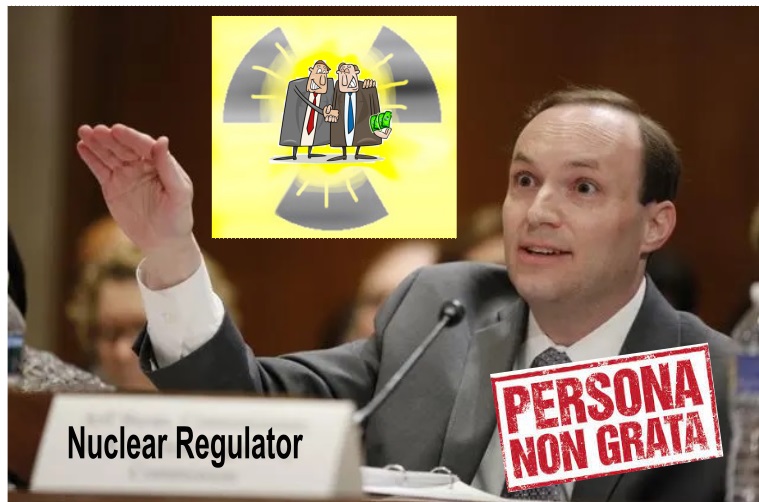
“We killed this nomination,” said Ted Nordhaus, executive director of the Breakthrough Institute, a California-based climate think tank that advocates for more nuclear energy.
Biden Drops Nuclear Regulator Nominee After Senate Backlash
Alexander C. Kaufman, Tue, 23 January 2024 https://au.news.yahoo.com/biden-drops-nuclear-regulator-nominee-190521226.html
President Joe Biden is dropping his pick to fill the open seat on the Nuclear Regulatory Commission after a handful of Democrats joined Senate Republicans to block the nomination last year, HuffPost has learned.
Jeff Baran had held a seat on the five-person federal panel overseeing atomic energy and radiation safety since former President Barack Obama first named to the position in 2014. The Democratic commissioner easily won Senate approval when former President Donald Trump renominated him in 2018.
But pro-nuclear advocates angry over what they saw as Baran’s unwillingness to overhaul the regulatory process in favor of building new types of reactor technologies launched a campaign against the commissioner last year. With Republicans opposed to the nomination, the Biden administration needed almost every Democrat in the Senate to vote for Baran ― or leave the NRC without a tie-breaker for party-line votes between the four current commissioners.
The White House had wanted the Senate’s narrow Democratic majority to reconfirm Baran before his term ended last July. But as many as four senators on the Democratic side, including Sen. Joe Manchin (D-W.Va.) and Sen. Kyrsten Sinema (I-Ariz.), either planned to come out against Baran or refused to pledge their votes, according to a source with knowledge of the process. Neither senator’s office immediately responded to emails requesting comment on Monday.
When the Senate ended 2023 last month without a vote, the nomination automatically went back to the White House.
The NRC directed HuffPost’s questions about when the administration would name its nominee for the open commission seat to the White House, which did not respond to a request for comment.
But three sources with knowledge of the plans confirmed to HuffPost that the Biden administration does not plan to nominate Baran again. Two spoke to HuffPost on condition of anonymity because they were not authorized to comment publicly. The third claimed Baran’s loss as a victory.
“We killed this nomination,” said Ted Nordhaus, executive director of the Breakthrough Institute, a California-based climate think tank that advocates for more nuclear energy.
He was among the most vocal opponents of Baran’s nomination, and helped drum up votes against the Democratic commissioner. Nordhaus had cast Baran as a holdover from an earlier era of liberal regulators who saw their job primarily as safeguarding the public against the atomic energy industry.
“It is my job to focus on nuclear safety and security,” Baran said in 2017 at his reconfirmation hearing before the Senate Environment and Public Works committee. “It is not my job to weigh in on the pros and cons of the merits of nuclear power.”
That view, Nordhaus said, was common among Democrats for decades. But a modern outlook on nuclear safety has to consider not only the threats of using atomic energy, but the risks that not doing so increases pollution from fossil fuels that damages lungs and traps heat in the planet’s atmosphere.
“Everyone went into this just assuming everybody would line up behind Baran, that this is just the kind of guy Democrats put on the commission,” Nordhaus said.
“The fact that enough Democratic senators were willing to say we’re not going to vote for this guy,” he added, “it’s pretty clear that for the first time in maybe ever a bunch of Democrats now recognize that we need reform at the NRC, that something has to change, that the technology can’t succeed if the NRC continues to approach this in the way it historically has.”
But Baran had defenders. The progressive pro-nuclear group Good Energy Collective previously told HuffPost Baran had a strong record of fighting for environmental justice and building relationships with communities saddled with radioactive pollution from the past.
Biden Has Started Another US War
CAITLIN JOHNSTONE, Jan 22 2024, https://www.caitlinjohnst.one/p/biden-has-started-another-us-war?utm_source=post-email-title&publication_id=82124&post_id=140915473&utm_campaign=email-post-title&isFreemail=true&r=1ise1&utm_medium=email
The Washington Post has an article out titled “As Houthis vow to fight on, U.S. prepares for sustained campaign,” with “sustained campaign” being empire-speak for a new American war.
“The Biden administration is crafting plans for a sustained military campaign targeting the Houthis in Yemen after 10 days of strikes failed to halt the group’s attacks on maritime commerce, stoking concern among some officials that an open-ended operation could derail the war-ravaged country’s fragile peace and pull Washington into another unpredictable Middle Eastern conflict,” the Post reports.
The Post acknowledges that “sustained military campaign” means “war” in the ninth paragraph of the article, saying the anonymous US officials cited in the report “don’t expect that the operation will stretch on for years like previous U.S. wars in Iraq, Afghanistan or Syria.” Which is about as reassuring as a pyromaniac saying he doesn’t expect he’ll be burning down any more houses like all those other houses he’s burned down.
This bizarre refusal to just call a war a war also appeared in a recent press conference with Pentagon spokesperson Sabrina Singh, who acted shocked and aghast that reporters would even ask if repeatedly bombing a country would qualify as being at war with them.
“Is it now fair to say that the U.S. is at war in Yemen?” Singh was asked by a Reuters reporter on Thursday.
“No, we don’t seek war,” Singh replied. “We don’t think that we are at war. We don’t want to see a regional war. The Houthis are the ones that continue to launch cruise missiles, antiship missiles at innocent mariners, at commercial vessels that are just transiting an area that sees, you know, 10 to 15 percent of world’s commerce.”
In a follow-up several questions later, Singh was asked by a reporter from Politico, “You said that we are not at war with the Houthis, but if — you know, this tit-for-tat bombing — we’ve bombed them five times now. So if this isn’t war, can you just explain this a little — a little bit more to us? If this isn’t war, what is war?”
“Sure, Lara, sure, great question, I just wasn’t expecting it phrased exactly that way,” Singh replied with a laugh and a smirk. “Look, we are — we do not seek war. We are — we do not — we are not at war with the Houthis. In terms of a definition, I think that would be more of a clear declaration from the United States. But again, what we are doing and the actions that we are taking are defensive in nature.”
It is worth noting that since that Thursday press conference the number of US strikes on Yemen has increased from five to seven as of this writing.
It is also worth noting here that, per Singh’s absurd definition, the US has not been at war since the end of WWII, as there has not been a “clear declaration of war” since June 5, 1942. The only wars the US has officially declared through congress in accordance with its own constitution have been the War of 1812, the Mexican-American War, the Spanish-American War, and the two world wars.
If you go by this definition the US is among the more peaceful nations in the world, since it hasn’t been at war in eight decades. In reality the US is the single most warlike and murderous nation of modern times with wars of aggression that have killed millions and displaced tens of millions just in the 21st century alone, and plays some role in most of the world’s major international conflicts.
Singh’s claim that the US attacks on Yemen are “defensive in nature” is also self-evidently absurd; Yemeni forces weren’t even attacking American commercial vessels until the US began attacking them. Only the US could launch unprovoked attacks on a foreign nation on the other side of the planet and call it self-defense.
Antiwar’s Dave DeCamp explains:
Indeed, the only reason Houthi forces began attacking ships in the Red Sea was to pressure Israel and its allies into ceasing the ongoing massacre that has been taking place in Gaza since October 7. As usual the world’s most murderous and powerful government is framing its horrifying acts of extreme aggression as innocent defensive responses to unprovoked attacks, when in reality the US empire is bombing Yemen in order to facilitate the genocide of Palestinians.
And while we’re on the subject of Gaza and Yemen it’s probably worth pointing out that according to US empire managers the stated goals of both campaigns have been completely unsuccessful. A new report by The Wall Street Journal says that according to US intelligence Israel is nowhere remotely close to eliminating Hamas, with only 20 to 30 percent of the group having been killed since October. Asked by the press on Thursday if the strikes against the Houthis are working, Biden replied “Well, when you say ‘working’ — are they stopping the Houthis? No. Are they going to continue? Yes.”
“Before the US began bombing the Houthis, Ansar Allah officials made clear they would only stop attacking Israeli-linked commercial shipping if the onslaught on Gaza ended. Instead of pressuring Israel to end the slaughter in Gaza, President Biden chose escalation, and now the Houthis are targeting US commercial shipping, and several US merchant vessels have been hit with missiles.”
So they’re raining military explosives on impoverished middle easterners to maintain their status quo domination, under the pretense of goals which they themselves admit are not being achieved. Just another day in the empire, I guess.
1 This Month

of the week – Shut Down Drone Warfare!


Tell the Ukrainian Government to Drop Prosecution of Peace Activist Yurii Sheliazhenko

Petition to revoke the licensing of the Near Surface Nuclear Disposal Facility (NSDF) at Chalk River. https://www.ourcommons.ca/petitions/en/Petition/Details?Petition=e-7247
To see nuclear-related stories in greater depth and intensity – go to https://nuclearinformation.wordpress.com
-
Archives
- April 2026 (79)
- March 2026 (251)
- February 2026 (268)
- January 2026 (308)
- December 2025 (358)
- November 2025 (359)
- October 2025 (376)
- September 2025 (257)
- August 2025 (319)
- July 2025 (230)
- June 2025 (348)
- May 2025 (261)
-
Categories
- 1
- 1 NUCLEAR ISSUES
- business and costs
- climate change
- culture and arts
- ENERGY
- environment
- health
- history
- indigenous issues
- Legal
- marketing of nuclear
- media
- opposition to nuclear
- PERSONAL STORIES
- politics
- politics international
- Religion and ethics
- safety
- secrets,lies and civil liberties
- spinbuster
- technology
- Uranium
- wastes
- weapons and war
- Women
- 2 WORLD
- ACTION
- AFRICA
- Atrocities
- AUSTRALIA
- Christina's notes
- Christina's themes
- culture and arts
- Events
- Fuk 2022
- Fuk 2023
- Fukushima 2017
- Fukushima 2018
- fukushima 2019
- Fukushima 2020
- Fukushima 2021
- general
- global warming
- Humour (God we need it)
- Nuclear
- RARE EARTHS
- Reference
- resources – print
- Resources -audiovicual
- Weekly Newsletter
- World
- World Nuclear
- YouTube
-
RSS
Entries RSS
Comments RSS
 nuclear-news