HOW BIDEN’S STATE DEPARTMENT CONCEALS ITS “HUMAN RIGHTS BLACK HOLE” IN THE MIDDLE EAST
At a key meeting, U.S. stage management stops the world from hearing critics of Israel’s war on Gaza.
Jon Schwarz, December 12 2023, https://theintercept.com/2023/12/12/universal-declaration-of-human-rights-state-department/?fbclid=IwAR3RvuNtk5azWxFu4KHGXg4zyZmA4dVF724kTpsKCcMOiiy4ScuWLkYYulQ
LAST WEEK, Secretary of State Antony Blinken hosted a meeting with leaders of human rights organizations to mark the 75th anniversary of the adoption of the Universal Declaration of Human Rights by the United Nations. But through subtle stage management, the State Department arranged for Blinken’s praise for human rights to be recorded and promulgated — while the world was not able to hear the retorts from human rights advocates who criticized America’s backing of Israel’s war on Gaza.
The Universal Declaration was a landmark in history. While it was only a statement of principles, and so did not have legal force in itself, it was broadly inspirational and has formed the basis for numerous subsequent treaties and laws. According to Guinness World Records, it’s been translated into more languages than any other document — over 550, from Abkhaz to Zulu.

After the December 7 meeting, the internet exploded in bitter laughter at Blinken, and it’s easy to understand why. At the start of the meeting at the State Department, Blinken informed the assemblage that “the universality of human rights is under severe challenge and rights are being violated in far too many places … And of course we see atrocities in the midst of conflict.” Yes, of course. Just one day later, on December 8, the U.S. vetoed a resolution at the U.N. Security Council calling for a ceasefire in Israel’s war on Gaza.
Notably, the Universal Declaration states that “everyone has a right to a nationality.” The Universal Declaration was adopted on December 10, 1948, one day before U.N. Resolution 194 was passed. Resolution 194 famously stated that, in the wake of the establishment of Israel earlier that year, Palestinian refugees “wishing to return to their homes and live at peace with their neighbors should be permitted to do so at the earliest practicable date.” This anniversary has not been commemorated with an event at the State Department.
Indeed, the whole process with Blinken was as distastefully funny as the Russian government’s own recent celebration of the Universal Declaration’s anniversary, in which it spoke of its deep concern over “the human rights situation in Ukraine.” This is where the U.S. government’s stage management comes in.
There were four human rights organizations in attendance, all represented by their top officials: Amnesty International (Agnès Callamard), Human Rights Watch (Tirana Hassan), the Committee to Protect Journalists (Jodie Ginsberg), and Freedom House (Michael Abramowitz).
We know this because all four leaders appeared in the above photo happily tweeted out by Blinken himself. And all four groups confirmed their presence to The Intercept. But when asked, the State Department refused to name who was in attendance because, it explained, this meeting took place in a “private setting.”
In addition to the photo provided by Blinken, you can watch a video of this private setting on the State Department’s publicly available website. At 0:59, as Blinken natters on, you can see one of his bored functionaries glancing at his watch.
What actually happened is that, as the Committee to Protect Journalists puts it, “the State Department made clear that Secretary Blinken wanted to make a statement on the record but the meeting was private.”
In other words, the U.S. government insisted that there be a public section of the meeting at the start, in which Blinken spoke and the human rights leaders would be photographed listening to him. Then, these photographs and Blinken’s words were distributed to the world. But the human rights leaders’ words were not.
Asked about his own experiences in such situations, Kenneth Roth, Hassan’s predecessor as head of Human Rights Watch, says that “there is nothing inherently wrong with having an off-the-record meeting with government officials … but it is odd for the Biden administration to mark the 75th anniversary of the Universal Declaration with an off-the-record meeting.” Roth explains that the Universal Declaration had modest influence in the decade after its adoption because it was considered undiplomatic for governments to criticize others by name. However, that changed in the 1960s and 1970s. “A commemoration of the Declaration that embraced what has made the document so impactful,” Roth contends, “would have been an on-the-record meeting in which abusive governments were unabashedly singled out by name.”
Human Rights Watch and Freedom House both declined to provide any details about what their officials told Blinken, stating that the post-photo op section of the meeting was off the record.
However, Amanda Klasing, Amnesty International’s national director for government relations and advocacy, did comment. Callamard, she says, “urged Secretary Blinken to seize the current inflection point, be consistent in the US’s attention to human rights, and send the message that human rights apply equally to non-US allies and to its closest friends. She made clear that this is especially urgent today, as Amnesty International has documented that the government of Israel – one of the US’s closest allies – is flagrantly violating international humanitarian law in its attacks on Gaza. She urged him to see the need for an immediate ceasefire and a stop to the transfer and sale of arms to the government of Israel in the existing context.”
The Committee to Protect Journalists was also willing to describe its leader’s remarks. According to CPJ, Ginsberg “most certainly brought our full-range of deep and urgent concerns regarding journalists in Gaza. The ongoing disaster is a top priority for us. Ginsberg underscored that more than 60 journalists have been killed (the vast majority Palestinians in Gaza), the increasingly difficult conditions, and the broader clampdown on the press and arrests including the West Bank. Notably, we strongly reiterated our demand for accountability in the likely targeting of journalists in southern Lebanon. In doing so, we stated our deep concern that the pattern of journalists being killed with impunity by the Israel Defense Forces is a long one.”
Roth, for his part, adds that “we don’t need another symbol of the Biden administration’s commitment to human rights. … A more meaningful way to celebrate the Universal Declaration would have been to visibly enforce it in the human rights black hole that the Middle East has largely become for the Biden administration.”
In a nice touch by the State Department, the meeting was held in its Thomas Jefferson State Reception Room, so the participants were overseen by both a statue and a painting of Jefferson. Jefferson was America’s first secretary of state, as well as the author of the Declaration of Independence — in some ways the progenitor of the Universal Declaration of Human Rights. Jefferson also enslaved 600 people over his lifetime and raped his dead wife’s half-sister, whom he owned. He thus is perhaps America’s greatest exemplar of our history of soaring rhetoric combined with a much grimier reality.
INTERNS ACCUSE CONGRESS OF SUPPRESSING CALLS FOR CEASE-FIRE
Poplsr Resistance, By Molly Redden, HuffPost., December 14, 2023, Resist!
The Workers In 71 Congressional Offices Have Recorded A Total More Than 690,000 Calls For A Cease-Fire.
But most are “unnoticed and unheard,” an open letter said.
Congressional interns and fellows released a letter on Monday accusing Congress of having “suppressed and ignored” a tidal wave of constituent support for a permanent cease-fire in the Israel-Gaza conflict.
More than 140 interns and fellows signed the letter, and 71 disclosed the number of calls and emails in support of a cease-fire that their offices have recorded. Those 71 offices (out of the total of 535) have received a total of 693,170 messages supporting a cease-fire since Israel’s bombing of the Gaza Strip began in early October.
But in spite of constituents’ outreach, most senators and representatives have refused to publicly support a cease-fire — and privately, the letter said, many senior staffers responsible for briefing members of Congress are downplaying the number and intensity of the calls.
“In some cases, Members of Congress are not being adequately briefed about the volume or contents of these messages,” the letter says. “In several instances, senior staff have deliberately provided inaccurate information about these data to Members. In other cases, Members have willfully ignored the pleas of large swaths of their constituents.”
Congressional phone lines have been clogged with calls for a cease-fire almost since the very start of hostilities, staffers have previously reported………………
The indiscriminate nature of the retaliation, coupled with the Biden administration’s steadfast support for its closest military ally, has sparked nationwide protests in the U.S. and profound outrage among many of the president’s own voters.
“While we refrain from telling our bosses how to do their jobs, as congressional interns and fellows, we owe it to the American people to expose the patent malpractice of Congress,” the letter says. “We can no longer stand by while the voices of constituents are suppressed and ignored by their elected officials.”
The letter came together after interns and fellows in several offices witnessed senior staff downplaying the number of calls and emails supporting a cease-fire, one of the letter’s organizers told HuffPost. In his office, a senior staffer quoted a number to the congressman that was 3,000 less than the actual number of callers, the organizer said.
“It’s very deliberate,” he said. “They see these overwhelming numbers, and they decrease it.”
Letter To Congress…………………………………………………………..
Signers of the letter work in Democratic and Republican offices and are remaining anonymous out of fear of career retaliation. The organizers, who spoke with HuffPost on the condition they not be named, verified the identities of those who signed.
Because interns answer the vast majority of constituent calls, many of those who signed the letter have personally fielded thousands of calls from constituents demanding a cease-fire.
“Out of the tens of thousands of calls made to our office, one in particular stood out to me: A constituent called in tears to share that her husband’s family had been killed in a hospital bombing in Gaza,” wrote one of the letter’s signers. “She had pleaded with me to change the Member’s stance on the war.”………………………………….. more https://popularresistance.org/interns-accuse-congress-of-suppressing-calls-for-cease-fire/
Why can’t the US ever say no to Israel?
The American UN veto on a Gaza ceasefire is a low point of wag-the-dog international politics
Rt.com, Tarik Cyril Amar, 13 Dec 23
December 8, 2023, is a day that will live in infamy. The United States made history of the worst kind by using its permanent seat on the UN Security Council to veto a resolution calling for an immediate ceasefire in Gaza. The resolution was advanced by the United Arab Emirates (a US partner) and supported by more than 90 member states. It also had preponderant backing in the global organization’s privileged “upper chamber,” the Security Council, where 13 of its 15 members were in favor (while the UK abstained, abdicating its sovereignty to the US, again).
The American veto directly defied UN Secretary-General Antonio Guterres. Not a natural-born rebel, the UN chief had deployed a rarely used procedure to promote the ceasefire, putting his authority on the line. Referring to Article 99 of Chapter 15 of the UN Charter, he already implied that “international peace and security” were in danger. His spokesperson was explicit that Guterres was making a “dramatic constitutional move.” While maintaining diplomatic balance by also highlighting the Hamas attack on Israel, Guterres’ letter to the Security Council depicted the catastrophic suffering of the Palestinians under the ongoing Israeli attack and concluded that “nowhere” was safe in Gaza.
All to no avail. The US could not be swayed and maintained its de facto unconditional support for Israel, even while the latter is conducting an intensifying genocidal assault on Gaza and its civilian population. This is no longer up for debate, and is no secret either; Israeli leaders have repeatedly made statements that signal the kind of intent that is a crucial element in the crime of genocide, while their actions and those of their forces on the ground speak even louder than their words.
The world has taken note. It took no special bias for the Palestinian leadership – the one derived from the PLO, as well as Hamas – to identify the veto as “disastrous” and “a disgrace and another blank cheque given to the occupying state to massacre, destroy and displace.” China and Russia have denounced American double standards and the “death sentence” Washington has handed down on future Palestinian victims of the Israeli assault.
Amnesty International says Washington has “brazenly wielded and weaponized its veto to strongarm the UN Security Council… undermining its credibility” and displaying a “callous disregard for civilian suffering in the face of a staggering death toll.” Doctors without Borders did not mince its words either, accusing the US of standing “alone in casting its vote against humanity,” with America “complicit in the carnage in Gaza” and undermining not only its own credibility but also that of international humanitarian law.
Craig Mokhiber – an authority on international law and former head of the UN High Commissioner for Human Rights office in New York – tweeted that “on the eve of the 75th Anniversary of the Genocide Convention, the US has again vetoed a ceasefire in the UN Security Council… demonstrating its further complicity in the #genocide in #Palestine.”
This list of censure and condemnation could be prolonged almost ad infinitum, especially if we add voices from the Global South. The key point, however, should be clear already: The US stands isolated and disgraced by its very own, easily avoidable – or so it would seem – decision. This was, after all, not a vote asking for justice and restitution for the victims, or – perish that radical thought! – for prosecution of the perpetrators. All this was about was the barest of bare minimums, just a ceasefire, not even a peace deal. Still, that was too much to ask of the US……………………………..
Future historians will ask how this happened. How could the single most powerful nation in the world, which claims to lead not only by force but by “values,” side with the Israeli perpetrators of such an outrageous and open crime, while openly contravening much of the international community? Some will even ask the more cynical question how America, even if its elites are entirely bereft of ethics, could do so much harm to itself.
The simplest, almost technical answer to that question has to do with a historical irony. America owes its veto power – as one of the five permanent members of the Security Council – to what happened in World War II. And while World War II and the German Holocaust against the Jews of (mostly) Europe are not the same, they are part of the same history. Much US pride has been invested in being among the powers that brought down the Holocaust perpetrator state Germany. And yet, here we are: The same US is now using that very veto not only to shield another genocidal state but to help it continue its crime.
There are, of course, broader reasons for this great American failure. Many have been discussed before. Israel serves the function of an enforcer and imperial outpost in the Middle East and sometimes beyond. As current US President Joe Biden – by now often trending on X as #GenocideJoe – stated in 1986, when still an ambitious and pandering senator, if there were no Israel, America would have to invent one. Let’s set aside that even the callous realpolitik behind such thinking is flawed: If it ever was an asset, Israel is turning into a liability. Let’s just note that the American elite claims to believe that Israel is so useful that the commitment to it must be, in Vice President Kamala Harris’ words, “ironclad.”
But so it was for Ukraine only, as it were, yesterday. And yet Kiev is about to be dropped, as so many US clients before. What makes Israel different? Clearly, it is the long-standing top recipient of US financial and military support. Is it sunk cost fallacy then? Is America so over-committed to Israel that it simply won’t walk away?
Yet that hypothesis does not explain the striking one-sidedness of the US-Israel relationship. If there has ever been a case of wag-the-dog, this is it: One thing that the American veto on the Gaza ceasefire resolution shows is that it is Israel that is dominating US foreign policy, not the other way around. Otherwise, Washington would have sought to find a compromise between preserving its own credibility and interests by allowing at least this very modest resolution to pass, while still supporting Israel in multiple other ways.
Clearly, one thing that is determining this American dependence on another, much smaller country is the massive success of lobbying and foreign influence operations on behalf of Israel. Indeed, it is Israel that has run the most invasive and effective such attack on US politics in history. And for the avoidance of any misunderstandings: Noting this obvious fact has nothing to do with “anti-Semitism.” Indeed, trying to smear those who dare bring it up with that accusation is part of how that influence operation works. It’s time to entirely disregard such cheap tricks.
………………………………………………………………. If only we could return, at least, to a world where Americans could forget a little about their Russia obsession when thinking about foreign influence on their country and focus that concern where it matters, namely on Israel. If in addition they could think a little more about Russia as a viable partner – at least occasionally – in helping resolve severe international crises, we would all be much better off. We might even be able to stop a genocide here or there. https://www.rt.com/news/588952-us-israel-un-veto/
Bernie Sanders Votes No on Giving Israel Aid to Continue ‘Inhumane War’ on Gaza
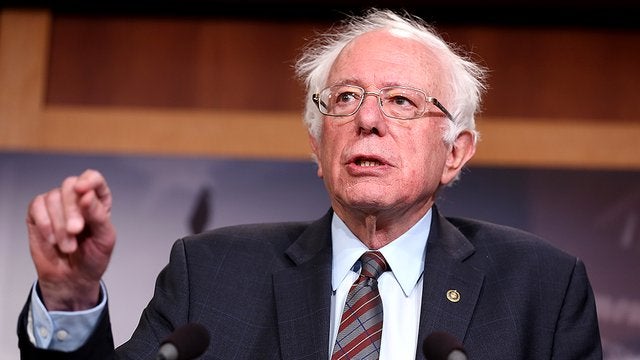
“I do not believe that we should give the right-wing extremist Netanyahu government an additional $10.1 billion with no strings attached.”
By Jake Johnson / Common Dreams, more https://scheerpost.com/2023/12/13/bernie-sanders-votes-no-on-giving-israel-aid-to-continue-inhumane-war-on-gaza/
Sen. Bernie Sanders was the lone member of the Senate Democratic caucus to oppose advancing a $110.5 billion supplemental foreign aid measure on Wednesday, expressing opposition to the bill’s unconditional military assistance for the Israeli government.
“I voted NO on the foreign aid supplemental bill today for one reason,” Sanders (I-Vt.) said in a statement. “I do not believe that we should give the right-wing extremist Netanyahu government an additional $10.1 billion with no strings attached to continue their inhumane war against the Palestinian people.”
“Israel has the absolute right to defend itself against the Hamas terrorists who attacked them on October 7,” Sanders added. “They do not have the legal or moral right to kill thousands of innocent Palestinian men, women, and children.”
The aid package, which also includes billions in military assistance for Ukraine, failed to clear a procedural hurdle Wednesday, with every Republican voting no over the absence of immigration policy changes that progressives have condemned as draconian. Senate Majority Leader Chuck Schumer (D-N.Y.) flipped his initial yes vote to no in a maneuver that will allow him to bring the bill forward again at a later date.
According to a summary released by the Senate Appropriations Committee, the supplemental package contains over $10 billion in military aid for Israel, which already receives roughly $4 billion in assistance from the U.S. per year and has gotten tens of thousands of bombs, artillery shells, and other weaponry since the Hamas-led October 7 attack.
The measure is largely in line with a request issued in October by the Biden White House, which has sought to expedite U.S. arms shipments to Israel even as the nation’s military is using American-made weaponry to commit heinous war crimes in the Gaza Strip.
One human rights monitor estimated earlier this week that at least 90% of the people killed by Israeli forces in Gaza since October 7 have been civilians.
Sanders, who has faced progressive criticism and outrage for rejecting calls for a permanent cease-fire in Gaza, said in a Senate floor speech on Monday that Israel “must dramatically change its approach to minimize civilian harm and lay out a wider political process that can secure lasting peace.”
The senator conceded during his remarks that there is no evidence Israel has altered its approach in response to light pressure from top U.S. officials, pointing to recent bombings of United Nations schools and other civilian infrastructure.
“Israel’s indiscriminate approach is, in my view, offensive to most Americans, it is in violation of U.S. and international law, and it undermines the prospects for lasting peace and security,” said Sanders.
Wins, losses and participation trophies for US nuclear power in 2023
From the long-awaited commissioning of Vogtle 3 to the NuScale pilot’s collapse, here are the biggest wins and losses for nuclear from this year.
By Eric Wesoff, 12 December 2023, https://www.canarymedia.com/articles/nuclear/wins-losses-and-participation-trophies-for-us-nuclear-power-in-2023
With this bumpy year for nuclear coming to a close and the world’s energy stakeholders having just gathered for the most nuclear-focused COP meeting ever, it’s a good time to assess the state of atomic power in the U.S.
Government pledges and consumer support for nuclear power in the U.S. have surged in recent years. Armed with this newfound policy support and financing, the relatively stagnant U.S. nuclear industry now has to start executing on its ambitious plans if the fuel is to play a meaningful role in decarbonizing the energy system.
So how did the U.S. nuclear sector fare in 2023? Here’s a list of its major wins and its losses.
A win on the world stage: Dubai hosts the first “nuclear COP”

More than 20 countries including the U.S., France, Japan and the U.K. pledged to triple global generation from nuclear energy by 2050 during this year’s COP28 global climate meeting in Dubai. Hitting that goal would require the world to install an average of 40 gigawatts of nuclear every year through 2050; presently, that annual installation figure is closer to 4 gigawatts.
Nuclear has received scant attention at previous COP meetings due to its financial challenges and the thorny issue of managing spent fuel, so the pledge is a marked departure from the policy status quo. All of this was enough to make this the year of the “nuclear COP.”

And although it’s a global pledge, President Biden’s climate envoy John Kerry helped spearhead the declaration, indicating the increasing embrace of nuclear power at the highest echelons of U.S. climate policy. Kerry said that the science has proven “you can’t get to net-zero 2050 without some nuclear.”
Participation trophy for Georgia Power: Vogtle 3 connects to the grid
It’s a bit of a stretch calling Vogtle 3’s long-awaited connection to the grid a “win” after a $16 billion cost overrun and a six-year overshoot of the target launch date, but the Department of Energy was looking forward to a new commercial reactor coming online this year, and the department ultimately did get its wish.
As of July 31, Georgia Power’s 1,100-megawatt Plant Vogtle Unit 3 nuclear reactor is supplying power to the grid — making it the first reactor to enter service since Tennessee’s Watts Bar Unit 2 began operating in 2016. Vogtle 4, a second 1,100-megawatt reactor, is nearing the finish line as well, with operations expected to start in early 2024, according to Georgia Power.

Thanks to then-Secretary Rick Perry, in 2019 the Department of Energy’s Loan Programs Office provided up to $12 billion in loan guarantees to help complete the Vogtle expansion amid a spate of spending freezes and lawsuits. The project generated more than 9,000 jobs during peak construction and will provide an additional 800 permanent jobs at the facility once fully operational.
Dan Yurman, publisher of Neutron Bytes, a blog on nuclear power, offered Canary Media this explanation for Vogtle’s major cost and schedule overruns: “The utility and the vendor kicked off a massive infrastructure project with major unaddressed risks in terms of supply chain, labor force skills, regulatory compliance and a 30-year gap in know-how to build large nuclear power plants. It is no surprise that the first-of-a-kind AP1000s came in at twice the cost and double the estimated time to complete them.”

The nuclear industry can call this a win — if it can learn from Vogtle and begin to remedy the missteps called out by Yurman.
A financial win: Nuclear funding and government support

The U.S. government is putting its money where its mouth is when it comes to supporting nuclear power: The (barely) Bipartisan Infrastructure Law added $3.2 billion for development of modular and advanced nuclear reactors, and the U.S. Department of Energy’s Loan Programs Office has devoted $11 billion in loan-making authority for advanced reactors and supply chains. What’s more, the epochal Inflation Reduction Act devotes $700 million to the HALEU Availability Program to support the development of a non-Russian supply of high-assay low-enriched uranium.
Additionally, the IRA offers a preposterously generous $15 per megawatt-hour production tax credit meant to keep today’s existing nuclear fleet competitive with gas and renewables, as well as a similarly generous investment tax credit to incentivize new plant construction.
Losing the global nuclear crown: China is sprinting ahead of the U.S. on nuclear
America has the world’s biggest nuclear power fleet at 93 reactors, but it’s on its way to losing that distinction.
China has built 37 new reactors over the last decade for a total of 55, according to the International Atomic Energy Agency. America has added a grand total of two reactors during that same period. China also aims to double its nuclear energy capacity by 2035, and it is well on its way; it has 22 nuclear plants currently under construction with more than 70 in the planning stages.
Outside of Vogtle 4, it’s unclear when — or if — another nuclear reactor will be connected to the U.S. grid.
And despite small modular reactors being held up as a cure-all to the U.S. nuclear industry’s significant challenges, the only country in the world that has actually built an SMR is China. It demonstrated a pair of smallish high-temperature, gas-cooled reactor units using a “pebble-bed” design and a more concentrated fuel format last year.
Notably, China is not a participant in the COP28 nuclear pledge — an ironic development as it’s the only country with any real chance of meeting the goal of tripling its capacity by 2050.
Huge win, disappointing loss for SMRs: NuScale’s ups and downs

The nuclear gods are fickle creatures. Small modular reactor pioneer NuScale Power made history in January 2023 when it scaled the highest regulatory peak in the U.S.: The Nuclear Regulatory Commission certified the design of its 50-megawatt module, the first small modular reactor and only the seventh reactor design ever approved for use in the U.S.
This was a long-fought victory for NuScale and advocates of SMRs: Utilities and developers can now reference NuScale’s SMR design when applying for a license to construct and operate a reactor. NuScale and the DOE spent more than 10 years and hundreds of millions of dollars to reach this regulatory milestone.
Armed with this historic design certification, NuScale landed a promising inaugural customer in the Utah Associated Municipal Power Systems and began working on a deployment near the Department of Energy’s national laboratory in Idaho. Project plans had called for one 77-megawatt unit to begin operation in 2029.
The Idaho project was once widely predicted to be not only the first small module reactor completed in the U.S., but the next nuclear reactor to be built in the country, period. However, it was not to be so.
The project was ultimately scrapped in November because it couldn’t secure enough subscriptions from utilities in the Western U.S. to make the project work financially.
The innovative SMR aspirant still has a pipeline of tentative agreements to deploy reactors across North America, Europe and the Middle East.
Win for domestic HALEU fuel: Bringing uranium enrichment capabilities back to the U.S.

Call this one a win because, for the first time in 70 years, America is home to a U.S.-owned enrichment facility producing the concentrated fuel needed by the many advanced reactors now in development.
Centrus, a company with roots in the Manhattan Project, began demonstration-scale enrichment operations at its facility in Piketon, Ohio in October. It marks the potential rebirth of a once-strong American enrichment industry. America was once the only source of uranium enrichment outside of the Soviet bloc, but over the last 30 years, it has surrendered that role to Russia and other countries.
The HALEU produced in Centrus’ centrifuges will be used to test new fuels and reactor designs, as well as to fuel the cores of the two demonstration reactors funded through the Bipartisan Infrastructure Law and supported by DOE’s Advanced Reactor Demonstration Program.
The U.S. currently depends on Tenex, part of Russian state-owned nuclear supplier Rosatom, to supply the low-enriched uranium fuel that’s used in our civilian fleet. And Russia (which is not blockaded on nuclear fuel exports) supplies all of America’s high-assay low-enriched uranium, the more concentrated material required by the new generation of advanced reactors.
It is a precarious situation for U.S. national and energy security.
The DOE is looking to jump-start the domestic market by directing IRA funding toward enrichment and fuel-processing facilities like Centrus’ plant in Ohio, as well as by acting as the initial customer, creating an inventory and providing a reliable customer and price.
It’s a win for the U.S., but it comes after years of stepping on rakes.
A win for preserving the existing nuclear fleet: Diablo Canyon lives on

Pacific Gas & Electric, one of the three large investor-owned utilities in California, decided to decommission both of the reactors at California’s Diablo Canyon Nuclear Power Plant in 2017.
But public outcry, political pressure and worries about grid failures seem to have helped get the plant’s operations extended an additional five years with the help of a state loan and up to $1.1 billion through the federal Civil Nuclear Credit Program designed to support economically ailing plants. It’s a win for California nuclear advocates and the emissions of the state’s grid.
PG&E has now filed an application with the Nuclear Regulatory Commission for a 20-year operating extension for the two 1,150-megawatt reactors at Diablo Canyon, which will trigger a review process expected to take a minimum of two years.
The U.S. nuclear fleet is the largest in the world, but it’s also one of the oldest: The average age of an American nuclear reactor is 42 years, compared to a world average of 31 years.
The majority of nuclear plant operators in the country have expressed interest in extending their operating licenses to allow operation up to 80 years, according to a poll of member utilities of Nuclear Energy Institute, a trade organization.
But even with such extensions, these older plants would all need to be replaced by around 2060, and nuclear power’s long lead times mean that decisions will have to be made about replacing their generation capacity in the late 2030s.
Neither a win nor a loss: Action in advanced reactors and microreactors
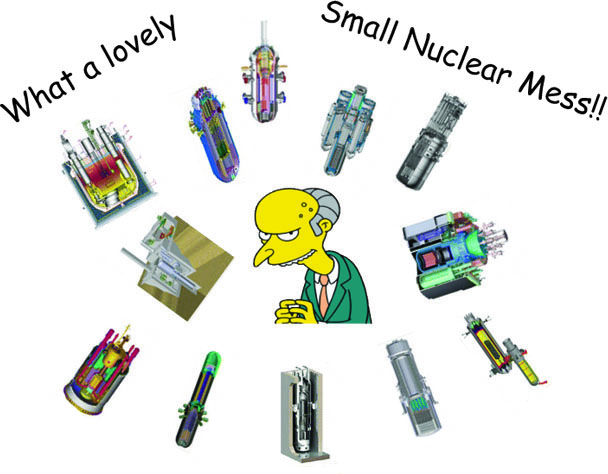
Encouraged by government funding, shifting societal sentiment and a cornucopia of new reactor designs, 2023 witnessed a raft of startups and established vendors making deals in the U.S. and abroad to build next-generation nuclear reactors.
Microreactors like Oklo’s 15-megawatt fast breeder reactor, Aalo Atomics’ 20-megawatt thermal design based on the Marvel reactor at Idaho National Labs, and Westinghouse’s 5MWe eVinci design are intended to provide electrical power and heat in remote or behind-the-meter industrial applications. Ultra Safe Nuclear has plans to construct a microreactor facility in Gadsden, Alabama. The Department of Defense’s Strategic Capabilities Office’s Project Pele program is looking to build and demonstrate a 1–5 MWe mobile, high-temperature, gas-cooled microreactor capable of powering U.S. military bases.
But none of these designs are approved by the Nuclear Regulatory Commission.
For its part, the DOE is betting big on TerraPower and X-energy, with the agency’s Advanced Reactor Demonstration Program providing initial funding of $80 million to each, along with future cost-sharing funds. These two demonstration projects are poised to use HALEU from Centrus’ newly commissioned 16-centrifuge cascade.
TerraPower, founded by Microsoft co-founder Bill Gates, is developing a 345-megawatt sodium-cooled fast reactor coupled with a molten salt energy storage system. The company has raised $750 million to build its operating demonstration reactor in Wyoming.
X-energy is developing its high-temperature gas-cooled advanced small modular reactor and plans the initial deployment at a Dow Chemical facility in Texas.
These reactor designs also are not approved by the NRC.
Despite the proliferation of tentative agreements, memorandums of understanding and handshake deals, all of these planned reactors — with the possible exception of NuScale’s — fall into the famous “paper reactor” category — meaning they are simple, light, small, cheap and quick to build. Importantly, they are also never actually going to be built.
Grand plan to triple nuclear energy with small nuclear reactors, but where’s the funding?

1 US nuclear start-ups battle funding challenge in race to curb emissions.
Reactors pioneered by Oklo, X-energy and NuScale suffer financing setbacks
as well as regulatory headwinds.
US plans to build up its nuclear industry
face big funding and regulatory challenges which could delay a new
generation of smaller, more efficient reactors touted by advocates as
critical to fighting climate change.
Industry experts told the Financial
Times a declaration signed last week by Washington and 21 other nations at
the COP 28 climate summit to triple the amount of installed nuclear energy
by 2050 was a step forward, given the sector’s ability to provide
(?)emissions-free power.
But a sharp fall in market support for start-ups
developing so-called small modular reactors and other advanced nuclear
facilities threaten US ambitions, they said. Last month NuScale Power Corp
cancelled plans to build the first SMR in the US, despite receiving $1.4bn in government cost-sharing pledges.
Not enough power utilities expressed an
interest in purchasing electricity from the facility in Idaho when NuScale
increased power prices by more than 50 per cent over two years to $89 per
megawatt hour. The setback followed the collapse of a $1.8bn deal agreed
between X-energy and special purpose acquisition company Ares Acquisition,
which was intended to enable the developer of nuclear technologies to go
public.
Now the industry is focused on whether Oklo, a start-up chaired by
OpenAI chief executive Sam Altman, can successfully go public via a
blank-cheque company announced in July with AltC Acquisition Corp. The
merger was proposed at a valuation of $850mn and would provide Oklo with
$500mn to develop and commercialise its reactor design.
FT 12th Dec 2023
https://www.ft.com/content/c0700a01-c1e8-4e5e-8300-ac264bd25293
U.S. Congress passes bill barring imports of Russian uranium for nuclear power, (but this ban can be waived as needed.)

The Hill, BY RACHEL FRAZIN – 12/11/23
The House on Monday passed legislation that would bar imports of Russian uranium for nuclear power plants.
The measure was passed by a voice vote with bipartisan support. Ahead of the voice vote, Republican Rep. Cathy McMorris Rodgers (Wash.) and Democrat Rep. Frank Pallone (N.J.) spoke in favor of the bill.
The legislation would make it illegal to import low-enriched uranium, which is used in nuclear fuel, 90 days after the bill becomes law.
It allows for the prohibition to be waived, however, if there aren’t other viable sources of uranium to sustain nuclear reactors.
According to the Energy Information Administration, the majority of uranium that powers U.S. plants is imported, and about 12 percent of those imports came from Russia in 2022. …………………. https://thehill.com/policy/energy-environment/4354533-house-passes-bill-barring-imports-russian-uranium-nucler-power/
US casts sole vote in UN to continue the annihilation of Gaza

Walt Zlotow, West Suburban Peace Coalition, Glen Ellyn IL ,10 Dec 23
December 8th now makes 2 consecutive calendar Days of Infamy for America. But this one, coming 92 years and a day after the first, is not from an attack on America. It comes from America’s descent into madness, enabling and supporting Israel’s genocidal ethnic cleansing of Gaza after the October 7th Hamas attack on Israel.
The UAE sponsored the UN Security Council resolution demanding an immediate humanitarian ceasefire in Gaza. Within 24 hours they garnered nearly a hundred co-sponsors from the UN’s 193 members. UN Secretary-General Antonio Gutierrez invoked rarely used Article 99 of the UN Charter to bring the resolution to the Security Council for immediate consideration over “threats to international peace and “humanitarian catastrophe in Gaza”.
But the US blocked the resolution with a dastardly veto. Thirteen other members voted for it, including some of America’s staunch allies. Even our most lockstep ally Britain abstained. The US now stands alone in supporting Israel’s campaign making Gaza uninhabitable.
Ministers from Egypt, Jordan, the Palestinian Authority, Qatar, Saudi Arabia and Turkey came to D.C. to plead with Secretary of State Anthony Blinken to support the ceasefire. But Blinken put them off till after the after the UN vote.
When questioned about the devastation in Gaza, Biden, Blinken just nod and mutter something about imploring Israel to try harder not to annihilate all the Palestinians there. Meanwhile Netanyahu tells his war cabinet “We need 3 things from the US: munitions, munitions, and munitions.” And he gets them PDQ
How bad is that annihilation? Roughly 70% of the 70,000 deaths and injuries are women and children. UN chief Gutierrez cited Article 99 for the first time since 1971 in calling the emergency session to address the “humanitarian nightmare Gaza is facing.” He cited endless bombings that have hit 339 schools, 26 hospitals, 56 health care facilities, 88 mosques and three churches.
Besides Gaza being destroyed, President Biden is ensuring that America’s standing in the world is being destroyed as a beacon of peace and freedom.
Yes, mark December 8th on the calendar as another American Day of Infamy.
Besides Gaza being destroyed, President Biden is ensuring that America’s standing in the world is being destroyed as a beacon of peace and freedom.
Yes, mark December 8th on the calendar as another American Day of Infamy.
Is Biden taking the Iran nuclear deal off life support?
If the JCPOA really is dead, as a top State Department appointee declared last week, that’s an own goal for the US and a huge risk for regional security
ELDAR MAMEDOV, DEC 12, 2023, Responsible Statecraft
When Joe Biden was running for U.S. president, he promised to reverse many of his predecessor’s decisions on foreign policy, generally hewing towards more restraint and diplomacy, and less bluster, militarism, and unilateralism. That included restoring the 2015 nuclear deal with Iran known as the Joint Comprehensive Plan of Action (JCPOA) from which Donald Trump withdrew in 2018 — despite evidence, shared even by his own officials, that the deal was delivering on its core objective to block Iran’s pathways to a nuclear weapon. On December 7, 2023, Biden’s nominee for deputy secretary of state, the current National Security Council Coordinator for Indo-Pacific Affairs, Kurt Campbell, effectively declared the JCPOA dead………………………………..
Although the prospects for a revived JCPOA have been dim since at least 2022 — for which Iran carries a fair share of blame — officials from the Biden administration until now have largely refrained from using such threatening language against Iran. Conclusively abandoning any effort to revive the JCPOA does not serve U.S. interests and is in fact counterproductive.
Addressing students at Tehran University a few days after Campbell’s Senate testimony, Iranian Foreign Minister Hossein Amir Abdollahian downplayed the relevance of the JCPOA by reportedly saying that the “more we move forward, the more JCPOA becomes pointless. We will not force ourselves to remain in the narrow tunnel of the JCPOA forever.”
So, the Biden administration finds itself in the rather awkward position of effectively agreeing with Tehran, but this was a self-inflicted problem: by refusing, for three years now, to engage with its critics and the broader public on the agreement’s benefits to the U.S. and global security, it has allowed the notion that the JCPOA was some kind of reward for Iran, rather than a deal that strictly curbed Tehran’s nuclear ambitions, to become conventional wisdom. As is evident in Abdollahian’s remarks, Iranians today certainly do see the JCPOA as a “narrow tunnel” that limits their options………………………………………….
If ever there was a mechanism that would prove effective in preventing Iran from acquiring a bomb, it was the JCPOA. In light of Abdollahian’s remarks (which clearly reflect a growing skepticism about the JCPOA in Iran), the Biden administration, by publicly disowning the deal, is in fact removing obstacles to further Iranian nuclear escalation.
Unless Biden is prepared to accept the advice of the late international relations scholar Kenneth Waltz, who, in an influential 2012 Foreign Affairs article, argued that an Iranian bomb would stabilize the Middle East, it is not clear what his administration would do in place of a revived JCPOA to check additional Iranian nuclear advances.
Campbell emphasized the “current environment” as an additional factor rendering a JCPOA revival infeasible. In fact, if he was referring to the Israel-Hamas war in Gaza, then it is precisely such a conflict that makes some sort of a direct dialogue between Washington and Tehran — on nuclear, but also regional security issues — all the more urgent if a wider war is to be avoided. Substituting such a dialogue with military threats at a moment when the U.S. is providing Israel virtually unconditional support, including the lavish replenishment of its arms stocks, the deployment of marines and two aircraft carrier task forces to the region, and the veto of a U.N. Security Council Resolution calling for a ceasefire, could do more to incentivize Iranians to seek a nuclear deterrent than anything else.
Vows to isolate Iran “internationally and diplomatically” are also unwarranted as Iran, despite its rhetorical support for Hamas, has so far demonstrated considerable restraint. While hardline ideological hostility to Israel is wired into the Islamic Republic’s identity, the actual position Tehran adopted towards the Israel-Palestine conflict is much more nuanced, more in line with the Arab and Islamic (and indeed broad international) mainstream consensus that insists on a viable two-state solution. Instead of building on these shifts, however modest and tentative, Washington seems to prefer to double down on confrontation.
The sad irony is that this explosive situation could have been avoided had Joe Biden had the courage and wisdom to deliver on his own election campaign promise to restore the nuclear agreement with Iran. ………. https://responsiblestatecraft.org/biden-iran-nuclear-deal/
Nebraska team launches study of Congress and nuclear weapons policy

Carnegie Corporation-funded study apparently first comprehensive analysis in three decades
news wise, 11-Dec-2023, by University of Nebraska-Lincoln
Newswise — Nebraska researchers are launching a two-year study of Congress’s involvement in nuclear weapons policy. The study is believed to be the first comprehensive look at the topic in more than 30 years.
Carnegie Corporation of New York recently awarded a $428,000 grant to University of Nebraska–Lincoln political scientists Rupal Mehta, Geoff Lorenz and Ingrid Haas for a multi-method study of Congress and nuclear weapons policy dating back to 1973.
“We believe that this is an important, but missing, piece of the puzzle when it comes to better understanding global nuclear and international security,’” the researchers wrote in their study proposal.
Historically, the president and other executive branch officials have been at the forefront of U.S. nuclear weapons policy, with lawmakers serving a subsidiary role based upon treaty ratification and defense budget allocations. Leaders like U.S. Rep. Don Bacon, R-Neb., an Air Force veteran who serves on the House of Representatives’ Armed Services Committee and U.S. Sen. Deb Fischer, R-Neb., who serves on the Senate’s Armed Forces Committee, often play influential roles in policy decisions based upon personal expertise and constituents’ interest.
“Congress historically has been much more deferential to the president on nuclear policy than on defense policy generally,” said Lorenz, who studies federal lawmaking. “That appears to be changing and so we want to examine the specific factors at play in Congress’s involvement in nuclear arms policymaking.”
Mehta’s work focuses on international security and conflict with a specialization in nuclear nonproliferation and related issues. Haas, a resident faculty member with the university’s Center for Brain, Biology and Behavior, uses theory and methods from political psychology and cognitive neuroscience to better understand American politics and international security.
Events in Washington, D.C., and around the world — such as the partisan battle over government funding and the ouster of Kevin McCarthy, R-Calif., as speaker of the House, and the wars in the Ukraine and Gaza — demonstrate the importance of understanding how Congress responds to nuclear policy questions, the researchers say………………………………………………………………………………………..
“There may be no more important time for these insights than now,” the researchers said in their proposal. “The proliferation of nuclear weapons, and nuclear security more broadly, pose a substantial threat to the security and stability of the international system.” https://www.newswise.com/articles/nebraska-team-launches-study-of-congress-and-nuclear-weapons-policy
US Blocks Gaza Peace Proposal at UN for 3rd Time, Holding World Hostage
The US government has paralyzed the United Nations, voting against the rest of the world and preventing peace in Gaza by vetoing three different resolutions in the Security Council. Meanwhile, Washington continues giving weapons to Israel.
By Ben Norton / Geopolitical Economy Report
The United States has used its veto power in the United Nations Security Council three times in less than two months to kill resolutions calling for peace in Gaza.
Meanwhile, Washington is sending billions of dollars worth of weapons to Israel, directly assisting the country as it commits war crimes against Palestinian civilians.
On December 8, the Security Council voted on a resolution that called for an “immediate humanitarian ceasefire” and the unconditional release of all hostages.
The United States was the only country on the 15-member council that voted against the measure.
Close US ally the United Kingdom was the only country to abstain in the vote.
The United States helped to design the United Nations after World War II, concentrating power in the Security Council and giving permanent seats with veto power to the victors: the US, UK, France, USSR (now Russia), and China.
Many countries in the Global South have called to expand the Security Council and to eliminate the veto.
China and Russia have repeatedly expressed support for expanding the council. But Washington has adamantly opposed the initiative.
Global South leaders are particularly frustrated by the fact that the UK and France, each of which has a population of fewer than 70 million people, both have permanent seats on the Security Council, but not many of the most populous countries on Earth, such as India, Pakistan, Bangladesh, Indonesia, Nigeria, or Brazil.
Brazil’s left-wing President Lula da Silva stressed this November that the failure of the UN to bring peace to Palestine demonstrates that the system is “broken” and has a “lack of credibility”.
“The UN needs change”, Lula said, calling to expand the Security Council and remove the veto.
“The UN of 1945 does not work in 2023”, the Brazilian leader added.
US rebukes UN secretary-general’s historic invocation of article 99
UN Secretary-General António Guterres has publicly called for a ceasefire in Gaza, but was rejected by Washington.
Guterres took the extraordinary measure of invoking article 99 of the UN Charter, for the first time in five decades.
Article 99 states, “The Secretary-General may bring to the attention of the Security Council any matter which in his opinion may threaten the maintenance of international peace and security”.
The Associated Press noted, “Article 99 is extremely rarely used. The last time it was invoked was during fighting in 1971 that led to the creation of Bangladesh and its separation from Pakistan”.
In the case of the Bangladeshi national liberation war of 1971, Pakistan’s right-wing military regime ethnically cleansed and committed genocide against Bengalis, with the support of the US government – specifically President Richard Nixon and National Security Advisor Henry Kissinger.
The genocidal situation in Palestine is strikingly similar today.
This November, top UN experts warned that “grave violations committed by Israel against Palestinians… point to a genocide in the making”.
The UN experts wrote:
[Israeli officials] illustrated evidence of increasing genocidal incitement, overt intent to “destroy the Palestinian people under occupation”, loud calls for a ‘second Nakba’ in Gaza and the rest of the occupied Palestinian territory, and the use of powerful weaponry with inherently indiscriminate impacts, resulting in a colossal death toll and destruction of life-sustaining infrastructure.
The Wall Street Journal reported on December 1 that the “U.S. has provided Israel with large bunker buster bombs, among tens of thousands of other weapons and artillery shells”.
In less than two months, Washington sent Israel approximately 15,000 bombs and 57,000 artillery shells.
In fact, Gaza is now one of the most heavily bombed areas in history, according to a report in the Financial Times.
US vetoed two other Security Council resolutions on Gaza
The United States voted against two similar resolutions in October.
On October 16, the US and its allies the UK, France, and Japan voted against a measure introduced by Russia that called for a humanitarian ceasefire in Gaza.
Two days later, the US unilaterally vetoed a resolution introduced by Brazil that urged “humanitarian pauses” in Gaza.
The UK abstained in that vote. Russia did too, but as a form of protest, arguing that the resolution was too weak, instead urging a ceasefire.
At the Security Council meeting on December 8, Russia’s UN representative, Dmitriy Polyanskiy, warned that the United States was “leaving scorched earth in its wake”.
China’s ambassador, Zhang Jun, stated, “The task required of the Council is very clear and definitive – act immediately, achieve a ceasefire, protect civilians and avoid a human catastrophe on a larger scale”.
139 of the 193 members of the United Nations recognize Palestine as a sovereign state, but it is not officially a UN member state – because the United States has prevented it from becoming one.
Palestine does however have observer status in the UN (along with the Vatican).
The representative of the observer state of Palestine, Riyad Mansour, participated in the December 8 Security Council session.
“Millions of Palestinian lives hang in the balance, every single one of them is sacred and worth saving”, he cautioned.
By failing to approve a ceasefire, the Security Council is ensuring that Israeli “war criminals are given more time to perpetrate their crimes”, Mansour added.
The Palestinian representative asked, “How can this be justified? How can anyone justify the slaughter of an entire people?”
Israel’s genocide in Gaza has Biden’s green light
The White House’s circumvention of Congressional review is consistent with its refusal to follow US law, which bars weapons transfers to countries that commit serious human rights abuses.
The Biden administration has evaded this requirement by simply pretending that it is a helpless bystander, rather than willing accomplice.
Ignoring US laws and its own token promises, the Biden administration protects Israel’s extermination campaign in Gaza.
AARON MATÉ, DEC 12, 2023
As Israeli warplanes resumed bombing Gaza on December 1st, putting an end to a seven-day pause, Secretary of State Antony Blinken’s motorcade “sped out of his hotel in Israel on its way to the Tel Aviv airport,” the Washington Post reported.
Before exiting Israel, Blinken claimed that he had pressed its government to prioritize “minimizing harm to innocent civilians.” But according to Axios, “Blinken didn’t ask Israel to stop the operation but… said the longer the high-intensity military campaign goes on, the more international pressure will build on both the U.S. and Israel to stop it.”
Additionally, Blinken asked Israel to “make sure that a military operation in southern Gaza doesn’t lead to an even higher amount of civilian casualties.” To Blinken, “minimizing harm” to the people of Gaza apparently means murdering slightly fewer of them.
After more than one week of relentless Israeli attacks on civilian targets, Blinken has been forced to acknowledge that even his token requests were ignored. When it comes to Israel’s assault, Blinken said Thursday, “there does remain a gap between exactly what I said when I was there — the intent to protect civilians — and the actual results that we’re seeing on the ground.”
There is not merely a gap between what Blinken and his colleagues say out loud and the reality on the ground, but an endless chasm.
One month ago, the Biden administration claimed that it was pressuring Israel to use smaller bombs against the densely populated Gaza Strip. “If the United States can get those smaller munitions to Israel, American officials hope Israel will use them to mitigate the risk to civilians,” the New York Times reported on Nov. 4th. That talking point is long forgotten. “In the first month and a half, Israel dropped more than 22,000 guided and unguided bombs on Gaza that were supplied by Washington,” according to US intelligence figures obtained by the Washington Post. During this same period, the US has given Israel at least 15,000 bombs, including 2,000-pound bunker busters. So much for “smaller bombs.”
The Wall Street Journal characterizes the current US approach as “urging its top ally in the region to consider preventing large-scale civilian casualties while supplying many of the munitions deployed.” The US position is therefore akin to an accomplice continuing to re-arm a school shooter’s assault rifle while asking him to consider slaughtering fewer students. The Biden administration is so committed to fueling the carnage in Gaza that it has even invoked rare emergency powers for transferring tank ammunition without Congressional review. “The arms shipment has been put on an expedited track, and Congress has no power to stop it,” the New York Times reports.
The White House’s circumvention of Congressional review is consistent with its refusal to follow US law, which bars weapons transfers to countries that commit serious human rights abuses. The Biden administration has evaded this requirement by simply pretending that it is a helpless bystander, rather than willing accomplice.
As the first phase of Israel’s military campaign expanded to multiple hospitals in mid-November, Israeli Prime Minister Benjamin Netanyahu insisted to CNN that his military “is doing an exemplary job trying to minimize civilian casualties,” and “fighting according to international law.”……………………………………………………………………….. more https://www.aaronmate.net/p/israels-genocide-in-gaza-has-bidens?utm_source=post-email-title&publication_id=100118&post_id=139684163&utm_campaign=email-post-title&isFreemail=true&r=ln98x&utm_medium=email
The View from Washington: Let the Killing in Gaza Continue

As this farcical theatre of constipated morality unfolded, the Biden administration was happy to beef up the Israeli war machine by asking Congress to urgently approve the sale of 45,000 shells for the IDF’s Merkava tanks to aid its offensive in Gaza. The sale, worth around $500 million, does not form part of Biden’s $110.5 billion supplemental request that covers funding for both Ukraine and Israel.
In pursuing such a course of action, be it defending Israel’s policies in the Security Council, or via armaments, the US is effectively colluding in the perpetration of crimes against humanity.
December 10, 2023, https://theaimn.com/the-view-from-washington-let-the-killing-in-gaza-continue/ by: Dr Binoy Kampmark
Bloodletting as form; murder as fashion. The ongoing campaign in Gaza by Israel’s Defence Forces continues without stalling and restriction. But the burgeoning number of corpses is starting to become a challenge for the propaganda outlets: How to justify it? Fortunately for Israel, the United States, its unqualified defender, is happy to provide cover for murder covered in the sheath of self-defence.
Such cover also takes the form of false fairness and forced balance. “We don’t have to choose between defending Israel and aiding Palestinian civilians,” Secretary of State Antony Blinken wrote inanely in the Washington Post on October 31. “We can and must do both. That is the only way to stand firmly by one of our closest allies, protecting innocent lives, uphold the international rules of the road that ultimately benefit the American people, and preserve the sole viable path to lasting peace and security for Israelis and Palestinians: two states for two peoples.” Given that innocent lives are being taken with mechanistic ruthlessness, international laws broken with impunity, and any remnant of a Palestinian state being liquidated, Blinken seemingly inhabits a parallel universe of mind-bending cynicism.
The latest attempt to halt hostilities came in the form of an intervention by UN Secretary-General António Guterres under the auspices of Article 99 of the UN Charter. The article grants the secretary-general the liberty to “bring to the attention of the Security Council any matter which in his opinion, may threaten the maintenance of international peace and security.”
In his December 6 letter to the members of the Security Council, Guterres gives a brief account of the conflict, commencing on October 7. After noting the death of 1,200 Israelis and 250 abductions (130 are still being held in captivity in Gaza), the focus shifts to the death of over 15,000 individuals in the strip itself, “more than 40 per cent of whom were children.” Somewhere in the order of 80 per cent of the population of 2.2 million residents in Gaza had been displaced, with 1.1 million seeking refuge in UNRWA facilities across the strip “creating overcrowded, undignified, and unhygienic conditions.” The provision of viable health care had all but ceased, with 14 hospitals of 36 facilities “partially functional.” Overall, Gaza was facing “a severe risk of collapse of the humanitarian system.”
The secretary-general concludes his note by urging the Security Council members “to press to avert a humanitarian catastrophe” and seek a “humanitarian ceasefire”. But on December 8, Washington predictably sabotaged the passage of the follow up resolution, which had been proposed by the United Arab Emirates. (Thirteen countries voted for the measure; with the United Kingdom abstaining.) The resolution demanded an immediate humanitarian ceasefire in Gaza and the immediate and unconditional release of all hostages and ensuring humanitarian access.
The US deputy ambassador to the UN Robert A. Wood, claimed that he and the delegation had “engaged in good faith on the text.” But “nearly all” of Washington’s recommendations had been ignored, resulting in “an unbalanced resolution divorced from reality on the ground.” Again, a sticking point was the omission in the draft of any reference to Hamas’s attack on October 7, Israel’s right to self-defence, and reference to any permission for the International Committee of the Red Cross (ICRC) to access and provide medical treatment to the hostages still being held by Hamas.
With the gloves off, Wood made it clear that, in solidarity with Israel, the US will not countenance the continued existence of Hamas. “The resolution retains a call for an unconditional ceasefire – this is not only unrealistic but dangerous; it will simply leave Hamas in place, able to regroup and repeat what it did on 7 October.”
While Israel’s UN ambassador, Gilad Erdan, was not present to address the Security Council, he subsequently affirmed the blood curdling, unending mission his country has embarked upon. “A ceasefire will only be possible only with the return of all the hostages and the destruction of Hamas.”
-ADVERTISEMENT-
As this farcical theatre of constipated morality unfolded, the Biden administration was happy to beef up the Israeli war machine by asking Congress to urgently approve the sale of 45,000 shells for the IDF’s Merkava tanks to aid its offensive in Gaza. The sale, worth around $500 million, does not form part of Biden’s $110.5 billion supplemental request that covers funding for both Ukraine and Israel.
In pursuing such a course of action, be it defending Israel’s policies in the Security Council, or via armaments, the US is effectively colluding in the perpetration of crimes against humanity. This was certainly the view of Palestinian President Mahmoud Abbas, who said in a statement released by his office that “the American position is aggressive and immoral, a flagrant violation of all humanitarian principles and values, and holds the United States responsible for the bloodshed of Palestinian children, women and elderly people in the Gaza Strip.”
Amnesty International’s Secretary General, Agnès Callamard also expressed the view that the US, in vetoing the resolution, had “displayed a callous disregard for civilian suffering in the face of a staggering death toll, extensive destruction and an unprecedented humanitarian catastrophe happening in the occupied Gaza Strip.” Washington had “brazenly wielded and weaponized its veto to strongarm the UN Security Council, further undermining its credibility and ability to live up to its mandate to maintain international peace and security.” Not that it had much credibility to begin with.
‘Moral Insanity’: Biden Admin Bypasses Congress to Rush Tank Shells to Israel
“Rushing deadly weapons to the far-right and openly genocidal Israeli government without congressional review robs American voters of their voice in Congress,” said one critic.
By Julia Conley / Common Dreams https://scheerpost.com/2023/12/10/moral-insanity-biden-admin-bypasses-congress-to-rush-tank-shells-to-israel/
Hours after United States Ambassador Robert Wood on Friday acted alone to veto a United Nations Security Council resolution demanding an immediate cease-fire in Gaza, the Biden administration again illustrated its growing isolation in continuing to back Israel’s onslaught as it bypassed Congress to send more weapons to the country’s extreme right-wing government.
The U.S. Defense Department posted a notice online Saturday saying U.S. Secretary of State Antony Blinken had informed Congress that a government sale of 13,000 rounds of tank ammunition was moving forward, even though Congress had not completed an informal review of the transaction.
The State Department invoked an emergency provision of the Arms Control Export Act to bypass the review process generally required for weapons sales to foreign nations. The sale, which Congress has no power to stop now that the provision has been invoked, was valued at more than $106 million.
“Rushing deadly weapons to the far-right and openly genocidal Israeli government without congressional review robs American voters of their voice in Congress, emboldens Netanyahu to kill more Palestinian civilians, and furthers stains our nation’s standing in the world,” saidEdward Ahmed Mitchell, national deputy director of the Council on American–Islamic Relations (CAIR).
Mitchell noted that the sale was finalized as media outlets confirmed Israeli tanks have “deliberately targeted and slaughtered journalists in Lebanon.”
“The Biden administration’s decision is an affront to democracy and an act of moral insanity,” he said.
The State Department notified congressional committees of the sale around 11:00 pm EST Friday, hours after a new Pew Research poll showedthat only 35% of Americans support the Biden administration’s backing of Israel’s attacks on Gaza. The Israel Defense Forces have now killed more than 17,700 Palestinians in Gaza in just over two months, while claiming they are targeting Hamas.
Thirteen members of the U.N. Security Council on Friday voted in favor of a humanitarian cease-fire, while the U.K. abstained from voting. The U.S. vetoed the resolution in a move CAIR condemned as “unconscionable.”
“It is not clear what level of suffering by the Palestinian people would prompt our nation’s leaders to act in their defense,” said CAIR national executive director Nihad Awad.
Also on Saturday, the global charity Save the Children warned that at least 7,685 children under age five in Gaza are now so malnourished—a result of Israel’s total blockade of the enclave that began in October and the delivery of just a small fraction of the aid that is needed—that they require “urgent medical treatment to avoid death.”
“The repeated failure of the international community to act signifies a death knell to children,” said Jason Lee, country director for Save the Children. “I’ve seen children and families roaming the streets of what hasn’t been flattened in Gaza, with no food, nowhere to go, and nothing to survive on. Even the internationally-funded humanitarian aid response—Gaza’s last lifeline—has been choked by Israeli-imposed restrictions.”
“Gaza’s children are being condemned to further bombardment, starvation, and disease,” said Lee. “We must heed the lessons from the past and must immediately prevent ‘atrocity crimes’ from unfolding.”
The intensifying opposition to Israel’s U.S.- and U.K.-backed bombardment of Gaza was made apparent by an estimated 15,000-20,000 people who marched through London on Saturday to demand a cease-fire.
As the US Vetoes UN Ceasefire Resolution, the People Take the Streets for Palestine
Crowds of thousands take to the streets across the country, disrupting centers of power, responding to a call to “Shut It Down for Palestine”
SCHEERPOST, By Peoples Dispatch, December 10, 2023
From Alaska to Florida, people in the US once again took to the streets en masse to demand a permanent ceasefire in Israel’s war on Gaza and an end US aid to Israel. The Shut It Down for Palestine Coalition, composed of several organizations including the International Peoples’ Assembly, the Palestinian Youth Movement, the ANSWER Coalition, and National Students for Justice in Palestine, called for a day of action on December 8, to continue putting pressure on Israel and the US one week after Israel resumed its genocidal violence against Gaza. This coalition of organizations is bringing together the Palestine solidarity movement to disrupt major centers of power across the country.
Many of the December 8 actions happened simultaneously to the United States vetoing a UN Security Council draft resolution that would have demanded an immediate humanitarian ceasefire.
Early in the morning, the demonstration was brought directly outside of Secretary of State Antony Blinken’s home in McLean, Virginia. Demonstrators chanted, “Blinken Blinken rise and shine, you’re committing genocide!” Last week, Blinken met with Israel’s war cabinet in occupied Jerusalem, after which he urged Israel to limit civilian casualties. Many suspect that he gave the greenlight for Israel to end its temporary pause in aggression and resume full-scale attacks. The death toll of Palestinians killed by Israel in Gaza has crossed 17,700……………………………………………………………………………………………………………………………………. https://scheerpost.com/2023/12/10/as-the-us-vetoes-un-ceasefire-resolution-the-people-take-the-streets-for-palestine/
1 This Month
19 February – VIRTUAL EVENT-Decision Time: AI and Our Nuclear Arsenal
12:45 p.m. Central / 1:45 p.m. Eastern
To see nuclear-related stories in greater depth and intensity – go to https://nuclearinformation.wordpress.com

-
Archives
- February 2026 (161)
- January 2026 (308)
- December 2025 (358)
- November 2025 (359)
- October 2025 (376)
- September 2025 (258)
- August 2025 (319)
- July 2025 (230)
- June 2025 (348)
- May 2025 (261)
- April 2025 (305)
- March 2025 (319)
-
Categories
- 1
- 1 NUCLEAR ISSUES
- business and costs
- climate change
- culture and arts
- ENERGY
- environment
- health
- history
- indigenous issues
- Legal
- marketing of nuclear
- media
- opposition to nuclear
- PERSONAL STORIES
- politics
- politics international
- Religion and ethics
- safety
- secrets,lies and civil liberties
- spinbuster
- technology
- Uranium
- wastes
- weapons and war
- Women
- 2 WORLD
- ACTION
- AFRICA
- Atrocities
- AUSTRALIA
- Christina's notes
- Christina's themes
- culture and arts
- Events
- Fuk 2022
- Fuk 2023
- Fukushima 2017
- Fukushima 2018
- fukushima 2019
- Fukushima 2020
- Fukushima 2021
- general
- global warming
- Humour (God we need it)
- Nuclear
- RARE EARTHS
- Reference
- resources – print
- Resources -audiovicual
- Weekly Newsletter
- World
- World Nuclear
- YouTube
-
RSS
Entries RSS
Comments RSS
 nuclear-news