Jewish Groups Decry House Passage of Bill Defining Criticism of Israel as ‘Antisemitism’
“Antisemitism is a serious problem, but codifying a legal definition could have dangerous implications for free speech,” said one campaigner.
BRETT WILKINS, May 01, 2024, Common Dreams,
House lawmakers voted overwhelmingly Wednesday to approve legislation directing the U.S. Department of Education to consider a dubious definition of antisemitism, despite warnings from Jewish-led groups that the measure speciously conflates legitimate criticism of the Israeli government with bigotry against Jewish people.
House members approved the Antisemitism Awareness Act—bipartisan legislation introduced last year by Reps. Mike Lawler (R-N.Y.), Josh Gottheimer (D-N.J.), Max Miller (R-Ohio), and Jared Moskowitz (D-Fla.) in the lower chamber and Sen. Tim Scott (R-S.C.) in the Senate—by a vote of 320-91.
Both progressive Democrats and far-right Republicans opposed language in the bill. The former objected to conflating criticism of Israel with hatred of Jews, while the latter bristled at labeling Christian scripture—which posits that Jews killed Jesus—as antisemitic.
“Antisemitism is the hatred of Jews. Unfortunately, one doesn’t need to look far to find it these days. But the supporters of this bill are looking in the wrong places,” Hadar Susskind, president and CEO of the Jewish-led group Americans for Peace Now, said following Wednesday’s vote.
“They aren’t interested in protecting Jews,” he added. “They are interested in supporting right-wing views and narratives on Israel and shutting down legitimate questions and criticisms by crying ‘antisemite’ at everyone, including Jews” who oppose Israel’s far-right government………………………………………………………………………………………………………… more https://www.commondreams.org/news/antisemitism-awareness-act
A new nuclear energy law will likely mean higher utility bills

RADIO IQ | By Michael Pope, May 2, 2024, https://www.wvtf.org/news/2024-05-02/a-new-nuclear-energy-law-will-likely-mean-higher-utility-bills
Customers of Dominion Energy and Appalachian Power might soon start seeing higher electric bills. That’s because of a new law signed by Governor Glenn Youngkin that allows for utilities to make customers pay for the costs of developing nuclear power facilities – things like permitting, for example. The bill was introduced by Senator Dave Marsden of Fairfax County.
“Ratepayers could be responsible for $1.40 a month for up to five years in creating the funds necessary to get through the nuclear regulatory commission process, which is hugely expensive,” Marsden says. “It takes four to five years.”
Utility customers don’t usually pay for things like development, and Josephus Allmond at the Southern Environmental Law Center says this poses a risk for ratepayers.
“The risk is that customers are footing the bill for this development several years, and if it doesn’t come to fruition, then they’ve just spent $500 million or $125 million, depending on the utility you’re talking about, going towards development of something that will never benefit them,” Allmond explains.
The new law goes into effect July 1st, but utilities would need to have any plans approved by the State Corporation Commission. Meanwhile, the clock is ticking on the goal for Virginia to be emissions free by 2050, a benchmark laid out in the Virginia Clean Economy Act.
This report, provided by Virginia Public Radio, was made possible with support from the Virginia Education Association.
US House votes to officially label Israel critics ‘antisemites’
“it would likely chill free speech of students on college campuses by incorrectly equating criticism of the Israeli government with antisemitism.”
Rights groups have warned that the definition could be used to target pro-Palestine protesters on university campuses
News Desk, MAY 2, 2024 https://thecradle.co/articles-id/24681
The US House of Representatives passed a bill on 1 May to expand the federal definition of antisemitism, coming in the wake of widespread pro-Palestine protests on university campuses across the country.
The bill passed in a 320 to 91 vote, and will now go to the Senate for consideration.
If successful, the bill would codify a definition of antisemitism established by the International Holocaust Remembrance Alliance (IHRA). IHRA defines antisemitism as “a certain perception of Jews, which may be expressed as hatred toward Jews. Rhetorical and physical manifestations of antisemitism are directed toward Jewish or non-Jewish individuals and/or their property, toward Jewish community institutions and religious facilities.”
The IHRA definition of antisemitism also includes the “targeting of the state of Israel, conceived as a Jewish collectivity.”
The definition says any comparison between “contemporary Israeli policy” and “that of the nazis” is antisemitic, as well as referring to Israel as “racist.”
This bill could potentially be used to bar funding of any institution perceived as advocating antisemitism, as many university campuses have been recently due to widespread support for the Palestinian cause.
Some have warned that it could specifically be used to confront pro-Palestine protests at US university campuses, which many have accused of being anti-Jewish.
Certain rights groups have criticized the bill for this reason. The American Civil Liberties Union (ACLU) called on members of the House to vote against it, clarifying that US federal legislation against antisemitism already exists.
The bill is “not needed to protect against antisemitic discrimination,” ACLU said, adding that, “Instead, it would likely chill free speech of students on college campuses by incorrectly equating criticism of the Israeli government with antisemitism.”
Campus protests have continued to rage in universities across the US, with violent police crackdowns taking place over the past few days. Dozens of protesters at New York’s Columbia University were aggressively detained by police on Tuesday night when the NYPD raided a building in which the students had barricaded themselves in.
Similar violent arrests involving the use of pepper spray took place at other universities.
Pro-Israel counter-protesters attacked the Gaza Solidarity Encampment at UCLA on 30 April, facing little to no backlash from campus authorities and police. The incident has spurred major outrage and criticism.
On Wednesday evening, riot police surrounded the pro-Palestine encampment at UCLA and are planning to move on the protesters and clear them out.
New York Times Not Much Concerned About Israel’s Mass Murder of Journalists
HARRY ZEHNER, 1 May 24 https://fair.org/home/nyt-not-much-concerned-about-israels-mass-murder-of-journalists/
A devoted New York Times reader might get the impression that the paper cares deeply about protecting journalists from those who seek to suppress the press.
After all, the Times runs sympathetic features on journalists like Evan Gershkovich, a Wall Street Journal reporter who was detained by Russia over a year ago. The paper (6/3/22) has written stingingly of Russia’s “clamp down on war criticism,” including in a recent editorial (3/22/24) headlined “Jailed in Putin’s Russia for Speaking the Truth.”
It has castigated China for its “draconian” attacks on the press in Hong Kong (6/23/21). The Times has similarly criticized Venezuela for an “expanding crackdown on press freedom” (3/6/19) and Iran for a “campaign of intimidation” against journalists (4/26/16).
Times publisher A.G. Sulzberger, in his keynote address at the 2023 World Press Freedom Day, spoke forcefully:
All over the world, independent journalists and press freedoms are under attack. Without journalists to provide news and information that people can depend on, I fear we will continue to see the unraveling of civic bonds, the erosion of democratic norms and the weakening of the trust—in institutions and in each other—that is so essential to the global order.
‘Targeting of journalists’
Yet since October 7—as Israel has killed more journalists, in a shorter period of time, than any country in modern history—the Times has minimized when not ignoring this mass murder. Conservative estimates from the Committee to Protect Journalists (CPJ) estimate that 95 journalists have been killed in the Israel/Gaza conflict since October 7, all but two being Palestinian and Lebanese journalists killed by Israeli Defense Forces (IDF). Other estimates, like those from the Palestinian Journalists Syndicate (4/4/24), place the number closer to 130. All told, Israel has killed about one out every 10 journalists in Gaza, a staggering toll.
(Two Israeli journalists were killed by Hamas on October 7, according to CPJ, and none have been killed since. Other tallies include two other Israeli journalists who were killed as part of the audience at the Supernova music festival on October 7.)
CPJ (12/31/23) wrote in December that it was “particularly concerned about an apparent pattern of targeting of journalists and their families by the Israeli military.” It noted that, in at least two instances, “journalists reported receiving threats from Israeli officials and IDF officers before their family members were killed.” This accusation has been echoed by groups like Doctors Without Borders. Israel has demonstrably targeted reporters, like Issam Abdallah, the Reuters journalist who was murdered on October 13 (Human Rights Watch, 3/29/24).
In a May 2023 report, CPJ (5/9/23) found that the IDF had killed 20 journalists since 2000. None of the killers faced accountability from the Israeli government, despite the incidents being generally well-documented. Despite its demonstration that Israel’s military has targeted—and murdered—journalists in the past, important context like this report is generally absent from the Times. (The CPJ report was mentioned at the very end of one Times article—12/7/23.)
We used the New York Times API and archive to create a database of every Times news article that included the keyword “Gaza” written between October 7, 2023, and April 7, 2024 (the first six months of the war). We then checked that database for headlines, subheads and leads which included the words (singular or plural) “journalist,” “media worker,” “news worker,” “reporter” or “photojournalist.” Opinion articles, briefings and video content were excluded from the search.
Failing to name the killer
We found that the Times wrote just nine articles focused on Israel’s killing of specific journalists, and just two which examined the phenomenon as a whole.
Of the nine headlines which directly noted that journalists have been killed, only two headlines—in six months!—named Israel as responsible for the deaths. Both of these headlines (11/21/23, 12/7/23) presented Israel’s responsibility as an accusation, not a fact.
Some headlines (e.g., 11/3/23) simply said that a journalist had been killed, without naming the perpetrator. Others blamed “the war” (e.g., 10/13/23).
During this same six-month period, the Times wrote the same number of articles (nine) on Evan Gershkovitch and Alsu Kurmasheva, two US journalists being held on trumped-up espionage charges by Russia.
From October 7 until April 7, the Times wrote 43 stories that mentioned either the overall journalist death toll or the deaths of specific journalists. As noted, 11 of these articles (26%) either focused on the death of a specific journalist or on the whole phenomenon. But in the vast majority of these articles, 32 out of 43 (74%), the killing of journalists was mentioned in passing, or only to add context, often towards the end of a report.
Many of these articles (e.g., 10/25/23, 11/3/23, 11/21/23, 12/15/23) contained a boilerplate paragraph like this one from November 4:
The war continues to take a heavy toll on those gathering the news. The Committee to Protect Journalists said that more news media workers have been killed in the Israel/Hamas war than in any other conflict in the area since it started tracking the data in 1992. As of Friday, 36 news workers—31 Palestinians, four Israelis and one Lebanese—have been killed since Hamas attacked Israel on October 7, the group said.
Saying that “the war” was taking a heavy toll, and listing the number of journalists “killed in the Israel/Hamas war,” the Times‘ standard language on the death toll for reporters omits that the vast majority have been killed by Israel. It does note, however, that these deaths occurred “since Hamas attacked Israel,” suggesting that Hamas was directly or indirectly to blame.
It took a month for the Times to write a single article (11/10/23) focused on what had become “the deadliest month for journalists in at least three decades.” This November article, published on page 8 of the print edition, and apparently not even deserving of its own web page—named “the war” as the killer, managing for its entire ten paragraphs to avoid saying that Israel had killed anyone.
Again, the writing subtly implied that Hamas was to blame for Israel’s war crimes (emphasis added):
At least 40 journalists and other media workers have been killed in the Israel/Hamas war since October 7, when Hamas launched a surprise attack on Israel, making the past month the deadliest for journalists in at least three decades, according to the Committee to Protect Journalists.
There was no mention of Israel’s long pattern of targeting journalists.
Obscuring responsibility
It took until January 30, nearly four months and at least 85 dead journalists into the war, for the New York Times to address this mass murder in any kind of comprehensive manner. This article—“The War the World Can’t See”—aligned with the Times practice of obscuring and qualifying Israeli responsibility for its destruction of Gaza. Neither the headline, the subhead nor the lead named Israel as responsible for reporters’ killings. Israel’s responsibility for the deaths of scores of reporters appeared almost incidental.
The lead positioned the mass death of journalists and the accompanying communications blackout as tragic consequences of “the war”:
o many people outside Gaza, the war flashes by as a doomscroll of headlines and casualty tolls and photos of screaming children, the bloody shreds of somebody else’s anguish.
But the true scale of death and destruction is impossible to grasp, the details hazy and shrouded by internet and cellphone blackouts that obstruct communication, restrictions barring international journalists and the extreme, often life-threatening challenges of reporting as a local journalist from Gaza.
Remarkably, we have to wait until the 11th paragraph for the Times to acknowledge that Israel is responsible for all of the journalists’ deaths in Gaza. Palestinian accusations that Israel is intentionally targeting journalists were juxtaposed, in classic Times fashion, with a quote from the Israeli military: Israel “has never and will never deliberately target journalists,” spokesperson Nir Dinar said, and the suggestion that Israel was deliberately preventing the world from seeing what it was doing in Gaza was a “blood libel.”
This rebuttal was presented without the context that, as discussed earlier, Israel has for decades been accused by human rights groups and other media organizations of intentionally targeting journalists. The article leaves the reader with the general impression that a terrible tragedy—not a campaign of mass murder—is unfolding.
This review of six months of the New York Times’ coverage exposes a remarkable selective interest in threats to journalism. Despite Sulzberger’s lofty rhetoric, the Times seems to only care about the “worldwide assault on journalists and journalism” when those journalists are fighting repression in enemy states.
Barrels Of Radioactive Waste Turn Up Off The Coast Of California

by Trisha Leigh, 27 Apr 24, https://twistedsifter.com/2024/04/barrels-of-radioactive-waste-turn-up-off-the-coast-of-california/
Mysterious radioactive waste showing up anywhere would be cause for concern, but today it’s barrels full of it off the coast of Los Angeles.
There is a notorious “graveyard” of discarded barrels off the coast of Los Angeles. They’re half-sucked into the seafloor and now scientists believe they contain not only toxic chemicals, but low-level radioactive waste as well.
For a long time, people assumed the barrels contained a dangerous pesticide called DDT, but this new study, published in Environmental Science & Technology, suggests they contain radioactive isotopes tritium and carbon-14.
These chemicals were once used in hospitals, labs, and industrial operations in the area.
David Valentine, lead researcher at UC Santa Barbara, says this might not be the worst thing they could have learned.
“This is a classic situation of bad versus worse. It’s bad we have potential low-level radioactive waste just sitting there on the seafloor. It’s worse that we have DDT compounds spread across a wide area of the seafloor at concerning concentrations.”
To be clear, they’re both bad, even if one compound might be a little bit worse.
The barrels were first discovered in 2020, and scientists have been working since to analyze the surrounding sediment and water to understand what could be inside of them.
They also went through hundreds of pages of old records to find evidence for who might have been dumping waste in the area.
One of them, California Salvage, could have been dumping radioactive waste.
They had received a permit for disposing of the stuff, but the US Atomic Energy Commission claims this permit was never activated.
There’s pretty much no accountability and no way to retroactively apply any now, either. Researchers say it’s more than possible that the radioactive material was dumped within 150 miles of shore.
The Atomic Energy Commission has a map that shows that, between 1946 and 1970, more than 56,000 barrels of radioactive waste was dumped on the US end of the Pacific Ocean.
Marine radiochemist Ken Buesseler, who was not involved in the study, says these are grim findings.
“The problem with the oceans as a dumping solution is once it’s there, you can’t go back and get it. These 56,000 barrels, for example, we’re never going to get them back.”
As always, it seems today’s scientists are hamstrung by the actions of the past.
And all of the ways we have to correct them aren’t working fast enough to keep up
The Israel-US game plan for Gaza is staring us in the face
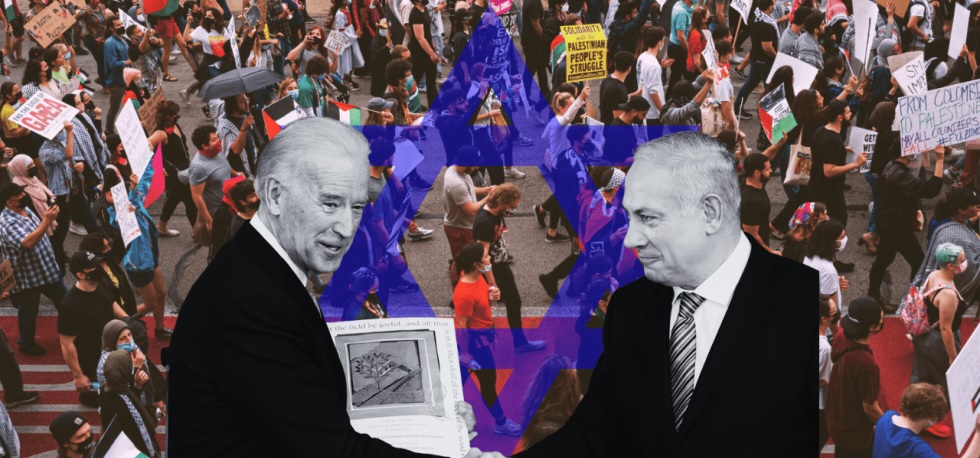
The western media is pretending the West’s efforts to secure a ceasefire are serious. But a different script has clearly been written in advance
JONATHAN COOK, APR 30, 2024, https://jonathancook.substack.com/p/the-israel-us-game-plan-for-gaza
One does not need to be a fortune-teller to understand that the Israel-US game plan for Gaza runs something like this:
1. In public, Biden appears “tough” on Netanyahu, urging him not to “invade” Rafah and pressuring him to allow more “humanitarian aid” into Gaza.
2. But already the White House is preparing the ground to subvert its own messaging. It insists that Israel has offered an “extraordinarily generous” deal to Hamas – one that, Washington suggests, amounts to a ceasefire. It doesn’t. According to reports, the best Israel has offered is an undefined “period of sustained calm”. Even that promise can’t be trusted.
3. If Hamas accepts the “deal” and agrees to return some of the hostages, the bombing eases for a short while but the famine intensifies, justified by Israel’s determination for “total victory” against Hamas – something that is impossible to achieve. This will simply delay, for a matter of days or weeks, Israel’s move to step 5 below.
4. If, as seems more likely, Hamas rejects the “deal”, it will be painted as the intransigent party and blamed for seeking to continue the “war”. (Note: This was never a war. Only the West pretends either that you can be at war with a territory you’ve been occupying for decades, or that Hamas “started the war” with its October 7 attack when Israel has been blockading the enclave, creating despair and incremental malnutrition there, for 17 years.)
Last night US Secretary of State Anthony Blinken moved this script on by stating Hamas was “the only thing standing between the people of Gaza and a ceasefire… They have to decide and they have to decide quickly”.
5. The US will announce that Israel has devised a humanitarian plan that satisfies the conditions Biden laid down for an attack on Rafah to begin.
6. This will give the US, Europe and the region the pretext to stand back as Israel launches the long-awaited assault – an attack Biden has previously asserted would be a “red line”, leading to mass civilian casualties. All that will be forgotten.
7. As Middle East Eye reports, Israel is building a ring of checkpoints around Rafah. Netanyahu will suggest, falsely, that these guarantee its attack meets the conditions laid down in international humanitarian law. Women and children will be allowed out – if they can reach a checkpoint before Israel’s carpet bombing kills them along the way.
8. All men in Rafah, and any women and children who remain, will be treated as armed combatants. If they are not killed by the bombing or falling rubble, they will be either summarily executed or dragged off to Israel’s torture chambers. No one will mention that any Hamas fighters who were in Rafah were able to leave through the tunnels.
9. Rafah will be destroyed, leaving the entire strip in ruins, and the Israeli-induced famine will worsen. The West will throw up its hands, say Hamas brought this on Gaza, agonise over what to do, and press third countries – especially Arab countries – for a “humanitarian plan” that relocates the survivors out of Gaza.
10. The western media will continue describing Israel’s genocide in Gaza in purely humanitarian terms, as though this “disaster” was an act of God.
11. Under US pressure, the International Court of Justice, or World Court, will be in no hurry to issue a definitive ruling on whether South Africa’s case that Israel is committing a genocide – which it has already found “plausible” – is proved.
12. Whatever the World Court eventually decides, and it is almost impossible to imagine it won’t determine that Israel carried out a genocide, it will be too late. The western political and media class will have moved on, leaving it to the historians to decide what it all meant.
13. Meanwhile, Israel is already using the precedents it has created in Gaza, and its erosion of the long-established principles of international law, as the blueprint for the West Bank. Saying Hamas has not been completely routed in Gaza but is using this other Palestinian enclave as its base, Israel will gradually intensify the pressures on the West Bank with another blockade. Rinse and repeat.
That’s the likely plan. Our job is to do everything in our power to stop them making it a reality.
Remember, All This Fascism Would Feel Way More Fascismy Under Trump

CAITLIN JOHNSTONE, MAY 01, 2024
Okay, yes, police are currently in the process of violently stomping out political dissent on university campuses across America following multiple statements from President Biden attacking the protesters as “antisemitic” for opposing the genocide he’s been enthusiastically facilitating in Gaza. And okay, fine, bands of right wing thugs are currently going around terrorizing students who don’t align with the US government’s support for the state of Israel.
But before any of my fellow liberals get any wild ideas about ceasing their support for Biden during an election year just because of a little tyranny and genocide, I think it’s important to remind everyone that all this fascism would feel way more fascisty if Trump was president…………………………………………………………… https://www.caitlinjohnst.one/p/remember-all-this-fascism-would-feel?utm_source=post-email-title&publication_id=82124&post_id=144202169&utm_campaign=email-post-title&isFreemail=true&r=1ise1&triedRedirect=true&utm_medium=email
US Presidential candidate arrested at anti-Israel protest
https://www.rt.com/news/596726-jill-stein-arrested-protest/ 29 Apr 24
Jill Stein has accused the Jewish state of committing “genocide” in Gaza.
Jill Stein of the US Green Party has been arrested at a pro-Palestinian rally at Washington University in St. Louis, Missouri. Stein’s arrest came amid a nationwide crackdown on anti-Israel demonstrations.
Stein, her campaign manager, and her deputy campaign manager were among 100 people detained at a protest camp on Washington University’s campus on Saturday. Video footage shows the 73-year-old being led away from the camp by three police officers, her hands apparently bound behind her back with zip ties.
The encampment was set up to demand that the university divest from Boeing, which manufactures arms used by the Israeli military to strike Gaza, Stein’s campaign manager, Jason Call, said in a statement.
“The Stein campaign supports the demands of the students and their peaceful protest and assembly on campus,” Call said. “Student protest for peace and civil liberties has always represented the best part of our collective moral conscience. Solidarity.”
The Washington University camp was one of around four dozen set up at college campuses across the US and Canada in recent weeks. As well as demanding that their universities divest from Israel-linked companies, the protesters have called on the US government to cease its financial and military support for Israel over the war in Gaza.
Police officers arrested hundreds of demonstrators in raids on 21 campuses on Wednesday, then hundreds more in similar sweeps on Thursday, Friday, and Saturday. While this crackdown has been encouraged by mainstream Democrats and Republicans alike, they have been condemned by progressive leftists and libertarian-leaning members of the GOP.
Pro-Israel activists claim that the protests are anti-Semitic in nature, and that some demonstrators have openly expressed support for Hamas. In an effort to justify a police raid on a protest camp at Boston’s Northeastern University on Saturday, school authorities claimed that chants of “Kill the Jews” were heard at the encampment the night before. Pro-Palestinian demonstrators deny the allegation.
Stein is a Jewish-American activist, and a long-time critic of the state of Israel. She opposes the construction of Jewish settlements on Palestinian land, supports the BDS (Boycott, Divestment, and Sanctions) movement, and has accused Israel of “genocide” in Gaza.
Stein ran for president of the US in 2012 and 2016, taking just over 1% of the popular vote in the 2016 contest with Donald Trump and Hillary Clinton. In November, she announced that she would run for the White House again this year, promising environmental reforms and “a new foreign policy based on diplomacy, international law, and human rights.”
Opposing The Gaza Genocide While Supporting Biden Is A Dishonest, Nonsensical Position
CAITLIN JOHNSTONE, APR 29, 2024,
https://www.caitlinjohnst.one/p/opposing-the-gaza-genocide-while?utm_source=post-email-title&publication_id=82124&post_id=144126903&utm_campaign=email-post-title&isFreemail=true&r=1ise1&triedRedirect=true&utm_medium=email
Nobody who claims to oppose the Gaza genocide while simultaneously supporting Joe Biden actually opposes the Gaza genocide. They’re just saying what needs to be said to win approval in the political sector they want the approval of. They’re not taking a moral stand, they’re cultivating an image. They’re building a brand.
One of many possible examples of this ridiculous posturing is Instagram progressive Alexandria Ocasio-Cortez, who has called Israel’s atrocities in Gaza “an unfolding genocide” while continuing to support and defend the US president who’s currently backing that genocide, and who recently attended one of the pro-Palestine campus demonstrations which her president recently smeared as “antisemitic protests”.
What AOC is doing here is attempting to straddle the impossible divide between what progressive Democrats claim their party is about and what it’s actually about in real life. She’s paying lip service to opposing injustice, supporting a ceasefire and siding with anti-genocide activists because that’s the sort of thing progressives are supposed to do, while simultaneously throwing her political support behind an administration that is facilitating injustice, keeping the genocide going, and smearing those who protest against it.
You really couldn’t put together a more incoherent position if you tried. You can’t acknowledge that Israel is committing genocide without also acknowledging that the Biden administration has been actively participating in that genocide. If you acknowledge that Biden is guilty of genocide, then you are acknowledging that he is guilty of the most horrific crime a state leader can possibly commit short of initiating a nuclear exchange.
Once you’ve acknowledged that Biden is guilty of doing pretty much the worst thing any state leader could possibly do, you’ve crossed a threshold. After such an acknowledgement, it is not logically or ethically coherent to follow it by saying you support him anyway because at least he’s a bit nicer to LGBT people than Donald Trump would be, or because he might try a tiny bit harder to reduce global warming.
You’ve acknowledged that he is participating in genocide. Genocide. There’s no “but” that could possibly follow that. It’s like saying “Sure my husband’s a serial killer, but he’s great with the kids.” If someone said that to you, the only conclusion you could possibly come to is that they’re really not all that bothered by the serial killing.
Those who support Israel’s actions in Gaza are the worst people on earth, but at least their position has some kind of integrity. They’re not contradicting themselves by pretending to oppose what they’re actually fine with. They’re not tearing themselves in half trying to straddle two completely incompatible positions while smiling for the camera and pretending it doesn’t hurt. They’re not posturing as compassionate anti-imperialists while serving the evil empire.
Those who are supporting Biden while opposing the destruction of Gaza do not have any kind of integrity. They’re just wearing whatever mask is politically convenient based on the way the winds are blowing on a given moment, while continuing to support the US-centralized empire which cannot be sustained without nonstop tyranny and bloodshed. They are providing social media-friendly soundbites which pay lip service to peace, while their true loyalty lies with the globe-spanning power structure whose existence makes peace impossible.
Biden’s pledge to aid Palestinians is a big, murderous lie
Walt Zlotow, West Suburban Peace Coalition, Glen Ellyn IL 29 Apr 24
President Biden claims to be supporting food, water and medical aid to Palestinians now dying in Gaza from disease, starvation as well as being blown to bits by Biden’s 2000 lb. bombs.
But he knows full well Israel is violation his February 8th directive requiring assurances from Israel that it’s not using U.S. military aid to violate human rights law. Israel’s ongoing genocide of 2,300,000 Palestinians there puts Israel about as far from required compliance with Biden’s edict as the two sides of the Grand Canyon.
Biden’s February 8th directive states that Israel “will facilitate and not arbitrarily deny, restrict, or otherwise impede, directly or indirectly, the transport or delivery of United States humanitarian assistance.”
But Israel is not only blocking most aid from alleviating starvation and disease in Gaza, It’s using Biden’s bombs to attack Palestinian and foreign humanitarian workers from delivering that aid. When it comes to impeding, Israel know what works. Its already killed one American aid worker.
Biden knows this but maintains the fantasy, sadly swallowed whole by many of his reelection supporters, that he’s doing ‘everything he can to aid the staving, disease ridden Palestinians.’
’ Truth is he’s doing everything he can to enable Israel’s grotesque removal of the Palestinians from their Gaza land coveted by Israel.
He’s even conspiring with Israeli Prime Minister Netanyahu to derail the impending indictment of Netanyahu by the International Criminal Court. The indictment is expected this week unless the Netanyahu-Biden genocide tag team can prevent it.
President Biden has bigger problems that losing tens of millions of his 2020 voters, sealing his reelection defeat, by his enabling of Israeli genocide. He may end up a fellow indicted war criminal with Benjamin Netanyahu in the dock at The Hague.
NNSA Delays Urgent Research on Plutonium “Pit” Aging But Spends Billions on Nuclear Weapons Bomb Cores

Concerned Citizens for Nuclear Safety, 28 Apr 24 http://nuclearactive.org/
This week, CCNS highlights portions of a recent press release by Nuclear Watch New Mexico, Tri-Valley Communities Against a Radioactive Environment (Tri-Valley CARES), and the Savannah River Site Watch about the National Nuclear Security Administration (NNSA). Their piece suggests NNSA does not have its priorities straight in neither producing up-to-date information on the way plutonium appears to age nor providing this information in a timely manner to the public. The entire press release is posted at http://nuclearactive.org/wp-content/uploads/2024/04/240417-NWNM-SRSW-TVC-Plutonium-Aging-PR.pdf
The press release reads: “Nearly three years after filing a Freedom of Information Act request, the public interest group Savannah River Site Watch has finally received [] the congressionally required Research Program Plan for Plutonium and Pit Aging.
However, the document is 40% blacked out, including references and acronyms.
Plutonium ‘pits’ are the radioactive cores of all U.S. nuclear weapons. The NNSA claims that potential aging effects are justification for a ~$60 billion program to expand production. However, the Plan fails to show that aging is a current problem. To the contrary, it demonstrates that NNSA is delaying urgently needed updated plutonium pit aging research.
“In 2006 independent scientific experts known as the JASONs concluded that plutonium pits last at least 85 years without specifying an end date. The average pit age is now around 40 years. A 2012 follow-on study by the Lawrence Livermore nuclear weapons lab concluded:
’This continuing work shows that no unexpected aging issues are appearing in plutonium that has been accelerated to an equivalent of [approximately] 150 years of age. The results of this work are consistent with, and further reinforce, the Department of Energy Record of Decision to pursue a limited pit manufacturing capability in existing and planned facilities at Los Alamos instead of constructing a new, very large pit manufacturing facility…’
“Since then NNSA has reversed itself. In 2018 the agency decided to pursue the simultaneous production of at least 30 pits per year at the Los Alamos National Laboratory (LANL) in northern New Mexico and at least 50 pits per year at the Savannah River Site (SRS) in South Carolina. Upgrades to plutonium facilities at LANL are slated to cost $8 billion over the next five years. The redundant Savannah River Plutonium Processing Facility in South Carolina will cost up to $25 billion, making it the second most expensive building in human history.
“Hundreds of billions of taxpayers’ dollars and future international nuclear weapons policies are at stake. …
Biden Wanted To Sanction An Israeli Battalion But He Didn’t Because Israel Said No
CAITLIN JOHNSTONE, APR 27, 2024
The Biden administration has reportedly canned its plans to issue sanctions on an extremist IDF unit for human rights violations in the occupied West Bank, following backlash from Israel and its high-powered supporters within the US government.
The State Department has put on hold its intention to impose sanctions on the Israel Defense Forces “Netzah Yehuda” battalion for human rights violations in the occupied West Bank and is reviewing the issue in light of information Israel provided in recent days, U.S. sources familiar with the issue said.
Why it matters: The review is part of a consultation process outlined in an agreement between the U.S. and Israel. But Secretary of State Antony Blinken has also been under extensive pressure from the Israeli government, members of Congress and some senior Biden administration officials to reconsider the possible sanctions.
The big picture: The Biden administration had intended to withhold U.S. military aid and training from the Netzah Yehuda battalion — an unprecedented move in the history of relations between the countries.

As Dr Assal Rad has highlighted on Twitter, this decision follows a sequence of events in which ProPublica revealed that Secretary of State Antony Blinken was ignoring his own State Department’s recommendation to sanction Israeli military units that have been credibly accused of human rights abuses like rape and torture, after which Blinken announced that he was preparing to issue sanctions after all. This announcement was met with outrage from Israel and its apologists, with Israeli Prime Minister Benjamin Netanyahu penning a furious screed calling the planned sanctions “the height of absurdity and a moral low”. Those planned sanctions are now canceled.
Or to put it more simply, the Biden administration had planned to sanction an IDF battalion, but it didn’t because Israel said no………………………………………………………………………………… more https://www.caitlinjohnst.one/p/biden-wanted-to-sanction-an-idf-unit?utm_source=post-email-title&publication_id=82124&post_id=144069670&utm_campaign=email-post-title&isFreemail=true&r=1ise1&triedRedirect=true&utm_medium=email
Gen Z Just Might Save The World
CAITLIN JOHNSTONE, APR 28, 2024, https://www.caitlinjohnst.one/p/gen-z-just-might-save-the-world?r=cqey&utm_campaign=post&utm_medium=email&triedRedirect=true—
Kids are taking over university campuses around the world for the noblest possible reason anyone could do such a thing in 2024. There are so many reasons to feel pessimistic, but Gen Z’s fierce opposition to the Gaza genocide is a massive reason to have hope for the future.
I talk all the time here about the need for a collective awakening and revolution in order to turn this disaster of a civilization around, but it could turn out that what ends up saving humankind is as mundane as a superior generation of humans emerging out of the information age and replacing inferior generations who’ve been far more indoctrinated by mass media propaganda.
Northeastern University brought in the police to break up a pro-Palestine demonstration, claiming antisemitic slurs and hate speech were being used by the demonstrators, but witnesses say it was actually pro-Israel counter-demonstrators who’d been shouting the antisemitic slogans, and a video confirms this. The pro-Israel agitators got some 100 demonstrators arrested by standing near them and shouting “Kill the Jews”, but they themselves were not arrested.
Whoever got this on video is a goddamn hero. Now nobody can deny that this has been happening. https://twitter.com/MaxBlumenthal/status/1784389687798366610
I keep seeing people expressing bafflement at the way Biden keeps alienating his base by shamelessly perpetuating the human butchery in Gaza. Doesn’t he care about getting re-elected?, they ask.
No, Biden does not care whether he gets re-elected, and neither do his empire manager handlers. What matters to them is advancing imperial interests in the middle east, not winning some pretend political puppet show that only exists to entertain and divert the common riff raff. They will happily lose the election and hand the genocidal baton off to Trump and his empire manager handlers who support all the same agendas as Biden’s.
Biden loses literally nothing of material relevance by being a one-term president, so there’d be no reason for him to step back from all the agreements he’s made with the inner workings of the empire to get him where he’s at now even if he wanted to.
❖
One of the weirdest things happening right now is how empire managers and propagandists are claiming these campus protests are being fueled by foreign influence from evil regimes, even as the Israeli PM openly influences state governments to crack down on those protests.
Biden loses literally nothing of material relevance by being a one-term president, so there’d be no reason for him to step back from all the agreements he’s made with the inner workings of the empire to get him where he’s at now even if he wanted to.
If you’ve been shocked by the lies and propaganda your government and your media have been churning out about Gaza, it would probably be a good idea to take another look at what they’ve been telling you about Ukraine too. And Russia, China, Iran, Syria, North Korea, Cuba, Venezuela and Yemen while you’re at it.
The New York Times has a new Pentagon press release disguised as news reporting titled “A New Pacific Arsenal to Counter China,” subtitled “With missiles, submarines and alliances, the Biden administration has built a presence in the region to rein in Beijing’s expansionist goals.”
It’s exactly what it sounds like: it describes the US empire’s military encirclement of China, but frames it as a defensive action to counter “Beijing’s expansionist goals” rather than the extreme act of aggression and military expansionism that it actually is. If China started surrounding the US with war machinery like this it would be World War Three instantaneously.
One of the dumbest things the imperial media ask us to believe is that the US empire is surrounding its #1 geopolitical rival with war machinery for defensive purposes, in response to “expansionist goals” by that rival who has zero war machinery anywhere near the United States.
❖
So many of the awesome anti-imperialists I follow and admire got their start years ago supporting Palestinian rights. Israel-Palestine is like a gateway drug for anti-imperialism and anti-war activism for a lot of westerners, because the issue is so mainstream-adjacent due to the west’s intimacy with the Israeli state.
The Gaza genocide is going to give rise to a real antiwar movement in the west if the empire managers can’t find a way to stomp it out. Which is why they’re trying so hard to do exactly that — but their attempts thus far have been pathetic failures, and have only made things worse for them.
❖
One of the weirdest things happening right now is how empire managers and propagandists are claiming these campus protests are being fueled by foreign influence from evil regimes, even as the Israeli PM openly influences state governments to crack down on those protests.
No Drones Over Gaza Or Anywhere!
Direct action at Holloman AFB in New Mexico
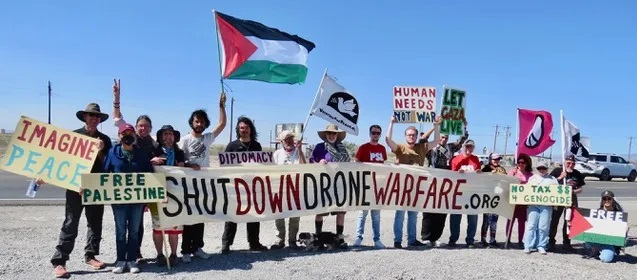
LISA SAVAGE, APR 28, 2024.Went to the Bridge – Substack
Dozens converged at for a week of nonviolent resistance to the illegal drone training program at Holloman Air Force Base, including several students and teachers from New Mexico State University (NMSU), Las Cruces. Many of their signs noted opposition to the role of drones in Israel’s ongoing genocide in Gaza.
On April 24, business at the drone training program was interrupted at two main gates by a nonviolent blockade during morning commute hour. After five activists blockaded the less used West Gate for about 20 min, they ended their blockade after the one minute police warning. Some then joined others at the Main gate and continued the interruption of criminal activity at the base. Ultimately six were arrested: Denise Sellers (San Diego), John Reese (High Rolls / Mtn. Park, NM), Natasha Robinson (Berkeley, CA), Toby Blomé (El Cerrito, CA), Virginia Hauflaire (Phoenix, AZ), and Ray Cage (Tucson, AZ). No warning was given at the 2nd gate and arrests occurred.
Arrestees were held at the police station and told that they would be be taken to the Otero County Detention Center to be processed and held over night. But after a few hours arrestees were taken directly to court, arraigned, and released at about 1pm.
Participant Scott Thompson of Alamogordo said, “Our government primarily serves an elite class that profits from wars and is unconcerned with the suffering we inflict on other humans. It is the duty of every good citizen to look beyond the headlines and understand the inhumane waste of resources making unconstitutional wars on others. Via public outreach and thoughtful actions we hope to get the attention of the misinformed.”
New local allies joined the Holloman campaign for its week of actions. …………………………………………
The secrecy of the drone program keeps it from the public eye. “Drone strikes” are rarely mentioned in the media or by the military, and the term “Air Strikes” provides convenient “shelter” from public scrutiny. Our week of action uncovers the secrecy and educates the local community, as well as the base employees! Equally important: The inhumane US drone program causes deep moral injury to our military personnel themselves. We offer alternatives and support to the new recruits and other employees, via signs, banners and leaflets that offer resources for GI support. https://went2thebridge.substack.com/p/no-drones-over-gaza-or-anywhere?utm_source=post-email-title&publication_id=1580975&post_id=144108116&utm_campaign=email-post-title&isFreemail=true&r=c9zhh&triedRedirect=true&utm_medium=email
Holocaust Survivor Tells Student Anti-Genocide Protesters: ‘Just Keep Doing It’
“There is a question of historical responsibility towards injustice, genocide, and fascism,” said Stephen Kapos. “If you are indifferent, if you do not take a stand, you acquire a degree of guilt.”
By Brett Wilkins / Common Dreams
A Holocaust survivor opposed to Israel’s war on Gaza on Wednesday told U.S. student protesters they’re on the right side of history, and that the global wave of demonstrations against the slaughter and starvation of Palestinians will soon force Western leaders to face up to their complicity in genocide.
Stephen Kapos, 86, was 7 years old in 1944 when he was separated from his family during the Nazi extermination of Jews in his native Hungary. Most of his family was murdered in the Holocaust but Kapos survived and moved to the United Kingdom after the 1956 Soviet invasion of Hungary.
Kapos is part of a small group of Shoah survivors and their descendants who “demonstrate disagreement with the use of the Holocaust experience as a cover by the Zionists and the state of Israel.” They attend protests wearing signs around their necks reading, “This Holocaust Survivor Says Stop the Genocide in Gaza!”
“As a Holocaust survivor, my message to the brave student protesters in America is just keep doing it. Don’t give up,” Kapos said in a video published by Double Down News. “We are doing exactly the same, and in the long term we are going to prevail.”
Kapos’ comments came amid a growing wave of pro-Palestine student protests—many of them Jewish-led—on dozens of U.S. university and college campuses in response to Israel’s U.S.-backed war on Gaza, which the International Court of Justice in January found “plausibly” genocidal and which many Israeli and international experts say is undoubtedly a genocide.
According to Gazan and international officials, more than 122,000 Palestinians have been killed or maimed during 202 days of near-relentless Israeli attacks. This figure includes around 11,000 people who are missing and presumed dead and buried beneath the rubble of hundreds of thousands of bombed-out buildings. Around 90% of Gaza’s 2.3 million people have been forcibly displaced. Starvation and dehydration caused by Israel’s bombardment and blockade of Gaza are killing children and other vulnerable people.
Instead of condemning Israeli leaders, the Biden administration has lavished them with billions of dollars in U.S. military aid while providing diplomatic cover for Israeli crimes and blocking recognition of Palestinian statehood at the United Nations.
As the suffering in Gaza continues, U.S. students have set up encampments or staged other forms of protest, some of which have been brutally repressed by police—who have also attacked and arrested journalists and bystanders.
On Wednesday, far-right Israeli Prime Minister Benjamin Netanyahu implored U.S. authorities to crack down even harder on the students, whom he called an “antisemitic mob.”
Highlighting video footage of Netanyahu comparing the student protests to what happened at German universities during the rise of Nazism, Kapos said that “the way that the Israeli government is using the memory of the Holocaust in order to justify what they’re doing to the Gazans is a complete insult to the memory of the Holocaust.”
He said he is also protesting “the conflating of Jewishness with Zionism, which is what the Israeli state is trying to do, which does nothing but increase antisemitism.”
Kapos predicted that “today’s marches are having a very hopeful aspect that is so large, so persistent, so global that eventually the Western leadership—which are trying to deny what is actually going on—will be forced to face up to it, and I think we are not far from that.”
“Today’s marches are having a very hopeful aspect that is so large, so persistent, so global that eventually the Western leadership—which are trying to deny what is actually going on—will be forced to face up to it.”
“There is a question of historical responsibility towards injustice, genocide, and fascism,” Kapos asserted. “If you are indifferent, if you do not take a stand, you acquire a degree of guilt without any doubt and I think it is imperative to assert opposition and even some degree of disadvantage and risk if you want to be guilt-free when history judges what’s happening.”
Kapos and his comrades are part of a long history of Holocaust survivors speaking out against Israeli crimes against Palestinians.
Long before today’s growing acknowledgment that Israel is an apartheid state, the late Suzanne Weiss—whose parents were murdered in Nazi-occupied France—said in 2010 that “the Palestinians are victims of ethnic cleansing and apartheid” and that “the Israeli government’s actions toward the Palestinians awaken horrific memories of my family’s experiences under Hitlerism.”
Hajo Meyer, who survived 10 months in the Auschwitz death camp in Poland, argued during his lifetime that “what is happening to the Palestinians every day under the occupation” was “almost identical” to “what was done to the German Jews before the ‘Final Solution,'” and that instead of making Jews safer, Israeli policies and practices were stoking the flames of antisemitism.
Holocaust survivors who stand up for Palestinian rights have been condemned by critics as “antisemites” and “self-hating Jews” who, in Meyer’s case, allegedly abused his status as a Holocaust survivor.
Kapos, who has experienced such slurs, is undaunted and says he has no plans to stop protesting. During a recent rally in London he vowed, “I’ll keep doing it as long as the bombing and apartheid and the injustice is going on.” https://twitter.com/DoubleDownNews/status/1783270524388294756?ref_src=twsrc%5Etfw%7Ctwcamp%5Etweetembed%7Ctwterm%5E1783270524388294756%7Ctwgr%5E0eba1ba4fc85a62ab6c36c37d2a5e14fdefd9921%7Ctwcon%5Es1_&ref_url=https%3A%2F%2Fscheerpost.com%2F2024%2F04%2F28%2Fholocaust-survivor-tells-student-anti-genocide-protesters-just-keep-doing-it%2F
Kapos’ comments came amid a growing wave of pro-Palestine student protests—many of them Jewish-led—on dozens of U.S. university and college campuses in response to Israel’s U.S.-backed war on Gaza, which the International Court of Justice in January found “plausibly” genocidal and which many Israeli and international experts say is undoubtedly a genocide…………………………………………………………….
Highlighting video footage of Netanyahu comparing the student protests to what happened at German universities during the rise of Nazism, Kapos said that “the way that the Israeli government is using the memory of the Holocaust in order to justify what they’re doing to the Gazans is a complete insult to the memory of the Holocaust.”
He said he is also protesting “the conflating of Jewishness with Zionism, which is what the Israeli state is trying to do, which does nothing but increase antisemitism.”
Kapos predicted that “today’s marches are having a very hopeful aspect that is so large, so persistent, so global that eventually the Western leadership—which are trying to deny what is actually going on—will be forced to face up to it, and I think we are not far from that.”……………………………………………….
Hajo Meyer, who survived 10 months in the Auschwitz death camp in Poland, argued during his lifetime that “what is happening to the Palestinians every day under the occupation” was “almost identical” to “what was done to the German Jews before the ‘Final Solution,'” and that instead of making Jews safer, Israeli policies and practices were stoking the flames of antisemitism………………………………………. more https://www.commondreams.org/news/holocaust-survivors-gaza-genocide
—
1 This Month

of the week – Shut Down Drone Warfare!


Tell the Ukrainian Government to Drop Prosecution of Peace Activist Yurii Sheliazhenko

Petition to revoke the licensing of the Near Surface Nuclear Disposal Facility (NSDF) at Chalk River. https://www.ourcommons.ca/petitions/en/Petition/Details?Petition=e-7247
To see nuclear-related stories in greater depth and intensity – go to https://nuclearinformation.wordpress.com
-
Archives
- April 2026 (57)
- March 2026 (251)
- February 2026 (268)
- January 2026 (308)
- December 2025 (358)
- November 2025 (359)
- October 2025 (376)
- September 2025 (257)
- August 2025 (319)
- July 2025 (230)
- June 2025 (348)
- May 2025 (261)
-
Categories
- 1
- 1 NUCLEAR ISSUES
- business and costs
- climate change
- culture and arts
- ENERGY
- environment
- health
- history
- indigenous issues
- Legal
- marketing of nuclear
- media
- opposition to nuclear
- PERSONAL STORIES
- politics
- politics international
- Religion and ethics
- safety
- secrets,lies and civil liberties
- spinbuster
- technology
- Uranium
- wastes
- weapons and war
- Women
- 2 WORLD
- ACTION
- AFRICA
- Atrocities
- AUSTRALIA
- Christina's notes
- Christina's themes
- culture and arts
- Events
- Fuk 2022
- Fuk 2023
- Fukushima 2017
- Fukushima 2018
- fukushima 2019
- Fukushima 2020
- Fukushima 2021
- general
- global warming
- Humour (God we need it)
- Nuclear
- RARE EARTHS
- Reference
- resources – print
- Resources -audiovicual
- Weekly Newsletter
- World
- World Nuclear
- YouTube
-
RSS
Entries RSS
Comments RSS
 nuclear-news