Environmental impacts of underground nuclear weapons testing

While underground nuclear tests were chosen to limit atmospheric radioactive fallout, each test still caused dynamic and complex responses within crustal formations. Mechanical effects of underground nuclear tests span from the prompt post-detonation responses to the enduring impacts resulting in radionuclide release, dispersion, and migration through the geosphere. Every test of nuclear weapons adds to a global burden of released radioactivity (Ewing 1999).
Bulletin, By Sulgiye Park, Rodney C. Ewing, March 7, 2024
Since Trinity—the first atomic bomb test on the morning of July 16, 1945, near Alamogordo, New Mexico—the nuclear-armed states have conducted 2,056 nuclear tests (Kimball 2023). The United States led the way with 1,030 nuclear tests, or almost half of the total, between 1945 and 1992. Second is the former Soviet Union, with 715 tests between 1949 and 1990, and then France, with 210 tests between 1960 and 1996. Globally, nuclear tests culminated in a cumulative yield of over 500 megatons, which is equivalent to 500 million tons of TNT (Pravalie 2014). This surpasses by over 30,000 times the yield of the first atomic bomb dropped on Hiroshima on August 6, 1945.
Atmospheric nuclear tests prevailed until the early 1960s, with bombs tested by various means: aircraft drops, rocket launches, suspension from balloons, and detonation atop towers above ground. Between 1945 and 1963, the Soviet Union conducted 219 atmospheric tests, followed by the United States (215), the United Kingdom (21), and France (3) (Kimball 2023).
In the early days of the nuclear age, little was known about the impacts of radioactive “fallout —the residual and activated radioactive material that falls to the ground after a nuclear explosion. The impacts became clearer in the 1950s, when the Kodak chemical company detected radioactive contamination on their film, which was linked to radiation resulting from the atmospheric nuclear tests (Sato et al. 2022). American scientists, like Barry Commoner, also discovered the presence of strontium 90 in children’s teeth originating from nuclear fallout thousands of kilometers from the original test site (Commoner 1959; Commoner 1958; Reiss 1961). These discoveries alerted scientists and the public to the consequences of radioactive fallout from underwater and atmospheric nuclear tests, particularly tests of powerful thermonuclear weapons that had single event yields of one megaton or greater.
Public concerns for the effects of radioactive contamination led to the Limited (or Partial) Test Ban Treaty, signed on August 5, 1963. The treaty restricted nuclear tests from air, space, and underwater (Atomic Heritage Foundation 2016; Loeb 1991; Rubinson 2011). And while the treaty was imperfect with only three signatories at the beginning (the United States, the United Kingdom, and the Soviet Union), the ban succeeded in significantly curbing atmospheric release of radioactive isotopes.
After the entry into force of the partial test ban, almost 1,500 underground nuclear tests were conducted globally. Of the 1,030 US nuclear tests, nearly 80 percent, or 815 tests (See Table 1 on original ), were conducted underground, primarily at the Nevada Test Site.[1] As for other nuclear powers, the Soviet Union conducted 496 underground tests, mostly in the Semipalatinsk region of Kazakhstan, France conducted 160 underground tests, the United Kingdom conducted 24, and China 22. These underground nuclear tests were in a variety of geologic formations (e.g., basalt, alluvium, rhyolite, sandstone, shale) to depths up to 2,400 meters.

In 1996, after some international efforts to curb nuclear testing and promote disarmament, the Comprehensive Test Ban Treaty (CTBT) was negotiated, which prohibited all nuclear explosions (General Assembly 1996). Since the negotiation of the CTBT, India and Pakistan conducted three and two underground nuclear tests, respectively, in 1998. And today, North Korea stands as the only country to have tested nuclear weapons in the 21st century.
While underground nuclear tests were chosen to limit atmospheric radioactive fallout, each test still caused dynamic and complex responses within crustal formations. Mechanical effects of underground nuclear tests span from the prompt post-detonation responses to the enduring impacts resulting in radionuclide release, dispersion, and migration through the geosphere. Every test of nuclear weapons adds to a global burden of released radioactivity (Ewing 1999)…………………………………………………………………………
………………………………………………………………….. Containment failures and nuclear accidents
Underground nuclear tests are designed to limit radioactive fallout and surface effects. However, containment methods are not foolproof, and radioisotopes, which are elements with neutrons in excess making them unstable and radioactive, can leak into the surrounding environment and atmosphere, posing potential risks to ecosystems and human health.
Instances of radiation leaks were not uncommon…………………………………..
Unintended radioactive releases from underground nuclear tests occurred through venting or seeps, where fission products and radioactive materials were uncontrollably released, driven by pressure from shockwave-induced steam or gas. In rare cases, more serious nuclear accidents occurred due to incomplete geological assessments of the surrounding medium in preparation for the test. A notable example of accidental release is the Baneberry underground nuclear test on December 18, 1970, which, according to the federal government, resulted in an “unexpected and unrecognized abnormally high water content in the medium surrounding the detonation point” ……………………………………………………………………………………………
Mechanical and radiation effects of underground nuclear tests
Three main factors affect the mechanical responses of underground nuclear tests: the yield, the device placement (i.e., depth of burial, chamber geometry, and size), and the emplacement medium (i.e., rock type, water content, mineral compositions, physical properties, and tectonic structure). These factors influence the physical response of the surrounding geological formations and the extent of ground displacement, which, in turn, determine the radiation effects by influencing the timing and fate of the radioactive gas release.
Every kiloton of explosive yield produces approximately 60 grams (3 × 10¹² fission product atoms) of radionuclides (Smith 1995; Glasstone and Dolan 1977). Between 1962 and 1992, underground nuclear tests had a total explosive yield of approximately 90 megatons (Pravalie 2014), producing nearly 5.4 metric tons of radionuclides. ……………………………………………….
……………………………..The partitioning of radionuclides between the melt glass and rubble significantly impacts the subsequent transfer of radioactivity to groundwater.
…………………………Temperatures produced by large explosions can change the permeability, porosity, and water storage capacity by creating new fractures, cavities, and chimneys……………………. The explosion also affects the porosity of the surrounding rock. For example, a fully contained explosion of 12.5-kiloton yield in Degelen Mountain at the former Soviet Union’s Semipalatinsk test site resulted in up to a six-fold increase in porosity within the crush zone surrounding the cavity (Adushkin and Spivak 2015). Increased permeability and porosity of the surrounding rock can lead to more radionuclides being released, as more groundwater can pass through the geologic formation.
Hydrogeology and release of radioactivity
The main way contaminants can be moved from underground test areas to the more accessible environment is through groundwater flow. …………………………………………..
Given their long half-lives (Table 2 on original ), the ability of plutonium isotopes to migrate over time raises concerns about the long-term impacts and challenges in managing radioactive contamination.
In all these cases, colloid-facilitated transport allowed for the migration of radioactive particles through groundwater flow over an extended period—long after the nuclear tests or discharge occurred (Novikov et al. 2006). ………………………
The risks associated with the environmental contamination from underground nuclear tests have often been considered low due to the slow movement of the groundwater and the long distance that separates it from publicly accessible groundwater supplies. But these studies demonstrate that apart from prompt effect of radioactive gas releases from instantaneous changes in geologic formations, long-term effects persist due to the evolving properties of the surrounding rocks long after the tests. Long-lived radionuclides can be remarkably mobile in the geosphere. Such findings underscore the necessity for sustained long-term monitoring efforts at and around nuclear test sites to evaluate the delayed impacts of underground nuclear testing on the environment and public health.
Enduring legacy
Nearly three decades after the five nuclear-armed states under the CTBT stopped testing nuclear weapons both in the atmosphere and underground, the effects of past tests persist in various forms—including environmental contamination, radiation exposure, and socio-economic repercussions—which continue to impact populations at and near closed nuclear test sites (Blume 2022). The concerns are greater when the test sites are abandoned without adequate environmental remediation. This was the case with the Semipalatinsk test site in Kazakhstan that was left unattended after the fall of the Soviet Union in 1991, before a secret multi-million effort was made by the United States, Russia, and Kazakhstan to secure the site (Hecker 2013). The abandonment resulted in heavy contamination of soil, water, and vegetation, posing significant risks to the local populations (Kassenova 2009).
In 1990, the US Congress acknowledged the health risks from nuclear testing by establishing the Radiation Exposure Compensation Act (RECA), which provides compensation to those affected by radioactive fallout from nuclear tests and uranium mining. Still, there are limitations and gaps in coverage that leave many impacted individuals, including the “downwinders” from the Trinity test site without compensation for their radiation exposure (Blume, 2023). The Act is set to expire in July 2024, potentially depriving many individuals without essential assistance. Over the past 30 years, the RECA fund paid out approximately $2.5 billion to impacted populations (Congressional Research Service 2022). For comparison, the US federal government spends $60 billion per year to maintain its nuclear forces (Congressional Budget Office 2021).
As the effects of nuclear testing still linger, today’s generations are witnessing an increasing concern at the possibility of a new arms race and potential resumption of nuclear testing (Drozdenko 2023; Diaz-Maurin 2023). The concern is heightened by activities in China and North Korea and with Russia rescinding its ratification of the CTBT. Even though the United States maintains a moratorium on non-subcritical nuclear tests, its decision not to ratify the test ban treaty shows a lack of international leadership and commitment. As global tensions and uncertainties arise, it is critical to ensure global security and minimize the risks to humans and the environment by enforcing comprehensive treaties like the CTBT. Transparency at nuclear test sites should be promoted, including those conducting very-low-yield subcritical tests, and the enduring impacts of past nuclear tests should be assessed and addressed.
Endnotes………………………………………………………………more https://thebulletin.org/premium/2024-03/environmental-impacts-of-underground-nuclear-weapons-testing/?utm_source=Newsletter&utm_medium=Email&utm_campaign=MondayNewsletter04152024&utm_content=NuclearRisk_EnvironmentalImpactsNuclearTests_03072024
Biden Tells Netanyahu US Won’t Support Attack on Iran
White House National Security Council spokesman John Kirby said that Biden also told Netanyahu “that the United States is going to continue to help Israel defend itself,” signaling the US would intervene again to help Israel if it does choose to escalate the situation and comes under another attack.
The US is portraying the Iranian attack as an Israeli victory
by Dave DeCamp April 14, 2024, https://news.antiwar.com/2024/04/14/biden-tells-netanyahu-us-wont-support-attack-on-iran/
President Biden told Israeli Prime Minister Benjamin Netanyahu that the US wouldn’t join Israel in any offensive action against Iran, multiple media outlets have reported.
US officials are touting Israel’s defense of Iran’s attack as a victory, and that’s the message Biden conveyed to Netanyahu, a sign the US doesn’t want the situation to escalate. Iran fired over 300 missiles and drones at Israel, which was a response to Israel’s bombing of Iran’s consulate in Damascus on April 1.
“Israel really came out far ahead in this exchange. It took out the IRGC [Islamic Revolutionary Guard Corp] leadership in the Levant, Iran tried to respond, and Israel clearly demonstrated its military superiority, defeating this attack, particularly in coordination with its partners,” a senior Biden administration official told reporters, according to The Times of Israel.
In a statement on the attack released by the White House, Biden said he would convene with other G7 leaders to “coordinate a united diplomatic response to Iran’s brazen attack.”
Israeli officials claimed 99% of the Iranian missiles and drones were intercepted by Israeli air defense systems and with assistance from the US, Britain, and Jordan. Some missiles got through and damaged the Nevatim Airbase in southern Israel. Only one person was injured in the attack, a seven-year-old Bedouin girl in the Negev, and nobody was killed.
Iran gave Israel plenty of time to respond to the attack by announcing it fired the drones hours before they reached Israeli territory, and Tehran said it gave other regional countries a 72-hour notice. Iranian officials said the attack was “limited” and made clear they do not seek an escalation with Israel.
But Tehran is also warning it will launch an even bigger attack if Israel responds. “If the Zionist regime or its supporters demonstrate reckless behavior, they will receive a decisive and much stronger response,” Iranian President Ebrahim Raisi said in a statement on Sunday.
While the US is signaling it seeks de-escalation and won’t support a potential Israeli attack on Iran, it’s unclear what Israel will do next. The Israeli war cabinet convened to discuss the situation on Sunday, and Israeli media reports said they agreed a response would come but didn’t decide on where or when.
Israeli War Cabinet Minister Benny Gantz vowed Israel would respond but signaled it wouldn’t be imminent. Gantz said the “event is not over” and that Israel should “build a regional coalition and exact a price from Iran, in a way and at a time that suits us.”
White House National Security Council spokesman John Kirby said that Biden also told Netanyahu “that the United States is going to continue to help Israel defend itself,” signaling the US would intervene again to help Israel if it does choose to escalate the situation and comes under another attack.
Israel’s bombing of the Iranian consulate in Syria killed 13 people, including seven members of the IRGC. Israel has a history of conducting covert attacks inside Iran and killing Iranians in Syria, but the bombing of the diplomatic facility marked a huge escalation.
US Declines Israel’s Invitation To Start WW3 (For Now)
CAITLIN JOHNSTONE, APR 14, 2024, https://www.caitlinjohnst.one/p/us-declines-israels-invitation-to?utm_source=post-email-title&publication_id=82124&post_id=143571202&utm_campaign=email-post-title&isFreemail=true&r=1ise1&triedRedirect=true&utm_medium=email
Iran has carried out its long-promised retaliation for Israel’s attack on its consulate building in Damascus, launching a massive barrage of drones and missiles which it claims hit and destroyed Israeli military targets, while Israel says they dealt only superficial damage with a few injuries. The US and its allies reportedly helped shoot down a number of the Iranian projectiles.
Just as we discussed in the lead-up to the strike, the western political-media class are acting as though this was a completely unprovoked attack launched against the innocent, Bambi-eyed victim Israel. Comments from western officials and pundits and headlines from the mass media are omitting the fact that Israel instigated these hostilities with its extreme act of aggression in Syria as much as possible. Here in Australia the Sydney Morning Herald write-up about the strike didn’t get around to informing its readers about the attack on the Iranian consulate until the tenth paragraph of the article, and said only that Iran had “accused” Israel of launching the attack because Israel has never officially confirmed it.
In any case, Iran says the attack is now over. Given that we’re not seeing any signs of massive damage, Iran’s reported claim that its retaliation would be calibrated to avoid escalation into a full-scale regional war seems to have been accurate, as does Washington’s reported claim that it didn’t expect the strike to be large enough to draw the US into war.
A new report from Axios says Biden has personally told Netanyahu that the US will not be supporting any Israeli military response to the Iranian strike. An anonymous senior White House official told Axios that Biden said to Netanyahu, “You got a win. Take the win,” in reference to the number of Iranian weapons that were taken out of the sky by the international coalition in Israel’s defense. Apparently helping to mitigate the damage from the Iranian attack is all the military commitment the White House is willing to make against Iran at this time.
And thank all that is holy for that. A war between the US alliance and Iran and its allies would be the stuff of nightmares, making the horrors we’ve been seeing in Gaza these last six months look like an episode of Peppa Pig.
But Washington merely declining to get involved is nowhere near enough. As the Quincy Institute’s Trita Parsi quipped on Twitter, “Biden needs to PREVENT further escalation, not just declare his desire to stay out of it.”
Indeed, Israel has already made it clear that it is going to be moving forward with an escalation against Iran. Israel’s Channel 12 cites an unnamed senior official saying the Iranian counter strike is going to receive an “unprecedented response”.
“Israel has already informed the Americans and governments in the region that its response is inevitable,” The Economist reports. “Its military options include launching drones at Iran, and long-range airstrikes on Iran, possibly on military bases or nuclear installations.”
It’s unclear at this time how much the latest message from the Biden administration will affect the calculations of this position, but the mass media are reporting that White House officials are worried Israel is getting ready to do something extremely reckless that could draw the US into a war it would rather avoid.
NBC News reports the following:
“Some top U.S. officials are concerned Israel could do something quickly in response to Iran’s attacks without thinking through potential fallout afterward, according to a senior administration official and a senior defense official.
“Those concerns stem in part from the administration’s views of the approach Israel has taken to its war against Hamas, as well as the attack in Damascus.
“President Joe Biden has privately expressed concern that Israeli Prime Minister Benjamin Netanyahu is trying to drag the U.S. more deeply into a broader conflict, according to three people familiar with his comments.”
People have been raising this concern for some time now. Earlier this month Responsible Statecraft’s Paul Pillar wrote up a solid argument that Netanyahu stands a lot to gain personally from drawing the US into a war with Iran to help him with his legal and political troubles and take the focus off of Israel’s genocide in Gaza.
Whether that’s the case or not it’s pretty absurd for the Biden administration to just sit around passively hoping this doesn’t happen as though it wouldn’t have a say in the matter, and as though there’s nothing it can do to prevent such an occurrence right now. Biden has had the ability to end this insane cycle of escalation in the middle east since it started six months ago by demanding a ceasefire in Gaza and demanding that Israel rein in its murder machine, just as US presidents have done successfully in the past.
Biden could end all this with one phone call. The fact that he doesn’t means he’s a monster, and no amount of mass media reports about how “concerned” and “frustrated” he is regarding Israel’s actions will ever change that.
Stop Pretending Biden Is Some Passive Witness To Israel’s Warmongering
CAITLIN JOHNSTONE, APR 15, 2024, https://www.caitlinjohnst.one/p/stop-pretending-biden-is-some-passive?utm_source=post-email-title&publication_id=82124&post_id=143599351&utm_campaign=email-post-title&isFreemail=true&r=1ise1&triedRedirect=true&utm_medium=email
The more I think about it the more obnoxious I find the Biden administration’s “Gee whiz, I sure hope Israel doesn’t drag us into a giant war in the middle east” posturing and the imperial media’s facilitation of it.
CNN has a new article out titled “As Iran attacks Israel, Biden confronts an escalating Middle East crisis he had hoped to avoid,” which is a genre of story that has been coming out in slightly different iterations again and again for the past six months. Every time Israel does something that makes things more dangerous in the middle east with the assistance of the United States, the American press fall all over themselves to inform the world that the president really doesn’t want this to happen and that his feelings are very upset about it.
“For President Joe Biden, an attack on Israel launched from Iranian soil amounts to a scenario he’d greatly sought to avoid since the start of the current Middle East conflict,” writes CNN, saying the strikes “heighten the risk of a wider regional conflict that could directly draw in the United States, along with other countries.”
“Israel will respond to Iran’s attack, but the scope of that response has yet to be determined,” CNN reports, citing an anonymous Israeli official.
And it’s just such an obscene insult to our intelligence to suggest that the Biden administration is some kind of passive witness to all this, sitting around wringing its hands hoping Israel doesn’t do something so horrible that the United States will have no choice but to leap into World War Three in defense of its dear ally. It’s insulting in that it asks us to believe the US would have no choice but to enter into a war of unimaginable horror if Israel acts belligerently enough, and it’s insulting in that it asks us to ignore the fact that Biden could have ended this insane cycle of escalation with one phone call to Israel at any time over the last six months.
Being asked to accept that the Biden administration is just standing there hoping Israel doesn’t ignite the worst war in middle eastern history is like seeing a dog owner letting their rottweiler run around biting people all over the neighborhood and saying “Yeah he just does what he likes, I just hope he doesn’t kill anybody.”
It’s like, no. Stop that. You’re not just crossing your fingers and hoping Israel doesn’t do something monstrous, you’re letting them do whatever they want because that’s what you’re choosing to do. Israel’s entire existence is as dependent on US support as a scuba diver is on their oxygen tank, and as such the White House has essentially limitless leverage it can use to make Israel do as it pleases — and it has done so in the past. Hell it’s done so during this very Gaza assault, successfully commanding Israel to stop cutting off Gazan telecommunications and to start letting more aid trucks in to the enclave.
If Biden truly didn’t want Israel to be turning the middle east into a hurricane of death and fire, he would stop it. He would put the damn dog on a leash.
The western press have a well-established track record of consistently framing US wars as these traps that Washington just clumsily stumbles its way into, like there’s some giant Macaulay Culkin-like deity sneaking around laying tripwires to force the Pentagon to regime change Libya or whatever. After a certain number of wars you have to figure that a regime is starting a bunch of wars because it’s just a warmongering regime, though — and the US has been involved in a whole, whole lot of wars. Nobody’s that clumsy or that unlucky; it’s like believing your husband when he tells you he keeps slipping and falling with his man parts inside the lady parts of various coworkers.
The most powerful empire that has ever existed is not just passively sitting there praying that big bad Israel doesn’t force it to go to war with Iran. That is not happening. All the violence and chaos that’s happening in the middle east right now is happening because the US empire wants it to happen, and because the people who steer that empire are psychopathic ghouls. And don’t let the crooked manipulators of the western mass media tell you otherwise.
Not enough war on the ground, the US is taking it to space

The military industrial complex is suiting up for a new arms race, far beyond the stratosphere
STAVROULA PABST, APR 05, 2024, https://responsiblestatecraft.org/u-s-space-race/
Elon Musk’s space company SpaceX recently secured a classified contract to build an extensive network of “spy satellites” for an undisclosed U.S. intelligence agency, with one source telling Reuters that “no one can hide” under the prospective network’s reach.
While the deal suggests the space company, which currently operates over half the active satellites orbiting Earth, has warmed to U.S. national security agencies, it’s not the first Washington investment in conflict-forward space machinery. Rather, the U.S. is funding or otherwise supporting a range of defense contractors and startups working to create a new generation of space-bound weapons, surveillance systems, and adjacent technologies.
In other words, America is hell-bent on a new arms race — in space.
Space arms, then and now
Attempts to regulate weapons’ presence and use in space span decades. Responding to an intense, Cold War-era arms race between the U.S. and Soviet Union, the 1967 Outer Space Treaty established that space, while free for all countries to explore and use, was limited to peaceful endeavors. Almost 60 years later, the Outer Space Treaty’s vague language regarding military limitations in space, as space policy experts Michelle L.D. Hanlon and Greg Autry highlight, “leave more than enough room for interpretation to result in conflict.”
Stonewalling subsequent international efforts to limit the militarization of space (though the U.S. is participating in a new U.N. working group on the subject), Washington’s interest in space exploration and adjacent weapons technologies also goes back decades. Many may recall President Ronald Reagan’s 1983 Strategic Defense Initiative (SDI), which was established to develop land-, air-, and space-based missile defense systems to deter missile or nuclear weapons attacks against the U.S. Cynically referred to by critics as the “Star Wars” program, many SDI initiatives were ultimately canned due to prohibitive costs and technological limitations.
And while the Pentagon established Space Command in 1985, the Space Force, an entirely new branch of the military “focused solely on pursuing superiority in the space domain,” was launched in 2019, signaling renewed emphasis on space militarization as U.S. policy.
Weapons contractors cash in

Long-term American interest in space war tech now manifests in ambitious projects, where defense companies and startups are lining up for military contracts to create a new generation of space weaponry and adjacent tech, including space vehicles, hypersonic rockets, and extensive surveillance and communications projects.
For starters, Space Force’s Space Development Agency recently granted defense contractors L3Harris and Lockheed Martin and space company Sierra Space contracts worth $2.5 billion to build satellites for the U.S. military’s Proliferated Warfighter Space Architecture (PWSA), a constellation of hundreds of satellites, built out on tranches, that provide various warfighting capabilities, including the collection and transmission of critical wartime communications, into low-Earth orbit.
The PWSA will serve as the backbone of the Pentagon’s Joint All-Domain Command and Control project, an effort to bolster warfighting capacities and decision-making processes by facilitating “information advantage at the speed of relevance.”
Other efforts are just as sci-fi-esque. Zoning in on hypersonic weapons systems and parts, for example, RTX (formerly Raytheon) and Northrop Grumman have collaborated to secure a DARPA contract for a Hypersonic Air-breathing Weapons Concept, where scramjet-powered missiles can travel at hypersonic speeds (Mach 5 or faster) for offensive purposes.
And Aerospace startup True Anomaly, which was founded by military officers and has received funding from the U.S. Space Force to the tune of over $17 million, is developing space weapons and adjacent conflict-forward tools. An example is True Anomaly’s Jackal Autonomous Orbital Vehicle, an imaging satellite able to take on, according to True Anomaly CEO Even Rogers, “rendezvous and proximity operations missions” with “uncooperative” targets.
As True Anomaly finds fiscal success, accruing over $100 million in a December 2023 series B fundraising round from venture capitalists including Eclipse Ventures and ACME Capital, other aerospace start-ups are flooding the market with the assistance of the U.S. government, both in funding and other critical partnerships.
Take how Firehawk Aerospace — which wants to “create the rocket system of the future” to “enab[le] the next generation of aerospace and defense systems” — partnered with NASA in 2021 to test rocket engines at NASA’s Stennis Space Center in Mississippi. It recently secured Army Applications Laboratory and U.S. Air Force Small Business Innovation Research Awards to advance developments in its rocket motors and engines.
And data and satellite-focused American space tech company Capella Space, a contractor for federal agencies including the Air and Space Forces, specializes in reconnaissance and powerful surveillance tools, including geospatial intelligence and Synthetic Aperture Radar monitoring that help national security officials identify myriad security risks. In early 2023, Capella Space even formed a subsidiary, Capella Federal, to provide federal clients with additional access to Synthetic Aperture Radar imagery services.
We need diplomacy, not space superiority
The funding of expensive, futuristic space surveillance and weapons projects indicates the U.S.’s eagerness to maintain superiority, where military personnel posit such advancements are critical within the context of both a “space race” and an increasingly tumultuous geopolitical climate, if not the possibility of war in space outright.
As Space Force General Chance Saltzman declared at the recent Mitchell Institute Spacepower Security Forum: “if we do not have space, we lose.” Testifying before the Senate Armed Services Committee in late February, U.S. Space Force General Stephen N. Whiting explained that the U.S. Space Command must bolster its military capacities through increased personnel training and investments in relevant technologies so that the U.S. is “ready if deterrence fails.”
While upping its own military capacities, however, Washington is simultaneously pushing against other countries’ anti-satellite weapons testing, a capability the U.S. already has.
In any case, such pointing fingers, when coupled with ongoing space deterrence and weapons proliferation efforts, does little to advance genuine diplomacy, where states could instead discuss, on equal terms, how space should be used and shared amongst nations.
Ultimately, weapons and aerospace companies’ efforts have launched a new generation of weaponry and adjacent tech — buoyed by consistent support from a “deterrence”-focused U.S. As a result, the military industrial complex has further expanded into the domain of space, where defense companies have new opportunities to score lucrative weapons contracts and theoretically even push for more conflict.
Will Biden’s zero sum game approach to foreign conflict bumble US into regional/nuclear war in Europe and Middle East?

Walt Zlotow, West Suburban Peace Coalition, Glen Ellyn IL, 14 Apr 24, https://heartlandprogressive.blogspot.com/
President Biden continues on his astonishing and disheartening path to regional/nuclear war in both Europe and the Middle East.
In Europe, he plows ahead with his foolish demand to squandering another $61 billion in weapons for the lost cause in Ukraine. Any weapons manufactured will not reach Ukraine before their impending collapse, turning Ukraine into a rump state of abject poverty requiring endless US/NATO assistance.
Biden views the Russo Ukraine war as a zero sum game: US must win, Russia must lose. That requires endless US efforts to reclaim all Russian held Ukraine territory and bring Ukraine into NATO. Biden’s approach? Assisting Ukraine attacks on Russian territory.
Ukraine President Zelensky’s only hope is to widen the war to obtain direct US intervention. He almost provoked that 2 years ago when he claimed an errant Ukraine missile that killed 2 Poles in neighboring NATO Poland, was a Russian strike requiring immediate NATO response. Every day this 26 month long war continues represents another chance for US belligerence to make that happen. But Biden pushes on to possible all out war with his refusal to pivot from military provocation to diplomacy. That would require Biden dropping his zero sum game. Not likely.
The Middle East is more precarious still. The US has been Israel’s go to weapons and diplomatic supporter in their grotesque genocidal ethnic cleansing of 2,300,000 Palestinians in Gaza. That has turned both Israel and America in pariah states worldwide.
Besides the genocide, the possibility of all out regional war between Israel and its Arab neighbors looms daily. Biden remained silent when Israel launched its dastardly bombing of the Iranian consulate in Syria, killing 7. But when Iran signaled its intent to reply militarily, Biden invoked his standard zero sum game view that Israel can do no wrong. Iran? They can do no right. That’s a recipe for all out war.
President Biden only learned one thing from his six decades of political leadership: America is 100% right in foreign affairs; our imagined enemies 100% wrong. History is filled with empires that disappeared from that zero sum game.
Will Biden’s America be next?
J.D. Vance – New York Times: The Math on Ukraine Doesn’t Add Up

The notion that we should prolong a bloody and gruesome war because it’s been good for American business is grotesque.
Mr. Zelensky’s stated goal for the war — a return to 1991 boundaries — is fantastical.
J.D.Vance, The New York Times, Fri, 12 Apr 2024 , https://www.nytimes.com/2024/04/12/opinion/jd-vance-ukraine.html
President Biden wants the world to believe that the biggest obstacle facing Ukraine is Republicans and our lack of commitment to the global community. This is wrong.
Ukraine’s challenge is not the G.O.P.; it’s math. Ukraine needs more soldiers than it can field, even with draconian conscription policies. And it needs more matériel than the United States can provide. This reality must inform any future Ukraine policy, from further congressional aid to the diplomatic course set by the president.
The Biden administration has applied increasing pressure on Republicans to pass a supplemental aid package of more than $60 billion to Ukraine. I voted against this package in the Senate and remain opposed to virtually any proposal for the United States to continue funding this war. Mr. Biden has failed to articulate even basic facts about what Ukraine needs and how this aid will change the reality on the ground.
The most fundamental question: How much does Ukraine need and how much can we actually provide? Mr. Biden suggests that a $60 billion supplemental means the difference between victory and defeat in a major war between Russia and Ukraine. That is also wrong. This $60 billion is a fraction of what it would take to turn the tide in Ukraine’s favor. But this is not just a matter of dollars. Fundamentally, we lack the capacity to manufacture the amount of weapons Ukraine needs us to supply to win the war.
Consider our ability to produce 155-millimeter artillery shells. Last year, Ukraine’s defense minister estimated that the country’s base-line requirement for these shells was over four million per year but that it could fire up to seven million if that many were available. Since the start of the conflict, the United States has gone to great lengths to ramp up production of 155-millimeter shells. We’ve roughly doubled our capacity and can now produce 360,000 per year — less than a tenth of what Ukraine says it needs. The administration’s goal is to get this to 1.2 million — 30 percent of what’s needed — by the end of 2025. This would cost the American taxpayers dearly while yielding an unpleasantly familiar result: failure abroad.
Just this week, the top American military commander in Europe argued that absent further security assistance, Russia could soon have a 10-to-1 artillery advantage over Ukraine. What didn’t gather as many headlines is that Russia’s current advantage is at least 5 to 1, even after all the money we have poured into the conflict. Neither of these ratios plausibly leads to Ukrainian victory.
Proponents of American aid to Ukraine have argued that our approach has been a boon to our own economy, creating jobs here in the factories that manufacture weapons. But our national security interests can be — and often are — separate from our economic interests.The notion that we should prolong a bloody and gruesome war because it’s been good for American business is grotesque. We can and should rebuild our industrial base without shipping its products to a foreign conflict.
The story is the same when we look at other munitions. Take the Patriot missile system — our premier air defense weapon. It’s of such importance in this war that Ukraine’s foreign minister has specifically demanded them. That’s because in March alone, Russia reportedly launched over 3,000 guided aerial bombs, 600 drones and 400 missiles at Ukraine. To fend off these attacks, the Ukrainian president, Volodymyr Zelensky, and others have indicated they need thousands of Patriot interceptors per year. The problem is this: The United States only manufactures 550 every year. If we pass the supplemental aid package currently being considered in Congress, we could potentially increase annual production to 650, but that’s still less than a third of what Ukraine requires.
These weapons are not only needed by Ukraine. If China were to set its sights on Taiwan, the Patriot missile system would be critical to its defense. In fact, the United States has promised to send Taiwan nearly $900 million worth of Patriot missiles, but delivery of those weapons and other essential resources has been severely delayed, partly because of shortages caused by the war in Ukraine.
If that sounds bad, Ukraine’s manpower situation is even worse. Here are the basics:Russia has nearly four times the population of Ukraine. Ukraine needs upward of half a million new recruits, but hundreds of thousands of fighting-age men have already fled the country. The average Ukrainian soldier is roughly 43 years old, and many soldiers have already served two years at the front with few, if any, opportunities to stop fighting. After two years of conflict, there are some villages with almost no men left. The Ukrainian military has resorted to coercing men into service, and women have staged protests to demand the return of their husbands and fathers after long years of service at the front. This newspaper reported one instance in which the Ukrainian military attempted to conscript a man with a diagnosed mental disability.
Many in Washington seem to think that hundreds of thousands of young Ukrainians have gone to war with a song in their heart and are happy to label any thought to the contrary Russian propaganda. But major newspapers on both sides of the Atlantic are reporting that the situation on the ground in Ukraine is grim.
These basic mathematical realities were true, but contestable, at the outset of the war. They were obvious and incontestable a year ago, when American leadership worked closely with Mr. Zelensky to undertake a disastrous counteroffensive. The bad news is that accepting brute reality would have been most useful last spring, before the Ukrainians launched that extremely costly and unsuccessful military campaign. The good news is that even now, a defensive strategy can work. Digging in with old-fashioned ditches, cement and land mines are what enabled Russia to weather Ukraine’s 2023 counteroffensive. Our allies in Europe could better support such a strategy, as well. While some European countries have provided considerable resources, the burden of military support has thus far fallen heaviest on the United States.
By committing to a defensive strategy, Ukraine can preserve its precious military manpower, stop the bleeding and provide time for negotiations to commence. But this would require both the American and Ukrainian leadership to accept that Mr. Zelensky’s stated goal for the war — a return to 1991 boundaries — is fantastical.
The White House has said time and again that it can’t negotiate with President Vladimir Putin of Russia. This is absurd. The Biden administration has no viable plan for the Ukrainians to win this war. The sooner Americans confront this truth, the sooner we can fix this mess and broker for peace.
Production of Highly Enriched Uranium (HEU) threatens our environment, health, and safety.

The nuclear industry is pushing for mass production of HALEU, which poses
significant risks to our environment, health, and safety. This form of
enriched uranium for new types of nuclear power reactors could perpetuate
the cycle of nuclear proliferation here in the US and worldwide.
Here’s the problem: HALEU requires producing uranium that is close enough to
weapons-grade that it could be used as cover to develop nuclear weapons.
Making it produces more radioactive pollution, and using it would generate
waste that is more hazardous and difficult to manage. And if the U.S.
starts making HALEU for nuclear power plants, other countries will believe
they should have the right to do so–opening the floodgates to weapons
proliferation and forever compromising the U.S. in standing against that.
We must voice our opposition to this reckless endeavor and demand
accountability from decision-makers. Your comment can make a difference in
shaping policy and preventing the acquisition of HALEU.
NIRS 13th April 2024
https://nirs.salsalabs.org/HALEUCommentsApril2024/index.html
Biden ‘very proud’ of expanding NATO to Russia’s borders
https://www.rt.com/news/595718-biden-proud-nato-expansion/ 12 Apr 24
The US leader believes it would be a “disaster” if the bloc were to break up
US President Joe Biden has hailed NATO’s further expansion toward Russia’s borders, while accusing Republican rival Donald Trump of undermining the unity of the American-led military bloc.
Russia has for years voiced concern about NATO’s creeping encroachment, viewing its policies as an existential threat. However, in an interview with Spanish-language broadcaster Univision that aired on Tuesday, Biden touted the recent addition of Finland and Sweden to the bloc’s ranks amid the Ukraine conflict as a great achievement.
“We’ve done something that I was very proud of. I’ve engaged with NATO for my whole career. We were able to expand NATO, and we have 2,000 miles of border because you have two Nordic nations having joined NATO. You have a whole range of NATO countries along the Russian border,” the US president said.
Biden went on to argue that a stalemate in Congress over his $61 billion military aid package for Kiev is “very dangerous” for the bloc’s unity, accusing his former US leader Trump of virtually holding the measure – and the entire Republican party – hostage.
“Trump runs that party. He maintains a sort of a death grip on it. Everybody’s afraid to take him on whether they agree with him or not, and it’s incredibly dangerous. The last thing we need is to see NATO start to break apart. It would be a disaster for the United States, a disaster for Europe, a disaster for the world,” Biden said.
The US has provided Ukraine with over $113 billion in various forms of assistance since the start of hostilities with Russia. Moscow has repeatedly condemned foreign arms shipments to Kiev, arguing they will only prolong the conflict, while making the West a direct participant in the hostilities.
Finland shares a 1,300km border with Russia, and Moscow has argued that NATO membership has threatened, not guaranteed, Finnish security. After Helsinki joined the alliance last year, Russian President Vladimir Putin announced the creation of a new military district bordering the Nordic nation. Sweden joined the bloc last month.
Putin has warned for nearly two decades that NATO’s policies undermine Russian national security, but a real “red line” for Moscow would be an attempt to move the bloc’s forces into Ukraine. The conflict in Ukraine is an “existential” one for Moscow and a “matter of life and death,” Putin said in February, while for the West it is simply a matter of “improving its tactical positions.”
Flicker of Hope: Biden’s Throwaway Lines on Assange
April 12, 2024 by: Dr Binoy Kampmark, https://theaimn.com/flicker-of-hope-bidens-throwaway-lines-on-assange/
Walking stiffly, largely distracted, and struggling to focus on the bare essentials, US President Joe Biden was keeping company with his Japanese counterpart, Prime Minister Fumio Kishida, when asked the question. It concerned what he was doing regarding Australia’s request that the WikiLeaks founder Julian Assange be returned to Australia.
Assange, who has spent five tormenting years in Belmarsh Prison in London, is battling extradition to the US on 18 charges, 17 tenuously and dangerously based on the US Espionage Act of 1917.
The words that followed from the near mummified defender of the Free World were short, yet bright enough for the publisher’s supporters. “We’re considering it.” No details were supplied.
To these barest of crumbs came this reaction from from Australian Prime Minister Anthony Albanese on ABC’s News Breakfast: “We have raised on behalf of Mr Assange, Australia’s national interest, that enough is enough, that this needs to be brought to a conclusion, and we’ve raised it at each level of government in every possible way.” When pressed on whether this was merely an afterthought from the president, Albanese responded with the usual acknowledgments: the case was complex, and responsibility lay with the US Department of Justice.
One of Assange’s lawyers, the relentless Jennifer Robinson, told Sky News Australia of her encouragement at Biden’s “response, this is what we have been asking for over five years. Since 2010 we’ve been saying this is a dangerous precedent that’s being set. So, we certainly hope it was a serious remark and the US will act on it.” Assange’s brother, Gabriel Shipton, also told Sky News that the statement was significant while WikiLeaks editor-in-chief, Kristinn Hrafnsson thought the utterance “extraordinary”, cautiously hoping “to see in the coming days” whether “clarification of what this means” would be offered by “those in power” and the press corps.
The campaign to free Assange has burgeoned with admirable ferocity. The transformation of the WikiLeaks founder from eccentric, renegade cyber thief deserving punishment to prosecuted and persecuted scribbler and political prisoner has been astonishing.
The boggling legal process has also been shown up as woefully inadequate and scandalous, a form of long-term torture via judicial torment and deprivation. The current ludicrous pitstop entails waiting for a UK Court of Appeal decision as to whether Assange will be granted leave for a full reconsideration of his case, including the merits of the extradition order itself.
The March 26 Court of Appeal decision refused to entertain the glaringly obvious features of the case: that Assange is being prosecuted for his political views, that due process is bound to be denied in a country whose authorities have contemplated his abduction and murder, and that he risks being sentenced for conduct he is not charged with “based on evidence he will not see and which may have been unlawfully obtained.” The refusal to entertain such material as the Yahoo News article from September 2021 outlining the views of intelligence officials on kidnapping and assassination options again cast the entire affair in a poor light.
Even if Assange is granted a full hearing, it is not clear whether the court will go so far as to accept the arguments. The judges have already nobbled the case by offering US prosecutors the chance to offer undertakings, none of which would or could be binding on the DOJ or any US judge hearing the case. Extradition, in other words, is likely to be approved if Assange is “permitted to rely on the First Amendment”, “is not prejudiced at trial (including sentence) by reason of his nationality” and that he “is afforded the same First Amendment protection as a United States citizen, and that the death penalty not be imposed.” These conditions, on the face of it, look absurd in their naïve presumption.
Whether Biden’s latest casual spray lends any credibility to a change of heart remains to be seen. In December 2010, when Vice President in the Obama administration, Biden described Assange as a “high-tech terrorist” for disclosing State Department cables. He failed to identify any parallels with previous cases of disclosures such as the Pentagon papers.
Craig Murray, former British diplomat and Assange confidant, adds a note of cautious sobriety to the recent offering from the president: “I’m not going to get too hopeful immediately on a few words out of the mouth of Biden, because there has been no previous indication, nothing from the Justice Department so far to indicate any easing up.”
For all that, it may well be that the current administration, facing a relentless publicity campaign from human rights organisations, newspapers, legal and medical professionals, not to mention pressure from both his own party in Congress and Republicans, is finally yielding. Caution, however, is the order of the day, and nothing should be read or considered in earnest till signatures are inked and dried. We are quite a way off from that.
The Mutually Reinforcing U.S. and Israeli Empires

By Ralph Nader, April 5, 2024, https://nader.org/2024/04/05/the-mutually-reinforcing-u-s-and-israeli-empires/
The U.S. government’s unwavering commitment to Israel’s annihilation of Gaza – torrents of heavy weaponry, diplomatic and political cover, and vast majorities in Congress swearing fealty to Netanyahu’s extremist regime – is usually attributed to AIPAC (American Israel Public Affairs Committee), the powerful domestic pro-Israeli government lobby, organized in every Congressional District, with its abundant campaign cash and its many personal contacts in Congress and the Executive Branch.
This is only a partial explanation of the US-Israel alliance. A far more formidably entrenched factor is that Israel and the U.S. have overlapping Empires – one in the Middle East and the other globally – with deep common purposes. Here are some examples of how these empires operate in tandem.
Both Empires violate international laws with impunity. The U.S. sends special forces, drones, the Army, the Navy, and the Air Force, anywhere and anytime it wants – especially the case of Iraq and Afghanistan. National boundaries and sovereignty mean nothing. Similarly, Israel completely dominates the Middle East militarily, bombing, sabotaging, and killing whomever it wants in neighboring countries. It has attacked Lebanon and Syria routinely with its air force, artillery, and invaded Lebanon on the ground, prompting feeble responses it always labels “terrorism.”
Both Empires consider every military operation defensive. They say they never conduct offensive attacks, but when they do, they invariably describe them as self-defense. Israel slaughters Palestinians decade after decade in the Palestinian territories while claiming self-defense. With the second most modern military in the world, backed by the U.S., Israel invades, engages in nightly destruction of Palestinian homes, seizes Palestinian land and water for their colonies, imprisons thousands without charges, including women and children, inflicts collective punishment, operates many checkpoints and imposes embargoes, sieges and blockades. All of these unlawful actions are claimed to be taken in the name of self-defense.
The U.S. has 750 military bases in over 80 countries, 26 military installations in the Middle East, runs the provocative NATO military alliance, and digs into the South China Sea. All this is also claimed to be done in the name of self-defense.
Both Empires have collaborating military-industrial complexes and are major arms exporters. As the chief innovator in weapons of mass destruction, the U.S. and its companies like Raytheon, Lockheed Martin, and Boeing welcome feedback from the Israeli military on how their weapons fare in its attacks. Palestine has become a major testing ground for the most super-modern surveillance technology. (Check out the book, The Palestine Laboratory: How Israel Exports the Technology of Occupation Around the World by Antony Loewenstein, 2023).
Both Empires wield “force projection” as atomic bomb powers, though Israel refuses to join the non-proliferation treaty.
Despite their many wars and raids on defenseless populations, both incurred a rare counter-attack (9/11 & October 7) when advance warnings by advisors were ignored (GW Bush and Netanyahu) and military defenses were AWOL. After being attacked, both Empires went berserk and responded with massive killing of civilians by overwhelming invasions.
Both Empires lie repeatedly regarding their tactics and strategies. Recall Rep. Ron Paul’s terse recognition that Bush and Cheney “lied us into invading Iraq.”
Both Empires control the United Nations Security Council with the U.S. veto shielding whatever Israel does. Both occupy or control land that is not theirs, violating international laws.
Both Empires violate their legal duty as occupiers to protect the civilian population’s well-being. Both have restricted humanitarian assistance and critical civilian imports – Israel savagely in Gaza and Palestine, and the U.S. in Iraq under Bill Clinton. Both decline to estimate their aggregate civilian casualties.
Both Empires’ leaders, Biden and Netanyahu, profess to practice their respective religions, though they are violating the basic precepts of both their religions in implementing their violent wars.
Both Empires spend little time pressing for ceasefires, peace negotiations, and the stability of peace treaties. They find such restraints as unacceptable curbs on their freedom to wage war.
Both Empires, contrary to their fundamental juridical documents, in the case of the U.S., our Constitution, operate as elected dictatorships in conducting military and foreign policy. The Congress and the Knesset become supine and surrender to the Executive and, for Israel, the ruling executive coalition. In the U.S., the U.S. Supreme Court has long ruled that no citizens of our country, not even individual members of Congress, “have legal standing to sue” the U.S. government for either initiating illegal wars or engaging in additional illegal tactics like torture or corruption.
To remove the challenges from “We the People” against a lawless government, the Supreme Court has endorsed the “state secrets” doctrine. It authorizes the government to demand the dismissal of constitutional claims, in federal court, based on killings, torture, kidnapping, or otherwise by alleging the defense would require disclosure of national security information.
The Israeli Supreme Court doesn’t worry about the Israeli military machine.
Both Empires have a so-called free mainstream media that mostly toes the Empire party line and knows its permissible place in the overall profit-making power structure. Both have a small independent media that is still able to dissent, however futilely, though the U.S. has no counterpart to the outspoken Israeli newspaper HAARETZ.
There are some differences between the two Empires. Israel attacked the USS Liberty on June 8, 1967, killing 34 American sailors and wounding 171, and mostly got away without consequences. (See, The Intercept article: Fifty Years Later, NSA Keeps Details of Israel’s USS Liberty Attack Secret by Miriam Pensack).
Prosperous Israel persuades the U.S. Congress yearly to provide Israel with billions of dollars, mostly for military arms, and is about to get an additional $14.1 billion – the Biden genocide tax on Americans – as Netanyahu’s terror state continues intensifying his Palestinian Holocaust. (The reported casualty toll is lethally undercounted. See the March 5, 2024 column: “Stop the Worsening UNDERCOUNT of Palestinian Casualties in Gaza”).
If Biden’s people privately object to some Israeli off-the-wall slaughter of courageous journalists, United Nations staff, aid workers, patients in hospitals, and the starvation of babies, Netanyahu can softly say to Biden and Blinken, “Joe, Tony, why don’t you take up your complaints with OUR Congress.”
U.S. Space Command adopts multipronged approach to prepare for ‘a conflict that has never happened’
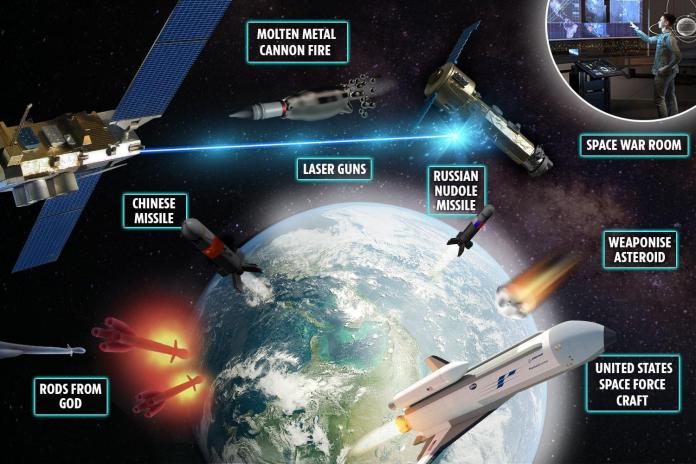
April 9, 2024, Sandra Erwin. https://spacenews.com/u-s-space-command-adopts-multipronged-approach-to-prepare-for-a-conflict-that-has-never-happened/
COLORADO SPRINGS – U.S. Space Command seeks to expand international collaboration by inviting Germany, France and New Zealand to join Operation Olympic Defender. Olympic Defender, a U.S.-led initiative to jointly strengthen defenses and deter hostility, already includes England, Australia and Canada.
“We share intelligence, we plan together and work to ensure space is safe for all,” Gen. Stephen Whiting, commander of U.S. Space Command, said April 9 at the 39th Space Symposium here. “We’re working to even improve our integration through improved command and control and planning. I’ve been proud to work alongside Germany, France and New Zealand for many years, and I look forward to their consideration of our invitation to join Operation Olympic Defender.”
Preparing for military operations with U.S. allies and partners is one of U.S. Space Command’s top priorities.
Other priorities for the Colorado-based organization are making its constellations more resilient, defending them against a growing array of threats, protecting the joint force from space-enabled attack, and conducting tests and training “that convinces us that these capabilities will work in a conflict which has never happened,” Whiting said.
Strategic Competition
As the combatant command responsible for military operations in outer space, U.S. Space Command is closely tracking military moves by China and Russia.
China is rapidly expanding space-based intelligence, reconnaissance and surveillance capabilities, and building a “range of counterspace weapons from reversible jamming all the way up to kinetic hit-to-kill direct-ascent and co-orbital” anti-satellite weapons, Whiting said.
Russia, meanwhile, “continues to invest in counterspace weapons,” Whiting said. “Russia appears more and more to be relying on asymmetric capabilities like space, cyber and nuclear.”
2027 Deadline
U.S. Space Command is focused on maximizing combat readiness by 2027.
“All of us at U.S. Space Command are laser-focused on improving all of our existing forces and capabilities, so that we can stitch them together seamlessly when called upon,” Whiting said.
U.S. Space Command also intends to draw on commercial space technology.
“Our commercial industry will deliver innovative state-of-the-art capabilities,” Whiting said. “We have to modernize our legacy systems, ensure they all work together seamlessly and deliver new capabilities by 2027 to counter the threats that we now see.”
Beyond 2027
At the same time, U.S. Space Command is eager to adopt technology that is likely to pay off in the longer term.
“It’s time to bring dynamic space operations and on-orbit logistics and infrastructure to the space domain,” Whiting said. “Sustained space maneuver will change how we operate, opening up new tactics, techniques, procedures and operating concepts, and allowing operations until the mission is complete, not until the fuel we launched with runs out.”
With an eye toward future conflict, U.S. Space Command also is expanding its reliance on modeling and simulation.
Whiting announced that Space Command’s Capability Assessment and Validation Environment, a modeling and simulation laboratory known as CAVE, has achieved minimum viable capability.
CAVE “enables us to perform analysis on warfighting, on plans, on campaigning,” Whiting said. Space Command will rely on CAVE to help plan “operations for a war that’s never happened and a war we don’t want to happen. We’ll also use it to figure out our combatant command requirements and gain insights into multi-domain joint-warfighting concepts.”
St. Louis Residents Seek Compensation for Illnesses Tied to Nuclear Contamination
By Jim Salter | April 8, 2024, https://www.insurancejournal.com/news/midwest/2024/04/08/768472.htm
Karen Nickel has been dealing with lupus and other illnesses for years, illnesses she blames on childhood exposure to a suburban St. Louis creek where Cold War-era nuclear waste was dumped decades ago. It’s time, she said Friday, for the federal government to start making amends.
“People have died and are still dying,” Nickel, co-founder of the activist group Just Moms STL, said.
Nickel and others impacted by nuclear waste exposure in the St. Louis region joined Democratic U.S. Rep. Cori Bush at a news conference at a park that sits near long-contaminated Coldwater Creek. They urged renewal of a law initially passed more than three decades ago that would provide an estimated $50 billion to compensate Americans exposed to radiation by the government.
Last month, the Senate approved legislation by Republican Sen. Josh Hawley of Missouri and Democratic Sen. Ben Ray Luján of New Mexico that would not only extend the 1990 Radiation Exposure Compensation Act, but expand its scope to include Missouri and other states adversely affected by the nation’s nuclear weapons program.
But the compensation plan was excluded from a spending bill.
“The Senate did its job, but House leadership has failed to act,” Bush, of St. Louis, said. “This injustice cannot stand.”
The plan isn’t dead. It could still pass as a stand-alone bill, or be attached to another piece of legislation. But time is of the essence, Bush said. The RECA program expires June 7.
Uranium processing in the St. Louis area played a pivotal role in developing the nuclear weapons that helped bring an end to World War II and provided a key defense during the Cold War. But eight decades later, the region is still dealing with contamination at several sites.
In July, an investigation published by The Associated Press, The Missouri Independent and MuckRock showed that the federal government and companies responsible for nuclear bomb production and atomic waste storage sites in the St. Louis area were aware of health risks, spills, improperly stored contaminants and other problems but often ignored them.
While it is difficult to prove definitively that the waste caused residents’ illnesses, advocates argue that there is more than enough evidence that it has sickened people.
Since the RECA program began, more than 54,000 claims have been filed and about $2.6 billion has been awarded for approved claims in Nevada, Utah and Arizona.
In New Mexico, residents in the communities surrounding the area where the first atomic bomb was detonated in 1945 — the top-secret Manhattan Project — were not warned of the radiological dangers and didn’t realize that an atomic blast was the source of the ash that was raining down upon them.
Advocates also have sought to bring awareness to the lingering effects of radiation exposure on the Navajo Nation, where millions of tons of uranium ore were extracted over decades to support U.S. nuclear activities.
President Joe Biden signed an executive order in 2022 extending RECA for two years, into June. Hawley’s bill would extend the law for five years and expand coverage to include people in Missouri as well as Idaho, Montana, Colorado, Tennessee, Kentucky, Alaska and Guam.
The White House has indicated that Biden would sign the legislation.
“The President believes we have a solemn obligation to address toxic exposure, especially among those who have been placed in harm’s way by the government’s actions,” the White House said in a statement earlier this year.
Others worry about the cost. The taxpayer advocacy group Committee for a Responsible Federal Budget said that the legislation should include budget offsets to pay for it.
Nuclear waste stored near St. Louis’ Lambert Airport made its way into Coldwater Creek in the 1960s. Many people who grew up or live near the meandering creek believe the contamination is responsible for cancers and other illnesses, though experts say connecting radiation exposure to illness is complicated. Cancer concerns also have been raised by people in nearby St. Charles County, Missouri, where uranium was processed and a large quarry became contaminated, resulting in a Superfund cleanup.
In 2022, a St. Louis County grade school closed amid worries that contamination from Coldwater Creek got onto the playground and inside the building. The Army Corps of Engineers announced last month that it is testing a few homes near the creek after high radiation levels were found in their backyards.
Like Nickel, Democratic state Rep. Doug Clemens grew up along Coldwater Creek. He said every man in his childhood neighborhood eventually died of stomach or intestinal cancer.
“They knew they were poisoning us for 75 years,” Clemens said of the government. “RECA is a step. We must do RECA now.”
CNN Finally Tells The Truth About The Flour Massacre After Previously Shilling For Israel
CAITLIN JOHNSTONE, APR 10, 2024, https://www.caitlinjohnst.one/p/cnn-finally-tells-the-truth-about?utm_source=post-email-title&publication_id=82124&post_id=143447638&utm_campaign=email-post-title&isFreemail=true&r=1ise1&triedRedirect=true&utm_medium=email
CNN has a new report out showing that (surprise!) Israel lied about the Flour Massacre in which IDF troops fired machine guns into a crowd of starving Gazans waiting for food this past February, killing over a hundred people. CNN found that Israel’s timeline and version of events doesn’t line up with video footage, witness testimony, and forensic evidence.
Which of course was obvious from the beginning to anyone who isn’t deeply invested in pretending Israel ever tells the truth about these things. Within hours of the massacre Euro-Med Human Rights Monitor had a preliminary report up saying that video, audio and material evidence shows that the IDF had been firing into the crowd in contradiction of Israel’s claims that the injuries and deaths sustained on the scene were mostly due to Gazans trampling on each other in a mad rush upon the convoy of aid trucks. Now here’s CNN, a month and a half later, telling us essentially the same thing.
This is the same CNN who at the time reported on the Flour Massacre in ways that advanced Israel’s information interests with headlines completely exonerating Israel of any wrongdoing like “At least 100 killed and 700 injured in chaotic incident” and “Carnage at Gaza food aid site amid Israeli gunfire”. CNN also repeatedly refers to the killings as “food aid deaths”, as though it’s the food aid that killed them and not the military of a very specific state power.
I don’t know if there’s a word for when a government does something evil and then churns out a bunch of easily disprovable lies with the understanding that by the time those lies are debunked public attention will have moved on from the controversy, but there should be. Over and over again we’ve seen the Israeli regime do just enough lying to dampen the initial burst of attention and outrage and get people doubting themselves, only to discover far too late that it was all a bunch of crap after the initial crime has been forgotten.
This is exactly what happened with Israel’s initial assault on al-Shifa Hospital back in November, when Israel was cranking out propaganda claiming the hospital was being used as a command center for Hamas. Not until the end of December did The Washington Post show up to acknowledge the abundantly obvious fact that there was no evidence for Israel’s claims, which independent outlets like Consortium News had been reporting since mid-November. Now al-Shifa Hospital — the largest hospital in Gaza — has been completely destroyed.
Back in October Israel and its apologists were shrieking with outrage that anyone would dare suggest that Israel would ever attack a hospital at all, saturating the media with bogus evidence that it falsely claimed proved its innocence. Since that time Israel has launched hundreds of attacks on Gaza’s healthcare services and has destroyed most of its healthcare system.
It’s a weaponization of the adage “A lie gets halfway around the world before the truth even puts its boots on.” They know all they have to do is lie really hard for a week or two, and then when the truth inevitably surfaces it won’t matter, because the truth will never be able to have the impact their lies had when it mattered.
It’s so obnoxious how even after all this time Israel is still given the benefit of the doubt on such claims by the western political-media class until they’re debunked weeks or months later, long after the outcry over the incident has been muted and neutered by Israeli lies. If a state power is preventing journalists and human rights groups from investigating the facts on the ground in a given area, then it is not legitimate to give their claims about what happens in that area weighted consideration when their track record and all the facts in evidence say they’re probably lying.
The fact that the western press keep giving Israel the benefit of the doubt whenever reports like this emerge after they’ve been caught in so very many lies means the western press are just as culpable for the circulation of Israeli lies as Israel itself. In journalism you’re taught that if someone says it’s raining and someone else says it’s dry, your job isn’t to quote them both and treat both claims as equal, your job is to go look out the window and see which is true. The fact that the imperial media take so long to drag their asses to the window serves nobody but Israel and the globe-spanning empire of which it is a part.
1 This Month
10 March A LIVE WEBINAR THE REAL EFFECTS OF NUCLEAR POWER
What the Industry Isn’t Telling Us
1:00 PM Mountain, 2 pm Central, 3 pm Eastern. Live on the Keepers of the Water Facebook page



18 March Webinar @ 1 PM EST: An Assessment of SMR Projects: The Case of Canada
register for the zoom:
https://us02web.zoom.us/webinar/register/WN_o8BIIOUvQ2ONJR1nta65DQ#/registration


of the week – STOP SMALL MODULAR REACTORS IN CANADA
To see nuclear-related stories in greater depth and intensity – go to https://nuclearinformation.wordpress.com
-
Archives
- March 2026 (109)
- February 2026 (268)
- January 2026 (308)
- December 2025 (358)
- November 2025 (359)
- October 2025 (376)
- September 2025 (258)
- August 2025 (319)
- July 2025 (230)
- June 2025 (348)
- May 2025 (261)
- April 2025 (305)
-
Categories
- 1
- 1 NUCLEAR ISSUES
- business and costs
- climate change
- culture and arts
- ENERGY
- environment
- health
- history
- indigenous issues
- Legal
- marketing of nuclear
- media
- opposition to nuclear
- PERSONAL STORIES
- politics
- politics international
- Religion and ethics
- safety
- secrets,lies and civil liberties
- spinbuster
- technology
- Uranium
- wastes
- weapons and war
- Women
- 2 WORLD
- ACTION
- AFRICA
- Atrocities
- AUSTRALIA
- Christina's notes
- Christina's themes
- culture and arts
- Events
- Fuk 2022
- Fuk 2023
- Fukushima 2017
- Fukushima 2018
- fukushima 2019
- Fukushima 2020
- Fukushima 2021
- general
- global warming
- Humour (God we need it)
- Nuclear
- RARE EARTHS
- Reference
- resources – print
- Resources -audiovicual
- Weekly Newsletter
- World
- World Nuclear
- YouTube
-
RSS
Entries RSS
Comments RSS
 nuclear-news