New Lines: How Washington is Weaponizing Media

New Lines Magazine purports to be an independent media organization. Yet it constantly attacks genuine alternative media who stray from Washington’s official foreign policy line, all while employing many spooks, spies and other figures at the heart of the national security state.
Worse still, its parent organization, the New Lines Institute, has recently admitted to being directly funded by the U.S. government. MintPress News takes a closer look at this shady organization acting as Washington’s attack dog.
A Slick, Well-Funded Organization
If you read the Wikipedia entries for many alternative media outlets, they are written off as fringe conspiracy websites pushing debunked foreign propaganda. MintPress News, for example, is described as a “far-left news website” which “publishes disinformation and antisemitic conspiracy theories.” The Grayzone is similarly smeared as a “fringe” blog known for its “misleading reporting” and “sympathetic coverage of authoritarian regimes” such as Syria, Venezuela and China.
The evidence for these evidence-light smears comes primarily from the U.S. foreign policy journal, New Lines Magazine, a product of the New Lines Institute. New Lines is a very new organization that was established only in 2020. Despite this, it has already become a key player in setting U.S. agendas worldwide, boasting a staff of more than 50 and working with over 150 contributors. Headquartered on the prestigious Massachusetts Avenue NW (some of the most expensive real estate in the world), it sits between foreign embassies and many of America’s most prestigious think tanks, a stone’s throw – metaphorically and physically – from the White House.
New Lines describes its goal as “seeking to shape U.S. foreign policy” based on a “deep understanding of distinct regional geopolitics and value systems.” It began by focusing solely on the Middle East but quickly expanded to cover Ukraine, China, Venezuela and other political hotspots that most concern hawks in Washington. It certainly shapes public debate, and its research and experts are regularly quoted in influential outlets like The New York Times, Washington Post, and CNN.
A Rogue’s Gallery of U.S. Officials
New Lines presents itself as an independent organization, claiming that it is “one of the few think tanks in Washington with no foreign or local agendas.” Yet its higher ranks are packed with former state officials.
Chief amongst them is New Lines Institute founder and president Ahmed Alwani. Alwani served on the advisory board of the U.S. military’s Africa Command and influenced Washington’s Middle East positions. His New Lines biography boasts that he “met the commanding generals of Fort Jackson, Fort Hood, Fort Bragg, Naval Station Norfolk and Joint Base Andrews as well as then Secretary of Defense Donald Rumsfeld and his staff numerous times during the Iraq War to consult on U.S. policy” – something many might not consider a badge of honor.
Alwani also founded Fairfax University, a controversial private educational institution that Virginia state regulators considered shutting down in 2019. Auditors found that “teachers weren’t qualified to teach their assigned courses,” academic quality was “patently deficient,” plagiarism was “rampant,” and students’ English levels were “abysmally poor,” making Fairfax look far more like a degree mill than a legitimate university.
New Lines’ senior director, Faysal Itani, has a similarly notable past. Before joining the organization, Itani was simultaneously a senior fellow at the Atlantic Council – a NATO-funded think tank that serves as the brains of the military alliance, and an adjunct professor of security studies at Georgetown University – a department a previous MintPress News investigation exposed as a department filled with CIA agents that functions as a training ground for the next generation of American spies.
Another senior director, Nicholas Heras, was central to U.S. actions in Iraq and Syria…………………………………………………………………………………………
Spy Games
Perhaps the most notable New Lines Institute employee, however, is non-resident fellow Elizabeth Tsurkov. Tsurkov is a Russian-born Israeli who, before joining New Lines, worked at a number of hawkish think tanks, including the Atlantic Council and Freedom House……………………………………………………………………………………………………………………………………………………………………
In a video released in November, Tsurkov stated that she was actually in Iraq on behalf of the CIA and Israeli intelligence outfit Mossad. …………………………………………..
Attacking Alternative Media
Studying their output, it is clear that New Lines has two principal targets: nations the U.S. has deemed enemy states and alternative media outlets that question the narratives that New Lines and the U.S. government are trying to establish. Indeed, New Lines has spent years investigating alternative media, promoting a narrative that opposition to U.S. foreign policy equals being in the pay of official enemy countries……………………………………………………………………………………………
State-Funded Media
Considering its output, its constant support for U.S. policy and attacks on both domestic and international opponents of Washington, speculation was rife that the U.S. government was secretly funding New Lines. But the institute had always denied this, presenting itself as a neutral, agenda-free organization. That was, at least, until late last year when it announced that it had reached a “cooperative agreement” with the Modern War Institute at the United States Military Academy at West Point to “jointly develop actionable recommendations for U.S. global leadership to address pressing global security challenges.” In other words, to plan out American military strategy. The New Lines Institute also noted that they would now “serve as an intellectual resource for solving military problems.”
Days later, New Lines’ “About Us” section was updated, removing all reference to being funded by the Fairfax Foundation and inserting a clause admitting U.S. government financial support, strongly suggesting that the military is now bankrolling it. It now reads (emphasis added):
Funding for The New Lines Institute is provided by the The [sic] Washington Institute for Education and Research, a 501c(3) nonprofit organization registered in Washington DC.
New Lines Institute accepts research grants and charitable donations from U.S. individuals, registered U.S. legal entities, and the U.S. Government in support of its research priorities, and only insofar as such support is in compliance with U.S. laws and regulations; aligns with the institute’s vision, mission, purpose and principles; and falls within its core areas of expertise.
The news did not come as a shock to those paying close attention. “It will come as a surprise to no-one that New Lines is funded by the U.S. government,” wrote investigative journalist Matt Kennard on Twitter. There is a certain tenor to the articles of these cut-outs that is instantly recognizable. Slightly critical—to be convincing—but only up to a point which leaves state narratives robust.”
The United States Is Expected to Announce a New $400 Million Package of Weapons for Ukraine
Associated Press | By Lolita C. Baldor and Matthew Lee, May 10, 2024, https://www.military.com/daily-news/2024/05/10/united-states-expected-announce-new-400-million-package-of-weapons-ukraine.html
WASHINGTON — The U.S. is expected to announce a new $400 million package of military aid for Ukraine on Friday, U.S. officials said, as Kyiv struggles to hold off advances by Russian troops in the northeast Kharkiv region.
This is the third tranche of aid for Ukraine since Congress passed supplemental funding in late April after months of gridlock. Ukrainian President Volodymyr Zelenskyy had warned Thursday that his country was facing “a really difficult situation” in the east, but said a new supply of U.S. weapons was coming and “we will be able to stop them.”
According to officials, the package includes High Mobility Artillery Rocket Systems and rockets for them, as well as artillery, air defense and anti-tank munitions, armored vehicles and other weapons and equipment. The officials spoke on condition of anonymity because the aid has not yet been announced. It will be provided through presidential drawdown authority, which pulls systems and munitions from existing U.S. stockpiles so they can be sent quickly to the war front.
Almost immediately after President Joe Biden signed the $95 billion foreign aid package, the Pentagon announced it was sending $1 billion in weapons through that drawdown authority,. And just days later the Biden administration announced a $6 billion package funded through the Ukraine Security Assistance Initiative, which pays for longer-term contracts with the defense industry and means that the weapons could take many months or years to arrive.
Russia has sought to exploit Ukraine’s shortages of ammunition and manpower as the flow of Western supplies since the outbreak of the war petered out while Congress struggled to pass the bill. Moscow has assembled large troop concentrations in the east as well as in the north and has been gaining an edge on the battlefield, Zelenskyy said.
Officials did not say if the latest package includes more of the long-range ballistic missiles — known as the Army Tactical Missile System — that Ukraine has repeatedly requested. The U.S. secretly sent a number of the missiles to Ukraine for the first time this spring and the White House has said it would send more. In one case, Ukraine used them to bomb a Russian military airfield in Crimea.
The new missiles give Ukraine nearly double the striking distance — up to 300 kilometers (190 miles) — than it had with the mid-range version of the weapon that it received from the U.S. in October.
China and the U.S. Are Numb to the Real Risk of War.

Like China, the United States is mired in jingoism and confusion. Like China, it has no idea what it would do if things go wrong.
With the 2024 U.S. presidential election heating up, the one thing every candidate, Democrat or Republican, has done is to show how tough they could get on China.
Like China, the United States is mired in jingoism and confusion. Like China, it has no idea what it would do if things go wrong. With the 2024 U.S. presidential election heating up, the one thing every candidate, Democrat or Republican, has done is to show how tough they could get on China.
The pair are dangerously close to the edge of nuclear war over Taiwan—again.
May 12, 2024, By Sulmaan Wasif Khan, the Denison chair of international history and diplomacy at Tufts University’s Fletcher School. https://foreignpolicy.com/2024/05/12/china-us-taiwan-strait-war-nuclear-weapons-military-biden-xi-history/
On the morning of April 5, 2023, Taiwan’s president, Tsai Ing-wen, met with then-U.S. House Speaker Kevin McCarthy in Simi Valley, California. This was a meeting Beijing had warned against in the strictest of terms. It was therefore a meeting that both sides found necessary to have. China had to be shown that it could not dictate whom either Taiwan or the United States met with. On this, both Taipei and Washington were agreed.
China delivered on its promised forceful response by engaging in military drills and sending warships and planes scudding around Taiwan. The median line and Taiwan’s air defense identification zone were breached. One aircraft carrier, the Shandong, entered the waters just south of Japan. Violations of the “One China” principle, Beijing had to make clear, were not going to be taken quietly. And in seeking to make that clear, it deepened the risk of war.
This article is adapted from The Struggle for Taiwan: A History of America, China, and the Island Caught Between by Sulmaan Wasif Khan,
Commentators dismissed Beijing’s response to the Tsai-McCarthy meeting as less intense than the one that had attended then-U.S. House Speaker Nancy Pelosi’s visit to Taiwan in 2022. But the dismissal itself highlighted the gravity of the problem. A certain level of military activity had become normalized. It was as though the world now took for granted the presence of missiles and aircraft carriers, the shows of force that demanded a response in kind. The week after the meeting in California, the United States and the Philippines launched their largest joint military exercise to date. It was a way of showing China that there were other militaries that could operate in the region. The new normal meant more ships and planes operating in close proximity to one another, mutual recrimination, and mutual suspicion.
Beijing and Washington have become desensitized to the risk these circumstances pose. But in the militarization of foreign policy and the failure to grasp the full significance of that militarization, the pair are one accident and a bad decision removed from a catastrophic war. Mathematicians speak of the “edge of chaos”: the final point separating order from doom. A system operating at this edge has no room for error. This is where the accumulated weight of the past has brought the United States, China, and Taiwan. They walked right up to the edge of a war that could go nuclear several times in the past: in 1954-55, 1958, and 1996. Now, they seem to be living on that edge permanently.
In recent years, China’s policy has alienated Taiwan completely. As China has bullied, threatened, and displayed force at home and abroad, it has made unification unacceptable to much of the Taiwanese electorate. And it has enjoyed only mixed success in trying to isolate Taiwan diplomatically. It has managed to buy off many of Taiwan’s erstwhile allies, but its conduct over COVID-19 and support for Russia despite the invasion of Ukraine have cost it friends, too—and those former friends have turned to the island across the strait.
Since at least 2021, Taiwan has had a seemingly endless parade of visitors, from Germany’s education minister to Liz Truss, the former U.K. prime minister. In November 2021, the European Parliament sent its first official delegation to the island; the head of the delegation, Raphaël Glucksmann, told Tsai, “We in Europe are also confronted with interference from authoritarian regimes and we came here to learn from you.” In October 2022, Tsai received lawmakers from Lithuania and Ukraine; the former had recently established a representative office in Taiwan despite Beijing’s anger, while the latter was making a gesture of solidarity with a country that, unlike China, had been sharp in its criticism of Moscow. A Japanese parliamentary delegation that arrived in December 2022spoke glowingly of Tsai’s defense plans and emphasized Japan’s own determination to keep the status quo in the region from being “changed by force or unilaterally.” China has warned against or condemned many of these visits.
Beijing has only itself to blame for Taiwan’s strengthened diplomatic position. Its wolf warrior nationalism and reluctance to break with Moscow have cost it European support. If visits from foreign politicians were to translate into condemnation of China at the United Nations, Beijing could veto a Security Council resolution. In this case, like Russia, China would find itself a pariah state—and unlike Russia, China cares about how it is seen by the world. China’s own corrosive nationalism has eaten into its body politic, too It has not torn itself apart in a bout of political bloodletting, but it has certainly let loose the kind of jingoism that would allow that to happen. What it will decide to do in a crisis is uncertain. Beijing itself does not know.
The United States, meanwhile, seems intent on reviving a defense treaty with Taipei that it once spent more than a decade trying to break. Taiwan has become a means of showing China just how tough the United States can get. Washington is not clear on how getting tough will alter Beijing’s conduct, but “deterrence” is the concept invoked most often. A show of force, the thinking goes, will deter China from aggression. But what if deterrence fails? What if the show of force backs China into a corner from which it feels it has no option but to lash out? To this, Washington has few answers beyond preparing for war.
Some U.S. pundits have waxed lyrical about how they would fight a war with China. Taiwan, they opined, will be turned into a “porcupine” with hardened defenses. One former defense official suggested the use of “low-yield tactical nuclear weapons” in the event of a conflict with China. (The bombs dropped on Hiroshima and Nagasaki qualify as low yield.) The possibility of Russian President Vladimir Putin using such weapons sent shock waves of horror through the world, but the idea of employing them in a war with China became normal in some circles. There was no guarantee that, once the nuclear taboo was breached, the weapons would stay “low yield.” But the question of what would happen if the two powers escalated to higher-yield arms and plunged the world into nuclear holocaust has been left unresolved.
It is as though the United States is being haunted by all the ghosts of its long past with China and Taiwan, forcing it to relive questions it had once thought resolved. U.S. military leader Douglas MacArthur wanted to wage war against China in 1950. President Dwight D. Eisenhower considered using nuclear weapons against China in 1955 and 1958. Today, Washington abides by the “One China” principle, but it wants Taiwan to enjoy “self-determination.” It vows that it does not dispute the formulation that Taiwan is a part of China, but it will help Taiwan resist Chinese coercion. It wishes to promote Taiwan’s presence in international organizations, but it remains unwilling to recognize Taiwan itself. The United States has shifted from pure ambiguity to ambiguity with a tilt in favor of Taiwan—and it has done so because it decided China is an enemy.
Like China, the United States is mired in jingoism and confusion. Like China, it has no idea what it would do if things go wrong. With the 2024 U.S. presidential election heating up, the one thing every candidate, Democrat or Republican, has done is to show how tough they could get on China. Republicans vying for the nomination got in on the act early; former President Donald Trump has denounced French President Emmanuel Macron for “kissing Xi’s ass,” referring to Chinese leader Xi Jinping. Joe Biden, with the power of the incumbent, has not stopped at rhetoric. Whether supporting a TikTok ban unless the app is sold or calling for increased tariffs on Chinese goods, his policies are calibrated to demonstrate toughness on China.
Taiwan’s own presidential elections, held on Jan. 13, showed just how deeply the island’s electorate had turned against unification. At first, William Lai, the candidate from Tsai’s Democratic Progressive Party (DPP), vowed not to alter the status quo, though he accused Beijing of doing so. Taiwan, he argued, was already sovereign. There was no need to change what worked. But his caution soon vanished. While campaigning, Lai defined success for Taiwan as its leaders being able to visit the White House. This was a gauntlet thrown down—Taiwanese officials are blocked from visiting Washington. The Biden administration immediately demanded an explanation. This was not, U.S. officials made clear, how the relationship worked. Where Tsai had been prudent, Lai was willing to push his luck.
The Kuomintang (KMT), the main opposition party, was not leaning toward Beijing, either. Its nominee, Hou You-yi, the mayor of New Taipei City, said that he would reject both “one country, two systems” and a formal move for independence, but that if Taiwan were attacked, he would face the challenge. Taiwan, according to Hou, needed to be ready to defend itself. On the crucial question of how to deal with China, there was little difference between the policies Lai and Hou espoused.
A third candidate, Ko Wen-je of the Taiwan People’s Party, was calculatedly vague on China policy. His campaign made clear that he was depending on votes from traditional KMT supporters: those who would have favored a closer relationship with China. He claimed that he would find the middle ground between the KMT’s appeasement of China and the DPP’s provocation of it; he would make Taiwan a bridge for Sino-American communication rather than a front in a Sino-American war. How he proposed to do all this was left undefined.
Lai eventually won the presidency, but it was not the ringing triumph Tsai had won four years earlier. Lai scraped through with a mere 40 percent of the vote, his victory made easier by the fact that Hou and Ko had failed to join forces. As he prepares to take office on May 20, Lai faces a deeply divided, volatile populace and a legislature in which the DPP is bereft of a majority.
This is a point China has been quick to underline. The DPP, it huffed after the election, is not representative of “majority public opinion.” What is lost on Beijing is that the other candidates made clear that unification was not something they were willing to countenance either. Hou had made a point of not inviting Ma Ying-jeou, the last KMT member to serve as Taiwan’s president, to his rallies; he knew that to associate himself with Ma’s embrace of China would have doomed his candidacy. Beijing still does not understand Taiwan. Meanwhile, the United States continues to disavow support for Taiwanese independence while making plans for further delegations to the island. With the U.S. presidential election going into fifth gear, the risk of miscalculation will only rise.
At the edge of chaos, a single choice can make the difference between order and catastrophe. More than 80 years on from the Cairo Declaration, which held that Taiwan would be “restored to the Republic of China” at the end of World War II, we can see that there were myriad moments that could have yielded different outcomes, for better or for worse. If President Franklin D. Roosevelt had insisted on self-determination for Taiwan after World War II, if the Korean War had not happened, if Beijing had made “one country, two systems” work, if Taiwan had developed a nuclear weapon, if Pelosi’s plane had indeed been shot at—if someone had made a different decision at any of those moments, the world would be a radically different place.
When deterrence, toughness, and pride drive policy, the room for error diminishes to virtually nil. China, Taiwan, and the United States are at a point where the choices they make could spell the difference between peace and nuclear holocaust. Those choices are best made with the historical record—and all its unrealized possibilities—firmly in mind.
United States nuclear weapons, 2024
The current strategic nuclear war plan—OPLAN 8010–12—consists of “a family of plans” directed against four identified adversaries: Russia, China, North Korea, and Iran.
Just like previous NPRs, the Biden administration’s NPR said the United States reserved the right to use nuclear weapons under “extreme circumstances to defend the vital interests of the United States or its allies and partners” and rejected policies of nuclear “no-first-use” or “sole purpose” (US Department of Defense 2022a, 9)
Bulletin, By Hans M. Kristensen, Matt Korda, Eliana Johns, Mackenzie Knight | May 7, 2024
The United States has embarked on a wide-ranging nuclear modernization program that will ultimately see every nuclear delivery system replaced with newer versions over the coming decades. In this issue of the Nuclear Notebook, we estimate that the United States maintains a stockpile of approximately 3,708 warheads—an unchanged estimate from the previous year. Of these, only about 1,770 warheads are deployed, while approximately 1,938 are held in reserve. Additionally, approximately 1,336 retired warheads are awaiting dismantlement, giving a total inventory of approximately 5,044 nuclear warheads. Of the approximately 1,770 warheads that are deployed, 400 are on land-based intercontinental ballistic missiles, roughly 970 are on submarine-launched ballistic missiles, 300 are at bomber bases in the United States, and approximately 100 tactical bombs are at European bases. The Nuclear Notebook is researched and written by the staff of the Federation of American Scientists’ Nuclear Information Project: director Hans M. Kristensen, senior research fellow Matt Korda, research associate Eliana Johns, and program associate Mackenzie Knight.
In May 2024, the US Department of Defense maintained an estimated stockpile of approximately 3,708 nuclear warheads for delivery by ballistic missiles and aircraft. Most of the warheads in the stockpile are not deployed but rather stored for potential upload onto missiles and aircraft as necessary. We estimate that approximately 1,770 warheads are currently deployed, of which roughly 1,370 strategic warheads are deployed on ballistic missiles and another 300 at strategic bomber bases in the United States. An additional 100 tactical bombs are deployed at air bases in Europe. The remaining warheads—approximately 1,938—are in storage as a so-called “hedge” against technical or geopolitical surprises. Several hundred of those warheads are scheduled to be retired before 2030 (see Table 1 on original).
While the majority of the United States’ warheads comprises the Department of Defense’s military stockpile, retired warheads under the custody of the Department of Energy awaiting dismantlement constitute a “significant fraction” of the United States’ total warhead inventory (US Department of Energy 2023b). Dismantlement operations include the disassembly of retired weapons into component parts that are then assigned for reuse, storage, surveillance, or for additional disassembly and subsequent disposition (US Department of Energy 2023b, 2–11). The pace of warhead dismantlement has slowed significantly in recent years: While the United States dismantled on average more than 1,000 warheads per year during the 1990s, in 2020 it dismantled only 184 warheads (US State Department 2021). According to the Department of Energy, “[d]ismantlement rates are affected by many factors, including appropriated program funding, logistics, legislation, policy, directives, weapon system complexity, and the availability of qualified personnel, equipment, and facilities” ……………………………………..
…………….. we estimate that the United States possesses approximately 1,336 retired—but still intact—warheads awaiting dismantlement, giving a total estimated US inventory of approximately 5,044 warheads.
Between 2010 and 2018, the US government publicly disclosed the size of the nuclear weapons stockpile; however, in 2019 and 2020, the Trump administration rejected requests from the Federation of American Scientists to declassify the latest stockpile numbers (Aftergood 2019; Kristensen 2019a, 2020b). In 2021, the Biden administration restored the United States’ previous transparency levels by declassifying both numbers for the entire history of the US nuclear arsenal until September 2020—including the missing years of the Trump administration. . This effort revealed that the United States’ nuclear stockpile consisted of 3,750 warheads in September 2020—only 72 warheads fewer than the last number made available in September 2017 before the Trump administration reduced the US government’s transparency efforts (US State Department 2021). We estimate that the stockpile will continue to decline over the next decade as modernization programs consolidate the remaining warheads.
Following the Biden administration’s initial declassification in 2021, it has since denied successive annual requests from the Federation of American Scientists to disclose the stockpile numbers for 2021, 2022, or 2023 (Kristensen 2023d). A decision to no longer declassify these numbers not only contradicts the Biden administration’s own recent practices, but also represents a return to Trump-era levels of nuclear opacity. Such increased nuclear secrecy undermines US calls for Russia and China to increase transparency of their nuclear forces.
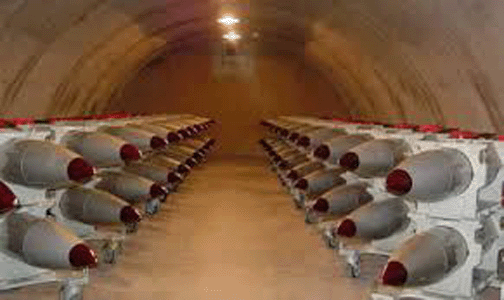
The US nuclear weapons are thought to be stored at an estimated 24 geographical locations in 11 US states and five European countries (Kristensen and Korda 2019, 124). The number of locations will increase over the next decade as nuclear storage capacity is added to three bomber bases. The location with the most nuclear weapons by far is the large Kirtland Underground Munitions and Maintenance Storage Complex south of Albuquerque, New Mexico. Most of the weapons in this location are retired weapons awaiting dismantlement at the Pantex Plant in Texas. The state with the second-largest inventory is Washington, which is home to the Strategic Weapons Facility Pacific and the ballistic missile submarines at Naval Submarine Base Kitsap. The submarines operating from this base carry more deployed nuclear weapons than any other base in the United States.
Implementing the New START treaty
The United States appears to be in compliance with the New Strategic Arms Reduction Treaty (New START) limits. Although Russia “suspended” its participation in New START in February 2023, the United States publicly declared in May 2023 that it had 1,419 warheads attributed to 662 deployed ballistic missiles and heavy bombers as of March 1st, 2023 (US State Department 2023a). The United States initially said that it voluntarily released the numbers “[i]n the interest of transparency and the US commitment to responsible nuclear conduct.” However, the United States did not continue this practice beyond that initial exchange and has not published any aggregate numbers since May 2023 (US State Department 2023a)
The United States contends that Russia’s “suspension” of New START implementation is “legally invalid” (US State Department 2023c). In response, the United States adopted four countermeasures in 2023 that it claimed were fully consistent with international law 1) no longer providing biannual data updates to Russia; 2) withholding from Russia notifications regarding treaty-accountable items (i.e. missiles and launchers) required under the treaty; 3) refraining from facilitating inspection activities on US territory; and 4) not providing Russia with telemetric information on US ICBM and SLBM launches (US State Department 2023c).
The New START warhead numbers reported by the US State Department differ from the estimates presented in this Nuclear Notebook, though there are reasons for this. …………………..
Since the treaty entered into force in February 2011, the biannual aggregate data show the United States has cut its arsenal by a total of 324 strategic launchers, reduced deployed launchers by 220 and the warheads attributed to them by 381 (US State Department 2011). The warhead reduction is modest, only equivalent to about 10 percent of the 3,708 warheads remaining in the US stockpile. ………….
As of March 2023, the United States had 38 launchers and 131 warheads less than the treaty limit for deployed strategic weapons but had 119 deployed launchers more than Russia—a significant gap that is just under the size of an entire US Air Force intercontinental ballistic missile (ICBM) wing. So far Russia has not sought to reduce this gap by deploying more strategic launchers but instead has increased the portion of its missiles that can carry multiple warheads.
The New START treaty has proven useful so far in keeping a lid on both countries’ deployed strategic forces. But it expires in February 2026 and if it is not followed by a new agreement, both the United States and Russia could potentially increase their deployed nuclear arsenals by uploading several hundred of stored reserve warheads onto their launchers.
Nuclear Posture Reviews and nuclear modernization programs
The Biden administration’s 2022 Nuclear Posture Review (NPR) was broadly consistent with the Trump administration’s 2018 NPR…………………………………
Just like previous NPRs, the Biden administration’s NPR said the United States reserved the right to use nuclear weapons under “extreme circumstances to defend the vital interests of the United States or its allies and partners” and rejected policies of nuclear “no-first-use” or “sole purpose” (US Department of Defense 2022a, 9)…………………………………………………………………………………………………………………………………………………
In 2023, multiple governmental advisory commissions published reports intended to influence US nuclear posture. The Congressionally-mandated report on “America’s Strategic Posture,” published in October 2023, included a broad range of recommendations for the United States to prepare to increase the number of deployed warheads, as well as to scale up its production capacity of bombers, air-launched cruise missiles, ballistic missile submarines, non-strategic nuclear forces, and warheads (US Strategic Posture Commission 2023). It also called for the United States to deploy multiple warheads on land-based intercontinental ballistic missiles (ICBMs) and consider adding road-mobile ICBMs to its arsenal…………………………………. the Strategic Posture Commission report’s status as a bipartisan document has been particularly useful for nuclear advocates to push for additional nuclear weapons (Heritage 2023; Hudson Institute 2023; Thropp 2023).
While additional modernization programs are being discussed, the National Nuclear Security Administration, or NNSA, delivered in 2023 more than 200 modernized nuclear weapons (B61–12 bombs and W88 Alt 370 warheads) to the Department of Defense (US Department of Energy 2024).
Nuclear planning and nuclear exercises
In addition to the Nuclear Posture Review, the nuclear arsenal and the role it plays is shaped by plans and exercises that create the strike plans and practice how to carry them out.
The current strategic nuclear war plan—OPLAN 8010–12—consists of “a family of plans” directed against four identified adversaries: Russia, China, North Korea, and Iran. Known as “Strategic Deterrence and Force Employment,” OPLAN 8010–12 first entered into effect in July 2012 in response to operational order Global Citadel. ………………………………………………………………….
…………………………………. changes are evident in the types of increasingly provocative bomber operations over Europe, in some cases very close to the Russian border (Kristensen 2022a). In October 2023, for example, a B-52 bomber from Barksdale AFB in Louisiana participated in NATO’s annual nuclear exercise Steadfast Noon, and in March 2023 a nuclear-capable B-52 cut south only a few kilometers from the Russian sea border and then flew south near Kaliningrad (Kristensen 2023a; NATO 2023).
…………………US strategy has changed in response to deteriorating East-West relations and the new “great power competition” and “strategic competition” strategy promoted by the Trump and Biden administrations, respectively. They also illustrate a growing integration of nuclear and conventional capabilities, as reflected in the new strategic war plan. B-52 Bomber Task Force deployments typically include a mix of nuclear-capable aircraft and aircraft that have been converted to conventional-only missions. With Sweden joining NATO, US strategic bombers now routinely operate over Swedish territory: In August 2022, for example, two B-52s—one version that is nuclear-capable and one that is de-nuclearized—overflew Sweden, the first overflight since it applied for NATO membership in May 2022 (Kristensen 2022c)…………………………………………………………………………………………….
Land-based ballistic missiles
The US Air Force (USAF) operates 400 silo-based Minuteman III ICBMs and keeps “warm” another 50 silos to load stored missiles if necessary, for a total of 450 silos. Land-based missile silos are divided into three wings: the 90th Missile Wing at F. E. Warren Air Force Base in Colorado, Nebraska, and Wyoming; the 91st Missile Wing at Minot Air Force Base in North Dakota; and the 341st Missile Wing at Malmstrom Air Force Base in Montana. Each wing has three squadrons, each with 50 Minuteman III silos collectively controlled by five launch control centers. We estimate there are up to 800 warheads assigned to the ICBM force, of which about half are deployed (see Table 1, on original).
The 400 deployed Minuteman IIIs carry one warhead each, either a 300-kiloton W87/Mk21 or a 335-kiloton W78/Mk12A. ICBMs equipped with the W78/Mk12A, however, could technically be uploaded to carry two or three independently targetable warheads each, for a total of 800 warheads available for the ICBM force……………………………………………………………………………………….
Part of the ongoing ICBM modernization program involves upgrades to the Mk21 reentry vehicles’ arming, fuzing, and firing system at a total cost of nearly $1 billion (US Department of Defense 2023c, 32). The publicly stated purpose of this refurbishment is to extend the vehicles’ service lives, but the effort appears to also involve adding a “burst height compensation” to enhance the targeting effectiveness of the warheads (Postol 2014)………………………………………………………………………………. As part of the Mk21A program, Lockheed Martin was awarded a sole source contract in October 2023 amounting to just under $1 billion for the engineering and manufacturing of the new reentry vehicle (US Department of Defense 2023b). These modernization efforts complement a similar fuze upgrade underway to the Navy’s W76–1/Mk4A warhead.
………………………………………………………………………………………………………………….. The Air Force’s FY24 budget for ICBM Reentry Vehicles Research Development, Test & Evaluation Programs increased significantly from the previous President’s Budget……………………………………………………………………………..
…………………………….Non-governmental experts, including those conducting Department of Defense-sponsored research, have questioned the Pentagon’s procurement process and lack of transparency regarding its decision to pursue the Sentinel option over other potential deployment and basing options (Dalton et al. 2022, 4). Moreover, it is unclear why an enhancement of ICBM capabilities would be necessary for the United States. For instance, any such enhancements would not mitigate the inherent challenges associated with launch-on-warning, risky territorial overflights, or silo vulnerabilities to environmental catastrophes or conventional counterforce strikes (Korda 2021). Additionally, even if adversarial missile defenses improved significantly, the ability to evade missile defenses lies with the payload—not the missile itself. ………………………………………..
……………………………………………….The development of the Sentinel has also been marked by a series of controversial industry contracts, starting with the awarding of a $13.3 billion sole-source contract to Northrop Grumman in 2020 to complete the engineering and manufacturing development stage
…………………………………………..in early 2024, the Air Force notified Congress of a two-year delay in the schedule and an estimated 37-percent increase from the current cost target to at least $125 billion (Tirpak 2024). These amounts do not include the costs for the new Sentinel warhead—the W87–1—which is projected to cost up to $14.8 billion, or the plutonium pit production that the US Air Force and US Strategic Command say is needed to build the warheads (Government Accountability Office 2020).
…………………………………………The schedule and extreme cost overruns for the Sentinel program incurred a critical breach of the Nunn-McCurdy Act, which requires the Secretary of Defense to conduct a root-cause analysis and renewed cost assessment before providing a certification to Congress that verifies the necessity and viability of the program no later than 60 days after a Selected Acquisition
…………………………………………………..Andrew Hunter, Assistant Secretary of the Air Force for Acquisition, Technology, and Logistics clarified that while the cost of the missile itself has increased, challenges with supporting infrastructure is the significant driver of schedule overrun, which also further impacts the overall cost (Tirpak 2024). In addition to an entirely new missile, the Sentinel program includes launch facility replacement and modifications (since the Sentinel may require a larger silo), new missile alert facilities, and new command and control facilities and systems—not to mention new training and curriculum for USAF personnel. Many of these delays are results of staffing shortfalls, clearance delays, IT infrastructure challenges, and trouble with supply chains on the part of Northrop Grumman (Government Accountability Office 2023a, 88)………………………………………………………………………………………………………………………………………………………………………..
Nuclear-powered ballistic missile submarines
The US Navy operates a fleet of 14 Ohio-class ballistic missile submarines (SSBNs), of which eight operate in the Pacific from their base near Bangor, Washington, and six operate in the Atlantic from their base at Kings Bay, Georgia……………………………………………………………………………………………..
Each submarine can carry up to 20 Trident II D5 sea-launched ballistic missiles
……………………………………………………………………………………………………………………Design of the next generation of ballistic missile submarines, known as the Columbia-class, is well underway.
………………………………………..the Navy’s fiscal 2024 budget submission estimated the procurement cost of the first Columbia-class SSBN—the USS District of Columbia (SSBN-826)—at approximately $15.2 billion, followed by $9.3 billion for the second boat (Congressional Research Service 2024, 9). A $5.1 billion development contract was awarded to General Dynamics Electric Boat in September 2017, and construction of the first boat began on October 1, 2020—the first day of FY 2021………………………………………………………..
…………………According to a June 2023 report by the Government Accountability Office, “the program remains behind on producing design products—in particular, work instructions that detail how to build the submarine—because of ongoing challenges using a software-based design tool. These, in turn, contributed to delays in construction of the lead submarine” (Government Accountability Office 2023a, 160). The Navy is working to mitigate additional delays, but these constraints mean that the program is at significant risk of cost overgrowth and is very likely to suffer further setbacks………………………………………………………………………………..
Strategic bombers
The US Air Force currently operates a fleet of 20 B-2A bombers (all of which are nuclear-capable) and 76 B-52 H bombers (46 of which are nuclear-capable)……………………………………………………………Each B-2 can carry up to 16 nuclear bombs (the B61–7, B61–11, B61–12, and B83–1 gravity bombs)…………..An estimated 788 nuclear weapons, including approximately 500 air-launched cruise missiles, are assigned to the bombers, but only about 300 weapons are thought to be deployed at bomber bases (see Table 1). The estimated remaining 488 bomber weapons are thought to be in central storage at the large Kirtland Underground Munitions Maintenance and Storage Complex outside Albuquerque, New Mexico.
The United States is modernizing its nuclear bomber force by upgrading nuclear command-and-control capabilities on existing bombers, developing enhanced nuclear weapons (the B61–12, B61–13, and the new AGM-181 Long-Range Standoff Weapon or LRSO), and designing a new heavy bomber (the B-21 Raider).
Upgrades to the nuclear command-and-control systems that the bombers use to plan and conduct nuclear strikes include the Global Aircrew Strategic Network Terminal (ASNT)…………………………………………………………………………………………………………….
The United States was initially expected to produce approximately 480 B61–12 bombs, but in 2023 it announced that a small number of them instead will be produced as the B61–13, a gravity bomb with a much larger yield (US Department of Defense 2023e………………………………………………………………………………………………………………
The Air Force is also developing a new nuclear air-launched cruise missile known as the AGM-181 LRSO……………………………………………………. The LRSO will arm both the 46 nuclear-capable B-52Hs and the new B-21, the first time a US stealth bomber will carry a nuclear cruise missile. A $250 million contract was awarded to Boeing in March 2019
…………………………………………….It is expected that the Air Force will procure at least 100 (possibly as many as 145) of the B-21, with the latest service costs estimated at approximately $203 billion …………………………………………………………………………………………………………………
Nonstrategic nuclear weapons
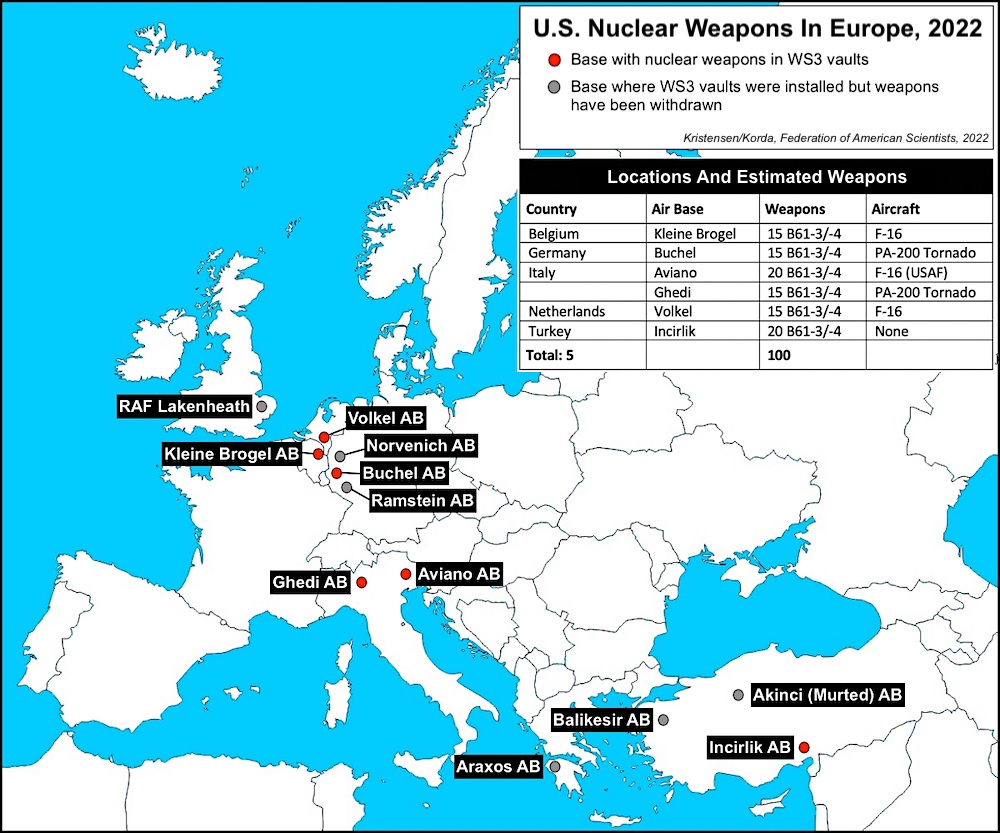
The United States has only one type of nonstrategic nuclear weapon in its stockpile: the B61 gravity bomb. But it exists in several versions: ……………………………………………………. About 100 of these (versions −3 and − 4) are thought to be deployed at six bases in five European countries: Aviano and Ghedi in Italy; Büchel in Germany; Incirlik in Turkey; Kleine Brogel in Belgium; and Volkel in the Netherlands…………………………………………………………………
The Belgian, Dutch, German, and Italian air forces are currently assigned an active nuclear strike role with US nuclear weapons. …………………………………………………………………………………………………………………………..
The United States withdrew nuclear weapons from the United Kingdom around 2007 after storing them at Royal Air Force (RAF) Lakenheath for several decades (Kristensen 2008). But increasing evidence over the past two to three years suggests that the United States may be returning its nuclear mission to UK soil (Korda and Kristensen 2023) (see Figure 3 on original)
……………………………………………………………In addition to the modernization of weapons, aircraft, and bases, NATO also appears to be increasing the profile of the dual-capable aircraft posture. NATO is now publicly announcing its annual Steadfast Noon tactical nuclear weapons exercise. For example, NATO described in 2023 that the exercise involved the participation of 13 countries and 60 aircraft including fighter jets and US B-52 bombers (NATO 2023)………………………………………………………………………………………………
This research was carried out with generous contributions from the New-Land Foundation, the Prospect Hill Foundation, Longview Philanthropy, Ploughshares Fund, and individual donors.
References…………………………………………….. https://thebulletin.org/premium/2024-05/united-states-nuclear-weapons-2024/
Nano Nuclear wants to reinvent the nuclear power business—but it could take a while.

The company is trying to not only reinvent reactors but also reinvent fuel production and transportation. It’ll take several years yet before we know if it works.
Fast Company, BY TIERNAN RAY 10 May 24
“…….. This week, a two-year-old company, Nano Nuclear Energy, is expected to go public on Nasdaq with a plan to solve what ails the nuclear power business.
The company, officially based on the 30th floor of an office building in New York’s Times Square, is a “distributed” company, meaning, its 27 staff members live and work here and there. The company is run by CEO James Walker, a physicist who was previously a nuclear engineer at Rolls-Royce.
Walker has gathered a mish-mash of engineering talent and former bankers to build what’s called a “microreactor,” also known as a “small modular nuclear reactor,” which can be hitched to a tractor trailer and driven around the country to wherever it is needed—be it a remote mining site that needs power, or an AI data center.
Walker has also assembled a star-studded advisory board that includes former U.S. presidential candidate and NATO commander Wesley Clark, and former New York governor Andrew Cuomo, who hold stock options in the company.
The premise of Nano Nuclear is the same that propels competitors such as privately held Terrapower and X-Energy: conventional nuclear energy is too costly…………………………………………………………………………………………………………………
Nano Nuclear and competitors have jumped on the DOE’s effort to make “advanced” reactors, things so compact they can ride around on a semitruck and be parked where needed. They produce far less energy, on the scale of tens of megawatts, but also can cost far less, claims the DOE, and they can be run with minimal safety oversight because of their advanced design.
Just about every company in nuclear power is working on such innovation, including Westinghouse, Terrapower, X-Energy, and publicly traded NuScale of Portland, Oregon. Walker and team contend, however, that those companies are going about it all wrong. They haven’t done enough to solve the main limiting factor of small reactors, adequate fuel supply, the enriched uranium that creates the nuclear chain reaction.
“Large SMR companies have raised billions of dollars for development but have been stalled by the lag in developing or acquiring the fuel necessary to advance their reactors,” states Nano Nuclear’s IPO prospectus. The fuel is critical because small reactors need uranium with more of the uranium isotope U235 in order to be so compact. It’s the density of power per unit of volume of fuel that lets microreactors be made very small.

The DOE has been fostering collaboration among many parties on what’s called “High-Assay Low-Enriched Uranium,” or, HALEU, which is uranium enriched more than the 5% standard in the industry, as high as 20%. Without enough HALEU, many of the advanced reactors being developed “do not have the fuel supply infrastructure necessary to succeed,” claims Nano Nuclear.
To secure HALEU, Nano Nuclear has started two subsidiaries, one to produce HALEU uranium, HALEU Energy Fuel Inc., and another to transport it in large quantities, Advanced Fuel Transportation, Inc. The company even has a subsidiary to mine for uranium.
You could say Nano Nuclear has formed a vertically integrated nuclear firm, going from uranium mining through fuel production and trucking to supplying the finished reactor.
Will it work? We won’t know for some time. The company’s two proposals for microreactors, “Zeus” and “Odin,” are not even built. The company has no revenue at present. Nano Nuclear hopes to have one of the reactors in production by 2030. The company apparently hasn’t begun the licensing process with the U.S. Nuclear Regulatory Agency, which can take several years. The fuel manufacturing, moreover, is not expected to be operational until 2027……………………….
Nano Nuclear nabbed almost ten million dollars with the IPO, but it expects to need “a significant infusion of additional capital for successful deployment, even following this offering.” Just the Zeus and Odin reactors alone are expected to cost four million dollars to develop. That means potential dilution of investors by lots of follow-on stock offerings.
The tiny staff of 27 is not entirely full-time. All the senior executives, including Walker and CFO Jaisun Garcha, are working as independent contractors, and they all have jobs running other companies.
You can’t scrutinize Nano Nuclear’s technology plans to know if they make sense because Nano Nuclear has filed no patent applications, instead preferring to keep its intellectual property secret.
The rest of this year, Nano Nuclear expects to use its IPO money to buy another company in order to get into the nuclear consulting business. The idea is to get some paying work in order to subsidize Zeus and Odin.
For a long time, then, Nano Nuclear is destined to be a far-less-interesting kind of company that simply has a great idea for the revival of the nuclear industry. https://www.fastcompany.com/91122128/nano-nuclear-reinventing-nuclear-power-business
Biden’s war on Gaza is now a war on truth and the right to protest

media has carefully refocused attention, dealing exclusively with the nature of the protests – and a supposed threat they pose to “order” – not addressing what the protests are actually about.
As ever, establishment journalists have been essential to distracting from these horrendous realities.
The student protest movement has been remarkably peaceful
The media’s role is to draw attention away from what the students are protesting – complicity in genocide – and engineer a moral panic to leave the genocide undisturbed
JONATHAN COOK, MAY 10, 2024, First published by Middle East Eye
As mass student protests quickly spread to campuses across the United States last week, and others took hold in Britain and elsewhere in Europe, the western media gave centre stage to one man to arbitrate on whether the demonstrations should be allowed to continue: US President Joe Biden.
The establishment media reverentially relayed the president’s message that the protests were violent and dangerous, treating his assessment as if it had been handed down on a tablet of stone.
Biden declared the protesters had no “right to cause chaos”, giving the green light for police to go in with even greater force to clear the encampments.
This week, Biden raised the stakes further by suggesting the protests were evidence of a “ferocious surge” of antisemitism in the US.
According to reports, more than 2,000 protesters have been arrested after some university administrators – under growing pressure from the White House and their own wealthy donors – called in local police.
In approving the crushing of dissent, Biden contradicted himself: “We are not an authoritarian nation where we silence people or squash dissent. But order must prevail.”
One small problem went unmentioned: Biden was not a disinterested party. In fact, his conflict of interest was so gigantic it could, like the damage to Gaza, be seen from outer space.
The students were calling on their universities to pull all investments from companies that are assisting Israel in carrying out what the World Court has called a “plausible” genocide in Gaza. Those weapons are being supplied in huge quantities largely thanks to the decisions of one man.
Yes, Joe Biden.
Law-breaking Biden
The “order” the US president wants to prevail is one in which his decisions to block any ceasefire and arm the slaughter, maiming and orphaning of many tens of thousands of Palestinian children go unchallenged.
Biden has been so indulgent of Israel’s destruction of Gaza that Benjamin Netanyahu’s government crossed the president’s supposed “red line” this week. Israel launched the initial stages of its long-threatened final assault on Rafah in southern Gaza. Some 1.3 million Palestinians have been huddling in makeshift tents there.
Biden could easily have forced Israel to change course at any point over the past seven months, but chose not to, even as he feigned concern about the ever-rising death toll among Palestinian civilians. Only under growing popular pressure, fuelled by the protests, has he finally appeared to pause arms shipments as the attack on Rafah intensifies.
The White House has authorised vast shipments of arms to Israel, including 2,000lb bombs that have levelled whole neighbourhoods, killing men, women and children outright or leaving them trapped under rubble to slowly suffocate or starve to death.
Late last month Biden signed a further $26bn of US taxpayers’ money to Israel, the majority military aid – just as mass graves of Palestinians killed by Israel were coming to light. He has been able to do so only by flagrantly ignoring the requirement in US law that any weapons supplied not be used in ways likely to constitute war crimes.
Human rights groups have warned his administration repeatedly that Israel is routinely breaking international law.
At least 20 of Biden administration’s own lawyers are reported to have signed off on a letter that Israel’s actions violate a host of US statutes, including the Arms Export Control Act and Leahy Laws, as well as the Geneva Conventions.
Meanwhile, the State Department’s investigations show that, even before Israel’s destruction of Gaza began seven months ago, five Israeli military units were committing gross violations of the human rights of Palestinians in the separate enclave of the Occupied West Bank.
There, Israel doesn’t even have the one-size-fits-all excuse that the abuse and killing of Palestinian civilians are unfortunate “collateral damage” in an operation to “eradicate Hamas”. The West Bank is under the control of the Palestinian Authority of Mahmoud Abbas, not Hamas.
Nonetheless, no action has been taken to stop the arms transfers. US laws, it seems, don’t apply to the Biden administration, any more than international law does to Israel.
Protest quicksand
In denying students the right to protest at the US arming of Israel’s plausible genocide, Biden is also denying them the right to protest the most consequential policy of his four-year term – and of at least the last two decades of US foreign policy, since the US invasion of Iraq.
And it is all happening in a presidential election year.
The students’ immediate aim is to stop their universities’ complicity in the slaughter of tens of thousands of Palestinians in Gaza. But there are two obvious wider goals.
The first is to bring attention back to the endless suffering of Palestinians in the tiny, besieged enclave. Until this week’s attack on Rafah, the plight of Gaza had increasingly dropped off front pages, even as Israeli-induced famine and disease tightened their grip over the past month.
When Gaza has made the news, it is invariably through a lens unrelated to the slaughter and starvation. It is details of the interminable negotiations, or political tensions over Israel’s Rafah “invasion”, or plans for the “day after” in Gaza, or the plight of the Israeli hostages, or their families’ agonies, or where to draw the line on free speech in criticising Israel.
The students’ second goal is to make it politically uncomfortable for Biden to continue providing the weapons and diplomatic cover that have permitted Israel’s actions – from slaughter to starvation, and now the imminent destruction of Rafah.
The students have been trying to change the national conversation in ways that will pressure Biden to stop his all-too-visible law-breaking.
But they have run up against the usual problem: the national conversation is largely dictated by the political and media class in their own interests. And they are all for the genocide continuing, it seems, whatever the law says.
Which means the media has carefully refocused attention, dealing exclusively with the nature of the protests – and a supposed threat they pose to “order” – not addressing what the protests are actually about.
Last Sunday, the head of the UN Food Aid Programme, Cindy McCain, warned that northern Gaza was in the grip of “full-blown famine” and that the south was not far behind. Dozens of children were reported to have died of dehydration and malnutrition. “It’s horror,” she said.
The head of Unicef pointed out last week, a few days before Israel ordered the evacuation of eastern Rafah: “Nearly all of the some 600,000 children now crammed into Rafah are either injured, sick, malnourished, traumatized, or living with disabilities.”
A separate UN report recently revealed it will take 80 years to rebuild Gaza, based on the historic levels of materials allowed in by Israel. On a highly unlikey, best-case scenario, it will take 16 years.
As ever, establishment journalists have been essential to distracting from these horrendous realities.
The students are caught in a protest equivalent of quicksand: the more they struggle to draw attention to the Gaza genocide, the more the Gaza genocide sinks from view. The media have seized on their struggle as a pretext to ignore Gaza and turn the spotlight on to their protests instead.
Feeling ‘unsafe’
The student protest movement has been remarkably peaceful – a fact that is all the more obvious when compared to the Black Lives Matter protests that swept the US in 2020, with Biden’s approval.
Four years ago there were many episodes of property damage, but that has been all but unheard of in the student protests, which are mostly confined to encampments on university campus lawns………………………………………………………………………………………………………………………………… more https://jonathancook.substack.com/p/bidens-war-on-gaza-is-now-a-war-on?utm_source=post-email-title&publication_id=476450&post_id=144499809&utm_campaign=email-post-title&isFreemail=true&r=ln98x&triedRedirect=true&utm_medium=email
US Congress passes major, bipartisan nuclear energy legislation

The House approved a bill Wednesday that includes major, bipartisan nuclear
energy legislation, keeping alive what may be the best hope for passing a
compromise nuclear bill before the end of the year. The chamber voted
393-13 to send S. 870, the “Fire Grants and Safety Act,” to the Senate
after lawmakers attached the “Accelerating Deployment of Versatile,
Advanced Nuclear for Clean Energy (ADVANCE) Act of 2024.” The fire grants
bill, sponsored by Sen. Gary Peters (D-Mich.), easily passed the Senate
last year, offering what lawmakers and nuclear energy backers believe could
be a nearly bulletproof vehicle for the bipartisan “ADVANCE Act.”
EE News 9th May 2024
NuScale, maker of small nuclear reactors, reported revenue of $1.4 million and net loss of $48.1 million for the three-month period ended March 31, 2024

NuScale reported revenue of $1.4 million and net loss of $48.1 million for
the three-month period ended March 31, 2024, compared to revenue of $5.5
million and a net loss of $35.6 million for the same period in 2023. Higher
net loss reported in the period was driven by a one-time $3.2 million
charge associated with continuing our transition from an R&D-based company
to commercial operations, and a $9.0 million non-cash adjustment to the
fair value of our warrants due to an increase in the Company’s share price.
Business Wire 9th May 2024
Empire Managers Explain Why This New Protest Movement Scares Them
CAITLIN JOHNSTONE, MAY 09, 2024
The US secretary of state and a Bilderberg surveillance tech oligarch have both made some very interesting admissions about the burgeoning protest movement against the US-backed slaughter in Gaza and the problems it poses for the empire they help run.
During a vitriolic rant about university demonstrators at the Ash Carter Exchange on Innovation and National Security on Tuesday, Palantir CEO Alex Karp came right out and said that if those on the side of the protesters win the debate on this issue, the west will lose the ability to wage wars.
For those who don’t know, Palantir is a CIA-backed surveillance and data mining tech company with intimate ties to both the US intelligence cartel and to Israel, playing a crucial role in both the US empire’s sprawling surveillance network and Israeli atrocities against Palestinians. Karp is a billionaire who sits on the Steering Committee of the Bilderberg Group and regularly features at the World Economic Forum and other platforms of plutocratic empire management.
“We kind of just think these things that are happening, across college campuses especially, are like a sideshow — no, they are the show,” Karp said during his rant. “Because if we lose the intellectual debate, you will not be able to deploy any army in the west, ever.”
Everyone should listen very carefully to Karp’s words here, because he’s giving the whole game away. He’s making it very clear how crucial it is for the empire to stomp out this protest movement and the zeitgeist upon which it rides, because the very existence of the imperial war machine depends on it. At a time when most imperial spinmeisters are trying to dismiss the importance of this movement and what young people are doing on college campuses around the world, this is a really extraordinary admission from someone who lives deep in the guts of the imperial hydra.
Such conferences are great for obtaining useful information from swamp monsters that you don’t normally hear, because when they’re surrounded by like-minded empire goons they tend to get a lot more loose-tongued than they are when they’re more aware that they have an audience of normal people.
We saw this illustrated again in a conversation between Senator Mitt Romney and Secretary of State Antony Blinken at the McCain Institute last week, during which both acknowledged some facts that generally go unstated by such creatures.
After bemoaning Israel’s lack of success at “PR” regarding its Gaza assault, Romney just came right out and said that this was “why there was such overwhelming support for us to shut down potentially TikTok or other entities of that nature” — with “us” meaning himself and his fellow lawmakers on Capitol Hill.
“How this narrative has evolved, yeah, it’s a great question,” Blinken responded, saying that at the beginning of his career in Washington everyone was getting their information from television and physical newspapers like The New York Times, The Wall Street Journal and The Washington Post.
“Now, of course, we are on an intravenous feed of information with new impulses, inputs every millisecond,” Blinken continued. “And of course, the way this has played out on social media has dominated the narrative. And you have a social media ecosystem environment in which context, history, facts get lost, and the emotion, the impact of images dominates. And we can’t — we can’t discount that, but I think it also has a very, very, very challenging effect on the narrative.”
to each other, because that’s how they think about everything.
This is because empire managers are always acutely aware of something that normal human beings are not: that real power comes from manipulating the stories — narratives — that people tell themselves about their reality.
They understand that humans are storytelling animals whose inner lives are typically dominated by mental narratives about what’s happening, so if you can control those narratives, you can control the humans.
They understand that power is controlling what happens, but true power is controlling what people think about what happens.
They understand that whoever controls the narrative controls the world……………………………………………………. more https://www.caitlinjohnst.one/p/empire-managers-explain-why-this?utm_source=post-email-title&publication_id=82124&post_id=144457706&utm_campaign=email-post-title&isFreemail=true&r=1ise1&triedRedirect=true&utm_medium=email
USA politicians threaten to invade International Criminal Court if Israel faces war crimes charges
By Ben Norton https://geopoliticaleconomy.com/2024/05/07/us-threat-icc-israel/
US Senators sent a letter to the International Criminal Court (ICC) prosecutor, threatening to impose sanctions and even invade the Hague if it issues arrest warrants for Israel’s Prime Minister Benjamin Netanyahu. The Biden administration is also pressuring the ICC not to charge Israeli officials over their war crimes in Gaza.
US government officials have threatened the International Criminal Court (ICC) at the Hague, telling its Prosecutor Karim Khan that if he issues arrest warrants against Israeli officials over their war crimes in Gaza, the US government could impose sanctions on him, other ICC personnel, and their family members.
US senators even threatened to invade the Hague if it tries to prosecute Israeli officials.
UN experts: Israel is committing genocide in Gaza
This April, Israel’s extreme-right Finance Minister Bezalel Smotrich, a prominent member of the state security cabinet, called for “total annihilation” of Gaza.
Smotrich cited the Biblical nation of Amalek – a genocidal reference also made by far-right Prime Minister Benjamin Netanyahu.
These invocations of Amalek are clear calls for genocide. In the Book of Samuel, God orders King Saul, “Now go, attack the Amalekites and totally destroy all that belongs to them. Do not spare them; put to death men and women, children and infants, cattle and sheep, camels and donkeys”.
The UN’s top legal body, the International Court of Justice (ICJ) ruled this January that Israel could be investigated on “plausible” charges of violating the Genocide Convention. (The ICJ and ICC are separate institutions, although both are located at the Hague.)
Amnesty International and Human Rights Watch have stated that Israel is violating this ICJ ruling that demands that it abide by the Genocide Convention.
Top UN experts have publicly warned that Israel is committing genocide in Gaza.
In addition to bombing civilian areas and killing tens of thousands of innocent men, women, and children, Israel has used hunger as a weapon, starving Palestinian civilians.
The US director of the UN World Food Program warned that Gaza is now suffering from a “full-blown famine”, after seven months of a suffocating Israeli blockade.
The US government has provided the vast majority of the weapons that Israel is using to bomb civilian areas in Gaza. If Israeli officials face charges over their war crimes, Washington would be complicit.
US senators threaten to sanction and invade the ICC
On April 24, a dozen Republican senators sent a threatening letter to the ICC prosecutor. The media outlet Zeteo obtained the document.
The missive was signed by major GOP leaders, including Senate Minority Leader Mitch McConnell, Ted Cruz, Marco Rubio, and Tom Cotton.
In the aggressively worded letter, the senators pledged to “sanction your employees and associates, and bar you and your families from the United States” if Israeli officials face charges over their war crimes in Gaza.
“Target Israel and we will target you”, they threatened.
Issuing an arrest warrant for Netanyahu or other top officials would be seen “not only as a threat to Israel’s sovereignty but to the sovereignty of the United States”, the US politicians wrote, making it clear that they see Israel as a key part of the US empire.
“Our country demonstrated in the American Service-Members’ Protection Act the lengths to which we will go to protect that sovereignty”, they added.
The American Service-Members’ Protection Act is popularly known as the “Hague Invasion Act”. The legislation was signed into law in 2002 by President George W. Bush.
Human Rights Watch explained that this law “authorizes the use of military force to liberate any American or citizen of a U.S.-allied country being held by the court”.
By invoking the Hague Invasion Act in their 2024 letter to the ICC prosecutor, the Republican senators made it clear that the two-decade-old legislation is still valid: hawks in Washington are willing to invade the Hague to save Israeli officials if they are prosecuted.
Biden administration double standards on the ICC
It is not just Republicans who are threatening the ICC. This is bipartisan in Washington.
The Israeli press reported that, behind the scenes, the Joe Biden administration is also aggressively pressuring the ICC not to issue arrest warrants for Israeli officials.
In 2020, when Donald Trump was in the White House, the ICC opened an investigation into war crimes committed in the war in Afghanistan. The US and NATO forces were included in this inquiry.
In anger, the US government imposed sanctions on the Hague. Trump administration officials even threatened family members of ICC staff.
When Biden came into power in 2021, he sought to differentiate himself from his Republican predecessor. Secretary of State Antony Blinken publicly announced the end of the Trump-era sanctions and visa restrictions against ICC personnel.
However, despite the Democratic administration’s claims to support the so-called “rules-based international order”, the Biden White House is now also intimidating ICC staff – if only a bit more quietly and less extravagantly than Trump and the Republicans have done.
The Biden administration furiously opposes any efforts to hold Israeli officials responsible for the war crimes they have committed in Gaza, with US weapons and political support.
This demonstrates Washington’s glaring double standards, as Biden himself had praised the ICC for issuing an arrest warrant for Russian President Vladimir Putin in 2023.
Secretary of State Blinken urged ICC member states to arrest Putin if he entered their territory. But a year later, he is aggressively pressuring the ICC to stop it from charging Israeli officials.
US and Israel supported Karim Khan as ICC prosecutor
Ironically, it was the US and Israel who had lobbied for the election of Karim Khan as ICC prosecutor.
This is despite the fact that the US and Israel are not state parties to the Rome Statute, and therefore are not members of the ICC.
US and Israeli lobbying paid off. In 2021, Khan entered office as ICC prosecutor, and immediately dropped the investigation into war crimes committed by US and NATO forces in Afghanistan.
But today, seven months into Israel’s brutal war on Gaza, the ICC is facing global condemnation for its inaction in the face of what UN experts say is clearly a genocide.
Global South leaders have long denounced the ICC as a colonial institution. Until 2016, only Africans had been tried for the worst crimes at the Court.
Khan is being forced to act, if he hopes to save face and salvage the legitimacy of the ICC. But his former sponsors in the US and Israel have turned against him.
It is not just justice for the Palestinian people, but the reputation of the International Criminal Court itself that is at stake.
Sam Altman’s nuclear energy company Oklo plunges 54% in New York Stock Exchange debut

Hayden Field, MacKenzie Sigalos, 10 May 24, https://www.cnbc.com/2024/05/10/sam-altman-takes-nuclear-startup-oklo-public-to-power-ai-ambitions.html
KEY POINTS
- Sam Altman, best known as the CEO of OpenAI, is also chairman of a nuclear power company called Oklo, which has just gone public through a special purpose acquisition company.
- Oklo merged with AltC Acquisition Corp., Altman’s SPAC, and is now trading on the New York Stock Exchange under the ticker “OKLO.”
- The company received about $306 million in gross proceeds upon closing the transaction, according to a release.
Sam Altman is now chairman of a public company. But it’s not OpenAI.
On Friday, advanced nuclear fission company Oklo started trading on the New York Stock Exchange. The company, which has yet to generate any revenue, went public through a special purpose acquisition company (SPAC) called AltC Acquisition Corp., founded and led by Altman.
Under the ticker symbol “OKLO,” shares plummeted 54% on Friday to $8.45, valuing the company at about $364 million. Oklo received roughly $306 million in gross proceeds in the transaction, according to a release.
Oklo’s business model is based on commercializing nuclear fission, the reaction that fuels all nuclear power plants. Instead of conventional reactors, the company aims to use mini nuclear reactors housed in A-frame structures. Its goal is to sell the energy to end users such as the U.S. Air Force and big tech companies.
Oklo is currently working to build its first small-scale reactor in Idaho, which could eventually power the types of data centers that OpenAI and other artificial intelligence companies need to run their AI models and services.
Altman is co-founder and CEO of OpenAI, which has been valued at over $80 billion by private investors. He’s said that he sees nuclear energy as one of the best ways to solve the problem of growing demand for AI, and the energy that powers the technology, without relying on fossil fuels. Microsoft co-founder Bill Gates and Amazon founder Jeff Bezos have also invested in nuclear plants in recent years.
“I don’t see a way for us to get there without nuclear,” Altman told CNBC in 2023. “I mean, maybe we could get there just with solar and storage. But from my vantage point, I feel like this is the most likely and the best way to get there.”
In an interview with CNBC Thursday, Oklo CEO Jacob DeWitte confirmed that the company has yet to generate revenue and has no nuclear plants deployed at the moment. He said the company is targeting 2027 for its first plant to come online.
Going the SPAC route is risky. So-called reverse mergers became popular in the low-interest rate days of 2020 and 2021 when tech valuations were soaring and investors were looking for growth over profit. But the SPAC market collapsed in 2022 alongside rising rates and hasn’t recovered.
AI-related companies, on the other hand, are the new darlings of Wall Street.
“SPACs haven’t exactly had the best performances in the past couple of years, so for us to have sort of the outcome that we’ve had here is obviously a function of the work we put in, but also what we’re building and also the fact that the market sees the opportunity sets here,” said DeWitte, who co-founded the company in 2013. “I think it’s very promising on multiple fronts for [the] nuclear, AI, data center push, as well as the energy transition piece.”
The company has seen its fair share of regulatory setbacks. In 2022, the U.S. Nuclear Regulatory Commission denied Oklo’s application for an Idaho reactor. The company has been working on a new application, which it isn’t aiming to submit to the NRC until early next year, DeWitte said, adding that it’s currently in the “pre-application engagement” stage with the commission.
Altman got involved with Oklo while president of the startup incubator Y Combinator. Oklo went into the program in 2014 after an earlier meeting between Altman and DeWitte. In 2015, Altman invested in the company and became chairman.
It’s not Altman’s only foray into nuclear energy or other infrastructure that could power large-scale AI growth.
In 2021, Altman led a $500 million funding round in clean energy firm Helion, which is working to develop and commercialize nuclear fusion. Helion said in a blog post at the time that the capital would go toward its electricity demonstration generator, Polaris, “which we expect to demonstrate net electricity from fusion in 2024.”
Altman didn’t respond to a request for comment.
In recent years, Altman has also poured money into chip endeavors and investments that could help power the AI tools OpenAI builds.
Just before his brief ouster as OpenAI CEO in November, he was reportedly seeking billions of dollars for a chip venture codenamed “Tigris” to eventually compete with Nvidia.
Altman in 2018 invested in AI chip startup Rain Neuromorphics, based near OpenAI’s San Francisco headquarters. The next year, OpenAI signed a letter of intent to spend $51 million on Rain’s chips. In December, the U.S. compelled a Saudi Aramco-backed venture capital firm to sell its shares in Rain.
DeWitte told CNBC that the data center represents “a pretty exciting opportunity.”
“What we’ve seen is there’s a lot of interest with AI, specifically,” he said. “AI compute needs are significant. It opens the door for a lot of different approaches in terms of how people think about designing and developing AI infrastructure.”
Protest And Dissent Can Absolutely Push The Empire To Retreat On Gaza
CAITLIN JOHNSTONE, MAY 10, 2024, https://www.caitlinjohnst.one/p/protest-and-dissent-can-absolutely?utm_source=post-email-title&publication_id=82124&post_id=144490253&utm_campaign=email-post-title&isFreemail=true&r=1ise1&triedRedirect=true&utm_medium=email
It is entirely possible for the surging anti-genocide protest movement and its accompanying zeitgeist in the general public to push the empire to retreat on Gaza. The imperial murder machine has many strengths, but it also has weaknesses.
The globe-spanning power structure that is loosely centralized around Washington has invested in perception management more heavily than any other empire in history — that’s what you’re seeing with all the mass media propaganda, Silicon Valley algorithm manipulation, oligarch-funded think tanks, and mainstream culture manufacturing in New York and Hollywood. By using mass-scale psychological manipulation via the most sophisticated perception management system that has ever existed, the US-centralized empire is able to manufacture support for its agendas at home and abroad while dissuading the public from protest and revolution.
If too many people realize that their government is psychopathic and their news media and other indoctrination systems have been lying to them about it all their lives, the empire will lose the ability to propagandize them, because propaganda only works if you don’t know it’s happening to you. If too many people wake up from the propaganda matrix it won’t have any effect any longer, and without their propaganda our rulers cannot rule, because that’s the entire control system upon which their rule is premised
The empire therefore needs to tread very carefully when public opinion starts to turn against it, and retreat whenever public trust in imperial institutions would be compromised too severely for the empire to continue on a given path. It simply cannot afford to wake the public up from the propaganda-induced coma it has spent generations lulling them into.
What this means is that the empire can be pressured into retreat simply by spreading enough awareness and sowing enough opposition to its depraved actions. If enough eyes open to the truth of what’s happening in Gaza, there’s no amount of geostrategic middle east agendas or Israel lobby funding that can outweigh the empire’s existential need to prevent a mass-scale awakening from the mainstream imperial worldview and a transition into widespread revolutionary consciousness. The empire would necessarily need to step back before things reached that point, because its very existence depends on it.
The empire has been walking that line this entire time. Whenever you see it doing things like stepping back from regime change invasions of Cuba or Syria or refraining from going as authoritarian as it could go on a given issue, it isn’t because the empire suddenly evolved a conscience. It’s because it hasn’t yet succeeded in manufacturing public consent for such agendas, and imposing them before the public has been manipulated into accepting them would snap them out of the matrix of psychological control. They work so hard to manufacture public consent because they absolutely need it.
So the empire can be pressured on Gaza and on every other issue if enough people put enough energy into spreading awareness of the truth. That’s why the empire managers are freaking out about this new protest movement right now; they understand the absolutely fundamental role that narrative control plays in the existence of imperial power structures, and how much they stand to lose if it is taken away.
Congress Restricts Russian Uranium Imports, Unlocks $2.7 Billion for Domestic Fuel
Rifka Handelman, MAY 08, 2024, https://ww2.aip.org/fyi/congress-restricts-russian-uranium-imports-unlocks-2-7-billion-for-domestic-fuel
The bill allows the energy secretary to issue waivers but aims to wean the U.S. off Russian nuclear fuel.
Legislation that restricts imports of unirradiated low-enriched uranium (LEU) from Russia is now headed to the president’s desk after the Senate passed it by unanimous consent last week.
The restriction will take effect 90 days after the president signs the legislation, which is expected to occur.
The act allows the secretary of energy to issue waivers for imports up to certain limits if there is no other viable source of LEU available. As of 2022, U.S. civilian nuclear power plants collectively sourced about 12% of their uranium from Russia.
Once the restriction is in place, the Department of Energy is permitted to spend up to $2.72 billion to support domestic production of LEU and high-assay low-enriched uranium (HALEU), which is a more concentrated fuel intended for use in prospective advanced reactors.
Congress allocated these funds through the final appropriations legislation for fiscal year 2024 but made them contingent on the U.S. restricting imports of Russian uranium.
The funds will specifically go toward implementing the Nuclear Fuel Security Act, which aims to expand U.S. capacity to make HALEU fuel and ensure there is a reserve of uranium that can sustain U.S. reactors in the event of supply chain disruption.
Report: Private US Security Firm To Take Control of Rafah Border Crossing!

This is an outrage!! The US is in this war!!
According to Haaretz, Israel, Egypt, and the US have agreed on the plan
by Dave DeCamp May 7, 2024, https://news.antiwar.com/2024/05/07/report-private-us-security-firm-to-take-control-of-rafah-border-crossing/
Haaretz reported on Tuesday that the US, Israel, and Egypt have agreed that control of the Rafah border crossing that connects Egypt and Gaza will be handed over to a private American security firm.
The report came after Israel captured the border crossing in an operation that was approved by the Biden administration. The private American firm was not named, but Haaretz said that it employs veterans of elite US Army units and has been employed in several Middle Eastern and African countries to guard sensitive sites.
State Department spokesman Matt Miller was asked about the report and said he wasn’t aware of any plan for Israel to transfer control of the border crossing.
Under the reported arrangement, American mercenaries would take responsibility for overseeing the border crossing, which would include monitoring goods coming into Gaza and preventing Hamas from taking control. Vital deliveries have been cut off since Israel took control of the crossing early Tuesday.
The Haaretz report said the arrangement was part of an effort by Israel to “win agreement” from the US and Egypt for a Rafah operation. The report said Israel had given assurances that it would limit its attack on Rafah to securing the border crossing, although Israeli bombs have been pounding the city.
1 This Month

of the week – Shut Down Drone Warfare!


Tell the Ukrainian Government to Drop Prosecution of Peace Activist Yurii Sheliazhenko

Petition to revoke the licensing of the Near Surface Nuclear Disposal Facility (NSDF) at Chalk River. https://www.ourcommons.ca/petitions/en/Petition/Details?Petition=e-7247
To see nuclear-related stories in greater depth and intensity – go to https://nuclearinformation.wordpress.com
-
Archives
- April 2026 (57)
- March 2026 (251)
- February 2026 (268)
- January 2026 (308)
- December 2025 (358)
- November 2025 (359)
- October 2025 (376)
- September 2025 (257)
- August 2025 (319)
- July 2025 (230)
- June 2025 (348)
- May 2025 (261)
-
Categories
- 1
- 1 NUCLEAR ISSUES
- business and costs
- climate change
- culture and arts
- ENERGY
- environment
- health
- history
- indigenous issues
- Legal
- marketing of nuclear
- media
- opposition to nuclear
- PERSONAL STORIES
- politics
- politics international
- Religion and ethics
- safety
- secrets,lies and civil liberties
- spinbuster
- technology
- Uranium
- wastes
- weapons and war
- Women
- 2 WORLD
- ACTION
- AFRICA
- Atrocities
- AUSTRALIA
- Christina's notes
- Christina's themes
- culture and arts
- Events
- Fuk 2022
- Fuk 2023
- Fukushima 2017
- Fukushima 2018
- fukushima 2019
- Fukushima 2020
- Fukushima 2021
- general
- global warming
- Humour (God we need it)
- Nuclear
- RARE EARTHS
- Reference
- resources – print
- Resources -audiovicual
- Weekly Newsletter
- World
- World Nuclear
- YouTube
-
RSS
Entries RSS
Comments RSS
 nuclear-news