Presidential candidate Joe Biden is only lukewarm about action on climate change
A Biden Presidency Would Be a ‘Death Sentence,’ Climate Activists Warn https://www.vice.com/en_ca/article/a3x39g/climate-activists-dont-like-joe-biden 12 May 19
The former vice president’s campaign has them very, very worried. Joe Biden backed one of the first climate bills in US history, has a relatively strong score from the League of Conservation Voters, and calls fighting global temperature rise “a matter of survival.” The former vice president—who became the frontrunner for the Democratic presidential nomination shortly after entering the race last month—has the profile, on paper, of someone who should be able to tout his bona fides on climate change and the environment.
It’s difficult to find many climate thinkers or activists these days who are all that excited about Biden’s entry into the Democratic primaries—and some interviewed for this story worry that if he wins he could actually slow down progress at a time when the planet is least able to afford it.
“This is an existential threat that we are talking about for all life on Earth, all Americans,” said Leah Stokes, a political scientist at the University of California, Santa Barbara, who closely follows the politics of climate change and energy. “I don’t trust him at all… I think he’s got some explaining to do about what exactly his plan is to deal with the climate crisis.”
Biden’s campaign website contains only three sentences about the greatest crisis ever to face humankind, and these are located midway down a secondary page. “We must turbocharge our efforts to address climate change and ensure that every American has access to clean drinking water, clean air, and an environment free from pollutants,” the site reads. His campaign did not respond to VICE’s request for more details on the actual policies this would entail.
There are virtually no specifics about how Biden plans to cut emissions in half by 2030—which is what United Nation scientists calculated is required to stabilize the world at or below 1.5 degrees Celsius of warming and keep cities like Houston, London, Shanghai, Jakarta, Bangkok, Lagos, Manila and Dhaka above water.
But the Reuters story sheds light on what a Biden presidency might include when it comes to climate—a return to Barack Obama’s policies of regulating emissions and working with the international community, but not the kind of aggressive action favored by experts and advocates. One of the sources for the Reuters article, Heather Zichal, previously advised Obama on climate change and is now an informal advisor to Biden. She is affiliated with Cheniere Energy, a major liquefied natural gas producer based in Houston.
Unsurprisingly, activists were alarmed by this news.
“A ‘middle ground’ policy that’s supportive of more fossil fuel development is a death sentence for our generation and the millions of people on the frontlines of the climate crisis,” Varshini Prakash, co-founder of the Sunrise Movement, which has been leading the push for a Green New Deal, said in a statement.
Even before the Reuters story, there were plenty of reasons for people like Prakash to be skeptical of Biden on climate. When he launched his campaign for president on April 29 in Pittsburgh he didn’t mention climate change once. Instead, he gave a lengthy shout-out to union leaders in the audience, promising to “restore,” “rebuild,” and “unify” America after four years under Donald Trump. Buried deep in his 40-minute speech, Biden made a passing reference to low-carbon growth, pledging his support for “rebuilding America’s clean, renewable energy.” He went on to brag that “North American energy makes us independent,” a phrase often used in reference to oil and gas production.
Ed Fallon, a former Iowa legislator turned radio talk show host and climate activist who once played a game of pool with Biden, wasn’t impressed. He found the former vice-president to be “an eloquent speaker and an all-around likable guy.” But with Iowa recovering from two months of historic flooding linked in part to global carbon emissions, and Democrat supporters rating climate change as a top concern, Fallon wanted to know how seriously Biden takes human survival on our planet.
So when Biden spoke in Des Moines on May 2, Fallon and 11 others put on penguin masks and stood directly in front of Biden’s podium holding signs that read “Climate is a crisis.” Biden addressed Fallon’s group directly. “Don’t worry, I’ll get to climate change,” he said, adding, “I introduced climate legislation way, way back in 1987,” a reference to a bill he’d pushed urging President Ronald Reagan to back a task force studying global warming. “You’re preaching to the choir,” Biden said.
But Fallon isn’t so sure. Biden at one point told the crowd that “the United States is soon going to be the largest producer of energy of any nation in the world by the end of the 2020s. My lord, what are we so afraid of?” Biden appeared to be referring to the fact that US oil production has rocketed over recent years to 12.1 million barrels per day, surpassing the output of Saudi Arabia and Russia.
“He’s proud of that,” Fallon told VICE. “Joe’s boasting about being the biggest oil producer. You can’t be proud of that and fight climate change.”
Several days later Biden travelled to Los Angeles to speak at some of his campaign’s first fundraising events. At the home of UCLA School of Medicine faculty member Cynthia Telles and media executive Joe Waz, Biden discussed global warming “in passing,” according to notes emailed to reporters from his campaign. Notes from an event at the Jonathan Club, a private Los Angeles social club, don’t mention climate change at all.
“This is not a second-tier problem,” Stokes said. “This is not something we can pretend will be easy to do and we’ll talk about later, this is a fundamental conversation that has to be happening.”
Biden has at times seemed willing to discuss climate change with the urgency it requires. Earlier this year he told the Conference of Mayorsthat the US could easily quadruple the wind power it generates and that half of electricity in North America should come “from non-polluting sources” with six years. If rising seas force millions of people out of their homes, he said, “that’s how wars start.”
Biden received an 83 percent score from the League of Conservation Voters for his support of environmental policy as a US senator, a score that may have been higher if he hadn’t missed votes while several times competing in Democratic presidential primaries, said Tiernan Sittenfeld, the group’s senior vice president for government affairs.
But she said with the impacts of climate change becoming clearer and more deadly all the time, “all candidates who are serious about running for president need to make climate change an absolute top-tier priority.” They must prove every day to voters, Sittenfeld went on, that they’ll “move forward in ambitious ways on combating climate change starting on day one in the Oval Office.” The world as we know it could literally be depending on it.
Geoff Dembicki is the author of Are We Screwed? How a New Generation Is Fighting to Survive Climate Change. Follow him on Twitter. This article originally appeared on VICE US.
Trump administration re-ignites the political issue of nuclear waste and Nevada’s Yucca Mountain
 In Nevada, Trump administration revives a radioactive campaign issue, CBS News, BY ALEXANDER TIN, MAY 2, 2019 /Last year, the Trump administration faced a dilemma: where could the Department of Energy stow a metric ton of surplus, weapons grade plutonium?
Efforts to recycle thousands of pounds in unwanted radioactive material had been crippled by cost overruns. Now the government faced a court ordered deadline to remove the plutonium from South Carolina, where it had been stockpiled.
For the plutonium’s new home, the administration turned to Nevada. Over the state’s objections, authorities planned to ship some of the radioactive material to a site adjacent to Yucca Mountain, where the federal government has long sought to store dangerous nuclear waste. ……
The state fought for months in court to block the new plutonium delivery, until a bombshell revelation in early 2019 that the administration had already quietly trucked in much of the plutonium, with details kept secret for “operational security.”
The response from Nevada’s government was swift.
“They lied to the state of Nevada, misled a federal court, and jeopardized the safety of Nevada’s families and environment,” Gov. Steve Sisolak said in a statement. Nevada Democratic Sen. Jacky Rosen slammed the move as “deceitful” and “unethical.”
Energy Secretary Rick Perry then struck a deal with Nevada Democratic Sen. Catherine Cortez-Masto, and department has since promised to pull out the plutonium. But the shipment has added fuel to a political firestorm in Nevada over recent efforts to resurrect Yucca Mountain, sowing mistrust over a key issue for the state, which is home an early and important presidential primary contest.
On Wednesday, the administration’s push to reopen Yucca Mountain that drew a forceful condemnation from Vermont Sen. Bernie Sanders.
“The proposal by President Trump and Republicans in Congress to send our nuclear waste to Yucca Mountain would be a geological, environmental, and social disaster,” the presidential candidate said in a statement.
Sanders joins a long list of fellow White House hopefuls in questioning the project’s future, including former Rep. Beto O’Rourke, Washington Gov. Jay Inslee, Minnesota Sen. Amy Klobuchar, Massachusetts Sen. Elizabeth Warren, New Jersey Sen. Cory Booker, California Sen. Kamala Harris, and former Obama HUD secretary Julián Castro.
Opponents have long cited the risks of seismic activity under the site, and its proximity to an aquifer and a military test range. They have rejected arguments that Yucca Mountain would hasten the transfer to a more environmentally friendly economy, warning of the risks for communities through which waste would pass through……
Testifying before the Senate Environment and Public Works Committee, Rosen — Heller’s successor — joined Cortez-Masto in calling on Congress to help Nevada block Yucca Mountain. Their bill would require consent from state and local authorities before storing nuclear waste in their respective jurisdictions.
Only six other senators have so far cosponsored the proposal: Cory Booker, Kamala Harris, Amy Klobuchar, Bernie Sanders, Elizabeth Warren, and Kirsten Gillibrand. https://www.cbsnews.com/news/in-nevada-trump-administration-revives-a-radioactive-campaign-issue/
Senator Chris Van Hollen on Gorging at the Nuclear Buffet Table
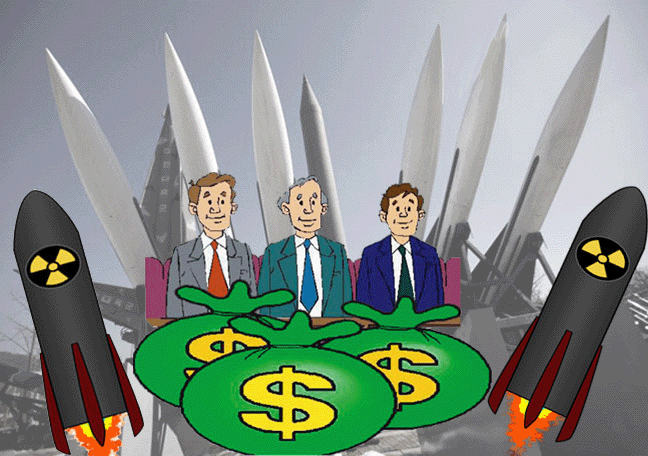 REMARKS: Gorging at the Nuclear Buffet Table Arms Control Association, May 2019
By Sen. Chris Van Hollen “…….we gather here at another urgent moment. It has been important work all along, but we are in an urgent moment now. Because with the Trump administration, all signs indicate that we’re jettisoning, we’re abandoning what has been a bipartisan tradition of recognizing that we need to modernize our nuclear forces, we need to modernize our triad, we need to make sure its survivable and resilient, but that we should do it within the framework of an arms control architecture that leads to predictability, stability, and transparency. That has been an important formula even as relations between the United States and the Soviet Union, now Russia, have gone up and down. We have still maintained that conversation, we have still maintained that structure, and that structure has helped keep the peace.
An emerging hopeful trend for US nuclear policy
A new, hopeful moment for US nuclear policy, Bulletin of the Atomic Scientists, By Joe Cirincione, April 17, 2019 Underneath the daily, depressing headlines, five converging trends offer hope, for the first time in more than a decade, for dramatic positive change in US nuclear policy.
The first trend is the growing recognition that current US nuclear security strategies have failed to make America safer. The policies pursued by President Donald Trump have made every nuclear danger he inherited worse, not better. Military budgets are spiraling out of control, new weapons and new doctrines are increasing the risk of nuclear use, effective treaties and agreements are frivolously discarded, and diligent diplomacy is replaced with narcissistic summitry. Our policies have alienated our allies and, most ominously, the instability of the president has exposed the underlying insanity of a system that gives one person the unchecked power to start a nuclear war that could end human civilization.
It is hard to find a bright spot in the Trump approach to nuclear affairs. The world is fully entrenched in a new arms race, with every nuclear-armed nation producing new weapons. Yet Trump is trying to destroy the accord that rolled back and contained Iran’s nuclear program, and he has seesawed his way to an incoherent North Korea policy. In fact, he and National Security Adviser John Bolton are methodically shredding the entire nuclear safety net of agreements, treaties, alliances, and security assurances constructed by their predecessors over decades.
This torrent of bad news has had one positive impact: It has made crystal clear that the United States needs a fundamentally new, saner nuclear strategy.
The second trend offers hope for developing such a strategy. The November elections brought fresh leadership and energy to the Congress. The House of Representatives can provide a check on a dangerous president and become a proving ground for new ideas and new policies. Leaders old and new are rising to the challenge.
Rep. Adam Smith, a 20-year veteran and now chair of the House Armed Services Committee, wants to “totally re-do the nuclear posture review.” Dozens of senators and members have introduced visionary legislation that could form the planks of a new strategic platform. There will be debates and votes on new weapons, a no first use policy, and efforts to prevent a nuclear arms race by preserving existing treaties.
The presidential campaigns, meanwhile, have started in earnest. Some candidates are already advancing dramatic, alternative security policies to end unjust wars and rethink our nuclear posture. Sen. Elizabeth Warren—who says, “our current nuclear strategy is not just outdated, it is dangerous”—mirrors Smith’s policy priorities with a three-part proposal: No new weapons, more arms control not less, and no first use. Sen. Bernie Sanders told a Fox News town hall April 15, “We have to bring the United States and the rest of the world together to do everything we can to rid this world of nuclear weapons.”
Meanwhile, six candidates have already said that one of their top priorities would be to re-commit the United States to the Iran anti-nuclear deal, including Warren, Sanders, Kamala Harris, Julian Castro, Amy Klobuchar, and Wayne Messam. Many also support negotiations with North Korea—but done with a competent team, a fully staffed State Department, and plans that rely less on summitry and more on diplomacy.
The most important trend, however, is the rise of vibrant mass movements that have translated angry street protests into sustained political action, powered 100 new members into Congress, and now are linking up with the “activist leadership” style of these members and some presidential candidates. Though primarily focused on domestic matters, these organizations are ready to embrace national security in their campaigns for a more just and equitable society. This is precisely the type of grassroots pressure needed to encourage political leaders to break with the nuclear-industrial complex and its outmoded programs and strategies—and then press for the implementation of new policies in Congress and in the White House.
Relatedly, the success of the Treaty on the Prohibition of Nuclear Weapons campaign indicates that the global appetite for the elimination of these weapons is growing. Allied governments—often in the grip of conservative defense officials who resist changes to nuclear doctrine—may be more receptive to discussion about disarmament, faced with this popular sentiment and the scares Trump’s personality and policies have given them.
Finally, trillion-dollar tax cuts and profligate military spending have brought budget realities home to America. ….. https://thebulletin.org/2019/04/a-new-hopeful-moment-for-us-nuclear-policy/
Democratic presidential candidate Tulsi Gabbard slams decision to sell Saudi Arabia nuclear weapons tech
 ‘How does this serve US interests?’ Gabbard slams decision to sell Saudi Arabia nuclear weapons tech https://www.rt.com/usa/455279-gabbard-saudi-arabia-extremism-isis/ 2 Apr, 2019 Tulsi Gabbard has slammed the US for allowing firms to sell Saudi Arabia nuclear tech despite its history of exporting extremism which inspires Islamic State (IS, formerly ISIS) and Al-Qaeda, which she says the Kingdom supports.
The Hawaiian congresswoman and Democratic presidential candidate took aim at the Kingdom’s history of extremism in a Twitter video that criticized Energy Secretary Rick Perry’s secret authorizations, to six US companies, allowing for the sale of nuclear power technology and assistance to Saudi Arabia, as Reuters revealed last week. Gabbard said the move is “both mind-blowing and inexplicable.”
Saudi Arabia is the “primary exporter of jihadist ideology, Wahhabi Salafist ideology that is the motivation and inspiration for terrorist groups like ISIS and al Qaeda – groups that the Saudis both directly and indirectly support,” Gabbard said.
The kingdom has been tied to Al-Qaeda and extremism in the past, with 15 of the 19 9/11 hijackers coming from Saudi Arabia, according to the CIA. In 2015, one of the alleged hijackers, Zacarias Moussaoui, claimed several members of the Saudi royal family had been listed as Al-Qaeda donors in the database he worked on under orders of Osama bin Laden, US media reported.
WikiLeaks cables from the US State Department from 2009 revealed“donors in Saudi Arabia constitute the most significant source of funding to Sunni terrorist groups worldwide.” In a 2014 email, published by WikiLeaks, then-Secretary of State Hillary Clinton said Saudi Arabia was “providing clandestine financial and logistic support to ISIL and other radical Sunni groups in the region.” It has also supplied weapons to IS in Syria.
Saudi Arabia is reportedly planning to create at least two nuclear power plants, but many are concerned that’s a precursor to developing nuclear weapons, which would further destabilize the region. It was also reported, last year, that Israel was selling Saudi Arabia nuclear secrets
The children’s climate fight is a fight against despair
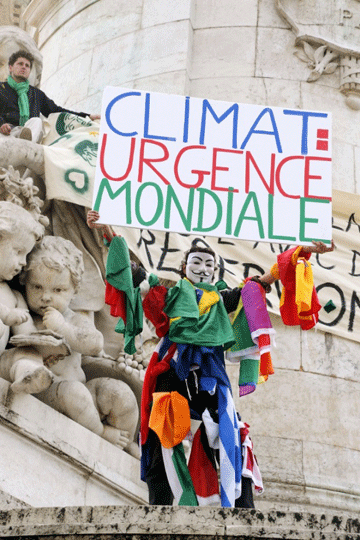 The youth climate strikes fight back against despair https://grist.org/article/the-youth-climate-strikes-fight-back-against-despair/, Last week, as I stood on the front steps of the Minnesota State Capitol, I watched hundreds of high schoolers stream by as they left their classes to join in the U.S. Youth Climate Strike. One sign in particular stood out to me: “Why are we studying for a future we won’t have?” The youth climate strikes fight back against despair https://grist.org/article/the-youth-climate-strikes-fight-back-against-despair/, Last week, as I stood on the front steps of the Minnesota State Capitol, I watched hundreds of high schoolers stream by as they left their classes to join in the U.S. Youth Climate Strike. One sign in particular stood out to me: “Why are we studying for a future we won’t have?”
|
|
1 This Month

of the week – Shut Down Drone Warfare!


Tell the Ukrainian Government to Drop Prosecution of Peace Activist Yurii Sheliazhenko

Petition to revoke the licensing of the Near Surface Nuclear Disposal Facility (NSDF) at Chalk River. https://www.ourcommons.ca/petitions/en/Petition/Details?Petition=e-7247
To see nuclear-related stories in greater depth and intensity – go to https://nuclearinformation.wordpress.com
-
Archives
- April 2026 (68)
- March 2026 (251)
- February 2026 (268)
- January 2026 (308)
- December 2025 (358)
- November 2025 (359)
- October 2025 (376)
- September 2025 (257)
- August 2025 (319)
- July 2025 (230)
- June 2025 (348)
- May 2025 (261)
-
Categories
- 1
- 1 NUCLEAR ISSUES
- business and costs
- climate change
- culture and arts
- ENERGY
- environment
- health
- history
- indigenous issues
- Legal
- marketing of nuclear
- media
- opposition to nuclear
- PERSONAL STORIES
- politics
- politics international
- Religion and ethics
- safety
- secrets,lies and civil liberties
- spinbuster
- technology
- Uranium
- wastes
- weapons and war
- Women
- 2 WORLD
- ACTION
- AFRICA
- Atrocities
- AUSTRALIA
- Christina's notes
- Christina's themes
- culture and arts
- Events
- Fuk 2022
- Fuk 2023
- Fukushima 2017
- Fukushima 2018
- fukushima 2019
- Fukushima 2020
- Fukushima 2021
- general
- global warming
- Humour (God we need it)
- Nuclear
- RARE EARTHS
- Reference
- resources – print
- Resources -audiovicual
- Weekly Newsletter
- World
- World Nuclear
- YouTube
-
RSS
Entries RSS
Comments RSS
 nuclear-news