Trump re-elected would mean unsafe climate for the world, democracy’s end in USA
Four more years of Trump would leave democracy, and hope for a safe climate, in tatters
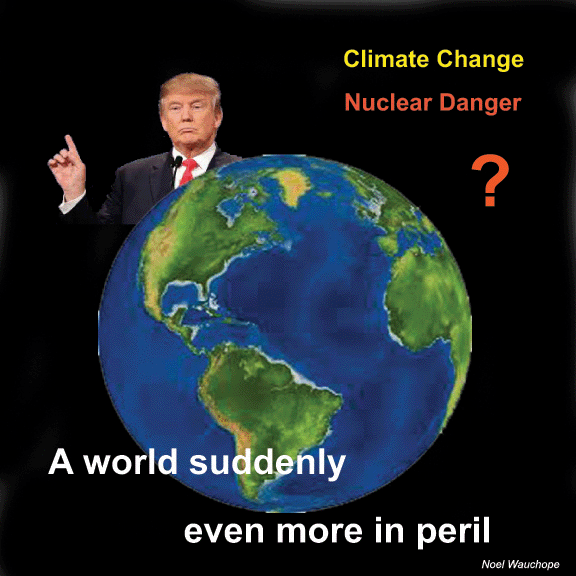
From the perspective of the human species as a whole, the arc of its life on this planet, it may be the most important election ever.
A second Trump term would mean severe and irreversible changes in the climate No joke: It would be disastrous on the scale of millennia. VOX, By David Roberts@drvoxdavid@vox.com Aug 27, 2020, I f Donald Trump is reelected president, the likely result will be irreversible changes to the climate that will degrade the quality of life of every subsequent generation of human beings, with millions of lives harmed or foreshortened. That’s in addition to the hundreds of thousands of lives at present that will be hurt or prematurely end.
This sounds like exaggeration, some of the “alarmism” green types are always accused of. But it is not particularly controversial among those who have followed Trump’s record on energy and climate change……..
………..a Trump victory would make any reasonable definition of “success” on climate change impossible….
More Trump will ensure the continued escalation of global temperatures
We know from the latest IPCC report that the climate target agreed to by nations — no more than a 2° Celsius rise in global average temperatures — is not a “safe” threshold at all. Going from 1.5° to 2° means many more heat waves, wildfires, crop failures, migrations, and premature deaths. We know that every fraction of a degree beyond 2° means more still, along with the increasing risk of tipping points that make further warming unstoppable. Continue reading
You can have four more years of Trump, or you can have a habitable planet. But you can’t have both.
 Climate Apocalypse Now, Maybe it’s just a failure of human imagination to understand what is coming, Rolling Stone, By JEFF GOODELL 28 Aug 20
And, of course, we are fucking it up. We are heating up the planet so fast that large parts of it will be uninhabitable by the end of the century. We are amping up storms like Hurricane Laura — it is the strongest storm to hit the Louisiana coast since 1856 — and turning the Gulf Coast into a shooting gallery — which city is going to get hit next? New Orleans? Houston? Tampa? Miami? They are all living on borrowed time. And it’s not just the hurricanes: As Greenland melts and Antarctica falls into the Southern Ocean, they will be swamped by rising seas, as will virtually every other low-lying city in the world. The rich will huddle behind sea walls; the poor will flee or drown.
We are mowing down rainforests, destroying the lungs of the planet, and pushing animals — and the viruses they carry — into new places, increasing the risks of spillover into humans. You think Covid-19, with a fatality rate of about one percent (depending on risk group), is bad? Wait until a Nipah virus, with a fatality rate of 50 percent or higher, morphs in a way that allows asymptomatic transmission. ………..
Maybe it’s a failure of human imagination to understand what is coming. Maybe it’s a failure of democracy and the media (including writers like myself). After all, at this vital turning point in the climate crisis, at a moment when most scientists agree is the last chance to save a stable climate, America elected a president who sees science as a church for losers, and who believes the climate crisis is a hoax perpetuated by the Chinese. ……
Maybe the real message that Mother Nature is sending with these storms and fires in the midst of the Republican National Convention is not to Trump, but to us. And it says this: You can have four more years of Trump, or you can have a habitable planet. But you can’t have both. https://www.rollingstone.com/politics/political-commentary/hurricane-laura-california-wildfire-climate-crisis-jeff-goodell-1050746/
Not all scientists are objective, especially nuclear scientists running for election

 system that only rewards those who can afford to contribute to political campaigns.” Foster “has
  taken millions of dollars from big banks, hedge fund managers, insurance companies, big Pharma and even money from fossil fuel companies.”
With a denier of science in The White House—whether it has to do with the climate crisis or Covid-19 and so on—there is a major push, including by Democratic officials, for making science the basis for governmental decision-making.
That’s completely understandable.
But what about the push by some scientists to politically further areas of science and technology which they favor? Science might be objective—but that doesn’t mean all scientists are.
Take Congressman Bill Foster.
Foster in a Democratic primary this year was challenged by Rachel Ventura, a member of the Will County Board in Illinois, who describes herself as a “progressive.” She is also an environmentalist who earlier worked as a naturalist for Georgia State Parks.
“Will County is effectively the ‘dumping grounds’ for Chicago’s dirty energy industry and garbage,” she declared in campaign literature. “Will County is home to two coal plants, two refineries and one nuclear power plant,” the twin-reactor Braidwood nuclear power plant.
She told patch.com/Illinois that the “Green New Deal is a centerpiece of my campaign” for both environmental and economic reasons. “I believe we can replace warehouse jobs with jobs building windmills and installing solar panels. I believe that we can replace the sweatshops in Aurora [a city, the second in population in Illinois after Chicago and in the Congressional district]…with better-paying jobs building energy efficient window and doors.”
She supports the Future Energy Jobs Act, pending before the Illinois General Assembly, which emphasizes solar and wind power and energy efficiency and commits the state to 100 percent renewable energy by 2050.
Ventura noted that Foster “argues that his Ph.D. somehow makes him a better lawmaker, yet he has become part of the broken pay-to-play system that only rewards those who can afford to contribute to political campaigns.” Foster “has taken millions of dollars from big banks, hedge fund managers, insurance companies, big Pharma and even money from fossil fuel companies.”
She wants to see nuclear power replaced by energy from solar, wind and hydropower.
Despite a modest budget—$80,000—she received 41.3 percent of the primary vote, 32,411 votes—to 58.7 percent, 46,116 votes, for Foster.
As to the Republican whom Foster will face on Election Day, it is Rick Laib, a Trumpster and sergeant in the Will County Sheriff’s Office, who stresses his opposition to abortion and the right for people to carry guns………..
In his farewell address as president in 1961, Dwight Eisenhower warned of the rise of a “military-industrial complex” in the U.S. In fact, according to Douglas Brinkley, formerly director of the Eisenhower Center for American Studies at the University of New Orleans, the original draft of the speech warned not only of a “military-industrial complex” but of a “military-industrial-scientific complex.” Because of the “urging” of Eisenhower’s science advisor, James Killian, said Brinkley, the word “scientific” was eliminated. (Brinkley is now Katherine Tsanoff Brown Chair in Humanities and professor of history at Rice University.)
Remaining in Eisenhower’s address were other words on the issue. Eisenhower said, “in holding scientific research and discovery in respect, as we should, we must also be alert to the equal and opposing danger that public policy could itself become the captive of a scientific technological elite.”
Eisenhower also said: “Akin to, and largely responsible for the sweeping changes in our industrial-military posture, has been the technological revolution during recent decades. In this revolution, research has become central; it also becomes more formalized, complex, and costly. A steadily increasing share is conducted for, by, or at the direction of, the federal government. Today, the solitary inventor, tinkering in his shop, has been overshadowed by task forces of scientists and laboratories.”
The chain of U.S. national laboratories which grew out of the crash program of World War II to build atomic bombs, the Manhattan Project, was—and is—the base for much of the scientific establishment about which Eisenhower was concerned.
In 1999, three-term U.S. Representative Michael Forbes, concerned about leaks of tritium from nuclear reactors at BNL, spoke out in connection to the radioactive pollution caused by the facility, located in his district. Its two reactors were leaking tritium directly into the underground water table below on which Long Island depends as its sole source of potable water.
As a result of Forbes’ criticism of the federal laboratory, he was opposed in a primary for the Democratic nomination by Regina Seltzer whose husband had been a BNL scientist. BNL personnel manned phone banks to campaign for Seltzer. She won the Democratic nomination over Forbes by 45 votes, but lost to the Republican candidate in the general election. Meanwhile, Forbes, a highly capable representative was driven out of Congress.
One need not be a scientist at a federal facility involved in atomic science to develop an affinity for nuclear technology. Involvement in the U.S. nuclear Navy can also be a springboard.
Take Congresswoman Elaine Luria.
Her online biography notes “Rep. Luria was one of the first women in the Navy’s nuclear power program.” She “served two decades in the Navy, retiring at the rank of Commander. Rep. Luria served at sea on six ships as a nuclear-trained Surface Warfare Officer, deployed to the Middle East and Western Pacific.”
In the online biography, Luria, of Virginia, states: “As a nuclear engineer in the Navy, I saw firsthand that nuclear power, when deployed safely and responsibly, can play a key role in our future as a zero-carbon energy source. That is why I introduced the bipartisan Nuclear Energy Leadership Act, which will encourage innovation in the design and deployment of advanced nuclear reactor technologies.”
Her Nuclear Energy Leadership Act, introduced in 2019, declares its purpose is to “direct the Secretary of Energy to establish advanced nuclear goals, provide for a versatile, reactor-based fast neutron source, make available high-assay, low-enriched uranium for research, development, and demonstration of advanced nuclear reactor concepts, and for other purposes.”
Luria is a Democrat and will face Republican Scott Taylor, a former Navy SEAL endorsed by Trump who had lost to her two years ago…… This past December “Congress voted to approve appropriations for fiscal year 2020 that includes $1.5 billion for nuclear energy programs, a 12.5 increase from the previous year,” the leading PR entity for the nuclear industry, the Nuclear Energy Institute, trumpeted. It quoted its president and CEO Maria Korsnick saying: “Today’s historic 2020 funding of $1.5 billion for nuclear energy programs reaffirms that nuclear energy is an essential driver in lowering carbon emissions. With Congress’ action, our government is signaling that nuclear energy is a vital part of our country’s commitment to a reliable and resilient energy system.” https://www.nationofchange.org/2020/08/25/science-is-objective-but-are-all-scientists-objective/?fbclid=IwAR32pATHxLwEv5-3jnrQTNCHcuavdl6zT0T1W1Bmm5O4UlCpMcu33L_E1dw
Compromise, compromise: U.S. Democrats almost merging into Republicans
Media Praise Biden’s ‘Centrist Coalition’ for Steering Clear of ‘Progressive Demands’, Fair 24 Aug 20, “Abortions for some, miniature American flags for others.”
That’s the line that an alien imposter who comes to America to run for president on The Simpsons (10/27/96) came up with after realizing any firm position on reproductive rights would draw some opposition, but a lukewarm compromise coupled with a sentimental devotion to the flag would get people cheering. Corporate media seem to be having a reaction similar to the cartoon alien as they opine on the nomination of former Vice President Joe Biden as the Democratic presidential candidate, with Sen. Kamala Harris as his running mate.
The Los Angeles Times (8/12/20) shared that optimism, with political reporter Janet Hook reporting that the Biden/Harris ticket has “a center-left brand that steers clear of the most far-reaching progressive demands,” which “has complicated the Trump White House’s efforts to portray the ticket as ‘dangerous radicals’”:
Harris, like Biden…has rebuffed some demands of the party’s rising progressive wing. That’s a profile that could help Biden appeal to moderate swing voters he needs to win in states like Michigan and Wisconsin.
U.S. Democratic Party not really interested in reducing the bloated military spending

War, Peace and the Democrats, Common Wonders, Wednesday, August 19th, 2020 By Robert C. Koehler
“There’s something happening here/What it is ain’t exactly clear . . .”
Or is it? “……………………………Yes, there are progressive, antiwar Democrats out there, gaining power, getting elected to office, almost winning presidential primaries — scaring the bejesus out of the Democratic establishment — but the party itself still stands firmly in the middle of nowhere, fully in favor of empathy and compassion and yet, somehow, fully supportive of the endless wars most of its own voters hate and utterly unwilling to challenge the bloated and ever-expanding defense budget.Citing the analysis of William Hartung and Many Smithberger, the Milwaukee Independent described that budget thus: “As of 2019, the annual Pentagon base budget, plus war budget, plus nuclear weapons in the Department of Energy, plus military spending by the Department of Homeland Security, plus interest on deficit military spending, and other military spending totaled $1.25 trillion . . .”
Indeed, as Alexander Sammon points out in the American Prospect, Democratic majorities were crucial this summer to the defeat of three separate bills, introduced by progressive Democrats, to reduce military spending and/or undo the militarization of police departments. These included amendments in both the Senate and the House to the National Defense Authorization Act, diverting 10 percent of the Department of Defense budget to health care, education and jobs; as well as a Senate proposal to end the 1033 Program, which allows the Pentagon to transfer military gear to the police. The amendment’s defeat in the House was especially an outrage, Sammon notes, in that the Dems hold a majority in the House and could have passed it.
“If Democrats are going to enact anything that resembles their own agenda,” Sammon writes, “they’re going to have to aim way higher than cutting defense to near Obama-era highs. Taking military spending not to pre-Trump but to pre-9/11 levels should be a starting point. Democratic voters abhor the War on Terror; it’s what helped deliver Obama the presidency back in 2008. It’s incumbent on Joe Biden to deliver on that preference, not just to end engagements in Iraq and Afghanistan but to bring an end to the bloated defense budgets of the War on Terror era. His silence on the proposal even in the thick of a campaign against Trump sends a troubling message.”
Bill McKibben not sure that Kamala Harris will be strong on addressing climate change
|
We’re in the Kamala Harris era now, and so far, so good. Of the four people on the major-party Presidential tickets, she appears to be the most energetic and normal………. Listening to Joe Biden speak, I feel a constant mild apprehension about what may emerge; Harris relaxes me.
Given the very real possibility that she’ll be at or near the pinnacle of our politics for somewhere between four and sixteen years, it’s worth asking how she will handle the gravest crisis that looms over our planet. That’s not the same as asking if she should be elected, because, on climate issues, a shrink-wrapped pallet of frozen Ore-Ida French fries would be a vast improvement on the incumbent. But it’s going to take an unflinching, unrelenting effort to transform America’s energy system and lead a similar process globally. Is she committed to that?
Her defenders point to a number of powerful statements that she made over the course of her Presidential primary campaign. She’d eliminate the filibuster to pass a Green New Deal. She’d tell the Department of Justice to investigate oil and gas companies. ………
Harris has been particularly outspoken about environmental injustice: just six days before she got the V.P. nod, she joined Alexandria Ocasio-Cortez to introduce the Climate Equity Act, which, as the Times explained, “would create a dedicated Office of Climate and Environmental Justice Accountability within the White House and require the federal government to rate the effect that every environmental legislation or regulation would have on low-income communities.”
If there’s a rub, it’s that, to date, she hasn’t been that eager to really stand up to power on this issue. ……. What will she do if she becomes Vice-President? I imagine that her courage will depend on the climate movement’s success in eroding the political power of the oil companies. The weaker the fossil-fuel conglomerates become, the less scary they are. (Oil barons understand this, which is why they’re spending large sums to reëlect Trump). My guess is that Harris is a run-of-the mill politician, who will go where the footing is easiest. ………. (Note to Joe Biden.) The Sunrise Movement—the group of under-thirties who organized the sit-in at House Speaker Nancy Pelosi’s office that served as a coming-out party for the Green New Deal—produced a YouTube video for Markey last week, which may be my favorite political ad of all time. (Watch till the end for one of the best knife twists in campaign history). If Markey wins, he will go back to the Senate a national progressive hero; more to the point, he will have demonstrated that truly taking on climate change can pay off politically. That lesson won’t be lost on anyone, Harris included. ………. Obvious but important: a new study from Climate Central found that as temperatures rise, so does demand for air-conditioning. It projects that, by 2050, demand for air-conditioning will rise in the United States by fifty-nine per cent—and far more than that around the world. That is why we need highly efficient air-source heat pumps, which also cool air, and why we need enormous amounts of renewable electricity to power it all. …… Scoreboard ⬇️ Big number on the board this week: a hundred and thirty degrees Fahrenheit (54.4 degrees Celsius), which is the highest reliably recorded temperature ever on planet Earth. It happened over the weekend, in California’s Death Valley, which is also the place where the nominal Earth temperature record of a hundred and thirty-four degrees Fahrenheit was set, in 1931. That number, though, has been disputed ever since, and the great weather historian Christopher Burt published a lengthy investigation, in 2016, proving it could not have happened. For now, a hundred and thirty degrees is the mark—but don’t expect it to last. ……..Extraordinarily bad fire news from across the planet. In the Amazon, fires are burning at a rate not seen for a decade. In Siberia, fires may be burning at a rate we’ve never previously seen—and the heating, drying region may be on the verge of moving into a new and extreme “fire regime.” In Colorado and elsewhere in the American West, this year’s fire season has begun in earnest. The forests surrounding Hanging Lake—one of the state’s premier tourist sites—almost burned. The fourteen-year-old climate activist Haven Coleman reports via Twitter: “Even inside my house it’s hazy. . . . Feels like I’m being cornered, trapped. Stuck home since there’s covid everywhere, but NOW my home is becoming unbreathable. Everything sucks. Ugh.” Indeed. By midweek, evacuations were under way in California, where fires were threatening the city of Vacaville and other parts of Napa and Sonoma. …….The two-thousands were, officially, the hottest decade on record, up 0.39 degrees Celsius from the previous decade, which is a huge change in ten years’ time. It’s an urgent reminder that the next decade may be our final chance to take serious climate action A new study in Nature confirms that the effect of the pandemic on the planet’s temperature was negligible—greenhouse-gas emissions fell, but much of the smog that tends to cool the planet also disappeared. “These results highlight that without underlying long-term system-wide decarbonization of economies, even massive shifts in behaviour, only lead to modest reductions in the rate of warming,” the authors wrote. They also, however, noted some good news: “Pursuing a green stimulus recovery out of the post-covid-19 economic crisis can set the world on track for keeping the long-term temperature goal of the Paris Agreement within sight.” |
|

Biden Condemns Trump’s Nuclear Plans, (but he himself supports nuclear power)
|
Uranium Week: Biden Condemns Trump’s Nuclear Plans, Fn ArenaAug 11 2020
Presidential nominee Joe Biden has reiterated his objection to President Trump’s nuclear energy plan. FN Arena By Mark Woodruff
Presidential nominee Joe Biden used Twitter last week to declare he would create a clean energy economy that will generate “millions of well-paying union jobs ..….without jeopardising the places we hold dear.” Biden was responding to President Trump’s recent plan to mine uranium around the Grand Canyon. To achieve this, the President would need to lift the current 20-year ban on new mining in the area. In a further statement he also reiterated condemnation for President Trump’s nuclear energy plan, released in April this year, which outlined the creation of a US$150m uranium reserve in the coming decade. Last month, according to the Washington Post, Joe Biden unveiled a proposal to transform the nation’s energy industry and significantly reduce the United States’ reliance on fossil fuels and the 15-year timeline for 100% clean electricity standard.
However, unlike some of his Democratic primary opponents, Biden backs nuclear power, according to energyworld.com. https://www.fnarena.com/index.php/2020/08/11/uranium-week-biden-condemns-trumps-nuclear-plans/
|
|

What about Vermont Yankee’s nuclear waste? Or dealing with it?
What about Vermont Yankee’s nuclear waste? Or dealing with it?
High-Level Nuclear Waste (HLNW) is a byproduct of nuclear power plants and is extremely dangerous for thousands of years. The Vermont Yankee Nuclear Power Plant, in Vernon, has been shut down since 2014 and the HLNW it produced over the years of operation has been transferred into stainless steel and concrete dry casks stored onsite. Currently, our federal government has not come up with a permanent site to store HLNW safely over time.
NorthStar, the corporation which now owns Vermont Yankee, wants to transport that waste to a Centralized “Interim” Storage (CIS) site that it owns in Texas. To transport this waste is a dangerous proposition since an accident would likely result in great damage to the environment and the life forms in the surrounding area. We should only move the material once to a permanent repository. Also, if Vermont Yankee’s HLNW is allowed to be transported across the country on our highways, railways and waterways to a temporary open-air storage site, such a precedent would likely result in thousands of shipments across the country as other nuclear plants are shut down during the coming four decades.
Communities in the Southwest are speaking out in opposition to accepting our toxic waste. As members of the Vermont Yankee Decommissioning Alliance (VYDA), we support their concerns and are against the transportation and interim storage of Vermont Yankee’s waste at a CIS. We feel it is safer to keep our waste within our state in monitored, hardened, onsite storage in stainless steel and concrete dry casks while a scientifically-based permanent storage site is located.
For the above reasons, join us in contacting U.S. Rep. Peter Welch and urge him to vote against any bill that would authorize Centralized Interim Storage of High-Level Nuclear waste? https://www.timesargus.com/opinion/commentary/famette-rice-and-the-nuclear-waste/article_436e1a1b-deb3-5b6a-87a9-228cfb16afbc.html
Audrey Famette lives in Montpelier. Nancy Rice lives in Randolph Center.
Trump administration keen for nuclear power, – so is Joe Biden
|
Trump Administration Pivots To Nuclear Energy, Finds Lever Against China, Russia, Forbes, Dipka Bhambhani, 9 Aug 20, Expanding U.S. commercial nuclear power abroad could become the Trump administration’s strongest lever against Chinese hegemony and Russian expansion in the global market. The U.S. Department of Energy, which is leading the national initiative, is on an aggressive timeline—five to seven years—to bring new advanced nuclear reactors for electric power to the international market. A senior Energy Department official told Forbes it’s a matter of national security……. a year ago, President Trump asked his Energy Secretary, Dan Brouillette, to assemble a nuclear energy working group to find ways to expand the U.S. nuclear energy industry in an effort to compete globally. ……
This May, DOE released Restoring America’s Competitive Nuclear Energy Advantage, a blueprint to transform a U.S. nuclear industry notorious for massive facilities, long construction timelines, cost overruns and a sour public opinion.
Baranwal has launched the $230 million Advanced Reactor Demonstration Program (ARDP) currently calling on the U.S. private sector to apply to demonstrate they can construct smaller, more efficient, more affordable advanced reactors that can be commercially available within five to seven years. Applications are due August 12.
…..the issue is bipartisan, giving it breath to continue regardless of who wins in the presidential election in November.
For about a dozen years, the U.S. government poured money into nuclear energy research and development (R&D) at DOE’s national laboratories. Now, the U.S. government will use those existing platforms, resources, materials and expertise to help commercialize private sector innovation and bring new nuclear reactors to the world market. ……. Government Financing for Nuclear is Lining Up DOE’s blueprint tacitly instructed the U.S. Development Finance Corporation (DFC), formerly the Overseas Private Investment Corporation, to remove legacy policies that prevented it from investing in nuclear power projects overseas. A few weeks ago, DFC did just that. It said it would “prioritize support of advanced nuclear technology in emerging and frontier markets that adheres to the highest safety standards.” DOE also cited a role for the U.S. Export-Import Bank (EXIM Bank). Last November, Republican and Democratic lawmakers agreed to President Trump’s request to reauthorize the country’s export credit agency. EXIM Bank is chartered to finance and facilitate the sale of U.S.-made products for export. Forbes reported extensively on the long-term value of the reauthorization, proving useful for global nuclear energy. …… Chinese officials told Forbes the country would be willing to sign new 123 agreements with the U.S. and welcomes continued cooperation, not an adversarial relationship. China and the U.S. established a 123 agreement about two decades ago led by the DOE’s assistant secretary of international affairs in the Clinton administration, Robert Gee, now president of Gee Strategies Group in Washington. Zheng Dongdong, director of China’s Department of Energy Research, said, “Nuclear energy expansion is a global issue that should be considered with global perspective.” Zheng is also China’s assistant secretary-general of the Energy Investment Professional Committee under the Investment Association of China, an administrative arm of China’s Ministry of Civil Affairs, which promotes global investment in China. Zheng said the energy relationship with the U.S. has not always been strained. In 2007, China, the United States, France, Japan, and Russia jointly established the Global Nuclear Energy Partnership, a multilateral effort to share R&D of advanced nuclear energy technologies, adopt safe, reliable global nuclear energy power systems and promote nonproliferation. “This is a good platform and a very effective means to strengthen global nuclear energy cooperation,” Zheng said…… https://www.forbes.com/sites/dipkabhambhani/2020/08/07/trump-administration-pivots-to-nuclear-energy-finds-lever-against-china-russia/#70baa6f547b1 |
|
Joe Biden’s pro nuclear plan ignores the nuclear waste question
|
Biden’s Clean Energy Plan Will Fix Everything and Nothing https://www.realclearenergy.org/articles/2020/07/31/bidens_clean_energy_plan_will_fix_everything_and_nothing_500581.html. By Oliver McPherson-Smith, July 31, 2020
The year 2020 has been one of upheaval and change, but the American love for the outdoors has remained constant. Unsurprisingly, climate change and protecting the environment are two key issues in this year’s election cycle. To pitch his vision for the future, former vice president Joe Biden has unveiled his revamped plan “to build a modern, sustainable infrastructure and an equitable clean energy future.” However, for a plan that takes aim at greenhouse emissions, the manifesto is filled with an excessive amount of hot air. Flashy spending targets and en vogue nomenclature are an unsustainable alternative to detailed policy.
The 7,000-word plan draws from the Democratic nominee’s initial climate plan, albeit renovated in light of the Coronavirus pandemic and the suggestions of Bernie Sanders and John Kerry. At the cost of $2 trillion, this new and improved version roams from rebuilding infrastructure to restoring wetlands, while constructing 1.5 million energy efficient homes and public housing units en route. It also sets the target of creating millions upon millions of jobs in industries as diverse as auto manufacturing and “climate-smart agriculture.”
The problem with these lofty ambitions is that they are often vague, and sometimes outright misleading. For example, the plan calls for the creation of an ”Environmental and Climate Justice Division” within the Department of Justice (DOJ). The plan doesn’t, however, detail why the lawyers and regulators in the DOJ, Environmental Protection Agency, and Department of Energy are so beyond reform that taxpayers need to hire more bureaucrats. Rather than marshalling a platoon of Erin Brockoviches, this eco-vanity department with no clear rationale risks emulating the seriousness and legal rigor of Greta Thunberg.
Even the clearest promises are short on details. Take the aim to convert “all 500,000 school buses in our country — including diesel — to zero emissions.” In principle, clean school transportation from door to desk is an easy sell for most Americans, but who is going to convert the buses and how much of the $2 trillion budget will be eaten up by it? Detailing the practical implementation of these ambitions would take them from fantasy to fact.
In its most egregious moments, Biden’s Clean Energy plan plays dirty with reality. One of the plan’s ambitious objectives is to make the American power sector “carbon pollution-free” by 2035. To achieve this, the plan carves out a role for greater nuclear power, offering reliable, emissions-free energy for consumers.
But the plan conveniently omits how a Biden administration would manage the nuclear waste created in the process. The former vice president has been a long-time critic of the perpetually beleaguered Yucca Mountain nuclear repository, and some have credited him with axing the project during the Obama administration. So where will the waste be stored? Which community gets to host America’s inaugural “carbon pollution-free” nuclear dumping ground?
In its most egregious moments, Biden’s Clean Energy plan plays dirty with reality. One of the plan’s ambitious objectives is to make the American power sector “carbon pollution-free” by 2035. To achieve this, the plan carves out a role for greater nuclear power, offering reliable, emissions-free energy for consumers. But the plan conveniently omits how a Biden administration would manage the nuclear waste created in the process. The former vice president has been a long-time critic of the perpetually beleaguered Yucca Mountain nuclear repository, and some have credited him with axing the project during the Obama administration. So where will the waste be stored? Which community gets to host America’s inaugural “carbon pollution-free” nuclear dumping ground?
|
|
|
|||||||
America’s choice – environmental and climate catastrophe under Trump, or some hope under Democratic rule
|
Editorial: Trump’s continued disregard for the environment and climate change poses a mortal threat, LA Times THE TIMES EDITORIAL BOARD, JULY 19, 2020
It’s fitting that President Trump invoked an interstate highway expansion in Atlanta last week to announce final rules that, if they survive the inevitable legal challenges, will undermine one of the nation’s bedrock environmental laws, the National Environmental Policy Act. American voters face a fork in their own road this November — stay on the Trump expressway to environmental degradation and catastrophic climate change, or shift to the road, bumpy as it may be, to a cleaner environment and more sustainable future of wind, solar and other energy sources that do not involve burning fossil fuels.
The COVID-19 pandemic understandably has seized the nation’s attention, but that hasn’t lessened the risk we all face from air and water pollution and carbon-fed global warming. Trump has unabashedly sought to dismantle federal regulatory structures to speed up construction projects while forging a national energy plan based on producing and burning fossil fuels. His embrace of the oil, gas and coal industries defies the global scientific consensus that burning fossil fuels emits greenhouse gases that make the Earth less habitable by warming the atmosphere, feeding stronger and more frequent storms, triggering devastating droughts that propel human migration, and pushing up sea levels so that they encroach on cities and other human settlements. In fact, the National Oceanic and Atmospheric Administration reported last week that unusually high tides led to record flooding among one-quarter of Atlantic and Gulf Coast communities where the agency maintains tide gauges. Climate change is no dystopian vision of the future; it is here. Trump’s efforts to eviscerate regulatory oversight of the environment is rooted in his belief that regulations are for the most part unnecessary hurdles to economic progress. He bewails the amount of time it takes for projects to clear environmental reviews and related court challenges, adding what, in his mind, are unnecessary costs and delays……….. Biden’s proposal at least recognizes the dire future we all face if the nation — and the world — do not fundamentally alter how we produce and consume energy. The world cannot afford to backslide on environmental protections and the all-important fight to mitigate the worst effects of climate change. Yes, jobs are important, but survival more so. The errors and consequences of the past are crystal clear. The question is, will we heed those lessons? https://www.latimes.com/opinion/story/2020-07-19/trump-nepa-biden-sanders-environment-climate-change |
|
If he wins election, Joe Biden would restore Iran nuclear deal
Biden would restore nuclear deal if he wins elections: George  Washington University professor, By Javad Heirannia Tehran Times, June 7, 2020
Professor Askari, who served as special advisor to Saudi finance minister, also says a Democratic president “would set about undoing Trump’s foreign policy errors.”
Following is the text of the interview:…………………..
Q: If Joe Biden is elected the next president of the United States, will he change his approach toward China? Also, what would be his approach to Iran and the nuclear deal in general?
A: I think a Biden, or for that matter any Democratic President, would set about undoing Trump’s foreign policy errors. Yes, he would try to chart a new course with China. Tough but with a plan that is step by step to restore workable relations. Not a series of disjointed reactions to the moment in time. He would restore, or rejoin, the nuclear agreement with Iran. But now he would want an extension of the time that Iran could resume for nuclear research and have breakout capabilities. In this way, he would appear as tough but at the same time reduce tensions in the Persian Gulf and America’s military exposure around the world. https://www.tehrantimes.com/news/448604/Biden-would-restore-nuclear-deal-if-he-wins-elections-George
Joe Biden, Bernie Sanders, on climate and nuclear power
 Georgia’s Presidential Primary: Biden And Sanders
 On Climate WABE
Sanders and Biden agree that the U.S. should re-commit to the Paris Climate Agreement, the international accord that President Donald Trump is pulling the country out of. They also say the U.S. should be a world leader on climate change. And they have pledged to reject donations from the fossil fuel industry.
Both say that we need to make sure workers from, say, the coal industry, and their communities, aren’t left behind in a transition to cleaner energy sources.
They want to make big investments in infrastructure and in research and technology; they want to help get more electric vehicles on the roads, and improve railroads and public transit.
Timeline and Spending
Biden says he’d spend $1.7 trillion over the next ten years. Sanders proposes to spend almost ten times that amount, $16.3 trillion.
On the schedule side, Biden’s goal is net-zero greenhouse gas emissions by 2050.
Different Tactics
Both candidates have extensive plans, and we’re not getting all the details in here. But here are some of the tactics where they begin to diverge.
Part of what Biden wants to invest in is carbon capture technology, to basically suck carbon dioxide out of the air and store it to help counteract emissions.
Biden wants to regulate natural gas much more strictly, and to ban new oil and gas leases on federal lands. And he’d encourage renewable energy development in those places.
Sanders wants to basically remake the country’s electric system.
He wants to expand government-run power authorities and have them generate electricity from renewable sources, to eventually drive coal- and gas-fired power plants out of business.
Beyond the regulations Biden is calling for on natural gas, Sanders wants to flat out ban fracking. He also wants to ban imports and exports of fossil fuels.
And Sanders calls carbon capture technology, which Biden supports, a false solution.
While Sanders is against all of it, Biden supports research on a new generation of smaller, cheaper nuclear reactors. And he doesn’t rule out continuing to use the existing ones. https://www.wabe.org/georgias-presidential-primary-sanders-and-biden-on-climate/
Joe Biden to encourage nuclear power, and Bernie Sanders is not all that anti nuclear
|
Bernie’s nuclear plan, explained, By KELSEY TAMBORRINO Politico Newsletter 03/10/2020 BREAKING DOWN BERNIE’S NUCLEAR PLAN: Sen. Bernie Sanders has pledged to secure 100 percent of U.S. electricity from renewable sources by 2030, and he’d do so in part by ending new licenses to nuclear power plants. But his opposition to nuclear energy may not be as radical as his critics fear, Pro’s Gavin Bade reports this morning. Sanders’ campaign says he would not order the vast majority of existing reactors in the U.S. to shut down, and campaign aides privately acknowledge that Sanders will lack the tools to bring an end to nuclear power within the next decade.Sanders’ opposition to nuclear power stands in contrast to former Vice President Joe Biden, who promises to “identify the future of nuclear power,” including new waste disposal systems and small, modular reactors that the industry hopes will be safer and easier to deploy. The nuclear issue could affect upcoming Democratic primaries in states like Illinois, New Jersey, Ohio and Connecticut, where state nuclear subsidies keep plants running and employ thousands of union jobs. Sanders’ allies say the candidate would prioritize phasing out natural gas and coal-fired power before shutting any nuclear generators. The campaign declined to give further detail on how it would ensure nuclear plants are not replaced by gas, but emphasized Sanders’ call for a complete phase-out of fossil fuels and a ban on hydraulic fracking for gas. …..https://www.politico.com/newsletters/morning-energy/2020/03/10/bernies-nuclear-plan-explained-785957 |
|
EXPERTS: NUCLEAR WEAPONS SHOULD BE FRONT-BURNER ISSUE IN 2020 RACE FOR WHITE HOUSE

Bulletin of the Atomic Scientist Briefing Audience Told: “We Are Living in a World Where the Next President Will Decide if the Number of Nuclear Weapons Go Up or Down.”
CHICAGO, IL///March 2, 2020///Two leading experts raised serious concerns today about the lack of substantive discussion among U.S. presidential candidates about their plans for U.S. nuclear weapons and related threats around the globe. They noted that arms control agreements resulted in the number of nuclear weapons in the world being slashed from 70,000 to 14,000, with that progress now in danger of being reversed.
The Bulletin of the Atomic Scientists briefing held one day before Super Tuesday included an appeal to both candidates and the news media to move nuclear weapons to the forefront of the 2020 elections.
Former Obama science adviser John P. Holdren said: “We live in a soundbite and Twitter culture. It’s difficult to express nuclear weapons threats in 240 words or an eight-second quote … We should be talking about embracing a no-first-use policy. We have much cheaper and safer ways to deal with conventional and biological attacks than using nuclear weapons and therefore launching a much wider nuclear war. That threat is not worth it. Candidates should be talking about their views on ‘no first use.’”
Holdren now is the Teresa and John Heinz Professor of Environmental Policy at Harvard’s Kennedy School of Government, Co-Director of the School’s Science, Technology, and Public Policy program, Professor of Environmental Science and Policy in the Department of Earth and Planetary Sciences, and Affiliated Professor in the John A. Paulson School of Engineering and Applied Science. Holdren also is Visiting Distinguished Professor at Tsinghua University in Beijing, China, and Senior Advisor to the President at the Woods Hole Research Center, a pre-eminent scientific think tank focused on global climate change. From January 2009 to January 2017, he was President Obama’s Science Advisor and Senate-confirmed Director of the White House Office of Science and Technology Policy (OSTP).
Alexandra Bell, the senior policy director at the Center for Arms Control & Non-Proliferation, said: “There are well over 4,000 nuclear weapons in the U.S. stockpile. Anyone running for President is asking the public to trust them … The next President is going to decide if we live in a world when the number of nuclear weapons is going up or going down. If we lose the (arms control) agreements, we are definitely headed to a world where that number is going up. That is why this should be a major issue in the 2020 election cycle.”
Previously, Bell served as a senior adviser in the Office of the Under Secretary for Arms Control and International Security. She has also worked on nuclear policy issues at the Ploughshares Fund.
Holdren said that the issue of “no first use” was considered at length during the Obama Administration and that a decision was deferred in the President’s second term “on the assumption that Hillary Clinton would win” the 2016 election.
Bell noted that President Trump is the first U.S. president since John F. Kennedy to fail to initiate a major arms control agreement in their first term in office. She said: “Whoever the next person is to sit behind that Resolute Desk is going to having to deal with a number of issues that have been left behind to them.”
Both Holdren and Bell agreed that the news media (except for a handful of key outlets) are not paying enough attention to nuclear weapons issues. But they also agreed that it is incumbent on experts to find a way to talk about nuclear weapons that engages presidential candidates, elected officials, the media, and the public.
John Mecklin, editor-in-chief of the Bulletin of the Atomic Scientists, moderated the expert panel discussion.
For more background information, see Nuclear Weapons Policy and the U.S. Presidential Election, an edition of the Bulletin of the Atomic Scientists available free online until March 31, 2020.
ABOUT THE BULLETIN OF THE ATOMIC SCIENTISTS
December 2020 marks the 75th anniversary of the first edition of the Bulletin of the Atomic Scientists, initially a six-page, black-and-white bulletin and later a magazine, created in anticipation that the atom bomb would be “only the first of many dangerous presents from the Pandora’s Box of modern science.” The Bulletin of the Atomic Scientists’ iconic Doomsday Clock was reset on January 23, 2020 to 100 seconds to midnight. www.thebulletin.org.
MEDIA CONTACT: Max Karlin, (703) 276-3255 and mkarlin@hastingsgroup.com.
EDITOR’S NOTE: A streaming recording of the Bulletin of the Atomic Scientists’ briefing will be available at www.thebulletin.org/nukes2020vote as of 5 p.m. CST/6 p.m. EST/2300 GMT on March 2, 2020.
1 This Month
10 March A LIVE WEBINAR THE REAL EFFECTS OF NUCLEAR POWER
What the Industry Isn’t Telling Us
1:00 PM Mountain, 2 pm Central, 3 pm Eastern. Live on the Keepers of the Water Facebook page



18 March Webinar @ 1 PM EST: An Assessment of SMR Projects: The Case of Canada
register for the zoom:
https://us02web.zoom.us/webinar/register/WN_o8BIIOUvQ2ONJR1nta65DQ#/registration


of the week – STOP SMALL MODULAR REACTORS IN CANADA
To see nuclear-related stories in greater depth and intensity – go to https://nuclearinformation.wordpress.com
-
Archives
- March 2026 (99)
- February 2026 (268)
- January 2026 (308)
- December 2025 (358)
- November 2025 (359)
- October 2025 (376)
- September 2025 (258)
- August 2025 (319)
- July 2025 (230)
- June 2025 (348)
- May 2025 (261)
- April 2025 (305)
-
Categories
- 1
- 1 NUCLEAR ISSUES
- business and costs
- climate change
- culture and arts
- ENERGY
- environment
- health
- history
- indigenous issues
- Legal
- marketing of nuclear
- media
- opposition to nuclear
- PERSONAL STORIES
- politics
- politics international
- Religion and ethics
- safety
- secrets,lies and civil liberties
- spinbuster
- technology
- Uranium
- wastes
- weapons and war
- Women
- 2 WORLD
- ACTION
- AFRICA
- Atrocities
- AUSTRALIA
- Christina's notes
- Christina's themes
- culture and arts
- Events
- Fuk 2022
- Fuk 2023
- Fukushima 2017
- Fukushima 2018
- fukushima 2019
- Fukushima 2020
- Fukushima 2021
- general
- global warming
- Humour (God we need it)
- Nuclear
- RARE EARTHS
- Reference
- resources – print
- Resources -audiovicual
- Weekly Newsletter
- World
- World Nuclear
- YouTube
-
RSS
Entries RSS
Comments RSS
 nuclear-news