Two-thirds of voters support Biden climate plan
  Poll: Two-thirds of voters support Biden climate plan, The Hill, BY REBECCA BEITSCH – 10/20/20 New polling indicates Democratic presidential nominee Joe Biden’s climate plan is doing well with voters even as they are split on their support for fracking.Results from a Tuesday survey conducted by The New York Times and Sienna College found that 66 percent of voters said they support Biden’s $2 trillion climate plan. Poll: Two-thirds of voters support Biden climate plan, The Hill, BY REBECCA BEITSCH – 10/20/20 New polling indicates Democratic presidential nominee Joe Biden’s climate plan is doing well with voters even as they are split on their support for fracking.Results from a Tuesday survey conducted by The New York Times and Sienna College found that 66 percent of voters said they support Biden’s $2 trillion climate plan.
Biden has made the plan part of his economic stimulus efforts, a way to create jobs while transitioning to clean energy. He calls for reaching net-zero emissions by 2050, with the electric sector doing so by 2035. President Trump has not released a formal climate plan, and the poll did not cover his position on climate change. But the results also show voters are split on fracking — a favorite talking point of Trump’s. ……. https://thehill.com/policy/energy-environment/521940-poll-two-thirds-of-voters-support-biden-climate-plan |
|
Hard to save the Iran nuclear deal, even if Biden wins the U.S. election.
Even if Biden wins US election, time is running out to save Iran nuclear deal
Events in the US are being watched closely as Iran’s presidential election looms in early 2021, Guardian, Patrick Wintour Diplomatic editor, Wed 21 Oct 2020 Even if Joe Biden triumphs at the polls, Iran’s weakened government may only have a few months to negotiate a revived nuclear deal before facing its own electoral challenge by hardliners who oppose any engagement with the west.
The narrow window has prompted calls for Biden to offer a phased approach to rejoining the Iran nuclear deal abandoned by Donald Trump in 2018, in order to show progress before the Iranian presidential election.
Iran’s reformists and centrists remain severely damaged by the failure of the original agreement to deliver economic benefits to ordinary Iranians.
Once Trump left the deal, he imposed maximum economic pressure on Tehran, blocking Iran’s oil exports, and leaving advocates of engagement with the US struggling to defend their strategy. In a recent interview in Kar Va Kargar the foreign minister Javad Zarif insisted the foreign ministry had not been naive to negotiate with the Americans, but said Trump had “blown up the entire negotiating room”.
Iran’s current president, Hassan Rouhani, was also an advocate of the deal, known as the Joint Comprehensive Plan of Action, but is standing down after two four-year terms. A range of conservatives, including members of the powerful Iranian Revolutionary Guards Corps, are preparing to stand, advocating either closer ties with China or a stronger self-reliant economic policy.
The reformist movement has not yet decided whether to put up a candidate or instead back a technocratic figure such as Ali Larijani, the former Speaker who is currently assisting Rouhani in framing a 25-year strategic partnership with China.
Reformists were trounced in spring parliamentary elections marked by a record low turn-out. The chances of persuading the disillusioned middle class to vote in the presidential election may in part depend on finding a credible candidate who can raise hopes of a resumption of talks with the west.
Biden has so far promised that “if Iran returns to strict compliance with the nuclear deal, the US would rejoin the agreement as a starting point for follow-on negotiations”.
But even if he does win, Biden would not take office until 20 January, leaving only a short time for reformists to convince Iranians that the path of engagement is worth trying again.
Some analysts say a Biden victory could be enough to change the mood in Iran – and certainly the elections are being watched with fascination in Tehran……. https://www.theguardian.com/us-news/2020/oct/21/even-if-biden-wins-us-election-time-is-running-out-to-save-iran-nuclear-deal
American election. Joe Biden’s climate plan would give the world a fighting chance
BBC 18th Oct 2020, Who occupies the White House for the next four years could play a critical role in the fight against dangerous climate change, experts say. Matt McGrath weighs the likely environmental consequences of the US election.
Scientists studying climate change say that the re-election of Donald Trump could make it “impossible” to keep global temperatures in check. They’re worried another four years of Trump would “lock in” the use of fossil fuels for decades to come – securing and enhancing the infrastructure for oil and gas production rather than phasing them out as environmentalists want. Joe
Biden’s climate plan, the scientists argue, would give the world a fighting chance.
Considering the future of the Iran nuclear deal
 deal alive.
The deal, which imposes limitations on Iran’s civilian nuclear enrichment program, was agreed in July 2015 between the Iranians and the P5+1 group — China, Britain, France, Germany, Russia and the United States — and implemented six months later. The deal was struck when the Obama administration was in the White House following years of negotiations. The JCPOA gave Iran relief from international economic sanctions in return for dismantling major parts of its nuclear program and giving access to its facilities for inspection.
Yet ever since Donald Trump was elected president of the United States in November 2016, the future of the JCPOA has hung in the balance. Trump made it a campaign promise to pull out of the Iran deal. He kept his word and officially withdrew the United States from the JCPOA in May 2018, saying the deal is “defective” and did not address Iran’s ballistic missile program or its interference in the affairs of other countries in the Middle East.
Washington has since reinstated US sanctions on Iran and sought to penalize any nation doing trade with the Iranians, which has led to widespread criticism. In response, Iran has resumed its uranium enrichment at the Fordow nuclear plant, which is banned under the JCPOA.
The events surrounding the Iran deal have seen their ups and downs, but one thing is for sure: The collapse of the JCPOA is in no one’s best interest………….
Considering that US–Iran diplomatic relations are a nonstarter under the Trump administration, the result of the US presidential election on November 3 will be critical. President Trump has promised to reach a new deal with Iran “within four weeks” if he is reelected. If he wins, his administration would have to reshape its approach toward Iran in a constructive way to meet the timeline he has set. On the other hand, if Democratic nominee Joe Biden wins, his administration would likely rejoin the JCPOA, as well as seek additional concessions from Tehran. In a recent op-ed for CNN, Biden stated, “If Iran returns to strict compliance with the nuclear deal, the United States would rejoin the agreement as a starting point for follow-on negotiations.”
Biden served as the vice president under the previous Obama administration, which, together with the P5+1 group, negotiated the JCPOA back in 2015. Therefore, it is safe to say that the future of the nuclear deal might just rest on the outcome of the US election.
A Regional Arms Race
For now, however, the US withdrawal from the JCPOA has weakened the impact of the accord. More importantly, the near-collapse of the deal could have a direct impact on the next Non-Proliferation of Nuclear Weapons Review Conference in 2021, potentially drawing criticism from non-nuclear-weapon states that may wish to pursue civilian programs of their own.
The JCPOA is not only important for global nonproliferation efforts, but also for stability in the Middle East. The complete failure of the deal would have severe implications. ………
Sanctions on Iran
On August 20, France, Germany and the UK issued a joint statement saying they do not support the US request for the UN Security Council to initiate the “snapback mechanism” of the JCPOA, which would reimpose the international sanctions against Iran that were lifted in 2015. As the US is no longer a party to the JCPOA, it has limited influence over its enforcement. Therefore, the Security Council rejected the US move.
The Iranian economy was already fragile before President Trump withdrew from the JCPOA, and US-enforced sanctions are further complicating the situation. High living costs, a deep recession and plummeting oil exports are just the tip of the iceberg………..
Nuclear Nonproliferation
With all of this in mind, it is vital that the remaining parties to the JCPOA continue with constructive dialogue to try to uphold the agreement. Everyone benefits from the deal, and its success depends on each side’s fulfillment of their responsibilities and commitments, particularly Iran’s full compliance.
Most importantly, the Joint Comprehensive Plan of Action is necessary for the future of nuclear nonproliferation. If the deal collapses, then the world enters uncharted territory. https://www.fairobserver.com/region/middle_east_north_africa/elif-beyza-karaalioglu-jcpoa-iran-nuclear-deal-us-sanctions-iranian-news-middle-east-world-news-78178/
Ask pro-HB 6 lawmakers seeking reelection what they plan to do about the nuclear bailout bill
 Ask pro-HB 6 lawmakers seeking reelection what they plan to do about the nuclear bailout bill https://www.cleveland.com/opinion/2020/10/ask-pro-hb-6-lawmakers-seeking-reelection-what-they-plan-to-do-about-the-nuclear-bailout-bill.html Oct 18, 2020, By Thomas Suddes, cleveland.com
House Bill 6, which Ohio’s House and Senate passed last year, requires Ohio’s electricity consumers to bail out two nuclear power plants formerly owned by FirstEnergy Corp. – Perry, in Lake County, and Davis-Besse, in Ottawa County.
HB 6 also requires electricity customers to subsidize two coal-burning power plants, one of them in Indiana. Evidently, our General Assembly has solved all Ohio’s problems and now has the time, not to mention the wisdom, to address an Indiana problem.
True, Ohio’s House and Senate usually favor utilities over consumers. That’s not news. But this was: In July, a federal grand jury indicted then-House Speaker Larry Householder, a Republican from Perry County’s Glenford, and four other Statehouse figures because of an alleged racketeering conspiracy, “involving approximately $60 million,” to pass HB 6 – “a billion-dollar nuclear plant bailout.” (Householder and the others are presumed innocent unless convicted.)
Oh yes, the Senate will consider repealing HB 6 – but only after the House repeals it. There’s no reason why the Senate (led by President Larry Obhof, a Medina Republican who voted “yes” on HB 6) can’t repeal HB 6 before the House does. Maybe the real reason is that GOP senators think the House will never repeal it.
About all that Ohio electricity consumers can do is ask those members of the General Assembly who voted “yes” on House Bill 6 whether they will now vote to repeal it.
These Greater Cleveland House members also voted “yes” on HB 6 and are asking voters to reelect them: Republican Reps. Thomas F. Patton, of Strongsville; Jamie Callender, of Concord Township (HB 6′s co-sponsor); Diane V. Grendell, of Chesterland (whose district includes parts of Geauga and Portage counties); Darrell Kick, of Loudonville (whose district includes Ashland County and part of Medina County); Scott Oelslager, of North Canton; Bill Roemer, of Richfield; Dick Stein of Norwalk (whose district includes part of Lorain County); and Scott Wiggam, of Wooster.
Even if legislators run unopposed, they’re still answerable to residents of their districts.
If HB 6 is such great legislation, why did it only attract 51 “yes” votes in the 99-member House – just one more “yes” vote than the 50-vote constitutional minimum?
And why did 15 of the House’s 61 Republicans – one in four – vote “no” on HB 6 even though then-GOP leader Householder wanted it passed?
Finally: Why would anybody allegedly spend $60 million in dark money to pass a bill that’s supposed to be such a great deal for Ohio electricity consumers – unless it isn’t?
Australia – climate doomed if Trump wins this election
 This is a cautionary tale for Australia. In both the US and Australia, conservative politicians
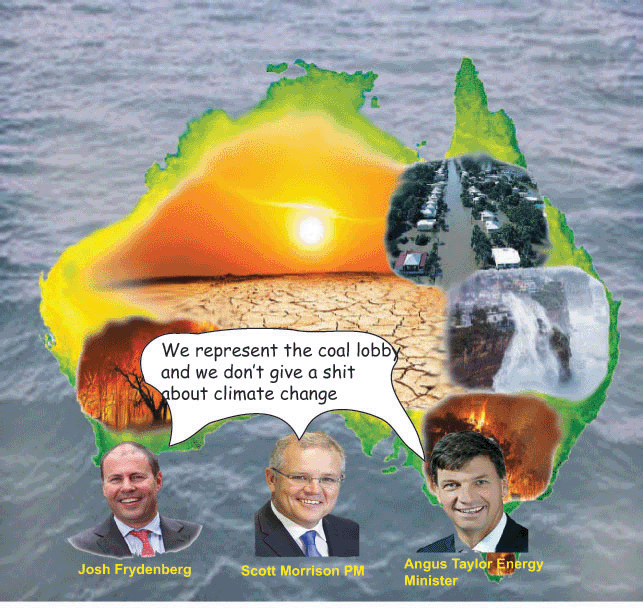 seem more eager to bail out dirty polluters than protect the public
For Australia’s sake, I hope Trump’s climate science denialism loses. https://www.theguardian.com/commentisfree/2020/oct/17/for-australias-sake-i-hope-trumps-climate-science-denialism-loses, Michael Mann US policy has emboldened Scott Morrison to be less ambitious on climate, just when so much is at stake.
Anyone in Australia who witnessed the Black Summer bushfires (as I did), and anyone in the US who experienced the thick smoke from our western wildfires (as I have), knows how much damage climate change is already doing. The stark reality is that worldwide efforts to avert ever-more catastrophic climate change impacts lie in the balance in the 2020 US election.
Donald Trump will go down in history bearing substantial responsibility for the deaths of over 200,000 Americans due to his rejection of the advice of public health experts and his refusal to endorse policies such as social distancing and mask-wearing that could have saved many thousands of lives. But his rejection of the science of climate change sets the stage for a far greater toll. Far more human lives will be lost from the impacts of climate change if we fail to act.
Whether or not Trump gets re-elected – and how other countries like Australia respond to the outcome of the US election – could determine the fate of our planet. Indeed, I’ve stated that a second Trump term might well be “game over for the climate” if it leads to the collapse of international efforts to act.
The damage caused by Trump’s climate denial is painfully visible within the US as we endure climate change-fuelled extreme weather events, including unprecedented wildfires in the west and unprecedented hurricanes in the east. But the damage can be felt around the world. Trump has proudly, and shamelessly, trumpeted his climate denialism on the global stage, joining with petrostates such as Russia, Saudi Arabia and Brazil in opposing international climate efforts.
Indeed, Trump’s actions have emboldened Australia to be less ambitious on climate too, prime minister Scott Morrison following Trump’s lead in promoting climate denial, coddling fossil fuel interests and blocking efforts to support a clean, renewable energy transition.
By pulling the US out of the Paris agreement (one of the first and only campaign promises he kept) Trump ceded America’s leadership on the defining challenge of our time. Thus far, other countries have fortunately filled the leadership void, at least temporarily. The EU and China, with its new net-zero pledge, have stepped up to the plate, recognising that they will benefit from the opportunities of a clean energy economy and better protect their citizens from dangerous climate change impacts.
But nobody stands to benefit more from climate action, or lose more if we fail to act, than Australia. Having spent a sabbatical leave down under earlier this year, aimed at collaborating with scientists in Australia to study the impact of climate change on extreme weather events, I instead witnessed those impacts first-hand. I saw the muted beauty of the Blue Mountains when shrouded in wildfire smoke. If Trump is re-elected, and we collectively continue down a path of insufficient climate action, it may not be long before those fires rage year-round, and the Blue Mountains are lost in a perpetual grey and dismal haze.
It’s the same with the vibrant sea life of the Great Barrier Reef, which I was fortunate enough to witness with my family during my time in Australia. The delicate ecosystems of the GBR are already on the ropes, with fossil fuels pushing up temperatures in the ocean to the point where bleachings occur with such frequency and ferocity that corals simply cannot recover. Research released this week found that the reef has lost half its coral, largely due to warming oceans caused by climate change. Add the impact of ocean acidification from increasing carbon emissions, and we could sadly, within a decade or two, be reading the GBR’s obituary for real.
It doesn’t have to be like that. For one thing, renewable energy costs are plummeting while the technology just keeps getting more efficient and better, so dirty energy no longer makes economic sense. For example, on one recent Sunday, all the electricity demand for the entire state of South Australia was met by solar power alone, and every state and territory in Australia has committed to go carbon neutral by 2050. Here in the US, we’ve seen a record number of cities and states stepping up on climate goals too, knowing clean energy is good for their communities’ health, resilience and prosperity.
Policymakers must accelerate the shift to clean energy that is already under way. As we’ve learned in the Trump-era, some fossil fuels are too far gone for even the most determined polluter-in-chief to save. Though another term would give Trump time to defend his environmental rollbacks in court and solidify his dirty energy policies, he has already failed to save coal from market forces, and another four years isn’t going to reverse the long-term decline of the industry.
This is a cautionary tale for Australia. In both the US and Australia, conservative politicians seem more eager to bail out dirty polluters than protect the public, denying politically inconvenient science in order to offer lavish payouts to help unprofitable fossil fuel companies.
If we are to avert catastrophic warming, we must do just the opposite, providing financial incentives for renewables and disincentives for fossil fuels. That will level the playing field, and accelerate the clean energy transition.
We must take the earliest exit possible off the fossil fuel highway. By trying to squeeze out the last drop of fossil fuel industry profits, the Morrison government could well be on its way to bleaching the life from Australia’s coral reefs and blighting the blue of its mountains.
There is some good news, however. Regardless of whom Americans vote for – and for the sake of the planet, I hope it’s Joe Biden and the Democrats – Australians can still work together for structural change at home. You can’t solve it alone, but we also can’t solve it without you. Australia has seen that the sun can power an entire state’s electricity for a day. Now it’s time to make that happen every day.
Australia must distance itself from the handful of bad petrostate actors who have sabotaged global climate action and rejoin the coalition of the willing, when it comes to the battle to save our planet.
• Michael E. Mann is distinguished professor of atmospheric science at Pennsylvania State University. He is author of the upcoming book The New Climate War: The Fight to Take Back Our Planet, due out in January (Public Affairs Books)
On climate: instead of denial or despair, there’s determined resolve
 ATLANTIC PLANET Scylla and Charybdis, Beyond climate denial and despair, The Atlantic, LAWRENCE WESCHLER 16 Oct 20 ”……………………..There is only one truly serious political problem facing all of us today, and that is climate change. Judging whether or not the human prospect on our planet is worth saving is the fundamental question confronting Americans in particular these coming weeks. Everything else—the fate of the Affordable Care Act, especially in the context of a rampaging pandemic; whether identity politics ought to supersede class solidarity; whether immigration controls should be tightened or loosened; even what to do about that Supreme Court vacancy—comes afterward………..
But it is possible, and urgent, to imagine a third possibility in lieu of Denial and Despair, a path forging clean between them: the course of Determined Resolve.
It’s worth remembering, for example, that the entire Manhattan Project in its Los Alamos incarnation, from soup to nuts—from the erection of those barracks and the ingathering of those scientists through the dropping of the first atomic bomb in Hiroshima, as hideous as that outcome proved—took less than three years. And if the prospect of climate disaster indeed calls us to what William James once cast as “the moral equivalent of war,” what would it be like if a president (or, for the time being, just a candidate for the presidency) promised to exercise his considerable authority by bringing together the finest minds in the country (not just scientists but educators and social workers and writers and artists and thinkers and managers as well) to brainstorm better battery technologies; quantum improvements in solar, tidal, and wind technologies and disbursements; desalinization; carbon-capture technologies; meat replacements; massive reforestation; resilient coastline and floodplain projects; ….—all on a virtually wartime footing, worthy of the urgencies and streamlined exigencies involved?……..
And as for all those other campaign issues, almost all of them can be subsumed within the wider climate debate, or at least viewed in ways that render the climate component crucial. Black lives matter, to be sure, but that’s all the more reason to foreground environmental-justice initiatives. This current pandemic may well turn out to be just the first of many more occasioned by mankind’s relentless encroachment on nature. If you think tidal migrations are politically destabilizing now, just wait until the migrations necessitated by the rising seas caused by polar melts or the narrowing zones of habitability caused by droughts, their attendant firestorms, and the ensuing wars for arable land really begin to kick in. …….. https://www.theatlantic.com/science/archive/2020/10/lawrence-weschler-beyond-climate-denial-and-despair/616698/
‘Fracking’ with its environmental harms, now acceptable to U.S. Democrats, to help win the election?
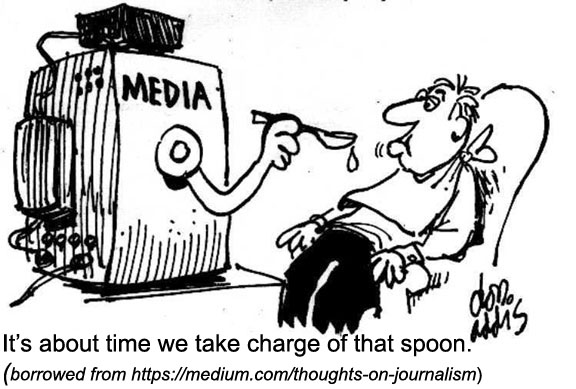 Press Worries About a Fracking Ban’s ‘Risk’ to Democrats—Not Fracking’s Threat to Planet, Fair,
“I will repeat, and the American people know, that Joe Biden will not ban fracking. That is a fact,” Harris said.
Harris emphasized that Biden “believes” in science; claimed that he “understands that the West Coast of our country is burning” and “sees what is happening on the Gulf states, which are being battered by storms”; and that he has “seen and talked with the farmers in Iowa, whose entire crops have been destroyed because of floods.”
One can —only wonder whether Biden or Harris truly “believe” in science when they pretend a fracking ban and a host of other strong climate measures are not urgent necessities required immediately. In 2018, the UN’s Intergovernmental Panel on Climate Change announced that carbon pollution needed to be cut by 45% by 2030 in order to keep the planet below the critical 1.5°C warming threshold to prevent irreversible planetary devastation (Guardian, 10/8/18). As time goes on, more reports inform us that pollution and the climate crisis are actually even worse than we thought (e.g., Vox, 8/12/20; New York Times, 10/23/19, 12/4/19).
Yet whenever there are discussions about enacting a national fracking ban, corporate media seem to prioritize the supposed short-term potential “risks” to Democrats’ electoral prospects, or potential economic downturns, over the long-term prospects for human civilization’s survival.
When there was discussion of Sen. Bernie Sanders and Rep. Alexandria Ocasio-Cortez’s bill for a nationwide fracking ban earlier this year, the New York Times’ “In Crucial Pennsylvania, Democrats Worry a Fracking Ban Could Sink Them” (1/27/20) cited a few state Democratic politicians claiming that any presidential candidate who supports a national fracking ban would risk losing Pennsylvania in the general election. The Times trivialized the issue by reducing it to a “political bet,” with the highest stakes being the mere loss of a Democratic presidency, as opposed to dooming humanity to climate apartheid (FAIR.org, 7/30/19) and ultimately losing human life as we know it
to natural disasters (FAIR.org, 6/11/19, 9/5/19, 1/3/20, 9/18/20). The Times’ Lisa Friedman and Shane Goldmacher wrote:
A pledge to ban all hydraulic fracturing, better known as fracking, could jeopardize any presidential candidate’s chances of winning this most critical of battleground states — and thus the presidency itself… In some ways, the fracking ban is indicative of the entire political bet undergirding the candidacies of Mr. Sanders and Ms. Warren that the 2020 campaign will not be won by appeals to the narrow interests of traditional swing voters but through the mass mobilization of an energized electorate.
NPR’s “Proposals to Ban Fracking Could Hurt Democrats in Key States” (2/11/20) likewise made dubious pronouncements on the opinions of swing-state voters the focal point of the story, as opposed to what actions are required to resolve the climate crisis:
Climate change is a top issue in the Democratic presidential primaries and some candidates have taken relatively aggressive policy stands, including vows to ban hydraulic fracturing. But some Democrats worry that could push moderate voters in key swing states to reelect President Trump next November… In a swing state like Pennsylvania, a major gas producer, fracking and energy are key issues. Even a small segment of voters swayed one way or another could change the election.
After the primaries, it’s clear that corporate media believe it’s their duty to function as Biden’s de facto campaign manager by explaining to voters what Biden’s position on a fracking ban actually is, as well as advising Biden to reject a fracking ban because, they claim, that would be an electoral disaster. Soon after the debate, Quartz (10/8/20) explained that Biden and Harris don’t support a fracking ban, because it “tempts political suicide in swing states like Pennsylvania and Ohio where fossil fuels still rule.” Why an electoral disaster ought to be prioritized over civilizational disaster is never explained. …….
Environmental activist Bill McKibben (New Yorker, 10/9/19) pointed out that US claims to have reduced carbon emissions during the past 20 years have mainly been accomplished by replacing coal-fired power plants with natural gas-fired power plants. While burning gas produces less carbon dioxide than coal, carbon dioxide isn’t the only greenhouse gas. The second most important contributor is methane, which can warm the planet more than 80 times as much as the same amount of carbon dioxide over a 20-year period.
“Fracking,” more formally known as “hydraulic fracturing,” is a method of extracting natural gas (as well as oil) from the ground with a horizontal drilling process that pumps water, sand and chemicals into the ground to fracture rocks that release fossil fuels. And in the process of fracking, lots of methane leaks out at every stage. The US strategy of reducing carbon emissions without reducing the total amount of greenhouse gases emitted is a form of literal gaslighting that encourages other countries to do the same.
The New York Times (11/8/19, 12/16/19) has published a series of excellent investigative reports that used infrared video gear and satellite measurements to capture the invisible methane emissions at “super emitter” fracking sites, where large-scale methane leaks are responsible for a disproportionately high share of methane emissions. The Times (6/21/18, 2/19/20) has also reported on findings showing that the US oil and gas industry is responsible for a much larger proportion of methane emissions than the US government previously thought, with oil and gas production in general being more responsible for soaring methane levels than natural sources, like the ocean bed and mud volcanoes. ……
FAIR (10/16/19) has pointed out how corporate media cheerleading of the “Shale Revolution” helped lead the US to become the world’s largest oil and gas producer during the Obama years; when they bemoaned the loss of fossil fuel emissions during the Covid pandemic (FAIR.org, 4/29/20), corporate journalists seemed more concerned with the profits of advertisers than with the survival of human civilization. Running excuses for presidential candidates in the pocket of the fossil fuel industry is only more evidence of the same.
Environmental and labor activists, economists and scientists have for years discussed the need for a full employment program based on green jobs to serve as a just transition for workers who would be displaced by a fracking ban; there is no reason for a fracking ban to be “political suicide” unless corporate journalists are determined to equate that with the death of the fossil fuel industry. https://fair.org/home/press-worries-about-a-fracking-bans-risk-to-democrats-not-frackings-threat-to-planet/
This election isn’t just about you, America.

|
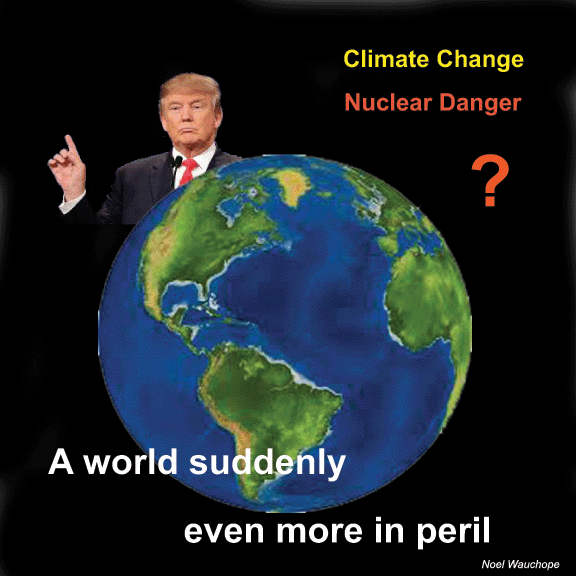
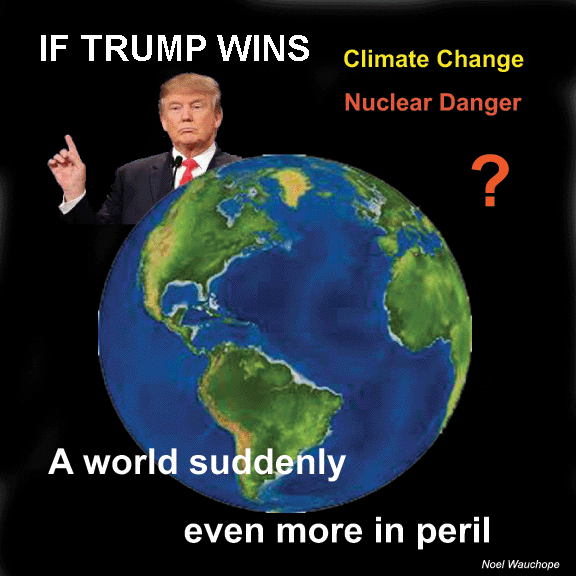
Can the world survive four more years of Donald Trump?
From climate change to nuclear weapons to global health — this election isn’t just about you, America. By POLITICO 10/8/20 This article is part of a special report, The Global Election. A second term could set Trumpism in concreteIn the middle of a devastating pandemic, recurring nationwide protests and a bitter presidential election — not to mention the president’s own COVID-19 diagnosis — Americans can be forgiven for losing track of what Donald Trump’s presidency has meant beyond their borders. But the list of changes he has wrought abroad is not short. A world order designed to function through slow consensus and underwhelming compromise, on a good day, has had virtually no coping mechanism for the American president’s disruption. In the name of putting America first, Trump has pulled out of one global deal after another, unpredictably reversing course on some of America’s biggest global priorities and moral commitments. He has snubbed democratic leaders and longtime allies while cozying up to Vladimir Putin and other autocrats. While the most important Western institutions — NATO, the European Union, the United Nations, the World Trade Organization, the World Health Organization — are still standing, it’s an open question whether they will be able to survive another four years of pummeling and disinvestment by the world’s superpower. So, what really happens if the world gets a second Trump term? ………. Here’s what the world should expect if Trump remains commander in chief.
Emissions come back, and America bows outThe climate crisis is a slow-moving disaster that hinges on single pivotal moments. Right now, the global community is planning around the year 2050, when experts say humans need to all but eliminate greenhouse-gas emissions to avoid the worst effects of global warming. But the biggest dates on the immediate calendar are November 3 and 4. Reelecting Donald Trump on November 3 would put America, and possibly other countries, on a new and hard-to-reverse course away from that emissions goal…… his abandonment of the Paris deal is still not official. That pullout will be final on November 4, the day after the election. A second Trump term would likely have a far bigger impact than the first, both domestically and abroad. The president would have more time to defend his deregulatory agenda in court, which could lock in rules that allow more pollution from power plants, leaking oil and gas wells, cars and refrigerants ……… If the United States pulls out entirely, the Paris deal could start to fall apart, much as the earlier Kyoto Protocol climate treaty did without U.S. involvement. Saudi Arabia, whose economy depends on petroleum, has long played a role in trying to unpick the U.N. process from within. Some diplomats worry the Saudis would see the U.S. departure as the moment to walk out entirely. What will President Jair Bolsonaro do with Brazil? An exodus of such major players would leave the deal increasingly toothless. ………… Joe Biden is largely promising a reversal of the Trump approach. His platform calls for a $2 trillion investment to clean up the power grid, electrify the transportation sector, and aid minority and low-income communities disproportionately impacted by pollution. And he has pledged to rejoin the Paris accord and put the United States on track toward net-zero emissions by 2050 — though the details of how that will work, in an American economy still reeling from the pandemic, are far from clear.
US becomes an ever more unreliable ally……………The far more likely threat is that Trump would remain as NATO’s most influential leader, sowing uncertainty and chaos from within. “It is likely he would persist in disrupting, both politically and militarily,” said retired Lieutenant General Douglas Lute, who was U.S. ambassador to NATO from 2013 to 2017, and is now chief executive of Cambridge Global, a strategic consulting firm. …… For military commanders, it’s Trump’s sheer unpredictability that is most unnerving. The worst possibility is unilateral military action, which Trump has shown a willingness to take with no warning to allies, as when he withdrew U.S. forces from northeastern Syria. …… — By David M. Herszenhorn Nuclear weapons. A direct strike on the treaty system On an existential global threat that often feels like a back-burner issue in U.S. politics, Donald Trump has quietly moved America into much riskier territory — and faces a decision point before February that has nuclear experts of both parties worried……. If he stays this course in a second term, Trump will have made permanent the biggest nuclear buildup since the Cold War — while simultaneously unraveling the treaties that have steadily reduced the nuclear threat since the end of the Cold War. A Biden presidency likely would pivot the United States back to its earlier approach, quickly. Biden and his advisers have pledged to extend New START without preconditions before it expires, and to scramble to rebuild some of the previous deals that Trump walked away from. Biden has also expressed support for declaring a “no first use” policy when it comes to nuclear weapons — replacing, for the first time, the purposely vague U.S. position on when it might actually resort to their use. Also, his advisers support proposals to pursue an agreement with Russia to take both nations’ nuclear weapons off “alert” status, a step that arms control advocates believe would do more than anything else to reduce the danger of an accidental nuclear exchange. ………… https://www.politico.eu/article/us-election-2020-implications-for-the-world-trump-biden/?fbclid=IwAR2JOtx6HJgGl8PEAVCfydecyMA4Z_oiCXXjNrl2bN5xwCJ8PkThzHR6Jg8 |
|
U.S. election – possibility of armed factions with military-style rifles showing up at polling places
 Will Trump’s Call for Poll-Watchers Bring Paramilitaries to the Voting Booth? TruthOut, BYKenny Stancil, Common Dreams, October 11, 2020
Two weeks after Donald Trump Jr. took to social media in an attempt to recruit an “army for Trump’s election security,” and with early voting already underway, Republicans this week have begun dispatching thousands of volunteers to in-person voting locations and mail-in ballot drop boxes, part of a desperate “effort to find evidence to back up Trump’s unsubstantiated complaints about widespread voter fraud,” Reuters reported Thursday.
According to more than 20 officials involved in the effort, “the mission… is to capture photos and videos Republicans can use to support so-far unfounded claims that mail voting is riddled with chicanery, and to help their case if legal disputes erupt over the results of… the contest between Republican incumbent Trump and his Democratic opponent Joe Biden.”
But critics of the Trump campaign’s operation — which revolves around baseless presumptions of fraudulent electoral activity committed by supporters of Democratic candidates — argued that the president’s “call for his supporters to serve as self-appointed” poll-watchers “sounded more like an incitement to voter intimidation and violence than an endorsement of the role election observers play in protecting democratic norms.”
Given the White House’s alarming normalization of violence against political foes, voting rights experts, civic officials, and citizens are increasingly concerned about the negative consequences that could ensue if tensions escalate and the president’s most militant supporters — white nationalist gangs, so-called “patriots” donning Confederate and Nazi regalia, and other heavily armed pro-Trump factions — follow his authoritarian cues.
Steven Gardiner, a scholar at the progressive think tank Political Research Associates, told The Guardian on Friday that “the militias will absolutely seize on” Trump’s comments.
“The possibility of armed factions with military-style rifles showing up at polling places is very troubling,” Gardiner added……..
As Common Dreams reported on Thursday amid the revelation that 13 suspects had been arrested on kidnapping and terrorism charges after law enforcement officials foiled a right-wing plot to attack the Michigan State Capitol and hold Gov. Whitmer hostage, many observers have made connections between Trump’s demagogic rhetoric and his followers’ violent actions.
“I wonder where they got their motivation from,” Rep. Rashida Tlaib (D-Mich.) noted sarcastically on social media, referring to an incendiary message Trump shared in April — during the height of anti-lockdown protests in the state — to “Liberate Michigan!”
“This is a pattern: Trump paints a target. An attack or plot follows,” tweeted Washington Post national security correspondent Greg Miller.
Gardiner told The Guardian that “the relationship between the militias and the current administration is call and response.”
“It’s not always clear who’s leading the chant,” he added. “Sometimes it’s coming from the militias, sometimes it’s coming from the president.”
Another worrisome development is that gun sales nearly doubled between summer 2019 and 2020, meaning that the U.S. is further arming itself with “deadly weaponry [that] is increasingly finding its way onto the streets, borne by self-styled private militias, and culminating in violent clashes that have caused bloodshed in several U.S. cities,” as The Guardian explained.
The New York Times estimated last month that the number of active militia members hovers around 20,000 people in 300 groups, with military veterans constituting one-fourth of those. But a new investigation by The Atlantic magazine into the Oath Keepers, one of the most prominent far-right paramilitary groups, revealed a list of nearly 25,000 current or former members, two-thirds of whom had military or law enforcement backgrounds, suggesting that the number of Americans with ties to extremist factions is larger.
As Common Dreams reported last month, armed white supremacists pose the greatest domestic terrorism threat in the U.S., according to the FBI, despite efforts by the Trump administration to downplay the risks associated with right-wing militias. ………..
Rivas explained that “militia groups such as the Montana branch of the United States Freedom Protectors were positioning themselves to be vigilante outriders of law enforcement on Election Day,” and that “the possibility of interventions by armed members of the group had to be taken seriously.”
“They present themselves as protectors of property and law and order, and are now starting to talk about the election,” Rivas said. “They may show up at polling places claiming to want to protect voting rights, but their impact will clearly be intimidatory.”……….
Rivas stressed that the threat of voter intimidation “really is top down.” Far-right paramilitary groups “are repeating word for word what they hear from President Trump,” she said. https://truthout.org/articles/will-trumps-call-for-poll-watchers-bring-paramilitaries-to-the-voting-booth/?eType=EmailBlastContent&eId=614ce999-9844-4d61-a600-169db0c99052
Trump’s psychopathology a threat to US democracy and to global stability.
 There’s one headline about Donald Trump that has not been printed but makes the most sense of all, https://www.smh.com.au/world/north-america/there-s-one-headline-about-donald-trump-that-has-not-been-printed-but-makes-the-most-sense-of-all-20201008-p563b7.html By Ian Hughes and Alan D. Blotcky, October 11, 2020 For almost four years, there has hardly been a day that Donald Trump has not made front-page news. The unrelenting avalanche of lies and norm-shattering behaviour that Trump has unleashed has presented the mainstream media with an unprecedented challenge. It is a challenge that the media has struggled to meet, largely because of the ethical and practical difficulties that journalists face in dealing with Trump’s mental pathology.Even before his election, mental health professionals were warning that Trump’s psychopathology posed a threat to US democracy and to global stability. After his election, dozens of mental health experts collaborated on the book The Dangerous Case of Donald Trump which became a New York Times bestseller. Over the past three or four months, the number of voices expressing alarm at Trump’s pathology has been growing. There’s one headline about Donald Trump that has not been printed but makes the most sense of all, https://www.smh.com.au/world/north-america/there-s-one-headline-about-donald-trump-that-has-not-been-printed-but-makes-the-most-sense-of-all-20201008-p563b7.html By Ian Hughes and Alan D. Blotcky, October 11, 2020 For almost four years, there has hardly been a day that Donald Trump has not made front-page news. The unrelenting avalanche of lies and norm-shattering behaviour that Trump has unleashed has presented the mainstream media with an unprecedented challenge. It is a challenge that the media has struggled to meet, largely because of the ethical and practical difficulties that journalists face in dealing with Trump’s mental pathology.Even before his election, mental health professionals were warning that Trump’s psychopathology posed a threat to US democracy and to global stability. After his election, dozens of mental health experts collaborated on the book The Dangerous Case of Donald Trump which became a New York Times bestseller. Over the past three or four months, the number of voices expressing alarm at Trump’s pathology has been growing.
The media, however, has largely continued to cover Trump’s actions one story at a time, without joining up the dots and accurately describing his pathology. Of all the thousands of headlines, there is one headline that has not been printed but that makes the most sense of all: “Donald Trump suffers from a dangerous incurable narcissistic disorder which makes him incapable of empathy or reason. He is a grave danger to the US and the world.” The failure of the media to emphasise this obvious fact is a lost opportunity to inform and educate the public so that Trump’s pathology is fully appreciated and understood. As mental health professionals know, Trump’s mental disorder manifests itself in a wide variety of behaviours and not in isolated or disconnected events. In these dangerous times, the challenge for the media, difficult though it is, should be to explain Trump’s pathology in all its complexities and ramifications for the public. To illustrate this, consider three separate headlines from the past few days. “The President’s taxes: Long-concealed records show Trump’s chronic losses and years of tax avoidance”, The New York Times, September 27, 2020. Pathological narcissists have a “false self” that they try to maintain at all cost. Trump’s “false self” is that he is smarter and richer and stronger and better looking than anyone else. Anything that undermines or contradicts his “false self” is aggressively defended against. Donald Trump has actively refused to share his federal tax returns with the American people in order to defend this “false self”. He has not wanted to reveal his losses, his fraud, and, perhaps, even his underhanded connections to Russia. The projection of his “false self” is the ultimate lie of a narcissist. Trump’s thousands of lies all join up as a defence against the truth of his true persona as a business failure. “Donald Trump ensures first presidential debate is national humiliation”, The Guardian, September 30, 2020. Donald Trump’s narcissistic pathology did not allow him to engage in reasonable and rational debate with Joe Biden. He is incapable of rational, orderly, and thoughtful discourse, and is compelled and guided instead by his internal needs, wants, and desires. In addition, Trump is increasingly desperate because he knows his poll numbers are dropping. As a narcissist, his reflexive response when his grandiose self- image is threatened is to attack and to bully. Over the past few months, Trump’s pathological response to the threat of failure has been in plain view: wild accusations, lies, scapegoating, conspiracy theories, and gaslighting. His unpresidential debate performance was an extension of this pathological behaviour. “Trump’s reckless joyride tops Bible-holding photo op in Washington”, The Sydney Morning Herald, October 5, 2020 Trump is unable to function without constant praise and adulation. This is the opposite of strength. Pathological narcissists need frequent affirmation to fill up their hollow shells. They need constant confirmation that their “false self” is indeed true – when it is not. With no internal capacity for maintaining a true and authentic identity, Trump is totally dependent on external adulation to function. His neediness now is on full display. In the space of a single week, Trump has exhibited three of the defining features of narcissistic personality disorder – sociopathy in defence of a “false self”, disordered thinking that renders him incapable of reason, and a constant need for adulation. Every headline on this president has spotlighted one or other aspect of his narcissistically disordered mind. The evidence about Trump is overwhelming. A free press is one of the central pillars of a democracy. Its role is to be a watchdog on our political leaders and to inform the public. The media can play a vital role in engaging with the alarming reality of Trump’s pathology, despite the difficulties in doing so. . Donald Trump is part of a much larger picture. Individuals with dangerous personalities have risen to the highest ranks of power throughout modern history – from Nixon to Mao, Stalin to Pol Pot. Some have played a crucial role in steering our world towards disaster. A widespread understanding of this basic fact has now become essential for the protection of democracy. Ian Hughes is the author of Disordered Minds: How Dangerous Personality Disorders Are Destroying Democracy and contributing author to The Dangerous Case of Donald Trump. He is a Senior Research Fellow at the MaREI Centre at University College Cork in Ireland. Alan D. Blotcky is a clinical psychologist in private practice in Birmingham, Alabama |
|
Trump hoping to conclude nuclear arms deal with Russia before Election Day
|
Trump aiming for nuclear arms deal with Russia before Election Day. Axios Dave Lawler, author of World, 9 Oct 20, The Trump administration is pushing to get a nuclear arms control agreement with Russia ready for President Trump and Vladimir Putin to apply their signatures before Election Day. Where things stand: The U.S. believes the prospective deal has buy-in from Putin — who has discussed arms control on a series of phone calls with Trump — and could be negotiated in as little as a week, according to a source familiar with the discussions.
The big picture: Election day is not the only deadline driving this process. New START, the last major bilateral treaty limiting the nuclear arsenals of the U.S. and Russia, is due to expire on Feb. 5.
The stakes: Russia knows that if Trump loses, it can expect Biden to agree to an extension shortly after taking office on Jan. 20.
The latest: That deadlock may have broken following a meeting in Geneva last Friday between National Security Adviser Robert O’Brien and his Russian counterpart, Nikolai Patrushev……….. https://www.axios.com/trump-russia-nuclear-arms-agreement-new-start-4fe42c37-83e0-4088-aa26-b37f8a07bf7f.html |
|
|
Trump’s false claim about the Green New Deal
|
Independent 10th Oct 2020, Donald Trump falsely claimed that the Green New Deal would require “tiny little windows”, during a rambling interview with Fox News host Sean Hannity on Thursday. “I mean, they literally want to take buildings down and rebuild them with tiny little windows, OK, little windows, so you can’t see out, you can’t see the light,” the president said.https://www.independent.co.uk/environment/trump-green-new-deal-hannity-windows-climate-change-b918754.html |
|
Greta Thunberg: ‘Get everyone to vote for Joe Biden’
Greta Thunberg: ‘Get everyone to vote for Joe Biden’ The New Daily, 11 Oct 20, Teen climate crusader Greta Thunberg is still too young to vote, but she knows presidential candidate Joe Biden has made the future of the planet his running-mate in the upcoming US election.
The Swedish 17-year-old said in a tweet that she never engages in party politics, but “the upcoming US elections is above and beyond all that”.
“From a climate perspective it’s very far from enough and many of you of course supported other candidates. But, I mean … you know … damn! Just get organized and get everyone to vote #Biden,” she wrote.
Thunberg, who sparked a global climate protest movement after striking outside the Swedish parliament in 2018, could encourage participation among younger voters typically less likely to vote than older Americans.
After Thunberg was named Time‘s Person of the Year in 2019, US President Donald Trump mocked the teen activist………
Trump has focused on dismantling former US President Barack Obama’s climate agenda to free the energy and auto industries from the costs of regulations meant to protect health and the environment, while Biden has a focus on a new massive green infrastructure. https://thenewdaily.com.au/life/science/environment/2020/10/11/greta-thunberg-get-everyone-to-vote-for-joe-biden/
The world’s climate future – much depends on America’s presidential election
|
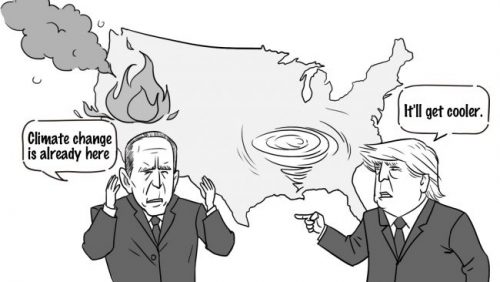
As we approach planetary tipping points, it’s vital to understand the two candidates’ plans—or lack thereof (Trump doesn’t have one)—for combatting climate change. Fast Company, 9 Oct 20, BY ADELE PETERS Whether the world succeeds in avoiding the worst impacts of climate change is likely to hinge in part on the results of the upcoming U.S. election. Climate scientist Michael Mann has said that a second Trump term would be “game over” for the climate, making it virtually impossible to limit global warming to 1.5 degrees Celsius. Biden, by contrast, is proposing the most ambitious climate policy of any major party nominee in U.S. history. Here’s a closer look at the differences. TRUMP: “IT WILL START GETTING COOLER”
The first major difference: Trump doesn’t accept the science of climate change or even necessarily seem to understand what “climate change” means. On a September visit to California, where heat and drought driven by climate change have helped fuel record-breaking fires, Trump said, “It will start getting cooler.” (He has previously called climate change a “con,” “hoax,” and claimed that it was invented by China.) At the first presidential debate, when asked about climate change, Trump started talking about clean air and water, and then claimed “we have now the lowest carbon.” (In fact, carbon dioxide levels in the atmosphere are now the highest that they have been in 15 million years.)
Through his first term, Trump has actively moved the country in the wrong direction on climate. “Across the board, the Trump administration has rolled or attempted to roll back all of the significant steps that the previous administration took under the Clean Air Act and other laws to reduce the carbon pollution and the other pollutants that are driving dangerous climate change,” says David Doniger, a senior advisor to the NRDC Action Fund, a political affiliate organization of the Natural Resources Defense Council. The administration weakened fuel economy standards, eliminated the Clean Power Plan, and weakened standards for emissions from the oil and gas industry. ……..
Trump’s campaign website says nothing about a plan for climate change. The Republican platform, recycled from 2016, says that climate change is “the triumph of extremism over common sense,” even though military experts have identified climate change as a national security threat and thousands of scientists have warned that we’re facing a climate emergency. To actually tackle climate change, the federal government would need to do far more, and a second Trump term would delay that action as the window of opportunity is closing………..
BIDEN: THE MOST AMBITIOUS CLIMATE POLICY OF ANY MAJOR PARTY NOMINEE
Biden, by contrast, has proposed investing $2 trillion to set us “on an irreversible course to meet the ambitious climate progress that science demands,” with a target of net-zero emissions by 2050. By 2035, he wants to decarbonize the electric grid. “This is more ambitious than the most ambitious states in the country,” says Stokes. (California and Hawaii are aiming for 100% clean electricity by 2045; New York is aiming for 2040.) The work on the electric grid would create millions of jobs. Retrofitting buildings to improve energy efficiency would create another million jobs. Ramping up the electric vehicle industry, and infrastructure like charging stations, would create a million more jobs. The plan also calls for “high-quality, zero-emissions” public transit for every large city, “climate-smart” agriculture, cleaning up pollution from the oil and gas industry, and the construction of 1.5 million sustainable homes and housing units. All of this would be done through the lens of environmental justice, ensuring that communities that have been hardest hit by pollution in the past see the benefits.
Though Biden has said that his plan is different from the Green New Deal, a resolution sponsored by Alexandria Ocasio-Cortez, the core principle is the same—creating jobs and fostering equity while reducing emissions. …..
The scope of the plan has to be massive because the country has waited so long to act; the changes could have been much more gradual if we had started 25 years ago. “We’re in a tough spot now,” Doniger says. “If Biden is elected, there’s a need for very deep reductions very fast.” Still, the vast scope of work means creating millions of jobs at a moment when the country also needs to invest in economic recovery.
If Biden wins—and, crucially, if Democrats also control Congress—it’s possible that the world could still avoid the worst impacts of climate change while addressing the recovery. “We’re going to need a very big recovery package, probably a lot bigger than the one from 2009,” Doniger says. “There’s a huge opportunity to build into that infrastructure spending for the transition to clean energy and low emissions that we need, and to do it in a way that invests in communities that have been underserved and beset by pollution.” https://www.fastcompany.com/90560969/the-2020-presidential-election-will-decide-the-fate-of-the-climate
|
|
1 This Month

of the week – Shut Down Drone Warfare!


Tell the Ukrainian Government to Drop Prosecution of Peace Activist Yurii Sheliazhenko

Petition to revoke the licensing of the Near Surface Nuclear Disposal Facility (NSDF) at Chalk River. https://www.ourcommons.ca/petitions/en/Petition/Details?Petition=e-7247
To see nuclear-related stories in greater depth and intensity – go to https://nuclearinformation.wordpress.com
-
Archives
- April 2026 (68)
- March 2026 (251)
- February 2026 (268)
- January 2026 (308)
- December 2025 (358)
- November 2025 (359)
- October 2025 (376)
- September 2025 (257)
- August 2025 (319)
- July 2025 (230)
- June 2025 (348)
- May 2025 (261)
-
Categories
- 1
- 1 NUCLEAR ISSUES
- business and costs
- climate change
- culture and arts
- ENERGY
- environment
- health
- history
- indigenous issues
- Legal
- marketing of nuclear
- media
- opposition to nuclear
- PERSONAL STORIES
- politics
- politics international
- Religion and ethics
- safety
- secrets,lies and civil liberties
- spinbuster
- technology
- Uranium
- wastes
- weapons and war
- Women
- 2 WORLD
- ACTION
- AFRICA
- Atrocities
- AUSTRALIA
- Christina's notes
- Christina's themes
- culture and arts
- Events
- Fuk 2022
- Fuk 2023
- Fukushima 2017
- Fukushima 2018
- fukushima 2019
- Fukushima 2020
- Fukushima 2021
- general
- global warming
- Humour (God we need it)
- Nuclear
- RARE EARTHS
- Reference
- resources – print
- Resources -audiovicual
- Weekly Newsletter
- World
- World Nuclear
- YouTube
-
RSS
Entries RSS
Comments RSS
 nuclear-news