Pete Hegseth’s War on Journalists (and Iran Too)
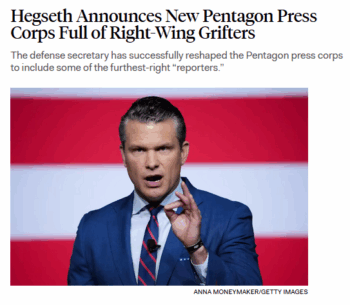
Pete Tucker, March 20, 2026, https://fair.org/home/pete-hegseths-war-on-journalists-and-iran-too/
Defense Secretary Pete Hegseth appears to be in the midst of two conflicts, one…in Iran, and the other with the American free press over its coverage of the widening Middle East war.
—MS NOW‘s Sydney Carruth (3/13/26)
Last fall, nearly the entire Pentagon press corps was banned from the Pentagon after refusing to sign Pete Hegseth’s loyalty oath, which would have bound them to only report information “authorized” by the government (FAIR.org, 9/23/25). They were quickly replaced by pundits from Hegseth-approved outlets like One America News, Gateway Pundit and Lindell TV, which is “Pillow Guy” Mike Lindell’s pet project.
But once the Iran War got underway, it dawned on Hegseth that a Defense secretary needs to communicate with the whole country, not just the narrow slice of it reached by his favorite right-wing pundits. So Hegseth reversed course, asking the major networks to bring their cameras back to the Pentagon. They agreed, but on one condition: Some of their reporters had to be allowed to return to the press briefing room, too.
So back they came, albeit now at the back of the room. Few of these reporters—who represent outlets you’ve actually heard of, like ABC, NBC and the New York Times—are called on. Hegseth, a former Fox News weekend host, instead fields questions almost exclusively from handpicked media personalities seated in the front rows. (I’d call them reporters, but if they signed Hegseth’s 2025 oath, as most did, they’re anything but.)
‘Typical gotcha-type question’
When Hegseth stepped to the podium for his first Iran War press briefing on March 2, there was a lot on the line. A skeptical American public wanted to know why President Trump had just launched another regime-change war, the very thing he’d railed against on the campaign trail. But Hegseth had little to offer, aside from “lots of chest-thumping,” a Pentagon reporter told CNN.
For the Q&A, Hegseth “only answered questions from his chosen outlets,” reported CNN’s Brian Stelter (3/4/26), until a journalist in the back lobbed a question about Trump’s changing timeline for the war’s duration. Hegseth initially ignored the interruption, but his anger got the best of him, and he returned to the matter.
“I heard the question about ‘four weeks,’” Hegseth sneered. “It’s the typical NBC sort of gotcha-type question.”
Having veered away from his friendly questioners, Hegseth was off script and had to think on his feet, not exactly a strength.
“President Trump has all the latitude in the world to talk about how long it may or may not take—four weeks, two weeks, six weeks. It could move up, it could move back,” Hegseth said at the opening of a rant that somehow included the word “aperture” and the observation that, “well, I mean, Joe Biden didn’t even know what he was doing.”
‘Only favorable images’
After face-planting at his first Iran War press briefing, Hegseth knew change was needed—only not by him, but with his enemies in the press.
If Hegseth couldn’t kick out any more reporters, who could he get rid of? Scanning the room, he fixed on the photographers.
The Pentagon’s stated reason for banning press photographers after the March 2 briefing was because of space restrictions. But the real reason, the Washington Post (3/11/26) reported, was they took “unflattering” photos of Hegseth.
Now only Pentagon photographers are allowed into briefings, and they are happy to provide the media with approved photos of their boss. Alex Garcia, president of the National Press Photographers Association, told the Post:
Excluding photographers from Pentagon briefings because officials did not like how published images portrayed them shows an astonishingly poor sense of priorities in the midst of a war and is, for a public servant, not a good look…. A free press cannot function if government officials decide that only favorable images of public officials may be created or distributed.
In Hegseth’s March 4 press briefing—without those pesky photographers—he stuck again to his preferred outlets, like the Daily Caller, Daily Wire, Lindell TV and the Washington Times. He also took one question from a mainstream journalist, Tom Bateman of the BBC, who pressed Hegseth on the US bombing of an elementary school in Minab. “We’re investigating it,” Hegseth replied curtly.
‘A snowflake behind a military shield’
Among the many reporters who didn’t get called on was the Atlantic’s Nancy Youssef, although in her case it was because she wasn’t allowed in. “I, along with print photographers, have been denied entry to cover today’s Pentagon briefing,” Youssef wrote on X. “All other media were allowed in.”
By Hegseth’s next briefing, March 19, his banned list had expanded again. “The Pentagon’s own publication, Stars and Stripes, was disinvited from Defense Secretary Pete Hegseth’s latest Iran War press conference—as he continues to clamp down on press coverage,” the Independent (3/19/26) reported.
This came less than two weeks after the Pentagon announced it was taking greater control of Stars and Stripes, a paper Hegseth previously claimed had gone “woke” (Daily Beast, 3/19/26). As former Stars and Stripes reporter Kevin Baron (X, 3/19/26) pointed out, the paper’s
employees are US Army civilians. Their editorial independence is protected by Congress specifically to prevent political leaders from feeding troops propaganda.
“Hegseth spent years on a comfortable Fox News couch building a brand around contempt for the thin-skinned and the easily offended,” wrote Status’s Jon Passantino (3/14/26). “But in office, Hegseth has revealed himself to be exactly that—a snowflake behind a military shield.”
‘An actual patriotic press’
As the US and Israel’s war on Iran continues to worsen, Hegseth’s attacks on the media have also escalated. At his March 13 briefing, Hegseth insisted that “an actual patriotic press” wouldn’t write headlines stating the war is expanding, even as the war has sprawled from an initial three countries—Israel, the US and Iran—to over a dozen.
“Allow me to make a few suggestions,” Hegseth offered. “People look up at the TV and they see banners, they see headlines [like]… ‘Mideast War Intensifies,’” he said. “What should the banner read instead? How about, ‘Iran Increasingly Desperate.’”
Hegseth also singled out a CNN story (3/13/26), headlined “Trump Administration Underestimated Iran War’s Impact on Strait of Hormuz.” That story is “patently ridiculous, of course,” Hegseth said, blithely dismissing the strait’s closure, saying we “don’t need to worry about it.”
Hegseth’s worries were directed elsewhere—at CNN. “The sooner David Ellison takes over that network, the better,” Hegseth said.
Ellison is the 43-year-old nepo baby of billionaire Larry Ellison, a close Trump ally. Having already purchased Paramount, and with it CBS, Ellison is on the verge of closing a $110 billion deal for Warner Bros. Discovery, which owns, among other media and film properties, CNN.
Hegseth’s comments about Ellison taking over CNN “should be a major scandal,” wrote Craig Aaron (Pressing Issues, 3/17/26), co-CEO of Free Press (the media advocacy group, not the right-wing, Ellison-owned outlet of the same name). “But in the chaos of the Trump administration, he’s just a warm-up act.”
‘Sick and demented people’
Indeed, as Trump’s historically unpopular war continues to sour, he’s sought to place blame on a familiar target: news media. Outlets critically covering the war, Trump posted on Truth Social (3/14/26), “are truly sick and demented people that have no idea the damage they cause the United States of America.” The next day (3/15/26), he declared they “should be brought up on Charges for TREASON for the dissemination of false information!” Treason is punishable by death.
Trump’s censorious FCC chair, Brendan Carr, backed up his boss: “The law is clear,” he tweeted (3/14/26). “Broadcasters must operate in the public interest, and they will lose their licenses if they do not.”
Hegseth succinctly outlined what “operating in the public interest” looks like at his March 19 briefing. The press need only say “one thing to President Trump,” he said. “Thank you.”
Israel’s Manipulation of Trump on Iran

The public has noticed who is in charge. According to a soon-to-be-released poll from IMEU Policy Project and Demand Progress, conducted by Data for Progress, voters believe the war is being conducted for Israel’s benefit over America’s by a nearly 2-to-1 margin.
Today on TAP: The worse the Iran war goes, the more blame is likely to be directed at Israel, and by association the Jews.
by Robert KuttnerMarch 18, 2026, https://prospect.org/2026/03/18/iran-israel-joe-kent-trump-netanyahu-antisemitism/
On Tuesday, Joe Kent, director of the National Counterterrorism Center, became the first senior administration official to resign over the Iran war. He resigned not because the war is a debacle, but because of Israel’s role in triggering U.S. involvement.
“I cannot in good conscience support the ongoing war in Iran,” he wrote in a letter to President Trump. “Iran posed no imminent threat to our nation, and it is clear that we started this war due to pressure from Israel and its powerful American lobby.”
Kent has a history of association with far-right white nationalist and antisemitic groups, according to the Associated Press. At the time of his confirmation hearing last February, Rep. Seth Magaziner (D-RI) pointed out, “During his two failed campaigns for Congress, we learned that Kent has ties to white nationalists … [and] sought political support from a Holocaust denier.”
Administration officials and allies spent a frantic 24 hours trying to do damage control, stepping around the question of why a well-documented antisemite should have been given the sensitive post in the first place. The question is doubly awkward, given Trump’s supposed love for the Jews when that posture is convenient to assault universities.
Quite apart from Kent’s record and motives, the issue of Israeli Prime Minister Netanyahu’s manipulation of Trump should be taken seriously. Early in the war, on March 2, Secretary of State Marco Rubio said in a press briefing, “We knew that there was going to be an Israeli action. We knew that that would precipitate an attack against American forces, and we knew that if we didn’t preemptively go after them before they launched those attacks, we would suffer higher casualties.” That’s about right.
Rubio has repeatedly tried to walk that back, but he can’t unsay it. The Israeli attack of February 28, which assassinated top Iranian leaders and effectively set off the war, was reportedly aided by U.S. intelligence, but Netanyahu was determined to launch it whether or not Trump concurred.
Just to rub Washington’s nose in Israel’s habit of escalating war without asking Trump’s permission, on Tuesday of this week top Israeli officials made clear that Trump learned about Israel’s latest assassinations only after the fact. The Wall Street Journal reported, “Israel killed Iran’s security chief, Ali Larijani, in airstrikes Monday night, according to Israel’s defense minister. President Trump would be informed of Larijani’s death, Israel Katz said. ‘Prime Minister Benjamin Netanyahu and I directed the IDF to continue to hunt down the leadership of the terror and oppression regime in Iran and cut off the head of the octopus again and again and prevent it from regrowing,’ Katz said in a statement.”
Let me repeat that, in italics: President Trump would be informed of Larijani’s death, Israel Katz said. Not only was Trump not informed or asked to concur before the assassination. The Israeli defense minister, speaking for himself and Netanyahu, informed Trump via a statement to The Wall Street Journal. That’s even more contemptuous than announcing it on social media, Trump-style. The fact that it was in a deliberate prepared statement means that this was no accidental off-the-cuff blunder. Just yesterday, Israel continued targeting Iran’s leaders, killing the country’s intelligence minister, Esmail Khatib.
The public has noticed who is in charge. According to a soon-to-be-released poll from IMEU Policy Project and Demand Progress, conducted by Data for Progress, voters believe the war is being conducted for Israel’s benefit over America’s by a nearly 2-to-1 margin………..
As the odds increase against Trump finding some kind of exit with dignity, the risk is that he will widen and deepen the war. While Trump is ambivalent, Netanyahu has made it clear that he wants the war to continue, and he acts accordingly. He is just as reckless as Trump, but more strategic.
When a wider war turns into an even bigger crisis, more people who did not start out as antisemites will be inclined to blame history’s favorite all-purpose scapegoats, the Jews. Only in this case, Bibi has provided plenty of ammunition.
‘Iran Posed No Imminent Threat’: Trump’s Counterterrorism Director Resigns in Protest
Trump decided to attack Iran despite Director of National Intelligence Tulsi Gabbard testifying before Congress last year that it “is not building a nuclear weapon,” and that late Iranian Supreme Leader Ali Khamanei—who was assassinated last month by an Israeli airstrike—“has not authorized the nuclear weapons program he suspended in 2003.”
US intelligence agencies have repeatedly come to the same conclusion since the George W. Bush administration.
“I cannot support sending the next generation off to fight and die in a war that serves no benefit to the American people,” the far-right former Army Ranger and CIA officer
Brett Wilkins, Mar 17, 2026, https://www.commondreams.org/news/joe-kent-resigns
National Counterterrorism Center Director Joe Kent announced his resignation Tuesday, accusing President Donald Trump of being manipulated by Israel into launching a war on Iran.
“I cannot in good conscience support the ongoing war in Iran. Iran posed no imminent threat to our nation, and it is clear that we started this war due to pressure from Israel and its powerful American lobby,” Kent—a former Army Ranger and CIA paramilitary officer often described as a white nationalist and conspiracy theorist—wrote in his resignation letter to Trump.
National Counterterrorism Center Director Joe Kent announced his resignation Tuesday, accusing President Donald Trump of being manipulated by Israel into launching a war on Iran.
“I cannot in good conscience support the ongoing war in Iran. Iran posed no imminent threat to our nation, and it is clear that we started this war due to pressure from Israel and its powerful American lobby,” Kent—a former Army Ranger and CIA paramilitary officer often described as a white nationalist and conspiracy theorist—wrote in his resignation letter to Trump.
“Early in this administration, high-ranking Israeli officials and influential members of the American media deployed a misinformation campaign that wholly undermined your America First platform and sowed pro-war sentiments to encourage war with Iran,” Kent continued. “This echo chamber was used to deceive you into believing that Iran posed an imminent threat to the United States, and that should you strike now, there was a clear path to a swift victory.”
“This was a lie and is the same tactic the Israelis used to draw us into the disastrous Iraq War that cost our nation the lives of thousands of our best men and women,” he claimed.
While there is no solid evidence that Israel “drew” the US under then-President George W. Bush into invading Iraq and toppling longtime dictator and erstwhile US ally Saddam Hussein, then-Israeli opposition leader Minister Benjamin Netanyahu said in 2008 that the September 11, 2001 attacks on the United States—which Iraq had nothing to do with—were “benefiting” Israel. He also said two years later that “America is a thing you can move very easily, move it in the right direction.”
Kent, whose first wife, Navy intelligence officer Shannon Smith, was killed in a 2019 bombing targeting US forces invading Syria, said that “I cannot support sending the next generation off to fight and die in a war that serves no benefit to the American people nor justifies the cost of American lives,” said
“I pray that you will reflect upon what we are doing in Iran, and who we are doing it for,” he told the president.
Trump decided to attack Iran despite Director of National Intelligence Tulsi Gabbard testifying before Congress last year that it “is not building a nuclear weapon,” and that late Iranian Supreme Leader Ali Khamanei—who was assassinated last month by an Israeli airstrike—“has not authorized the nuclear weapons program he suspended in 2003.”
US intelligence agencies have repeatedly come to the same conclusion since the George W. Bush administration.
Kent—who has been a staunch Trump loyalist—is the most prominent US official to resign as the president, who infamously campaigned for reelection on a promise of no new wars, has attacked seven countries since returning to the White House and 10 over the course of his two terms.
In contrast to his vehement opposition to waging war on Iran, Kent led an effort to rewrite intelligence so that it did not clash with Trump’s dubious claim that the government of Venezuela was involved with the Tren de Aragua drug trafficking gang ahead of the recent US invasion of the South American country and kidnapping of its president, Nicolás Maduro.
While Kent’s resignation drew praise from many opponents of Trump and the illegal US-Israeli war of choice in Iran, others focused on his troubling record and associations.
“Joe Kent isn’t suddenly a good guy,” former Republican Congressman Adam Kinzinger (R-Ill.) said on X. “He’s a straight-up white nationalist. But there are fissures in the MAGA base.”
MeidasTouch News CEO Ron Filipowski also took to social media, writing, “Just for the record, I’m glad Joe Kent resigned but he is still a POS.”
US Congress near totally complicit in Trump’s criminal Iran war.
Walt Zlotow West Suburban Peace Coalition Glen Ellyn IL 17 March 26
There are 533 congresspersons (2 vacancies) all of whom have allowed Trump to launch his immoral, criminal war on Iran that has failed. Not a single one called out Trump’s criminality before his clear, obvious decision to invade.
Virtually all 271 Republicans are either supportively silent about its criminality or are, like Senator Lindsey Graham and Senator Ted Cruz, ecstatic Trump finally launched the war they have e spent years promoting. Even the lone antiwar Republicans, Senator Rand Paul and Representative Tom Massie, avoid calling out Trump’s criminality by focusing on his usurping Congress’ constitutional power to declare war.
Aside from fanatical Democratic war supporter Senator John Fetterman, the other 261 Democrats oppose the war for two political reasons. They support Rand Paul and Tom Massie’s constitutional argument regarding Congressional primacy in declaring war. But they are more motivated by using the war’s failure and rising US gas prices to demolish the Trump presidency and regain Democratic control of Congress this November. Their cynicism ignoring Trump’s international law criminality killing thousands including 13 US military, causing massive destruction in Iran, Israel and the Gulf States, pushing the world economy into decline is both stunning and reprehensible.
President Trump is a monstrous war criminal who, in a just world, would be answering to his war crimes in the dock at The Hague. But the 533 cowardly congresspersons who either support Trump’s war crimes or simply use them to collapse his presidency are near fully complicit in them. When the war ends and the wages of his sins are totaled up, President Trump can look toward the 533 congresspersons on Capitol Hill and beam…’Couldn’t have done it without you.’
Coalition Grows Against Hochul’s Nuclear Plan
By Karl Grossman South Shore Press 5th March 2026
As Gov. Kathy Hochul pushes to make New York the “center” of a revival of nuclear power in the United States, the third in a series of “Forums for a Nuclear-Free New York” was held last week to counter her drive.
Meanwhile, more than 100 organizations—including Sag Harbor-based Coalition Against Nukes, founded by Priscilla Star, its director, and Huntington-based Healthy Planet, its executive director Bob DiBenedetto—sent an “open letter” to Governor Hochul, with copies to other state officials, pushing back on what it called New York’s “failing energy vision.”
It charged there now is an “increasingly likely failure…of will if not the targets themselves…to meet” the climate goals set by a 2019 state law which emphasizes solar and other renewable energy sources.
The “Forums for a Nuclear-Free New York” have been organized by a coalition of environmental organizations. The first was titled “Safe and Affordable Energy,” featuring Dr. Mark Z. Jacobson, professor of civil and environmental engineering at Stanford University and author of “No Miracles Needed,” a book about how existing green power sources led by solar and wind could provide all the energy the U.S. and world require. Also featured was Joseph Mangano, executive director of the Radiation and Public Health Project, who presented research linking nuclear power plants to cancer and other illnesses in communities near them.
The second forum was titled “Why Nuclear Power is Neither Low-Carbon nor Emissions-Free,” and it featured Susan Shapiro, an environmental attorney, and Dr. Marvin Resnikoff, a nuclear physicist who has worked on radioactive issues in the U.S. and internationally for five decades. A main Hochul claim is that nuclear power is “zero-emission” and thus needed, she says, as an answer to climate change. They countered that the nuclear fuel cycle was heavily carbon-intensive and nuclear power plants themselves emit a radioactive form of carbon, Carbon-14. To claim nuclear is emissions-free “is a fraud on the public,” said Shapiro.
The third forum featured Dr. Gordon Edwards and was titled: “Debunking Nuclear Hopium—Small Modular Nuclear Reactors, Advanced Nuclear Reactors, and Fusion.” Gordon is president of the Canadian Coalition for Nuclear Responsibility. He refuted Hochul’s claim that nuclear power plants are of new “safe” designs, detailing how they continue to be dangerous and expensive………………………………………………………………………………………………………………………………………………..To see and hear the illuminating presentations at the forums, visit: http://www.grassrootsinfo.org/forums
Iran Is Forcing The World To Care About US-Israeli Warmongering
Caitlin Johnstone, Mar 19, 2026, https://www.caitlinjohnst.one/p/iran-is-forcing-the-world-to-care?utm_source=post-email-title&publication_id=82124&post_id=191429893&utm_campaign=email-post-title&isFreemail=true&r=1ise1&triedRedirect=true&utm_medium=email
Israel has bombed the world’s largest natural gas field in southwestern Iran, reportedly in coordination with the United States. Now that a major red line for Tehran has been crossed, retaliatory strikes have already begun pummeling the energy infrastructure of US allies in the region, with Qatar reporting that its primary gas facility has sustained “significant damage” from an attack after Iran issued evacuation warnings for energy facilities in Qatar, Saudi Arabia and the UAE.
Fuel prices are already surging. If middle eastern energy infrastructure starts taking extensive damage on top of the already hugely significant Iranian blockade on the Strait of Hormuz, this war could end up affecting virtually every corner of human civilization in one way or another.
Westerners are largely apathetic about US military explosives landing on populations on other continents. But once it starts having a direct impact on their personal bank accounts, you can expect them to get a lot more interested in US foreign policy.
This war has been a bit odd for me because as an anti-imperialist peacemonger I’m not yet entirely sure what my role is in my commentary here.
Normally I’d be begging westerners to care about another horrific act by the US war machine, but as things stand it looks like westerners are going to be forced to care about this one whether they want to or not.
Normally I’d be writing furiously about how people should not support this war, but the war has exceptionally low public support already.
Normally I’d be trying to help everyone open their eyes and recognize the US warmongers for the psychopaths that they are, but the Trumpanyahu administration is openly waging an unprovoked war of aggression while constantly thumping its chest and boasting about how it’s showing the Iranians “no quarter, no mercy” and saying it can kill whoever it wants with impunity.
Normally I’d be writing about how the mass media are churning out war propaganda to manufacture consent for more US military butchery, but the mass media keep putting out stories about how the US government is lying about a war that should never have happened while Trump administration figures have public tantrums about how the media isn’t churning out war propaganda for them.
President Trump is on social media babbling about how news outlets “should be brought up on Charges for TREASON” for not reporting on an embarrassing story about a US aircraft carrier fire the way he wants, while Secretary of War Pete Hegseth gave one of his fire-and-brimstone podium sermons bitching about how “an actual patriotic press” would be framing this war in a more positive light.
Do you see what I mean? What am I supposed to do with this? Where does that leave dissident fringesters like myself? All I can do is clear my throat and sheepishly go “Uh, yeah, I uh… agree with CNN.”
With Ukraine the mass media fell all over themselves to hide the west’s role in provoking the conflict, framing Putin as an evil maniacal Hitler figure who just spontaneously flipped out and invaded a country on Russia’s border because he hates freedom. With Gaza the western press gave nonstop narrative cover to Israel’s genocidal atrocities, constantly dragging public attention into an endless conversation about antisemitism and Jewish feelings whenever opposition to the slaughter got too hot.
That’s just not happening with Iran. It’s the first US war I’ve ever seen where a big chunk of the imperial power structure just refuses to get on board. The media’s not playing along, US allies are telling Trump to get stuffed when he asks for military assistance with the Strait of Hormuz, and the public’s not buying the lies.
This is a frightening time to be alive — but you can’t say we’re in a period of stasis. Things are moving faster and faster. They might get a whole lot worse. They might get a whole lot better. They might get a whole lot worse and then get a whole lot better. But it seems a safe bet that the situation won’t remain the same.
As Trump Talks of Taking Cuba, Havana Promises “Impregnable Resistance”
March 18, 2026, Joshua Scheer, https://scheerpost.com/2026/03/18/as-trump-talks-of-taking-cuba-havana-promises-impregnable-resistance/
As Miguel Díaz-Canel denounced escalating threats from Donald Trump, Havana made clear that any U.S. attempt to impose regime change by force would not go unanswered.
“The United States threatens Cuba publicly, almost daily, with overthrowing the constitutional order by force,” Díaz-Canel wrote, accusing Washington of manufacturing crisis conditions through an economic siege that has targeted the island for more than sixty years.
He argued that the same powers tightening sanctions and restricting fuel are now presenting Cuba’s hardship as justification for intervention — a pattern familiar across decades of U.S. policy toward governments unwilling to submit to Washington’s demands.
“They announce plans to seize the country, its resources, its property, even the economy they themselves are trying to suffocate,” Díaz-Canel said, warning that collective punishment of the Cuban people is being openly paired with renewed language of occupation. “Any external aggressor will collide with impregnable resistance.”
The warning came after Trump declared from the White House that he believed he would have “the honor of taking Cuba,” speaking as if sovereignty itself were negotiable.
The remark landed amid intensifying pressure on the island, where fuel shortages and blackout conditions have deepened under a tightening oil embargo imposed after the U.S. confrontation with Nicolás Maduro.
According to recent reporting, officials inside the administration are treating Díaz-Canel’s removal as a condition for any future talks, reviving a familiar regime-change formula dressed up as diplomacy.
Marco Rubio, long one of Washington’s most aggressive voices on Cuba, reinforced that message by saying the island “has to get new people in charge,” a statement widely read in Havana as confirmation that coercion — not negotiation — remains U.S. policy.
Yet public support inside the United States for another foreign intervention appears thin. Recent polling shows more Americans oppose than support the embargo, while only a small minority back military action against Cuba.
Meanwhile, the economic war continues to hit ordinary Cubans hardest: prolonged blackouts, fuel shortages, and collapsing infrastructure remain the immediate consequences of sanctions that Washington insists are aimed at the government.
Against that backdrop, the first delegation of the Nuestra América Convoy reached Havana this week carrying humanitarian aid — food, medicine, and energy supplies intended to bypass the blockade’s human toll.
Editors from Current Affairs joining the mission said the convoy is meant not only to deliver material support but to send a political message: that many Americans reject threats of annexation, strangulation, and forced political change carried out in their name.
“Words like “sanctions” and “restrictions” really don’t capture the reality. This is an undeclared economic war, and a lethal one. Trump and Secretary of State Marco Rubio want to bring about regime change in Cuba, and have demanded that President Miguel Díaz-Canel resign from office. So they’re inflicting as much pain and suffering on the Cuban people as they can, in hopes of bringing the entire nation to its knees. If the blackouts continue, they will kill people; it’s possible they already have.
Now, it’s the rest of the world’s turn to come to Cuba’s aid. This month, a coalition of activists from around the globe are launching a humanitarian aid mission to Cuba to break the siege. Modeled after the Global Sumud Flotilla that attempted to bring aid to Gaza last year, the Nuestra América Convoy will converge in Havana on March 21, with participants coming from around the world by air and sea… Alex Skopic and Nathan J. Robinson: Why We’re Going to Cuba
For many on the American left, the convoy is more than a humanitarian delivery — it is a direct rejection of a foreign policy that continues to treat economic deprivation as leverage and sovereignty as conditional. At a moment when Washington openly discusses who should govern Cuba while tightening measures that deepen daily hardship on the island, the mission underscores a longer political truth: sanctions are never merely abstract instruments of pressure. They land in darkened homes, empty pharmacies, strained hospitals, and disrupted food supplies, while officials in Washington frame that suffering as evidence that the system must collapse. In traveling to Havana, the delegation is asserting that solidarity means refusing the logic that punishment can be called diplomacy when an entire population is made to absorb its cost.
At a time when American officials speak casually of deciding Cuba’s future, the deeper question is whether empire still assumes it owns that right. For Cuba, the message from Havana is equally blunt: pressure may deepen, but surrender is not on offer.
Washington’s Public Swagger Meets Private Panic Over Iran
18 March https://scheerpost.com/2026/03/17/washingtons-public-swagger-meets-private-panic-over-iran/
The White House is denying that special envoy Steve Witkoff sent back-channel messages to Iranian officials during the current war—but the denial itself is beginning to look like another chapter in Washington’s increasingly frantic damage control.
In an interview with Breaking Points, Jeremy Scahill said Iranian officials told him that the Trump administration, only days into the bombing campaign, began using intermediaries and private communications to probe whether Tehran would accept talks over an “endgame.”
According to Scahill, Iran’s answer was silence.
That silence matters because it punctures one of the White House’s most repeated claims: that Tehran is “begging” Washington for negotiations while President Donald Trump supposedly holds firm from a position of strength.
Instead, the picture emerging from multiple channels suggests something far less triumphant: an administration that expected rapid capitulation, encountered resistance, and then quietly began searching for exits.
The Story the White House Wants—and the One It Can’t Control
Scahill reported that Iranian officials described third countries carrying messages from Washington almost immediately after the bombing began.
The request was simple enough: was Iran prepared to discuss terms?
The answer, according to those officials, was no—at least not until Tehran believed it had restored deterrence and raised the cost of future U.S.-Israeli attacks.
That refusal reportedly extended to direct outreach allegedly sent through WhatsApp by Witkoff to senior Iranian officials, including Foreign Minister Abbas Araghchi.
The White House responded not with evidence, but with fury.
Rather than issue a standard denial, Scahill said officials sent back a statement attacking Drop Site News as “abhorrent,” accusing it of carrying water for Iran and engaging in “America Last” journalism.
The intensity of that reaction may explain why the administration’s denial has drawn more scrutiny than reassurance.
In Washington, the louder the outrage, the more often it signals a pressure point.
A Diplomatic Reality Hidden Beneath Public Swagger
Trump has publicly insisted that Iran wants talks.
But if Tehran is refusing direct engagement while Washington privately tests channels through intermediaries, the public posture begins to look less like confidence and more like performance.
Scahill’s account suggests Iran’s leadership concluded that entering negotiations too early would validate a pattern it believes has defined recent U.S. policy: negotiate, strike, then negotiate again under coercion.
Their reported demands are expansive—ceasefire terms extending beyond Iran to Lebanon and Iraq, reparations for wartime destruction, and a U.N. Security Council resolution.
Those are not the demands of a government signaling surrender.
They are the demands of a government convinced it has leverage.
Assassinations and the Elimination of Moderates
The timing is especially volatile following reports that senior Iranian figure Ali Larijani may have been killed in Israeli strikes.
If confirmed, the killing would remove one of the few figures widely viewed as capable of mediating future de-escalation.
Scahill warned that each assassination of relatively pragmatic political actors hardens the internal balance inside Iran, strengthening factions less inclined toward diplomacy.
That pattern has repeated across the region for years: eliminate negotiators, then express surprise when negotiations become impossible.
The same logic has played out in Gaza, Lebanon, Iraq, and now appears to be repeating inside Iran itself.
Strait of Hormuz: The War’s Economic Fault Line
At the same time, Washington’s strategic problems are multiplying in the Strait of Hormuz.
Scahill described an administration struggling to recruit allies for maritime operations after Iran demonstrated it can selectively restrict shipping without imposing a total blockade.
That distinction matters.
A full closure would trigger universal backlash.
Selective disruption punishes adversaries while preserving Tehran’s own export routes, particularly toward China.
It also leaves Washington facing a dangerous choice: tolerate strategic embarrassment or escalate naval exposure near Iranian missile range.
Trump reportedly wants allied participation.
So far, major partners appear reluctant.
Even governments normally aligned with Washington are signaling caution.
That hesitation reflects what military planners already know: every additional vessel sent into contested waters increases the odds of casualties—and with them, political consequences at home.
The Familiar Machinery of Narrative Collapse
For now, the administration continues selling a narrative of control.
But the contradiction is becoming harder to conceal:
Publicly, Trump says Iran wants talks.
Privately, according to Iranian accounts, Washington is the one reaching out.
Publicly, officials frame escalation as strength.
Privately, they appear increasingly anxious about where escalation leads.
And as always, the press corps closest to power receives selective denials while independent reporters absorb the political blowback for asking whether the official story holds.
The deeper the war goes, the harder it becomes for the White House to keep its public narrative intact. Even as Trump claims Iran is “begging” for negotiations, reporting by Drop Site News indicates his own administration has been quietly reaching out through back channels, with envoy Steve Witkoff allegedly sending private messages that Tehran chose not to answer. In the account assembled by Jeremy Scahill, Iran’s refusal reflects a belief that Washington is again seeking a pause only after misjudging how costly escalation could become—for U.S. credibility, global energy markets, and a region already pushed to the edge. Here is the larger story from Drop Site News
Iranian Officials Say They Have Been Ignoring Witkoff’s Private Requests to Talk
Trump’s special envoy has been texting Iran’s foreign minister asking to start talks. Tehran says the war will end only when Iran believes it has established long-term deterrence.
Reader support is what makes Drop Site possible. Without it, this journalism wouldn’t exist. If you’re able, please consider making a tax-deductible donation or upgrading to a paid subscription today.
Principled: Trump-appointed counterterrorism director Joe Kent resigns in protest over US war with Iran
ZeroHedge, 17 Mar 2026
In a massive break from President Trump and MAGA, Joe Kent, Director of the National Counterterrorism Center (NCTC), announced his immediate resignation on Tuesday, citing irreconcilable opposition to the ongoing U.S. military operations against Iran.
Kent declared he could not “in good conscience support the ongoing war in Iran,” stating unequivocally that Iran posed “no imminent threat to our nation” and that the conflict was initiated “due to pressure from Israel and its powerful American lobby.” The move comes weeks into active strikes targeting Iranian nuclear sites, leadership, and infrastructure, with Iranian retaliation underway and global oil markets feeling the strain.
Kent, a retired Green Beret with 11 combat deployments, former CIA paramilitary officer, and Gold Star husband who lost his wife Shannon in a 2019 ISIS-claimed suicide bombing in Syria, framed his exit as a defense of the “America First” principles Trump championed during his 2016, 2020, and 2024 campaigns. He praised Trump’s first term for decisively striking Qasem Soleimani and defeating ISIS without escalating into endless wars, noting that until June 2025, Trump recognized Middle East conflicts as a “trap” draining American lives and wealth. However, Kent alleges that “early in this administration, high-ranking Israeli officials and influential members of the American media deployed a misinformation campaign” that undermined Trump’s platform, deceived him into believing Iran posed an imminent threat with a “clear path to a swift victory,” and echoed tactics used to draw the U.S. into the “disastrous Iraq war.” He explicitly compares the current situation to Iraq, warning against repeating the mistake that cost thousands of American lives.
“As a veteran who deployed to combat 11 times and as a Gold Star husband who lost my beloved wife Shannon in a war manufactured by Israel, I cannot support sending the next generation off to fight and die in a war that serves no benefit to the American people,” Kent wrote.
The resignation carries profound weight as Kent was a Senate-confirmed Trump loyalist installed in July 2025, not a career holdover. As head of the NCTC – tasked with assessing terrorist threats from Iranian proxies and beyond – Kent is directly challenging the administration’s justification for the conflict. The letter, addressed personally to the president and thanking DNI Tulsi Gabbard, signals deeper fractures in the MAGA coalition or prompts a policy pivot, Kent’s bombshell exit underscores the high personal and political stakes of America’s latest Middle East engagement.
The resignation effectively places Kent within a growing bloc of Republican lawmakers who have opposed the Iran campaign from the outset, elevating what had been a vocal but limited faction into a more institutionally significant challenge to the administration’s approach.
Rep. Thomas Massie (R-KY) and Sen. Rand Paul (R-KY), longtime advocates of non-interventionist “America First” foreign policy, were among the earliest critics of the strikes, warning they risk entangling the U.S. in another costly and open-ended Middle East conflict. Both have argued in recent weeks that the operation mirrors the strategic missteps that led to the Iraq and Afghanistan wars, calling for de-escalation and greater congressional oversight.
The most prominent political voice amplifying that message has been Rep. Marjorie Taylor Greene (R-GA), who has emerged as one of the war’s fiercest critics within Trump’s base. Since the first strikes in late February, Greene has repeatedly denounced the operation in media appearances and on social platforms, calling it a betrayal of Trump’s campaign pledge to avoid new foreign entanglements.
On Saturday, Greene told CNN that the Republican base is fractured“along generational lines.”
“Many of the older Americans from the Baby Boomer generation that watch Fox News all day long very much believe the talking points on Fox News, and they have spent decades of their lives convinced that fighting these wars is the right thing to do,” she explained.
Meanwhile, the knives are out. Trump’s former Deputy Chief of Staff Taylor Budowich said that Kent is a “crazed egomaniac who was often at the center of national security leaks, while rarely (never?) producing any actual work.”
Safety meltdown: Trump’s weakening of nuclear reactor regulations sparks opposition

Morning Star 16th March 2026, https://www.morningstaronline.co.uk/article/safety-meltdown-trumps-weakening-nuclear-reactor-regulations-sparks-opposition
Nuclear safety experts warn that sweeping cuts to oversight rules could undermine environmental safeguards as the White House races to bring new reactors online by 2026, says Chauncey K Robinson
ON MARCH 4, attorneys general from several states across the US announced they’d formed a coalition to oppose the Trump administration’s new rules slashing security and environmental requirements for experimental nuclear reactors.
The coalition asserts that the new rules incentivise the creation of “much more nuclear waste.” They argue that the fundamental nature of nuclear fission technology entails risks to the environment and public health, which the federal government is downplaying.
In January, exclusive reporting from National Public Radio revealed that President Donald Trump’s Department of Energy (DOE) quietly overhauled a set of safety directives related to nuclear power plants. The changes were shared with the companies the administration is charged with regulating, but not with the public, according to documents obtained by NPR.
As reported by the news outlet, the orders eliminate hundreds of pages of security requirements for reactors. The updated rules loosen protections for groundwater and the environment, cut back on record-keeping requirements, and raise the amount of radiation a worker can be exposed to before an official accident investigation is triggered.
The public announcement of this move didn’t come until early February, when the DOE finally disclosed the fact that it was establishing a categorical exclusion (CatEx) for the application of the National Environmental Policy Act (NEPA) procedures on the authorisation, construction, operation, reauthorisation, and decommissioning of advanced nuclear reactors.
The DOE defended the change, claiming that it is “based on the experience of DOE and other federal agencies, current technologies, regulatory requirements, and accepted industry practice.” In a statement sent to NPR after it broke the initial story, the DOE asserted that the “reduction of unnecessary regulations will increase innovation in the industry without jeopardizing safety.”
Yet the announcement, and the Trump administration’s rationale for it, have drawn immediate backlash from critics who say the move is dangerous and irresponsible.
Edwin Lyman, director of nuclear power safety for the Union of Concerned Scientists, asserted that the experimental reactors have insufficient operating experience “to justify a claim that you can just turn them on and they’re going to be safe and that you don’t have to worry.”
The scientist said that the administration was taking a “wrecking ball to the system of nuclear safety and security regulation oversight that has kept the US from having another Three Mile Island accident,” referencing the historic 1979 nuclear meltdown in Pennsylvania.
The overhaul of the reactor rules came about after the president signed an executive order in May last year titled “Reforming Nuclear Reactor Testing at the Department of Energy,” which called for three or more experimental reactors to come online in time for the 250th anniversary of US independence on July 4 2026. The new rules seem to be intended to help the administration meet the unprecedentedly tight deadline, despite warnings of danger.
According to the Nuclear Regulatory Commission (NRC), which has usually been in charge of regulating commercial nuclear reactors, “advanced reactors” are defined as next-generation nuclear fission systems that “differ from today’s reactors primarily by their use of inert gases, molten salt mixtures, or liquid metals to cool the reactor core.
“Advanced reactors can also consider fuel materials and designs that differ radically from today’s enriched uranium-dioxide pellets within zirconium cladding.”
While the DOE touts these new reactors as being designed for improved safety, economics and environmental impact, scientific reports paint a different picture. In 2021, a report by the Union of Concerned Scientists (UCS) found that “they [‘advanced’ non-light-water nuclear reactors] are no better — and in some respects significantly worse — than the light-water reactors in operation today.”
Critics also note that Trump’s push for more nuclear reactors by July 4 may have less to do with “advancement” or celebrating our nation’s birthday than with the demands of AI and the tech billionaires connected to it.
Billions of dollars in private equity, venture capital and public investments are reported to be backing the reactors. This includes tech giants Amazon, Google and Meta.
Last year, when numerous nuclear power industry executives visited the Oval Office, Trump called the industry “hot” and “brilliant.” This sentiment seems to align with his aggressive public rejection of renewable energy sources such as wind and solar power.
Yet, the coalition of attorneys general — from Washington, California, Illinois, Maryland, Massachusetts, Minnesota, New Mexico, New York, Nevada, Oregon, Vermont, and the District of Columbia — is sounding an alarm that the administration’s actions will be detrimental to the environment and communities.
“The words ‘exemptions,’ ‘exclusions,’ and ‘nuclear safety regulations’ should never be put together. When it comes to nuclear energy and public safety, there should be more safety regulations and environmental protections, not less,” said coalition participant California attorney general Rob Bonta.
“With this new exemption, the Trump administration is trying to run before it can walk by accelerating the development of certain experimental and largely unproven advanced nuclear reactors — just like the president himself acknowledged,” Bonta said in a statement.
Bonta noted that advanced nuclear reactors lack a proven track record of safety.
The coalition’s comment letter makes a number of key assertions. It states that the DOE failed to adequately consider the potential environmental impacts of advanced nuclear reactors and that the department provided no concrete data demonstrating the reactors do not have the potential to “create significant environmental impacts.” The letter also accuses the DOE of exceeding its authority to regulate nuclear reactors.
The recent expansion and deregulation of nuclear power around the globe, particularly in the United States, has been a cause of concern for many environmental and safety advocates who warn that the world is sliding further down a “slippery nuclear slope.”
This is an edited version of an article published at peoplesworld.org.
Trump, Netanyahu down to last card in criminal Iran war
10 March 2026 AIMN Editorial, By Walt Zlotow, West Suburban Peace Coalition Glen Ellyn IL, https://theaimn.net/trump-netanyahu-down-to-last-card-in-criminal-iran-war/
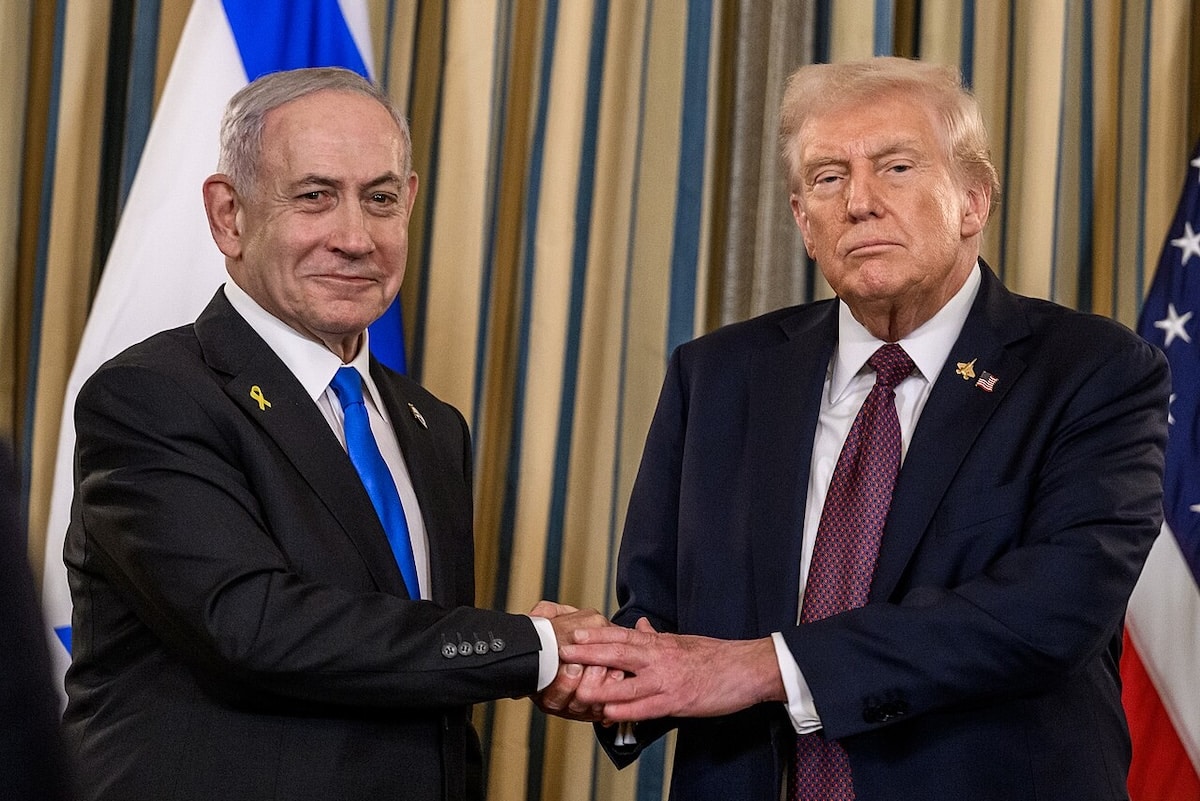
President Trump and Israeli Prime Minister began their second war on Iran in 7 months with just 2 war crime cards to play.
The first card was the US, Israeli version of Blitzkrieg from the air. Kill Iran’s beloved leader the Ayatollah Ali Khamenei, demand surrender, then wait for the 90 million Iranians to capitulate to new masters Trump and Netanyahu. That was projected to take just about 72 hours.
As expected, millions of Iranians came into the streets following Khamenei’s assassination. But not to welcome the grisly invaders bombing them. It was to show near total support to the Islamic government, cheering them on to inflict as much retaliation possible to repel the Trump Netanyahu criminal tag team.
And they are succeeding, causing massive damage to US military facilities in Bahrain, Qatar, Jordan, Kuwait. Saudi Arabia and UAE. All 6 are running out of defensive interceptors provided by Uncle Sam. Why? Trump is giving them all to himself and his war partner Netanyahu. When this is all over, the Gulf States will never again trust America for their defense. They may even tell the US to vamoose the region PDQ.
Iran is also bombing Israel night and day, giving Netanyahu, flying around the region 24/7 to avoid Khamenei’s fate, a taste of what he visited on Palestinians in Gaza for 2 years.
That leaves Trump and Netanyahu with their last war crime card to play. Bomb Iran to smithereens till there is no more Iranian weapons or personnel left with which to retaliate.
Big problem facing America and Israel is size. Both Israel and US military facilities nearby are compact in size making them easy targets, while Iran, the 17th largest country by area, has their tens of thousands of missiles scattered and largely unreachable.
Now that Iran has chosen to fight to the death rather than capitulate as expected, the advantage may be tiltng in their favor. Rumors surfacing Trump is pondering an off ramp to stop the bleeding he has no way of controlling.
Worst case scenario remains that Netanyahu may get so desperate facing unfathomable defeat, he escalates to war crime card 3… nuke Tehran.
Trump hints U.S. will turn to Cuba after Iran: ‘Just a question of time’
Kevin Breuninger, Fri, Mar 6 2026, https://www.cnbc.com/2026/03/05/trump-cuba-iran-regime-change.html
Key Points
- President Donald Trump suggested his administration will turn its sights to Cuba after U.S. military operations in Iran are done.
- It “will be just a question of time before you and a lot of unbelievable people are going to be going back to Cuba, hopefully not to stay,” Trump told a crowd at the White House.
- On Iran, Trump said the U.S. and Israeli militaries are continuing to “totally demolish the enemy.”
President Donald Trump on Thursday suggested his administration will turn its sights to Cuba after U.S. military operations in Iran are finished.
“What’s happening with Cuba is amazing,” Trump said at the White House while participating in a visit of Inter Miami CF, the 2025 Major League Soccer champions.
“We think that we want to fix — finish this one first, but that will be just a question of time before you and a lot of unbelievable people are going to be going back to Cuba, hopefully not to stay,” Trump said to the Miami-heavy audience that included people of Cuban heritage.
The comments show Trump, less than a week into an escalating military conflict in the Middle East, is considering another major foreign policy move.
“We want you back, and we don’t want to lose you. We don’t want to make it so nice that they stay. But some people probably do want to stay. They love Cuba so much,” he said. “That was another one that wasn’t supposed to happen.”
Trump turned his focus to Cuba after providing a boastful update on the war in Iran, where he said the U.S. and Israeli militaries are continuing to “totally demolish the enemy.”
Trump said Secretary of State Marco Rubio has been “doing a fantastic job.”
“And you’ve been doing a fantastic job on a place called Cuba,” Trump added, prompting applause from the room.
Trump’s latest remarks on Cuba follow previous hints, some less subtle than others, that he and his allies have dropped about their plans for the Caribbean island nation.
“Cuba’s next,” Sen. Lindsey Graham, R-S.C., said Sunday on Fox News after the Iran strikes began.
In an interview with Politico earlier Thursday, Trump predicted that after Iran’s regime is toppled, “Cuba’s going to fall, too.”
Trump also took credit for choking Cuba’s economy to force them to the negotiating table, which he had vowed to do after the U.S. military in January attacked Venezuela, a major supplier of oil to Cuba.
“We cut off all oil, all money, or we cut off everything coming in from Venezuela, which was the sole source. And they want to make a deal,” he told Politico.
“We are talking to Cuba,” Trump also said in that interview. “How long have you been hearing about Cuba — Cuba, Cuba — for 50 years?” he added. “And that’s one of the small ones for me.”
“AIPAC Is Toxic”: Illinois Races Expose a Shifting Democratic Landscape

SCHEERPOST, March 8, 2026 Joshua Scheer
The shift comes amid growing criticism of the pro-Israel lobby. Senator Chris Van Hollen recently telling a Jewish audience at a J Street conference that the actions of American Israel Public Affairs Committee were “un-American.”
A growing divide over the war with Iran is emerging inside Democratic politics and within AIPAC itself, and nowhere is it more visible than in Illinois.
According to reporting by Jewish Currents, several Democratic congressional candidates in Illinois who are backed by the powerful pro-Israel lobby American Israel Public Affairs Committee (AIPAC) have publicly criticized the U.S. attack on Iran—despite the lobby’s strong support for the military action.
The break highlights a political dilemma for AIPAC as it pours millions of dollars into Democratic primary races across the country in an effort to maintain strong congressional backing for Israel.
AIPAC praised Donald Trump’s decision to strike Iran, describing the move as “decisive.” But the Democratic candidates the group has supported in Illinois have largely taken the opposite position, condemning the U.S. attack while carefully avoiding direct criticism of Israel’s role in the conflict.
Among them is Illinois State Senator Laura Fine, who warned that Trump’s decision could send the Middle East into further chaos and suggested the president’s actions were grounds for impeachment. Other AIPAC-backed candidates—including former congresswoman Melissa Bean, Cook County Commissioner Donna Miller, and Chicago City Treasurer Melissa Conyears‑Ervin—also criticized the strikes, describing them as unconstitutional, dangerous, or an immoral “war of choice.”
Yet none of the candidates have openly challenged Israel’s involvement in the conflict, reflecting the delicate balancing act facing Democrats who rely on AIPAC support while campaigning in districts where Democratic voters overwhelmingly oppose the war.
Political analysts say that tension is not accidental. Matt Duss, executive vice president at the Center for International Policy and a former adviser to Senator Bernie Sanders, noted that Democratic voters are strongly against the war.
A recent poll by The Washington Post found that roughly 87 percent of Democrats oppose the conflict with Iran. As a result, many candidates are directing their criticism at Trump rather than confronting AIPAC or Israel directly.
“They have to be careful if they want to keep AIPAC support,” Duss explained.
The same political dynamic is playing out in several other races. In New York, Representative Dan Goldman, who has received backing from AIPAC, criticized Trump for defying the Constitution in launching the attack but did not mention Israel. Goldman is currently facing a progressive challenge from former New York City comptroller Brad Lander.
Meanwhile, in North Carolina, Representative Valerie Foushee narrowly defeated progressive challenger Nida Allam in a Democratic primary where the Iran war emerged as a late campaign issue. Allam ran television ads highlighting her opposition to the war and criticizing Foushee for accepting donations from defense contractors. Foushee also opposed the war and attempted to distance herself from AIPAC during the race.
Progressive candidates have seen stronger results in other states. In Texas, Reverend Frederick Haynes won the Democratic primary in the heavily Democratic 30th Congressional District. Haynes has been outspoken in criticizing Israeli policies in Gaza and has also opposed the war with Iran.
Advocates on the left say the results reflect a broader shift within Democratic politics. Beth Miller, political director of Jewish Voice for Peace Action, said recent primaries demonstrate how rapidly the political landscape is changing………………………………………………………………………………………………………………………….
In a joint statement, several progressive candidates—including Peters, Ahmed, Evanston Mayor Daniel Biss, and union organizer Anthony Driver—accused Trump of dragging the United States into what they described as an unnecessary war backed by AIPAC, and called on their opponents to reject the lobby’s “pro-war agenda.”……………………………………………………………. https://scheerpost.com/2026/03/08/aipac-is-toxic-illinois-races-expose-a-shifting-democratic-landscape/
‘The Military-Industrial Complex Is Winning’: While Bombing Iran, Trump Says Weapons Contractors to Boost Production.
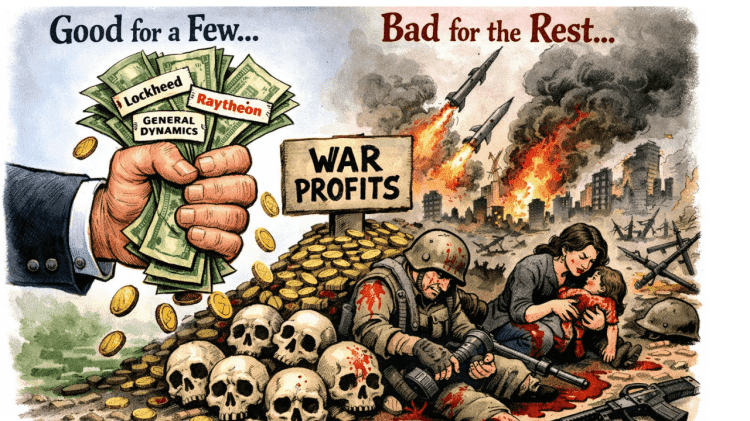
The president and Lockheed Martin said that the expansion began months ago, but his comments followed a White House meeting held amid a US-Israeli assault on Iran and mounting threats against Cuba.
Jessica Corbett, Common Dreams, Mar 06, 2026
After meeting with several chief executives at the White House on Friday—while also bombing Iran with Israel and threatening Cuba—US President Donald Trump said that top military contractors “have agreed to quadruple Production of the ‘Exquisite Class’ Weaponry in that we want to reach, as rapidly as possible, the highest levels of quantity.”
Trump said on his Truth Social platform that he met with the CEOs of BAE Systems, Boeing, Honeywell Aerospace, L3Harris Missile Solutions, Lockheed Martin, Northrop Grumman, and RTX—formerly Raytheon.
“Expansion began three months prior to the meeting, and Plants and Production of many of these Weapons are already underway,” he wrote, adding that another meeting is scheduled in two months.
……………………………………………………………………………………………………………….
It was not immediately clear whether the meeting… resulted in any new agreements to boost production beyond those previously announced by the Pentagon since the beginning of the year.
Those agreements include a multiyear deal to triple PAC-3 production and quadruple THAAD interceptor production with Lockheed. It also included separate multiyear deals with RTX to boost production for the Tomahawk, AMRAAM air-to-air missile, Standard Missile-3 IIA and IB, and Standard Missile-6, with production for certain of those munitions set to double or quadruple, RTX said at the time………………….
Northrop Grumman said in a statement that “we support the president’s focus on speed and investment to deliver military capabilities. With our industry-leading levels of investment and decades of proven performance, we continue to grow production capacity and deliver mission-ready technologies for the nation’s warfighters.”
Using Trump’s preferred name for the Pentagon, an RTX spokesperson said the company “is proud to support the administration’s goals of defending the US and its allies at this critical moment and committed to accelerating the production of five key munitions in accordance with the historic frameworks reached with the War Department last month.”
Defense Secretary Pete Hegseth also joined the meeting, according to White House press secretary Karoline Leavitt. After Hegseth shared Trump’s Truth Social post on the platform X, Lockheed Martin replied, saying that it began working with the Pentagon chief and Feinberg “months ago,” and the company has “agreed to quadruple critical munitions production………………………………………………………….. https://www.commondreams.org/news/trump-defense-contractors
1 This Month


Tell the Ukrainian Government to Drop Prosecution of Peace Activist Yurii Sheliazhenko

Petition to revoke the licensing of the Near Surface Nuclear Disposal Facility (NSDF) at Chalk River. https://www.ourcommons.ca/petitions/en/Petition/Details?Petition=e-7247


of the week – STOP SMALL MODULAR REACTORS IN CANADA
To see nuclear-related stories in greater depth and intensity – go to https://nuclearinformation.wordpress.com
-
Archives
- March 2026 (183)
- February 2026 (268)
- January 2026 (308)
- December 2025 (358)
- November 2025 (359)
- October 2025 (376)
- September 2025 (258)
- August 2025 (319)
- July 2025 (230)
- June 2025 (348)
- May 2025 (261)
- April 2025 (305)
-
Categories
- 1
- 1 NUCLEAR ISSUES
- business and costs
- climate change
- culture and arts
- ENERGY
- environment
- health
- history
- indigenous issues
- Legal
- marketing of nuclear
- media
- opposition to nuclear
- PERSONAL STORIES
- politics
- politics international
- Religion and ethics
- safety
- secrets,lies and civil liberties
- spinbuster
- technology
- Uranium
- wastes
- weapons and war
- Women
- 2 WORLD
- ACTION
- AFRICA
- Atrocities
- AUSTRALIA
- Christina's notes
- Christina's themes
- culture and arts
- Events
- Fuk 2022
- Fuk 2023
- Fukushima 2017
- Fukushima 2018
- fukushima 2019
- Fukushima 2020
- Fukushima 2021
- general
- global warming
- Humour (God we need it)
- Nuclear
- RARE EARTHS
- Reference
- resources – print
- Resources -audiovicual
- Weekly Newsletter
- World
- World Nuclear
- YouTube
-
RSS
Entries RSS
Comments RSS
 nuclear-news