Welcome to Planet Vogtle! The Lessons of Georgia’s Nuclear Boondoggle
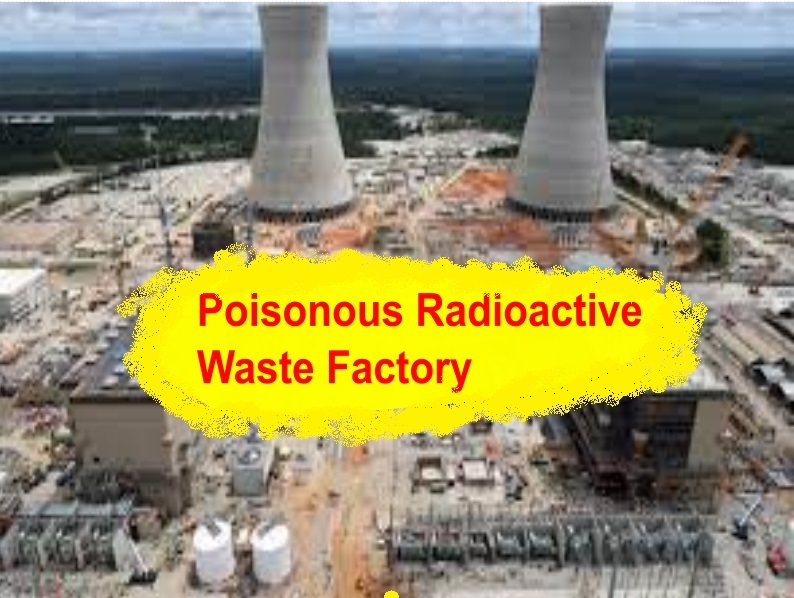
The ADVANCE Act greases the tracks by eliminating regulatory barriers, essentially transforming the Nuclear Regulatory Commission from a safety watchdog into an industry booster. It curtails the licensing process, downgrades health and safety standards, and promotes the export of nuclear technology. The U.S. can now compete with Russia and China to spread “nuclear waste factories” like Vogtle around the globe.
Jul 1, 2024, https://www.stephenwing.com/blog/2024/07/01/welcome-to-planet-vogtle-the-lessons-of-georgias-nuclear-boondoggle/
A global race is on to see who will host the next nuclear disaster, and as always the U.S.A. is determined to take the lead. On June 18 the Senate passed the so-called ADVANCE Act, pledging billions of taxpayer dollars to the most expensive, inefficient, and toxic form of energy ever devised. Thanks to the $37 billion expansion of Plant Vogtle, Georgia Power ratepayers like me know what that means: record-breaking profits for utility companies, record-breaking power bills for the rest of us.
Lavish federal subsidies under the last four presidents and a grandiose “nuclear renaissance” P.R. campaign have failed to reverse decades of decline for nuclear energy. No surprise – it’s an obsolete, dangerous, and financially untenable technology that no private investor or insurance carrier will touch.
Now, like the Four Horsemen of the Apocalypse, what Naomi Klein calls “disaster capitalism” comes galloping to the rescue. A rare bipartisan consensus hails “clean, safe nuclear energy” as the answer to climate change. The 93-page ADVANCE Act – cleverly concealed within the 3-page Fire Grants & Safety Act – delivers the entire wish list of the nuclear industry. Only Bernie Sanders and Ed Markey voted “no.” Liberal icon Sheldon Whitehouse actually helped to draft the legislation.
Calling nuclear power “clean” and “safe” would be laughable if it weren’t such a grim joke. Radioactive contamination plagues it at every step, from carcinogenic uranium mining to routine radionuclide releases at every operating reactor to the mounting backlog of radioactive waste. “Disposal” is a euphemism; the waste will remain deadly to life for tens of thousands of years, longer than the entire history of civilization, with no safe storage option in sight.
Expecting nukes to help slow global warming is equally deluded. The two new reactors at Plant Vogtle – the nation’s first since the Three Mile Island meltdown in 1979 – took 15 years to construct, double the original estimate. We would have to build 1,400 more within ten years to noticeably impact the pace of climate change. Developing untested technologies such as “Small Modular Nuclear Reactors” will take decades longer.
Electricity as a Byproduct of Profit
The ADVANCE Act greases the tracks by eliminating regulatory barriers, essentially transforming the Nuclear Regulatory Commission from a safety watchdog into an industry booster. It curtails the licensing process, downgrades health and safety standards, and promotes the export of nuclear technology. The U.S. can now compete with Russia and China to spread “nuclear waste factories” like Vogtle around the globe.
Not that the NRC ever seriously hindered the industry it is charged to regulate. The new legislation comes amid a nationwide rush to extend the licensing of nuclear plants from their estimated safe lifespan of 40 years to 60, 80, even 100 years, despite the proven tendency of radioactivity to “embrittle” the concrete that shields us from exposure.
Though media coverage of the ADVANCE Act was largely clueless, several outlets quoted a statement by Ed Lyman of the Union of Concerned Scientists: “Make no mistake: This is not about making the reactor licensing process more efficient, but about weakening safety and security oversight across the board, a longstanding industry goal.”
The only reason utilities are pushing nukes – and the only reason they ever did – is profit. Ever since Eisenhower heralded “the peaceful atom” and the industry promised energy “too cheap to meter,” nuclear power has depended entirely on government subsidies to survive. By far the most costly way to generate electricity, it’s also the most profitable, since We the Taxpayers cover most of the costs, from uranium mining and enrichment to managing nuclear waste to the uninsurable consequences of catastrophic accidents.
Betting on nukes not only wastes irrecoverable time and money; it pre-empts real solutions. Investing the same tax dollars in renewables like solar and wind, energy-efficient retrofits, and upgrading the power grid would displace far more carbon emissions. Renewables already provide more electricity globally than nukes, are far cheaper per kilowatt-hour, and can be expanded much more rapidly while generating exponentially more jobs.
Not to mention sidestepping the risk of another Fukushima, Chernobyl, or Three Mile Island. Factor in the escalating threats of extreme weather and terrorism, declining safety standards, and the industry’s eagerness to sell its radioactive snake-oil to developing nations, and the odds of another deadly meltdown somewhere in the world approach the threshold of inevitability – maybe right here in my home state.
Georgia’s Plant Vogtle: A Cautionary Tale
On the eve of Georgia Power’s triumphant ribbon-cutting for its new reactors, six environmental and consumer groups released “Plant Vogtle: The True Cost of Nuclear Power in the United States,” a 35-page report exposing the political maneuvering and cynical profiteering that made the project a “success.”
The story begins in 2009, when most U.S. utilities had abandoned the “nuclear renaissance” due to plunging natural gas prices, zero growth in energy consumption, and the astronomical cost of nuclear fission. Despite federal loan guarantees, no one was investing – until the Georgia General Assembly solved the problem with a bill allowing Georgia Power (a subsidiary of Southern Company) to charge customers a monthly fee to finance two additional reactors at Plant Vogtle, near Augusta.
Georgia Power’s sales had been flat for two decades and its generating capacity was nearly three times the reserves recommended by the federal agency in charge of our national grid. So why would the company build two expensive, unnecessary new reactors? And why would Georgia’s elected utility regulators, the Public Service Commission, allow it?
“By all appearances,” the report explains, “the Georgia PSC is deep in regulatory capture, a phenomenon where a regulator prioritizes the interests of the companies it regulates (like Georgia Power) over the public good. . . .
Since Georgia Power is a monopoly and operates outside of a competitive business market, it can shift risks and costs onto customers if regulator or legislative bodies enable it. That is exactly what the Georgia PSC did.”
Adding as much as 10% to a typical power bill, the fees raised over $4 billion – 88% of it from residential customers, small businesses, even public schools, and only 11% from major industries, thanks to some canny lobbying. The average household ended up paying about $1,000 up-front to subsidize the reactors. The U.S. Treasury contributed a $12 billion low-interest loan, and the rest of the up-front cost came from other lenders. But Georgia law guarantees that ratepayers must cover loan repayment along with Georgia Power’s other costs – which the PSC repeatedly approved as the budget jumped from an initial $14 billion to $21, then $27 billion.
In effect, ratepayers and taxpayers were forced to shoulder the entire investment, while the profits go to Southern Company shareholders.
Milking a Corporate Monopoly to the Max
That same year, South Carolina authorized a similar customer fee to expand its VC Summer plant. Both projects were contracted to Westinghouse. Construction began in 2013, but according to the report, “Cost overruns at both reactor sites began immediately, and by early 2017 were so extreme that Westinghouse declared bankruptcy.” In South Carolina, an investigation led to criminal charges against Westinghouse and utility executives, four of whom went to prison and paid steep fines “for lying about the costs and progress of the project.”
“Similar behavior by Westinghouse and Georgia Power/Southern Company officials occurred in Georgia,” the report goes on, “but there has been no accountability. . . . Commissioners repeatedly accepted Georgia Power’s budget and schedule forecasts in defiance of documented evidence from the Commission’s own staff and consultants that they were materially inaccurate for over ten years.” The Commissioners also praised the company and nuclear power itself with evangelical fervor, violating state regulations that require neutrality in upholding the public interest.
The two reactors ultimately cost over $36.85 billion, making Vogtle “the most expensive power plant ever built on Earth.” But because the PSC approved an exceptionally high rate of “return on equity” (ROE), every cost overrun and construction delay only bolstered Georgia Power’s profits. “Georgia Power was making substantially greater profits from Vogtle 3 and 4’s delay than if it had finished on schedule,” the report says. “Indeed, commissioners allowed Georgia Power to amass a record $17 billion in profits between 2009 and 2023, while allowing $20 billion in cost overruns for Vogtle 3 and 4.”
In December 2023, the PSC voted to saddle ratepayers with $11.1 billion in cost overruns, often caused by shoddy workmanship, inept management, or poor design. Vogtle-related rate increases will eventually total 23.7% – “in stark contrast,” the report points out, “to claims Georgia Power made in 2016 that completing Vogtle units would put ‘downward pressure on rates.’ . . . It is very likely Georgians will soon be paying the highest power bills in the nation due to Plant Vogtle.”
The report’s conclusion illuminates the fraudulent premises of the ADVANCE Act:
“Fossil fuels and uranium are burned to boil water to produce steam to generate electricity which produces large amounts of waste heat. Renewable energy not only does not produce waste heat, but is more than twice as efficient as steam generated power, thus fossil fuel and nuclear energy can be replaced by less than half as much clean, renewable energy . . .”
“Washington, Oregon, Idaho, and South Dakota produced over 60% of their electricity from renewables in 2023, and ten countries generated 60 to 90% of their electricity from renewables in 2022 including Scotland, Iceland, the Netherlands, Germany, and Guatemala, among others. California’s output from wind, water and solar power exceeded demand for 30 of 38 days early in 2024 . . .”
“Investments in a clean energy transition would save substantial amounts of ratepayer money, and would quickly meet the reduced greenhouse gas emissions reduction targets the world needs to address the climate crisis. Yet these investments are not made as they are not as profitable for monopoly utilities seeking to maximize profits. . . . An immense transfer of wealth is taking place from the people of Georgia to a rich, powerful monopoly whose only motivation is to maximize profits.”
Don’t let your state be taken in by scammers in suits! Download the full report here.
Playing with nuclear fire
Eric S. Margolis, 16 Sept 24, https://thesun.my/opinion-news/playing-with-nuclear-fire-EC13005045
REPUBLICANS in the US Senate have been urging the White House to provide Ukraine with long-range missiles that can strike deep into Russia. Such is the madness of pro-war sentiment.
America’s Secretary of State Anthony Blinken has apparently confirmed that Washington plans to shortly deliver such strategic weapons to Ukraine. This week, Britain’s new prime minister arrived in Washington to discuss more strategic arms for Ukraine.
One is vividly reminded of the mobs who thronged Paris train stations in August 1914, screaming “on to Berlin”. As a British historian aptly noted, “if patriotism is the last refuge of scoundrels, then war is the first platform of fools”.
US-supplied long-range missiles are the last step between what was a border conflict and an all-out war that will likely go nuclear.
Russia’s leader Vladimir Putin has repeatedly stated that he reduced conventional forces to divert funds to Russia’s stunted civilian economy. Nuclear weapons, said Putin, will be used to replace conventional forces if Russia is attacked. We must take him at his word.
The border war with Ukraine, which began in 2014, has shown how much Russia reduced its former conventional might. The once mighty Red Army has proven a shadow of its former self. Under Putin, armies of tanks have been replaced by new apartments across the sprawling nation.
The idea of sending more long-range missiles to Ukraine is sheer madness. Ukraine is slowly being ground down in this long war of attrition.
Ukraine’s current strategy is to provoke a direct clash between Russia and the US. Interestingly, Israel used the same strategy to provoke direct US military intervention against Syria and various Arab militias.
The US, dominated by pro-war Republicans and wealthy pro-Israel special interests, appears eager to promote war with Russia. Most importantly, neoconservatives are urging intensified war against Russia to advance their goal of breaking up the Russian Federation into small, weak pieces dominated by Washington.
Such was the case under former Russian president, Boris Yeltsin, who allowed US financial interests to dominate Russia while he made merry. Former KGB officer Putin put an end to Washington’s attempt to turn Russia into an American satrapy.
I interviewed the leaders of KGB at Moscow’s Lubyanka Prison in 1991. They expressed disgust with Russia’s then-Communist leadership and said there would be a housecleaning. The result was, of course, Putin’s surprising rise to power.
Putin quickly became the target of US media hate. He committed terrible brutalities in Chechnya, but without him, Russia may have ended up as today’s supine Germany.
The US overthrew Ukraine’s last pro-Russian government. Ukraine had been part of the Russian state for hundreds of years and the centre of its heavy industries. This coup cost the US $5 billion (RM21.44 billion), according to leading State Department neocon Victoria Nuland.
An actor, the amiable Volodymyr Zelensky, was put in charge by Nuland. US funds and arms poured into Ukraine. Efforts by Washington to shatter the old Soviet Union were a brilliant success, except that Washington had to foot the bill, which has so far reached an astounding US$44 billion, depriving the US military of many important weapons systems.
One also wonders why former president Donald Trump did not raise the issue of Ukraine’s payments to President Joe Biden and his son.
As a veteran war correspondent and old friend of Ukraine, I see the US and Russia heading to a major war. The Western powers have been relentlessly provoking Russia. The idea of supplying Ukraine with a new class of long-range missiles will likely ignite a dangerous war that may likely go nuclear.
Now is the time for the great powers to impose peace, not supply arms. Time to end the unnecessary sufferings of Ukrainians and Russians. Genuine diplomacy, not more weapons, is the answer.
Nuke waste confusion continues with D.C. Circuit ruling

Kennedy Maize, https://energycentral.com/c/um/nuke-waste-confusion-continues-dc-circuit-ruling. 13 Sept 24
The D.C. Circuit appeals court has upheld the authority of the U.S. Nuclear Regulatory Commission to license private, away-from-reactor storage of spent nuclear fuel, adding confusion to the gnarly issue of what to do with high-level nuclear waste. With federal circuit courts in collision, it may take the U.S. Supreme Court to sort it out.
On Aug. 27, a three-judge D.C. Circuit panel rejected a challenge to a 2021 Nuclear Regulatory Commission license to Interim Storage Partners, a subsidiary of Orano USA, for a private, above-ground “temporary” waste storage site in West Texas near the New Mexico state line. Not long after that, the NRC granted a similar license to Holtec International for an above-ground storage site in eastern New Mexico, close to the Texas line.
In granting the Holtec license, the NRC rejected petitions to intervene by Beyond Nuclear, a Maryland anti-nuclear group, the Sierra Club, and Texas-based Fasken Land and Minerals, a Permian Basin oil and gas producer.
Almost exactly a year ago (Aug. 25, 2023), the ultra-conservative Fifth Circuit Court of Appeals, with jurisdiction in Texas, Louisiana, and Texas, rejected the NRC license for the Texas site in a case brought by Texas Gov. Greg Abbott and Fasken. The Fifth Circuit ruled that neither the Atomic Energy Act nor the Nuclear Waste Policy Act authorized private, away-from-reactor storage of spent fuel, at least until a final federal underground repository is available. That prospect is far in the future, if at all.
In March, the Fifth Circuit expanded its ban of the Texas project to Holtec’s New Mexico waste project, despite it being outside the court’s jurisdiction. In an unpublished decision, the circuit court wrote, “Because this court’s holding in Texas v. NRC dictates the outcome here, we GRANT Fasken’s and PBLRO’s petition for review and VACATE the Holtec license.” The court also rejected an NRC petition to move the case to the D.C. appeals court.
That led to the anti-nuclear filing in D.C., challenging to NRC’s decision to deny them intervenor status in the Holtec license case. In the denial of the petition last month, Judge Neomi Rao wrote for the panel that “the Commission reasonably declined to admit petitioners’ factual contentions and otherwise complied with statutory and regulatory requirements when rejecting the requests to intervene.”
Rao also took on some of the Fifth Circuit’s ruling about the authority for away-from-reactor, above-ground storage. Rao wrote, “According to Beyond Nuclear, the [waste policy act] prohibits DOE from taking title to private spent nuclear fuel until a permanent repository for the disposal of spent nuclear fuel is built, so it is unlawful for the Commission to consider the application.” That’s an assertion the Fifth Circuit also made.
Citing a 2004 D.C. Circuit decision, Rao found, “Even if the NWPA prohibits DOE from taking title to private spent nuclear fuel until a permanent repository for the disposal of such fuel is built, a point we assume without deciding, the statute does not affect ‘the NRC’s authority under the AEA to license and regulate private use of private away-from-reactor spent fuel storage facilities.’
” The Commission correctly determined that Beyond Nuclear did not raise a genuine dispute of law or fact, so we deny its petition for review.”
Rao, 51, a Trump appointee, has served on the D.C. Circuit Court since March 2019.
As the online legal site Justia noted, “Additionally, the court determined that Fasken’s late-filed contentions were procedurally defective, untimely, and immaterial.”
An analysis by the D.C. law firm Hogan Lovells commented, “This decision is contrary to recent Fifth Circuit decisions, but in line with prior D.C. Circuit and Tenth Circuit decisions—further deepening the circuit split on such authority and increasing the likelihood the Supreme Court will consider the issue in its upcoming term.”
The analysis noted that “commercial interim storage” (CIS) “was initially challenged in federal courts in the early 2000s, when the NRC was licensing the first commercial CIS, known as the Private Fuel Storage facility. At that time, a number of court challenges were brought contesting the NRC’s authority to license a CIS facility, and in two circuit court decisions—specifically, in the D.C. Circuit and the Tenth Circuit—the court upheld the NRC’s authority to license the CIS under the AEA. For NRC licensing decisions, as a general matter, the federal circuit courts have direct appellate review, and the appeal can be brought in either the D.C. Circuit or the circuit court where the proposed facility is located.”
How to Make a ‘War Reserve’ Nuclear Bomb

Earlier this year, at the annual Nuclear Deterrence Summit in Washington, D.C., there was a palpable sense of excitement at the return to Cold War strategies of shoring up our nuclear arsenal. Today, with what some call the two-peer problem—Russia and China—and the specter of nuclear-armed rogue nations and terrorists, the NSE is racing against what-if targets. The language is aggressive. Opposition is largely mute. Congress has opened the tap. The NSE is hiring, training, building, and spending billions a year.
The dark art of crafting nuclear ‘pits’ was almost lost. Now it’s ramped up into a multibillion dollar industry.
The Progressive Magazine, by Jim Carrier , September 5, 2024
Sometime in the next few months a technician at Los Alamos National Laboratory, using an arc welder, will seal together two half-domes of plutonium, creating a “pit,” a seven-pound ball the size of a grapefruit, which, if tucked into America’s newest nuclear warhead and triggered above Times Square, would destroy most of Manhattan and kill more than 1.2 million people.
The bomb is part of a $1.7 trillion plan to rebuild the U.S. nuclear arsenal. The new pit, and hundreds like it, are being made for the W87-1, a new warhead designed to sit atop the Sentinel, a new intercontinental ballistic missile design that will replace all 400 Minuteman III missiles that have been on alert in silos across the Upper Midwest for the last five decades.
Not since the Manhattan Project, the crash program during World War II to invent the atomic bomb, has so much money and urgent energy been spent by the United States to create a weapon of mass destruction. In a paradox of nuclear madness, production of the W87-1—each one with a yield of around 400 kilotons, twenty times larger than the bombs that destroyed Hiroshima and Nagasaki—is breathing life into the U.S. Nuclear Security Enterprise (NSE), the agency that makes nuclear weapons and runs the planes, missiles, and submarines that deliver them.
The warhead “is reinvigorating and transforming the production complex such that NSE can once again produce all of the components typically required for modern nuclear warheads,” according to the Lawrence Livermore National Laboratory, which designed the W87-1. “This work will give the nation expanded options for maintaining an effective nuclear deterrence posture for decades to come.”
Earlier this year, at the annual Nuclear Deterrence Summit in Washington, D.C., there was a palpable sense of excitement at the return to Cold War strategies of shoring up our nuclear arsenal. Today, with what some call the two-peer problem—Russia and China—and the specter of nuclear-armed rogue nations and terrorists, the NSE is racing against what-if targets. The language is aggressive. Opposition is largely mute. Congress has opened the tap. The NSE is hiring, training, building, and spending billions a year.
At Los Alamos, the urgency can be seen inside Plutonium Facility Building 4, known as PF-4, the only building in the United States where plutonium pits are made. Working around the clock, technicians are dismantling old contaminated glove boxes—the laboratory apparatus that allow technicians using built-in gloves to work with toxic or volatile substances inside a sealed chamber—before a new shift of workers arrives to install shiny new steel glove boxes for work on the new pits…………………….
The process of turning plutonium into a bomb is a dark art—an alchemy invented in 1945 on the same New Mexico mesa. Wizards of physics and math who divined the immense energy locked within its atoms, together with master machinists, created the first atomic bomb, “Trinity,” and its copy, “Fat Man,” which destroyed Nagasaki with the power of twenty kilotons, or 20,000 tons of TNT. These two plutonium bombs produced enough heat and radiation to ignite, or trigger, the kind of fusion fire present in the sun.
One year later, as Baby Boom children were teething, Los Alamos blew up a similar plutonium bomb named “Baker” on Bikini Atoll. Its twenty-one-kiloton underwater eruption captured both the bounty of nuclear power and America’s intent to weaponize it.
During the Cold War, Los Alamos produced ninety-four different nuclear weapons—bigger, smaller, deadlier, more accurate. Many were thermonuclear, or hydrogen bombs, whose design, first revealed to the public by Howard Morland in this magazine in 1979, was theorized during the Manhattan Project. In 1952, Los Alamos, using a plutonium pit as a trigger, detonated its first thermonuclear bomb. That same year, the United States built the Rocky Flats Plant, a plutonium pit factory outside Denver. It produced 1,000 pits a year.
The hands-on, metallurgical master craft of fashioning pits was almost lost, though, when Rocky Flats was raided and closed in 1989 by the FBI for massive environmental crimes—the year the Soviet Union began to collapse, ending the Cold War. The NSE fell into a funk, reduced to cleaning up its messes and “stockpile stewardship.”……………………………………………………………………………………………….
“The reestablishment of pit production capabilities is the largest and most complex infrastructure undertaking at NNSA since shortly after the Manhattan Project,” Jill Hruby, administrator of the National Nuclear Security Administration, told the Strategic Weapons in the 21st Century Symposium on April 18. “Our current total estimated acquisition cost range for pit production is $28-37 billion . . . . I know that’s a lot of money . . . . Los Alamos is on track to diamond stamp the first fully qualified War Reserve pit for the W87-1 this year. We anticipate Los Alamos achieving the capability to produce the thirty pits per year envisioned by the two-site plan in or near 2028, with increased manufacturing rate confidence as we install equipment through 2030.”
he United States will never need to make plutonium again. During the Cold War, nuclear reactors at Hanford, Washington, produced more than sixty tons of plutonium. Some 14,000 pits, made by Rocky Flats, each bearing the War Reserve diamond stamp, are warehoused in Pantex, Texas.
As Los Alamos cranks up its program, pits are brought from Pantex, torn apart, and subjected to pyrochemistry, which removes impurities. The metal is then heated into a hot syrup and poured into molds, creating two halves of a sphere. These are welded together. This process is done in rows of connected glove boxes, the plutonium moving from one to another in an overhead trolley system, and dumbwaiters that raise and lower it.
Today at Los Alamos, hundreds of people work at the plutonium factory, some of them making plutonium heaters for space vehicles. But on the pit side, fewer than ten people in the world are trained or are being trained to perform final pit assembly, which must be done by hand inside a large, walk-in glove box, wearing multiple layers of personal protective equipment to prevent plutonium contamination. These master machinists and welders hold Q clearances and undergo annual physical and mental exams. It can take up to four years to train them.
…………………………………………………………………………… fundamental questions are being raised. Scientists debate whether new pits are really needed when existing pits might last for decades. And the need for the W87-1 and the Sentinel missile itself is being questioned because of rising costs and its vulnerability as a land-based, easily targeted weapon. The Pentagon reported in July that the missile’s estimated cost has risen 81 percent over budget to $141 billion.
In New Mexico, two longtime watchdog organizations, the Los Alamos Study Group and Nuclear Watch New Mexico, list dozens of reasons to not make pits at Los Alamos: waste disposal, radiation deposits, earthquake potential, cost and schedule overruns among them.
“Every dollar spent at LANL [Los Alamos National Laboratory] on this program is wasted,” wrote Greg Mello of the Los Alamos Study Group. “Every drum of waste produced in the process need not have been produced. Every career spent making these pits, or supporting the work, is a career that could have been spent building a sustainable, moral, responsible future. The LANL pit production program is a symptom of pure arrogance, greed, and management failure at the highest levels of government.”
………………………. As America’s nuclear train chugs forward, it is virtually certain that if the Sentinel missiles containing the Los Alamos pits are in their silos by the early 2030s, as planned, they will inflame an arms race that is already underway, while posing—if we’re lucky—nothing more than an apocalyptic threat in a new Cold War. https://progressive.org/magazine/how-to-make-a-war-reserve-nuclear-bomb-carrier-20240905/
‘Obvious Conflict of Interest’: Report Reveals 50+ US Lawmakers Hold Military Stocks


“It’s abjectly terrifying that the personal benefit of any member of Congress is factored into decisions about how to wield and fund the largest military in the world,” said one critic.
Brett Wilkins 12 Sept 24, https://www.commondreams.org/news/members-of-congress-who-own-defense-stock
At least 50 U.S. lawmakers or members of their households are financially invested in companies that make military weapons and equipment—even as these firms “receive hundreds of billions of dollars annually from congressionally-crafted Pentagon appropriations legislation,” a report published Thursday revealed.
Sludge‘s David Moore analyzed 2023 financial disclosures and stock trades disclosed in other reports and found that “the total value of the federal lawmakers’ defense contractors stock holdings could be as much as $10.9 million.”
Melanie D’Arrigo, @DarrigoMelanie
Over 50 members of Congress, who vote to approve the military budget and approve the sale of weapons, own up to $10.9M in military contractor stocks. Military contractors have also donated $29M this year to election campaigns. That isn’t national defense. That’s corruption.
According to the report:
The spouse of Sen. Susan Collins (R-Maine), the ranking member of the Defense Appropriations subcommittee, holds between $15,000 and $50,000 worth of shares in each of Boeing and RTX, as well as holdings in two other defense manufacturers. Sen. Jerry Moran (R-Kansas), another Defense Appropriations subcommittee member, holds up to $50,000 in the stock of Boeing, which received nearly $33 billion in defense contracts last year. On the Democratic side of the aisle, Sen. John Hickenlooper (Colo.) holds up to a quarter of a million dollars’ worth of stock in RTX…
The most widely held defense contractor stock among senators and representatives is Honeywell, an American company that makes sensors and guiding devices that are being used by the Israeli military in its airstrikes in Gaza. The second most commonly held defense stock by Congress is RTX, formerly known as Raytheon, the company that makes missiles for Israel’s Iron Dome, among other weapons systems.
All 13 senators whose households disclosed military stock holdings voted for the most recent National Defense Authorization Act, which, as Common Dreams reported, allocated a record $886.3 billion for the U.S. military while many lawmakers’ constituents struggled to meet their basic needs.
“It is an obvious conflict of interest when a member of Congress owns significant stock investments in a company and then votes to award the same company lucrative federal contracts,” Craig Holman, government affairs lobbyist at the consumer advocacy group Public Citizen, told Sludge.
“Whether or not the official action is taken for actual self-enrichment purposes is beside the point. There is at least an appearance of self-enrichment and that appearance is just as damaging to the integrity of Congress,” Holman added. “This type of conflict of interest is already banned for executive branch officials and so should be for Congress as well. The ETHICS Act would justly avoid that conflict of interest by prohibiting members of Congress and their spouses from owning stock investments altogether.”Holman was referring to the Ending Trading and Holdings In Congressional Stocks (ETHICS) Act, introduced earlier this year by Sens. Jeff Merkley (D-Ore.), Jon Ossoff (D-Ga.), Gary Peters (D-Mich.), and Josh Hawley (R-Mo.).
In the House of Representatives—where the 2024 NDAA passed 310-118, with the approval of over two dozen members who own shares in military companies—House Foreign Affairs Committee Chair Michael McCaul’s (R-Texas) household owns up to $2.6 million in General Electric, Oshkosh Corporation, and Woodward shares. Rep. Dave Joyce (R-Ohio), who sits on the Defense Appropriations subcommittee, owns as much as $100,000 worth of Boeing and General Electric stock.
Other House lawmakers with potential conflicts of interest include Rep. Gerry Connolly (D-Va.), a member of the Foreign Affairs Committee, who owns Leidos shares worth as much as $248,000; Rep. Debbie Dingell (D-Mich.), who owns up to $100,000 worth of RTX stock; and Rep. Patrick Fallon (R-Texas), a member of the Armed Services Committee who holds Boeing stock worth between $100,000 and $250,000.
“Every American should take a long, hard look at these holdings to conceptualize the scope of Congress’ entanglement with defense contractors,” Public Citizen People Over Pentagon advocate Savannah Wooten told Sludge. “It’s abjectly terrifying that the personal benefit of any member of Congress is factored into decisions about how to wield and fund the largest military in the world.”
“Requiring elected officials to divest from the military-industrial complex before stepping into public service would create a safer and more secure world from the outset,” she added.
NuScale Power Is Great. Here’s Why You Shouldn’t Buy It.

The Motley Fool, By Reuben Gregg Brewer – Sep 14, 2024
NuScale Power (SMR 12.17%) is at the leading edge of the nuclear power sector. It is doing great things and making important progress toward its goal of mass-producing small-scale modular nuclear reactors. In a world increasingly looking toward carbon-free energy sources, it is positioning itself well for a bright future. But it won’t be a good fit for every investor. Here’s why you might want to buy the stock and why you might not want to buy it.
NuScale is moving (slowly) toward the nuclear future
Today, nuclear reactors are giant infrastructure assets that cost huge sums of money to build and years of effort to get up and running. NuScale Power is working to upend that inefficient model by offering small, modular reactors that would be built in a factory and then delivered where they are needed.
If one reactor isn’t enough, they can be linked to create a larger reactor………….
Adding to the allure here is a balance sheet with zero debt and $136 million in cash. In other words, it is working from a strong financial position. Also, NuScale Power’s largest shareholder is Fluor (FLR 2.21%), a large construction company.
Clearly, Fluor has its own motives in backing NuScale, like supporting the growth of a new market (small-scale nuclear power plant construction), but it means that NuScale has a strong parent to help it along. That’s showing up right now, too, as a project from Fluor is going to help add revenue to NuScale’s earnings statement, helping the upstart nuclear power company pay for its own product development plans.
There are indeed some good reasons to like the future prospects for NuScale power, including that, as management likes to highlight, it is “the only SMR certified by the U.S. Nuclear Regulatory Commission.” So, it basically has a leg up on the competition right now.
NuScale Power comes with some big risks
Despite the positives, NuScale Power is not going to be a good fit for every investor. In fact, only aggressive types should really be looking at the stock today. There are a host of reasons.
For starters, NuScale Power’s product plans are approved by U.S. regulators, but not fully approved to the point where it can start building and selling units. So, there’s more work to be done before NuScale Power even has a product to sell. And while it has inked a tentative deal to sell its first units, it can’t actually do that yet. It has to spend even more money on the effort to get the final government nod to start building and delivering a product.
That, in turn, means more red ink. NuScale Power is basically still in start-up mode, so it isn’t unusual that more money would be going out the door than coming in. The revenue from the work with Fluor will help, but the income statement is likely to look ugly for years to come. That’s because it will still have to ramp up its production abilities even after it gets all the approvals it needs. All in all, NuScale Power has a great story, but that story is still in its early chapters.
NuScale Power is an acquired taste
To highlight the risks here, it helps to look at the stock price. Over the past year, the stock has gone from a low of roughly $2 per share to a high of just over $15, and it currently sits at around $7. If you can’t handle price swings like that, you definitely don’t want to own this nuclear power start-up.
That said, investors with a high tolerance for risk might be interested in NuScale power, given that it has achieved a great deal on its path to producing small-scale modular nuclear reactors. But for most investors, the risks are likely too great at this point in time to justify hitting the buy button. https://www.fool.com/investing/2024/09/14/nuscale-power-is-great-heres-why-you-shouldnt-buy/
How Corporate News Has Tried To Numb Americans To The Horrors In Gaza

“a consistent bias against Palestinians.” Those highly influential news outlets “disproportionately emphasized Israeli deaths in the conflict” and “used emotive language to describe the killings of Israelis, but not Palestinians.”
eurasia review By Norman Solomon
As the Gaza war enters its 12th month with no end in sight, the ongoing horrors continue to be normalized in U.S. media and politics. The process has become so routine that we might not recognize how omission and distortion have constantly shaped views of events since the war began in October.
During the first five months of the war, the New York Times, Wall Street Journal, and Washington Post applied the word “brutal” or its variants far more often to actions by Palestinians (77 percent) than to Israelis (23 percent). The findings, in a study by Fairness and Accuracy In Reporting (FAIR), pointed to an imbalance that occurred “even though Israeli violence was responsible for more than 20 times as much loss of life.” News articles and opinion pieces were remarkably in the same groove; “the lopsided rate at which ‘brutal’ was used in op-eds to characterize Palestinians over Israelis was exactly the same as the supposedly straight news stories.”
Despite exceptional coverage at times, what was most profoundly important about the war in Gaza—what it was like to be terrorized, massacred, maimed, and traumatized—remained almost entirely out of view. Gradually, surface accounts reaching the American public came to seem repetitious and normal. As death numbers kept rising and months went by, the Gaza war diminished as a news topic, while most interview shows seldom discussed it.
Gaps widened between the standard reporting in media terms and the situation worsening in human terms. “Gazans now make up 80 percent of all people facing famine or catastrophic hunger worldwide, marking an unparalleled humanitarian crisis in the Gaza Strip amid Israel’s continued bombardment and siege,” the United Nations reported in mid-January 2024. The UN statement quoted experts who said: “Currently every single person in Gaza is hungry, a quarter of the population are starving and struggling to find food and drinkable water, and famine is imminent.”
President Biden dramatized the disconnect between the Gaza war zone and the U.S. political zone in late February when he spoke to reporters about prospects for a “ceasefire” (which did not take place) while holding a vanilla ice-cream cone in his right hand. “My national security adviser tells me that we’re close, we’re close, we’re not done yet,”……………………………………………………… more https://www.eurasiareview.com/10092024-how-corporate-news-has-tried-to-numb-americans-to-the-horrors-in-gaza-oped/
The Gaza war received a vast amount of U.S. media attention, but how much the media actually communicated about the human realities was a whole other matter. Easy assumptions held that the news enabled media consumers to see what was really going on. But the words and images reaching listeners, readers, and viewers were a far cry from experiences of being in the war zone. The belief or unconscious notion that news media were conveying of the war’s realities ended up obscuring those realities all the more. And journalism’s inherent limitations were compounded by media biases.
In-depth content analysis by the Intercept found that coverage of the war’s first six weeks by the New York Times, Washington Post, and Los Angeles Times “showed a consistent bias against Palestinians.” Those highly influential news outlets “disproportionately emphasized Israeli deaths in the conflict” and “used emotive language to describe the killings of Israelis, but not Palestinians.” For example: “The term ‘slaughter’ was used by editors and reporters to describe the killing of Israelis versus Palestinians 60 to 1, and ‘massacre’ was used to describe the killing of Israelis versus Palestinians 125 to 2. ‘Horrific’ was used to describe the killing of Israelis versus Palestinians 36 to 4.”
Federal Conflict Rules Would Have Barred New Brunswick, Ontario Cabinet Ministers from New Corporate Posts, Expert Says

The ENERGY MIX, Mitchell Beer September 12, 2024
Two former provincial cabinet ministers would have been barred by conflict of interest legislation from the senior positions they’ve taken with engineering services and nuclear energy giant AtkinsRéalis if they’d been in federal politics, an expert in government and corporate ethics has concluded.
Former New Brunswick natural resources minister Mike Holland and Ontario energy minister Todd Smith both left their positions over the summer and signed on with Montreal-based AtkinsRéalis within a couple of weeks of quitting politics. Holland resigned from cabinet in late June and was appointed as Atkins’ director of business development for North America in early July. Smith quit in mid-August and was hired as vice-president, marketing and business development for Atkins subsidiary Candu Energy two weeks later……………………………………………………
Holland’s and Smith’s career moves are permitted by New Brunswick’s and Ontario’s conflict of interest rules, respectively. Both provinces set 12-month bans on activities like direct lobbying after a former official leaves office, but do not bar other employment with a company that does business with the official’s former government.
……………………………………………… Democracy Watch co-founder Duff Conacher said neither official would have been allowed to make the move if they’d been serving in the federal cabinet. And Smith would have been barred by Ontario rules if he had been working as minister’s staff, rather than as minister.
A Preceding Transaction
“At the federal level you wouldn’t be allowed to do what they did,” Conacher told The Energy Mix.
“There’s a preceding transaction, a negotiation they provided advice on. They were both quoted in AtkinsRéalis’ news release.”
That was a reference to an April 13, 2022 release in which Candu Energy and Saint John, New Brunswick-based Moltex Energy announced a “strategic partnership to advance the development and deployment of next-generation Small Modular Reactor (SMR) nuclear technology in Canada,” including a “first of a kind” installation in New Brunswick. In that release, Holland and Smith both showed up as early boosters for the partnership.
“New Brunswick welcomes investment in clean energy, especially as it builds on the province’s established core of expertise in nuclear technology,” Holland said. “This agreement contributes not only to the growth of long-term, high-quality jobs in New Brunswick’s energy sector; it also recognizes the leadership role of both Moltex and the province in advancing the next generation of nuclear technology.”
“I’m thrilled to welcome this new partnership between Moltex and SNC-Lavalin that builds our provincial energy industry, one renowned for its talented work force and strong nuclear supply chain,” Smith added. “This partnership enhances our clean energy advantage and reputation as a global hub for SMR expertise, making Ontario an even more attractive place to do business and create jobs.”
The release cited Candu Energy as a subsidiary of SNC-Lavalin, the politically connected but often deeply troubled global firm that eventually rebranded as AtkinsRéalis in September, 2023. But not before it set up Candu Energy by acquiring key commercial nuclear contracts, intellectual property, and personnel from federally-owned Atomic Energy of Canada Ltd. in 2011.
‘You’re Never Allowed’
Neither Holland nor Smith would have been allowed to join AtkinsRéalis if they were bound by the federal Conflict of Interest Act, Conacher told The Mix.
“You’re never allowed to act on behalf of any person or organization connected with something you were involved with in government. It’s not 12 months. It’s never. You’re never allowed,” Conacher said.
“And then secondly, you’re not allowed to give advice to anyone using confidential information,” he added. That amounts to a blanket restriction because “they learn things every day that are not disclosed,” which means all the advice a former cabinet official gives is based on confidential information.
“How do you unknow what you know and then give advice pretending you don’t know what you know? It’s impossible.”
That concern doesn’t apply in New Brunswick or Ontario, and Conacher said New Brunswick’s conflict of interest rules are the weaker of the two. In mid-August, Holland was listed in the federal lobbying registry as an AtkinsRéalis senior officer whose lobbying activities represented more than 20% of his duties.
Other Ways to Be Useful
But direct lobbying isn’t the only way, or even the most useful way, a former cabinet minister can help out a new corporate employer.
If a provincial ban applies only to lobbying, “you just don’t make the representation,” Conacher explained. “You give strategic advice to the company’s lobbyists on who they should be talking to, who’s the real decision-maker in cabinet, and what you should be saying to make something go through smoothly or get some extra benefit, like a subsidy or a [deadline] extension without any penalty. And that’s why they’re hired—because they have that inside knowledge.”………………………… https://www.theenergymix.com/exclusive-federal-conflict-rules-would-have-barred-new-brunswick-ontario-cabinet-ministers-from-new-corporate-posts-expert-says-old/
Biden’s Legacy: The Decline of Arms Control and Disarmament

the mainstream media and many commentators are making the case for additional nuclear weaponry and the modernization of weapons currently in the nuclear arsenal.
Washington’s “Nuclear Employment Guidance” is based on the threat of nuclear coordination between Moscow and Beijing, but there is no evidence of such coordination
by Melvin Goodman September 13, 2024 https://www.counterpunch.org/2024/09/13/bidens-legacy-the-decline-of-arms-control-and-disarmament-2/
Last month, I reported on the Biden administration’s new nuclear doctrine to prepare the United States for a coordinated nuclear challenge from Russia, China, and North Korea. The Biden doctrine revives the concept of “escalation dominance,” one of the main drivers of the nuclear arms race between the United States and the Soviet Union in the 1950s and 1960s.
President Biden’s neglect of arms control and disarmament means that the next president will inherit a nuclear landscape that is more threatening and volatile than any other since the Cuban missile crisis more than 60 years ago. The Cuban missile crisis, however, was a wake up call for both President John F. Kennedy and General Secretary Nikita Khrushchev, leading to a series of arms control and disarmament treaties beginning with the Partial Test Ban Treaty of 1963.
We need another wake up call.
Currently, there is little discussion of reviving arms control and disarmament. Instead the mainstream media and many commentators are making the case for additional nuclear weaponry and the modernization of weapons currently in the nuclear arsenal. The influential British newsweekly, The Economist, is leading the way in this campaign, arguing that the concept of deterrence demands that the United States build up and modernize its nuclear arsenal. An oped in the New York Times this week, written by the chairman of the House Permanent Select Committee on Intelligence, argues that credible deterrence will prevent our adversaries from “even considering a nuclear strike against America or its allies.”
Deterrence requires that nuclear weapons must be in a high state of readiness in order to address the danger of surprise attack, which increases the possibility of unintentional use of nuclear weapons. We need a discussion of alternatives to deterrence, such as negotiations for confidence-building measures as well as arms control and disarmament.
Instead, we are getting a discussion of the need for low-yield nuclear weapons. The Economist and others have been making the case for such weapons—20 kilotons of explosive power, roughly Hiroshima-sized—that can be delivered with “extreme precision and less collateral damage.” U.S. think tanks, such as the Center for a New American Security (CNAS), have argued that the “line between low-yield tactical nuclear weapons and precision-guided conventional weapons in terms of their operational effects and perceived impact is blurring,” and that “nuclear arms are more efficient at destroying large-area targets.”
The current discussion is dangerously reminiscent of the nuclear discussion of the 1950s, which was dominated by false notions of a vast Soviet superiority in deployed nuclear ballistic missiles, the so-called “missile gap,” as well as the so-called “bomber gap” regarding strategic aircraft. The conventional wisdom in the defense community was that we were facing a powerful enemy that was undertaking costly efforts to exploit the potential of nuclear weapons in order to gain unchallenged global dominance. Is history abut to repeat itself, particularly in view of exaggerated concerns regarding greater threats from both China and North Korea as well as the possibility of Sino-Russian collusion?
Henry Kissinger, the most famous and most controversial American diplomat of the 20th century, was responsible for initiating the idea that nuclear powers could wage a war that would involve limited use of nuclear weapons. In his “Nuclear Weapons and Foreign Policy,” Kissinger made the case for limited uses of nuclear weapons, which attracted him to Richard Nixon who made Kissinger the national security adviser in 1969. It was fifteen years before a U.S. president—Ronald Reagan— and a Soviet leader—Mikhail Gorbachev—agreed that a “nuclear war cannot be won and must never be fought,” and that the two sides must not “seek to achieve military superiority.” The initiative for these statements originated with Gorbachev, and they received greater attention in Soviet media than in their U.S. counterparts.
Now, we are facing a disturbing situation that finds the United States modernizing its nuclear arsenal at great cost; China ending its doctrine of limited nuclear deterrence and expanding its nuclear arsenal, and Russia threatening the use of tactical nuclear weapons against Ukraine and issuing warnings of a World War III. Russian publications are discussing the possibility of placing a nuclear weapons in space. U.S. defense analysts project that China could have as many as 1,000 nuclear warheads over the next ten years.
Washington’s “Nuclear Employment Guidance” is based on the threat of nuclear coordination between Moscow and Beijing, but there is no evidence of such coordination and it’s unlikely that these former adversaries are formalizing their nuclear and strategic plans. U.S. guidance is based on worst-case analysis, but there needs to be a recognition of similar worst-case analyses in Moscow and Beijing. In view of greatly expanded U.S. defense spending over the past several years as well as the discussion of a strategic missile defense, Russia and China have much to worry about. Even worse, the United States quietly announced in July that it will deploy conventionally armed ground-launched intermediate-range missiles in Germany on a rotational basis beginning in 2026. This is madness.
Iran’s nuclear program is also expanding in size and sophistication, and North Korea has a nuclear arsenal that rivals three nuclear powers—Israel, India, and Pakistan—that were never part of the Nuclear Non-Proliferation Treaty. Iran’s Ayatollah has indicated a readiness to open discussions with the United States on nuclear matters, but the Biden administration has turned a deaf ear to such a possibility. North Korea’s Kim Jong Un has similarly indicated an interest in discussing nuclear matters with the United States.
The only remaining nuclear disarmament treaty—the New START Treaty—expires in February 2026, and there is no indication that U.S. and Russian officials are planning for talks to renew the treaty. The election year predictably finds Kamala Harris and Donald Trump boasting about maintaining and improving U.S. military prowess. Next to nothing is known about Harris’s view of nuclear matters, and the thought of facing a new nuclear age with Trump back in the White House is positively frightening. We are confronting this difficult situation because the Bush and Trump administrations abrogated two of the most important disarmament treaties in history: the Anti-Ballistic Missile Treaty and the Intermediate Nuclear Forces Treaty.
It’s time for the nuclear experts of the nine nuclear powers as well as the general public to read M.G. Sheftall’s “Hiroshima: The Last Witnesses.” These first-person accounts educate and re-educate the global community on the horrors of Hiroshima and Nagasaki 80 years ago. The accounts of gut-wrenching recollections should be enough to make any sane individual reject the notion of “modernizing” nuclear weapons or discussing “tactical” uses of nuclear weapons.
The danger of nuclear war resulting from an accident, an unauthorized action, the danger of alert practices, or false alarms should never be far from our thinking. Another nuclear arms race in the current international environment would be far more threatening and terrifying than any aspect of the Soviet-American rivalry in the Cold War.
Melvin A. Goodman is a senior fellow at the Center for International Policy and a professor of government at Johns Hopkins University. A former CIA analyst, Goodman is the author of Failure of Intelligence: The Decline and Fall of the CIA and National Insecurity: The Cost of American Militarism. and A Whistleblower at the CIA. His most recent books are “American Carnage: The Wars of Donald Trump” (Opus Publishing, 2019) and “Containing the National Security State” (Opus Publishing, 2021). Goodman is the national security columnist for counterpunch.org.
The Armageddon Agenda
Kamala Harris, Donald Trump, and the Race to Oblivion
mong the first major decisions the next president has to make in January 2025 will be what stance to take regarding the future status of New START (or its replacement).
By Michael Klare, Tomgram, 13 Sept 24
The next president of the United States, whether Kamala Harris or Donald Trump, will face many contentious domestic issues that have long divided this country, including abortion rights, immigration, racial discord, and economic inequality. In the foreign policy realm, she or he will face vexing decisions over Ukraine, Israel/Gaza, and China/Taiwan. But one issue that few of us are even thinking about could pose a far greater quandary for the next president and even deeper peril for the rest of us: nuclear weapons policy.
Consider this: For the past three decades, we’ve been living through a period in which the risk of nuclear war has been far lower than at any time since the Nuclear Age began — so low, in fact, that the danger of such a holocaust has been largely invisible to most people. The collapse of the Soviet Union and the signing of agreements that substantially reduced the U.S. and Russian nuclear stockpiles eliminated the most extreme risk of thermonuclear conflict, allowing us to push thoughts of nuclear Armageddon aside (and focus on other worries). But those quiescent days should now be considered over. Relations among the major powers have deteriorated in recent years and progress on disarmament has stalled. The United States and Russia are, in fact, upgrading their nuclear arsenals with new and more powerful weapons, while China — previously an outlier in the nuclear threat equation — has begun a major expansion of its own arsenal.
The altered nuclear equation is also evident in the renewed talk of possible nuclear weapons use by leaders of the major nuclear-armed powers. Such public discussion largely ceased after the Cuban Missile Crisis of 1962, when it became evident that any thermonuclear exchange between the U.S. and the Soviet Union would result in their mutual annihilation. However, that fear has diminished in recent years and we’re again hearing talk of nuclear weapons use. Since ordering the invasion of Ukraine, Russian President Vladimir Putin has repeatedly threatened to employ nuclear munitions in response to unspecified future actions of the U.S. and NATO in support of Ukrainian forces. Citing those very threats, along with China’s growing military might, Congress has authorized a program to develop more “lower-yield” nuclear munitions supposedly meant (however madly) to provide a president with further “options” in the event of a future regional conflict with Russia or China.
Thanks to those and related developments, the world is now closer to an actual nuclear conflagration than at any time since the end of the Cold War. And while popular anxiety about a nuclear exchange may have diminished, keep in mind that the explosive power of existing arsenals has not. Imagine this, for instance: even a “limited” nuclear war — involving the use of just a dozen or so of the hundreds of intercontinental ballistic missiles (ICBMs) possessed by China, Russia, and the United States — would cause enough planetary destruction to ensure civilization’s collapse and the death of billions of people.
And consider all of that as just the backdrop against which the next president will undoubtedly face fateful decisions regarding the production and possible use of such weaponry, whether in the bilateral nuclear relationship between the U.S. and Russia or the trilateral one that incorporates China.
The U.S.-Russia Nuclear Equation
The first nuclear quandary facing the next president has an actual timeline. In approximately 500 days, on February 5, 2026, the New Strategic Arms Reduction Treaty (New START), the last remaining nuclear accord between the U.S. and Russia limiting the size of their arsenals, will expire. That treaty, signed in 2010, limits each side to a maximum of 1,550 deployed strategic nuclear warheads along with 700 delivery systems, whether ICBMs, submarine-launched ballistic missiles (SLBMs), or nuclear-capable heavy bombers. (That treaty only covers strategic warheads, or those intended for attacks on each other’s homeland; it does not include the potentially devastating stockpiles of “tactical” nuclear munitions possessed by the two countries that are intended for use in regional conflicts.)
At present, the treaty is on life support. On February 21, 2023, Vladimir Putin ominously announced that Russia had “suspended” its formal participation in New START, although claiming it would continue to abide by its warhead and delivery limits as long as the U.S. did so. The Biden administration then agreed that it, too, would continue to abide by the treaty limits. It has also signaled to Moscow that it’s willing to discuss the terms of a replacement treaty for New START when that agreement expires in 2026. The Russians have, however, declined to engage in such conversations as long as the U.S. continues its military support for Ukraine.
Accordingly, among the first major decisions the next president has to make in January 2025 will be what stance to take regarding the future status of New START (or its replacement). With the treaty’s extinction barely more than a year away, little time will remain for careful deliberation as a new administration chooses among several potentially fateful and contentious possibilities…………………………………………………………………………. more https://tomdispatch.com/the-armageddon-agenda/
White House finalizing plans to expand where Ukraine can hit inside Russia
The talks have been closely held among a small group of officials inside the White House.
Gunners fire at a Russian position in the Kharkiv region, on April 21, 2024, amid the Russian invasion in Ukraine. | Anatolii Stepanov/AFP via Getty Images
Politico, By Erin Banco, Joe Gould and Paul McLeary 09/11/2024
The White House is finalizing a plan to ease some restrictions on how Ukraine can use U.S.-donated weapons and better protect itself from Russian missiles, according to a Western official and two other people familiar with the discussions.
The talks have been closely held among a small group of officials inside the White House, one of the people involved in the debate said. All were granted anonymity because they were not authorized to speak publicly about the conversations.
The details of the plan are still coming together. But officials in Washington, London and Kyiv have in recent days discussed expanding the area inside Russia that Ukraine can hit with American and British-made weapons. They’ve also discussed how to prevent additional cross-border attacks by Russia, including the U.S. agreeing to allow Ukraine to use U.K. long-range missiles that contain American parts to strike inside Russia.
The current conversations between Washington and Kyiv mark a significant change in tenor from the ones the two countries held earlier this summer. And it signals the Biden administration may be ready to finally agree to Kyiv’s requests to enable Ukraine’s military to more forcefully defend itself and to make more aggressive moves inside Russia.
The National Security Council declined to comment.
In an interview with PBS Newshour in June, national security adviser Jake Sullivan indicated that the U.S. might be willing to expand the area it would allow Ukraine to use U.S. weapons in Russia.
“It is not about geography. It is about common sense,” he said. “If Russia is attacking or about to attack from its territory into Ukraine it only makes sense to allow Ukraine to hit back.”
When asked if the administration would lift restrictions on long-range weapons, Biden told reporters Tuesday: “We’re working that out now.”…………………………………………………………..
U.S. officials have also pointed out that since the Army no longer buys Army Tactical Missile Systems, the inventory is limited and is drawing close to where the U.S. would be concerned about its own stockpile. The maker of the missile, Lockheed Martin, is still producing several hundred a year but they are slated for sale to allies overseas. The replacement for the weapon, the Precision Strike Missile, is only beginning to be fielded and not in numbers to fully replace the missiles currently being expended.
Secretary of State Antony Blinken and his British counterpart David Lammy were in Kyiv on Wednesday to huddle with Ukrainian President Volodymyr Zelenskyy to discuss the weapons issue, along with Ukraine’s incursion into Russia and recent Russian advances in Ukraine.
British defense leaders have been in discussions with their U.S. counterparts for weeks about getting the U.S. to sign off on Ukraine using British Storm Shadow missiles to strike inside Russia. No decision has been reached, according to one person familiar with the talks, but the issue will be a part of the discussion between President Joe Biden and U.K. Prime Minister Keir Starmer when the two meet at the White House on Friday………………………………………..
It’s unclear if the Biden administration has decided to lift its restrictions on long-range Army Tactical Missile Systems, which the U.S. has transferred to Ukraine. It has previously told Ukraine it does not want its military using those weapons to strike deep inside Russia………………..
Biden’s earlier decision to allow Ukraine the ability to conduct limited strikes inside Russia came with several caveats, including that Kyiv could only use the weapons in and around the Kharkiv region. The U.S. eventually expanded that geographic plane largely so that Ukraine could shoot down Russian glide bombs………………………………………………………………….. more https://www.politico.com/news/2024/09/11/white-house-weapons-ukraine-00178673
‘Its been a battle’: Neighbors worry about Palisades Nuclear Plant restarting
Fox News , By: Daren Bower, Sep 12, 2024
In May of 2022, Palisades Nuclear Power Plant shut down its reactor. Now Holtec International is in the process of restarting the facility, but neighbors are concerned that the process is being rushed and want to make sure the plant is restarted and operated safely.
Just up the beach from Tom and Jody Flynn’s house is the Palisades Nuclear Power Plant.
“Its been a battle having them as a neighbor,” said Jody Flynn.
The facility was commissioned in 1971 and stopped operating two years ago.
Now, new owner Holtec International is in the process of making Palisades the first nuclear power plant to ever be restarted in the country.
May of 2022 Palisades Nuclear Power Plant shut down it’s reactor. Holtec International is in the process of restarting the facility, but neighbors say the process is being rushed.
Holtec disagrees, saying the plant won’t be operational until December of 2025 at the earliest…………
On Sept. 9, residents filed a petition with the Nuclear Regulatory Commission (NRC) arguing that Palisades is not meeting the standards for a safe start-up.
Palisades Neighborhood spokesperson Alan Blind said, “We’re not sure that anything we say could stop the NRC from approving Palisades. But please, please, please NRC, take the time to do it right.”
Blind adds, since this has never been done before, the NRC needs to have more guidelines in place for the restart to happen safely.
“It’s the NRC’S responsibility to decide what the rules are, and they haven’t done that yet,” said Blind. https://www.fox17online.com/news/local-news/its-been-a-battle-neighbors-worry-about-palisades-nuclear-plant-restarting
US Militarism Is a Leading Cause of the Climate Catastrophe

US military interventions are not just wars on people — they’re also wars on the climate.
By Marjorie Cohn , Truthout, September 10, 2024
This week marks 23 years since George W. Bush declared a U.S.-led “war on terror” and the people of Afghanistan and Iraq are still suffering its consequences.
After the U.S. invaded Iraq, an estimated half a million Iraqis were killed and at least 9.2 million were displaced. From 2003-2011, more than 4.7 million Iraqis suffered from moderate to severe food insecurity. Over 243,000 people have been killed in the Afghanistan/Pakistan war zone since 2001, more than 70,000 of them civilians. Between 4.5 and 4.6 million people have died in the post-9/11 wars.
The U.S.’s “war on terror” also escalated the climate catastrophe, resulting in local water shortages and extreme weather crises that are only getting worse. In 2022, Afghanistan had its worst drought in 30 years and it is facing a third consecutive year of drought. “The war has exacerbated climate change impacts,” Noor Ahmad Akhundzadah, a professor of hydrology at Kabul University, told the New York Times.
Meanwhile in the current moment, U.S. military assistance to Israel’s genocidal campaign is also intensifying the climate crisis.
As we look back across more than two decades of the “war on terror,” it is clear that many lives will be saved if we can bring a halt to U.S. military interventions throughout the world and simultaneously target the U.S. military’s catastrophic contributions to the climate crisis that threaten us all.
“The U.S. military is the single largest institutional consumer of fossil fuels in the world,” Taylor Smith-Hams, U.S. senior organizer at 350.org, a global climate justice organization, said at a workshop on the Impact of Current Wars on Climate Crisis at the Veterans For Peace (VFP) Convention on August 17. “Militarism and war are key drivers of the climate crisis,” she added, citing fighter jets, warships and the U.S.’s massive constellation of military bases throughout the world.
Climate Effects of the “War on Terror”
On September 11, 2001, 19 men committed suicide and took roughly 3,000 people with them by flying two airliners into the World Trade Center, one into the Pentagon and one into a field in Pennsylvania. None of the hijackers hailed from Afghanistan or Iraq; 15 came from Saudi Arabia. Nevertheless, the Bush administration illegally invaded Afghanistan and Iraq and overthrew their governments, then killed, injured and tortured nearly three-quarters of a million of their people.
Beyond the terrible death tolls in both countries, a lesser known consequence of the “war on terror” was the exacerbation of the climate catastrophe, both in the countries targeted by the war and globally.
Since the 1997 Kyoto Protocol excluded military emissions from the counting of national emissions figures, U.S. military emissions are significantly undercounted. Although militaries are a significant source of carbon emissions, little is understood about their carbon footprint.
Beyond the terrible death tolls … a lesser known consequence of the “war on terror” was the exacerbation of the climate catastrophe, both in the countries targeted by the war and globally.
One of the first studies to expose direct and indirect military emissions as a result of combat was conducted by Benjamin Neimark, Oliver Belcher, Kirsti Ashworth and Reuben Larbi. They examined the use of concrete “blast walls” by U.S. forces in Baghdad, Iraq, from 2003-2008, the first five years of Bush’s “Operation Iraqi Freedom,” to measure the carbon footprint of the war. Concrete walls and barriers were also used in U.S. counterinsurgency operations in Kandahar and Kabul, Afghanistan, from 2008-2012 during “Operation Enduring Freedom.” (Although these two wars did not bring freedom, their effects on the climate crisis are enduring.)
While occupying Baghdad, the U.S. military erected hundreds of miles of blast walls in order to control the urban population pursuant to its counterinsurgency strategy. “Effective weaponisation of concrete has an extraordinary carbon footprint,” Neimark, Belcher, Ashworth and Larbi wrote. “The large carbon footprint comes mainly from the amount of heat and energy in cement production, the main ingredient in concrete.”
The logistical movement of troops, convoys, weapons, supplies and equipment, as well as firepower itself, carry a direct carbon cost. Jet propulsion fuel for fighter jets is a major culprit. U.S. military fuel use is “one of the largest single institutional carbon polluters in modern history,” the researchers wrote. But the indirect emissions in blast walls that result from the concrete supply chains that furnish the U.S. military are also substantial, Neimark and his coauthors argue.
“Parts of Afghanistan have warmed twice as much as the global average” New York Times international climate reporter Somini Sengupta wrote in 2021, and the war has intensified the impact of climate change.
Afghanistan ranks in the top 10 countries undergoing extreme weather conditions, including droughts, storms and avalanches, the United Nations Office for the Coordination of Humanitarian Affairs (OCHA) reported a year ago. Afghanistan ranks fourth among countries with the highest risk of a crisis and eighth on the Notre Dame Global Adaptation Index of nations most vulnerable and least prepared to deal with climate change.
The story of what happened in Afghanistan provides a chilling example of the long-term consequences of war on climate change. Decades from now, Gaza, which was already vulnerable to the climate crisis before October 7, 2023, will invariably suffer increased climate effects from Israel’s current genocidal campaign. “Climate consequences including sea level rise, drought and extreme heat were already threatening water supplies and food security in Palestine,” Nina Lakhani wrote in a January article in The Guardian. “The environmental situation in Gaza is now catastrophic.”
Emissions From U.S.-Aided Israeli Genocide Have “Immense” Effect on Climate Crisis
Israel’s ongoing genocide in Gaza has killed at least 41,000 Palestinian people, and likely many more. During the first two months of Israel’s genocidal campaign, emissions that warmed the planet exceeded the annual carbon footprint of over 20 of the world’s most climate-vulnerable countries, according to a study by Benjamin Neimark, Patrick Bigger, Frederick Otu-Larbi and Reuben Larbi. Roughly 281,000 metric tons of war-related carbon dioxide were emitted in the first two months of the war following October 7, 2023. More than 99 percent of these emissions resulted from Israel’s bombing campaign and ground invasion of Gaza and U.S. supply flights to Israel. The climate cost was equivalent to the burning of at least 150,000 tons of coal. Almost half of the emissions were caused by U.S. cargo planes flying military supplies to Israel. Hamas rockets fired into Israel accounted for the equivalent of 300 tons of coal, an indicator of the asymmetry of Israel’s war on Palestine.
“The role of the US in the human and environmental destruction of Gaza cannot be overstated,” said Patrick Bigger, coauthor of the study and research director at the thinktank Climate + Community Project (CCP). During the VFP workshop, Bigger called it an “environmental Nakba.”
The story of what happened in Afghanistan provides a chilling example of the long-term consequences of war on climate change.
David Boyd, UN special rapporteur for human rights and the environment, said, “This research helps us understand the immense magnitude of military emissions — from preparing for war, carrying out war and rebuilding after war. Armed conflict pushes humanity even closer to the precipice of climate catastrophe, and is an idiotic way to spend our shrinking carbon budget.”
“From an ecological perspective, there is no such thing as an ‘effective’ or ‘green’ technology or military,” Neimark, Belcher, Ashworth and Larbi, coauthors of the concrete blast wall study, found. While Israel touts itself as a global leader in climate change adaptation and mitigation, it is actually engaged in “greenwashing” — misleading marketing practices to make policies appear more environmentally friendly. Indeed, “Israel’s green technologies are fundamentally structured by the Zionist project of appropriating Palestinian lands,” Sara Salazar Hughes, Stepha Velednitsky and Amelia Arden Green argue in their 2022 article, “Greenwashing in Palestine/Israel: Settler colonialism and environmental injustice in the age of climate catastrophe.”
Israel’s systems of waste management, renewable energy and agricultural technologies (“agritech”) are actually mechanisms for appropriation and dispossession of Palestinian territory, according to Hughes, Velednitsky and Green. Although Israel promotes itself as a responsible steward of Palestinian lands, “Israeli sustainability sustains settler colonialism.”
“Climate crisis in Palestine cannot be detached from the Israeli occupation. The brutal and extensively documented apartheid regime that Israel imposes and maintains over Palestinians is fundamentally incompatible with the tenets of climate justice,” Patrick Bigger, Batul Hassan, Salma Elmallah, Seth J. Prins, J. Mijin Cha, Malini Ranganathan, Thomas M. Hanna, Daniel Aldana Cohen and Johanna Bozuwa wrote for the think tank CCP.
Bigger and his coauthors cite Israel’s settler-colonial campaign to replace native olive groves with nonnative plants that reduce biodiversity, increase susceptibility to fire and put unsustainable pressure on natural resources. Palestinians, they write, are much more vulnerable than Israelis to the effects of climate change. “While Palestinians are displaced to support Israel’s renewable energy industry, Palestinian solar projects are destroyed as ‘illegal constructions,’ having failed to secure permits from Israeli authorities.”
As the largest provider of military hardware to the Israeli regime, the U.S. government is “directly complicit” in Israel’s genocide, ethnic cleansing and apartheid. “An immediate, permanent ceasefire and the end of US funding for Israeli apartheid and occupation is needed to halt the ongoing violence and address the driving forces of climate breakdown in Palestine,” Bigger and coauthors wrote.
About 20 percent of the U.S. military’s annual operational emissions is devoted to protecting fossil fuel interests in the Gulf, which is warming twice as rapidly as the rest of the world, according to Neta Crawford, author of The Pentagon, Climate Change and War. Nevertheless, the U.S. and other NATO countries are largely concerned with climate change as a national security threat. They don’t focus on their contributions to it.
“Here in the U.S., our government continues to dump enormous amounts of money into death and destruction at home and around the world, while cutting social programs and refusing to adequately contribute to international climate finance commitments, always with the excuse that there isn’t enough money,” Smith-Hams said at the VFP workshop.
Our anti-militarism work should target the U.S. military’s devastating contributions to the climate crisis. Our future depends on it.
For more information, see the Climate Crisis & Militarism Project of Veterans For Peace.
Marjorie Cohn is professor emerita at Thomas Jefferson School of Law, dean of the People’s Academy of International Law and past president of the National Lawyers Guild. She sits on the national advisory boards of Assange Defense and Veterans For Peace. A member of the bureau of the International Association of Democratic Lawyers, she is the U.S. representative to the continental advisory council of the Association of American Jurists. Her books include Drones and Targeted Killing: Legal, Moral and Geopolitical Issues.
Sane foreign policy biggest loser in Harris/Trump debate.
Walt Zlotow, West Suburban Peace Coalition, Glen Ellyn IL, 11 Sept 24
You know that foreign policy gets short shrift in US elections when it isn’t even broached till over half way thru the lone presidential debate.
As bad as that was, it pales in comparison to the dreadful discussion of the No. 1 issue affecting all 8 billion of us: achieving peace while preventing nuclear war.
When asked how she would end Israel’s genocidal ethnic cleansing of 2,300,000 Palestinians in Gaza, Harris could have stated she’d cut off all US weapons to Israel, over 50,000 tons of which have killed tens of thousands of Palestinian moms and kids. Without them the Israeli genocide there would collapse within 3 months. Instead of an action plan she merely restated her now tired wish of achieving a ceasefire that is impossible till she pivots to ending all weapons deliveries.
At least we know where she stands…the weapons will continue flowing into Israel till all the Palestinians flow out of Gaza and the West Bank. This is Israel’s stated goal and Kamala’s support of it is “ironclad.” Trump, could have exploited Harris’ ghoulish support of genocide by calling for an immediate weapons embargo on Israel. Instead he offered the unhinged charge that Harris hates Israel and if elected, she’ll be responsible for Israel being destroyed “within 2 years.” What he didn’t reiterate is that he’s even more enamored of Israeli genocidal ethnic cleansing in Gaza than Harris. He’s never supported a ceasefire of any kind, instead trumpeting that Israel must “finish the job.”
Sane views on the US proxy war against Russia fared no better. Harris reiterated the delusional Biden position that Ukraine is the first step in Russia’s plan to go after Poland and other European countries. With Ukraine near defeat with no chance of prevailing, Harris appears ready to commit another $150 billion on a lost war of America’s making till the last Ukrainian solder is dead. But the greatest threat to peoplekind that Harris refuses to acknowledge, is that current US policy with Russia in Ukraine presents the biggest threat of nuclear war since the Cuban Missile Crisis 62 years ago. That is unconscionable.
Trump response was to boast Russia would never have invaded Ukraine under his presidency and that he could end it while still President Elect with his superior negotiating skills. But it was Trump who reinstituted the flow of weapons to Ukraine during his term that fueled the civil war in Donbas. Along with endless NATO membership overtures to Ukraine by both Trump and Biden, the Russian invasion of Ukraine became virtually inevitable.
To his credit Trump did not view the war in Ukraine as a zero sum game that America must totally win; Russia totally lose. He simply said it must end period, reflecting disdain for the US national security establishment by refusing to parrot their assertion Russia is recreating the Soviet Union starting with Ukraine. While commendable, Trump never acted on any initiative to further peace during his term by reigning in our trillion dollar national security budget. Indeed, he expanded provocative bombings such as his assassination fo Iranian general Qasem Soleimani in Baghdad that nearly triggered war with Iran in 2020.
Trump did inadvertently offer one truth that got no reaction. He said the Biden/Harris policies could provoke WWIII. While he likely only offered that to further his ‘demonize Harris’ agenda, every person in the peace community knows that is precisely the ominous path Biden/Harris policy in Ukraine have set the world on.
The Harris Trump debate did educate those of us in the peace community that peace will not be priority in either a Harris or Trump administration. Neither offered a plan to end the genocidal ethnic cleansing in Gaza nor the possibility of nuclear war with Russia over Ukraine.
But simply on Trump’s refusal to join the crowd viewing Russia as an existential threat to America or any other country including Ukraine once they renounce NATO membership and designs on Donbas, Trump is less a threat to our survival than Kamala Harris. She once again bragged the US must remain the “most lethal” country of the world’s 193. That should dishearten every person of peace to their core.
‘Unacceptable’: Is this Ontario nuclear waste dump a risk to Quebec’s water supply?
The Bloc Québécois is calling for work to immediately stop on an already-approved nuclear waste facility at the Chalk River research site in eastern Ontario, arguing its current placement unnecessarily risks Quebecers’ water supply — a claim that the company behind the project denies.
Sept. 10, 2024, By Alex Ballingall, Ottawa Bureau, Toronto Star
OTTAWA — The Bloc Québécois is calling for work to immediately stop on an already-approved nuclear waste facility at the Chalk River research site in eastern Ontario, arguing its current placement unnecessarily risks Quebecers’ water supply — a claim the company behind the project denies.
Bloc Leader Yves-François Blanchet held a news conference on Parliament Hill Monday with First Nations from Ontario and Quebec who also oppose the project. Trumpeting his solidarity with the leaders, who claim the project’s approval early this year violated their rights as Indigenous Peoples, Blanchet said the waste facility is too close to the Ottawa River that separates Quebec from Ontario and flows into the St. Lawrence River.
Speaking in French, Blanchet described the plan as a way to take the “dangerous” waste from Ontario’s nuclear industry and place it in a spot that he claimed could put the water supply of Quebecers at risk.
“This is unacceptable to us,” Blanchet said. He added that the planned facility “should be placed elsewhere.”
Chief Lance Haymond of the Kebaowek First Nation, who attended the news conference with Blanchet, accused the company building the facility — Canadian Nuclear Laboratories, which is contracted to run the Chalk River facility by an arms-length federal Crown corporation — of dismissing his community’s concerns, which include worries about disruption to local bears and other wildlife.
Haymond said the company is presenting a “façade of reconciliation” over its failure to seek his nation’s consent for the project, which is on unceded territory of the Algonquin Anishinaabeg near Deep River, Ont., almost 200 kilometres northwest of Ottawa.
The Kebaowek First Nation has also launched a legal process in Federal Court that seeks to overturn the January decision by Canada’s federal nuclear regulator to green-light the project.
“We will not stand by while our rights are trampled, our lands desecrated and our future put at risk,” Haymond said. ……………………………………………………………..
The Canadian Nuclear Safety Commission approved the project in January, more than eight years after Canadian Nuclear Laboratories first raised the idea.
A spokesperson for the commission declined to comment Monday, citing the Federal Court challenge………………………………………………………………………….
According to the safety commission, most of the waste slated for disposal there will come from the company’s existing Chalk River Laboratories operation at the site, with about 10 per cent coming from other sites, including commercial sources like hospitals and universities.
The waste site is planned as an “engineered containment mound” that covers 37 hectares, alongside other facilities like a wastewater treatment plant.
The project has been controversial for months, with several municipalities in the region and environmental groups stating their opposition alongside First Nations. Bloc MPs and Green Leader Elizabeth May have also denounced the project. https://www.thestar.com/politics/federal/unacceptable-is-this-ontario-nuclear-waste-dump-a-risk-to-quebecs-water-supply/article_27adb27e-6ec2-11ef-985e-9345e7a9932d.html?source=newsletter&utm_source=ts_nl&utm_medium=email&utm_email=C574FBD817092BE3920DD70067C080F0&utm_campaign=frst_1906
1 This Month

of the week – Shut Down Drone Warfare!


Tell the Ukrainian Government to Drop Prosecution of Peace Activist Yurii Sheliazhenko

Petition to revoke the licensing of the Near Surface Nuclear Disposal Facility (NSDF) at Chalk River. https://www.ourcommons.ca/petitions/en/Petition/Details?Petition=e-7247
To see nuclear-related stories in greater depth and intensity – go to https://nuclearinformation.wordpress.com
-
Archives
- April 2026 (114)
- March 2026 (251)
- February 2026 (268)
- January 2026 (308)
- December 2025 (358)
- November 2025 (359)
- October 2025 (376)
- September 2025 (257)
- August 2025 (319)
- July 2025 (230)
- June 2025 (348)
- May 2025 (261)
-
Categories
- 1
- 1 NUCLEAR ISSUES
- business and costs
- climate change
- culture and arts
- ENERGY
- environment
- health
- history
- indigenous issues
- Legal
- marketing of nuclear
- media
- opposition to nuclear
- PERSONAL STORIES
- politics
- politics international
- Religion and ethics
- safety
- secrets,lies and civil liberties
- spinbuster
- technology
- Uranium
- wastes
- weapons and war
- Women
- 2 WORLD
- ACTION
- AFRICA
- Atrocities
- AUSTRALIA
- Christina's notes
- Christina's themes
- culture and arts
- Events
- Fuk 2022
- Fuk 2023
- Fukushima 2017
- Fukushima 2018
- fukushima 2019
- Fukushima 2020
- Fukushima 2021
- general
- global warming
- Humour (God we need it)
- Nuclear
- RARE EARTHS
- Reference
- resources – print
- Resources -audiovicual
- Weekly Newsletter
- World
- World Nuclear
- YouTube
-
RSS
Entries RSS
Comments RSS
 nuclear-news