Biden spending last month shoveling billions to get more Ukrainians killed for nothing
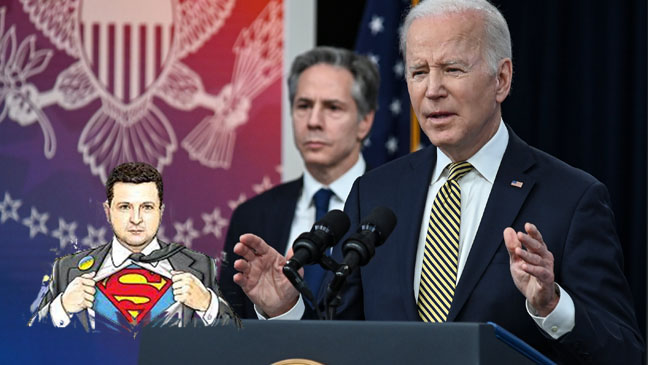
Walt Zlotow, West Suburban Peace Coalition, Glen Ellyn IL 2 Jan 25
On Monday, President Biden released another $6 billion in precious US treasure to keep his proxy war against Russia killing Ukrainians till Trump arrives January 20.
Here’s what $6 billion will provide the decimated Ukrainian army being systematically destroyed in a war provoked and prolonged by President Biden
· Munitions for National Advanced Surface-to-Air Missile Systems (NASAMS)
· HAWK air defense munitions
· Stinger missiles
· Counter-Unmanned Aerial Systems (c-UAS) munitions
· Ammunition for High Mobility Artillery Rocket Systems
(HIMARS)
· 155mm and 105mm artillery ammunition
· Air-to-ground munitions
· High-speed Anti-radiation missiles (HARMs)
· Unmanned Aerials Systems (UAS)
· Javelin and AT-4 anti-armor systems
· Tube-launched, Optically guided, Wire-tracked (TOW) missiles
· Small arms and ammunition and grenades
· Demolitions equipment and munitions
· Secure communications equipment
· Commercial satellite imagery services
· Medical equipment
· Clothing and individual equipment
· Spare parts, maintenance and sustainment support, ancillary, services, training, and transportation
That’s the final treasure Biden can squander because House Speaker Mike Johnson nixed his last request for another $25 billion before his thankful departure January 20.
Biden’s $175 billion in 3 years of war is all for naught as Russia is pushing remaining Ukraine forces out of the Russian province of Kursk and extending their defensive perimeter around the 4 eastern Ukraine provinces captured. None of these provinces would be in Russian control had Biden not sabotaged the peace agreement Zelensky and Putin were about to complete back in March, 2022.
Biden will leave office mired in the echo chamber of US exceptionalism and world dominance. He will no doubt praise his bloody, wasteful and failed course he plunged Ukraine to follow in his Farwell Address. While he could be worse, successor Trump has ample opportunity to end Biden’s Ukraine madness. Regarding Ukraine, Joe Biden cannot leave the presidency soon enough.
Armed with Canadian taxpayer support, AtkinsRéalis and Westinghouse are competing to export nuclear reactors. Which one will prevail?

One thing is certain: No vendor will get far without taxpayer support.
But some observers think that dwelling on the prospects of various reactor vendors entirely misses the point. Mr. Schneider said renewables, already considerably cheaper to build than nuclear plants, can now offer a steadier supply of electricity thanks to maturing battery storage technologies. In major markets such as the U.S., China and India, solar combined with storage is the cheapest option.
MATTHEW MCCLEARN, January 2, 2024, https://www.theglobeandmail.com/business/article-atkinsrealis-westinghouse-nuclear-reactors-exporting/
After a long absence, Canada is back in the business of exporting nuclear reactors.
In November, Montreal-based AtkinsRéalis Group Inc. (formerly SNC-Lavalin) announced it will participate in a four-company consortium that could resume construction of two 700-megawatt reactors at Cernavoda, Romania’s only nuclear power station. The new units, Cernavoda Units 3 and 4, would be the first Candus built anywhere since their sister, Unit 2, was completed in 2007. The deal was sealed by $3-billion in Canadian export financing, provided by the federal government and administered by Export Development Canada, a Crown corporation.
Mere weeks later, AtkinsRéalis’s Pennsylvania-based competitor, Westinghouse Electric Co., announced it had a “letter of interest” from EDC for just over $2-billion in financing to build three of its AP1000 reactors at what would be Poland’s first nuclear power plant. Westinghouse is now under Canadian ownership – just over a year ago it was purchased by Brookfield Asset Management and Cameco Corp.
These announcements represent notable victories for Western nuclear interests, which otherwise have greatly receded in importance globally in recent decades. Russian dominance has been near-total: According to Mycle Schneider Consulting’s annual report on the state of the nuclear industry, Russia is constructing 20 reactors abroad, including in China, Egypt, India and Turkey. Mr. Schneider said the only other international vendor is Électricité de France SA, which is building two reactors in Britain. Canada isnot even in the running because it hasn’t built a reactor in so long.
But Russia’s invasion of Ukraine, and growing concerns around its use of its energy clout to achieve geopolitical ends, has raised discomfort. This at a moment when nuclear power plants are again being considered worldwide. Suddenly, Western reactor vendors smell opportunity – and they’re scrambling to win contracts, recruit from the same limited pool of partners and suppliers, and secure the government loans that are crucial to these projects.
Home-court advantage
AtkinsRéalis is a large international engineering firm; last year its nuclear division accounted for 12per cent of its revenues. That division is growing rapidly, however, and now employs about 4,000 people, up from 3,000 in 2022. Much of its recent hiring is in preparation for anticipated new reactor sales, in Canada and abroad.
Cernavoda exemplifies the nuclear industry’s meandering fortunes. Conceived during the long reign of Communist dictator Nicolae Ceaușescu, it was built in fits and starts. The earliest design and procurement contracts for the first reactor were signed in 1978; within a decade, five Candu 6 reactors were under construction. But the first wasn’t even half-complete by the time of the Romanian revolution, in December, 1989, during which Mr. Ceaușescu was deposed and executed. Only two units were completed after lengthy delays. They now supply about 20 per cent of Romania’s electricity.
Units 3 and 4 are to be Enhanced Candu 6s, updated versions of the originals. During the initial phase, AtkinsRéalis will provide design, engineering and procurement services, and handle relations with the country’s nuclear regulator. The company said this work will earn revenues of $224-million. The other partners include the nuclear division of Italy’s Ansaldo Energia SpA, Texas-based engineering and construction firm Fluor Corp., and Sargent & Lundy, an architect engineering firm. The customer is Nuclearelectica, Romania’s nuclear power utility, which must ultimately decide whether to proceed with the rest of the €3.2-billion ($4.7-billion) project.
Joe St. Julian, president of AtkinsRéalis’s nuclear division, sees this as just the beginning.
He expects 1,000 new reactors will be built worldwide over the next 25 years, at a cost of up to US$15-billion each. As many as 100 could be Candus, he predicts. His reasoning is that 35 of the approximately 600 reactors built to date worldwide were Candus, about 5 per cent.
“In the next round, we’ll call it round two, we should be able to get more than 5 per cent, maybe as much as 10 per cent,” he said.
The Candu’s most important advantage, he contends, is that it runs on natural uranium. Most reactors require enriched uranium, which is expensive to produce, and Russia dominates international nuclear fuel supply chains. This does seem to have influenced Romania, where wariness over reliance on Russian nuclear technology dates back to Mr. Ceaușescu’s time.
Another advantage might be AtkinsRéalis’s relationships with the rest of the Canadian nuclear industry. This year, several other companies havejoined AtkinsRéalis’s Canadians for CANDU campaign, including nuclear industry giants such as BWX Technologies Inc. and Aecon Group Inc. Earlier this month, AtkinsRéalis boasted that its Canadian subsidiary, Candu Energy Inc., had issued more than $1-billion in orders across its supply chain. Unifor, a large private-sector trade unionthat represents many workers in the nuclear industry, recently issued an open letter calling on the Ontario government to prioritize the Candu.
But there’s a problem.
Reactors have trended ever-larger since the dawn of the nuclear age, and the average output of new ones is about 1,000 megawatts. AtkinsRéalis largely stayed out of the risky business of reactor development, a decision that anemic global reactor sales long seemed to vindicate. But now, as governments and utilities consider building large new reactors to meet surging power demand, AtkinsRéalis lacks a modern, large model to offer them.
So, last year it proposed the Monark, which at 1,000 megawatts would be the largest-ever Candu. The company plans to spend $50-million to $70-million annually to complete the design by the end of 2026 and has 250 employees working on it.
Mr. St. Julian said the Monark’s success depends entirely on selling it in Canada first, to utilities such as Bruce Power and Ontario Power Generation, which are in the early planning stages for potential new power plants in Ontario.
“If we cannot sell a Candu Monark in Canada, there is no export strategy,” he said.
Contenders
But gone are the days when Candus enjoyed exclusivity at home. Key legacy customers have already defected: OPG, which owns more Candus than any other utility, selected an American light water reactor for its next power plant in Ontario, Darlington B. It plans to construct four BWRX-300s from America’s GE Hitachi Nuclear Energy – a model the Ontario government is actively marketing in Eastern Europe, according to Stephen Lecce, its Energy Minister.
In the large reactor market, Westinghouse aims to steal the Candu’s lunch. Westinghouse has opened an office in Kitchener, Ont., and now employs 270 people in Canada. It’s courting many suppliers that are members of AtkinsRéalis’s Canadians for CANDU campaign, including BWX Technologies and Aecon, both of which entered agreements in December to work on AP1000 projects in Canada and worldwide.
“The not-so-secret secret is that we help them participate in the export markets to build up the diversification and strength in the Westinghouse technologies, and then we deliver here at home, domestically,” said John Gorman, president of Westinghouse Canada, who joined the company last month.
In Poland, Westinghouse markets itself as a “gold standard American” company. But Mr. Gorman emphasizes its Canadian ownership. “Let’s use our Canadian ownership, let’s use this very strong Canadian supply chain, to help service those export markets, to diversify our supply chain here at home,” he said.
Mr. Gorman is careful not to directly diss the Candu. (He previously served for six years as head of the Canadian Nuclear Association, the industry’s trade association.) AtkinsRéalis has the “ambition” to design a new reactor, he says, “that will be modern and be up to today’s requirements” – a quest he encourages.
But the AP1000, he notes, is “not only developed, but proven and recently being built out in multiple jurisdictions.” Two AP1000s have already been licensed and constructed in the United States. (Those reactors, at the Vogtle site in Georgia, were tremendously over-budget and behind schedule, which led to Westinghouse’s bankruptcy and its acquisition by Brookfield and Cameco.) Another four AP1000s have been built in China; eight are under construction worldwide, and more are under consideration in Europe, Britain and India, according to Westinghouse.
It’s a considerable head start, albeit one purchased at great expense.
Mr. St. Julian says he isn’t worried. He said the most important purchase consideration will be the levelized cost of electricity that reactors produce.
“Can we produce a megawatt hour of electricity at a lower cost than the AP1000? We absolutely believe we can.”
Watch your wallet
But some observers think that dwelling on the prospects of various reactor vendors entirely misses the point. Mr. Schneider said renewables, already considerably cheaper to build than nuclear plants, can now offer a steadier supply of electricity thanks to maturing battery storage technologies. In major markets such as the U.S., China and India, solar combined with storage is the cheapest option.
One thing is certain: No vendor will get far without taxpayer support.
Foreign reactor sales are invariably accompanied by generous and highly opaque government subsidies. Global Affairs Canada says the loan for the Cernavoda project is still being negotiated, but terms and conditions are considered “commercially confidential” and will never be disclosed. EDC wasn’t any more forthcoming about its proposed $2-billion loan in favour of Westinghouse.
“As per our Transparency and Disclosure policy, we cannot comment on prospective transactions or anything beyond what we’ve provided already and what the company announced,” wrote spokesperson Anil Handa in an e-mailed response to questions.
Biden Administration Announces Nearly $6 Billion in New Ukraine Aid

ANTIWAR.com, Dave DeCamp, 31 Dec 24
Ukraine is receiving about $2.5 billion in military aid and $3.4 billion in ‘budget support,’ which funds government salaries and servicesby Dave DeCamp December 30, 2024.
The Biden administration on Monday announced nearly $6 billion in new aid for Ukraine as it’s determined to escalate the proxy war as much as possible before President-elect Donald Trump is inaugurated on January 20, 2025.
The aid includes $3.4 billion in “direct budget support,” a form of assistance meant to pay for Ukrainian government services, salaries, pensions, and other types of spending. It has also been used to subsidize Ukrainian small businesses and farmers.……………………….
Ukraine is also receiving nearly $2.5 billion in military aid from the US, which includes $1.22 billion from the Ukraine Security Assistance Initiative, a program that allows the US to purchase weapons for Ukraine. The remaining military aid is in the form of the Presidential Drawdown Authority, which enables President Biden to ship weapons directly from US military stockpiles.
The Biden administration is dumping more weapons into Ukraine even though there’s no path to a Ukrainian victory on the battlefield as Russian forces continue to make gains in the Donbas and Ukraine’s invading force in Kursk is being pushed out. Biden officials are determined to keep the war going and are even pressuring Ukraine to begin conscripting 18-year-olds.
According to the Pentagon, the new military aid includes:
Spare parts, maintenance and sustainment support, ancillary equipment, services, training, and transportation
Munitions for National Advanced Surface-to-Air Missile Systems (NASAMS)
HAWK air defense munitions
Stinger missiles
Counter-Unmanned Aerial Systems (c-UAS) munitions
Ammunition for High Mobility Artillery Rocket Systems (HIMARS)
155mm and 105mm artillery ammunition
Air-to-ground munitions
High-speed Anti-radiation missiles (HARMs)
Unmanned Aerials Systems (UAS)
Javelin and AT-4 anti-armor systems
Tube-launched, Optically guided, Wire-tracked (TOW) missiles
Small arms and ammunition and grenades
Demolitions equipment and munitions
Secure communications equipment
Commercial satellite imagery services
Medical equipment
Clothing and individual equipment
In recent months, President Biden signed off on several significant escalations in the proxy war, including supporting long-range strikes on Russian territory and the provision of widely banned anti-personnel mines to Ukraine.
Biden asked Congress for an additional $24 billion to spend on Ukraine, but the request was rejected by House Speaker Mike Johnson (R-LA), who said any decisions on Ukraine aid would be up to Trump. https://news.antiwar.com/2024/12/30/biden-administration-announces-nearly-6-billion-in-new-ukraine-aid/
Is it realistic for Donald Trump to boast of a quick peace deal for Ukraine ?
AIMN Editorial, https://theaimn.net/is-it-realistic-for-donald-trump-to-boast-of-a-quick-peace-deal-for-ukraine/ 2 Jan 25
Donald Trump has made so many promises on what he will quickly achieve once he takes office as President. The one about ending the Ukraine war in 24 hours probably gained him support from quite a few normally left-leaning people, who understand that the history of this conflict is far more complicated than is portrayed by the Western media.
However, Trump made that statement in July 2023. By 2025, he has somewhat moderated that particular promise. He has had several conversations with Ukraine’s President Zelensky, . Zelensky praised their Paris meeting on 7 December as “productive and meaningful”, but there were no details discussed. Later, Trump opposed the sending of long-range missiles for Ukraine , but said he would not “abandon” Ukraine. He predicted “less aid” to Ukraine https://www.youtube.com/watch?v=E-R7Gi-uLiY. BY 21st December, it was reported that Trump would continue to supply military aid to Ukraine, provided that NATO members dramatically increase their defence spending.
So, peace in Ukraine is not going to happen in such a hurry, even with President Trump and his supposed great negotiating skills. Britain considers sending troops to Ukraine to train Ukrainian regiments. NATO is not prepared for any compromises, especially about giving up the plan for Ukraine’s NATO membership. With any peace deal, the Western allies agree with Zelensky – “Security guarantees without the US are not sufficient for Ukraine.”
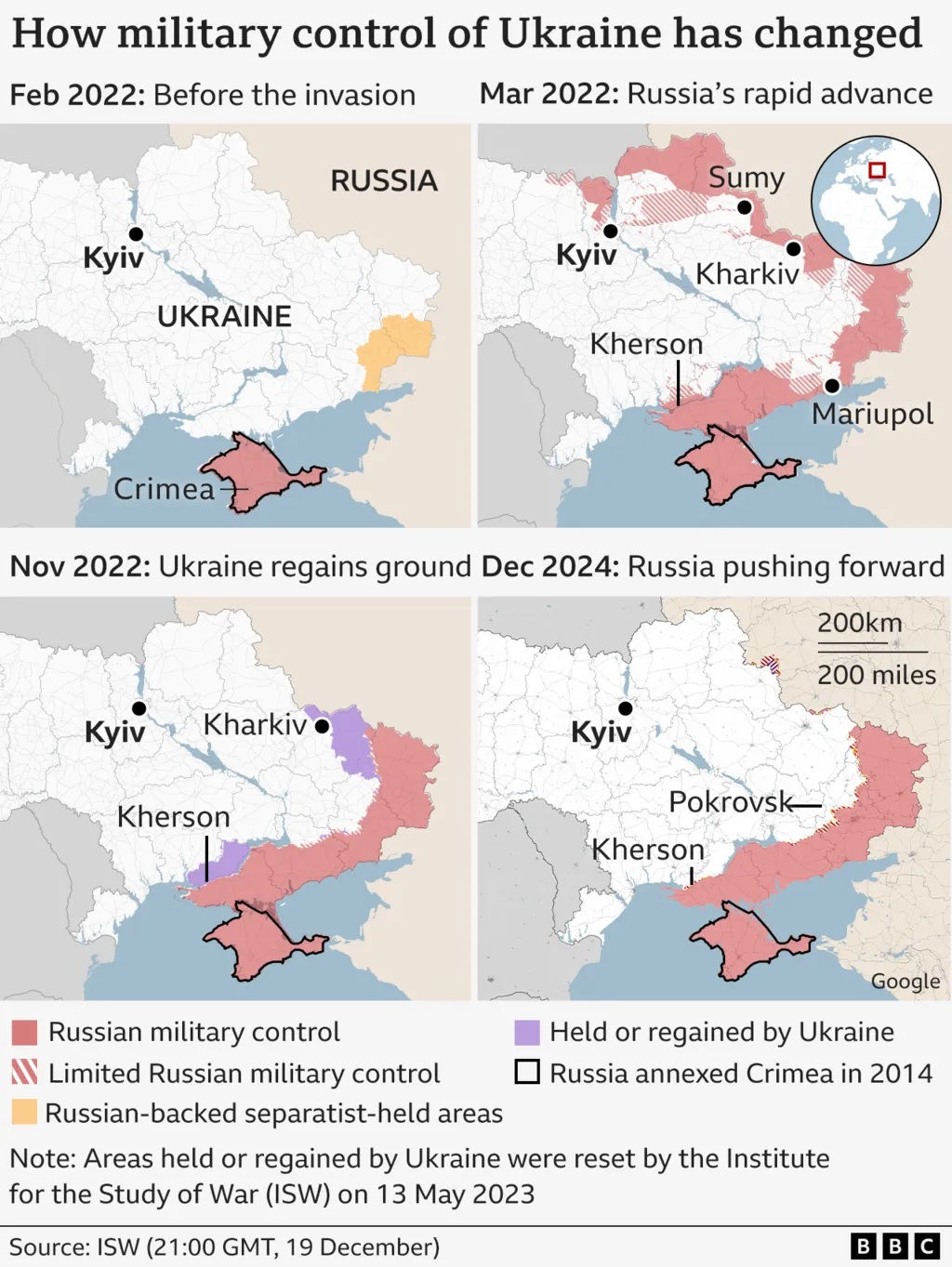
As well as European reluctance to a peace deal, there is the Russian point of view. Despite many set-backs, and a catastrophic loss of soldiers’ lives, Russia is now headed towards winning this war. Why make a deal now, before being in a more powerful position for demanding concessions?
Then we come to the USA. However much Donald Trump might want to end the carnage, and be seen as the peace hero, he is up against significant forces at home – making up what he calls the Deep State. This is a conspiracy theory that helped Trump to gain popularity – and I hate to agree with it, in its rather paranoid theme. BUT, war enthusiasts do exist – among the, military, intelligence, government officials, and wealthy industrialists, and they do exercise influence, and pressure politicians of both parties, to manipulate America’s defense policies. The war in Ukraine continues to be profitable to America’s weapons industries, and at no cost to American lives.
In the whole saga of the war in Ukraine, history has been forgotten. Of course Ukrainian-Russian relations have been tortuous and often terrible. In modern history it goes back to the 1930s, with Stalin’s starvation and genocide of Ukrainians. Then, following oppression from Russia, came in 1941, the short-lived moment of “liberation” by the German Nazis. That brought mass killings of Jews, slave labour, wholesale destruction, and the loss of up to 7 million lives. Russian control over Ukraine returned in 1944, and while the economy was restored, Stalin’s totalitarian rule was back again. In 1991 Ukraine gained independence from Russia.
Is it any wonder that Ukraine, with both Russian and Ukrainian languages still in common use, has been divided in attitudes and loyalties? Going even further back in history, Catherine the Great of Russia, in the 18th Century, made Kiev become Europe’s centre of art and culture, as well as making improvements in health, education, legal rights for Jews, improved conditions for serfs. Sure, she was an absolute monarch, – miles away from being democratic. Now her name and her statues are trashed in Kiev, which is a pity.
From 2014 to 2022, the Ukrainian government waged a war against the separatists in the Eastern, Donbass region. The war was about the 2014-2015 Minsk agreements which meant that the Donbass should have its autonomous government within Ukraine. Volodymyr Zelensky was elected on a platform that he would implement those agreements, but later he reneged on this promise. Russia’s President Putin in 2022 started what he called “a special military exercise” to support the separatists and uphold the Minsk agreement. That turned into the full-scale war against Ukraine.
European and USA support for Ukraine developed into a campaign, at enormous cost, to weaken Russia. The phrase “too big to fail” is used to describe financial crises. But it could apply to the Russia-Ukraine war. From the Western perspective the war is seen as a battle between good and evil – the evil giant Putin against the heroic little Zelensky. With NATO, with most European countries lined up against Russia, it is world democracy to be desperately defended, For Russia, it now is to prevent that last big nation on its border joining that threatening USA-armed line-up.
It was a mistake that Russia started a ‘special military enterprise’ -to evolve into a full-scale war. Some argue that by encouraging Zelensky to reneg on the Minsk agreement, the Western nations provoked the war.
Whatever started the war, the majority of Ukrainians, and especially those in the East, now just want it to end. The prevailing cry of Western leaders – “Putin must fail, Ukraine must prevail” expresses that simplistic view of good versus evil, and just ignores the complicated historic and local concerns of Eastern Ukraine. Diplomacy is jettisoned. As one writer puts it – voices calling for pragmatism and peace remain drowned out by the cacophony of war rhetoric.
Ultimately , every war ends in some sort of a diplomatic outcome. It is doubtful that Trump can make this one end quickly. It might be just one of the promises that he has to give up.
Japan, US to communicate on possible use of nuclear weapons
Establishing such an operational framework is aimed at strengthening the U.S. nuclear umbrella that protects Japan and enhancing its deterrence capabilities against North Korea and China.
Asia News Network, December 30, 2024
TOKYO – Japan and the United States will communicate regarding Washington’s possible use of nuclear weapons in the event of a contingency, the two governments have stipulated in their first-ever guidelines for so-called extended deterrence, The Yomiuri Shimbun has learned.
According to Japanese government sources, Japan will convey its requests to the United States via the Alliance Coordination Mechanism (ACM), through which the Self-Defense Forces and U.S. forces maintain contact with each other.
Establishing such an operational framework is aimed at strengthening the U.S. nuclear umbrella that protects Japan and enhancing its deterrence capabilities against North Korea and China.
Against North Korea, China
The Foreign Ministry announced the formulation of the guidelines Friday but had not disclosed the details, as they contain classified military intelligence.
The U.S. president, who is also the commander in chief of U.S. forces, has the sole authority to authorize a nuclear attack. Before the completion of the guidelines, no written statement existed that said Japan was allowed to pass on its views to the United States regarding Washington’s possible use of nuclear weapons.
Extended deterrence is a security policy aimed at preventing a third country from attacking an ally by demonstrating a commitment to retaliate not only in the event of an armed attack on one’s own country, but also in the event of an attack on an ally.
Responding to North Korea’s nuclear development program and China’s military buildup, the Japanese and U.S. governments in 2010 began holding working-level consultations in which their foreign and defense officials meet regularly to discuss nuclear deterrence and other issues. Japan has expressed its stance on the use of nuclear weapons in the meetings.
The two countries will exchange views on Washington’s use of nuclear weapons also in the framework of the ACM, which was set up in normal times under the revised Guidelines for Japan-U.S. Defense Cooperation in 2015.
Under the ACM, discussions are designed to take place both by the Alliance Coordination Group, comprising director general-level officials of the diplomatic and defense authorities, and by the Bilateral Operations Coordination Center, involving senior officials of the SDF and U.S. forces. If necessary, high-level discussions involving Cabinet members are also expected to be held.
This system will enable Japan to convey its views to the United States on Washington’s potential use of nuclear weapons at all stages, from normal times to contingencies………………. https://asianews.network/japan-us-to-communicate-on-possible-use-of-nuclear-weapons/
Departing Air Force Secretary Will Leave Space Weaponry as a Legacy

msn, by Eric Lipton, 30 Dec 24
WASHINGTON — Weapons in space. Fighter jets powered by artificial intelligence.
As the Biden administration comes to a close, one of its legacies will be kicking off the transformation of the nearly 80-year-old U.S. Air Force under the orchestration of its secretary, Frank Kendall.
When he leaves office in January — after more than five decades at the Defense Department and as a military contractor, including nearly four years as Air Force secretary — Mr. Kendall, 75, will have set the stage for a transition that is not only changing how the Air Force is organized but how global wars will be fought.
One of the biggest elements of this shift is the move by the United States to prepare for potential space conflict with Russia, China or some other nation.
In a way, space has been a military zone since the Germans first reached it in 1944 with their V2 rockets that left the earth’s atmosphere before they rained down on London, causing hundreds of deaths. Now, at Mr. Kendall’s direction, the United States is preparing to take that concept to a new level by deploying space-based weapons that can disable or disrupt the growing fleet of Chinese or Russian military satellites………………………
Perhaps of equal significance is the Air Force’s shift under Mr. Kendall to rapidly acquire a new type of fighter jet: a missile-carrying robot that in some cases could make kill decisions without human approval of each individual strike.
In short, artificial-intelligence-enhanced fighter jets and space-based warfare are not just ideas in some science fiction movie. Before the end of this decade, both are slated to be an operational part of the Air Force because of choices Mr. Kendall made or helped accelerate.
The Pentagon is the largest bureaucracy in the world. But Mr. Kendall has shown, more than most of its senior officials, that it too can be forced to innovate.
“It is big,” said Richard Hallion, a military historian and retired senior Pentagon adviser, describing the change underway at the Air Force. “We have seen the maturation of a diffuse group of technologies that, taken together, have forced a transformation of the American military structure.”
Mr. Kendall is an unusual figure to be the top civilian executive at the Air Force, a job he was appointed to by President Biden in 2021, overseeing a $215 billion budget and 700,000 employees…………….
Mr. Kendall, who has a folksy demeanor more like a college professor than a top military leader, comes at the job in a way that recalls his graduate training as an engineer.
He gets fixated on both the mechanics and the design process of the military systems his teams are building at a cost of billions of dollars. Mr. Kendall and Gen. David Allvin, the department’s top uniformed officer, have called this effort “optimizing the Air Force for great power competition.”………………….
Mr. Kendall has taken these innovations — built out during earlier waves of change at the Air Force — and amped up the focus on autonomy even more through a program called Collaborative Combat Aircraft.
These new missile-carrying robot drones will rely on A.I.-enhanced software that not only allows them to fly on their own but to independently make certain vital mission decisions, such as what route to fly or how best to identify and attack enemy targets.
The plan is to have three or four of these robot drones fly as part of a team run by a human-piloted fighter jet, allowing the less expensive drone to take greater risks, such as flying ahead to attack enemy missile defense systems before Navy ships or piloted aircraft join the assault.
Mr. Kendall, in an earlier interview with The Times, said this kind of device would require society to more broadly accept that individual kill decisions will increasingly be made by robots……………….
These new collaborative combat aircraft — which will cost as much as about $25 million each, compared to the approximately $80 million price for a manned F-35 fighter jet — are being built for the Air Force by two sets of vendors. One group is assembling the first of these new jets while a second is creating the software that allows them to fly autonomously and make key mission decisions on their own.
This is also a major departure for the Air Force, which usually relies on a single prime contractor to do both, and a sign of just how important the software is — the brain that will effectively fly these robotic fighter jets………………………………………
Space is now a fighting zone, Mr. Kendall acknowledged, like the oceans of the earth or battlefields on the ground.
The United States, Russia and China each tested sending missiles into space to destroy satellites starting decades ago, although the United States has since disavowed this kind of weapon because of the destructive debris fields it creates in orbit.
So during his tenure, the Air Force started to build out a suite of what Mr. Kendall called “low-debris-causing weapons” that will be able to disrupt or disable Chinese or other enemy satellites, the first of which is expected to be operational by 2026.
Mr. Kendall and Gen. Chance Saltzman, the chief of Space Operations, would not specify how these American systems will work. But other former Pentagon officials have said they likely will include electronic jamming, cyberattacks, lasers, high-powered microwave systems or even U.S. satellites that can grab or move enemy satellites.
The Space Force, over the last three years, has also been rapidly building out its own new network of low-earth-orbit satellites to make the military gear in space much harder to disable, as there will be hundreds of cheaper, smaller satellites, instead of a few very vulnerable targets.
Mr. Kendall said when he first came into office, there was an understandable aversion to weaponizing space, but that now the debate about “the sanctity or purity of space” is effectively over.
“Space is a vacuum that surrounds Earth,” Mr. Kendall said. “It’s a place that can be used for military advantage and it is being used for that. We can’t just ignore that on some obscure, esoteric principle that says we shouldn’t put weapons in space and maintain it. That’s not logical for me. Not logical at all. The threat is there. It’s a domain we have to be competitive in.” https://www.msn.com/en-us/news/politics/departing-air-force-secretary-will-leave-space-weaponry-as-a-legacy/ar-AA1wE4iS
The Time Navy Lt. Jimmy Carter Was Lowered Into A Partially Melted-Down Nuclear Reactor
The recently deceased 39th president had a hand in the dawn of the nuclear submarine age, including one especially dangerous mission.
The War Zone, Geoff Ziezulewicz, 30 Dec 24
resident Jimmy Carter’s time as a U.S. Navy officer might have been brief, but it served to inform the rest of his days before passing away Sunday at the age of 100. Prior to his political career and Nobel Prize-winning peacemaking efforts, Carter stood at the side of the father of the nuclear Navy during its infancy, and even got lowered into a melted-down nuclear reactor as a junior officer. Decades later, the former president was stunned to learn of the capabilities carried by the secretive spy submarine that bears his name to this day.
Ensign James Earl “Jimmy” Carter graduated from the U.S. Naval Academy in 1946, and applied to join the Navy’s nuclear submarine community a few years later, according to the Navy…………………………………………………………………………………………………………………………….
After Carter joined the Navy’s nuclear efforts, the 28-year-old and his crew were sent to repair the Chalk Water nuclear reactor near Ottawa, Canada, in late 1952. The reactor had suffered a partial meltdown, and a team was needed to shut it down, take it apart and replace it. Carter and the rest of the team took a train up north and soon got to work.
“They built an identical replica of the reactor on an adjacent tennis court to precisely run through the repair procedures, due to the maximum time humans could be exposed to the levels of radiation present in the damaged area,” a Navy history recounts. “Each member of the 22 member team could only be lowered into the reactor for 90-second periods to clean up and repair the site.”
Official accounts don’t clarify whether Carter was in command during the mission, or his precise role. Still, the future president did his part, Canadian journalist Arthur Milnes later recounted.
“He was lowered into the building … with his wrench, and he had to run over to the reactor casing and he had one screw to turn,” Milnes said after interviewing Carter about the incident. “That was all the time he had. And then, boom, back up.”
Carter and the others were regularly tested after the mission was finished to look for long-term health effects.
“They let us [crew members] get probably a thousand times more radiation than they would now.” Carter told CNN in 2008 while reflecting on the incident. “We were fairly well-instructed then on what nuclear power was, but for about six months after that, I had radioactivity in my urine.”
In his autobiography, “A Full Life, Reflections at Ninety,” Carter recounted the distinctive perils of being a submarine officer:
“Although some enlisted men could concentrate almost exclusively on their own fields of responsibility as engine men, electricians, torpedo experts, boatswains, quartermasters, gunners or operators of navigation and fire control equipment, every officer was expected to master all of these disciplines…we knew one mistake could endanger everyone aboard.”…………………………………………………………………………
Carter lived an extraordinary life, by all accounts. His time in the submarine community played a critical role in all that came after, and he remained a Navy man until the end.
You and I leave here today to do our common duty—protecting our Nation’s vital interests by peaceful means if possible, by resolute action if necessary,” Carter told the graduating class of Naval Academy midshipmen in 1978. “We go forth sobered by these responsibilities, but confident of our strength. We go forth knowing that our Nation’s goals—peace, security, liberty for ourselves and for others—will determine our future and that we together can prevail.”
RIP President Jimmy Carter, 1924-2024, https://www.twz.com/sea/the-time-navy-lt-jimmy-carter-was-lowered-into-a-partially-melted-down-nuclear-reactor
Nuclear power had a strong year in 2024, but uncertainty looms for 2025
Though companies are touting aggressive timelines, no decommissioned reactor has ever been restarted in the United States, and there is no regulatory framework for the process.
From VC funding to planned reactor restarts, the U.S. nuclear industry notched wins this year. But the winning streak could end if Trump revokes government support.
By Eric Wesoff, 30 December 2024, more https://www.canarymedia.com/articles/nuclear/nuclear-power-had-a-strong-year-in-2024-but-uncertainty-looms-for-2025
2024 was a breakout year for the U.S. nuclear power sector — at least on paper.
There’s more government, industry, and civilian support for nuclear energy than there has been in decades. There aren’t enough retired nuclear plants to keep up with the newfound desire to plug mothballed facilities back into the grid. Advanced reactor companies continue to raise a lot of money, both private and public. Congress managed to pass a bipartisan law to support domestic nuclear development.
But this ostensible U.S. nuclear renaissance will come to a screeching halt without continued federal support, especially from two of the Biden administration’s marquee policies, the Inflation Reduction Act and the bipartisan infrastructure law. While the first Trump administration funded billion-dollar nuclear demonstration programs and loans, it’s the Biden-era programs that have been pumping the most funding into the nuclear industry — and that are most at risk when Donald Trump takes office next year.
So, at the end of this momentous year for nuclear, the industry is left not only with some wins but also with some major questions. Let’s review.
The big question: What will Trump do on nuclear?
So far, Trump has been sending mixed signals about nuclear power policy, and no one in government, in industry, or on the social network formerly known as Twitter can yet divine his true leanings.
The first Trump administration provided crucial billions in loan guarantees to complete construction of Plant Vogtle Units 3 and 4 in Georgia. Trump signed the Nuclear Energy Innovation and Modernization Act, which opened up a new technology-agnostic advanced reactor licensing pathway, expected to be finalized by the Nuclear Regulatory Commission by 2027. He also oversaw the Department of Energy’s launch of the Advanced Reactor Demonstration Program.
But Trump has pledged to repeal the IRA tax credits for lower-carbon energy sources, which could potentially include funding for existing reactors and new advanced reactors. It’s very possible that the second Trump administration won’t continue the Biden administration’s “massive appropriations” to the nuclear sector, John Starkey, director of public policy at the American Nuclear Society, told Utility Dive.
Searching for clarity, we are compelled to cite a recent Joe Rogan podcast, where the president-elect expressed some doubt about large nuclear projects like Vogtle, which he said “get too big and too complex and too expensive.”
But a few months earlier, Trump vowed, “Starting on day one, I will approve new drilling, new pipelines, new refineries, new power plants, new reactors.”
The bottom line is that without federal tax credits — or other government support as a backstop in the likely event of cost overruns — utilities and utility commissions won’t proceed with new reactor construction during the second Trump term, regardless of the memorandums of understanding and letters of intent now being signed.
A win: Vogtle 4 online in 2024
The nuclear industry will take its wins where it can get them, even when they’re expensive and bruising — a description that fits the finally completed buildout of Georgia’s Vogtle nuclear facility. After years of delays and billions in cost overruns, the Vogtle Unit 3 reactor entered commercial operation on July 31 of last year and the fourth and final unit came online on April 29, 2024.
These reactors are the first newly constructed nuclear units built in the U.S. in more than three decades and the first U.S. deployment of the Westinghouse AP1000 Generation III+ reactor design.
With these AP1000 projects complete, America now has familiarity with a modern reactor design and a trained workforce that knows how to build these reactors. There are plenty of potential places to build similar power plants — the NRC has approved licenses or is considering applications for new reactors at 17 sites across the U.S.
A small win: Advancing a nuclear pledge at COP29
At last year’s United Nations climate conference, COP28, the U.S. and two dozen other countries signed a pledge to triple nuclear power capacity by 2050.
We saw a tad more progress at this year’s conference, COP29, in Baku, Azerbaijan, as six additional countries signed onto that pledge. And the Biden administration unveiled its plan for getting the U.S. from nearly 100 gigawatts of nuclear power capacity to 300 gigawatts by mid-century, including adding 35 gigawatts by 2035, through the construction of new reactors, plant restarts, and upgrades to existing facilities.
Of course, Trump plans to pull the U.S. out of the Paris climate agreement (again), so he can’t be counted on to follow through on Biden’s pledges.
Question: Will the U.S. commit to big reactors or chase small ones?
If the U.S. were to try to meet Biden’s goal for expanding nuclear in the U.S., companies would need to place orders ASAP for many of the same model of big reactors — like, say, a bunch of AP1000s — according to the September update to the U.S. Department of Energy’s report Pathways to Commercial Liftoff: Advanced Nuclear.
The report suggests that the path to a U.S. nuclear renaissance runs not through small modular reactors (SMRs) or fusion machines, but through the iterative construction of already licensed, large-scale, light-water reactors and the development of an order book and stakeholder consortium.
This focus on large-scale reactors marks a departure from the years of conventional wisdom that SMRs are the cure for America’s nuclear malaise — a wisdom that has yet to result in a single grid-connected reactor. But many investors have not gotten the memo, hence …
A win: VCs and tech firms back small nuclear
Traditional venture capitalists and the celebrity investor class poured more than $800 million into so-called advanced nuclear this year, returning to the sector after a dip in 2023, according to Axios Pro. The investors are anticipating venture-scale returns from the imminent AI-driven demand for power.
Not all investors are aligned. Tyler Lancaster of Energize Capital tells Axios Pro Rata, “Nuclear SMRs and fusion investment will result in a massive loss of capital for venture investors and will prove to be for this generation of climate-tech what biofuels were for the last.”
Still, plenty of investors are going all-in on advanced nuclear, and they’re not alone — the hyperscaling data-center operators are as well.
Search giant Google and startup Kairos Power signed one of the first corporate agreements to develop a fleet of SMRs. The plan is to bring Kairos’ first SMR online by 2030, followed by additional reactor construction through 2035. The NRC has issued Kairos a construction permit to build a demonstration reactor, a 35-megawatt unit using a molten fluoride salt coolant and a higher-concentration uranium fuel recipe.
Amazon is planning to deploy SMRs of an as yet unlicensed design to power its data centers. It announced in October that it would commit $334 million to explore installing small gas-cooled reactors at Hanford in Washington state, a contaminated site where the federal government used to produce nuclear weapons.
And microreactor startup Oklo just announced a partnership with data-center provider Switch to develop 12 gigawatts of power from its fast breeder design
Question: Is restarting reactors the cure for data-center fever?
But the data oligarchs aren’t only interested in advanced or smaller nuclear technologies. They’re also keen on big, old-school reactors.
This was the year that the biggest players in artificial intelligence — Amazon, Google, Meta, Microsoft, and Oracle — started inking deals to tap nuclear power to keep their data centers dreaming of electric sheep. Energy usage by data centers is surging and expected to continue to rise, and most of the companies driving this demand have voluntary carbon-free energy goals that they’d prefer not to completely undermine.
The data-center hyperscalers have plans to tap existing nuclear power, develop new reactors, and even reopen shuttered reactors and plants.
Constellation Energy is planning to restart operations at its shuttered Three Mile Island Unit 1 nuclear power plant in 2028, thanks to a 20-year deal to sell Microsoft the revived reactor’s power. Constellation has already begun procurement of nuclear fuel and long-lead materials and equipment, like a $100 million power transformer, according to Reuters.
NextEra CEO John Ketchum said in July that his company continues to evaluate the possibility of reopening the 601-megawatt Duane Arnold nuclear power plant in Iowa amid interest from data-center companies, but added, “There are only a few nuclear plants that can be recommissioned in an economic way.”
The defueled Palisades nuclear plant in Michigan, while not yet contracted with a data center, is expected to be back online by the end of this year, according to Nick Culp, a spokesperson for owner and operator Holtec International.
Though companies are touting aggressive timelines, no decommissioned reactor has ever been restarted in the United States, and there is no regulatory framework for the process.
Josh Wolfe, a VC investor at Lux Capital and the rare nuclear energy advocate who has actually made venture returns in the sector thanks to Kurion, a materials treatment startup, is not convinced that the AI revolution will be nuclearized. “The tech giants who built empires on weightless bits and bytes are now grappling with atoms: steel, copper, water rights, and, critically, natural gas,” he wrote in his firm’s quarterly update. “While we’re bullish on the seeming resurgence of nuclear power, abundant natural gas from the Texas Permian seems a wiser bet.”
A win: Restarting domestic fuel enrichment
This year, the Biden administration, with the help of a cooperative Congress, took steps that will help nuclear reactors of all types and sizes. It’s working to reestablish a uranium-enrichment supply chain to fuel the existing nuclear reactor fleet as well as provide the more concentrated fuels needed by many of the advanced reactors in development.
Centrus Energy, which has a corporate lineage stretching back to the Manhattan Project, resumed centrifuge manufacturing and expanded production capacity at its Oak Ridge, Tennessee, facility in November. Centrus will also invest about $60 million to support an expansion of uranium enrichment at its plant in Piketon, Ohio.
That’s important because roughly one in 20 American homes and businesses get their power from nuclear facilities that depend on Russian uranium-enrichment services, James Krellenstein, a nuclear expert and historian, said on a recent Decouple podcast.
A portion of the enriched uranium used in the current American reactor fleet comes from Russia’s nuclear defense and materials company, Rosatom. That fraught arrangement will stay in place until the U.S. has its own domestic enrichment program.
Although the U.S. once did have massive enrichment capacity following the second World War, those capabilities were abandoned in a series of governmental and corporate missteps. Now the U.S. is beginning the long journey back to self-sufficiency.
With successful Syrian regime change, will US set sights on Iran regime change 2.0?
Walt Zlotow, West Suburban Peace Coalition, Glen Ellyn IL 30 Dec 24.
Seventy-one years ago the US and UK launched Operation AJAX, a jointly planned coup that deposed Iran’s legitimate ruler Dr. Mohammed Mosaddeq in August, 1953.
The Brits conceived the coup in 1952 and presented it to ‘Give ‘Em Hell’ Harry Truman, who told the Brits to go to Hell. A year later newbie Prez Ike greenlighted AJAX to allow Britain to grab back its Iranian oil monopoly nationalized by Mosaddeq, seeking to break free from US, UK dominance. For Ike, it was a chance to make his bones as a bonafide anti-communist, due to Mosaddeq’s unwillingness to crush Iranian leftist influence. In McCarthyite America and forever more, leftist governments posed a danger to US exceptionalism.
Leading this first official CIA coup against a foreign leader who wouldn’t do our bidding was Teddy Roosevelt’s grandson Kermit Roosevelt Jr. Our hand-picked successor was Mohammad Reza Shah Pahlavi, son of the first Pahlavi monarch Reza Shah Pahlavi. His reluctance and indecision about being summoned as the US/UK puppet almost wrecked Uncle Sam’s best laid plans. But CIA coup leader Roosevelt disobeyed orders to shut down Ajax. He had his Iranian operatives masquerading as commies shed enough blood to turn the tide against Mosaddeq. Up in Warlovers Heaven, Grandpa Teddy beamed with pride.
The Shah ruled Iran for another 26 years, with his CIA trained secret police killing thousands who dared speak out against his tyrannical rule.
The CIA, emboldened by their success, toppled the Guatemalan government a year later and were on a roll till their delusional 1961 Bay of Pigs regime change operation failed spectacularly. This led to the Cuban Missile a year later that nearly got us all vaporized in nuclear war with Russia.
Seventy-one years later the US appears bent on Iran regime change 2.0. Goaded by Israel seeking to topple its only remaining rival for Middle East dominance, the incoming Trump administration is signaling a return to a belligerent anti Iran policy.
By withdrawing from the Iran nuclear agreement in 2018, Trump freed up Iran to start up a nuclear weapons program if it felt US/Israeli pressure posed an existential threat. Current warfare in Gaza, Lebanon and the Syrian regime change makes that more likely today. Trump’s return to power, staffing his foreign policy team with anti-Iran hardliners, s increases that likelihood. That could trigger implementation of a 21st century Operation Ajax with Israel replacing the UK as Uncle Sam’s co coup plotter against Iran. More ominous than the 1953 version, this one could lead to all out war posing extreme danger to 40,000 US troops in the region.
Iran is not now and never has been America’s enemy. But senselessly imagining a nuclear program that does not exist and plotting with Israel to topple its Middle East rival is a sure way to make Iran one.
China sanctions US defense firms
https://www.rt.com/news/610080-china-sanctions-us-defense-firms/ 27 Dec 24
Beijing has placed restrictions on Washington’s military assistance to Taiwan, the foreign ministry has said.
Beijing has imposed sanctions on seven US defense companies and their executives in response to Washington’s sale of arms to Taiwan in violation of the One-China principle, the Chinese Foreign Ministry announced on Friday.
The move comes after outgoing US President Joe Biden last week authorized a $571.3 million military aid package to Taiwan.
Washington’s actions “interfere in China’s internal affairs, and undermine China’s sovereignty and territorial integrity,” the Chinese Foreign Ministry said as it announced the restrictions.
The companies targeted by the sanctions include Insitu Inc., Hudson Technologies Co., Saronic Technologies, Inc., Raytheon Canada, Raytheon Australia, Aerkomm Inc., and Oceaneering International Inc.
The ministry said “relevant senior executives” of the companies had also been blacklisted, without providing any names.
The sanctions will freeze “movable and immovable” assets belonging to US firms and their executives within China, and ban organizations and individuals in the country from trading or collaborating with them, the ministry stated.
The restrictions, which will contribute to already strained relations between Beijing and Washington, were announced after Biden approved a record $895 billion defense budget, which surpassed last year’s allocation by $9 billion.
The bill does not refer to Ukraine aid, however, it contains measures aimed at strengthening the US presence and defense capabilities in the Indo-Pacific region, primarily to “counter China.” Beijing has already condemned the bill, citing its “negative content on China” and attempts to play up the ‘China threat’ narrative.
Beijing has repeatedly stressed that it considers the self-governing island of Taiwan to be an inalienable part of the country under the One-China principle. It has denounced Washington’s arms sales to Taipei, accusing the US of fomenting tensions over Taiwan.
High tide for Holtec

The study — Model-Based Study of Near-Surface Transport in and around Cape Cod Bay, Its Seasonal Variability, and Response to Wind — found that contrary to Holtec’s claims, the wastewater would not immediately disperse into the ocean, but would linger potentially for months, and wash up on the shores of area communities.
by beyondnuclearinternational, Linda Pentz Gunter
Tritium dumped into Cape Cod Bay will wash back onto community shores, says a new report
Holtec, the company that has purchased a number of permanently closed nuclear reactors in order to decommission them, has encountered yet another obstacle to its “dilution is the solution to pollution” plans.
One of the reactor sites Holtec has taken over is Pilgrim in Plymouth, Massachusetts, on the Cape Cod Bay, which closed permanently in 2019. Holtec’s not-so-little problem there is what do with what started out as at least 1.1 million gallons of radioactively contaminated wastewater stored at the site.
The company first suggested it would simply release the wastewater into Cape Cod Bay, assuring residents and the immediately alarmed fishing community not to worry because (a) the wastewater isn’t dangerous anyway (b) everyone does this all the time at reactor sites and no one has gotten sick so far and (c) it would quickly disperse into the wider ocean. Holtec chose this disposal method for one reason alone: it is the cheapest.
The proposal was vigorously fought by citizens, the state, and powerful Massachusetts Democrat, Senator Ed Markey. The state of Massachusetts effectively banned the discharge option, a decision Holtec is contesting.
That Final Determination to Deny Application to Modify a Massachusetts Permit to Discharge Pollutants to Surface Waters was issued by the Massachusetts Department of Environmental Protection Division of Watershed Management on July 18, 2024. A month later, Holtec launched its appeal to reverse the decision, something that could take months or longer to find its way to court.
In the meantime, help has come from a new quarter in the form of an in-depth study by the prestigious Woods Hole Oceanographic Institution, also, as it happens, based on the Massachusetts shoreline, near Falmouth.
The study — Model-Based Study of Near-Surface Transport in and around Cape Cod Bay, Its Seasonal Variability, and Response to Wind — found that contrary to Holtec’s claims, the wastewater would not immediately disperse into the ocean, but would linger potentially for months, and wash up on the shores of area communities.
“We found virtually no out-of-the-Bay transport in winter and fall and slightly larger, but still low, probability of some of the plume exiting the Bay in spring and summer,” said Woods Hole study leader and physical oceanographer, Irina Rypina.
The radioactively contaminated wastewater stored at Pilgrim is contaminated with what Holtec and the Massachusetts Department of Public Health have described as “four gamma emitters —Manganese-54, Cobalt-60, Zinc-65 and Cesium-137 along with Tritium, a beta radiation emitter”.
While the Woods Hole Study did not look at the health outcomes of releasing the radioactive water into Cape Cod Bay — only at the plume pathway — there are plenty of data that demonstrate the harmful effects of these radioisotopes on human health, especially women and children…………………………………………………….. https://beyondnuclearinternational.org/2024/12/29/high-tide-for-holtec/
As construction of first small modular reactor looms, prospective buyers wait for the final tally.
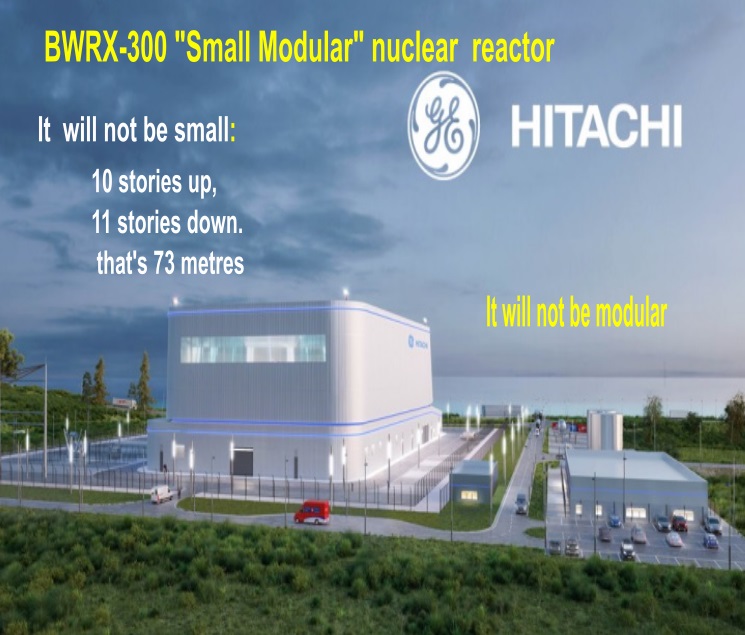
the first BWRX-300 could cost more than five times GE-Hitachi’s original target price.
emerging consensus that SMRs are not economic
“The nuclear people don’t operate in a vacuum, they operate in competition to other technologies,………… “The cost for solar is going down.”
Matthew McClearn, Dec. 27, 2024 , https://www.theglobeandmail.com/business/article-as-construction-of-first-small-modular-reactor-looms-prospective/
The race to construct Canada’s first new nuclear power reactor in 40 years seems to have passed a point of no return. This summer, Ontario Power Generation completed regrading the site for its Darlington New Nuclear Project in Clarington, Ont., and started drilling for the reactor’s retaining wall, which will be buried partly underground. At a regulatory hearing, OPG’s chief executive officer Ken Hartwick, who will retire at the end of this year, promised that this reactor will be “the first of many to come.”
But that will depend on a crucial yet-to-be-revealed detail: its price tag.
It’s no exaggeration to say that the world is waiting for it. The new Darlington reactor would be the first BWRX-300, a small modular reactor (SMR) being designed by an American vendor, GE-Hitachi Nuclear Energy, and the first SMR built in any Western country. Other prospective buyers include the Tennessee Valley Authority (TVA), SaskPower and Great British Nuclear. More BWRX-300s are in early planning stages in Poland and the Czech Republic.
Crucially, however, OPG is the first and only utility worldwide to bind itself contractually to build a BWRX-300. A report published by the U.S. Department of Energy in September said American utilities are waiting to see pricing and construction schedules for early units, and would “prefer to be fifth.” SaskPower also wants to avoid the risks associated with building a “first of a kind” reactor; it won’t decide until 2029 and it hopes SMRs will be less expensive than traditional nuclear plants.
Scheduled for release this winter, the Darlington SMR’s estimated cost will speak volumes about whether SMRs can deliver on their many promises. Yet there are early indications of serious sticker shock: Recently published estimates from the TVA suggest the first BWRX-300 could cost more than five times GE-Hitachi’s original target price. How will OPG and GE-Hitachi drive pricing far below the TVA’s estimate? And if they cannot, what then will be the prospects for SMRs?
Ditching the scaling law
SMRs were conceived as an antidote to the hefty price tags that brought reactor construction to a standstill in Western countries for decades.
Previously, the nuclear industry relied heavily on something called economies of scale or the “scaling law”: As a power plant’s size increases, capital costs also rise, but in a less than linear fashion. So vendors designed ever-larger reactors. Reactors under construction today average about one gigawatt, roughly three times the BWRX-300’s output. They can cost more than US$10-billion, leaving only the largest government-backed utilities as potential purchasers.
SMRs represent a promising but untested new approach to manufacturing reactors – one that emphasizes simplification and mass production techniques. The key term is modular: Rather than building monolithic, one-of-a-kind plants, the industry hoped instead to churn out substantially identical factory-built units; repetition would help drive down costs, as it had for competing technologies such as wind turbines and solar panels.
But modularity requires multiple orders, which in turn demands competitive pricing. Through early discussions with potential customers, GE-Hitachi executives understood the BWRX-300 had to be priced low, not only in absolute terms, but also relative to other power-generation technologies. They told audiences it would cost less than US$1-billion, or US$2,250 per kilowatt hour of power generation capacity – low enough to compete with natural gas-fired power plants.
“The total capital cost of one plant has to be less than $1-billion in order for our customer base to go up,” Christer Dahlgren, a GE-Hitachi executive, said during a talk in Helskini in March, 2019.
Shrinking a giant
GE-Hitachi’s designers began by shrinking a behemoth: the 1,500-megawatt Economic Simplified Boiling Water Reactor (ESBWR). Their objective was to reduce the volume of the building housing the reactor by 90 per cent, to greatly reduce the amount of concrete and steel required during construction.
This was accomplished primarily through eliminating safety systems. Pressure relief valves, common in traditional reactors, were removed. In place of two completely separate emergency shutdown systems, as is customary, the BWRX-300 would have two systems that would propel the same set of control rods into the reactor’s core. GE-Hitachi emphasized that the BWRX-300 featured “passive” safety systems that would keep the reactor safe during an accident, and its simplicity reduced the need for redundant engineered systems.
Sean Sexstone, head of GE-Hitachi’s advanced nuclear team, said the entire facility – which includes the reactor building, the control room and the turbine hall – will measure just 145 metres by 85 metres.
“You can walk that site in a minute-and-a-half,” he said.
GE-Hitachi also sought substitutes for concrete. The reactor building is to be constructed using factory-made steel panels that will be shipped to the site, assembled into modules and lifted by crane into position. These modules essentially serve as forms into which concrete is poured. These steel plates are as strong as concrete, OPG says, yet eliminate the need to use rebar extensively. This approach “lends itself to more modularity, more work in a factory, versus more work in the field,” Mr. Sexstone explained.
The Darlington SMR will be erected using a technique called “open-top construction.” The reactor building’s roof won’t be installed until the very last. The building will be constructed upward, floor by floor, with large components lowered in by crane rather than being moved through doors and hatches.
Many of the BWRX-300’s components would be identical to those used in previous GE power plants, such as its control rods, fuel assemblies and steam separators. Its steam turbine would be the same one used in natural-gas-fired plants. And the plant could be run by as few as 75 staff, far below the nearly 1,000 employed at large single-reactor Canadian nuclear plants.
Historically, utilities tended to build bespoke nuclear plants meeting highly individualized requirements. The result: In the United States alone there are more than 50 commercial reactor designs. Few designs were built twice, limiting opportunities to learn through repetition.
GE-Hitachi intended the BWRX-300 to be highly standardized, constructible in multiple countries with as few tweaks as possible. It assembled an international coterie of utility partners, including OPG, the TVA and a Polish company named Synthos Green Energy, which last year agreed to jointly contribute to the estimated US$400-million cost of the SMR’s standardized design.
Subo Sinnathamby, OPG’s chief projects officer, acknowledged in an interview that the first SMR will be expensive. But lessons learned from building it, including newly identified opportunities for additional modularization, will be applied to three subsequent units at Darlington, bringing down overall costs.
“For us, success is going to be sticking to how we have executed megaprojects at OPG, using the same processes and principles,” she said, citing the continuing refurbishment of Darlington’s existing reactors.
“The last thing we want to do is get into construction and then stop the work force.”
GE-Hitachi’s emphasis on lowering plant costs has been validated by many independent observers, who regard it as essential to SMRs’ future prospects.
In a report published in May, Clean Prosperity, a climate policy think tank, concluded that the BWRX-300 “is the strongest candidate” among SMRs to experience continued cost reductions as more were built – but only at the right price, which it pegged at about $3.3-billion. “Cost curves will only become possible for the BWRX-300 in Ontario and beyond,” it warned, “with a final price tag that is low enough to compel additional expansion.”
In September, the U.S. Department of Energy published a report examining the prospects for widespread deployment of reactors across the U.S., an expansion it strongly supported. But to drive down costs, SMR vendors needed to move more than half of the overall spending on a project into standardized factory-like production – a tall order.
Similarly, a report published last year by the U.S. National Academy of Sciences argued that if nuclear plants are to contribute meaningfully to future electricity systems, they must be cost-competitive with other low-emission technologies. It looked at so-called overnight capital costs – what costs would be if construction were completed overnight, with no charges for financing and no consideration of how long it will last. The academy said capital costs should be US$2,000 or less per kilowatt of generating capacity. At between US$4,000 and US$6,000 a kilowatt, reactors might still be competitive if costs unexpectedly rose for renewable technologies.
Enter the TVA.
In an integrated resource plan published in September, the TVA estimated that a first light water SMR would have an overnight capital cost of nearly US$18,000 a kilowatt.
At that pricing, the first Darlington SMR would cost more than $8-billion. That’s about 10 times the cost of a similarly sized natural-gas-fired plant: SaskPower’s recently completed Great Plains Power Station, a 377 MW natural-gas-fired plant in Moose Jaw, cost just $825-million.

Oregon-based NuScale Power Corp. has already discovered what happens when pricing falls in this range. Founded in 2007, its 77-MW NuScale Power Module was the first SMR to be licensed by regulators in a Western country. But last year its flagship project, undertaken with the Utah Association of Municipal Power Systems (UAMPS), was cancelled after cost soared to about US$20,000 a kilowatt.
There are several important caveats about the TVA’s estimate.
Greg Boerschig, a TVA vice-president, described it as a “Class 5″ estimate. According to standard global practices, cost estimation is based on a five-level system. Class 5 is the least detailed and reliable and is intended for planning purposes; actual costs could be half that much, or double.
The estimate is far higher than the TVA would have liked, Mr. Boerschig said. But since OPG is further along in deploying the BWRX-300, he added, it has a better sense of the reactor’s cost.
“We’re a couple of years behind them,” Mr. Boerschig acknowledged.
Indeed, according to a presentation by Aecon Group Inc., a partner on the Darlington SMR, a Class 4 estimate had already been completed as of February this year. Ms. Sinnathamby said OPG is working on a Class 3 estimate.
“Our number is going to be very specific: What is it going to cost us to build, on this location, these four SMRs?” she said.
Another caveat is that the BWRX-300 was only one of several reactors represented in the estimate, which was based on the TVA’s experience exploring potential SMRs at its Clinch River site near Oak Ridge, Tenn., and by examining recently completed nuclear construction projects.
OPG might enjoy certain cost advantages over the TVA. The Darlington Nuclear Generating Station is a complex that was built during the 1980s and early 1990s on the shore of Lake Ontario, the proximity of which could make cooling reactors there cheaper. Clinch River is a greenfield site, whereas Darlington already has four operating reactors.
“That will automatically reduce the cost to OPG relative to TVA,” said Koroush Shirvan, a professor of energy studies at the Massachusetts Institute of Technology, who has studied the BWRX-300’s economics.
Nonetheless, opponents and skeptics of SMRs in general, and the Darlington SMR in particular, have embraced TVA’s estimate.
Chris Keefer, an emergency medicine physician, has advocated passionately for refurbishment of Ontario’s existing nuclear power plants, which are all based on Canada’s homegrown reactor design, the Candu. He has also argued for modernizing the Candu design and building more. He said the TVA’s estimates reflect a more honest assessment of SMR pricing than Canadians received in the past.
“It points to this emerging consensus that SMRs are not economic, and that shouldn’t be a surprise,” he said.
“TVA, I think they’ve got several hundreds of millions of dollars in the development process on this reactor. I wouldn’t say that those numbers are naive.”
Prof. Shirvan said his own cost estimate for the BWRX-300 reactor is “in line” with the TVA’s.
Chris Gadomski, head of nuclear research at BloombergNEF, said TVA’s estimates are discouragingly high, and imply that reactor sales might be less than anticipated. Contributing factors might include high labour costs in North America, and recent high inflation and high financing costs, factors he expects will persist.
“The nuclear people don’t operate in a vacuum, they operate in competition to other technologies,” he said.
“The cost for solar is going down. The cost of batteries, we anticipate, is going down. And so, when you’re looking at spending billions of dollars and all of a sudden the price tag gets so large, people will say: ‘Hey, listen, you’ve got to look at other options, or buy less of this.’ ”
If there is a silver lining, the TVA estimated follow-on SMRs would cost substantially less than the first, at roughly US$12,500 a kilowatt. But that’s still more than double the upper limit the U.S. National Academy of Sciences deemed necessary to support widespread SMR adoption.
We might learn in a few months whether GE-Hitachi and OPG have succeeded in bringing the BWRX-300’s cost down. But a review of regulatory applications and other documents hint at why the original US$1-billion target price might be difficult to realize.
Prof. Shirvan said GE-Hitachi’s original plan – to slim the reactor down by removing safety systems – encountered resistance from regulators in Canada and the U.S. “When you strip out most of the safety system, you have to come up with very good reasoning how that’s justified,” he said. GE-Hitachi started adding some of those systems back in, he said, which caused the BWRX-300’s reactor building’s diameter to swell.
This dramatic increase, Mr. Keefer said, has greatly reduced the BWRX-300’s economic attractiveness.
“Proportionately, you’re actually doing a lot more civil works than you would for a large reactor,” he said. “And that actually means that the whole SMR paradigm, which is to get all the work into a factory, goes away.”
(GE-Hitachi denied that the plant had grown. “While the design has matured, the overall footprint of the BWRX-300 plant has not changed significantly,” Mr. Sexstone said.)
OPG’s regulatory documents also make clear that some modular construction techniques it seeks to employ at Darlington are in their infancy. As recently as last year, most of the walls and floors of the SMR building were to have been built using a technique developed in Britain known as Steel Bricks. GE-Hitachi recently dropped Steel Bricks in favour of a similar approach known as Diaphragm Plate Steel Composite.
Moreover, OPG’s published construction plans show that the reactor building will be built largely below-grade, requiring significant excavation including into bedrock. Tunnel boring machines will be used to excavate more tunnels, tens of metres wide, to convey cooling water to and from Lake Ontario. Make no mistake, the Darlington SMR remains a complex capital project.
To date there have been no indications that pricing might derail the Darlington SMR. Ontario’s government appears willing to pay a significant premium: It hopes that as a first mover, OPG will be well-poised to sell equipment and expertise in other countries.
During a stump speech in Scarborough in December, Energy Minister Stephen Lecce said Ontario was keen to sell its technology and expertise for building SMRs abroad.
“I was just in Poland and Estonia, literally selling Canadian small modular reactors that will be built here, exported there,” he said.
Yet Mr. Lecce has also vowed to keep Ontarians’ electricity bills low, an objective high SMR price tags might compromise.
GE-Hitachi maintains its creation’s pricing will stack up favourably.
“I think we’re in a really good spot to feel very comfortable about this unit being probably the most cost competitive SMR in the market,” Mr. Sexstone said. “I think your readers will be pleasantly surprised.”
Ms. Sinnathamby, for OPG’s part, said actual costs to construct BWRX-300s should be considerably lower than TVA’s estimate.
“The TVA numbers can only come down,” she said. “That’s how conservative, in our mind, those numbers are.”
US Military Supported Syrian Rebel Offensive That Toppled Assad Government
Geopolitical Economy, By Ben Norton, 12 Dec 24
Syrian rebel commanders have boasted that the US military helped them overthrow the government of Bashar al-Assad.
They acknowledged this in a report published by major British newspaper The Telegraph, titled “US ‘prepared Syrian rebel group to help topple Bashar al-Assad’”.
The article revealed that a rebel group armed, trained, and funded by the United States, based in the south of Syria, collaborated with rebranded al-Qaeda in the north to jointly topple the Syrian government.
According to the report, the US military helped to create a Syrian militia called the Revolutionary Commando Army (RCA). The US and UK armed and trained the RCA. The Pentagon paid its fighters a salary of $400 per month, which The Telegraph noted was “nearly 12 times what the soldiers in the now defunct Syrian army were paid”. (This was because illegal unilateral Western sanctions on Syria had crushed the country’s economy, causing high rates of inflation that decimated local purchasing power.)
The US military knew that an offensive was being planned to topple Assad, The Telegraph reported. The Pentagon pressured disparate rebel groups and mercenaries in southern Syria to unify behind the US-funded RCA.
In the lead-up to the assault, which was launched in November 2024, US military officers met with Syrian rebel commanders in the Al-Tanf base that the US had built on the border with Iraq………………………………………………………………………………………………………………………………… more https://geopoliticaleconomy.com/2024/12/23/us-military-syria-rebels-assad/
Northwestern Ontario nuclear waste site selection raises concerns
The Hill Times: Canada’s Politics and Government News Source, BY ERIKA SIMPSON | December 12, 2024, https://www-hilltimes-com.proxy1.lib.uwo.ca/story/2024/12/12/northwestern-ontario-nuclear-waste-site-selection-raises-concerns/444838/
The selection process has overlooked the broader impact on local and Indigenous populations near highways that could be used to transport nuclear waste north.
Opinion | BY ERIKA SIMPSON | December 12, 2024
The Nuclear Waste Management Organization selection of two northwestern Ontario communities—Wabigoon Lake Ojibway Nation and Ignace—as host communities for Canada’s proposed Deep Geological Repository raises concerns and controversy. Located approximately 1,500 km from Toronto, the distance highlights the geographical separation between the selected communities and Toronto, home to the Darlington and Pickering nuclear power plants that will eventually be decommissioned.
On Nov. 28—the same day of Nuclear Waste Management Organization’s (NWMO) announcement—the Municipality of South Bruce took many by surprise by announcing it was exiting the site selection process for the proposed Deep Geological Repository (DGR). Despite South Bruce’s proximity—just 46 km from the Bruce reactor, the world’s largest-operating nuclear facility on Lake Huron’s shores—the NWMO decided to pursue the Ignace location.
This raises questions about why the NWMO chose to bypass South Bruce, which, due to its location, appeared to be a more logical choice for Canada’s first DGR.
Despite being presented as a “community-driven, consent-based” process, the selection process launched in 2010 sought to narrow 22 potential sites down to just one willing community. The process has thus far overlooked the broader impact on local and Indigenous populations near highways that could be used to transport nuclear waste northward.
Media outlets like The Globe and Mail and The Hill Times report that the NWMO’s DGR plan involves transporting nuclear waste by truck for over four decades, from all Canada’s reactor sites to the nuclear facility, where the waste could be stored underground. More than 90 per cent of the waste is currently at Pickering, Darlington, and Bruce nuclear stations in Ontario, with the rest located in Point Lepreau, N.B., Quebec, Manitoba, and Ottawa.
With the NWMO selecting the Ignace site and an all-road transportation method, the trucks are expected to travel a total of 84 million km on Canadian roads. There is always the risk that radioactive material will leak while in transit or short-term storage, something that has happened in Germany and New Mexico over the past two decades.
The NWMO’s claims of a rigorous and independent process are undermined by a lack of public dialogue and transparency. Few have been aware of the proposal to build a national underground nuclear waste site. Northwatch and We The Nuclear Free North raised concerns about the NWMO’s decision involving Wabigoon Lake Ojibway Nation (WLON) in the project.
WLON’s Nov. 28 statement clarifies that the First Nation has not approved the project but has agreed to proceed with the next phase of site characterization and regulatory processes. Their “yes” vote reflects a commitment to assess the project’s feasibility through environmental and technical evaluations, not an endorsement of the DGR itself.
South Bruce, the other potential willing community, held a referendum on Oct. 28, which revealed deep divisions. The final tally was 1,604 votes in favor (51.2 per cent) and 1,526 against (48.8 per cent), with a total of 3,130 votes cast. A margin of just 78 votes decided a by-election with far-reaching implications for millions of people across multiple generations.
The decision to allow a local municipality to oversee the referendum on the nuclear waste disposal site has been met with significant controversy. Critics argue that the arrangement posed a conflict of interest, as municipal staff—partially funded by the NWMO—actively promoted the project, casting doubt on their impartiality and raising concerns about financial influence on the referendum’s outcome. The council’s firm opposition to allowing a paper ballot raised further suspicions. Why reject a voting method that could be physically verified?
Located about 19 km southeast of Dryden, WLON faces similar concerns regarding the fairness of the online voting process and voter eligibility. These issues could erode public confidence in municipal referendum processes, and the handling of decisions by councils.
The nuclear waste storage site selection marks an early shift to the regulatory phase, raising concerns about whether the process is premature. Over the coming year, the effectiveness of the Canadian Nuclear Safety Commission and its regulation of all steps in the management of radioactive waste will come under scrutiny, particularly as Ontario’s new energy minister, Stephen Lecce, emphasizes the need to invest in energy infrastructure to meet rising electricity demand over the next 25 years.
Critics argue that despite evaluations with long-term implications, ethical and environmental concerns surrounding nuclear waste disposal remain long unaddressed. Ontario Power Generation’s initial 2005 proposal to the safety commission for a DGR near the Bruce reactor was rejected in 2020 following a Saugeen Ojibway Nation vote.
While many acknowledge the potential benefits of nuclear energy and DGR technology, the NWMO’s approach to the project over the past two decades has drawn significant scrutiny. Questions centre on the decision to place untested DGR technology in populated farmland near the Great Lakes, the world’s largest source of freshwater. The risks of radiation leakage into Hudson’s Bay and the Arctic over thousands of years are particularly troubling, especially as the technology remains unproven in such a critical and sensitive location.
Despite objections, the NWMO pressed forward, with its process viewed as federally approved bribery through financial incentives. South Bruce has already received millions and will receive $4-million more for its involvement, with another $4-million due in 2025. Mayor Mark Goetz has announced plans for alternative development, but critics like W.J. Noll from Protect Our Waterways question why such options weren’t considered earlier, given the risks to farmland, water sources, and the divisions left in the local farming community.
The growing influence of the nuclear industry on international and local governance has left many feeling powerless, fearing that war-torn regions, Indigenous lands, and rural communities are being sacrificed, threatening ecosystems from Ukraine and Russia to the Great Lakes and Arctic rivers.
If no Canadian community agrees to host a permanent nuclear waste depository, it may be necessary to reconsider nuclear energy expansion, halt new plant construction, and scale back capacity at existing reactors. In the interim, managing waste at above-ground sites could offer a safer alternative until technology ensures long-term environmental protection.
Erika Simpson is an associate professor of international politics at Western University, the author of Nuclear Waste Burial in Canada? The Political Controversy over the Proposal to Construct a Deep Geologic Repository, and Nuclear waste: Solution or problem? and NATO and the Bomb. She is also the president of the Canadian Peace Research Association.
The Hill Times
1 This Month

of the week– Nuclear Reactor Information Task Force

14 May – online event From Bombs to Data Centres: the Face of Nuclear Colonialism
To see nuclear-related stories in greater depth and intensity – go to https://nuclearinformation.wordpress.com
-
Archives
- May 2026 (116)
- April 2026 (356)
- March 2026 (251)
- February 2026 (268)
- January 2026 (308)
- December 2025 (358)
- November 2025 (359)
- October 2025 (376)
- September 2025 (257)
- August 2025 (319)
- July 2025 (230)
- June 2025 (348)
-
Categories
- 1
- 1 NUCLEAR ISSUES
- business and costs
- climate change
- culture and arts
- ENERGY
- environment
- health
- history
- indigenous issues
- Legal
- marketing of nuclear
- media
- opposition to nuclear
- PERSONAL STORIES
- politics
- politics international
- Religion and ethics
- safety
- secrets,lies and civil liberties
- spinbuster
- technology
- Uranium
- wastes
- weapons and war
- Women
- 2 WORLD
- ACTION
- AFRICA
- Atrocities
- AUSTRALIA
- Christina's notes
- Christina's themes
- culture and arts
- Events
- Fuk 2022
- Fuk 2023
- Fukushima 2017
- Fukushima 2018
- fukushima 2019
- Fukushima 2020
- Fukushima 2021
- general
- global warming
- Humour (God we need it)
- Nuclear
- RARE EARTHS
- Reference
- resources – print
- Resources -audiovicual
- Weekly Newsletter
- World
- World Nuclear
- YouTube
-
RSS
Entries RSS
Comments RSS
 nuclear-news