Project 2025 calls for massive changes to Hanford nuclear cleanup

Project 2025 calls on the EPA to be an ally of DOE against the state, instead of being an independent regulator.
the bulk of Project 2025 was written by former Trump officials and allies.
Project 2025 sees reclassifying high-level wastes into low-activity wastes
The Heritage Foundation’s blueprint proposes reclassifying radioactive waste as something less dangerous so it can be disposed of more cheaply.
John Stang, November 20, 2024,
https://www.cascadepbs.org/politics/2024/11/project-2025-calls-massive-changes-hanford-nuclear-cleanup
ill the next presidential administration tinker with the Hanford nuclear reservation’s complicated cleanup of radioactive wastes?
Project 2025, the Heritage Foundation’s conservative blueprint for the future, offers some strong hints that cleanup plans for the nation’s most polluted nuclear site might change with or without the approval of the Washington Department of Ecology.
One Project 2025 idea recommends reclassifying highly radioactive wastes into something less dangerous so cheaper methods can be used to dispose of them. Another proposal is to speed up the cleanup by rerouting money to Hanford from a couple of huge Biden-era appropriations for jobs and infrastructure programs elsewhere. The third Hanford-related idea in Project 2025 posits that the state of Washington and the legally negotiated cleanup deadlines and standards are obstacles to completing the cleanup faster.
Gov. Jay Inslee’s office, the Washington Attorney General’s Office and the state Ecology Department all declined to comment on Project 2025’s plans for Hanford. However, Attorney General and Gov.-elect Bob Ferguson and Attorney General-elect Nick Brown recently held a press conference to announce the AG’s office and have spent months reviewing Project 2025 in preparation for possible litigation with the Trump administration. Ferguson and Brown said the ball is in the Trump administration’s court on whether it will provoke legal battles with Washington.
As attorney general, Ferguson — frequently with other attorneys general — filed several dozen lawsuits against the first Trump administration, losing only two or three. “No one has a record like that except Perry Mason,” Inslee said at a Nov. 6 press conference.
Arguably the most radioactively and chemically contaminated spot in the Western Hemisphere, the Hanford nuclear reservation’s cleanup is governed by a 35-year-old legal agreement called the Tri-Party Agreement. The state of Washington and the U.S. Environmental Protection Agency have repeatedly used this contract to force a sometimes foot-dragging U.S. Department of Energy to meet its legal standards and schedule to clean up the highly radioactive site.
But Project 2025 says the Washington government poses significant legal and political obstacles to cleaning up Hanford.
“Some states (and contractors) see [nuclear cleanup] as a jobs program and have little interest in accelerating the cleanup. [DOE’s nuclear cleanup program] needs to move to an expeditious program with targets for cleanup of sites. The Hanford site in Washington state is a particular challenge. The Tri-Party Agreement among DOE, the Environmental Protection Agency, and Washington State’s Department of Ecology has hampered attempts to accelerate and innovate the cleanup,” the 900-page Project 2025 document says. Nuclear cleanup is addressed on pages 394-396.
Project 2025 continues: “Hanford poses significant political and legal challenges with the State of Washington, and DOE will have to work with Congress to make progress in accelerating cleanup at that site. DOE and EPA need to work more closely to coordinate their responses to claims made under the TPA and work more aggressively for changes, including congressional action if necessary, to achieve workable cleanup goals.”
In other words, Project 2025 calls on the EPA to be an ally of DOE against the state, instead of being an independent regulator.
In reality, Washington has been the greatest force to push the federal government to stick to its legal schedules and meet agreed-upon cleanup standards. Hanford has had problems over the past three decades with keeping to the schedules and getting its engineering up to snuff to prevent future breakdowns.
The Project 2025 document does not elaborate on why it believes Washington’s Ecology Department is a hindrance. Washington’s congressional delegation has strongly supported the state and the Tri-Party Agreement on Hanford cleanup issues.
Project 2025 is a detailed master plan put together by the conservative think tank Heritage Foundation on how the Trump administration should govern. Much of it is highly controversial, focused on issues like immigration and crime. Presidential campaigner Donald Trump claimed he was unfamiliar with it. However, the bulk of Project 2025 was written by former Trump officials and allies.
Vice President-elect JD Vance wrote the foreword for another book authored by Project 2025’s leader Kevin Roberts, titled “Dawn’s Early Light.” The New York Times wrote that Vance’s foreword said the Heritage Foundation has been “the most influential engine of ideas for Republicans from Ronald Reagan to Donald Trump.” Roberts wrote the foreword to the Project 2025 document. The New York Times recently wrote that Roberts plans to meet soon with Trump.
On Saturday, Trump named Chris Wright, CEO of Denver-based fracking company Liberty Energy, as his Secretary of Energy nominee. Wright is a major opponent of fighting climate change. For his first term, Trump’s selection for Energy was Rick Perry, who had called for abolishing the DOE when he ran for president, and was unaware that he would be in charge of cleaning up radioactive nuclear sites when he became energy secretary. Trump recently selected former New York congressman Lee Zeldin as the EPA’s head administrator. As a congressman, Zeldin boosted cleanup of Long Island Sound and wanted the United States to leave the Paris climate accords. But his environmental resume is thin beyond that.
The U.S. government set up Hanford in 1943 to create plutonium for the nation’s atomic bombs, including those exploded in New Mexico and over Nagasaki in 1945. That development work created many billions of gallons of chemical and radioactive wastes, the worst 56 million gallons of which were pumped into 177 underground tanks. About a third of those tanks leak. At least a million gallons of radioactive liquid has leaked into the ground, seeping into the aquifer 200 feet below and into the Columbia River, roughly seven miles away.
In 1989, the Washington Department of Ecology, DOE and the EPA signed the Tri-Party Agreement to govern Hanford’s cleanup with the state and EPA as the regulators enforcing that contract. The agreement has been modified many times. It originally called for Hanford to begin converting the underground tank wastes into glass in 2009 and finish by 2019. After several delays due to budget and technical problems, glassification is scheduled to begin in August 2025. The glassification project’s budget has grown from $4 billion to $17 billion, and is expected to expand to more than $30 billion. Legally, glassification is supposed to be finished by 2052, although future negotiations may push that back.
While the tank wastes are Hanford’s biggest program, the site has numerous other contamination problems. The entire 584-square-mile site is supposed to be cleaned up by 2091.
In 2020, DOE, the EPA and the state began four years of secret negotiations to revise the Tri-Party Agreement. Last April, the three parties unveiled tentative revisions. The three now are reviewing public comments on those proposed revisions before taking the changes to a federal judge for approval.
Those changes would not set a new completion date for glassifying the tank wastes, which is likely to be part of another negotiation. Right now, DOE expects glassification to be done by 2069, which is 17 years beyond the current legal deadline, according to a 2021 report by the Government Accountability Office.
Project 2025 calls for finishing all of Hanford’s cleanup by 2060. It recommends a massive study and remapping of the cleanup of Hanford and other nuclear sites across the nation. DOE has done this type of review a few times over the past 30 years, usually when a new presidential administration comes on board.
Hanford’s 56 million gallons of tank wastes consist of highly radioactive wastes and lesser radioactive wastes (dubbed “low-activity wastes”) mixed together in many of the same tanks. Hanford’s high-level wastes amount to 5 million to 6 million gallons. The Tri-Party Agreement calls for two plants to be built for dealing with low-activity wastes and a third to be built for handling high-level wastes. So far, one low-activity waste plant has been built.
That low-activity waste plant is scheduled to begin glassification in August 2025. A plant to separate high-level wastes from low-activity wastes along with the facility to glassify the high-level wastes are expected to be ready in the 2030s. These plans are all part of the current Tri-Party Agreement, with the revisions also calling for a newer approach for handling the radioactive waste: turning it into a cement-like substance called grout.
Grouting is easier and cheaper than glassification, but has not been extensively tested with Hanford’s chemically complex tank wastes. The grout must be shipped off-site, likely to disposal sites in either Utah or Texas. DOE and the state are still figuring out what type of grouting technology to use. Part of this agreed-upon new approach would reclassify any high-level wastes in 22 tanks aimed toward grouting into low-activity wastes.
Project 2025 sees reclassifying high-level wastes into low-activity wastes as a major step toward speeding up cleanup, although it does not address whether DOE should be able to reclassify wastes beyond the 22 tanks.
“A central challenge at Hanford is the classification of radioactive waste. High-Level Waste (HLW) and Low-Level Waste (LLW) classifications drive the remediation and disposal process. Under President Trump, significant changes in waste classification from HLW to LLW enabled significant progress on remediation. Implementation needs to continue across the complex, particularly at Hanford,” the Project 2025 document said.
Still unknown is whether the state — which has been skeptical about widespread use of grout — would go along with grouting high-level wastes beyond those 22 tanks. One indication of the Ecology Department’s reluctance is that the high-level waste glassification plant and the waste separation facility have been kept in the proposed Tri-Party Agreement revisions.
Meanwhile, Project 2025 calls for appropriating more money toward Hanford’s cleanup. However, that money would be taken from projects nationwide covered by 2022’s Inflation Reduction Act and 2021’s Infrastructure Investment and Jobs Act.
The Infrastructure Investment Act provides money for federal highways, transit, research, hazardous materials work, broadband access, clean water projects and improving electric grids.
The Inflation Reduction Act covers greatly reduced insulin costs, a huge number of climate change-related projects including reducing greenhouse emissions, drought-related measures for the western states, boosting subsidies for the Affordable Care Act, supporting vaccine coverage, increasing tax enforcement by the Internal Revenue Service, and paying for new energy projects.
Biden seeking extra $24bn for Kiev – Politico

https://www.rt.com/news/608270-biden-ukraine-aid-politico/ 27 Nov 24
The “long-shot” funding request was reportedly sent to Congress on Monday
Outgoing US President Joe Biden has quietly asked Congress to allocate an additional $24 billion in Ukraine-related spending, according to a report by Politico on Tuesday.
The funding pitch includes $16 billion to backfill US stocks depleted by deliveries of weapons to Kiev and $8 billion to pay US arms producers for contracts in support of the Ukrainian military, the news outlet said, calling Biden’s bid a “long shot”.
The report is based on a document produced by the White House Office of Management and Budget, which was sent to lawmakers on Monday, according to Politico’s sources on Capitol Hill.
The Biden administration previously vowed to spend every dollar already approved for Ukraine before the president leaves office on January 20. Last week, he also wrote off some $4.7 billion in forgivable loans given to Kiev. The money was part of a tranche approved by Congress in April, with $9.4 billion provided as a “loan” to appease lawmakers, who opposed continued funding of the Ukraine conflict.
President-elect Donald Trump claimed during the election campaign that he would end the Ukraine conflict in 24 hours if voters grant him a new term in office. Some of his allies have accused the “lame duck” Biden of trying to corner the next administration into a continued conflict with Russia.
Republican Senator Mike Lee reacted negatively to the new funding request from the White House, especially as it came days after Biden’s unilateral move on the loan.
”Congress must not give him a free gift to further sabotage President Trump’s peace negotiations on the way out the door. Any Biden funding demands should be DOA,” he wrote on X.
Elon Musk, a key Trump supporter, who will lead an effort to reduce government waste in the incoming administration, has called the request “not ok” and said the money would be “funding the forever war,” if lawmakers authorize the spending.
Trump’s Cabinet Picks Aren’t Looking Good For Peace In Ukraine
Caitlin Johnstone, Nov 25, 2024, https://www.caitlinjohnst.one/p/trumps-cabinet-picks-arent-looking?utm_source=post-email-title&publication_id=82124&post_id=152120142&utm_campaign=email-post-title&isFreemail=true&r=1ise1&triedRedirect=true&utm_medium=email
Conventional wisdom about the outgoing Biden administration’s reckless escalations in Ukraine these past few days is that things will cool down once Donald Trump takes office, but Trump’s cabinet picks aren’t really selling this idea.
While Trump did campaign on ending the war in Ukraine, the president elect has given multiple cabinet appointments to strategists who say that the way to achieve that peace is to substantially escalate aggressions against Russia. Michael Tracey has been doing a great job compiling footage of Trump’s recent cabinet picks advocating extreme measures which happen to be in perfect alignment with the nuclear brinkmanship of the demented outgoing president and his handlers.
Sebastian Gorka, who Trump has named as his next senior director for counterterrorism, is on record saying that Trump has told him he plans on saying to Putin, “You will negotiate now or the aid that we have given to Ukraine thus far will look like peanuts.”
Mike Waltz, who Trump has selected as his next national security advisor, promotes a similar vision. Waltz says Russia can be pressured to come to the negotiating table via increased energy sanctions combined with “taking the handcuffs off of the long-range weapons we provided Ukraine.” Biden has since removed those very “handcuffs” by authorizing Kyiv to use US-supplied long-range missiles to attack Russia.
If it seems like these remarks from Trump’s incoming administration work very nicely with the actions of the outgoing administration, then you may find it interesting that Waltz just told Fox News Sunday that the two administrations are working “hand in glove” as the presidency changes over.
“Jake Sullivan and I have had discussions, we’ve met,” Waltz said. “For our adversaries out there that think this is a time of opportunity, that they can play one administration off the other — they are wrong. We are hand in glove. We are one team with the United States in this transition.”
This would seem to be an oblique reference to Russia specifically, since that’s the only US adversary with any hope that the incoming administration might be a bit less hawkish toward it than the outgoing one, and since years of mass media coverage went into spinning narratives about Trump being a pawn of Vladimir Putin.
But Trump was never a pawn of Vladimir Putin. Contrary to the narratives of both Democrat-aligned punditry and Republican-aligned punditry while he was in office, Trump spent his entire term ramping up cold war aggressions against Russia which helped pave the way to the war and brinkmanship we are seeing in Ukraine today. Tracey recently shared an audio clip of Gorka on X Spaces back in January 2023 exuberantly boasting about the way Trump ordered the US military to kill hundreds of Russian mercenaries in Syria in 2018. Putin himself cited the Trump administration’s withdrawal from the Intermediate-Range Nuclear Forces treaty in 2019 when defending his decision to hit Ukraine with a new type of intermediate-range missile the other day in response to its use of US- and UK-supplied long-range missiles to strike inside Russia.
Other cabinet appointments who have taken extremely hawkish positions on Russia include secretary of state nominee Marco Rubio, secretary of defense nominee Pete Hegseth, CIA director nominee John Ratcliffe, and National Security Council appointee Doug Burgum. But it’s those comments from Waltz and Gorka which I find most concerning, because they explicitly refer to escalatory strategies that Trump might employ once he takes office.
This all comes out as we get news that US and European officials recently discussed providing nuclear weapons to Ukraine under the gamble that Putin will not escalate against the west before Trump takes office. The more aligned the Trump administration’s posture toward Russia appears to be with that of the Biden administration, the less safe a gamble this appears to be.
It seems likely that the Trump administration will end the Ukraine proxy war at some point down the road in order to reallocate those resources toward preparation for war with Iran and/or China. But it is not at all clear that this will happen soon enough before soaring escalations spin out of control into the single worst-case scenario that could possibly unfold on this planet.
Christian Nationalism Marches on With ‘Bible-Infused’ Texas Curriculum
“What we’re seeing here in Texas with these lessons is a larger national push to promote the idea that American identity and Christian identity are woven together, are one in the same,” said one professor.
Jessica Corbett, Nov 22, 2024, Common Dreams
Parents, teachers, and other critics of Christian nationalism were outraged by a Texas board’s Friday vote to approve a “Bible-infused” curriculum for elementary school students—part of a broader right-wing push to force Christianity into public education.
“They chose politics over what’s best for students, promoting an evangelical Christian religious perspective and undermining the freedom of families to direct the religious education of their own children,” declared the Texas Freedom Network, accusing the State Board of Education (SBOE) of ignoring warnings from religious studies experts, national media attention, and overwhelming negative feedback from the people they’re elected to serve.”
Like a preliminary vote Tuesday, eight of the SBOE’s 15 members voted to approve Bluebonnet Learning, instructional materials proposed by the Texas Education Agency. Three Republicans joined all four Democrats in opposing the curriculum. The deciding vote in favor of it was cast by Leslie Recine, a Republican recently appointed by GOP Gov. Greg Abbott to temporarily fill a vacant seat.
“In a state as diverse as Texas, home to millions of people from countless faiths and beliefs, the Texas Republicans on the State Board of Education voted to incorporate Biblical teachings into the state curriculum—completely undermining religious freedom,” said Texas Democratic Party Chair Gilberto Hinojosa in a statement after the final vote.
“This move has ultimately violated parents’ rights to guide their children’s faith while presenting teachers with additional needless challenges,” Hinojosa argued. “Our public schools should be focused on equipping students with the education and skills they need to succeed beyond grade school whether it’s pursuing a higher education or entering the workforce. The teaching of religious doctrine should stay in our places of worship where it belongs.”
Although the curriculum isn’t required, The Texas Tribunereported, “the state will offer an incentive of $60 per student to districts that adopt the lessons, which could appeal to some as schools struggle financially after several years without a significant raise in state funding.”
“Christian nationalists have bought their way into every governing body of the state, including the SBOE. And they will not stop with inserting Biblical content in English textbooks.”
Bluebonnet Learning features lessons from Christianity in reading and language arts materials for kindergarten through fifth grade………………………
Zeph Capo, president of the Texas arm of the American Federation of Teachers, urged districts “to resist the dollars dangled before them and refuse to use Bluebonnet Learning materials,” arguing that they violate the code of ethics for the state’s educators and “the separation of church and state by infusing lessons with Bible-based references more appropriate for Sunday Schools than public schools.”…………………………………………………………………….
Noting the current “moment of profound political division,” the union leader added that the vote “is the latest evidence that Christian nationalists have bought their way into every governing body of the state, including the SBOE. And they will not stop with inserting Biblical content in English textbooks. We can anticipate what will come next, whether that’s the erasure of contributions of marginalized populations in social studies or the minimalization of climate change in science.
The curriculum push coincides with an SBOE effort to restrict library materials. The ACLU of Texas said on social media that “the same politicians censoring what students can read now want to impose state-sponsored religion onto our public schools.”
The Tribunereported Thursday that “10 members on the board responsible for determining what Texas’ 5.5 million public schoolchildren learn in the classroom voted to call on the Texas Legislature, which convenes in January, to pass a state law granting them authority to determine what books are appropriate for school-age children.
Earlier this week, Mark Chancey, a religious studies professor at Southern Methodist University, toldFox 4 that he supports teaching religion in public schools, but in a fair and unbiased way, and he doesn’t agree with the state proposal…………………………………………………………..
At the federal level, Trump—who is set to return to the White House in January—has advocated for dismantling the U.S. Department of Education. For now, he has named Linda McMahon, a former wrestling executive accused of enabling sexual abuse of children, as his pick for education secretary. https://www.commondreams.org/news/christianity-in-schools?utm_source=Common+Dreams&utm_campaign=08cb74510b-Weekend+Edition%3A+Sun.+11%2F24%2F24&utm_medium=email&utm_term=0_-3b949b3e19-600558179
Indigenous views on nuclear energy and radioactive waste
https://cedar-project.org/indigenous/ 25 Nov 24
The Point Lepreau nuclear reactor is the only power reactor in Atlantic Canada. The nuclear plant, in New Brunswick on the Bay of Fundy, opened in 1983. The plant’s owner, the public utility NB Power, is also proposing to build two smaller, experimental, reactors on the nuclear site.
The affected Indigenous nations did not consent to the existing reactor, or the proposed new reactors, or the storage of radioactive waste on their homelands.
Since the Point Lepreau reactor started up 40 years ago, it has produced hundreds of tons of intensely radioactive high-level nuclear waste (used nuclear fuel) that NB Power is storing at the site in aging concrete silos less than a kilometre from the Bay of Fundy.
The CEDAR project’s Indigenous partners – Chief Hugh Akagi of the Passamaquoddy Recognition Group (PRGI) and Chief Ron Tremblay of the Wolastoq Grand Council– are concerned about the existing radioactive waste, that the reactor is continuing to produce more of it, and that the proposed experimental reactors, if built, will produce new forms of radioactive waste at the site.
Radioactivity cannot be turned off – that’s what makes it so dangerous. The radioactivity from high-level waste can take millennia to decay. If exposed, radioactivity can damage living tissue in a range of ways and can alter gene structure. For this reason, high-level waste must be kept isolated from living things for millennia.
The plan to manage the the new forms of waste from the proposed experimental reactors is unknown. NB Power plans to transport the high-level radioactive waste from the existing reactor by public roads through New Brunswick, Quebec and Ontario to a proposed nuclear waste dump, a deep geological repository. Our project focused on the perspectives of Indigenous nations and communities in these three provinces on nuclear energy and radioactive waste.
In collaboration with CEDAR, the Passamaquoddy Recognition Group (PRGI) organized a meeting in Ottawa at the end of April 2024, inviting Indigenous leaders from communities in New Brunswick, Ontario and Quebec and representatives from NGOs across Canada involved in nuclear issues.
The purpose of the meeting was to share information and common concerns about: uranium mining and processing; nuclear energy and radioactive waste; the nuclear industry’s plans to transport radioactive waste through Indigenous homelands; industry proposals to develop radioactive waste dumps on Indigenous territories; plans to develop more nuclear reactors on Indigenous homelands that would produce even more, and new forms, of nuclear waste; and concerns about the close ties between the nuclear industry and the regulator, the Canadian Nuclear Safety Commission.
A press conference was held at the National Press Theatre in Ottawa. Participants were Chief Hugh Akagi and Kim Reeder of PRGI, Chief Ron Tremblay of the Wolastoq Grand Council, Councillor Peyton Pitawanakwat of Missisauga First Nation, and Elizabeth May, leader of the Green Party of Canada. To watch the video of the press conference, click HERE. To read the media release, click HERE.
A team from Eleven North Visuals filmed interviews in Ottawa with Chief Akagi, Chief Tremblay and Councillor Pitawanakwat. Later they produced the video, Askomiw Ksanaqak (Forever Dangerous) – Indigenous Nations Resist Nuclear Colonialism, available for viewing on this page.
Following the Ottawa events, in the summer of 2024, a PRGI-CEDAR team in New Brunswick–including research assistants Abby Bartlett with the CEDAR project and Robbie Atwin with PRGI, supervised by CEDAR primary investigator Susan O’Donnell – worked on a report, Indigenous Views on Nuclear Energy and Radioactive Waste, available for download from this page. A French version is currently in development.
For the report, we analyzed 30 public statements about nuclear energy and radioactive waste by Indigenous communities in New Brunswick, Quebec and Ontario. We also gathered more than 125 documents submitted to the Canadian Nuclear Safety Commission (CNSC) by Indigenous organizations in these three provinces.
The report – featuring photos of the Bay of Fundy by William (Eric) Altvater, a member of Passamaquoddy Nation in Maine – was co-published in November 2024 by PRGI and the CEDAR project. We are currently organizing an event at St. Thomas University to launch the report and the video.
The CEDAR-PRGI team and collaborators across Canada are now discussing the next steps for this work.
For more information, feedback on the report or the video, or to get in touch for any reason, contact the CEDAR team.
The CEDAR project is supported by the Social Sciences and Humanities Research Council Canada (SSHRC).
Inside Project Esther, the right wing action plan to take down the Palestine movement
The Heritage Foundation’s “Project Esther” claims to combat antisemitism but in fact, aims to destroy the Palestine solidarity movement as a first step in a crusade against all domestic dissent in the U.S. https://www.youtube.com/watch?v=PPar-qf5FwY
By Mitchell Plitnick November 22, 2024 , https://mondoweiss.net/2024/11/inside-project-esther-the-right-wing-action-plan-to-take-down-the-palestine-movement/?ml_recipient=138796694236038510&ml_link=138796674607744710&utm_source=newsletter&utm_medium=email&utm_term=2024-11-23&utm_campaign=Daily+Headlines+RSS+Automation
Mitchell Plitnick is the president of ReThinking Foreign Policy. He is the co-author, with Marc Lamont Hill, of Except for Palestine: The Limits of Progressive Politics. Mitchell’s previous positions include vice president at the Foundation for Middle East Peace, Director of the US Office of B’Tselem, and Co-Director of Jewish Voice for Peace. You can find him on Twitter @MJPlitnick.
The Heritage Foundation got a lot of publicity during this election cycle for its infamous Project 2025. But that’s not the only project they intend to carry out now that Donald Trump is returning to the White House.
Project Esther is a new proposal from Heritage that claims to lay out a plan to combat antisemitism in the United States. In fact, it aims to destroy the Palestine solidarity movement as a first step in a crusade to, ultimately, restrict activism against American policy of all sorts, foreign and domestic. .
It’s not a new enterprise, of course. Disingenuous accusations of antisemitism have been weaponized by the Zionist movement and the State of Israel for a century or more but Project Esther means to unify and coordinate the cynical use of the fight against real antisemitism in order to completely destroy the movement for Palestinian rights.
But that is only its initial ambition. As the full plan makes clear, the people who produced this scheme see it as the key to devastating movements against both American imperialism abroad and white supremacy domestically.
What is Project Esther?
The Project Esther document describes its purpose this way: “Named after the historic Jewish heroine who saved the Jews from genocide in ancient Persia, Project Esther provides a blueprint to counter antisemitism in the United States and ensure the security and prosperity of all Americans.”
It should raise concerns right away that the document treats the story of Esther as historical. Most biblical scholars agree that the story is apocryphal, or at best allegorical. Only the most puritanically fundamentalist approach to the Book of Esther would treat it as history.
The key strategy Project Esther proposes is to identify the Palestine solidarity movement as the “Hamas Support Network,” and organizations in the movement as “Hamas Support Organizations.”
This strategy carries two key effects. One is to discredit the Palestine solidarity movement and all the organizations within it by associating it with Hamas, an organization most of the American public identifies as nothing but a terrorist organization, based on decades of misrepresentations of the group and its goals.
The second aim is to attack the ability of organizations to function by casting them as supporters of terrorism, and specifically of an organization that has been designated by the U.S. government as a terrorist organization. This would make it impossible for those organizations to legally raise money or complete legal business transactions.
Unsurprisingly, the “Hamas Support network” purportedly revolves around American Muslims for Palestine and prominently includes Students for Justice in Palestine and Jewish Voice for Peace. Completing the picture are funding organizations such as the Open Society Institute, Tides Foundation, and Rockefeller Brothers Fund.
This demonization of the movement combines with the conspiratorial thinking that permeates the entire world in 2025 to take aim at many common tactics of activism.
After laying out allegedly “sinister” exploitation of the “open society” the United States ostensibly has, Project Esther makes the mere use of press releases, social media posts, letters to and meetings with elected officials, and other common tools of activism sound illegitimate simply because Palestine solidarity activists are using them. Again, they do this simply by talking about these activities being conducted by “Hamas Supporting Organizations.”
After establishing this, they state, without evidence, “It should be obvious at this point even to the casual observer that there is an active cabal of Jew-haters, Israel-haters, and America-haters in Washington—all apparently aligned with the far left, progressive movement.”
A political witchhunt
Throughout the document, in addition to erasing the distinction between anti-Zionism and antisemitism, the writers attempt to paint the movement as a threat not only to Israeli apartheid—which, of course, it is—but also to democracy in the United States.
The conspiracy that Project Esther tries to paint also reaches into the United States government. The document names Rashida Tlaib, Ilhan Omar, Cori Bush, Jamaal Bowman, Summer Lee, Ayana Pressley, Alexandria Ocasio-Cortez, Greg Casar, Andre Carson, Hank Johnson, Jan Schakowsky, Mark Pocan, Pramila Jayapal, Bernie Sanders, Chris Van Hollen, and Elizabeth Warren as being part of or supporting the “Hamas Caucus.”
There is a lot to be read into who is on that list and who is not.
Anyone who follows Congress would immediately see that the range of Democrats listed is very wide. It includes some like Rashida Tlaib, Cori Bush, and Jamaal Bowman whose stances on Palestine have featured very prominently in their political images and stances.
But others on the list have been cautious about Palestine, sometimes standing for Palestinian rights, sometimes not, but even when they do, it has been with relatively little fanfare. That would include some like Jayapal and Casar, and even some like AOC and Pressley who have tried, on one hand to appease their left-wing base on Palestine but have generally been more cautious than Tlaib, Bowman, and Bush.
More telling though is the absence of any Republicans. Before Bernie Sanders’ current effort at passing a Joint Resolution of Disapproval on sales of certain arms to Israel, no senator has been more active in slowing, delaying, and questioning aid to Israel than Republican Senator Rand Paul of Kentucky.
In the House, Rep. Thomas Massie routinely breaks with his party to vote against military aid and other bills related to Israel. Yet neither his name nor Paul’s appear in the Project Esther document.
If, as the authors claim, votes against Israel in Congress are forms of antisemitism, and Project Esther is all about going after antisemitism in the guise of anti-Israel resolutions, where are Massie and Paul in this document?
Their absence clearly reveals the game. The document also attacks outgoing Senate Majority Leader Chuck Schumer, whom Project Esther says “called for Israeli Prime Minister Netanyahu’s ouster for no apparent reason other than Netanyahu’s being on Israel’s political right.”
Schumer did make such a call and did so because he believed that Netanyahu was leading Israel down a disastrous path with his attempt at a judicial coup that threatened to strip away Israel’s thin veneer of democracy even within its 1948 borders. It wasn’t ideological, or even political; it was Schumer trying to save the apartheid state from itself, as he demonstrated shortly thereafter by attending Netanyahu’s despicable address to Congress.
Project Esther’s selective criticism shows its fundamental aim is certainly not to protect Jewish safety, and is politically broader than just the Palestine solidarity movement it targets.
Return to McCarthyism
Project Esther wants to pull out all the stops in its attempt to destroy the Palestine solidarity movement.
Its initial focus is very squarely on the academy, where the document makes clear it hopes to establish a new standard in universities and lower-level schools that treat critical examination of both Israel and the United States as unacceptable. So most of its first tactics revolve around many of the efforts we’ve already seen in universities, twisting existing anti-discrimination laws to defend Israel, using “naming and shaming” and doxing tactics, lawfare, and, of course, congressional activism.
But Project Esther seeks to expand on this, and it goes to great lengths to try to equate the growing movement in support of Palestinian rights with the rise of pro-Nazi elements in the United States prior to World War II.
They note how, in response to the rise of the pro-Nazi Bund in the U.S., various elements came together to fight them. These included organized crime figures from the so-called “Jewish gangland,” as they note, “Jewish gangsters like Meyer Lansky, Benjamin “Bugsy” Siegel, Abner “Longy” Zwillman, and Meyer “Mickey” Cohen—sometimes at the behest of their rabbis—happily coordinated “less than kosher” activities, pro bono, to disrupt and thwart the Bund.” That partnership with organized crime echoes Donald Trump’s own association with vigilante racist groups like the Proud Boys.
They further cite the creation of the House Un-American Activities Committees (HUAC) as a key element in the fight against both support for Nazism and Communism. “New York Democratic Congressman Samuel Dickstein, a Lithuanian-born Jew, worked with Texas Congressman Martin Dies to establish the House of Representatives’ Special Committee on Un-American Activities, also known as the Dies Committee, charged with uncovering Nazi and Communist activities inside the United States.”
The Dies Committee became HUAC in 1945 when it became a standing House committee, and it went on to commit some of the worst violations against civil rights in the United States of the 20th century.
This is what Project Esther would re-create if given the opportunity. And they are well aware that they have the opportunity right now. Written with Joe Biden still in office, and with too many Democrats doing their part to help create fertile ground for this plot, Project Esther states, “Our hope is that this effort will represent an opportunity for public–private partnership when a willing Administration occupies the White House.” That willing administration will arrive on January 20.
It only starts with Palestine solidarity
Speaking with Zeteo, Professor Joseph Howley of Columbia University, an anti-Zionist Jew, said, “[F]ar-right Zionist hegemonists have wanted for years to make being an anti-Zionist or non-Zionist or Israel-critical Jew illegal. This year they’ve succeeded in getting universities to make it policy …. Now they want to make it federal law.”
Once that is accomplished though, the aim is clearly against all possible dissent.
Jewish Voice for Peace’s executive director Stefanie Fox told Zeteo, ““It has never been clearer that defending Palestinian solidarity organizing is one of the most critical frontlines of democracy defense today… this McCarthyite initiative is led by Christian Nationalists, who directly threaten the safety and freedom of all marginalized people, including BIPOC peoples, religious minorities, queer people and women.”
Fox is right, and it goes even further. Project Esther intends to destroy the Palestine solidarity movement as a first step toward crushing dissent of all kinds against white supremacy within the United States and American military and imperial hegemony internationally. There is a very narrow band of people who will be safe from this effort if it’s not stopped.
Will New Brunswick choose a “small, modular” nuclear reactor – that’s not small at all (among other problems)?

There is nothing modular about this reactor. The idea that such an elaborate structure can just be trucked in, off-loaded, and ready to go, is a fantasy cultivated by the nuclear industry as a public relations gimmick.
by Gordon Edwards, November 23, 2024, https://nbmediacoop.org/2024/11/23/will-new-brunswick-choose-a-small-modular-nuclear-reactor-thats-not-small-at-all-among-other-problems/
NB Power seems determined to build at least two experimental reactors at the Point Lepreau nuclear site, but their chosen designs are running into big problems.
One possible alternative is the reactor design Ontario Power Generation (OPG) hopes to build at the Darlington nuclear site on Lake Ontario. OPG is promoting it as a “small, modular” nuclear reactor.
Consider a building that soars 35 metres upwards and extends 38 metres below ground. That’s 10 stories up, 11 stories down. At 73 metres, that’s almost as tall as Brunswick Square in Saint John, or Assumption Place in Moncton, the tallest buildings in New Brunswick. Would you call such a structure small?
That’s the size of the new reactor design, the first so-called “Small Modular Nuclear Reactor” (SMNR) to be built in Canada, if the Canadian Nuclear Safety Commission gives OPG the go-ahead in January. It’s an American design by GE Hitachi that requires enriched uranium fuel – something Canada does not produce. If the reactor works, it will be the first time Canada will have to buy its uranium fuel from non-Canadian sources.
The new project, called the BWRX-300, is a “Boiling Water Reactor” (BWR), completely different from any reactor that has successfully operated in Canada before. Quebec tried a boiling water CANDU reactor several decades ago, but it flopped, running for only 180 days before it was shut down in 1986.
The Darlington BWR design is not yet complete. Its immediate predecessor was a BWR four times more powerful and ten times larger in volume, called the ESBWR. It was licensed for construction in the U.S. in 2011, the same year as the triple meltdown at Fukushima in Japan. The ESBWR design was withdrawn by the vendor and never built.
The BWRX-300 is a stripped-down version of ESBWR, which in turn was a simplified version of the first reactor that melted down in Japan in 2011. To shrink the size and cut the cost, the BWRX-300 eliminates several safety systems that were considered essential in its predecessors.
For example, BWRX-300 has no overpressure relief valves, no emergency core cooling system, no “core catcher” to prevent a molten core from melting through the floor of the building. Instead, it depends on a closed-loop “isolation condenser” system (ICS) to substitute for those missing features.
But is the ICS up to the job? During a 1970 nuclear accident, the ICS failed in a BWR at Humboldt Bay in California. At Fukushima, the ICS system failed after a few hours of on-and-off functioning.
Because CNSC, the Canadian nuclear regulator, has no experience with Boiling Water Reactors, it has partnered with the US Nuclear Regulatory Commission (NRC). They both met with the vendor GE-Hitachi several times.
The regulatory approach of the two countries has been very different: in February 2024, the U.S. NRC staff told GE-Hitachi that a complete design is needed before safety can be certified or any licence can be considered. But In Canada, the lack of a complete design seems no obstacle.
CNSC public hearings in November 2024 and January 2025 are aimed at giving OPG a “licence to construct” the BWRX-300 – before the design is even complete, and before the detailed questions from U.S. NRC staff have been addressed.
Building the BWRX-300 will require a work force of 1,000 or more. The entire reactor core, containing the reactor fuel and control mechanisms, will be in a subterranean cylindrical building immersed in water, not far from the shore of Lake Ontario.
There is nothing modular about this reactor. The idea that such an elaborate structure can just be trucked in, off-loaded, and ready to go, is a fantasy cultivated by the nuclear industry as a public relations gimmick.
The BWRX-300 will not be small. It will not be modular. And so far, its design is incomplete. An initial analysis of the design has identified unanswered safety questions.
If CNSC is prudent, it will not grant OPG a licence to construct the reactor next year. There are too many unanswered safety-related questions.
And if OPG is prudent, It will count on a doubling or tripling of the estimated cost. Already we have seen SMR projects in Idaho and Chalk River in Ontario run into crippling financial roadblocks.
The financial problems of the current SMNR designs in New Brunswick are the latest examples of private capital shunning nuclear investments. If New Brunswick is prudent, it will think very hard before diving into another nuclear boondoggle. The potential fallout will not be small at all.
Dr. Gordon Edwards is the president of the Canadian Coalition for Nuclear Responsibility based in Montreal.
Immoral Senate votes down resolutions to end US weapons fueling Israel’s genocide in Gaza.

Walt Zlotow, West Suburban Peace Coalition, Glen Ellyn IL, 24 Nov 24
Sen. Bernie Sanders (I-VT) tried but failed to pass his 3 Joint Resolutions of Disapproval (JRD) aimed ending billions in US weapons used by Israel to obliterate habitable life for 2,300,000 Palestinians in Gaza.
Sanders and fellow Independent Angus King of Maine were joined by 17 Democrats hoping to persuade President Biden to stop violating the Leahy Law which forbids sending US weapons to states or groups committing war crimes, human rights violations and ghoulishly, genocide. The vote was engineered by a small contingent of moral Democrats to send a message to Biden they’re growing weary of shoveling over $20 billion in weaponry to assist Israel committing the worst genocide this century. They also heeded the 77% of pre-election Democratic voters who want an end to all US weapons to Israel.
Republican senators wanted no part of following the Leahy Law to extinguish the flames of genocide devouring Gaza. They all voted the resolutions down.
Kudos to my Illinois Senator Dick Durbin who voted for all 3 resolutions. Raspberries to my Illinois Senator Tammy Duckworth who voted to keep the weapons train rolling into Israel in spite of opposition from virtually the entire civilized world save for Israel and America.
Biden worked feverishly to defeat the resolutions. He’s determined to end his presidency an unabashed, morally degraded enabler of genocide. Trump may be even more ravenous in supplying weaponry to Israel come January 20. But at the rate Biden is going, all the Palestinians in Gaza may be dead and gone by then.
In 14-1 UN Security Council Vote, Lone US Veto Kills Gaza Cease-Fire Resolution

“Today’s message is clear to the Israeli occupying power—you may continue your genocide… with complete impunity.”
“Today’s message is clear to the Israeli occupying power—you may continue your genocide… with complete impunity.”
The U.S. government, said one human rights lawyer, “proves once again to the world that it is fully committed to the continuation of the genocide in Palestine.”
Jessica Corbett, 22 Nov 24 https://www.commondreams.org/news/us-vetoes-un-security-council
The Biden administration faced fierce criticism on Wednesday after using its veto power at the United Nations Security Council to block a resolution demanding an immediate, unconditional, and permanent cease-fire in Israel’s assault on the Gaza Strip.
The vetoed measure also called for all parties to implement a U.N. Security Council (UNSC) resolution passed in June—which would lead to the release of all hostages—and to enable Gaza civilians’ immediate access to basic services and humanitarian assistance.
Jess Peake, who directs the International and Comparative Law Program at the University of California, Los Angeles, condemned the U.S. decision as “absolutely unforgivable” while Nina Turner, a senior fellow at the Institute on Race, Power, and Political Economy, declared that “this is absurd.”
Mai El-Sadany, executive director of the Tahrir Institute for Middle East Policy in Washington, D.C., called it “yet another shameful abuse of the UNSC veto by the U.S. to perpetuate a war that violates U.S. law and U.S. international legal commitment.
“Today’s message is clear to the Israeli occupying power—you may continue your genocide… with complete impunity.”
Human rights attorney Craig Mokhiber, who last year resigned as the New York director for the Office of the High Commissioner for Human Rights over the United Nations’ response to Gaza, said Wednesday that “the U.S. has just vetoed another cease-fire resolution in the U.N. Security Council, and, in doing so, proves once again to the world that it is fully committed to the continuation of the genocide in Palestine.”
Mokhiber also called for action at the United Nations General Assembly (UNGA), where there is no U.S. veto power.
“Even as we seek accountability for Israeli perpetrators, we must also seek accountability for complicit U.S. actors,” he said. “Israeli/U.S. impunity threatens the entire world. And the U.N. must now move to take concrete action in the UNGA.”
The 14-1 vote at the UNSC marked the fourth time the United States has blocked a Gaza resolution since Israel began its retaliation for the Hamas-led October 7, 2023 attack. All five permanent members of the Security Council—the U.S., the United Kingdom, Russia, France, and China—have veto power. The other seats are filled on a rotating basis and lack that authority.
The 10 nonpermanent members—Algeria, Ecuador, Guyana, Japan, Malta, Mozambique, Sierra Leone, Slovenia, South Korea, and Switzerland—were behind the push to pass this draft resolution. Those who supported it represent “the collective will” of the international community, Algerian Ambassador Amar Bendjama said after the vote, according toU.N. News.
“It is sad day for the Security Council, for the United Nations, and the international community as a whole,” Bendjama said, stressing that it has been “five months since the adoption of Resolution 2735, five months during which the Security Council remained idle—remained hand-tied.”
“Today’s message is clear to the Israeli occupying power—you may continue your genocide… with complete impunity. In this chamber—you enjoy immunity,” he added. “To the Palestinian people, another clear message—while the overwhelming majority of the world stands in solidarity with your plight, others remain indifferent to your suffering.”
Israel faces a South Africa-led genocide case at the International Court of Justice over its assault on Gaza, which as of Wednesday has killed at least 43,985 Palestinians, according to local officials. Another 104,092 people have been wounded, and most of the enclave’s 2.3 million residents have been repeatedly displaced as Israeli forces have devastated civilian infrastructure.
U.S. Ambassador Robert Wood said Wednesday that “we made clear throughout negotiations we could not support an unconditional cease-fire that failed to release the hostages.”
“This resolution abandoned that necessity,” he argued. “For that reason, the United States could not support it.”
The U.S. government has been widely accused of complicity in genocide for arming Israeli forces over the past 13 months—including by progressives in Congress. Sen. Bernie Sanders (I-Vt.) on Wednesday planned to force a vote on resolutions that would block American weapons sales to Israel on the grounds that they violate federal law.
Trump opposes Israel annexation of West Bank, Republican sources say
November 20, 2024, https://www.middleeastmonitor.com/20241120-trump-opposes-israel-annexation-of-west-bank-republican-sources-say/
Newly-elected United States’ President, Donald Trump, is in opposition to Israel’s reported plans to annex the Occupied West Bank, sources from his Republican Party have revealed.
According to Israeli outlet, Ynet News, a senior Republican Senator close to the President-elect has said that “Trump will not approve annexation” of the West Bank.
Such a move is reportedly seen by the new President as one that would be “a mistake for Israel” which would worsen its international standing – already severely damaged after over a year of the Occupation’s bombardment and invasion of the Gaza Strip.
Trump is also apparently primarily concerned that any official annexation could further disrupt and severely derail efforts to finally reach a normalisation between Israel and Saudi Arabia – a key priority for the incoming Trump administration, with Republican Senator, Lindsey Graham, particularly working on that goal.
The reported comments by the unnamed sources follow increased speculation in recent weeks over Trump’s appointments of controversial figures in his incoming administration, with many of the relevant roles being filled by radically pro-Israel figures who favour annexation of the West Bank.
Shares in nuclear reactor company OKLO bite the dust

Sam Altman-Backed Oklo Slumps After Kerrisdale Says It’s Shorting Stock
By Carmen Reinicke and Will Wade, November 20, 2024 , https://www.bnnbloomberg.ca/investing/2024/11/20/sam-altman-backed-oklo-slumps-after-kerrisdale-says-its-shorting-stock/
Shares of Oklo Inc., the nuclear fission reactor company backed by OpenAI Inc’s Sam Altman, tumbled Wednesday after Kerrisdale Capital said it is shorting the stock.
The report alleges that “virtually every aspect of Oklo’s investment case warrants skepticism,” sending the stock down as much as 10%. Shares pared much of the decline and were down about 6% in midday trading in New York.
Oklo shares have whip-sawed recently, rallying more than 20% this week through Tuesday’s close after falling 25% on Friday following its earnings release and the expiration of a lockup period that allows key investors like Peter Thiel’s venture capital firm to start selling shares.
Oklo declined to comment.
Since the company went public via a special purpose acquisition merger in May, its shares have soared more than 150%.
“In classic SPAC fashion, Oklo has sold the market on inflated unit economics while grossly underestimating the time and capital it will take to commercialize its product,” the Kerrisdale report said.
The company is among a wave of firms developing so-called small modular reactors that are expected to be built in factories and assembled on site. Advocates say the approach will make it faster and cheaper to build nuclear power plants, but the technology is unproven. Only a handful have been developed, and only in Russia and China.
Oklo has said it expects its first system to go into service in 2027, but the Kerrisdale report highlights numerous technical and regulatory hurdles that may delay that schedule. Oklo is pursuing a new technology that it said will make its design safer and cheaper than conventional reactors in use today. The company’s design doesn’t have approval from the US Nuclear Regulatory Commission, a process that typically takes years.
Wall Street is split on the company thus far. Of the four analysts covering Oklo, two have buy-equivalent ratings and two are neutral. The average price target implies about 5% return from where shares are trading.
Besides Altman and Thiel, the company has another potentially high-profile connection. Board member Chris Wright was nominated by President-elect Donald Trump to lead the Energy Department last week.
US one shy of becoming an Ace in blocking genocide ceasefire resolutions in UN
Walt Zlotow, West Suburban Peace Coalition, Glen Ellyn IL 22 Nov 24
For the fourth time since the US enabled Israeli genocide in Gaza, the US vetoed a genocide ceasefire resolution in the UN Security Council.
The resolution passed overwhelmingly 14-1 as Uncle Sam enticed no Security Council partners to help him continue the genocide.
But he didn’t need any since the US, as one of 5 permanent members, has veto power to prevent any such resolution from passing.
Algerian Ambassador Amar Bendjama who voted for the ceasefire, blasted the US veto: “Today’s message is clear to the Israeli occupying power: First you may continue your genocide. You may continue your collective punishment of the Palestinian people with complete impunity. In this chamber, you enjoy immunity,”
In aerial combat, a pilot who downs 5 enemy planes is called an Ace of the Air. With America’s fifth soon to occur veto , America can be called an Ace…of Genocide.
On Way Out, Reckless Biden Allows Deep Russia Strikes
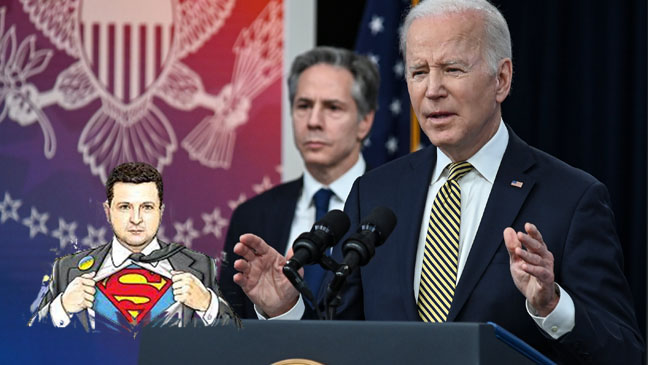
Biden staked his legacy on Ukraine. He was involved in the 2014 coup, in allegedly shady practices there with his son and then in provoking Russia to invade in 2022. He foolishly believed he would prevail in bringing down Putin with an economic, information and proxy ground war. [See: Biden Confirms Why the US Needed This War]
All three are now decisively lost as the U.S. — still under Biden — prepares for the end game. Biden’s only face saver is for Ukraine to get back some of its lost territory by trading for it with Russian territory it seized in Kursk this summer.
November 17, 2024 By Joe Lauria, Consortium News, https://consortiumnews.com/2024/11/17/on-way-out-reckless-biden-allows-deep-russia-strikes/
With his party decisively beat at the polls, the rejected president is gambling with regional security to preserve his ‘legacy’ and to saddle the incoming president, who wants to end the war, with a major new crisis, writes Joe Lauria.
As a parting shot to incoming U.S. President Donald Trump and Russian President Vladimir Putin, the defeated Joe Biden has defied the Pentagon by risking European and U.S. security with his decision announced Sunday to allow Ukraine to fire U.S. long-range missiles into Russian territory.
Just two months ago, in September, Biden had bowed to the realists in the Pentagon to oppose allowing long-range British Storm Shadow missiles from being fired by Ukraine deep into Russia out of fear it would lead to a direct NATO-Russia military confrontation with all that that entails.
Putin warned at the time in that British soldiers on the ground in Ukraine launching the British missiles into Russia with U.S. geostrategic support “will mean that NATO countries — the United States and European countries — are at war with Russia. And if this is the case, then, bearing in mind the change in the essence of the conflict, we will make appropriate decisions in response to the threats that will be posed to us.”
That was a clear warning that British and U.S. targets could be hit. Biden thus wisely backed off.
It was the second time that Biden had sided with the Pentagon against the neocons in his administration when it came to avoiding direct war with Russia.
The first time was in March 2022 when his neocon Secretary of State Antony Blinken stepped out of line to announce that the U.S. would give NATO-member Poland a “green light” to send Mig-29 fighter jets to Ukraine to enforce a no-fly zone against Russian aircraft.
Members of Congress and the media then piled the pressure on Biden to approve it until cooler heads at the U.S. Defense Department, the greatest purveyor of violence in history, stepped in to stop it.
Biden ultimately sided with the Pentagon, and he couldn’t be more explicit why. He opposed a NATO no-fly zone over Ukraine fighting Russian aircraft, he said, because “that’s called World War III, okay? Let’s get it straight here, guys. We will not fight the third world war in Ukraine.”
U.S. Defense Secretary Lloyd Austin at the time backed him up, saying:
“President Biden’s been clear that U.S. troops won’t fight Russia in Ukraine, and if you establish a no-fly zone, certainly in order to enforce that no-fly zone, you’ll have to engage Russian aircraft. And again, that would put us at war with Russia.”
But now Biden has reversed himself on his sensible positions and is defying the Pentagon to roll the dice that Russia’s warnings, repeated on Monday by Putin’s spokesman, won’t lead to nuclear conflict.
While he previously would not even authorize British long-range missile attacks into Russia in September, let alone U.S. ATACMS, on Sunday he authorized the ATACMS, risking Russia taking direct action against U.S. targets.
So what changed Biden’s addled mind?
An Undemocratic Democratic System
First, the undemocratic U.S. electoral system gave Biden the opportunity. His party was voted out of office on Nov. 5, but though the demos rejected Democrats in the White House they get to hang on in power for another 11 weeks, enough time to do considerable mischief to tie up the incoming administration that the people chose. (In a parliamentary system the new prime minister takes office on the next day and names the new cabinet well in advance of the election).
After one-term president George H.W. Bush lost to Bill Clinton in the 1992 election, Bush used those 11 weeks to invade Somalia, saddling Clinton with a foreign policy crisis that would bog him down and distract him from his agenda.
What’s happening now is something similar. Biden wants to undermine Trump’s effort to end the Ukraine war. The incoming vice president has floated the idea of Russia holding on to territory it has won in exchange for peace.
Biden staked his legacy on Ukraine. He was involved in the 2014 coup, in allegedly shady practices there with his son and then in provoking Russia to invade in 2022. He foolishly believed he would prevail in bringing down Putin with an economic, information and proxy ground war. [See: Biden Confirms Why the US Needed This War]
All three are now decisively lost as the U.S. — still under Biden — prepares for the end game. Biden’s only face saver is for Ukraine to get back some of its lost territory by trading for it with Russian territory it seized in Kursk this summer.
So he is authorizing U.S. soldiers to operate ATACMS missiles from Ukraine to beat back a 50,000-man Russian force seeking to take back all of that Russian territory. Part of that force, according to the Pentagon spokesman, is a contingent of at least 10,000 North Korean troops invited by Moscow, thus operating legally on pre-war Russian territory.
Yet the presence of these North Koreans has sent the Biden administration and its allied media into paroxysms of near insanity. The New York Times reported on Sunday:
“Officials said Mr. Biden was persuaded to make the change in part by the sheer audacity of Russia’s decision to throw North Korean troops at Ukrainian lines. He was also swayed, they said, by concerns that the Russian assault force would be able to overwhelm Ukrainian troops in Kursk if they were not allowed to defend themselves with long-range weapons.”
It is not like Biden doesn’t know the potentially grave consequences he is recklessly unleashing. He was already warned about the no-fly zone and said “that’s called World War III, okay?” He was then warned by the Pentagon against allowing the British missiles and acted like a responsible statesman.
But now, when it comes to his precious legacy, he doesn’t appear to give a damn about anything else. He was deprived of a second term (by traitors within his own party he no doubt thinks) and he will risk a NATO-Russia war to avoid the taint of utter defeat in Ukraine.
This is what he’s ignoring, according to the Times:
“Some of Mr. Biden’s advisers had seized on a recent U.S. intelligence assessment that warned that Mr. Putin could respond to the use of long-range ATACMS on Russian soil by directing the Russian military or its spy agencies to retaliate, potentially with lethal force, against the United States and its European allies.
The assessment warned of several possible Russian responses that included stepped-up acts of arson and sabotage targeting facilities in Europe, as well as potentially lethal attacks on U.S. and European military bases.”
Where it goes from there, nobody knows. Thanks, Joe.
Biden’s Missile Crisis
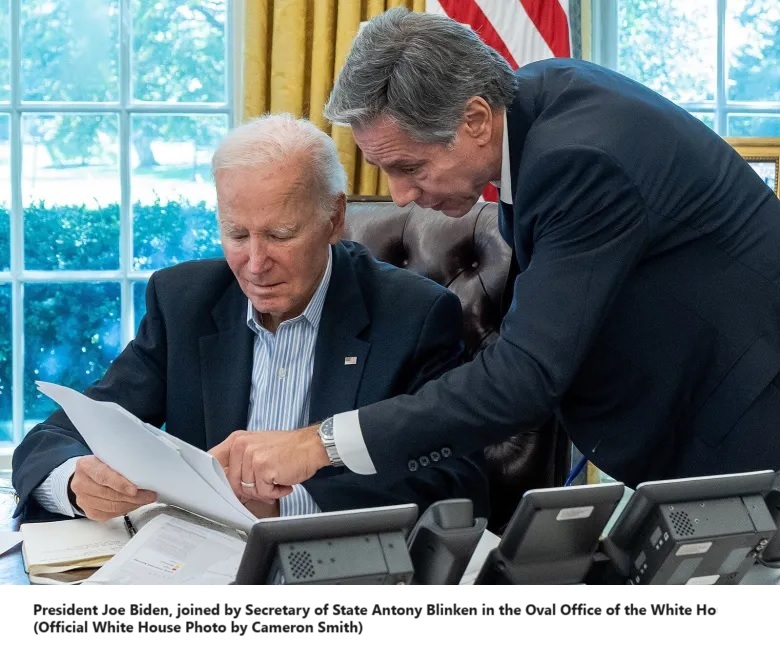
The American people voted for Trump to end the wars. Biden apparently wants to end the world.
Dennis Kucinich, Nov 20, 2024, https://denniskucinich.substack.com/p/bidens-missile-crisis
When President Biden approved the use of supersonic Army Tactical Missile Systems (ATACMS) to strike Russia, he placed in jeopardy the national security of the United States, the safety of our troops abroad and violated the U.S. Constitution, Article I, Section 8, which provides that only Congress can declare war.
Biden has made a decision to insert the U.S. into an unambiguous, escalatory phase, using the territory of Ukraine to attack Russia directly with missiles which can reach 190 miles deep. This is an illegal act by the President which puts our nation on a path to war with Russia.
The American people voted for Trump to end the wars. Biden apparently wants to end the world. Trump is listening to the American people. Biden is listening to NATO’s malignant agenda.
Trump has put America’s interests for peace and prosperity first.
No President has the right to use unilateral executive authority to permit a U.S. missile strike against another nation. It invites a retaliatory attack. It is an impeachable offense.
Congress, as a co-equal branch of government, must act now:
Any Member of Congress can, under privileges of the House, ask for immediate consideration of a joint resolution which invokes Article I, Section 8, and then cuts off all funding for personnel, coordination, technical advisers, materiel, equipment and deployment of ATACMS and emplacement of any other offensive missile systems in Ukraine.
The specter of WWIII has loomed before, in October of 1962, when the Soviet Union used the territory of Cuba to place offensive missiles just 90 miles away from the American mainland.
Absent the wisdom of President Kennedy and the forbearance of Nikita Krushchev, the world was on a path to nuclear annihilation.
If Krushchev had “permitted” Russian missiles to be launched at the U.S. from Cuba, you would not be reading this.
It is magical thinking that U.S. missiles can be used to attack Russia without consequences. Now it is Putin who must exercise forbearance.
North Korea has reportedly sent a detachment to assist Russia. Once the North Koreans learn the Russian language and vice versa, military cooperation will be instructive. That some in the Biden Administration use this occurrence as a bogus excuse to aim U.S. missiles at Russia, shows the neocon/neolieral addiction to war has become a tragicomic death wish.
Western vainglorious cynicism, together with hundreds of billions of dollars for weapons, shoved Ukraine into an unwinnable conflict. Russia is not NATO’s footstool, but its undoing.
The Putin-as-Hitler narrative projected in the media accelerated fear, induced acquiescence and rallied Western support for what was essentially a long-standing war scam by the military-industrial-intelligence complex. The alchemy which turned man into monster turned blood into cash.
Kiev has already paid a horrible price for being a US/NATO proxy: the loss of the flower of its youth, the destruction of its beautiful cities, the spoilation of its fertile farmland, and the sacrifice of its sovereignty.
Now, as U.S. missiles rain down on Russia, a counterstrike will occur, spreading ever wider the misery which has enveloped Ukraine.
The Biden Administration, in the face of the Afghanistan withdrawal debacle, rejected a Ukrainian-Russian diplomatic settlement more than two years ago, and continued financing the war for domestic political reasons, giving Americans a false hope for victory over Russia.
Two weeks ago, the people of the United States voted to stop the endless wars and elected Donald Trump.
Two months to go before the January 20, 2025 Inauguration and Joe Biden has handed Donald Trump a poisoned presidential chalice. Trump knows better than to drink from it.
Nuclear reactor cooling systems threatened by global heating.

Believing that waterways used as cooling sources for nuclear power plants
could get warmer due to climate change, climate scientists and nuclear
engineering specialists at the US Department of Energy’s Argonne National
Laboratory are joining forces to develop a plan B for nuclear power in
Richland, Washington.
The plan is to use Gateway for Accelerated Innovation
in Nuclear (GAIN) funding from DOE to work with Energy Northwest to inform
the design and selection of future nuclear reactor cooling systems and
assess their impacts on electricity cost.
NS Energy 20th Nov 2024, https://www.nsenergybusiness.com/analysis/determining-optimal-configurations-for-nuclear-plants-and-advanced-reactors-in-local-climates/
1 This Month

of the week – Shut Down Drone Warfare!


Tell the Ukrainian Government to Drop Prosecution of Peace Activist Yurii Sheliazhenko

Petition to revoke the licensing of the Near Surface Nuclear Disposal Facility (NSDF) at Chalk River. https://www.ourcommons.ca/petitions/en/Petition/Details?Petition=e-7247
To see nuclear-related stories in greater depth and intensity – go to https://nuclearinformation.wordpress.com
-
Archives
- April 2026 (68)
- March 2026 (251)
- February 2026 (268)
- January 2026 (308)
- December 2025 (358)
- November 2025 (359)
- October 2025 (376)
- September 2025 (257)
- August 2025 (319)
- July 2025 (230)
- June 2025 (348)
- May 2025 (261)
-
Categories
- 1
- 1 NUCLEAR ISSUES
- business and costs
- climate change
- culture and arts
- ENERGY
- environment
- health
- history
- indigenous issues
- Legal
- marketing of nuclear
- media
- opposition to nuclear
- PERSONAL STORIES
- politics
- politics international
- Religion and ethics
- safety
- secrets,lies and civil liberties
- spinbuster
- technology
- Uranium
- wastes
- weapons and war
- Women
- 2 WORLD
- ACTION
- AFRICA
- Atrocities
- AUSTRALIA
- Christina's notes
- Christina's themes
- culture and arts
- Events
- Fuk 2022
- Fuk 2023
- Fukushima 2017
- Fukushima 2018
- fukushima 2019
- Fukushima 2020
- Fukushima 2021
- general
- global warming
- Humour (God we need it)
- Nuclear
- RARE EARTHS
- Reference
- resources – print
- Resources -audiovicual
- Weekly Newsletter
- World
- World Nuclear
- YouTube
-
RSS
Entries RSS
Comments RSS
 nuclear-news